LATIN GRAMMAR; (continued 2)
Reading edition
Potior, to gain, is joined either to a genitive or to an ablative case, as
Xantippe, marito subacto, femoralium potita fuit.
Xantippe, her husband being overcome, gained the breeches.
Terentius Thrace potitus est:
Terence got a Tartar.
At least he said he did, when he took the prisoner who would n’t let him come.
The Dative Case after the Verb.
All verbs govern a dative case of that thing to or for which any thing is gotten or taken away, as
Diminuam tibi caput:
I will break your head.
Eheu! mihi circulum ademit!
Oh dear, he has taken away my hoop!
What a thing it is to be a junior boy!
Verbs of various kinds belong to the above rule. In the first place verbs signifying advantage or disadvantage govern a dative case, as
Judæi ad commodandum nobis vivunt:
The Jews live to accommodate us.
Or accommodate us to live—which?
Of these juvo, lædo, delecto, and some others, require an accusative case, as
Maritum quies plurimum juvat:
Rest very much delighteth a married man—when he can get it.
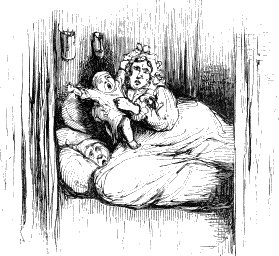
Verbs of comparing govern a dative case, as
Ajacem “Surdo” componere sæpe solebam:
I was often accustomed to compare Ajax to the “Deaf un,”—not because he was hard of hearing, but hard in hitting.
Sometimes, however, they require an ablative case with the preposition cum; sometimes an accusative case with the prepositions ad and inter, as
Comparo Pompeium cum globo nivali:
I compare Pompey with a snow-ball.
Pompey is called in the schools a proper name. Whether it is a proper name for a nigger or not, may be questioned. It may also be doubted whether a negro can ever rightly be called “snow-ball,” except he be an ice man; in which case even though he should be the knave of clubs, it is obvious that he ought never to be black balled.
Si ad pensum verberatio comparetur nihil est:
If a flogging be compared to an imposition, it is nothing.
A flogging is a fly-blow, or at least a flea-blow to the boy, and a task only to the master; whereas an imposition is a task to the boy, and very often a verse task.
Verbs of giving and of restoring govern a dative case, as
Learius unicuique filiarum dimidium coronæ dedit:
Lear gave his daughters half-a-crown a-piece.
Hence we are enabled to gain some notion of the great value of money in the time of the Ancient Britons.
Verbs of promising and of paying govern a dative case; as
Menelaus Paridi fustuarium promisit:
Menelaus promised Paris a drubbing.
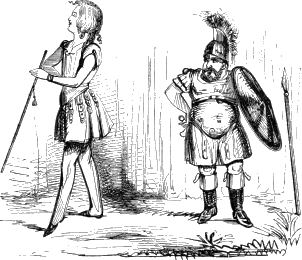
“Gubernatoris” est pendere sartoribus pecuniam:
It is the place of “the governor” to pay tailors.
Hence young men may learn how desirable it is to be “in statu pupillari.” True, in that state of felicity, they are somewhat under control, but the above example, and many others of a like nature, sufficiently prove, that such restriction, compared to the responsibilities of manhood, is but a minor inconvenience.
Verbs of commanding and telling govern a dative case, as
Alexander, vinosus, animis imperare non potuit:
Alexander, when drunk, could not command his temper.
Thus, in a state of beer, he committed manslaughter at least, by killing and slaying his friend Clitus. We could not resist the temptation to mention this fact, since, as we have so often laughed at its narration in those interesting compositions called themes, we thought there must needs be something very funny about it. Alexander the Great, be it remarked, for the special behoof of schoolboys, furnishes an example of any virtue or vice descanted on in any prose task or poem under the sun.
Antonio dixit Augustus Lepidum veteratorem fuisse.
Augustus told Antony that Lepidus was a humbug.
We don’t know exactly where this historical fact is mentioned. Lepidus is a funny name.
Except, from the foregoing rule, rego, to rule, guberno, to govern, which have an accusative case; tempero and moderor, to rule, which have sometimes a dative, sometimes an accusative case; as
Luna regit ministros:
The moon rules the ministers.
That is to say, when it is at the full, and resembles a great O.
Præco pauperes gubernat:
The beadle governs the paupers.
Non semper temperat ipse sibi:
He does not always govern himself.
Non animos mollit proprios, nec temperat iras:
He neither softens his own mind, nor tempers his anger.
Ecce, Ducrow moderatur equos:
Lo, Ducrow manages the horses.
Q. Why is a general officer like a writing-master?
A. Because he is a ruler of lines.
Verbs of trusting govern a dative case, as
Credite, fœmineæ, juvenes, committere menti, Nil nisi lene decet.
Believe me, young men, it is fit to entrust nothing to a female mind but what is soft.
In fact, soft nothings are fittest for the ear of a lady.
Pomarius poetæ non credit:
The costermonger trusts not the poet.
How wrong, therefore, it is to call him a green grocer.
Verbs of complying with and of opposing govern a dative case, as
Nunquam obtemperat tiro hodiernus magistro:
A modern apprentice never obeys his master.
Verbs of threatening and of being angry govern a dative case, as
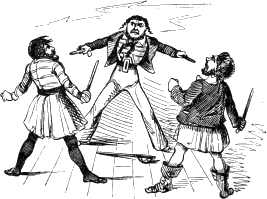
Utrique latronum mortem est minitatus:
He threatened death to both of the robbers,—
By presenting a pistol right and left at each of them. This when done by some well-disposed sailor in a melodrame, constitutes a situation of thrilling interest.
Sum with its compounds, except possum, governs a dative case, as
Oculi nigri non semper sunt faciei ornamentum:
Black eyes are not always an ornament to the face.
Verbs compounded with these adverbs, bene, well, satis, enough, male, ill, and with these prepositions, præ, ad, con, sub, ante, post, ob, in, inter, for the most part govern a dative case, as
Saginatio multis hominibus benefacit:
Cramming does good to many men.
For instance, it does good to aldermen, especially in these days of reform, by enlarging the Corporation. Cramming, or rather the effect of it, benefits medical men, who again do good to their patients by cramming them in another way. There is also a species of cramming which is found very serviceable at the Universities, by enabling certain students to pass in a crowd.
OH! HERE ’S A COMPLIMENT.
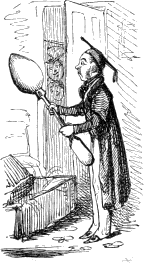
In this respect however it differs essentially from aldermanic cramming, which enhances the difficulty of such a feat in a very remarkable manner.
Puellæ, aliæ aliis prælucere student:
Girls endeavour to outshine one another.
And yet they make light, as much as they can, of each other’s charms and accomplishments.
Intempestive parum longe prospicienti Doctori adlusit.
He joked unseasonably on the short-sighted Doctor.
Johnson was not so short-sighted as to be blind to a joke.
Not a few of the verbs mentioned in the last rule, sometimes change the dative into another case; as
Præstat ingenio alius alium:
One exceeds another in ability.
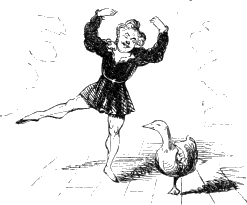
Thus one boy learns Latin and Greek better than the rest; another learns slang. One is a good hand at construing, another at climbing. Some boys are peculiarly skilled at casting accounts, others in casting stones. Here we have a boy of a small appetite and many words, there one of a large appetite and few words. Sometimes precocious talent is evinced for playing the fiddle, sometimes for playing a stick; sometimes, again, a strong propensity is discovered for playing the fool. This boy makes verses, as it were, by inspiration; that boy shows an equal capacity in making mouths. The most peculiar talent, however, and the one most exclusive of all others, is that of riding. Those who are destined to attain great proficiency in this science, can seldom do any thing else; and usually begin their career by being horsed at school.
Est, for habeo to have, governs a dative case, as
Est mihi qui vestes custodit avunculus omnes:
I have an uncle who takes care of all my clothes.
Suppetit, it sufficeth, is like to this, as
Pauper enim non est cui rerum suppetit usus:
For he is not poor, to whom the use of things suffices.
The two last examples must suggest a rather alarming idea to those who are accustomed to propitiate the relation to whom we have just alluded, by relinquishing their habits. Is it possible that he can ever use one’s things? We recommend this query to the serious consideration of theatrical persons, and all others who are addicted to spouting.
Sum with many others admits a double dative case, as
Exitio est avidis alvus pueris:
The belly is the destruction of greedy boys.
Particularly those of Eton College.
Sometimes this dative case tibi, or sibi, or also mihi, is added for the sake of elegance in expression, as
Cato suam sibi uxorem Hortensio vendidit:
Cato sold his own wife to Hortensius.
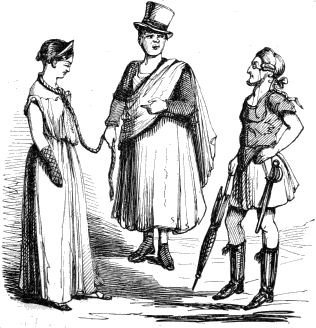
Some say he only lent her. The fact most probably is, that the lady, being tired of her husband, wished to be a-loan.
The Accusative Case after the Verb.
Verbs transitive, of what kind soever, whether active, deponent, or common, require an accusative case, as
Procuratorem fugito, nam subdolus idem est:
Avoid an attorney, for the same is a cunning rogue.
Yet the legal profession are always boasting of their deeds.
Verbs neuter have an accusative case of a like signification to themselves, as
Pomarii asinus duram servit servitutem:
A coster-monger’s donkey serves a hard servitude.
Poor animal! A Sterne heart was once melted by thy sufferings—how then must they affect that of the gentle reader?
There are some verbs which have an accusative case by a figure, as
Nec vox hominem sonat;
Nor does your voice sound like a human creature’s.
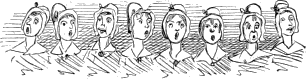
This may be said of boys of various kinds—as pot-boys, butcher’s boys, baker’s boys, and other boys who are in the habit of bawling down areas; also of several descriptions of men, as cab-men, coach-men, watch-men, and dust-men. The same may likewise be asserted of some women, such as apple-women, oyster-women, fish-women, and match-women. Here also the singing of charity children of both sexes, and the voices of parish-clerks, may be specified, and, lastly, of many foreigners whose names terminate in ini.
Verbs of asking, of teaching, of clothing, and of concealing, commonly govern two accusative cases, as
Ego docebo te, adolescentule, lectiones tuas:
I’ll teach you your lessons, young man.
This speech is usually the prelude to something which elicits that exemplification of the vocative case which has been given in the first part of the Grammar.
Some verbs of this kind have an accusative case even in the passive voice, as
Bis denos posceris versus de scoparum manubrio:
You are required to make twenty verses on a broomstick.
Why should not a broomstick form the subject of a poetical effusion, when the material of the broom itself is so often used in schools to stimulate inventive genius?
Nouns appellative are commonly added with a preposition to verbs which denote motion, as
Interea ad templum non æquæ Palladis ibant Crinibus Iliades passis. Virgil.
In the mean time the Trojan woman went to the temple of unfriendly Pallas with their hair about their ears.
How odd they must have looked. Here we take occasion to remind schoolboys never to lose an opportunity of giving a comic rendering to any word or phrase susceptible thereof, which they may meet with in the course of their reading. To say “crinibus passis”,—“with dishevelled hair” would be to give a very feeble and spiritless translation. Vir is literally construed man; some school-masters will have it called hero,—we propose to translate it cove. So dapes may be rendered grub, or perhaps prog; aspera Juno, crusty Juno; animam efflare, to kick the bucket; capere fugam, to cut one’s stick, or lucky; confectus, knocked up; fraudatus, choused; contundere, to whop, &c. &c.
The Ablative Case after the Verb.
Every verb admits an ablative case, signifying the instrument, or the cause, or the manner of an action, as
Pulvere nitrato Catilina senatum subruere voluit:
Catiline wished to blow up the Parliament. Catiline was a regular Guy.
A noun of price is put after some words in the ablative case, as
Ovidius solidis duobus fibulas siphonem ascendere fecit:
Ovid pawned his buckles for two shillings.
The sipho was a tube, pipe, or spout, projecting from the shops of pawnbrokers, of whom there is every reason to believe that there were a great many in ancient Rome. Into this sipho the pledges were placed in order to be conveyed to the adytum or secret recess of the dwelling. Vide Casaubon de Avunc: Roman.
Vili, at a low rate, paulo, for little, minimo, for very little, magno, for much, nimio, for too much, plurimo, for very much, dimidio, for half, duplo, for twice as much, are often put by themselves, the word, pretio, price, being understood, as
Vili venit cibus caninus:
Dog’s meat is sold at a low rate.
These genitive cases put without substantives are excepted, tanti, for so much, quanti, for how much, pluris, for more, minoris, for less, quantivis, for as much as you please, tantidem, for just so much, quantilibet, for what you will, quanticunque for how much soever, as
Non es tanti: You’re no great shakes.
Flocci, of a lock of wool, nauci, of a nut-shell, nihili, of nothing, assis, of a penny, pili, of a hair, hujus, of this, teruncii, of a farthing, are added very properly to verbs of esteeming, as
Nec verberationem flocci pendo, nec ferulâ percussionem pili æstimo:
I don’t value a flogging a straw, nor do I regard a spatting a hair.
A boy who can say this, must have a brazen front, and an iron back, and be altogether a lad of mettle.
Verbs of abounding, of filling, of loading, and their contraries, are joined to an ablative case, as
Tauris abundat Hibernia:
Ireland aboundeth in bulls.
This circumstance it most probably was which gave rise to the Tales of the O’Hara family.
We once heard a son of Erin, while undergoing the operation of bleeding from the arm, remark that that would be an easy way of cutting one’s throat.
Some of these sometimes govern a genitive case, as
Optime ostrearum implebantur:
They had a capital blow out of oysters.
We are sorry to remark that these are the only native productions patronized by great people.
Fungor, to discharge, fruor, to enjoy, utor, to use, vescor, to live upon, dignor, to think one’s self worthy, muto, to change, communico, to communicate, supersedeo, to pass by, are joined to an ablative case, as
Qui adipisci cœnas optimas volet, leonis fungatur officiis.
He who shall desire to obtain excellent dinners, should discharge the office of a lion.
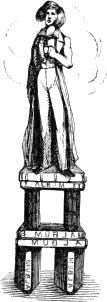
In which case he will come in for the “lion’s share.”
Q. Why is the lion of a party like one of the grand sources of prejudice mentioned by Lord Bacon?
A. Because he is the Idol of the den.
Mereor, to deserve, with these adverbs, bene, well, satis, enough, male, ill, melius, better, pejus, worse, optime, very well, pessime, very ill, is joined to an ablative case with the preposition de, as
De libitinario medicus bene meretur:
The doctor deserves well of the undertaker.
Notwithstanding it might at first sight appear, that the doctor, in furnishing funerals, invades the undertaker’s province.
Some verbs of receiving, of being distant, and of taking away, are sometimes joined to a dative case, as
Augustus eripuit mihi nitorem:
Augustus has taken the shine out of me.
Last Dying Speech of M. Antony.
An ablative case, taken absolutely, is added to some verbs, as
Porcis volentibus lætissime epulabimur:
Please the pigs we’ll have a jolly good dinner.
The pig had divine honours paid to it by the ancient Greeks. —Jos. Scalig. de Myst. Eleusin.
An ablative case of the part affected, and by the poets an accusative case, is added to some verbs, as
Qui animo ægrotat, eum aera risum moventem ducere oportet.
He who is sick in mind should breathe the laughing gas.
Much learned controversy has been expended in endeavouring to determine whether this gas was the exhalation by which it is supposed that the ancient Pythonesses were affected.
Rubet nasum: His nose is red. Candet genas: His cheeks are pale.
Some of these words are used also with the genitive case, as
Angitur animi juvenis iste, et mundum indignatur.
That young man is grieved in mind and disgusted with the world.
Such a man is called by the ladies an interesting young man.
Verbs Passive.
An ablative case of the doer (but with the preposition a or ab going before), and sometimes also a dative case, is added to verbs passive, as
Darius eleganter ab Alexandro victus est:
Darius was elegantly licked by Alexander.
The other cases continue to belong to verbs passive which belonged to them as verbs active, as
Titanes læsæ majestatis accusati sunt:
The Titans were indicted for high treason.
And being found guilty were quartered in a very uncomfortable manner, as well as drawn by various artists, whose skill in execution has been much commended.
Vapulo, to be beaten, veneo, to be sold, liceo, to be prized, exulo, to be banished, fio, to be made, neuter passives, have a passive construction, as
A præceptore vapulabis. Eton Gram.
You will be beaten by the master.
It appears to us that vapulo, to be beaten, is here at all events more susceptible of a passive construction than a funny one.
Malo a cive spoliari quam ab hoste venire. Eton Gram.
I had rather be stripped by a citizen than sold by an enemy.
The Romans were regularly sold by the enemy for once, when they had to go under the yoke.
Verbs of the Infinitive Mood.
Verbs of the infinitive mood are put after some verbs, participles, and adjectives, and substantives also by the poets, as
Timotheus ursos saltare fecit:
Timotheus made the bears dance.
This was done in ancient as it is in modern times, by playing the Pandean pipes.
Inconcinnus erat cerni Telamonius Ajax; Ajax (ut referunt) vir bonus ire minor:
The Telamonian Ajax was a rum un to look at; The lesser Ajax (as they say) a good un to go.
The Grecians used to call Ajax senior, the fighting cock, and Ajax junior, the running cock.
Verbs of the infinitive mood are sometimes placed alone by the figure ellipsis, as
Siphonum de more oculis demittere fluctus Dardanidæ:
The Trojans (began understood) to pipe their eyes.
As for Æneas he might have been a town crier.
Gerunds and Supines
govern the cases of their own verbs, as
Efferor studio pulices industrios videndi:
I am transported with the desire of seeing the industrious fleas.
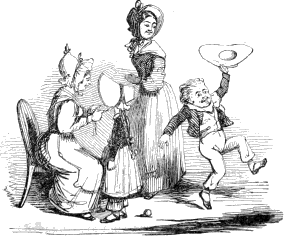
Gerunds.
“When Dido found Æneas would not come, She mourned in silence, and was Di-do-dum.”
Gerunds in di have the same construction as genitive cases, and depend both on certain substantives and adjectives, as
Londinensem innatus amor civem urget edendi:
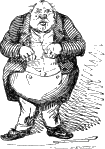
An innate love of eating excites the London citizen.
People are accustomed to utter a great deal of cant about the intellectual poverty of civic magistrates, and common councilmen in general; but it must be allowed that those respectable individuals have often a great deal in them.
TURTUR ALDERMANICUS.
Gerunds in do have the same construction with ablative, and gerunds in dum with accusative cases, as
Scribendi ratio conjuncta cum loquendo est:
The means of writing are joined with speaking.
Some things are written precisely after the writer’s way of speaking. We once, for example, saw the following notice posted in a gentleman’s preserve.
Whear ’as Gins and Engens are Set on Thes Grouns for the Destruction Of Varmint, Any trespussing Will be prossy-Cuted a-cordin Too Law.
Locus ad agendum amplissimus:
A place very honourable to plead in.
It may be questioned whether Cicero would have said this of the Old Bailey.
When necessity is signified, the gerund in dum is used without a preposition, the verb est being added.
Cavendum est ne deprênsus sis:
You must take care you ’re not caught out.
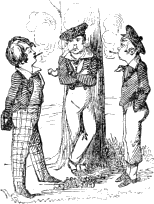
A piece of advice of special importance to schoolboys on many occasions, such as the following: shirking down town; making devils, or letting off gunpowder behind the school, or in the yard; conducting a foray or predatory excursion in gardens and orchards; emulating Jupiter, à la Salmoneus,—in his attribute of Cloud-Compelling—by blowing a cloud, or to speak in the vernacular, indulging in a cigar; hoisting a frog; tailing a dog or cat, or in any other way acting contrary to the precepts of the Animals’ Friend Society; learning to construe on the Hamiltonian system; furtively denuding the birch-rods of their “budding honours.” Cum multis aliis quæ nunc perscribere longum est.
Gerunds are also changed into nouns adjective, as
Ad faciendos versus molestum est:
It is a bore to make verses.
This being a self-evident proposition, we shall not enlarge upon it.
The supine in um signifies actively, and follows a verb expressing motion to a place, as
Spectatum veniunt, veniunt spectentur ut ipsæ:
They come to see, they come that they themselves may be seen.
So said, or sung the poet Ovid. Was there an opera at Rome in his time?
The supine in u signifies passively, and follows nouns adjective, as
Quod olfactu fœdum est, idem est et esu turpe:
That which is foul to be smelled, is also nasty to be eaten.
Except venison, onions, and cheese.
Nouns of time and Place. Time.
Tempus—time. There is a story, mentioned (we quote from memory) by the learned Joe Miller; of a fellow who seeing “Tempus Fugit” inscribed upon a clock, took it for the name of the artificer.
Persons who have lived a long time in the world, are generally accounted sage; and are sometimes considered to have had a good seasoning.
Nouns which signify a part of time are put more commonly in the ablative case, as
Nemo mortalium omnibus horis sapit:
No mortal man is wise at all hours.
The excuse of a philosopher for getting married.
But nouns which signify the duration of time are commonly put in the accusative case, as
Pugna inter juvenem Curtium et Titum Sabinum tres horas perduravit.
The fight between young Curtius and Sabine Titus lasted three hours.
It is an error to suppose that Roman mills were only water-mills and wind-mills. The above mill must have been rather a “winder” though, and must have cost the combatants much pains.
We say also: in paucis diebus, in a few days: de die, by day, de nocte, by night, &c.
A jest upon the nouns of Time would, perhaps, be somewhat ill timed: we hope, however, to have Space for one presently.
The Space of a Place.
The space of a place is put in the accusative, and sometimes also in the ablative, as
Cæsar jam mille passus processerat, summâ diligentiâ.
Cæsar had now advanced a mile with the greatest diligence—
not on the top of the vehicle so named, as a young gentleman was once flogged for saying.
Qui non abest a scholâ centenis millibus passuum, balatronem novi.
I know a blackguard who is not absent a hundred miles from the school.
“Cantare et apponere” to sing and apply, is the maxim we would here inculcate on our youthful readers.
Every verb admits a genitive case of the name of a city or town in which any thing takes place, so that it be of the first or second declension, and of the singular number, as
Quid Romæ faciam? mentiri nescio:
What shall I do at Rome? I know not how to lie.
What a bare-faced perversion of the truth that cock and bull story is of Curtius jumping into the hole in the forum. How the Romans managed to get credit from any body but the tailors is to us a mystery.
These genitive cases, humi, on the ground, domi, at home, militiæ, in war, belli, in war, follow the construction of proper names, as
Parvi sunt foris arma nisi est consilium domi:
Arms are of little worth abroad unless there be wisdom at home.
Cicero must have said this with a prospective eye to Canada.
But if the name of a city or town shall be of the plural number only, or of the third declension, it is put in the ablative case, as
Aiunt centum portas Thebis fuisse:
They say there were an hundred gates at Thebes.
You needn’t believe it unless you like.
Egregia Tibure facta videnda sunt:
Fine doings are to be seen at Tivoli.
The name of a place is often put after verbs signifying motion to a place in the accusative case without a preposition, as
Concessi Cantabrigiam ad capiendum ingenii cultum:
I went to Cambridge to become a fast man.
After this manner we use domus, a house, and rus, the country, as Rus ire jussus sum, I was rusticated. Domum missus eram, I was sent home.
Going too fast at Cambridge sometimes necessitates, in two senses, a dose of country air.
The name of a place is sometimes added to verbs signifying motion from a place, in the ablative case without a proposition, as
Arbitror te Virginiâ veteri venisse:
I reckon you’ve come from old Virginny.
Verbs Impersonal.
Verbs impersonal have no nominative case, as
Scenas post tragicas multum juvat ire sub umbras:
After a tragedy it is very pleasant to go under the Shades.
The worst of these “Shades” is, that people are now and then apt to get rather “too much in the sun” there.
These impersonals, interest, it concerns, and refert, it concerns, are joined to any genitive cases, except these ablative cases feminine, meâ, tuâ, suâ, nostrâ, vestrâ, and cujâ, as
Interest magistratûs tueri insulsos, animadvertere in acres.
It concerns the magistrate to defend the flats; to punish the sharps.
These genitive cases also, are added, tanti, of so much, quanti, of how much, magni, of much, parvi, of little, quanticunque, of how much soever, tantidem, of just so much; as
Tanti refert honesta agere;
Of such consequence is it to do honest things.
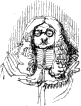
By this course of conduct, you certainly render yourself worthy of the protection of the magistrate; although whether you thereby constitute yourself a flat or not, is perhaps a doubtful question. Much may be said on both sides. Dishonesty, it is true, may lead to being taken up; but then honesty often leads to being taken in. Yet honesty is said to be the best policy. Policy is a branch of wisdom, and “wisdom” they say “is in the wig.” Certain wigs are retained at the head—of affairs, by a good deal of policy; perhaps the best they could adopt—a fact that throws considerable doubt on the truth of the old maxim.
Impersonal verbs which are put acquisitively, require a dative case; but those which are put transitively an accusative, as—
A ministris nobis benefit:
We enjoy blessings from Ministers.
For instance—No—We cannot think of any just at present.
Me juvat per lunam errare, et “Isabellam” cantare:
I like to wander by moonlight, and sing “Isabelle.”
The connexion between love and moonlight is as interesting as it is certain. We shrewdly suspect that the said planet has more to do with the tender passion than lovers are aware of.
But the preposition ad is peculiarly added to these verbs—attinet, it belongs, pertinet, it pertains, spectat, it concerns, as
Spectat ad omnes bene vivere:
It concerns all to live well—
When they can afford it.
An accusative case with a genitive is put after these verbs impersonal—pœnitet, it repents, tædet, it wearies, miseret, miserescit, it pities, pudet, it shames, piget, it grieves, as—
“Nihil me pœnitet hujus nasi”—Trist: Shand:
“My nose has been the making of me.”
A verb impersonal of the passive voice may be elegantly taken for each person of both numbers; that is to say, by virtue of a case added to it.
Thus statur is used for sto, stas, stat, stamus, statis, stant. Statur a me; it is stood by me, that is, I stand; statur ab illis: it is stood by them, or they stand.
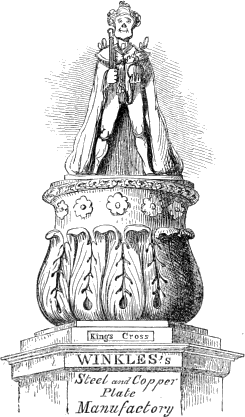
King George the Fourth’s statue at King’s Cross is a standing joke.
The Construction of Participles.
Participles govern the cases of the verbs from which they are derived, as—
Duplices tendens ad sidera palmas, Talia voce refert:
Stretching forth his hands to heaven, he utters such things.
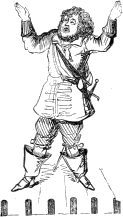
This reminds us of the Italian opera.
A dative case is sometimes added to participles of the passive voice, especially when they end in dus, as—
Sollicito nasus rutilans metuendus amanti est:
A fiery nose is to be feared by an anxious lover.
Participles, when they become nouns, require a genitive case, as—
Vectigalis appetens, linguæ profusus:
Greedy of rint, lavish of blarney.
Exosus, hating, perosus, utterly hating, pertæsus, weary of, signifying actively, require an accusative case, as—
Philosophus exosus ad unam mulieres:
A philosopher hating women in general, i.e. a Malthusian.
Exosus, hated, and perosus, hated to death, signifying passively, are read with a dative case, as
Comœdi sanctis exosi sunt:
The comedians are hated by the saints.
We mean the spiritual Quixotes, or Knights of the Rueful Countenance. We “calculate” that they will be the greatest patrons of rail roads, considering their dislike to the stage.
Natus, born, prognatus, born, satus, sprung, cretus, descended, creatus, produced, ortus, risen, editus, brought forth, require an ablative case, and often with a preposition, as—
Taffius, bonis prognatus parentibus, cerevisiam haud tenuem de sese existimat:
Taffy, sprung of good parents, thinks no small beer of himself.
De Britannis Antiquis se jactat editum:
He boasts of being descended from the Ancient Britons.
Q. Why is the eldest son of a King of England like a Leviathan?
A. Because he is the Prince of Wales.
The Construction of Adverbs.
En and ecce, adverbs of showing, are joined most commonly to a nominative case, to an accusative case but seldom, as
En Romanus: See the Roman (q. rum-un.)
Ecce Corinthium: Behold the Corinthian.
Modern Corinthians, we fear, know but little Greek, except that of the Ægidiac, or St. Giles’s dialect.
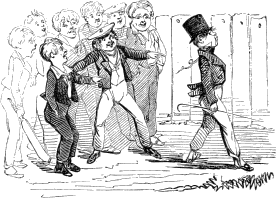
En and ecce, adverbs of upbraiding, are joined most commonly to an accusative case only, as—
En togam squamosam!
Look at his scaly toga!
Ecce caudam! Twig his tail!
Certain adverbs of time, place, and quantity, admit a genitive case, as
Ubi gentium est Quadra Russelliana?
Where in the world is Russell Square?
We must confess that this question is exquisitely absurd.
Nihil tunc temporis amplius quam flere poteram:
I could do nothing more at that time than weep.
Talking of weeping—how odd it is that an affectionate wife should cry when her husband is transported for life.
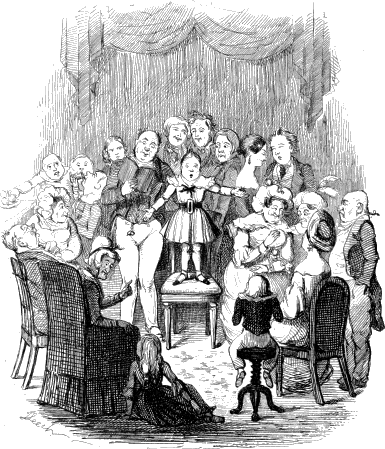
DOMESTIC ELOCUTION “MY NAME IS NORVAL ON THE GRAMPIAN HILLS”
Satis eloquentiæ, sapientiæ parum:
Eloquence enough, wisdom little enough.
This quotation applies very forcibly to domestic oratory as practised by small boys at the instigation of their mamma, for the amusement of visitors. Those on whom “little bird with boothom wed,” “deep in the windingths of a whale,” or “my name is Nawval,” and the like recitations are inflicted, have “satis eloquentiæ”—enough of eloquence, in all conscience; and we cannot but think that “sapientiæ parum,” “wisdom little enough” is displayed by all the other parties concerned.
Some adverbs admit the cases of the nouns from which they are derived, as
Juvenis benevolus sibi inutiliter vivit:
The good-natured young man lives unprofitably to himself—
Especially if he have a large circle of female acquaintance.
These adverbs of diversity, aliter, otherwise, and secus, otherwise; and these two, ante, before, and post, after, are often joined to an ablative case, as—
Plure aliter. More t’other.
Multo ante. Much before.
Paulo post. Little behind.
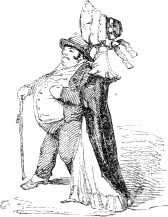
Those who are much before, are guilty of a great waste—of time; and those who are little behind should make it up by a bustle.
Instar, like or equal to, and ergo, for the sake of, being taken as adverbs, have a genitive case after them, as—
Instar montis equum divina Palladis arte Ædificant:
By the divine assistance of Pallas they build a horse as big as a mountain.
This may appear incredible; yet the learned Munchausenius relates prodigies much more astonishing.
Mentitur Virgilius leporis ergo:
Virgil tells lies for fun.
As may be sufficiently seen in the example before the last, and also in the sixth book of the Æneid, passim.
The Construction of Conjunctions.
Conjunctions copulative and disjunctive, couple like cases, moods, and tenses, as
Socrates docuit Xenophontem et Platonem geographiam, astronomiam, et rationem globorum:
Socrates taught Xenophon and Plato geography, astronomy, and the use of the globes.
Q. How may a waterman answer the polite interrogation “Who are you?” correctly, and designate at the same time, an educational institution.
A. By saying A-cad-am-I.
The foregoing rule (not riddle) holds good, unless the reason of a different construction requires it should be otherwise, as
Emi librum centussi et pluris:
I bought a book for a hundred pence, and more,
“100d. are 8s. 4d.” —Walkinghame.
The conjunction, quam, than, is often understood after amplius, more, plus, more, and minus, less, as
Amplius sunt sex menses:
There are more than six months.
For this interesting piece of information we are indebted to Cicero. The author to whom reference has just been made, has somewhere, if we mistake not, a similar observation. In thus ushering the Tutor’s Assistant into notice, we feel that we are citing a work of which it is impossible to make too comical mention.
Thank goodness there are not more than six months in a half year!
To what Moods of Verbs certain Adverbs and Conjunctions do agree.
Ne, an, num, whether put doubtfully or indefinitely, are joined to a subjunctive mood, as—
Nihil refert fecerisne an persuaseris:
It matters nothing whether you have done it or persuaded to it—
as the school-master said when he got hold of the wrong end of the cane.
Here it may be remarked—First, that the young gentlemen who play tricks with tallow are likely to get more whacks than they like on their fingers. Secondly—That a master whose hand is in Grease cannot be expected to be at the same time in A-merry-key.
Dum, for dummodo, so that, and quousque, until, requires a subjunctive mood, as—
Dum felix sis, quid refert?
What’s the odds, so long as you’re happy.
Qui, signifying the cause, requires a subjunctive mood, as
Stultus es qui Ovidio credas:
You are a fool for believing Ovid.
Ut, for, postquam, after that, sicut, as, and quomodo, how, is joined to an indicative mood; but when it signifies quanquam, although, utpote, forasmuch as, or the final cause, to a subjunctive mood, as
Ut sumus in Ponto ter frigore constitit Ister:
Since that we are in Pontus the Danube has stood frozen three times.
Were skating and sliding classical accomplishments? Ambition, we know, led many of the Romans to tread on slippery ground: many of them struck out new paths, but none (that we have heard of) ever struck out a slide. Imagine Cato or Seneca “coming the cobbler’s knock.”
Te oro, domine, ut exeam:
Please, sir, let me go out.
Lastly, all words put indefinitely, such as are these, quis, who, quantus, how great, quotus, how many, require a subjunctive mood, as
Cave cui incurras, inepte:
Mind who you run against, stupid.
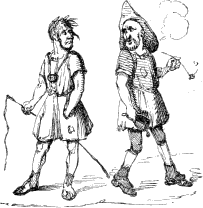
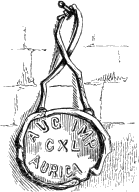
Such may have been the speech of a Roman cabman. A very curious specimen of the tessera, or badge, worn on the breast by this description of persons, has lately been discovered at Herculaneum.
The construction of Prepositions.
A preposition being understood, sometimes causes an ablative case to be added, as
Habeo pigneratorem loco avunculi; i.e. in loco:
I esteem a pawnbroker in the place of an uncle: that is, in loco.
A preposition in composition sometimes governs the same case which it also governed out of composition, as
Jupiter Olympo Vulcanum calce exegit:
Jupiter kicked Vulcan out of Olympus.
This was not only an ungentlemanly, but also an ungodly act on Jupiter’s part. Reasoning à posteriori, one would think it must have been very unpleasant to Vulcan.
Præteriit me in Quadrante insalutatum:
He cut me in the Quadrant.
Verbs compounded with a, ab, de, e, ex, in, sometimes repeat the same prepositions with their case out of composition, and that elegantly, as
Abstinuerunt a vino:
They abstained from wine.
This properly is an allusion to the Tiber-totallers. It should be remembered that tea was unknown in Rome, except as the accusative case of a pronoun.
In, for, erga, towards, contra, against, ad, to, and supra, above, requires an accusative case, as
Quietum Accipit in pueros animum mentemque benignam:
He admits kind thoughts and inclinations towards the boys.
The master does—when he gives them a half holiday or a blow out. Mr. Squeers (vide Nicholas Nick: illustriss. Boz.) was in the habit of making much of the young gentlemen intrusted to his care.
Sub, when it relates to time, is commonly joined to an accusative case, as
Sub idem tempus—Isaaculus trans maria deportatus est:
About the same time—Ikey was transported beyond the seas.
We say beyond the seas, lest it should be questioned whether Mr. I. was transported as a necessary or contingent consequence of cheating.
Super, for, ultra, beyond, is put with an accusative case, for de, concerning, with an ablative case, as
Super et Garamantas et Indos Proferet imperium:
He will extend the empire both beyond the Africans and the Indians.
A wide rule expressed in poetical measure.
Quid de domesticis Peruviorum rebus censeas?
What may be your opinion concerning the domestic economy of the Peruvians?
Tenus, as far as, is joined to an ablative case, both in the singular and plural number, as
Cervice, auribusque tenus Marius in luto inveniebatur:
Marius was found up to his neck and ears in mud.
What a lark! or rather a mud lark. But tenus is joined to a genitive only in the plural, and it always follows its case, as
Crurum tenus: up to the legs.
Which it is very necessary to be at Epsom and Ascot.
The Construction of Interjections.
Interjections are often put without a case, as
Spem gregis, ah! silice in nudâ connixa reliquit:
Having yeaned, she left the hope of the flock, alas! upon the bare flint stones.
And exposed to the steely-hearted world, which, as an Irishman remarked, was a dangerous situation for tinder infancy. It must have been, to say the least, a most uncomfortable berth.
O! of one exclaiming, is joined to a nominative, accusative, and vocative case, as
O lex! Oh law! O alaudas! Oh larks! Oh meum! Oh my! O care! Oh dear!
We cannot find out what is Latin for oh Crikey!
Heu! and proh! alas! are joined, sometimes to a nominative, sometimes to an accusative, and occasionally to a vocative case, as—Heu bellis! Lack-a-daisy. Heu diem! Lack-a-day. Proh Clamor! Oh cry! Proh deos pisciculosque! Oh, ye gods and little fishes!
Heu miserande puer!
Oh, boy, to be pitied!
What boy is more to be pitied than a junior boy? The Fagin system described in Oliver Twist is nothing compared to that adopted in public schools. People may say what they will of the beneficial effect which it produces on the minds of those who are subjected to it—we contend that to breed a gentleman’s son up like a tiger is the readiest way to make a beast of him.
Hei! and væ! alas, are joined to a dative case, as
Hei mihi quod nullis amor est medicabilis herbis:
Woe is me that love is curable by no herbs.
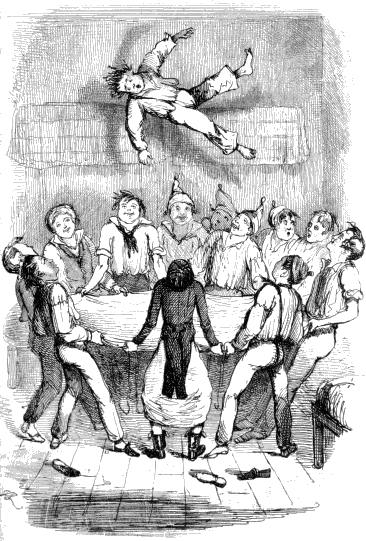
HEU! MISERANDE PUER!
Ovid never would have said that, if he had smoked a cigar or chewed tobacco. The ancients believed that love might be excited by certain articles taken from the vegetable kingdom. Why then should it be considered impossible to allay the same feeling in a similar manner? Every bane has its corresponding antidote; if so, there may be physic even for a philter. And for the pangs which a virgin has inflicted, what remedy could be prescribed more reasonable than the Virginian weed;—besides, love generally ends in smoke.
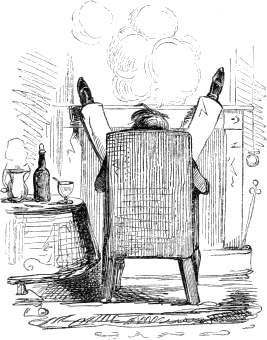
A CURE FOR THE HEARTACHE.
Væ misero capiti, madefacto, sæpe fenestræ Imbribus immundis, Lydia cara, tuæ:
Woe to my wretched head, often wetted, dear Lydia, by the unclean showers of your window.
This would be a proper place for introducing a few remarks on the ancient mode of serenading; which we are prevented from doing by the very imperfect state of our present information on this interesting point. It is, however, pretty generally admitted that the Romans always took care to provide themselves with an umbrella on these occasions, and this for a reason which the above distich will have rendered sufficiently obvious. It appears to us that so salutary a precaution is well worthy of being sometimes adopted in these modern days—and with this hint we conclude the Syntax.
PROSODY.
All you that bards of note would be, Must study well your Prosody.
As Comparative Anatomy teaches what the sound of a cod-fish is; so Prosody teaches what is the sound of syllables.
Sound and quantity mean the same thing; though how that fact is to be reconciled with the proverb, “great cry and little wool,” we do not know.
Prosody is divided into three parts. Tone, Breathing, and Time. As to tone—boys are usually required to repeat it in a loud one, without stammering or drawling; and with as little breathing and time, or breathing-time, as possible.
We shall leave tone to the consideration of pianoforte and fiddle-makers; and breathing to doctors and chemists, who can analyze it a great deal better than we can. In this place we think proper to treat only of Time.
Now of Time a very great deal may be said, taking the word in all the senses in which it is capable of being used.
In the first place, Time flies—but this we have had occasion to observe before; as also that Time is a very great eater.
In the second, Time is a very ill-used personage; he is spent, wasted, lost, kicked down, and killed—the last as often as an Irishman is—but for all that he never complains.
It is a question whether keeping Time, or losing Time, is the essential characteristic of dancing.
Then we might expatiate largely about the value of Time, and of the propriety of taking him by the forelock—but for two reasons.
One of them is, that all this has been said long ago; the other, that it is nothing at all to the purpose.
We might also quote extensively from Dr. Culpeper’s Herbal, and from Linnæus and Jussieu; but the time we speak of, (although we hope it will be twigged by the reader,) is no plant; nevertheless it is a necessary ingredient in grammatical stuffing.
Time in prosody is the measure of the pronouncing of a syllable.
Like whist, it is divided into Long and Short. A long time is marked thus, as sūmēns, taking: a short time thus; as pĭlŭlă, a pill.
A foot is the placing together of two or more syllables, according to the certain observation of their time, the organ of which should be well developed for that purpose.
Ordinary feet are long feet, short feet, broad feet, splay feet, club feet, and bumble feet, to which may be added cloven feet in the case of certain animals, and an “old gentleman.”
There are several kinds of Latin feet; here, however, we shall only notice spondees and dactyls.
A spondee is a foot of two syllables, as īnfāns, an infant.
A dactyl is a foot of three syllables, as āngĕlŭs, an angel, pōrcŭlŭs, a little pig.
Scanning is measuring a verse as you are measured by your tailor—by the foot, according to rule. To scanning there belong the figures called Synalœpha, Ecthlipsis, Synæresis, Diæresis, and Cæsura.
Synalœpha is the cutting off a vowel at the end of a word, before another at the beginning of the next; as
Ōcclūsīs ēvāsi ŏcŭlīs nāsōquĕ cruēntō:
I came off with my eyes bunged up and a bloody nose.
We have here knocked out an i in evasi, on the strength of a synalœpha.
But heu and o are never cut off—at least there are no cases on record in which this operation has been performed.
Ecthlipsis is as often as the letter m is cut off with its vowel; the next word beginning with a vowel, as
Mōnstrum hōrrēndum īnfōrme īngēns—spectāvĭmŭs hōrtīs:
We saw a horrible, ugly, great monster in the gardens.
If every bear and boar were kept in a den—what a fine world this would be.
Synæresis is the contraction of two syllables into one, as in alvearia, pronounced alvaria.
Strāvĭt hŭmī dēmēns cōnfērta ālveārĭă Jūnō:
Mad Juno threw the crowded beehives on the ground.
Hydrophobia occurring in a queen bee from the bite of a dog would be an interesting case to the faculty.
Diæresis is the separation of one syllable into two, as evoluisse for evolvisse. Thus Ovid says, alluding probably to the padding system adopted by dandies and theatrical artists,
Dēbŭĕrant fūsōs ēvŏlŭīssĕ sŭōs:
They ought to have unwound their spindles.
Cæsura is when after a perfect foot (though not one like Taglioni’s), a short syllable is made long at the end of a word, as
Pēctŏrĭbūs ĭnhĭāns—mōllēs, ēn, dēsĕrĭt ālās:
Intent upon the breasts (of the fowls) lo! he deserts the tender wings.
Of the Kinds of Verses.
Should any one seek here for an account of every kind of verse used by the Latin poets, all we can say is—we wish he may get it. As it behoveth no one to be wiser than the law, so it behoveth not us to be wiser than the Eton Grammar.
The verses which boys are commonly taught to make are hexameters and pentameters.
An hexameter verse consists of six feet. As the ancient heroes were at least six feet high, this is probably the reason why it is also called an heroic verse.
The fifth foot in this kind of verse should be a dactyl, the sixth a spondee; the other feet may be either dactyls or spondees; as
Ōbstāntī plŭvĭīs vēnīt cūm tēgmĭnĕ Sāmbō:
Sambo came with his Macintosh.
The fifth foot also is sometimes a spondee, as
Clāvĭgĕr Ālcīdēs, māgnūm Jŏvĭs īncrēmēntūm.
Hercules, king of clubs, great offspring of Jupiter.
The last syllable of every verse is a common affair.
An elegiac, lack-a-daisical, or pentameter verse, consists of four feet and two long syllables, one of which is placed between the second and third foot, and the other at the end of the verse. The two first feet may be dactyls, spondees, or both; the two last are always dactyls, as
Rēs ēst īnfēlīx, plēnăquĕ frāudĭs ămōr:
Love is an unlucky affair, and full of humbug.
We feel compelled, notwithstanding what has been before said, to make a few additions to what is contained in the Eton Grammar with respect to verses.
The rhythm of Latin verses may be easily learned by practising (out of school), exercises on the principle of the examples following—
Dūm dĭdlĕ, dī dūm, dūm dūm, dēedlĕdy, dēēdlĕ dĕ, dūm dum; Dūm dĭdlĕ, dūm dum, dē, dēedlĕdy̆, dēedlĕdy̆, dūm.
N.B. The following familiar piece of poetry would not have been admitted into the Comic Latin Grammar, but that there being many various readings of it, we wished to transmit the right one to posterity.
Patres conscripti—took a boat and went to Philippi. Trumpeter unus erat qui coatum scarlet habebat, Stormum surgebat, et boatum overset–ebat, Omnes drownerunt, quia swimaway non potuerunt, Excipe John Periwig tied up to the tail of a dead pig.
Here, also, this poetical curiosity may perhaps be properly introduced.
Conturbabantur Constantinopolitani, Innumerabilibus sollicitudinibus.
Of the Quantity of the first Syllable.
There is a river in Macedon and a river in Monmouth: in like manner there are positions in dancing and positions in Prosody.
The following vowels are long by position.
1. A vowel before two consonants, or before a double consonant in the same word—as pīnguis, fat, īngens, great, Ājax, the name of a hero.
2. A vowel coming before one consonant at the end of a word, and another at the beginning of the next, as
Majōr sūm quām cui possīt tua virga nocere:
I’m a bigger boy than your rod is able to hurt.
The syllables jor, sum, quam, and sit, are long by position.
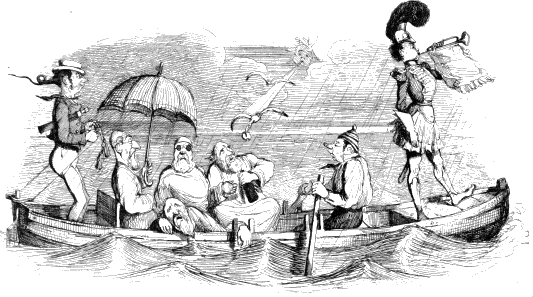
PATRES CONSCRIPTI TOOK A BOAT AND WENT TO PHILIPPI TRUMPETER UNUS ERAT QUI COATUM SCARLET HABEBAT.
3. Sometimes, but seldom, a short vowel at the end of a word placed before two consonants at the beginning of the next; as
Occultā spolia hi Croceo de Colle ferebant:
These persons brought the secret spoils from Saffron Hill.
A short vowel before a mute, a liquid following, is rendered common, as in the word patris.
Sunt quibus ornatur Jenkins femoralia pātris:
The breeches that Jenkins is rigged out in are his father’s.
A vowel before another is always short, as tŭa, thy, memorĭa, memory.
Except the genitive cases of pronouns in ius, where the i is a common i, although alterĭus has always a short i and alīus a long i.
Except, likewise, those genitive and dative cases of the fifth declension where the vowel e, like Punch’s nose, is made long between two i’s, as faciēi, of a face.
The syllable fi also in fīo is long, except e and r follow together, as fĭerem, fĭeri.
Fīent quæ “Fĭeri Facias” mandata vocantur:
The writ which is called “Fieri Facias” will be made.
Fi. fa. is a legal instrument that deprives a poor man of his mattress that a rich one may lounge on his ottoman. Ca. Sa. is a similar benevolent contrivance for punishing misfortune as felony.
Dīus, heavenly, has the first syllable long;—Diana, common: and so has the interjection Ohe!
Thus there’s a common medium of connexion, Between a goddess and an interjection.
A vowel before another in Greek words is sometimes long, as
Cærula, Pīerides, sunt vobis tegmina crurum:
Oh, Muses, your stockings are blue.
Also in Greek possessives, as
Somniculosa fuit, pinguisque Ænēia nutrix:
Æneas’s nurse was sleepy and fat.
Æneas has often enough been represented in arms.
In Latin mark, that every dipthong ’S as long as any stage-coach whip-thong; Except before a vowel it goes, When ’tis as short as Elsler’s clothes.
Words derived from others are tarred with the same stick, that is, are assigned the same quantity as those which they are derived from, with some few exceptions, which we must trouble the student to fish for.
Compounds follow the quantity of their simple words, as from lĕgo lĕgis, to read, comes perlĕgo, to read through.
By the way, reading does not always induce reading through; though we hope it may in the case of the C. L. G.
If to a preterperfect tense belong Two only syllables, the first is long; As vēni, vīdi, vīci, speech so cool. Which Cæsar made to illustrate our rule; To which we need not cite exceptions small. Look in your Gradus and you’ll find them all.
Consult also the Eton Grammar, and works of the poets, passim, as well for exceptions to the above as to the two following rules:
1. Words that double the first syllable of the preterperfect tense have the first syllable short—as cĕcĭdī from cădŏ, &c.
Fortis Higinbottom cĕcidit terramque mŏmordit:
Brave Higinbottom fell and bit the ground.
2. A supine of two syllables has the first syllable long—
As vīsum lātum lōtum mōtum:
And many more if we could quote ’em.
Of the Quantity of the last Syllable.
We have had a poetical fit gradually growing upon us for some time—’tis of no use to resist—so here goes—
Oh! Muse, thine aid afford to me, Inspire my Ideality; Thou who, benign, in days of yore, Didst heavenly inspiration pour On him, who luckily for us Sang Propria Quæ Maribus; Teach me to sound on quiv’ring lyre, Prosodial strains in notes of fire; Words’ ends shall be my theme sublime, Now first descanted on in rhyme. Come, little boys, attention lend, All words are long in a that end: (In proof of which I’ll bet a quart,) Excepting those which must be short— As pută, ită, posteă, quiă, Ejă, and every case in iă; Or a, save such as we must class With Grecian vocatives in as, And ablatives of first declension— Besides the aforesaid, we may mention Nouns numeral that end in ginta, Which common, as a bit of flint are. Some terminate in b, d, t; All these are short; but those in c Form toes—I mean, form ends of feet As long—as long as Oxford Street. Though nĕc and donĕc every bard Hath written short as Hanway yard, Fac, hic, and hoc are common, though Th’ ablative hōc is long you know. Now “e finita” short are reckon’d, Like to a jiffey or a second, Though we must call the Gradus wrong, Or these, of fifth declension, long. As also particles that come In mode derivative therefrom. Long second persons singular Of second conjugation are, And monosyllables in e. Take, for example, mē, tē, sē, Then, too, adverbial adjectives Are long as rich old women’s lives— If from the second declination Of adjectives they’ve derivation: Pulchrē and doctē, are the kind Of adverbs that I have in mind. Fermē is long, and ferē also— Benĕ, and malĕ, not at all so. Lastly, each final eta Greek, Is long on all days of the week— To wit—(for thus we render nempe) Lethē, Anchisē, cetē, Tempē. Those words as long we classify Which end, like egotists, in i, Rememb’ring mihi, tibi, sibi Are common, so are ubi, ibi; Nisĭ is always short, and quasĭ’s Short also, so are certain cases In i—Greek vocatives and datives (At least if we may trust the natives;) Making their genitives in os, For instance—Phyllis, Phyllidos. (A name oft utter’d with a sigh,) Whereof the dative ends in ĭ. Words in l ending short are all, Save nīl for nihil, sāl, and sōl, And some few Hebrew words t’were well To cite; as Michaēl, Raphaēl. Your n’s are long, save forsităn Ĭn, tamĕn, attamĕn, and ăn Veruntamĕn and forsăn, which Are short as any tailor’s stitch; These, therefore, we except, and then Contractions “per apocopen”— As vidĕn’? mĕn’? and audĭn?—so in Exĭn’ and subĭn’, deĭn’, proĭn’. An, from a nominative in a Ending a word is short, they say, But every an for long must pass Derived from nominative in as. Nouns, too, in en are short whose finis Doth in the genitive make inis. And so are n’s that do delight ĭn An i and y—Alexĭn, Ity̆n. Greek words are short I’d have you know, That end in on with little o, Common are terminating o’s, Cases oblique except from those, Adverbial adjectives as falsō Are long,—take tantō,—quantō also; Save mutuo, sedulo, and crebro. Common as vestment vending Hebrew. Modŏ and quomodŏ among Short o’s we rank—nor to be long. Nor citŏ, egŏ, duŏ; no nor Ambŏ and Homŏ ever prone are; But monosyllables in o, Are counted long. Example—stō. And omega, the whole world over, ’S as long as ’tis from here to Dover. If r should chance a word to wind up, ’Tis short in general, make your mind up; But fār, lār, nār, and vīr, and fūr Pār, compār, impār, dispār, cūr, As long must needs be cited here, With words from Greek that end in er; Though ’mong the Latins from this fate are These two exempted—patĕr, matĕr; Short in the final er we state ’em, Namely, “auctoritate vatum.” Now, s, the Eton Grammar says, Ends words in just as many ways As there are vowels—five—as thus In order, as, es, is, os, us. As, in a general way appears Long unto all but asses’ ears, But some Greek words take care to mark as Short,—for example—Pallăs, Arcăs— And nouns increasing plural sport An as accusative that’s short. Es in the main’s a long affair, Anchisēs, such, and patrēs are, Though of the third declension you As short such substantives must view, The genitives of which increase, Derived from nominatives in es, And have an accent short upon The syllable that’s last but one. As milĕs, segĕs, divĕs, (which Means what a Poet is n’t,)—rich: But pēs is long, with bipēs, tripēs, Like to a hermit munching dry pease. To these add Cerēs, Saturn’s cub, (Name of a goddess, and for grub The figure Metonymy through,) And ariēs, abiēs, pariēs, too. Sum with its compounds forming ĕs, Are short, join penĕs, if you please, Item Cyclopĕs Naiadĕs. Greek nominatives and plural neuters, For lists of which consult your tutors. Is, we call short, as Parĭs, tristĭs, Save all such words as mensīs, istīs. Plurals oblique that end in is, Adding thereto for quibus quīs. The is in Samnīs long by right is Because its genitive’s Samnītis, Where you observe a lengthened state Of syllable penultimate. The same to all such words applies, And īs contracted, meaning eis, Long too,—and pray remember this Are monosyllables in is. Save ĭs the nominative pronoun, And quĭs, and bĭs, which last is no noun. When verbs by is concluded are, In second person singular; But in the plural itis make, The is is long, and no mistake— Provided always that the pe- Nultimate plural long shall be. Os, saving compŏs, impŏs, ŏs Is long—as honōs dominōs. The Greek omicron ’s short, and that in All conscience must be so in Latin. Words should be short in us, unless Authority has laid a stress On the penultimate of any Word that increases in the geni- Tive case when us is long, the same Pronunciation nouns may claim— Declined like gradūs or like manūs Though here exceptions still detain us. The first case and the fifth are those Singular; short as monkey’s nose. Long are mūs, crūs, and thūs and sūs All monosyllables in ūs, And Grecian nouns by diphthong ous, Translated us by men of nous. Lastly, all words in u are long, And so we end our classic song.
And not our song only, but our work—the companion of our solitude—the object of our cares—for which alone we live, for which we consumed our midnight oil; and not only that, but also burnt a great deal of daylight.—Our work, we say, is ended—and such as it is we commit it to the world. Horace says Carm. Lib. iii, Ode XXX. (an ode which by some strange association of ideas, is always connected in our mind with the visionary image of a jug of ale,) “Exegi monumentum ære perennius,” I have perfected a work more durable than brass. Whether our production is characterized by the durability of that metal or not, is a question which we leave to the decision of posterity; we cannot, however, help thinking that, considering the boldness of our attempt, it possesses figuratively at least, something in common with the substance in question—and we would fain hope that that something does not consist in hardness.
And now farewell to the reader—farewell, “a word that must be and hath been”—said a great many times when once would have been quite sufficient. We need not, therefore, repeat it; nor need we say how much we hope that we have amused, instructed him, and so forth; that being as much an understood thing to put at the end of a book, as “Love to papa, mamma, brothers and sisters,” in a holiday letter.
Nothing, then, remains for us now to do, but to kick up our hat and cry
“ALL OVER.”
FINIS.
LIST OF ETCHINGS.
1. Vocative case (schoolmaster spatting a boy) to face page 22
2. Schoolmaster beating a drum, and boys singing in chorus 52
3. Ingenuas pugni didicisse fideliter artes (fight) 64
4. Prometheus Vinctus (vagabond in the stocks) 72
5. Smelling a Pig (boys at supper in the bed room) 74
6. Domestic Oratory (small boy spouting in a chair) 135
7. Heu miserande Puer (boy tossed in a blanket) 144
8. Patres conscripti 152
COE, PRINTER, 27, OLD CHANGE, ST. PAUL’S.
Except for the words “to face page”, all text shown in italics was damaged in the original; content was supplied from elsewhere in the book.
CHARLES TILT’S LIST OF NEW AND POPULAR Books, FOR PRESENTS, THE DRAWING-ROOM TABLE, &c.
ELIZA COOK’S POETICAL WORKS;
BEAUTIFULLY ILLUSTRATED EDITION.
Post 8vo, bound in cloth, 16s.; morocco elegant, 20s.
“Miss Cook is a writer of great promise. Her book contains a great number of lyrical and other poems, many of which are extremely beautiful.” —United Service Gazette.
A GIFT FROM FAIRY LAND;
A SERIES OF FAIRY LEGENDS.
Profusely embellished with One Hundred fanciful and illustrative Etchings. Small 8vo, very neatly bound, price 12s.
SIR WALTER SCOTT’S
LADY OF THE LAKE.
TILT’S BEAUTIFULLY ILLUSTRATED EDITION.
Foolscap 8vo, price 7s. cloth; 10s. 6d. morocco, very elegant.
Also, same size and price,
MARMION; A TALE OF FLODDEN FIELD. Engravings. LAY OF THE LAST MINSTREL. Twelve Engravings.
FINDEN’S
PORTS AND HARBOURS OF GREAT BRITAIN.
Fifty large Plates, engraved in the first style of art, from Drawings by Harding, Balmer, &c. &c. Morocco elegant, 1l. 11s. 6d.
FINDEN’S
ILLUSTRATIONS OF THE BIBLE.
Ninety-six Views of the most interesting Places mentioned in the Old and New Testament, with Descriptions by the Rev. T. Hartwell Horne.
Three vols, demy 8vo, morocco, 3l. 3s.; or in two vols, super-royal 8vo, neatly half-bound in morocco, gilt edges, 3l. 10s.; morocco, 3l. 16s.
FINDEN’S
ILLUSTRATIONS OF LORD BYRON’S WORKS.
One Hundred and Twenty-six Plates in the highest style of art.
In two vols, large 8vo, beautifully bound in morocco, 3l. 3s.
THE AUTHORS OF ENGLAND,
OR, BIOGRAPHICAL NOTICES OF MODERN LITERARY CHARACTERS. By HENRY F. CHORLEY.
Fourteen splendid medallion Portraits. Imperial 4to, 1l. 11s. 6d.
NEW AND INTERESTING WORKS.
THE POETS OF AMERICA;
ILLUSTRATED BY ONE OF HER PAINTERS,
With many beautiful Embellishments engraved on Steel, in an entirely new style.
Post 8vo, cloth, 14s.; morocco elegant, 18s.
TRAVELS IN SOUTH-EASTERN ASIA;
INCLUDING
BURMAH, MALAYA, SIAM, CHINA, AND HINDUSTAN;
WITH A FULL ACCOUNT OF THE
MANNERS, CUSTOMS, AND COMMERCE OF THE BURMESE, &c. &c.
By HOWARD MALCOM.
Two volumes post 8vo, with a Map and many Illustrations, 16s. cloth.
THE LYRE; THE LAUREL;
A CHOICE COLLECTION OF THE FUGITIVE POETRY OF THE NINETEENTH CENTURY.
NEATLY PRINTED BY WHITTINGHAM.
Each 4s. cloth; 6s. 6d. morocco.
TILT’S CABINET LIBRARY,
BEAUTIFULLY PRINTED IN FOOLSCAP 8vo.
The following are now ready:—
1. JOHNSON’S LIVES OF THE POETS. Many Portraits. 2. BOSWELL’S LIFE OF JOHNSON. 3. HERVEY’S MEDITATIONS. 4. GOLDSMITH’S MISCELLANEOUS WORKS.
Each volume will contain a complete work of the Author, at an extremely moderate price; while care will be taken that the Edition shall be neat, correct, and elegant. Price 6s. cloth; 8s. 6d. morocco.
THE COMIC LATIN GRAMMAR;
A NEW AND FACETIOUS INTRODUCTION TO THE
LATIN TONGUE.
With numerous Illustrations. Crown 8vo, 8s. cloth.
Illustrated Works, WITH PLATES, ELABORATELY COLOURED, AFTER THE ORIGINAL PAINTINGS.
1. FINDEN’S TABLEAUX; or Prose, Poetry, and Art for 1840. Embellished in a new and unique style, 3l. 3s.; or plain, 2l. 2s.
2. HEATH’S SHAKSPEARE GALLERY; consisting of Forty-five Portraits of the Female Characters of Shakspeare’s Plays, from Drawings by A. E. Chalon, R. A. Stephanoff, Bostock, Meadows, &c. 3l. 13s.. 6d.; or plain, 2l. 2s.
3. THE AGES OF FEMALE BEAUTY: PICTORIAL ILLUSTRATIONS OF WOMAN’S LIFE, from Drawings by the most eminent Artists. With Prose and Poetical Illustrations, by Barry Cornwall, Mrs. Norton, Miss Jane Porter, &c. 31s. 6d.; or plain, 21s.
4. LE BYRON DES DAMES; or, Portraits of the principal Female Characters in Lord Byron’s Poems. Containing Thirty-nine highly-finished Plates, each illustrated by Critical Remarks and Poetical Extracts. 3l., or plain, 1l. 11s. 6d.
5. FLORA’S GEMS; or, The Treasures of the Parterre. In Twelve splendid Groups of Flowers drawn and coloured by James Andrews. The Plates of this work are all coloured in the most finished style, so as to equal first-rate Drawings, and are accompanied with Poetical Illustrations. By Louisa Twamley. 2l. 2s.
6. THE GALLERY OF THE GRACES. Thirty-six Beautiful Female Heads, illustrating celebrated Passages in Modern British Poets, with accompanying Extracts. 3l.; or plain, 31s. 6d.
7. THE ROMANCE OF NATURE: or, The Flower Seasons Illustrated. By L. A. Twamley. 3d edition, 8vo, 31s. 6d.
“This is a book of singular beauty and taste. Twenty-seven exquisite coloured drawings of favourite flowers are accompanied by graceful quotations from the various authors who have felt their ‘sweetest inspiration,’ and some charming original poems. Whether for tasteful decoration, originality, or grace, we have seen no superior to this most beautiful volume.” —Literary Gazette.
8. PEARLS OF THE EAST; or Beauties from “LALLA ROOKH.” Twelve large-sized Portraits of the Principal Female Characters in this celebrated Poem. Designed by Fanny Corbaux. 2l. 12s. 6d.; or printed with tint, 31s. 6d.
9. HARDING’S PORTFOLIO.— Twenty-four highly-finished Views, coloured under Mr. Harding’s directions. Imp. 4to, 31s. 6d.; or printed with tint, 21s.
10. OUR WILD FLOWERS: a Popular and Descriptive Account of the Wild Flowers of England. By L. A. Twamley, Author of “The Romance of Nature.” Many Coloured Plates, 21s.
⁂ All the above works are very handsomely bound and ornamented at the prices mentioned, and have been expressly prepared for Presents, Souvenirs, the Drawing-Room Table, &c.
POPULAR JUVENILE WORKS, JUST PUBLISHED.
THE LITTLE FORGET-ME-NOT;
A LOVE-TOKEN FOR CHILDREN.
Prettily illustrated with Twelve interesting Engravings. Handsomely bound, 2s. 6d.; or with Coloured Plates, 4s.
Third Edition. Price 4s. neatly bound,
BINGLEY’S STORIES ABOUT DOGS;
ILLUSTRATIVE OF THEIR INSTINCT, SAGACITY, AND FIDELITY.
With Plates by Landseer.
Also, same Size and Price,
BINGLEY’S STORIES ABOUT HORSES BINGLEY’S STORIES ABOUT INSTINCT BINGLEY’S TALES ABOUT BIRDS BINGLEY’S TALES OF SHIPWRECKS
TILT’S HAND-BOOKS FOR CHILDREN;
Each containing 48 pretty Plates, price 1s. 6d. neatly bound.
MRS. CHILD’S LITTLE PICTURE BIBLE. MRS. CHILD’S LITTLE PICTURE TESTAMENT. WILLIAMS’ ZOOLOGICAL GARDENS, REGENT’S PARK. MAY’S LITTLE BOOK OF BRITISH BIRDS. MAY’S LITTLE BOOK OF QUADRUPEDS. WILLIAMS’ SURREY ZOOLOGICAL GARDENS.
Others in Preparation.
BIBLE QUADRUPEDS;
THE NATURAL HISTORY OF THE ANIMALS MENTIONED IN SCRIPTURE.
With Sixteen Engravings, price 5s. neatly bound.
TALES OF ENTERPRISE,
FOR THE AMUSEMENT OF YOUTH.
Four Steel Plates, 2s. 6d.
Price 1s. 6d. each, neatly bound,
BOB THE TERRIER; OR, MEMOIRS OF A DOG OF KNOWLEDGE. DICK THE PONY; SUPPOSED TO BE WRITTEN BY HIMSELF.
NEW AND POPULAR WORKS.
PICTORIAL FRENCH DICTIONARY,
Illustrated with Seven Hundred and Sixty Characteristic Engravings on Wood. A large 8vo volume, 12s. cloth.
CHEAP EDITION.
THE PILGRIMS OF THE RHINE.
By Sir E. Lytton Bulwer,
Author of “Pelham,” “Eugene Aram,” &c. With Twenty-seven Engravings, from Drawings by McClise, Roberts, &c. &c.
In medium 8vo, uniform with Campbell, Rogers, &c. Nearly ready.
MEANS AND ENDS;
Or Self-Training, by Miss Sedgwick, author of “Hope Leslie,” &c.
18mo, 3s. 6d. cloth.
LACONICS;
OR THE BEST WORDS OF THE BEST AUTHORS.
Three volumes, embellished with Thirty small Portraits,
New and very cheap Edition, price 8s., cloth.
“There is a world of wit and wisdom in these three little volumes.” —Lit. Gaz.
ILLUSTRATIONS OF THE BIBLE.
From the Monuments of Egypt, by W. C. Taylor, LL.D.,
Ninety-Three Engravings, price 6s. 6d., cloth.
THE REDEEMER,
A POEM,
By William Howorth, author of the “Cry of the Poor.”
Octavo, 8s., cloth.
“We may venture to predict that this Poem is not doomed to sink unnoticed, but will be hailed with a very wide share of popularity, as soon as its quality is known by a religious public.” —Court Magazine.
TILT’S MINIATURE CLASSICS.
A CHOICE COLLECTION OF THE WORKS OF THE BEST AUTHORS, COMPLETE,
IN HANDSOME SATIN-WOOD BOOK-CASE,
With Glass Door, and Lock and Key.
Each volume of this admirable series of Standard Works is printed on the finest paper, and is illustrated with an elegant Frontispiece. The binding is executed in a superior manner, very tastefully ornamented.
The series, bound in embossed cloth £5 10s.
Ditto ditto in silk 8 0
Ditto in morocco, very elegant 11 0
THE BOOK-CASE ALONE, 24s.
Any work may be purchased separately. The prices per volume are:—
Ornamented cloth, gilt edges 1s. 6d.
Prettily bound in silk 2 0
Very handsome in Morocco 3 0
Those to which a star is prefixed, being much thicker than the others, are Sixpence per Volume extra.
BACON’S ESSAYS, Moral and Economical.
BEATTIE’S MINSTREL, a Poem.
CHANNING’S ESSAYS. 2 vols.
CHAPONE’S LETTERS ON THE MIND.
COLERIDGE’S ANCIENT MARINER, &c.
COTTIN’S ELIZABETH, OR THE EXILES OF SIBERIA.
* COWPER’S POEMS. 2 vols.
FALCONER’S SHIPWRECK.
FENELON’S REFLECTIONS AND THOUGHTS.
* GEMS OF ANECDOTE. Original and Selected.
* GEMS OF WIT AND HUMOUR.
* GEMS FROM AMERICAN POETS.
* GEMS OF AMERICAN WIT AND ANECDOTE.
* GEMS OF BRITISH POETS—Chaucer to Goldsmith.
* GEMS OF BRITISH POETS—Falconer to Campbell.
* GEMS OF BRITISH POETS—Living Authors.
* GEMS OF BRITISH POETS—Sacred.
GILES’S GUIDE TO DOMESTIC HAPPINESS.
* GOLDSMITH’S VICAR OF WAKEFIELD.
GOLDSMITH’S ESSAYS.
GOLDSMITH’S POETICAL WORKS.
GRAY’S POETICAL WORKS.
GREGORY’S LEGACY TO HIS DAUGHTERS.
* HAMILTON’S COTTAGERS OF GLENBURNIE.
* HAMILTON’S LETTERS ON EDUCATION. 2 vols.
LAMB’S TALES FROM SHAKSPEARE. 2 vols.
LAMB’S ROSAMUND GRAY, a Tale.
* IRVING’S ESSAYS AND SKETCHES.
JOHNSON’S RASSELAS, Prince of Abyssinia.
LEWIS’S TALES OF WONDER.
MASON’S TREATISE ON SELF KNOWLEDGE.
MILTON’S PARADISE LOST. 2 vols.
* MORE’S CŒLEBS IN SEARCH OF A WIFE. 2 vols.
MORE’S PRACTICAL PIETY. 2 vols.
PURE GOLD FROM THE RIVERS OF WISDOM.
* SACRED HARP.—A Collection of Sacred Poetry.
ST. PIERRE’S PAUL AND VIRGINIA.
SCOTT’S BALLADS AND LYRICAL PIECES.
* SCOTT’S LADY OF THE LAKE, a Poem.
SCOTT’S LAY OF THE LAST MINSTREL.
* SCOTT’S MARMION, a Tale of Flodden Field.
* SHAKSPEARE’S WORKS. 8 vols., 53 Plates.
* GEMS FROM SHAKSPEARE.
THOMSON’S SEASONS.
TALBOT’S REFLECTIONS AND ESSAYS.
TOKEN OF AFFECTION.
TOKEN OF FRIENDSHIP.
TOKEN OF REMEMBRANCE.
WALTON’S COMPLETE ANGLER. 2 vols.
WARWICK’S SPARE MINUTES.
YOUNG’S NIGHT THOUGHTS. 2 vols.
Morocco Case, with Glass Door, holding Ten or Twelve Volumes, neatly ornamented, Price 6s.
As there are several imitations of this beautiful series, it is necessary to specify
“TILT’S EDITION.”
ALSO, UNIFORM IN SIZE,
SCOTT’S POETICAL WORKS,
COMPRISING
Lady of the Lake, Marmion, Lay of the Last Minstrel, Eve of St. John, Glenfinlas, and other romantic Ballads; very tastefully bound in Three miniature Volumes,
WITH ILLUMINATED TITLE-PAGES.
Cloth, 7s. 6d.; silk, 9s.; morocco, 12s.
GEORGE CRUIKSHANK’S WORKS.
THE COMIC ALMANACK
For Six Years. Neatly bound, in Two vols, 17s. Containing Seventy-two large Plates on steel and many hundred Woodcuts.
⁂ Any year separately may be had, price 2s. 6d.
THE LOVING BALLAD OF LORD BATEMAN,
With Twelve Humorous Plates, neatly bound in cloth, Price 2s.
MY SKETCH BOOK;
Containing Two Hundred Groups. Cloth, 15s. plain; 21s. coloured.
⁂ The Work may also be had in Numbers, each containing Four Sheets of Plates, 2s. 6d. plain; 3s. 6d. coloured. —Nine Numbers have appeared.
MORE HINTS ON ETIQUETTE,
With Humorous Cuts. 2s. 6d.
THE COMIC ALPHABET:
24 Plates. Done up on a novel and ingenious plan. 2s. 6d. plain; 4s. coloured.
SCRAPS AND SKETCHES:
IN FOUR PARTS.
ILLUSTRATIONS OF PHRENOLOGY.
ILLUSTRATIONS OF TIME.
8s. each, plain; 12s. coloured.
DEMONOLOGY AND WITCHCRAFT;
In Twelve Plates. 2s. sewed.
ILLUSTRATIONS OF THE ENGLISH NOVELISTS;
Containing Humorous Scenes from Humphrey Clinker, Roderick Random, Peregrine Pickle, Tom Jones, Joseph Andrews, Vicar of Wakefield, &c. &c. Forty-one Plates, with Descriptive Extracts. 7s. cloth.
THE BEE AND THE WASP;
A Comic Tale. Four Plates, 1s.
HOOD’S EPPING HUNT.
Six Engravings, by G. Cruikshank. New and Cheap Edition, price 1s. 6d.
COWPER’S JOHN GILPIN;
With Six Engravings. Price 1s.
USEFUL WORKS.
In a handsome volume, foolscap 8vo, price 5s.,
THE YEAR-BOOK OF FACTS, 1840.
Exhibiting the most important Discoveries and Improvements in Science and Art of the present Year, in
MECHANICS. NATURAL PHILOSOPHY. ELECTRICITY. CHEMISTRY. ZOOLOGY. BOTANY. GEOLOGY. MINERALOGY. ASTRONOMY. METEOROLOGY. GEOGRAPHY. ETC. ETC.
By the Editor of “The Arcana of Science.”
“To bring Facts together, so as to enable us to grasp with new and greater generalisations.” —Professor Sedgwick.
(Will appear early in January.)
GLOSSARY OF ARCHITECTURE;
Containing Explanations of the Terms used in Grecian, Roman, Italian, and Gothic Architecture. Exemplified by many hundred Woodcuts. Third edition, greatly enlarged.
STUART’S ATHENS.
THE ANTIQUITIES OF ATHENS,
AND OTHER MONUMENTS OF GREECE;
Abridged from the great work of Stuart and Revett, with accurately reduced copies of Seventy of the Plates, forming a valuable Introduction to Grecian Architecture, price 10s. 6d. bound in cloth.
ETIQUETTE FOR THE LADIES;
Eighty Maxims on Dress, Manners, and Accomplishments. Seventeenth Edition. Price 1s. cloth, lettered in gold.
ETIQUETTE FOR GENTLEMEN;
With Hints on the Art of Conversation. Tenth Edition. Price 1s. cloth, lettered.
THE HAND-BOOK OF PHRENOLOGY;
Familiarly explaining its Principles, with a Map of the Organs, and Instructions on the best mode of Study. Price 1s. cloth.
700 DOMESTIC HINTS
IN EVERY BRANCH OF FAMILY MANAGEMENT.
By A Lady. Foolscap 8vo, 2s. 6d. cloth.
A TREATISE ON DIET AND REGIMEN;
Intended as a Text Book for the Invalid and Dyspeptic. By W. H. Robertson, M.D. New edition, much enlarged and improved, 4s. 6d. cloth.
“As a family book, Dr. Robertson’s ‘Treatise’ is unequalled in the language.”
VALUABLE BOOKS, AT GREATLY REDUCED PRICES.
WINKLES’S BRITISH CATHEDRALS.
Architectural & Picturesque Illustrations of the Cathedral Churches of England and Wales,
From Drawings by Robert Garland, Architect, with descriptions by Thomas Moule; containing One Hundred and Twenty Plates, beautifully engraved by B. Winkles. In two handsome volumes, imperial 8vo, very neatly bound in cloth.
Originally published at 2l. 2s.; reduced to 24s.
Royal 4to, India Proofs (very few left), published at 4l. 4s.; reduced to 48s.
WINKLES’S FRENCH CATHEDRALS.
ILLUSTRATIONS OF THE PRINCIPAL CATHEDRALS OF FRANCE,
From Drawings by R. Garland, with Historical and Descriptive accounts, containing Fifty large 4to Plates, engraved by Winkles and others. In a handsome volume, bound in cloth.
Originally published at 1l. 10s.; reduced to 21s.
Royal 4to India Proofs, published at 3l.; reduced to 42s.
MUSEUM OF PAINTING AND SCULPTURE;
A collection of the principal Pictures, Statues, and Bas Reliefs in the Public and Private Galleries of Europe, drawn and engraved by Reveil, with Critical and Historical Notices. This splendid work, which contains engravings of all the chief works in the Italian, German, Dutch, French, and English Schools, includes Twelve Hundred Plates, and is an indispensable vade mecum to the Artist or Collector. In seventeen handsome volumes small 8vo, neatly bound, with gilt tops.
Originally published at 17l. 17s.; reduced to 6l. 6s.
THE ENGLISH SCHOOL;
A series of Engravings of the most admired works in Painting and Sculpture, executed by British Artists from the days of Hogarth; with descriptive and explanatory Notices, by G. Hamilton. In four vols, small 8vo, containing nearly Three Hundred Plates, neatly bound, with gilt tops.
Originally published at 3l. 12s.; reduced to 1l. 16s.
WATER-COLOUR GALLERY;
Containing large and highly-finished Engravings of the most distinguished Painters in Water-colours; including Prout, Stephanoff, Cox, Dewint, Harding, Cattermole, Fielding, &c. &c. Eighteen Plates, imperial 4to, cloth.
Originally published at 3l. 3s.; reduced to 21s.
ILLUSTRATIONS OF SCOTT’S WORKS.
1.—LANDSCAPE ILLUSTRATIONS OF THE WAVERLEY NOVELS.
Eighty fine Views of real Scenes described in these popular Tales, engraved by Finden, &c., from Drawings by Roberts, Harding, Stanfield, &c. &c. Two handsome volumes super-royal 8vo, originally published at 4l. 4s.; or India Proofs, royal 4to, 7l. 7s.
Now reduced to 28s. in 8vo, and 3l. 3s. in 4to.
2.—PORTRAIT ILLUSTRATIONS OF THE SAME.
Forty Plates from Drawings by Parris, Inskipp, Landseer, &c. Super-royal 8vo, published at 1l. 13s.; India Proofs, royal 4to, 3l.
Now reduced to 14s. in 8vo, and 31s. 6d. in 4to.
3.—LANDSCAPE ILLUSTRATIONS OF THE POEMS.
Forty Plates from Drawings by Turner, Calcott, Fielding, &c; with ample descriptive Polices. In a handsome volume super-royal 8vo, published at 30s.; India Proofs royal 4to, 2l. 8s.
Now reduced to 14s. in 8vo, and 31s. 6d. in 4to.
⁂ The complete Series of these valuable Illustrations are kept, very handsomely and appropriately bound in morocco, price only Four Guineas; forming one of the cheapest and most elegant books ever offered.
LIBRARY OF ANECDOTE;
Containing Remarkable Sayings, Efforts of Wit and Humour, Eccentricities of Conduct, Private Reminiscences of Celebrated Persons, &c. &c. With five Engravings, small 8vo, cloth.
Published at 5s.; reduced to 2s. 6d.
MARTIN’S ILLUSTRATIONS OF THE BIBLE.
Consisting of Twenty large and magnificent Plates, designed and engraved by John Martin, author of “Belshazzar’s Feast,” &c. In a large folio volume, cloth.
Originally published at 10l. 10s.; reduced to 3l. 3s.
Proof impressions (very few left), published at 21s.; reduced to 4s. 4d.
MILTON’S PARADISE LOST;
ILLUSTRATED BY JOHN MARTIN.
Imperial 8vo. Twenty large mezzotinto Plates, published at Six Guineas, reduced to 2l. 2s. cloth; 2l. 15s. very neat, in morocco.
SINGER’S EDITION OF SHAKSPEARE,
Beautifully printed by Whittingham, with a Life of the Poet, and illustrative Notes. Embellished with many Engravings by Stothard, Harvey, &c. In ten vols. small 8vo, neatly bound in cloth, gilt.
Originally published at 4l. 4s.; reduced to 2l.
WILD’S ENGLISH CATHEDRALS;
Twelve select Examples of the Ecclesiastical Architecture of the Middle Ages, beautifully coloured after the Original Drawings by Charles Wild, Esq. Each Plate is mounted on Tinted Card-board, in imitation of the original.
Originally published at 12l. 12s.; reduced to 5l. 5s.
LEKEUX’S ILLUSTRATIONS OF NATURAL HISTORY;
Containing One Hundred and Fourteen Engravings, with descriptive accounts of the most popular and interesting Genera and Species of the Animal World, drawn by Landseer, Lekeux, &c. &c. Large 8vo, bound in cloth.
Originally published at 1l. 1s.; reduced to 9s. 6d.
PUCKLE’S CLUB; OR, A GREY CAP FOR A GREEN HEAD.
Many first-rate Wood Engravings, cloth. Published at 7s. 6d.; reduced to 3s. 6d.
⁂ This very curious book is illustrated with numerous and characteristic designs by the celebrated Thurston. It was published originally in 4to, at One Guinea. —See Jackson on Wood Engraving.
ADDISON’S ESSAYS;
FROM THE SPECTATOR.
Two neat volumes, cloth. Published at 8s.; reduced to 4s. 6d.
CARICATURE SCRAP-BOOK,
BY H. HEATH.
Containing many Hundred laughable and amusing Groups, illustrative of Life and Character, on Fifty sheets imperial 4to, neatly and strongly bound; forming a never-failing source of amusement for Visitors.
Published at 28s.; reduced to 18s.
CHARLES TILT, 86, FLEET STREET.
Bradbury & Evans,] [Printers, Whitefriars