Cynthia Stockley (continued 6)
Reading edition
“They’re rather fresh,” hesitated Maurice as I took the reins.
“Oh, Maurice! Do you think I can’t manage two old Mashonaland nags?” I smiled.—So he left me, and as I watched him go, tall, nonchalant, and graceful, taking long strides over the knolly ground, I asked myself if it could really be true that I was married, and that—my husband!
Frogs were beginning to croak in the swampy marsh between the Kopje and the Causeway. I could hear far-off voices, and see the smoke of others’ homes against the evening sky. But a terrible soul-sickness crept over me: the sickness of a soul that has lost its mate. At that moment I seemed quite alone in the world. Some words of Gordon’s that a dying man in Fort George had been fond of muttering flitted through my mind:
“Oh whisper, buried Love, is there rest and peace about! There is little help or comfort here below! On your sweet face lies the mould, and your bed is straight and cold—”
Voices and the sound of horses coming along the road broke my dreary reverie. A man’s rather sardonic laugh reached me, and a voice I seemed to know, yet could not recall the owner of. The riders were still a long distance off but sounds travel far on the clear high air of Rhodesia, and I presently heard some words as distinctly and plainly as if they were spoken beside me in the cart.
“He is not a fellow I have ever cared about—I found out long ago that he is not straight. Another thing, he’s too fond of his little quiet tot by himself.—I like a man that drinks with his fellows—not one of your soakers in his bedroom.”
“Well! I’ll tell you what I don’t like about him, Bell, he hasn’t the pluck of a louse—there was a little incident here in Salisbury just after he came up—then again, at Fort George, he played sick with a sprained arm rather than go into Matabeleland with the others. Sprained arm! Sprained grandmother—and I told him so! He slunk out of my office like a dog!”
“It makes me sick to think of him marrying that fine girl.”
How careless people are about what they say of others: I mused. Small wonder one’s secrets are not one’s own in a land where a reputation can be damned on the highroad for all the world to hear!
I had heard a man’s honour—all that was worth keeping in this sad old world—dispensed with, in a few cynical but strangely convincing words. How cruel life was! How tragic! I shivered and wished Maurice would come.
I could see the backs of the two men now as they rode blithely upon their way, having saddened me with the sordid tale of a man’s secret sins that were no secret! the story of some poor fellow’s stumbling journey down hill instead of up! Men were very pitiless in their judgments I thought. Perhaps the other man was not so despicable after all. But secret drinking, cowardice! Those were terrible sins—none more revolting to a woman’s mind—and not straight; the hardest thing one man can say of another! Surely there had been no such man in Port George!—I had never heard of one, and I had heard most things in that tragic little town.—I could think of no one whom such condemnation, fitted. Monty Skeffington-Smythe perhaps?—but no; his faults were open and above-board for all the world to see—nothing hidden there, not even his preference for laager in time of war! Anyway it was no business of mine—I ought to have been ashamed to be speculating about it even, and I was. But why did Maurice stay so long? What could be keeping him?
Some one who played sick rather than go into Matabeleland—But they were all so keen.—all except baggy old Dr Abingdon. Ah! now I knew whose voice that was—Dr Abingdon’s of course—the blasé old doctor with his goat-like leer, and his pretentions that fear kept him from Matabeleland, when as we had found out afterwards he had absolutely begged to go, and been refused on account of his gout—the dear old doctor! His value had been only too well proved in the hospital work he had done later—in the big fights he had put up for men’s lives, and won out, when every one else despaired... I had heard of his recent arrival in Salisbury, and was hoping to see him before I left.
With the knowledge that it was he who had been speaking, my curiosity was once more aroused by the words I had heard. Against my will my mind persistently went back again to the subject. Who of all his patients in Port George had a sprained arm. Ah!—suddenly I remembered!
Afterwards, all the words I had heard floating so idly on the clear air came back one by one, like little birds of ill-omen, to roost in my memory and sing in my ears. It seemed that my brain had taken down everything in shorthand—there was nothing in that brief conversation that I had forgotten!
When Maurice climbed in beside me and took the reins from my hands he exclaimed at their coldness.
“Good Lord! you’re frozen,” he said. “Why, it isn’t cold!”
As he turned towards me I caught from his lips that faint sickly odour of spirits I had long ago learnt to associate with African scenery.
“I am not cold,” I said in a voice that in spite of my striving must have given some sign of the inquietude of my soul, for he gave me a curious glance as the horses lunged forward.
“Oh! cheer up, my dear girl, for God’s sake! This is not a funeral.”
I was so utterly taken aback at this remark, unlike in tone and words anything I had heard from him before, that for an instant I almost forgot the terror that in the last few moments had crept like a little cold slimy snake about my heart. Suddenly I burst into a convulsive laugh, so strange in sound that it should surely have betrayed me. But no, he did not perceive the genre of my laughter. He was satisfied that I laughed.
“That’s right!” he approved, whipping up the horses. “And as soon as we get round the Kopje I’ll give you a little whiskey to warm you up. I never drink anything myself, but its a good thing to keep the cold out, and I’ve brought a bottle with me in case of accidents.”
I laughed again then, a merry ringing laugh, extraordinarily like Mrs Rockwood’s in the old Fort George days. He lashed at the horses and we tore through the town in clouds of dust. When he made to pull up, almost opposite the cemetery, I clutched spasmodically at his arm.
“Don’t stop, Maurice. I don’t want whiskey,” I stammered. “I—I cannot even bear the thought of spirits. Please, please drive on.”
“Oh, very well!” he said in an impatient voice. “All right, if you don’t care about it. As I said before, I never drink myself but it is a good thing to keep out the cold.”
He turned and observed me with something like suspicion in his manner, and again the faint sickly odour crept past me.
We were travelling now at a slackened speed. There was time and opportunity for conversation, and driven by the cold little snake that wound itself tighter and tighter round my heart, I hastened to make it.
“What detained you, Maurice? You were away a long time!”
“Some brute had been ransacking my room. I found the place in absolute confusion. As far as I could see at a glance not a thing had been stolen, but everything was all over the place—papers, letters, clothes! I picked up the important things and stuffed them in my pockets, no time to put anything away; besides, all the padlocks had been burst off everything. I think I can guess who it was—a nigger I discharged last week, and to punish him took away from him a charm that some witch doctor had given him. That’s what he was after, no doubt, but he didn’t get it, the brute, for I have it on me, that’s some satisfaction. Good God! what a mess the place was in!”
“Why did you take his charm, Maurice?” I asked, not from curiosity but from a wild desire to keep talking.
“Oh, never mind about that! There is one thing I must ask you, Deirdre—never interfere with me and my boys.”
For the second time that night I flushed hotly at the tone he used, resenting its unpardonable rudeness. It was on my tongue to answer him proudly that he would not need to make the request twice; but remembering all the plans and resolutions I had taken to the altar a few hours before, I bit the words back before they could escape, and found courage to say instead, with as much gentleness as I could conjure:
“Of course not. You know that my wish is to help, not hinder you, or interfere in any way.”
“That’s all right then,” said he in a tone so extremely domineering and self-satisfied, that my spirits drooped even a little lower than before. But I picked them up again, I forced myself to be gay and sociable, I laughed (like Saba Rookwood), and talked of anything and everything that could have any possible interest for him, even while the knowledge began to push itself into my mind that there were strangely few subjects of common interest between us; and the wonder began to make itself felt that I had never before noticed how little he had to say on any subject. He had always been so quiet, so chivalrously, gently silent, that I had perhaps given him credit for depth and feeling that were not there. No, no, I struggled against that thought, and jested on, occupying my tongue with incessant remarks.
At last the lights of our temporary home beaconed across the veldt and the interminable drive came to an end.
Water-lily Farm consisted of three thatched rooms, and a few straggling huts dumped on the wide and rolling plain with horizon all round. As we drove up in the chilly gloom we saw that the beaconing lights came from lamps with green glass shades that gleamed like anaemic stars from the windows of the bungalow. A dog barked fretfully in the verandah, and a boy came running out with some information in the native language.
“He says there’s a letter from Bingham on the table,” remarked Maurice. “Wait a moment, I’ll go and see.” He sprang from the cart, catching his coat on some projection and sending a shower of papers and things flying from his over-crammed pockets. I collected them as best I could in the darkness, while he went within, and found the letter. He presently came out again calling to me:
“That’s all right. It’s only to say he is sorry he had to go off on duty and couldn’t wait to welcome us; but our boxes of provisions have arrived and everything is O.K. Go inside, dear, while I see about the horses with the boy. If anything happens to them I shall have to pay.”
He helped me down, and I went into the homely little living-room lighted by the pale-green lamps. The supper-table was carefully laid out with an attempt at grace that was more touching than successful. As I looked at the clumsy little bunches of wild flowers arranged in tumblers, I felt that Bingham was a pleasant fellow. There was an honest, serene air about the simple room with its canvas deck-chairs, cane lounge, white-wood book shelves and framed photographs of English people on the walls. The woman who was coming from England to her man here should be very happy, I thought.
A light from the door of an adjoining room drew me thither, but before I reached it I passed some boxes piled against the wall—open packing cases full of provisions: canned beef, biscuits, bottles of preserved fruits, loose potatoes, a case of champagne. There was another case also, nailed up and branded with the name of John Dewar and Sons. I had lived long enough in Rhodesia to know that these were not the names of gentlemen-philanthropists who lived in the Imperial Institute and provided packing-case seats in the open air for the public. I now recognised a case of whiskey when I saw one. I fled from the room and from my thoughts.
The next room had nothing in it but a wholesome smell of pipe-tobacco, a rough desk with many papers piled on it, some racks of shelves, and a chair: obviously Mr Bingham’s office.
More simplicity in the bedroom: white mats, a white dressing-table of unpainted wood, a sheet of mirror in a white frame, a large white double bed. I gazed at that large white bed, fascinated, while the knowledge crept slowly over me that there was no other bed in the house. At last I turned away, and then I saw that in the mirror there was a woman who matched all the other white things in the room—a deathly white woman with a gay-tragic face, standing very still, her clutching hands full of papers. I stared at the papers for a moment wondering what they were, then remembered picking them up in the cart. I was holding a little green leather case too, that I had gathered up with them—something Maurice had dropped. I recalled having heard the little dull thud of it as it fell. It was a jewel-case, a small, new-looking, green leather box, and when I saw that it was half open I wondered if anything had been lost out of it. My mind turned to that question as though it was of importance far greater than the one that was blanching my cheeks and chilling my blood. It was imperative that I should fasten my mind on something outside itself, and I fastened it with avidity on the little green jewel-case half open in my hand.
“Perhaps something is lost out of it,” I repeated mechanically; something of Maurice’s—something of my husband’s!
I opened it entirely, looked in, and found that it contained one blue turquoise ear-ring.
It was a very new little box, with the name of the same Durban jeweller to whom I had sold my rings, printed in bright gold letters on the white satin lid. (Of course! I remembered it was Maurice who had given me the man’s address.)
The one ear-ring was stuck into a dent in the white velvet cushion; by its side was another little dent—empty.
“The other ear-ring must have been lost,” I said to the woman in the glass. She made no reply.
“The other—must have been lost!” I repeated, but I did not hear my voice, and though I saw that the lips of the woman in the glass were moving, no sound came from them.
Then I noticed an odd thing. The woman in the glass was tearing open the front of her gown: tearing it open with shaking frantic hands to get at something that she wore against her heart in a little silken bag.
I did not see her again for a long while. When I looked up at last she was still standing there: only the white lips in the gay-tragic face were smiling, a brooding subtle smile, that had in it a strange mingling of triumph, despair, hatred—and some other desperate element that might have been hope or madness; and the little leather jewel-box in her hands contained two ear-rings. The lost one had been found.
Steps in the verandah dragged me away from the glass and the fascinating things I saw there. I crossed the room swiftly, and closing the door locked it; there was also a wooden button to turn, and a large bolt which slid into its socket soundlessly.
I returned to the dressing-table and my contemplation of the contents of the pretty new box from Durban. I examined them as carefully as if I were a jeweller; as if I had never seen a turquoise ear-ring before and might never see one again. The gold setting of one was tarnished with mud; tiny particles of dirt were still clinging to it; but the stone was undimmed blue, and resembled in every particular its radiant mate which had plainly never left a white velvet bed to make acquaintance with mud. They were screw earrings, meant to pass through a hole in the ear and screw behind the lobe with a little gold washer like a miniature bicycle-nut. Both nuts were in place and the hold wire thread on which they were screwed was quite unworn. When I had removed all traces of mud and stain from the one and polished it with a handkerchief, they were both as flawless and new as when they left the jeweller’s; you could not tell one from the other.
The only interruptions I suffered in my engrossing occupation were the sounds of tins and bottles being opened and occasional shouts to me to hurry up and come to supper. To these I paid no attention until they were accompanied by thumpings on the door.
“What have you locked yourself in for? Do hurry up, for God’s sake! I’m as hungry as the devil. Deirdre! what on earth are you doing?”
I was considering with her the fate of the woman in the glass.
“Are we or are we not going to eat anything to-night?”
“You may eat without me,” I called out in a clear voice. “I do not need any food.”
“The devil you don’t!” There was a pause.
“But—What on earth is the matter with you, my dear girl. Of course you must eat—what’s the matter? Are you angry about anything?—Damn it! what kind of behaviour is this? Open the door.”
“I do not intend to open the door, Maurice, until—I have come to a decision. You had better go away and not waste your breath speaking to me.”
He wasted a good deal more breath, however, before he went away. The next sound was the pop of a champagne cork hitting the ceiling, and the little water-fall rush of wine into a glass. Afterwards the boy was roughly and loudly told to “Hambeela and get out.” Later a knife and fork clattered on plates, and there were more pops and water-fall rushes. At length a silence. The scent of a cigarette crept into the room.
“What now?” I wondered dully. Having finished considering the problem of the future with my reflection, I went and sat on the large white bed which no longer had any terrors for me. I heard the front door being locked, then steps across the room to my door once more.
“Is this a game, Deirdre?”
I did not answer.
“If you do not unlock the door I will break it in!” he said in the same loud bullying voice he had used to the boy, but which did not alarm me at all. I knew now that it was a coward’s voice—a coward’s and a liar’s: my husband’s!
I looked at the stout, unpainted deal door and then at some kaffir curios fastened to the wall on either side of it in rather picturesque groups. There was quite a collection of strangely shaped knives and assegais.
“Do you hear? I shall break in the door.”
“You may do what you wish. But if you come in here I will kill you.”
My voice was very low and quiet, but the hatred in it carried through the door like a dagger aimed at his heart, and he drew away as if it had reached him. A moment later he laughed—a coward’s laugh—uncertain at the beginning, then, taking courage from its own loud sound, blustering at the end. Afterwards he sought in more champagne courage to fulfil his threat: but he found what was better for him at that time—oblivion.
As for me, I lay on the great white bed with crushed face and clenched hands, and asked God for death. At first I was a woman in agony, a tortured and tricked woman whose sorrows were too many for her, whose right was death as the only solution of the sordid problem. But afterwards I was only a weeping child, sobbing over the wreckage of my life, and crying out in the words of my childhood’s prayers:
“Oh, gentle Jesus!... Oh, Mary!... have pity on me!”
Chapter Eighteen.
What the Dawn Heard.
“The means of a man’s ruin are on his tongue.”
In the bleak grey dawn I unlocked the door and sought my husband.
He was sleeping, sprawled in a canvas chair beside the table frowsy now, and littered with empty tins, spilt wine, and overturned flowers. His mouth hung open, and I saw that it was weak and loose; that his dark skin was yellowed, not tanned; that his eyes were set with a sinister closeness to his handsome thin nose; that under them lay the mean lines of secret sins; that his hands were not the staunch, square hands of a man that could work for a woman and take hold of her heart and keep it for himself against all comers; they were long and cruel and womanish, and looked as though they knew only how to tear and wring and destroy.
While he snored I drank to the dregs the bitterness of my cup. I was bound to this drunkard and liar for all my days. And Anthony Kinsella was alive. I knew, that he was alive. If all the angels in Heaven had come down to tell me now that he was not living I would not have listened. I knew that he was living and breathing somewhere in this land that he loved. I had always known it. But I had let this man blunt my instinct and blur my soul’s vision with his base lies; and he had profited by the blindness of suffering to trick me with a lie and an ear-ring dipped in mud to convince me of my lover’s death! It seemed to me a shameful thing that I should have been so easily convinced. Now that my faith had come back in a great sweeping tide I convicted myself of base treason in the haste I had made to believe the false tale. But faith, reproaches, discovery—all came too late, for me. Anthony was living—somewhere; but not for me. Here was the mate I had given myself, snoring before me in drunken slumber! Lest I should strike him on his open lying mouth, I fled from the room.
In the verandah the austere, sweet air of dawn greeted my burning temples and lulled the fever of my burning cheeks and hands. The stars were paling to whiteness and falling away into lemon-tinted distance. Shadowy hands tipped with faintest rose reached down from the skies, gathering the mists of night back into the bosom of the clouds; and the land, like some subtly tinted Japanese map on which was traced streams, grasses, and flying birds, swiftly unrolled itself to the eye, yard by yard, mile by mile. A line of mauve-tinted hills appeared suddenly on the horizon, as though sketched in by some rapid, skilful hand.
A strange thing about the veldt is that if you stare long at it when you are happy your eyes will fill with tears, and an indefinable sorrow surges in your veins. But go to it when you are wretched, and its beauty will lay shadowy hands on you and bless you and enfold you, and something will wing its way into your heart like a white heron of peace, and nestling there give you comfort and courage.
As I re-entered the room the man in the chair opened his eyes and regarded me stupidly. We looked at each other in silence for a while. I was surprised to see that the eyes I had always thought to be a deep and rather beautiful brown were really as yellow as an eagle’s: the effect of darkness was given by a number of brown spots scattered closely on the iris. When the eyes were opened the little mean lines disappeared, and a curious deferential expression took their place. His colouring was dusky, almost mournful, but he had beautiful teeth that lit up his face when he smiled, and the effect was that fleeting suggestion of chivalrousness that had impressed me so deeply and was so false. He was smiling now, but the chivalrous engagement was absent. His gaze had quickly changed from stupidity to one of sneering anger.
“So you have deigned to come forth at last! Would it be troubling you too much to ask for an explanation of your charming behaviour?”
With an affectation of carelessness which his furtive glance and shaking hand denied, he took out a cigarette and lit it.
Without speaking I laid upon the table the little green jewel-case, open—with the blue stones smiling on their satin cushion.
For a few seconds there was silence, and as I watched him with disdain and hatred I could not control, I saw that he was not taken unawares. He knew what I had found, and had his tale ready. Incredible as it may seem, he was ready to burden his soul with fresh lies. I had yet to find that this was ever his way. He never confessed a fault, but lied to cover it, and if the lies were not long enough or broad enough he lied again; and if you still did not believe he lied on and on—useless, futile lies.
What pretty ear-rings, he said. Where did I get them? They were just like a pair he had bought intending to give me; but he had remembered in time that turquoises meant unhappy memories for me, so he had kept them, and by Jove, yes! when he had found his things all over the place in his rooms he had come upon the box, too, but with only one ear-ring in it, and had thought that brute Makupi had taken it (he forgot he had told me the boy had stolen nothing). Perhaps he had the thing in his pocket now. (He, in fact, affected to make a search, feeling in all his pockets, then looked more closely at the box on the table.) Why! this was the very box—but of course I must have picked it up in the cart—then the ear-ring had not been lost after all! At first he had thought it was a pair of my own I was showing him—a pair just like those he had bought,—for that class of screw ear-ring was all made alike—a jeweller had told him so. They were all made exactly in the same way—you couldn’t tell one pair from another.
Fascinated, I stood watching him weave his tangle of lies and uttering them between little puffs of smoke. If it had not been so horrible it would have been an interesting study in soul pathology. I had never met any one with an idiosyncrasy like this; never known a man who thought it worth while to lie at all, certainly not in this idle yet curiously intent way. Could he be mad, I wondered. With each new lie or portion of one his confidence increased. The last part of his statement, made with the utmost aplomb, was an inspiration. I saw the gleam of the creator in his eye as he propounded it. And when I still gazed at him in stony-eyed fascination he repeated it with an assurance almost childish.
“All blue ear-rings are alike. Yes: that fellow in Durban told me so when we were talking about earrings once long ago. Perhaps that is why you are upset—old memories, I suppose. You are thinking of that chap Kinsella. Still, I don’t see why you should treat me like a dog on that account.”
His tone became injured and indignant once more. There were to be no more propitiatory inventions. He had explained the whole thing satisfactorily as far as he was concerned, and the subject was now closed. He swept it away with his tobacco smoke, and returned to his grievance against me.
“On a man’s wedding night! To drive him into getting beastly drunk out of sheer misery and loneliness! I have told you before that I never drink anything, but last night,”—he waved at the empty champagne bottles—“upon my soul I think this lapse should be forgiven me.”
Half unconsciously my eyes sought the wall where the packing cases stood; the case of whiskey was gone. It had been spirited away in the night to some other hut. I remembered now the shuffling sounds of some one lifting and carrying away a heavy weight.
“But I am willing to kiss and make friends if you are.”
He rose to his feet and put out a hand with the frank manly air he could so easily assume while the half-modest, half-chivalrous smile that had always attracted me flitted across his face. It was an elusive expression and never stayed to be examined; but for a moment it bred in me the hope that at the bottom of this dark soul there was some spark of nobility, covered heavily with great weights, perhaps, but smouldering still. I must appeal to it if there was to be any way for either of us out of this tangled wild.
“Maurice,” I said almost gently, “there can be no kisses between you and me. I know now that you have lied to me and deceived me, and the knowledge is so terrible that I can hardly bear it. There was a time during the past night when I could have killed you for what you have done. I can never forget it—it is no use saying that. But because you and I are irrevocably bound together by the laws of my religion I will try to forgive you if you will give me time. I will try only to remember the promises I made to you at the altar a few hours ago. By the help of God I will keep compact with you: if you on your part will not lie to me any more, and will strive to be the honourable man I believed you when I married you.”
He gazed at me with a sneering mouth.
“And what is to come of all these fine compacts, may one ask?”
What indeed! God knew best what house, if any, could be built upon the shifting sand of this man’s nature and the ashes of my heart’s desire! I could not prophesy with my hope; I could only try to keep from my voice the despair that obsessed me.
“A home perhaps that you and I can live in with peace and honour, Maurice,” I faltered at last. “Who knows; we may yet build some fine thing with the wreckage of our old selves. If we learn to tolerate and help and comfort each other—will not that be something? Perhaps in the end friendship may come.”
He interrupted me with a fleering laugh.
“Friendship! You think that is what a man marries a beautiful girl like you for? You talk like a fool. If friendship was what I wanted I could have got it—and a jolly sight more, too—without tying myself up for life. It is not every woman who finds me so objectionable as my wife apparently does. Friendship be damned!”
“It is all I ever promised you,” I broke out at him then. “I told you when we made our bargain that you must expect nothing from me but my presence in your house, and my help in your career. You swore you would ask nothing more of me.”
“A likely story,” he answered. “Who ever means those tom-fool things?”
“I meant them if you did not, and I mean to stand by them,” I said firmly, though my soul shook at this faithlessness; this trampling under foot of solemn vows.
“We’ll see about that,” he said darkly.
“We will see about it now. It will be finally and definitely settled now, or I will leave this house, and you. If your promises do not bind you neither will I be bound to you.”
He was moved at last, though I could not tell on what raw place of pride or personal vanity my words flicked him. His manner changed. Consideration came into it, and some trace of humility.
“Deirdre, you would not leave me?”
“Not unless you force me to. But so sure as you forget the compact there is between us, Maurice, I will go. Understand now clearly and then let us speak of it no more. I married you believing Anthony Kinsella to be dead, and hoping to dedicate the rest of my loveless life to something which would make it worth the living. You offered me the task of helping you, and I took it with a clear bargain between us, and a hope—Ah! I know not what hope, but I thought that perhaps—life might still bear some little gentle flower. And so it may,”—I found courage to continue, looking at his whitening face: “I pray God for your sake, that it may. But you must not forget, Maurice, that things do not stand just where they were that night we made our bargain; do not forget that I gave my promise with a lie between us that made all the difference to me; that now I know the truth and believe Anthony Kinsella still alive I can no more help loving him than I can help my heart beating. You can drive me from your home if you choose, but I tell you that I love him, and I will never forswear my love for him. I cannot now ever give him my body as he has my soul; but neither will I give it to another.”
My voice had sunk to a whisper. My words rustled out like leaves across my dry lips. He, too, was pallid-faced and stammering.
“This is a bitter bargain!”
“Not less for you than for me,” I contended inexorably, for I was fighting for more than life. I knew that if this last appeal failed it would be the end. The ship of our marriage must founder, and we two, like broken, useless spars float apart on dangerous seas.
For me the thought of living in companionship with this man held nothing but terror and disgust. But with the fervour of a Catholic I clung to the marriage vows I had made, not only because my faith and the traditions of all the clean, pure women of my ancestry bade me do it; but, because I terribly feared for what might happen when Anthony Kinsella came riding back into my life, as now with the clear prevision of an Irishwoman I knew he would.
If I were alone—married and yet alone—and he should come for me, would I refuse to go? No, no, no! I knew the spell of my love and the strength of his will too well to suppose it! Faith and tradition would go to the winds; they would be burnt up in the fierce flame of our love.
I was fighting with Maurice Stair for my soul. I could not love him; he was an unworthy traitor and liar, but I was his wife and I wanted his home and name to shelter me from sin. Only, I would take them on no other conditions than those I had named to him.
Long, long we stayed there, fighting that fight. I cannot remember all that was said. I only know that once I sank into a chair almost fainting, that once there was a time when he wept like a child, his head on the table. At another he reviled me until my knees shook, and cursed the hour I had set foot in his life.
But at last when the sounds of broad day were all about us and the room full of leaping sunshine, the fight was over, and I knew that my will had conquered. The victory, if so it could be called, was to me! For how long I knew not. I had learned much of my husband in those dawn hours of weeping and reviling and recriminations; and one thing I knew—this battle would be often to fight. Life with Maurice Stair, unless I was prepared to surrender my will to his, would be one long, ceaseless struggle—a struggle in which my adversary would disdain no weapon or device to bring me down.
Chapter Nineteen.
What a Goad Performed.
“A word fitly spoken is like apples of silver in baskets of gold.”
A few days after our marriage Maurice went into town, and came back to Water-lily Farm with a brief but interesting statement.
“We shall not be leaving Mashonaland. When I made you some such promise I had not reckoned with my dear uncle Alexander. It appears that he objects to my going away from Africa.”
I regarded him steadfastly for a while, trying to read between the lines of this announcement.
“What has made him change his mind about helping you into the Consular service, Maurice?” I asked, not without a shade of irony I must confess, for any one less adapted than Maurice to a profession in which high principles, tact, and good manners are essential qualifications it would have been hard to find, even in Africa, where budding diplomats do not grow on every bush.
“He hasn’t changed his mind. I have changed mine about asking him, that’s all. I know it would be no good, anyway.”
He got into the verandah hammock, which was also his bed, propped himself comfortably against a cushion, and lit a cigarette.
From my deck-chair I stared blankly at the surrounding horizon. To say that I was agacée is to say nothing. Even in the face of his recently revealed duplicity I was unprepared for this cool jettisoning of the most solemn part of our compact. It left me breathless. I said at last:
“What is there to prevent you from leaving Africa without your uncle’s consent? You are not an infant—”
“No; I wish I were. Life would be considerably simpler. But the fact is, my uncle is so kind as to pay me five hundred a year to stay out of England, and the country he specifies as my residence, being a nice long way off from him, is Africa. The moment I quit he’ll stop payment, and I shall have nothing to live on but my lordly salary of twenty quid a month.”
What sinister meaning lurked in so strange an arrangement I shrank from asking, but I had an instinct to combat it—an instinct that was roused in me twenty times a day as my husband’s character unfolded itself, and I saw upon what ignoble props and bolsters his life was arranged; how slack were his moral muscles; how low his code of honour. Sometimes, when I realised these things, and that my lot was irrevocably cast for life companionship with a man who so deliberately outraged my ideals of what a man should be, and what life should mean, I felt like a trapped creature, and my instinct was to turn in bitter rage and rend the trap with teeth and nails. But what good in that? And what good in all my fine resolutions if they so quickly dissolved in the face of disaster? I smothered down indignation and disdain, and used a gentleness with him that, knowing my own proud ardent heart, surprised myself. With burning cheeks I might presently have been heard pleading with him to throw off the five-hundred-pound yoke, and strike out on his own account.
“Surely the freedom of your soul is worth more than five hundred a year!” I cried. “You detest your uncle, why take his money under such an ignominious condition? Fling his money into his teeth and take your life into your own hands. Africa is not the only country on the map. There are still Europe, Asia, America, and Australia. Let us go to Canada and start a farm, open a shop, run a hotel—anything, anywhere. I will help you at whatever you put your hand to, Maurice, and I don’t care how poor we are. Only let us be honourable, and let us go away from Africa.”
And all the time my blood was leaping and my heart quivering at the thought of staying on in this land, behind whose silent hills and dense bush the fate of Anthony Kinsella still was hidden. To all my eloquence he puffed at his cigarette and returned a cool stare.
“Jack up five hundred a year and go and look for a chance living in some new country where I don’t know the ropes? Not much, my dear girl! I know my own limitations, thanks, and how likely I’d be to make my fortune or even a bare living in Canada or anywhere else.”
“What of the noble career you were to carve out for yourself,” I flung at him, hoping that scorn might achieve what pleading and reasoning failed to do. But that stone broke no bones. He merely laughed and flung one back at me with a man’s sure aim.
“Why should I bother about a career, since I am never to have any children to pass my glories on to?”
That sealed my lips from further retort. I sat still and stared silently at the passionate blue of the skies, and the radiant sunlit plain. What was the use of struggling against the witch who had me in her toils and never meant to let me go?
“If she loves you, she will keep you, whether you will or no!” Anthony had prophesied on just such a blue-and-gold day, when life went sweetly with us. Well, if this was love, it was a strong, austere passion, hard to distinguish from hate. Under its fierce cold caress I could truly cry with the words of the Hindoo woman to her faithless lord:
“Hadst thou not called it Love— I had called it a drawn sword!”
A little way off a native boy, whom I had noticed about the place the last day or two, was sitting in the sunshine, with his back against a hut. He wore a brick-red blanket sewn with large blue beads, swathed round him rather gracefully, and a necklace of some wild beasts’ teeth about his neck. He was better looking than the average kaffir—nose less flat, and lips less protruding; with a dreamy, moody air about him, and in his big dark eyes. He had a tiny kaffir instrument in his hands, upon which he was making a soft, sad, monotonous sound.
Tom—brr—torn—brr—tom-tom-tom—
Sometimes he would give a look, in which there seemed to be some significant wistfulness, towards the verandah where we sat.
“Yes, I’ve got a nice little soft billet in the Mounted Police,” pursued Maurice serenely. “The powers that be thought it a pity for a happily married man like me, with an adoring wife, to have to be so much away from home as an N.C. must be, so they laid their heads together to see what they could do for you and me. The result is the offer of a sub-inspectorship in the Police, my service in the N.C. Department to count towards seniority. They’ve given me the camp at Mgatweli.”
Afterwards I learnt, as one learns everything in Rhodesia if one lives long enough, that the whole affair had been arranged weeks before, upon Maurice announcing the news of his approaching marriage. He had accepted the appointment quite a month before he told me anything about it.
But I soon learned that I must take falseness and double-dealing for granted.
Judy, too, was proving faithless to her promise. She had written to say that she had decided to take Dickie with her to Europe, where she was going to spend her honeymoon.
I rose wearily to go inside and find out what arrangements were being made for lunch, when I noticed that the boy with the music had left off playing. He put his piano in his hair and came up to the verandah. His eyes were fixed wistfully upon Maurice, who was apparently composing himself to sleep. In the Mashona tongue he made a soft little request:
“Neega meena e’tambo Inkos.”
My husband very quickly opened his eyes.
“Get out, you scoundrel, or I’ll give you a kicking instead. And don’t let me see you hanging round here any longer.” He added something. Some added threat in the vernacular made the boy walk away. But he did not leave the farm. I found out later that he was Makupi, the boy whose charm Maurice would not give up, keeping it out of sheer deviltry and malice, just because the boy wanted it so frightfully. When we left Water-lily Farm Makupi left also, and a few days after our arrival at our new home I saw his brick-red blanket again, and heard the thrumming of the little melancholy piano. Often he would come to Maurice and repeat his gentle request:
“Neega meena e’tambo Inkos” (give me my charm, master). And when refused with menaces would walk uncomplainingly away.
Mgatweli was a little gathering of houses and huts, a church, and two hotels—the habitations of three hundred souls. The town nestled in the hollow of a plain, with low, wooded kopjes brooding round it.
Our home consisted of five huts: a dining-room lined with white limbo, a drawing-room lined with red, two bedrooms, and a kitchen. They had been lived in before, and left in a ragged and disreputable condition. There was grass growing on my bedroom floor, and the ants had devoured most of the drawing-room wall drapery. However, the place was undeniably picturesque.
The huts were built in a wide ring round a compound full of bush and big trees, and the whole camp was pitched half-way up the slope of the biggest kop.
We were about a mile away from the town, and between us and it stretched an emblazoned sea—an extravagant, brilliant champs Élysée of terrible colour.
In the first mushroom uprising of the town the little hospital had stood where now our huts were built, and a young nurse, receiving a packet of zinia seed from home, had, in the innocence of her heart, planted it at the doors of the hospital, to cheer the patients, she said; but in time it had frightened the patients.
Any one who knows anything about zinias need not be told that they want nothing more than a shower and some sunny days to bloom gaily, and thereafter fling their seed in turn to the four winds. That is what Nurse Agnes’s zinias had done, and now between the camp and the town billowed an iridescent ocean of colour. And such colour! Atrocious blues and reds and terra-cottas and pinks and magentas, all cheek by jowl, and head to head. Perky little stiff-stalked wretches, blazing wickedly in the sun. I detested them. The natural flowers of Africa never clash with each other, or the skies, or the changing scarlets and ambers of the veldt. But these malapert immigrants sinned against all laws and canons of colour. They struck the eye a thousand blows a minute. They disturbed the splendour of the skies. There was no peace in the distant hills because of them.
Close beside us was the police camp: a bevy of huts built round a large open space, with the stumps of chopped-down trees for occasional seats. A sergeant and ten troopers came and went on the zinia-lined road, patrolling the neighbouring kraals and visiting the town. From our hut doors we could see the men busy with their horses at morning and evening “stables,” and on Sunday nights they usually chanted Barrack-room Ballads round their fires to hymn tunes played on a concertina. They were an ill-kempt, casual, careless lot of men, but fine looking fellows and all of them well-born ne’er-do-wells. The only one among them who had no claim by birth to the title of gentleman was Locke, the smart and spruce sergeant in charge of them under Maurice.
Life with Maurice Stair was too lively and active a misery to be truthfully described as dreary. It was more difficult than climbing the Dent blanche with bare and broken feet, or wandering waterless in the burning desert; for there was no glorious peak in sight up the steep and rugged path, nor any oases to rest by in the weary desert, nor any hope of “Death, the tardy friend” overtaking one’s faltering footsteps. I was too young and strong to hope for death, even while I felt that youth was being left far behind in the shadow of happier days, and age crouched somewhere in the tangled thorny wild in front. And always, always, the terrible regret for the passing of days that held nothing in them! Empty days—empty nights! Life was not meant to be passed thus, and life was passing!
“The wine of life was falling drop by drop; The leaves of life were fading one by one!”
Maurice spent little of his time at the police camp. His duties as commanding officer did not oppress him. He rarely went near his men. The sergeant came to the house with all papers and reports, and Maurice conducted the affairs of the Government in his bedroom, often from his bed, for which he had a fondness.
As Public Prosecutor he was obliged to go over to the court-house every morning at ten, but it was usually nearer eleven when he rode away, looking like a modern Galahad on his white horse. There is no doubt he was a very handsome fellow.
His duties at the court-house did not keep him long, there being little more to do than to produce certain Mashonas who had been brought in by the troopers for refusing to pay the hut-tax (ten shillings a year) and thereafter to be sentenced to a month’s labour at Government work. Sometimes there was a cattle-stealer to face his crimes, or a breaker of his brother’s skull in some kraal revel. Whatsoever the cases they did not detain Maurice long. He soon came riding gallantly back through the zinias, to the hours of idleness that his soul loved. He would fling off his uniform, get into a pair of shrunken flannel trousers, and in his shirt sleeves and a pair of atrocious black leather slippers spend the rest of the day pottering. He was the most successful potterer I ever met. Sauntering from one hut to the other, he was never far from his own. He may or may not have believed that I did not know the reason for this; but I must have been deaf and blind and lacking in all my seven senses not to know of the case after case of whiskey that was carried to his hut and consumed there in solitude. Yet he still kept up the pose of being a man who did not drink, and when I had the tantalus filled with spirits and placed openly in the dining-room he looked at me with surprise, and asked me whether I realised that whiskey was five pounds a case!
He had the art of wasting time brought to a fine point. He could sit for hours polishing some part of his saddlery (that it was his batman’s business to attend to), or spend the afternoon piercing fresh holes in a strap he never intended to use, piercing them beautifully, with the care of a diamond cutter at the most delicate work, polishing them afterwards with sand-paper. He loved polishing as few housemaids do. The matter of getting a rhino-hide sjambok ebony black would happily occupy him for many days, or cleaning a pipe that he never smoked—anything that was futile and foolish and useless and that some one else could have done better!
He also liked to make little pottering things with carpenters’ tools. After studying for the army he had, it appeared, taken a course at one of the big technical training colleges in London, and had there chosen to learn carpentering. No doubt I am snobbish, but I could never quite understand what a gentleman wanted with a knowledge of carpentering. Probably Maurice took it up to avoid being obliged to study something that would make a demand on his brain. He was always very careful not to overstrain his brain in any way. However, the result of this special branch of instruction was that he could make nice little boxes that would not quite close, and wooden pegs that wouldn’t stay in the dagga walls, and other things that no one had any earthly use for.
Once, it is true, he made a beautiful little tea-table, a thing we much required, for furniture was still almost unobtainable in the wilds as we were, and the drawing-room was but scantily furnished. But when the table was finished he spoilt it by painting it a diabolical pink that made it get up and smite in the eye everything in the room, including the walls which were lined with scarlet twill. The thing was impossible. The colour of a stuffed wolfs tongue! But do you think he would change it? No. He would have it no other colour, and he forced it through the drawing-room door, tearing the limbo and smashing up pots of ferns, and planting it in the middle of the room, left it there whether I liked it or not. I dispensed tea from it to my visitors and let them gauge my taste by it if they liked. What did it matter?
When all his possessions had been picked over and polished and he could for the moment find nothing sufficiently futile to do, he would get a pack of cards and play patience, or amuse himself with a chess-board. He never touched a book or a pen, or took the slightest interest in the profession into which he had been pitch-forked over the heads of better warn, by a Government whose kindly idea at that time was to do well by the men who had first come into the country. He appeared to have no use whatever for his head: but his long, womanish, restless hands were everlastingly occupied.
His favourite seat was a packing case under a big thorn tree—not too far from his bedroom door; and there day after day he murdered time.
If he had possessed the easy-going, warm-hearted, beauty-loving Bohemian temperament that usually accompanies a lazy nature, much could have been forgiven him. A gipsy’s heart and a poet’s dreams would have gone very far towards compensating to me, at least, for idleness and incompetence. But Maurice had no more poetry in him than a packing-case. And if his soul had ever given birth to dreams he had long since drowned them in whiskey. So far from being easy-going he was extremely cantankerous to every one under him. The servants detested him, and his men only tolerated him because he left them to their own devices. As for loving beauty; he never raised his eyes to the hills except to curse them for cutting him off from civilisation. He infinitely preferred to see his own cigarette smoke than to watch the pansy-coloured shadows flocking across the plains at eventide. A sunset left him cold; he never saw a dawn.
If any one thinks I sat down meekly to this life, and to this man they gravely err. I am not of the meek of the earth. Irish-Americans rarely are. Moreover, a meek woman in the household of Maurice Stair would have been extremely out of place. He would have calmly proceeded to wipe his boots on her.
I was consumed with shame for this man. I looked upon him as a cheat; and I knew the humiliation and shame of a woman whose husband was defrauding his employers. I had been long enough in the country to know how hard the real men, who had ideals, worked for the country and for themselves. I knew that there were a hundred things Maurice could have done to improve his men, the camp, and the general state of affairs. But he preferred to let Sergeant Locke earn his salary for him, while he sat under a thorn tree and polished a strap; and I, his wife, shared the salary!
At first, having learnt something of his arrogant, stubborn nature, I tried to beguile him from his ways with soft and even flattering words. I painted to him, with a daring impressionist hand, the future that ought to be his, clothing it in mists of scarlet and gold.
“Grind away at your profession,” I invoked him, “and show them you’re too good for this little hole. Have your men in such a state of efficiency that the fame of them will reach Buluwayo. Improve the camp. Get after the kaffirs and make them work at this place so hard that the next time the C.O. is here he will cast an envious eye on it for one of his pets, and you’ll be moved on somewhere else. Having shown your stamina they won’t dare to push you in the background again. They’ll have to give you something better.”
I descended deep into flattery, and though to my own ears it sounded uncommonly like irony, he took it well. But afterwards he smiled at me, the patient smile of the great.
“What’s the good, my dear girl? You don’t know this country. You can work the flesh off your bones and nobody will thank you for it. You will never get ahead of the Company’s pets.”
The old cry of the idle and incompetent, whether in art, trade, or the professions—the uselessness of striving against injustice and favouritism!
“I consider that they have distinctly petted you, Maurice. Show them that they did well, and you’ll get more petting.”
“I suppose you would like me to be like Popper in Salisbury—always after the men to see if they’ve got their putties on straight, and whether they’re taking Epsom salts and saying their prayers regularly.”
“Oh, Maurice, you know very well that is not what I mean.”
“I don’t think you know what you mean. You are talking through your hat, my dear girl, of things you know absolutely nothing about.”
“Perhaps so,” I admitted with a humility that was far from being natural to me. “But I am only making suggestions. I can’t bear to see you wasting your life. There are such a lot of things you could do in this country, and make a big future out of. If you could get inside the inscrutable native mind, for instance, you who know so much about the natives already. Why not become an authority on them, a master of the native tongue as no other man in this country is? Dear Maurice, I want to see you start carving that career you told me about.”
(I never let him off that!) But he was entirely undisturbed.
“You talk like a book, my dear girl,” he affably responded. “But I’d rather carve a stick. Less trouble. Go and get into the native mind yourself if you think it such a mighty interesting place. And further, I wish you’d remember that I warned you on our wedding day that I would not have you interfering with my affairs. I knew well enough you’d start this blither about ambition. I must ask you once and for all to mind your own business.”
“It is my business,” I said. “How dared you ask me to take a name you did not mean to do something with?”
This was no gentle answer to turn away wrath, as I very well knew. But there were moments, and this was one of them, when my spirit rebelled against the embargo of submission I had laid upon it. I saw at last that guileful persuasion was useless. I might as well have tried to beguile a wildebeeste from the veldt, or a crocodile from the green slime of the Pungwe River, as this man from the paths of sloth. But there was still the goad left.
“Oh, Alexander the Great! Do you remember what he said to the soldier he found sleeping at his post? ‘Either honour your name, sir, or change it!’”
“Oh! Bah! What do women know of honour. Let me alone, for God’s sake.”
But I would not let him alone. Even when his retorts were coarse and insulting, I persisted. It burned me like an acid to bear the name of this neglecter of his duties: this skulker behind a bush while other men did his work. I made clear to him that any woman with a backbone detests the type of man who potters about the house driving in nails instead of getting out after the big things of life. I gave him no rest under his thorn tree.
I jeered at his wooden boxes, and made mock of the slovenly troopers who passed upon the road below our camp. I jibed at his beloved shrunken white flannels, and let him know I found him no object of beauty in the black bath-slippers. I scarified him, and inflicted many a scar on my own pride in the process; and apparently he remained invulnerable. But sometimes I saw a little colour creep into his sallow cheek, and knew that an arrow had gone home. Until at last one day he turned on me raging:
“Good God! a man had better have married a flaming sword than you! I might as well try to sleep with vitriol trickling over me!”
At that I rejoiced: if an emotion of mingled despair and savage triumph could be described as joy. And thereafter I gave him no quarter. More than ever I bit into him like a steel blade and flickered round him like a flame.
That was the beginning of a new era. And if sometimes the last state of these persons seemed worse than the first—I flamed and flickered on.
One thing was certain; anything was better than stagnation in a swamp; so I made the swamp as untenantable as if it were infested with asps.
However, departure from the swamp meant departure also from tranquillity. With the mists of idleness and the green slime of sloth, peace also disappeared. It is true that Sergeant Locke came no more to the house with the reports; no longer paid the men and harangued them vainly for their sins; nor rode any more to the court-house to play deputy P.P. while his superior officer lay in bed; nor performed any more of the duties of that same superior officer. That was so much to the good. But for amendment Maurice took toll of me at home, retaliating with the malice of a small-minded woman, interfering in the affairs of the house, grumbling at the food, abusing the cook, and insulting me. Nothing pleased him. Though he was much more at the camp and court than he had ever been he also seemed to have more time to be at home, to fall upon the cook and kick the house boys, with the result that no sooner had I trained one servant to do his duties unsuperintended, than he ran away, and I had to begin the thankless task over again.
My husband was a bad person to keep house for at any time. One of those men who tells every one he doesn’t care what he eats so long as it is food; and then raises the roof if he has cold mutton daintily served with a salad for lunch, after having had it for dinner the night before.
“Damn it! is this goat going to last for ever?” he would cry outraged. “It must have been a blazing horse. Did you buy the whole four quarters in the name of God?”
My mornings were taken up with trying to manufacture new dishes, and teaching Mango, the cook, to manage the sparse material at his disposal, so that the result might spell variety in the menu.
I discovered that turning out charming suppers in a Paris studio was a very different matter to keeping house in a land where goat and “bully” were the foundations of life; fresh fruit and fish unheard-of things; and vegetables luxuries that had to be fetched on horseback from a coolie river-garden several miles away, and pleaded and bartered for at that.
Chickens, of which it took about half-a-dozen to make a meal, had also to be fetched from kaffir kraals, and eggs had to be ridden after (and sometimes run away from afterwards).
I found, as many a weary woman has found before me, that housekeeping is the most thankless, heart-breaking, soul-racking business in the world to those who have not been trained to it from their youth upwards. But I had to stick to my job. Maurice having been driven forth from his swamp into the wilds had come back with at least two of the qualities of the king of beasts: an enormous appetite, and a tendency to roar the house down. My plain duty was to appease him, and pray for further lion-like attributes to develop.
In a small way we were obliged to entertain. Maurice’s official position demanded as much, though it was an obligation he was very willing to shirk, preferring a quiet, swamp-like evening in his hut to the trouble of dressing for dinner and being polite to people for a few hours. But my plans for his redemption did not include any evenings off, and I asked the necessary people to dine whether he liked it or not. He had many ways of revenging himself on me for this. Sometimes he would absent himself at the last moment, leaving me to make what excuse I was able to the guests for the non-appearance of the host whom they had probably seen lounging in his hut door smoking, as they came up the road. At other times after I had made elaborate excuses he would appear in his white flannel trousers and shirt sleeves, and without any apology take his seat at the head of the table where his guests sat arrayed in the immaculate evening dress that people buried in the wilds love to assume, cherishing the custom of dressing for dinner as a symbol that they are not yet of the beasts of the field, though obliged to congregate with them. What these people thought of a host in dirty flannels facing a hostess decked in a Paris gown, décolletée et très chic (for if I could not alter my gowns with the skill of a couturière they at least still bore the cachet of Paris) I cannot say. But Rhodesians are a gay-hearted people and would always prefer to believe that you mean to amuse rather than insult them, and so, as a flowing brook passes over a jagged rock, the incident would be passed over and covered up with ripples.
As for me, I learned in time to manage my cheeks as well as my gowns, so that they no longer burned at such contretemps.
My method was not to apologise in words for my husband’s behaviour, but by delicate implication to let it be understood that I considered such vagaries perfectly permissible in a genius—or a fool. They may have been in doubt (as I meant them to be) as to which of the two I considered him. But Maurice knew; and his was the cheek to burn.
When he insulted his guests over cards later in the evening I pursued the same tactics. I do not profess that I at any time played the rôle of a gentle and propitiating houri. As I have before remarked, such a person would have been thrown away on Maurice, and very bad for him. A man with a dog whip would have been much more to the point.
The art of winning or losing with equanimity at cards was not one which his ancestors had bequeathed to him. If he lost sixpence he also lost his temper. If he won he became jaunty and facetious and tried to make others lose their tempers by jeers at their poor play. When things went very wrong with his game he thought nothing of taking advantage of being in his own house to jibe a man about his income or his debts or any private matter he might happen to have cognisance of.
Once after squabbling outrageously with a man over his losses early in the evening, and winning from him later, he at the end of the game ostentatiously tore up the man’s I.O.U. saying calmly:
“That’s all right old man! I know you can’t afford to lose it.”
The man turned a bright green, and everybody in the room commenced to talk vivaciously about the weather. But Maurice smiled the triumphant smile of the man who has scored.
It was upon such occasions that I positively detested him. When I saw a man who for the sake of decency had been calm under affliction all the evening, smiling the set smile of a gargoyle, when only the presence of women prevented him from getting up and hitting Maurice in the eye (as I certainly should have done in his place); when I saw such a man swallow some flagrant final insult with an effort that made him turn pale, I too turned pale, and tasted aloes. When in my bedroom at the end of the evening, while they were putting on their wraps, I found myself mechanically muttering inventions to women as pale as myself about my husband’s touch of fever—stroke of sun—overwork—strain, anything that was not too utterly futile a reason for outrageous behaviour; the taste of life was bitter in my mouth, and I knew shame that burned to the bone.
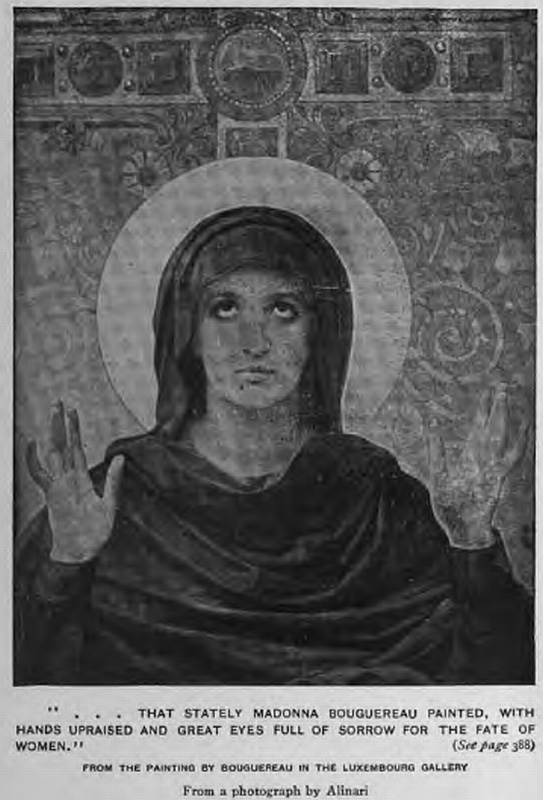
Those were the nights when I could have torn out my tongue for making vows before God to Maurice Stair; when my soul was blotted with hatred; when I drove the knives of scorn and contempt into myself for desecrating my life, and my father’s name by such an alliance.
On such nights I dared not open my lips to Maurice. I feared myself too much. Locked in my hut I would spend hours watching with dry eyes the spectacle of pride writhing in the dust. Or kneeling before the tortured body of Christ crucified, but not daring to lift my face to him, nor to the lovely face of that stately Madonna Bouguereau painted with hands upraised and great eyes full of sorrow for the fate of women; no prayer would come to my bitten lips, nor tears to my scorched eyes; but the cry of the desolate and the despairing was in my heart.
“Oh, Mother of Consolation!... Help of the Afflicted... ora pro nobis!”
Often when dawn, that scarlet witch, with golden fingers came tapping on the canvas windows I would still be kneeling there, stiff-limbed, my shoulders chilled to stone above my gown. And after a little while I would open my door and go out into the sweet wild morning. Strange that sometimes it almost seemed as if the pagan witch had more healing in her golden hands than the Mother of Sorrows herself; for standing there gazing at her rising from the mists of the hills like a goddess from the incense on her altars, I would feel at last the frozen tears thawing in my heart and surging to my weary-lidded eyes.
There were other hours when battles of a different kind were to be faced, not with myself but Maurice. Thrusting himself violently into my hut he would revoke all promises and trample compacts under foot, making demands of me that seemed to fill and darken the room with shame: transforming me into a pillar of ice that could utter no word but one—a word that fell like a little cold icicle into space, re-forming again upon my benumbed lips to fall and fall again. “No—no—no—no—no—no.”
There was such a night that ended at dawn with an unspeakable struggle—scorching kisses on my bare shoulders, and a blow across his lips that left blood upon my clenched fist.
Ah! those were dark days! Desperate, soul-deforming nights!
There was another night when after bitter taunts had been hurled like poisoned arrows round the room, he tore the bed-clothes and pillows from my bed and the gowns and hangings from the walls and flung them in heaps and tatters into the rain-sodden yard. When the boys came in the morning to their work they picked everything up, cleaned and dried them as best they could, and with calm, inscrutable faces replaced them in my room.
After such incidents came intervals of days and weeks in which we never opened lips to each other. I moved about his house like a ghost, passing from hut to hut, arranging his meals, ordering his household, but speaking him no word, or if I did getting none in return. When we rode together, because it had become a set habit to mount our horses at a certain hour every afternoon, we never addressed each other except in the presence of other people who might chance to join us in our ride.
One day when we sat at table and I crossed myself for grace, as I had always been accustomed to do, he found a new jibe to throw at me.
“It makes me sick to see you sitting there tapping at yourself like an Irish peasant!”
Swiftly I found words to requite him for this new outrage. Until then he had at least left my faith untainted by his touch.
“Oh, Maurice!” I said. “If you were only an Irish peasant I would wash your feet and dry them with my hair.”
I spoke very softly, but my words brought two little streaks of red into his cheeks, as though I had flicked them there with a whip. God forgive me, I had developed a cruel tongue; I was no Angel in the house: only a sorely driven woman. And it was true that I would have poured out gifts at his feet if he had only been an Irish peasant with any of the nobility of some of the natures that come to birth in that sad land of beauty. If only he had possessed some of the lovely Irish traits that draw love as the sun draws the dew—generosity, a few ideals, a sweet thing or two about his heart, a little room in it for dreams and beauty!
If even his sins had been big sins I should have felt some hope. Had everything he did been of the same calibre as his coming to table in his dirty flannels, offensive and discourteous as that action was, I could have forgiven much. There is hope for the boldly offensive man who does not care a button whose feelings he hurts, or who sees his sins. Such men usually have the force of character to do big, bold, fine things also to offset their offences, and such men never fail to bring women to their banner; for women, above all things, love in a man the quality of bigness.
But a man who lies and is a coward! who drinks whiskey in his room, and afterwards eats cloves! who pats animals in public, and viciously kicks them in private! whose wretched puling sins are afraid to stand on their own legs and assert themselves as sins—hiding behind doors, skulking in the darkness!
Oh! there were days when, as we rode together over the short golden grass, I wished my horse would throw me and break my neck—and did not pray at night for forgiveness for that sinful wish. In the terrible season of drought that had fallen, the source of prayer was beginning to dry up and fail.
In a letter from Judy, which came from Australia this passage occurred:
“I hear that the petit sobriquet Rhodesians have for you since you went to Mgatweli is ‘Ghostie’ Stair. They tell me you are as gay and witty as ever, and seem to be extremely happy in your marriage, but have become as white and spectral as a ghost. Doesn’t the place agree with you? Dickie is flourishing, and I have got a splendid German governess for him. John is a perfect Pet.”
Chapter Twenty.
What a Vulture Told.
“As I came thro’ the Desert thus it was— As I came thro’ the Desert.”
For a reason that had to do with my intense love for animals I had steadfastly refused to have any pets, though I had been offered an adorable Irish terrier puppy, a tame meerkat and a baby monkey.
But one day, Major Ringe, the magistrate, a big, fair man of forty with innocent eyes, lank limbs, and a reputation in the Gunners for valour second to none, brought me a pretty little white kitten that I could not resist.
It had china-blue eyes and other traces of Persian ancestry, but its chief charm was its lovely fluffy playfulness, and soft snowballiness. It seemed to me I had never had anything so sweet and wonderful in my life since the day Anthony Kinsella left me. It was like a little blue and white cloud dropped from the skies: it brought back dreams.
We called it Snowie, and from the first Maurice seemed as fond of it as I, and insisted that Major Ringe had meant it for him also. I was only too willing to share it with him if he really cared, but I was always a little nervous for fear that in some sudden gust of rage he might give the little trustful thing a bang. But at other times, when I saw him fondling it with real tenderness in his eyes, I reproached myself, and a piercing thought darted into my mind.
What if I am ginning against him? What if in my selfishness and pride I am wickedly unjust to him? Perhaps if he had a child to love—he would be different!
Yet when I thought of a child of mine—with Maurice’s eyes and Maurice’s ways—I turned sick and faint, and I flung the thought out. But it came back and back, roosting in my mind, pecking at my heart like a little black vulture.
I let him have the kitten to himself when he wanted it, and he would take it away to his room. We got into the way of keeping it in turn to spend the night with us. But it always preferred me. It would escape from him whenever it could and come scampering back across the yard to me; and he following it in a rage, would grab it up roughly, accusing me of feeding it in the night to make it like me best!
The nights I had Snowie I slept well, dreaming I had a child with Anthony Kinsella’s blue eyes, nestling at my heart. I often woke crooning to it as my old Irish nurse used to croon to me:
“Hush-a, Hush-a, Hush-a, m’babee.”
But on the nights that I had no kitten to nestle against my throat, the little black vulture kept me company, staying with me unweariedly, plucking at my heart, asking little terrible questions to which I had no answer.
“Do you think Maurice Stair also croons over dream children?—does he give them the eyes of his love?—have they little hands that fondle him?”
“You have tried beguiling, and flattering, and scorn, and hate—is there nothing else left to try?”
“Is a man’s soul nothing?—what of the little smouldering spark down below, under the mud and weights—is it still there?—or have you put it out?”
“Who are you to keep yourself so aloof and proud?—do you think women have not sacrificed themselves before to-day—better, nobler women than you?”
“Yes—but for love—for love—for love!” I cried, and wept till dawn.
One night it was raining terribly when Maurice got up to leave the drawing-room and go across to his hut. Lightning was streaking between the trees, and great crashes of thunder seemed to fall bodily from the skies and explode like tons of dynamite amongst the kopjes, echoing and detonating through the land.
It was Maurice’s night for the kitten, but she didn’t want to go. She tried hard to get away to me, but he tucked her into the pocket of his mackintosh, and only the top of her little fluffy face was to be seen gazing at me with appealing blue eyes.
“Let her stay for a little while, Maurice,” I said, “just till the storm goes off a little. I’ll bring her over to your door later. She’s afraid of the storm.”
“Nonsense: the storm won’t hurt her. Get back into my pocket, you little devil.”
But the little devil only mewed the louder, and tried the harder to escape, gazing at me imploringly. I turned away with my eyes full of tears. She was so like a child asking to be left with its mother. I knew, too, that I had a wretched night before me with a black companion. I should have been glad of the little furry thing snuggling against me. But it was Maurice’s turn.
“Good-night!” I said abruptly. “I shall stay here till the storm goes down. I’m afraid of the lightning in the trees.”
He said good-night, and went out into the storm, his mackintosh buttoned round him, lantern in hand. I stood watching in the door, and heard him stumbling against tree trunks and swearing, until he found his hut. Then the door banged, and light gleamed through his canvas windows.
Presently when the lightning was not quite so vivid, I wrapped myself up, and locking the drawing-room door beat my way across the compound to my own hut. Though the journey was only a matter of a few seconds I was wet to the skin when I arrived, and hastily throwing off my clothes slipped into bed. As I put out my light I thought I heard Snowie mewing again. I was very tired, and, contrary to my expectation, fell asleep very quickly. Perhaps the vulture was tired out too.
I dreamed I saw Snowie backing away from the fangs of a wolf and crying piteously. I rushed to save her, but the wolf already had her, and was mauling the life out of her. Her screams were terrible—almost human! They woke me up. With a wet forehead I sat up in bed, listening. But I could hear nothing; only bursts of thunder, the whip of the rain on the trees, and the swish and ripple of little streams tearing down the sides of the hill. The storm had increased.
After awhile I lay down again, but I could sleep no more. The cries had been so real they haunted me. I considered the matter of going over to Maurice to see if all was well with the kitten. I had never entered his hut, only looked in the door daily, to see that it was kept clean by his boy. What excuse had I to knock at his door in the middle of the night? He would probably, and with every reason, be very indignant at being waked up. Nevertheless, I presently found myself on the floor groping for my slippers and feeling for my cloak.
When I opened the door a wild blast tore in, lifting my cloak to the roof, and in a moment the front of my night-gown was like a wet rag, and my body streaming with wet. It was no use attempting to take a light. I stumbled among the trees, in the thick darkness; blinding lightning flickered across my eyeballs like liquid fire, but it showed the way, and at last I reached the door I knew to be Maurice’s and battered on it. Silence!
“Maurice! Maurice!”
Silence again. Nothing but the flacking rain and pealing thunder. Within, all was darkness and silence; evidently Maurice was fast asleep, and Snowie too. My worry had been about nothing. How foolish to be so disturbed by a dream, I thought, as I beat my way back, and once more sought my bed. Still, I was glad I had gone and set my mind at rest.
By one of those extraordinary lapses of memory that sometimes occur, I woke in the morning with no recollection of the night’s adventure. I had slept it all away. The only thought in my mind as I jumped out of bed was that if I did not make double-quick time Maurice would be at the breakfast table before me, a thing I never allowed to happen since he had taken to rising for breakfast. I flew through my dressing, and was still five minutes to the good when I ran across the yard in the morning air of a world washed, and fresh, and glittering like crystal.
To my astonishment Maurice was not only at the table, but had finished his breakfast.
“But why so early?” I cried in surprise.
“I had a message from Ringe to say that he wants me at the court early.”
As he finished speaking Mango entered to say that Sergeant Locke was outside, wanting to speak to the master. Maurice rose hastily, putting his serviette to his lips, and as he did so I saw upon the back of his right hand three long deep scratches. In an instant he had whipped his hand into his pocket. He gave me a searching glance which I noticed but vaguely, for at that moment the whole of my last night’s dream and adventure in the rain had come flashing back, brought to memory by the sight of those deep new scratches on the back of his hand. While I sat thinking I heard Sergeant Locke’s voice saying:
“Major Ringe went off at four this morning, sir, with Mr Malcolm—they got news last night of a lion out at Intanga. As they rode by the camp the Major called me up to ask you to see about Masefield’s boy at the court this morning. It is the only case there is.”
“All right, Locke.”
Then how could Maurice have received a message from Ringe? Why had he got up so early and finished his breakfast before—What was that scratch?
As these questions flashed one after the other through my mind, I sprang up and ran to the door. He was just flicking the reins on his horse’s neck for it to start. He hardly ever wore gloves, but he had a pair on this morning, and the scratch was hidden.
“Maurice,” I cried out, “where is Snowie?”
He turned on his horse without stopping it and regarded me with surprised eyes.
“Snowie?”
“Yes—my kitten?”
“Why, haven’t you seen her around the place this morning? She was in the dining-room a few minutes ago.”
“Oh!” I cried, and my heart nearly burst with relief. I waved to him, gladness in my smile, and ran back into the dining-room calling the kitten. “Snowie—Snowie—Snow—ie.”
Later I went into the yard, and all round the huts, still calling. But she did not come running with her little tail erect and her little pink mouth open. There was no sign of her. I turned to the boys, but their faces were blank walls. No one had seen her that morning. I questioned Mango. He had not noticed her, he said. Doubtless if the Inkos said so, she must have been in the dining-room, but he had not happened to notice her.
The other boys seemed to be observing me closely, but when I returned their searching gaze they dropped their mysterious dark eyes to the ground, after the manner of kaffirs. None of them had seen Snowie since the evening before, when I had crossed to the drawing-room with her on my shoulder, after dinner.
Maurice came home very gay and hungry to lunch. He had easily disposed of the one case, he said; but he and Clarke, the magistrate’s clerk, had had a great morning hunting a wild-cat that had taken refuge under the courthouse, and refused to budge. It was imperative to get her as she had been after Clarke’s canaries.
“At last we smoked her out,” he related, “and she came for me like a red-hot devil. If I hadn’t put up my hand she’d have had my eyes out. Look what she did to me.”
He held out for my inspection the hand with the long deep scratch I had seen at the breakfast table! I stared at it speechless. He withdrew it and proceeded with his lunch. Presently he related to me several bits of news he had heard in town that morning. He was, for him, extraordinarily talkative.
“And who do you think have just arrived here?—the Valettas. They’ve taken that big thatched place that Nathan, of the Royal Hotel, has just put up. Mrs Valetta is very sick—fever and complications—never been right since Fort George, Valetta says. He’s brought her here from their mine, to get some good nursing before he can take her home.”
I was silent as the dead.
“Valetta has struck it rich somewhere to the north of Buluwayo, and is going home to float a company as soon as his wife is well.”
“Maurice, Snowie cannot be found. We have searched everywhere for her.”
He put down his coffee cup.
“But that is strange! I tell you she was in the room here when you came in this morning. I had just given her a piece of bacon.”
I looked away from him. It was not good to watch his eyes when he was lying. It seemed to me that I saw something in them black and naked jibbering at me like a satyr.
“What made her cry out last night—in your hut?—”
“Last night?—in my hut? She didn’t stay with me, you know. The little brute was so ill-tempered and vixenish, and so determined not to stay, that I opened the door and threw her out about half an hour after I left you.”
“Into the storm?”
“Oh, the storm! Pooh! cats know how to look after themselves. She evidently did, for she was as lively as a cricket in here this morning. What are you worrying about, my dear girl? She’ll come sidling in when it pleases her. She’s gone off on a hunting trip like Ringe. All the cats in this country are more than half wild.”
I got up and left the table, my heart like a stone: not only for my little snowbally cat with her winning ways, but for myself. At that moment I terribly hated life.
“I’m going to ride out and see if Ringe got that lion,” he called after me. “Will you come?”
“No!”
I had planned to go ferning that afternoon to a creek near by. The ground of my grotto was all prepared for the new plants, but I could not bring myself to start. I kept wandering up the kopje side, and among the zinias. At last, as I came to the huts again, I heard the boys wrangling outside the kitchen.
Mango was a Zanzibar boy and always at variance with the Mashonas. Maurice’s servant, Sixpence, a shrewd-looking fellow of about seventeen, was squatting on his haunches opposite the door, fiercely and monotonously demanding soap; some clothes lay beside him on the ground. He must go to the river and wash, he announced. But Mango replied that all the washing was done the day before yesterday, and declined to hand out soap. Coffee was backing up Sixpence, and telling him that as the master’s boy he had a right to ask for what he wanted, and get it. Makupi, who in spite of curses and blows was quite one of the domestic staff, though he never did any work, was turning over the soiled linen with his foot when I came up.
“But it is not washing day, Sixpence,” I objected. He arose quickly and gathered up the things he proposed to wash, muttering imprecations on Makupi for spreading them out. He rolled them hastily, but a little too late, into a ball. I had seen what he wanted to wash—a suit of pale blue pyjamas with fresh stains of blood all over them.
“The master told me I must go and wash to-day,” he repeated sullenly.
“Give him soap, Mango,” I said dully and walked away. It was no use looking for Snowie any longer!
For three days I did not speak to Maurice. I saw to his house and food, but I would not sit at meals with him, and I would not speak to him. He bore all with a cheerful air. I often heard him whistling. On the third day he wrote a note and sent it to my hut by Sixpence:
Would I be so extremely kind and condescending as to grace his table that evening? A rather important man from Salisbury was in, and coming to dinner. Of course I was full of imaginary grievances against him (the writer) but perhaps for the sake of appearances I would be so exceedingly gracious as to forget them for an hour or two. He had not the slightest objection to my going back to my sulks afterwards.—Mine effusively, Maurice Stair.
I arranged a good menu with Mango, decorated the table, and was ready to receive his guest. Dinner passed as smoothly and pleasantly as a deep river may glide over dark unthinkable things.
Just as the boys were putting the dessert upon the table I felt something against my skirt. I pushed back my chair and looked down. Snowie had come home.
With a cry I caught her up and put her on the table before me. The next cry came from the guest.
“My God!—the fiend who did that ought to be—hanged!”
There was a silence that the kitten tried to break. She essayed to mew, almost as if she had something to tell; but no sound came from the broken jaws gummed together with matter and dried blood. One blue eye gazed dully round, the other was battered into her head like a crushed turquoise. Every paw but one was broken; they trailed behind her, and her body waggled strangely from an injured spine. I was afraid to take the little mangled body to my breast for fear of what fresh pain I might cause it. I thought I heard it moaning like a woman: yet its mouth did not move.
“Hanging would be too good for the brute—brandy, Stair—your wife is fainting.”
“No—no; milk—bring warm milk for my baby—it has Anthony’s eyes—my poor little white baby—all broken—”
The moaning that did not come from Snowie filled the room.
“No use giving the poor little beggar milk, Mrs Stair—it is dying—better to put it out of its misery at once—drink this brandy, will you—got any poison in the house, Stair?”
“Yes.”
The man took the kitten from me and went from the room, and I followed; but as I passed Maurice Stair I whispered three words at him, with terrible eyes: