IV New York, the Unclean (continued 2)
Reading edition
A few of these cases will abundantly illustrate the point:
Dr. J. S. Sprague, of Cooperstown, Otsego County, reports the occurrence of twenty-six cases of smallpox in that town, communicated by one person in October, 1860, who took the disease at a hotel in our city, in which a person with the disease had recently died. He was a merchant, and came to the city on business.
Dr. C. C. F. Gay, of Buffalo, reports the case of a female, who arrived from New York in November, 1860, and was removed from the cars of the Erie Railroad to the State Line Road, and proceeded westward. As was afterward ascertained, she had smallpox, and communicated the disease at Columbus, Ohio, where there were three deaths produced by it. Four deaths were directly traceable to this exposure, viz.: three milkmen and one baggage man, all of whom came in contact with the sick woman.
W. T. Babbitt mentions the case of a young man who took the disease in this city at a hotel where it was prevailing, at which he stopped while on a visit here, in whom the disease appeared after his return to Olean, in Cattaraugus County.
Dr. M. Jarvis, of Canestota, Madison County, relates the case of a man who visited this city with horses for sale, and was attacked with symptoms of smallpox some ten days after his return to Smithfield, in that county, who communicated the disease to his family, from whom it spread to others in that and, also, in a neighboring town.
Dr. C. M. Noble, of Waverley, Delaware County, mentions the case of a merchant of that place, who came to this city with his wife, and went to one of our most frequented hotels. Being very much fatigued, they retired to the room provided Smallpox in a Hotel Bedroom for them without any particular examination of it—but found in the morning that they had been put in a room from which a patient with smallpox had just been removed, without its having been cleansed. The gentleman was seized with a malignant form of that disease after his return home. Two deaths and six cases of smallpox and varioloid resulted from this case.
Dr. S. W. Turner, of Chester, Connecticut, gives also two cases, one of smallpox and one of varioloid, in that and a neighboring place, which could be traced to this city.
Dr. Snow, the vigilant Health Officer of Providence, R. I., states that smallpox is rarely known in that city, except when imported from New York.
I could repeat these details until it was shown that nearly every town in the State, and nearly every city in the country, has been inoculated by New York with this most loathsome disease. The most striking and most melancholy instances of New York Inoculates the Nation the free dissemination of contagion are found in the army, where whole regiments have been stricken with smallpox through infected clothing manufactured at the homes of the poor, where the disease was prevailing. But these are facts too well known to every medical man, and even to the community, to require further illustration.
What terror smallpox creates in country towns when it attacks its first victim, you very well know. The house where it occurs is quarantined, and not unfrequently the sufferer is deserted by his friends, and left to recover or die, as the case may be. Business with the country is often suspended by the placards posted upon the highways, with the terrifying word “Smallpox” upon them, and a finger pointing ominously to the town. In nine cases out of ten, another finger should point toward New York, as the source of the pestilence.
It has been estimated by a competent observer, that every case of smallpox in a country town costs, by derangement of business alone, more money than is annually expended upon its public schools. If we add to this pecuniary loss the feverish excitement and popular apprehension, and the sufferings and probable death of the victim from want of proper care, we may but indifferently estimate the cost to the country of the prevalence of this disease.
Now, this diffusion of contagion from New York, we contend, is unnecessary. Every well-informed medical man knows that we may have a sanitary police so vigilant, so efficient and so powerful, that it will not only preserve the public health, but prevent the spread of disease therefrom. We hold, therefore, that you are not only called upon to protect the people of the City of New York from contagious disease, but equally that you are bound to protect the people of the State from dissemination of pestilence by every legislative safeguard which sanitary science can suggest.
The Sanitary Committee of the Board of Health, during the prevalence of cholera in 1849, remark in their report:
“The labors of your committee, during the Inefficiency of Health Organizations past appalling season of sickness and death, and the awful scenes of degradation, misery, and filth developed to them by their researches, have brought into full view the fact that we have no sanitary police worthy of the name; that we are unprotected by that watchful regard over the public health which common sense dictates to be necessary for the security of our lives, the maintenance of the city’s reputation, and the preservation of the interests of the inhabitants.”
This is a perfectly truthful statement of the present condition of New York. Practically, it is a city without any sanitary government. In its growth it is developing the natural history of a city that utterly ignores all rules and regulations which tend to Without Sanitary Government make the homes of its people pleasant and healthy. It is the only city in the civilized world which disregards the Platonic idea that in a model republic medical men should be selected to preserve and promote the public health. Its board of health, the mayor and common council, is an unwieldly body. Its commissioners of health have limited powers, and are equally incompetent.
The City Inspector’s department, which alone has the machinery for sanitary inspection and surveillance, is a gigantic imposture. Of its forty-four health wardens, whose duty it should be to make house-to-house inspections, searching out the cause The City Inspector’s Department of disease, and using every known agency for the control and suppression of epidemics, many are liquor dealers, and all are grossly ignorant. Not one has any knowledge of medical subjects, nor dare they freely visit such diseases as smallpox, typhus, or cholera.
During this entire voluntary inspection, extending over six months, health wardens have rarely been known to visit infected quarters, although smallpox, fever, etc., etc., have been prevalent, and the city has been in a most disgracefully filthy condition. A single health warden recently ventured to visit a house where smallpox existed in an upper room; he sent for the attendant, and when she appeared, ordering her not to approach him, he gave the following as the best means of prevention: “Burn camphor on the stove, and hang bags of camphor about the necks of the children.”
To what depth of humiliation must that community have descended, which tolerates as its sanitary officers men who are not only utterly disqualified by education, business, and moral character, but who have not even the poor qualification of courage to perform their duties. But perhaps the most decisive proof of the utter and hopeless inefficiency of our multiform health arrangements is found in the fact that all the evils from which we now suffer have grown up under their care. A late City Inspector thus emphatically gave expression to the popular feeling in regard to existing organizations:
“With such a system, can there be a wonder that the sanitary condition of the city is not improved? * * * Nor must the consideration be kept from view, that the members of the common council, the board of health, and commissioners of health are all, from the manner of their appointment, subject to partisan influence. To expect a perfect sanitary system, under such a condition of things, is to expect an impossibility.”
The medical officer of health for the City of London, a gentleman of large experience, thus defines a health organization capable of answering the demands of a large and growing town: “The object of this organization lies in a word: inspection, inspection of Sanitary Inspection the most constant, most searching, most intelligent, and most trustworthy kind, is that in which the provisional management of our sanitary affairs must essentially consist.” The results of this work of voluntary sanitary inspection which I have before me prove on every page the truth of the above statement. No health organization without daily inspection would have any efficiency.
Of the value of such thorough inspection in the suppression of epidemics, and in the prevention of disease, there are abundant examples. The people of a populous town of England, becoming alarmed at the approach of cholera in 1849, organized a corps of inspectors, whose duty it was to visit from house to house, and inquire for cases of premonitory diarrhoea, and when found to apply the remedy at once. The result was that cholera did not visit that town. The same systematic house-to-house visitation was adopted in some poor districts of London in 1854, and there was an almost complete exemption of those parts of the city, while some quarters of the wealthy, which were not under such surveillance, suffered severely.
But it is essential that this inspection should be by thoroughly qualified medical men, and it must consist in a house-to-house visitation. Disease must be sought for, found, its incipient history completely made out, the causes upon which it depends Inspection Must Be Thorough reported, and its remedy suggested. Every case of death should be visited, and all the circumstances attending the development of the disease, if it belong to the preventable class, should be rigidly investigated and reported, in order that the central bureau may apply the proper remedy.
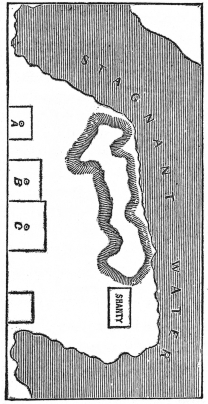
FEVER-BREEDING STAGNANT WATER, EIGHTH AVENUE, BETWEEN 75TH AND 76TH STREETS, 1865
Striking examples of the value of medical sanitary inspection are furnished by this voluntary organization. One inspector found diarrhoeal affections very prevalent in a settlement in an up-town ward, and for a long time was baffled in his efforts to discover the cause. He was finally led to examine the water of a neighboring well, which the people used. This water appeared to be of an excellent quality, but on examination by Prof. Draper, it was found to contain a large amount of organic matter, derived either from a sewer or privy. Prof. Draper pronounced it liquid poison. The mystery was at once solved, and the proper remedy suggested.
In another instance a very contagious disease was found in a tenant-house, and after a long course of inquiry it was at length discovered that a washer-woman, living in the basement, had taken in sailors’ clothing. The sailors were found, the ship visited from which they came, and there the disease was found. None but medical men can prosecute such investigations with success, or suggest the proper remedy. If such a corps of sanitary inspectors were daily patrolling their districts, visiting from house to house, searching out sanitary evils, advising and aiding the people in the adoption of preventive measures, no epidemics of smallpox, typhus, scarlet fever, or cholera would ever gain more than a transient foothold. The sanitary inspector would truly become an officer of health and would be everywhere welcome.
The remedy for our evils must be apparent; and this remedy is suggested in such terse unqualified language by the City Inspector above quoted, that I call the attention of the committee especially to this remark, as a proper guide in your deliberations. The Remedy In the City Inspector’s report for 1861 we find the following:
“The stay of pestilence, to be effectual, must be prompt, and equally prompt must be the interposition of barriers against the introduction of disease, which may be kept back, but, once introduced, can with difficulty be checked or extirpated. For these reasons, there should be a power existing in other hands that may be ready to be used at the moment the exigency may arise.” * * * “The remedy, apparent to every one, must consist in the adoption of laws transferring the power of sanitary regulations to some other authority of a different order of instruction in sanitary science.” * * * “The first groundwork of reform, in the opinion of the undersigned, is to bestow upon some other body, differently constituted, all power over the sanitary affairs of the city; and, until this is done, all other proposals of reform will be deprived of their essentially beneficial features. To escape present complications is the first great point to be gained; and this point secured, simplicity, promptness, and efficiency may be substituted for inefficiency, complication, and delay.”
Accepting this as the first step in reform, the practical question arises: How shall that body be constituted to which is to be confided the sanitary interests of New York?
If the experience of other large cities is of any value, or, indeed, if we rely simply on common sense, the following are indispensable prerogatives in any well-organized health board:
1. It should be independent of all political influence and above all partisan control.
2. It should combine executive ability with a profound knowledge of disease and the proper measures of prevention. To this end the board should be composed in part An Efficient Health Board of men especially accustomed to the dispatch of business, and in part of medical men of great skill and experience.
3. It should have a corps of skilled medical officers as inspectors, which should be the eyes, the ears, in a word, the senses of the board, in every part of the city, searching out disease, investigating the causes which give rise to it, the conditions under which it exists, the means of its propogation, and the most effectual mode of its suppression.
4. It should have a close alliance with the police, which must be its arm of power in the prompt and efficient execution of its orders.