Front matter (continued 6)
Thomas Johnes translation
Page 49. line 9. from the bottom. Attempt.] Together with the queen and the prince of Wales, the dukes of Exeter and Somerset, the earls of Devon and Wiltshire, the lord Clifford and many other great lords, were on the king's side this day. The young duke of Rutland was murdered in cold blood by the barbarous Clifford. The duke of York himself was killed in the field, not made prisoner as in the text. The earl of Salisbury was made prisoner and carried to the castle of Pomfret, where "he had grant of life for a great ransome, but the common people of the country, who loved him not, tooke him out of the castle by violence, and smote off his head." The earl of March, now duke of York by his father's death, and afterwards king of England, was at Gloucester when this event happened.
Page 54. line 5. Uncle.] Probably Ralph Nevil, earl of Westmoreland, who is named among the slain at this battle.
Page 55. line 2. from the bottom. Earl of Northumberland.] Henry Percy, the second earl of that name and family who fell in this long conflict. The former was killed at the first battle of St. Alban's, mentioned before, vol. ix. p. 360. I believe that no earl of Shrewsbury fell on this occasion, and that the continuator of Croyland in this point confounds the battle of Towton with that of Northampton mentioned before, p. 48.
Page 58. last line. Towton.] He was created earl of Northumberland in 1463, and marquis of Montacute, or Montague, a short time after; but in 1466 he resigned the earldom in favour of Henry Percy, son of the earl who was killed at Towton.
Page 64. line 13. Lord de la Roche-Bourguignon.] Not de la Roche-Bourguignon, but de la Roche, a Burgundian. This Philip lord de la Roche, was afterwards in high favour with king Louis, and advanced him to the dignity of count of St Pol, on the attainder and confiscation of the constable.
Page 73. line 13. from the bottom. Counts of Angoulême.] John count of Angoulesme, brother to the duke of Orleans;—Charles of Artois, last count of Eu;—John of Bourbon, count of Vendôme.
Page 73. line 12. from the bottom. Grand-Prè.] Henry de Borselle, a nobleman of Holland, who purchased the county of Grand-Pré from Raoul le Bouteiller. He was father to Wolfhard de Borselle, marshal of France.
Page 73. line 11. from the bottom. Sir Philip de Savoye.] Philip of Savoy, lord of Bauge, younger brother to the prince of Piedmont, who married a daughter of the duke of Bourbon, and became duke of Savoy on the death of his grand nephew, Charles II. in 1496; John the elder, count of Nassau.
Page 74. line 10. Duke of Bourbon.] Peter de Bourbon, lord of Beaujeu, who married Anne of Valois, daughter of Louis XI. and became duke of Bourbon on the death of his elder brother without lawful issue in 1488. James de Bourbon, a younger brother of these, died young and unmarried.
Page 77. line 19. Lord de la Roche.] Philip Pot, mentioned before in p. 64.
Page 78. last line. Perdriac.] Pardiac. See notes to vols. vii. viii. and ix. Qu. If the count de la Marche and de Pardiac was not one and the same person?
Page 81. line 9. Count du Perche.] René, duke of Alençon, after the death of his father in 1476. His mother was Joanna, daughter to the duke of Orleans.
Page 82. line 7. from the bottom. Sister.] Mary of Anjou, queen of France, who survived her husband only two years, dying in 1463.
Page 93. line 7. Relative.] I do not understand what relationship could possibly have existed between the count de Charolois and the duke of Somerset, and must therefore set this down under the head of mistake.
Page 95. line 18. Master Nicholas Raullin.] Or Rollin. He was father of the lord d'Aymeries, mentioned before in chap. lxviii. of volume, ix. and, by merit, had raised his family from a middling station of life to the honours of nobility. Heuterus.
Page 98. line 7. Deceased.] Joan de Bar only daughter and heir of Robert, count of Marle and Soissons. Her children are said by Moreri to have been John, count of Marle and Soissons, who was killed in 1476 at the battle of Morat; Peter II. count of St. Pol; Anthony, count of Brienne, and Charles, bishop and duke of Laon.
Page 98. line 19. Duchess of Orleans.] Mary, daughter of Adolph, duke of Cleves, third wife of Charles, duke of Orleans. The infant of whom she is now delivered was afterwards king of France by the name of Louis XII.
Page 107. line 6. Accuser.] Heuterus relates the subject of this chapter with some varieties which deserve to be noticed. "Coustain," he says, "is reported to have sent his accomplice (whose name is latinized to Ingiëus) into Savoy to a famous witch, from whom he received certain waxen images of the man whom they designed to destroy, over which various and admirable forms of incantation had been practised." Arquembart the informer, should be Hacquenbach—"Petrus Haquenbachius, vir nobilis." Heuterus adds that, in making his confession, Coustain did not accuse any of the family of Croy, or other great nobles of Burgundy who were most suspected on the occasion by the count of having instigated the crime; but he says, "The wiser sort, however, had their suspicions with regard to king Louis; and the opinion which they now secretly entertained seemed to be afterwards confirmed, when they learned that he had procured the death of his own brother, merely to avoid giving up to him a small portion of his dominions." This is a very curious passage, for although the alledged murder of the duke of Guienne, Louis's brother, is at least a very doubtful point of history, and although, if manifestly proved, it would be a strange piece of sophistry to urge that the perpetration of one crime ought to be admitted as evidence of the intention to perpetrate another, wholly unconnected with it either in time or circumstances, yet it sufficiently shows what must even at the commencement of his reign have been the character of the king, and the opinion generally entertained of his dissimulation, perfidy, and inhumanity. I imagine however, that Heuterus is hardly to be credited when he adds that the suspicion entertained by the duke of Burgundy on this occasion was the immediate cause of his quarrel with the king whom he suspected; unless it be conjectured that among the secret confessions mentioned in this chapter to have been made by the villain Coustain previous to his execution, he actually accused the king and supported his accusation by some very pregnant reasons. If this be admitted, it may justify in a great degree the assertion of Heuterus just mentioned.
Page 110. line 12. Lord de Goux.] Qu. Joux? Peter de Beaujeu du Columbier, lord of Joux, Montcoquier, Asnois, &c. died after 1469 leaving Blain, lord of Joux, his son and successor.
Page 116. line 11. Duty.] Heuterus adds that it was the purpose of the king, with the profits of the Gabelle to have redeemed the lands on both sides of the Somme which were assigned to the duke by the treaty of Arras.
Page 116. line 4. from the bottom. Stamp.] The question, as stated by Heuterus, was "solidiori è materia Boni ne corpus coagimentatum foret, quam ceterorum principum?" To which Chimay is made to answer, "Imò: nam nisi id ita foret, quomodo te patris iram fugientem recipere, &c. &c. ausus fuisset?" The king was greatly confounded, and from this time said no more about the gabelle; but the duke of Burgundy, by the advice of the lords of the house of Croy, and to the great displeasure of his son, shortly after gave up the towns on the river Somme, as is mentioned in chapter 23.
Page 118. line 3. from the bottom. Duke of Orleans.] Qu. Peter, lord of Beaujeu, was married to Anne daughter of Louis XI. This might be a second marriage; but I do not find it so in the genealogical tables which I have consulted.
Page 119. line 8. Lord d'Arquel.] Here is a double mistake in the genealogy. Catherine, third daughter of the duke of Bourbon, married Adolphus, son of Arnold duke of Gueldres, who was himself duke of Gueldres after his father's death in 1473, and might, during his father's life time, have been sometimes stiled the lord of Arckeln, which lordship came into his family by the marriage of his grandfather John count of Egmond with the heiress of Arckeln and Gelders. The connection of the families of Gueldres and Cleves with each other and with the house of Burgundy will be better understood by the following table, which will also explain at one view the mode by which the duchy of Gueldres passed successively by marriages into the families of Juliers, Arckeln, and Egmont, and the county of Cleves into that of Marck, and how the younger branch of Cleves came into possession of the county of Nevers.
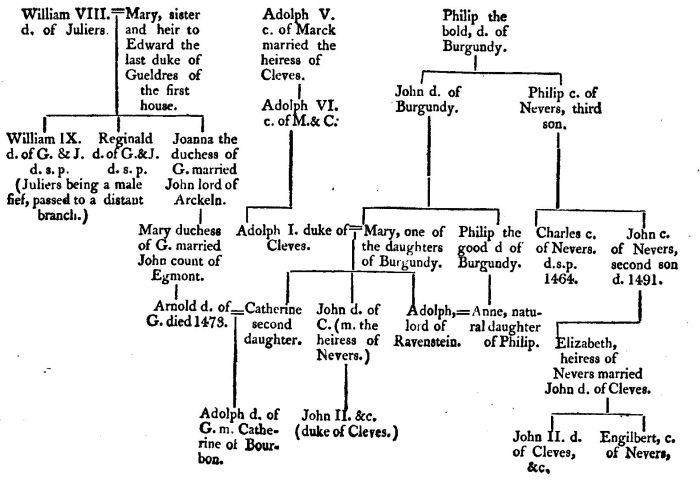
Page 125. line 2. Lord de Montigny.] Simon de Lalain, lord of Montigny, who died in 1478, was the father of Jodocus, lord of Lalain and Montigny, governor of Holland, who was killed at the siege of Utrecht in 1483.
Page 129. line 5. Navarre.] By the terms of the marriage-contract between John of Arragon and Blanche queen of Navarre, Charles prince of Viana, the eldest son of that marriage, ought to have succeeded to the kingdom immediately on the death of his mother. This was, however, delayed from time to time and at last effectually prevented through the intrigues of Johanna Henriques the second wife of king John. A civil war was the consequence of these acts of injustice, and the prince sought the protection of a stronger power by an alliance with Isabella sister of Henry IV. of Castile. This treaty also was rendered abortive by the intrigues of his step-mother. He was then inveigled to Lerida under colour of a pacification, and treacherously made prisoner. Being at last liberated from his confinement to appease the dangerous indignation of his adherents, he ended his life in a few days, being, as some say, poisoned while in prison, but more probably from the effects of ill-treatment and sorrow.
Mean-while, Blanche, his eldest sister was divorced by her husband Henry the fourth, for no fault of her own; and the count of Foix (the husband of Leonora her sister) in order to possess himself of her right to the crown of Navarre, gained possession of her person and is reported, by connivance with his own wife, to have put an end to her days. After this, he turned his views toward the protection of France, which he hoped to secure by the marriage of his son Gaston to Magdalen daughter of Charles the seventh, and by a further union of interests between the crowns of France and Arragon. The advantage of these skilful manoeuvres soon displayed itself, when the Catalans, enraged at the death of the prince of Viana, which they attributed whether justly or unjustly to the king his father, revolted, and their example was followed by almost all the states of Arragon. King John, upon this, mortgaged the counties of Cerdagne and Roussillon to France, in order to obtain supplies to carry on the war, and the count de Foix obtained the principal command in the conduct of it. The rebels finding themselves too weak, naturally applied for assistance to Castille, and the war soon assumed a new face, the principals on each side being the king of Arragon and the count of Foix, and the king of Castille. The treaty here alluded to, at which the king of France assisted, was made in an island of the river Bidassoa which separates France from Spain. Its articles were such as to offend all parties concerned, and in particular to sow the seeds of future dissention between the French and Spanish nations. Those historians, however, may be thought rather too refined who attribute to this celebrated interview the foundation for that enmity between the two countries for which they have been remarkable in modern times. The connexion between the different crowns of Spain, and succession to the crown of Navarre will be best seen from the following table.
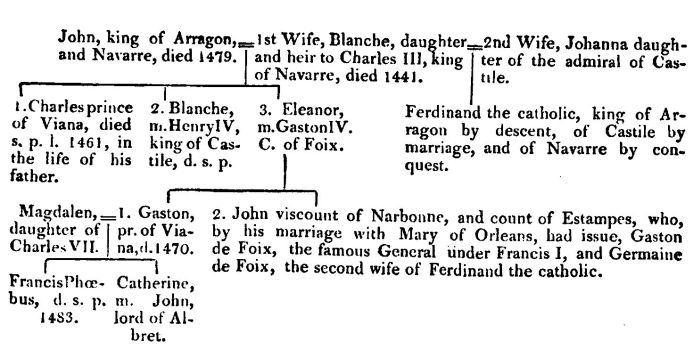
Page 131. line 2. Crown.] The principal crime of this nobleman, in the eyes of Louis, was his high favour with Charles VII. He afterwards escaped from prison during the war of the public good, and was at last restored to his offices about the court, and taken into the peculiar confidence of the king. One act of justice resulted from his temporary disgrace, the restitution to the heirs of Jacques Coeur of great part of the plunder made from the wreck of that unfortunate merchant's affairs. The count de Dammartin is said to have been one of the seven persons whom Louis excepted out of the amnesty which he granted to the duke of Burgundy's intercession on ascending the throne. Others were, as is reported the mareschal de Brézé, the lords de Loheac and de Chatillon, and the chancellor des Ursins. Duclos.
Page 135. line 5. from the bottom. Lord de Launoy.] This name should be always spelt Lannoy. John lord of Lannoy was son of another John lord of Lannoy by Joanna sister of Anthony lord de Croy and John lord of Chimay. See notes to the third volume.
Page 139. line 2. Duchess of Bourbon.] The table to p. 119. will explain these alliances.
Page 139. line 15. Cardinal of Arras.] Jean Joffredy; not bishop of Alby and cardinal of Arras, but bishop of Arras and cardinal of Alby. He was the son of a merchant at Luxeuil in Franche Comté. His ecclesiastical ambition displayed itself very early in life and pushed him on to the episcopal dignity through the patronage of the duke of Burgundy. He then found means to persuade his sovereign that it was for his dignity to have one of his own subjects promoted to a cardinal's hat and appointed papal legate in his dominions. Solicitations were accordingly made at Rome both by the duke and by Louis (then dauphin) to have this high honour bestowed upon Joffredy; and when Louis succeeded to the crown, Joffredy was given to understand that there would be no difficulty in his attaining the dignity provided he would use his best endeavours with the king for the abolition of the pragmatic sanction. Joffredy readily undertook the pious office enjoined him, and was rewarded with the red hat very shortly after. [Du Clos.
Page. 141. line 6. from the bottom. Reconciliation.] Ever since the war with the people of Ghent in 1452, the count de Charolois had seldom resided at the court of his father, and was chiefly at the castle of Gorcum which he had fortified so as to render it almost impregnable and ornamented for his residence at a great expence and with royal magnificence. See Heuterus.
Page 154. line 9. Duke of Berry.] Charles, duke of Berry, afterwards of Normandy, and of Guienne, the only brother of the king then alive.
Page 158. last line. Arms.] The unpopularity of the old duke of Savoy, and Amadeus, his eldest son, was principally owing to their unwarlike and devotional temper so adverse to the notions and habits of a martial nobility. Lewis, the second son, had married the heiress of Cyprus after the death of her first husband, the duke of Coimbra; and possibly the adventurous spirit of the times anticipated the glory of an expedition for the recovery of a kingdom which had been snatched from a female sovereign by an illegitimate usurper, aided by the forces of the infidels. Another and more just ground of discontent was the manifest subjection in which both father and son held themselves enthralled to the pleasure of the king of France. On the other hand, Philip count of Bresse, (a younger son of the duke of Savoy, not the third as here stated, but the eighth of his numerous male issue) was a prince of the greatest promise, of high military spirit, and a commanding person; and the duke his father (who, in the course of his religious exercises, had probably paid great attention to the history of David and Absalom) was so afraid of the popularity which these endowments ensured him, that he actually abandoned his dominions to seek the protection of Louis XI. against this imaginary danger. He was at this time very infirm in body; and Amadeus, his eldest son, who followed the steps of his father in all things, was no less so from his cradle.
Page 159. line 3. from the bottom. Bastard.] Baldwin the eighth son of this numerous family of bastards, was lord of Falaise and Somergheim, and had several children by his marriage with a lady of the house of la Cerda.
Page 161. line 10. from the bottom. Duke.] The historians of Savoy relate that this act of violence and injustice was committed at the suit of the duke of Savoy, his father. He was not released till after the old duke's death in 1465.
Page 161. line 3. from the bottom. John.] Before called the count of Estampes. His only daughter and heir conveyed the counties of Nevers, &c. into the house of Cleves, by marriage with John duke of Cleves.
Page 163. line 1. Earl of Warwick.] Stowe says that the lord Montacute, Warwick's brother, commanded in this engagement, and that he was rewarded by Edward with the earldom of Northumberland.
Page 168. line 3. from the bottom. Pope Pius.] This is the celebrated Æneas Sylvius, perhaps the most able as well as the most learned, in the catalogue of Roman pontiffs. The object which he had principally at heart was the expulsion of the Turks from Europe by a coalition of the princes of Christendom; and, had he lived, it is not improbable that he might have seen the accomplishment of his wishes by the gradual operation of his influence over the European governments. He earnestly recommended the prosecution of the enterprize to the cardinals who attended him, even with his latest breath. He died of a fever at Ancona where he had resided for some months in order to inspect the equipment of the fleet and armies destined for this important expedition. See afterwards, p. 378.
Page 169. line 14. from the bottom. Whom.] Monstrelet, here speaks very guardedly, and Comines does not hazard an explicit opinion. Heuterus says positively, that the king sent Rubempré on this mission with orders to take the count either dead or alive, and he adds, that it was in consequence of a conspiracy in which he knew him to be already engaged with the dukes of Brittany and Berry. But this authority, if unsupported, is of little weight since he wrote more than a century afterwards. I have not seen Olivier de la Marche. This bastard de Rubempré was, I believe, the son of the count de Vendôme, who married the daughter and heir of Charles lord of Rubempré, and assumed the title of that lordship.
Page 173. line 5. Lord de Crequi.] John V. lord of Crequy, who died very old in 1474 leaving John VI. his son and successor who married Frances de Rubempré daughter of the lord de Bievres. His other sons were James lord de Pontdormi, killed at the battle of Nancy. Francis lord of Douriers, &c.
Page 175. line 8. Holland.] This circumstance, as far as it goes, gives some weight to Heuterus. What could the vice-chancellor of Brittany have to do in Holland, in his way from England, unless charged with some commissions of a secret nature from the duke his master to the count de Charolois?
Page 185. line 1. Lord de Torcy.] John d'Estouteville, master of the cross-bows, captain of Rouen, and knight of St Michel.
Page 187. line 5. from the bottom. Old.] The duke of Orleans, being present at this assembly held at Tours, ventured to defend the duke of Bretagne against some of the charges instituted by the king; and his remonstrances offended Louis so highly that he fell into a passion and called him a rebel, or the favourer of a rebel. The duke, being then very old and infirm took this conduct so much to heart that it hastened his death which happened a few days afterwards. This prince, after the battle of Agincourt, had sustained 25 years of captivity with exemplary fortitude, applying his mind to study and reflexion; and he derived so much benefit from the lessons of calamity that at his death he was universally regretted as one of the most virtuous princes that France had ever known. He left by his duchess Mary of Cleves (whom he married after his return to France) one son, afterwards king of France; and two daughters, one the abbess of Fontevrauld, the other the wife of John de Foix viscount of Narbonne. Du Clos.
Page 225. line 5. from the bottom. Sir Anthony de Baudoin.] Qu. Anthony and Baldwyn? These were the names of the two bastards.
Page 226. line 12. from the bottom. Toulongeon.] John IV. lord of Toulongeon and Senecey, died in 1462, without issue. He was son of John III. marshal of Burgundy mentioned in a former volume. Upon his death Claude de Toulongeon lord of Trave, of a younger branch became head of the family; and it is he who is here mentioned. He died in 1495.
Page 234. line 12. Lord de Boullencourt.] Hué de Mailly, lord of Lorsignol and Bouillencourt, governor of Montdidier; fifth son of Colart de Mailly, celebrated for his crusade in Prussia, and brother of Colart de Mailly, who was killed at Agincourt together with his father.
Page 245. line 16. Lord de Barbasan.] Beraud de Faudoas was instituted heir by the valiant Barbasan, who died 1432.
Page 245. line 16. Flocquet Salzart.] A mistake. It should be "Floquet Salazar, and other captains." Robert Floquet was bailiff of Evreux, and is mentioned before in page 396 of this volume.
John de Salazar, surnamed "le grand chevalier," lord of St Just, &c. &c. chamberlain to Charles the seventh, and further recompensed for his great services by the lordship of Issoudun, died in 1479 at Troyes in Champagne. He married Margaret de la Trimouille, daughter of George count of Guisnes, and had by her, Hector lord of St Just, Galeas lord of Lez, Lancelot lord of Marcilly, all celebrated warriors, and Tristan bishop of Meaux, who in 1471 was promoted to the archbishoprick of Sens.
Page 252. line 12. Victory.] There has seldom been a battle fought with so much loss on both sides and so indecisive in the result. The count de Charolois was so far from carrying off the undisputed honours of victory that many writers of the time ascribe it to the king; and even between the relations of two who were present during the engagement, and both in the count's army, there is so wide a difference in this respect as would be unaccountable were it not for the peculiar circumstances that attended this engagement. The cause of this uncertainty and contradiction is to be found in the frequent changes of fortune which took place during the important struggle. Victory had no sooner appeared to declare herself in one part of the field but in another part all was terror, dismay, and rout on the victorious side. "Both parties believed or affected to believe that the victory rested with them, but disorder and confusion reigned on every side; and this is the reason of the difference to be found in the various relations of the affair." However, as the business turned out ultimately to be of some advantage to the king's affairs, and the count could not possibly lay claim to any benefit whatever from the event of the day, the former seems upon the whole to have had the best right to boast of success. See Du Clos.
Page 256. line 2. Lord de Harnes.] The lord de Hames. See before.
Page 256. line 8. from the bottom. Admiral of France.] A mistake. The count du Maine was never admiral of France. It should be thus; "the count du Maine, the admiral of France, and his other captains." Upon the death of Pregent de Coetivy in 1450, John de Bueil count of Sancerre was advanced to this dignity. After the accession of Louis XI. he was displaced, and John lord of Montauban and Landale appointed to succeed him. This is the nobleman here mentioned. He died in 1466 much regretted by the king, and was succeeded in his high office by Louis bastard of Bourbon, count of Rousillon. [Morery's list of the admirals of France.
Page 259. line 4 from the bottom. Count de Charny.] Peter de Bauffremont count of Charny.
Page 262. line 4. Nemours.] James, son of Bernard d'Armagnac count of la Marche, Castries, Pardiac, &c. a younger son of the constable, was soon after the accession of Louis XI. rewarded for his services in the wars of Spain by advancement to the dignity of duc et pair de France. This was, at that time, an unprecedent mark of the royal favour, and greatly offended the princes of the blood as well as the noblemen of the same rank with himself. The policy of Louis, was evidently twofold; first, to lessen the supposed dignity of those of his own family by extending it to the families of vassals unconnected with the blood-royal; secondly, to divide the interests of the powerful house of Armagnac by exciting a subject of jealousy between the elder and the younger branch.
Page 263. line 3. Sir Simon de Lalain.] Not, I believe, the lord of Montigny mentioned before in p. 76, but another Simon de Lalain lord of Chevrain and Descaussins.
Page 270. line 7. Marquis of Rothelin.] The marquis de Rothelin is said by Commines, however, to have been with the confederated princes in the army of the duke of Calabria. Rodolph IV. marquis of Hockberg rotelin and count of Neufchatel in Switzerland, died in 1486 leaving his son and successor Philip; upon whose death in 1503 without issue male, the county of Neufchatel passed by marriage into the house of Dunois Longueville and the marquisate of Hockberg-rotelin reverted (by virtue of a prior contract) to the house of Baden.
Page 270. line 8. Count of Horne.] James the first, son of William the ninth, lord of Hornes, was advanced to the dignity of a count of the empire by Frederic the third. He died a monk in 1488. His son James the second, succeeded him, whose son John the second, dying without issue, bequeathed the county of Hornes to Philip de Montmorency, lord of Neville, son of his wife by a former marriage. Floris, the son of Philip, was the count of Hornes so celebrated in the history of the Netherlands, who, together with the count of Egmont, perished on the scaffold in 1570.
Page 275. line 9 from the bottom. Lord de Haisenberghe.] John de Hynsberg, or Heinsberg, the 52nd bishop of Liege, who had some years before been compelled to resign his bishopric in favour of Louis de Bourbon, nephew of the duke of Burgundy.
Page 279. line 20. Thither.] There must be some mistake in this passage which I am unable to set right, not having Monstrelet before me. The widow of Brézé was already in Rouen, where her husband had been accustomed to reside as seneschal of Normandy; and the duke of Bourbon obtained entrance by means of a conspiracy entered into between this lady and Louis de Harcourt, bishop of Bayeux and patriarch of Jerusalem. See Du Clos. See also, afterwards, page 429.
Page 281. last line. Montenac,—a village of Messin, near Metz.] A mistake. The Montenac here mentioned must be the same with the Montenac which is mentioned at page 333 and there said to be but four leagues distant from Liege.
Page 284. line 13 from the bottom. De Gasebecque.] Philip de Hornes lord of Gaesbeck and Baussignies, grand chamberlain to the duke of Burgundy, died in 1488 leaving issue Arnold lord of Gaesbeck, and John lord of Baussignies.
Page 284. line 17. Grand bailiff of Hainault.] John, son of Anthony de Rubempré and Jaqueline de Croy, dame de Bievres. He was a great favourite of duke Charles and fell by his side at the battle of Nancy. His son was Charles lord of Riviéres.
Page 304. line 5. Count de Harcourt.] John V, de Rieux, son of Francis, and grandson of John III. lord of Rieux who acquired the county of Harcourt by marriage with Joan, daughter and heir of John VII. last count de Harcourt of the original line. He was made mareschal of Bretagne by Francis II., and advanced to the dignity of a mareschal of France in 1504.
But Anthony count de Vaudemont laid claim also to the county of Harcourt in right of his wife Mary, another daughter of John VII. who brought the county of Aumale into his house; and John of Lorraine, his second son, bore the title of count de Harcourt. From the subsequent passage to which I have referred it seems probable that it is this nobleman and not the lord de Rieux who is here mentioned.
Page 323. line 10. Lord de Cohen.] John de Berghes, lord of Cohan.
Page 354. last line. Amen.] The death of the duke of Burgundy was, in respect to his corporal suffering, as fortunate as the whole course of his life had been. He had at that time reigned forty-eight years, for the most part in peace, and during the whole with unvarying prosperity over the ample dominions left him by his father, to which, by conquest and alliances he added very considerably himself; and at last he yielded up his soul to God, not, (in the words of Pontus Heuterus) "e morbo continua intemperantia ascito, sed corpore justæ ætatis pleno decursu confecto, hoc a Deo magno, inter multa alia, ornatus munere, ut non diu mortis vitæque conflictum senserit, sed paucis diebus decumbens, extincto levi continuaque febri, calore naturali, quasi somno oppressus invictus expirarit." He lost the use of his speech for some time before his dissolution, but his reason did not forsake him to the last. When his son Charles threw himself upon his knees before the bed and submissively asked forgiveness of all his offences, the duke looked upon him with the most affectionate kindness possible and pressed his hand most tenderly, but was then unable to speak. He was first buried at Bruges where he died, but upon the death of his widow Isabella a few years afterwards, his body was removed to be interred by the side of hers at the Carthusians of Dijon, where those of both his predecessors lay. His character, as given by Pontus Heuterus, is too long for this place; but all historians bear witness to the justice of the following, as drawn by Du Clos in his life of Louis the eleventh. "La crainte que les princes inspirent, ne marque que leur puissance, les respects s'addressent a leur dignité: leur gloire veritable nait de l'estime et de la considération personnelles que l'on a pour eux. Philippe jouissoit de ces précieux avantages: il fut surnommé le bon, titre plus glorieux que tous ceux qui ne sont fondés que sur l'orgueil des princes et le malheur des Hommes. Il aimoit ses peuples autant qu'il en étoit aimè, et satisfaisoit egalement son inclination et son devoir, en faisant leur bonheur: on rendoit à ses vertus les respects dûs à son rang. Son commerce étoit aimable, il étoit sensible au plaisir, aimoit extremement les femmes, et sa cour étoit la plus galante de l'Europe. En rendant justice à la vertu de ce prince, on ne doit pas dissimuler, qu'il s'en écarta quelquefois. Il porta trop loin sa vengeance contre ceux de Dinant; et son ambition, soutenue d'une conduite prudente, lui fit faire plusieurs usurpations." The count de Charolois was the only legitimate offspring that survived him. His illegitimate children were very numerous, and many of the principal families in the low countries were descended from them. Though very munificent and splendid on proper occasions, duke Philip had, by his wise administration, without in the least impoverishing his states, amassed a treasure amounting to 400,000 crowns of gold in money, and 62,000 marks of silver in plate, all which was soon dissipated by his son in his extravagant and unnecessary wars.
Page 361. line 3 from the bottom. Geoffroy de St Belin.] Geoffry de St Belin, Bailli de Chaumont. He was killed in the battle.
Page 362. line 12. Lord de la Barde.] Jean Stuyer, lord de la Barde.
Page 370. line 5. Chancellor Juvenal des Ursins.] The chancellor, succeeded by Pierre de Morvillier who held the seals to the year 1465.
Page 370. line 6. Marshal.] The marshal who was thus displaced appears by Morery's tables to be the famous Saintrailles, and there are two creations of marshals in the same year; 1st John bastard of Armagnac, lord of Gourdon, and count of Cominges, and 2nd Joachim Rouault, lord of Boismenard.
Page 370. line 6. Admiral.] The admiral, the count de Sancerre, succeeded by the lord de Montauban. See before.
Page 370. line 8. Provost of Paris.] John d'Estouteville, lord of Beyne, succeeded by Jacques de Villiers, lord of l'Isle Adam. See afterwards, p. 2. Vol. XI.
Page 376. line 2. Pierre d'Oriole.] Pierre d'Oriole afterwards lord of Loire and chancellor of France in 1472. He was at first mayor of Rochelle and being sent on frequent deputations to king Charles VII. attached himself to the court where he rose through the offices of maitre des Comptes and general des finances to the high dignity of chancellor. He was reckoned the best lawyer in France, and till age impaired his powers, was remarkable for his laboriousness and exactness. But upon his growing remiss with the increase of years, Louis deprived him of his chancellorship and gave him the post of first president of the chamber of accounts which he held with honour till his death in 1483. Du Clos.
Page 376. line 7. Sir Charles de Melun.] Charles de Melun, lord of Nantouillet, lieutenant-general of the kingdom of France, and, in 1465, appointed grand master. He was at first high in his master's confidence and esteem but afterwards became suspected, and was accused by his enemies of treasonable practices and ended his days on a scaffold.
Page 376. line 9. John Balue.] This extraordinary person was born at Angle in Poitou and is reported to have been the son of a miller. Entering into the church he attached himself to the service of Jacques Juvenal des Ursins, bishop of Poitiers, who had so much confidence in him that he made him his executor, an office in which it is suspected he found means to enrich himself considerably. He afterwards dealt very largely in simoniacal contracts while under the patronage of Jean de Beauveau bishop of Angers whom he followed to Rome in 1462. On his return, he attached himself to the court, where the penetration of the king soon found out his uncommon abilities and advanced him to the rank of a counsellor of parliament. He had also the administration of the royal charities, and is called by historians, but improperly, grand almoner of France, an office which was first created by Charles the 8th. Of his subsequent life several particulars will appear in the course of this history and many more may be seen in Du Clos.
Page 392. line 5. William Charretier.] Chartier. This prelate was celebrated for his virtue and probity; but did himself no good by meddling in affairs of state for which he was by no means fit. When the confederate princes menaced Paris previous to the battle of Montlehery, he gave his advice to admit them within the walls of the city. His opinion, fortunately for Louis was over-ruled; but the king never liked him from that time, and when he died in 1472, Louis took the whimsical measure of sending his complaints against him to the provost of Paris in order to have them recorded in his epitaph. Du Clos. See also, vol. ix. p. 124. where this incident is mentioned.
Page 403. line 9. Lord de Rambures.] James son of Andrew II; died after 1488 leaving by Mary de Berghes daughter of John lord of Cohan, Andrew the third, lord of Rambures his son and successor.
Page 404. line 8 from the bottom. Lord de Craon.] This lord de Craon was George de la Trimoille, second son of George count of Guines and Boulogne and brother of Louis, first prince of Talmont. He was governor of Burgundy in 1474 and died without issue in 1481.
Page 410. line 19. Poncet de Riviere.] Poncet de la Riviere, Bailli de Montferrand, commander of franc-archers, &c. &c. an officer of distinguished merit, but not connected as some have supposed, with either the ancient house of the viscounts de Riviere in Gascony, or with that of Rivers in England. See Morery.
Page 424. line 9. Staves.] It was in coming out of the house of a lady of bad fame (probably this very Jeanne du Bois) that the bishop was thus attacked. The trimming he received proved of some service to him; for from this time he addicted himself wholly to business and assumed a gravity of deportment which was more suitable to his ecclesiastical dignity. Du Clos.
Page 424. line 19. Lord de Villier-le-bôcage.] Raoul, lord of Villiers-au-bocage, third son of John the fourth, lord of Crequy. He died in 1472 without issue.
Page 429. line 4. Lord de Broquemont.] Qu. Braquemont? William de Braquemont lord of Campremis died some time after 1480, and in him the family was extinct.
Page 430. line 2 from the bottom. Bishop of Evreux.] A mistake—the bishop of Evreux was the most unlikely person in the world to be concerned in this business. It is evidently the bishop of Bayeux who is here meant.
H. Bryer, Printer, Bridge-Street, Blackfriars, London.