CHAPTER THREE THE VARIETIES OF DRAGONS
Reading edition
To the majority of people the word “dragon” denotes one animal only. There are, however, at least eight species of animals which bear this name. These are the Lung Wang, the Shen Lung, the Li Lung, the Chiao Lung, the Ying Lung, the Chiu Lung, the Tsao Lung, and the Tu Lung. They all belong to the genus dragon (Lung), but each has one or more characteristics which differentiates it from the others. For example, the Li Lung, or Chih Lung, as it is also named, has and is the only species which possesses wings. It is, however, but one of these species, the Shen Lung, which will be considered at this time. Of the eight varieties this is the one best known. The others may be dismissed with a word. Dr. Williams, in his “Middle Kingdom,” mentions only three varieties and says that these are respectively dragons of the sky, of the sea, and of marshes. However, it seems that the Chinese are not generally accustomed to make such a classification. They rather consider that the one species, Shen Lung, controls and operates in all of these three spheres. Most of the other varieties are minor creatures which are practically unknown and have slight bearing upon this study. The one exception to this rule is the Lung Wang, or dragon king. This species differs from the others in that its members possess a dragon’s head upon a human body. By some this dragon is said to answer to Neptune in Western mythology. Each ocean has a dragon king. The members of this species differ from those of the one in which we are the most interested in that dragon kings rarely grow old and never die. The remaining varieties are all quite secondary and practically never appear in any form of art. These are mentioned only occasionally in Chinese literature. This article will therefore be confined to an account of the Shen Lung, or spirit dragon, the real dragon, the dragon which has held China in its spell since the days of Yao and Shun.
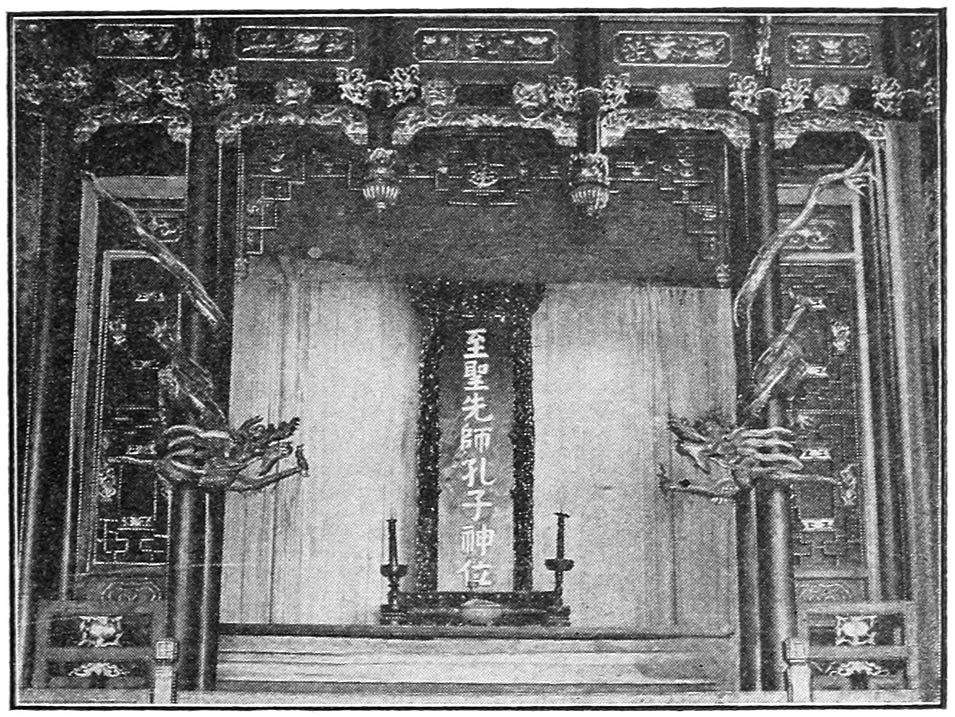
Tablet to Confucius
This red lacquer tablet, inscribed with eight characters in gold, stands in the shrine of the Provincial Temple of Chekiang at Hangchow. The inscription may be freely translated, “The Sacred Tablet of Our Revered Teacher Confucius.” The tablet is approximately four feet high and one foot wide. Nine dragons play hide and seek in the framework that borders the edge of the inscription. Two larger dragons twine themselves about the slender pillars before the shrine. These serve as guards of honor. These two creatures symbolize the two dragons which, history says, encircled the home of Confucius when the sage was born. Similar tablets are found in all temples to Confucius throughout China.
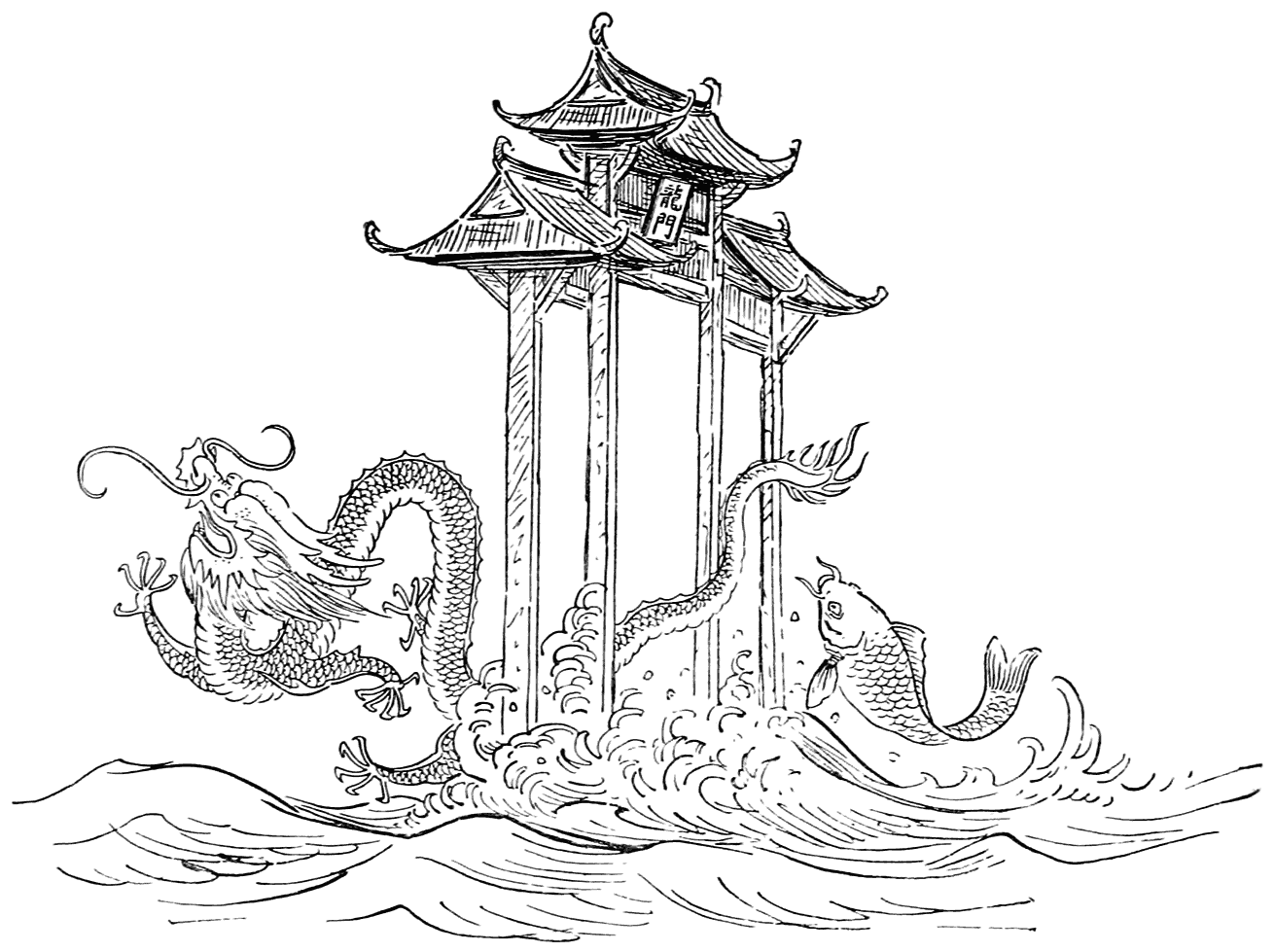
Dragon Gateway
Within the main entrance to Nanking’s Examination Hall, where the Master’s Degree was earned, stood a long “spirit wall.” Upon the front of this structure was painted a dragon gate, beneath which was shown a carp changing into a dragon. A Bachelor of Arts, according to China’s ancient system of education, upon becoming a Master, was congratulated by his friends as having passed through the “Dragon Gate.” The implication was that it was as difficult for a Bachelor of Arts to become a Master as for a carp to be transformed into a dragon.
All true dragons are of two kinds: those which are such by birth and those which become dragons by transformation from fish of the carp species. The transformed variety become dragons by leaping up the waters of a certain cataract upon a western mountain stream. Large numbers of carp swim once each year, we learn, to this waterfall known as the “Dragon’s Gate.” Here under the cataract they flounder about, jumping and springing up out of the swirling waters; a few of them succeed in getting over the falls to the higher waters above. Those which are successful in this effort become dragons. After the story of this strange occurrence became known to the public, it was incorporated into the life of the people in a popular saying, and scholars who succeeded in passing the great triennial literary examinations were said to have “passed the Dragon Gate.” The use of this figure was doubtless to illustrate the difficulty of passing the examinations, for it implied that it was as difficult a task for a man to succeed at these examinations as it was for the carp to leap up over the falls. This figure has, in addition, the happy inference that even as the carp, an ordinary fish, might become a mighty dragon, just so by this supreme effort a scholar might become a master of arts, thus placing the value of the transformation on a very high scale.
One ancient authority tells us that there is a class of these great saurians which are known as “lazy dragons.” These do not like to exert themselves in the task of directing clouds which carry rain over the surface of the earth. They sometimes make themselves small in size, drop to the surface of the earth and hide in trees, under roofs of houses, and even in the clothing of unsuspecting countrymen. The Thunder God, learning of their desertion from their posts of duty, sends his messengers to search for them and when he discovers their location, kills them with thunderbolts during an electric storm, after the manner of Zeus. This explains to many an unsophisticated man the frequent destruction of life and property during thunderstorms. An epithet that in some parts of the country is often hurled at lazy people is “Lan Lung,” or “lazy dragon.”
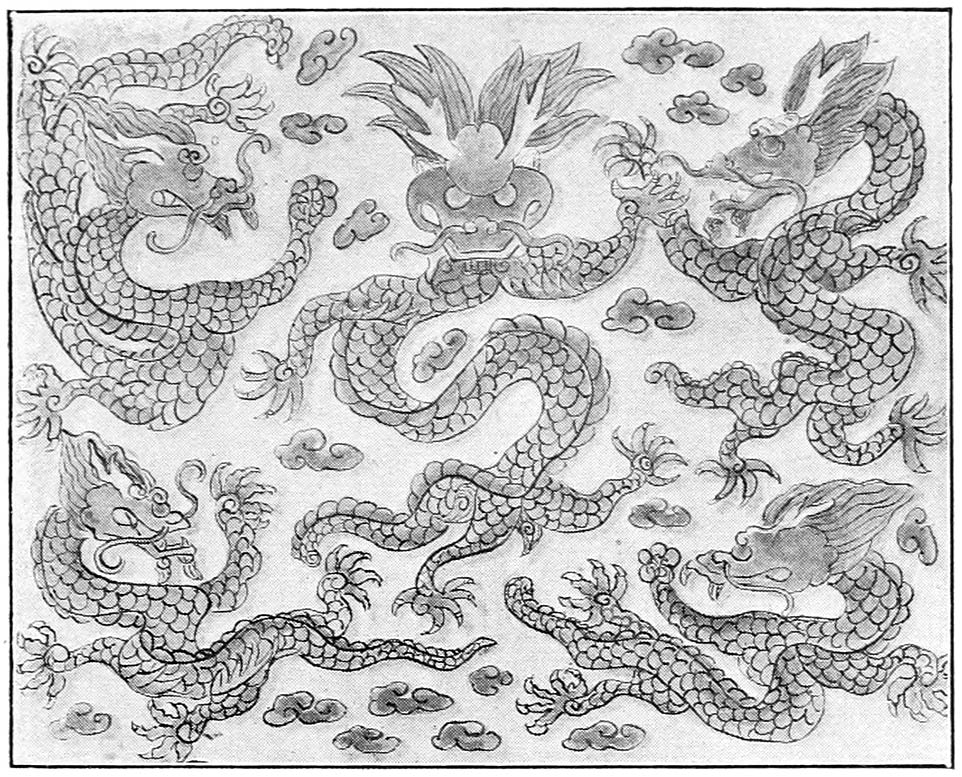
The Dragon Stone
In the city of Kaifengfu, Honan, the first capital of the Sung emperors, is a sacred building known as the “Dragon Pavilion.” Within this structure, which stands on an eminence high above most of the buildings of the city, is a large basaltic stone known as the “Dragon Throne.” This is cut in the form of a cube of about six feet in each dimension and rests to-day under the shrine of the Pearly Emperor. Nine hundred years ago the Sung emperors doubtlessly placed their lacquered thrones upon its upper surface. In order to protect it from vandal hands, the historic stone is now incased within wooden walls, which form a cavelike room about it. Fourteen dragons in deep relief surround the outer edge: five on the front and back faces, and two on either end. Visitors must use candles in order to see at all in the inky darkness. Because of the narrow quarters no photograph can be taken. This drawing by a Kaifengfu artist was made under the greatest difficulties and is probably the first reproduction ever attempted.
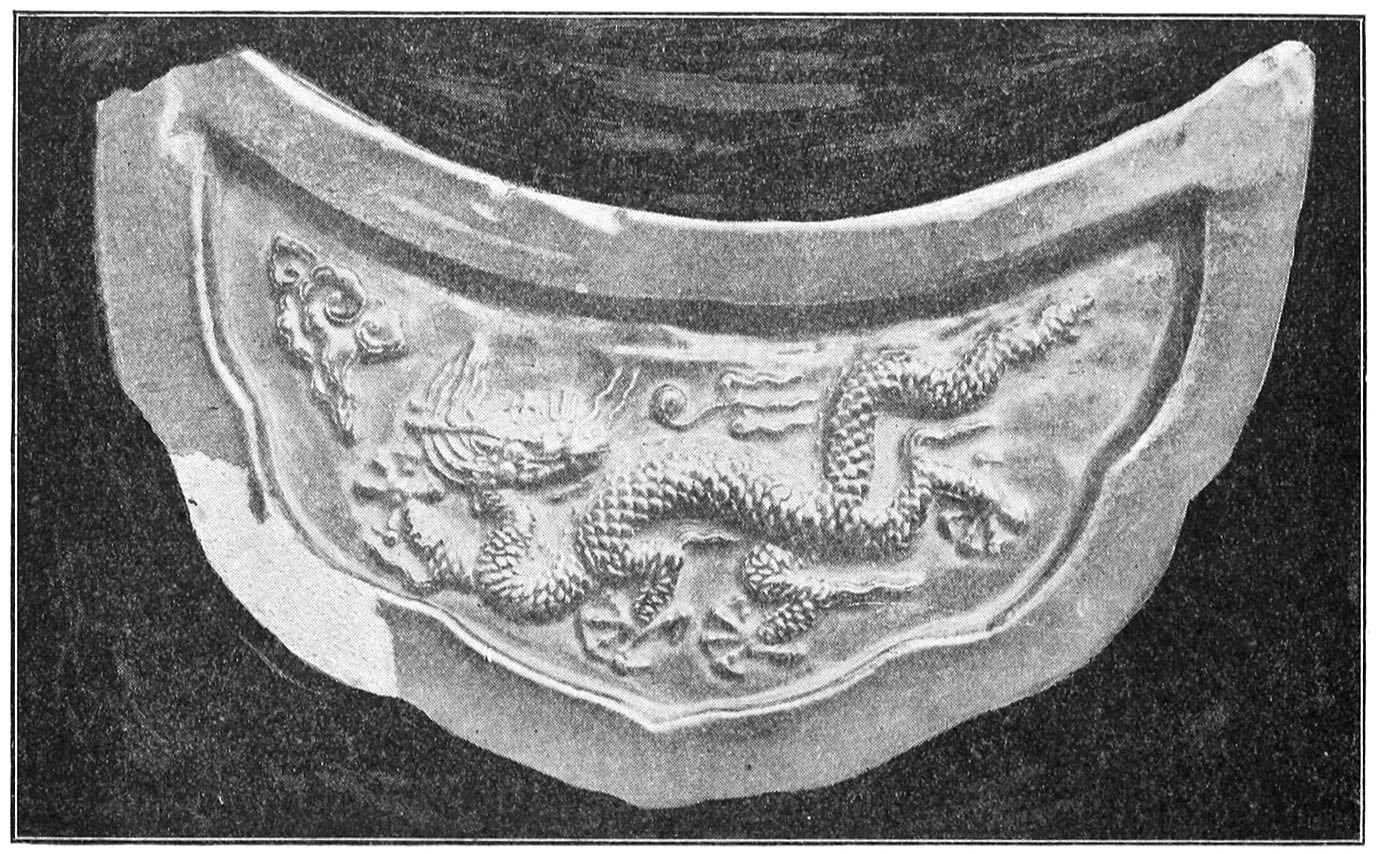
Dragon Eaves Tile
This crescent-shaped tile fell from the roof of one of the imperial temples of Peking. It is made of highly glazed porcelain and is ten inches across and five inches high. Its age is estimated to be about two hundred years.
[
Contents
]