Volume 4 — CHAPTER XVI.
Reading edition
THE FALL OF PRZEMYSL.
You will remember that while von Hindenburg was vainly attempting to pierce the river line of the Niemen and the Narev on the Russian right wing, the Austrians were in motion against the south or left wing. On page 249 of our third volume I gave you a map, which I repeat on page 119, showing the line which the Russians were holding in Galicia at the close of the year 1914. They then held the northern entrances to the Carpathian passes, and had pushed up the Dukla Pass almost to the crest. Newspaper readers in this country believed that before long the Russian legions would be pouring down on the Hungarian plain, and that when the great granary of the Central Powers was invaded the end of the war would be in sight.
During the month of January the Russians strove hard to push across the Galician passes, and their cavalry actually descended to the Hungarian plain thirty miles south of the mountains. Not only was fighting going on in Galicia, but in Bukovina[22]—that is, the country of the beech woods—which stretches southward from the Dneister, across the Pruth and the Sereth, to the eastern face of the Carpathians. Ever since September 1914 the Russians had held Northern Bukovina, and they now wished to conquer the whole of it, for several reasons. In the first place, it was Germany's main source of supply for petrol; in the second place, it lay on the frontier of Rumania, and it was thought that the presence of a Russian army in Bukovina would induce Rumania to join the Allies. Further, if Rumania should elect to do so, she would be able to join hands at once with the Russians. In the third place, there are several fairly easy passes from Bukovina into Hungary, and one of them is the main route from the north to the plains of Hungary.
The Russians had only a division in Bukovina, and the Austrians opposed them with a force which was not much stronger. By the middle of January almost all the country was in the hands of the Russians. They had, however, not yet secured the pass which would enable them to advance into Hungary.
The time had now come for the Austrians to make a great effort to save Hungary, and to prevent Rumania, with her large and well-equipped army, from entering into the struggle on the side of the Allies. How was this to be done? Two campaigns were necessary—the one to drive back Brussilov from the passes and to relieve Przemysl, and the other to clear Bukovina of the invaders.
Let us see how the campaign in Bukovina fared. Three Austrian corps and one German corps crossed the mountains and advanced in two columns. The Russians, you will remember, had only one division with which to meet these four army corps. They were obliged to fall back, and thus Bukovina was cleared. The Austrians captured town after town, and early in March they entered Stanislau,[23] a railway junction only seventy miles from Lemberg. They were delighted with their success, and they reported that they had made huge captures of prisoners. They had now reached a position from which they could threaten the Russian communications. Soon, however, it was discovered that the Russians had only fallen back to a point where they could be reinforced. As soon as their numbers were sufficiently increased they advanced again, and pushed the Austrians out of Stanislau, and almost back to the line of the Pruth. By doing so they removed the danger to their communications.
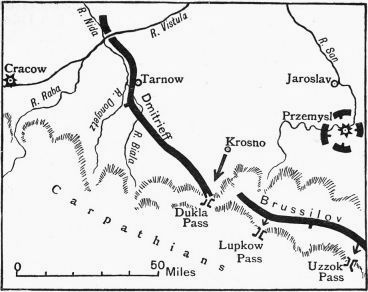
Position of the Russians in Galicia at the end of 1914.
Meanwhile what had happened in Galicia? Two Austrian armies had been fighting fierce battles in the deep snows and slush of the Carpathians. With infinite labour guns and transports had been hauled up the icy slopes, where a foothold could barely be maintained. Infantry attacks were difficult; the white snow threw up the figures of the men, who thus became excellent targets, no matter what uniforms they wore. Even night attacks were revealed, for on moonless nights the light reflected from the snow made all things clear. Both sides suffered terribly from the cold, but it told more severely on the Austrians than on the Russians, who are accustomed to bitter winters. In the last week of January a bright sun shone, and often the pure white snow was stained scarlet with the blood of the fallen. Blizzards swept across the mountains during February, and checked the fighting on the uplands, though it continued to rage in the foothills. Perhaps the most terrible hand-to-hand fighting known to history took place at a little village near the Uzsok Pass. Large German forces for two months vainly tried to oust the Russians, who had captured the position from them. Some idea of the awful losses sustained by the Germans may be gathered from the statement that one regiment changed from colonel to drummer boy three and perhaps four times. The village stands on a height, and during the winter is shrouded in snow. While the furious battles were raging, the height was reduced to bare soil, every foot of its surface having been ploughed with shell and drenched with blood. You can imagine the horror of trench life in this region, with the thermometer below freezing-point and the icy blizzards blowing almost daily. In some places the trenches were only forty paces apart, and so fierce were the attacks and counter-attacks that eight out of every ten men engaged in them are said to have fallen. At the beginning of February the Russians in this region destroyed a whole battalion of Germans, save the commander and twenty men.
The Austrian army which fought between the Dukla Pass and the Uzsok Pass was charged with the duty of relieving Przemysl, but it was held back by the Russians, as also was the army which was operating more to the east. During the last days of February and the first days of March Brussilov fought a fierce battle on a ridge near the Uzsok Pass. He held the heights, drove back the Austrians, and even the most desperate bayonet attacks could not force him from his position of vantage. The Austrians were held up, and the Russians gained sufficient time to reinforce their weak troops which had been driven out of Bukovina. I have already told you that they advanced again and pushed the Austrians back to the line of the Pruth.
The attempt to relieve Przemysl had failed, and on 22nd March the fortress fell. Before I proceed to tell you the story of this Russian success, let me give you some idea of the situation and importance of Przemysl. It has been famous as a fortress for a thousand years. In early times it was regarded as the key to the Hungarian plains, and in modern times it has been considered as the main outlying protection to the city of Cracow. The town claims to date back to the eighth century, and certainly is one of the oldest cities of Galicia. The river San, which washes its walls, descends in wide sweeps from the Uzsok Pass, through mountain glens filled with fir and beech trees, and then through the vales of the foothills, which are planted with groves of apricot, pear, and cherry, and are dotted here and there with brightly painted wooden houses. The valley of the San is the orchard land of Galicia.
The first modern forts of Przemysl were erected in 1871, and since then have been several times enlarged and improved, until, on the eve of the war, the fortress was one of the strongest in the country. It was a ring fortress like Liége and Namur. At a distance of six miles from the city there was a circle of outer forts with smaller works connecting them. Within this ring, about a thousand yards from the city, there was another circular series of forts. Had Russia been supplied with heavy siege guns such as the Germans brought against the Belgian and French fortresses, Przemysl would have fallen in a month. As it was, it held out, during its second siege, for seven months.
A glance at the map[24] shows you that Przemysl is chiefly important because of its situation with regard to the railways of Galicia. It stands on the main trunk line connecting Lemberg with Cracow, and it gives railway access to the Lupkow and Uzsok passes. While Przemysl held out the Russians had to send supplies to their armies by long and roundabout routes, and they could not readily mass troops for a big movement against the passes. As far back as September 27, 1914, the Russians had closed round it, and had sat tight in their trenches hoping to starve it into surrender. The town was not well supplied with provisions, and by the middle of October the defenders were on very short commons indeed. Then came a blessed respite. Von Hindenburg's first assault on Warsaw forced Ivanov to retire beyond the San, and the Austrians found themselves able to pour food, ammunition, and supplies into the besieged fortress. By the 12th of November, when the Russians had surrounded it once more, there were four Austrian army corps in the place, and these, with the townsfolk and refugees, numbered some 200,000 souls.
It is still a matter of wonder why the Austrians kept four army corps in Przemysl. To hold the twenty-five miles circuit of the fortress 50,000 men would have been ample, and every extra mouth in the place only brought the day of surrender nearer. One would have supposed that during the retreat of the Russians in October distant lines of trenches would have been flung out from Przemysl, as had been done at Verdun. The Austrians, however, showed no foresight, and the governor seems to have considered the town a capital place in which to spend the winter. When the Russians returned they had nothing to do but sit down and let the garrison eat up its supplies. When food gave out the fortress was bound to fall.
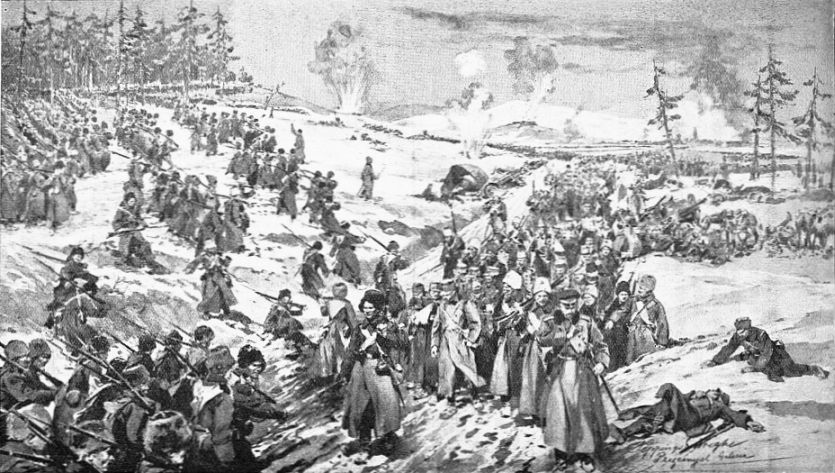
The Fall of Przemysl.
(From the picture by H. C. Seppings-Wright. By permission of The Illustrated London News.) This picture, which was drawn by the artist on the spot, shows Russians advancing to occupy the fortress, and passing on the way large numbers of Austrians who had been captured in the final sortie. The town of Przemysl is seen in the distance on the right. In the background are seen Austrian forts and a railway bridge being blown up. Almost in the middle of the picture a land-mine is exploding.
In December the Austrians made an attempt to relieve the fortress. In Chapter XXVII. of our third volume I told you how the Austrians launched two armies against the Russians, who were then threatening Cracow, and how the Russians were forced to retreat to the position shown on the map on page 119. During the Russian retreat the Austrians were so near to Przemysl that they could hear its guns thundering, and exchange signals with its garrison by means of searchlights. The time had come for the Austrians within the fortress to dash out and break through the lines of their besiegers. On 15th December five regiments did so.
They broke through the Russian lines at the south-east angle, and for four days there was fierce and doubtful fighting. The Russians, however, managed to drive the Austrians back into the town. The sortie had failed, with a loss of 3,000 killed and wounded. Shortly afterwards Brussilov cleared the mouths of the passes, and by Christmas Day Przemysl was once more girdled by a ring of iron. I have already told you how the Austro-Germans made another attempt late in January and early in February 1915 to relieve the strain on the fortress, and how it came to nought. Thereafter the fall of Przemysl was only a matter of time.
Fighting went on night and day. Many times the Austrians strove to break out, but each time they were driven back, with huge losses on both sides. The Russians counter-attacked, and won several of the forts. "These unexpected blows," wrote a Russian general, "greatly excite the garrison. Right through the night their searchlights sweep to and fro over our positions, and the long white rays rest trembling on every fold of the ground. At times something alarms the forts, and the air is instantly filled with the thunder of Austrian guns. The fire is kept up for thirty minutes to an hour before it subsides again." It is worthy of note that not a single Russian shell fell within the town itself.
But all the time famine was doing its deadly work. Up to December there was no shortage of food; but when the new year set in the rations were severely cut down, first for the civilians, then for the soldiers, next for the hospitals, and finally for the officers. The weather grew cold, and there was no firewood. Bread could not be obtained at all, and a fowl cost twenty-four shillings. Soon the cavalry began slaughtering their horses for food. By March a cow was selling for £140, and a dog for £2, 10s.
Mr. Stanley Washburn, a correspondent with the Russian army, tells us that the place was greatly over-garrisoned by patient, haggard soldiers starving in the trenches and sleek faultlessly-dressed officers living on the fat of the land in fashionable hotels and restaurants. While the garrison became thin and half starved, the officers ate three meals a day, and enjoyed fresh meat, cigars, wines, and every luxury. While soldiers were falling fainting in the streets, their officers were leading the life to which they had been accustomed in Vienna during times of peace.
On the night of 13th March the end began. The Russians pushed through the outer line of defences and began to bombard the inner forts. Four days later the Austrians strove for the last time to break out, but the Russian guns caught them and mowed them down in swathes. The survivors were driven back with heavy loss, and 4,000 prisoners remained in Russian hands. Early on the morning of the 22nd the besiegers were awakened by the noise of loud explosions. The Austrians were blowing up the forts before surrendering the city. We are told that the burning forts smoked like a circle of volcanoes. Soon a white flag was seen fluttering above the highest building in the town. Przemysl was ready to surrender. Meanwhile the officers were shooting their chargers, to prevent them from falling into the hands of the Russians, and the soldiers, crazy with hunger, were greedily devouring the raw flesh. Tons of explosives were sunk in the river, guns and rifles were destroyed, and bridges were blown up.
About nine o'clock a letter reached the Russian headquarters from the Austrian general saying that hunger had forced him to yield the fortress. A few Russian officers entered and received the surrender; but there was no triumphal parade such as had been witnessed when the Germans entered Antwerp.
"Civilians inform me," wrote Mr. Washburn, "that they gladly welcome the Russians, and that the first troops who entered were greeted with cheers, while the garrison was frankly pleased that the siege was over and their troubles at an end. I have seen on the road and in the town tens of thousands of prisoners, and I believe the Austrians, especially the Hungarians, are first-class raw material, but that now they are utterly broken and helpless." (This he considered to be due to their wretched officers, who, if those seen in Przemysl were fair samples, appeared to be the most selfish and incompetent in Europe.) "I have never witnessed a more unpleasant sight than that of the dapper, overdressed Austrian officers laughing and chatting gaily as they were driven in carriages to the railway station for departure, passing through columns of their own men, pale and haggard from hardships which apparently had not been shared in any particular by their officers."
So fell Przemysl. Its capture was not so much a Russian victory as an Austrian disgrace. By overcrowding the place with soldiers, and putting careless, ignorant officers in charge of them, the Austrians ensured its downfall. About 120,000 prisoners, including 2,600 officers, fell into Russian hands; about 1,000 guns were captured, 180 of them fit for use, as well as a large amount of shell and small-arm ammunition. Russia had obtained an excellent base from which to advance against the central passes of the Carpathians, and she had set free an army of 100,000 men for future operations.
The fall of Przemysl was greeted with great delight by the Allies, and it was thought that before the end of the summer Cracow would be sure to fall, Silesia would be entered, and the Russian legions would be sweeping through Hungary. Alas! these rosy hopes were soon to be disappointed. Within five weeks clouds began to gather in the East. The Russians were caught napping. The strongest army which Germany had ever mustered was hurled against them, and huge guns drove them remorselessly back from the soil which they had so hardly won. Less than forty days after the Austro-Germans began to move, Przemysl was once more in their hands. Nor was the retreat stayed until the Russians were driven far back on their own soil, and the very existence of their armies was at stake.