PART II
Reading edition
Many years had passed away since the burning of the village of Grand-Pré, and the exiles had been scattered far asunder. Among them a maiden, patient and meek in spirit, waited and wandered. Sometimes she lingered in towns, at others she passed through the country and wandered into churchyards, gazing sadly at the crosses and tombstones, but never did she remain long in the same place. It was Evangeline searching for her lover, and, though many sought to dissuade her from her quest, and urged her to listen to the wooing of her faithful suitor Baptista Leblanc, the notary's son, she only answered sadly: "I cannot, for whither my heart has gone, there follows my hand." And in all her doings she was upheld and cheered by her faithful friend, the priest Felician. Wherever she went she asked for news of Gabriel, and at last she found out that he and his father had become famous hunters, and had been met with on one of the vast prairies, but she was never able to trace his movements.

Still she journeyed onward and onward till, one May, she joined a band of Acadian exiles who were sailing in a cumbrous boat down the broad river Mississippi. They were seeking for their kinsmen who, it was rumored, had settled down as farmers in that fertile district. Day after day the exiles glided down the river, and night after night they encamped on its banks and slept by the blazing camp-fires which they kindled. One night—if only Evangeline had known it—a boat rowed by hunters and trappers, Gabriel among them, passed by close to their camp. But the exiles' boat was hidden among the willows and they themselves screened from sight by thick shrubs, so the hunters sped northward and their passing was unheeded. Only when the sound of their oars had died away, the maiden awoke and said to the priest: "Father Felician, something tells me that Gabriel is near me. Chide me not for this foolish fancy."
"Not far to the south," answered the faithful priest, "are the towns of St. Maur and St. Martin, where many of our kinsfolk have settled. There in that beautiful land, which its inhabitants call the Eden of Louisiana, the bride shall surely be restored to her bridegroom."
Full of hope, the travelers continued their journey, and presently arrived at a herdsman's house which stood in a lovely garden close to the river. The owner himself, mounted on horseback, was watching his numerous herds which were grazing in the meadows around him. As he turned towards his house, he caught sight of the maiden and the priest coming toward him. With a cry of joy he sprang from his saddle and hastened towards them, and then the travelers saw that it was none other than Basil the blacksmith. You can imagine how cordial were the greetings, how numberless the questions and answers that passed between them. Only Evangeline grew silent and thoughtful when Gabriel did not appear, and at length Basil said, "If you came by way of the lakes, how is it that you did not meet my son's boat?"
"Gone, is Gabriel gone?" murmured Evangeline piteously; she could not hide her disappointment, and shed bitter tears.
"Be of good cheer, my child," returned honest Basil, "it is only to-day he went from here. He grew moody and restless ever thinking of thee, till at length he could no longer endure this quiet existence. Therefore I let him go among the Indians, hoping thus to divert his mind from his troubles. Early to-morrow thou and I will set out after him, and I doubt not but we shall overtake him and bring him back to his friends."
A sound of many voices was now heard, and the other travelers came up joyously led by Michael the fiddler, who had lived with Basil since their exile, having no other task than that of cheering his companions by his merry music. Basil invited all the travelers to sup with them, and greatly did they marvel at the former blacksmith's wealth and many possessions. When they were seated at the table, Basil told his friends of the beauty of the country and the fertility of the soil, and, when he added that land might be had for the asking, they all resolved to settle there and help to form the new Acadian colony.
On the morrow, according to his promise, Basil set out to overtake his son, and Evangeline went with him. Day after day they journeyed onward through a wild and desolate country, but could hear no tidings of the traveler. At length they arrived at the inn of a little Spanish town, where they heard that Gabriel had left that very place the previous day and had set out with his horses and guides for the prairies.
Basil and Evangeline determined not to give up their search, and, hiring some Indian guides, they followed in the direction which Gabriel had taken. One evening as they were sitting by their camp-fire, there entered an Indian woman whose face bore the marks of heavy grief. She was returning from the far distant hunting-grounds, where her husband had been cruelly murdered by a hostile tribe. Touched by her sad story, the white people offered her food and a night's shelter, which she gratefully accepted. After the evening meal was over, Evangeline and the stranger sat apart, and the maiden, in her turn, related to the other the story of her lost lover and her other misfortunes.
Early the next day the march was resumed, and as they journeyed along, the Indian woman said: "On the western slope of these mountains dwells the Black Robe, Chief of the Mission. He talks to the people of their Heavenly Father and they give heed to his teaching."
Then said Evangeline: "Let us go to the Mission, for there good tidings await us."
So they turned their steeds thither, and just as the sun was setting they reached a green meadow by the riverside. There the preacher knelt in prayer and with him a multitude of people. The travelers joined reverently in the prayers, and when the service was over, the priest came to welcome the strangers and offered them shelter and a share of his frugal meal of wheaten cakes and spring water. Afterwards they told the priest their story, and he said: "Only six days ago Gabriel sat by my side and told me this same sad tale, then he continued his journey. He has gone far to the north, but in autumn when the hunting is over he will return to the Mission."
Then Evangeline pleaded: "Let me remain with thee, for my soul is sad and afflicted." This seemed to the others a wise thing to do, so thus it was arranged. Early on the morrow Basil returned homewards and Evangeline stayed on at the Mission.
Slowly and wearily the days passed by, and Evangeline lived and worked at the Mission till autumn drew on. But still Gabriel did not come, and the maiden lived on there till the following summer. Then a rumor reached her ears that Gabriel had encamped in a far distant forest, and Evangeline took leave of her friends at the Mission and set forth again to seek her lover, but when she reached the hunter's lodge she found it deserted and fallen to ruin.
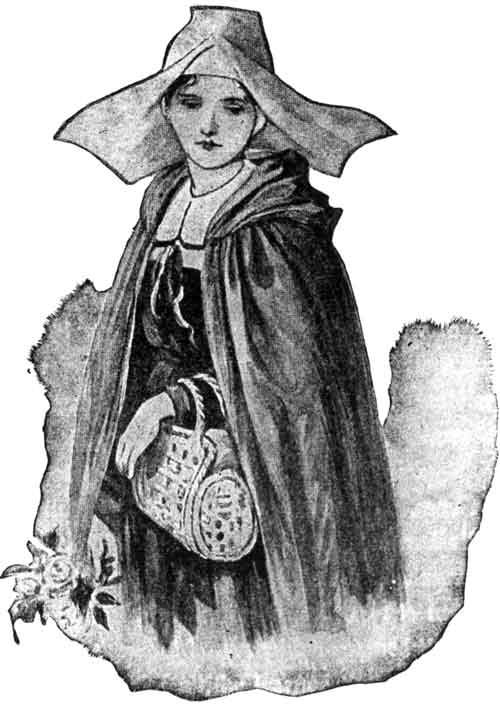
And now her weary pilgrimage began anew. Her wanderings led her through towns and villages, now she tarried a while in mission tents, now she tended the sick and wounded in the camp of a battlefield. As the years went on, her beauty faded and streaks of gray appeared in her dark hair. She was fair and young when she began her long journey, faded and old when it ended in disappointment.
At length poor Evangeline grew weary of wandering through strange places and resolved to end her days in the city founded by the great preacher, Penn. Here other of the Acadian exiles had settled, and Evangeline felt that there was something homelike in the pleasant streets of the little city and the friendly speech of the Quakers.
There for many years she dwelt as a Sister of Mercy, bringing hope and comfort to the poor and suffering ones. Then it came to pass that a terrible pestilence fell on the city and thousands perished. The poor crept away to die in the almshouse, and thither by night and day came the Sister of Mercy to tend them.
One Sabbath morning Evangeline passed through the deserted streets and entered the gates of the almshouse. On her way she paused to pluck some flowers from the garden, that the dying might be comforted by their fragrance. As she mounted the stairs she heard the chime of church-bells and the sound of distant psalm-singing, and a deep calm came over her soul, for something within her seemed to say, "At length thy trials are ended!"
Suddenly, as she was passing down the wards, she stood still and uttered a cry of anguish. On the pallet before her lay an old man with long gray hair, and, as she gazed, she saw that this was none other than her lover, Gabriel. She knelt by his bedside and the dying man opened his eyes and tried to whisper her name, but his strength was spent, and with one last look he passed away from her.
Evangeline's weary quest was over; sweetly and patiently she took up her life again and henceforth lived only for others. And now, in the little Catholic churchyard of this far-away city, side by side the lovers are sleeping.