THE OLD TESTAMENT (continued 5)
Reading edition
Then Joram said, "Get my chariot ready," and when it was ready he went to meet Jehu and found him in the field of Naboth the Jezreelite. When Joram saw Jehu, he said, "Do you come with peaceful purpose, Jehu?" Then Joram turned to flee, but Jehu drew his bow and struck Joram between the shoulders, so that the arrow went through his heart, and he fell down in his chariot.
Then Jehu said to Bidkar, his charioteer, "Take him up and throw him into the field of Naboth the Jezreelite, for I well remember that, as you and I rode together after Ahab, his father, Jehovah pronounced this sentence upon him: 'Surely I saw yesterday the blood of Naboth and his sons, and I will punish you on this same piece of land.' So throw him into this piece of land, as Jehovah said."
Then Jehu arrived at Jezreel. As soon as Jezebel heard of it, she painted her eyes, arranged her hair, and looked out of the window. As Jehu came in at the gate, she said, "Is all well with you, you traitor, you murderer of your master?" But he looked up to the window and cried, "Who is on my side? who?" Two or three slaves looked down at him, and he said, "Throw her down." And they threw her down and the horses trampled on her. When Jehu had gone in and had had something to eat and drink, he gave this command, "Look after this woman and bury her, for she is a king's daughter." But when they went to bury her, they found no more of her than the skull, the feet, and the hands. When they went back and told Jehu, he said, "This is what Jehovah declared by his servant Elijah when he said, 'On the piece of land at Jezreel the dogs shall eat Jezebel's flesh, and her body shall be as refuse on the surface of the field, so that no one can say, This is Jezebel.'"
THE BOY JOASH ON THE THRONE OF JUDAH
When Joram had ruled twelve years over Israel, Ahaziah the son of Jehoram began to rule over Judah. And he went down to Jezreel to visit Joram, who was ill. When Jehu struck down Joram, Ahaziah saw it and fled toward Beth-gannim. But Jehu followed after him with the words, "Shoot him down, too, in the chariot." So they shot him down on the way up to Gur, near Ibleam, but he escaped to Megiddo and died there.
When Athaliah, the mother of Ahaziah, learned that her son was dead, she rose and put to death all of Ahaziah's children except Joash, whom his aunt, Jehosheba, secretly took and placed with his nurse in the bedchamber. In this way she hid him from Athaliah, so that he was not put to death. He was with her, hid in the temple of Jehovah, six years, while Athaliah ruled over the land.
But in the seventh year Jehoiada the priest called together the officers of the royal guard and brought them into the temple of Jehovah. After he had made them make a solemn promise, he showed them Ahaziah's son, and gave them these orders, "This is what you shall do: a third part of you who go in on the Sabbath to guard the palace shall keep watch over it. Two divisions of you, including all who go out on the Sabbath to guard the temple of Jehovah, shall surround Joash, each with his weapons in his hand. And let every one who comes within the ranks be put to death. Thus you shall guard Joash, when he goes out and when he comes in."
The officers did as Jehoiada the priest commanded. And he brought out Ahaziah's son and put the crown and the royal ornaments upon him; and they made him ruler over Judah and poured oil upon his head and clapped their hands, crying, "Long live the ruler!"
But when Athaliah heard the people shouting, she came to them in the temple of Jehovah. When she saw Joash standing by the pillar, as was the custom, and the officers and the trumpeters by him, and all the people of the land rejoicing and blowing trumpets, she tore her clothes and cried, "Treason! Treason!" But Jehoiada the priest gave this order to the officers: "Bring her out between the ranks, and kill with the sword whoever follows her," for the priest said, "Let her not be put to death in the temple of Jehovah." So they seized her, and she was killed as she went through the horses' entry to the palace.
Jehoiada made a solemn agreement between Jehovah and the new ruler and the people, that they should be Jehovah's people; also between the ruler and the people, and Joash ruled forty years in Jerusalem.
A YOUNG MAN WHO SAID, "SEND ME"
© Curtis Publishing Company The Prophet Isaiah Painted by W. L. Taylor
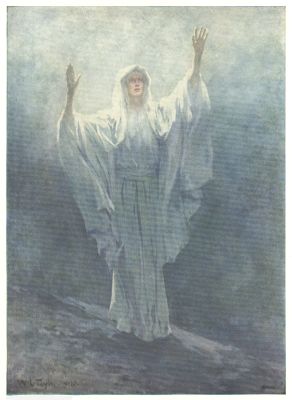
Uzziah, Joash's grandson, was sixteen years old when he began to rule over Judah and he ruled fifty-two years in Jerusalem.
He fought against the Philistines, and broke down the wall of Gath and of Jabneh and of Ashdod and built cities near Ashdod and among the Philistines. And God helped him against the Philistines. The Ammonites also paid tribute to Uzziah, for he became very strong.
And Uzziah built towers in Jerusalem at the Corner Gate and at the Valley Gate and at the corner of the wall, and fortified them. He also built towers in the wilderness and dug many cisterns, for he had many herds in the lowland and farmers in the plain and vine-dressers in the mountains and in the fruitful fields, for he loved to cultivate the ground. But he was a leper to the day of his death. He lived in his own house, while Jotham, his son, was at the head of the royal household, ruling the people of the land. And Uzziah died; and they buried him with his fathers in the city of David, and Jotham, his son, became ruler in his place.
Isaiah said it was in the year that Uzziah, the ruler of Judah, died that I saw the Lord sitting on a high and lofty throne; and the train of his robe filled the temple. Guardian angels stood above him. Each had six wings, one pair to cover the face, another pair to cover the feet, and another pair with which to fly. And they cried to one another:
"Holy, holy, holy, is Jehovah of hosts, The whole earth is full of his glory."
The foundations of the thresholds trembled at the voice of those who called, and the temple was filled with smoke. Then I said: "Woe is me! I am ruined; for I am a man with unclean lips, and I live among a people with unclean lips; for my eyes have seen the King, Jehovah of hosts!" But one of the guardian angels flew to me with a hot coal in his hand that he had taken from off the altar, and with it he touched my mouth and said: "See, this has touched your lips; your guilt is taken away and your sin forgiven."
Then I heard the voice of the Lord, saying:
"Whom shall I send, And who will go for us?"
and I said, "Here am I, send me."
JEREMIAH'S CALL TO DO A HARD TASK
This was the message which came to me from Jehovah: "Before you were born I knew you and prepared you for your work. I have appointed you to be a prophet to the nations." But I (Jeremiah) said: "O Lord Jehovah! I do not know how to speak in public, for I am only a youth." Then Jehovah said to me: "Do not say, 'I am only a youth,' for you shall go to all to whom I send you, and you shall speak whatever I command you. Do not be afraid of them, for I am with you to protect you."
Then Jehovah stretched out his hand and touched my mouth and said to me: "See. I have put my words in your mouth, and I have appointed you this day over the nations and kingdoms, to tear up and break down, to destroy and to overthrow, to build and to plant."
Again this message came from Jehovah, "What do you see?" I answered, "A great kettle brewing hot, and it faces from the north." Then Jehovah said to me: "From the north trouble is brewing for all the people of the land. For I am about to call all the kingdoms of the north, and they shall come and each set up his throne at the entrance to the gates of Jerusalem and around its walls and against all the cities of Judah. And I will pass judgment upon Jerusalem and these cities for all their wickedness, for they have been disloyal to me and offered sacrifices to other gods and have worshipped that which their own hands have made.
"Therefore make ready, rise, speak to them all that I command you. Do not be afraid of them, for see, I myself will make you this day like a fortified city, and like a bronze wall against the rulers of Judah, its leaders, its priests, and the common people. Though they fight against you, they will not overcome you, for I am with you to protect you."
THE YOUNG JOSIAH AND THE BOOK OF THE LAW
Josiah was eight years old when he began to rule, and he ruled thirty-one years in Jerusalem. In the eighteenth year of his rule he sent Shaphan, the scribe, to the temple of Jehovah with the command, "Go up to Hilkiah, the chief priest, and see that, when he has taken the money that is brought into the temple of Jehovah and that which the doorkeepers have gathered from the people, they give it to the workmen who have charge of the temple of Jehovah. Then let them give it to the carpenters, the builders, and the masons who are in the temple of Jehovah, to repair the breaks in it and to buy timber and cut stone to restore it." But no account was asked of them for the money that was given to them, for they dealt honestly.
Then Hilkiah, the chief priest, said to Shaphan, the scribe, "I have found the book of the law in the temple of Jehovah." And Hilkiah gave the book to Shaphan, and he read it. Then Shaphan went to Josiah and told him, "Your servants have taken the money that was found in the temple and have turned it over to the workmen who have charge of the temple of Jehovah." Shaphan, the scribe, also said to Josiah, "Hilkiah, the priest, has given me a book." And Shaphan read it to him.
When Josiah had heard the words of the book of the law, he tore his clothes. Then he gave this command to Hilkiah, the priest, to Ahikam, the son of Shaphan, to Achbor, the son of Micaiah, to Shaphan, the scribe, and to Asaiah, his servant, "Go, ask of Jehovah for me and for the people and for all Judah about the words of this book that has been found; for Jehovah must be very angry with us, because our fathers have not listened to the words of this book nor done all that we are there commanded to do."
So Hilkiah, the priest, and Ahikam and Achbor went to Huldah, the prophetess, who lived in Jerusalem and talked with her. She said to them, "This is the message of Jehovah, the God of Israel: 'Tell the man who sent you to me, Jehovah says, I am now about to bring evil upon this place and upon its people even all that is written in the book which the ruler of Judah has read. But you shall say to him who sent you to ask of Jehovah, Jehovah the God of Israel declares, Because you listened and humbled yourself before Jehovah and have wept before me, I also have heard you,'" So they brought back word to Josiah.
Then at his command they got together all the leaders of Judah and of Jerusalem. And Josiah went up to the temple of Jehovah, and with him all the men of Judah and all the people of Jerusalem, as well as the priests and the prophets and all the people, including the children. And he read to them all the words of the book of the covenant which was found in the temple of Jehovah. And Josiah stood by the pillar and made a solemn promise before Jehovah to obey all the commands and carry out the rules written in this book. And all the people also agreed to do so.
Then Josiah commanded Hilkiah, the chief priest, and the second priest and the doorkeepers to bring out from the temple of Jehovah all the things that were made for Baal and for the Canaanite goddess of fortune, and for the Babylonian star gods. And he burned them outside Jerusalem in the lime-kilns by the Kidron, and carried their ashes to Bethel. He also put away the idolatrous priests, whom the rulers of Judah had appointed to offer sacrifice at the temples on the heights in the towns of Judah and in the places about Jerusalem; those also who offered sacrifices to Baal, to the sun, the moon, and the planets and all the starry host.
He also destroyed Topheth, which is in the valley of Ben-Hinnom, so that no man could ever make his son or his daughter pass through the fire to Molech. He removed the horses at the entrance of the temple of Jehovah, which the rulers of Judah had given to the sun, and burned the chariots of the sun. Josiah broke down and crushed in pieces the altars that were on the roof, which the rulers of Judah had made.
Josiah also tore down the altar and the old temple at Bethel, broke its stones in pieces, and beat it to dust.
Then he gave this command to all the people: "Keep the passover to Jehovah your God, as is commanded in this book of the covenant." Such a passover as this had not been kept from the days of the judges who ruled Israel and during the period of the rulers of Israel and of Judah; but this passover was kept in Jehovah's honor in Jerusalem for the first time in the eighteenth year of Josiah's rule.
Josiah put away all the mediums, the wizards, the idols and all the evil things that were discovered in the land of Judah and in Jerusalem, that he might carry out the words of the law which were written in the book that Hilkiah, the priest, found in the temple of Jehovah. Josiah was the first ruler who turned to Jehovah with all his heart, with all his soul, and with all his strength in exact accord with the law of Moses, nor were any of the rulers that followed like him.
THE WRITING OF AN ANCIENT BOOK
When Jehoiakim, the son of Josiah, had been ruler for four years, this message came to Jeremiah from Jehovah, "Take a parchment roll and write on it all the words that I have spoken to you about Jerusalem and Judah and all the nations from the time of Josiah to the present. Perhaps the people of Judah will pay attention to all the evil which I intend to bring upon them, so that they will turn each from his evil way, that I may forgive their guilt and sin."
Then Jeremiah called Baruch, the son of Neriah; and Baruch wrote on a parchment roll as Jeremiah told him all the words which Jehovah had spoken to him. And Jeremiah commanded Baruch, saying, "I am not permitted to go to the temple of Jehovah. Therefore you go and read in the temple on the fast day the words of Jehovah from the roll which you have written at my command. You shall read them to all the people of Judah who have come from their towns. Perhaps they will pray to Jehovah and each turn from his evil way; for great is the anger and wrath of Jehovah against this people." So Baruch did as Jeremiah, the prophet, commanded him, reading in the temple from the writing the words of Jehovah.
The next year, when all the people who had come to Jerusalem from the cities of Judah were observing a fast in the temple courts, Baruch read to them all from the writing the words of Jeremiah.
When Micaiah, the grandson of Shaphan, had heard all the words of Jehovah, he went down to the palace, where all the court officials were sitting, and told them all that he had heard when Baruch read the book to the people.
Then all the nobles sent Jehudi, the son of Nethaniah, to Baruch to say: "Take the roll from which you have read to all the people and come here." So Baruch took the roll in his hand and went to them. And they said to him, "Sit down now and read it to us." So Baruch read it to them. But when they had heard all, they turned in fear to one another and said to Baruch, "We must surely tell Jehoiakim all this." So they asked Baruch, "Tell us now: how did you write all this?" Baruch answered, "Jeremiah told it all to me and I wrote it down in ink." Then the nobles said to Baruch, "Go, hide both yourself and Jeremiah, and let no one know where you are."
But after they had put the roll in the room of Elishama, the chancellor, they went to Jehoiakim's room, and told all these things to him. Then he sent Jehudi to bring the roll, and he brought it out of the room of Elishama, the chancellor. And Jehudi read it to him and to all the leaders who were with him.
Now Jehoiakim was sitting in the winter house with a brazier burning before him. When Jehudi had read three or four double columns, Jehoiakim cut it with a paper-knife and threw it into the fire that was on the brazier, and the entire roll was burned up. But neither he nor any of his servants who were present, were disturbed or tore their garments. Elnathan and Delaiah and Gemariah begged Jehoiakim not to burn the roll, but he would not listen to them. He also ordered Jerahmeel, his son, and Seraiah, the son of Azriel, and Shelemiah, the son of Abdeel, to seize Baruch, the scribe, and Jeremiah, the prophet, but Jehovah kept them hidden.
Then Jeremiah took another roll and gave it to Baruch, the scribe, who wrote on it as Jeremiah spoke to him, all the words of the book which Jehoiakim, the ruler of Judah, had burned in the fire; and many other similar words were added.
A PROPHET WHO SAVED A GREAT CITY
Once the king of Assyria sent a high official with a great army to Jerusalem. When they arrived at Jerusalem, they called for Hezekiah the ruler of Judah, Eliakim, the son of Hilkiah, Shebnah, the scribe, and Joah, the son of Asaph, and they came out to them. And the high official said to them, "Why are you so confident? To whom do you look for help that you have rebelled against me? You count on Egypt to help you. Pharaoh, king of Egypt, is as weak as a broken reed. But if you say, 'We trust in Jehovah our God,' is not he the one whose high places and altars Hezekiah has destroyed? Now therefore make a bargain with my master, the king of Assyria, and I will give you two thousand horses, if you are able on your part to set riders upon them. How then can you conquer one of the least of my master's servants? Have I now come up against this place to destroy it without Jehovah's approval? Jehovah it was who said to me, 'Go up against this land and destroy it.'"
Then Eliakim and Shebnah and Joah said to the high official, "Speak, I pray you, to your servants in the Aramaic language, for we understand it; but do not speak with us in the Jewish language in the hearing of the people who are on the wall." But the high official said to them, "Has my master sent me to your master and to you to speak these words? Is it not rather to the men who sit on the wall, who will suffer most from the siege?"
Then the high official stood and cried with a loud voice, in the Jewish language, saying, "Hear the message of the great king, the king of Assyria. 'Thus saith the king, Let not Hezekiah deceive you; for he will not be able to save you from my hand. Neither let Hezekiah make you trust in Jehovah by saying, Jehovah will surely save us, and this city shall not be given into the power of the king of Assyria.'"
"Do not listen to Hezekiah, for thus says the king of Assyria, 'Make your peace with me and come over to me; then each one of you shall eat from his own vine and his own fig-tree and drink the waters of his own cistern, until I come and take you away to a land like your own land, a land full of grain and new wine, a land full of bread and vineyards, a land full of olive-trees and honey, that you may live and not die. But do not listen to Hezekiah, when he deceives you by saying, Jehovah will save us. Has any of the gods of the nations ever saved his land from the power of the king of Assyria? Have the gods of the land of Samaria saved Samaria from my power? Who are they among all the gods of the countries, that have saved their country from my power, that Jehovah should save Jerusalem from my power?'"
Then the people were silent and made no answer; for the ruler's command was, "Do not answer him." But Eliakim, the steward of the palace, and Shebnah, the scribe, and Joah, the son of Asaph, came to Hezekiah with torn clothes and told him the words of the high official. And as soon as Hezekiah heard it, he tore his clothes and covered himself with sackcloth and went into the temple of Jehovah. And he sent Eliakim, who was in charge of the palace, and Shebnah, the scribe and the oldest of the priests, covered with sackcloth, to Isaiah, the prophet. And they said to him, Hezekiah says, "This is a day of trouble, of discipline and of shame. It may be Jehovah your God will hear all the words of the high official, whom his master, the king of Assyria, has sent to defy the living God, and will punish him for them; therefore lift up your prayer for the people."
When the servants of Hezekiah came to Isaiah, Isaiah said to them, "Take back this answer to your master: Jehovah says, 'Do not be afraid of the words that you have heard, with which the servants of the king of Assyria have insulted me. I will put a spirit in him, so that he will hear bad news and return to his own land; and I will cause him to fall by the sword in his own land.'"
So the high official returned and found the king of Assyria making war against Libnah, for he had heard that he had gone from Lachish. But the king of Assyria had heard that Tirkakah, king of Ethiopia, had come out to fight against him. Now that very night the angel of Jehovah went out and struck down in the camp of the Assyrians a hundred and eighty-five thousand. And when men arose early the next morning, these were all dead.
Then Sennacherib, king of Assyria, went away and returned to Nineveh. While he was worshipping in the temple of Nisroch his god, his sons struck him down with the sword; and they escaped into the land of Ararat. And Esarhaddon, his son, became king in his place.
JEREMIAH'S COURAGE IN DANGER
The command came to Jeremiah from Jehovah, "Stand in the door of the temple and speak this message: 'Hear the word of Jehovah, all you people of Judah who enter these gates to worship him. Jehovah, the God of Israel, says: Change your ways and your deeds and I will let you live in this place. Trust not in misleading words, thinking, this is the temple of Jehovah. For if you really change your ways and your deeds, if you faithfully see that justice is done between a man and his neighbor, if you do no wrong to the foreigners who live among you, to the fatherless nor to the widow, and do not shed the blood of the innocent in this place nor follow other gods to your hurt, then I will let you stay in this place, in the land that I gave to your fathers, forever and ever.
"'But now you are trusting in misleading words that are useless. Will you steal, murder, tell lies and offer sacrifice to Baal, and follow other gods whom you have not known, and then come and stand before me in this house which bears my name and say, We are free to do all these shameful deeds? Is this my house, which bears my name, in your eyes a den of robbers? I myself have seen these shameful deeds,' says Jehovah.
"'Then go to my temple which was at Shiloh, where people used to worship me at first, and see what I did to it because of the wickedness of my people Israel. Now because you have done all these deeds, and have paid no attention, although I spoke to you earnestly and often; and have not answered, although I called you, I will destroy the temple which bears my name, in which you trust, and the place which I gave to you and to your fathers, as I did at Shiloh. I will also send you from my sight, as I have sent away your relatives, even all the Northern Israelites.'"
When Jeremiah had finished speaking all that Jehovah had commanded him to say, the priests and prophets seized him and said, "You must die. Why have you said in the name of Jehovah that this temple shall be like Shiloh and this city shall be deserted, with no one living in it?" And all the people were gathered about Jeremiah in the temple of Jehovah.
But when the public officials of Judah heard of these things, they came up from the palace to the temple of Jehovah and held court at the entrance, at the new gate of the temple. Then the priests and the prophets said to the officials and to the people, "This man should be put to death, for he has prophesied against this city as you have heard with your own ears." But Jeremiah answered the officials and all the people, "It was Jehovah who sent me to prophesy against this temple and city all that you have heard. Now therefore change your ways and your deeds and listen to Jehovah your God; and he will not do the evil things that he has threatened to do to you. But as for me, see, I am in your power; do to me as you think right and proper. Only remember that, if you put me to death, you will bring upon yourselves and upon this city and upon its inhabitants guilt for shedding innocent blood, for Jehovah has indeed sent me to you to tell you all these things."
Then the officials and all the people said to the priests and to the prophets, "This man does not deserve to die, for he has spoken to us in the name of Jehovah our God." Certain of the elders of the land rose and said to the assembly of the people, "Micah prophesied in the days when Hezekiah ruled over Judah, and said to the people of Judah, 'Jehovah of hosts says:
"Zion shall be ploughed as a field, Jerusalem shall become a ruin, The temple-mount an overgrown hill."'
"Did Hezekiah and the people of Judah put him to death? Did they not rather fear Jehovah and ask him to forgive them, so that he did not do the evil things that he had threatened to do to them? But we are in danger of doing great harm to ourselves?"
THE SAD FATE OF A GUILTY NATION
Jerusalem was taken in the eleventh year of the rule of Zedekiah, on the ninth day of the fourth month. An opening was made through the walls, and all the princes of the king of Babylon came and sat in the middle gate. When Zedekiah, the ruler of Judah, and all the warriors saw them, they fled and left the city by night by the way of the royal garden, through the gate between the two walls, and went out toward the Arabah. But the army of the Chaldeans followed them and captured Zedekiah on the plains of Jericho. Then they brought him up to Nebuchadrezzar, king of Babylon, who was then at Riblah in the land of Hamath. And the king of Babylon killed the sons of Zedekiah before his eyes. And the king of Babylon put to death all the nobles of Judah. Moreover, he put out Zedekiah's eyes and bound him in chains to carry him to Babylon.
In the nineteenth year of the reign of Nebuchadrezzar, king of Babylon, Nebuzaradan, the commander of the body-guard, an officer of the king of Babylon, came to Jerusalem. He burned the temple of Jehovah and the royal palace and all the houses in Jerusalem. All the soldiers of the Chaldeans, who were with the commander of the body-guard, broke down the walls around Jerusalem. The rest of the people who were left in the city and the deserters who had gone over to the king of Babylon, Nebuzaradan carried away captive. But he left some of the poorest of the people to take care of the vineyards and farms.
The pillars of brass that were in the temple of Jehovah, and the stands and the bronze sea that were in the temple of Jehovah the Chaldeans broke in pieces and carried the brass from them to Babylon. Also the pots, the shovels, the snuffers, the bowls, and all the vessels of brass, with which sacrifices were offered in the temple, they took away. The fire-pans and the basins of silver and of gold, the commander of the body-guard also melted and took away.
The commander of the body-guard carried away Seraiah, the chief priest and Zephaniah, the second priest, and the three doorkeepers and brought them to the king of Babylon at Riblah. And the king of Babylon put them to death at Riblah in the land of Hamath. So the people of Judah were carried away captive from their own homeland.
Nebuchadrezzar made Gedaliah, the grandson of Shaphan, governor over the people he had left in the land of Judah.
Now Nebuchadrezzar, king of Babylon, had given this command about Jeremiah to Nebuzaradan, the commander of the body-guard, "Take good care of him, and do him no harm; but do to him as he shall tell you." So Nebuzaradan, the commander of the body-guard, said to him, "See, I release you this day from the chains which are upon your hand. If it seems best to you to come with me to Babylon, come, and I will look out for you. But if you do not wish to come with me to Babylon, do not come; go back to Gedaliah, whom the king of Babylon has made governor over the cities of Judah, and live with him among the people, or go wherever it seems right for you to go." So the commander of the body-guard gave Jeremiah food and a present, and sent him away. Then Jeremiah went to Gedaliah, who was at Mizpah, and lived with him among the people who were left in the land.
THE COURAGE OF FOUR CAPTIVES
Nebuchadrezzar, the king of Babylon, commanded Ashpenaz, the chief of his servants, to bring to him certain of the Israelites and some of their princes and nobles. They were to be young men who were strong and handsome, well taught and quick to learn and able to serve in the king's palace. And they were to be taught the learning and the language of the Chaldeans. The king gave to them each day some of his rich food and some of the wine which he drank. He also commanded that they should be taught for three years, and that at the end of that time they should enter the royal service.
Among these young men were: Daniel, Hananiah, Mishael, and Azariah; but the chief of the king's servants gave other names to them. To Daniel he gave the name Belteshazzar, and to Hananiah, Shadrach, and to Mishael, Meshach, and to Azariah, Abednego.
But Daniel made up his mind not to injure himself with the rich food of the king nor with the wine which he drank. So he asked the chief of the king's servants not to make him injure himself. And God helped Daniel to win the kindness and favor of the chief of the king's servants.
But the chief of the king's servants said to Daniel, "I fear that my lord, the king, who has given you your food and your drink will see that your faces are sadder than those of young men who are your own age, and so you will endanger my head with the king."
Daniel said to the guardian whom the chief of the king's servants had put over Daniel, Hananiah, Mishael, and Azariah, "Try your servants ten days; and let us have vegetables to eat and water to drink. Then compare the way we look with that of the young men who eat of the king's rich food. Then do to us as seems best." So he did as they asked and tried them ten days. At the end of ten days they looked better and they were fatter than all the young men who ate of the king's rich food. So the guardian took away their rich food and the wine and gave them vegetables.
To these four young men God gave knowledge, learning, and wisdom; and Daniel understood all kinds of visions and dreams.
At the end of the days which the king had fixed for bringing them in, the chief of his servants brought them in to Nebuchadrezzar, and the king talked with them. But not one of all the young men was found equal to Daniel, Hananiah, Mishael, and Azariah. So they began to serve the king. On every subject which called for wisdom and understanding and about which the king questioned them, he found them ten times better than all the wise men and magicians who were in his entire kingdom.
A KING'S STRANGE DREAM
Nebuchadrezzar in the second year of his reign had dreams, and his mind was so troubled that he could not sleep. Then the king sent for the magicians and the wise men, and those who studied the stars to tell him what his dreams meant. So they came in before the king, and he said to them, "I have had a dream and my mind is troubled, for I want to know what the dream means."
Then those who studied the stars said to the king: "O king, live forever! Tell the dream to your servants and we will tell you what it means." The king answered, "What I now say is certain: if you do not tell me the dream and what it means, you shall be torn limb from limb and your houses shall be made ash-heaps. But if you tell the dream and what it means, you shall receive from me gifts and rewards and great honors; therefore tell me the dream and what it means." They answered the second time, "Let the king tell the dream to his servants, and we will tell what it means." The king replied, "I see clearly that you wish to gain time, for you know that what I have said is certain, and that if you do not tell the dream to me, you will all suffer the same punishment. So you have planned to speak lying and false words before me, until the time when it is to happen has passed. Therefore tell me the dream, and I shall know that you can tell me what it means." The Chaldeans answered the king, "There is no man on earth who can do what the king asks, for no king, however great and powerful, has ever asked such a thing of any wise man or magician, or of one who studies the stars. What the king asks is too hard. There is no one else who can tell it to the king, except the gods, who do not live with men." This made the king very angry and he ordered all the wise men of Babylon put to death.
So the command was given that the wise men were to be put to death. And search was made for Daniel and his friends that they too might be put to death. Then Daniel spoke wisely, to Arioch, the captain of the king's guard, who had gone out to put the wise men of Babylon to death, and said, "Why is the king's command so harsh?" When Arioch told Daniel the facts, he went to the king and asked that he give him time to tell what the dream meant.
Then Daniel went to his house and told the facts to his friends, Hananiah, Mishael, and Azariah, that they might ask the God of heaven to be kind to them and to tell Daniel this secret, so that they might not die with the rest of the wise men of Babylon. Then the secret was told to Daniel in a vision at night, and he praised the God of heaven and said:
"Blessed be the name of God From everlasting to everlasting! For wisdom and power are his. He gives wisdom to the wise, And knowledge to those who have insight. He shows the deep, secret things; He knows what is in the darkness, And the light of truth dwells in him. I give thee thanks and praise, For thou givest me wisdom and strength, And hast made known the things we asked; Thou hast made known to us the king's secret!"
Then Daniel went to Arioch, whom the king had commanded to kill the wise men of Babylon, and said to him, "Do not kill the wise men of Babylon. Take me to the king, and I will tell him what his dream means."
Then Arioch quickly brought Daniel to the king and said to him, "I have found a man among the captives from Judah who will tell you what this dream means." The king said to Daniel (whose name was Belteshazzar), "Can you make known to me the dream which I have had and what it means?" Daniel answered, "The secret which the king asks is something that neither wise men, magicians, nor those who study the stars can make known to him; but there is a God in heaven who tells secrets, and he has made known to King Nebuchadrezzar what shall come in the future. Your dream and the visions which you had as you lay asleep are these: You, O king, had a vision and saw a great image. That image was large and it was exceedingly bright as it stood before you, and its appearance was terrible. The head of the image was of fine gold, its breast and its arms of silver, its body and its thighs of brass, its legs of iron, its feet part of iron and part of clay. You looked at it until a stone was cut out, not by the hands of men, which struck the image on its feet of iron and clay and broke them in pieces. Then the iron, the clay, the brass, the silver, and the gold were all broken in pieces and became like the chaff which blows from the summer threshing-floors, and the wind carried them away so that nothing was left of them. But the stone that struck the image became a great mountain and filled the earth.
"This is the dream, and we will tell the king what it means: O king, you are the king of kings to whom God has given the rule, the power, the strength, and the glory. Over the whole world he has given into your power, men, the wild beasts and the birds, and has made you rule over them all. You are the head of gold.
"After you shall rise another kingdom not so strong as you are, and a third kingdom of brass, which shall rule over the whole earth. A fourth kingdom shall be strong as iron, for iron breaks in pieces and shatters all things, and like iron which crushes, it shall break in pieces and crush all things. As you saw the feet and toes, part clay and part iron, it shall be a divided kingdom; but there shall be in it some of the strength of the iron, for you saw the iron mixed with clay. As the toes of the feet were part iron and part clay, so the kingdom shall be partly strong and partly broken. You saw the iron mixed with clay, for the rulers will marry one another, but they will not stick together, even as iron does not stick to clay.
"During the reigns of these kings the God of heaven will set up a kingdom which shall never be destroyed, nor shall the power be left to another people; but it shall break in pieces and destroy all these kingdoms, and it shall stand forever. This is shown by the fact that you saw a stone cut out of the mountain, but not with the hands of men. And it broke in pieces the iron, the brass, the clay, the silver, and the gold.
"The great God has made known to the king what is to come, and the dream is real and this meaning true."
Then King Nebuchadrezzar fell upon his face and worshipped Daniel, and ordered that a sacrifice and sweet odors should be offered to him. The king also said to Daniel, "Your God is the God of gods and the Lord of kings, and one who tells his secrets to his servant, for you have been able to tell this great secret." Then the king gave Daniel a high position and many costly gifts, and made him ruler over all of Babylon and chief over all the wise men in Babylon. And at Daniel's request the king placed Shadrach, Meshach, and Abednego in charge of the province of Babylon; but Daniel stayed in the king's court.
THE TEST BY FIRE
Nebuchadrezzar, the king, made an image of gold ninety feet high and nine feet wide. He set it up in the plain of Dura, in the province of Babylon. Then he sent for the officers, the governors, the judges, the treasurers, and all the rulers of the provinces. So they all came together and stood before the image that Nebuchadrezzar had set up.
Then the herald cried aloud, "To you it is commanded, O peoples, nations: 'The moment you hear the sound of the trumpet, flute, lute, harp, bagpipe, and all kinds of musical instruments, you shall fall down and worship the golden image. Whoever does not fall down and worship shall be thrown into a burning, fiery furnace.'" So when all the people heard the sound of the trumpet, flute, lute, harp, bagpipe, and all kinds of musical instruments, all the peoples, nations, and races fell down and worshipped the golden image that King Nebuchadrezzar had set up.
But at that time certain Chaldeans came near to the king and made this charge against the Jews: "O king, live forever! O king, you have commanded that every man who hears the sound of the trumpet, flute, lute, harp, bagpipe, and all kinds of musical instruments shall fall down and worship the golden image, and that whoever does not fall down and worship shall be thrown into a burning, fiery furnace. There are certain Jews, Shadrach, Meshach, and Abednego, whom you have placed in charge of the province of Babylon. These men, O king, have not obeyed your command; they do not serve your gods nor worship the golden image which you have set up."
Then Nebuchadrezzar in his rage and fury gave command to bring in Shadrach, Meshach, and Abednego. When they were brought before the king, Nebuchadrezzar said to them, "Is it true, O Shadrach, Meshach, and Abednego, that you do not serve my god nor worship the golden image which I have set up? If you are now ready, as soon as you hear the sound of the trumpet, flute, lute, harp, bagpipe, and all kinds of musical instruments, to fall down and worship the image which I have made, well; but if you do not worship, you shall at once be thrown into a burning, fiery furnace. Where is there a god who can deliver you out of my hands?" Shadrach, Meshach, and Abednego replied, "O king, there is no need of our answering you about this. Our God whom we serve is able to save us from the burning, fiery furnace; he will save us out of your hand, O king. But if not, know, O king, that we will not serve your gods nor worship the golden image which you have set up."
Then Nebuchadrezzar was very angry and the appearance of his face changed, as he looked at Shadrach, Meshach, and Abednego. He ordered that the furnace should be heated seven times hotter than usual. He also commanded certain strong men who were in his army to bind Shadrach, Meshach, and Abednego, and throw them into the burning, fiery furnace. Then these men were bound in their cloaks, their tunics, their robes, and their other garments, and were thrown into the burning, fiery furnace. As the king's command was urgent and the furnace very hot, the flames destroyed the men who took up Shadrach, Meshach, and Abednego. But Shadrach, Meshach, and Abednego, fell down, bound, into the midst of the burning, fiery furnace.
Nebuchadrezzar, the king, was so astonished that he rose up hastily and said to his counsellors, "Did we not throw three men, bound, into the fire?" They answered, "True, O king." He said, "Now I see four men, unbound, walking in the midst of the fire, and they are unhurt, and the fourth looks like an angel."
Then Nebuchadrezzar went near the door of the burning, fiery furnace and said, "Shadrach, Meshach, and Abednego, servants of the Most High God, come out." Then Shadrach, Meshach, and Abednego came out of the fire. And the officers, governors, and counsellors who were there saw that the fire had no power over the bodies of these men, and that the hair of their heads was not singed and that their cloaks were not harmed, and that there was no smell of fire. And Nebuchadrezzar said, "Blessed be the God of Shadrach, Meshach, and Abednego, who has sent his angel to save his servants who trusted in him and refused to obey the king's command and have offered their bodies, that they might not serve nor worship any god except their own. Therefore I command that every people, nation, and race that shall say anything against the God of Shadrach, Meshach, and Abednego shall be cut in pieces and their house shall be made an ash-heap, for there is no other god who is so able to save as is this one." Then the king gave high positions, in the province of Babylon, to Shadrach, Meshach, and Abednego.
THE HANDWRITING ON THE WALL
Belshazzar, the king, made a great feast for a thousand of his nobles and drank wine before them all. Under the influence of wine, he gave command to bring the gold and silver utensils which his father, Nebuchadrezzar, had taken from the temple at Jerusalem, that the king, his nobles, his wives, and the others of his household might drink from them. So they brought the golden vessels which were taken from the temple of God which was at Jerusalem. And the king, his nobles, his wives, and the others of his household drank from them. They drank wine and praised the gods of gold, of silver, of brass, of iron, of wood, and of stone.
At that moment the fingers of a man's hand appeared and wrote opposite the candlestick upon the plaster of the wall of the king's palace; and the king saw the palm of the hand that wrote.
Then the king grew pale, and his thoughts troubled him, his legs trembled and his knees knocked together. The king called for the magicians and those who study the stars and said to the wise men of Babylon, "Whoever shall read this writing and tell what it means shall be clothed in purple and have a chain of gold about his neck and shall be the third ruler in the kingdom." Then all the king's wise men came in, but they could not read the writing nor tell the king what it meant. So King Belshazzar was greatly troubled, and his face grew pale, and his nobles were thrown into confusion.
Now the queen, because of what the king and his nobles had said, came into the banquet-house and said, "O king, live forever; let not your thoughts trouble you nor let yourself grow pale. There is a man in your kingdom in whom is the spirit of the holy gods, and in the days of your father he was found to have light and understanding and wisdom, like the wisdom of the gods. Now let Daniel be called, and he will tell what it means."
So Daniel was brought in before the king, and the king said to him, "Are you that Daniel, one of the men who were carried away captive, whom the king, my father, brought from Judah? I have heard that the spirit of the gods is in you, and that you have understanding and great wisdom. The wise men and the magicians have been brought in before me to read this writing and to tell what it means; but they are not able. I have heard that you can tell what dreams mean and answer hard questions. Now if you can read the writing and tell what it means, you shall be clothed with purple and have a chain of gold about your neck and shall be the third ruler in the kingdom."
Then Daniel answered the king, "Keep your gifts and give your rewards to another. Without them I will read the writing to the king, and tell what it means. O king, the Most High God gave Nebuchadrezzar, your father, the kingdom and power, glory and majesty. Because of the power that he gave him, all peoples, nations, and races trembled and feared him. He killed or kept alive as he wished; and he raised up or put down whom he pleased. But when he became proud and haughty, he was made to come down from his kingly throne and his glory was taken from him, and he was driven away from men, and his mind became like that of the beasts, and he lived with the wild asses; he was fed with grass like oxen, and his body was wet with the dew of heaven, until he learned that the Most High God rules over the kingdom of men and that he sets up over it whom he will.
"But you, his son, O Belshazzar, have not been humble, though you knew all this, but you have raised yourself against the Lord of heaven, and have had the utensils of his temple brought before you, and you, your nobles, your wives, and the others of your household have drunk wine from them. You have given praise to the gods of silver, of gold, of brass, of iron, of wood, and of stone, which cannot see nor hear nor know; and you have not praised the God in whose control are your very breath and all that you do."
"Then the hand was sent out before him and traced this writing:
MENE, TEKEL, PERES
"This is what it means: Mene: God has numbered your kingdom and brought it to an end. Tekel: you are weighed in the scales and found wanting. Peres: your kingdom is divided and given to the Medes and Persians."
Then at Belshazzar's command Daniel was clothed with purple and a chain of gold was put about his neck, and he was proclaimed the third ruler in the kingdom. But on that very night Belshazzar, the Chaldean king, was killed, and Darius, the Mede, received the kingdom.
DANIEL IN THE LIONS' DEN
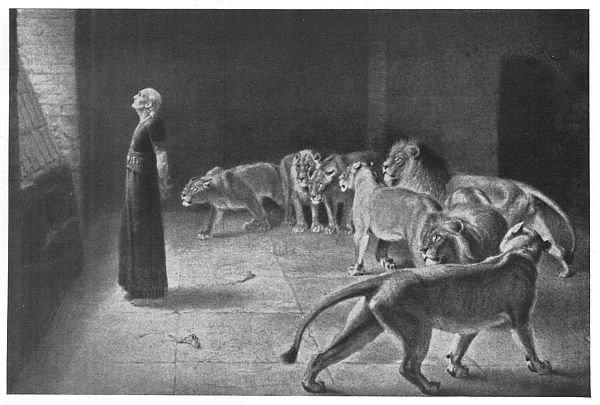
Reproduced by permission of Thomas Agnew & Sons, owners of the copyright Daniel's Answer to the King Painted by Briton Riviere
It pleased Darius to set over the kingdom a hundred and twenty officers who ruled the whole kingdom, and over them three chief officials, of whom Daniel was one, that these officers might report to them and that the king should lose nothing. Daniel was better than the other chief officials and the officers, for he had a fine spirit; and the king intended to set him over the whole empire.
Then the chief officials and the officers tried to find a way to accuse Daniel of not having done his duty, but they could not find anything against him, for he was faithful and was not guilty of any mistake or wrong-doing.
Then these men said, "We shall not find any way to accuse this Daniel unless we find it in connection with the law of his God." So these chief officials and officers all went to the king, and said to him, "King Darius, live forever. All the chief officials of the kingdom, the counsellors and the officers, the judges and the governors, have consulted together to have the king make a law and give a strong command that whoever shall ask a petition of any god or man for thirty days, except of you, O king, shall be thrown into a den of lions. Now, O king, give the command and sign the law that, like the law of the Medes and Persians, it may not be changed." So King Darius signed the law and the command.
When Daniel knew that the law was signed, he went into his house. His windows were open in his room toward Jerusalem, and he knelt upon his knees three times a day and prayed, and gave thanks to his God as he had done before. Then these men rushed in and found Daniel praying and calling upon his God. So they went before the king and spoke to him about the royal command: "Have you not signed a command, that every man who shall ask a petition of any man or god within thirty days, except of you, O king, shall be thrown into the den of lions?" The king answered, "The rule is fixed according to the law of the Medes and Persians, which cannot be changed." Then they went on to say to the king, "That Daniel, who is one of the captives from Judah, pays no attention to you, O king, nor to the command that you have signed, but prays three times a day."
When the king heard these words, he was greatly displeased, and set his heart on saving Daniel, and he worked until the sun set to save him. Then these men all went to the king and said to him, "Know, O king, that it is a law of the Medes and Persians, that no command nor law which the king gives may be changed."
So the king gave his command, and they brought Daniel and threw him into the den of lions. But the king said to Daniel, "Your God, whom you always serve, will save you." Then a stone was brought and laid at the entrance to the den; and the king sealed it with his own seal-ring and with those of his nobles, that no change might be made so as to rescue Daniel. Then the king went to his palace and passed the night fasting.
At dawn, as soon as it was light, the king rose and hurried to the den of lions. When he came near to the den where Daniel was, he cried with a very sad voice, "O Daniel, servant of the living God, has your God, whom you always serve, been able to save you from the lions?" Daniel said to the king, "O king, live forever. My God has sent his angel and has closed the lions' mouths, and they have not hurt me, for I was innocent before him; and also before you, O king, I have done no wrong." Then the king was very glad and commanded that they should take Daniel up out of the den. So Daniel was taken up out of the den, and it was found that he was not injured, for he had trusted in his God.
Then the king commanded that those men who had accused Daniel should be brought and thrown into the den of lions.
And King Darius wrote to all the peoples, nations, and races in all his kingdom, "May your peace be great! I make a law that throughout all my kingdom, men tremble and fear before the God of Daniel; for he is the living God, and is the same forever, and his kingdom is one that shall not be destroyed; and his rule shall be without end. He saves and rescues, and does wonderful things in heaven and earth; it is he who has saved Daniel from the power of the lions." So Daniel was successful and happy during the reign of Darius.
QUEEN ESTHER'S LOVE FOR HER PEOPLE
After Xerxes had been king of Persia for three years, he gave a feast for all his officials, officers, and servants. The commanders of the armies of Persia and Media, the nobles and governors were before him; while for one hundred and eighty days he showed them the wonderful riches of his kingdom and the costliness of his magnificent regalia.
When these days were ended, the king made a seven days' feast in the enclosed garden of the royal palace, for all classes of people who were in the royal palace at Susa. Vashti, the queen, also gave a feast for the women in the royal palace which belonged to King Xerxes.
On the seventh day, when King Xerxes had been drinking wine, he commanded his seven court attendants to bring Vashti, the queen, before him with the royal crown on her head, to show the peoples and the officials her beauty, for she was very fair. But Queen Vashti refused to come as the king commanded. Therefore the king was very angry.
In his anger the king said to the wise men, "According to law what shall we do to Queen Vashti?" Memucan, one of the seven high officials, said before the king and his officers, "Vashti, the queen, has done wrong not only to the king but also to all the officials and to all the peoples in all of the king's provinces. For the refusal of the queen will be reported to all the women so that they will disobey their husbands, for they will say, 'King Xerxes commanded Vashti, the queen, to be brought in before him, but she did not come!' And this very day the ladies of Persia and Media who have heard of the refusal of the queen will tell it to all the king's officials, and there will be contempt and strife! If it seems best to the king, let him send out a royal command, and let it be written among the laws of Persia and Media, in order that it may not be changed, that Vashti may never again come before King Xerxes; and let the king give her place as queen to another who is better than she. And when the king's command shall be heard throughout his kingdom—great as it is—the wives of all classes will give honor to their husbands!"
The plan pleased the king and the officials, and the king did as Memucan advised. Then the king's pages who waited upon him said, "Let beautiful young girls be sought for the king, and let the king appoint officers to all the provinces of his kingdom to gather them all to the palace at Susa. Then give them what is needed to make them beautiful, and let the girl who pleases the king be queen instead of Vashti." The plan pleased the king and he did so.
There was in the royal palace at Susa, a certain Jew named Mordecai, who had been carried away from Jerusalem with the captives by Nebuchadrezzar, the king of Babylon. He had adopted Esther, his uncle's daughter, for she had neither father nor mother. The girl was attractive and beautiful, and after her father and mother died, Mordecai took her as his own daughter.
So when the king's command was made known, and when many girls were brought to the royal palace at Susa, Esther also was taken into the king's palace and placed in the charge of Hegai, who took care of the women. The girl pleased him and won his favor, so that he quickly gave her what she needed to make her more beautiful and her allowance of food and the seven maids chosen from the king's household. He also moved her and her maids to the best place in the women's quarters. Esther had not told who were her people or her family, for Mordecai had told her not to tell. Every day Mordecai used to walk in front of the court of the women's quarters to ask after Esther's health and what had been done with her.
When Esther's turn came to go in to the king, he loved her more than all the other women, and she became his favorite and won his love, so that he placed the royal crown on her head and made her queen instead of Vashti. Then the king gave a great feast to all his officials and servants in honor of Esther.
In those days while Mordecai was sitting in the king's gate, two of the king's servants, who guarded the entrance of the palace, became enraged and tried to kill King Xerxes. But Mordecai learned of the plot and told it to Queen Esther, and she told the king in Mordecai's name. When the truth was known, the men who plotted against the king were both hanged on a tree; and it was written down in the daily record of events that was kept before the king.
After these events King Xerxes promoted Haman, the Agagite, and gave him a place above all the officials who were with him. All the king's servants who were in the king's gate used to bow down before Haman, for so the king had commanded. But Mordecai did not bow down before Haman.
Then the king's servants, who were in the king's gate, said to Mordecai, "Why do you disobey the king's command?" When they had spoken to him day after day without his listening to them, they told Haman, so as to find out whether Mordecai's acts would be permitted, for he had told them that he was a Jew. When Haman saw that Mordecai did not bow down before him, he was very angry; but as they had told him that Mordecai was a Jew, he decided not to lay hands on him alone but to plot to destroy all the Jews in the whole kingdom of Xerxes.
So Haman said to King Xerxes, "There is a certain people scattered among the peoples in all the provinces of your kingdom, whose laws differ from those of every other and who do not keep the king's laws. Therefore it is not right for the king to leave them alone. If it seems best to the king, let an order be given to destroy them, and I will pay ten thousand silver talents into the royal treasury."
So the king took off his ring from his hand and gave it to Haman, "The money is yours and the people also to do with them as you wish." So messages were sent by men on horses to all the king's provinces, to destroy, to kill, and to put an end to all the Jews, young and old, little children and women, on the thirteenth day of the twelfth month, and to rob them of all that they had. Then the king and Haman sat down to drink, but the people of Susa were troubled.
When Mordecai learned all that had been done, he tore his clothes and put on sackcloth and put ashes on his head, and went out into the city and raised a loud and bitter cry of sorrow. And he went as far as the king's gate, for no one could enter the gate clothed with sackcloth. In every province, wherever the king's command went, there was great mourning, fasting, weeping, and wailing among the Jews; and many of them sat in sackcloth and ashes.
When Esther's maids and servants told her about it, she was greatly troubled. She sent garments for Mordecai to put on, that he might take off his sackcloth; but he would not accept them. So Esther called Hathach, one of the king's servants whom he had appointed to wait on her, and ordered him to go to Mordecai to learn what this meant and how it had happened.
So Hathach went to Mordecai at the city square in front of the king's gate. And Mordecai told him all that had happened to him and the exact sum of money that Haman had promised to pay into the king's treasury. Also he gave him a copy of the order to destroy them, that had been given out in Susa, to show to Esther that she might know about it. He also urged her to go to the king and ask his mercy and plead with him for her people.
When Hathach came and told Esther what Mordecai had said, she commanded Hathach to go and say to Mordecai, "All the king's servants and the people of the king's provinces know that death is the punishment for every man or woman who goes to the king into the inner court without being called, except for the one to whom the king may hold out the golden sceptre, which means that he may live. But now for thirty days I have not been called to go in to the king."
When Mordecai was told what Esther had said, he sent back this answer to Esther, "Do not think that you alone of all the Jews will escape because you belong to the king's household. If you keep silent at this time, help will come to the Jews from somewhere else, but you and your family will perish. Who knows but that you have been raised to the throne for a time like this?"
Then Esther sent this message to Mordecai: "Go, gather all the Jews in Susa and fast for me; do not eat nor drink anything for three days and nights. I and my maids will fast also, and so I will go in to the king, although it is against the law. And if I perish I perish." So Mordecai went away and did as Esther directed.
On the third day, Esther put on her royal garments and stood in the inner court of the royal palace opposite the king's house. The king was sitting on his throne in the palace, opposite the entrance. When he saw Esther, the queen, standing in the court, she won his favor, and he held out to her the golden sceptre that was in his hand. So Esther went up and touched the top of the sceptre. Then the king said to her, "Whatever you wish, Queen Esther, and whatever you ask, it shall be granted, even if it is the half of the kingdom." Esther said, "If it seems best to the king, let the king and Haman come to-day to the feast that I have prepared for him." Then the king said, "Bring Haman quickly, that Esther's wish may be granted."
So the king and Haman went to the feast that Esther had prepared. While they were drinking wine, the king said to Esther, "Whatever you ask shall be granted, even if it takes the half of my kingdom." Esther answered, "If I have won the king's favor and if it seems best to the king to grant what I ask, let the king and Haman come to the feast which I shall prepare for them; and to-morrow I will do as the king wishes."
So Haman went out that day joyful and happy, but when he saw Mordecai in the king's gate and noticed that he neither stood up nor moved for him, he was furiously angry with Mordecai. But Haman controlled his temper and went home. Then he called together his friends and Zeresh, his wife, and told them the greatness of his wealth, how many children he had, and all the ways in which the king had honored him, and how he had given him a place above the officials and the royal servants. Haman said, "Queen Esther brought no one in with the king to the feast which she had prepared but me, and to-morrow also I am invited by her along with the king. Yet all this does not satisfy me as long as I see Mordecai, the Jew, sitting at the king's gate."
Then Zeresh, his wife, and all his friends said to him, "Let a gallows seventy-five feet high be built and in the morning speak to the king and let Mordecai be hanged on it. Then go merrily with the king to the feast." The advice pleased Haman, and so he had the gallows built.
On that night the king was unable to sleep; so he gave orders to bring the books that told of great deeds; and they were read before the king. And it was written how Mordecai had told about the two servants of the king who had tried to kill King Xerxes. Then the king said, "How has Mordecai been honored and rewarded for this?" When the king's pages who waited on him replied, "Nothing has been done for him," the king said, "Who is in the court?" Now Haman had just entered the outer court of the king's house to speak to the king about hanging Mordecai on the gallows that he had prepared for him. So the king's pages said to him, "Haman is standing there in the court." The king said, "Let him enter."
So Haman entered, and the king said to him, "What shall be done for the man whom the king wishes to honor?" Haman said to himself, "Whom besides me does the king wish to honor?" So Haman said to the king, "For the man whom the king wishes to honor let a royal garment be brought, which the king has worn, and the horse on which the king has ridden and on whose head a royal crown has been placed. Then let the garment and the horse be placed in charge of one of the king's noble officials and let him clothe the man whom the king longs to honor and make him ride on the horse through the city square and proclaim before him, 'This is what is done for the man whom the king wishes to honor.'"
Then the king said to Haman, "Make haste and take the garment and the horse, as you have said, and do thus to Mordecai, the Jew, who sits in the king's gate. Do not fail to do all you have said." So Haman took the garment and the horse and clothed Mordecai, and made him ride through the city square and proclaimed before him, "This is what is done for the man whom the king wishes to honor."
Mordecai returned to the king's gate, but Haman hurried to his house, mourning, with his head covered. And Haman told Zeresh, his wife, and all his friends everything that had happened to him. Then his wise men and Zeresh, his wife, said to him, "If Mordecai before whom you have already been disgraced is of the Jewish race, you can do nothing against him, but you will surely fall before him."
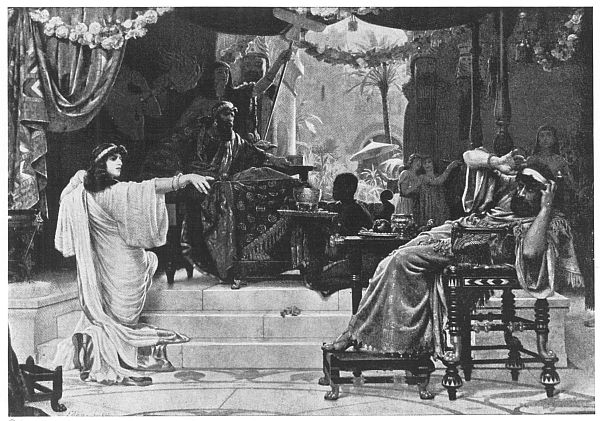
While they were still talking with him, the king's servants came and quickly took Haman to the feast that Esther had prepared. So the king and Haman went to drink with Queen Esther. And the king said to Esther, as they were drinking wine, "Whatever you ask, Queen Esther, it shall be granted you, even if it takes half of the kingdom." Then Queen Esther answered, "If I have won your favor, O king, and if it seems best to the king, let my life and my people be given me at my request, for I and my people have been sold to be destroyed, to be killed, and to perish!"
The King Xerxes said to Queen Esther, "Who is he and where is he who dares to do so?" Esther answered, "A foe, an enemy, this wicked Haman." Then Haman shrank in terror before the king and the queen, and Harbonah, one of those who waited on the king, said, "There, standing in the house of Haman, are the gallows, seventy-five feet high, which Haman built for Mordecai, who spoke a good word for the king." The king said, "Hang him on them." So they hanged Haman on the gallows that he had prepared for Mordecai. Then the wrath of the king was quieted.
At that time King Xerxes gave the property of Haman, the Jews' enemy, to Queen Esther. And Mordecai was made one of the king's advisers, for Esther had told of his relationship to her. The king also drew off his signet-ring, which he had taken from Haman, and gave it to Mordecai; and Esther placed Mordecai in charge of Haman's property.
Then Esther came again before the king and fell at his feet and with tears begged him to prevent the evil that Haman had planned against the Jews. The king held out to her the golden sceptre, and she arose and stood before him. Then King Xerxes said to Queen Esther and to Mordecai, the Jew, "Write in behalf of the Jews, as seems best to you, in the king's name and seal it with the king's ring; for what is written in the king's name and sealed with the king's ring no one may disobey."
So Mordecai wrote in the name of King Xerxes and sealed it with the king's ring. And he sent by messengers, who rode the king's swift horses, mules, and camels, the king's command that the Jews who were in every city should gather together and protect their lives.
The command had also been given out in the royal palace at Susa; and Mordecai had gone out from the presence of the king in royal garments of violet and white and with a great crown of gold and with a robe of fine linen and purple. The people of Susa shouted and were glad. To the Jews there came light and gladness and joy and honor. And in every country and city, where the king's command came, there was gladness and joy among the Jews, and a holiday.
On the fourteenth day of the month Adar, the Jews rested and made it a day of feasting and rejoicing. Therefore the Jews who live in the country villages keep the fourteenth day of the month Adar as a day of rejoicing and feasting and a holiday, and as a day on which they send gifts to one another. But the Jews in Susa rested on the fifteenth day of the same month and made it a day of feasting and rejoicing.
The Jews made it a custom for them, and for their children, and for all who should join them, so that it might not be changed, that they should observe these two days as feasts each year. For Haman had plotted to destroy the Jews completely, and he cast pur, that is, the lot, to destroy them. For this reason these days are called Purim.
© Ernest Normand Esther Denouncing Haman Painted by Ernest Normand
REBUILDING THE TEMPLE
That the promise made by Jehovah through the mouth of Jeremiah might be fulfilled, Jehovah influenced Cyrus, king of Persia, in the first year of his reign to make this written law throughout all his kingdom, "Thus commands Cyrus, king of Persia: 'Jehovah, the God of heaven, has given me all the kingdoms of the earth and has charged me to build him a temple in Jerusalem in Judah. Whoever among you of all his people wishes to return, may his God be with him, and let him go up to Jerusalem, in Judah, and rebuild the temple of Jehovah, the God of Israel. (He is the God who lives at Jerusalem.) In every place where any who are left of Jehovah's people now live, let the men of that place help with silver, with gold, with goods, and with animals, in addition to the offering each man wishes to give for the house of God at Jerusalem.'"
Then the heads of the families of Judah and Benjamin and the priests and the Levites, including all whom God had influenced to build the temple of Jehovah at Jerusalem, started to return. And all their neighbors supplied them with silver, with gold, with goods, with animals, and with precious things in addition to all that each man wished to give.
Cyrus, king of Persia, had the vessels of the temple of Jehovah, which Nebuchadrezzar had carried from Jerusalem, brought out under the direction of Mithredath, the treasurer, and given to Sheshbazzar, the prince of Judah; and he carried them to Jerusalem, with the people who returned from captivity in Babylon. And Jehovah commanded them, through Haggai, the prophet, "Go up to the mountains and bring wood and rebuild the temple, then I will be pleased with it and I will show my glory."
Then Zerubbabel and Joshua, the high priest, with all the rest of the people obeyed the command of Jehovah their God; and they came and worked on the temple of Jehovah their God. They finished the building as the God of Israel commanded.
NEHEMIAH'S ANSWER TO A CALL FOR HELP
In the twentieth year of Artaxerxes' reign, in the month of November, I (Nehemiah) was in Shushan, the royal palace, when Hanani, one of my brothers, and certain men came from Judah. I asked them about Jerusalem and about the Jews who were left from the captivity. They told me, "Those still living there in the province are in great trouble and disgrace. The wall of Jerusalem is broken down and its gates have been destroyed by fire."
When I heard these words I sat down and wept and mourned several days. Then I fasted and offered this prayer to the God of heaven, "I pray thee, O Jehovah, the God of heaven, who showest kindness to those who love and follow thy commands, let thine ears now be open to hear the prayers of thy servant which I am now making before thee day and night for the Israelites, thy servants, while I confess the sins which we have committed. These are thy servants and thy people, whom thou hast saved by thy great power and by thy strong hand. O Lord, I pray thee, let thine ear be open to the petition of thy servant and to the petitions of thy servants who take pleasure in worshipping thee, and give success to thy servant this day, and grant that he may win this man's sympathy."
Now I was cupbearer to the king, and in the month of March in the twentieth year of the reign of Artaxerxes, the king, I had charge of the wine offered to the king. Up to this time I had not been sad; so the king said to me, "Why is your face sad, for you are not sick? This is nothing else but sorrow of heart." Then I was greatly afraid, and I said to the king, "Let the king live forever! Why should not my face be sad, when the city, the place where my fathers are buried, lies in ruins and its gates are destroyed by fire?" Then the king said to me, "What do you wish?" So I prayed to the God of heaven and said to the king, "If it please the king and if your servant has won your favor, then send me to Judah, to the city where my fathers lie buried, that I may rebuild it." The king said to me (and the queen was also sitting by him), "How long will your journey take, and when will you return?" Then I told him when I would return, so that the king was willing to let me go.
I also said to the king, "If the king is willing, let letters be given me to the governors of the province west of the Euphrates, that they may let me pass through until I come to Judah, and a letter to Asaph, the keeper of the king's park, that he may give me timber to make beams for the gates of the castle which guards the temple and for the wall of the city and for the house in which I shall live." The king granted me all this, for my God kindly cared for me.
Then I went to the governors of the province and gave them the king's letters. The king had sent with me officers and horsemen; and when Sanballat, the Horonite, and Tobiah, the Ammonite slave, heard of it, it troubled them greatly, that one had come to look out for the welfare of the Israelites.
So I arrived at Jerusalem. After I had been there three days I rose in the night, together with a few of my followers. I told no one what my God had put into my mind to do for Jerusalem, and I had no animal with me except the one upon which I rode. I went out by night through the Valley Gate, toward the Dragon's Well and to the Dung Gate; and I examined carefully the walls of Jerusalem which were broken down and the places where its gates had been destroyed by fire. Then I went on to the Fountain Gate and to the King's Pool, but there was no place for the animal on which I rode to pass.
I also went up in the night along the Brook Kidron and examined the wall; then I turned back and entered by the Valley Gate and so returned. The rulers did not know where I went or what I did, and I had not as yet told my plan to the Jews or to the priests or to the nobles or to the rulers or to the others who did the work.
Then I said to them, "You see the bad condition in which we are, how Jerusalem lies in ruins and its gates are destroyed by fire. Come and let us rebuild the wall of Jerusalem, that we may no longer be in disgrace." I told them too how my God had kindly cared for me and the words which the king had spoken to me. They said, "Let us go to work and build?" So they entered heartily into the good work.
OVERCOMING GREAT DIFFICULTIES
Now when Sanballat heard that we were rebuilding the wall, he was so angry and indignant that he mocked the Jews. He spoke before his tribesmen and the army of Samaria and said, "What are these feeble Jews doing? Will they leave it to God? Will they offer a sacrifice? Will they finish the work in a day? Will they recover the stones from the heaps of rubbish even after they have been destroyed by fire?"
Tobiah, the Ammonite, was with him, and he said, "This stone wall which they are building—if a fox should go up on it, he would break it down!"
But we went on rebuilding the wall; and all the wall was joined together to half its height, for the people were eager to work. But when Sanballat and Tobiah and the Arabians and the Ammonites and the Ashdodites heard that the rebuilding of the walls of Jerusalem was going on, so that the broken places began to be closed, they were very angry. And they all planned together to come and fight against Jerusalem and frighten the people there. But we prayed to our God and set a watch as a protection against them day and night.
When our enemies heard that their plan was known to us and that God had not let them carry it out, we all returned to the wall, each to his own work. From that time on, while half of my servants were at work, half of them held the lances, the shields, the bows and the coats of mail; and the rulers stood behind all the people of Judah. Those who built the wall and those who carried burdens were also armed, each using one of his hands for the work, and was ready with the other to grasp his spear. And each builder worked with his sword fastened at his side. The man who sounded the alarm was by me; and I said to the nobles and to the rulers and to the rest of the people, "The work is great and spread out, and we on the wall are far from each other. Wherever you hear the sound of the trumpet, gather about us; our God will fight for us."
So we worked hard, while half of them held the lances from early in the morning until the stars came out. And I said at that time to the people, "Let each man with his servant stay in Jerusalem, that they may protect us at night and work during the day." So neither I, nor any of my relatives, nor my servants, nor the men of the guard who accompanied me took off our clothes, but each kept his spear in his right hand.
After fifty-two days the wall was finished. When our enemies heard of it, all the nations around us were afraid, and it seemed very wonderful to them, and they knew that this work had been done by our God.
After the wall had been built and I had set up the doors, and the porters and the singers and the Levites had been appointed, I placed my brother Hanani, the commander of the castle, in charge of Jerusalem, for he was a faithful man and more God-fearing than many. And I said to them, "Let not the gates of Jerusalem be opened until after sunrise; and at night, while the watchmen are still on guard, let them shut the doors and bar them. Also let the people who live in Jerusalem be on guard, each at his post opposite his own house."
Now the city was wide and large, but there were few people in it, and the houses had not been rebuilt. So my God put it into my mind to gather together the nobles and the officials and the people. The officials lived in Jerusalem. The rest of the people drew lots that one out of every ten should live in Jerusalem, the sacred city, while the others stayed in the villages.
Then I had the officials of Judah take their place on the wall, and I formed two great processions. The first marched to the right upon the wall toward the Dung Gate; and behind them went Hoshaiah and half of the officials of Judah. At the Fountain Gate they went straight up the stairs of the City of David by the ascent along the wall above the House of David to the Water Gate on the east of the city.
The other procession went to the left on the wall above the Tower of the Furnaces, and I after them, with half of the people, to the broad wall and above the Gate of Ephraim and past the Old Gate, the Fish Gate, the Tower of Hananel, and the Tower of the Hundred to the Sheep Gate. Then they stood in the Gate of the Guard. So the two processions took their position in the temple and I and half of the rulers who were with me.
Then the singers sang loudly, and the people offered many sacrifices that day and rejoiced, for God had given them great cause for joy. The women and children rejoiced, too, so that the cries of joy at Jerusalem were heard far away.
A BRAVE KNIGHT
Then the common people and their wives raised a loud cry against their fellow Jews. Some said, "We must give up our sons and our daughters in pledge to get grain that we may eat and live." Others said, "We must give up our fields and our vineyards and our houses, that we may get grain because there is so little." Others said, "We have borrowed money to pay the king's taxes. Although our flesh is as the flesh of our brothers, our children as their children; yet we must sell our sons and our daughters as slaves. Some of our daughters have already been made slaves, and it is not in our power to stop it, for our fields and our vineyards belong to the nobles."
When I heard their cry and these words, I was very angry. After I had thought about it, I rebuked the nobles and the rulers and said to them, "You make each of your fellow Jews pay what you loan him."
Then I called a great meeting to protest against what they were doing. And I said to them, "We ourselves have, as far as we could, bought back our fellow Jews who have been sold to foreigners. Would you sell your fellow Jews, and should they be sold to us?" Then they were silent and could not find a word to say. So I said, "What you are doing is not good. Ought you not to live in the fear of God, so as not to be an object of shame to our foreign foes? I, too, my relatives, and my servants lend the people money and grain. Let us stop taking anything for what we lend. Give back to them at once their fields, their vineyards, their olive-yards, and their houses, and whatever you have made them pay for the money, the grain, the new wine and the oil."
Then they said, "We will give them back and will ask nothing from them; we will do even as you say." Then I called the priests and made them solemnly promise that they would do as they had said.
For twelve years from the time that I was appointed to be their governor in the land of Judah, I and my relatives did not eat the food which was my right as governor. But the governors who were before me were an expense to the people and took from them bread and wine and forty pieces of silver each day. Their servants also were cruel to the people. But I did not do so, for I feared God. I also gave myself to the work on the wall, and we did not buy any land, but all my servants were gathered there for work. Also a hundred and fifty of the Jews and rulers, beside those who came to us from other nations, were fed at my table. Each day one ox and six choice sheep and fowls were prepared at my expense, and once in ten days plenty of wine for all. Yet with all this expense, I did not demand the food which was due me as governor, because the public work was a heavy burden upon this people. Remember to my credit, O my God, all that I have done for them!
JONAH THE NARROW-MINDED PATRIOT
This message from Jehovah came to Jonah, the son of Amittai: "Arise, go to that great city, Nineveh, and preach against it; for their wickedness is known to me." But Jonah started to flee to Tarshish from the presence of Jehovah. He went down to Joppa and found a ship going to Tarshish. So he paid the fare and went aboard to go with them to Tarshish from the presence of Jehovah.
But Jehovah made a furious wind blow over the sea, and there was such a great storm that the ship was in danger of breaking to pieces. Then the sailors were afraid and each cried for help to his own god. They threw into the sea the things that were in the ship, in order to make it lighter. But Jonah had gone down into the bottom of the ship and lay fast asleep. Then the captain of the ship went and said to him, "How is it that you are asleep? Call on your god; perhaps that god will think of us, so that we may not be lost."
And they said to one another, "Come, let us cast lots, that we may know on whose account this evil has come upon us." So they cast lots, and the lot fell upon Jonah. Then they said to him, "Tell us, what is your business, and where do you come from? What is your country and to what race do you belong?" He said to them, "I am a Hebrew, and a worshipper of Jehovah, the God of heaven, who made the sea and the dry land." Then the men were greatly frightened and said to him, "What is this you have done?" For they knew that he was fleeing from the presence of Jehovah, because he had told them.
Then they said to him, "What shall we do to you, that the sea may be calm for us?" for the sea grew more and more stormy. He said to them, "Take me up and throw me into the sea, and the sea will be calm for you, for I know that on account of me this great storm has overtaken you." But the men rowed hard to get back to the land; they could not, however, for the sea grew more and more stormy ahead.