Mrs Molesworth (continued 2)
Reading edition
“Ruby; Mavis,” it said.
Ruby turned to Mavis.
“It’s a trick of that boy’s,” she said. “He wants to startle us. He has no business to call us by out names like that. I’ll not stay;” and she ran out. Mavis was following her to bring her back when a ray of light—scarcely a ray, rather, I should say, a soft glow—seemed to fill the entrance to the grotto. And gradually, as her eyes got used to it, she distinguished a lovely figure—a lady, with soft silvery-blue garments floating round her and a sweet grave face, was standing there looking at her. A strange thrill passed through the child, yet even as she felt it she knew it was not a thrill of fear. And something seemed to draw her eyes upwards—a touch she could not have resisted if she had wished—till they found their resting-place in meeting those that were bent upon her—those beautiful, wonderful blue eyes, eyes like none she had ever seen, or—nay, she had heard of such eyes—they were like those of the fairy lady in her old cousin’s dream. And now Mavis knew in part why the strange vision did not seem strange to her; why, rather, she felt as if she had always known it would come, as if all her life she had been expecting this moment.
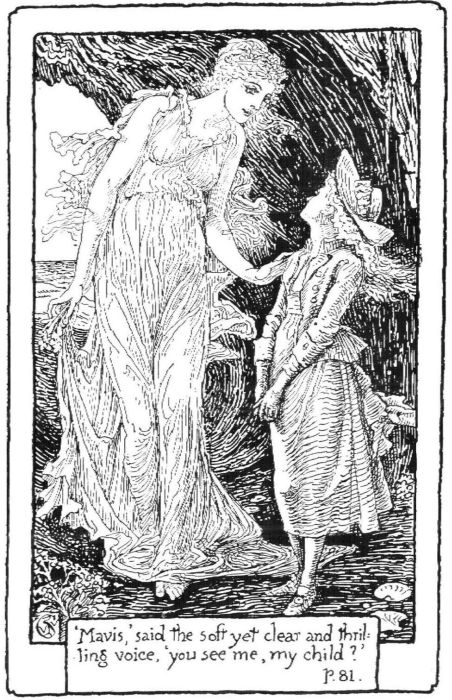
“Mavis,” said the soft yet clear and thrilling voice, “you see me, my child?”
“Yes,” said the little girl, speaking steadily, though in a whisper, “I see you, and I see your eyes. Who are you? I may ask you, may I not?”
The fairy—if fairy she was—smiled.
“I have many names,” she said; “but if you like you may think of me by the one Winfried loves. He calls me ‘Princess with the Forget-me-not Eyes,’ or ‘Princess Forget-me-not.’”
“Yes,” said Mavis, “I like that; and I will never forget you, princess.”
Again the lovely vision smiled.
“No, my child, you never will, for, to tell you a secret, you cannot, even if you wished. Afterwards, when you know me better, you will see how well my name suits me. But it does not seem to all a sweet name, as I think it always will to you,” and she sighed a little. “There are those who long to forget me; those who wish they had never seen me.”
The sadness in her eyes was reflected in the child’s.
“How can that be?” asked Mavis.
The blue-eyed princess shook her head.
“Nay, my darling, I cannot tell you, and I scarce would if I could,” she said gently. But then a brighter look came over her face again, “Don’t look so sad. They change again some of them, and seek me as earnestly as they would have before fled from me. And some day you may help and guide such seekers, simple as you are, my little Mavis. Now I must go—call Ruby—she would not stay for me; she has not yet seen me. But she heard my voice, that is better than nothing. Good-bye, little Mavis, and if you want me again before I come of myself, seek me in the west turret.”
Mavis’s face lighted up.
“Then it was you—you are cousin Hortensia’s fairy, and it wasn’t a dream after all. And of course you must be a fairy, for that was ever, ever so long ago. She was a little girl then, and now she is quite old, and you look as young as—as—”
“As who or what?” asked the princess, smiling again.
“As the Sleeping Beauty in the wood,” replied Mavis, after deep consideration.
At this the princess did more than smile; she laughed,—the same clear delicate laugh which the children had heard that day in the distance.
And Mavis laughed too; she could not help it.
“May I tell cousin Hortensia?” she asked. “Oh do say I may.”
“You may,” said Forget-me-not, “if—if you can!”
And while Mavis was wondering what she meant, a breath of soft wind seemed to blow past her, and glancing up, the princess was gone!
Mavis rubbed her eyes. Had she been asleep? It seemed a long time since Winfried told her and Ruby to wait for him in the grotto; and where was Ruby? Why did she not come back? Mavis began to feel uneasy. Surely she had been asleep—for—was she asleep still? Looking round her, she saw that she was no longer in the grotto-cave behind old Adam’s cottage, but standing in the archway at the sea side of the castle—the archway I have told you of into which opened the principal entrance to the grim old building. And as she stood there, silent and perplexed, uncertain whether she was not still dreaming, she heard voices coming near. The first she could distinguish was Ruby’s.
“There you are, Mavis, I declare,” she exclaimed. “Now it’s too bad of you to have run on so fast without telling, and I’ve been fussing about you all the way home, though Winfried said he was sure we should find you here. How did you get back?”
“How did you?” asked Mavis in return. “And why didn’t you come back to me in the grotto? I—I waited ever so long, and then—” but that was all she could say, though a smile broke over her face when she thought of what she had seen.
“You look as if you had been asleep,” said Ruby impatiently.
“And having pleasant dreams,” added Winfried. “But all’s well that ends well. Won’t you run in now, my little ladies, and let Miss Hortensia see that I’ve brought you safe back. It is cold and dark standing out here, and I must be off home.”
“Good-night then,” said Ruby; “you’re a very queer boy, but you brought me home all right any way, and those cakes were very good.”
“You will come to see us soon again, won’t you, Winfried?” said Mavis, who felt as if she had a great deal to ask which only he could answer, though with Ruby there beside her she could not have explained what she wanted to know.
“To be sure I will, if you want me,” said the boy.
“Don’t be puzzled, Miss Mavis, pleasant dreams don’t do any one harm.”
And as they pushed open the great, nail-studded door which was never locked till after nightfall Winfried ran off.
They stood still for a moment just inside the entrance. They could hear him whistling as he went, smoothly at first, then it seemed to come in jerks, going on for a moment or two and then suddenly stopping, to begin again as suddenly.
“He’s jumping down the cliff. I can hear it by his whistle,” said Ruby. “How dangerous!”
“He’s very sure-footed,” said Mavis with a little sigh. She was feeling tired—and—was it a dream? If so, how had she got home? Had the fairy lady wrapped her round in her cloak of mist and flown with her to the castle? Mavis could not tell, and somehow Ruby did not ask her again.
“How did you come home, Ruby?” Mavis asked as they were going along the passage to their sitting-room.
“Oh,” said Ruby, “Winfried took me down some steps, and then up some others, and before I knew where we were, we were in the rock path not far from home. It was like magic. I can’t make out that boy,” she said mysteriously; “but we’re not turned into frogs or toads yet. Here we are, cousin Hortensia,” she went on, as the good lady suddenly appeared at the end of the passage, “safe home from the wizard’s haunts.”
But Miss Hortensia only smiled.
“I was not uneasy,” she said. “I thought you would be quite safe.”
Chapter Six.
Bertrand.
“But the unkind and the unruly, And the sort who eat unduly, Theirs is quite a different story.” Good and Bad Children: Louis Stevenson.
They were just beginning tea, and Ruby’s tongue was going fast as she described to Miss Hortensia all that happened that afternoon, while Mavis sat half-dreamily wondering what the fairy lady had meant by saying she might tell her cousin about her “if she could,” when there came a sudden and unusual sound that made them all start. It was the clanging of the great bell at the principal entrance on the south side—the entrance by which, you remember, all visitors, except those coming by sea, came to the castle.
“Who can that be?” exclaimed Ruby, jumping up and looking very pleased—Ruby loved any excitement. “Can it be father? What fun if he’s come to surprise us! Only I hope he won’t have forgotten our presents. He generally asks us what we want before he comes.”
Mavis had grown a little pale; somehow the things that Ruby was frightened of never alarmed her, and yet she was more easily startled by others that Ruby rather enjoyed.
“I hope it isn’t a message to say that anything is the matter with dear father,” she said anxiously.
Miss Hortensia got up from her seat and went to the door. She did not seem frightened, but still rather uneasy.
“I’m afraid,” she began, “I’m afraid—and yet I should not speak of it that way; it is not kind. But I did so ask them to give us notice of his coming.” She had left the room almost before she had finished speaking. The children looked at each other.
“I say, Mavis,” said Ruby, “it’s Bertrand! Don’t you think we might run out and see?”
“No,” Mavis replied decidedly, “certainly not. Cousin Hortensia would have told us to come if she had wanted us.”
But they went to the open door and stood close beside it, listening intently. Then came the sound of old Joseph’s steps along the stone passage from the part of the house which he and Bertha—Joseph was Bertha’s husband—inhabited, then the drawing back of the bolts and bars, and, most interesting and exciting of all, a noise of horses stamping and shaking their harness as if glad to have got to the end of their journey. Then followed voices; and in a minute or two the children heard Miss Hortensia coming back, speaking as she came.
“You must be very cold, my dear boy, and hungry too,” she was saying. “We are just beginning tea, so you had better come in at once as you are.”
“It’s terribly cold, and that fool of a driver wouldn’t come any faster; he said his horses were tired. I wish I could have got a cut at them—what are horses for?” was the reply to Miss Hortensia’s kind speech.
Mavis touched Ruby.
“Come in. Cousin Hortensia wouldn’t like to see us standing at the door like this,” she said.
They sat down at their places again, only getting up as Miss Hortensia came in.
She was followed by a boy. He was about the height of the twins, broad and strong-looking, wrapped up in a rich fur-lined coat, and with a travelling cap of the same fur still on his head. He was dark-haired and dark-eyed, a handsome boy with a haughty, rather contemptuous expression of face—an expression winch it did not take much to turn into a scowl if he was annoyed or put out.
“These are your cousins, Bertrand; your cousins Ruby and Mavis—you have heard of them, I am sure, though you have never met each other before.”
Bertrand looked up coolly.
“I knew there were girls here,” he answered. “Mother said so. But I don’t care for girls—I told mother so. I’m awfully hungry;” and he began to pull forward a chair.
“My dear,” said Miss Hortensia, “do you know you have not taken off your cap yet? You must take off your coat too, but, above all, your cap.”
Bertrand put up his hand and slowly drew off his cap.
“Mother never minds,” he said. But there was a slight touch of apology in the words.
Then, more for his own comfort evidently than out of any sense of courtesy, he pulled off his heavy coat and flung it on to a chair. The little girls had not yet spoken to him, they felt too much taken aback.
“Perhaps he is shy and strange, and that makes him seem rough,” thought Mavis, and she began drawing forward another chair.
“Will you sit here?” she was saying, when Bertrand pushed past her.
“I’ll sit by the fire,” he said, and he calmly settled himself on what he could not but have seen was her seat or Ruby’s; “and I’m awfully hungry,” he went on.
“At home I have dinner, at least if I want it, I do. It’s only fit for girls to have tea in this babyish way.”
He helped himself to a large slice of cake as he spoke; and not content with this, he also put a big piece of butter on his plate. Miss Hortensia glanced at him, and was evidently just going to speak, but checked herself. It was Bertrand’s first evening, and she was a very hospitable person. But when Bertrand proceeded to butter his cake thickly, Ruby, never accustomed to control her tongue, burst out.
“That’s cake, Bertrand,” she said. “People don’t butter cake.”
“Don’t they just?” said the boy, speaking with his mouth full. “I do, I know, and at home mother never minds.”
“Does she let you do whatever you like?” asked Ruby.
“Yes,” said Bertrand; “and whether she did or not I’d do it all the same.”
Then he broke into a merry laugh. It was one of the few attractive things about him, beside his good looks, that laugh of his. It made him seem for the time a hearty, good-tempered child, and gave one the feeling that he did not really mean the things he said and did. And now that his hunger was appeased, and he was warm and comfortable, he became much more amiable. Ruby looked at him with admiration.
“I wish I lived with your mother,” she said, “how nice it must be to do always just what one likes!”
“Do you think so,” said Mavis. “I think it would be quite miserable.”
“Quite right, Mavis,” said Miss Hortensia. “When I was a child I remember reading a story of a little girl who for a great treat one birthday was allowed to do just what she wanted all day, and—oh dear!—how unhappy she was before evening came.”
Bertrand stared at her with his big eyes. Some eyes are very misleading; his looked now and then as if he had nothing but kind and beautiful thoughts behind them.
“What a fool she must have been,” he said roughly. And poor Miss Hortensia’s heart sank.
The evening was not a long one, for Bertrand was tired with his journey, and for once willing to do as he was told, by going to bed early. A room near his cousins’ had been preparing for him, and though not quite ready, a good fire made it look very cosy. They all went upstairs with him to show him the way. As they passed the great baize door which divided their wing from the rest of the house. Bertrand pushed it open.
“What’s, through there?” he asked, in his usual unceremonious way.
“Oh, all the rest of the castle,” said Ruby importantly.
Bertrand peered through. It was like looking into a great church with all the lights out, for this door opened right upon the gallery running round the large hall.
“What a ramshackle old cavern!” said Bertrand. A blast of cold air rushed in through the doorway as he spoke and made them all shiver.
“Nonsense, Bertrand,” said Miss Hortensia, more sharply than she had yet spoken to him. “It is a splendid old house.”
“You should see the staircases up to the turrets,” said Ruby. “They are as high as—as I don’t know what. If you are naughty we can put you to sleep in the west turret-room, and they say it’s haunted.”
“I shouldn’t mind that,” laughed Bertrand.
“Nor should I,” said Ruby boastfully. “Mavis here is a dreadful coward. And—oh, Bertrand—I’ll tell you something to-morrow. I have such an idea. Don’t you love playing tricks on people—people who set themselves up, you know, and preach at you?” Her last words were almost whispered, and Miss Hortensia, who had gone on in front—they had closed the swing door by this time—did not hear them. But Mavis caught what Ruby said, and she waited uneasily for Bertrand’s answer.
“Prigs, you mean,” he said. “I hate prigs. Yes, indeed, I’ll join you in any game of that kind. You should have seen how we served a little wretch at school who tried to stop us teaching a puppy to swim—such a joke—the puppy could scarcely walk, much less swim. So we took Master Prig and made him swim instead. It was winter, and he caught a jolly cold, and had to leave school.”
“Did he get better?” said Mavis, in a strange voice.
“Don’t know, I’m sure. I should think not. His mother was too poor to pay for a doctor, they said. He’d no business to be at a school with gentlemen,” said Bertrand brutally.
Mavis gasped. Then suddenly, without saying good-night to any one, she rushed down the passage to the room she shared with her sister; and there Ruby found her a few minutes later on her knees and all in the dark.
“What’s the matter with you? Cousin Hortensia told me to say good-night to you for her. It wasn’t very civil to fly off like that the first night Bertrand was here. I’m sure cousin Hortensia thought so too,” said Ruby carelessly. “My goodness, are you crying?” as the light she carried fell on Mavis’s tear-stained face.
“Cousin Hortensia didn’t hear,” said Mavis. “Oh, Ruby, I can’t bear it.”
“What?”
“That wicked boy. Oh, Ruby, you can’t say you like him?”
“I think he’s lots of fun in him,” said Ruby wonderingly. “He’s only a boy; you are so queer, Mavis.” But catching sight again of her sister’s expression she suddenly changed. “Poor little Mavie,” she cried, throwing her arms round her, “you’re such a goose. You’re far too tender-hearted.”
Mavis clung to her, sobbing.
“Oh, Ruby, my Ruby,” she said, “don’t speak like that. I couldn’t bear you to get hard and cruel.”
But Ruby was, for her, wonderfully gentle and kind, and at last the two little sisters kissed each other, promising that nothing should ever come between them.
A good night’s rest and a huge breakfast put Master Bertrand into a very fairly amiable humour the next morning. He flatly refused, however, to do any lessons, though it was intended that he should; and Miss Hortensia, judging it best to make a virtue of necessity, told him he should have his time to himself for three days, after which he must join the twins in the school-room.
“For these three days,” she said, “I will give Ruby and Mavis a half-holiday, so that they may go about with you and show you everything. But if you do not come regularly and punctually to lessons after that, I will not give your cousins any extra holidays while you are here.”
She spoke firmly, and Bertrand looked at her with surprise. He was surprised indeed into unusual meekness, for he said nothing but “All right.”
They gave him some directions as to where he would be most likely to amuse himself and with safety. Indeed, unless one were determined to hurt oneself, there were no really dangerous places about the castle; in spite of the cliffs and the sea, Ruby and Mavis had played there all their lives without ever getting into mischief.
“He is not a stupid boy,” said Miss Hortensia, after giving her instructions to Bertrand, “and I have no doubt he can take care of himself if he likes.”
“I’m sure he wouldn’t like to hurt himself,” said Ruby with a little contempt; “he’s the sort of boy that would hate pain or being ill.”
“It is to be hoped nothing of that kind will happen while he is here,” said Miss Hortensia. “But I can only do my best. I did not seek the charge, and it would be quite impossible to shut him up in the house.”
“He’d very likely try to get out of the window if you did, cousin Hortensia,” said Mavis with her gentle little laugh. She was feeling happy, for Ruby had continued kind and gentle this morning. “And if I were a boy I’m not sure but that I would too, if I were shut up.”
“Well, let us get to our work,” said Miss Hortensia with a resigned little sigh.
Lessons were over; Ruby and Mavis had had their usual morning run along the terrace, had brushed their hair and washed their hands, and were standing up while Miss Hortensia said grace before beginning dinner, when Bertrand appeared.
He came banging in, his cap on his head, his boots wet and dirty, his cheeks flushed, and his eyes bright with running and excitement. He looked very pretty notwithstanding the untidy state he was in, but it was impossible to welcome him cordially; he was so rude and careless, leaving the door wide open, and bringing in a strong fishy smell, the reason of which was explained when he flung down a great mass of coarse slimy seaweed he had been carrying.
“You nasty, dirty boy,” said Ruby, turning up her nose and sniffing.
“Really, Bertrand, my dear,” began Miss Hortensia, “what have you brought that wet seaweed here for? It cannot stay in this room.”
“I’ll take it away,” said Mavis, jumping up.
“What harm does it do?” said Bertrand, sitting down sideways on his chair. “I want it. I say you’re not to go pitching it away, Mavis. Well when am I to have something to eat?”
“Go and wash your hands and hang up your coat and come and sit straight at the table and then I will give you your dinner,” said Miss Hortensia drily.
“Why can’t you give it me now?” said Bertrand, with the ugly scowl on his face.
“Because I will not,” she replied decidedly.
The roast meat looked very tempting, so did the tart on the sideboard. Bertrand lounged up out of his seat, and in a few minutes lounged back again. Eating generally put him into a better temper. When he had got through one plateful and was ready for another, he condescended to turn to his companions with a more sociable air.
“I met a fellow down there—on the shore,” he said, jerking his head towards where he supposed the sea to be; “only a common chap, but he seems to know the place. He was inclined to be cheeky at first, but of course I soon put him down. I told him to be there this afternoon again; we might find him useful, now he knows his place.”
Ruby’s eyes sparkled.
“I’m very glad you did put him down,” she said. “All the same—” then she hesitated.
“Do you know who he is?” asked Bertrand.
“He’s the best and nicest and cleverest boy in all the world,” said little Mavis.
Bertrand scowled at her and muttered something, of which “a dirty fisher-boy,” was all that was audible. Miss Hortensia’s presence did overawe him a little.
“I am afraid there can be no question of any of you going out this afternoon,” she said, glancing out of the window as she spoke; “it is clouding over—all over. You must make up your minds to amuse yourselves indoors. You can show Bertrand over the house—that will take some time.”
“May we go up into the turret-rooms and everywhere?” said Ruby.
“Yes, if you don’t stay too long. It is not very cold, and you are sure to keep moving about. There—now comes the rain.”
Come indeed it did, a regular battle of wind and water; one of the sudden storms one must often expect on the coast. But after the first outburst the sky grew somewhat lighter, and the wind went down a little, the rain settling into a steady, heavy pour that threatened to last several hours. For reasons of her own, Ruby set herself to coax Bertrand into a good humour, and she so far succeeded that he condescended to go all over the castle with them, even now and then expressing what was meant to be admiration and approval.
“It isn’t ramshackle, any way,” said Ruby. “It’s one of the strongest built places far or near.”
“If I were a man and a soldier, as I mean to be,” said Bertrand boastfully, “I’d like to cannonade it. You’d see how it’d come toppling over.”
“You wouldn’t like to see it, I should think,” said Mavis. “It’s been the home of your grandfathers just as much as of ours. Don’t you know your mother is our father’s sister?”
Bertrand stared at her.
“What does it matter about old rubbishing grandfathers and stuff like that?” he said. “That was what that fisher-fellow began saying about the castle, as if it was any business of his.”
“Yes indeed,” said Ruby, “he’s far too fond of giving his opinion.” She nodded her head mysteriously. “We’ll have a talk about him afterwards, Bertrand.”
“Ruby,” began Mavis in distress; but Ruby pushed her aside.
“Mind your own business,” she said, more rudely than Mavis had ever heard her speak.
“It’s all Bertrand,” said Mavis to herself, feeling ready to cry. “I’m sure they are going to plan some very naughty unkind thing.”
They were on their way up the turret-stair now; the west turret. They had already explored the other side. Suddenly a strange feeling came over Mavis; she had not been in this part of the castle since the adventure in the grotto.
“She said she comes to the west turret still,” thought the child; “just as she did when cousin Hortensia was a little girl. I wonder if she only comes in the night? I wonder if possibly I shall see her ever up here? If I did, I think I would ask her to stop Bertrand making Ruby naughty. I am sure dear Princess Forget-me-not could make anybody do anything she liked.”
And she could not help having a curious feeling of expecting something, when Ruby, who was in front, threw open the turret-room door.
“This is the haunted room, Bertrand,” she said, and there was a mocking tone in her voice. “At least so Mavis and cousin Hortensia believe. Cousin Hortensia can tell you a wonderful story of a night she spent here if you care to hear it.”
Bertrand laughed contemptuously.
“I’d like to see a ghost uncommonly,” he said.
“It would take a good lot of them to frighten me.”
“That’s what I say,” said Ruby. “But the room looks dingy enough, doesn’t it? I don’t think I ever saw it look so dingy before.”
“It looks as if it was full of smoke,” said Bertrand, sniffing about; “but yet I don’t smell smoke.”
There was something strange. Mavis saw it too, and much more clearly than did the others. To her the room seemed filled with a soft blue haze; far from appearing “dingy,” as Ruby said, she thought the vague cloudiness beautiful; and as she looked, it became plain to her that the haze all came from one corner, where it almost seemed to take form, to thicken and yet to lighten; for there was a glow and radiance over there by the window that looked towards the setting sun that did not come from any outside gleam or brightness. No indeed. For the rain was pouring down, steadily and hopelessly, with dull pitiless monotony from a leaden sky. Scarcely could you picture to yourself a drearier scene than the unbroken grey above, and unbroken grey beneath, which was all there was to be seen from the castle that afternoon. Yet in Mavis’s eyes there was a light, a reflection of something beautiful and sunshiny, as she stood there gazing across the room, with an unspoken hope in her heart.
The others did not see the look in her face, or they saw it wrong, Ruby especially, strange to say.
“What are you gaping at, Mavis?” she said.
“You do look so silly.”
Bertrand stared at her in his turn.
“She looks as if she was asleep, or dreaming,” he said curiously.
Mavis rubbed her eyes.
“No, no,” she said brightly, “I’m not.”
And then she tried to be very kind and merry and pleasant to the others. She felt as if “somebody” was watching, and would be pleased. And Bertrand was a little bit gentler and softer than he had yet been, almost giving Mavis a feeling that in some faint far-off way the sweet influence was over him too.
But Ruby was very contradictory. She ran about making fun of the old furniture and mocking at Miss Hortensia’s story till she got Bertrand to join with her, and both began boasting and talking very foolishly—worse than foolishly indeed. More than once Mavis caught words and hints which filled her with distress and anxiety. She knew, however, that when Ruby was in this kind of humour it was less than useless to say anything, now above all that she had got Bertrand to back her up.
Suddenly the boy gave an impatient exclamation.
“I hate this cock-loft,” he said. “It’s so stuffy and choky, and that smoke or mist has got into my eyes and makes them smart. Come along, Ruby, do.”
“It’s not stuffy. I think it’s dreadfully cold,” she replied. “But I’m sure I don’t want to stay here. The mist’s quite gone—not that I ever saw any really; it was only with the room being shut up, I suppose. I’m quite ready to go; let’s run down and get a good warm at the school-room fire, and I’ll tell you something—a grand secret, Bertrand.”
Chapter Seven.
In the Turret-Room.
“The wind with the clouds is battling, Till the pine-trees shriek with fear.” Pan.
They ran off, leaving Mavis alone in the turret-room. Poor Mavis! all her happy and hopeful feelings were gone.
“It is no use,” she said to herself; “I can’t stop Ruby. Bertrand will just make her as naughty as himself. Oh, how I do wish he had never come! All our happiness is spoilt.”
And feeling very sorry for herself, and for every one concerned except Bertrand, towards whom, I fear, her feelings were more of anger than grief, Mavis sat down on one of the capacious old chairs that stood beside her and began to cry quietly. Suddenly a strange sensation came over her—through her, rather. She drew her handkerchief from her eyes and looked up—she had to look up—and—yes, there it was again, there they were again. The wonderful unforgettable blue eyes, so searching, so irresistible, so tender. Sweet and perfectly loving as they were, it was yet impossible to meet them without a half-trembling thrill. And the first thought that flashed through the little girl was, “How could I bear her to look at me if I had been naughty?”
“Naughty” she had not been, but—she felt her cheeks flush—look down she could not, as she said to herself that she was afraid she had been—
The word was taken out of her thoughts and expressed just as she came to it.
“Silly,” said the clear soft voice. “Silly little Mavis. What is it all about? Is everything going wrong at the first trial?”
Then as Mavis gazed, the silvery-blue mist grew firmer and less vague, and gradually the lovely form and features became distinct.
“Oh dear princess,” said the child, “I am so glad you have come. Yes, I daresay I am silly, but I am so unhappy;” and she poured out all her troubles. “I shall not be unhappy any more,” she ended up, “now I know you are true. I had almost begun to fancy you were all a dream.”
Forget-me-not smiled, but for a moment or two she did not speak. Then she said—
“What is it you are afraid of Ruby doing—Ruby and Bertrand?”
“Playing some unkind trick on Winfried,” replied Mavis eagerly; “or even worse—for Ruby knows that would hurt him most—on his old grandfather. It would be so horrid, so wicked,” and Mavis’s voice grew tearful again, “when they have been so kind to us. Oh dear princess, will you stop them?” Forget-me-not looked at her gravely.
“My child,” she said, “do they not know it would be wrong to do such a thing?”
“Yes,” Mavis replied, “of course they do.”
“Then how could I stop them? I mean to say, what would be the good of stopping them, if they know already it is wrong?” said the princess.
Mavis looked puzzled.
“But if—if—they were to hurt or frighten old Adam or Winfried?” she said.
Forget-me-not smiled again.
“Ah yes,” she said, “that I can promise you shall not be. But beyond that, if it is in their hearts wilfully to do what they know to be wrong, I fear, little Mavis, I fear they must do it, and perhaps learn thereby. When people know—”
Mavis’s eyes told that she understood; she looked very grave, but still somewhat relieved.
“I am glad you won’t let it hurt Winfried or his grandfather,” she said. “But oh, I can’t bear Ruby to be made naughty by that horrid boy,” and she seemed on the point of bursting into tears. “Dear princess,” she went on, “couldn’t you speak to her—the way you do to me? You make me feel that I would—I would do anything you told me.”
“Dear child, Ruby cannot hear me yet; she cannot see me. If she could, she would feel as you. Be patient, Mavis, love her as you have always done; that will not be difficult. But that is not all. You must try to love Bertrand too.”
Mavis’s face grew very long.
“I don’t think I can,” she said at last.
“But you must, sooner or later, and it may as well be sooner. I will tell you one thing—a secret, which perhaps will make it easier for you. I mean to make him love me before I have done with him, though he may begin by hating me.”
The little girl looked very grave.
“And Ruby?” she said. “I should care most for Ruby to love you.”
Strange to say, Forget-me-not’s eyes looked sadder than when she had been talking of Bertrand.
“It may be more difficult,” she murmured, so low that Mavis hardly caught the words.
“Oh no, dear princess,” she said eagerly, “Ruby isn’t anything like as naughty as Bertrand. You mustn’t fancy that. She’s just—just—she doesn’t think—”
“I know,” said Forget-me-not; but that was all, and her eyes still looked sad.
Then she glanced round. The old room seemed like a background to her lovely figure, it was like gazing at a picture in a dark setting.
“I must go,” she said, “and when I go you will be all in the dark. The clouds are so heavy and the day is getting on. Can you find your way all down the stair alone, Mavis? The others have not thought about leaving you up here alone.”
“I don’t think I mind,” said Mavis; but her voice was a little tremulous, for the corner where the door was, across the room from where Forget-me-not stood, loomed dark and gloomy.
The princess smiled.
“Yes you do, dear. Don’t tell stories. I was only trying your courage a tiny bit. Come here, darling.”
Mavis crept nearer her, nearer than she had yet been.
“I am afraid of soiling your lovely dress,” she said.
“My pinafore’s rather dirty; we’ve been playing all over the dusty rooms, you see.”
Then Forget-me-not laughed. Her talking was charming, her smile was bewitching, her grave sad looks were like solemn music—what words have we left to describe her laugh? I can think of none. I can only tell you that it made little Mavis feel as if all the birds in the trees, all the flowers in the fields, all the brooks and waterfalls, all the happy joyous things in the world had suddenly come together with a shout—no, shout is too loud and rough,—with a warble and flutter of irrepressible glee.
“Oh,” said Mavis, “how beautiful it is to hear you, princess, and how—”
She did not finish her sentence. In another moment she felt herself lifted up—up in the air ever so far, it seemed, and then cosily deposited most comfortably on Forget-me-not’s shoulder. It was years and years since Mavis had thought herself small enough to ride even on her father’s shoulder—great, strong tall father—and the princess who looked so slight and fairy-like, how could she be so strong? Yet the arms that had lifted her were strong, strong and firm as father’s, nay stronger. And the hand that held her up in her place was so secure in its gentle grasp that the little girl felt she could not fall, and that is a very pleasant feeling, I can assure you.
“Shut your eyes, Mavis,” said Forget-me-not, “I am quick in my movements. You are quite firm—there now, I have thrown my scarf over you. I am going to take you rather a round-about way, I warn you.”
A soft whirr and rush—where were they? Out of the window somehow they had got, for Mavis felt the chilly air and heard the swish of the rain, though strange to say the chill seemed only a pleasant freshness, and the raindrops did not touch her. Then up, up—dear, dear, where were they off to? Had Forget-me-not suddenly turned into the old woman who goes up to brush away the cobwebs in the sky? Mavis laughed as the fancy struck her; she did not care, not she, the higher the better, the faster they flew the merrier she felt. Till at last there came a halt. Forget-me-not stopped short with a long breath.
“Heigh-ho!” she exclaimed, “I’ve given you a toss up, haven’t I? Look out, Mavis; we’ve come ever so far,—peep out and you’ll see the stars getting ready to bid you good-evening. It’s quite clear, of course, up here above the clouds.”
Mavis opened her eyes and peeped out from the folds of Forget-me-not’s scarf, which, light as it was, had yet a marvellous warmth about it.
Clear, I should think it was clear! Never had Mavis pictured to herself anything so beautiful as that evening sky, up “above the clouds,” as the princess had said. I have never seen it, so I cannot very well describe it; indeed, I should be rather afraid to do so on hearsay, for I should be sure to make some mistake, and to name the wrong planets and constellations.
“Oh,” said Mavis, “how nice!”
It was rather a stupid little word to say, but Forget-me-not was too “understanding” to mind.
“Look about you well for a minute or two. Who knows when you may have such a chance again?” and for a little there was silence. Then “Shut your eyes again, dear, and clasp me tight; little girls are apt to get giddy in such circumstances. Yes, that’s right.”
“The stars are like your eyes,” said Mavis.
Then again the soft rash; a plunge downwards this time, which made Mavis need no second bidding to clasp her friend closely. There came over her a misty, sleepy feeling. She could not have told exactly when they stopped; she only felt a sort of butterfly kiss on her eyes, and a breath that sounded like good-night, and then—she was standing in the school-room by the fire; the lamp was lighted, it looked bright and cosy, and Mavis had never felt happier or stronger in her life.
“That nice fresh air has brightened me up so,” she said to herself. But her hands were rather cold. She went close up to the fire to warm them. There was no one in the room.
“I wonder where Ruby and Bertrand are,” thought Mavis. Just then she heard Miss Hortensia’s voice.
“Poor dear,” she was saying. “Ruby, how could you be so thoughtless? I must get lights at once and go and look for her.”
“We’ve called and called up the stair, but she didn’t answer,” said Ruby in rather an ashamed tone of voice.
“Called,” repeated Miss Hortensia, “why didn’t you go?”
“It was so dark when we remembered about her, and—”
“You were afraid, I suppose,” said her cousin.
“Really; and yet you would leave poor Mavis all alone—and a great boy like you, Bertrand.”
“I wasn’t afraid, but I wasn’t going to bother to go up all that way. She could come down by herself,” said Master Bertrand rudely.
But before Miss Hortensia could reply again Mavis ran out.
“Here I am, dear cousin,” she said. “I’m all right.” And indeed she did look all right, as she stood there sideways in the doorway, the light from the room behind her falling on her pretty hair and fair face.
“The dear child,” thought Miss Hortensia. “No one could say Mavis isn’t as pretty as Ruby now.” And aloud she exclaimed: “My darling, where have you been? And were you afraid up there in the dark all by yourself?”
“Why didn’t you come with us?” said Ruby crossly. “It was all your own fault.”
“I didn’t mind,” said Mavis. “I’m only sorry cousin Hortensia was frightened. I’m all right, you see.”
“I was frightened about you too,” grumbled Ruby.
“I wasn’t,” said Bertrand with a rough laugh. “There’s nothing to frighten one up in that cock-loft; dingy, misty place that it is.”
“Misty!” exclaimed Miss Hortensia in surprise, “what does the child mean?”
“Bertrand will say the turret was full of blue smoke,” said Ruby, “and that it hurt his eyes.”
“It did,” said the boy; “they’re smarting still.” Mavis smiled. Miss Hortensia seemed perplexed, and rather anxious to change the subject.
“I do hope,” she said, “that to-morrow will be fine, so that Bertrand and you, Ruby, may get rid of some of your spirits out-of-doors.”
“I hope too that it will be fine,” said Ruby meaningly. “Bertrand and I have planned a very long walk. You needn’t come,” she went on, turning to Mavis, “if you think you’d be tired.”
“I don’t get tired quicker than you do,” said Mavis quietly. Her heart sank within her at Ruby’s tone; for though she was glad to think Forget-me-not would prevent any harm to old Adam or Winfried, she did not like to think of Ruby’s heartlessness and folly. And when she glanced at Bertrand and saw the half-scornful smile on his face, it was all she could do to keep back her tears.
All that evening the rain kept pouring down in torrents, and the wind beat on the window, shaking even the heavy frames, like a giant in a fury, determined to make his way in.
“What a storm,” said Miss Hortensia more than once, with a little shiver. “I cannot bear to think of the poor souls at sea.”
Bertrand laughed.
“It would be great fun to see a shipwreck, if one was safe out of harm’s way. I wouldn’t mind staying up in that musty old turret a whole afternoon to have a good view.”
Even Ruby was startled.
“Oh Bertrand,” she said, “you can’t know what a shipwreck means if you speak like that.”
“I’ve read stories of them,” said the boy, “so I should know.”
There was a very slight touch of something in his tone which made Mavis wonder if he really meant all the naughty things he said. She glanced up at him quickly.
“If there ever were a shipwreck here,” she said, “I know who’d help and who wouldn’t.”
Bertrand’s face hardened at once.
“That’s meant for me,” he retorted; “for me and that precious lout of a friend of yours. You think him so grand and brave! Ah well! wait a bit and see. When people don’t know their proper place they must be taught it.”
Mavis drew herself up.
“Yes,” she said, “we will wait a bit and see. But it won’t be the sort of seeing you’ll like perhaps.”
“You’ve no business to speak like that,” said Ruby. “I think you’re quite out of your mind about that common boy and his grandfather—or else—and I shouldn’t wonder if it was that, they’ve bewitched you, somehow.”
She dropped her voice with the last words, for she did not want her cousin to hear. But Miss Hortensia, though she was busily counting the rows of her knitting at the other end of the room, noticed the tone of the children’s voices.
“Come, come, my dears,” she said, “no wrangling—it would be something quite new here. I do hope,” she added to herself, “that it will be fine to-morrow; it is so much better for children when they can get out.”
It wasfine “to-morrow”; very fine. It was almost impossible for the little girls to believe that so few hours before the storm spirits had been indulging in their wild games, when they looked out of their window on to the bright clear winter sky, where scarcely a cloud was to be seen, the sun smiling down coldly but calmly; not a breath of wind moving the great fir-trees on the south side of the castle. Yet looking a little closer there were some traces of the night’s work; the ground was strewn with branches, and the last of the leaves had found their way down to their resting-place on old Mother Earth’s brown lap.
In spite of her anxieties, Mavis could not help her spirits rising.
“What a nice afternoon Ruby and I might have had with Winfried, if only Bertrand hadn’t come,” she thought.
Ruby was all smiles and gaiety.
“Perhaps,” Mavis went on to herself, “perhaps she’s really going to be nice and good. And if we two keep together, we can stop Bertrand being very naughty.”
Miss Hortensia was anxious for them to profit by the fine day. She had not much faith in the clear thin sunshine’s lasting, she said, and she shortened the lessons so that dinner might be very early, and the afternoon free.
It was still very bright and fine when the three children found themselves standing at the entrance of the archway, on the sea side of the castle.
“Which way shall we go?” said Mavis.
“Oh, down to the shore,” Ruby replied. “We may,” she went on, with a very slight glance in Bertrand’s direction, and a tone in her voice which struck Mavis oddly, though she scarcely knew why—“we may meet Winfried.”
“Yes,” said Bertrand in an off-hand way. “I told the fellow we might be somewhere about if it was fine to-day, and I said he might as well have his boat ready. I don’t mind paying him for the use of it. I’ve any amount of pocket-money;” and he thrust his hands into his pockets, jingling the coins which were in them.
Mavis thought to herself that she had never disliked him as much as now. But she said nothing, and they all three walked on. The pathway soon became steep and rugged, as I have told you. Ruby and Mavis were accustomed to it, and Bertrand was a strong, well-made boy. Still none of them were agile and nimble as the fisher-lad.
“You should see Winfried running down here,” said Ruby; “he goes like a stag, or a chamois, rather.”
She glanced at Bertrand as she spoke. Notwithstanding her alliance with him, there was something in Ruby’s nature that made it impossible for her to resist vexing him by this little hit.
The black look came over the boy’s face.
“What do you mean by that?” he muttered. “I’m not going to—”
“Rubbish, Bertrand,” interrupted Ruby. “I never said anything about you. Winfried’s a fisher-boy; it’s his business to scramble about.”
Then she went close up to her cousin and whispered something to him, which seemed to smooth him down, though this only made Mavis more anxious and unhappy.
Chapter Eight.
A Naughty Plan.
“The boatie rows, the boatie rows, the boatie rows fu’ weel.” Ewen.
They were nearly at the cove, when they caught sight of a scarlet cap moving up and down among the rocks.
“There’s Winfried,” cried Mavis joyfully. She could not help having a feeling of safety when the fisher-lad was with them, in spite of her fears about the mischief the other two were planning. “Winfried, Winfried,” she called, “here we are.”
He glanced up with his bright though rather mysterious smile.
“I knew you’d be coming,” he said quietly.
“Of course you did,” said Bertrand in his rough, rude way, “considering I told you to meet us here. Have you got that boat of yours ready?”
“Yes,” said Winfried, and he pointed towards the cove. There, sure enough, was the little boat, bright and dainty, the sun shining on its pretty cushions and on the white glistening oars.
Bertrand was running forward, when there came a sudden exclamation from Ruby. She had put up her hand to her neck.
“Oh, my cross,” she cried, “my little silver cross. I forgot to fetch it from the turret-room. I left it there last night, and I meant to go and get it this morning. And I daren’t go on the sea without it—I’d be drowned, I know I should be.”
Mavis looked at her.
“Ruby,” she said, “I don’t, think you could have left it up there. You had no reason to take it off up there.”
“Oh, but I did, I did,” said Ruby. “I have a trick of taking it off; the cord gets entangled in my hair. I know it’s there.”
“I’ll fetch it you,” said Bertrand, with perfectly astounding good-nature. And he actually set off up the rocky path. Winfried started forward.
“I will go,” he said. “I can run much faster than he,” and he hastened after Bertrand.
But Bertrand had exerted himself unusually. He was already some way up before Winfried overtook him.
“No,” he said, when Winfried explained why he had come, “I want to go. But you may as well come too. I want to carry down my fishing-tackle—I’d forgotten it. You haven’t got any in the boat, I suppose?”
“No,” said Winfried, “it would keep us out too long. It’s too cold for the little ladies, and we should have to go too far out to sea.”
“I’ll bring it all the same,” said Bertrand doggedly; “so mind your own business.” But as Winfried walked on beside him without speaking, he added more civilly, “you may as well look at it and tell me if it’s the right kind. It’s what my father gave me.”
“I’m pretty sure it’s not right,” said Winfried. “The fishing here is quite different to anything you’ve ever seen. And any way we cannot keep your cousins waiting while we look at it.”
They were at the arched entrance by now.
“Well, then,” said Bertrand, “you run up and look for the cross. No need for two of us to tire our legs. I’ll wait here.”
Winfried entered the castle, and after one or two wrong turnings found himself on the right stair. He knew pretty exactly where he had to go, for he had often looked up at the west turret from the outside. But just as he got to the door he was overtaken by Bertrand, who had naturally come straight up without any wrong turnings.
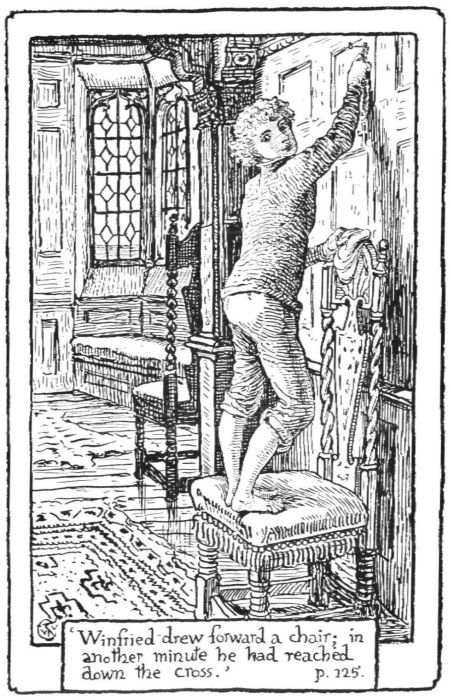
“What a time you’ve been,” said Bertrand, pushing in before him. “Now, let’s see—where did Ruby say she’d left her cross? Oh yes, hanging up there; she must have stood on a chair to reach it.” And sure enough, on a nail pretty high up on the wall hung the little ornament.
Winfried drew forward a chair; in another minute he had reached down the cross.
“Here it is,” he said, turning to Bertrand. But—he spoke to the air! Bertrand was gone. Winfried’s face flushed; but he controlled himself. He walked quietly to the door and turned the handle. It did not open. It was locked from the outside. He was a prisoner!
“I knew something of the kind would come,” he said to himself. “What will they do now? Poor little Mavis! I must trust her to the princess.”
But he could not help a feeling of bitter anger. It was no light punishment to the active energetic boy to have to spend all the bright afternoon hours shut up here like an old owl in a church tower. And he knew that till some one came to let him out, a prisoner he verily was. For he might have shouted his voice hoarse, no one down below could have heard him. And the chance of any one in the castle coming up was very small.
“What will gran think?” he said to himself.
“And, if these naughty children try to play him any trick. I know Ruby more than half believes all that nonsense about his being a wizard and about the mermaids, and Bertrand will egg her on.”
He went to the window and stood looking out, trying to keep down the dreadful restless caged feeling which began to come over him.
“How can I bear it?” he said. “If I had tools now, and could pick the lock; but some of these old locks are very strong, and I have nothing. If only I had wings;” and he gazed again out of the window.
When he turned round, though it was quite bright and sunny outside, it almost seemed as if the evening haze had somehow got into the room before its time. It was filled with a thin bluish mist. Winfried’s eyes brightened.
“My princess!” he exclaimed. “Are you there?” A little laugh answered him, and gradually the mist drew together and into shape, and Forget-me-not stood before him.
“My boy,” she exclaimed, “I am surprised at you. Why, you were looking quite depressed!”
Winfried reddened.
“It was the horrid feeling of being locked up,” he said. “I never felt it before, and—it seems such a shame, such a mean trick. I wouldn’t have minded a stand-up fight with any fellow, but—”
“Of course you wouldn’t; but you’ve got a good bit farther than that, I hope, Winfried,” she said with a smile. “And besides, Bertrand is much smaller than you. But it had to be, you know. I have explained enough to you—you and little Mavis;—it had to be.”
Winfried started.
“That’s another thing,” he said. “I am uneasy about her. What will they do? They don’t understand the boat, you know, princess, and she is alone with them.”
Forget-me-not smiled again.
“How faithless you are to-day, Winfried,” she said. “Mavis will be getting before you if you don’t take care, simple and ignorant as she is. Can’t you trust her to me?” And as the boy’s face brightened.
“Come,” she said, “I see you are recovering your usual ground, so I will tell you how I am going to do. But first, shut your eyes, Winfried; and here, wrap the end of my scarf round you. You might feel giddy still, though it’s not the first time. Ready?—that’s right—there now, give me your hand—we’re up on the window ledge. You were wishing for wings—isn’t this as good as wings?”
Bertrand rushed down—as much as he could rush, that is to say, over the steep and rough path—to the shore where the sisters were waiting.
“Have you got it?” asked Mavis eagerly.
“What?” asked Bertrand, out of breath.
“What? Why, Ruby’s cross, of course, that you went for. And where is Winfried?”
“All right,” said Bertrand, in a curious voice; “he’s coming directly. We’re to get into the boat and go on a little way, keeping near the shore. He’s coming down another way.”
(Yes, Bertrand, that he is!)
Mavis looked up anxiously.
“And the cross?” she said.
“Winfried’s got it,” he said. Which was true. Then he turned away, the fact being that he was so choking with laughter that he was afraid of betraying himself.
“Ruby,” he called, “come and help me to drag the boat a little nearer;” and as Ruby came close he whispered to her, “I’ve done it—splendidly—he’s shut up in his tower! Locked in, and the locks are good strong ones—now we can have a jolly good spree without that prig of a fellow. Only don’t let Mavis know till we’re safe out in the boat.”
Ruby jumped with pleasure.
“What fun!” she exclaimed. “How capital! You have been clever, Bertrand. But take care, or Mavis will suspect something. Quick, Mavis,” she went on, turning to her sister, “help us to pull in the boat. There, we can jump in now, Bertrand. You and Mavis steady it while I spring;” and in another moment she was in the boat, where her sister and Bertrand soon followed her.
All seemed well; the sky was clear and bright, the sun still shining. The faces of two of the party were sparkling with glee and triumph. But Mavis looked frightened and dissatisfied.
“I wish Winfried had come back with you, Bertrand,” she said. “Why didn’t he? Did cousin Hortensia keep him for anything?”
“Goodness, no,” said Bertrand. “What a fuss you make, child! He’s all right; you can look out for him, and tell me if you see him coming. I shall have enough to do with rowing you two.”
“Winfried doesn’t find the boat hard to row,” said Mavis; “it’s your own fault if it is hard. You might as well wait for him; he’d see us as he comes down the cliffs.”
“Oh no, that would be nonsense,” said Ruby hastily; “besides, he’s not coming that way. You heard Bertrand say so. I could row too, Bertrand,” she went on.
But the boy had already got his oars in motion, and though he was neither skilful nor experienced, strange to say the little boat glided on with the utmost ease and smoothness.
“There now,” said Bertrand, considerably surprised, to tell the truth, at his own success, “didn’t I tell you I could row?”
“No,” said Mavis bluntly, “you said just this moment you’d have enough to do to manage it.”
“Mavis, why are you so cross?” said Ruby. “It is such a pity to spoil everything.”
She spoke very smoothly and almost coaxingly, but Mavis looked her straight in the eyes, and Ruby grew uncomfortable and turned away. But just then a new misgiving struck Mavis.
“Bertrand,” she cried, “either you can’t manage the boat, or you’re doing it on purpose. You’re not keeping near the shore as you said you would. You’re going right out to sea;” and she jumped up as if she would have snatched the oars from him.
“Sit down, Mavis,” said Ruby. “I’m sure you know you should never jump about in a boat. It’s all right. Don’t you know there’s—there’s a current hereabouts?” Current or no, something there was, besides Bertrand’s rowing, that was rapidly carrying them away farther and farther from the shore. Mavis looked at Bertrand, not sure whether he could help himself or not. But—
“Winfried wouldn’t have told you to keep near the shore if you couldn’t,” she said; “he knows all about the currents.”
Bertrand turned with a rude laugh.
“Does he indeed?” he said. “It’s more than I do; but all the same this current, or whatever it is that is taking us out so fast, has come just at the right minute. I never meant to keep near in, there’s no fun in that. We’re going a jolly good way out, and when we’re tired of it we’ll come back and land close to the old wizard’s cottage. Ruby and I are going to play him a trick; we want to catch him with the mermaids Ruby heard singing the other day. If we set the villagers on him, they’ll soon make an end of him and his precious grandson.”
“Yes,” said Ruby spitefully; “and a good riddance they’d be. That Winfried setting himself up over us all.”
Mavis grew pale.
“Ruby; Bertrand,” she said, “you cannot mean to be so wicked. You know the villagers are already set against old Adam rather, even though he has been so good to them, and if you stir them up—they might kill him if they really thought he was a wizard.”
“We’re not going to do anything till we know for ourselves,” said Ruby. “We’re first going to the cottage really to find out if it’s true. You know yourself, Mavis, we did hear some one singing and speaking there the other day who wasn’t to be seen when we got there. And I believe it was a mermaid, or—or a syren, or some witchy sort of creature.” Mavis was silent. She had her own thoughts about the voice they had overheard, thoughts which she could not share with the others.
“Oh, dear Princess Forget-me-not,” she said to her self, “why don’t you make them see you, and understand how naughty they are?”
For the moment she had forgotten the princess’s promise that neither Winfried nor his grandfather should suffer any harm, and she felt terribly frightened and unhappy.
“Where is Winfried?” she said at last. “He will see us going out to sea when he comes down to the shore, and if he tells cousin Hortensia she can easily get some of the fishermen to come after us. They can row far quicker than you.”
Bertrand stopped rowing to laugh more rudely than before.
“Can they?” he said. “I doubt it. And as for Winfried telling—why, he doesn’t know; he’s locked in safe and sound in the west turret! He’ll be quite comfortable there for as long as I choose to leave him, and however he shouts no one can hear him. Not that there’s much fear of any of those lumbering boats overtaking us if they tried—why—”
He took up the oars again as he spoke, but before he began to row he half started and glanced round. No wonder; the boat was gliding out to sea without his help, quite as fast as when he was rowing.
“How—how it drifts!” he said in a rather queer tone of voice. “Is there a current hereabouts, Ruby?”
“I suppose so,” said Ruby. “Try and row the other way, that’ll soon show you.”
But it was all very well to speak of “trying.” No efforts of Bertrand’s had the very slightest effect on the boat. On it sped, faster and faster, as if laughing at him, dancing along the water as if it were alive and enjoying the joke. Bertrand grew angry, then, by degrees, frightened.
“It isn’t my fault,” he said. “I don’t pretend to know all about the currents and tides and nonsense. You shouldn’t have let me come out here, Ruby?”
Ruby was terrified, but angry too.
“It isn’t my fault,” she said. “You planned it all; you know you did. And if we’re all—”
“Be quiet, Ruby,” said Mavis, who alone of the three was perfectly calm and composed. “If it stops you and Bertrand carrying out your naughty plan, I am very glad if we are taken out to sea.”
“That’s too bad of you,” said Ruby, angry in spite of her terror. “I believe you’d rather we were drowned than that your precious Winfried and his grandfather should get what they deserve. And we are going to be drowned, or any way starved to death. We’re going faster and faster. Oh, I do believe there must be a whirlpool somewhere near here, and that we are going to be sucked into it.”
She began to sob and cry. Bertrand, to do him justice, put a good face upon it. He looked pale but determined.
“This is what comes of having to do with people like that,” he said vindictively. “I believe he’s bewitched the boat to spite us. I’ll have another try, however.”
But it was all no use. The boat, slight and fragile as it seemed, resisted his efforts as if it were a living thing opposing him. Crimson with heat and vexation, the boy muttered some words, which it was to be hoped the girls did not catch, and flung down the oars in a rage. One fell inside, the other was just slipping over the edge when Mavis caught it. Strange to say, no sooner was it in her hold than the motion stopped; the boat lay still and passive on the water, swaying gently as if waiting for orders.
“We’ve got out of the current,” exclaimed Ruby. “Try, Mavis, can you turn it?”
It hardly seemed to need trying. The boat turned almost, as it were, of itself, and in another moment they were quietly moving towards the shore. Nor did it seem to make any difference when Bertrand took the oars from Mavis and resumed his rowing.
“If I only waited another moment,” he said. “We got out of the current just as you caught the oar, Mavis.”
She shook her head doubtfully.
“I don’t know. I don’t think it was that,” she said. “But any way now it is all right again, and we are going back, you and Bertrand, Ruby, will not think of playing any trick, or setting the villagers on to old Adam.”
“Why not, pray?” said Bertrand. “And—”
“I don’t see what has made any difference,” said Ruby pertly. “Suppose the horrid things had bewitched the boat, is that any reason for not showing them up? You think it’s all your wonderful cleverness that got the boat round, do you, Mavis?”
“No, I don’t. I think a good many things I’m not going to tell you,” said the little girl. “But one thing I will tell you, I will not leave the boat or come on shore unless you promise me to give up your naughty cruel plan.”
She spoke so firmly that Ruby was startled. And indeed her own words seemed to surprise Mavis herself. It was as if some one were whispering to her what to say. But on Bertrand they made no impression.
“You won’t, won’t you?” he said. “Ah, well, we’ll see to that.”
They were close to the shore by this time. The marvellous boat had “got over the ground,” I was going to say—I mean the water—even more quickly than when going out to sea. And in another minute, thanks to something—no doubt Bertrand thought it was thanks to his wonderful skill—they glided quietly into the little landing-place where Winfried had brought them two days ago.
Up jumped Ruby.
“That’s capital,” she said. “We can easily make out way to the old wizard’s cottage from here. And before we peep in on him himself, Bertrand, we may as well look round his garden, as he calls it. It is the queerest place you ever saw, full of caves and grottoes.” Both Bertrand and she had jumped on shore.
“Come on, Mavis,” cried they. “What are you so slow about?”
For Mavis sat perfectly still in her place.
“I am not coming on shore,” she said quietly, “not unless you promise to give up whatever mischief it is that you are planning.”
“Nonsense,” said Bertrand. “You just shall come; tell her she must, Ruby, you’re the eldest.”
“Come, Mavis,” said Ruby. “You’d better come, for everybody’s sake, I can tell you,” she added meaningly. “If you’re there you can look after your precious old wizard. I won’t promise anything.”
“No,” Mavis repeated. “I will not come. We have no right to go forcing ourselves into his cottage. It is as much his as the castle is ours, and you know you have locked up Winfried on purpose so that he can’t get out. No, I will not go with you.”
“Then stay,” shouted Bertrand, “and take the consequences.”
And he dragged Ruby back from the boat.
Chapter Nine.
Beginnings?
“Very wrong, very wrong, Very wrong and bad.” Child World.
“Let’s run on fast a little way,” said Bertrand, “to make her think we won’t wait for her. That will frighten her, and she will run after us, you’ll see. Don’t look round, Ruby.”
In his heart he really did not believe that Mavis would change her mind or run after them. And he did not care. Indeed, he much preferred having Ruby alone, as he knew he could far more easily persuade her by herself to join in his mischievous schemes. But he felt that she was half-hearted about leaving her sister, and so he did not hesitate to trick her too.
They hurried on for some distance. Then Ruby, who was growing both tired and cross, pulled her hand away from Bertrand.
“Stop,” she said. “I’m quite out of breath. And I want to see if Mavis is coming.”
Bertrand had to give in. They were on higher ground than the shore, and could see it clearly. There lay the little boat as they had left it, and Mavis sitting in it calmly. To all appearance at least.
“She’s not coming—not a bit of her,” exclaimed Ruby angrily. “I don’t believe you thought she would, Bertrand.”
“She will come, you’ll see,” said the boy, “and even if she doesn’t, what does it matter? We’ll run on and spy out the old wizard and have some fun. Mavis will stay there safe enough till we get back.”
“I thought you meant to go home by the village and tell the people about old Adam, if we do see anything queer,” said Ruby.
“So I did, but if you’re in such a fidget about Mavis perhaps we’d better go home as we came, and not say anything in the village to-day. I’d like to see what Master Winfried has been up to when we get back. Perhaps he’ll have got some old witch to lend him a broomstick, and we shall find him flown;” and Bertrand laughed scornfully.
Ruby laughed too.
“I don’t think that’s likely,” she said. “But there’s no telling. I do wish he and his grandfather were out of the country altogether. There’s something about Winfried that makes me feel furious. He is such a prig; and he’s even got cousin Hortensia to think him a piece of perfection.”
“He may take his perfections elsewhere, and he shall, too,” said Bertrand. And the fierceness of his tone almost startled even Ruby.
They were not far from the old fisherman’s cottage by this time. They stopped again to take breath. Mavis and the boat were not visible from where they stood, for the path went in and out among the rocks, and just here some large projecting boulders hid the shore from sight.
Suddenly, as if it came from some cave beneath their feet, both children grew conscious of a faint sound as of distant music. And every moment it became clearer and louder even though muffled. Bertrand and Ruby looked at each other.
“Mermaids!” both exclaimed.
“They always sing,” said Bertrand.
“Yes,” added Ruby, with her old confusion of ideas about syrens; “and they make people go after them by their singing, and then they catch them and kill them, and I’m not sure but what they eat them. I know I’ve read something about bare dry bones being found. Shall we put our fingers in our ears, Bertrand?” She looked quite pale with fear.
“Nonsense,” said the boy. “That’s only sailors at sea. They lure them in among the rocks. We’re quite safe on dry land. Besides, I don’t think it’s mermaids that do that. They’re miserable crying creatures; but I don’t think they kill people.”
The subterraneous music came nearer and nearer. Somehow the children could not help listening.
“Didn’t you say you and Mavis heard singing the day you were here before—at the wizard’s cottage, I mean?” said Bertrand.
“N-no, not exactly singing. It was laughing, and a voice calling out good-bye in a singing way,” answered Ruby.
As if in response to her words, the ringing suddenly stopped, and from below their feet—precisely below it seemed—came the sound of ringing, silvery laughter, clear and unmistakable.
“Oh,” cried Ruby, “come away, Bertrand. I’m sure it’s the mermaids, and they will catch us and kill us, you’ll see.”
Her boasted courage had not come to much. And yet there was nothing very alarming in the pretty sounds they had heard.
“And what if it is the mermaids?” said Bertrand coolly. “We came out to catch them, didn’t we? It’s just what we wanted. Come along, Ruby. How do we get to the cottage? There seems to be a sort of wall in front.”
“We go round by the back,” said Ruby. “It’s there there are the queer grottoes and little caves. But you won’t go far into them, will you, Bertrand? For I am not at all sure but that the mermaids come up from the sea through these caves; you see they do come some underground way.”
Bertrand gave a sort of grunt. What Ruby said only made him the more determined to explore as far as he possibly could.
They entered the strange little garden I have already described without further adventure. There seemed no one about, no sound of any kind broke the almost unnatural stillness.
“How very quiet it is,” said Ruby with a little shiver. “And there’s no smoke coming out of the chimney—there was the last time, for there was a good fire in the kitchen where old Adam was.”
And as she said this there came over her the remembrance of the kind old man’s gentle hospitality and interest in them. Why had she taken such a hatred to Winfried and his grandfather, especially since Bertrand’s arrival? She could not have given any real reason.
“I hope he isn’t very ill—or—dead,” she said, dropping her voice. “And Winfried locked up and not able to get to him. It would be our fault, Bertrand.”
“Nonsense,” said Bertrand roughly, with his usual scornful contempt of any softer feelings. “He’s fallen asleep over his pipe and glass of grog. I daresay he drinks lots of grog—those fellows always do.”
“I’m sure he doesn’t,” contradicted Ruby, feeling angry with herself as well as Bertrand. “Let’s go to the window and peep in before we look at the caves.”
She ran round to the front, followed by her cousin, taking care to make as little sound as possible. She remembered on which side of the door was the kitchen, and softly approached what she knew must be its window. But how surprised she was when she looked in! It was the kitchen; she remembered the shape of the room; she recognised the neat little fireplace, but all was completely deserted. Every trace of furniture had disappeared; old Adam’s large chair by the hearth might never have been in existence, well as she remembered it. Except that it was clean and swept, the room might not have, been inhabited for years.
Ruby turned to Bertrand, who was staring in at another window.
“I say, Ruby,” he whispered, “the room over here is quite—”
“I know,” she said. “So is the kitchen. They’re gone, Bertrand, quite gone, and we’ve had all our trouble for nothing. It’s too bad.”
“They!” repeated Bertrand, “you can’t say they, when you know that Winfried is locked up in the turret-room.”
“Oh,” exclaimed Ruby starting, “I quite forgot. He must have hidden his grandfather somewhere. And yet I don’t see how they could have managed it so quietly. We always know when any of the village people are moving their furniture; they send to borrow our carts.”
“Well,” said Bertrand, “there’s one thing certain. If you didn’t believe it before, you must now; I should think even Mavis would—the old fellow is a wizard, and so’s his precious grandson.”
“Shall we go into the house?” said Ruby, though she looked half afraid to do so.
“Isn’t the door locked?” said Bertrand, trying it as he spoke. It yielded to his touch; he went in, followed, though tremblingly, by Ruby.
But after all there was little or nothing to see; the three rooms, though scrupulously clean, even the windows shining bright and polished, were perfectly empty. As the children strolled back to the kitchen, annoyed and disappointed, feeling, to tell the truth, rather small, something caught Ruby’s eye in one corner of the room. It was a small object, gleaming bright and blue on the white stones of the floor. She ran forward and picked it up, it was a tiny bunch of forget-me-nots tied with a scrap of ribbon; the same large brilliant kind of forget-me-not as those which she and Mavis had so admired on their first visit to the now deserted cottage. She gave a little cry.
“Look, Bertrand,” she said, “they can’t have been long gone. These flowers are quite fresh. I wonder where they came from. They must have been growing in a pot in the house, for there are none in the garden. I looked as we came through.”
Bertrand glanced at the flowers carelessly.
“Wizards,” he began, “can—”
But his sentence was never finished. For as he spoke there came a sudden gust of wind down the wide chimney, so loud and furious that it was as startling as a clap of thunder. Then it subsided again, but for a moment or two a long low wail sounded overhead, gradually dying away in the distance.
“What was that?” said Bertrand. While the sounds lasted both children had stood perfectly still.
“The wind of course,” said Ruby. She was more accustomed than her cousin to the unexpected vagaries of the storm spirits so near the sea, still even she seemed startled. “It’s often like that,” she was beginning to say, but she hesitated. “It was very loud,” she added.
“There must be rough weather coming,” said Bertrand. “We’d better go home by the road, I think, Ruby.”
“We,” exclaimed Ruby indignantly. “Do you mean you and me, Bertrand? And what about Mavis?”
“She can come on shore,” replied the boy carelessly. “She knows where we are. It’s her own fault. Come along, there’s nothing to wait for in this empty old hole. I want you to show me the caves outside.”
“I’ll try to signal to Mavis first,” said Ruby. “I’ll tie my handkerchief to a stick and wave it about. She can see us up here quite well, and perhaps when she finds we’re alone she’ll come.”
They left the cottage, and Ruby got out her handkerchief. But it was small use. For just as they stepped on to the rough little terrace in front from whence they could clearly see the shore, there came another and even—it seemed so at least now they were standing outside—more violent blast. It was all Ruby could do to keep her feet, and when she recovered from the giddying effect of the wind she was still breathless and shaken. And that the hurricane was gathering strength every second was plain to be seen; the waves were dashing in excitedly, the sky at one side had that strange lurid purple colour which foretells great disturbance.
But it was not these things only which made Ruby turn pale and shiver.
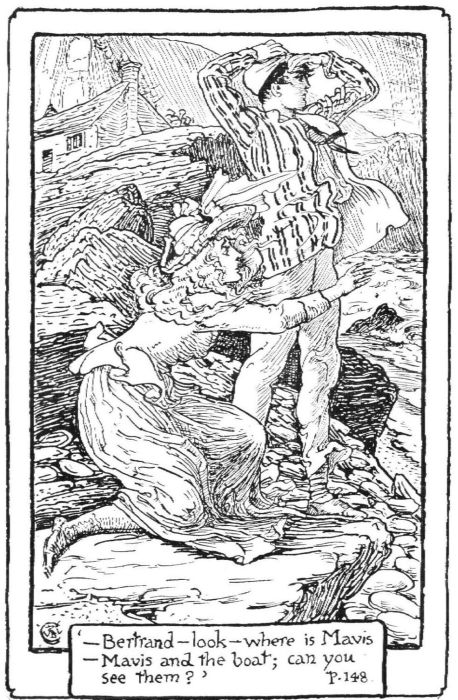
“Bertrand,” she gasped, “I don’t know if there’s something the matter with my eyes, I can’t see clearly—Bertrand—look—where is Mavis—Mavis and the boat; can you see them?”
Bertrand shaded his brow with his hand and gazed.
“’Pon my soul,” he said, “it’s very odd. I can’t see them. And there’s not been time for Mavis to have rowed out to sea or even to have drifted out; we can see right out ever so far, and there’s no boat; not a sign of one.”
“Can—can she have landed and dragged the boat ashore somehow?” said Ruby, her teeth chattering with cold and fear.
“No,” said Bertrand, “we’d certainly see her and the boat in that case.”
“Then, where is she?” cried Ruby. “Bertrand, you must care. What do you think has become of her?”
“Can’t say, I’m sure,” said the boy. “The boat may have capsized: the sea’s awfully rough now.”
“Do you mean that Mavis may be drowned or drowning?” screamed Ruby. She had to scream, even had she been less terribly excited, for the roar of wind was on them again, and her voice was scarcely audible.
“I don’t see that she need be drowned,” said Bertrand. “It’s shallow. She may have crept on shore, and be lying somewhere among those big stones; and if not, can’t your precious wizard friends look after her? She’s fond enough of them.”
He was partly in earnest; but Ruby took it all as cruel heartless mocking. She turned upon him furiously.
“You’re a brutal wicked boy,” she screamed. “I wish you were drowned; I wish you had never come near us; I wish—” she stopped, choked by her fury and misery, and by the wind which came tearing round again.
Bertrand came close to her.
“As you’re so busy wishing,” he called into her ear, “you’d better wish you hadn’t done what you have done yourself. It was all you who started the plan, and settled how we were to trick Winfried into the turret-room; you know you did.”
“And did I plan to drown Mavis, my own darling little sister?” returned Ruby as well as she could speak between her sobs and breathlessness. “Come down to the shore with me this moment and help me to look for her, if you’re not altogether a cruel heartless bully.”
“Not I,” said Bertrand, “we’d probably get drowned ourselves. Just see how the waves come leaping in; they look as if they were alive. I believe it’s all witches’ work together. I’m not going to trust myself down there. Come and show me the grottoes and the caves, Ruby. We may as well shelter in them till the wind goes down a bit. We can’t do Mavis any good; if she’s on the shore she can take care of herself, and if she’s under the water we can’t reach her;” and he caught hold of Ruby to pull her along, but she tore herself from his grasp with a wrench.
“You wicked, you heartless, brutal boy,” she cried.
“I don’t care if I am drowned; I would rather be drowned with Mavis than stay alive with you.”
And almost before Bertrand knew what she was doing, Ruby was rushing through the little garden at the back of the cottage on her way to descend the rough path to the shore.
He stood looking after her coolly for a moment or two with his hands in his pockets. He tried to whistle, but it was not very successful; the wind had the best of it.
“I don’t believe Mavis has come to any harm,” he said aloud, though speaking to himself, and almost as if trying to excuse his own conduct. “Anyway, I don’t see that it’s my business to look after her, it was all her own obstinacy.”
He kicked roughly at the pebbles at his feet, and as he did so, his glance fell on a tiny speck of colour just where he was kicking. It was one of the blue flowers Ruby had found in the cottage. Bertrand stooped and picked it up, and, strange to say, he handled it gently. But as he looked at it there came again to him the queer smarting pain in his eyes which he had complained of in the turret-room, and glancing up he became aware that the wind had suddenly gone down, everything had become almost unnaturally still, while a thin bluish haze seemed gathering closely round where he stood. Bertrand rubbed his eyes.
“There can’t be smoke here,” he said. “What can be the matter with my eyes?” and he rubbed them impatiently. It did no good.
“No, that will do no good,” said a voice. It seemed quite near him.
“Look up;” and in spite of himself the boy could not help looking up.
“Oh,” he screamed; “oh, what is it? what is it?”
For an agony, short but indescribable, had darted through his eyeballs, piercing, it seemed to him, to his very brain; and Bertrand was not in some ways a cowardly boy.
There was silence, perfect, dead silence, and gradually the intense aching, which the short terrible pain had left, began to subside. As it did so, and Bertrand ventured to look up again, he saw that—what he had seen, he could not describe it better—was gone, the haze had disappeared, the air was again clear, but far from still, for round the corner of the old cottage the blast now came rushing and tearing, as if infuriated at having been for a moment obliged to keep back; and with it now came the rain, such rain as the inland-bred boy had never seen before—blinding, drenching, lashing rain, whose drops seemed to cut and sting, with such force did they fall. It added to his confusion and bewilderment. Like a hunted animal he turned and ran, anywhere to get shelter; and soon he found himself behind the house, and then the thought of the grottoes the little girls had told him of returned to his mind.
“I won’t go back into that witches’ hole,” he said to himself as he glanced back at the house. “I’ll shelter in one of the grottoes.”
As he thought this he caught sight of an opening in the rockery before him. It was the entrance to the very cave where Mavis had been left by Ruby. Bertrand ran in; what happened to him there you shall hear in good time.
Chapter Ten.
“Forget-Me-Not Land.”
“A world... Where the month is always June.” Three Worlds.
Ruby meanwhile was running or rather stumbling down the stones. She cried and sobbed as she went; her pretty face had never, I think, looked so woebegone and forlorn; for it was new to her to be really distressed or anxious about anything.
“Mavis, Mavis,” she called out every now and then, “are you there darling? can’t you answer?” as if, even had the wind been less wildly raging, Mavis could possibly have heard her so far-off.
And before long Ruby was obliged to stop for a moment to gather strength and breath. The wind seemed to increase every minute. She turned her back to it for a second; the relief was immense; and just then she noticed that she was still clutching the little bunch of flowers she had picked up. They made her begin to cry again.
“Mavis loves them so,” she thought, and her memory went back to the happy peaceful afternoon they had spent with old Adam and his grandson. How kind they were, and how nice the cakes were that Winfried had made for them himself!
“Oh,” thought Ruby, “I wish Bertrand had never come! It’s all—” but there she hesitated. There had been truth in her cousin’s mean reproach, that the mischief and the cruel tricks they had planned had been first thought of by her. And Ruby knew, too, in her heart, that she had not been gentle or unselfish or kind long before she had ever seen Bertrand. She had not been so actively naughty because she had had no chance of being so, as it were. The coming together of the two selfish unfeeling natures had been like the meeting of the flint and steel, setting loose the hidden fire.
And besides this, for Bertrand there might have been some excuse; he had been neglected and yet spoilt; he had never known what it was truly to love any one, whereas Ruby had lived in love all her life; and this was her return for it.
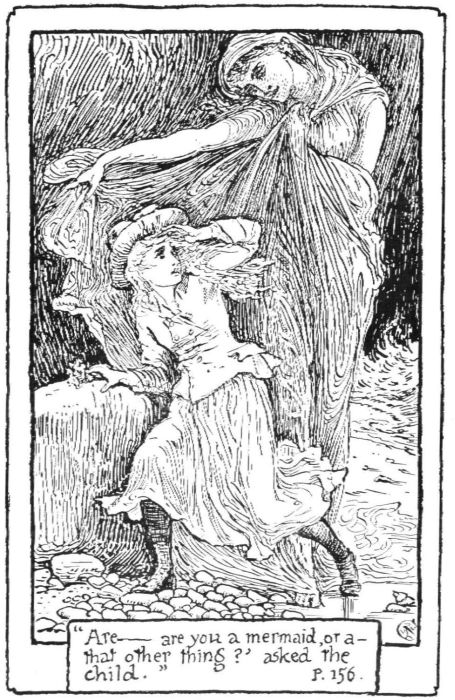
“I have killed my little Mavis,” she sobbed. “Yes, it has been all me. We needn’t have minded Bertrand; he couldn’t have made me naughty if I hadn’t let him. Oh, Mavis, Mavis, whatever shall I do?” Her glance fell again on the flowers in her hand. They were not the least withered or spoilt, but as fresh as if just newly gathered. They seemed to smile up at her, and she felt somehow comforted.
“Dear little flowers,” she said. Seldom in her life had Ruby spoken so tenderly. She started, as close beside her she heard a faint sigh.
“Ruby,” said a voice, “can you hear me?”
“Yes,” said the little girl, beginning to tremble.
“But you cannot see me? and yet I am here, close to you, as I have often been before. Try Ruby, try to see me.”
“Are—are you a mermaid, or a—that other thing?” asked the child.
There came a little laugh, scarcely a laugh, then the sigh again.
“If you could see me you would know how foolish you are,” said the voice. “But I must have patience—it will come—your eyes are not strong, Ruby; they are not even as strong as Bertrand’s.”
“Yes, they are,” said Ruby indignantly. “I’ve never had sore eyes in my life, and Bertrand’s have hurt him several times lately.”
“I know; so much the better for him,” was the reply. “Well, good-bye for the present, Ruby. Go on to look for Mavis; you must face it all—there, the rain is coming now. Ah!”
And with this, which sounded like a long sigh, the voice seemed to waft itself away, and down came the rain. The same swirl which had been too much for sturdy Bertrand was upon Ruby now, standing, too, in a far more exposed place, with no shelter near, and the rough rocky path before her. She did not stand long; she turned again and began to descend, stumbling, slipping, blinded by the rain, dashed and knocked about by the wind.
“She might have helped me, whoever she was that spoke to me,” sobbed Ruby. “It isn’t my fault if I can’t see creatures like that. I’m not good enough, I suppose.”
As she said these last words, or thought them, rather, a queer little thrill passed through her, and something, in spite of herself, made her look up. Was it—no, it could not be—she had suddenly thought a gleam of sunshine and blue sky had flashed on her sight; but no, the storm was too furious. “Yet still, I did,” thought Ruby, “I did see something bright and blue, as if two of my little flowers had got up there and were looking down on me.”
She glanced at her hand; the forget-me-nots were gone!
“I must have dropped them,” she said. “Oh dear, dear!”
And yet as she struggled on again she did not feel quite so miserable.
Yet it was terribly hard work, and every moment her anxiety about Mavis increased; Ruby had never felt so much in all her life.
“Who could it be that spoke to me so strangely?” she asked herself over and over again. “And what can I do to be able to see her? I wonder if Mavis has seen her, I wonder—” and suddenly there came into her mind the remembrance of Miss Hortensia’s long-ago story of the vision in the west turret.
“There was something about forget-me-nots in it,” she thought dreamily. “Could it have been true?”
How she had mocked at the story!
She had at last reached the shore by this time. The rain still fell in pitiless torrents, but the wind had fallen a little, and down here she seemed rather less exposed than on the face of the cliffs. Still Ruby was completely drenched through; never before had she had any conception of the misery to which some of our poor fellow-creatures are exposed to almost every day of their lives. And yet, her fears for Mavis overmastered all her other sufferings; for the first time Ruby thought of another more than of herself.
“Mavis, dear little Mavis, Mavis darling, where are you?” she sobbed wildly, her teeth chattering, while terrible shivers shook her from head to foot. “Oh, it can’t be that she is under those dreadful, fierce, leaping waves. They look as if they were dancing in cruel joy over something they had got;” and a shudder worse than those caused by the cold went through the poor child.
“Mavis,” she called out at last, after she had peered round about every large stone, every corner where her sister could possibly have tried to find shelter, without coming upon the slightest trace of either the child or the boat, “you must be in the sea. I’ll go after you; it doesn’t matter if I am drowned if you are. Perhaps—perhaps the mermaids are keeping you safe; there are kind ones among them it says in the fairy stories.”
And she turned resolutely to the water. It was cold, icily cold as it touched first her feet, then her ankles, then crept up to her knees; it seemed to catch her breath even before it was at all deep. Ruby felt her powers going and her senses failing.
“I shall never be able to find Mavis even if she is under the sea,” she thought to herself, just as a huge wave caught her in its rolling clutch, and she knew no more.
It seemed as if time beyond counting, years, centuries had passed when Ruby came to her senses again, enough to know that she was herself, gradually to remember that once, long ago, there had been a little girl called Ruby, somewhere, somehow, and that some one dear, most dear to her, had been in awful danger from which she had tried to rescue her. And through all the long mist, through all the dream wanderings of her spirit, in which may be it had been learning lessons, the fruit of which remained, though the teachings themselves were forgotten,—for who knows, who can limit what we do learn in these mysterious ways?—Ruby’s guardian angel must have rejoiced to see that the thought of her sister, not herself, was uppermost.
“Mavis,” was the first word she whispered; “Mavis, are you alive? Are you not drowned, darling? But it was such a very long time ago. Perhaps the world is finished. But Mavis—I thought Mavis was dead; and, oh! who are you?” she ended with a thrill which seemed to make her quite alive and awake.
“Are you the fairy in the turret? And what are you doing to my eyes?”
She sat up and rubbed them. There was the strangest feeling in them—not pain now; indeed it was, though strange, a beautiful feeling. They felt drawn upwards, upwards to something or some one, and a new light and strength seemed to fill them, light and strength and colour such as Ruby had never before even imagined. And the some one—yes, it was the lovely gracious figure, with the exquisite never-, once seen, to-be-forgotten eyes, of Winfried’s princess. Ruby saw her at last!
A smile overspread the sweet face; the blue eyes shone with gladness.
“How often I have hoped for this,” she murmured. “No, Ruby, you will never know how often. Darling, shut your eyes, you must not strain them; shut your eyes and think of Mavis, and trust yourself to me.”
Ruby obeyed; she had not even looked round to see where she was; she only felt that she was lying on something soft and warm and dry; oh, how nice it was to feel dry again. For now the distant, long-ago sensation began to fade, and she remembered everything clearly as if it had happened, say, yesterday or the day before at farthest. The naughty mischief she and Bertrand had been planning, the strange little boat, the deserted cottage, the hurricane, and the misery about Mavis, the plunge in search of her into the sea, even to the loss of the forget-me-nots, which had been her only comfort, all came back; and with it a wonderful delightful feeling of hope and peace and trust, such as she had never known before. She gave herself up to the kind strong arms that clasped her round! “She will take me to Mavis,” she thought; “and oh, I will try never, never to be selfish and unkind and naughty again.”