Chapter XXVII
Reading edition
One I have marked, the happiest guest In all this covert of the best: Hail to thee, far above the rest In joy of voice and pinion! Thou, Linnet! in thy green array, Presiding spirit here to-day, Dost lead the revels of the May, And this is thy dominion.
w. wordsworth.

“DOLORÈS had a tame bird called ‘Piripe,’ you know,” said Clare one day to the children.
“She brought him up by hand, and when he died she was miserable. She’s got a long poem that a man called Skelton wrote long ago when English was spelt strangely. It is full of pretty phrases, and it has got a long list of birds’ names; if you’ll listen, she’ll read it to you, she says.”
Clare spoke eagerly. But she had no need to call the children twice. They gather round any one willingly enough who will read to them.
Dolorès looked very small and sad as she sat on a low stool, about to commence reading. There is something you will see, in the manner her little bodice is crossed, that is curiously at one with that lift in her eyebrow.
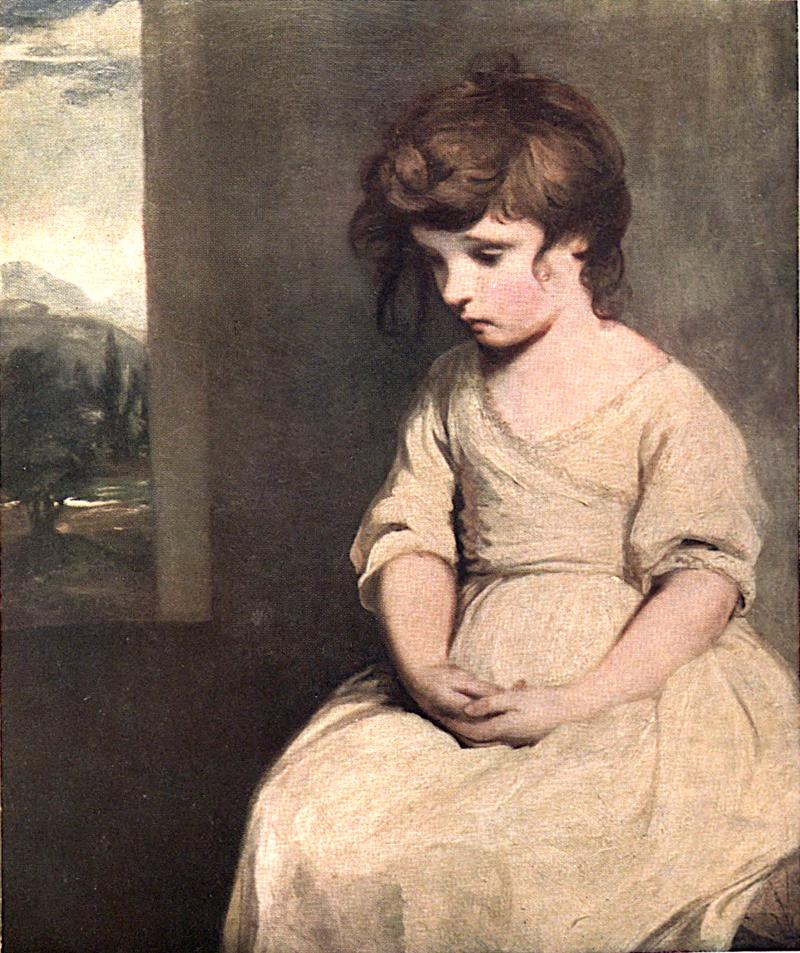
Reynolds.
DOLORÈS.
“My bird was a green finch,” she said, “and he had the crossest little eye I’ve ever seen; it was like a sour bead, full of greediness. But all the same I loved him, and I shall never have such another. I shall never, never, have such a dear again. This man Skelton who wrote this poem must have known some little girl who lost a bird she loved, for listen to what he writes about it. It is called
The Boke of Phyllyp Sparowe,
and these are only some of the lines:—
“‘When I remember again How my Phylyp was slain Never half the payne Was between you twain, Pyramus and Thisbe, As then befell to me. I wept and I wayled, The tears down hayled, But nothing it availed To call Philyp again, Whom Gib, our cat, hath slain. Gib, I say, our cat Worried her on that Which I loved best. It cannot be expressed By sorrowful heaviness. It was so prety a fool It wold sit on a stool; It had a velvet cap, And would sit upon my lap, And seek after small wormes And sometymes white bread crommes. Sometimes he wold gasp When he saw a wasp, A fly, or a gnat, He would fly at that; And pretily he wold pant When he saw an ant; Lord, how he wold pry After the butterfly! Lord, how he wold hop After the gressop! And when I sayd, Phyp, Phyp! Then he wold leap and skyp And take me by the lyp. Alas! it will me slo That Phyllyp is gone me fro! For it wold come and go And fly so to and fro, And on me it wold leap When I was asleep, And his fethers shake, Wherewith he wold make Me often for to wake. He did nothing perdie But sit upon my knee. Phyllyp had leave to go To pike my lytell toe; Phyllip might be bold And do what he wold. Phyllyp wold seek and take All the fleas blake That he could there espy With his wanton eye. That vengeance I aske and cry By way of exclamation On the whole nation Of cattes, wyld and tame. God send them sorrowe and shame! That cat specially That slew so cruelly My lytell prety sparowe That I brought up at Carowe. When I remember it, How pretily it wold sit Many times and oft On my finger aloft! His bill between my lippes— It was my prety Phyppes! He was wont to repayre And go in at my spayre, And creep in at my gore Of my gown before, Flyckering with his wings. Alas! my heart it stings Remembrynge prety things! Of fortune this the chance Standeth on variance Oft time after pleasaunce, Trouble and grievaunce No man can be sure All way to have pleasure. As well perceive ye may How my desport and play From me was taken away By Gyb, our cat, savage, That in a furious rage Caught Phyllyp by the head And slew him there, starke dead. Kyrie eleison, Christe, eleison, Kyrie eleison, For Phyllyp Sparowe’s soule Set in our bead roll Let us now whisper A Pater noster. All manner of birdes in your kind So none be left behind, Some to sing and some to say, Some to weep and some to pray Every birde in his laye. The goldfink, the wagtayle, The jangling pie to chatter Of this dolorous matter; And robyn redbreast He shall be the priest The requiem mass to sing Softly warbelynge. With help of the red sparrow And the chattringe swallow This hearse for to hallow. The larke, with his long toe, The spynk and martinet, also The shoveler with his brode bek; The dotterell, that folyshe pek The partryche, the quayle, The plover, with us to wayle, The lusty chaunting nightingale; The popinjay to tell her tale That looketh oft in the glasse, Shall read the gospel at Masse. The mavis with her whystle Shall read the epistle, But with a large and a longe To keep just playne songe Our chanters shall be the cuckoo, The culver, the stockdoo, With puwyt, the lapwyng, The versicles shall syng. The bittern with his bumpe, The crane with his trumpe, The swan of Menander, The gose and the gander, The duck and the drake, Shall watch at this wake. The owle, that is so fowle, Must help us to howle; The barnacle, the bussarde, With the wild mallarde; The puffin and teal Money they shall dele; The seamewe, the tytmose, The wodcocke, with the longe nose; The throstyll, with her warblyng, The starling, with her brablyng; The roke and the osprey That putteth fysshe to the fraye; And the dainty curlew, With the turtyll most trew. And it were a Jewe It wold make one rewe To see my sorrow newe! These villainous false cattes Were made for myse and rattes, And not for birdes smale. Alas! my face waxeth pale Telling this piteous tale. Alas! I say agayne, Deth hath departed us twayne; The false cat hath thee slayne. Farewell, Phyllyp, adieu, Our Lord thy soule reskew; Farewell, without restore, Farewell for evermore.’”
John Skelton, born 1460.