QUOTATIONS—CHAPTER II.
Reading edition
CHRISTIANITY AND THE HOME
Christianity will call into existence a sympathy between parents and children hitherto unknown, and one of the greatest needs of the Chinese home. It will teach parents to govern their children, an accomplishment which in four millenniums they have never made an approach to acquiring. This it will do, not as at present by the mere iterative insistence upon the duty of subjection to parents, but by showing parents how first to govern themselves, teaching them the completion of the first relations by the addition of that chiefest one hitherto unknown, expressed in the words Our Father. It will redeem many years during the first decade of childhood, of what is now a mere animal existence, filling it with fruitfulness for a future intellectual and spiritual harvest.
It will show Chinese parents how to train as well as how to govern their children—a divine art of which they have at present no more conception than of the chemistry of soils. (Dr. Arthur H. Smith, “Village Life in China.” Revell.)
MOTHERS’ MEETINGS
I have been much interested in our Mothers’ Meetings this winter. They meet at our house twice a month, and we have been trying to have some very practical talks which shall help them to be better mothers and women. The need for such talks is very great, and I wonder more and more that so many children escape physical and moral wreck. Our more intelligent women realize their need for instruction and help, and are very grateful for the opportunities given them by these meetings, but a large number come only out of curiosity. Some of the young women say, “You ought to have these meetings for our mothers-in-law instead of for us. They govern the house and our children. We would like to try these methods. We know they are right, but we are not allowed our way.” But I know it is hopeless to do anything with the grandmothers, and I believe that at least these young women will learn enough to keep their hands off when their turn comes to be mothers-in-law! It’s a long look ahead, but well worth while to plan for the future generation, even though we cannot do all we long to for the present one. (Mrs. Henry Riggs, Harpoot, Turkey.)
A TRANSFORMED HOME
In a small village near Hoi-How lived Sitli Nin, a poor woman, worn out by a life of hard work, bitter poverty, and sorrow. Her husband had become a victim of the opium habit, and squandered what little property she had. When her eldest boy was eight years old, the inhuman father, in order to gratify his cravings, sold him to a Hong Kong boatman, and the mother never heard from him since. Eight times she had attempted suicide, three times by drowning, three times by hanging, and twice by taking opium; but in the latter case she had failed to take enough, and the other times love for her children restrained her at the last moment. By some chance the ladies of our mission found her. Her husband was persuaded to take the opium cure at the hospital.... While he was in the hospital, she attended the services at the mission, and was genuinely converted. Her husband was cured, and they went home rejoicing in their new-found happiness. (Josephine P. Osmond, “Home Life in Hainan,” leaflet of Women’s Foreign Missionary Society of the Presbyterian Church)
CHILD MARRIAGE, INDIA
Sir W. W. Hunter says, “In Bengal, out of every thousand girls between five and nine years of age, two hundred and seventy-one are married. More than ten boys in every thousand between five and ten years old are bridegrooms; while of girls, twenty-eight in one hundred are wives or widows at an age when, if they were in Europe, they would be in the nursery or infant school.”
In England, out of every hundred females of twenty years of age and upwards, 25.80 are single, 60.60 are married and 13.60 widows.
“A Brahmin of Bengal gave away his six aunts, eight sisters, and four daughters in a batch of altogether eighteen, in marriage to one person—a boy less than ten years old. The brides of three generations were in age from about fifty years to three months at the lowest. The baby bride was brought to the ceremony on a brass plate.” (Quoted from Times of India.)
The origin and authority for early marriage are worthy of inquiry. Like so many Hindu customs, it claims a quasi-divine authority, and is based on certain reasons which, from the Hindu point of view, are of great weight. “Reprehensible,” says Manu, “is the father who gives not his daughter in marriage at the proper time.” And all commentators say the proper time is before the age of puberty.... A high legal authority, Mr. Justice Moothoswami Iyer, recently said, “According to custom now obtaining, a Brahmin girl is bound to marry, for fear of social degradation, before she attains maturity. Marriage is of the nature of a sacrament which no Brahmin is at liberty to neglect without forfeiting his caste.”... Thus a religious or sacramental purpose has been operative here, as in most other departments of Hindu life and thought.... There has been one strong incentive to early marriage, which in the past might be urged in its justification. The unsettled, precarious conditions of life, from the remotest times until the establishment of British power, encouraged parents to have their children married as soon as possible. (Rev. E. Storrow, “Our Sisters in India.” Revell.)
CHILD-WIVES, PERSIA
The usual age for a Mohammedan girl to marry is thirteen or fourteen, but in many places they marry as early as eight.... Poor little girl wives! They are taken away from home before they are grown up, and although they are now married women they cannot help behaving as children. There was one young wife of a Government official who received her visitors with the utmost dignity and propriety, and then could not resist the temptation to pinch the old black woman who was handing the tea and make her jump....
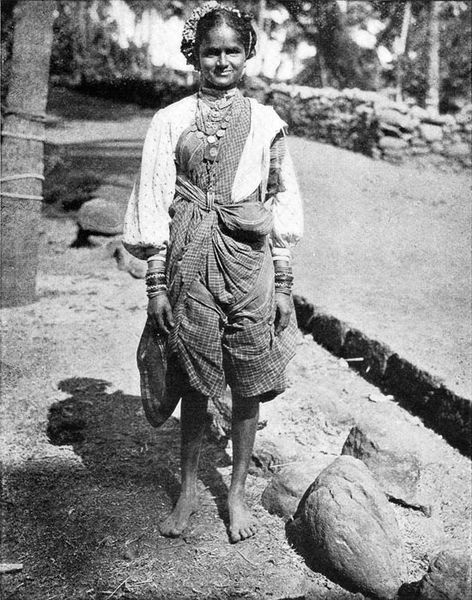
A Little Goanese Bride in India
Even when the children grow older their mothers, grown-up children themselves, do not know how to manage them.... One woman bit her little boy’s hand till it bled badly. He was about seven, and had cried to have his best coat on when he went to see the missionary. Another woman bit the cheek of a poor little consumptive girl of eight or nine so that there was a great bruise and the skin was broken. She told a neighbor, with a laugh, that she had got angry with the child because she was tiresome about taking her medicine, which was very nasty.
There is no command in the Koran that girls should be married so young, but the mothers declare that it was the command of Mohammed, and certainly he himself set the example by marrying a girl of nine....
The man is absolute master in his own house, and unless his wife has powerful relations he may do what he likes to her and her children, and no one will take any notice. I knew one woman whose husband treated her like a slave. He forced her not only to do all the work of the house, but the work of the stable too, for he was well enough off to keep a horse. He killed one child in her arms, and twice stole another away from her, sending it once to a town a week’s journey off, and once to another part of the town. Finally he divorced her, without giving any reason, and left her ill and destitute. And she had at no time any redress....
Little Bagum, the child-wife, was deliberately and cruelly burnt by her husband, and was brought to the mission hospital. There was no hope of recovery, but all was done that was possible to relieve her pain and brighten her last days. She had heard something of the Gospel story from a missionary who had paid a visit to her native village, and she had been so interested that she asked two Persian children to teach her more. When she was brought to the hospital even the terrible pain she was suffering did not make her forget the wonderful story, and she begged to be told more and more. And, resting in the love of Christ and trusting wholly in Him and His salvation, she loved to sing of the joy to which He was going to take her, and kept begging for “Here we suffer grief and pain,” until even the Mohammedan women would sit beside her and sing the hymn that comforted her so much....
“I have a foolish husband,” said one little girl, “He says he will beat Jesus Christ out of me, but he can only beat my body, and Jesus Christ is in my heart, so he cannot beat Him out.”
(Mrs. Malcolm, “Children of Persia,” Oliphant, Anderson & Ferrier.)
BIBLE READING THE IDEAL HOME
Psalm 128
v. 2. The busy father working with joy for the maintenance of the home.
v. 3. The happy, willing, successful mother, striking the keynote of the home.
v. 3. The vigorous young children growing up in the home.
v. 4, 5. All this is the token of God’s rich blessing to him who puts God first, and who is interested in the growth of God’s kingdom as well as in his own home.
v. 6. Not only as parents but as grandparents God’s blessing will be enjoyed.
PRAYER
We thank Thee, O Lord,
For the sweet and silent years of the Holy Childhood.
For the light and gladness brought into the world by little children.
For Thy servants who, by word and good example, are protecting and guiding Thy lambs in the dark and waste places.
For the Christian nurture, Christian homes, and Christian parents, which are the gifts of the Christ-Child to our nation; the strength of its life and the hope of its future.
For Thine assurance that inasmuch as we have done it unto the least of Thy little ones, we have done it unto Thee.
For the growing interest and co-operation of the children of the Church in the up-building of the world-wide Kingdom.
May it please Thee—
To guard and protect the innocence of children, and by their example to win men and women to a worthier life.
To bless family life, and direct parents in their sacred task, that Thy children may have a fear and love of Thy Holy Name.
To bring to the mothers of the world the knowledge which alone can sanctify their joy and soothe their sorrow.
(Spirit of Missions, February, 1910.)
QUESTIONS
1. What is the saddest part of the life of a girl in India?
2. What do you consider the greatest sorrow of Mohammedan motherhood? Of heathen motherhood?
3. What methods can you suggest for effecting a beneficial change in the home life of the Chinese?
4. What feature of home life in Mohammedan lands most needs to be improved?
5. What effect would it have on your boy to be married at the age of fourteen?
6. If you could make marriage laws, what would you set as the lowest marriage age for boys? For girls?
7. Name the missionary wives and mothers of your acquaintance. In what ways do they serve and help the communities in which they live?
BIBLIOGRAPHY. CHAPTERS I & II.
LEAFLETS
Home Life in China Women’s Foreign Missionary Society of the Presbyterian Church.
Home Life in Syria
Home Life in Siam
Home Life in Persia
Home Life in Hainan
Home Life in Korea
Home Life in Africa
Home Life in India
Home Life in Japan
Child Life among the Lao
Other Children
Being a Boy in Korea Woman’s Board of Foreign Missions of the Presbyterian Church.
Selma (Beirut)
A Faithful Follower
Auntie’s Explanation
Child Life in China Woman’s Presbyterian Board of Missions of the Northwest.
Story of Satabia
Child Life in Burma Woman’s Foreign Missionary Society of the Methodist Episcopal Church.
Foot Binding in China
Little Daughters of Islam
Motherhood in Heathen Lands
Young Ladies here, Young Ladies there
Childhood in Heathen Lands
Child Life in Turkey Woman’s Board of Missions of the Congregational Church.
Chih, the little Chinese Girl
Sister May’s Impressions Woman’s Board of Foreign Missions of the Reformed Church in America.
Village of the Milky River
Sorrows of Heathen Motherhood Woman’s Baptist Foreign Missionary Society.
CHILDREN’S MISSIONARY MAGAZINES
World Wide American Baptist Publication Society, Ford Bldg., Boston, Mass.
Over Sea and Land Pres. Bd. For. Miss., 156 Fifth Ave., New York City.
Day Star Woman’s Bd. of For. Miss. Ref. Ch. in Am., 25 E. 22d St., N. Y.
Lutheran Boys and Girls Lutheran Board, 1424 Arch St., Phila.
Children’s Missionary Friend Woman’s For. Miss. Soc. of the M. E. Church, 581 Boylston St., Boston, Mass.
Everyland Everyland Publishing Co., 156 Fifth Ave., New York, N. Y.
See magazines of the Women’s Foreign Missionary Boards.
See also Bibliography for Chapter I.