HOME STUDIES IN CHEMISTRY AND PHYSICS.
Reading edition
BY PROF. J. T. EDWARDS, D.D. Director of the Chautauqua School of Experimental Science.
PHYSICS OF EARTH.
Our earth, as a whole, may be compared to a ship sailing on a smooth sea. Like the ship, it has its own motions with reference to other objects, and is affected by forces exterior to itself. The ship feels the influence of winds, currents and tides.
The earth also yields to forces outside of itself; to such an extent, indeed, that philosophers have more than once been led to look for an invisible power, which strangely affected it. For example, Adams[1] and Leverrier[2] were led to prophesy the existence of the planet Neptune, because the earth seemed to yield to the touch of some unknown body, which was afterward discovered at the enormous distance of 2,746,271,000 miles.
The ship, in addition to its motion in regard to distant points and susceptibility of being moved by outside forces, has its own peculiar construction, a complex adjustment of planks, timbers, bolts, spars, sails and ropes. It also has its inhabitants, living beings which move to and fro, quite independent, for the time being, of all other parts of the universe, save that on which they reside.
As it glides past some island we look from our cabin window and discover that the island seems to be moving by us in an opposite direction. Even so, as our earth sweeps round its axis with a speed of a thousand miles an hour, it seems motionless, while the starry spheres above appear gliding westward.
In spite of the impassioned and reiterated exclamation of Galileo, “It does move!” men would not believe it, until his experiment at the leaning tower of Pisa; and the beautiful demonstration of Foucault[3] from the dome of the Pantheon in Paris, proved beyond question the earth’s rotation. Let us briefly outline these two experiments. If the world has no motion, a heavy weight dropped from the top of a tall shaft would strike exactly at its base. But if the earth were rotating, the top of the tower must move faster than the base. The weight at the top would have the same motion as the top of the shaft, and would keep it, in falling, in accordance with a well known law, and consequently would strike beyond the base. The ball dropped by Galileo did thus strike. Foucault argued: If the earth does not rotate, a pendulum suspended so that a needle fastened to its lowest point would trace a line in sand sprinkled on the surface beneath, would forever move along the same line. But if the earth is rotating, the needle will trace different lines on the sand. If the pendulum was suspended at one of the poles, it would, in twenty-four hours, trace a series of lines like the spokes of a carriage wheel about the pole. Foucault showed that the needle did trace varying lines in the sand, therefore the earth moves. This experiment is repeated annually at Paris, and I have performed it in the Amphitheater at Chautauqua.
Sir Isaac Newton, as all the world knows, discovered the relation and mutual dependence of all matter in the universe. The law of gravitation has been called “Newton’s Darling Child.” It states, in brief, that every body attracts every other directly as the mass, and inversely as the square of the distance.
The sun has three hundred thousand times the amount of matter contained in our earth; its power of attraction is therefore proportional. A man on its surface would be crushed by his own weight, but even Brobdignag,[4] or any other giant, could live comfortably on an asteroid. Indeed, he would weigh so little there that he could leap like the mountain goat.
As an illustration of the second part of the law: one body three times as far away as another from the attracting power, will be held by a force but one ninth as great. A body near the surface of the earth, or 4,000 miles from its center, will fall sixteen feet in a second. The moon is sixty times further from the center of the earth than such a body. Newton found that the moon fell toward the earth, or varied from a straight line, 1.36 of sixteen feet in a second. Now, the square of sixty is 3,600, therefore the moon proves that the force of gravity decreases as the square of the distance increases.
Nothing in nature is more beautiful than the adjustment of forces by which our earth is kept forever revolving in its appropriate orbit. In perihelion,[5] or its nearest approach to the sun, it is 3,000,000 miles nearer than in aphelion, when farthest away from it. Of course it will follow from the law that the attraction of the sun would then be greater. If there were no counteracting influence, there could be but one result—the earth would fly into the sun and be consumed. The very proximity of the earth to the sun, however, increases its speed, and therefore its tendency to fly off on a tangent. Kepler[6] has expressed this truth in one of his laws: “The radius vector (a line drawn from the sun to the earth) passes over equal areas in equal times.” The average speed of the earth in its orbit is 1,100 miles a minute—3,300 times that of the fastest steamship—but it varies throughout its course, and how wonderful that system of breaks by which its motion is regulated! Divine wisdom alone could invent such a plan.
TERRESTRIAL GRAVITY.
To the ordinary observer, our earth seems, in general, a flat surface, here and there varied by hills and valleys. In reality it is a sphere, with a curvature of eight inches to the mile. The equatorial diameter is twenty-six and five-elevenths miles greater than the polar. The irregularities of the earth’s surface are relatively far less than they seem. Very thin letter paper, spread over a globe sixteen inches in diameter, would by its thickness adequately represent the highest mountain ranges. The greatest ocean depth is about equal to the height of the highest mountain; we see by this that the earth is essentially a smooth, round body.
Its shape is proven in four ways: First, two different navigators may start from the same point, one sailing east and the other west, and reach the same destination. Second, navigators have sailed around the world, Magellan having first performed the task. Third, in moving toward elevated objects, their upper portion first strikes the eye. Fourth, the shadow of the earth, when it falls upon the moon, is round.
The enlargement of the equatorial diameter is supposed to be due to the fact that the earth was once in a plastic state, and the centrifugal force, which is directly proportioned to the rotating speed of a body, caused the matter in the equatorial region to bulge. This action can easily be shown by revolving rapidly a flexible steel hoop, or other mobile substance. All bodies tend to revolve around their shortest axis. A great variety of interesting experiments showing this can easily be performed, some of which are indicated in an accompanying picture.
There is no magical power in the center of our earth, as some have supposed from the fact that all bodies seek that point. Indeed, that is the one spot where there is no attraction, and where all substances would weigh nothing. The path described by a plummet, or any falling body, is simply a resultant motion produced by opposite particles of the earth making it pass half way between their lines of attraction. This will ordinarily be toward the center of the earth. As attraction of gravity is in proportion to mass, a body suspended near a mountain will be deflected toward it.
This has been shown by an experiment performed by Dr. Maskelyne,[7] near Mt. Schehallien, in Wales. Upon suspending a light body on opposite sides of this mountain, he observed that it swerved from the perpendicular toward the mountain. The amount of this variation measured the attraction of the mountain, as compared with the attraction of the earth. As the geological structure of this eminence was known, it was not difficult to compute its mass, and a comparison was made between it and the earth. From this calculation the entire weight of the earth was obtained, proving its specific gravity to be five times that of an equal bulk of water. Dr. Cavendish[8] afterward arrived at precisely the same result by experimenting with a pendulum.
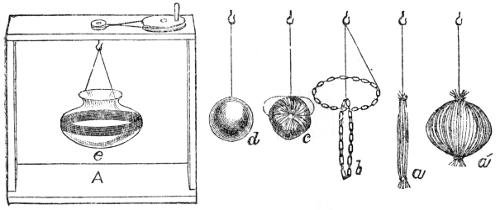
A is a rotating machine; a is a skein of thread; á is the skein rotated; b is a chain; c is an onion; d is an apple; e is a glass fish aquarium, one tenth full of water, and rotated. A stick, hoop, shingle, or any such body suspended by a cord, when rapidly rotated will rise and revolve around its shortest axis.
Terrestrial gravity is constantly affecting the motion of bodies. Motion is the act of changing place, and always indicates the presence of some force; force or energy being that which tends to produce motion or rest. Motion in curved lines is produced by two or more forces acting upon a body, one of which must be constant. Example: A cannon ball is acted upon by the sudden explosion of the powder, the resistance of air, and the constant downward attraction of gravity. Nature seems to delight in curved motion; the waves, the flight of birds, the running brooks, the clouds, even the waving trees and grasses, all furnish illustrations of this. A little reflection upon any such instances will show that they are usually produced by the united action of an instantaneous and constant force.
The center of gravity is that point around which the opposite particles of a body balance each other. This point does not necessarily coincide with center of figure or center of motion, the former of which is a point equally distant from opposite parts of a regular body, while the latter is a point in a substance around which it revolves.
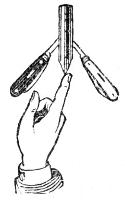
Ex.—A lead pencil poised on the finger. This experiment can be varied in many ways, showing the nature of stable and unstable equilibrium.
If the sun and all the planets could be strung on a rod passing through their centers, with the planets to the east, the center of gravity of the solar system would be somewhere in the sun, east of its center. As the planets assume various positions with reference to the sun, it must follow that the center of gravity in our system must vary accordingly.
The same is true of objects on the earth. The center of gravity may be elevated or depressed, moved to the right or left. We instinctively adjust our bodies so that a perpendicular let fall from the center of gravity will constantly fall within the base. The most surprising exhibition of this power of automatic adjustment was seen in Blondin, in his performances on the tight rope.
Stability in structures is usually secured by lowering the center of gravity in one of two ways: either by broadening the base or by making it of heavy materials.
Specific gravity is the weight of a substance as compared with an equal bulk of something taken as a standard; water having been selected as the standard for solids and liquids, and air for gases.
Gravity furnishes more units of measure of various kinds—weight, work, heat, tenacity—than any other force of nature.
It will be remembered that Physics is that branch of science that considers the general properties of matter, and the character of those forces which affect matter without destroying its molecule. It includes many subdivisions. In addition to those already mentioned, we find Molecular Attraction, or the operation of forces that act at insensible distances; Hydrostatics, which treats of liquids at rest; Hydraulics, of liquids in motion; Pneumatics, of gases; Machines, of means for applying force; Acoustics, of the laws of sound; Heat; Light; and Electricity.
As many physical properties have been mentioned in the articles on Air, Water, and Fire, they will not now be considered. Our discussion here applies more especially to those substances which, at ordinary temperatures, are solid.
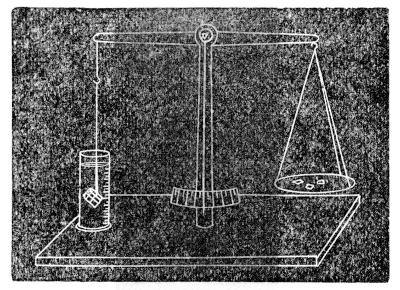
Ex.—A body buoyed up in water displaces its own weight of the liquid. The glass is nicely graded, and as the water rises in the vessel, the registration at once indicates the amount of water displaced. This proves the truth of the “Law of Archimedes”[9], ascertained while he was investigating the problem of the golden crown.
The most characteristic properties of solid bodies are the following: Hardness, tenacity, malleability, ductility, and crystalline form. Hardness is the resistance which a body offers to being scratched. Tenacity is the resistance offered by a body to a separation of its parts. Malleability is that property of a body which makes it capable of being rolled into sheets. Ductility is capacity for being drawn into wire, and crystalline form is the property which causes it to assume regular shapes.
As will be observed, these peculiarities are closely dependent upon cohesion and adhesion. By the former we understand the force which holds together the similar molecules of a substance; and by the latter, the force which unites the surfaces of different materials. Familiar as we are with these two agencies, their nature is not yet understood. We can easily discover that they are very dependent upon heat, by the application of which most solids pass from the stable form, to one in which, instead of cohesive force between the molecules, there is repulsion; as in the conversion of ice into water, and then into steam.
This movement of molecules is also dependent upon pressure. The most interesting illustration of this is seen in the action of glaciers. It has been ascertained that the melting temperature of ice lowers one two hundred and fiftieth of a degree for every fifteen pounds of pressure to the square inch.
The immense superincumbent mass of ice must, in many places, set free so much latent heat that a portion of the ice melts, so that here and there cells and liquid veins would be opened in the interior of the glacier. But the particles which separate these thin layers of water would almost immediately close up. This is the brilliant demonstration of Prof. Tyndall, who has given the operation the name of “regelation.” It has been thus described: “This phenomenon takes place at every point in the thickness of the glacier. Particles of ice approach one another, and unite across little veins of water, which permeate it in every direction; fresh liquid films are formed under the pressure from above; fresh unions take place between the divided morsels of ice; and, by this continual process of change, the air contained in the mass of that which once was snow, is gradually expelled. Thus it happens that the whole mass ultimately assumes an almost perfect transparency and a beautiful azure color.”
CRYSTALLIZATION.
One of the most beautiful illustrations of cohesive attraction is seen in crystallization. In every instance in which substances pass into the form of a solid, they tend to assume regular shapes called crystals. Each material has its own characteristic form, so that a crystal is a type of a species in the mineral world, even as a plant or an animal is in the organic kingdom. A crystal is a substance bounded by plain surfaces and symmetrically arranged about imaginary lines called axes. The final form depends upon certain smaller forms in its interior structure. They possess lines of division, often in three directions, called “cleavage.”
While there are millions of crystals, they have all been classified under six systems, as follows: 1. Monometric, where the three axes are equal. 2. Dimetric, having one axis unequal to the other two, which are equal to each other. 3. Trimetric, having no two axes equal. 4. Monoclinic, having one axis inclined. 5. Triclinic, in which all the three intersections are oblique and the axes unequal. 6. Hexagonal, which has the form of a regular hexagonal prism.
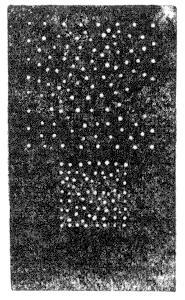
Ex.—Showing change of volume. The upper part of the figure represents a substance expanded. There are no more molecules here than below, but they are pushed further apart. This is supposed to be the way in which all bodies are enlarged by heat.
While contemplating the thousand beautiful forms in which molecules are arranged into crystals, whereby many economic purposes are served, as well as taste manifested, one can not resist the conviction that such displays of wisdom, benevolence and love of beauty can alone emanate from the eternal Mind.
Another wide-spread effect of cohesion is seen in
PETRIFACTIONS.
Everywhere in fossiliferous rock may be found organic remains in which the material of which they were originally composed has been replaced by some mineral substance. Some have supposed that these plants and animals have actually been converted into stone by a change of their elements. This is of course absurd. Carbon can never be anything but carbon, nor indeed, can any element ever become anything other than itself. This dream of the alchemist was long since dissipated. No, strange as it may seem, the molecules of these fossilized organisms must actually pass out, and silica, lime, clay, or some such matter pass in and take their places. Beautiful specimens of petrified wood, found especially on the Pacific coast, are often hard as glass. One very handsome variety, called “opalized” wood, clearly indicates that petrifaction was either accompanied or followed by crystallization.
Myriads of shells, bones and plants scattered through the earth’s strata have been transformed in the manner indicated. Although petrifaction is usually a long process, there is reason to believe that it sometimes takes place rapidly. This operation must not be confounded with incrustation, which is often mistaken for it, and takes place where substances, like bending twigs, have deposited upon them layer after layer of lime, salt, sulphur or ice.
The molecules of solids, even, are in intense and ceaseless motion. As has been said, “A continuous and restless, nay, a very complicated activity is the order of Nature throughout all her individuals, whether these be living beings or inanimate particles of matter. Existence is, in truth, one continued fight, and a great battle is always and everywhere raging, although the field in which it is fought is often completely shrouded from our view.”
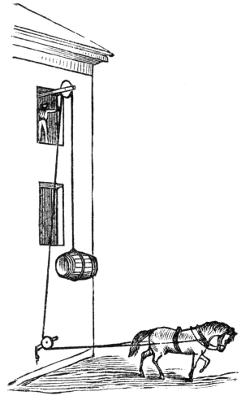
Ex.—A simple illustration of the convenience of machinery in applying force and changing direction.
The motto of the brave Huguenots in the time of Louis XIV. was “Ever burning, but never consumed.”
Nature’s motto, both for matter and energy is, “Ever changing, but never destroyed.” Let us next notice some instances of the
CONSERVATION OF ENERGY.
Energy is the power to do work or overcome resistance. It is of two kinds—potential and kinetic. The former is the energy or force due to position, but it is latent or inactive. The latter is the energy of a body which is in motion. A stone resting on a mountain top, the water in a quiet mill pond, a coiled spring, are all examples of potential energy.
The stone, crushing through the cottage of a peasant, the water turning a factory wheel, the spring turning the wheels of a clock, are examples of actual or kinetic energy.

Ex.—Lay a magnet down on iron filings. They will gather in greatest abundance about the poles, and diminish toward the center, where there are none; thus showing the nature of polarity.
Energy often disappears to reappear under a different name. If we lift our hand to strike the palm of another, our vital energy becomes motion, and that in turn is changed into heat.
In the Bell telephone the sound-waves in the mouthpiece are converted into electric vibrations in the wire, and these, in turn, induce sound-waves in the receiving instrument at the other end of the line.
In dynamo-electric machines we have a chain of transmutations of force—chemical affinity in the fire-box, expansion in the boiler, becoming in turn, motion, magnetism, electric currents, until it appears as resplendent light and intense heat between the carbon points.
Potential energy slumbers in the raindrop, and, anon, as kinetic energy, flashes in the lightning.
In short, the sum of all the energies of nature is a constant quantity, although it manifests itself in a thousand different ways. The foregoing reflections indicate that the researches of modern science all point to a grand unity in God’s universe. Let us conclude by briefly referring to some instances of plan or design in the
GROUPING OF LAWS.
The most characteristic feature of all science is that it arranges facts in an orderly manner, under principles or laws.
Nature seems to delight, likewise, in doing a variety of things under one general principle. Note a curious trinity in her method: We have three great departments of nature—animal, vegetable and mineral; three parts to our being—physical, mental and moral; three divisions of the mind—intellect, sensibilities and will; three parts to all plants—root, stem and foliage; there is earth, sea and sky; three great classes in all mechanism—lever, cord, and inclined plane—and many others that might be mentioned.
Observe another group of laws in physics: Variation, in accordance with an exact proportion.
Gravity varies inversely as the square of the distance; heat varies inversely as the square of the distance; light varies inversely as the square of the distance, and sound varies also in exactly the same ratio.
Who can contemplate this exact mathematical arrangement, extending through many departments of matter, without concluding that “Nature is but the name for an effect whose cause is God?”