Chapter I
Reading edition
Biology is the science of life, the true doctrine concerning all living things. Animal biology is that branch of the science which relates to animals, as distinguished from plants. It tells of these animals what we know about them, where and how they live, what food they eat, how it is received, and how they grow and multiply. Of all the sciences, this seems most extensive, having for its field a world of numberless forms, alike in that they all live, and have some characteristics in common, yet showing great diversity in their structure, appearance, and mode of life. In this summary of facts we shall simply classify, or methodically arrange in groups, according to their distinguishing peculiarities, the members of this vast family.
The animal kingdom is divided into the following sub-kingdoms, each of which is subdivided into classes. The following table shows these divisions in their proper order, beginning with the lowest:
Sub-kingdom I—Protozoa. { Class I—Monera. { Class II—Gregarinida. { Class III—Rhizopoda. { Class IV—Infusoria.
Sub-kingdom II—Spongida.
Sub-kingdom III—Cœlenterata. { Class I—Hydrozoa. { Class II—Anthozoa. { Class III—Ctenophora.
Sub-kingdom IV—Echinodermata. { Class I—Crinoidea. { Class II—Asteroidea. { Class III—Echinoidea. { Class IV—Holothuroidea.
Sub-kingdom V—Vermes. { Class I—Flat Worms. { Class II—Round or Thread Worms. { Class III—Rotifera. { Class IV—Polyzoa. { Class V—Brachiopoda. { Class VI—Annelidæ.
Sub-kingdom VI—Mollusca. { Class I—Lamellibranchiata. { Class II—Gasteropoda. { Class III—Cephalopoda.
Sub-kingdom VII—Articulata. { Class I—Crustacea. { Class II—Arachnida. { Class III—Myriapoda. { Class IV—Insecta.
Sub-kingdom VIII—Tunicata.
Sub-kingdom IX—Vertebrata. { Class I—Pisces. { Class II—Reptilia. { Class III—Aves. { Class IV—Mammalia.
SUB-KINGDOM I.
Protozoa (first animals). These earliest formed animals are distinguished for the simplicity of their structure. In some cases their animal nature was long ago in doubt, and they were, for a time, put down as probably belonging to the vegetable kingdom. The border line between the two has never been very definitely located. Biologists may fail to tell just what special quality distinguishes the minute animal from the microscopic plant. This is not wonderful, when it is remembered that myriads of animals, known to be such, are so small that it requires a lens of strong magnifying power to discover them. Three thousand of them, placed side by side, would make a line but little over an inch long.
Class I.—Monera (single). These are the simplest forms of microscopic aquatic animals. They are entirely homogeneous, and without any developed organs; mere particles, of a jelly-like, but living, or life-supporting substance, called protoplasm, or more properly, bioplasm. This, all admit, is the physical basis of life, and the medium of its manifestation, just as the conductor is a medium of manifestation of electricity. But is it not a stupid blunder to confound the mere medium of its manifestation with the life itself? In neither case is the recognized physical basis of the manifestation necessary to the existence of that manifested by its means. Electricity exists without the conductor, and life may exist without the bioplasm.
Class II.—Gregarinida (living in herds). Minute animals which are found in the intestines of the lobster, clam, and cockroach. They are worm-like in form, and of a very simple, cell-like structure, the only organ being a nucleus.
Class III.—Rhizopoda (root footed). The representative forms of this class are the Amœba[1] and Foraminifera. The amœba is an indefinite little bit of bioplasm, as structureless as the monera, only that it is made up of two layers of the substance, has an apparent nucleus, and a contractile cavity within. These first animals vindicate their right to be recognized as such, by moving, receiving food, growing, and reproducing their kind. They move by a contractile force, throwing out at will processes of their soft bodies, to serve them as feet and arms. True, these are blunt, and without digits, but they answer the purpose. They eat either by simple absorption, or by wrapping their soft bodies around the food, and holding it in the extemporized stomach till it is, in some way, assimilated.
The work of reproduction is carried on principally by self-division, and budding. The animal rends itself into two or more parts, each having all the elements of the whole, or it throws out buds that mature and drop from the parent mass, having the vital element, and a portion of the bioplasm, or medium necessary to its development.
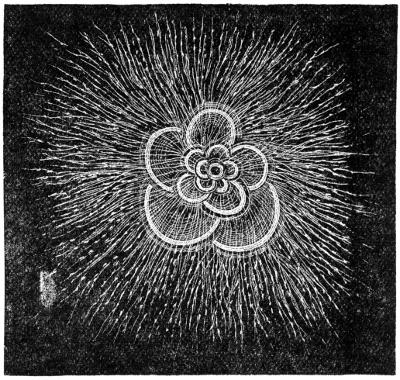
FORAMINIFERA, SHOWING ROOT-LIKE FEET.
The Foraminifera (perforated animals), of this class, have several peculiarities. The body is even more simple, being apparently without layers or cavity. The processes thrown out as arms and legs are not blunt or massive, but long and slender. And, moreover, small as it is, it has the wonderful property of secreting about itself an envelope, whose thin walls are built of the carbonate of lime. The delicate little structures are often singularly beautiful. Some are monads, having but a single shell; others, by a process of budding add new cells or chambers, often in a spiral coil. These are marine shells, and their numbers in many parts of the ocean are astounding. The bottom of the sea, for many degrees on both sides of the equator, wherever examined by dredging, is found covered with them, either still in their organic state, or ground by attrition to a fine lime dust. It is estimated that a single pound of the sea bottom in some localities contains millions of them, and they are the principal material of the chalk hills.
Class IV.—Infusoria. This class includes Vorticella (wheel animals), Flagellata (whip-shaped animals), Tentaculata (having tentacles), and others. Their general characteristics do not differ widely from those already mentioned. As the name imports, they are mostly found in vegetable infusions that have been exposed for some time, and are directly the product of invisible cells or animal germs that were floating in the atmosphere till a lodgment was found favorable to their development. Those called Vorticella, to the eye seem simply mould on the plant to which they are attached, but under the glass their animal qualities appear; and they multiply with amazing rapidity. Every drop of water from a stagnant pool is full of these animalculæ, of various shapes and dimensions, some of them constantly in motion, propelled by numerous cilia, or slender, hair-like appendages that fringe the circumference, and are used as oars. Their whole organism, though delicate, and having a thin membranous covering, is imperfect. There are two contractile openings, with a slight depression at the mouth, leading to a funnel-shaped throat, into which the nutritive substances descend.
SUB-KINGDOM II.
Spongida, or sponges, are especially worthy of mention. When much less was known of their nature and habits, they were classed with vegetables, but since their mode of reproduction has been discovered, they are known to be animals. The sponge is formed of an aggregation of ciliated cells, built together on a skeleton or framework of calcareous or silicious substance, that extends by slow external secretions as the animal body grows. There is a central cavity toward which there are numerous channels, from openings on the surface, through which water is continually received, and one through which it is discharged. The animal part is a sensitive, gelatinous film, extending through the growing mass, and spreads out over the surface. It is perforated, in places, and adapts itself to all the sinuosities and intersections of the canals that run in every direction. The little animals are provided with exceedingly fine cilia that they keep in almost constant motion; no one knows how, or for what, but it is supposed they thus sweep in the water that circulates through all the channels and chambers formed for it. After death, the soft matter, like all animal tissues, decays, or is dried up; and by beating and washing, it and any calcareous substances are removed. The horny, elastic fibers are found so exquisitely connected about the internal canals and cavities that water is freely admitted, or by pressure expelled. Sponges are found in every latitude, but are more numerous and grow larger in warm climates. Those in our markets are mostly from the Bahamas and the islands of the Mediterranean. They are obtained by diving, often to great depths.
SUB-KINGDOM III.
Cœlenterata (hollow intestines). These are radiate animals, have a distinct digestive cavity, and always two layers of tissue in their walls. They have minute sacs containing a fluid, and barbed filaments capable of being thrown out as stings. The classes of the Cœlenterata are the Hydrozoa, Anthozoa, and Ctenophora. The best known representative of the former is the fresh water hydra (water animal). It gives but slight evidence of a nervous system, has no stomach, or digestive sac, but is a simple tube into which the mouth opens. The sensitive little body is in color and texture, to the casual observer more like a plant than an animal. It is attached at one end to a submerged aquatic plant, while the mouth at the free end is provided with tentacles,[2] by which it feeds and moves. It buds, and also produces eggs. The young hydra, when hatched or thrown off, attaches itself to plants, as did its parents. Some hydroids attach themselves to shells, and are supported by horny, branching skeletons, specimens of which are numerous, and may be seen in almost any museum.
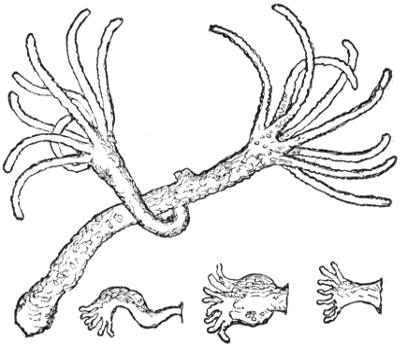
HYDRA, SHOWING BUDS.
A second representative of this class is the jelly fish. It has a soft, gelatinous, circular body, that floats or swims on the surface in calm weather, with the mouth downward. Tubes radiate from the center to the circumference that is fringed all around with pendant tentacles, sometimes of great length and of considerable contractile power. They are of various sizes, some quite small, others as much as eight feet in diameter. They move about by flapping their sides, after the manner of opening and shutting an umbrella. When dried, the thin, filmy covering is very light. One variety, called Lucernaria, is found attached to grasses along the Atlantic shore. But the ordinary jelly fish is free, and borne on the surface of the sea.
The Anthozoa (flower animals) are small, but not microscopic animals, having a double cavity, the inner of which is the digestive sac. The best known of the class is the Actinia (rayed), or sea anemone, so called from its resemblance to a plant or flower of that name. The body is somewhat like a flower in shape. The disc has a central orifice, very contractile, and surrounded with tubular tentacles of various forms, which it elongates, contracts, and moves in different directions. They are so many arms by which the animal seizes its prey, and when expanded for the purpose, being tinted with brilliant colors, present an elegant appearance, and make vast fields of the ocean look like beautiful flower gardens. They feed voraciously on little crabs and mollusks, that often seem superior to themselves in strength and bulk, but they have power in their little tentacles to seize and hold their prey, and when they engulf large bodies the stomach is distended to receive them; and their digestion is good. The purple sea anemone is very common on the southern shores of England, and one species, found on the shores of the Mediterranean, is said to be esteemed a great delicacy by the Italians. At night, or when alarmed, the animal draws in its arms, shuts the door, and seems but a rounded lump of flesh, a huge oyster without a shell. The coral polyps (many footed), belonging to this class, are little folk, but of importance from their well-earned reputation as reef builders. They are very diminutive creatures, mere drops of animal jelly, often not larger than the head of a pin, but their works show unmistakable evidence of life, and an organic structure. They live in communities, closely united, but each, having a distinct individuality, by the sure process of secreting a portion of the calcareous matter within reach, prepares for himself a house, as all his ancestors have done, and his neighbors are now doing. They build together, their foundations having strong connections, and thoroughly cemented. There in his own little palace the polyp lives, his food being brought to his lips; and, having sent out a numerous progeny to do likewise for themselves, there he dies. Life and death, as in all mundane communities, being in close proximity, the old dying, a new generation builds houses over their sepulchres.
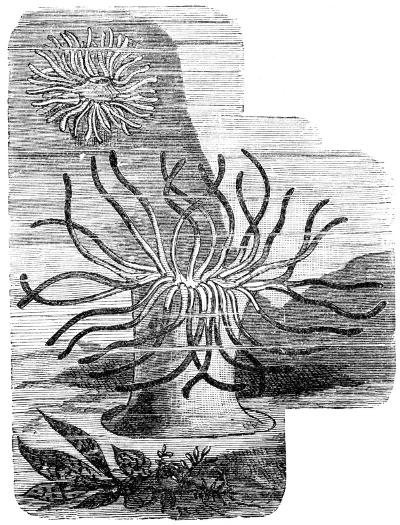
SEA ANEMONE.
The great variety of corals seen in any extensive collection, some very beautiful, others rough and unsightly, are from different branches of a very extensive family. Astrea (star shaped), from the Fiji islands, is a kind of coral hemisphere, covered with large and beautiful cells.
Mushroom coral is disc shaped, not fixed or attached, and is the secretion, not of many, but of a single huge polyp.
Brain coral is globular, and the surface irregularly furrowed or corrugated.
Madrepora (spotted pores) coral is neatly branched, the branches having pointed extremities ending in single minute cells.
Porites, or sponge coral, is also branched, but the branches are not pointed, and the surface smoother.
Tubipora, or organ pipe coral, shows some very striking peculiarities. A section of the vast structures built by them resembles a collection of regular, smooth, red colored pipes, firmly bound together by cross sections.
Coral rocks are of slow formation, but have attained prodigious dimensions; whole islands are of coral origin, and in some seas the concealed rocks make navigation dangerous. The reefs are often 2,000 feet thick, though it is estimated that not more than five feet are added in a thousand years. The little architects were at work early.
Corallium rubrum, or red coral, much sought after and precious, is shrub-like, of fine texture, and a beautiful crimson color. In a living state its branches are said to be covered over with bright polyps, and the skeleton receives a very fine polish. It is used for ornaments. Professor Dana says: “Some species grow in large leaves rolled round each other, like an open cabbage, and another foliated kind consists of leaves more crisped, and of more delicate structure. ‘Lettuce coral’ would be a significant name; each leaf has its surface covered with polyp flowers. The clustered leaves of acanthus and oak are at once called to mind by this species.”
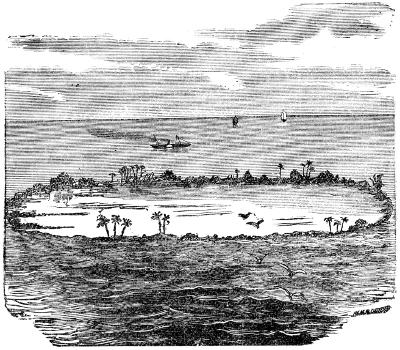
CORAL ISLAND.
The Ctenophora (comb-bearing) are considered the highest of the Cœlenterata, having a more complex digestive apparatus, and better developed nervous system. Their long tentacles, and comb-like cilia are used for swimming.
SUB-KINGDOM IV.
Echinodermata (spiny skinned) have all their parts symmetrically arranged about a central axis, a contractile heart, good digestive organs, and a peculiar system of radiating canals extending through the organism. They are a numerous family of exclusively marine animals, and their characteristics furnish an interesting study. Most naturalists mention four classes.
Class I.—Crinoidea, or sea lilies, now nearly extinct, are fixed to rocks, or the sea bottom, by what seems simply a stem, but is the body of the animal. At the top is the mouth, resembling an expanding bud or flower that opens upward, surrounded by long tentacles, or arms, not unlike the sea anemone. It is supported by a calcareous skeleton consisting of many members, stiff-jointed, crossing and interlacing with one another. When living, the gelatinous animal partly envelops this framework.
Class II.—Asteroidea, or star fish, have a flat disc, five or more radiating arms extending some distance from the body at the center, and containing a part of the viscera. The mouth is where the arms meet, and opens downward. The upper surface is studded over with rough knobs, between which are the openings of many little tubes, for the passage of water into and out of the body. The round mouth is very dilatable, enabling it to receive large and solid objects for its food, which there is no attempt to masticate. After the digestive organ is somehow wrapped around the shell fish on which it feeds, it is held in its firm embrace till the nutritive portion is disposed of, and then thrown out. They are voracious eaters, devouring all kinds of garbage that would otherwise accumulate along the shores, valuable as sea scavengers, though destructive of living crustaceans and shell fish.
Class III.—Echinoidea (hedgehog-like) are covered with spines which they move either by the enveloping membrane or by small muscles properly situated for the purpose. The thin, horny, and, when dry, very light skin is peculiar, in that it is composed of regularly shaped, pentagonal plates, arranged in radiating zones, every alternate plate perforated with small holes; and among the spines, but capable of extending beyond them, are little arms, provided at the end with forceps, probably for seizing their prey, or for ridding themselves of troublesome parasites. These are also used for locomotion. They are less active than some others of the family, live near the shore among rocks, or under the seaweed, feed on crabs, and are oviparous.[3]
Class IV.—Holothuroidea (whole mouthed). They are elongated, like a cucumber, and the head end terminates abruptly, the mouth being a circular opening surrounded with feathery tentacles. They have remarkable muscular power, by which they can disgorge the contents of the stomach, throw off their tentacles, and even eject most of their internal organs, and survive the loss, afterward producing others, perhaps more satisfactory or in a healthier condition. In tropical climates, they have been likened to the sea urchin, without a shell, but are proportionally longer, and their axis horizontal.
SUB-KINGDOM V.
Vermes (worms). Animals having head and tail composed of segments. The digestive organ is tubular, and the nervous system a double chain of ganglia[4] on the ventral[5] surface. There are six classes of vermes. The animals differ greatly in appearance.
Class I.—Flat worms are best known as the parasites that infest animals, such as the liver fluke of the sheep, and the tapeworm. The flat worms pass through a very peculiar metamorphosis, some varieties taking as many as seven different forms.
Class II.—Round or Thread Worms are represented by the pin worm and Trichina. The latter is the dangerous worm which finds its way into the human system from pork flesh, in which it is imbedded.
Class III.—Wheel Animalculæ, or Rotifera. A most interesting microscopic worm, abounding in fresh water and in the ocean. They will remain dried up for years, and then recover life. Their shapes are very peculiar.
Class IV.—Moss Animals, or Polyzoa, are the animals which form a coral-like shell. They are abundant on the seashore, and are called sea mosses.
Class V.—Lamp Shells (Brachiopoda). These worms are marine, and form a bivalve shell, the valves being on either side of the body. The body has long arms on one side of the mouth, which bear fringes; the motion of the fringes draws food into the mouth. They are also used in respiration. But few species of the Brachiopods are now living, though they were once very plenty.
Class VI.—Annelidæ. This last class includes the leeches, a flat worm, whose body is divided into segments; the earth or angleworm, a familiar worm of many segments, and the marine worms. Each segment of the latter bears clusters of bristles, used in swimming.
SUB-KINGDOM VI.
Mollusca (soft). General characteristics—Mollusks, a numerous branch of the animal kingdom, are so called from the softness of their bodies, which usually have no internal skeleton or framework to support them. They are covered with a tough, muscular skin, and generally protected by a shell. They have a gangliated nervous system, in some cases well developed, the medullary[6] mass not enclosed in a cranium or spinal column—of which they are mostly destitute—but distributed more or less irregularly through the body. They have hearts, and an imperfect circulative system, the blood being pale or blueish. Some breathe in air, some in fresh, more in sea water. Some—both of those on land and those in water—are naked, others have a calcareous covering or shell. The larger marine mollusks are often guarded by very strong, heavy shells. Some are viviparous, others oviparous, and multiply rapidly.
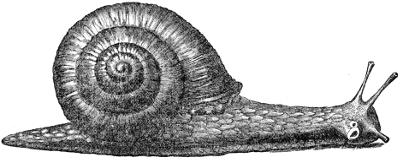
SNAIL.
Three general, and many subdivisions are recognized. The total number of living species is said to exceed twenty thousand, of which only a few can be mentioned. The classes under this division are Lamellibranchiata, Gasteropoda, and Cephalopoda. The chief representatives of the first class are all ordinary bivalves.
Ostrea (oysters) are well known bivalve mollusks. The shells are so irregular in surface and shape that it would be impossible, as it is unnecessary, to describe them. The animal itself is very simple in structure, proverbially stupid, low in the scale of animal life, but highly esteemed as a delicious article of food. They are found in almost all seas, and in water of from two to six fathoms, but never very far from some shore. They multiply so rapidly that, though the consumption increases with the increase of population and the facilities for distributing them, the supply is equal to the demand. Boston is mostly supplied from artificial beds, and the flats or shallow bays in the vicinity of our maritime cities abound in such “plants.” Baltimore and New York have each an immense local trade, and the oysters exported from the Chesapeake Bay fisheries amount to about $25,000,000 annually.
Class II.—Gasteropoda (stomach-footed). This class, including the great snail family, is a very large division of terrestrial, air-breathing mollusks. Their light shells vary much in form; when spiral and fully developed they have as many as five or six whorls, symmetrically arranged. The shell can contain the whole body, but the animal often partially crawls out and carries the shell on its back. The locomotion is slow and accomplished by the contractile muscle of the ventral foot.
Class III.—The Cephalopoda (head-footed) have distinctly formed heads, large, staring eyes, mouths surrounded with tentacles or feelers, symmetrically formed bodies wrapped in a muscular covering; they have all the five senses, and are carnivorous. This class is entirely marine, and breathes through gills on the side of the body. The naked Cephalopoda are numerous, and furnish food for many other animals. Those living in chambered shells, once numerous, are now known principally by their fossils, the pearly Nautilus (sailor) being their only living representative. This has a smooth, pearly shell, and is much prized as an ornament. It is a native of the Indian Ocean, dwelling in the deep places of the sea, and at the bottom. The shell is too well known to need description, and but few specimens of the living animal have been obtained.
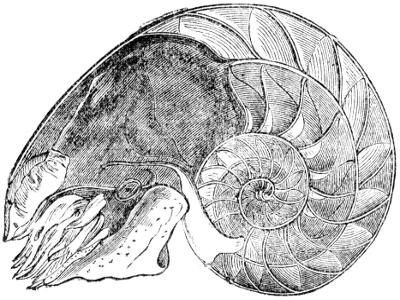
NAUTILUS.
The following facts as to the physical organization and habits of this interesting species of univalves are gleaned from the American Cyclopædia, and given for those who have not access to any extensive work on the subject; they were mostly copied for the Cyclopædia from Professor Owen’s celebrated memoir, and the “Proceedings of the Linnæan Society of London:”
The posterior portion of the body containing the viscera is soft, smooth and adapted to the anterior chamber of the shell; the anterior portion is muscular, including the organs of sense and locomotion, and can be drawn within the shell. The mantle is very thin behind, and prolonged through the calcareous tube of the occupied chamber as a membranous siphon, and through all the divisions of the shell to the central nucleus; on the upper part of the head is a broad, triangular, muscular hood, protecting the head when retracted and used as a foot for creeping at the bottom of the sea, with the shell uppermost. … The mouth has two horny mandibles, like the beak of a parrot reversed, the lower overlapping the upper, moving vertically, and implanted in thick, muscular walls. … There are ninety tentacles about the labial processes and head. The internal cartilaginous skeleton is confined to the lower surface of the head, a part of the cephalic nervous system being protected in a groove on its upper surface, and the two great muscles which fasten the body to the shell are attached to it. The funnel is very muscular and is the principal organ of free locomotion, the animal being propelled backward by the reaction of the ejected respiratory current against the water before it. … The nautilus, though the lowest of the Cephalopods, offers a nearer approach to the vertebrate animals than does any other invertebrate, in the perfect symmetry of the organs, the larger proportion of muscle, the increased bulk and concentration of the nervous centers in and near the head, and in the cartilaginous cephalic skeleton. The mature nautilus occupies but a small part of the shell, the parts progressively vacated during its growth are one after another partitioned off by their smooth plates into air tight chambers, the plates growing from the circumference toward the center, and pierced by the membranous siphon. The young animal before the formation of these chambers can not rise from the bottom of the sea, but the older ones come to the surface by the expansion and protrusion of their bodies producing a slight vacuum in the posterior part of the chamber unoccupied, and, some say, by the exhalation of some light gas into the other deserted chambers. They rise in the water as a balloon does in the air, because lighter than the element surrounding them. They float on the surface with the shell upward, and sink quickly by reversing it. By a nice adjustment, in the completed structure, between the air chambers and the dwelling chamber, the house and its inhabitant are nearly of the same specific gravity as water. … In parts of the Southern Pacific, at certain seasons of the year, fleets of these little ships are carried by the winds and currents to the island shores, where they are captured and used for food.
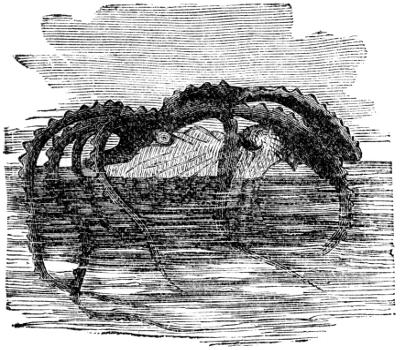
ARGONAUT.
The Paper Nautilus, or argonaut, secretes a thin, unchambered shell in which its eggs are carried; has tentacles or arms with which it crawls on the bottom, and swims backward, usually with the back down, squirting water through its breathing funnel. The argonaut differs from the true nautilus in having larger arms of more complicated structure, with sucker discs, and partially connected by a membrane at the base. It has an ink gland and sac, for its secretion. It has a great number of little cells, containing pigment matter of different colors, whose contractions and expansions give it a remarkable power of rapidly changing its tints. There is no internal shell, and it is ascertained that the external shell is peculiar to the female, and is only an incubating and protective nest for the eggs. The eggs are attached to the involuted spire of the shell, behind and beneath the body of the female. From the fact that the animal has no muscular or other attachment to its shell, and has been known, after quitting it, to survive sometime without attempting to return, the argonaut has been supposed to be a parasitic occupant of the cast off shell of another, but is now pretty clearly proved to be the architect of its own shell, which it also repairs when broken by the agency of its palmated arms. It is said the argonaut rises to the surface, with the shell upward, turning it downward when it floats on the water; by drawing the six arms within the shell and placing the palmated ones on the outside, it can quickly sink. This explains why the animal is so seldom taken with the shell. The shell is flexible when in water, but very fragile when dry. The largest known specimen is in the collection of the Boston Society of Natural History; it is 10 by 6½ inches. For a full account of this animal see “Proceedings of the Boston Society of Natural History,” vol. v, pp. 369-381.
End of Required Reading for April.