C. L. S. C. SONGS.
Reading edition
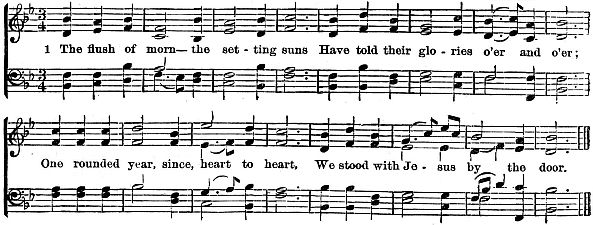
HYMN OF GREETING.
Mary A. Lathbury. (Chautauqua, 1875.) German Air.
[Transcriber's Note: You can play this music (MIDI file) by clicking here.]
1 The flush of morn—the setting suns Have told their glories o’er and o’er; One rounded year, since, heart to heart, We stood with Jesus by the door. 2 We heard his wond’rous voice; we touched His garment’s hem with reverent hand; Then at his word went forth to preach His coming kingdom in the land. 3 And following him, some willing feet The way to Emmaus have trod; And some stand on the Orient plains; And some upon the mount of God! 4 While over all, and under all, The Master’s eye, the Master’s arm, Have led in paths we have not known, Yet kept us from the touch of harm. 5 One year of golden days and deeds Of gracious growth, of service sweet; And now, beside the shore again, We gather at the Master’s feet. 6 “Blest be the tie that binds,” we sing; Yet to the bending blue above We look, beyond the face of friends, To mark the coming of the Dove. 7 Descend upon us as we wait With open heart—with open word Breathe on us, mystic Paraclete! Breathe on us, Spirit of the Lord!
Copyright by J. H. Vincent.
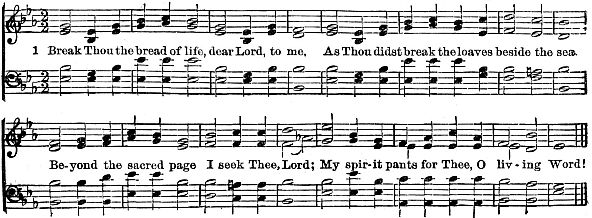
BREAK THOU THE BREAD OF LIFE.
Mary A. Lathbury. (Study Song.) Wm. F. Sherwin, 1877, by per.
[Transcriber's Note: You can play this music (MIDI file) by clicking here.]
1 Break Thou the bread of life, dear Lord, to me, As Thou didst break the loaves beside the sea. Beyond the sacred page I seek Thee, Lord; My spirit pants for Thee, O living Word! 2 Bless Thou the truth, dear Lord, To me, to me, As Thou didst bless the bread by Galilee; Then shall all bondage cease, All fetters fall, An I shall find my peace, My All in All!
Copyright, 1877, by J. H. Vincent.

A member of the Circle suggests that local circles should occasionally hold an evening of song, making use of the “Chautauqua Songs” which have been sent to all members. By doing this in advance of the several Assembly meetings the coming season, they would be prepared to enjoy a general service of song on the C. L. S. C. days.
A lady holding a lucrative position in a Boston printing room writes: “All that the C. L. S. C. has done for me it is impossible to tell. It has helped me to become better acquainted with my Maker and his wonderful works; the history of nations and individuals; created a greater love for solid, instructive reading; better fitted me for teaching in the Sunday-school, and opened avenues for thought, study, and usefulness which, I trust, will make life more successful and useful.”
“Will you please advise me through the columns of The Chautauquan what book to procure to learn at home how to speak and write the English language grammatically?” An excellent practical teacher gives the following answer to the above question: “There is no book warranted to turn out good writers and speakers of the English Language. If the person desiring the information is a foreigner—a Frenchman or a German—we could better answer the question. If he is English, with what knowledge does he begin? If with little knowledge, he should use some elementary book, such as Swinton’s ‘Language Lessons,’ or better, Whitney’s ‘How to Speak and Write Correctly.’ If somewhat advanced, some one standard text-book of the English language, some grammar like Brown’s, would be helpful. But better would be the advice to read some masters of English. Read carefully and critically, and try to reproduce such essays as Irving’s, Hawthorne’s, and Longfellow’s. Johnson said, ‘Give days and nights to the study of Addison if you would attain a style familiar but not coarse, elegant but not ostentatious.’ Bunyan is said to have become master of English from the study of the Bible.”