AYLMER WRITES OF NORWAY AND DENMARK (continued 2)
Reading edition
We had a great time in Luleå, and I shall have to admit that Sweden has some attractions after all. I came here to Trondhjem by way of Bräcke and Ostersund and Storlien, a route you can trace by the map I inclose, if you care to. Storlien is the border town between the two countries, and near it a wide path cut through the forest marks the boundary.
From here on we dropped right down to the edge of the fjord, which we reached at the town with the startling name of Hell. It is a delightful, smiling little town, and its only misfortune lies in its name. It offers an endless and irresistible opportunity for questionable puns. One guide book says: “Ten miles from Trondhjem on the railway to Sweden there is a station called Hell. The number of return tickets for this quiet rural spot which are bought by English tourists but never used constitutes quite a source of revenue.”
You see, even the prosy guide book cannot resist such an opportunity for a joke. Probably at least two thirds of the English-speaking tourists who visit this town imagine that they are original when they remark that the town is paved with good intentions, and that they are going to write a Divine Comedy like Dante, etc., etc.
Hell is beautifully situated and offers pleasant excursions in all directions.
Here in Trondhjem I am in the heart and soul of Norway. The town was founded under the original name of Nidaros by our old friend Olaf Tryggvesson. Century after century the Haakons and the Olafs and Haralds and Eriks and all the other kings and warriors fought for Norway here. Many of the streets are named for the old heroes. The cathedral, which dominates the whole town, is a perpetual memorial to Olaf the Saint. I could not find a more appropriate spot from which to write you something about the history of Norway. There is so much that is interesting that I feel hopeless about trying to really make you acquainted with it. Hjalmar Boyesen has written five hundred and twenty-eight pages of vividly, dramatically interesting history on the subject, yet he does not pretend to write exhaustively. All I shall do is to skim over a thousand years or so and here and there pick out an incident or a character that particularly interested me.
The old Norsemen, the vikings, were the most terrible of roving marauders, terrible at least to the rest of the world. Tacitus says: “They deem it a disgrace to acquire by sweat what they might obtain by blood.” The chieftains were venerated in almost direct proportion to the number of marauding expeditions they had made and the number of towns they had plundered. For the sake of glory they made countless sallies in all directions, over the Baltic, to Finland and Germany, across to England and Ireland, to France, to Spain, and even to Italy. A marauder named Hasting is said to have gone as far as Italy and to have sought to conquer the Eternal City of Rome.
Unfortunately for this desire, Hasting was not good at geography. He arrived with his fleet at the city of Luna, near Carrara, and, thinking it was Rome, he concocted a wily scheme. He sent word to the bishop there that he was dying and wished to be baptized into the Christian faith before he passed away. The simple priest was in ecstasy at the thought of the heavenly glory he would win by converting such a notorious robber. He made great preparations for the reception of the Norseman. On the day when the ceremony of baptism was to be held, messengers came to the bishop saying that Hasting had suddenly died. A pompous funeral was held, and the bishop prepared to say masses for the welfare of the viking’s soul. As all were assembled for this purpose, Hasting suddenly burst from his coffin, called to his men, and fell savagely upon the bishop and the priests. It is reported that “blood flowed in torrents through the sacred aisles.” The whole city was captured amid a scene of wholesale slaughter. Some time after Hasting discovered that it was not Rome he had captured after all.
For many years various chieftains with picturesque names kept up this marauding life, interspersing their piratical raids with occasional attacks upon each other.
Finally an Yngling chief named Harald arose from obscurity and conceived the brilliant idea of conquering all Norway and uniting it into a single nation. The idea was presented to him very forcibly by a maiden named Princess Gyda, to whom he sent messengers asking her to become his wife. Like Sigrid the Haughty, Gyda was furious. She vowed that she would teach little kings the risks of proposing to her. She scorned Harald’s overtures, sending word that when he was king over all Norway she would consider his offer. The idea appealed to Harald, and he wondered why he had not thought of it before. Accordingly he vowed that he would not cut his hair until he had conquered all Norway. He eventually succeeded in his undertaking, but the process was long, and his hair, being of decidedly blond “persuasion,” waved like a bright banner wherever he went. He had always been called Harald Frowsly-Headed, but now he came to be called Harald Fairhair, and he founded a race of kings that ruled Norway for centuries. Also he married the proud Gyda, and lived happily ever after. Gyda seems to have been not even annoyed by the fact that during the interval in which he had been conquering Norway and letting his hair grow he had married a maiden named Aasa and had three sons.
Harald was a jealous tyrant, and made life in Norway so uncomfortable that many of the earls and nobles fled and founded settlements in the Hebrides and the Orkneys, and even in Iceland. Rolf the Walker (so called because he was so huge that no horse could carry him) embarked for France and made terrible ravages there. King Charles the Simple, however, succeeded in making a peace with him whereby Rolf was to be baptized and receive large fiefs. As token of his fealty to Charles the Simple he was to kiss the king’s foot. The haughty Rolf snorted at such an idea and sent one of his servants to perform the osculation. The proxy stalked stiffly to King Charles, seized his foot, and kissed it so violently that the simple Charles tumbled from his horse. Charles was frightened out of what wits he had, and instead of punishing such insolence gave Rolf the hand of his daughter in marriage, and also gave him half of his kingdom. This territory came to be called Normandy, and about two centuries later Rolf’s descendant, William the Conqueror, achieved fame.
Harald had countless matrimonial ventures. Besides Aasa and Gyda, he married half a dozen other wives. One of them, Snefrid by name, was a sorceress. For several years the king forgot everything but his passion for her, forgot even his other wives. She bore him five sons and then died, and the king was almost insane with grief until he discovered that she had been a sorceress. He was then thoroughly angry, and to save his face he married right and left in all directions. Among others he wooed Ragnhild, daughter of King Erik of Jutland. Ragnhild was a girl of some spirit. She said she would not put up with one thirtieth part of the king’s affection, and he could give her the whole or none. He accordingly deserted his other wives and devoted himself to Ragnhild. She bore him a son, who later became King Erik Blood-Axe.
When Harald was seventy years old he married his servant-girl, Thora, who was so tall that she was known as the “Pole.” She bore him a son, who became King Haakon the Good.
I should not dwell so much on Harald’s matrimonial adventures except they that form indirectly an important link in the long chain of Norwegian history. He had a small army of children, and he was foolish enough to stipulate at his death that each child, whether legitimate or illegitimate, should inherit a province, but that all should owe allegiance to his favorite son, Erik Blood-Axe.
For centuries there was a ceaseless squabbling among the numerous descendants. Every one who had any ambition asserted that he was a son or a descendant of Harald, and claimed the throne. As it was of course impossible to disprove such a claim, might became the only right. Two centuries later a vicious Irishman, named Harold Gilchrist, landed in Norway and claimed to be a son of King Magnus Barefoot and consequently a descendant of Harald Fairhair. He had no proof whatever of his claim, but no one could disprove it, and, as Gilchrist was a cruel and unscrupulous man, he actually succeeded in gaining the throne. He learned a smattering of the Norwegian language and ruled cruelly, leaving a monstrous name behind him, and a long line of vicious children who helped to complicate matters.
After all this it is a pleasure to come to a king who thoroughly earned the name of Haakon the Good. This king was the image of his father in face and figure, but exactly opposite to him in character. It is difficult to guess how he came by his wonderful qualities of soul and mind. His father was a faithless, polygamous roué, and his mother’s only claim to distinction lay in the fact that she was a servant-girl of gigantic stature. Haakon was almost a saint. He seems to have possessed every good quality in the category. He was gentle and lovable and mild, yet he was a model of manly strength and courage. He was beautiful to look at, and the bitterest enemy could not be in his presence for even a few minutes without falling under the spell of his powerful personality. With heart and soul and the tenderest conscience, he sought only for the good of his people. It was a new thing for a king to use his office for any purpose other than the gratification of selfish ambition. No wonder the people almost worshiped him.
He had spent his boyhood in England and had been baptized, and now the one desire of his heart was to bring his country to accept the Christian faith. He was so mild, and he loved mankind so devotedly, that he could not bring himself to use the militant methods of conversion which his successor, Olaf Tryggvesson, employed. He was too gentle to be a successful propagandist in a country fanatically devoted to Odin, but he did win a great many true converts in his quiet way. At one time he was forced much against his will to attend a popular feast in honor of Odin, but he quieted his conscience by making the sign of the cross over Odin’s horn. In battle he was almost invincible. At one time the sons of Gunhild attacked him with a force six times his own in strength, but so great was the zeal which Haakon’s followers displayed that his little handful of men won a great victory.
His enemies on this occasion were the sons of Erik Blood-Axe’s queen, Gunhild. She was as near a devil as Haakon a saint, and never has a queen been more heartily or more deservedly hated. Her sons inherited her devilish disposition with interest. This wicked queen brought troublous times to Norway after the death of Haakon the Good. One man, Tryggve, a grandson of Harald Fairhair and consequently a rival claimant to the throne, Gunhild particularly hated. She tricked him into her power and murdered him, but Tryggve’s widow fled to a tiny islet in the Randsfjord and there gave birth to Olaf Tryggvesson, later to be one of the greatest of Norway’s kings, the violent but successful propagandist of Christianity.
The name of little Olaf’s mother was Aastrid, and with fine courage she roamed for years with her little baby, a starving outcast, in continual terror of Gunhild. Her foster-father, Thorolf Lousy-Beard, joined her and her child, and for long they lived a hunted, precarious life. Fortunately for Norway, all Gunhild’s efforts proved in vain. Once one of her spies almost had the child, when a half-witted peasant appeared on the scene, rushed at the spy with a pitchfork, and saved Olaf’s life.
Earl Haakon was another of Harald Fairhair’s descendants who somehow escaped Gunhild’s murderous tentacles. He joined King Harald Bluetooth of Denmark, and as a reward for murdering Gold-Harald, an aspirant to the Danish throne, Bluetooth generously offered to accompany him on an expedition against Gunhild. On their arrival in Norway they took everything without striking a blow. “So great was the hatred of Gunhild and her sons,” says Boyesen, “that not a man drew his sword in their defense.” Gunhild fled in terror to the Orkneys, but, according to Saga report, was later enticed to Denmark by Harald Bluetooth, under promise of marriage, and drowned, at his command, in a swamp.
Earl Haakon now became King Haakon of Norway. He was a powerful and great king, and a sincere heathen. Harald Bluetooth was an insincere Christian. With ulterior and decidedly questionable motives he sent for Haakon to come and be baptized. For some reason Haakon appeared to obey, visited Bluetooth, and with a shipload of priests set sail from Denmark; but whether because of twinges of conscience or for less worthy reasons, he repented, hustled the priests ashore, and made an enormous sacrifice to Odin. Two ravens, messengers of Odin, immediately alighted on his ship and croaked loud approval, whereat Haakon was highly encouraged. The Christian Bluetooth was enraged. He sought the alliance of a powerful company of pirates called Jomsvikings.
These, under the influence of the flowing bowl, made most extravagant vows of vengeance (on Bluetooth’s account) against King Haakon. On the morning after things seemed different to them, but nevertheless, for their vows’ sake, they set out for Norway. Earl Erik, an illegitimate son of Haakon, born, it is said, when the king was fifteen years old, heard news of the Jomsvikings, and he and his father prepared to give them a warm reception. When the two fleets met, there ensued one of the wildest and most ferocious battles in all history. The phenomenal courage of these old heroes is almost unbelievable. One of the Jomsvikings, by name Haavard the Hewer, had both his legs cut off at the knees, but he fought on furiously, standing on the stumps of his knees. Bue the Big received a blow from one of Erik’s men which completely struck off his nose. Bue never stopped to mourn such a trifle as the loss of a nose. He jokingly remarked to one of his companions: “Now I fear the Danish maidens will no more kiss me.”
At length Haakon and Erik were victorious. Vagn Aakeson, the leader of the Jomsvikings, was bravely and hopelessly fighting on. “When all but thirty of his men were dead, he at last surrendered. The captives were brought ashore and ordered to sit down in a row upon a log. Their feet were tied together with a rope, while their hands remained free. One of Erik’s men, Thorkell Leira, whom Vagn at that memorable feast had promised to kill, was granted the privilege of reciprocating the intended favor toward Vagn. With his ax uplifted, he rushed at the captives, and, beginning at one end of the log, struck off one head after another. He meant to keep Vagn until the last, in order to increase his agony. But Vagn sat chatting merrily with his men; and there was much joking and laughter.
“‘We have often disputed,’ said one, ‘as to whether a man knows of anything when his head is cut off. That we can now test, for if I am conscious after having lost my head, I will stick my knife into the earth.’
“When his turn came, all sat watching with interest. But his knife fell from his nerveless grasp, and there was no trace of consciousness. One of the vikings on the log seemed in particularly excellent spirits. He laughed and sang as he saw the bloody heads of his comrades rolling about his feet.”
The next cracked a clever pun at the executioner’s expense, and Erik, who was superintending the job, was so pleased at his audacity that he pardoned him. The next of the doomed men had long flaxen hair, and humorously requested the executioner not to soil his hair with the blood. Accordingly an assistant was delegated to hold out of harm’s way the glorious flaxen locks. Just as the ax was descending, the Jomsviking jerked his head in such a way that the hands of the assistant were struck off at the wrists. He laughed derisively, and Erik, who was particularly partial to such cleverness, pardoned him.
At this point Gissur the White was suddenly shot dead by an arrow coming from nowhere in particular. It seemed that Haavard the Hewer, whom everybody had forgotten, was still alive and still standing on the bloody stumps of his knees. With his last dying gasp of strength he had shot this arrow.
During the battle King Haakon sacrificed one of his sons, and this horrible action did much to hasten the king’s overthrow. His name became a nightmare to his subjects. It was a name to scare bad boys with. In the most abominable manner he insulted several of his most powerful nobles, and finally they rose in revolt. In terror Haakon fled with a single thrall, named Kark, to Rimul, the home of his mistress Thora. She hid the two in a pigsty, and there they spent a horrible night. A searching party, under the leadership of Olaf Tryggvesson, who had lately returned to Norway from Russia, where he had spent his youth, walked all about, within hearing of the miserable king in his hiding place. Olaf mounted a stone close to the sty and said in a loud tone, which the two miserable men could hear, that he offered a great reward to whoever should find Haakon. This of course added to Haakon’s terrors the fear of treachery on the part of his thrall.
All night king and thrall sat in their noisome den, eyeing each other in awful, mutual distrust. Toward morning the king was overpowered by sleep. “But the terrors of his vigil pursued him sleeping. His soul seemed to be tossed on a sea of anguish. He screamed in wild distress, rolled about, rose upon his knees and elbows, and his face was horrible to behold.” Kark then stabbed his master, cut off his head, and took it to Olaf, claiming his reward. Olaf, on the dead king’s account, took vengeance on the traitor by killing him.
Longfellow has immortalized this event, and I lately came across these lines of his, commemorating Olaf’s celebration:
“At Nidarholm the monks are all singing, Two ghastly heads on the gallows are swinging; One is Earl Haakon’s and one is his thrall’s, While the people are shouting from windows and walls, And alone in her chamber swoons Thora, the fairest of women.”
These were hard old times. But the influence of a few noble kings like Haakon the Good and Olaf the Saint wrought in time a great change on these brave Norsemen. They were of too fine a stock to be permanently satisfied with a god who delighted in bloodshed and deceit. Christianity eventually gave them higher ideals without robbing them of their indomitable courage.
I will tell you in my next letter a little about the better days of Norway, particularly in connection with this old city. Of course I can only skim along, picking out a bit here and there. The reading of Boyesen’s Story of Norway has left me with a tremendous respect for the caliber of the Norwegians, from the days of Hasting the Pirate to the days of King Haakon VII, who was crowned in Trondhjem Cathedral in 1905.
Good-by. As ever,
Aylmer.
SIXTH LETTER
The “thermometer of Norway”; the Reformation in Norway; the caliber of the early Reformation pastors; the register of the “Hospitset”; “fladbröd” and “mysost”; a type of Norwegian gentleman.
Trondhjem, February 23.
My dear Judicia,
I have spent over a month now in Trondhjem, and I like it better and better every day. It bristles so with memories of the past, and yet it is such a wide-awake, modern city. Our old friend, Olaf Tryggvesson, founded it in 996, and ever since then the Norwegians have considered it the heart of their nation, even though Christiania is now the nominal capital. If Trondhjem is the nucleus of Norway, then the cathedral is the nucleolus. The Norwegians appropriately call it their national thermometer. It has been burned in whole or in part no less than seven times, and once it was struck by lightning and partly destroyed. It was built originally by King Olaf the Quiet in the eleventh century, and after every catastrophe some succeeding king has rebuilt it. If it happen that the cathedral has not been destroyed for several decades, the people occupy themselves with making additions. If hard times come to Norway, the cathedral is left as it may chance to be. If times are prosperous, money is given by state and private subscription to enlarge or beautify it. Just now times are prosperous, and strangely enough there has been no fire for over a century. Consequently there are now to be seen dozens of the most hideous gargoyles reposing in one part of the church, waiting to be put up.
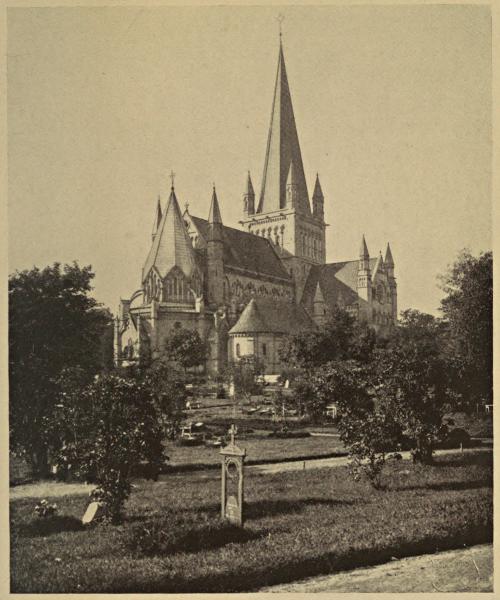
Copyright by Underwood & Underwood, N. Y.
Trondhjem Cathedral.
I don’t suppose you have any idea of the beauty and grandeur of this historic Domkirke. I never dreamed of finding anything like it way up here near the arctic circle. We Americans get into the habit of thinking that Cologne and Milan and Rome and Florence and one or two other places of continental Europe have all that is worth looking at in the line of cathedrals. But this Trondhjem Dom is as fine as any of them, though much smaller than most. It is built entirely of a bluish, slaty stone, except for the marble pillars, which contrast beautifully with the blue. It is a masterpiece of Gothic architecture, and the entire church is as delicately fashioned as any in Europe.
My British author, before quoted, says of it: “This is supposed to be the grandest church in the whole of Scandinavia. It is built largely of bluish soapstone and white marble, and it is mostly Gothic in architecture. A service, apparently for children, was in progress, so we were not able to walk around the interior.” I am forced to think that the gentleman did not possess quite the average amount of ingenuity, or he might have somehow obviated the difficulty and seen the interior in spite of the service “apparently for children.” Well, this is supposed to be the grandest church in the whole of Scandinavia, and it bears out the supposition.
To me its greatest interest lies in its history. The one great king particularly associated with this cathedral was Olaf the Saint. He was the king who finally achieved the conversion of his country to Christianity, and because of his devoted life and heroic death at Sticklestad he has been made the patron saint of Norway. Cold, relentless history reveals the fact that he was not in reality as near sainthood as Harald the Good, but his saintliness was of a more romantic character and appealed to the imagination of the people. After spending many years at the court of the Russian king, Jaroslav, he believed that he was called by a vision to go back to Norway and attempt to complete the conversion of his native land. He went to Sweden and collected all the men he could. They might be robbers and outlaws, but they must be baptized Christians, and he was courageous and consistent enough to dismiss a great many brave soldiers who refused to be baptized. At Sticklestad, in Norway, he met the opposing forces, but was beaten and finally killed, fighting bravely to the last. At the very moment when he was slain, there occurred a total eclipse of the sun. “The sun grew blood-red, and a strange red sheen spread over the landscape. Darkness fell upon the fighting hosts, and the sun grew black.”
Of course nothing more than this was needed to convince the people that Olaf’s god was angry with them. Stricken with terror, they did their utmost to atone for their guilt. They later built a great cathedral in his honor. They made him the national saint, and they laid his bones in a costly silver reliquary in the cathedral, where for six centuries devout pilgrims visited his shrine.
Better times did indeed come to Norway with the introduction of Christianity, but some centuries later, when the countless claimants to the throne had ruined the nation’s unity, and Denmark had taken possession of Norway virtually as a province, Christianity suffered a horrible relapse. Denmark introduced into Norway the Reformation, but the Danes considered their Norwegian subjects scarcely worth salvation. They sent to Norway the very lowest scum of their clergy. As Boyesen says, “Ex-soldiers, ex-sailors, bankrupt traders, all sorts of vagabonds, who were in some way disqualified for making a living, were thought to be good enough to preach the word of God in Norway.” Just as England once sent its criminal class to Australia, so Denmark in the Middle Ages sent its vagabond class to Norway in the form of Protestant pastors. For a long time physical strength was the Norwegian pastor’s only requisite. As a general rule he could scarcely read, and cared little or nothing for the religion he taught except as a means of keeping the wolf from his door; but if only he could thrash the strongest ruffian in his parish he was sure of success.
I am staying at the Hospitset, which corresponds somewhat to the hospitzes or Christian hotels in Switzerland and Germany. When I arrived here I had to sign a sort of register that seemed to me unwarrantably inquisitive. It must know my name, my destination, my last previous address, my permanent address, my age, my occupation, and I don’t know what other items of gossip. Some of the guests have used the opportunity to exercise their native wit. Exempli gratia. Michael O’Shaughnessy writes that his permanent address is care of the king of Siam; his occupation, plumber; his age, thirty-two; his destination, heaven. Many other humorists, mostly signing themselves under obvious noms-de-plume, have thought fit to enliven the dull pages for future readers. This register is a government institution, at least in many places, and the hotel keeper must not be blamed for such inquisitiveness.
The food in this Hospitset is excellent, both as to quality and quantity. One Norwegian feature of the meals is the cheese. You know Norway is famous for its sæters, or mountain dairies, where butter and cheese are made. The most delicious, to my mind, and certainly the most typically Norwegian, is a brown cheese called mysost. It looks like brown Windsor soap, as English authors never fail to remark, and it is sweetish. It is made from goat’s milk, and tastes as though all the cheese part had been extracted. That does not sound particularly attractive, perhaps, but honestly I like it immensely. A great cube of it, measuring something less than a foot on all sides, is put on the table, and each guest is supposed to pare off as many thin slivers of it as he can eat. It is most delicious when taken with Norwegian fladbröd. This is a sort of oat cake, and when well made is as crisp and delicious as anything I know of in that line.
I admit that both the mysost and the fladbröd are somewhat unique. There is nothing like either of them in England or America, or anywhere except in Scandinavia, and unless you are something of an adventurer you may not like them at first. Several very conservative authors write most disparagingly of it: of course they do, for mysost and fladbröd are new to them. Mysost they liken to brown soap, “which however will not lather.” Fladbröd, they say, “resembles in appearance and consistency old boot-leather.” I, personally, have never tasted old boot-leather or brown soap, but if it is really true that they taste like fladbröd and mysost, then I shall begin cultivating my appetite for them as soon as I get home.
I have met a good many of the Norwegians. Most of them speak English, at least here in Trondhjem. Particularly I am impressed with the stateliness and nobility of the old men. You have seen pictures, haven’t you, of Björnstjerne Björnson, and Grieg, and some of the others. Well, they are typical. I have talked with several of these old, patriarchal Norwegians, and they are the finest, truest gentlemen you can imagine. Benevolence and good will seem to radiate from them.
Doctor J. D. Forbes calls the Norwegians “a free, intelligent, and fine-hearted people,” and certainly he is right. Another author finds that “sincerity, honesty, and freedom from conventional cant are the chief national virtues.” If you combine these two opinions you will come near to describing the Norwegian of to-day.
The other day I hired a very good violin at a shop here, and had to pay the exorbitant sum of one kroner. I didn’t have to make any deposit, and the shopkeeper asked me no questions. When I was going out he inquired at what hotel I was staying. I told him, and he said in English: “Never mind, then, about returning the violin. I’ll come around to the hotel some time and get it.” Can you imagine such confidence in any other country? The Norwegians expect you to trust them, and in return they trust you.
I intend to go to Christiania in a few days and will write to you from there.
As always,
Aylmer.
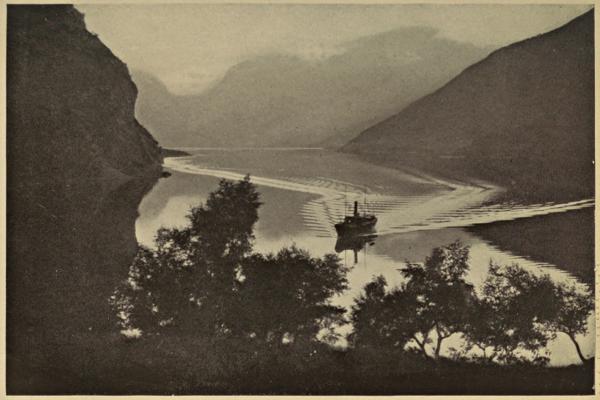
On the Sognefjord.
SEVENTH LETTER
Holmenkollen, the skiing center of the world; the throng of sport-seekers; Holmenkollen Day; the stuff from which Norsemen are made; Veidirektör Krag; Harald Hardruler; how to manufacture a halo.
Holmenkollen, March 15.
My dear Judicia,
I have found the home of winter sport. Its name is Holmenkollen. Of course all Norway is known as the birthplace of the ski, and Holmenkollen is the sporting center of Norway. To-day a heavy mantle of fog has settled over Christiania, but up here at Holmenkollen we don’t know what fog means. It is as bright and crisp and clear as possible. Winter has not thought of passing the first flush of its youth, though it is the middle of March. It is often good skiing here until the end of April.
Every day and many times a day the electrics from Christiania bring up a load of sport-seekers, the skis and sleds being strapped on to the outside of the car. There is a winding course, five miles long, which is crowded every minute of these long, bright afternoons with an endless procession of boys and girls, young men and maidens, old men and old women, on skis or sleds or toboggans. Really the most doddering, toothless grandma is no more out of place at Holmenkollen than the toddling, toothless babe, and neither of these two extremes is more out of place than the stalwart youth of “collegy” age and appearance. Every one comes to Holmenkollen. If you are a beginner and can’t stand up on skis, you will have company, and if you are a world’s champion you will have plenty of other aspirants to dispute the title with you.
You could hardly find a more jumbled and heterogeneous collection of humanity anywhere than you can find any bright winter afternoon on the slopes of Holmenkollen. I have just been out for an hour or so, taking an “inventory” of the sport-seekers. It was an average crowd, and I must describe its appearance as it slid by my place of inspection, by the roadside.
First came three girls, each clad in most brilliant sweaters, and each on a separate sled, dragging behind her a pole twenty-five or thirty feet long, which served as rudder and also as brake. After a little pause a very buxom, oldish woman appeared around the bend in the course. She had two little children on the sled with her, who were fairly chortling with delight. A solemn old man next passed by. I have seldom seen a face which exhibited such profundity of thought and such deep concentration on his occupation as the face of this old man showed. He was dragging his feet so hard that he barely crept along. He gave the appearance of being absorbed in a very dangerous undertaking, which he was going to “see through” if it killed him.
While he was trundling by, a pair of skiers appeared, flying at tremendous speed. They were a man and a woman, and the most graceful pair you can imagine. They swirled around the corner, and when they came to the old man went one on either side, making a bridge over him with their hands. He continued on his precarious course without the slightest indication that he had seen them.
The next in the procession was a man on a sled, smoking a pipe as he went and actually reading a paper. But a very self-conscious smile betrayed his suspicion that he was being watched. I fear he was guilty of an attempt to “show off.” Next came two tottering English girls on skis. They fell every few yards, and as they passed me one of them reeled and tremblingly cried: “Oh dear, I’m going again.” She did “go,” and I had the opportunity of rescuing her. She said “tak tak” very sweetly, which was probably all the Norwegian she knew, and I was so delighted to have palmed myself off as a native that I said nothing for fear of spoiling her illusion. After this several men went sailing by on skis. They turned down a very steep side path and whirled out of sight like lightning. There is nothing like the beauty and grace of a ski artist who is absolutely sure of himself. His knees do not totter, he doesn’t reel about, he takes the turns smoothly and easily with a confidence which is wonderful to behold. A good skier seems to me nearer to a bird than a good aëronaut.
All this which I have described passed by my station of inspection in about two minutes, and the kaleidoscope continued hour after hour.
The greatest sporting day of the year is what is called Holmenkollen Day. Then all Christiania adjourns to the neighboring hill. The shops are closed, and it is virtually a holiday for all. It usually comes early in March, and on it are held annually the greatest contests in Norway, and perhaps the greatest in all Europe. All the best ski runners and ski jumpers from all over Europe assemble for the test. The most coveted prize is the King’s Prize, which is given for the best aggregate of marks for any single competitor in the two big events, the fifteen-kilometer ski race and the ski jump. No one who does not compete in both these events is eligible for the King’s Prize. The fifteen-kilometer race is held on the day before the big jumping contest and is comparatively uninteresting. The competitors start at intervals of thirty seconds, and each one is timed separately. There is no excitement at the finish, and for all the spectator can tell the last man in may be the winner.
On the big day the crowds begin to assemble about eleven o’clock, though the contest does not begin for two hours. Boxes are built all along the side of the jump to accommodate the wealthy aristocrats who can afford to pay for them. Some forty thousand “plebs” take their stand around the great “horseshoe,” which is roped off as a landing and stopping place for the jumpers.
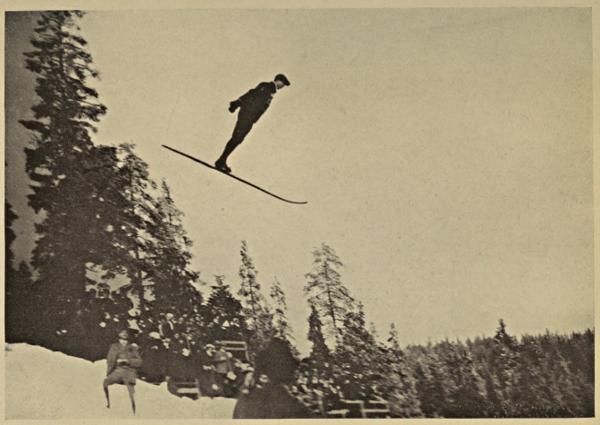
Ski Jumping. An Absolutely Perfect Jump.
Promptly at one o’clock a tremendous cheering announces the arrival of King Haakon, Queen Maud, and little Crown Prince Olaf. This trio constitutes the first real royalty of their own that the Norwegians have had for five or six centuries, and they go wild with enthusiasm whenever any one of the party appears at a public gathering. Little Prince Olaf is all but worshiped by his future subjects, and if they don’t look out I fear they will some day have a spoiled crown prince on their hands. However, he seems to be at present a very natural and normal boy.
As soon as the royal party arrives, the jumping begins, and this year, though there were fully two hundred competitors, and each one had two jumps, the whole contest was run off in a little over two hours. Of course that meant three or four jumps to a minute, and so there was a steady stream swooping down from the hill to the take-off, then sailing out into the air and landing a hundred feet or so down the slope, where, if the jump was successful, they continued their course at express-train speed.
Of course the great majority of the jumpers were Norwegians. It takes years and years of practice to become skillful, and only those who have been at it since babyhood reach the highest pinnacles of skill. No matter how many times you see ski jumping, the thrill never seems to wear off.
As each jumper took his place at the top of the hill, a huge number on a blackboard announced to the spectators who was coming. All the competitors were numbered, as they are in races, and printed lists were distributed for the convenience of the onlookers.
The jumpers would come tearing down the hill and crouch low as they approached the take-off. Then, with arms outspread, they would shoot out into space, straightening themselves quickly and bending forward. While they were in the air, they would put one ski a little ahead of the other; with a little “spat” the skis would strike the snow far down the slope; agile and light as a feather, the jumper would sink down almost on his heels, and then, if he kept his balance, he would fly ahead for a second or two, then make a beautiful “Telemark” or Christiania swing, coming to a dead stop. Telemark and Christiania are in skiing parlance two methods of coming to a sudden stop.
As I understand it, a Telemark means a wide, sweeping curve, with one foot considerably in front of the other, while the Christiania is a quick snap at right angles accomplished by a sudden swing of the arms and of the whole body. However, nobody quite understands how it is done unless he has been practicing it half a lifetime. There is a great knack about it, and it was beautiful to watch the ease with which many of the jumpers did it.
Of course there were unfortunates who fell. There would be a wild whirl of arms and legs and skis and snow, and, when the whirl gradually resolved itself into a man, he would crawl to one side to get out of the way of the next comer.
The distance some of these men jump is appalling. A leap of one hundred and forty-eight feet such as that made by Harald Smith (a Norwegian in spite of his surname) is certainly more like flying than jumping.
Compared with these thrilling exhibitions the mild daily procession down the five-mile slope of Holmenkollen seems rather tame, but it is interesting nevertheless. In the restaurant here, which overlooks the city and fjord of Christiania, there is a huge picture of Nansen. He was once a competitor in ski jumping, and perhaps it was here that he developed the courage which later made him famous the world over as an explorer.
The modern Norwegians have inherited their love of sport from their viking ancestors. I have lately been reading in Du Chaillu’s The Viking Age an account of viking sports, and the prowess of the present-day Norwegians is explained in my mind. A viking, it seems, had to be athletic if he would amount to anything. Courage, skill, and dexterity were the necessities of his life.
Once there was a viking named Kari who saved his life by means of his high-jumping ability. His enemy Sigurdson ran at him with a spear from behind, but Kari saw him just in time, jumped high in the air so that the spear went under his feet, and then came down on top of it, smashing the handle.
The sagas abound with tales of athletic prowess, and, even if these sagas were apt to become a little over enthusiastic in dealing with their heroes, nevertheless we can see easily enough how it is that the modern Norwegian comes by his wonderful athletic skill and courage.
Nansen is not the only explorer to whom Norway does honor. You know it was not long ago that Amundsen’s name was on all lips, because of his discovery of the South Pole. He, too, has the stuff in him of which vikings were made.
Up near the top of this five-mile road stands a bronze figure leaning carelessly against a milestone. He rests his bronze fist on his bronze waistcoat, and a bronze felt hat and a bronze cane complete the picture of calm self-satisfaction. On close inspection I learned that this was no other than Veidirektör Krag, who long ago directed the building of this road and now stands contentedly surveying his work. Besides having a good view of the sports, he has a wonderful prospect out over the fjord and the national capital.
If Veidirektör Krag had stood there four or five centuries ago he would have seen not Christiania, but Oslo. Five times the city has been burned, and after one of its destructions, in 1624, Christian IV rebuilt it and modestly named it for himself.
The original Oslo was founded for a very practical purpose by Harald Hardruler in 1051. Oslo was in the heart of the province of Viken, which had formerly belonged to Denmark and had never been fully amalgamated with Norway. At the period when Harald ruled, things were in a particularly precarious state in Viken, owing to the fact that the shrine of St. Olaf, in Trondhjem, was proving a magnet and drawing prosperity from Viken to that section of the country. Accordingly the practical Harald said there ought to be a local saint in Viken—a saint who should rival Olaf and make Viken as important a center as Tröndelag. He soon discovered that a cousin of his, named Hallvard, had recently died, and was said to have been a good man. Harald decided to kill several birds with one stone. By creating Cousin Hallvard a saint he could bring prosperity to Viken, and he could greatly hasten the unification of his kingdom. Therefore he built a shrine for Hallvard, after first canonizing him (without the aid of the pope), and around the shrine he laid the foundations of the city of Oslo. As an historical fact, Hallvard was scarcely worthy of the honor which was thrust upon him. He was probably rather a good man for those times, but he certainly had done nothing unusual, and the halo which was thrust about his memory was a masterpiece of human ingenuity.
I expect soon to go over to the Hanseatic city of Bergen on the west coast of Norway, and I will write to you from there. Auf wiedersehen.
As ever,
Aylmer.
EIGHTH LETTER
Written on the train crossing the great Christiania-Bergen route. The prophet of Norway; Nicholas Breakspeare; a typical Norwegian hotel; the Gogstad ship takes us back a few centuries; Odin as poet; the practical opening of the Earlier Frostathing’s Law; the advertising propensities of the Norwegians; the liquor laws of Norway; the musical Spirit of the North; Ole Bull and Edvard Grieg.
En route. Christiana to Bergen, April 3.
My dear Judicia,
Again I seem to be writing to you from a train. I have traveled all day over one of the finest railroads, from a sightseeing point of view, in all Europe. At last darkness is settling down, and I have several hours yet before I reach Bergen, so I may as well employ my time in writing to you, not that I write to you on principle only when there is nothing else to do.
I am traveling on a circular ticket which I bought at Trondhjem of Bennett, “the traveler’s guide, philosopher, and friend,” as Mr. John L. Stoddard styles him in one of his lectures on Norway. Bennett is, to my mind, the final authority on Scandinavian travel. In Norway Thomas Cook is dwarfed into insignificance by Bennett. The same lecturer whom I have quoted goes on to say: “And who is Bennett? you perhaps exclaim. My friends, there is but one Norway, and Bennett is its prophet. Bennett is the living encyclopædia of Norway! Its walking guide book! Its animated map! He sketches lengthy tours back and forth as easily as sailors box the compass! And to still further aid the general public, he has begotten four young Bennetts who act as courteous agents for their father in Bergen, Trondhjem and Christiania.”
His most entertaining guide book contains testimonials from various celebrities. Ex-President Theodore Roosevelt writes a typical letter, bursting with half-suppressed energy and vehemence, in which he thanks the prophet of Norway for his courtesy. Other celebrities, such as the Zemudar of Palavipat (Judicia, don’t tell me you never heard of him!) write in glowing terms, and one anonymous enthusiast, with a poetic turn of mind, writes:
“So be you a clerk or a lord of the Senate You’ll always do well to rely upon Bennett.”
I seem to be using a great amount of stationery in singing the praises of this tourist agency, but really, Judicia, Bennett is one of the “institutions” of Norway. Everywhere appears the sign Benyt Bennett’s Billetter, which command I have gladly obeyed.
I should have told you before that in coming from Trondhjem to Christiania we passed through a very interesting historic region, the district of which Lake Mjösen is the center. A few miles south of Lake Mjösen is Eidsvold, where the famous national thing was held on various occasions.
Christiania is distinctly a city of the modern type. Scarcely anything venerable remains. I stopped while I was there in a pleasant though modest hotel on Carl Johan’s Gate. Certainly part of the attraction lay in the name, for it is called Fru Bye’s Hotel. Right across the street Fru Bye’s daughters, Fröknerne Bye, keep a Privat Hotel. What a pleasure it must be to the good Fru to have the Fröknerne in business right across the street. The freedom of Fru Bye’s Hotel is delightful. Meals are apparently served at all hours. Supposedly breakfast, or frukost, comes about mid-forenoon; dinner, or middag, from two till four o’clock; and supper, or aftensmad, from eight until ten. On several occasions I got home to the hotel about eleven o’clock and had a full supper. Everything was spread out for me on the table, including mysost and fladbröd, and no one was hovering around anxiously to count the number of pieces I ate, or the number of glasses of milk I drank.
All around the wall are hung huge old copper platters, highly ornamented. The whole hotel is cozy and typically Norwegian.
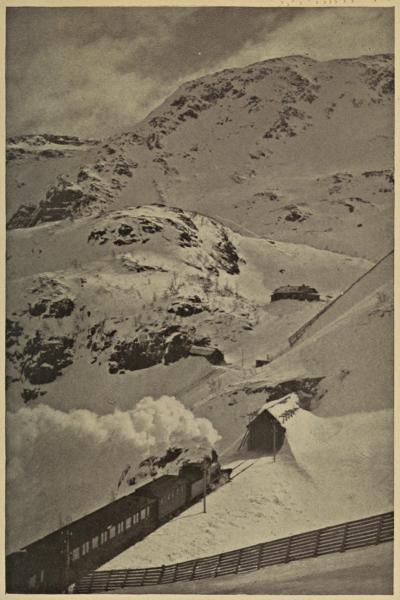
The Railroad between Bergen and Christiania.
Carl Johan’s Gate, on which it is situated, is the most important street in the city, as it runs straight up to the royal palace. Not far from the palace are situated the National University, the National Theater, the Parliament or Storthing building, and various other public buildings very similar to those of any other European capital. The city has suffered so frequently from fire that it has given up the picturesque for the substantial. Among other buildings of particular interest to Americans is the headquarters of the Nobel Peace Commission.
There is only one place (outside of Fru Bye’s Hotel) in all Christiania where I felt I was truly in Norway rather than in any other European city. That was when I was in the presence of the famous Gogstad viking ship, which is placed in a shed back of the University. This ship was found near the entrance to the Christiania fjord, buried in blue clay, where it had lain for a thousand years or so, and it convinced me that the marvelous tales which the sagas relate are tales of actual heroes; for certainly the sagas did not invent this Gogstad ship. In the center is the Death Chamber, where the captain was buried in his beloved ship. Here one may see just how the viking made his marauding expeditions, how the oars were arranged sixteen on a side, how the square sail was attached by means of pulleys to a mast fastened in the center, and how the rudder was attached on the right side (whence “starboard” or steerboard). The whole ship is only about eighty feet long and sixteen feet wide, and how the ancients managed to navigate the North Sea and the Bay of Biscay and sail far around into the Mediterranean in such primitive craft I cannot understand.
In this old Gogstad ship were found the bones of a dozen horses, several dogs, and a peacock. The owners of these bones were to be the chieftain’s bodyguard during his voyage to the next world. Du Chaillu says of this ship:
“Very few things in the north have impressed me more than the sight of this weird mausoleum, the last resting place of a warrior, and as I gazed on its dark timber I could almost imagine that I could still see the gory traces of the struggle and the closing scene of burial when he was put in the mortuary chamber that had been made for him on board the craft he commanded.”
This same author has written a book of two volumes of some twelve hundred pages about the vikings, and since I saw the Gogstad ship I have been intensely interested in reading of their customs. Their Bible was a long poem called Hávámal, supposed to have been written by Odin himself, containing much worldly wisdom. Odin, it seems, was the precursor of Horace Fletcher as an advocate of “dietetic righteousness.” He says:
“A greedy man Unless he has sense Eats ill-health for himself; A foolish man’s belly Often causes laughter When he is among wise men. “Herds know When they shall go home And then walk off the grass; But an unwise man Never knows The measure of his stomach.”
The same god also poses as an authority on matters of the heart. He says:
“The words of a maiden Or the talk of a woman Should no man trust; For their hearts were shaped On a whirling wheel, And fickleness laid in their breasts.”
Many epigrammatic gems of wisdom the poet utters, under the name of Odin. Most of them have rather a cynical turn, such as the following:
“A day should be praised at night; A woman when she is burnt; A sword when tried; A maiden when she is married; Ice when crossed; Ale when drank.”
Many other quotations from the old Norse writers are extremely entertaining. The first item in the Earlier Frostathing’s Law, Section I, Article I, begins in a very practical way with the following words:
“Every child which is born into this world shall be raised, baptized, and carried to the church, except that only—whose heels are in the place of his toes, whose chin is between his shoulders, the neck on his breast with the calves on his legs turning forward, his eyes on the back of his head, and seal’s fins or a dog’s head.—It shall be buried in the churchyard and its soul shall be prayed for as well as is possible.”
Apparently there used to be considerable doubt whether a deformed child could be legitimately an object for prayer, but nevertheless the experiment was to be tried.
The Norwegians are great advertisers. I have never seen in any other country such a complete utilization of every inch of available space. Inside the electric cars layers of “ads,” three deep, line the car above the windows. A clock in the middle of the car is surrounded by them; the electric lights and windows have advertisements wrought into their very being. Every available inch and much that we should not consider available is used to instruct the passenger as to his needs, which range from insurance companies and banks all the way through cash registers and skates and lamp chimneys to bananas and margarine and Mellin’s Food.
The one thing which it is difficult to get in Christiania is liquor—not that I have personally tried to get any, but I have learned through my oft-quoted British author that he found it very difficult. He was considerably annoyed at finding himself unable to buy whisky anywhere in Christiania from 1 P.M. on Saturday until Monday morning. The liquor laws of Norway are very strict indeed, and cause annoyance to many tourists, who find themselves deprived of their “nip.” However, I hope they remember that these laws, which have been enacted in the last thirty or forty years, have, in a great degree, reduced drunkenness, poverty, crime, and disease. It would seem that a tourist who has a spark of unselfishness in him, however much he may long for his cocktail, would not grudge Norway the laws that have proved such a blessing to the whole country.
Besides forbidding the sale of liquor on Sundays and holidays, and on the eve of festivals, many districts, under government permission, have absolutely prohibited it. There is not a saloon in Norway, but in the larger towns a few of the hotels and restaurants are allowed to sell liquor under certain restrictions. All profits from its sale, with the exception of the company’s expenses and five per cent interest, must be devoted to public and philanthropic purposes. Consequently the trade does not offer great inducements to ambitious merchants.
My train has already passed Voss and is rapidly nearing old Hanseatic Bergen, and I have not even begun to tell you of the glories of this day’s ride. We left Christiania soon after daylight, and in a little less than three hours reached the town of Hönefos, which is one of the centers of the Norwegian wood-pulp industry. There is a great mill here which receives trees in its capacious maw and turns them out again in the form of pulp. Gigantic letters on the side of a barn announce that from here comes the pulp which eventually is made into Lloyd’s Weekly and the London Daily Chronicle.
A little farther on we catch a glimpse of some lofty pine forests which inevitably bring to mind Milton’s lines:
“His spear, to equal which the tallest pine Grown on Norwegian hills, to be the mast Of some great admiral, were but a wand, He walked with.”
Soon after leaving Hönefos, we begin to climb and leave the tall, Norwegian pine and even the scrubby, Norwegian birch far below. This is the only regular railway in Europe which travels above the tree line. To get beyond the tree line in Switzerland, the railway would have to reach an altitude of at least seven thousand feet, but here of course the line is much lower. The resort of Finse has not a single wild tree to its name, though it is only four thousand feet above sea level. Finse is the most unique sporting center in the world, for its winter season lasts from August 1 to July 31, inclusive. Every year there is held a Midsummer Skiing Contest, which attracts people from all over Europe. Here one may ski at midnight by daylight on soft, feathery snow. Of course it is too far south to afford a midnight sun, but it is not too far south to afford midnight daylight.
To-day our train started out in a light rain, ran through a terrific blizzard, and into a bright, sunlit afternoon. I have never seen such concentrated essence of winter as I saw at Finse. The snow must have been four or five feet deep on the average, and in drifts it was ten or twelve feet deep. Finse’s freight house was buried; a big white mound showed where it ought to be, and where it might some day appear if the sun, by its heat, or men, by their shovels, ever attained energy enough to remove the white shroud. Giant snow plows kept the track clear, and our train ignored the blizzard. We “skirted” several invisible valleys, absolutely shut out by the driving snow, and, as Baedeker would say, “threaded” several tunnels, and to my infinite surprise emerged from one of them into a bright, sunny afternoon at Myrdal. We had passed the highest point of the line and had left our blizzard on the other side of the watershed.
From Myrdal I could look far, far down the Flaam Valley, which is one of the finest in Norway. Here and there, clinging to the rocky sides of the valley, were sæter huts. It would be easy enough for one of the milkmaids to “fall out of her sæter,” as the peasant of Mark Twain fame once “fell out of his farm.”
Whenever I think of a sæter, my mind invariably jumps to the romantic figure of Norway’s greatest violinist, Ole Bull. Are you acquainted with a plaintive Norwegian air called Sæterjentens Söndag? You must have heard it, even though you may not recognize it by name. Well, that was written by the great Ole Bull, and it is unquestionably the most familiar and the most beloved of Norway’s national melodies. Ole Bull was born at Bergen, so I am less than a half-hour’s journey from the place which this musician, whose tones thrilled all Europe and America, called home.
He is not the only musician who achieved world-wide fame, with Norway as a starting point. Every one who loves music knows Grieg’s famous Peer Gynt Suite, with its Anitra’s Dance, which seems to reflect the wild, free spirit of the north. Nordraak and Kjerulf and many other lesser musical lights have made all the world familiar with the music of the northland.
I must “pack up” now, as we are fast nearing Bergen. I shall be in an atmosphere there almost as historical as that of Trondhjem, so if some history creeps into my next letter I hope you will forgive me. I shall write you soon from there.
As ever yours,
Aylmer.
NINTH LETTER
Bergen, a Hanseatic city; an interesting museum; “Little Sir Alf”; the greatest military genius Norway ever had; the struggle between “Birchlegs” and “Baglers”; further historical connections of Bergen; Haakon Haakonsson.
Bergen, May 1.
My dear Judicia,
I am comfortably situated in Hotel Norge, on Ole-Bulls-Plads. Directly beneath my window stands Ole Bull himself, continually though silently playing his violin, through rain and hail and snow and vapor and stormy wind. Bergen is a thoroughly old-world city. To be sure, it has a modern section, but the whole flavor of the place is ancient. Like all other towns in Norway, it has suffered time after time from fire, but, strangely enough, it has been built up on the old lines. Another thing that lends a flavor of antiquity is the fact that it is surrounded (supposedly) by seven hills, like the seven hills of Rome, though it is an unfortunate geographical fact that there are not seven but four in the case of Bergen. Of course there are countless little unevennesses in the ground, some of which might even be called hillocks. With more romance than accuracy the citizens have selected three of these mounds, added them to their four real hills, and put seven on their armorial bearings.
There is a wide street, which assumes the proportions and name of a square, which separates the old town from the new and also serves in the capacity of fire road. When we cross this square, which bears the name of Torv-Almenning, we are in fairyland—a dirty, medieval, Hanseatic fairyland. The streets are very narrow, and the white timber houses with their red-tiled roofs certainly lay claim, along with the Lofoten Islands and the Damascus rag fair and the Nile dahabiyeh, to the right of being called picturesque. The vaagen, or harbor, is inclosed on all sides by ancient warehouses, suggesting fish. At the end of the harbor is a market, where fish are sold with considerable bargaining.
A great part of Norway’s fish trade passes through Bergen, though the principal reason for this seems to lie in the fact that it always has been so. Formerly it was compulsory. The German merchants settled in Bergen and succeeded in gaining an absolute monopoly on the trade, which they maintained for nearly three centuries. At one end of the market lies the Hanseatic House, now made into a museum. It is the only genuine house of its kind now in existence, anywhere, and gives a good idea of the manner in which these selfish old merchants conducted their business. Here we find the merchant’s office and his manager’s bureau, the clerk’s apartments, and even the common bedroom. An old ledger is exhibited, which, as Goodman says, “contains, no doubt, the record of many a fraudulent transaction.” The whole house, inside and out, is profusely ornamented and painted in lurid colors, which make not the slightest pretense of harmonizing. All sorts of articles are exhibited, which formerly made up the merchant’s office and household property, “such as their scales and weights, the latter [here a little sidelight on Hanseatic methods] being of two sorts, for buying and selling; their cloaks, lanterns, candlesticks, fire engines, snuff boxes, washing bowls, drinking cups and tankards, machines for chopping cabbage, and staves with bags for making collections in church.”
The arms of the leaguers were half an eagle and half a codfish, or a cornucopia with a cod supplanting the usual fruit or flowers.
The merchants trusted each other no more than they trusted outsiders, and their strong-box is fitted with three locks, the keys to which were possessed by three different members of the league.
These “crooks” were very modest about some things. Their bedrooms were arranged in a peculiar way, with the beds along the side of the wall, each bed opening out through a sort of lattice work to a main corridor. This was to enable the female domestic to make the gentleman’s bed without having to enter his room.
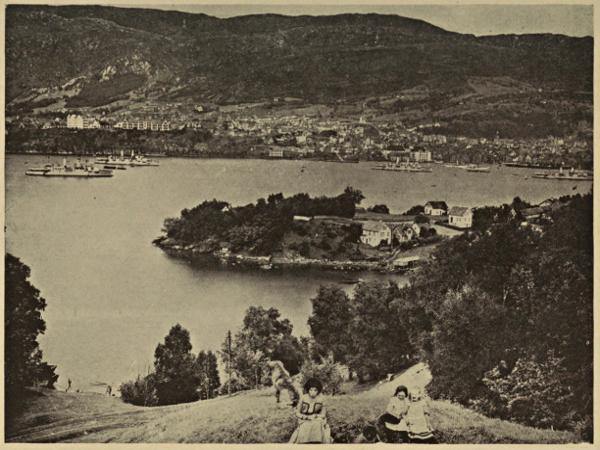
Copyright by Underwood & Underwood, N. Y.
Bergen, Northeast from Laksevaag.
The German merchants of the league grew more insolent as they grew more powerful, and they used to swagger around the quays, beating and bullying the native Norwegians who chanced to be in their way. It is with peculiar delight that I read of a trick played on them by the notorious pirate, the Norwegian Baron Alf Erlingsson, called “Little Sir Alf.” He was as bold in spirit as he was diminutive in stature, and he became a constant terror to the Hanseatic merchants, because of the depredations he committed upon them. They tried by every means in their power to get him into their hands, but he always outwitted them. As Boyesen says: “It was of no use that the league sent out ships of war to capture him; he outmaneuvered them, deceived them, sent them on a wild-goose chase, and ended by capturing his would-be captors.”
As a final, crowning insult, he one day appeared incognito in an open boat and bargained with them about the price set upon his head. It is a sad fact that later the little pirate’s luck deserted him. He was captured and brought before Queen Agnes of Denmark. On his arrival before this lady, she twitted him mercilessly about his size. He blazed out in return that she would never live to see the day when she could bear such a son, at which the queen furiously ordered him to be put to death by way of the rack and wheel.
There is an old cathedral here, which the Bergeners proudly point out as the home of the Reformation when it first reached Norway. Perhaps you might not think this anything to be very proud of, in view of what I told you in one of my other letters about the introduction of the Reformation from Denmark. But Bergen does have a right to be proud, for it was here that Bishop Gjeble Pedersson lived and finally succeeded in educating a good, native Norwegian clergy, which gradually supplanted the abominable class Denmark sent.
Denmark’s treatment of Norway in matters of religion was only a sample of her treatment of Norway in all matters. King Christian I wished to arrange a marriage between James III of Scotland and his daughter Margaret, but, as he did not happen to have sufficient money in his exchequer to supply the customary dowry, he promptly pawned the Orkneys for fifty thousand gulden, and the Shetland Isles for an additional sum. Thus poor, downtrodden Norway lost her island possessions, which she had colonized and held for ages. It was a cruel blow, and the land mourned as for the loss of her own children.
To the northwest of Bergen is an interesting tower called Sverresborg, named for Sverre Sigurdsson, the most romantic figure in all Norwegian history, and certainly the country’s greatest king, from the point of view of pure genius. For thirty years, at the end of the twelfth century, the history of Norway is the history of Sverre. Bergen is more closely associated with him than any other town in Norway, for it was here that the “Birchlegs” and the “Baglers,” with whom he was so closely identified, fought for a whole summer.
Sverre was born in the Faroe Isles at a time when Norway was absorbed, as usual, in a red-hot dispute over the succession to the throne. Sverre’s father had been King Sigurd Mouth, and his mother, whose name was Gunhild, had been cook in the king’s service, if the saga is true. At any rate, she was a very sharp-witted woman, and kept his royal parentage secret from every one, even from the boy himself. Magnus Erligsson occupied the throne of Norway and made every effort to exterminate the race of Sigurd Mouth. He heard that there was an illegitimate son of old Sigurd in the Faroes, and he sent a spy named Unas to kill the child. Gunhild cleverly averted this danger by inducing Unas to marry her and become the child’s stepfather. She was in the service of Bishop Matthias as a milkmaid, and she brought up her son with the idea that he should become a priest.
It so happened that when Sverre was a young man there was in Norway a pretender named Eystein Little-Girl. He certainly did not earn his nickname through his shyness in pushing his claims. He organized a small rebel band of brave outlaws and robbers, who succeeded in having him proclaimed king. Soon after, however, Eystein Little-Girl was killed, and his miserable band of supporters, who had come to be called “Birchlegs,” because of their dilapidated appearance and their birch-bark shoes, seemed destined to pass out of existence. They sought a new leader, and at this point Sverre appeared on the scene. They invited him to become their leader, and he accepted.
With this ragged little band of outlaws, numbering less than a hundred, Sverre set out to gain the throne of Norway, and in the end he succeeded. For long he roamed about, like Robin Hood with his merry men. He would “drop in” on a country festival and scare the people so that they fled, whereupon he and his merry men would sit down to a comfortable banquet.
However, this was more by way of a practical joke, enforced by hunger, than by any real cruelty, for Sverre was by nature extremely merciful. On one occasion, when he and his Birchlegs were crossing a mountain lake on rafts, he himself started out on the last one, but when he was some distance from shore a poor comrade, who was nearly dead and was being left behind, called piteously to be taken along. Although every raft was crowded to its utmost capacity, Sverre went back and got the dying man. The raft was so overloaded that he now had to stand up to his knees in icy water, but he did finally reach the other shore. It is reported that when Sverre’s foot left the raft (he was the last man to disembark), it sank out of sight. His followers regarded this as a miracle, and it filled them with hope.
Amid incredible hardships he fought his way to the throne, and he became so formidable that nurses throughout all Norway used to scare bad boys by saying that Sverre would catch them if they didn’t watch out.
In 1195 the Byzantine Emperor Alexius had a quarrel on his hands and sent an ambassador, Reidar, to collect from Norway two hundred mercenaries. Reidar collected his force and was prepared to return, when Bishop Nicholas, who hated Sverre with almost insane malignity, persuaded him to turn his attention to the task of wiping out the powerful Birchlegs. Accordingly these two hundred mercenaries were formed into the famous band called “Baglers” (crookmen, from bagall, a bishop’s crook or staff). The historic war between the Baglers and the Birchlegs centered around Bergen.
I climbed Flöifjeldet the other day, one of Bergen’s four real hills, and as I looked down on the city I could seem to see the whole struggle between Birchlegs and Baglers. But that was not the only famous struggle which took place in Bergen, and Sverre’s is not the only great name closely associated with it. Here, in Christ Church, Haakon Haakonsson was crowned on St. Olaf’s Day, July 29, 1247. On this occasion a continuous banquet was held for three days, for which function a huge boathouse was “commandeered,” as the palace was not large enough for the guests. It was the most splendid feast that had ever been held in Norway, and after the banquet a five-day fête was held in honor of the cardinal. At this fête Ordeals were forever abolished, on the very excellent ground that “it was not seemly for Christian men to challenge God to give his verdict in human affairs.”
Another reform was introduced, excluding from the royal succession all illegitimate sons—in the future. In putting forward this reform, Haakon Haakonsson must have made an effort to forget that he himself was an illegitimate son of King Haakon Sverresson.
His father, who was a son of the great Sverre, as his name indicates, had been foully murdered by his stepmother, the dowager queen Margaret. This dowager queen had stolen away Christina, Sverresson’s half-sister. As Sverresson was her legal protector, he tried in every way to get her back. Argument and pleading proving vain, he resorted to stratagem. He sent his cousin, Peter Steyper, who “burst into the princess’ room while her mother was taking a bath, crying at the top of his voice that the Baglers had come to town.” Christina was terrified, but Steyper told her not to fear, as he would save her. He took her in his arms and fled to the wharves, where he hustled her aboard his ship. The dowager queen soon discovered the trick and dashed down to the water’s edge in the most scandalous décolleté. She reached it just as the ship pulled off and for a long time vainly screamed curses after it. However, she took a glorious revenge by inviting her stepson to a banquet of peace and there poisoning him.
Interesting as is the history of Norway, it is to say the least “strenuous,” and it is rather a relief if you have been on Flöifjeldet, dreaming of Sverre and Haakonsson, to come down into Bergen’s quiet, old-fashioned market, where there are no Birchlegs and no Baglers now. The name “Bergen,” or Björgvin, means “pasture on the mountains,” and seems to suggest a restfulness with which history has not always favored the city. Many of the fisherwomen, or fiskerpiger, in the market place are gayly dressed in some of the varied forms of the national costume. However, I understand that the costumes are so much gayer and more conspicuous in the Hardanger and Sætersdal regions that I think I will wait until I get there before I tell you about them. I have not yet seen any of the well-known fjords, though I doubt if there is anything much finer in that line than the Ofotenfjord at Narvik.
I do not know when or from where I shall write to you again, but it will be from somewhere among the fjords, as no one could really feel the full spell of Norway, I suppose, without exploring the famous Hardanger and Sogne and some of the others. Another place which I want surely to see before I leave Norway is the famous Sætersdal in the south. It is here I understand that one may find the past par excellence—not history, for Sætersdal is not a particularly historic region, but the customs and manners and dress and general characteristics of the Norwegians of a few centuries back.
It may be some time before I shall write again, as there is much to see and much to explore. In the mean-time please prepare yourself to chalk up many points for Norway, for its fjords and its dals, as you know, are among its chief claims to distinction.
Yours as ever,
Aylmer.
TENTH LETTER
Norwegian fjord scenery; the “Seven Sisters” and “Pulpit Rock”; a comparison of the Sogne and Hardanger type of beauty; a drowned village; the cliff, Hornelen; the “City of Roses”; Björnstjerne Björnson; over the Romsdal-Gudbrandsdal route by carriole; an atmospheric kaleidoscope; the land of the “fos”; some Norwegian characteristics illustrated by the “skydsgut”; the “sæter” huts on the “fjeld”; Norwegian fauna; the terror of a lemming raid; “into the valley of death rode the six hundred”; a strange shipwreck; the giants of the Sogne; Balholm and Longfellow; Leif Eriksson; “The Skeleton in Armor.”
Marok, Geiranger Fjord, June 27.
My dear Judicia,
Have you ever seen the ocean so still that there was not a single, tiniest wind-made ripple on it; when a rowboat left a broadening wake a quarter of a mile long, and when the circling sea gulls could signal to their images beneath? If not, I wish you could transport yourself by telegraph here to Marok. Here in this quiet, mountain-guarded Geiranger Fjord, eighty miles or so from the open sea, it is even calmer than the proverbial mill pond. It is not the stagnant calm of the mill pond either, suggesting green slime and malarial gases, but a clear, fresh, healthy calm, suggesting only peace and shelter from the elements. Probably the fjord’s surface will not long be left unmolested. Soon a breeze will come creeping around the turn of the Sunelvsfjord, or down the dal, from the frozen Lake Djupvand.
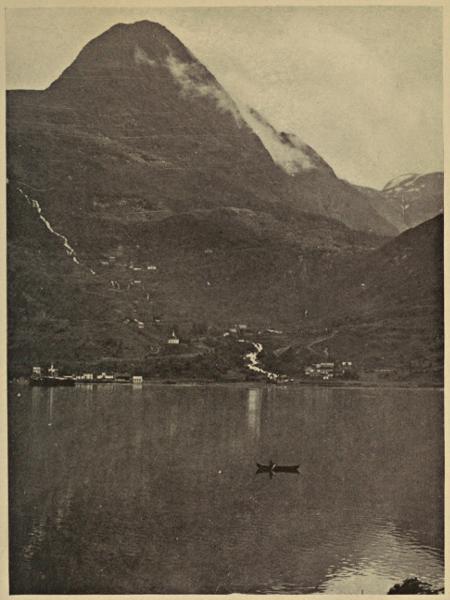
Copyright by Underwood & Underwood, N. Y.
Across the Glassy Geirangerfjord.
My purpose in this letter, Judicia, is not to take you on the “best trip in Norway,” or indeed on any trip. Countless trips have been carefully planned and then as carefully written up for the assistance of future travelers and for the benefit of tourist agencies. I shall simply take you as though you were a chessman and put you on whatever spot I choose. I hope you will not rebel at such autocratic treatment, for I shall try to make the best moves I can. If you suddenly find yourself moved from one fjord or dal to another without the assistance of steamer or train or Norges Communicationer, or anything but pure imagination, I hope you will accept the move in good faith. You know it’s yours as a reader not to question why, yours not to make reply, etc. I hope the places I describe will be their own reply.
Geiranger (please consult a map if you would know where it is) is probably oftener described and more praised than almost any other fjord in Norway, though it seems to me absolutely impossible to pick out any single fjord for first prize. Perhaps Geiranger would not receive so much attention were it not for its famous “Seven Sisters” and “Pulpit Rock.” The Seven Sisters are seven branches of a waterfall which drops hundreds of feet sheer into the fjord. As was the case with Bergen and its hills, it is an unfortunate, prosy, geographical fact that there are only four real branches to the waterfall; but three little wisps of spray up at the top separate slightly and give a somewhat plausible pretext for the name. Directly opposite the Seven Sisters is a projecting rock of most striking appearance, which would make an excellent pulpit if the preacher desired to address a vast audience of screaming sea gulls, but the pulpit is so high in air and so inaccessible that any other audience would be impossible.
There is one house which occupies a nook on the side of one of these lofty cliffs in Geiranger Fjord in such an inaccessible spot that formerly the only method of reaching it was by a rope, lowered by a member of the household. More recently, however, a flight of steps has been cut in the rock. It is often said that at some of these little houses the children are tethered, in order to prevent their falling down into the fjord.
Before I go any farther, Judicia, I must tell you something about the Norwegian fjords in general. Like so many other portions of the globe, Norway traces its peculiar formation to the grinding, irresistible glaciers of the ice age. While the actual coast line of Norway is about seventeen hundred miles, the distance is increased to twelve thousand if all the indentations are added, so that the fjords alone have a coast line which would stretch nearly halfway around the world. Also some of them are very deep, the Sogne showing a depth of nearly a mile in some places far inland. There are several fjords which stand out with particular prominence, not that they are necessarily finer than others, but because they are more accessible. The most southerly fjord to achieve fame is the Hardanger; then, going north, the Sogne, the Nord, the Hjörund, the Geiranger, and the Molde. One author, who signs himself O. W. F., thus vividly contrasts the great Hardanger and Sogne: “… whereas the mountains of the Sognefjord are knit together in mighty knots, those of Hardanger shoot in straight, slim peaks from the bottom of the fjord, higher and higher, until at last they end in glittering glaciers. Whereas the Sognefjord is wild, Hardanger is deep blue and tranquil.”
But the Nordfjord is not like either. The mountains do not rise continuously to a lofty tableland, but at intervals, in sharp, isolated peaks. No fjord is quite like another, and I cannot sympathize with the tourists who complain that Norwegian scenery, even in its grandeur, is monotonous. Of course to some unfortunate traveler who craves some new excitement every day Norway may be a dull country after he has once seen two or three of the fjords. They will all look alike to him, and some of these calm retreats like Marok will be unendurable.
Marok is a center for some of the most delightful excursions in Norway. A fifteen-mile boat ride and then a fifteen-mile drive to Oie will take you through one of the most varied and beautiful scenes that the imagination can picture. It is inspiring, no less in the mountain walls that rise on the Geiranger than in the smiling, sunlit Norangdal, which leads from Hellesylt to Oie.
Midway in this Norangdal a landslip occurred in 1908. It carried away a part of the road and formed a new lake by damming up the river. When the water of this new-born lake is clear, the roofs of the submerged houses of the old village may be plainly seen. There is something uncanny in the thought that a skillful swimmer might dive far below the water’s surface and swim into the garret window of any one of these former habitations.
Another trip which Marok affords is up the valley to Grotlid, past the frozen Lake Djupvand; but still another valley, the Romsdal, which extends from Næs on the Molde Fjord to Domaas on the Dovre fjeld, and there connects with the Gudbrandsdal, leading down toward Christiania, affords such a wonderful trip that I think I must wait and tell you of that and not dull your appetite by describing inferior valleys.
But Marok needs no valleys to add to its attraction. The superb Geiranger is surely enough to bring it fame. At the opening of the long fjord, which changes its name every few miles and at its inmost extremity assumes the name Geiranger, is situated the town of Aalesund. It is a beautiful port, but its chief claim to distinction lies in the fact that it was once the home of Rolf the Walker, who, you remember, conquered Normandy and caused his proxy to kiss Charles the Simple’s foot so violently that he fell from his horse. In token of this conquest the town of Rouen has given to Aalesund a statue of Rolf.
A few miles north of Aalesund the steamers going to Molde pass a cliff called Hornelen, which towers three thousand feet in air. There is no cliff in Norway which can compare with it, and that is equivalent to saying that there is none in Europe. Formerly every tourist steamer which sailed by Hornelen fired a gun in order that the passengers might hear the echo, but this was done once too often, for on one occasion the concussion made by the firing of the gun loosened an immense amount of rock on the side of the cliff, and this came hurtling down, leaving a hole which can plainly be seen now.
Farther up the coast and not so very far from Trondhjem lies Molde, the “City of Roses.” You see, Portland, Oregon, does not have a monopoly of the name. Molde might equally well call itself the “City of Honeysuckles” or the “City of the Wild Cherry.” The town is at the head of the fjord which bears its name, and far in the distance we can just distinguish the Romsdalshorn, which we shall later see at closer range. Those skilled in mathematics say that forty-six peaks are visible from Molde, and even the mathematically untrained can count nearly that number. Prominent among the forty-six stand out King, Queen, and Bishop—you see, church and state are side by side.
The citizens of Molde are proud to relate that once the great Björnstjerne Björnson was a school teacher in their town. They may well be proud, for Björnson stands out as one of the most daring figures in Norway’s recent history. All Norwegians, and most other Europeans who take any interest in literature, are familiar with the fine, commanding face of Björnson, surrounded with its halo of white hair. No wonder he held his audiences in the hollow of his hand whenever he made public addresses. His oratory was not of the highest order, but his powerful personality compelled attention. Those who could not hear him speak can feel the thrill of his personality in his poems and stories. Some of his peasant tales, such as A Happy Boy and The Fisher Maiden, are considered the finest of their type in all literature. He wrote his first verses when he was ten years old and his genius in this line culminated in his ode called Bergliot. He was always emotional, often fiery, and generally radical in his views, so much so that his figure and his writings became the center of a whirlwind of controversy. He wrote several national dramas, such as Between the Battles and Lame Hulda, but later his genius took such a radical turn that he had the greatest difficulty in getting any manager to stage his plays. His symbolical play, Beyond Our Powers, dealing with religious themes, was either violently criticised or as violently praised, according to the personal feelings of the critic, and another, called In God’s Way, caused even more heated discussion.
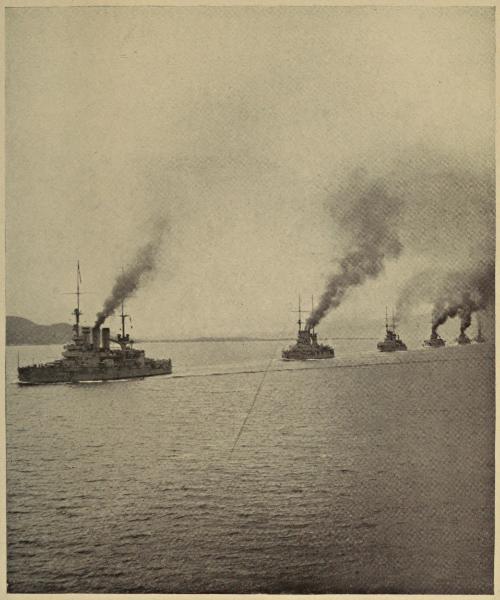
Copyright by Underwood & Underwood, N. Y.
German Battleships in Norwegian Waters.
Björnson seems not to have cared how much discussion or opposition he aroused, though he never tried to arouse it simply for the sake of publicity. He was daring and defiant, and cared not a snap of his finger what this or that critic said of him. Toward the end of his life he turned more to short stories, and in all of these the violent, startling, emotional element was never lacking. In the end he won the highest literary honor by receiving in 1903 the Nobel Literary Prize. Strangely enough this apostle of radicalism preached conciliation with Sweden during the crisis of 1905, and later he went so far as to advocate Pan-Germanism, the uniting of all the peoples of Germanic origin into a single nation.
There is no more interesting character in all the north than Björnson, unless it be his compatriot, Ole Bull. He could never be called “safe.” But in spite of his occasional wildness, he is recognized by all his people as a great reformer, and Molde is justly proud of its former school teacher.
I have rambled on a long time about Björnson. Interesting as fjord and fjeld and dal are in themselves, they always seem to me more interesting when enhanced by memories of some striking character with whom they are associated. Therefore, I hope you will forgive my frequent rambles.
At the end of the long Molde Fjord is the little village of Næs, the starting point for the Romsdal-Gudbrandsdal route. No one who is not a stick or a lump of rock can take this trip without feeling his emotions stirred to their very foundations. There are few places in the world where nature has so unsparingly lavished her art as here. As if the diversity of the scenes were not enough in itself to hold our attention, nature provides an infinite variety of lighting effects. Fleecy clouds play about the mountain tops and then give way to full sunlight. A fog rolls up and curls around the Romsdalshorn, soon to dissolve into nothingness. A heavy curtain of clouds appears most unexpectedly, and the wildest thunder pounds and rolls and crackles through the valley to the accompaniment of pattering hail. We have hardly found shelter when all is over. The sun seems to shine twice as brightly as before, and a few discontented mutterings in the distance show whither the storm is retreating. All this in itself would be inspiring, yet the scenery needs no assistance in producing a feeling of reverence and awe.
On one side of the road towers the mountain pyramid called Romsdalshorn, beside which the poor little attempts of Cheops in Egypt would look pathetic. Opposite to the Romsdalshorn the “Witches’ Pinnacles” and the “Bridal Procession” carry on their little pantomime through endless ages. Formerly it was supposed to be a great feat to climb the Romsdalshorn, but it has now been done so many times that the glamor of the achievement has worn off. The whole route up the Romsdal is lined at this time of year with imposing waterfalls. A waterfall in Norway is called a fos, and on this route, as on so many others in Norway, it is practically impossible to get out of sight of at least one tumbling fos. The three in Romsdal which excite the most interest are Mongefos, Værmofos, and Slettafos. The latter produces a roar which can be heard a great distance away, but the finest looking of the three is Værmofos. It makes one great leap of seven hundred feet and then is divided by a projecting rock into three separate falls, which leap another three hundred feet. But the Værmofos is only one of thousands and thousands, which leap or tumble helter-skelter into valleys and fjords all through the land. One writer says: “To enumerate the waterfalls of Romsdal would be rather a serious task. There are a dozen or two that would support half a dozen hotels, and be perpetually sketched, photographed, and stereoscoped if they were anywhere up the Rhine.”
The road winds in sharp zigzags or wide curves ever higher and higher, with the Rauma surging along below in its rock-bound gulley until we reach Domaas at the top of the pass.
I should have told you before something about our method of locomotion. So much travel in Norway must be done by road (railway mileage is the least in proportion to the extent of territory of any country in Europe) that posting has been developed to a high degree, and certain peculiarly national conveyances have come into being. The most distinctive of these is the carriole, a very diminutive, two-wheeled gig, which accommodates but one person beside the driver, who sits up behind. Even this one person must place his feet in stirrups outside the wagon and below its floor. If he tries to keep his feet inside the wagon he will find himself cramped into a bowknot. Your driver, who is known as skydsgut (pronounced shusgut), is generally a peasant boy. In many respects he is like peasant boys of other countries, but he is sure to possess the quality of absolute honesty. If you give him too much money by mistake, he will return your change. You cannot cheat yourself if you will. There is one other characteristic which your skydsgut will possess, if he is at all a normal Norwegian; that is a stolid sort of courtesy, which cannot be bullied into doing anything for you, but will invariably do the utmost if politely requested. Demand your carriole rather peremptorily and a little harshly, and you will get no answer—neither will you get your carriole. Tell your skydsgut that you are in a hurry to get started and would appreciate it if he could bring the carriole immediately. Before you have finished speaking he is off, and with all possible speed he brings you the carriole. The normal Norwegian simply cannot resist a polite appeal to his sympathy or courtesy. No more can he refrain from resisting to the finish an attitude of overbearing peremptoriness.
From the town of Domaas we must take a side excursion up into the Dovre Mountains or fjeld. The fjeld is generally a wild, rough, mountain wilderness, implying snow fields. It is the paradise of the solitude seeker, unless it be robbed of its quietude by the ubiquitous huntsman. Here we find the sæter huts in all their primitive, old-world charm. For centuries these sæter huts have existed just as they exist to-day. They are very rude affairs, being built only for summer occupation. Trunks of fir trees are fitted together, and the chinks are filled in with birch bark and sods. Generally a single room is used as sitting room, dining room, kitchen, bedroom, and dairy. This doesn’t sound particularly attractive for the ultimate consumer of the dairy products, but the dairying processes are really carried on in cleanly and sanitary fashion.
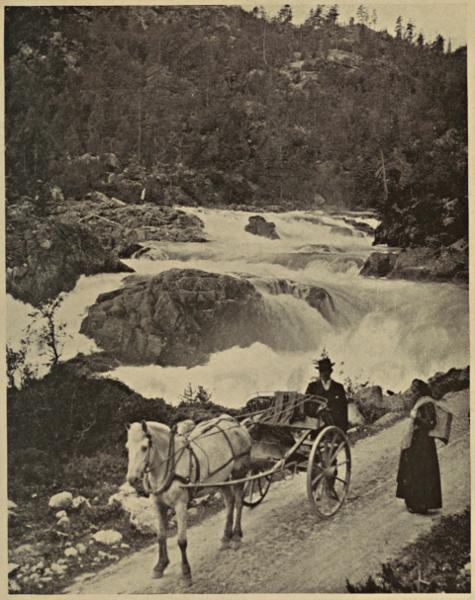
Copyright by Underwood & Underwood, N. Y.
A Stolkjaerre.
Into most of the accessible nooks of the fjeld the sportsman has found his way. Beasts of the field and birds of the air are still abundant in some places. Of this latter class there are found the more or less international grouse, woodcock, snipe, partridge, and golden plover. The Lapland bunting, the puffin, the kittiwake, and the capercaillie have a more northern sound, but I am not enough of a huntsman or a naturalist to know just where their habitat is.
Bears and wolves are still found in Norway and add a decided thrill to the life of the adventurous hunter. There is a single island off the mouth of the Trondhjem Fjord which has an almost complete monopoly of the red deer. For some strange reason the red deer has disappeared throughout the length and breadth of peninsular Norway, but still abounds on this island of Hitteren.
I confess, Judicia, that I have not shot or caught a single bird, beast, or fish during all these past months, but I have seen a good many of them, and I have been much interested in reading the accounts of those who are initiated. One sportsman has amused himself and others by making a collection of the names by which different groups of animals are designated in the sporting world. He does not confine himself to Norway, but goes far afield and finds no less than thirty-one different names, all meaning “group.” Besides the common and well-known designations, he speaks of a “nide” of pheasants, a “wisp” of snipe, a “muster” of peacocks, a “siege” of herons, a “cast” of hawks, a “pride” of lions, a “sleuth” of bears, and several others equally fantastic and unfamiliar.
The most peculiarly national animal in Norway, whether he is designated collectively as a “pride” or a “muster” or a “siege” or otherwise, is the lemming. The lemming is a fierce little brute, about the size of a rat, but when brought to bay he is a most dangerous enemy. Ordinarily he is a rather harmless, useless beast, but once in awhile he becomes a national scourge. Such occasions are called “Lemming Years.” For some unaccountable reason swarms of lemmings are born, and they come sweeping over Norway in great waves. For days a ceaseless army of them marches seaward, and nothing can stop them. They eat all that lies in their path, and leave a track of devastation behind them like a plundering army of soldiers. They look neither right nor left, but travel straight on until they reach the open sea. They plunge down the mountain sides into the fjords, blindly and madly, and are soon drowned. It would be well for Norway if they all reached the sea, but alas, thousands fall by the wayside. Wells are choked up with their bodies, and the water is poisoned, so that “lemming fever” is the inevitable sequel to a lemming raid. I believe there has not been a big raid since 1902, but every summer the farmers expect them again and are filled with dread.
Returning to Domaas, we jog along in our carriole down to Otta in the Gudbrandsdal. Between Domaas and Otta, at a place called Kringen, the road “runs like a narrow ribbon between the steep cliff on the one side and the foaming river on the other.” Here, in 1612, six hundred Scottish mercenaries, hired by Gustavus Adolphus, landed at what is now Næs and prepared to walk to Sweden by way of the Romsdal and Gudbrandsdal valleys. At Kringen the Norwegians collected big boulders at the top of the cliff. A peasant girl named Pillar Guri stood on the opposite side and blew a horn to let her compatriots know just when the Scottish soldiers were passing below. At the signal the fatal shower descended, and it is said that not one of the six hundred escaped. Truly “into the valley of death rode the six hundred.” A monument has been placed on the spot to commemorate the event.