Part Three CONCLUSION
Reading edition
I. FEDERAL CO-OPERATION AND ASSISTANCE RENDERED BY SENATORS OF THE UNITED STATES, REPRESENTATIVES IN CONGRESS AND OTHERS.
This record would be incomplete without reference to the active co-operation of the Government of the United States in authorizing formal invitations to be extended through the Department of State to the Republic of France and the Kingdom of Great Britain including the Dominion of Canada to be officially represented at the Tercentenary Celebration and in making ample appropriation for the entertainment of the foreign guests and of the President, Vice-President and other officials of the United States; and without formal acknowledgment in appreciation of the activities and assistance rendered by Vice-President James S. Sherman, whose grandfather was a navigator of Lake Champlain, and by the Senators of New York and Vermont and other states in the Senate of the United States and by the Representatives from those states in Congress. The New York and Vermont members of the Committee on Foreign Affairs, namely, Hon. James Breck Perkins, a writer on French history; Hon. David J. Foster, Hon. Jacob Sloat Fassett and Hon. Francis Burton Harrison, all forceful and influential Representatives, assisted by Hon. John J. Fitzgerald, Hon. Edward B. Vreeland, Hon. George R. Malby, Hon. James S. Sherman, Hon. Michael E. Driscoll, Hon. John W. Dwight, Hon. William H. Draper, Hon. George N. Southwick, Hon. William Sulzer, Hon. William S. Bennet, Hon. Jacob Van Vechten Olcott, Hon. Peter A. Porter, Hon. De Alva S. Alexander, and other Representatives of New York, and Hon. Kittredge Haskins of Vermont, were zealous in their support of the project from its inception. On February 16, 1909, Representative Foster of Vermont from the Committee on Foreign Affairs reported the following Joint Resolution favorably to the House, viz.:
Joint resolution (H. J. Res. 257) to authorize the Secretary of State to invite the Governments of France and Great Britain to participate in the proposed tercentenary celebration of the discovery of Lake Champlain by Samuel de Champlain.
Whereas, The States of New York and Vermont, by legislation and appropriation, have authorized the celebration of the three hundredth anniversary of the discovery of Lake Champlain by Samuel de Champlain; and
Whereas, The date of the said celebration has been fixed for the first week in July, 1909; Therefore be it
Resolved, etc., That the Secretary of State be, and he is hereby, authorized and requested to extend to the Governments of France and Great Britain an invitation to be present at and to participate in the proposed celebration during the first week of July, 1909, to commemorate the three hundredth anniversary of the discovery of Lake Champlain by Samuel de Champlain.
When said resolution was reached on the House Calendar on February 17th, Mr. Foster said:
Mr. Speaker, there is very little to be said by the way of explanation of this resolution. A very full report accompanies it explaining fully the significance of the proposed celebration. As indicated in the preamble, both the States of New York and Vermont have appropriated money for this celebration, which will occur during the first week of next July. While these two states have taken the initiative, the occasion will be one of national significance. We are already assured that the President of the United States will be present and participate in the exercises. And the occasion will be one of international importance. For this reason it is desired that authority be given the State Department to extend an invitation to the two nations most intimately associated with the United States in the historic event which this celebration will commemorate. It was a son of France who discovered the beautiful body of water that bears his name. Canada, that loyal dominion of Great Britain, borders upon the lake. It is peculiarly desirable, therefore, that an invitation be extended to the Governments of France and Great Britain to participate in the celebration.
The Joint Resolution after a brief discussion was thereupon unanimously passed.
The Report of the House Committee on Foreign Affairs was printed in full in the Congressional Record of March 3, 1909, in the form in which it was adopted and appears in the Appendix of this Report. (See Congressional Record 60th Congress, Second Session, pp. 2531, 2582 and 3770.)
Speaker Joseph G. Cannon, Representative James A. Tawney of Minnesota, Chairman of Committee on Appropriations and other members of the House from states not in direct touch with the undertaking gave it their support.
The Joint Resolution was favorably reported through Senator Henry Cabot Lodge from the Committee on Foreign Relations of the Senate on February 24, 1909, and on motion of Senator Chauncey M. Depew it was passed. (See Congressional Record 60th Congress, Second Session, p. 2987.)
Senator Thomas C. Platt of New York and Senators William P. Dillingham and Carroll S. Page of Vermont also gave this and other matters pertaining to the celebration such consideration as was necessary to ensure Federal co-operation. The Joint Resolution was approved by President Roosevelt on March 2, 1909. (See Congressional Record 60th Congress Second Session, p. 3666.)
In this connection it will be remembered that Senator Redfield Proctor of Vermont and the Honorable Elihu Root, while Secretary of State had presented the matter at a late day in a prior session of Congress and had in a measure prepared the way for favorable action in 1909. Senator Proctor took deep interest in the project, but to the great regret of his many friends he did not live to see it carried to completion. His death occurred in Washington, D. C., March 4, 1908.
His son, the Honorable Fletcher D. Proctor, while Governor of Vermont in 1906, had approved the original Concurrent Resolution, introduced in the House of Representatives of Vermont in November of that year by Hon. Robert W. McCuen of Vergennes, providing for the appointment of a Commission to confer with several Commissions to be appointed in New York and in Canada to arrange for a celebration of the Three Hundredth Anniversary of the Discovery of Lake Champlain.
From that time on Senator Redfield Proctor and Governor Fletcher D. Proctor of Vermont gave the matter their official and strong personal support as long as they lived.
Congressmen George R. Malby and David J. Foster were untiring in their efforts to insure Federal co-operation, as was Honorable Elihu Root, both as Secretary of State and as United States Senator, whose masterly address at Plattsburgh on July 7, 1909, is a contribution to the history of the Iroquois Confederacy.
The untimely deaths of Governor Fletcher D. Proctor, of Congressmen David J. Foster and George R. Malby before the Champlain memorials were dedicated and the work of the Commissions completed, to whose success they had all materially contributed, were deeply deplored. The loss of Professor Walter E. Howard of the Vermont Commission and of Assemblyman Alonson T. Dominy of New York Commission, both of whom were desirous of co-operation in the work of their respective Commissions, was keenly felt by their colleagues.
Senators John Raines and Thomas F. Grady of New York, who were majority and minority leaders of the Senate when the project was given legislative sanction, did not live to see the Champlain memorials constructed. Senator Patrick H. McCarren of Brooklyn, who assisted in interesting the Representatives in Congress from the City of New York in the celebration, did not live to participate in it himself.
All these friends of the project in its initial and later stages will be remembered for their interest in this historical commemorative celebration, the results of which have been felt in both hemispheres in strengthening the amicable relations existing between the three great nations participating in the international festivities. Its scope in a measure was outlined in the presentation of the matter to the Legislative Committees, making the original and second appropriation, over which Senators William W. Armstrong and Jotham P. Allds in the Senate and Hon. Edwin A. Merritt, Jr., in the Assembly, presided.
II. BRIEF REVIEW OF THE WORK OF THE COMMISSION AND ACKNOWLEDGMENTS IN APPRECIATION OF THE ASSISTANCE RENDERED BY THE REPRESENTATIVES OF FOREIGN NATIONS, MILITARY ORGANIZATIONS AND OTHERS.
An outline of the work of the Commission was embodied in the recommendations adopted at the conclusion of the investigation and deliberation of the Preliminary Commission, found at pages 21 to 40 of the First Report of this Commission. Some modifications in the original plan were found necessary as the preparation for the celebration took definite form, but in the main there was substantial adherence to the original recommendations of the Preliminary Commission as may be seen from an examination of the Tercentenary Exercises and the transactions of the Commission hereinbefore given in some detail which involved, in addition to the celebration, the construction of two memorials to Samuel Champlain in the Champlain valley. One of these was a joint memorial constructed by the Vermont and New York Commissions in co-operation from funds jointly contributed by the two Commissions. That is the Champlain memorial at Crown Point Forts. Without the friendly assistance and co-operation of the Vermont Tercentenary Commission in planning and in sharing the expense involved in the construction of the Crown Point memorial, it is not likely that two memorials would have been built. This Commission takes this occasion to make permanent record of the fact that the members of the Vermont Commission were quite as desirous of erecting a fitting memorial to Samuel Champlain as were the members of the New York Commission, notwithstanding the fact that it was apparent to them that the joint memorial was likely to be located within the confines of the State of New York, rather than in Vermont. Undoubtedly the character of the memorial in the form of a lighthouse and its location on a point projecting far into the waters of the lake where it may be seen quite as readily by the citizens of Vermont as by those of New York, had something to do in bringing about unanimity of sentiment in the action of the two Commissions in deciding to erect a joint memorial.
It is hoped that this memorial will stand for all time as a monument to the wisdom of the two Commissions in thus performing a public duty in the spirit of fairness to the people of both states and in grateful appreciation of the character and services to humanity of Samuel Champlain. It met with the hearty approval of the French delegation, who placed on it the Rodin bust, a work of art, selected by M. Hanotaux and others and purchased with funds contributed by His Excellency, Clément Armand Fallières, President of the Republic of France, M. Raymond Poincaré, President of the Council and Minister of Foreign Affairs, recently elected President of the Republic of France and many others, as the seal of the Republic of France. They spoke in commendation of its artistic proportions and of its unique symbolism of the diffusion of the light of civilization through the valley by Champlain and his followers, who sought to inculcate in the “untutored minds” of the savages in the region the humane principles and benign precepts of the Christian religion.
The Champlain Memorial Statue at Plattsburgh was erected by the New York Commission out of the funds appropriated solely by the Legislature of New York. It occupies a commanding position at the outlet of the Saranac river overlooking the lake. The bronze statue of Champlain, the crouching Indian at its base and the granite approach together constitute an unique memorial, artistic in outline and worthy the discoverer of the lake, which bears his name. This will stand comparison with any memorial of the kind in the country.
The Commission submits these two memorials to the considerate judgment of the people of the State in the confidence that they will meet with general approval.
The Commission has thus constructed two suitable permanent memorials to Samuel Champlain in the valley as it was authorized to do by Chapter 181 of the Laws of 1911. In this as in other matters the Commission has endeavored to carry out the spirit as well as the letter of the acts under which it performed its labors.
In addition to the building of the Champlain memorials, the Celebration with its varied literary, military and naval features was carried to a successful conclusion by the Lake Champlain Tercentenary Commissions of New York and Vermont with the co-operation of the Government of the United States and the attendance of the official representatives of France, Great Britain and Canada. The Dominion of Canada sent over the Governor-General’s Foot-Guards under Lieut. Colonel D. R. Street with twenty-two officers and three hundred and eleven enlisted men and also the Fifth Royal Canadian Highlanders under Lt. Colonel George S. Cantlie with twenty-eight officers and four hundred and thirty-eight men.
The participation of the Canadian troops in their brilliant uniforms in the Plattsburgh and Burlington parades on July 7 and 8, 1909, gave color to the marching columns and elicited the commendation of President Taft as well as of the French and British Ambassadors. It was a graceful compliment on the part of the Canadian Government to the people of the United States and gratefully appreciated by members of the Commission and others interested in the success of the celebration, to which this contributed not a little.
The presence of the French Ambassador, His Excellency, J. J. Jusserand, the British Ambassador, the Right Honorable James Bryce, the Postmaster-General of the Dominion of Canada, the Honorable Rodolphe Lemieux, the Premier of the Province of Quebec, Sir Lomer Gouin, the Lieut.-Governor of the Province of Quebec, Sir Adolphe Pelletier, the Vice-Admiral of the Japanese Navy, Baron Stakichi Uriu and others officially representing their respective Governments, gave it international significance, and the history of Lake Champlain in this and other ways has become a matter of interest to the people of other lands.
The participation of these distinguished representatives of France, Great Britain, Canada and Japan in the Tercentenary Exercises added dignity and stateliness to the public and social functions of the celebration, which was widely commended through the press of this and other countries and has since become known as one of the principal commemorative celebrations of the century.
The discriminating and brilliant addresses of the French Ambassador, well known as the author of “The Literary History of The English People” and of many other works, as well as for his celebrity as a great diplomat, were keenly appreciated and will be read by all interested in the tragic events occurring in the Champlain valley during the period of its French occupancy. His touching tribute to Marquis de Montcalm, his graceful expressions of the warmth of the friendship existing between the people of France and those of America and his profound appreciation of the generous impulses of the people of New York and Vermont in projecting and carrying to a successful conclusion this commemorative celebration, in which Samuel Champlain was the central figure, will long be remembered. His long residence at Washington as the Ambassador Extraordinary and Minister Plenipotentiary of the Republic of France, his deep interest in American institutions and in American history, and his wide and favorable acquaintance with the people of this country have ingratiated him in their affections, until they have become accustomed to look upon the distinguished French Ambassador as a member of the official circle of the nation.
The profound and illuminating addresses of the Rt. Hon. James Bryce, the British Ambassador Extraordinary and Minister Plenipotentiary, delivered by him at Ticonderoga, Plattsburgh and Burlington, were full of that ripe scholarship found in all his public papers and in such works as his “Holy Roman Empire,” “The American Commonwealth,” “Studies in History and Jurisprudence” and in his other treatises. They were overflowing with good will toward the people of this country who consider Ambassador Bryce as a staunch friend of American institutions, as evidenced in “The American Commonwealth” and in all his public addresses.
Rarely, if ever, have there been accredited to this country by foreign nations two Ambassadors at the same time possessing such rare literary and diplomatic qualities as Ambassadors Jusserand and Bryce, each of whom achieved distinction and has been honored in his own country.
The able and instructive addresses of Hon. Rodolphe Lemieux, Postmaster-General of Canada and Sir Lomer Gouin, Premier of the Province of Quebec, at Plattsburgh and Burlington were replete with historical suggestions touching the Champlain, St. Lawrence River and Great Lake regions and conveyed to the people south of the international boundary the good will of the people of Canada and their gratitude at the efforts being put forth to commemorate the life, the character and achievements of Samuel Champlain, who founded Quebec, the oldest city in the Dominion. There breathed through these the spirit of good will and genuine appreciation for what was being done in this celebration. The Canadian visitors created a most favorable impression and on their departure left many warm friends behind.
By a fortunate coincidence, Vice-Admiral of the Japanese Navy, Baron Stakichi Uriu, was visiting this country during the period of the Tercentenary Celebration and was one of the invited guests of the New York Commission. He spoke briefly at Ticonderoga and since his return to Japan has conveyed to the Commission his appreciation of the honor conferred upon him in being permitted to witness the Tercentenary Celebration and at receiving the official Report containing a record of it.
The addresses of these representatives of Foreign Governments were entertaining and valuable contributions to the Tercentenary Exercises, giving them an international character exponential of events to be commemorated in tracing the history of the discovery of the lake and the subsequent control of the territory by three successful sovereign nations.
The Commission takes this occasion to acknowledge its obligations in this respect to the distinguished visitors and Foreign Governments, which they severally represented, for their assistance and co-operation in giving the Tercentenary Celebration its international character and some of its most charming features.
We cannot close this report without again expressing our grateful appreciation to the people of France for their thoughtfulness and generosity in sending to this country a work of art by one of their most distinguished sculptors, to embellish the Memorial Lighthouse erected by the States of New York and Vermont to commemorate the life of Samuel Champlain. It was a delicate and beautiful expression of appreciation on the part of the leaders of thought and culture in our sister Republic across the sea to present a bust of such symbolism as “La France” as the seal of their approval of our efforts in this regard.
As far as we have been able to do so, we have preserved in this report the addresses of M. Hanotaux and others, as well as some of their reports on their return to Paris, embodying their views and expressing their feelings toward the people of this nation, which throw new light on the sympathetic character and generous impulses of the French people. The coming of a delegation of so many distinguished Frenchmen was a great compliment to the people of this nation. This in itself was a testimonial of good will, appreciated fully as keenly as the work of art. The people of the Champlain valley and elsewhere will not be likely to forget the fact that in addition to the distinguished line of great Frenchmen from Champlain to Ambassador Jusserand, who have visited the Champlain valley, there came to that valley in the month of May, 1912, a delegation of the most distinguished Frenchmen representing industry, commerce, science, literature and art, as well as civil and military affairs, jurisprudence, statesmanship and diplomacy, that ever visited this country. They came to place the seal of France upon the Crown Point Memorial Lighthouse to Samuel Champlain, and to convey to the people of this country the appreciation of the French Nation for what was being done to commemorate the life and character of one of their countrymen. The names of this delegation have already appeared, but let record be herein made of the fact that Fernand Cormon, member of the Institute and President of the Academy of Fine Arts, was one of the delegation that brought the Rodin allegorical bust from France and directed its location on the Champlain Memorial Lighthouse.
The President of the United States, William Howard Taft, Governor Charles E. Hughes, Governor George H. Prouty, Secretary of War Jacob M. Dickinson, Senator Elihu Root, Congressmen George R. Malby, David J. Foster, Frank Plumley and the other speakers, the poets and the clergymen who participated in the Celebration as well as Governor John A. Dix of New York and Governor John A. Mead of Vermont and other speakers and clergymen, who took part in the dedication of the two Champlain memorials, not only put the members of the two Champlain Commissions, but the people of the Champlain valley under obligations to them for their contributions to the excellence and high quality of the literary exercises.
Col. Calvin D. Cowles and staff of officers and the Fifth U. S. Infantry; Col. William Paulding and staff of officers and the Twenty-fourth U. S. Infantry; Captain William T. Littebrant and staff of officers and the Fifteenth U. S. Cavalry; Brigadier-General J. H. Lloyd and staff of officers of the Third Brigade of the National Guard, New York; Col. James W. Lester and staff of officers and enlisted men of the Second Regiment of the National Guard, New York; Col. John I. Pruyn and staff of officers and enlisted men of the Tenth Infantry of the National Guard, New York; and the Canadian Military Organizations heretofore referred to and the Flotilla, comprising the torpedo boat Manley and two steam cutters named Plattsburgh and Burlington, respectively, under command of Lieut. G. W. Steele, Jr., with Midshipman Gerard Bradford second in command, and L. O. Armstrong, with his company of 150 Indians, descendants of the tribes originally occupying the Champlain valley, were important factors in the military, naval and pageant features of the Tercentenary Celebration contributing materially to its success. The maneuvering of these troops in the Champlain valley was suggestive of the military expeditions and fierce engagements that characterized its history for nearly two hundred years after the discovery of the lake by Samuel Champlain.
This Commission takes this occasion to acknowledge its obligations in this direction to the commissioned and other officers and members of these various military organizations as well as to the Brigadier-General, Major-General and other officers and members of the National Guard of New York, who took part in the celebration and in the dedicatory ceremonies of the two memorials in July, 1912.
The Commission is also grateful to Hon. Robert Bacon, former Ambassador to France, to Paul Fuller, Jr., Secretary of Franco-American Committee, to Hon. Frank S. Witherbee, President and to the members of the Lake Champlain Association, to President John H. Finley of the College of the City of New York, to Hon. McDougall Hawkes, Chairman of the American Board of the French Institute in the United States, to Hon. Charles B. Alexander, to former Senator William A. Clark of New York, to Hon. A. Barton Hepburn, President of the Chamber of Commerce of the State of New York and to all others, who assisted in the entertainment of the French Delegation on their visit to this country in April-May, 1912.
Acknowledgment is also made of the entertainment of the members of the Preliminary Champlain Commission by the Hon. and Mrs. Nelson W. Fisk at their home at Isle La Motte on September 7, 1907, and of the transportation of the members of that Commission on the Valcour, owned by Hon. Joseph C. Sibley, to Burlington in the afternoon of that day, where they were entertained by the Ethan Allen Club in the evening. Representative Sibley also placed his yacht, Valcour, at the disposition of the Commission during the week of the Celebration.
It will also be remembered that Mr. and Mrs. Stephen H. P. Pell entertained President Taft and other distinguished guests at their home at Ticonderoga on July 6, 1909, and also the French delegation on May 3, 1912.
Commissioner and Mrs. Walter C. Witherbee entertained members of the Commission at their beautiful home at Port Henry on July 5, 1909.
Through the courtesy of Col. Robert M. Thompson, accommodations were provided by him for entertainment of members of the Commission at Ticonderoga on July 5 and 6, 1909.
Commissioner Howland Pell entertained the members of the Commission at his reconstructed Germain Redoubt at Ticonderoga on May 3, 1909.
Hon. John R. Myers of Rouse’s Point supervised the transportation of the participants in the Indian pageants during the celebration and in other ways aided the Commission in its labors.
Frank H. Severance, secretary of the Buffalo Historical Society, was secretary of the Preliminary Lake Champlain Commission and prepared two historical papers, which appeared in the First Report of this Commission. In these respects and otherwise he rendered important services to this Commission.
The Notes on the Archæology of the Champlain valley, contained in the Appendix of this volume, by Prof. George H. Perkins, Ph.D., state geologist of Vermont, is a valuable contribution to this Report and is gratefully appreciated by the members of this Commission.
The typographical excellence of the First Report of this Commission elicited general commendation and the State Printers, J. B. Lyon Company of Albany, New York, have spared no pains in the presswork of this Final Report to insure its general excellence.
The exhaustive analytical Index to the First Report and also that to the Final Report, prepared by Charles Alexander Nelson, A. M., will greatly facilitate their usefulness for historical and other purposes.
The members of the Commission were among the invited guests of the Hudson-Fulton Commission during that memorable celebration.
All these were gratefully appreciated as well as all other things done and courtesies shown to the Commission by the people of the Champlain valley in their enthusiastic support of the project of suitably celebrating the discovery of the lake.
In concluding their work, the Commissioners take this occasion to express their appreciation of the generous support and wide publicity given to the Tercentenary project by the Press of this Country and of Canada, which contributed much to the popular interest shown in this commemorative celebration.
III. HISTORICAL SIGNIFICANCE OF THE TERCENTENARY CELEBRATION
If the Tercentenary Celebration has awakened a deeper popular interest in the history of the Champlain valley, and as a result of that a broader and more profound appreciation of the principles of civil and religious liberty underlying our American institutions, and of the heroic sacrifices made by the founders of this government to insure its perpetuity, then the members of the Commission and the people of the state may feel well repaid for all efforts put forth in its prosecution.
In the various papers and addresses of the celebration frequent allusion was made to the important events occurring in the several epochs of the history of Lake Champlain, and many of these were elaborated upon at some length. It was not possible, however, to do more.
The critical history of the Champlain valley is yet to be written. For three centuries it has been the arena wherein have occurred many crucial events affecting the evolution and the character of American institutions.
Ira Allen in his “Natural and Political History of the State of Vermont,” Francis Parkman in his various historical works, Hon. Lucius E. Chittenden in his addresses and public papers, Peter S. Palmer in his “History of Lake Champlain,” and in his “History of the Battle of Valcour on Lake Champlain,” Winslow C. Watson in his “History of Essex County,” his “Pioneer History of the Champlain Valley” and his “Men and Times of the Revolution,” Thomas Hawley Canfield in his “Discovery, Navigation and Navigators of Lake Champlain,” Zadock Thompson in his histories of the State of Vermont and in his “Northern Guide,” Hiland Hall in his “History of Vermont,” Winslow C. Watson in his “Military and Political History of Essex County,” [N. Y.] in the “History of Essex County,” [N. Y.] by H. P. Smith, in the papers entitled “The First Battle of Lake Champlain,” by George F. Bixby, Rev. Joseph Cook in his “Historical Address at the Centennial Anniversary of the Settlement of Ticonderoga,” and in other addresses and writings, Walter H. Crockett in his “History of Lake Champlain,” and others, have given much of the history of the successive periods, although the works of some of these are necessarily too limited to include a complete history of the region in all its amplitude and in all its details.
In the papers and proceedings of the Vermont Historical Society, as well as in the “Documents Relative to the Colonial History of the State of New York” and the “Documentary History of the State of New York,” and in other transcripts of documents in foreign and American archives, and in the Military Records of the United States, France, Great Britain and Canada may be found much material relating to the history of Lake Champlain. There will be found in such libraries as the State Library at Albany, the State Library at Montpelier, the library of the Ticonderoga Historical Society, the libraries at Port Henry and at Plattsburgh, as well as in the library at Middlebury College and in the library of the University of Vermont, at Burlington, Vt., in the Collections of the New York State Historical Association, the New York, Massachusetts, Connecticut, Rhode Island and other State Historical Societies, and in the libraries of Ottawa, Montreal and Quebec, maps, charts, documents and other material relating to the region. The foreign material is confined principally to events occurring prior to 1783, except such British and Canadian documents as relate to the War of 1812.
The correspondence between the Colonial Governors and military and naval officers in America, including General Jeffrey Amherst and General John Burgoyne, with William Pitt and other representatives of the home government, throws much light on the events of the British period from 1758 to 1783. Other historical writings and standard histories may also be consulted with profit.
Since the conclusion of the War of 1812 the history of the Champlain valley has been that of a record of the settlement, the agricultural and mineral development of the territory bordering on the lake, and of an active transportation and commercial business done on the lake until the construction of railroads paralleling it on either side, which checked the volume of transportation by water as well as the active passenger service that had been done by steamers for three-quarters of a century. The completion of the barge canal between the Hudson and Lake Champlain may to some extent restore the volume of transportation on the lake.
From pre-historic times the Champlain valley has been one of the thoroughfares of successive nations occupying the region, inviting alike to discoverer, trader, pioneer, warrior and traveler. It was but natural that its circumjacent shores and beautiful islands should become the homes of sturdy men, breathing the ozone of the mountain air wafted down into the valley, and possessing an independence and resolution found in such men as the Allens, the Warrens, the Bakers, and the Chittendens. It was this spirit which moved Ira Allen to incorporate in the first constitution of Vermont, adopted July 2 to 8, 1777, a mandatory provision providing for a common school in each town, a grammar school in each county, and a university in the state, and afterward he gave all his property to found the University of Vermont.
The conditions obtaining in the Champlain valley during the Tercentenary Celebration were thus picturesquely but aptly described by Dr. Hamilton Wright Mabie, the Tercentenary orator at Ticonderoga, in the Outlook of July 31, 1909:
* * * Never were conditions more favorable for such a celebration as that planned in honor of Champlain’s discovery. Barring one day, the weather was perfect. Refreshing breezes swept through the gaps between the soft blue domes on either side of the lake, tempering the ardor of the sun’s rays, while the air was of that crystalline clarity, which exhilarates and draws from man involuntary exclamations of gladness for the fact of mere existence. Each day a pageant of great, snowy clouds swept across the deep blue sky, adding to the dreamy charm of the background of the celebration. The spectator’s manipulation of the pigments of language is not so perfect as was Turner’s of paints; but he wishes it were, in order that he might convey an impression of the changing lights and shadows and tints, which presented new combinations of color with every passing moment. From the moment the rays of the rising sun shot through the notches in the Green Mountains, informing the visitor that he or she must be up and doing if the event of the day was to be witnessed, until the golden afterglow had ceased to define the rounded heights of the Adirondacks and the amethystine tints of the mountain sides had deepened into the black shadow of night, each hour had a fresh temptation for the artist.
IV. REPRESENTATIVE MEN OF THE CHAMPLAIN REGION
Out from that valley have come a host of statesmen: Stephen A. Douglas, Samuel Prentice, Solomon Foote, Silas Wright, Samuel S. Phelps, Jacob Collamer, Robert S. Hale, William A. Wheeler, Chester A. Arthur, George F. Edmunds, John M. Thurston, born at Montpelier, August 21, 1847, and U. S. Senator from Nebraska, 1895 to 1901; Matthew H. Carpenter, born at Moretown, December 22, 1824, U. S. Senator from Wisconsin, 1869 to 1875, and from 1879 to February 25, 1881; Jacob M. Howard, born at Shaftsbury, July 10, 1805, representative in Congress from Michigan from 1841 to 1843 and U. S. Senator from 1862 to 1871; William Pitt Kellogg, born at Orwell, December 8, 1831, U. S. Senator from Louisiana, 1868 to 1874; Leslie M. Shaw, born at Morristown, Vt., November 2, 1848, Governor of Iowa in 1898 to 1902, and became Secretary of U. S. Treasury on February 1, 1902, under President Theodore Roosevelt; Alexander W. Buel, born in Rutland in 1813, representative from Michigan in Congress from 1849 to 1850; Selucius Garfielde, born at Shoreham, December 8, 1822, and representative from Washington Territory in the 41st and 42d Congresses; Josiah B. Grinnell, born at New Haven, December 22, 1821, and representative from Iowa in the 38th Congress; Joseph Ketchum Edgerton, born in Vergennes, February 16, 1818, and representative from Indiana in the 38th Congress; J. Allen Barber, born at Georgia, Vt., member of the first Constitutional Convention of Wisconsin and representative from Wisconsin in the 42d and 43d Congresses; Lucien B. Caswell, born at Swanton, Vt., representative from Wisconsin in the 44th-47th Congresses; Joel Turrel, born at Shoreham, Vt., February 22, 1794, and representative from New York in Congress from 1833 to 1837; John Fassett Follett, born in Franklin County, Vt., and representative from Ohio in 48th Congress; Stephen C. Millard, born at Stamford, January 14, 1841, representative from New York in the 48th and 49th Congresses; John M. Parker, born at Granville, N. Y., June 14, 1805, and representative in Congress from 1855-9; Aaron F. Perry, born at Leicester, Vt., January 1, 1815, representative from Ohio in 42d Congress; Ossian Ray, born at Hinesburgh, Vt., December 13, 1815, and representative from New Hampshire in the 46th and 47th Congresses; Almon H. Read, born at Shelburne, Vt., June 12, 1790, representative from Pennsylvania in Congress from 1842-1844; John Gilbert Sawyer, born at Brandon, Vt., June 5, 1825, and a representative from New York in the 49th and 50th Congresses; Philetus Sawyer, who spent his youth in the Adirondacks, was a representative from Wisconsin in the 39th and ten succeeding Congresses, and in 1881 elected to the United States Senate and re-elected in 1887, where he served with great distinction; George Willard, born at Bolton, Vt., March 20, 1824, and a representative from Michigan in 43d and 44th Congresses; Joseph W. Babcock, born at Swanton, Vt., March 6, 1850, and representative from Wisconsin in the 53d to the 60th Congresses; Martin J. Wade, born at Burlington, Vt., October 20, 1861, and representative from Iowa in the 58th Congress; George Edmund Foss, born at Berkshire, Vt., July 2, 1863, a representative from Illinois in the 54th to 62d Congresses; Eugene N. Foss, born at West Berkshire, Vt., September 24, 1858, representative from Massachusetts in Congress in 1910, and Governor of Massachusetts since 1910, and such diplomats as John A. Kasson, George P. Marsh, Levi P. Morton, Edward J. Phelps, and such journalists as James R. Spalding, founder of the New York World, Jeremiah Evarts, father of William M. Evarts, and scores of others. Some of these, however, were not born in the valley, but they received their early impressions from conditions existing there, while attending college or spending their youth in that invigorating atmosphere. Among such was Henry J. Raymond, who took his course at the University of Vermont, and became founder of the New York Times and representative in Congress during the Lincoln administration.
In the Congressional representation of the Champlain valley occur the names of many distinguished citizens: Peter Sailly of Plattsburgh, representative in Congress in 1804, who enjoyed the confidence of President Thomas Jefferson and who appealed to the Secretary of the Treasury in August, 1813, to prevent the further destruction of property on the west side of the lake, where, he said, “there is not a military post nor a soldier to be seen”; Hon. Reuben H. Walworth of Plattsburgh, representative in Congress in 1821-1823 and Chancellor for the State from 1828 to 1848; General Henry H. Ross of Essex, representative in the 19th Congress and on General Macomb’s staff at the battle of Plattsburgh; Hon. Augustus C. Hand of Elizabethtown, representative in Congress in 1839-1840; Hon. William Slade of Middlebury, representative in Congress from 1831 to 1843; Hon. Lemuel Stetson of Plattsburgh, representative in the 28th Congress and later County Judge of Clinton County; Hon. Orlando Kellogg of Elizabethtown, a representative in the 30th, 38th and 39th Congresses, and an intimate friend of President Lincoln; George R. Andrews of Ticonderoga, representative in Congress, 1849-1850, and later Justice of the Supreme Court; George A. Simmons of Keeseville, one of the most eminent lawyers in the State at that time and representative in Congress in 1853-1855; Hon. Frederick E. Woodbridge of Vergennes, representative in Congress for several terms; Hon. Robert S. Hale of Elizabethtown, N. Y., representative in Congress in 1865; Hon. George W. Palmer of Plattsburgh, representative in the 35th and 36th Congresses; Judge Homer E. Royce of St. Albans, Vt., representative in Congress and later Chief Judge of the Supreme Court of Vermont; Hon. John W. Stewart of Middlebury, Vt., representative in Congress and United States Senator; Hon. Henry G. Burleigh, representative in the 48th and 49th Congresses; Judge Horace Henry Powers of Morrisville, Vt., Chief Judge of the Supreme Court of Vermont and representative in Congress from 1890 to 1900; John H. Moffit of Plattsburgh, representative in the 50th and 51st Congresses; Hon. John M. Wever of Plattsburgh, representative in the 52d and 53d Congresses; Hon. Wallace T. Foote, Jr. of Port Henry, representative in the 54th and 55th Congresses; Richard Keese, representative in the 20th Congress; Orange Ferris, representative in the 40th Congress; John Rogers, representative in the 42d Congress; John Hammond, representative in the 46th and 47th Congresses; Roswell G. Horr, representative in the 46th, 47th and 48th Congresses; and others.
Honorable Azariah C. Flagg of Plattsburgh was Secretary of State in 1826, and State Comptroller in 1834, and Hon. John F. O’Brien of Plattsburgh was Secretary of State from 1903 to 1907.
Hon. St. John B. L. Skinner of Clinton County was Postmaster-General under Andrew Johnson.
Among the early settlers, who located in Plattsburgh, were Judge Zephaniah Platt, formerly of Poughkeepsie, member of the first Provincial Congress of New York and a member of the Convention called to consider the Federal Constitution and the advisability of its adoption; Judge Melancton Smith, a native of Queens County, member of the First Provincial Congress of New York from Dutchess County and an opponent of Hamilton and Livingston in the Convention called to consider the advisability of the ratification of the Federal Constitution; and Judge Thomas Treadwell, a member of the First Provincial Congress of New York and of the Convention called to formulate the First State Constitution, who was also a member of the Convention called to consider the Federal Constitution and the advisability of its adoption.
In a later period, it will be remembered that Hon. Matthew Hale, Hon. Francis Lynde Stetson, Hon. John I. Gilbert, Hon. Richard L. Hand, and others were natives of the Champlain valley.
Many judges have been natives of the Champlain valley. Some of them have served in the courts of Vermont and New York, but more have become residents of other states, and there filled judicial positions in the state and Federal Courts. It would be interesting to record the names of all such judges who had their birth in the Champlain valley, if space permitted. We must content ourselves, however, with giving the names of a few. The first of these to occur to one is Samuel Nelson, born at Hebron, N. Y., November 10, 1792, who was a member of the State Constitutional Conventions of 1821 and 1846, a Justice of the Supreme Court of New York from 1831 to 1845, and a Judge of the Supreme Court of the United States from 1845 to 1872, one of the longest judicial tenures ever held by a judge in this country.
The following may also be mentioned: Chancellor Reuben H. Walworth, Samuel Hand, Judge of the Court of Appeals, Judges, John C. Churchill, William Sweetland, John Lynde, Charles Henry Phelps, Aldace F. Walker, Wheelock G. Veazey, William P. Kellogg, Henry Chipman, Pliny Moore, John M. Parker, George Martin, Mark Skinner, Charles L. Benedict, John Alexander Jameson, Melville A. Sheldon, Eugene E. Sheldon, Walter C. Dunton, Perry G. Ellsworth, Joseph Potter, S. Alonzo Kellogg, Chester B. McLaughlin, Winslow C. Watson, Albert C. Barnes, Henry T. Kellogg, Jesse Walker, Thomas H. Noonan, John H. Booth, and John B. Riley.
Only a few of the lawyers, who were natives of the Champlain valley, can be mentioned out of the great number that have gone forth to take up their residences elsewhere. Many of them have located in New York and other Atlantic states, although a goodly number have located in the Central and Western states, and are among the persons heretofore mentioned as holding, or who have held official positions.
In addition to such, however, may also be mentioned George L. Clarke, Hon. Smith M. Weed, Hon. George M. Beckwith, Hon. Robert D. Benedict, Hon. Thomas F. Conway, Elroy N. Clark, Charles W. Waterman, George Murray Wright, John C. Clark, Hon. John J. Allen, James M. Gifford, William L. G. Smith, Hon. Benjamin E. Hall, Charles E. Shaw, James B. Ross, Hon. Henry W. Hill, member of the New York Constitutional Convention of 1894 and State Senator from 1901 to 1911, Julius H. Seymour, George W. Alger, Adelbert W. Boynton, Hon. Daniel Roberts, Charles C. Farnham, Samuel B. Botsford, Harold J. Adams, Hon. Lucian L. Shedden, Oliver D. Barrett, Rome G. Brown and Charles F. Blair.
Among the natives of the Champlain valley who entered the Army and Navy during the Civil War and since that time were Gen’l Wm. F. Smith, Gen’l George J. Stannard, Gen’l William Wells, Col. Frank Palmer, Col. George F. Nichols, Lieut. Matthew M. Standish, Gen’l Stephen Moffitt, Col. John Hammond, Rear-Admiral John W. Moore, Commodore A. V. Wadhams, Admiral George Dewey, and many others, who maintained the high standards of efficiency and bravery exhibited by those who a century earlier participated in the engagements at Ticonderoga, Bennington and Saratoga, and in the naval engagements of Valcour and Plattsburgh Bay.
In addition to those already named, there have come from the Champlain valley many to fill positions of responsibility in the state and nation, of whom only the following few need be mentioned, viz., Loyal L. Smith the philanthropist, Hon. John H. Converse, President of the Baldwin Locomotive Works, Thomas Waterman Wood, President of the National Academy of Design in 1891, Hon. Stephen A. Walker, at one time Commissioner of the Board of Education of the State of New York, Hon. Darwin P. Kingsley, President of the New York Life Insurance Company, the late Dr. Abel Mix Phelps, the orthopedic surgeon, Henry H. Vail, publisher of school books, Samuel Sheldon, expert in electric science, Charles F. Longworth, expert in food products, Augustus Torrey, chief engineer of M. C. R. R., Rt. Rev. Bishop Edgar P. Wadhams of Ogdensburg, Rev. Byron Sunderland of Washington, D. C., the late Rev. Constans Liberty Goodell, D. D. of St. Louis, Mo., Rev. George F. Herrick, D. D., author of many Biblical works, located in Constantinople, Rev. George F. Hunting, D. D., President of Alma College, author of many papers and poems, Rev. George B. Spalding, President William Nelson Ferrin of Pacific University, Prof. Warren H. Landon, the late Prof. Walter E. Howard, Prof. John Dewey of Columbia University, Prof. Davis R. Dewey of Boston, Prof. Frank E. Woodruff of Bowdoin College, the Hon. Edwin Ferry Johnson, civil engineer and educator, James R. Chapman, General Manager of the Metropolitan District Electric Traction Company of London, England, Charles A. Catlin, expert in chemistry, and others.
Among the prominent educators of the Champlain valley have been Presidents James Marsh, Joseph Torrey and Matthew H. Buckham, all of the University of Vermont; Presidents Benjamin Larabee, Ezra Brainerd and John M. Thomas, all of Middlebury College, Captain John Alden Patridge, and Presidents Allen Danvers Brown and Charles Horace Spooner, all of Norwich University. These were and are representatives of the higher culture of its educational institutions.
There have also been many noted and learned professors, filling their respective chairs in these educational institutions since their foundation, with distinction. These institutions have maintained educational standards so high that they have exerted a marked influence on the culture and refinement of people residing in and outside of the valley. Other educational institutions have also made their influence felt on students coming from the Champlain valley, as well as on their graduates returning to it, thereby contributing materially to the intellectual uplift of the people of the territory. All this is evidenced by the large number of liberally educated men and women who have gone forth to fill civic, technical, professional, political and other positions with marked ability, in various parts of the country.
Representatives of the Champlain valley are found in the Army, the Navy and in all departments of the national Government, as well as in the various state governments. They will also be found in the learned professions, in commercial, technical, engineering, mechanical and electrical pursuits, and are thus spreading abroad the professional, technical and general information, which they have received in the institutions of the Champlain valley and in the institutions outside of the Champlain valley, which they attended.
If space permitted, it might be of interest to submit a bibliography of the works of the authors, who have at various times lived in the Champlain valley. A few only need be cited to show their character and scope.
In addition to his services as a civilian and a Major-General of the State Militia, Ira Allen wrote the “National and Political History of the State of Vermont,” and many state papers, wherein were treated matters in controversy between the State of New York and the people under the New Hampshire grants.
The state papers of Governor George Clinton of New York, and Governor Thomas Chittenden of Vermont, in relation to matters in dispute between New York and Vermont, and the correspondence between Nathaniel Chipman and Alexander Hamilton in relation to the boundary dispute, and the speech of Alexander Hamilton before a committee of the Assembly in relation to the same matter, and the controversy as to the boundary line between the two states, and other matters of interest to both commonwealths, form a most important chapter in the early history of the two states, and are contained in the Documentary History of New York and the publications of the Vermont Historical Society.
As an evidence of the intellectual and moral culture of the people of the Champlain valley, attention is called to the writings of James Marsh, President of the University of Vermont, including his Preliminary Essay to Samuel Taylor Coleridge’s “Aids to Reflection.”
Dr. Joseph Torrey, President of the University of Vermont, read an important paper on “The Discovery and Occupation of Lake Champlain,” before the Vermont Historical Society, on October 16, 1860, and he also wrote a work, which had an extensive sale, known as “A Theory of Fine Art,” but he is widely known as the translator of Neander’s “General History of the Christian Religion and Church.”
The works of George P. Marsh, for many years United States Minister to Turkey and Italy, include “Lectures on the English Language,” published in 1861, “The Origin and History of the English Language,” published in 1862, “The Earth as Modified by Human Action,” published in 1874, some of which were standard treatises.
Judge Edmund Hatch Bennett was the author of an edition of the works of Judge Joseph Story and also of an hundred volumes of law reports.
Rev. William G. T. Shedd, lecturer at the University of Vermont, was a prolific writer on historical, philosophical and literary subjects, and his works became standard authorities on the subjects treated.
Thomas Jefferson Conant of Middlebury, born at Brandon, Vt., and a graduate of Middlebury College, was the author of various Biblical works, and a member of the American Bible Revision Committee.
Rev. John B. Wentworth, D. D., was the author of “The Logic of Introspection,” and “The Philosophy of Methodism.”
Rev. George N. Boardman, graduate of Middlebury College, was the author of the “History of New England Theology.”
Samuel Ward Boardman, of Middlebury College, was the author of “Arbitration” and other works.
Rev. Charles Marsh Mead, a graduate of Middlebury College, was the author of several works, and a member of the American Bible Revision Committee.
Prof. John E. Goodrich, D. D., of the University of Vermont, is the author of several historical papers, including a volume entitled “Vermont Revolutionary Rolls,” and parts of the Standard Dictionary and other publications.
Col. George Grenville Benedict of Burlington, President of the Vermont Historical Society, was the author of “Vermont in the Civil War” in two volumes, and “Vermont at Gettysburg,” and “Army Life in Virginia.”
Prof. George H. Perkins of the University of Vermont is the author of several works and reports on the Geology of Vermont and the archaeology of the Lake Champlain region.
Prof. Brainard Kellogg, formerly of Middlebury College, is the author of several school and college text books.
A recent work is “Three Centuries in Champlain Valley,” by Mrs. George Fuller Tuttle of Plattsburgh, Regent of Saranac Chapter, Daughters of American Revolution.
Several works have heretofore been cited in this report relating to the history of Lake Champlain, by persons residing in the valley and deeply interested in its history. All these will be carefully examined by students and writers of the events occurring in the Champlain valley.
Among the poets of the valley is John G. Saxe, born at Highgate, Vt., June 2, 1816, a graduate of Middlebury College in 1839. It has been said of him that he was second only to Dr. Holmes as a humorist.
Lucretia Maria Davidson of Plattsburgh, a promising poetess, died at an early age, in 1825.
For many years Julia Ward Howe, born in New York, resided in Rutland county, and wrote poetry. Her principal poem is the “Battle Hymn of the Republic.”
Rev. Orville G. Wheeler, born at Charlotte, Vt., resided in Grand Isle county, and wrote poems occasionally, the principal one of which is his Semi-Centennial Poem of the University of Vermont, read in 1854.
Daniel L. Cady, L.H.D., a graduate of the University of Vermont in the class of 1886, was the poet at the Tercentenary Exercises at Plattsburgh, and his poem entitled “Champlain and Lake Champlain” is an Epic of the Champlain valley.
Prof. Davis R. Dewey is the author of a work and several papers on Economics and kindred subjects, and has done much in that field of political science.
Prof. John Dewey is the author of one or more works on Psychology, and is one of the leading authorities in this country on philosophical subjects.
Rev. George F. Wright, D. D., born in Whitehall, is the author of many works, including the annual publications known as “Records of the Past.” He is also the author of “Logic of Christian Evidences,” and works on geological and archæological subjects.
Rev. Joseph Cook, born at Ticonderoga in 1838, after pursuing his studies in American and German universities, delivered several courses of lectures in Boston, New York and elsewhere, on current topics and on such subjects as “Transcendentalism,” “Orthodoxy,” etc., with such clearness and force as to arouse deep interest in them, notwithstanding their abstruseness. His lectures were published in book form and widely read. His noted “Centennial Address” at Ticonderoga on July 25, 1864, is a valuable contribution to the history of Lake Champlain, in which he took a deep interest. In some respects he was one of the best informed living writers on the subject at the time of his death.
The Hon. Lucius E. Chittenden, born in Williston, Vt., May 24, 1824, who became Register of the United States Treasury under President Lincoln, collected a valuable library relating to the history of Lake Champlain, and delivered the annual address before the Vermont Historical Society on October 8, 1872, on the “Capture of Ticonderoga.” He is also the author of “Recollections of President Lincoln and his Administration,” and other works.
Henry W. Hill, President of the Buffalo Historical Society, a native of Isle La Motte, Vt., one of the first points visited by Samuel Champlain in the valley, is the author of “Waterways and Canal Construction in New York State,” of “The Development of Constitutional Law in the State of New York,” the framer of several constitutional provisions of New York, a contributor to the Bibliophile edition of the works of Horace, the author of several articles in encyclopaedias and the compiler and editor of the Reports of the New York Lake Champlain Tercentenary Commission.
Hon. Robert Roberts of Burlington, Vermont, is the author of the valuable Digest of the Vermont Reports.
Charles W. Baker is the author of “Monopolies and the People” and editor of the Engineering News, New York City.
Moses Nelson Baker is the author of books, papers and numerous articles on engineering, sanitation, and economic subjects, and associate editor of the Engineering News, New York City.
Kirby Flower Smith, Ph.D., a native of Rutland county, Vermont, a graduate of the University of Vermont in 1884, is the Dean of the Latin Faculty of Johns Hopkins University and is the author of several articles, books and papers on various phases of the Latin language and the literature of the Romans. He is one of the leading authorities of America in this domain of classical literature.
Henry Norman Hudson of Cornwall, Vt., a graduate of Middlebury college, was one of the principal Shakspearian scholars in the United States at the time of his death in 1886.
One of the more recent contributors to the literature of the Champlain region was the late Robert O. Bascom of Fort Edward. A bibliography of his papers may be found in the New York State Historical Association Publications, vol. 10, p. 301.
Frederick B. Richards, Secretary of the New York State Historical Association, Hon. James A. Holden, State Historian, Victor Hugo Paltsits, former State Historian, Dr. George F. Bixby, Dr. William A. E. Cummings, President of the Ticonderoga Historical Society, and others, have contributed valuable papers in recent years on different phases of the History of Lake Champlain, some of which have been included in the publications of the New York State Historical Association.
James Buckham, son of President Matthew H. Buckham, the essayist and poet, whose writings possess a charm and purity of diction not unlike those of Matthew Arnold.
Prof. James R. Wheeler, Ph.D., of Columbia University, one of the leading authorities in this country on the Greek language, archæology and art.
Bert Hodge Hill, Ph.D., of Bristol, Vt., is Director of American School of Classical Studies at Athens, Greece.
Rev. Earl M. Wilbur, a graduate of the University of Vermont, is Dean of the Pacific Unitarian School at Berkeley, Cal.
These are a few of the native authors and writers of the Champlain valley, and the list might be extended, if space permitted.
Others might be cited, but the foregoing will suffice to show the trend of thought in the Champlain valley and that it has been quite as productive of men of noble culture as any other part of the country. This may have been lost sight of in the attention given to its more spectacular and thrilling military and naval history. But for a century past, the amenities of peace and the fruition of high ideals have accelerated its intellectual and moral uplift and contributed to that general culture which has long prevailed in the Champlain valley.
Its residents are for the most part well-trained, thoughtful, cultured people. They thoroughly appreciated the Tercentenary exercises, as well as the dedicatory ceremonies. The social as well as the atmospheric conditions there are wholesome and invigorating, consequently it is fast becoming the resort during the summer months of the people from the metropolis and other cities, seeking rest and recreation under conditions that are healthful and inspiring. The Tercentenary celebration brought its advantages to the attention of a large portion of our population, who may find in the Champlain valley such resorts as they need for health and pleasure.
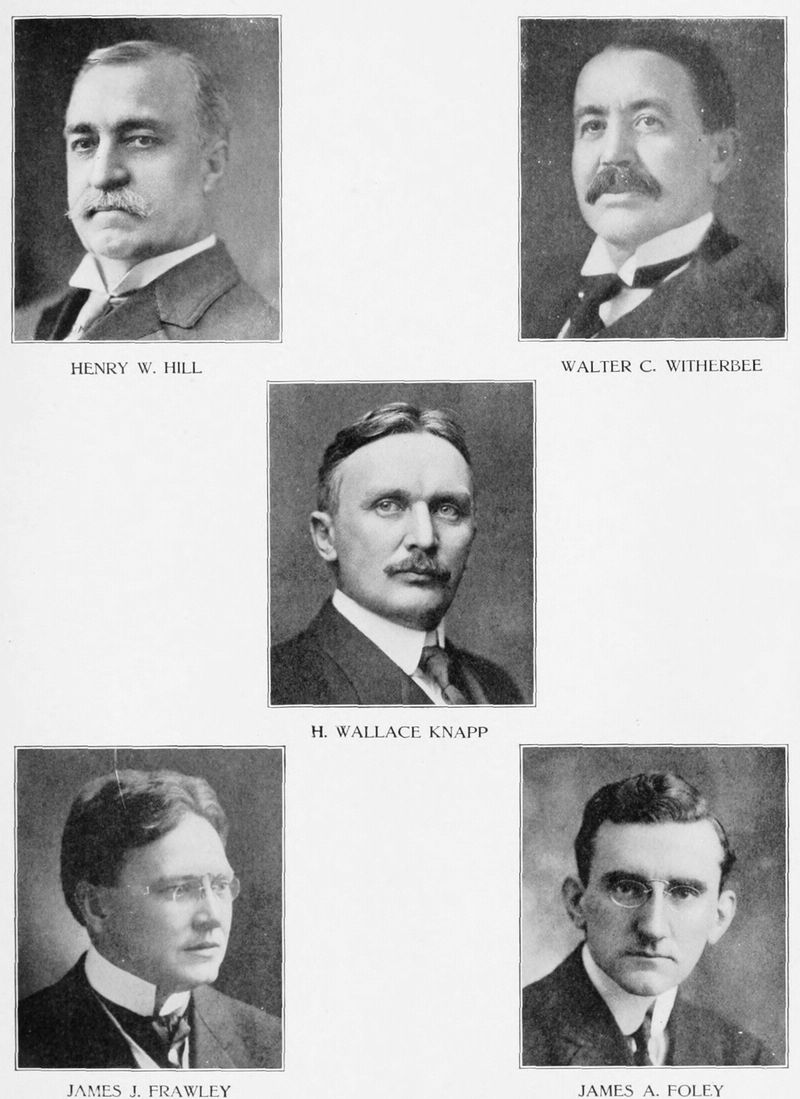
NEW YORK COMMISSIONERS
HENRY W. HILL
WALTER C. WITHERBEE
H. WALLACE KNAPP
JAMES J. FRAWLEY
JAMES A. FOLEY
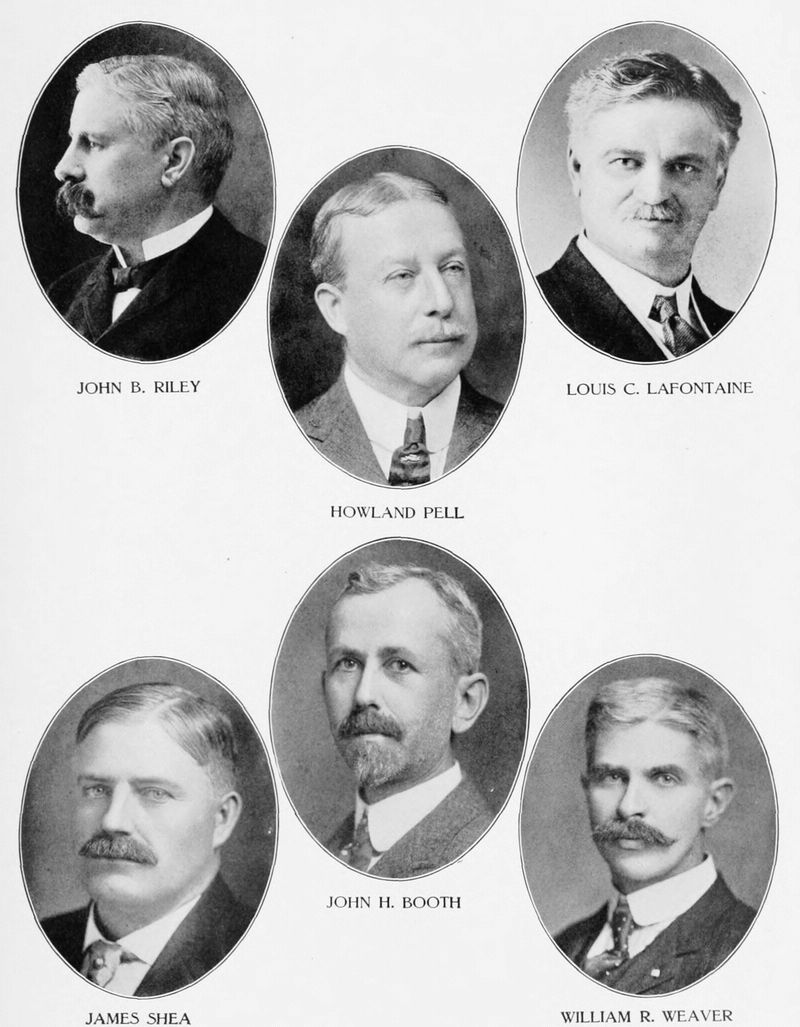
NEW YORK COMMISSIONERS
JOHN B. RILEY
LOUIS C. LAFONTAINE
HOWLAND PELL
JOHN H. BOOTH
JAMES SHEA
WILLIAM R. WEAVER
V. CONCLUSION OF THE WORK OF THE NEW YORK LAKE CHAMPLAIN TERCENTENARY COMMISSION
The work of the Commission was done largely through committees after a presentation and consideration of such problems as arose under instructions adopted at formal sessions of the Commission from time to time with reference to the conduct of the celebration and the construction of memorials. The Commission held upwards of thirty-seven formal sessions and the results may be seen in the work accomplished. From the first it was the purpose of the Commission to organize and carry to a successful conclusion such a celebration as would be in keeping with the dignity of the state and true to the historical events to be commemorated. The members of the Commission fully appreciate their limitations in undertaking to present in outline the history of the Champlain valley in the form necessarily pursued in the Tercentenary Celebration, which President Taft humorously characterized as a “traveling show,” but there was no other way suggested or that occurred to members of the Commission, whereby that could be done and any adequate presentation of the tragic events following the discovery of the lake could be made, than that adopted by the Commission.
Though there may not have been given “the substance,” the members trust that they may not have failed to so present its essentials as to enable many to behold something of what Professor William M. Sloane denominates “the vision of history,” as unfolded in the Champlain valley.
Activities of the Tercentenary Commissioners
The multifarious duties, devolving upon the members of Lake Champlain Tercentenary Commission during the period of five years of its existence, and involving activities of a wide range and great detail, may never be fully appreciated nor even fully understood. The members of the Commission were business and professional men actively engaged, but they were so deeply interested in the celebration, that they left nothing undone to ensure its success. Senator James J. Frawley was chairman of the Finance Committee of the Senate from 1911 and also a member of another State Commission, Senator James A. Foley, who was a member of Preliminary Champlain Commission, took a deep interest in the project from its inception, Senator H. Wallace Knapp, chairman, Hon. Walter C. Witherbee, treasurer, Hon. Howland Pell, whose family has done much to restore Ft. Ticonderoga, Hon. Louis C. Lafontaine, Judges John B. Riley and John H. Booth and Hon. James Shea, and Hon. William R. Weaver, all freely gave their services and as much of their time as they were able to the Tercentenary celebration.
At the final meeting of the New York Lake Champlain Tercentenary Commission a resolution was adopted expressing the appreciation of its members to its secretary, Henry W. Hill, for his long and unrequited services in preparing the comprehensive, historical and scholarly First and Final Reports of the Commission, which possess a literary finish and a perfection in every detail worthy the commemorative Tercentenary celebration and the bi-state, national and international functions involved.
In presenting their Final Report to the Legislature, the Tercentenary Commissioners avail themselves of this opportunity to make it a matter of record that they have had the support and active co-operation of the several Governors and successive Legislatures of the state in office during the life of the Commission in carrying to a successful conclusion the celebration and in the construction and dedication of the two permanent memorials to Samuel Champlain, the first white man to set foot on the soil of what is now within the confines of the state. The Government of the United States invited and, out of an appropriation made by it for that purpose, entertained the foreign guests. The state of Vermont contributed its proportionate share of the general expenses and of the cost of the joint memorial at Crown Point forts. The state of New York paid its proportionate share of the general expenses and of the cost of the joint memorial at Crown Point forts and the entire cost of the Champlain memorial at Plattsburgh and the Commission has turned a small balance back into the State Treasury, as will appear from the Financial Statement in the Appendix of this Final Report.