IN LIGHTER VEIN
Reading edition
WORLD REFORMERS—AND DUSTERS
THOUGH often entranced by that brilliant group of cosmic problem-solvers—Mr. H. G. Wells, Mr. Shaw, Mr. Chesterton, and others—I insist on my personal irresponsibility for the state of Mankind as a whole. These men are always nursing civilization. They regard it as a sort of potted plant which they fear to find frost-bitten of a morning. This is especially clear in the latest writings of Mr. H. G. Wells, who would tidy up the whole world at once. At one swoop he would remove the shirts from our clothes-lines and the errors from our minds. The world is too large for his feather duster; he had thought to find it a smaller planet that he might have kept at least half-way clean. Now see what he has on his hands—everything in a mess, Africa backward, China careless, the sex relation by no means straightened out, socialism, imperialism, industrialism, planless progressivism littering up things, and nobody caring a rap—at times it seems to the good housewifely soul almost too much for one person to manage. And then that infernal human diversity—slow minds, stupid minds, minds made up too soon, or not at all, closed minds, tough minds, tender minds—what’s to be done with them? He burns to do something. At least he says he does.
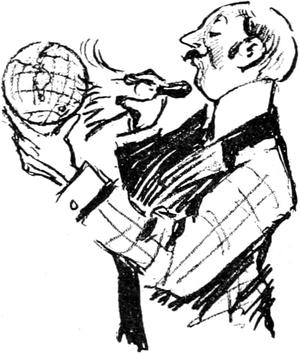
In one of his books he describes himself in fancy as going about the country and, with the keenest joy, spearing Anglican bishops. Though I am myself a stranger to the sport, I believe the pleasure of spearing bishops is exaggerated. For once begun it must lead logically to a daily drudgery of slaughter among the great crowds of folks who are not intellectually independent or morally daring—lead, in short, to the massacre of those who are not particularly exciting, a large task and tedious.
I wonder if we commonplace persons are not right after all in a certain instinct of distrust toward these gifted writers. We believe implicitly in their fancies and not at all in their facts. We believe in the world they have invented and not in the world they have observed; and we distrust them utterly as world-pushers. The signs are plain—terribly plain sometimes—that it is when they have the smallest notions that they say their largest things.
The Senior Wrangler.
LADY CLARA VERE DE VERE: NEW STYLE
(REFORMER, UPLIFTER, SOCIAL SERVICER AND BELIEVER IN BETTERMENT)
BY ANNE O’HAGAN
WITH A PICTURE BY E. L. BLUMENSCHEIN
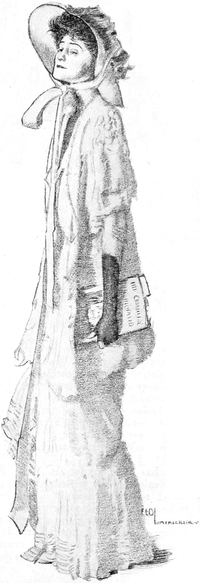
LADY CLARA: NEW STYLE
LADY CLARA VERE DE VERE, Though, ’neath the Tennysonian frown, You’ve ceased to play at hearts, what need For throwing all the graces down? The quip, the wile, the wingèd smile, Must these in truth be quite retired, Reformer of a thousand ills, O lady with a mission fired? Lady Clara Vere de Vere, You cause a tumult in my head. I do not know how many quarts Of coal-tar every year are fed In store-made pies, or what dread dyes Give that bright emerald to canned peas. I do not know the cure for graft, Or juvenile delinquencies; And, oh, my very soul is sick Of these and topics like to these! Lady Clara Vere de Vere, On suffragism you’ve a view. You have one on the cost of war, And what the working-girl should do. Your uplift crusade comprehends The stage, the mart, the funeral bier; Your dinner-table talk has grown Statistical and very drear. Trust me, Clara Vere de Vere, By yon blue heavens above us bent, The gardener Adam and his wife Yawn at your plans for betterment. We never see such sad ennui Among our hapless human brood As when the ladies’ motto runs: “’Tis fashionable to do good.” · · · · · · · Clara, Clara Vere de Vere, If time hangs heavy on your hands, Are there no suitors at your gates, No squires of dames about your lands? Go, play the game of hearts again, Coquette, and sparkle, languish, glow; Ask pardon of the folk you’ve bored, And let the thousand causes go!

Drawn by Reginald Birch
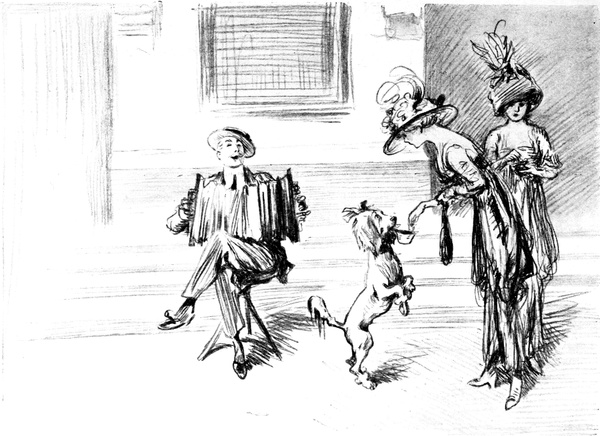
“THE PET HAS BECOME OF MATERIAL AID TO HIM IN HIS WALL STREET WORK”
THE NEWS IN WALL STREET
BY JAMES L. FORD
Author of “The Literary Shop”
WITH PICTURES BY REGINALD BIRCH AND MAY WILSON PRESTON
ALGY BOND is one of the brokers who is doing remarkably well in Wall Street now. He is widely known as a cotillion leader, as vice-president of the Westminster Kennel Club, and as a member of the MacDowell Musical Union. He has lately trained Grassmere Dolly—his intelligent French poodle—so that the pet has become of material aid to him in his Wall Street work.
MONEY has been easier in Wall Street since the sale of many gilt-edged mining and industrial securities brought a number of eager home-builders into the market. The new fashion of papering the walls of country homes with these beautiful and durable specimens of steel-engraving has created a lively demand for the stocks in question.
THE opening of the new station of the Herald Ice Fund at the corner of Wall and Broad streets created a profound sensation in the financial district. The Stock-Exchange closed during the distribution of the ice, and many pitiful scenes were enacted as the members of the great banking-houses crowded about the wagon and fought for the chilly cubes that were handed out to them. An office boy generously shared his piece with a bank president. The magnate burst into tears, and promised that he would make his benefactor rich by never giving him a tip on the stock-market.
YEGGMEN entered the office of Bilkheimer Brothers, Bankers and Brokers, last Saturday night, and blew open the safe with dynamite. When Mr. Abie Bilkheimer, the popular bond specialist, and the head of the firm, reached his office on Monday morning, he found a ten-dollar bill and a card on which were inscribed a few words of heartfelt sympathy from the yeggmen.
THAT a cat cannot live in a vacuum has been proved by a series of recent experiments carried on by the Wall Street Class for Scientific Study to which many of the younger brokers belong. It was found that the quickest method of killing a cat is to lock it in the vaults of that trust company which claims the largest capital and surplus.
MANY charitable persons have been in the habit of scattering pennies from the gallery of the Stock-Exchange, but this practice has been forbidden since Looey Pinchenstein (the organizer of the pool in Rio and Hernandez copper) fractured his nose in the scramble. Pennies will hereafter be left with the doorman to distribute at the close of the day.
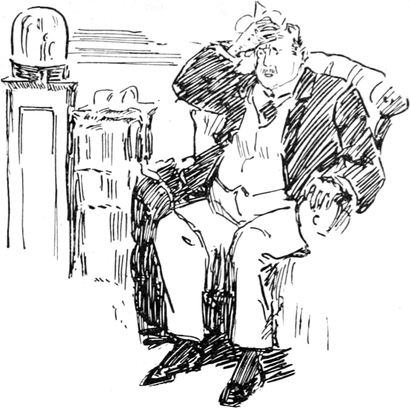
“A POOR TICKER-TIED BROKER”
Drawn by May Wilson Preston
THE Tribune Fresh Air Fund has received a touching letter from little Willie Noodle, inclosing thirty-eight cents—which he had saved in a toy bank from his candy money—and expressing the hope that it would help to send a poor ticker-tied broker on an outing to the sea-shore.
THE other day a gentleman of provincial aspect was found wandering on Wall Street in a dazed and feeble condition. Upon being questioned as to the nature of his errand there, he announced his intention of opening an account with a Wall Street brokerage firm.... When the police finally rescued him from the surging mob of brokers, it was found that he had suffered severe contusions about the hips and breasts. He is at present confined in one of the private wards of the observation pavilion.
CONTINUED IN THE ADS
A DIRGE INSPIRED BY A REGRETTABLE TENDENCY IN THE PERIODICALS OF OUR DAY
BY SARAH REDINGTON
(With the usual apologies to Swinburne)
IF I wrote sonnets soulful And you wrote ads for beans, And I got in your section ’Twould cause me deep dejection. (My Muse would be so doleful In such unwonted scenes.) If I wrote sonnets soulful, And you wrote ads for beans. If you had sung the praises Of soap or safety-pin, And found some high-brow lyric Beside your panegyric, You’d be as mad as blazes To see bards butting in. If you had sung the praises Of soap or safety-pin. When, on page eight, perusing “The Baby and the Cop,” Its dénouement I’m bidden To seek, ’mid ads half hidden, I find it hanged confusing And let the Baby drop. When, on page eight perusing “The Baby and the Cop.” When one is just deciding To buy a fountain-pen, And in the ads one’s seeking For “Notablot Non-Leaking,” Who wants to be colliding With “Wives of Famous Men”? When one is just deciding To buy a fountain-pen. Oh, magazines suggesting A boarding-house ragout, Why mix your tales and ballads With ads of soups and salads? It’s hard enough digesting The awful stuff we do. Oh, magazines suggesting A boarding-house ragout.
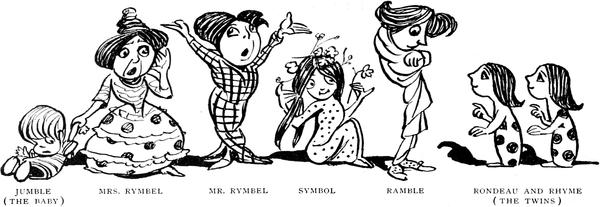
THE RYMBEL FAMILY. FROM A RECENT PORTRAIT BY OLIVER HERFORD
HOW THE RYMBELS BROKE INTO VERSE
THE above portrait is the first authentic likeness of the eccentric Rymbels. It portrays them rymbling, chez eux. It is, in particular, a speaking, not to say a shouting, likeness of Mr. Rymbel.
This interesting, demented, and extremely misunderstood verse family was first discovered and laid bare to the public by Mr. Herford in the August issue of THE CENTURY. As a result of his happy discovery, and because of his two remarkable rymbels in that issue, he has lately been appointed Rymbel Laureate of America. Since their successful début, public interest in the Rymbels has increased amazingly. In New York the fever is now at its height. Everybody’s rymbling it. Rude, ridiculous, and ribald rymbels are arriving by every post.
For those who are not already confirmed rymbelists it may be merciful to explain that, roughly speaking, a rymbel is any poem of two, four, or six stanzas, preferably of five lines each, in which the ultimate word in one verse must inevitably be a miscue for the subject-matter of the next. This miscue is due to three things: eccentricity, deafness, and dementia, all of them pronounced Rymbel family characteristics.
Whenever Mr. Rymbel embarks on the first verse, Mrs. Rymbel, because of her deafness and lightness of mind, seizes on the most unexpected meaning embodied in the last word of her husband’s verse, and proceeds properly to mangle it in the second, after which the children take up the tangled skein, and do a little mangling on their own.
In the masterly canvas at the head of this page, Mr. R. is seen inflated with an afflatus and embarking on his first verse. Mrs. R., with a tight hold on the baby, is feverishly awaiting her all important cue. Symbol, their beautiful daughter, is the seated lady shown at the right of Mr. R. The astute reader will already have guessed, because of the prevalence of flowering hay in her hair, that, mentally, Symbol is, to put it charitably, only sparking on one cylinder. Ramble, the eldest son, has, it will be seen, just rebuked Rondeau and Rhyme, the twins, who, after hearing parts of their father’s verse, have turned to their mother to mutter: “What’s the matter with his metre-motor, mater?”
Miss Carolyn Wells, who has for years been on the most intimate terms with the Rymbels, and who might almost be called a member of the family, has preserved, as souvenirs of a boy-and-girl affair with Master Ramble, two noteworthy examples of rymbelican verse. In the first of these the Rymbels have touchingly voiced their preferences for the nobler and loftier bards of our day. It is entitled:
A RYMBEL OF RHYMERS
DEAR Edith Thomas! Oft do I Feel in my heart the call of her. Swift to my book-shelf then I fly, And, hovering ’twixt a laugh and cry, I read and re-read all of her. Oliver Herford! How can praise Add aught to his renown? His comic kits, his fetching fays, His books and works and healthful plays, Are known all over town. Charles Hanson Towne! his lyrics flow Soft as the dews of Harmon; His tastes are musical, and so To please them he will often go To “Lohengrin” or “Carmen.” Bliss Carman all our hearts must win; To higher thought he’d urge us; Divinely tall, divinely thin, Austere of mien, he should have been A beadle or a burgess. G. Burgess, Super-Sulphide! yet Perhaps more saint than sinner. His rhymes cavort and pirouette, And as for that mad thing, Vivette, I almost wish I’d been her. Oh, Witter Bynner, oftener sound Your note of lyric joys! Come, poets, let us gather round, Lest our brave pipings yet be drowned By some strange foreign Noyes!
MR. L. FRANK TOOKER of Callao, Peru, insists that the rymbel is didactic, and that its highest form is found in Spanish South America, where it is used to inculcate the prudence and self-restraint for which that region is preëminent. In illustration of this contention, he sends this from Callao:
THE PRUDENT LOVER
I THINK when I behold her face, It is so varee fair, ’Tis best to get acquaint’, you know, And so I gaze simpatico: That’s how you call to stare. Ah, she was pausing on that stair So timid like the fawn; And fawn-like were her eyes, her lips Were like the flowers the slow bee sips Upon the dewy lawn. But, hola! she was not in lawn; For as she turned to go, I saw the pearls glow at her throat, The satin gown about her float, Though timid like the doe. Caramba! I have not the dough For such expensiveness. The eyes, the lips, the timid air, That’s varee nice; but, oh, beware That C. O. D. express!
AGAIN the low rymbling sound of Miss Carolyn Wells!! This time ART is her impassioned theme. She writes from Hansontown, Herfordshire.
ON A PORTRAIT OF NANCY
FULL winsome was her bonny face, And eke her golden hair. Her gown was weft of rarest lace; And high aloft, with gentle grace, A sunshade pink she bare. The She Bear from the forest came, Just why, I cannot state. The creature seemed to be quite tame; Methought, would I her favor claim, I must ingratiate. In gray she ate! The lunch was fair,— We had a window-seat. Her gray gown meek, yet debonair;— Demure,—yet with a regal air,— She looked imperial,—sweet. “Imperial suite? Yes,—I dare say ’T would make our voyage gladder.” My wife is mad about display— (But when I mentioned what we’d pay, It only made Rose madder!) Rose madder,—’tis the tint I’d use To paint my brain’s fair figment; A shape, half goddess and half muse, And all in misty, pinkish hues, The color scheme,—the pigment. The color scheme the pig meant? Ma’am, That was a subtle fancy! In tints of dawning gooseb’ry jam, And those soft pinks of early ham, We painted little Nancy!
Drawing by Birch
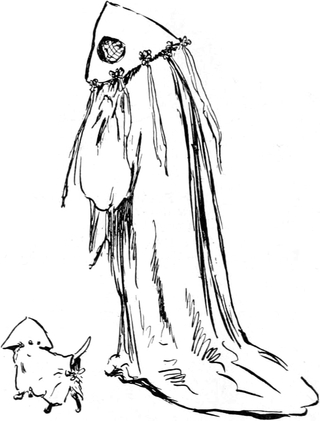
THE “ELITE” BATHING DRESS
Now so much in vogue at Newport
WE have been distressed to learn, from our great Metropolitan dailies, that the ladies of assured and ultramundane position at Newport have recently suffered severely from the unwarrantable intrusion on Bailey’s Beach of certain Sunday Supplement sketch artists, society editors, female policemen, independent kodakers, and foreign noblemen. As an indirect result of these intrusions the “Elite” bathing dress has been designed to assuage the sensibilities of the more modest and fastidious among the hostesses of Newport. Our illustration shows Mrs. Reginald Ochrepoint and Wu, her clever pet, ready for their morning dip.
Drawn by C. F. Peters
FROM GRAVE TO GAY
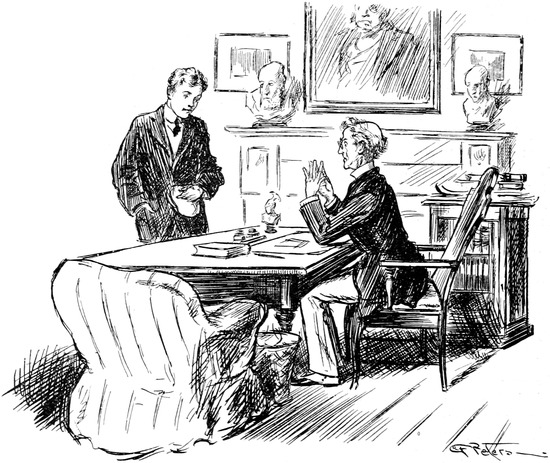
THE FRESHMAN: “Oh—er—might I be excused from my lectures for a few days? The truth is—er—I want very much to attend the funeral of an old and trusted friend.”
THE DEAN: “Well, really, Robinson,—I wonder if that is quite necessary?—Now, if it were your father or your mother, I should, of course, be only too delighted.”
THE WISE SAINT
(A FABLE FOR ANYBODY)
BY HERMAN DA COSTA
PICTURE BY W. T. BENDA
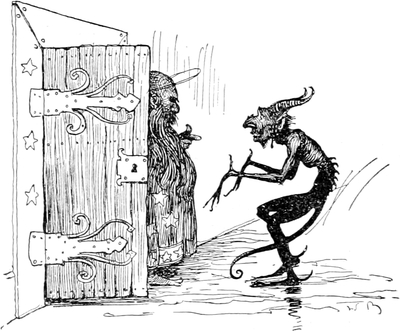
DE debble see St. Peter sneak into heaben’s gate; He holler: “What’s yo’ hurry? Wait dar, Peter! Wait!” De saint pull in de latch-string, an’ holler: “Now, you go! I’ll sic de houn’ dawg on you de fustest t’ing you know.” “I speaks you like a ge’man,” de debble up an’ say, “And yere you shets me out, sah! Fer shame! to ack dat way!” “Don’ argify,” say Peter. “You leads fo’ks into sin. Ain’t shettin’ you out, nohow; I’s shettin’ mahse’f in.”
LIMERICKS
TEXT AND PICTURES BY OLIVER HERFORD
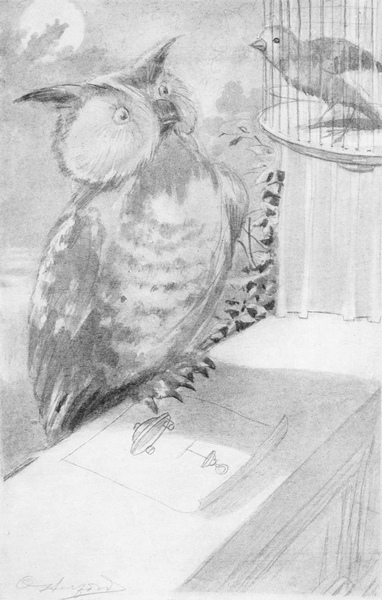
THE CONSERVATIVE OWL
A CANARY, its woe to assuage, Once invented a wireless cage. The owl shook his head, “It’s a Great Thought,” he said, “But it’s far in advance of the age.”
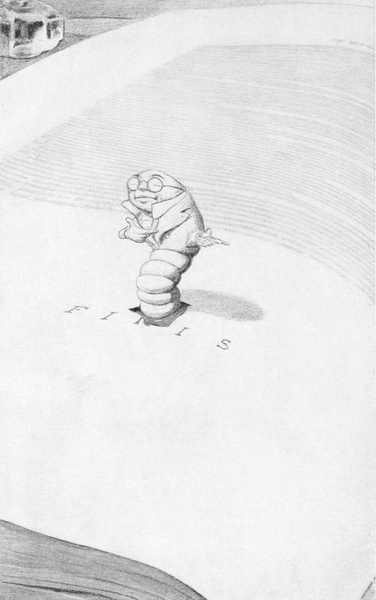
THE OMNIVOROUS BOOK-WORM
QUOTH the book-worm, “I don’t care one bit If writers have wisdom or wit; A volume must be Pretty dull to bore me As completely as I can bore it.”
THE DE VINNE PRESS, NEW YORK