THE RETURN TO HARD MONEY
Reading edition
BY CHARLES A. CONANT
Formerly Washington Correspondent of the New York “Journal of Commerce”
WITH PORTRAITS AND CARTOONS
TAXES FOR EVERYBODY
WHEN the wrack and waste of war are done, and ceased are the tumults and the shouting, the harder task lies before the statesman and the financier of paying the cost. A great war, at least down to very recent times, has usually carried with it haphazard and wasteful financing, an oppressive debt, unequal and burdensome taxation, and a depreciated currency. The aftermath of the Civil War was no exception. At its close all these evils lay heavy upon the people of the United States.
The public debt stood at $2,846,000,000, or about $80 per capita; and of this amount nearly $1,900,000,000 was paying interest at the rate of six per cent., or higher. The ordinary expenditures of the Government, including the support of the armies, were running at the rate of about $3,300,000 a day, while receipts from taxation and other sources than loans were falling below $1,000,000 a day. The man of business could not affix his signature to a check, a receipt, or a bill of exchange, receive a legacy or transfer a piece of real estate, without paying a tax. Cotton was taxed two cents a pound; salt, six cents a hundred pounds; sugar, from two to three and a half cents a pound. Manufacturers were paying licenses for the right to do business, and also taxes upon the value of their output whether a profit emerged or not; middlemen were taxed upon the volume of goods dealt in, irrespective of the fact that such goods had already paid several times. Among other taxes were those levied on matches, photographs, lottery tickets, perfumery, theaters, and carriages; and additions made by repairs to the value of a carriage or a machine paid their own distinctive tax. Incomes were taxed up to twelve and one half per cent. There existed, in short, to use the terse language of David A. Wells, “a system of internal taxation which for its universality and peculiarities has no parallel in anything which had theretofore been recorded in civil history.”
A FLOOD OF PAPER MONEY
THE currency consisted of irredeemable paper, a part issued by national banks, a part by State banks, and a part directly from the government printing-presses. Its value, which had been as low as $35.09 in gold for $100 in paper, in July, 1864, was still less than $70 in gold after the stimulus of Lee’s surrender. Prices of commodities, which had fluctuated even more wildly than the gold premium, showed an average for leading articles, in the first quarter of 1865, representing 2.62 times the corresponding average just before the war.
Brave and energetic as had been the policy of Salmon P. Chase as Secretary of the Treasury in grappling with the problems of the war, he made two economic errors which greatly added to the difficulties that confronted his successor. He continued too long the policy of borrowing instead of taxing, thereby impairing the public credit and adding to the cost of his borrowings; and he opened the Pandora’s box of legal-tender paper money, which left its mark upon our political history for nearly half a century.
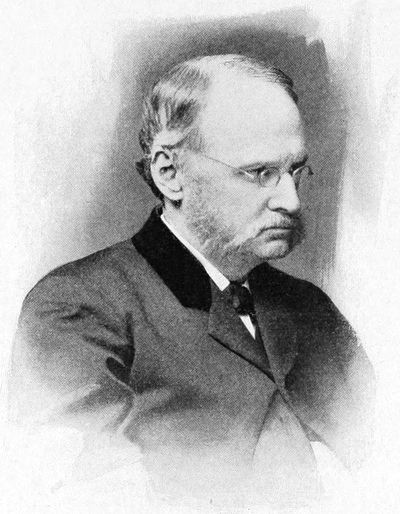
From a photograph by W. Kurtz
DAVID A. WELLS
McCULLOCH’S FACULTY FOR ECONOMY
THE problems presented to Hugh McCulloch, when he succeeded to the headship of the Treasury in Lincoln’s second cabinet, were to reduce expenditures, to reorganize taxation, to systematize and consolidate the debt, and to restore stability to the currency. The country was fortunate in having such a man as Mr. McCulloch to perform these services. Of long experience as a practical banker, he had been made Comptroller of the Currency upon the reorganization of the national banking system, and was familiar with all branches of government finance. Fortunately, also, he was not a politician. He was a descendant of that small but prolific colony of Scotch and Scotch-Irish who settled in northern New England, whose sturdy courage enriched the blood of all other races with which it was mingled. His views of what was required to restore sanity to the national finances were not warped by fear of popular clamor; and if they went further than the condition of the country warranted in the direction of monetary contraction, they at least set a standard of national honor and obligation which was like a beacon set on a hill to the supporters of honest money.
Toward reducing expenditures, rapid progress was made as the million men who had sprung to arms at the call of the country were mustered out of the Grand Army and returned to their plows and workshops. Expenditures for the War Department, which were $1,030,000,000 in 1865, were brought down the next year to $283,000,000, and in 1867 to $95,000,000. On the side of reducing and simplifying taxation much was accomplished by the clear-headed young man who had been called into consultation by President Lincoln a few weeks before his death. This man, David A. Wells, tall, gaunt, and deadly in earnest, had perhaps a greater capacity for massing facts than any other American economist. At his suggestion, the war taxes, which had fettered production and exchange, began to drop from the limbs of industry. By the act of July 13, 1866, taxes on articles of common consumption were abolished, the income tax was suspended from and after June 30, 1870, and the foundations were laid of the existing system of internal revenue, taxing substantially only spirits and tobacco.
Of the elaborate operations of refunding, which converted obligations paying six and seven per cent. into five, four, and finally even into three per cent. securities, and raised American credit to the level of that of other powerful nations, it is not desirable, here, to set forth the details. It is enough to say that the funded debt was reduced within ten years after the war by nearly $500,000,000, and that interest payments upon it, which in 1867 were $143,700,000, had fallen in 1877 to $97,100,000. Even more remarkable in figures were the achievements of later years; but if it is by obstacles overcome that the greatness of a victory is measured, then the palm of achievement belongs to those earlier years when, in the language of Secretary McCulloch, “the industry of one third part of the country, by reason of the war and the unsettled state of its political affairs, has been exceedingly depressed, and the other two thirds by no means exerted their full productive power.”
A MEASURE OF THE COUNTRY’S GROWTH
FOR America was still only on the threshold of that wonderful development which was to make her in the beginning of the twentieth century one of the half-dozen great Powers of the world; with a homogeneous white population second in numbers only to that of Russia; with accumulated wealth exceeding in per capita average that of any other country except perhaps England; and with imperial interests in Cuba, Porto Rico, Central America, Samoa, the Philippine Islands, and China.
The population of the United States in 1860 was only 31,443,000, or less than one third what it was in 1912; and the estimated total wealth was $16,159,616,000, or about one seventh of the great accumulations of to-day. Of these amounts, moreover, the South had taken out of the Union a proportion which may be estimated roughly at two fifths. Railway mileage, which was 30,626 for the whole Union in 1860, had increased only to 35,085 in 1865, or less than one seventh the mileage of to-day. Much of the country west of the Mississippi was still an untracked wilderness. Senator John Sherman, after the adjournment of Congress in 1866, made a vacation trip with his brother, General William T. Sherman, in the general’s official inspection of army posts. The Central Pacific Railroad ended at Fort Kearney, and thence the party traveled in light army-wagons drawn by mules, camping at night, sleeping in the wagons, the horses parked near by, guarded by sentinels, and with the frequent menace of Indian attack.
Skilful as was the financial leadership required to reduce expenditures, reform taxation, and refund the debt, these were the least difficult in a sense of the economic problems of the war, because they were chiefly problems of legislation. Much more serious were the questions of escape from the hectic influences of war prices and conditions and of inflated government-paper issues; and these were to give their color to the industrial and financial history of the country for a generation. Dreams of untold fortunes derived from speculation in the securities of new railways were rendered peculiarly vivid by the disorganized state of the currency and the fluctuations in its gold value, stimulated by manipulation in the gold-room of the New York Stock Exchange, but due fundamentally to uncertainty as to the quantity of currency in circulation and as to when it would be made redeemable. Thaddeus Stevens went to the extreme of declaring that one of the measures proposed, with the approval of the Secretary of the Treasury, would put under the absolute and uncontrolled discretion of that official more than sixteen hundred million dollars’ worth of paper money, and would confer upon him more power “than was ever before conferred upon any one man in a government claiming to have a constitution.” It is small wonder that amid such possibilities speculation became a rankly luxuriant growth of the financial markets.
“BLACK FRIDAY”
TYPICAL of these conditions was the famous “Black Friday” of September 24, 1869. It was the result of a daring speculation on the part of Jay Gould, “Jim” Fisk, and kindred spirits in Wall Street to corner the gold stock of the country and compel short sellers of the yellow metal to settle with them at their own price. Plans were carefully laid early in the summer of 1869 to enlist President Grant’s sympathy by convincing him that high prices were necessary to the prosperity of the country, and at the same time to entangle Mrs. Grant, her brother-in-law, A. R. Corbin (the husband of General Grant’s sister Virginia), the President’s private secretary, General Horace Porter, the Collector of the Port of New York, and others close to the President, in the appearance of a corrupt conspiracy to participate in the profits of the corner. It was planned to bring to a stop the sales of gold which were being made from time to time by the Secretary of the Treasury, and which tended to supply the demand for gold for the payment of customs and other special purposes, and thereby keep down its price. The tendency of the yellow metal had been downward during the spring, and the quotations of early September stood at about 135.
The effort to convince President Grant that he ought not to interfere by throwing Treasury gold upon the market was begun as early as the middle of June, when the President was on board one of the Fall River steamers on his way to Boston. Supper was served at nine o’clock, and the conversation was deftly turned to the state of the country, the crops, and the financial outlook. On Gould’s own confession, President Grant’s favorite rôle of a listener stood him in good stead. After listening for a long time to the talk, which had been carefully planned by Gould and in which Corbin and others took part, the President remarked that he thought there was a certain amount of fictitiousness about the prosperity of the country, and that the bubble might as well be tapped in one way as another. This remark, according to Gould, in his testimony before the Congressional Committee of investigation, “struck across us like a wet blanket.” They concluded that the President was a contractionist.
The game was by no means abandoned, however, as a result of this first rebuff. A prominent English financier who was visiting the country advocated the theory that business interests required an advance in the price of gold in order to move the crops and sell them on favorable terms in foreign markets. Corbin was a willing convert to this theory, for he was already a party to a pool in which Gould and Fisk were members. Corbin was put forward to talk to the President whenever he came in contact with him, and even introduced Gould for the purpose of presenting his views. The President, according to Corbin, engaged in these conversations with reluctance, and the moment any allusion was made to the future policy of the Government he became very reticent. Fisk also tried his hand on the President, but without much success. Thus matters dragged along until September, when the President wrote a letter to the Secretary of the Treasury, George S. Boutwell, suggesting that it would not be wise to sell gold in large amounts to force down the price while the crops were moving, as it might embarrass the West. This was the first ray of light from the Presidential office that had reached the conspirators. It is not certain that they knew definitely of this letter; but on the third and fourth of September gold began to rise rapidly, and on the sixth it touched 137-⅝.
About two weeks later, with President Grant staying at a small country place in Washington, Pennsylvania (on a visit to William Smith, a cousin of Mrs. Grant), far from the railway and the telegraph, the time seemed ripe to push up the price of the yellow metal, drive the “shorts” to cover, and compel them to settle. The final coup was played by getting Corbin to write a letter to the President, urging him not to interfere in the struggle between the two factions in the gold market by ordering or permitting sales of gold by the Treasury. A faithful messenger, W. O. Chapin, was selected to take this letter to Pittsburgh, and from there by carriage to Washington, thirty miles distant. It was testified by General Horace Porter, secretary to the President, that they were engaged one morning in playing a game of croquet when General Porter was told that a gentleman wished to see him. The messenger was asked to wait until the game was finished, when he handed Porter a note stating that he had a letter which he desired to deliver to the President. The letter was shown to the President, who glanced over it and said to the bearer, “No answer.” General Porter then called the President’s attention to the peculiarity of the missive being brought so far by a special messenger, with a letter of introduction. The President was set to thinking. The letter, which Corbin and his conspirators were relying upon to prevent interference by the Secretary of the Treasury, proved their ruin. President Grant began to see through the plot, and suggested to Mrs. Grant to say in a letter she was writing to Mrs. Corbin that rumors had reached her that Mr. Corbin was connected with speculators in New York, and that she hoped, if this were true, that he would disengage himself from them at once, adding that the President was very much distressed at such rumors.
Mrs. Grant’s letter caused something approaching a panic in the ranks of the gold speculators. When Gould called at Corbin’s house on the evening of Wednesday, September 22, and read the contents of the letter, it was apparent to him that Corbin had no such influence over the President as had been expected, and that a blow from the Treasury might fall at any hour. It was a picturesque spectacle, described by Gould himself in his testimony, when the two were shut in the library near midnight, Corbin bending over the table and straining with dim eyes to decipher the contents of the letter, written in pencil to his wife, while the gold-room gambler, looking over his shoulder, caught with his sharper vision every word. Corbin had already prepared a letter to the President denying that he had any interest in the movement, direct or indirect, and now told Gould that he must send the letter by the first mail; but that, if it were sent, its statements must be true. He proposed, therefore, to Gould that they should settle his (Corbin’s) account, paying him his accrued profits, which as gold stood that night would amount to more than $100,000, in addition to $25,000 which he had already received. Gould put the matter over until morning and eventually drew a check, which, however, never was paid to Corbin.
Gould knew better than to divulge the unfortunate news to Fisk. It appeared to be his plan to let him and their brokers continue to buy gold and force up its price, while Gould himself was unostentatiously getting rid of his stock at maximum prices. Fisk entered the gold-room the next morning and struck terror into the hearts of the “bears” by offering to bet any part of $50,000 that gold would sell at 200. Thursday afternoon gold closed at about 144, and the conspirators held a meeting in the evening to lay plans for the next day’s campaign. They held calls for more than $100,000,000 in gold, and there were not more than $15,000,000 of gold and gold certificates in New York, outside of the Sub-Treasury. They had a full list of those who were short of gold, including more than two hundred and fifty prominent firms; and it was proposed to publish this list next morning, and to inform the victims that if they did not settle at 160 before three o’clock, a higher rate would be demanded. This detail was abandoned because they were advised by counsel that under the statutes of New York such a course would constitute a conspiracy. Fisk was asked the next morning why he feared any sale the Treasury could make, since the clique held calls for more gold than both the Treasury and the city could command. His answer was, “Oh, our phantom gold can’t stand the weight of the real stuff!”
About Friday noon, the blow from the Treasury fell. President Grant had returned from Pennsylvania to Washington on the previous afternoon, and in the evening had held a consultation with the Secretary of the Treasury. Both agreed that if the price of gold should be forced higher, so as to threaten a general financial panic, it would be their duty to interfere to protect business interests. Friday morning the price advanced rapidly, and telegrams poured into Washington from all parts of the country, urging the Government to interfere and if possible prevent a financial crash. At a conference, held soon after eleven o’clock, it was agreed to sell $4,000,000 of Treasury gold. The message to the assistant treasurer at New York, General Butterfield, was not sent in cipher, and soon the news was in everybody’s mouth. In the meantime, James Brown, a Scottish banker of New York, with the support of leading merchants, offered successively to sell $1,000,000 gold at 162, another $1,000,000 at 161, and $5,000,000 more at 160. The market began to break; and when ten minutes afterward the news came that the Treasury would sell, the price fell from 160 to 133.
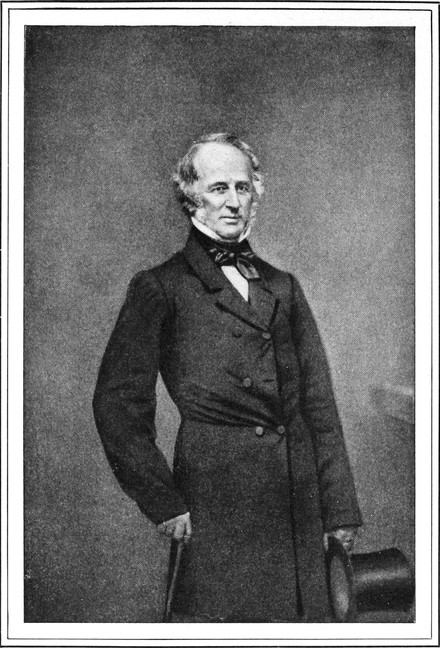
From a photograph owned by F. H. Meserve
COMMODORE CORNELIUS VANDERBILT
It was with difficulty that Gould and Fisk escaped from the fury of the ruined victims who had been following their lead, and succeeded in finding refuge in their up-town stronghold, the office of the Erie Railroad Company at Twenty-third Street and Eighth Avenue. During Thursday and Friday they had sold out at high rates a large part of the gold they had purchased, and had made many private settlements at rates ruinous to their victims. They now repudiated all the purchases they had made through Belden, the principal broker who had acted as their agent. They called on Corbin and overwhelmed him with denunciations. As Fisk told the story, Corbin “was on one side of the table weeping and wailing, and I was gnashing my teeth.” In vain they despatched Corbin to Washington to plead with Grant to suspend the order to sell. The President cut him short with the remark that that subject was closed. Corbin returned to New York and did not even see his fellow conspirators when he got back. As Fisk characterized the situation, “Matters took such a turn that it was no use; it was each man drag out his own corpse.” Afterward it was shown that neither Mrs. Grant nor General Porter was in any way connected with the conspiracy.
THE ERA OF RAILWAY BUILDING
“BLACK FRIDAY” was only a symptom of the deeper disorders of the body politic. The minority of the committee of the House which investigated the “Black Friday” episode declared that “no one doubts that if the constitutional currency of coin had remained to us, such panics would have been, and would now be, impossible.” The stimulus to over-expansion afforded by an unstable currency operated also upon mercantile enterprise and railway development. The demand for the extension of the railway network over new farm land, and across the Rocky Mountains to the Pacific, became the channel through which speculative influences converged to bring on the panic of 1873. Already, in 1862, Congress had granted a charter for the construction of the Union Pacific line, and in 1864 it granted further aid by making the United States bonds that were to be issued for construction purposes a subordinate lien to that of the bonds of the company sold in the market. Thus, as John Sherman put it, “The constructors of these roads, who were mainly directors and managers of the company, practically received as profit a large portion of the bonds of the United States issued in aid of the work, and almost the entire capital stock of the company.” At the same time was enacted the Northern Pacific charter, which, according to the same authority, was an act “with broad and general powers, carelessly defined, and with scarcely any safeguards to protect the Government and its lavish grants of land.”
Already, shortly before the war, the ground had been cleared for extensive railway enterprises by the knitting together of small roads into trunk lines connecting New York with the Mississippi Valley. Originally, eleven companies owned and operated the lines making up the route between Albany and Buffalo. After this anomaly disappeared, it remained for the genius of Commodore Vanderbilt to acquire the Hudson River road in 1864 and the New York Central lines in 1867, and to bear his share in the picturesque battles of the Stock Exchange and the courts, which gave such fascination to this lawless epoch of American finance.
VANDERBILT AND DREW
IT was the period of Cornelius Vanderbilt, Daniel Drew, Jay Gould, and “Jim” Fisk; the period in which were conceived and carried out the famous “corners” in Harlem, in Hudson River, and in Erie stocks. None of the leaders in these speculations would have shone in Newport or in the polished, well-groomed crowd that watches the races at Deauville or takes the “cures” at Vichy or at Nauheim. Cornelius Vanderbilt, the son of a farmer in moderate circumstances on Staten Island, was ferrying passengers over to New York at sixteen years of age, and at the age of eighteen owned two boats and was captain of a third. He derived his education from practical experience, his successes from innate shrewdness. Daniel Drew, beginning as a drover and afterward the keeper of a tavern, never sought to rise socially above his early environment. To a reported trick of his in early life is ascribed the familiar stock-market expression, “watering stock.” According to the legend, Drew gave his cattle salt in order to create a thirst, which would cause them to drink freely and make them appear bigger and fatter when brought to market. He was negligent in his attire, even to the verge of slovenliness, and never departed from the provincial pronunciation of his youth. In many a broker’s office where he called for his securities his loud demand for “them sheers” was long remembered.
THE BATTLE OF THE GIANTS OVER ERIE
“THE COMMODORE,” as Vanderbilt was familiarly called, was seeking to develop the Hudson River property, when he found it assailed by a large “bear” element. Immediately taking the situation in hand, he tricked his opponents into the belief that his position was weak, and lured them into increasing their output of short stock. Getting virtually all the real stock in existence into his possession, and accepting contracts for additional amounts from the short interest, he soon had the market at his mercy. From 112 the stock rose in a few days to 180. The shorts, unable to make the deliveries they had contracted for, begged for mercy, and the stock was sold back to them at a handsome profit.
Much more complicated and daring were the operations of Daniel Drew, Jay Gould, and Fisk in Erie. The story of their use of the Erie road is worth outlining, if only to illustrate methods which in the financial world of to-day would no longer be tolerated, even if they were possible. In July, 1868, the Erie Railroad became the personal property of Fisk and Gould. The board of directors held no meetings; the executive committee never was called together. The Erie offices were moved to a white marble “palace” on the corner of Eighth Avenue and Twenty-third Street, which was furnished with vulgar ostentation, contained an opera-house (still a popular theater), and was connected with the private apartments of Fisk. Just before this (in 1866), Drew had operated his famous plan of loaning money to the Erie Railroad on the security of stock and convertible bonds, and converting the bonds into stock to meet his short contracts.
It was the acquisition by Commodore Vanderbilt in 1867 of the New York Central Railroad which brought him into conflict with Drew and Gould. “The Commodore” desired to acquire Erie. To guard against the transformation of more “convertible bonds” into stock, he employed the services of Frank Work to obtain from Judge Barnard an injunction restraining Drew from the payment of interest on $3,500,000 in bonds, pending an investigation of his accounts as treasurer of the railway. But Drew was equal to the emergency. Under a statute authorizing any railroad to create and issue its own stock in exchange for that of a leased line, he and his associates issued against an insignificant property, worth perhaps $250,000, the amount of $2,000,000 in Erie stock. Deals and counter-deals, and injunctions to restrain injunctions, did not prevent Fisk from seizing the enjoined stock certificates by force, nor Drew from aiding him by throwing 50,000 shares on the market and breaking Vanderbilt’s attempted “corner.” It is said that while new stock was thus being put out, Fisk summed up the purposes of his clique toward Vanderbilt in the remark, “If this printing-press don’t break down, I’ll give the old hog all he wants of Erie.” Vanderbilt was credited with spending $7,000,000 in this operation, and it was the wonder of his friends that he was not ruined.
To tell fully the story of these battles of the financial giants would be beyond the scope of a sketch like this. How Gould and Fisk succeeded Drew in control of the Erie; how they nearly ruined him when he came back into the speculative field; how Judge Barnard authorized Gould and Fisk to sell their Erie stock, issued at 40, back to the corporation at any price less than par, is a story of surpassing interest, but it represents methods long since discarded in American finance.
THE CHICAGO AND BOSTON FIRES
DURING these years of unsettlement and wild speculation, the country seemed pursued by an evil destiny. About two years after business credit was so seriously disturbed by the incidents of “Black Friday,” a destruction of capital amounting to more than $200,000,000 was caused by the great fire in Chicago, and within another thirteen months came the great fire in Boston. It was a quiet Sunday on October 8, 1871, when a small wooden barn on De Koven Street, Chicago, surrounded by cheaply-built wooden buildings and lumber-yards, burst into flames. Sweeping ruthlessly through the fire-traps of the western division of the city, the fire soon got beyond control, wiped out the Union Depot and the Pittsburgh and Fort Wayne Terminal, and destroyed in this division alone five hundred buildings. This, however, was only a beginning. All night Sunday and the following Monday the flames steadily advanced over the southern division, comprising nearly the whole of the business district, and then to the northern division, comprising many private residences. Business blocks of brick and granite melted like wax before the flames, which swept clear up to the water-front of Lake Michigan, and spread a pall of smoke and cinders far across the northern sky. All the wholesale stores, the newspaper offices, and the principal banks, insurance-and law-offices were reduced to smoldering heaps of ruins. The court-house, custom-house, and other public buildings, and nearly all the hotels, suffered the same fate. Crowds of people, driven from their homes, camped in the parks and sought refuge in the buildings left standing.
In the southern division, which was the business district, it was calculated that 3650 buildings were destroyed, including 1600 stores, twenty-eight hotels, and sixty manufacturing establishments. The number of people rendered homeless was estimated at 2250 in the western division, 21,800 in the southern division, and 74,450 in the northern division. The total money loss in buildings was calculated at $53,000,000; business stocks and produce, $84,000,000; and personal effects, $58,000,000. This total of nearly $200,000,000 was swelled by the depreciation of property which naturally followed such a destruction of values. The total valuation of the city before the fire was estimated at $620,000,000, and the population at 334,270. The insurance in force in the burned district was about $100,000,000; but fifty-six insurance companies suspended, and only about $40,000,000 in insurance was collected.
The Boston fire broke out on Saturday, November 9, 1872. The fire-department was crippled in fighting the fire by a remarkable epidemic, or distemper, which prevailed among the horses. So completely were the horses of the city disabled that ordinary local deliveries of merchandise had almost come to a standstill; some of the street-railways had ceased running, and teaming by oxen or by gangs of men was the only means of moving freight. On Saturday, October 26, a meeting was held at the City Hall of the board of engineers of the fire-department to decide upon a course of action in case of serious fire during the distemper. It was decided that the strength of each fire company should be temporarily doubled by the enlistment of volunteers, and that drag-ropes should be furnished each engine-house for the purpose of drawing the apparatus by hand. But with these precautions was taken a step which probably contributed materially to the delay in attacking the fire of two weeks later. It was provided that the hose-jumpers should alone be taken out on a first alarm, and that the engines were to follow only in case of a second alarm, unless the fire was above the third story.
The neighborhood in which the fire broke out was at the corner of Kingston and Summer streets. This corner was then on the fringe of the business district, with the remains of some of the old aristocratic homes of the city still standing, which had, however, for the most part, been converted into boarding-houses. It was in a five-story granite block that the fire began, and the whole building seemed to leap into flames before there was any response from the fire-department. Inexplicable delays seemed to attend the arrival of the engines. The fire was already visible in Charlestown before 7:10, and the alarm at City Hall was received only at 7:24 P.M. from box No. 52. Box No. 52 was known among the city firemen as “a bad box,” because it was in the heart of the dry-goods district, which was filled up with costly and inflammable stocks, and the principal water-mains were of insufficient size, put in years before, when it was a region of quiet dwellings. Only two engines left their quarters on the first alarm. Two others soon followed, but it required the third alarm, at 7:34, to bring out the rest of the force. Then, as the fire was gaining headway, went out the general alarm, and messages were rushed by telegraph to neighboring towns and cities to come to the aid of Boston.
The fire was already beyond control. Walls were toppling into the street, great billows of flame surged into the air, and the fire began pressing through street after street until it destroyed Trinity Church and threatened the Old South. At this historic spot was wrought something like the “miracle” that occurred on the field of Waterloo, when the burning of the chapel at Hougomont stopped when it reached the crucifix. The Old South was saved, and the fire was checked at Milk Street on the line between Devonshire and Washington streets.
The out-of-town engines in the meantime had been pouring into the city at all hours of Saturday night and up to Sunday morning, and rendered heroic services in raising a wall of water against the flames. Crowds of citizens gathered on the corners and watched the struggle to stay the fire. President Eliot of Harvard University mingled with the crowd, his mind weighed down perhaps by the thought of the injury to Harvard’s endowments invested in Boston real estate. Phillips Brooks, the young rector of Trinity, stayed in the church, then on Summer Street, near Hawley, until lines of flame were creeping along the rafters. Powder was used in some cases to blow up buildings and thereby destroy the fuel for the flames.
In Boston as in Chicago, soldiers were called to the aid of the civil authorities to patrol the smoking heaps of ruins, in which were buried many safes containing money, jewelry, and valuable documents. Serious as the fire was, it did not sweep over any such territory as in Chicago, nor represent half of the Chicago loss. The total loss in Boston was estimated at $75,291,530, out of a valuation for the entire city (which did not then include Charlestown and other suburbs) of $682,724,300. Buildings and property were largely insured, but the magnitude of the calamity again carried down many insurance companies and permitted them to pay only a percentage of their losses. Upon the whole, however, the insurance companies acquitted themselves with remarkable credit, the Massachusetts mutual companies, of which there were fourteen, paying losses in full except two. Companies organized in other States to the number of about 120, which had Boston risks, paid their losses in full, with the exception of four companies.
THE PANIC OF 1873
THE panic of 1873 was the natural result of the destruction of capital by war, fire, and unwise investment which had been going on during the previous decade, and of the encouragement given to speculation by a fluctuating paper currency. The money-markets of the world had to reckon not only with the enormous destruction of property during civil war in the United States, but with the similar fruits of two other recent wars: that between Germany and Austria in 1866, which was crowned by the victory of Germany at Sadowa, and the great war between France and Germany in 1870, for which France was compelled to pay to Germany an indemnity of a thousand millions of dollars. The direct cost of the American Civil War, exclusive of pensions, has been estimated at more than $5,500,000,000, and the cost of the Franco-Prussian War at only $2,700,000,000, owing to its shorter duration. An enormous amount of capital also was absorbed in the ten years prior to 1873 in the building of railways. New construction in the United States in 1870 was 5690 miles; in 1871, 7670 miles; in 1872, 6167 miles; and in 1873, including a part of the period of panic, 3948 miles. In Russia a system of 12,000 miles of railway had been almost entirely created since 1868, and in South America nearly $200,000,000 in English capital had been borrowed, mostly for railway enterprises. It was at about this period also that the substitution of Bessemer steel for iron began, as the material for rails, sending thousands of dollars’ worth of old rails to the scrapheap.
The severity of the panic in the United States, as well as in Austria, was heightened by the state of the currency. There had been, up to the climax of the Civil War, an almost uninterrupted decline in the value of the paper money issued by the United States Government, and a corresponding rise in paper prices. With the close of the war, these movements were reversed. A rise in the value of the currency began, and also a decline in prices. This decline in prices spelled ruin to many who had bought real estate or merchandise in the expectation of its rise in value, and it imposed paralysis even upon the more conservative, who had correctly read the downward tendency of values expressed in paper money.
The specific cause usually assigned by economic historians for the panic of 1873 was the failure of the great house of Jay Cooke and Company, as the result of tying up its resources in the Northern Pacific Railway. The incident was, however, only typical of the times; and if Jay Cooke never had lived, the story would have differed chiefly by the substitution of another name for his. The house of Jay Cooke and Company had grown to power and prestige by the clever and original methods employed by Mr. Cooke in borrowing money for the Government during the Civil War. Cooke was a true child of the new America, the first or nearly the first male child born, as he was fond of boasting, in Sandusky, Ohio. Through political and social connections, he entered a Philadelphia banking-house during the period of hazardous financing and State banking before the Civil War, and had made enough money by 1859, while still under forty years of age, to contemplate retiring from active business. But his was not a nature for inactivity. The close relations established by his father and his brother with Salmon P. Chase, the new Secretary of the Treasury, obtained Cooke a hearing in the floating of the early war loans. He was not of the old style of banker, who sat in his office waiting for a customer to come in; he quickly realized that if the Government was to obtain the money necessary to carry on the war, it must be by educating the people to understand the value of the war bonds, and the necessity of taking them as a patriotic duty.
It was a wonderful campaign of advertisement, of canvassing the post-offices, of manipulating the press, and of removing opposition, which Cooke carried on in floating hundreds of millions of the five-twenties, the ten-forties, and the seven-thirties. The later flotations, however, which came after the war, required perhaps as much skill as the earlier ones, because they involved persuading the people to retain their public funds while accepting considerable reductions of interest. Inevitably Cooke’s success drew competitors into the field. When the question of refunding arose, a committee representing other New York banking-houses appeared in Washington to demand a share in the operation. The composition of this committee is of interest because it was virtually the first appearance on the stage of public finance of John Pierpont Morgan, then a young man of thirty-five. He, with Levi P. Morton, who had established the banking-house of Morton, Bliss and Company, and had enlisted the aid of the Rothschilds, appeared in Washington in January, 1873, and demanded and obtained from Secretary Boutwell a share in the new issues. The methods of the syndicate had little of the “go” of the old Cooke methods, and already the tightening of the money-market was making itself felt. Where subscriptions of $600,000,000 had been expected for the new loan, they amounted after several weeks to less than $50,000,000, and the entire operation was ultimately suspended by the outbreak of the panic.
The lack of uninvested capital to subscribe for the government loan was a warning of conditions prevailing in the money-market generally. Jay Cooke, swept along by the great success of his methods in disposing of the war loans, believed it possible to perform the same miracle with the bonds of the Northern Pacific. It was his calculation that he could sell bonds as fast as he was called upon for money for the work of construction, and it was distinctly provided in the contract with the road that the advance in excess of the amounts realized from sales of bonds by the bankers never should exceed $500,000, which itself was secured by the deposit of the company’s bonds at fifty cents on the dollar.
During the summer of 1872, however, with President Grant’s campaign for re-election against Horace Greeley at its height, sales of bonds fell to a few hundred thousand dollars a month, while the drafts of the treasurer of the railway company were running at about $1,000,000 a month. Inevitably, the balance of floating indebtedness by the railroad to the banking house began creeping up, until it stood near the close of August at $1,583,000. Ex-Secretary McCulloch, who had become head of the London connection of Jay Cooke and Company, and other associates of Cooke were quick to realize that the house was getting into deep water, and that further uncovered advances must be stopped. It was much easier to lay down this rule, however, than to carry it out. Already there were complaints along the line of construction that wages were not being paid promptly and that men were being laid off. Smaller railway enterprises in hands less strong were going to the wall from similar causes, and in October, 1872, the coupons were defaulted on the St. Paul and Pacific road, in which a controlling interest was owned by the Northern Pacific.
The year 1873 was thick with omens of disaster for the new railway enterprises. The Boston fire of the previous November, while not so disastrous as that in Chicago the year before, caused a crash in the stock market similar to that which followed the San Francisco fire in 1906. Scandalous frauds were disclosed in the management of the Erie Railroad; General John C. Frémont failed conspicuously in an effort to raise money for the Southern Pacific system in France; and at last grave exposures were made in connection with the Union Pacific Railroad, which resulted in the Crédit Mobilier investigation and its long train of scandals. A traveler in Germany wrote home in August that an American railway bond, “even if signed by an angel in heaven, would not sell.” So desperate was the situation becoming that Henry Cooke, brother of Jay Cooke, put his chief dependence, in a letter to his brother, on “an unfailing confidence in the God in Whom we put our trust.” “I do not believe,” he said, “He will desert us.”
But the Lord did not intervene to prevent the results, which seemed to the profane to be an inevitable outcome of economic laws. Jay Gould was still manipulating a powerful gold pool in the late summer and early autumn, when on September 8, 1873, the first rude blow was given to the card house of the New York money-market. The New York Warehouse and Security Company suspended, followed five days later by a firm with which Daniel Drew was associated. When Jay Cooke reached his Philadelphia office on September 18, he found a despatch announcing that the New York office had been closed by his partners in that city. The news spread like fire on one of the Northern Pacific’s own dry prairies. Other houses fell the same day or the next day; stocks dropped from twenty to forty points; money could hardly be had at any price; and the Stock Exchange Committee closed the exchange, in the language of the vice-chairman, “to save the entire Street from utter ruin.”
While ultimately the assets of the failed house proved to be amply adequate to meet its liabilities, the career of Mr. Cooke as a financier was ended. Facing cheerfully for a time the prospect of extreme poverty, he found his fortune partially recouped six years after the panic by an almost forgotten mining investment. Repurchasing his old home in the suburbs of Philadelphia, he continued to live there, content with the society of his children and grandchildren, his farming and fishing, almost forgotten by the new generation of Americans, until his death in 1905 at the age of eighty-four. In his great cape cloak and his wide-brimmed, gray, soft felt hat, set over a gentle face adorned by a long white beard, his patriarchal figure was long familiar in the streets of Philadelphia, a very different type from the shrewd, grasping men who speculated in their country’s fortunes in the New York gold-room.
THE FIRST MOVE FOR A CONTRACTION OF THE CURRENCY
THE disorder and discouragement caused by the panic did not make easy the return to a sound monetary system. Already, prior to 1873, the people had expressed themselves against the policy of acute contraction so vigorously urged by Secretary McCulloch. The return of the Southern States to the Union naturally opened a new field for the circulation of greenbacks and national bank-notes. Influenced by this wider area of circulation for the employment of money, and by the improvement of public credit, the greenbacks rose from a gold value of $49.50 in 1865 to $71.20 in 1866, for $100 in paper. There was little further change in average value until 1870, when there was a gain of about $10 per $100 and a further advance the next year to $88.70, which remained substantially the average during the years of depression that followed. The average value of these years, however, is no measure of the fluctuations, which arose naturally from differences in the demand for currency and were made erratic from time to time by speculation.
Up to 1875 no one knew what steps were to be taken, or whether any were to be taken, to restore specie payments. Half a dozen different schools argued crudely, with imperfect economic knowledge and narrow horizons, as to the proper policy to be pursued. For a moment the sturdy Scotchman, McCulloch, at the head of the Treasury from 1865 to 1869, carried Congress with him in his policy of sharply contracting the volume of government notes by an issue of bonds. A resolution passed the House of Representatives on December 18, 1865, by a vote of 144 to 6, that the House cordially concurred in the view of the Secretary of the Treasury in relation to the necessity of a contraction of the currency, with a view to as early a resumption of specie payments as the interests of the country would permit, and that “We hereby pledge coöperative action to this end as speedily as practicable.”
The problem was not, however, so simple as it seemed. The greenbacks formed considerably more than one half of the currency circulation of the country. Unless gold or some other form of currency could be brought in, their retirement would mean violent contraction at the very moment when the new field of the South had been opened to the national money. While such a contraction would undoubtedly have tended to bring the greenbacks up with a jerk to their old parity of 100 cents in gold, such a sudden enhancement in the value of the monetary unit would have caused a fall in prices which would have spelled wide-spread ruin. Only vaguely, apparently, was this danger apprehended by advanced economists; but the danger was real enough to arouse among the masses, especially in the debtor States, stubborn opposition to immediate resumption or to the reduction of the volume of paper currency. Mortgages on farms, running for three, five, or even ten years, which had been incurred in paper, if required to be paid back in gold would have absorbed more than the total value of the farms. Other conditions are thus summed up by Senator Theodore E. Burton of Ohio in his “Life of John Sherman” (1906):
Prices were high in 1865; great investments were made in numerous enterprises at the existing high prices; agricultural areas of the West were rapidly developed, and the production of cereals vastly increased. With the returning soldiers of the disbanding armies, and increased immigration from abroad, new fields were settled. The change of so great a multitude of soldiers from consumers to producers, changed the relation between demand and supply in many classes of products.
WHETHER TO PULL THE GREENBACK UP OR THE GOLD DOLLAR DOWN
DURING the thirteen years from July 1, 1865, to July 1, 1878, six months before the resumption of specie payments, the net monetary stock of the country in circulation remained practically stationary, and the per capita average was reduced by the addition of thirteen millions of population from $20.57 to $15.32. It is not surprising that under the pressure of such drastic contraction, all manner of financial heresies sprouted and thrived. The amazing proposition came from President Johnson himself, in his annual message of 1868, that inasmuch as the holders of government securities had received upon their bonds a larger amount than their original investment, as measured by gold, it would be just that the six per cent. interest then paid them should be applied to the reduction of the principal of the debt, thus liquidating it in sixteen years and eight months. Thaddeus Stevens, the great congressional leader of the Civil War, made violent speeches in favor of paying the bonds in paper. In the West, the proposition was so warmly advocated by Senator Thurman of Ohio that it became known as “the Ohio idea.”
It is a question whether the soundest economic policy would not have been to take the resolute steps for resumption supported by McCulloch and the Eastern bankers, and at the same time to adopt a new monetary unit which recognized the status quo; in other words, to create a new gold dollar worth 75 or 80 per cent. of the old. This was the principle adopted by Austria-Hungary in 1892, by Russia in 1895, and by Mexico in 1905, in bringing to an end the instability of their currency and planting it upon a permanent basis of gold. The conclusive argument for such a policy lies in the fact that it recognizes and crystallizes the existing purchasing power of money, in which prices are expressed, instead of seeking violently to change it. It thus permits the transition from the old unstable basis to the new fixed basis without jar, and without radically changing the relations between the holders of money and those who are under contracts to pay money.
Monetary science was less advanced, however, in 1865 than it is in our time. In the United States the problem of the monetary unit was entangled by both parties with the very different problem—whether the bonded debt of the Government should be paid in the money in which it had been promised. While ultimately the country reached the ideal of the most pronounced hard-money men of pulling the greenback up to 100 cents in gold, it was at the cost of six years of falling prices, which spread a pall over real estate and industrial development, and ruined many men who had in good faith bought property at its valuation in paper when paper was the legal-tender money of the country.
The ink was hardly dry on the resolutions by which the House approved the proposals of Secretary McCulloch in 1865 before a counter movement set in. By the following April a bill had been enacted aimed at tying the secretary’s hands by limiting the retirement of United States notes to $10,000,000 for the next six months, and thereafter to $4,000,000 a month. In the face of two succeeding annual reports by the secretary in favor of contraction, Congress, by the act of February 4, 1868, suspended entirely his authority to make any reduction of the currency by retiring or canceling United States notes.
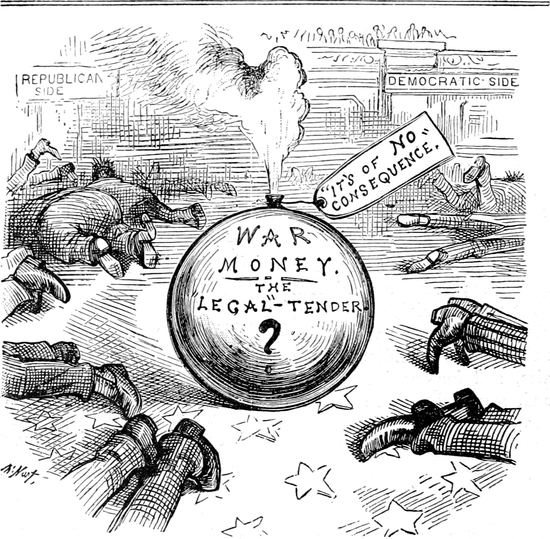
THE FINANCIAL BOOM
“Lay low!”
FROM A CARTOON BY THOMAS NAST IN “HARPER’S WEEKLY,” DECEMBER 27, 1879
GENERAL GRANT’S SERVICE TO SOUND MONEY
THUS matters stood up to the inauguration of President Grant. Early in his term was passed the “act to strengthen the public credit,” with its courageous declarations that “the faith of the United States is solemnly pledged to the payment in coin, or its equivalent, of all obligations of the United States not bearing interest, known as United States notes, and of all interest-bearing obligations of the United States.” The final clause was subject to a few proper exceptions; but coin was then held to mean gold, and the Government thus stood committed to establish its monetary system, as well as to discharge its debts, upon the basis of other advanced nations. General Grant as President brought to the solution of financial problems much of that grim, hard sense which served him so well in the field. In his annual message of 1869 he urged resumption of gold payments, but added:
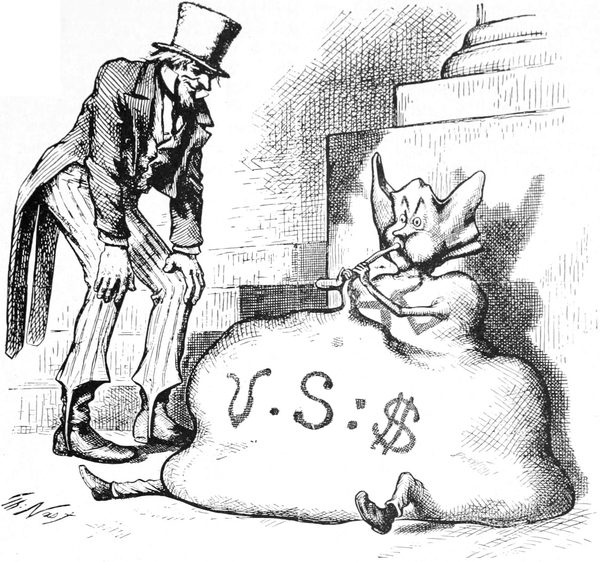
BY INFLATION YOU WILL BURST
UNCLE SAM: “You stupid Money-Bag there is just so much Money in you; and you can not make it any more by blowing yourself up!”
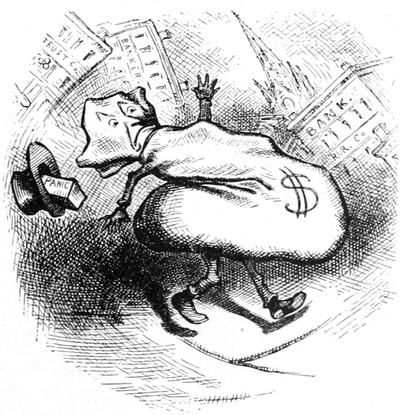
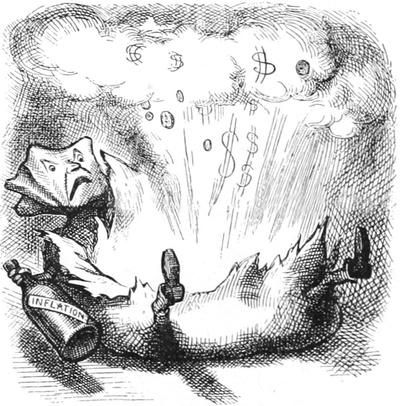
LET WELL ENOUGH ALONE, AND DON’T MAKE IT WORSE
Money is tight, but let it recover itself naturally, and then it will stand on a Sounder Basis.
Stimulants or Inflation only bring final collapse.
FROM CARTOONS BY THOMAS NAST IN “HARPER’S WEEKLY,” DECEMBER 20, 1873
“Immediate resumption, if practicable, would not be desirable. It would compel the debtor class to pay, beyond their contracts, the premium on gold at the date of their purchase, and would bring bankruptcy and ruin to thousands.”
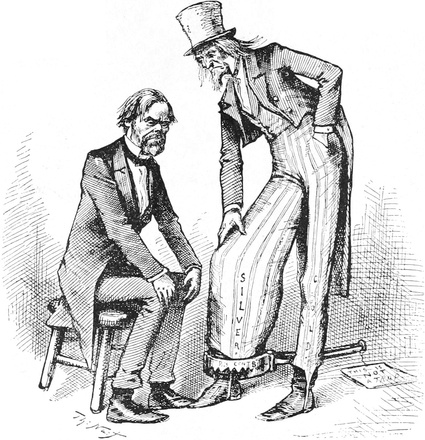
RESUMPTION (?)
UNCLE SAM: “There is no circulation in that leg, and it’s swelling every day more and more. Mortification will set in, and I am sure my other leg will be affected. Now Dr. SHERMAN, something must be done, and quick, too.”
FROM A CARTOON BY THOMAS NAST IN “HARPER’S WEEKLY,” NOVEMBER 29, 1879
But Grant, like other Republican Presidents, set his face like a flint against further inflation. When he received from a Congress controlled by his own party the so-called “Inflation Bill” of 1874, authorizing the increase of the volume of greenbacks to $400,000,000, he promptly returned it with his veto. John Sherman, a leading member of the Senate Committee on Finance, who had been unwilling to follow McCulloch in 1865, became convinced by 1873 that the time had come for setting a definite date for specie resumption. His method was not to retire the greenbacks, but to provide a gold fund for their current redemption. It was not until the crushing Republican defeat in the Congressional elections of 1874, however, that the party was ready for action. In the short session of December a special committee of Republican senators was appointed, from whose labors emerged the Resumption Act of January 14, 1875. It was a vague and evasive measure, purposely avoiding questions upon which there were wide differences of opinion; but it contained the one salient declaration that “on and after the first day of January, 1879, the Secretary of the Treasury shall redeem in coin the United States legal-tender notes then outstanding, on their presentation for redemption at the office of the Assistant Treasurer of the United States in the City of New York.” It also placed power in the hands of the Secretary of the Treasury to prepare and provide for resumption.
WHEN THE GOLD WAS THERE IT WAS NOT WANTED
MARKET conditions did not at once respond to this promise; but after the election of Hayes, a sound-money President, in 1876, and the gradual accumulation of gold, under the guiding hand of John Sherman, as Secretary of the Treasury, the same man who had managed the passage of the Resumption Act, it began to be understood that specie resumption was to be actually accomplished. The banks of New York City, which held about $125,000,000 of the $346,000,000 in legal-tender notes outstanding, abolished special gold deposits and agreed with the Treasury to receive and pay balances without discrimination between gold and notes. The news of these arrangements, completed in November, 1878, removed lingering doubts. In the gold-room of the New York Stock Exchange—the scene of so much agitation on “Black Friday” nine years before—a sale of gold was made, on December 17, 1878, at 12:29 P.M., at par. It was the first sale at par in sixteen years, but so quietly was the transaction accomplished that only three or four persons who stood near the registrar’s desk were cognizant of it. When the first of January, 1879, dawned, the banks, which might have presented millions of notes for gold, did not ask for a dollar; and the dull corridors of the New York Sub-Treasury hardly afforded an indication that the United States had reached and passed a crucial point in her history and on that day had reëntered the circle of solvent nations. Truly, the experience of that day, carefully prepared for as it had been, and attained at much cost and suffering, seemed to verify the contention of those who for many years had insisted that “The way to resume is to resume.”
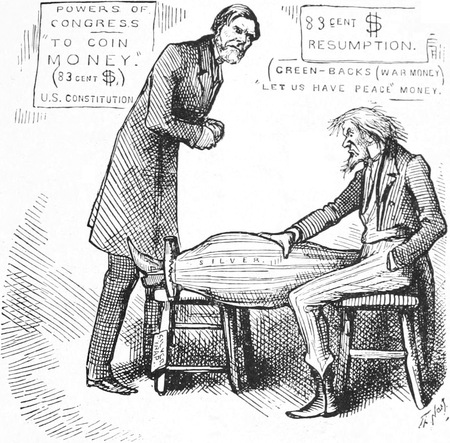
BE SOUND IN MIND AND BODY
UNCLE SAM: “As long as I keep these outstanding notes on my mind, which I am well able to pay, I am violating the laws of my constitution: and how can I expect my body to recover when my mind is not at ease?”
FROM A CARTOON BY THOMAS NAST IN “HARPER’S WEEKLY,” DECEMBER 13, 1879
THE “CROSS OF GOLD”
TWENTY-ONE years were to pass, however, before the country was to be extricated finally and absolutely from the shadow of an uncertain monetary standard. Specie resumption had not been accomplished when a bill was passed over the veto of President Hayes, on February 28, 1878, providing for the infusion of large masses of silver dollars into the circulation. This was followed by the so-called Sherman Silver Law of 1890, further increasing the amount of silver to be absorbed by the Treasury. The underlying motive for an increase in the monetary stock was the steady contraction which had been going on in the effort to restore the paper dollar to its old parity with gold; and for a time the country absorbed without apparent risk the additions made by the silver to the currency of the country. Gold exports set in, however, in heavy volume after the law of 1890; the Treasury began to lose its gold; and soon after the inauguration of President Cleveland, in 1893, the country stood face to face with the destruction of the gold standard. Panic supervened, and only at a special session of Congress in the autumn of 1893 was the further purchase of silver suspended by law.
The country lay prostrate for three years under a variety of ills, from which a young prophet from the West sought to rescue it by raising the standard of the free and unlimited coinage of silver “without the aid or consent of any other nation.” For a moment it seemed that the majority of the voters would respond to the electric thrill conveyed by this young leader, William Jennings Bryan, to the Democratic National Convention of 1896, when he wound up his famous speech with the declaration, “You shall not press down upon the brow of labor this crown of thorns; you shall not crucify mankind upon a cross of gold!”
A REAL CROSS OF GOLD
THE country decided for the continuance of the gold standard, and its decision was crystallized into law by the act of March 14, 1900. This act set aside for the protection of the greenbacks the sum of $150,000,000 in gold, to be kept inviolate from all other uses, and declared the bonds and other obligations of the Government to be redeemable in gold and in gold only. But the causes that were operating prior to 1892 to cause contraction in the monetary stock were reversed after that date by the great outpouring of new gold from the mines of South Africa and the Klondike. New processes of separating gold from low-grade ores made profitable fields that in earlier years would have been considered unavailable. The gold production of the world rose from $113,000,000 in 1890 to $202,251,000 in 1896 and $454,000,000 in 1910. Gold flowed into the Bank of England in the summer of 1896, even while Mr. Bryan was making his canvass for free silver, to an amount never before recorded in monetary history; and the beneficent flood soon overflowed the coffers of the advanced commercial nations and filled up the void in metallic money in such developing countries as Argentina, Brazil, Mexico, and India. In place of the fear of a scarcity of gold, which hung like a pall over some minds at the close of the last century, such a redundancy of the yellow metal arose that swollen bank reserves stimulated loans at low rates, manufacturing plants were extended, and prices of commodities advanced with a rapidity which lessened the purchasing power of wages and threatened to reduce the world to the unfortunate state of Midas, making gold a curse instead of a blessing.
It is this situation which has reduced the real income of the laborer, the professional man, and other classes, through the diminished purchasing power of their money, which is imposing a true cross of gold on the world to-day, and which presents to a new administration the problem of finding a way to establish and maintain an equitable standard of value.

Owned by Ernest W. Longfellow and now in the Boston Museum of Art. Half-tone plate engraved by H. Davidson
THE WIDOW
FROM THE PAINTING BY COUTURE
(EXAMPLES OF FRENCH PORTRAITURE)
❏ LARGER IMAGE