BOOK the Firſt.
John Clarke translation
A Man that is of Copernicus’s Opinion, that this Earth of ours is a Planet, carry’d round and enlighten’d by the Sun, like the reſt of the Planets, cannot but ſometimes think, that it’s not improbable that the reſt of the Planets have their Dreſs and Furniture, and perhaps their Inhabitants too as well as this Earth of ours: Eſpecially if he conſiders the later Diſcoveries made in the Heavens ſince Copernicus’s time, viz. the Attendants of Jupiter and Saturn, and the champaign and hilly Countries in the Moon, which are a ſtrong Argument of a Relation and Kin between our Earth and them, as well as a Proof of the Truth of that Syſtem. This has often been our Talk, I remember, good Brother, over a large Teleſcope, when we have been viewing thoſe Bodies, a Study that your continual Buſineſs and Abſence have interrupted for many Years. But we were always apt to conclude, that ’twas in vain to enquire after what Nature is doing there, ſeeing there was no likelihood of ever coming to any Certainty of the Enquiry. Nor could I ever find that any Philoſophers, either antient or modern, have attempted any thing upon this Subject. At the very Birth of Aſtronomy, when the Earth was firſt aſſerted to be Spherical, and to Some have already talk’d of the Inhabitants of the Planets, but went no farther. be ſurrounded with Air, even then there were ſome Men ſo bold as to affirm, there were an innumerable Company of Worlds in the Stars. But later Authors, ſuch as Cardinal Cuſanus, Brunus, Kepler, (and if we may believe him, Tycho was of that opinion too) have furniſhed the Planets with Inhabitants. Nay, Cuſanus and Brunus have allowed the Sun and fixed Stars theirs too. But this was the utmoſt of their Boldneſs; nor has the ingenious French Author of the Dialogues about the Plurality of Worlds carried this Matter any farther. Only ſome of them have coined ſome Stories of the Men in the Moon, juſt as probable as Lucian’s true Hiſtory; among which I muſt count Kepler’s, which he has diverted us with in his Aſtronomical Dream. But a while ago thinking ſomewhat ſeriouſly of this matter (not that I count my ſelf quicker-ſighted than thoſe great Men, but that I had the Happineſs to live after moſt of them) the Enquiry appeared not ſo impracticable, nor the Way ſo ſtopt up with Difficulties, but that there was very good room left for probable Conjectures. As they came into my Head, I put them down into common Places, and ſhall now try to digeſt them into ſome Method for your better Conception of them, and add ſomewhat of the Sun and fix’d Stars, and the Extent of that Univerſe of which our Earth is but an inconſiderable Point. I know you have ſuch an Eſteem and Reverence for any thing that belongs to the Heavens, that I perſwade my ſelf you will read what I have written with ſome Pleaſure: I’m ſure I writ it with a great deal; but as often before, ſo now, I find the Saying of Archytas true, even to the Letter, That tho’ a Man were admitted into Heaven to view the wonderful Fabrick of the World, and the Beauty of the Stars, yet what would otherwiſe be Rapture and Extaſie, would be but a melancholy Amazement if he had not a Friend to communicate it to. I could wiſh indeed that all the World might not be my Judges, but that I might chuſe my Readers, Men like you, not ignorant in Aſtronomy and true Philoſophy; for with ſuch I might promiſe my ſelf a favourable hearing, and not need to make an Apology for daring to vent any thing new to the World. But becauſe I am aware what weak Hands it’s likely to fall into, and what a ſevere Sentence I may expect from thoſe whoſe Ignorance or Zeal is too great; it may be worth the while to guard my ſelf beforehand againſt the Aſſaults of thoſe ſort of People.
The Objections of ignorant Cavillers prevented. There’s one ſort who knowing nothing of Geometry or Mathematicks, will laugh at it as a whimſical and ridiculous Undertaking. It’s an incredible Thing to them to talk of meaſuring the Diſtance and Magnitude of the Stars: And for the Motion of the Earth, they count it, if not a falſe, at leaſt a precarious Opinion; and no wonder then if they take what’s built upon ſuch a ſlippery Foundation for the Dreams of a fanciful Head and a diſtemper’d Brain. What ſhould we anſwer to theſe Men, but that their Ignorance is the Cauſe of their Diſlike, and that if they had ſtudied theſe things more, and viewed the Works of Nature nicely, they would have fewer Scruples? But few People having had an opportunity of proſecuting theſe Studies, either for want of Parts, Learning or Leiſure, we cannot blame their Ignorance; and if they reſolve to find fault with us for ſpending time in ſuch Matters, becauſe they do not underſtand the Uſe of them, we muſt appeal to properer Judges.
Theſe Conjectures do not contradict the holy Scriptures. The other ſort, When they hear us talk of new Lands, and Animals, and Creatures endued with as much Reaſon as themſelves, will be ready to cry out, that we ſet up our Conjectures againſt the Word of God, and broach Opinions directly oppoſite to Holy Writ. For we do not there read any thing of the Production of ſuch Creatures, no not ſo much as that they exiſt; nay rather we read the quite contrary. For, That only mentions this Earth with its Animals and Plants, and Man the Lord of them: To ſuch Perſons I anſwer, what has been often urged by others before me: That it’s evident, God had no deſign to make a particular Enumeration in the Holy Scriptures, of all the Works of his Creation. When therefore it is plain that under the general Name of Stars or Earth at the Creation, are comprehended all the Heavenly Bodies, even the Attendants upon Jupiter and Saturn, why muſt all that Multitude of Beings which the Almighty Creator has been pleaſed to place upon them, be excluded the Privilege, and not ſuffered to have a Share in the Expreſſion? And theſe Men themſelves can’t but know in what Senſe it is that all things are ſaid to be made for the Uſe of Man, not certainly for us to look at through a Teleſcope, for that’s very abſurd. Since then the greateſt part of God’s Creation, that innumerable multitude of Stars, is placed out of the reach of any Man’s Eye; and many of them it’s likely, of the beſt Glaſſes, ſo that they don’t ſeem to belong to us; is it ſuch an unreaſonable Opinion to think, that there are ſome reaſonable Creatures who ſee and admire thoſe glorious Bodies at a nearer diſtance?
This Enquiry not over curious. But perhaps they’ll ſay, it does not become us to be ſo curious and inquiſitive in theſe Things which the Supreme Creator ſeems to have kept for his own Knowledge: For ſince he has not been pleaſed to make any farther Diſcovery or Revelation of them, it ſeems little better than preſumption to make any inquiry into that which he has thought fit to hide. But theſe Gentlemen muſt be told, that they take too much upon themſelves when they pretend to appoint how far and no farther Men ſhall go in their Searches, and to ſet bounds to other Mens Induſtry; as if they knew the Marks that God has placed to Knowledge: or as if Men were able to paſs thoſe Marks. If our Forefathers had been at this rate ſcrupulous, we might have been ignorant ſtill of the Magnitude and Figure of the Earth, or that there was ſuch a Place as America. We ſhould not have known that the Moon is inlightned by the Sun’s Rays, nor what the Cauſes of the Eclipſes of each of them are, nor a multitude of other Things brought to light by the late Diſcoveries in Aſtronomy. For what can a Man imagine more abſtruſe, or leſs likely to be known, than what is now as clear as the Sun? Whence it follows, that vigorous Induſtry, and piercing Wit were given Men to make Advances in the Search of Nature, and there’s no Reaſon to put any Stop to ſuch Enquiries. I muſt acknowledge that what I here intend to treat of is not of that Nature as to admit of a certain Knowledge; I can’t pretend to aſſert any thing as poſitively true (for how is it poſſible) but only to advance a probable Gueſs, the Truth of which every one is at his own liberty to examine. If any one therefore ſhall gravely tell me, that I have ſpent my Time idly in a vain and fruitleſs Enquiry after what by my own acknowledgment I can never come to be ſure of; The Anſwer is, that at this rate he would put down all Natural Philoſophy as far as it concerns it ſelf in ſearching into the Nature Conjectures not uſeleſs, becauſe not certain. of Things: In ſuch noble and ſublime Studies as theſe, ’tis a Glory to arrive at Probability, and the Search it ſelf rewards the Pains. But there are many degrees of Probable, ſome nearer Truth than others, in the determining of which lies the chief exerciſe Theſe Studies uſeful to Religion. of our Judgment. But beſides the Nobleneſs and Pleaſure of the Studies, may not we be ſo bold as to ſay, they are no ſmall help to the Advancement of Wiſdom and Morality? ſo far are they from being of no uſe at all. For here we may mount from this dull Earth, and viewing it from on high, conſider whether Nature has laid out all her Coſt and Finery upon this ſmall Speck of Dirt. So, like Travellers into other diſtant Countries, we ſhall be better able to judge of what’s done at home, know how to make a true Eſtimate of, and ſet its own Value upon every Thing. We ſhall be leſs apt to admire what this World calls Great, ſhall nobly deſpiſe thoſe Trifles the generality of Men ſet their Affections on, when we know that there are a multitude of ſuch Earths inhabited and adorned as well as our own. And we ſhall worſhip and reverence that God the Maker of all theſe things; we ſhall admire and adore his Providence and wonderful Wiſdom which is diſplayed and manifeſted all over the Univerſe, to the Confuſion of thoſe who would have the Earth and all things formed by the ſhuffling Concourſe of Atoms, or to be without beginning. But to come to our Purpoſe.
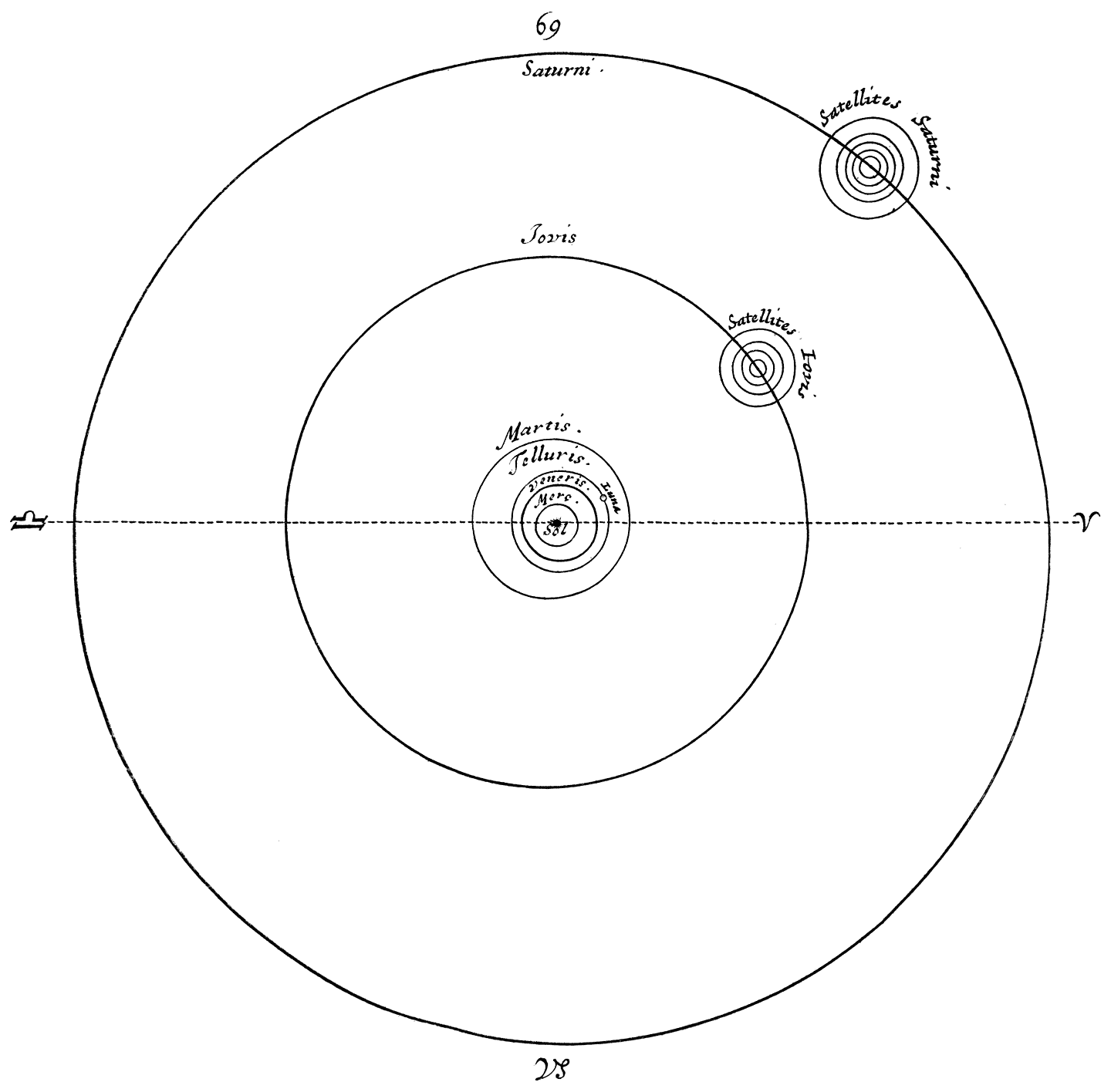
Fig. 1 SYSTEMA COPERNICI.
p. 11.
Copernicus’s Syſtem explained. And now becauſe the chief Argument for the Proof of what we intend will be taken from the Diſpoſition of the Planets, among which without doubt, the Earth muſt be counted in the Copernican Syſtem, I ſhall here firſt of all draw two Figures. The firſt is a Deſcription of the Orbs the Planets move in, in that order that they are placed round the Sun, drawn as near as can be in their true Proportions, like what you have ſeen in my Clock at home. The ſecond ſhows the Proportions of their Magnitudes in reſpect of one another and of the Sun, which you know is upon that ſame Clock of mine too. In the firſt the middle Point or Center is the Place of the Sun, round which, in an order that every one knows, are the Orbits of Mercury, Venus, the Earth with that of the Moon about it; then thoſe of Mars, Jupiter and Saturn: and about the two laſt the ſmall Circles that their Attendants move in: about Jupiter four, and about Saturn five. Which Circles as well as that of the Moon are drawn larger than their true Proportion would admit, otherwiſe they could not have been ſeen. You may eaſily apprehend the Vaſtneſs of theſe Orbits by this, that the diſtance of the Earth from the Sun is ten or twelve thouſand of the Earth’s Diameters. Almoſt all theſe Circles are in the ſame Plane, declining very little from that in which the Earth moves, call’d The Plane of the Ecliptick. This Plane is cut obliquely by the Axis upon which the Earth turns it ſelf round with reſpect to the Sun in 24 Hours, whence ariſe the Succeſſions of Day and Night: The Axis of the Earth always keeping the ſame Inclination to the Ecliptick (except a ſmall Change beſt known to Aſtronomers) while the Earth itſelf is carried in its yearly Courſe round the Sun, cauſes the regular Order of the Seaſons of the Year: as you may ſee in all Aſtronomers Books. Out of which I ſhall tranſcribe hither the Periods of the Revolutions of the Planets, viz. Saturn moves round the Sun in 29 Years, 174 Days, and 5 Hours: Jupiter finiſhes his Courſe in 11 Years, 317 Days, and 15 Hours: Mars his in about 687 Days. Our Year is 365 Days 6 Hours: Venus’s 224 Days 18 Hours: and Mercury’s 88 Days. This is the now commonly received Syſtem, invented by Copernicus, and very agreeable to that frugal Simplicity Nature ſhows in all Arguments for the Truth on’t. her Works. If any one is reſolved to find fault with it, let him firſt be ſure he underſtands it. Let him firſt ſee in the Books of Aſtronomers with how much greater Eaſe and Plainneſs all the Motions of the Stars, and Appearances in the Heavens are explained and demonſtrated in this than either in that of Ptolomy or Tycho. Let him conſider that Diſcovery of Kepler, that the Diſtances of the Planets from the Sun, as well of the Earth as the reſt, are in a fix’d certain proportion to the Times they ſpend in their Revolutions. Which Proportion it’s ſince obſerved that their Satellites keep round Jupiter and Saturn. Let him examine what a contradictory Motion they are fain to invent for the Solution of the Polar Star’s changing its Diſtance from the Pole. For that Star in the end of the little Bear’s Tail which now deſcribes ſo ſmall a Circle round the Pole, that it is not above two Degrees and twenty Minutes, was obſerved about 1820 Years ago, in the Time of Hipparchus, to be above 12: and will within a few Ages more be 45 Degrees diſtant from it: and after 25000 Years more will return to the ſame Place it is now in. Now if with them we allow the Heavens to be turned upon their own Axis, at this rate they muſt have a new Axis every Day: a Thing moſt abſurd, and repugnant to the Nature of all Motion. Whereas nothing is eaſier with Copernicus than to give us Satisfaction in this Matter. Then he may impartially weigh thoſe Anſwers that Galilæus, Gaſſendus, Kepler, and others have given to all Objections propoſed, which have ſo ſatisfied all Scruples, that generally all Aſtronomers now-a-days are brought over to our Side, and allow the Earth its Motion and Place among the Planets. If he cannot be ſatisfied with all this, he is either one whoſe Dulneſs can’t comprehend it, or who has his Belief at another Man’s Diſpoſal.
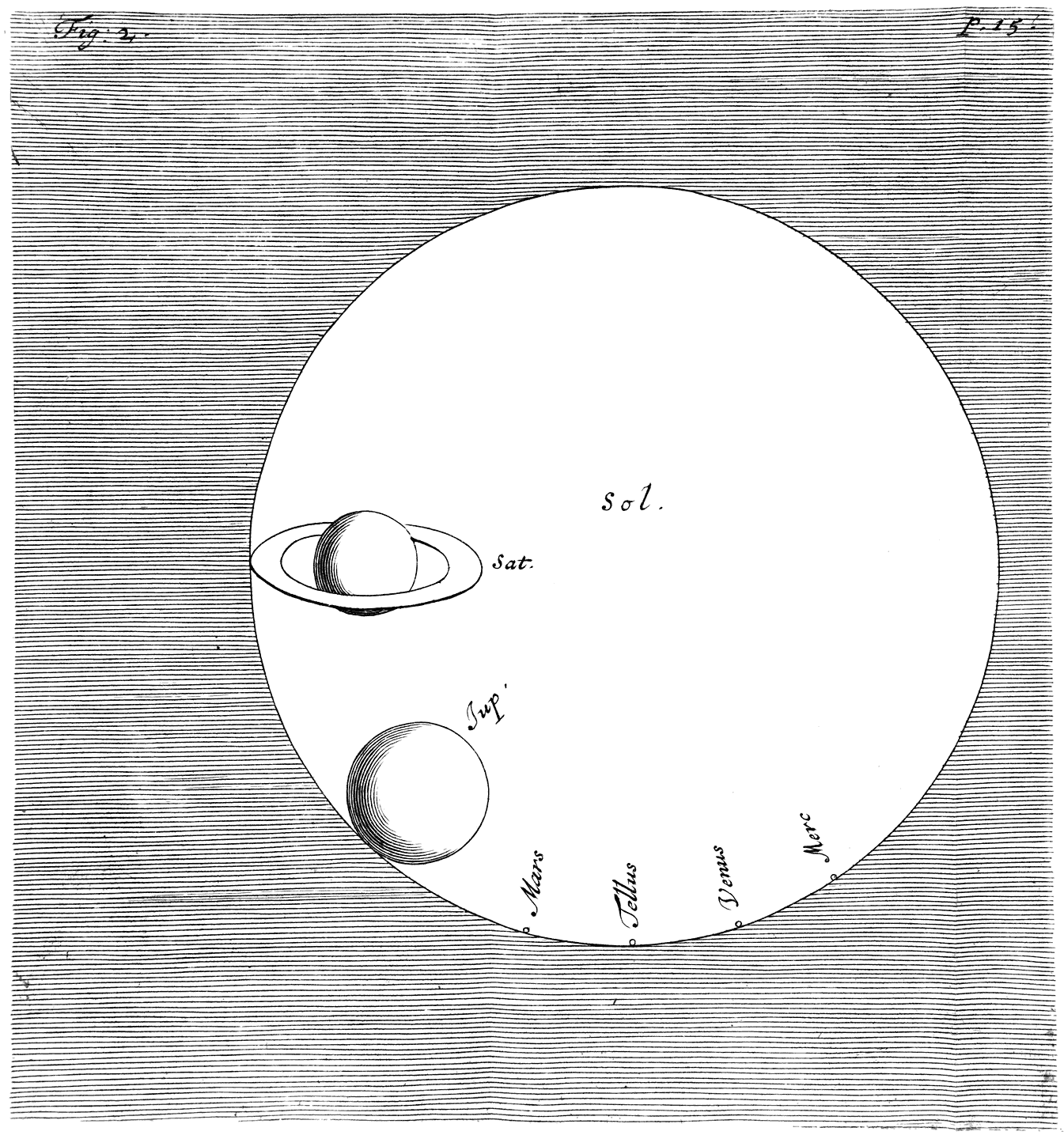
Fig. 2.
p. 15.
In the other Figure you have the Globes of the Planets, and of the Sun, repreſented to your Eyes as placed near one another. Where The Proportion of the Magnitude of the Planets, in reſpect of one another, and the Sun. I have obſerved the ſame Proportion, of their Diameters to that of the Sun, that I publiſhed to the World in my Book of The Appearances of Saturn: namely, the Diameter of the Ring round Saturn is to that of the Sun as 11 as to 37; that of Saturn himſelf about as 5 to 37; that of Jupiter as 2 to 11; that of Mars as 1 to 166; of the Earth as 1 to 111; and of Venus as 1 to 84: to which I ſhall now add that of Mercury obſerved by Hevelius in the Year 1661, but calculated by my ſelf, and found to be as 1 to 290.
If you would know the way that we came to this Knowledge of their Magnitudes, by knowing the Proportion of their Diſtances from the Sun, and the Meaſures of their Diameters, you may find it in the Book before-mentioned: And I cannot yet ſee any Reaſon to make an Alteration in thoſe I then ſettled, altho’ I will not ſay they are without their Faults. The Lamellæ more convenient than Micrometers. For I can’t yet be of their Mind, who think the Uſe of Micrometers, as they call them, is beyond that of our Plates, but muſt ſtill think that thoſe thin Plates or Rods of which I there taught the Uſe, not to detract from the due Praiſes of ſo uſeful an Invention, are more convenient than the Micrometers.
In this proportion of the Planets it is worth while to take notice of the prodigious Magnitude of the Sun in compariſon with the four innermoſt, which are far leſs than Jupiter and Saturn. And ’tis remarkable, that the Bodies of the Planets do not increaſe together with their Diſtances from the Sun, but that Venus is much bigger than Mars.
The Earth juſtly likened to the Planets, and the Planets to it. Having thus explained the two Schemes, there’s no Body I ſuppoſe but ſees, that in the firſt the Earth is made to be of the ſame ſort with the reſt of the Planets. For the very Poſition of the Circles ſhows it. And that the other Planets are round like it, and like it receive all the Light they have from the Sun, there’s no room (ſince the Diſcoveries made by Teleſcopes) to doubt. Another Thing they are like it in is, that they are moved round their own Axis; for ſince ’tis certain that Jupiter and Saturn are, who can doubt it of the others? Again, as the Earth has its Moon moving round it, ſo Jupiter and Saturn have theirs. Now ſince in ſo many Things they thus agree, what can be more probable than that in others they agree too; and that the other Planets are as beautiful and as well ſtock’d with Inhabitants as the Earth? Or what ſhadow of Reaſon can there be why they ſhould not?
If any one ſhould be at the Diſſection of a Dog, and be there ſhewn the Intrails, the Heart, Stomach, Liver, Lungs and Guts, all the Veins, Arteries and Nerves; could ſuch a Man reaſonably doubt whether there were the ſame Contexture and Variety of Parts in a Bullock, Hog, or any other Beaſt, tho’ he had never chanc’d to ſee the like opening of them? I don’t believe he would. Or were we thoroughly ſatisfy’d in the Nature of one of the Moons round Jupiter, ſhould not we ſtraight conclude the ſame of the reſt of them? So if we could be aſſur’d in but one Comet, what it was that is the Cauſe of that ſtrange Appearance, ſhould we not make that a Standard to judge of all others by? Arguments from their Similitude, of no ſmall weight. ’Tis therefore an Argument of no ſmall Weight that is fetch’d from Relation and Likeneſs; and to reaſon from what we ſee and are ſure of, to what we cannot, is no falſe Logick. This muſt be our Method in this Treatiſe, wherein from the Nature and Circumſtances of that Planet which we ſee before our Eyes, we may gueſs at thoſe that are farther diſtant from us.
The Planets are ſolid, and not without Gravity. And, Firſt, ’tis more than probable that the Bodies of the Planets are ſolid like that of our Earth, and that they don’t want what we call Gravity, that Virtue, which like a Loadſtone attracts whatſoever is near the Body to its Center. And that they have ſuch a Quality, their very Figure is a Proof; for their Roundneſs proceeds only from an equal preſſure of all their Parts tending to the ſame Center. Nay more, we are ſo skilful now-a-days, as to be able to tell how much more or leſs the Gravitation in Jupiter or Saturn is than here; of which Diſcovery and its Author you may read my Eſſay of the Cauſes of Gravitation.
But now to carry the Search farther, let us ſee by what Steps we muſt riſe to the attaining ſome knowledge in the deeper Secrets concerning the State and Furniture of theſe new Earths. And, firſt, how likely is it that they may be ſtock’d with Plants Have Animals and Plants. and Animals as well as we? I ſuppoſe no Body will deny but that there’s ſomewhat more of Contrivance, ſomewhat more wonderful in the Production and Growth of Plants and Animals, than in Lifeleſs Heaps of inanimate Bodies, be they never ſo much larger; as Mountains, Rocks, or Seas are. For the Finger of God, and the Wiſdom of Divine Providence, is in them much more clearly manifeſted than in the other. One of Democritus’s or Cartes’s Scholars may venture perhaps to give ſome tolerable Explication of the Appearances in Heaven and Earth, allow him but his Atoms and Motion; but when he comes to Plants and Animals, he’ll find himſelf non-plus’d, and give you no likely account of their Production. For every Thing in them is ſo exactly adapted to ſome Deſign, every part of them ſo fitted to its proper Uſe, that they manifeſt an Infinite Wiſdom, and exquiſite Knowledge in the Laws of Nature and Geometry, as, to omit thoſe Wonders in Generation, we ſhall by and by ſhow; and make it an Abſurdity even to think of their being thus happily jumbled together by a chance Motion of I don’t know what little Particles. Now ſhould we allow the Planets nothing but vaſt Deſerts, lifeleſs and inanimate Stocks and Stones, and deprive them of all thoſe Creatures that more plainly ſpeak their Divine Architect, we ſhould ſink them below the Earth in Beauty and Dignity; a Thing very unreasonable, as I ſaid before.
Well then, we have gain’d the Point thus far, and the Planets may be allowed ſome Creatures capable of moving themſelves, not at all inferior to ours; and theſe are Animals. And if this be allowed, it almoſt neceſſarily follows, that there muſt be Herbs Not to be imagin’d too unlike ours. for Food for them. And as for the Growth and Nouriſhment of all theſe, ’tis no doubt the ſame with ours, ſeeing they have the ſame Sun to warm and enliven them as ours have.
But perhaps ſome Body may ſay, we conclude too faſt. They will not deny indeed but that there may be Plants and Animals on the Surface of the Planets, that deſerve as well to be provided for by their Creator as ours do: but why muſt they be of the ſame Kind with ours: Nature ſeems to love variety in her Works, and may have made them widely different from ours either in their matter or manner of Growth, in their outward Shape, or their inward Contexture; ſhe may have made them ſuch as neither our Underſtanding nor Imagination can conceive. That’s the Thing we ſhall now examine, and whether it be not more likely that ſhe has not obſerv’d ſuch a Variety as they talk of. Nature ſeems moſt commonly, and in moſt of her Works, to affect Variety, ’tis true; But they ſhould conſider ’tis not the Buſineſs of Men to pretend to ſettle how great this Difference and Variety muſt be. Nor does it follow, becauſe it may be Infinite, and out of our Comprehenſion and Reach, that therefore Things in reality are ſo. For ſuppoſe God ſhould have pleaſed to have made all Things in the reſt of the Planets juſt as he has here, the Inhabitants of thoſe Places (if there are any ſuch) would admire his Wiſdom and Contrivance no leſs than if they were widely different; ſeeing they can’t come to know what’s done in the other Planets. Who doubts but that God, if he had pleaſed, might have made the Animals in America and other diſtant Countries nothing like ours? yet we ſee he has not done it. They have indeed ſome difference in their Shape, and ’tis fit they ſhould, to diſtinguiſh the Plants and Animals of thoſe Countries from ours, who live on this ſide the Earth; but even in this Variety there is an Agreement, an exact Correſpondence in Figure and Shape, the ſame ways of Growth, and new Productions, and of continuing their own Kind. Their Animals have Feet and Wings like ours, and like ours have Hearts, Lungs, Guts, and the Parts ſerving to Generation; whereas all theſe Things, as well with them as us, might, if it had pleaſed Infinite Wiſdom, have been order’d a very different Way. ’Tis plain then that Nature has not exhibited that Variety in her Works that ſhe could, and therefore we muſt not allow that Weight to this Argument, as upon the Account of it to make every Thing in the Planets quite different from what is here. ’Tis more probable that all the Difference there is between us and them, ſprings from the greater or leſs diſtance and influence from that Fountain of Heat and Life the Sun; which will cauſe a Difference not ſo much in their Form and Shape, as in their Matter and Contexture.
Planets have Water. And as for the Matter whereof the Plants and Animals there conſiſt, tho’ it is impoſſible ever to come to the Knowledge of its Nature, yet this we may venture to aſſert (there being ſcarce any Doubt of it) that their Growth and Nouriſhment proceeds from ſome liquid Principle. For all Philoſophers agree that there can be no other way of Nutrition; ſome of the Chief among them having made Water to be the Original of all Things: For whatſoever’s dry and without Moiſture, is without Motion too; and without Motion, it’s impoſſible there ſhould be any Increaſe. But the Parts of a Liquid being in continual Motion one with another, and inſinuating and twiſting themſelves into the ſmalleſt Places, are thereby very proper and apt to add not themſelves only, but whatſoever elſe they may bring along with them, to the Increaſe and Growth of Bodies. Thus we ſee that by the Means of Water the Plants grow, bloſſom, and bear Fruit; and by the Addition of that only, Stones grow together out of Sand. And there’s no doubt but that Metals, Cryſtals, and Jewels, have the ſame Method of Production: Tho’ in them there has been no opportunity to make the ſame Obſervation, as well by reaſon of their ſlow Advances, as that they are commonly found far from the Places of their Generation; thrown up I ſuppoſe by ſome Earthquakes, or Convulſions. That the Planets are not without Water, is made not improbable by the late Obſervations: For about Jupiter are obſerved ſome Spots of a darker Colour than the reſt of his Body, which by their continual change ſhow themſelves to be Clouds: For the Spots of Jupiter which belong to him, and never remove from him, are quite different from theſe, being ſometimes for a long time not to be ſeen for theſe Clouds; and again, when theſe diſappear, ſhowing themſelves. And at the going off of theſe Clouds, ſome Spots have been taken notice of in him, much brighter than the reſt of his Body, which remained but a little while, and then were hid from our Sight. Theſe Monſieur Caſſini thinks are only the Reflection from the Snow that covers the Tops of the Hills in Jupiter: But I ſhould rather think that it is only the Colour of the Earth, which happens to be free from thoſe Clouds that commonly darken it.
Mars too is found not to be without his dark Spots, by means of which he has been obſerved to turn round his own Axis in 24 Hours and 40 Minutes; the Length of his Day: but whether he has Clouds or no, we have not had the ſame opportunity of obſerving as in Jupiter, as well becauſe even when he is neareſt the Earth, he appears to us much leſs than Jupiter, as that his Light not coming ſo far, is ſo brisk as to be an Impediment to exact Obſervations: And this Reaſon is as much ſtronger in Venus as its Light is. But ſince ’tis certain that the Earth and Jupiter have their Water and Clouds, there is no Reaſon why the other Planets But not juſt like ours. ſhould be without them. I can’t ſay that they are exactly of the ſame nature with our Water; but that they ſhould be liquid their Uſe requires, as their Beauty does that they ſhould be clear. For this Water of ours, in Jupiter or Saturn, would be frozen up inſtantly by reaſon of the vaſt diſtance of the Sun. Every Planet therefore muſt have its Waters of ſuch a temper, as to be proportioned to its Heat: Jupiter’s and Saturn’s muſt be of ſuch a Nature as not to be liable to Froſt; and Venus’s and Mercury’s of ſuch, as not to be eaſily evaporated by the Sun. But in all of them, for a continual ſupply of Moiſture, whatever Water is drawn up by the Heat of the Sun into Vapours, muſt neceſſarily return back again thither. And this it cannot do but in Drops, which are cauſed as well there as with us, by their aſcending into a higher and colder Region of the Air, out of that which, by reaſon of the Reflection of the Rays of the Sun from the Earth, is warmer and more temperate.
Here then we have found in theſe new Worlds Fields warm’d by the kindly Heat of the Sun, and water’d with fruitful Dews and Showers: That there muſt be Plants in them as well for Ornament as Uſe, we have ſhewn juſt now. And what Nouriſhment, what manner of Growth ſhall we allow Plants grow and are nouriſhed there as they are here. them? Probably, there can be no better, nay no other, than what we here experience; by having their Roots faſtned into the Earth, and imbibing its nouriſhing Juices by their tender Fibres. And that they may not be only like ſo many bare Heaths, with nothing but creeping Shrubs and Buſhes, we may allow them ſome nobler and loftier Plants, Trees, or ſomewhat like them: Theſe being the greateſt, and, except Waters, the only Ornament that Nature has beſtowed upon the Earth. For not to ſpeak of thoſe many uſes that are made of their Wood, there’s no one that is ignorant either of their Beauty or Pleaſantneſs. Now what way can any one imagine for a continual Production and Succeſſion of theſe Plants, but their bearing Seed? A Method ſo excellent, that it’s the only one that Nature has here made uſe of, and ſo wonderful, that it ſeems to be deſigned not for this Earth alone. In fine, there’s the ſame reaſon to think that this Method is obſerved in thoſe diſtant Countries, as there was of its being followed in the remote Quarters of this ſame Earth.
The ſame true of their Animals. ’Tis much the ſame in Animals as ’tis in Plants, as to their manner of Nouriſhment, and Propagation of their Kind. For ſince all the living Creatures of this Earth, whether Beaſts, Birds, Fiſhes, Worms, or Inſects, univerſally and inviolably follow the ſame conſtant and fix’d Inſtitution of Nature; all feed on Herbs, or Fruits, or the Fleſh of other Animals that fed on them: ſince all Generation is performed by the impregnating of the Eggs, and the Copulation of Male and Female: Why may not the ſame Rule be obſerved in the Planetary Worlds? For ’tis certain that the Herbs and Animals that are there would be loſt, their whole Species deſtroyed without ſome daily new Productions: except there be no ſuch thing there as Misfortune or Accident: except the Plants are not like other humid Bodies, but can bear Heat, Froſt, and Age, without being dry’d up, kill’d or decay’d: except the Animals have Bodies as hard and durable as Marble; which I think are groſs Abſurdities. If we ſhould invent ſome new Way for their coming into the World, and make them drop like Soland Geeſe from Trees, how ridiculous would this be to any one that conſiders the vaſt Difference between Wood and Fleſh? Or ſuppoſe we ſhould have new ones made every Day out of ſome ſuch fruitful Mud as that of Nile, who does not ſee how contrary this is to all that’s reaſonable? And that ’tis much more agreeable to the Wiſdom of God, once for all to create of all ſorts of Animals, and diſtribute them all over the Earth in ſuch a wonderful and inconceivable way as he has, than to be continually obliged to new Productions out of the Earth? And what miſerable, what helpleſs Creatures muſt theſe be, when there’s no one that by his Duty will be obliged, or by that ſtrange natural fondneſs, which God has wiſely made a neceſſary Argument for all Animals to take care of their own, will be moved to aſſiſt, nurſe or educate them?
As for what I have ſaid concerning their Propagation, I cannot be ſo poſitive; but the other Thing, namely, that they have Plants and Animals, I think I have fully proved, viz. from hence, that otherwiſe they would be inferiour to our Earth. And by the ſame Argument, they muſt have as great a Variety of both as we have. What this is, will be beſt known to him that conſiders the different Ways our Animals make uſe of in moving from one Place to another. Which may be reduc’d, I think, to theſe, either that they walk upon two Feet or Four; or like Inſects, upon Six, nay ſometimes Hundreds; or that they fly in the Air bearing up, and wonderfully ſteering themſelves with their Wings; or creep upon the Ground without Feet; or by a violent Spring in their Bodies, or paddling with their Feet, cut themſelves a Way in the Waters. I don’t believe, nor can I conceive, that there ſhould be any other Way than theſe mentioned. The Animals then in the Planets muſt make uſe of one or more of theſe, like our amphibious Birds, which can ſwim in Water as well as walk on Land, or fly in the Air; or like our Crocodiles and Sea-Horſes, muſt be Mongrels, between Land and Water. There can no other Method be imagined but one of theſe. For where is it poſſible for Animals to live, except upon ſuch a ſolid Body as our Earth, or a fluid one like the Water, or ſtill a more fluid one than that, ſuch as our Air is? The Air I confeſs may be much thicker and heavier than ours, and ſo, without any Diſadvantage to its Tranſparency, be fitter for the volatile Animals. There may alſo be many ſorts of Fluids ranged over one another in Rows as it were. The Sea perhaps may have ſuch a fluid lying on it, which tho’ ten times lighter than Water, may be a hundred Times heavier than Air; whoſe utmoſt Extent may not be ſo large as to cover the higher Places of their Earth. But there’s no Reaſon to ſuſpect or allow them this, ſince we have no ſuch Thing; and if we did, it would be of no Advantage to them, for that the former Ways of moving would not be hereby at all increas’d: But when we come to meddle with the Shape of theſe Creatures, and conſider the incredible Variety that is even in thoſe of the different parts of this Earth, and that America has ſome which are no where elſe to be found, I muſt then confeſs that I think it beyond the Force of Imagination to arrive at any knowledge in the Matter, or reach to Probability concerning the Figures of theſe Planetary Animals. Altho’ conſidering theſe Ways of Motion we e’en now recounted, they may perhaps be no more different from ours than ours (thoſe of ours I mean that are moſt unlike) are from one another.
If a Man were admitted to a Survey of Jupiter or Venus, he would no doubt find as great a Number and Variety as he had at home. Let us then, that we may make as near a Gueſs at, and as reaſonable a Judgment of the Matter as we can, conſider the many Sorts, and the admirable Difference in the Shapes of our own Animals; running Great Variety of Animals in this Earth. over ſome of the Chief of them (for ’twould be tedious to ſet about a general Catalogue) that are notoriouſly different from one another, either in the Figure or ſome peculiar Property belonging to them; as they belong to the Land, or the Water, or the Air. Among the Beaſts we may take notice of the great Diſtance between the Horſe, the Elephant, the Lion, the Stag, the Camel, the Hog, the Ape, the Porcupine, the Tortoiſe, the Cameleon: in the Water, of that between the Whale, and the Sea-Calf, the Skait, the Pike, the Eel, the Ink-Fiſh, the Pourcontrel, the Crocodile, the Flying-fiſh, the Cramp-fiſh, the Crab, the Oiſter, and the Purple-Fiſh: and among Birds, of that between the Eagle, the Oſtrich, the Peacock, the Swan, the Owl, and the Bat: and in Inſects, of that between the Ants, the Spider, the Fly, and the Butterfly; and of that Prodigy in their wonderful change from Worms. In this Roll I have paſs’d by the creeping Kind as one Sort, and skip’d over that vaſt Multitude of leſs different Animals that fill the intermediate Spaces. But be they never ſo many, there is no And no leſs in the Planets. reaſon to think that the Planets cannot match them. For tho’ we in vain gueſs at the Figures of thoſe Creatures, yet we have diſcover’d ſomewhat of their manner of Life in general; and of their Senſes we ſhall ſpeak more by and by.
The ſame in Plants. The more conſiderable Differences in our Plants ought to be thought on, as well as the other. As in Trees, that between the Fir and the Oak, the Palm, the Vine, the Fig, and the Coco-Nut Tree, and that in the Indies, from whoſe Boughs new Roots ſpring, and grow downwards into the Earth. In Herbs, the Difference is notable between Graſs, Poppy, Colewort, Ivy, Pompions, and the Indian Fig with thick Leaves growing up without any Stalk, and Aloe. Between every one of which again there are many leſs differing Plants not taken notice of. Then the different Ways of raiſing them are remarkable, whether from Seeds, or Kernels, or Roots, or by grafting or inoculating them. And yet in all theſe, whether we conſider the Things themſelves, or the Ways of their Production, I make no doubt but that the Planetary Worlds have as wonderful a Variety as we.
But ſtill the main and moſt agreeable Point of the Enquiry is behind, Rational Animals in the Planets. which is the placing ſome Spectators in theſe new Diſcoveries, to enjoy theſe Creatures we have planted them with, and to admire their Beauty and Variety. And among all, that have never ſo ſlightly meddled with theſe Matters, I don’t find any that have ſcrupled to allow them their Inhabitants: not Men perhaps like ours, but ſome Creatures or other endued with Reaſon. For all this Furniture and Beauty the Planets are ſtock’d with ſeem to have been made in vain, without any Deſign or End, unleſs there were ſome in them that might at the ſame time enjoy the Fruits, and adore the wiſe Creator of them. But this alone would be no prevailing Argument with me to allow them ſuch Creatures. For what if we ſhould ſay, that God made them for no other Deſign, but that he himſelf might ſee (not as we do ’tis true; but that he that made the Eye ſees, who can doubt?) and delight himſelf in the Contemplation of them? For was not Man himſelf, and all that the whole World contains, made upon this very account? That which makes me of this Opinion, that thoſe Worlds are not without ſuch a Creature endued with Reaſon, is, that otherwiſe our Earth would have too much the Advantage of them, in being the only part of the Univerſe that could boaſt of ſuch a Creature ſo far above, not only Plants and Trees, but all Animals whatſoever: a Creature that has ſomething Divine in him, that knows, and underſtands, and remembers ſuch an innumerable number of Things; that deliberates, weighs and judges of the Truth: A Creature upon whoſe Account, and for whoſe Uſe, whatſoever the Earth brings forth ſeems to be provided. For every Thing here he converts to his own Ends. With the Trees, Stones, and Metals, he builds himſelf Houſes: the Birds and Fiſhes he ſuſtains himſelf with: and the Water and Winds he makes ſubſervient to his Navigation, as he doth the ſweet Smell and glorious Colours of the Flowers to his Delight. What can there be in the Planets that can make up for its Defects in the want of ſo noble an Animal? If we ſhould allow Jupiter a greater Variety of other Creatures, more Trees, Herbs and Metals, all theſe would not advantage or dignify that Planet ſo much as that one Animal doth ours by the admirable Productions of his penetrating Wit. If I am miſtaken in this, I do not know when to truſt my Reaſon, and muſt allow my ſelf to be but a poor Judge in the true Eſtimate of Things.
Vices of Men no hindrance to their being the Glory of the Planet they inhabit. Nor let any one ſay here, that there’s ſo much Villany and Wickedneſs in Man that we have thus magnified, that it’s a reaſonable Doubt, whether he would not be ſo far from being the Glory and Ornament of the Planet that enjoys his Company, that he would be rather its Shame and Diſgrace. For firſt, the Vices that moſt Men are tainted with, are no hindrance, but that thoſe that follow the Dictates of true Reaſon, and obey the Rules of a rigid Virtue, are ſtill a Beauty and Ornament to the Place that has the Happineſs to harbour them. Beſides, the Vices of Men themſelves are of excellent Uſe, and are not permitted and allowed in the World without wiſe Deſign. For ſince it has ſo pleaſed God to order the Earth, and every Thing in it as we ſee it is (for it’s abſurd to ſay it happen’d againſt his Will or Knowledge) we muſt not think that ſo great a Diverſity of Minds were placed in different Men to no End or Purpoſe: but that this mixture of bad Men with Good, and the Conſequents of ſuch a Mixture, as Misfortunes, Wars, Afflictions, Poverty, and the like, were permitted for this very good End, viz. the exerciſing our Wits, and ſharpening our Inventions; by forcing us to provide for our own neceſſary Defence againſt our Enemies. ’Tis to the Fear of Poverty and Miſery that we are beholden for all our Arts, and for that natural Knowledge which was the Product of laborious Induſtry; and which makes us that we cannot but admire the Power and Wiſdom of the Creator, which otherwiſe we might have paſſed by with the ſame indifference as Beaſts. And if Men were to lead their whole Lives in an undiſturbed continual Peace, in no fear of Poverty, no danger of War, I doubt they would live little better than Brutes, without all knowledge or enjoyment of thoſe Advantages that make our Lives paſs on with Pleaſure and Profit. We ſhould want the wonderful Art of Writing, if its great Uſe and neceſſity in Commerce and War had not forced out the Invention. ’Tis to theſe we owe our Art of Sailing, our Art of Sowing, and moſt of thoſe Diſcoveries of which we are Maſters; and almoſt all the Secrets in experimental Knowledge. So that thoſe very Things on account of which the Faculty of Reaſon ſeems to have been accuſed, are no ſmall helps to its Advancement and Perfection. For thoſe Virtues themſelves, Fortitude and Conſtancy, would be of no uſe if there were no Dangers, no Adverſity, no Afflictions for their Exerciſe and Trial.
If we ſhould therefore imagine in the Planets ſome ſuch reaſonable Creature as Man is, adorn’d with the ſame Virtues, and liable to the ſame Vices, it would be ſo far from degrading or vilifying them, that while they want ſuch a one, I muſt think them inferior to our Earth.
Reaſon they are not different from what ’tis here. But if we allow theſe Planetary Inhabitants ſome ſort of Reaſon, muſt it needs, may ſome ſay, be the ſame with ours? Certainly it muſt, whether we conſider it as applied to Juſtice and Morality, or exerciſed in the Principles and Foundations of Science. For Reaſon with us is that which gives us a true Senſe of Juſtice and Honeſty, Praiſe, Kindneſs and Gratitude: ’tis That that teaches us to diſtinguiſh univerſally between Good and Bad; and renders us capable of Knowledge and Experience in it. And can there be any where any other Sort of Reaſon than this? or can what we call juſt and generous, in Jupiter or Mars be thought unjuſt Villany? This is not at all, I don’t ſay probable, but poſſible. For the Aim and Deſign of the Creator is every where the Preſervation and Safety of his Creatures. Now when ſuch Reaſon as we are Maſters of, is neceſſary for the preſervation of Life, and promoting of Society (a thing that they are not without, as we ſhall ſhow) would it not be ſtrange that the Planetary Inhabitants ſhould have ſuch a perverſe Sort of Reaſon given them, as would neceſſarily deſtroy and confound what it was deſign’d to maintain and defend? But allowing Morality and Paſſions with thoſe diſtant Inhabitants to be ſomewhat different from ours, and ſuppoſing they may act by other Principles in what belongs to Friendſhip and Anger, Hatred, Honeſty, Modeſty, and Comelineſs, yet ſtill there would be no doubt, but that in the Search after Truth, in judging of the Conſequences of Things, in Reaſoning, particularly in that Sort which belongs to Magnitude or Quantity, about which their Geometry (if they have ſuch a Thing) is employ’d, there would be no doubt, I ſay, but that their Reaſon here muſt be exactly the ſame, and go the ſame way to work with ours, and that what’s true in one part will hold true over the whole Univerſe; ſo that all the difference muſt lie in the Degrees of Knowledge, which will be proportional to the Genius and Capacity of the Inhabitants.
They have Senſes. But I perceive I am got ſomewhat too far: Let us firſt enquire a little concerning the bodily Senſes of theſe Planetary Perſons; for without ſuch, neither will Life be any Pleaſure to them, nor Reaſon of any Uſe. And I think it very probable, that all their Animals, as well their Beaſts as rational Creatures, are like ours in all that relates to the Senſes: For without the Power of Seeing we ſhould find it impoſſible for Animals to provide Food for themſelves, or be ſore-warn’d of any approaching Danger, ſo as to guard themſelves from it. So that where-ever we plant any Animals, except we wou’d have them lead the Life of Worms or Moles, we muſt allow them Sight; than which nothing can conduce more either to the Preſervation or Pleaſure of their Lives. Then if we conſider the wonderful Nature of Light, and the Sight. amazing Artifice in the fit framing the Eye for the Reception of it, we cannot but ſee that Bodies ſo vaſtly remote could not be perceived by us in their proper Figures and juſt Diſtances, any other way than by Sight. For this Senſe, and all others that we know of, muſt proceed from an external Motion. Which in the ſenſe of Seeing muſt come either from the Sun, the fix’d Stars, or Fire: whoſe Particles being put into a very quick Motion, communicate it to the Celeſtial Matter about, whence ’tis convey’d in a very ſhort time to the moſt diſtant parts, juſt like Sound through the Air. If it were not for this Motion of the intermediate Ætherial Matter, we ſhould be all in Darkneſs, and have Sight neither of Sun nor Stars, nor any thing elſe, for all other Light muſt come to us by Reflection from them. This Motion perceived by the Eyes is called Light. And the nice Curioſity of this Perception is admirable, in that it is cauſed by the ſmalleſt Particles of the luminous Body brought to us by that fine Matter, which at the ſame time determine the Coaſt from whence the Motion comes; and in that all theſe different Roads of Motion, theſe Waves croſſing and interfering with one another, are yet no hindrance to every one’s free Paſſage. All theſe Things are ſo wiſely, ſo wonderfully contrived, that it’s above the Power of humane Wit, to invent or frame any thing like them; nay, it is very difficult ſo much as to imagine and comprehend them. For what can be more amazing, than that one ſmall Part of the Body ſhould be ſo deviſed and framed, as by its means to ſhow us the Shape, the Poſition, the Diſtance, and all the Motions, nay, and all the Colours, of a Body that is far remote from us, that it may appear the more diſtinct? And then the artful Compoſition of the Eye, drawing an exact Picture of the Objects without it, upon the concave Side of the Choroides, is even above all Admiration, nor is there any Thing in which God has more plainly manifeſted his excellent Geometry. And theſe Things are not only contriv’d and fram’d with ſo great Wiſdom and Skill, as not to admit of better, but to any one that conſiders them attentively, they ſeem to be of ſuch a Nature as not to allow any other Method. For it’s impoſſible that Light ſhould repreſent Objects to us at ſo vaſt a diſtance, except by ſuch an intervening Motion; and it’s as impoſſible that any other Compoſition of the Eye ſhould be equally fitted to the Reception of ſuch Impreſſions. So that I cannot but think them greatly miſtaken, that maintain theſe Things might have been contrived many other Ways. It’s likely then, and credible, that in theſe Things the Planets have an exact correſpondence with us, and that their Animals have the ſame Organs, and uſe the ſame way of Sight that we do. They muſt have Eyes therefore, and two at leaſt we muſt grant them, otherwiſe they would not perceive thoſe Things cloſe to them, nor hardly be able to walk about with Safety. And if we muſt allow them to all Animals for the Preſervation of their Life, how much more muſt they that make more, and more noble Uſes of them, not be deprived of the Bleſſing of ſo advantageous Members? For by them we view the various Flowers, and the elegant Features of Beauty: with them we read, we write, we contemplate the Heavens and Stars, and meaſure their Diſtances, Magnitudes, and Journeys: which how far they are common to the Inhabitants of thoſe Worlds with us, I ſhall preſently examine. But firſt I ſhall enquire whether now we have given them one, we ought alſo to give them the other Hearing. four Senſes. And indeed as to Hearing many Arguments perſwade me to give it a Share in the Animals of thoſe new Worlds. For ’tis of great conſequence in defending us from ſudden Accidents; and, eſpecially when Seeing is of no uſe to us, it ſupplies its Place, and gives us ſeaſonable warning of any imminent Danger. Beſides, we ſee many Animals call their Fellow to them with their Voice, which Language may have more in it than we are aware of, tho’ we don’t underſtand it. But if we do but conſider the vaſt Uſes and neceſſary Occaſions of Speaking on the one ſide, and Hearing on the other, among thoſe Creatures that make uſe of their Reaſon, it will ſcarce ſeem credible that two ſuch uſeful, ſuch excellent Things were deſigned only for us. For how is it poſſible but that they that are without theſe, muſt be without many other Neceſſaries and Conveniences of Life? Or what can they have to recompenſe this Want? Then, if we go ſtill farther, and do but meditate upon the neat and frugal Contrivance of Nature in making the ſame Air, by the drawing in of which we live, by whoſe Motion we ſail, and by whoſe Means Birds fly, for a Conveyance of Sound to our Ears; and this Sound for the Conveyance of another Man’s Thoughts to our Minds: Can we ever imagine that ſhe has left thoſe other Worlds deſtitute of ſo vaſt A Medium to convey Sound to the Ears. Advantages? That they don’t want the Means of them is certain, for their having Clouds in Jupiter puts it paſt doubt that they have Air too; that being moſtly formed of the Particles of Water flying about, as the Clouds are of them gathered into ſmall Drops. And another Proof of it is, the neceſſity of breathing for the preſervation of Life, a Thing that ſeems to be as univerſal a Dictate of Nature, as feeding upon the Fruits of the Earth.
Touch. As for Feeling, it ſeems to be given upon neceſſity to all Creatures that are cover’d with a fine and ſenſible Skin, as a Caution againſt coming too near thoſe Things that may injure or incommode them: and without it they would be liable to continual Wounds, Blows and Bruiſes. Nature ſeems to have been ſo ſenſible of this, that ſhe has not left the leaſt place free from ſuch a Perception. Therefore it’s probable that the Inhabitants of thoſe Worlds are not without ſo neceſſary a Defence, and ſo fit a Preſervative againſt Dangers and Miſhaps.
Smell and Taſte. And who is there that doth not ſee the inevitable neceſſity for all Creatures that live by feeding to have both Taſte and Smell, that they may diſtinguiſh thoſe Things that are good and nouriſhing, from thoſe that are miſchievous and harmful? If therefore we allow the Planetary Creatures to feed upon Herbs, Seeds, or Fleſh, we muſt allow them Taſte and Smell, that they may chuſe or refuſe any Thing according as they find it likely to be advantageous or noxious to them.
I know that it hath been a Queſtion with many, whether there might not have been more Senſes than theſe five. Their Senſes not very different from ours. If we ſhould allow this, it might nevertheleſs be reaſonably doubted, whether the Senſes of the Planetary Inhabitants are much different from ours. I muſt confeſs, I cannot deny but there might poſſibly have been more Senſes; but when I conſider the Uſes of thoſe we have, I cannot think but they would have been ſuperfluous. The Eye was made to diſcern near and remote Objects, the Ear to give us notice of what our Eyes could not, either in the Dark or behind our Back: Then what neither the Eye nor the Ear could, the Noſe was made (which in Dogs is wonderfully nice) to warn us of. And if any thing eſcapes the notice of the other four Senſes, we have Feeling to inform us of the too near Approaches of it before it can do us any miſchief. Thus has Nature ſo plentifully, ſo perfectly provided for the neceſſary preſervation of her Creatures here, that I think ſhe can give nothing more to thoſe there, but what will be needleſs and ſuperfluous. Yet the Senſes were not wholly deſigned for uſe: but Men from all, and all other Animals from ſome of them, reap Pleaſure as well as Profit, as from the Taſte in delicious Meats; from the Smell in Flowers and Perfumes; from the Sight in the Contemplation of beauteous Shapes and Colours; from the Hearing in the Sweetneſs and Harmony of Sounds; from the Feeling in Copulation, unleſs you pleaſe to count that for a particular Senſe by it ſelf. They have Pleaſure ariſing from the Senſes. Since it is thus, I think ’tis but reaſonable to allow the Inhabitants of the Planets theſe ſame Advantages that we have from them. For upon this Conſideration only, how much happier and eaſier a Man’s Life is rendred by the enjoyment of them, we muſt be obliged to grant them theſe Bleſſings, except we would engroſs every thing that is good to our ſelves, as if we were worthier and more deſerving than any elſe. But moreover, that Pleaſure which we perceive in Eating or in Copulation, ſeems to be a neceſſary and provident Command of Nature, whereby it tacitly compels us to the preſervation and continuance of our Life and Kind. It is the ſame in Beaſts. So that both for their Happineſs and Preſervation it’s very probable the reſt of the Planets are not without it. Certainly when I conſider all theſe Things, how great, noble, and uſeful they are; when I conſider what an admirable Providence it is that there’s ſuch a Thing as Pleaſure in the World, I can’t but think that our Earth, the ſmalleſt part almoſt of the Univerſe, was never deſign’d to monopolize ſo great a Bleſſing. And thus much for thoſe Pleaſures which affect our bodily Senſes, but have little or no relation to our Reaſon and Mind. But there are other Pleaſures which Men enjoy, which their Soul only and Reaſon can reliſh: Some airy and brisk, others grave and ſolid, and yet nevertheleſs Pleaſures, as ariſing from the Satisfaction which we feel in Knowledge and Inventions, and Searches after Truth, of which whether the Planetary Inhabitants are not partakers, we ſhall have an opportunity of enquiring by and by. There
There are ſome other things to be conſider’d firſt, in which it’s probable they have ſome relation to us. That the Planets have thoſe Elements of Earth, Air and Water, as well as we, I have already made not unlikely. Let us now ſee whether they may not have Fire alſo: which is not ſo properly call’d an Element, as a very quick Motion of the Particles in the inflammable All the Planets have Fire. Body. But be it what it will, there are many Arguments for their not being without it. For this Earth is not ſo truly call’d the Place of Fire as the Sun: and as by the Heat of that all Plants and Animals here thrive and live; ſo, no doubt, it is in the other Planets. Since then Fire is cauſed by a moſt intenſe and vigorous Heat, it follows that the Planets, eſpecially thoſe nearer the Fountain of it, have their proportionate degrees of Heat and Fire. And ſince there are ſo many ways of its Production, as by the collection of the Rays of the Sun, by the reflection of Mirrors, by the ſtriking of Flint and Steel, by the rubbing of Wood, by the cloſe loading of moiſt Graſs, by Lightning, by the eruptions of Mountains and Volcanos, it’s ſtrange if neither Art ſhould have produced it, nor Nature effected it there by one of theſe many means. Then how uſeful and neceſſary is it to us? By it we drive away Cold, and ſupply the want of the Sun in thoſe Countries where his oblique Rays make a leſs vigorous Impreſſion, and ſo keep a great part of the Earth from being an uninhabited Deſert: which is equally neceſſary in all the Planets, whether we allow them Succeſſion of Seaſons, or a perpetual Spring and Æquinox: for even then the Countries near the Pole would receive but little Advantage from the Heat of the Sun. By the help of this we turn the Night into Day, and thereby make a conſiderable addition to the ſhortneſs of our Lives. Upon all theſe Accounts we ought not to think this Earth of ours enjoy it all alone, and exclude all the other Planets from ſo advantageous and ſo profitable a Gift.
But perhaps it may be asked as well concerning Brutes as rational Creatures, and of their Plants and Trees too, whether they are proportionably The bigneſs of their Creatures not rightly gueſt at by the bigneſs of the Planets. larger or leſs than ours. For if the Magnitude of the Planets was to be the Standard of their meaſure, there would be Animals in Jupiter ten or fifteen times larger than Elephants, and as much longer than our Whales, and then their Men muſt be all Giants in reſpect to us. Now tho’ I don’t ſee any ſo great Abſurdity in this as to make it impoſſible, yet there is no reaſon to think it is really ſo, ſeeing Nature has not always ty’d her ſelf to thoſe Rules which we have thought more convenient for her: For example, the Magnitude of the Planets is not anſwerable to their diſtances from the Sun; but Mars, tho’ more remote, is far leſs than Venus: and Jupiter turns round his Axis in ten Hours, when the Earth which is much leſs than him, ſpends 24. But ſince Nature, perhaps ſome will ſay, has not obſerved ſuch a Regularity in the proportion of Things, for ought we know there may be only a Race of Pygmies about the Bigneſs of Frogs and Mice, poſſeſs’d of the Planets. But I ſhall ſhow that this is very improbable by and by.
In the Planets are ſorts of rational Creatures as well as here. There may ariſe another Queſtion, whether there be in the Planets but one ſort of rational Creatures, or if there be not ſeveral ſorts poſſeſſed of different degrees of Reaſon and Senſe. There is ſomething not unlike this to be obſerved among us. For to paſs by thoſe who have human Shape (altho’ ſome of them would very well bear that Enquiry too) if we do but conſider ſome ſorts of Beaſts, as the Dog, the Ape, the Beaver, the Elephant, nay ſome Birds and Bees, what Senſe and Underſtanding they are maſters of, we ſhall be forced to allow, that Man is not the only rational Animal. For we diſcover ſomewhat in them of Reaſon independent on, and prior to all Teaching and Practice.
But ſtill no Body can doubt, but that the Underſtanding and Reaſon of Man is to be preferr’d to theirs, as being comprehenſive of innumerable Things, indued with an infinite memory of what’s paſt, and capable of providing againſt what’s to come. That there is ſome ſuch Species of rational Creatures in the other Planets, which is the Head and Sovereign of the reſt, is very reaſonable to believe: for otherwiſe, were many Species endued with the ſame Wiſdom and Cunning, we ſhould have them always doing Miſchief, always quarrelling and fighting one with another for Empire and Sovereignty, a Thing that we feel too much of where we have but one ſuch Species. But to let that paſs, our next Enquiry ſhall be concerning thoſe Animals in the Planets which are furniſhed with the greateſt Reaſon, whether it’s poſſible to know wherein they employ it, and whether they have made as great Advances in Arts and Knowledge as we in our Planet. Which deſerves moſt to be conſidered and examined of any thing belonging to their Nature; and for the better Performance of it we muſt take our Riſe ſomewhat higher, and nicely view the Lives and Studies of Men.
And in thoſe things wherein Men provide and take care only of what’s abſolutely neceſſary for the preſervation of their Life; in defending themſelves from the Injuries of the Air; in ſecuring themſelves againſt the Incurſions of Enemies by Walls; and againſt Fraud and Diſturbances by Laws; in educating their Children, and providing for themſelves and them: In all theſe I can ſee no great reaſon that Man has to boaſt of the Pre-eminency of his Reaſon above Beaſts and other Animals. For moſt of theſe Things they perform with greater Eaſe and Art than we, and ſome of them they have no need of. For that Senſe of Virtue and Juſtice in which Man excels, of Friendſhip, Gratitude and Honeſty, of what uſe are they, but either to put a ſtop to the Wickedneſs of Man, or to ſecure us from mutual Aſſaults and Injuries, Things wherein the Beaſts want no Guide but Nature and Inclination? Then if we ſet before our Eyes the manifold Cares, the Diſturbances of Mind, the reſtleſs Deſires, the dread of Death, that are the reſult of this our Reaſon; and compare them with that eaſy, quiet, and harmleſs Life which other Animals enjoy, we ſhould be apt to wiſh a Change, and conclude that they, eſpecially Birds, lived with more Pleaſure and Happineſs than Man could with all his Wiſdom. For they have as great a Reliſh of bodily Pleaſures as we, let the new Philoſophers ſay what they will, who would have them to be nothing but Clocks and Engines of Fleſh; a Thing which Beaſts ſo plainly confute by crying and running away from a Stick, and all other Actions, that I wonder how any one could ſubſcribe to ſo abſurd and cruel an Opinion. Nay, I can ſcarce doubt but that Birds feel no ſmall Pleaſure in their eaſy, ſmooth ſailing through the Air; and would much more if they but knew the Advantages it hath above our ſlow and Men chiefly differ from Beaſts in the Study of Nature. laborious Progreſſion. What is it then after all that ſets human Reaſon above all other, and makes us preferable to the reſt of the Animal World? Nothing in my Mind ſo much as the Contemplation of the Works of God, and the Study of Nature, and the improving thoſe Sciences which may bring us to ſome knowledge in their Beauty and Variety. For without Knowledge what would be Contemplation? And what difference is there between a Man, who with a careleſs ſupine Negligence views the Beauty and Uſe of the Sun, and the fine golden Furniture of the Heaven, and one who with a learned Niceneſs ſearches into their Courſes; who underſtands wherein the Fix’d Stars, as they are call’d, differ from the Planets, and what is the Reaſon of the regular Viciſſitude of the Seaſons; who by ſound Reaſoning can meaſure the Magnitude and Diſtance of the Sun and Planets? Or between ſuch a one as admires perhaps the nimble Activity and ſtrange Motions of ſome Animals, and one that knows their whole Structure, underſtands the whole Fabrick and Architecture of their Compoſition? If therefore the Principle we before laid down be true, that the other Planets are not inferiour in Dignity to ours, They have Aſtronomy. what follows but that they have Creatures not to ſtare and wonder at the Works of Nature only, but who employ their Reaſon in the Examination and Knowledge of them, and have made as great Advances therein as we have? They do not only view the Stars, but they improve the Science of Aſtronomy: nor is there any thing can make us think this improbable, but that fond Conceitedneſs of every Thing that we call our own, and that Pride that is too natural to us to be eaſily laid down. But I know ſome will ſay, we are a little too bold in theſe Aſſertions of the Planets, and that we mounted hither by many Probabilities, one of which, if it chance to be falſe, and contrary to our Suppoſition, would, like a bad Foundation, ruin the whole Building, and make it fall to the Ground. But I would have them to know, that all I have ſaid of their Knowledge in Aſtronomy, has Proofs enough, antecedent to thoſe we now produced. For ſuppoſing the Earth, as we did, one of the Planets of equal Dignity and Honour with the reſt, who would venture to ſay, that no where elſe were to be found any that enjoy’d the glorious Sight of Nature’s Theatre? Or if there were any Fellow-Spectators, yet we were the only ones that had dived deep into the Secrets and Knowledge of it? So that here’s a Proof not ſo far fetch’d for the Aſtronomy of the Planets, the ſame which we uſed for their having rational Creatures, and enjoying the other Advantages we before talk’d of, which ſerves at the ſame time for the Confirmation of our former Conjectures. But if Amazement and Fear at the Eclipſes of the Moon and Sun gave the firſt occaſion to the Study of Aſtronomy, as probably they did, then it’s almoſt impoſſible that Jupiter and Saturn ſhould be without it; the Argument being of much greater force in them, by reaſon of the daily Eclipſes of their Moons, and the frequent ones of the Sun to their Inhabitants. So that if a Perſon diſintereſted in his Judgment, and equally ignorant of the Affairs of all the Planets, were to give his Opinion in this Matter, I don’t doubt he would give the Cauſe for Aſtronomy to thoſe two Planets rather than us.
This Suppoſition of their Knowledge and Uſe of Aſtronomy in the Planetary Worlds, will afford us many new Conjectures about their manner of Life, and their State as to other things.
And all its ſubſervient Arts. For, Firſt: No Obſervations of the Stars that are neceſſary to the Knowledge of their Motions, can be made without Inſtruments; nor can theſe be made without Metal, Wood, or ſome ſuch ſolid Body. Here’s a neceſſity of allowing them the Carpenters Tools, the Saw, the Ax, the Plane, the Mallet, the File: and the making of theſe requires the Uſe of Iron, or ſome equally hard Metal. Geometry and Arithmetick: Again, theſe Inſtruments can’t be without a Circle divided into equal Parts, or a ſtrait Line into unequal. Here’s a neceſſity for introducing Geometry and Arithmetick. Then the Neceſſity And Writing. in ſuch Obſervations of marking down the Epochas or Accounts of Time, and of tranſmitting them to Poſterity, will force us to grant them the Art of Writing; perhaps very different from ours which is commonly uſed, but I dare affirm not more ingenious or eaſy. For how much more ready and expeditious is our Way, than by that multitude of Characters uſed in China; and how vaſtly preferable to Knots tied in Cords, or the Pictures in uſe among the barbarous People of Mexico and Peru? There’s no Nation in the World but has ſome way or other of writing or marking down their Thoughts: So that it’s no wonder if the Planetary Inhabitants have been taught it by that great School-miſtreſs Neceſſity, and apply it to the Study of Aſtronomy and other Sciences. In Aſtronomical Matters the Neceſſity of it is moreover apparent from hence, that the Motion of the Stars is as ’twere to be fancied and gueſs’d at in different Syſtems, and theſe Syſtems to be continually improved and corrected, as later and more exact Obſervations ſhall convince the old ones of Faults: all which can never be deliver’d down to ſucceeding Generations, unleſs we make uſe of Letters and Figures.
But after all theſe large and liberal Allowances to Them, they will ſtill be behind-hand with us. For we have ſo certain a Knowledge of the true And Opticks. Syſtem and Frame of the Univerſe; we have ſo admirable an Invention of Teleſcopes to help our failing Eye-ſight in the view of the Bigneſs and different Forms of the Planetary Bodies, in the diſcovery of the Mountains, and the Shadows of them on the Surface of the Moon, in the bringing to light an innumerable multitude of Stars otherwiſe inviſible, that we muſt neceſſarily be far their Maſters in that Knowledge. Hence it is almoſt neceſſary (except we have a Mind to flatter and complement our ſelves as the only People that have the Advantage of ſuch excellent Inventions) either to allow the Planetary Inhabitants ſuch ſharp Eyes as not to need them, or elſe the uſe of Glaſſes to help the Deficiency of their Sight. And yet I dare not aſſert this, leſt any one ſhould be ſo diſturbed at the Extravagancy of ſuch an Opinion, as to take the meaſure of my other Conjectures by it, and hiſs them all off, upon the account of this alone.
Theſe Sciences not contrary to Nature. But ſome Body may perhaps object, and that not without reaſon at firſt ſight, that the Planetary Inhabitants it’s likely are deſtitute of all refined Knowledge, juſt as the Americans were before they had Commerce with the Europeans. For if one conſiders the Ignorance of thoſe Nations, and of others in Aſia and Africa equally barbarous, it will appear as if the main Deſign of the Creator in placing Men upon the Earth was that they might live, and, in a juſt ſenſe of all the Bleſſings and Pleaſure they enjoy, worſhip the Fountain of their Happineſs; but that ſome few went beyond the Bounds of Nature in their Enquiries after Knowledge. There does not want an Anſwer to theſe Men. For God could not but foreſee the Advances Men would make, in their enquiring into the Heavenly Bodies: that they would diſcover Arts uſeful and advantageous to Life: that they would croſs the Seas, and dig up the Bowels of the Earth. Nothing of all this could happen contrary to the Mind and Knowledge of the Infinite Author of all Things. And if he foreſaw theſe Things would be, he ſo appointed and deſtin’d them to humane kind. And the Studies of Arts and Sciences cannot be ſaid to be contrary to Nature, ſince in the ſearch thereof they are employ’d: eſpecially if we conſider how great the natural, deſire and love of Knowledge, rooted in all Men is. For it’s impoſſible this ſhould have been given them upon no Deſign or Account. But they will urge, that if ſuch a Knowledge is natural, if we were born for it, why are there ſo very few, eſpecially in Aſtronomy, that proſecute theſe Studies? For Europe is the only Quarter of the Earth in which there have been any Advancements made in Aſtronomy. And as for the Judicial Aſtrology, which pretends to foretel what is to come, it is ſuch a wretched and oftentimes miſchievous piece of Madneſs, that I do not think it ought to be ſo much as named here. And even in Europe, not one in a hundred Thouſand meddles with theſe Studies. Beſides, its Original and Riſe is ſo late, that many Ages were paſt before the very firſt Rudiments of Aſtronomy or Geometry (which is neceſſary to the learning of it) were known. For every Body is acquainted almoſt with its firſt Beginnings in Egypt and Greece. Add to this, that ’tis not yet above fourſcore Years ſince the bungling Epicycles were diſcarded, and the true and eaſy plain Motion of the Planets was diſcovered. For the Satisfaction of theſe Scruples, to what we ſaid before, concerning the Fore-knowledge of God, may be added this; That God never deſigned we ſhould come into the World Aſtronomers or Philoſophers; theſe Arts are not infuſed into us at our Birth, but were ordered, in long Tracts of Time, by degrees to be the Rewards and Reſult of laborious Diligence; eſpecially thoſe Sciences which are now in debate, are ſo much the more difficult and abſtruſe, that their late Invention and ſlow Progreſs are ſo far from being a Wonder, that it is rather ſtrange they were ever diſcover’d at all. There are but few, I acknowledge one or two perhaps in an Age, that purſue them, or think them their Buſineſs: but their Number will be very conſiderable if we take in thoſe that have lived in all the Ages in which Aſtronomy hath flouriſhed: and no Body can deny them that Happineſs and Contentment which they have pretended to above all others. In fine, it was ſufficient that ſo ſmall a Number ſhould make it their Study, ſo that the Profit and Advantage of their Inventions might but ſpread it ſelf over all the World. Since then the Inhabitants of this Earth, let them be never ſo few, have had Parts and Genius ſufficient for the Attainment of this Knowledge; and there’s no reaſon to think the Planetary Inhabitants leſs ingenious or happy than our ſelves; we have gain’d our Point, and ’tis probable that they are as skilful Aſtronomers as we can pretend to be. So that now we may venture to deduce ſome Conſequences from ſuch a Suppoſition.
We have before ſhow’d the neceſſary Dependence and Connexion, not only of Geometry and Arithmetick, but of Mechanical Arts and Inſtruments with this Science. This leads us naturally to the Enquiry how they can uſe theſe Inſtruments and Engines for the Obſervation of the Stars, how they can write down ſuch their Obſervations, and perform other Things which we do with our Hands. So that we muſt neceſſarily give them They have Hands. Hands, or ſome other Member, as convenient for all those Uſes, inſtead of them. One of the ancient Philoſophers laid ſuch Streſs upon the Uſe and Conveniency of the Hands, that he made no ſcruple to affirm, they were the Cauſe and Foundation of all our Knowledge. By which, I ſuppoſe, he meant no more, than that without their Help and Aſſiſtance Men could never arrive to the Improvement of their Minds in natural Knowledge: And indeed not without Reaſon. For ſuppoſe inſtead of them they had had Hoofs like Horſes or Bullocks given them, they might have laid indeed the Model and Deſign of Cities and Houſes in their Head, but they would never have been able to have built them. They would have had no Subject of Diſcourſe but what belong’d to their Victuals, Marriages, or Self-preſervation. They would have been void of all Knowledge and Memory, and indeed would have been but one degree diſtant from brute Beaſts. What could we invent or imagine that could be ſo exactly accommodated to all the deſign’d Uſes as the Hands are? Elephants can lay hold of, or throw any thing with their Proboſcis, can take up even the ſmalleſt Things from the Ground, and can perform ſuch ſurpriſing Things with it, that it has not very improperly been call’d their Hand, tho’ indeed it is nothing but a Noſe ſomewhat longer than ordinary. Nor do Birds ſhow leſs Art and Deſign in the Uſe of their Bills in the picking up their Meat, and the wonderful Compoſure of their Neſts. But all this is nothing to thoſe Conveniences the Hand is ſo admirably ſuited to; nothing to that amazing Contrivance in its Capacity of being ſtretched, or contracted, or turned to any Part as Occaſion ſhall require. And then, to paſs by that nice Senſe that the Ends of the Fingers are endued with, even to the feeling and diſtinguiſhing moſt ſorts of Bodies in the Dark, what Wiſdom and Art is ſhow’d in the Diſpoſition of the Thumb and Fingers, ſo as to take up or keep faſt hold of any Thing we pleaſe? Either then the Planetary Inhabitants muſt have Hands, or ſomewhat equally convenient, which it is not eaſy to conceive; or elſe we muſt ſay that Nature has been kinder not only to us, but even to Squirrels and Monkeys than them.
And Feet. That they have Feet alſo ſcarce any one can doubt, that does but conſider what we ſaid but juſt now of Animals different Ways of going along, which it’s hard to imagine can be perform’d any other ways than what we there recounted. And of all thoſe, there’s none can agree ſo well with the ſtate of the Planetary Inhabitants, as that that we here make uſe of. Except (what is not very probable, if they live in Society, as I ſhall ſhow they do) they have found out the Art of flying in ſome of thoſe Worlds.
That they are upright. The Stature and Shape of Men here does ſhow forth the Divine Providence ſo much in its being ſo fitly adapted to its deſign’d Uſes, that it is not without reaſon that all the Philoſophers have taken notice of it, nor without Probability that the Planetary Inhabitants have their Eyes and Countenance upright, like us, for the more convenient and eaſy Contemplation and Obſervations of the Stars. For if the Wiſdom of the Creator is ſo obſervable, ſo Praiſe-worthy in the Poſition of the other Members; in the convenient Situation of the Eyes, as Watches in the higher Region of the Body; in the removing of the more uncomely Parts out of ſight as ’twere, we cannot but think he has almoſt obſerved the ſame Method in the Bodies of thoſe remote Inhabitants. Nor It follows not therefore that they have the ſame Shape with us. does it follow from hence that they muſt be of the ſame Shape with us. For there is ſuch an infinite poſſible variety of Figures to be imagined, that both the Structure of their whole Bodies, and every part of them, both outſide and inſide, may be quite different from ours. How warmly and conveniently are ſome Creatures cloth’d with Wool, and how finely are others decked and adorn’d with Feathers? Perhaps among the rational Creatures in the Planets there may ſome ſuch diſtinction be obſerv’d in their Garb and Covering; a Thing in which Beaſts ſeem to excel Men in here. Unleſs perhaps Men are born naked, for this reaſon to put them upon employing and exerciſing their Wits, in the inventing and making that Attire that Nature had made neceſſary for them. And ’tis this Neceſſity that has been the greateſt, if not only occaſion of all the Trade and Commerce, of all the Mechanical Inventions and Diſcoveries that we are Maſters of. Beſides, Nature might have another great Conveniency in her Eye, by bringing Men into the World naked, namely, that they might accommodate themſelves to all places of the World, and go thicker or thinner cloth’d, according as the Seaſon and Climate they liv’d in requir’d. There may ſtill be conceived a greater difference between us and the Inhabitants of the Planets; for there are ſome ſort of Animals, ſuch as Oyſters, Lobſters, and Crab-fiſh, whoſe Fleſh is on the inſide of their Bones as ’twere. But that which hinders me from aſcribing ſuch a kind of Frame and Compoſition to the Planetary Inhabitants, is that Nature ſeems to have done it only in a few of the meaneſt Sort of Creatures, and that hereby they would be deprived of that quick eaſy motion of their Hands and Fingers, which is ſo uſeful and neceſſary to them, otherwiſe I ſhould not be much affected with the odd Shape and Figure.
A rational Soul may inhabit another Shape than ours. For ’tis a very ridiculous Opinion, that the common People have got, that ’tis impoſſible a rational Soul ſhould dwell in any other Shape than ours. And yet as ſilly as ’tis, it has been the occaſion of many Philoſophers allowing the Gods no other Shape; nay, the Foundation of a Sect among the Chriſtians, that from hence have the Name of Anthropomorphites. This can proceed from nothing but the Weakneſs, Ignorance, and Prejudice of Men; the ſame as that other concerning humane Shape, that it is the handſomeſt and moſt excellent of all others, when indeed it’s nothing but a being accuſtomed to that Figure that makes us think ſo, and a Conceit that we and all other Animals naturally have, that no Shape or Colour can be ſo good as our own. Yet ſo powerful are theſe, that were we to meet with a Creature of a much different Shape from Man, with Reaſon and Speech, we ſhould be much ſurpriſed and ſhocked at the Sight. For if we try to imagine or paint a Creature like a Man in every Thing elſe, but that has a Neck four times as long, and great round Eyes five or ſix times as big, and farther diſtant, we cannot look upon’t without the utmoſt Averſion, altho’ at the ſame time we can give no account of our Diſlike.
The Planetarians not leſs than we. When I juſt now mentioned the Stature of the Planetary Inhabitants, I hinted that ’twas improbable they ſhould be leſs than we are. For it’s likely, that as our Bodies are made in ſuch a proportion to our Earth, as to render us capable of travelling about it, and making Obſervations upon its Bulk and Figure, the ſame Order is obſerv’d in the Inhabitants of the other Planets, unleſs in this Particular alſo, which is very conſiderable, we would prefer our ſelves to all others. Then ſeeing we have before allow’d them Aſtronomy and Obſervations, we muſt give them Bodies and Strength ſufficient for the ruling their Inſtruments, and the erecting their Tubes and Engines. And for this the larger they are the better. For if we ſhould ſuppoſe them Dwarfs not above the Bigneſs of Rats or Mice, they could neither make ſuch Obſervations as are requiſite; nor ſuch Inſtruments as are neceſſary to thoſe Obſervations. Therefore we muſt ſuppoſe them larger than, or at leaſt equal to, our ſelves, eſpecially in Jupiter and Saturn, which are ſo vaſtly bigger than the Planet which we inhabit.
They live in Society. Aſtronomy, we ſaid before, could never ſubſiſt without the writing down the Obſervations: Nor could the Art of Writing (any more than the Arts of Carpenters and Founders) ever be found out except in a Society of reaſonable Creatures, where the Neceſſities of Life forc’d them upon Invention: So that it follows from hence, (as was before ſaid) that the Planetary Inhabitants muſt in this be like us, that they maintain a Society and Fellowſhip with, and afford mutual Aſſiſtances and Helps to one another. Hereupon we muſt allow them a ſettled, not a wandring Scythian way of living, as more convenient for Men in ſuch Circumſtances. But what follows from hence? Muſt they not have every thing elſe proper for ſuch a manner of living granted them too? Muſt they not have their Governours, Houſes, Cities, Trade and Bartering? Why ſhould they not, when even the barbarous People of America and other Places were at their firſt Diſcovery found to have ſomewhat of that nature in uſe among them. I don’t ſay, that Things muſt be the ſame there as they are here. We have many that may very well be ſpared among rational Creatures, and were deſign’d only for the preſervation of Society from all Injury, and for the curbing of thoſe Men who make an ill uſe of their Reaſon to the Detriment of others. Perhaps in the Planets they have ſuch plenty and affluence of all good Things, as they neither need or deſire to ſteal from one another; perhaps they may be ſo juſt and good as to be at perpetual Peace, and never to lie in wait for, or take away the Life of their Neighbour: perhaps they may not know what Anger or Hatred are; and if ſo, they muſt be much happier than we. But it’s more likely they have ſuch a mixture of Good with Bad, of Wiſe with Fools, of War with Peace, and want not that School-miſtreſs of Arts Poverty. For, as was before ſhown, ſome good uſe may be made of theſe things, but if not, there is no Reaſon why we ſhould prefer their Condition to our own.
They enjoy the Pleaſures of Society. What I am now going to ſay may ſeem ſomewhat more bold, and yet is not leſs likely than the former. For if theſe Nations in the Planets live in Society, as I have pretty well ſhow’d they do, ’tis ſomewhat more than probable that they enjoy not only the Profit, but the Pleaſures ariſing from Society: ſuch as Converſation, Amours, Jeſting, and Shews. Otherwiſe we ſhould make them live without Diverſion or Merriment; we ſhould deprive them of the great Sweetneſs of Life, which it can’t well be without, and give our ſelves ſuch an Advantage over them as Reaſon will by no means admit of.
But to proceed to a farther Enquiry into their Buſineſs and Employment, let’s conſider what we have not yet mention’d, wherein they may bear any Likeneſs to us. And firſt we have good Reaſon to believe they build themſelves Houſes, becauſe we are ſure they are not without their Showers. For in Jupiter have been obſerved Clouds, big no doubt with Vapours and Water, which hath been proved by many other Arguments, not to be wanting in that Planet. They have Rain then, for otherwiſe how could all the Vapours drawn up by the Heat of the Sun be diſpoſed of? And Winds, for they are cauſed only by Vapours diſſolved by Heat, and it’s plain that they blow in Jupiter by the continual Motion and Variety of the They have Houſes to ſecure ’em from Weather. Clouds about him. To protect themſelves from theſe, and that they may paſs their Nights in Quiet and Safety, they muſt build themſelves Tents or Huts, or live in Holes of the Earth. But why may we not ſuppoſe the Planetary Inhabitants to be as good Architects, have as noble Houſes, and as ſtately Palaces as our ſelves? Unleſs we think that every Thing which belongs to our ſelves is the moſt beautiful and perfect that can be. And who are we, but a few that live in a little Corner of the World, upon a Ball ten Thouſand times leſs than Jupiter or Saturn? And yet we muſt be the only skilful People at Building; and all others muſt be our Inferiours in the Knowledge of uniform Symetry; and not be able to raiſe Towers and Pyramids as high, magnificent, and beautiful, as our ſelves. For my part, I ſee no reaſon why they may not be as great Maſters as we are, and have the Uſe of all thoſe Arts ſubſervient to it, as Stone-cutting and Brick-making, and whatſoever elſe is neceſſary for it, as Iron, Lead and Glaſs; or ornamental to it, as Gilding and Picture.
If their Globe is divided like ours, into Sea and Land, as it’s evident it is (elſe whence could all thoſe Vapours in Jupiter proceed?) we have great Reaſon to allow them the Art of Navigation, and not vainly ingroſs ſo great, ſo uſeful a Thing to our ſelves. Eſpecially conſidering the great Advantages Jupiter and Saturn have for Sailing, in having ſo many Moons to direct their Courſe, by whoſe Guidance they may attain eaſily to the Knowledge that we are not Maſters of, of the Longitude of Places. And what a Multitude of other Things follow from this Allowance? If they have Ships, they muſt have Sails and Anchors, Ropes, Pullies, and Rudders, which are of particular Uſe in directing a Ship’s Courſe againſt the Wind, and in ſailing different Ways with the ſame Gale. And perhaps they may not be without the Uſe of the Compaſs too, for the magnetical Matter, which continually paſſes thro’ the Pores of our Earth, is of ſuch a Nature, that it’s very probable the Planets have ſomething like They have Navigation, and all Arts ſubſervient. it. But there’s no doubt but that they muſt have the Mechanical Arts and Aſtronomy, without which Navigation can no more ſubſiſt, than they can without Geometry.
But Geometry ſtands in no need of being prov’d after this manner. Nor doth it want Aſſiſtance from other Arts which depend upon it, but we may have a nearer and ſhorter Aſſurance of their not being without it in thoſe Earths. For that Science is of ſuch ſingular Worth and Dignity, ſo peculiarly imploys the Underſtanding, and gives it ſuch a full Comprehenſion and infallible As Geometry. certainty of Truth, as no other Knowledge can pretend to: it is moreover of ſuch a Nature, that its Principles and Foundations muſt be ſo immutably the ſame in all Times and Places, that we cannot without Injuſtice pretend to monopolize it, and rob the reſt of the Univerſe of ſuch an incomparable Study. Nay Nature it ſelf invites us to be Geometricians; it preſents us with Geometrical Figures, with Circles and Squares, with Triangles, Polygones, and Spheres, and propoſes them as it were to our Conſideration and Study, which abſtracting from its Uſefulneſs, is moſt delightful and raviſhing. Who can read Euclid, or Apollonius, about the Circle, without Admiration? Or Archimedes of the Surface of the Sphere, and Quadrature of the Parabola without Amazement? or conſider the late ingenious Diſcoveries of the Moderns with Boldneſs and Unconcernedneſs? And all theſe Truths are as naked and open, and depend upon the ſame plain Principles and Axioms in Jupiter and Saturn as here, which makes it not improbable that there are in the Planets ſome who partake with us in theſe delightful and pleaſant Studies. But what’s the greateſt Argument with me, that there are ſuch, is their Uſe, I had almoſt ſaid Neceſſity, in moſt Affairs of humane Life. Now we are got thus far, what if we ſhould venture ſomewhat farther, and ſay, that they have our Inventions of the Tables of Sines, of Logarithms, and Algebra? I know it would ſound very odd, and perhaps a little ridiculous, and yet there’s no reaſon but the thinking our ſelves better than all the World, to hinder them from being as happy in their Diſcoveries, and as ingenious in their Inventions as we our ſelves are.
They have Muſick. It’s the ſame with Muſick as with Geometry, it’s every where immutably the ſame, and always will be ſo. For all Harmony conſiſts in Concord, and Concord is all the World over fix’d according to the ſame invariable Meaſure and Proportion. So that in all Nations the Difference and Diſtance of Notes is the ſame, whether they be in a continued gradual Progreſſion, or the Voice makes skips over one to the next. Nay very credible Authors report, that there’s a ſort of Bird in America, that can plainly ſing in order ſix muſical Notes: Whence it follows, that the Laws of Muſick are unchangeably fix’d by Nature, and therefore the ſame Reaſon holds for their Muſick, as we e’en now ſhewed for their Geometry. For why, ſuppoſing other Nations and Creatures, endued with Reaſon and Senſe as well as we, ſhould not they reap the Pleaſures ariſing from theſe Senſes as well as we too? I don’t know what Effect this Argument, from the immutable Nature of theſe Arts, may have upon the Minds of others; I think it no inconſiderable or contemptible one, but of as great Strength as that which I made uſe of above to prove that the Planetary Inhabitants had the Senſe of Seeing.