Chapter XVII · Tunis
L. A. E. B. translation
Monsieur Rouvier[5] may be described as an unimpeachable gentleman attired in black; of his statesmanship I will offer no opinion. He had only just returned from Paris, and the Press had not received him favourably. Evidently he had not achieved all that had been expected of him, and was attacked accordingly, but whether with or without grounds I know not. In any case, it is said by those who know him, that he, who had formerly shown himself friendly to all, now began to be haughty and distant in manner. He had perhaps discovered that every man’s friend is no one’s friend.
After having paid my respects to M. Rouvier, I had, according to previous arrangement, to call on His Highness the Bey. Our Consul was ill, and could not present me; I therefore drove alone to the palace near the Kasba, outside which was a crowd of carriages and waiting Mussulmans.
The General of Division, Valenci, the Bey’s interpreter, received me, and with an insinuating and affable smile clasped my right hand in both of his, assuring me of the great pleasure it gave him to see me.
Valenci is by birth a Jew, and was once a tailor; he became a favourite at the Court—how, I know not—and was gradually promoted until he was made a general, though he has never been in command of a soldier, much less of a division.
As a matter of fact, the French soldiers regard the Bey’s officers with contempt; they do not even salute them unless they happen to be personally acquainted with them. The Bey’s entire army now consists only of a bodyguard of some two hundred men, who are paid by the French, and with whom the old man is delighted, as they are well drilled and equipped and regularly paid, so that they no longer need to knit stockings when on guard, as in old days.
Seldom have I seen a breast glitter with so many orders as Valenci’s; his brilliant uniform was—in front, at least—literally covered with large crosses, bestowed on him by the many European Powers, whose emissaries have been received by him—as the Bey’s chief interpreter—when presented to the Bey. In the case of the “Legion d’honneur” alone, he has to be content with a low rank, as of that he is only an officer.
It must be admitted that praise is due to him for his great tact and extraordinary discretion, on account of which he has been allowed to remain in his present position since the French occupation.
But now the great man appeared on the scene—Rouvier, the real Regent of Tunis, who at one and the same time is Premier and Minister for Foreign Affairs to the Bey, and also Representative of France—that France which has made of the Bey, the kind, amiable Bey; a shadow king.
For him the drums beat and the guard presented arms. The sound must, I think, strike with a jarring note on the Bey’s ear.
Whilst M. Rouvier stood beside the Bey, I entered and thanked him for the great assistance His Highness’s subjects had afforded me. I named especially the Khalifas of Gabés and Hadeij, and gave a cursory account of my journey in the south. General Valenci translated sentence by sentence. The Bey replied, put questions, and expressed his pleasure at my having been so well pleased. He shook me warmly by the hand, the poor old shadow prince with the white beard and kindly eyes, who is led out now like a chained animal on his reception days.
Officially speaking, the Bey reigns over his subjects without interference, but, in fact, he is bound to be guided by his Minister’s will.
The Commander-in-Chief in Tunisia, a Brigadier-General, is at the same time the Bey’s Minister for War; thus all the political posts are filled by Frenchmen. The Bey has Civil Governors in his provinces, under whom are Khalifas, and under them again Sheikhs. General Allegro at Gabés was one of the first of these. These Governors exercise supreme power in the Bey’s name, but they are watched by the “contrôleurs civil” and the Intelligence Department, so that in reality the administration is managed in accordance with the will of the French, and the Governors are freed from responsibility in the conduct of affairs.
But now peace and quiet reign over nearly the whole country; the plundering and fighting which formerly laid the land waste has ceased, arms are put aside, and trade flourishes, roads have been improved and extended, and colonists arrive.
Before the French occupation, the tribes in Tunisia were divided into two parties (“Sof”), of which the adherents changed according to circumstances. One of these parties termed itself the Bey’s, but only with the intent of being able to plunder and rob the other with impunity.
At the head of what were known as the independent tribes were, as a rule, the Beni Zid, in the neighbourhood of the oasis of El Hamma, who pretend to be the descendants of a French renegade. The French traveller Pellissier, in his time, was well received by them on that score, and they called him cousin. Some years ago the Beni Zid seized the Kasba at Sfax by a coup de main.
Again it was these independent tribes who offered armed resistance to the French, though certainly not always in great force or with much success. After the conquest of the country, some thirty thousand of them emigrated across the frontier into Tripoli, whence they have now mostly returned.
We have seen that the tribe of Urghamma, on the Tripolitan frontier, adhered ostensibly to the Bey, but only that under cover of his name they might commit the worst excesses.
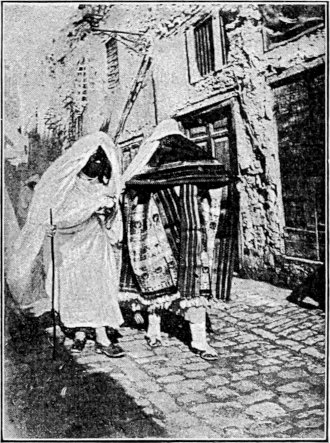
MOORISH WOMEN IN A STREET IN TUNIS.
After taking leave of the Bey I returned to my hotel. First I glanced through my letters, and, after a bath and having dressed, I enjoyed an excellent breakfast, at which I met M. Gauckler, who promised to help me make various purchases,—which promise he faithfully kept. On the whole, I cannot sufficiently thank him for all his valuable assistance. As it turned out that many of the photographs I had taken were failures, he handed me a collection of views of the whole of Tunisia, photographed for the “Service des Antiquités,” and which had in great part been exhibited in Madrid in 1892, and presented me with all those that I selected, that I might make any use of them I pleased. Thanks to his generosity, I am able to adorn my book with many of these interesting pictures. He also undertook the troublesome task of bargaining on my account with the Jews and Moors who were to pack all I had bought.
During my absence he had been engaged in making excavations, and had brought back some fine mosaics for the museum at Bardo. Under his direction the latter will be enlarged, and will in time contain some priceless treasures. A law now prohibits the exportation of antiquities of any kind to foreign countries. Still, under certain circumstances, exceptions are made, as, for instance, with regard to some objects found at Carthage, which I had acquired, and which, during my absence in the south, were stopped at the custom-house; but, on our Consul applying to M. Gauckler, he had them passed for me.
The remainder of the day I spent in the shops of the Sok, and in paying visits, amongst others to Drummond Hay, who had long expected my return. I found him in his beautiful government house, near the “Porte de France,” where I also called on his wife. They invited me to spend a day with them in the country, where I had an opportunity of thanking Drummond Hay for his valuable assistance and advice, without which my journey would have been made with no fixed purpose, and, notwithstanding all the kindness and hospitality so generously shown me, it might have had a far less interesting result.