Part 11 — CHAPTER XV. (continued 4)
Reading edition
Döllinger has a wonderful memory for everything in the world of print, but very little for what concerns his own person or his own acts. When he wrote his declaration to the Archbishop of Munich, he seems to have quite forgotten the intentional “corrections” of his celebrated work. Otherwise, he would not have referred to the approval which it met with from the whole of Catholic Germany, and raised the question, Which text he meant—the true one of 1860, or the altered, not to say the falsified, one of 1868? Moreover, he, as the inspirer of Janus, recalled, in that last-named book, the little he had left in the edition of 1868 favorable to the primacy, for the reason that it “contradicted all opinions of the fathers, and the principles of exegetical theology.” In other words, Janus has completely and flatly denied the primacy.
It is hard to calculate what a blessing Döllinger might have been the means of to his contemporaries and to posterity, had he continued to make the rich treasures of his knowledge accessible to Christendom as he had done in his work of 1860. The Almighty, who had preserved him upright during the wars and passions of these later years, would have decreed him doubtless a rare old age had he remained true to his resolution not to divide his powers, to live an unprejudiced votary of science. It was to be otherwise. That book was the last fruit of the professional activity of the historian. The historian was now to become the bitter party-man, not to say the future Bavarian senator, and, as a writer, a mere political pamphleteer. Here his career as a man of science closes.
Late in the fall of 1861 appeared his work, The Church and the Churches, etc. It was a kind of colossal apology for the two well-known Odeon Lectures of the fifth and ninth of April of the same year, on the temporal power of the popes. In these lectures Döllinger has come forward in the rôle of the politician—a rôle which he was never intended to play on account of his too great credulity. Expressions had crept into these lectures so little savoring of piety, so painful to Catholic hearts, that the worst was feared for Döllinger in ecclesiastical circles. We also feared the consequences. Döllinger himself was evidently staggered at the unexpected impression of his, to say the least, unexplained appearance in such a character. The book which followed, in other respects a wonder of historical information, was nothing but a powerful effort to shield himself from the consequences of this step.
The ideas expressed in the royal conversation above referred to are here recognizable, more particularly in the introduction, as well as the endeavor to harmonize them with the principles of the church. It would not be very difficult to allay the doubts which Döllinger has endeavored to awaken concerning the mediæval church and the Papacy in his (or his amanuensis’s) letters on the council in the Allgemeine Zeitung, and now in his “declaration,” from his own work of 1861. The Encyclical, and particularly the doctrine of the Syllabus on the relations of church and state, may be both explained and defended by the assistance of the same book. Döllinger then knew very well how to vindicate the true sense of certain decrees and bulls of the popes issued while the mediæval III. intended to take advantage of the Bull “Cum ex apostolatus officio” against the Protestant princes of Germany and Prussia, with what shouts of laughter would he not have received him! Now he himself is guilty of just such an absurdity—and how grave he is withal!
The question of the relations of science to church authority became now in Bavaria a practical question, and Döllinger was called upon to prove the strength of his principles by overt acts. One difference followed another in that country, and Döllinger was as interested in them as he could be in matters entirely personal to himself. Like a general, he felt himself responsible for the result of all those contests, and never thought of examining closely the claims of those who crowded around him and offered him their services. In this way it was that he became the protector of one so unworthy as Pichler against the archiepiscopal ordinary. At this time, even, he had his passionate turns, which gave rise to serious misgivings, but which he was sure to regret himself before any length of time had expired.
At this period the episcopal conference at Fulda resolved to take steps to revive action in the matter of the establishment of a “free Catholic university.” Döllinger could see in this nothing but the proof of a dark conspiracy against German science.
He was unable to see that the anti-ecclesiastical, not to say the antichrist, spirit which had crept into the universities, was more than even he would be willing to be accountable for were he the chief pastor of a diocese.
The opinion expressed in an appeal to the Catholic ladies of Germany on the subject of the higher schools, made him lose his patience altogether. The outbreak of the Seminary question in Spiers was in his view another attempt of those infected with the “Roman” spirit against free German science, and it found him, even if not publicly, on the side of the decided opponents of the bishop’s rightful claim in the matter.
Very nearly at the same time, the then Bavarian minister of worship made a report to the king on the occasion of a vacancy in the theological faculty of Würzburg, in which he painted the clergy educated in the German College at Rome in no flattering terms. An accidental circumstance threw suspicion on Döllinger as the instigator of it. The pamphlet “for the information of kings,” which appeared in the beginning of 1866, represented Döllinger, although only under the general name “of the Munich school,” as the real actor in the minister of worship’s puppet-play. There was a report that in the Spiers matter, speaking of the attitude of the bishops, he had said: “They are attempting to misuse the king’s youth!” How much of this had its foundation in truth, to what extent the statements of the pamphlet were based on a change or mistake between the ministry and cabinet, must remain undecided.
The pamphlet referred to created no small excitement, however; and, precisely two years before the appearance of the notorious articles on the Council, was exhaustively replied to in the Allgemeine Zeitung. The style and other accidents would lead to suppose that the “amanuensis,” since known more of, had here made début. The reply was not a refutation. It was made up of a series of counter-complaints, and, with the exception of the attacks on the Jesuits, the Roman party, and the boys’ seminaries, these articles contain the kernel of the articles against the Council published two years later. In spite of all this, however, Döllinger is represented in these articles as of the same unaltered mind with other members of the faculty, Haneberg and Reithmayer.
“If there was no ground of suspicion during all these long years, no reason to believe that these men were hankering after dangerous novelties, how comes it recently that such suspicions are aroused, seeing that they have always been of the same mind?” It is now certain that this unanimity has since ceased; and it is clear that Döllinger’s monstrous accusation—“not a soul believes it”—must have been unjustly brought by him against his colleagues. The articles also quote the words of the Tübingen theologian: “The suspicion has spread further—Döllinger and Michelis are no longer innocent.” What says the Tübinger of the drifting of these two men to-day?
On the first of January, 1867, the Hohenlohe ministry took charge of the ship of state.
It will not be claimed that Döllinger’s influence increased with the accession of his old friend Prince Hohenlohe to the ministry; it seemed more probable that the prince would have found the learned professor a powerful obstacle in his way. The prince had formerly been considered unexceptionable in his religious views and relations; but in order to dissipate the bad odor in which he was in the highest circles, suspected as he was of favoring Prussia, he knew no better method than to encourage the superstitious fear of the Ultramontanes and of the Jesuits which for twenty years had reigned within the walls of the royal palace at Munich. This it was which had made Dr. Döllinger so interesting a subject since he was regenerated from the infection of Ultramontanism.
Countenanced by such a man, it was thought the discomfiting of the “clerical party” would be a less dangerous operation than effecting it by an unasked-for alliance with the party of progress.
This explains how Prince Hohenlohe, at the head of the foreign department, was determined to serve Döllinger in every way possible against the “Curia” and all matters related to it.
The infamous articles on the Council appeared in the Allgemeine Zeitung from the 10th to the 15th March, 1869, under an anonymous name. Every effort was made to conceal the author, and even to mislead the public as to who he was. The real author could not conceal himself as far as we were concerned; but it required a long time to convince the many, and great was the surprise of all unprejudiced minds at the discovery.
In the meantime, the preparation of the anonymous Janus was undertaken, and the circulatory dispatches of Prince Hohenlohe made their appearance on the 9th of April, 1869, which, of course, Döllinger could not well subscribe as their author. The council of ministers, of course, was not consulted in the matter; and the well-known five questions put by Prince Hohenlohe to the theological faculties of Munich and Würzburg, concerning the future council, were not whispered to the minister of foreign affairs by some secret agent.
In the name of the majority of the faculty of Munich, Döllinger was
The absence of conviction in the whole affair is so evident that we may well yet remain in doubt concerning the position of Döllinger’s colleagues; and that in spite of the fact that the libellous articles of the Allgemeine Zeitung are to be found in the widespread pages of Janus. We have already looked into this department of the literature of our day; we have done so already. Not only was infallibility condemned in it; but the primacy, at least since 845, is there made to appear as an infinite series of deception and forgeries, or, as Janus expresses it, as a sickly, uncouth, consumptive-engendering excrescence on the organism of the church. Not only was the future council condemned before it was held, but the Council of Trent was turned into “a should-be œcumenical council,” which was arbitrarily governed by legates, in which the Roman party alone had sway, and which, in a word, was nothing but an assemblage of fools and pickpockets. This view of the Council of Trent Döllinger seems to have forgotten, when he wrote his declaration of the 28th of March of the present year, in which he refers to the Tridentine article of faith which he had twice sworn to, and in which he leaves out the essential part of the oath, namely, the promise to interpret the Holy Scripture only “in the sense approved by Holy Mother Church.”
The foreign office and its zealous co-operator, the learned professor, now began their campaign against the Council. The reporter of the Leipzig Grenzboten of the 24th of June, 1870, thus expresses himself on the subject: “The alarming circulatory dispatches of Prince Hohenlohe have turned to political account the results obtained by Janus, and introduced them into governmental and diplomatic circles.” The Bavarian ambassador, a man of no distinction and one who favored the “Curia,” was recalled and replaced by Count Tauffkirchen, the most talented diplomatist at that time at the disposal of the government.
His operations in Rome were very influential; and if the matter furnished by the events in the Council became immediately the subject of discussion in the press and in the literature of the day, the Bavarian Embassy is not entitled in the least to the merit of it. The rest was accomplished by Döllinger, as is now well known, and by his intimate young friend Lord Acton.
About the end of the year appeared the pamphlet, Considerations for the Bishops of the Council on the Question of Papal Infallibility. This time he appeared again anonymously, but without making any extra effort to conceal himself as the author. A little later, he appeared under his own name in the official organ of the new Catholic theology, the Allgemeine Zeitung, in the “Declaration in the matter of the address touching Papal Infallibility,” on the 19th January, 1870. From this declaration, says the Lepzig correspondent more than once referred to above, proceeded his agreement with the views of Janus.
The publication of his name was no sooner made than the party of
This had already been done in the press; now it was accomplished in the House.
On the 7th of February, Dr. Völk, a deputy, seized the opportunity presented by the debates on the “address” to drag Döllinger into the field against the “patriotic” majority. He read the most objectionable and most venomous parts of the “Considerations” and “Declaration,” and imputed these views to the majority of the House as their own opinions, endeavoring to drive them to declare themselves for Döllinger and against the Pope and the Council. The “patriotic” majority had taken care not to embitter the debates by introducing questions ecclesiastical into them; but now a defence was called for. The stenographic report describes the scenes, which were closed with the following words from Deputy Törg:
“I have been on the most intimate terms with the gentleman whom Deputy Völk so formally parades before the House, for years. I became acquainted with him shortly after the time of the ‘genuflexion question’ in Bavaria; and, surely, no one then imagined that a time would come when Dr. Döllinger would be thus quoted before the whole House by Dr. Völk. I consider it a terrible misfortune, and accept it as such; yes, gentlemen, as a personal misfortune. Dr. Döllinger was an authority for me; he is such no longer; for he has fallen the victim of blind passion and lost the calmness necessary to the forming of an opinion; and he is no longer in a condition to formulate a dogmatic question as a theologian ought to be able to formulate one.”
But that is not what Döllinger wants. He now stands in dread of all conscientious critics, his own fame for critical acumen being entirely gone.
He makes the definition of Papal infallibility a monstrous bugbear, and no remonstrance prevails to prevent his making the bugbear more terrible to himself and others. The worst feature in the whole is his passion against the temporal power. He sees nothing in his opponents that is not criminal. They use the infallible Pope to depose the monarchs who do not suit them, to absolve subjects from their oath of fealty, to overthrow constitutions, to annihilate every right. Dr. Döllinger endeavors by the most unqualified denunciation to tell the new German Empire—elsewhere he always says that the doctrine was never known in Germany: “I cannot dissemble that this doctrine, in consequence of which the former German empire perished, in case it should obtain sway among the Catholic portion of the German nations, would sow the seeds of an incurable disease in the newly founded German empire.”
But what now? As we have already pointed out, the matter did not turn out as those interested wished it would.
It was expected that Döllinger’s influence would have carried the greater part of the clergy and intimidated the bishops; thus it was hoped without much danger would be obtained the object which, although yet not clearly defined in every particular, embraced, at all events, the annihilation of Ultramontanism, of the “clerical party,” and of the Jesuits in Germany. It was hoped to accomplish all this without the always, as was acknowledged, dangerous assistance of the party of progress, through the mere weight of Döllinger’s name and influence. But his name has not accomplished what was hoped it
He need not know the state of the consciences of his Munich colleagues who signed the address, in which they hesitate not to give the lie to the whole Catholic episcopate; he knows better than anybody how many of them have a moral right to speak in the name of “Catholic Christendom.”
Viewing the matter in this light, we have in one way wondered at the signing of many, in another way we have wondered at the signing of only a few. And in the face of such phenomena, Dr. Döllinger desires a church the duty of whose bishops it shall be simply to declare that which all believers, represented by scientists, will have thought or believed upon a question of the faith.
It is easy to say what the next thing sought by those who follow behind Döllinger’s banner is. The police regulations required by the government against the decrees of the Council are a matter of secondary importance. And the great storm of an ovation given to Döllinger is meant not so much for Döllinger himself as for its influence on the king and his government.
The king must a second time be made to serve the cause of German liberalism. We said it in the beginning: as soon as the little German Empire is established, the party will want a “German National Church” for their little empire. We did not think, indeed, that any attempt at this would be made so soon; for, a year ago, men who knew what they were talking about assured us that so long as the old king lived he would not permit the peace of religion to be disturbed; but that it would be otherwise with those who came after him. But now that the king has become German Emperor, unanimous reports of the contrary come to us. “The idea of the establishment of a German National Church is taking deeper root, to all appearances, in the government circles.” So a relatively unprejudiced Berlin correspondent lately reported. The rest of the tale is told by the debates in the chamber of deputies.
The party are anxious to strike the iron while it is hot; not without reason was the party battle-cry spoken during the war—all our noble blood were shed in vain did not the stroke which freed us from France sever the Catholics of Germany from Rome—“War against France and against—Rome!” Even Dr. Michelis joined in the cry.
If it was very desirable that the Bavarian king should take the initiative in the matter of the imperial title, it was also very desirable that the first step for the establishment of the “German National Church”
The King of Bavaria was to be to the “new Luther” what Prince Frederick of Saxony had been to Luther of old; and on that account, he is promised the surname of the Wise. This is the meaning of the infamous telegram of the tenth of March from Dresden—“him, the enlightened thinker who publicly proclaims his dissatisfaction with the dogma of Papal infallibility!” When the representatives of high offices in Munich dare to set themselves up publicly as commanders in the military ecclesiastical society, one need not be surprised at the progressionist intrusive attempts, rashly sporting with the monarchical principle itself. Thus only can we understand how any one could be so bold as to encourage the clergy to fall by insinuating a provision that no one might fear a material loss. Could the necessary number of state-church servants have been found, the programme was that the King of Bavaria should give the “German National Church” its first ground in the Munich places of worship. We wish to be excused from describing further the plan which finally would make true the saying: “They wish to misuse the king’s youth.”
We are not deceived. Should this plan fail, another will be sought to accomplish what is intended. Döllinger has been in relation with Prussian diplomats since 1866. However, neither he nor the new German Empire has the divine promise which the church has; and where the Pope and the bishops are, there is the church.
Let all Catholics gather more closely yet about the centre of unity. We can do no better service to the world. God will take care of the rest.
A GHOST STORY OF THE REVOLUTION.
Now, in years gone by it was quite otherwise; so far from being invited, they were universally shunned; man, woman, and child fled at the slightest indication of their presence; and as for speech, it was next to impossible for them to put in a single word before the terror-stricken mortal had speeded away, far beyond all hearing. Not much seemed the gain to either side by those interviews; occasionally some rogue was known to disgorge his ill-gotten pelf in consequence of the midnight apparitions of some phantom things, a warning to him to mend his ways; or some timid heart perhaps grew faint, and before long time ceased to beat, under the idea that it had received a supernatural summons to the unseen
But what attraction has modern America for sprites, spooks, brownies, fairies, and all that dainty ethereal tribe that may be met in the Old World? Or what, for the more solemn shadows that haunt dilapidated galleries, in the tumble-down ruins of ancient transatlantic castles? What homes have we for “elves and little people,” that dance for years, yes for centuries, on the same greensward in the Highlands of Scotland? Alas! in an incredibly short period grass here gives place to wheatfields, and fairy rings would be disrespectfully ploughed up and planted. Let any sociable brownie plan a visit to old friends, she would probably find the whole family, bag and baggage, moved off to the far West, and only strangers round the hearthstone. They love things old, and here all is new and cheerful under the tireless march of improvement. We have no black forest, no
“Castled crag of Drachenfels,”
but the primitive woodland yet clothes the mountain that “frowns o’er the wide and winding” river.
The nearest approach to a haunted castle is to be seen sometimes in travelling over the Western States. There, in some lonely inconvenient spot which no prudent man would have chosen for a homestead, an unfinished, overgrown, weakly-looking wooden house tells its story, not of greatness gone by, but of greatness planned and never accomplished—a pitiful comment on the uncertainty of human affairs! It happens thus: Some settler, sadly miscalculating his resources, projects a palace in the wilderness on a scale of city splendor; that is, with parlor, dining-room, kitchen, bedrooms, and the little elegances of pantries and closets. The sides are enclosed, the roof is on, and the revenues he counted on as certain are not forthcoming. Then do papered walls and panelled doors with brass knobs, and visions of portico and piazza, all float away to the blue clouds; the hapless dreamer fits up one corner room for the reception of his whole household until he can find another location, and take a new start in the search after fortune, and so abandons his rickety palace to the lord of the soil. As the boards blacken in wind and storm, and one end blows down perhaps in some rough northwester, it gains the name of being haunted; and to ride past such a skeleton thing by moonlight or in the dim twilight, with the utter desolation of all around, and the yawning blackness of cavities which should have been doors and windows, it requires no great stretch of imagination to picture an unearthly head peeping out here and there. Very bold yeomen are known to always whip their horses to a full gallop as they approach and pass the fearful spot; and as for women and children, under that strange fascination by which the supernatural repels and yet attracts, they always gaze intently, and as surely “see something”!
Although goblin visits in our land are just now rather on the decline (except in a regular business way), there was a time when strange sights were seen and strange things happened; and,
This certainly ensures for the tales the firm belief of all mankind. When an imaginative Hibernian or a lively, light-hearted Gaul announces a vision, it must be taken with some little allowance for flights of fancy, etc., etc.; but when a phlegmatic, cool-headed Hollander declares he has seen a spook, you may believe as if it was your own eyes.
For the precise period most prolific in signs, sights, and dreams, we must go back to the early days of our state, yet not to the first settlers. Their troubles, so numerous that it is scarcely possible to number them, had their origin in things tangible; and so closely did these troubles press daily on all sides, that the thoughts of the first colonists were entirely engrossed by the things of earth. To such a point did this downward tendency reach, that they seemed at times in danger of relapsing into heathendom, as may be seen from the reports sent back to Amsterdam, and yet extant among colonial papers, that they possessed neither school-houses nor churches. They did possess, however, three unfailing sources of annoyances and danger—an Indian warfare, neighbors on their eastern boundary of unparalleled audacity, and domestic bickerings in the perpetual strife kept up between Manhattan and Rensselaerwyck.
What might have happened if the Indians had been treated with common justice and honesty can be now only conjecture; but their wrongs began at the beginning. It is a dark spot on the glories of the adventurous little yacht Half-Moon that her very first track through the waters of the magnificent Cahohatéa (now the Hudson) was marked with their blood, causelessly and wantonly shed.
Hendrik Hudson and his crew landed, we are told, on the western bank of the great bay, which was lined with “men, women, and children, by whom they were kindly received, and presented with tobacco and dried currants.”[68] A little further on were “very loving people and very old men, by whom the Europeans were well used.” They brought in their canoes to the voyagers all sorts of fruit and game, and on one occasion of a visit made by white men to the shore they broke their arrows and threw them in the fire to express their pacific intentions. Yet despite all this, when the vessel had advanced only a few miles, one of her crew fired and killed an Indian, without the least warning, for attempting to steal a pillow and some old garments.[69] No satisfaction was offered to the terrified savages, and they pushed off for the shore in their canoes, but they vowed a vengeance, and they kept the vow; so that, when some few years later one ship after another brought the enterprising individuals who first unpacked their household utensils and farm tools in the New World, they entered upon a stormy existence already prepared for them. It was not a glimpse of wraith or goblin that people feared to encounter in the lonely by-path, but the stealthy tread and dark visage of some lurking savage, ever watchful and merciless, ever close at hand when least expected. How often in the silent night, in how many little hamlets, in how many solitary huts, women and children
But, though the Dutch colonists were generally at fault in provoking contention, they were also valiant, after some preparation, to meet it. When Claes Smit was ruthlessly murdered by the natives, some time about 1642, and they refused either to give up or punish his murderer because he had fled and could not be found, the colonists consented to march to battle,
“provided the director himself (Von Kieft) accompanied them to prevent disorder, also that he furnish, in addition to powder and ball, provision necessary for the expedition, such as bread and butter, and appoint a steward to take charge of the same, so that all waste be prevented.
“If any person require anything more than this bread and butter, he to provide himself therewith.”[70]
Finally, however, gunpowder prevailed; and the aborigines retreated to forests beyond the reach of the pale-faces; schoolmasters and ministers had been sent over from Holland, and the inhabitants of Manhattan Island, as well as the other little settlements up the river, began to live a more spiritual life, and to gather around them by degrees all that troop of unearthly beings well-known in the mother country. Little children were encouraged to be good and expect Santa Klaus, and bad ones were no longer frightened into propriety with the threat of being devoured by some hideous Waranancongyn with tomahawk and scalping-knife.
One of the spots first renowned for ghostly adventures was a pleasant little valleylike place, on the northern limits of the town, called Medge Padje (now Maiden Lane), where a clear stream ran between grassy banks, so gentle and noiseless that it carried the gazer’s heart back—far back over the ocean to the canals of Faderlandt, and was a perfect relief from the lashing waves of the great North River. Hither, on pleasant summer afternoons, many a gude vrow would turn her steps with her troop of sturdy urchins, and, work in hand, knitting, knitting, all the way. But they were always careful to return before dark; for such fearful tales had been told, principally of a tall woman in white who always vanished in the direction of Golden Hill (now John Street), that no one cared to make her acquaintance.
Long years after this, when the palisades marking the extent of the city had been removed as far north as what is now Warren Street, and a field of barley flourished on the Heerewegh (now Broadway), somewhat about the present City Hall, we again hear of the same apparition. The Rev. John Kimball, passing along the little stream rather late at night, heard steps, and, looking behind him, saw the spectre; of course he fled. Doubtless she was the bearer of some important message from the spirit-land which she was anxious to communicate, but, as no one ever stopped
Mr. Watson, in his Annals of New York, relates a story given by a military gentleman of his own encounter with an apparition in that same place. The captain declares, and doubtless believed, that he bravely attacked it, and discovered only a mischievous mortal in disguise; but it is hardly probable that any mortal in his senses would be personating a ghost at midnight on haunted ground, so that the tale, being rather one-sided evidence, is doubtful.
Another solitary place was Windmill Lane,[71] which led from Broadway between Cortlandt and Liberty Streets down quite a steep hill, in a northwest direction, to the river edge, where stood a windmill. There was a time when this lane was the most northern street in the settlement; then house after house began to be built around the old mill, and the city crept up gradually in that direction. Among those who made their homes there was a French lady, Madame Blonspeaux, who had crossed the ocean to teach the rising generation all she knew—French and embroidery. Two paths led to her establishment, one through the Lane, the other through a wheatfield, where now is St. Paul’s church, and both were beset with spectres. Alas for the scholar kept in after the others were dismissed! Lightly did the offended majesty of madame weigh in the balance compared to what might possibly beleague the path homeward. There was a legend of a tall Indian who was always digging about for his bow and arrows, and a little short Dutchman about a foot high in breeches and cocked hat, who, the moment he found them, sprang into sight from somewhere and kicked the dirt over them, and the Indian began his search again![72]
But the section of country most famous for spectral manifestations was the region about the Kaatskill Mountains. Darkly wooded glens, and lonely streams, and deep ravines offered the most ample facilities for all kinds of signs and wonders. Indeed, the Dutch settlers that dwelt in that by-place of existence, on the little cleared spots that here and there dotted the landscape, were so quiet and orderly, so far removed from the commotions that agitated the river colonies, no wonder ethereal beings found their companionship most congenial. These settlers had removed thither originally from the neighborhood of Fort Orange, and principally, nay, I may say solely, in disgust at the general uproar and discomfort which invested everything in proximity to that fort, under the joint dominion of the Patroon of Rensselaerwyck (or his agent), who resided there, and Director-General Petrus Stuyvesant, who fulminated his bulls from the south end of the Hudson; the contemporary edicts of the rival parties being always diametrically opposed to each other.
The truth is that, from the moment Director Stuyvesant landed at Manhattan, appointed there by the States-General of the United Netherlands, he had carried matters with such a high hand that everything succumbed before him. The boldest spirits bent to his rule, and (to continue the metaphor) he walked over them. His word was law without reason or explanation. He had even been known to shorten a troublesome state audience by tearing up the documents and dismissing the deputation.
When Stuyvesant directed Carl von Brugge to quarry stone and cut wood for repairs on Fort Orange, nearly destroyed by a freshet, Brant dared the deputy to touch stone or stick at his peril, either for fortification or firewood; for the trees, root and branch, all belonged to his employer the patroon! He further forbade any of the inhabitants to aid them with horses, etc., while at the same time he was building a house himself not a pistol-shot from the fort. The news being carried to Manhattan, the director sent some soldiers to demolish the offending house now being built, and arrest the offender. This was more easily ordered than accomplished, so the soldiers held a parley with him, and were cautioned, among other bits of good advice, to take warning by one Jacob Jansen, who had not long before cut two fir-trees—eight days after he was seized with his plunder on the river by the patroon’s officer, and duly punished! with the stunning point to the climax: “Can’t he do so now?” All this being duly reported to the great director at Manhattan, it was deemed best to seek supplies beyond the domain of Rensselaerwyck, “stones from the mountains, rocks, and plains—timber from anywhere within the limits of New Netherlands—to have a wagon made, and take the horses of Jonas Bronck, who was in debt to the company,” and whose opinions on the subject were of course of no consequence. As for pulling down the house recently erected, Herr Van Slechtenhorst pointed to the fact that Fort Orange stood on the very soil of his employer, and that it was his intention at some leisure day to annihilate it. So went matters, until at last, when Stuyvesant ordered a solemn fast, and Van Slechtenhorst absolved all in his latitude from obedience, human patience could stand it no longer, and the insulted autocrat rushed to Albany in the swiftest sailing sloop that could be found; there, as has been said, to meet his match.
But our business is not with these belligerents, but with those peacefully disposed burghers, who had grown tired more and more, year after year, with this turmoil, which seemed now to have reached its height. Armed soldiers were in their midst (for seven had been sent up from Manhattan), and when the talk was of razing houses, why, even the neighboring Indians came crowding in to ask what the Swannekins were about.
Happily another home opened to them, and very many packed up all their worldly goods and migrated. This home was the region about the Kaatskill. One part of the mission of Herr Van Slechtenhorst when sent over the ocean was “to acquire by purchase the lands around Kaatskill for the greater security of the colonie, as they were forming companies to remove thither.”[74]
On the land thus obtained, they had nothing to fear from Indian opposition, and the kind of domestic life they coveted is pictured in a lease yet extant in the Van Rensselaer family, dated 1651, wherein the tenant binds himself to “read
Such were the mortal inhabitants of the place; but the invisible portion of the community—their name was Legion! It seemed the very place of refuge for all sorts of bodiless personages who had been insulted and expelled from other places; indeed, if a census had been taken, according to the old wives’ stories, their aggregate numbers would have made up near half the population of the village.
In one portion of the spot which might truly have been called the supernatural reservation was a deep ravine, which bore traces of having once been the bed of a mountain stream. At this period (some time before the old French war), its sole inhabitants were a morose, ill-looking woodman and his aged mother, and their dwelling-place was a miserable hut perched on rocks, and so hidden by gnarled and twisted trees and a dense undergrowth of shrubs as to be almost invisible to any but its occupants. Why they established themselves in that uninviting place, or what were the events of their lives previous to their appearance there, their unintelligible English failed to communicate, nor was there aught in the sullen taciturnity of both of them in the presence of a stranger, or in the loud and fearful bickerings heard ofttimes in their hovel by the passer-by, that created a desire to fathom the mystery. When the news arrived that French and English had met, the outcasts in the glen, strange to say were the only ones in the settlement whose fortunes seemed in any way to be affected by it. Their disputes were heard louder and more frequent than ever before, to end, alas! in a tragedy. The man, tired perhaps of his monotonous existence, and hoping also to better his fortunes, was desirous of joining the ranks of war, yet, feeling at the same time the necessity of his support to his old mother, he strove to wring from her a consent to his departure. It was sought in vain. The aged woman, to her consciousness of utter helplessness, added doubtless a natural desire for his safety, and consent was withheld. Opposition goaded him, and in a moment of passion he struck her lifeless to the ground.
The miserable parricide fled, and the hut fell in ruins. Time passed on, the war was ended, and peace restored.
And now, when the tragedy of the glen had grown to be an old story, only told by a winter evening’s fire, it began to be whispered—and it fairly petrified the senses of every hearer—that Dark Rob, as he was called, or his spectre, had returned to his old abode!
No one cared to investigate the matter very closely. A light was certainly seen flickering in the ruined hovel, and a phantom-like thing in human shape glided about the spot. No mortal would choose to remain there alone, so it must be the shade of Dark Rob, on the theatre of his unnatural crime!
Many an evil deed was related of him in this, his second sojourn in the
As a matter of course, the worldly affairs of Jans Van Dorp became disjointed things. His vrow had always borne a close resemblance to the helpmate of Socrates, and it is not to be supposed that such doings on the part of her truant spouse added to her sweetness of temper.
The most irritating part was the sudden taciturn spirit which seemed to possess the mynheer. Taunts, sneers, questions, reproaches, all were in vain! This was both new and alarming, because on no previous occasion had he ever been backward in contributing his share to the Babel din of their wordy skirmishes. It confirmed, alas! her worst suspicions, namely, that he was in toils and snares beyond all mortal power of extrication.
Great light was thrown on the affair by a shrewd neighbor, Effie Demson, who, having migrated to America from the Highlands of Scotland (and by some odd chance wandered down to the Kaatskill), was allowed to be especially versed in hobgoblin ethics. She affirmed that she had often heard from reliable authority that, whenever a mortal is admitted to the society of spirits, an oath of secrecy is imposed under a penalty few would care to brave. She cited the cases of several imprudent individuals who, having violated this compact, suffered fearful consequences. One was Alice Pearson, of Byrehill, somewhere about 1588. Having been introduced to the invisible world by a friend, and joined them in “piping, mirth, and good cheer” (to use her own words), she was warned that, if she ever related what she had seen, “she should be martyred.” One day, when she began to speak of these things, an unseen blow took away her breath and left an ugly mark on her side; heedless of the warning, Alice continued her revelations until she was burned as a witch, thus fulfilling her doom.[75] Every one in the Highlands knew, too, the terrible visitation that had lighted on one kirk for having pried into secrets merely to publish them. Every one knew that he was a mere wandering gypsy in the universe, and would be to the end of time.
Effie generally concluded her oracles with the remnant of an old song, written about fairies particularly, but equally applicable to any unearthlies. It was called
“God a Mercy Will.
“To be sung or whistled to the tune of Meadow Brow by the learned; by the unlearned, to the tune of Fortune.
“A tell-tale in their companie They never could endure, But whoso kept not secrecy Their deed was punished sure. It was a just and Christian deed To pinch such black and blue.” Etc., etc., etc. Poetica Stromata.
As this bore the antique date of 1648, and was written by Corbet,
This, then, explained the unusual silence of Jans Van Dorp, and it also half-reconciled his gude vrow to endure her unsatisfied curiosity. To wonder and to be afflicted night after night by his truant absence was bad enough, but to have seen him vanish in blue smoke would have been worse.
Things were passing thus in that sequestered little spot, while the great world without was agitated with mightier events—the opening scenes of the Revolutionary war. It is doubtful whether the faint rumors of it which penetrated the seclusion there would have excited the least attention, except for the fact that it was the only earthly topic on which Jans Van Dorp nowadays manifested the least interest. Every Dutch villager, whose business led him to the great cities, was questioned and cross-questioned on his return as to the precise state of things, with a minuteness which would have done honor to that renowned lawyer Heer Adrian Van der Donck, the first who landed in the New Netherlands. The one little gray newspaper that arrived weekly, and had hitherto circulated among his neighbors until it was quite illegible, was now packed immediately in his great-coat pocket and taken to his ghostly partner. All this was a perfect labyrinth of mystery, and furnished texts for many a sage conjecture and dubious shake of the head. Some hinted that Jans Van Dorp might mean to put in execution the threat he had been so often heard to hurl at his irritating helpmate when her vexatious volubility exceeded all bounds of endurance—that he’d be off to some war. But time puts an end to all things, although it does not always explain things to universal satisfaction. What Jans or the goblin thought or meant can never be fathomed, but some things are matters of history; and it is a testified fact that the very moment this little dingy newspaper brought tidings that the first cannons of battle had boomed, Jansen Van Dorp started as if his doom was somehow connected with it. It was a night, dark and stormy, but he seized his hat, and rushed from the cheerful glow of his own home to the pitchy darkness without, and they whispered he was bound to the haunted hovel! Too probable, for from that hour neither Jans nor spectre was ever seen there more.
It should rather be said, never seen as mortal could be seen, for by many he was still considered an inhabitant of the settlement, although lost for ever to his hapless vrow. He had visited her in dreams, and warned her of something she could not exactly remember, but very terrible, and given on these occasions such
As he gave no sign on these occasions, her charitable conclusion was that he had nothing very good to relate of himself.
Many months after this, one of the most intelligent mynheers of the settlement, having been called by business to a far eastern city, declared on his return that, among a troop of soldiers marching to the frontiers, he had recognized Jans Van Dorp and Dark Rob; but, as he failed in speaking to them, his assertion passed for nothing, and his story was dismissed as mere moonshine, too absurd to be believed.
THE RELIGIOUS MOVEMENT IN GERMANY, AND THE FRACTION DU CENTRE IN THE GERMAN PARLIAMENT.
TRANSLATED FROM THE REVUE GENERALE.
Fraction du Centre, which began during the session, increased to an actual storm at the close of the diet. Most of the foreign journals have spoken of this phenomenon, but in so unsatisfactory a manner that perhaps a more minute account of the movement will not be displeasing to the readers of the Revue Générale.
I have already indicated in a general way, in an account of the parties in the German Parliament, the attitude and tendency of the Catholic party, or the so-called Fraction du Centre.
The bases upon which it is founded are as follows:
“Justitia fundamentum regnorum. The Fraction au Centre in the German Parliament limits its activity by the following principles:
“I. The fundamental characteristics of the empire as a confederation (Bundesstaat) shall be maintained. Conformably to this principle, all efforts shall be opposed that tend to modify the federal character of the constitution of the empire, and the spontaneity and independence of the several states in their interior affairs shall only be sacrificed when the general interests evidently require it.
“II. The material and moral welfare of the popular classes shall be urgently insisted upon. The civil and religious liberty of all the subjects of the empire shall be secured by means of constitutional guarantees, and religious associations, in particular, shall be protected against legislative encroachments.
“III. The Fraction weighs and forms resolutions in accordance with these principles, upon all questions submitted to the deliberation of the parliament, but without forbidding isolated members to vote in the assembly contrary to the decisions of the Fraction.”
The Fraction remained faithful to these principles during the session of the parliament that has just closed. It avoided all extreme views, and manifested no systematic hostility to the government. Nevertheless, the very fact that it is composed of Catholics firmly resolved to defend the rights and liberties of the church against all attacks, and that these Catholics were elected from the most prosperous and intelligent sections of Germany, where pseudo-liberalism thought its rule immovably established, sufficed to excite against the Fraction a coalition of all who were opposed to the church. Their invectives began with the debates on the address. The form of address Centre drew up a counter-schedule, which did not contain the proposition of absolute non-intervention we have just referred to, but which was nevertheless in conformity with the address of the liberals. This counter-schedule did not demand, either directly or indirectly, any intervention in favor of the Pope: it contained nothing that clashed either with the government or the other parties, and consequently was not the object of criticism in any quarter. So true is this, that the Allgemeine Zeitung of Augsburg, the chief organ of anti-religious liberalism, could not disguise its preference for the schedule of the Centre as to its substance as well as form. Nevertheless, though the Centre remained wholly on the defensive, and its orators exhibited the greatest moderation, a real storm of invectives was raised against them and the church by the journalists of all the other parties and by the parliament. Even the so-called conservatives took sides against the Centre, whose motion, thanks to these outcries, only obtained sixty votes. A proposition made shortly after by the Centre in the interests of civil liberty met the same fate. This proposition had for its object the admission of several principles into the constitution of the German Empire which had been sanctioned by the Prussian constitution. As these principles guaranteed the independence of the church—the Evangelical as well as the Catholic (Art. 15, Pruss. const.)—the proposition was opposed with extreme bitterness, even by a large majority of the Catholic deputies who did not belong to the Fraction du Centre. Among these was Count de Frankenberg, of Silesia. This noble member had given his electors a written promise to vote in accordance with the proposition of the Fraction du Centre. But in the speech he made against it, he declared that he did not consider the time chosen by the Fraction as opportune. In his ignorance of judicial things, he probably is not familiar with the adage: Quod sine die debetur, statim debetur.
The Fraction du Centre made no other independent motions during the session that could incur any attacks. But the “clerical party” was attacked the more vehemently at the elections, so the Centre found itself still exposed to a cross fire. The whole affair has been related in the journals. We will confine ourselves to an incident that gives a tolerably correct idea of the majority.
Before the election of Dr. Schüttinger, nominated from the district of Bamberg, and belonging to the Fraction du Centre, the curate of a small town within that district announced from the pulpit, after divine service, that those of his parishioners who had confidence in him could assemble at his house after church to learn which candidate was preferable, according to his opinion. This invitation
In all the occurrences we have referred to, the government showed itself entirely passive, so there was no real conflict between it and the party of the Centre. When the debate took place respecting Alsace-Lorraine, our party proposed to ensure to those provinces the most independent existence possible, and a separate constitution. Prince Bismarck did not exactly agree with this, but his opinions coincided far oftener with those of the deputies Windthorst and Reichensperger than with those of the leaders of the other parties. On the whole, no instance can be mentioned in which the Fraction du Centre is in flagrant hostility to that powerful statesman. It even openly opposed an interpellation respecting the Roman question, in order not to excite any irritating debates and appear suspicious of the good intentions of the emperor and chancellor. In spite of this, it was reported during the session that the Fraction du Centre had incurred the disapprobation of the chancellor of the empire. The Deutsche Reichscorrespondenz, the organ of the so-called liberal conservatives, gave some foundation to this report by pretending that the Count de Tauffkirchen had, according to the instructions of Prince Bismarck, accused the Fraction du Centre to Cardinal Antonelli of having assumed an attitude hostile to the government of the empire, and that the cardinal had expressed his disapproval of this attitude not only before the Count de Tauffkirchen, but in a letter addressed to the leaders of the Fraction. This assertion being repeated in several quarters, the said leaders denied it in the journals. Driven to the wall, the Deutsche Reichscorrespondenz then brought up the case of the Count de Frankenberg already mentioned, and at last Prince Bismarck himself declared the blame really proceeded from Cardinal Antonelli. This induced the Bishop of Mayence to ascertain the correct account of the matter from the cardinal. His eminence replied that it had been incorrectly reported to him that the Fraction du Centre had insisted upon the Emperor of Germany’s intervention in favor of the Pope, and that, under the existing circumstances, he had declared such a step inopportune. At the same time, the cardinal assured the Bishop of Mayence and his friends that he had a particular esteem for the members of the Fraction du Centre and its proclivities. Thus failed the effort made at the court of Rome to bring discredit on the Fraction among Catholics, for at once a great number of Catholics gave in their full adhesion to the Fraction, and besought it to persevere courageously. This effort had, moreover, a comic side, for until now the Fraction had been represented as the servile tool of the Roman curia, whence it received its orders on all important questions.
No general interest would be felt in all these facts, if they were not the clear prelude of an act the consequences of which cannot be foreseen. It is not the acts of the Fraction that provoke the violent attacks against it: it is its very existence that is considered a crime. Those hostile to the church had calculated, without distinction of party, that the very first diet of the German Empire would aim a blow at “Romanism” in Germany, on the ruins of which would afterwards rise a national German church, that might finally end in a cosmopolitan “Humanitarianism,” without dogmas, without sacraments, and without altars—the very beau idéal of freemasonry. Everything, in fact, seemed propitious for the realization of this hope. The two principal Catholic nations successively conquered, the Roman race suffering from incessant convulsions, the head of the Catholic Church a prisoner at the Vatican, and, finally, a schism that seemed likely to arise on account of the dogma of infallibility—all seemed to form a breach by which it was hoped their opponents would be overcome. Only, as an ancient adage says: “Man proposes, but God disposes!”
The election of the Prussian deputies and the members of the German Parliament has already paralyzed the action of these regenerators of humanity, by rousing the Catholics to an energy not easily to be surmounted. The complete union of the representatives elected, and their bold stand, showed it would be quite useless for the legislative assemblies at Berlin to make any serious charge against Catholicism. On the contrary, it was hoped at Berlin that the initiative would be taken by Munich, where “the Luther of the nineteenth century” had raised a standard of revolt against the Roman Pontificate. But Munich was likewise under the influence of illusions. It was supposed that Mgr. Hefele, the Bishop of Rothenberg, would add the sanction of episcopal authority to the influence of the learned Professor Döllinger, and thus sustain his course. It was still more certain that a great number of the pupils of the theological seminaries would respond to the appeal of Döllinger and his able adherents. Döllinger, it may be remembered, had publicly declared that thousands of priests thought exactly as he did.
But Bishop Hefele remained faithful to the Pope, and the German clergy unanimously declared that Döllinger’s assertion was a calumny. The King of Bavaria himself, who had given Döllinger so many proofs of his esteem, hesitated a long time about giving him his support, because he could not help seeing that the anti-ecclesiastical movement was chiefly led by a political party whose efforts openly tended to mediatize the reigning houses of the second and third ranks in order to form a united and centralized Germany, in imitation of the empire of Napoleon III. These efforts naturally met with the most favorable concurrence on the part of the democrats; for an empire of this kind, established on a broad and “liberal” basis, would lead, by a sort of fatality, to a republic, especially if they first succeeded in doing away with the religious and historic traditions.
Immediately after the close of the parliament, a fire was opened at Berlin upon the “clericals,” and especially upon the Fraction du Centre. The official journals did their best to open the way to “modern progress” by removing all the obstacles that might impede it, and to increase the diplomatic pressure that had so long been exerting its influence on the Bavarian cabinet. The whole German press, with the exception of a dozen journals, naturally joined in the chorus, and then began an attack on the
The German Catholics are accustomed to these kinds of accusations, which have passed through all possible variations. Thus, the Catholics of the Rhenish provinces have been successively accused, according to the circumstances of the moment, of plotting with France, Belgium, Bavaria, and Austria, against Prussia, and of considering the Pope as their legitimate sovereign. Foreigners can hardly credit what I am obliged to relate here, and, if they should, it would excite their risibility. Unfortunately, these absurdities have a serious side for the Prussian Catholics. Independently of the circumstance that these perfidious calumnies, systematically repeated, might pervert public opinion in those sections of Germany where Protestantism prevails, they serve as a pretext for practically refusing Catholics the open equality which they should share with the adherents of other religions. For example, all the higher offices of influence are, with very rare exceptions, filled by Protestants, who, as a matter of course, specially favor the interests of their co-religionists in every way, and, so to speak, are obliged to do so, because genuine Catholics are officially designated as unpatriotic. An exact list of the functionaries of the German communes and government, drawn up with reference to the religion of each one, would be a valuable statistic, because it would incontestably establish how far the principle of suum cuique, which constitutionally recognizes the equality of Christian sects, is really applied. It is evident that such a report will never be published or drawn up by the authorities, consequently the formation of a private agency to effect such an object is an urgent necessity. Perhaps this report might at last put an end to the constantly repeated accusations of the base ingratitude of Catholics against the Prussian government. The clear judgment of Frederick William IV., and the constitutions that sprang from the events of 1848, guaranteed a liberty of action to the Catholic Church and its organs which had not existed in any German state since the peace of Westphalia. The Prussian Catholics displayed a lively gratitude for this, and flattered themselves with the hope that several crying injustices which weighed on them would be removed, especially in the conferring of public offices and the nomination of professors at the universities. This hope was then the more reasonable, because, in the war against France, Catholics, as well as Protestants, shed their blood on the battle-fields, and submitted to the heaviest requisitions. The religious orders particularly signalized themselves by their services, as the recently published report of the Knights of Malta (Catholics) prove. Unfortunately, this hope has already given place to serious preoccupation.
Prince Bismarck appears no longer able to endure repose. Having vanquished our foreign enemies, he seems to aim, unless all appearances deceive us, at making adversaries of the Catholics of Germany and causing them to feel the weight of his hand. Perhaps he is influenced by the consideration that military unity, to be on a solid basis, should be founded on, or crowned by, political and religious unity. At all events, this is the opinion of the liberal party, whose course involuntarily recalls the expression of Tacitus, “Ruere in servitium;”
But it is not the anti-religious journals alone that take this liberty. M. de Mühler himself, the Prussian minister of the public worship, treats the Catholics, who remain faithful to the decrees of the Pope and bishops as rebels to the government. Immediately after the suspension of the council, he took under his protection the professors, even those who were priests, who refused to submit to the decisions of the council and the bishops, and encouraged them in their revolt against ecclesiastical authority. Recently, à propos of the affair of the Bishop of Ermland, he went so far as to submit to the ministry of Prussia, composed exclusively of Protestants, a resolution to ascertain what Catholics should be considered as orthodox, and he ordered a priest named Wollmann, who had been excluded from the fold of the church by major excommunication, to retain his professorship as religious instructor in the Catholic college of Braunsberg. The students, unwilling to receive religious instruction from a fallen priest, left the college. They were thus obliged to give up most of their studies, as there is no other establishment of the kind at Braunsberg. It should also be remarked that the College of Braunsberg was founded by a bishop and sustained by Catholic foundations. In Silesia, another priest named Kaminski, likewise excommunicated, was appointed to a church that he might celebrate the divine service for those who protested against the Council of the Vatican. In a word, every where there is any reason, or even a pretext, the episcopal authority is sacrificed to those who refuse them the obedience solemnly sworn to them, or become unfaithful to the church by calling the episcopal crosier the bâton of a police officer. On all sides were declarations, more and more threatening, that an end must be made of “Romanism,” that German science should take the place of idolatrous papistry, and the echo of this cry is to be found in the papers that seek their inspiration from the ministerial bureaux.
But in spite of the great power of the Prussian government, the centralists, to their severe mortification, were doubtful about succeeding in fully organizing a persecution against the Catholics unless the other German governments, or at least the most important of them, declare war against the church. The Würtemberg government was so wise as to declare from the first that it would ignore the decisions of the Council of the Vatican as long as no one was influenced by it against the laws and constitution of the kingdom. As this evidently would never be the case, the Würtemberg ministry, if the national liberals who have just begun an outcry in the assembly of representations at Stuttgart do not impose a different policy on them, will consequently remain strictly passive
As we have remarked, the course of the Bavarian government in the ulterior development of this agitation, will be of great importance. The pressure brought to bear on that government by Prussia and all the parties inimical to the church has led to the retirement of Count Bray, whose devotedness to the church is well-known. Nevertheless, the king has not fully decided to create, by an open rupture with the religious authorities, unforeseen complications in his kingdom, already so shaken, and to recompense by moral violence the fidelity of those of his subjects who have shown themselves the most devoted partisans of the dynasty of Wittelsbach. This question, so painful for the majority of Bavarians, will be doubtless decided before this article is published.
Having given a general outline of the present state of affairs, I am led to ask myself what, before the end of the year, will be the stand of the Catholic representatives who are still faithful to the church in the legislative assemblies of Prussia and the German empire. The reports of those deputies to their electors appear to me adapted to strengthen them in their resolution to continue to struggle courageously against the supremacy of the state as well as against revolutionary absolution, and to remain defenders of the church and of all constitutional rights against the false apostles of liberty and an arbitrary ministry. At all events, I imagine these deputies will smile with pity when they hear themselves styled unpatriotic by some parties in imitation of a part of the journals hostile to the church, or even accused of conspiring with foreigners or the Internationale. Some papers, in fact, have not shrunk from the ridicule attached to such foolish accusations. Does not this having to resort to such imputations prove the want of any serious charge against the members of the Centre? They are evidently not credited by those who make use of them, nor is any attempt made to convince others of their truth.
The members of the Fraction du Centre figure, for the most part, among the notabilities of their districts. Many of them have occupied or occupy some public office with honor: and several have, for many years, showed their constant zeal in the old Prussian house of legislation, where they had a seat, and gave their devoted support to the government in the crisis of the year 1848 and the following year, often at the expense of their popularity. They were often known to defend the authorities against the attacks of those who are now endeavoring to excite the government against them.
In support of what I have just stated, it is sufficient to recall the names of those whom the confidence of their colleagues chose as a committee of the Fraction du Centre in the German parliament and the Prussian house of representatives. I will mention M. de Savigny, the son of the illustrious jurisconsult so well-known throughout the whole world, who was formerly Prussian minister at Brussels, and latterly the representative of the King of Prussia at the Diet of Frankfort; M. Windthorst, who was president of the [76]
He who consecrates his time and strength to the cause of justice and religious liberty, or uses them in the arena of political combat, should not expect to reap any gratitude, but the leaders of the Centre and their friends could not foresee that they would be exposed to the calumnies I have alluded to. The only appreciable grievance uttered against the Hanoverian and Bavarian members of their Fraction is, that the former disapproved of the annexation of their country to Prussia, and the latter used its influence to prevent Bavaria from joining the new German Empire. But these deputies have stated publicly that, these measures having been decided by vote, they were ready not only to fall in with the new order of things, but to endeavor to strengthen it, which cannot be the case if the national liberal party is not opposed, the evident tendency of which is not of a nature to fortify the constitution of the empire, being directed against the federative principle, which is the fundamental characteristic of this constitution. No one has a right to suspect the statements and character of these men who merit the esteem of all honorable people for having defended in a purely conservative sense, and by all legal means, the traditions of their ancestors, to which they remain faithful, and which they wish to maintain as long as their duty evidently requires it.
To the Fraction du Centre in the German Parliament belongs also M. Kraetzig, the leader of the Catholic department of the ministry of public worship, which has just been dissolved. This division, composed of three counsellors belonging to the Catholic faith, was organized by Frederick William IV. with the benevolent intention of giving the Catholics of Prussia a sort of guarantee for the suitable administration of the funds for public worship: it was not wished that such matters should be decided by a Protestant government without at least listening to the advice of the Catholic functionaries. (The leader of the Catholic department of public worship had only a consultative voice.) The existence of this division was a pledge to the Catholics, being an assurance that their religious interests would never fall into hostile or indifferent hands. If we except the Prince de Hohenzollern, no Catholic ever had a seat in the ministerial council, and especially no Catholic was ever appointed minister of public instruction. The suppression of this division, decreed on the eighth of last July, is the more serious a symptom that it has been applauded by the journals opposed to the church, and with a joy equal to that manifested at the measures taken in Alsace against the brothers Centre will naturally oppose with all its might the current of opinion which these acts prove to exist in the region of power. Its voice, it is true, will be stifled by the majority, but it will not be raised the less energetically for liberty and justice, with the hope of seeing a better day dawn, and, whatever the event, with the conviction of having fulfilled an obligation of conscience not only toward the church, but to the state.
The hope of soon seeing the clouds disperse that have been accumulating of late around Germany in so unexpected a manner is founded on the political prudence, the experience, and the opinions of the Emperor William. It is not possible for this monarch crowned with laurels, after having established peace with foreign powers through the bravery and fidelity of the whole German nation, to authorize the persecution of millions of Germans on account of their faith, and consent to sacrifice the national peace—the peace which is especially due to his royal brother, whose memory is still blessed by Catholics. There is no doubt but the appeals of the Catholic population will be heard and listened to, as soon as they reach the foot of the throne. The statesman who, in such an unparalleled manner, has been so highly exalted to the very steps of that throne, and whose celebrated name is displayed, without his consent I am persuaded, on the standard of the enemies of the church, cannot be ignorant that, when these troubles shall have assumed more formidable proportions, it will be more difficult to overcome moral resistance than to triumph over physical obstacles, and that measures of policy will be powerless against the former. He will hardly consider it chivalric; with all the enormous material resources of the state at his disposal, to enter into a combat against people who can and will only oppose him passively, as is suitable in the defence of a cause which represents the most powerful interests of humanity.
But perhaps all these hopes are illusory; perhaps we are about to see in our Fatherland the beginning of a sad and fruitless struggle, such as has so exhausted the strength of other countries by giving a free course to the most dangerous passions. In this case the Catholics of Germany should prepare themselves to endure a long succession of contradictions, for their moral courage will be severely tried. They will have to make sacrifices of all kinds for their faith, recalling the precept of the Gospel that commands us not only to render to Cæsar the things that are Cæsar’s, but also to God the things that are God’s, whatever may happen, whatever may be the consequence of such a struggle, the church of God, which has always been victorious through patience, will never yield either under assaults of unbelief or the attacks of a false science, that in its pride seems to declare anew: Eritis sicut Deus. Truth is great, and it will prevail: Magna est veritas et prævalebit.
A. Reichensperger.
Cologne, Aug., 1871.
The mountain’s sides are green anear, In clouds is lost its snow; And he who climbs that Alpine height Shall earth and heaven know. Lo! like a temple to the skies, For toil, for prayer, for sacrifice, Its green and snowy heights arise. A thousand pilgrims wander up To yonder blue abode, And some are lost, and some are slain, Or robbed upon the road. Far up the holy hermits dwell, And sounds the monastery bell The safe and ancient way to tell. And they who mount that highest steep Are tired and sad and poor, But lo! a starry house is there, And angels at the door. Rich joy for poverty and pain They give, that summit to attain: All earth they leave all heaven to gain.
COLOR—ITS POETRY AND PROSE.
red, green, and blue.
Oersted, in one of the chapters of his Soul in Nature, gives us a little diagram to show how the complementary and characteristic combinations of colors are produced.
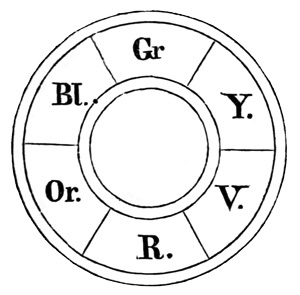
The colors opposite in the figure complete each other in white, hence are called complementary colors—red and green, orange and blue, yellow and violet. These are the harmonious colors.
Two colors, between which there is only one intermediate color, constitute characteristic combinations of color, as Goethe calls them—for instance, red and yellow, yellow and blue, blue and red—and are the combinations most common in uniforms.
In regard to the symbolism of colors, Oersted gives the following enumeration:
White fitly typifies innocence; the purity of snow and summer clouds, and all the analogies of nature, suggesting and completing its significance. Black, which, as the withdrawal of light, denotes loss of life-giving power, as in night, and to which is added in the storm-cloud unwonted gloom and desolation, stands appropriately for the color of mourning. Red is the color of love, from the hue of the blood, to which stimulating negation.’ We learn from natural science that blue united with violet is reflected back every time that light passes through a less occupied space, namely, a vacuum, hence Goethe’s expression. Violet and blue also indicate darkness, since they are the colors which have the least light in them, and the pigments which they represent are easiest converted into black.
Faith, which looks up out of the blackness and shadow of death into the full-orbed splendor of the sun of righteousness, may not inappropriately take for its symbol the “stimulating negation” of the poet.
Thus do the three primary colors, blue, green, and red, represent the triad of Christian graces, the primary virtues of the Christian life—faith, hope, and charity, or love.
But leaving the poetry of color, we come to the subject of its place and function as it imprints itself on the myriad forms of the organic world. The question has been asked, Are all these tints of nature in the flower and shrub, the gorgeous plumage of the bird, only meant to please the eye of man and to gratify the artistic sense? Is there a deeper, subtler purpose running through all this apparently wanton pageantry, aside from the delight which it affords the mind of man, and looking only to the perfecting and preservation of the organism itself?
A utilitarian age has answered in the affirmative, and the researches of Darwin, Wallace, and others are daily opening new vistas into this interesting field of inquiry.
Darwin was the first to establish the fact that the bright coloring of flowers is for the purpose of attracting insects in order to accomplish their fertilization, and deduces the general rule that all flowers fertilized by the wind are of dull and inconspicuous colors. In the animal kingdom the principle of assimilation guides and modifies coloring in conformity with surrounding nature, and it is, therefore, to a great extent, protective.
The lion inhabiting the desert is of the color of the sands, so as hardly to be distinguished at a short distance. The leopard lives in jungles, and the vertical stripes on its body harmonize admirably with the vertical
In arctic regions, white is the prevailing color, as here reign perpetual snows; therefore, it is that the bear is only found white in this part of the globe.
The curious fact that among birds the female is usually of a dull neutral tint, while the male monopolizes the bright colors, is accounted for on the principle of protective coloring, the female needing the obscurity afforded her by her sober plumage. When there is an exception to this rule, the protection is afforded in some other way. And this leads us to the subject of birds’ nests.
Wallace, in a chapter on the theory of birds’ nests, divides them into two classes, those in which the eggs are protected by the shape or position of the nest, and those in which they are left exposed to view. He then gives the following law: “That, when both sexes are of strikingly gay and conspicuous colors, the nest is of the first class, or so as to conceal the sitting bird; while, whenever there is a striking contrast of colors, the male being gay and conspicuous, the female dull and obscure, the nest is open and the sitting bird exposed to view.”
In connection with the subject of protective coloring, the phenomenon of mimicry is not the least curious. Wallace gives several instances of butterflies, moths, snakes, etc., where the coloring of protected families is imitated by weak and unprotected ones not in any way allied to them. A large and bright-colored butterfly, the heliconidæ of South America, which is protected by a disagreeable quality affecting its taste, thus rendering it secure from insect-eating birds, is imitated by a smaller and eatable family, resembling it so completely as to be quite indistinguishable by its enemies from the former. Thus it is protected and enabled to perpetuate itself by borrowing the colors of its secure and powerful neighbor.
The elaps among venomous snakes is another instance where protection is afforded through mimicry to a harmless snake that would otherwise be defenceless. The elaps and the species that copy its coloring are found only in tropical America, and are peculiar as being the only snakes marked in the same manner by red, black, and yellow rings.
NEW PUBLICATIONS.
The Works of Aurelius Augustine, Bishop of Hippo. A New Translation. Edited by the Rev. Marcus Dods, M.A. Vols. I. and II. The City of God. Edinburgh: T. & T. Clark. For sale by the Catholic Publication Society, New York. 1871.
The Messrs. Clark, of Edinburgh, are well known and honorably distinguished among publishers for the works of a high class of scientific and literary worth in sacred literature which they are regularly bringing out in the best style of the typographic art. Besides their series of works by the most eminent German Protestant theologians of the orthodox school, some of which are really valuable to the Catholic student, they are issuing a set of translations of the Ante-Nicene Fathers, and have now commenced a series of translations from St. Augustine which they design to extend to sixteen or eighteen volumes. We cannot sufficiently rejoice in the publication of these patristic works. Nothing can produce an equally powerful impression in favor of the Catholic Church on serious and educated minds with the perusal of numerous and extensive works translated from the early Christian writers. The two volumes before us are, in every sense of the word, superb. The editor has prefaced them by an introduction, whose style reminds us of Macaulay—while its matter is excellent, interesting, and in all respects unexceptionable—in which he gives an account of the nature and the circumstances of the great work of St. Augustine, and of the various judgments of eminent scholars upon it. So far as a merely cursory glance can warrant us in judging of the merit of the translation, it appears to us that the extremely difficult task of rendering the Latin accurately into good English has been successfully accomplished. The work itself has been considered by some eminent scholars as one of the great masterpieces of human genius. It is the first great work on the philosophy of history which was ever written. It was the fruit of the latest and most mature period of the great doctor’s life. Its plan embraces a comprehensive defence of Christianity against the objections of the Roman statesmen and philosophers of the fifth century. A vast number of interesting topics are treated in it, so that, apart from the philosophical value which it possesses, it is most interesting and curious as a museum of antiquities from the epoch when paganism was passing away to give place to Christianity. It is to be hoped that Catholics as well as Protestants will patronize the truly noble and useful undertaking of the Messrs. Clark and their literary collaborateurs, to enrich our English libraries with these splendid patristic translations.
A Life of St. Augustine is also promised to accompany the selections from his writings. From this we can scarcely expect as much satisfaction as from the other parts of the undertaking. The theology and opinions of the writer must unavoidably prevent him from understanding and correctly representing a Catholic bishop and doctor, and giving a perfectly complete and correct account of the state of the church during the period in which he lived. No one but a Catholic can achieve this task with success, although a Protestant who is sufficiently learned, accurate, and skilled in the art of composition, may make a perfectly satisfactory translation of Catholic works. It were much to be desired that some competent Catholic scholar would give us a biography of St. Augustine so complete and perfect that it would supplant all others, and take rank as the standard history of his life and times.
Light in Darkness. A Treatise on the Obscure Night of the Soul. By the Rev. A. F. Hewit, of the Congregation of St. Paul. New York: Catholic Publication Society. 1871. Pp. 160.
This is a very small volume in bulk, and of very modest pretensions, but of great merit, and treats with much truth and justice a very important subject. It belongs to what is called Mystic Theology, and gives us in a small compass the simpler elements of the science of the saints, and cannot fail to interest all those who are entering upon a life of Christian perfection, whether in religion or in the world. The “obscure night of the soul,” as St. John of the Cross calls it, is experienced in some degree by all whom the Holy Spirit is conducting through purification, not to be effected without pain and sorrow, to the highest and closest union with God possible while we are still in the flesh. It is a deprivation
If carefully distinguished from sadness and melancholy, which may spring from the physical constitution and a variety of natural causes, this inward desolation, in which the soul longs for light, for spiritual life, and to behold the countenance of the Lord, is a great good, and a proof that the Holy Spirit has not left us, but is present within, and is preparing us for the joyful day that will dawn in the soul, and permit us to ascend to the Mount of Vision with the saints. Sensible sweetness, even visions, which are not seldom experienced by one just entering a religious life, are baits to lure us on, or to save us from discouragement, but they cannot create in us a robust and solid piety. Whom the Lord loveth he chasteneth, and scourgeth every son that he receiveth. Far more profitable to the soul is this obscure night in which the Lord hides his face from us, and leaves us desolate, and yet does not leave us, nor cease to love and care for us.
Father Hewit explains the sources and solidity, the certainty, the infallibility, of the science of the saints; shows the principles on which it rests; describes the desolation of the soul due to the discipline to which the Holy Spirit subjects the aspirant to Christian perfection; gives plain and simple directions to distinguish it from natural sadness or melancholy, and for the behavior of the soul while suffering, and for deriving the greatest possible spiritual benefit from it. He also gives us a criterion by which the operations of the Holy Ghost may be distinguished from visionary illusions sent by Satan to deceive and ruin the soul, which the spiritists make so much of. His remarks on spiritism are just and opportune, are exceedingly valuable, and should be pondered by every Catholic. The ravages of spiritism are fearful.
The work is addressed solely to Catholics, and we think young and inexperienced confessors and directors will find much in it to aid them in their noble but arduous duties of directing souls in the way of perfection. To the class of Christians for whom it is specially intended, it will serve as a valuable and trustworthy guide, and will assist them to profit by the many larger and fuller treatises on the spiritual life whose excellence is unquestionable, and without superseding them. We thank the author for the rich present he has made us.
The Monks of the West, from St. Benedict to St. Bernard. By the Count de Montalembert. Boston: Patrick Donahoe. 1872. 2 vols.
This is an American reprint of the English translation of Count Montalembert’s great work. The English edition is not only very splendid, but very costly. Mr. Donahoe’s edition is compressed into two volumes, at the reduced price of eight dollars, and is nevertheless very handsomely printed, with type sufficiently large and clear, and in all other respects well brought out. We welcome its appearance as a most fortunate event, and recommend the work most heartily as one which every intelligent Catholic ought to read as a glorious monument of his religion, and every literary man as one of the finest historical
It is without a question that the Count de Montalembert was one of the greatest and noblest men of this century, whether in or out of the Catholic Church. The present work is the most complete and splendid monument of his genius and piety which he has left to perpetuate his fame. It is no mere compilation of biographies of the common sort, but a history of the great monastic institution in the West, of its stupendous works, and of the civilization of which it was one of the chief organizing powers. It includes some most important and little known chapters in the history of the chief nations of Christendom. Its copious and exact erudition is only equalled by the majestic eloquence of the style in which it is written, and which the translator has well rendered into English. There are a few passages in the introduction in which the author has allowed a certain bitterness of feeling to disturb the ordinarily pure current of his sentiments, and has betrayed some signs of his sympathy with the errors of the party of so-called Liberal Catholics. We do not consider this blemish, however, sufficient to detract seriously from the value and merit of this great work, or to make its perusal in any way dangerous. It is a work thoroughly Catholic, and pervaded with the same spirit of loyalty to the Holy See which the illustrious author has expressed in his dedication of the work to Pius IX. Whatever he said or did in a contrary spirit was a lamentable inconsistency, which we trust God has pardoned, as the Holy Father has done in so tender and magnanimous a manner.
Peters’s Catholic Choir. A Monthly Magazine devoted to Catholic Church Music. New York: J. L. Peters.
The purpose of this publication is to offer in a cheap form selected musical Masses, hymns, and motets for the use of our church choirs. The selections, from a purely musical point of view, are as good as publications of this nature generally contain.
The Pictorial Bible and Church History Stories. Abridged. A Compendious Narrative of Sacred History, brought down to the present Time of the Church, and complete in one Volume. By the Rev. Henry Formby. New York: The Catholic Publication Society, 9 Warren St. 1871.
This is a book which deserves to find a place as a text-book in all Catholic schools, and to be put by all Catholic parents into the hands of their children. Even the very little ones will be found capable of comprehending the easy and familiar English of the narrative; nor can too much stress be laid on the importance of thus familiarizing them from the start with the history of God’s dealings with men. For this purpose, the plan of acquainting them with the Bible history simply is far from sufficient. It leaves too great a gap between the past and the present—as if sacred history had virtually come to an end eighteen centuries ago, and since then everything had been merely secular and profane. A well-instructed child needs to have the whole of sacred history, from the creation of the world to the usurpation of Rome by Victor Emanuel, laid before his eyes in a series the connections of which are plain and unbroken. Such a simple historical knowledge will be apt to prove the best safeguard of his faith in a time when there is no longer any great temptation for him to abandon it in favor of misbelief, but when open unbelief in the providence of God is fast becoming his only real enemy. The task which Father Formby has undertaken, of presenting this history in an easy and compendious form, is one which he has very satisfactorily accomplished, and for which there seemed to be a crying need.
The Illustrated Catholic Family Almanac for the United States for the Year of our Lord 1872. Calculated for different Parallels of Latitude, and adapted for use throughout the Country. Illuminated cover, 12mo, pp. 144. New York: The Catholic Publication Society. 1872.
There are many good works to be done for our Catholic community, and here is one of them. A little annual at a trifling price, yet, in paper, typographical execution, and illustrations, wonderfully attractive, now finds its way to over seventy thousand Catholic homes, and gives to perhaps a quarter of a million of Catholic readers information, instruction, and entertainment.
The material is new and healthy. It is a commentary on the communion of saints. Catholics are not of one state or country, of one age or century. We are a brotherhood embracing all. The young growing up wish to know of the past glories of the church as the old love to speak of them; and all desire information of the actual life of the church.
God’s hand is not shortened in the nineteenth century. He overlooks the great and wise, and reveals himself to little ones, now as of old. Bernadette Soubirous, whose likeness is given, kneels there, and all cluster round her to hear the wonderful history of Lourdes. The lately martyred Archbishop of Paris will be viewed with interest, and the sketch of him will be imprinted on all minds. The beautiful portraits of Adelaide Procter and Eugénie de Guérin bring to mind the representative women of the church in our day, whom to know is to love; and many thousands will here begin to appreciate those two beautiful souls. In the history of the church in America, all will feel that Catholicity is no stranger in the land when we see before us the remains of a cathedral in Greenland, built in the twelfth century; a bishop in Florida in the sixteenth, predecessor of the illustrious Carroll in the last, and the saintly Flaget in our own.
Ireland, the fatherland of so many sons of our Holy Mother, is not forgotten. The ruins of religious houses, caused by hate, and the excellent portrait of the Liberator, O’Connell, show the close union between Catholics of all lands and times.
This little attractive bouquet of Catholic flowers, rich with the aroma of faith, will, by its suggestions, its information, and its creditable appearance alone, keep alive and stimulate the true Catholic feeling; and there can be no better work than to disseminate it widely and more widely in every parish, until it finds its way to every Catholic family in the land.
Life of the Reverend Mother Julia, Foundress and First Superior of the Sisters of Notre Dame, of Namur. Translated from the French. With the History of the Order in the United States. New York: The Catholic Publication Society, 9 Warren Street. 1871.
Marie Rose Julia Billiart, the foundress of the Sisters of Notre Dame, was born at Cuvilly, in Picardy, in 1751, and died in 1816. The life from which this is translated was first published in 1862, for the use of the Sisters, but will be found also of great interest to the general reader. It is certainly so, or at least should be, in this country, where they are so widely diffused, are doing so much for the cause of Catholic education, and are so well known. Mother Julia was also a saint, and the lives of the servants
We have before us a list of the houses of the Sisters in Massachusetts, nine in number, at which nearly seven thousand children are instructed, as well as over a thousand night-scholars; they have also more than five thousand attending Sunday-school. It is very much to be desired and hoped that so useful a body of religious may be everywhere as abundant as in this favored state; and yet there are not enough even there, and probably never will be. The words of our Lord are always verified: “The harvest indeed is great, but the laborers are few.” Still, there will, no doubt, be vocations when they are really asked for.
The Life of Mother Julia is well and clearly printed, and beautifully bound; and the translation was made by an American lady fully qualified for the task.
An excellent portrait of Mother Julia embellishes the book.
The Four Great Evils of the Day. By Henry Edward, Archbishop of Westminster. London: Burns, Oates & Co. 1871. Pp. 142. For sale by The Catholic Publication Society, New York.
The Four Great Evils exposed in these four lectures are the Revolt of the Intellect against God, the Revolt of the Will against God, the Revolt of Society against God, the Spirit of Antichrist. The author shows how the revolt against the Roman Church and the Vicar of Christ results in atheism, immorality, social anarchy, and the disruption of the whole fabric of Christianity, involving the destruction of the human race, and of the world, the Catholic Church excepted, which is preserved by miracle to the end of time. These lectures are very timely, and ought to be read by every reflecting person. The Archbishop of Westminster is equal to the greatest of our modern prelates in his clear insight into Catholic principles, and thorough knowledge of the atheistic and communistic tendencies of Protestantism. Hence the respect, fear, and hatred with which he is regarded by the enemies of the church. One thing especially noticeable in these lectures, and which we have observed with peculiar pleasure, is the exhibition of the intellectual as well as moral degradation of modern infidelity. The superstition and absurdity into which the proud rebellion of the mind against the authority of the church has plunged it is shown by Archbishop Manning, in a different way from that employed by Dr. Newman, but with a force equally irresistible. We recommend all our intelligent readers, and we presume that all our readers are intelligent, who desire to master the true and pure principles of
A Critical Greek and English Concordance of the New Testament. Prepared by Charles F. Hudson, under the direction of Horace L. Hastings, editor of The Christian; revised and completed by Ezra Abbot, LL.D., Assistant Librarian of Harvard University. Second edition, revised. Philadelphia: J. B. Lippincott & Co. 1871.