Volume 7 — The Sun. [Footnote 154]
Reading edition
Gentlemen: From the beginning of my stay in Paris, I was invited by persons to whom I owe great deference to lecture to you on some of the subjects which are studied at the Observatory of the Roman College. This invitation I felt to be in the nature of a command, which I would readily have obeyed long before, had I not been prevented by numerous and incessant cares. I cannot, however, leave France without discharging the debt; and it is for this purpose that we have met together, on the present occasion. I propose to speak to you of the sun, and to show you what science teaches us of its physical constitution. For eighteen years I have studied the sun, and observed all that passes over its surface. I hope, also, to interest you in acquainting you not only with the fruit of my own labors, but also with the discoveries of my learned contemporaries.
What is the sun? Such is the question which has been frequently asked me. I confess it has always perplexed me to reply to it. I should not be pardoned, perhaps, if I should say I know nothing of the matter; nevertheless, it is impossible for me to give a complete and satisfactory answer. You yourselves have addressed this question to me with an eagerness which I appreciate as a particular honor; and, in responding to your desire, I am going to place before you the very interesting results which we have obtained in the study of this luminary, to which, after God, its creator, we owe all the physical blessings we enjoy here below.
To deal with this vast subject in something like an orderly form, let us speak first of the new means of observation with which modern science has furnished us; after which we shall see what advantage we have derived from them, and in what way they have served to make us better acquainted with the sun.
Astronomers, gentlemen, are not privileged beings. Like simple mortals, they are dazzled by the sun. Far from sharing the penetrating sight which poets accord to the eagle, they cannot fix their gaze on the bright orb of day without exposing their eyes to the greatest danger; and this danger becomes more serious if they employ their instruments for this purpose without taking proper precautions. Until recently, two means have been employed to protect the eyes of the observer: first, the reduction of the objective aperture of the glasses; and second, providing strongly-colored glasses. These two expedients present the most serious inconveniences. The first deprives the observer of the advantages which he would gain from the large apertures, and the confusion of the image is greatly augmented by the diffraction which the small diaphragms cause the light to undergo; while the second will not permit of our distinguishing the different colors which may meet in the sun; and on this account the observer is liable to fall into very grievous errors. The means now in use effectually obviate this double inconvenience, inasmuch as they allow of the use of the entire aperture of the glasses, and leave to the different parts of the sun their natural color. The first means consists of the employment of the reflective glass. A rectangular prism of crystal is disposed in such a manner as that its hypothenuse has an inclination of 45 degrees on the axis of the glass. The light, on reaching the surface, divides itself into two very unequal parts. The reflected rays are rather feeble, but of sufficient brightness to make them pass through a glass faintly colored, falling perpendicularly on one of the faces of the prism, without reaching the eye of the observer. The colored glass, not having to sustain so high a temperature, is not so liable to break, as often happened in the old method.
If the colored glass is completely done away with, we shall succeed by adopting a method which rests on the properties of polarized light. When the light is reflected by a glass mirror under an angle of 35 degrees 25 minutes, it undergoes a modification which is called polarization. If the rays thus polarized are received on a second glass mirror under the same inclination of 35 degrees 25 minutes, they will divide into two parts, one part of which will traverse the glass, and the other will undergo a second reflection. The quantity of light reflected by the second mirror will depend on the relative position of the two surfaces of reflection. It will be at the maximum if these surfaces are parallel, but otherwise if they are perpendicular; so that, by varying the relative position of the two mirrors to each other, we may either augment or diminish gradually the intensity of the reflected rays. Such is the property of the polarized light, which is utilized for making observations of the sun. To the eye-glass of the instrument are fixed two smooth mirrors, so adjusted as to make to the direction which the light follows an angle equal to the angle of polarization. One of these mirrors can turn round to the reflected rays. Then, by putting the surface of the second almost perpendicular to that of the first, we can observe the sun as easily as we can the moon, seeing it in its natural color, and we can regulate at will the intensity of the light. It is to this new arrangement of the eye-glasses that we owe the greater part of the discoveries of which I am about to speak to you. I ought to add, however, that in the astronomical glasses we employ not only two, but three and even four, of these reflections.
But to come to the consideration of the sun. Everybody knows that it has spots; that these spots, relatively very small, are of a black color, and also, that they adhere to the body of the sun. They move in a manner leading us to the conclusion that this luminary turns on its own axis in the space of twenty-five and a quarter days, and that its equator has an inclination of seven degrees and a half on the ecliptic. These spots are far from being constant. They undergo, on the contrary, the greatest changes both of form and size. They show themselves particularly in some zones, and appear and disappear at very irregular periods. The maximum and the minimum are reproduced at intervals of about eleven years. One of the most curious discoveries of our times is, that this periodicity of the solar spots has some correspondence with terrestrial magnetism. It is impossible to discover the point at which the two classes of phenomena unite, but the existence of the fact is incontestable. Thus, we have just seen the spots pass through the minimum. From September, 1866, to March, 1867, there were scarcely any of them; and during the same period the magnetic perturbations have been very feeble. As soon as the existence of these spots had been fully ascertained, the questions naturally arose, What is the cause of them, and what their nature? On these points there have been numerous opinions, all as diverse as possible. This is not to be wondered at; for hitherto there has been no correct observation from which could be learned the character and the particulars of the phenomena we desire to explain. So, without stopping to discuss ancient theories, I am about to bring before you the latest observations, and the conclusions at which we have arrived. The drawings of the first observers represent the spots as formed with a black centre surrounded by a gray tint of a uniform figure, which is called penumbra. It is not surprising that, with such imperfect means of observation, the theory of the spots should remain so long uncertain, and that these phenomena should have been taken for simple clouds floating in the solar atmosphere. This theory, which was put forth by Galileo, has been revived in our day. The solar spots have an aspect completely different from that which we see in the ancient cuts. I am going to show the drawing of several of them as observed at the Roman College. I designed them myself, by a very rapid process, such a process being very important for objects essentially variable, and which change their form with great rapidity, and in a short space of time. Here is, first, one of the most common forms. (Figure 1.)
Figure 1.
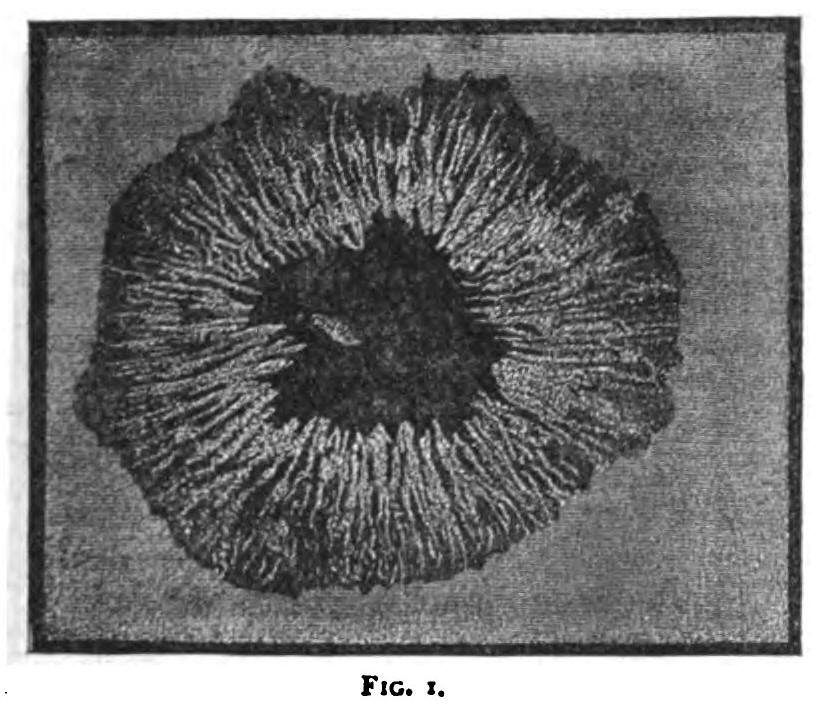
It is a round spot, consisting of a black centre, around which is a penumbra all ragged. The first thing you wall observe is, that the figure of the penumbra is far from being uniform. It is composed of filaments, very long and very thin, which converge toward the centre. These have been called wisps of straw, willow-leaves, etc. I prefer to call them currents, being aware, at the same time, that it is impossible to compare them to any known thing. They are more scattered near the outline of the penumbra, and they become condensed near the centre, where the light is stronger and brighter. These luminous threads start from the outline of the spot, traverse the penumbra, and often run into the black space that forms the centre, where we see them floating singly, gradually becoming smaller, and disappearing after a while.
The penumbra is not always composed exclusively of threads like those you see. The centre is often surrounded by a uniform pale color, over which the currents are disseminated. These currents are not always continuous, and their different parts present an appearance which may be compared to elongated grains.
In spite of the increased power of the instruments we employ to observe the sun, the detached parts of the spots often appear to us as microscopic objects. In order to form an exact idea of their real dimensions, we must always remember that, at this distance, four fifths of a second is equal to 140 kilometres, and consequently these apparent threads, whose seeming width is at most not more than one or two seconds, are in reality immense currents, being, about the middle, of 600 or 700 kilometres in width, while their length is at least equal to the diameter of the terrestrial globe.
The drawings which you have just seen represent some of these spots in their complete form and exactly defined. But they present themselves oftener under fantastic and irregular forms. They are sometimes accompanied by a kind of tail, itself formed of black spots, and which seems to follow the centre in its motion. We have here a curious example. The centre is not quite black; we meet with shadows there—some gray, and others red; the filaments on all sides fall toward the centre, and their edges are turned back and bent, as if they had experienced some resistance, or as if they had encountered a whirlwind.
Figure 2.
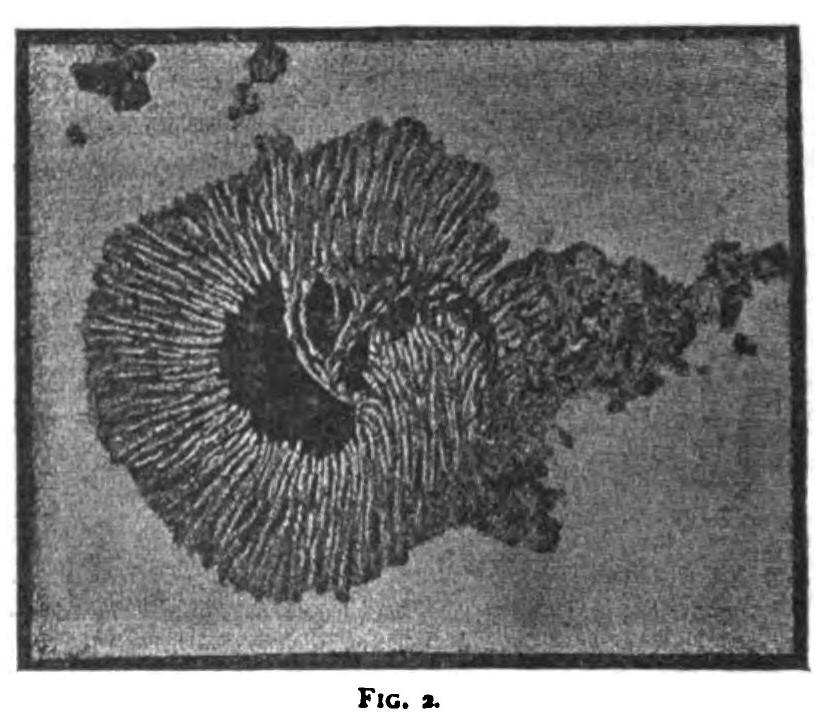
Here is a spot of this kind, (Figure 2,) the details of which are most instructive, and most important in a theoretical point of view. We find the centre divided in several parts by the luminous threads. This appearance was remarked by the ancient astronomers, who explained it by supposing that on the surface of the sun solid crusts were formed, which broke into shivers like glass under a blow from a stone. Modern observations, however, do not admit of this explanation. They show us clearly that these divisions are produced by currents which, leaving opposite edges, meet in the middle of the centre, and thus divide the spot into several parts.
The formation of a spot is never instantaneous. It is ordinarily announced by the appearance of several black points, and by a kind of diminution in the thickness of the luminous bed. These little cavities multiply themselves; one of them develops itself, absorbing the others, and the process ends in the formation of a black spot in the centre. In this first phase the movements of the spots are very irregular, and their advance is always to the front, by reason of the solar rotation.
The drawing which is now before you represents the first appearance of a great spot which was formed almost suddenly on the 30th of July, 1865. The day preceding that of its appearance, in observing the sun as usual, we had remarked only three little cavities, of which we noted the position. On the 30th of July, at mid-day, we found in the place of these cavities an enormous spot, the surface of which was equal to at least ten times the size of our globe. It was so mobile, and its form changed so constantly, that we could scarcely draw it. We could discover in it four principal centres, where the movement of the matter was visible in the form of a whirlwind. In an interval of 24 hours it had undergone some considerable changes. On the 31st of July, the four centres were completely distinct, and the matter which separated them seemed as if it were stretched out. During the days which followed, this form became more and more marked. Soon there were four spots clearly defined, which ultimately assumed the form of four independent craters or cavities. In the interior of these craters we perceived some light shadows, whose form reminded us of that of the clouds we call cirrus. Their color was different from that of the other part of the sun which presented itself to view. As the polariscopic eye-glass does not change the color of objects, we are enabled to see that these clouds are often of a very decided red; and, as this tint is clear and well marked, it is impossible to confound it with the effects due to the achromatism of the instruments. You see here a great number of spots presenting this appearance, and especially in Figure 2, where the red shadows seem intertwined with the white shadows. I have more than once seen these luminous tongues, so to speak, transform themselves into red veils.
This hasty view is, however, so complete as to convince us that the spots cannot be compared to clouds, their aspect not warranting such a comparison. If any part of them may be compared to clouds, it is more the luminous matter; for we see it precipitate itself in the obscure space, and there dissolve in much the same way as we see the vapor which forms the mist dissolve into thin air. All that we are required to believe is, that these apparently black masses are but rents made in the luminous veil which covers the solar body, and to which we give the name of photosphere. It is this bed which transmits light and heat to us. It is suspended in the solar atmosphere, just as clouds in the terrestrial atmosphere. What appear to us as spots in the sun is simply the effect of the rents which take place in it. We are confirmed in this view by the well-ascertained fact that the spots are depressions in the solar body, and that they have the form of a funnel. This form becomes very perceptible, when the spots are drawn by the rotary movement toward the solar disk. When we examine a spot situated toward the centre of the sun, we find that the shape of the penumbra is more regular. But when the spot moves toward the edge, we see the penumbra diminish on the side of the centre, and increase on the opposite side, in which case it presents the appearance of a cavity in the form of a funnel looked at obliquely.
Figure 3.
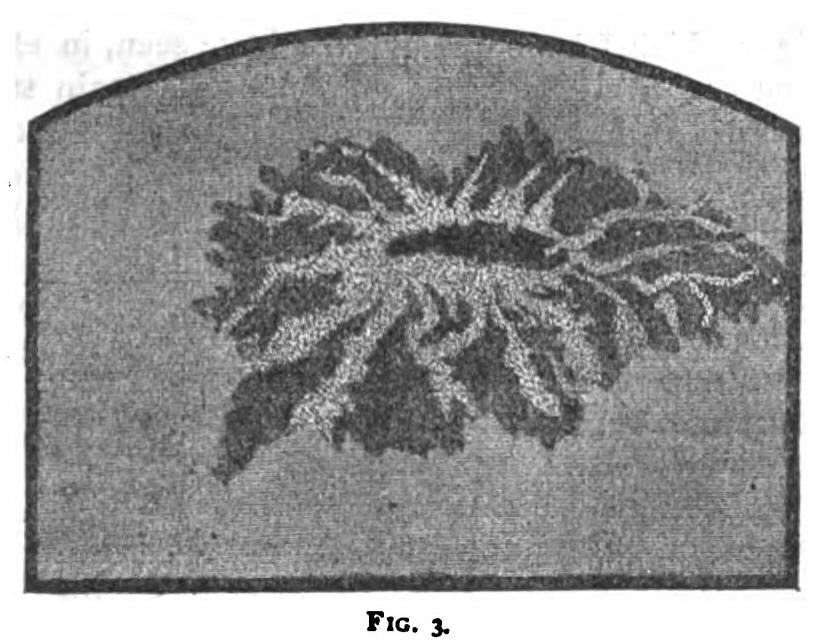
This effect is very clearly indicated in the drawing (Figure 3) which you have now before you, and for which we are indebted to M. Tacchini, the astronomer, of Palermo. We have observed this same spot at Rome, and we have made a drawing of it similar to that you now see; but I would rather exhibit that of M. Tacchini, because it cannot be objected that it was made under the influence of a preconceived idea. You see that in this spot the edge of the aperture is raised much in the same way as in the craters of the moon, and around these apertures are elevations, clearer and more luminous, which we call faculas.
The conclusions which I have just presented to you are also those to which M. Faye arrived, in studying the apparent perturbations in the movements of the spots. In short, what settles the question definitively is the study of the spots of exceptional grandeur when they reach the edge of the solar disk. It is then very easy to prove that the centre is lower than that part of the outline from which radiates the facule. Both M. Tacchini and I proved this at Rome, in studying the grand spot of July, 1865, at the moment in which it disappeared behind the disk of the sun.
The spots, then, are apertures, rents made in the photosphere. But how is it that these spaces do not fill up immediately? This is a serious difficulty, and it leads us to study the structure of the photosphere. If the photosphere was solid, all the movements which take place in it would be impossible. It is, then, fluid. But, on the other hand, a fluid would naturally spread itself until all points of the surface were on the same level, and it would require very little time to fill a gap having the dimensions of even the largest of the spots. The celebrated William Herschel saw this difficulty, and he met it by a solution which we still adopt, because it has been confirmed by observations and discoveries; so that what to Herschel was but a conjecture has become to us a demonstrated truth. The photospheric matter is like our clouds, gauze-like and transparent as ours. We often see among the clouds differences of level—disruptions which enable us to perceive the blue of the sky in the space which separates them. The same thing happens in the sun; and this hypothesis, which is so useful in explaining the phenomena I have just set before you, accords perfectly with all the particulars observed.
We have seen, in effect, the luminous matter remain suspended and floating in the midst of the centre, and the photospheric currents melt in obscure parts, just as our clouds dissolve, apparently dispersing themselves in a space completely deprived of vapor, when the temperature is sufficiently elevated. The little white veil in Figure 1 is a cloud about to be dissolved. Without this dissolving force, the matter which radiates from the circumference to the centre would not be long in filling up this gap. As I told you just now, we have been able to seize the fact of this dissolution of the solar atmospheric matter, and to see these cloud-like forms change into red veils occupying a large surface in the centre.
One thing alone remains to be proved—the existence of a transparent atmosphere. We have for a long time presumed its presence and its action to explain a well-established fact, namely, that the edges of the sun impart to us less of heat and light than the centre. This fact, inexplicable by any known laws of radiation, is easily explained by the action of an absorbing atmosphere; for the rays part at the edge before passing through a thicker atmospheric stratum, proving necessarily an absorption more considerable than that which flows to the centre. The existence of a solar atmosphere, which was formerly regarded as probable, has been reduced to certainty by the observation of eclipses, and it has been shown that veritable clouds float in this gauze-like bed.
Everybody has heard of the magnificent aureola which surrounds the moon during the total eclipse of the sun. It is a truly solemn moment when, the last rays having just disappeared, we see the shadow of the moon projected on a sky of leaden hue, with a perfectly black disk surrounded by a magnificent luminous glory, like that which we see represented around the heads of the saints. This aureola, at least the part nearest the disk, is owing to the atmosphere of the sun. This spectacle is magnificent, but it becomes much more instructive when we examine it through a good telescope. We then perceive around the disk of the moon gigantic flames, of a lively red, the height of which is incomparably greater than the diameter of the earth. Some are suspended without any support, and others take a horizontal direction, like the smoke that comes out of our chimneys. These flames were designated protuberances; but we knew not how to explain them. It was even doubted whether they were real; and we were quite disposed to attribute them to an optical illusion. These doubts have disappeared since the observations we made in Spain during the eclipse of 1860. On that occasion we were stationed at Desertio de las Palmas, on the coast of the Mediterranean, while M. De la Rue took up his post at Riva Bellosa, at a short distance from the ocean. We succeeded at both these stations in photographing the sun at the period of the total eclipse, and a comparison of the two photographs has proved that the protuberances have a real existence, that they have a form so fixed as to give identical images at two points distant from each other by several hundreds of kilometres. The perfect resemblance of the two photographs is the more remarkable, from their not having been executed at the same moment. Between the two operations an interval of ten minutes elapsed. These protuberances, considering their distance and their bent forms, can be nothing but clouds suspended in the solar atmosphere, and it is these which form the red veils that we have seen in the centre. The observation of eclipses proves to us conclusively that the sun is really surrounded by a stratum of this red matter, which we ordinarily see only on the most elevated summits.
In the photograph taken at Desertio de las Palmas during the total eclipse, the exterior form of the atmosphere is perfectly visible. We see that it is more extended at the equator than at the polar regions, which is a natural effect arising from the movement of rotation which the sun possesses. We see, in short, that this atmosphere is livelier in its action in the two zones on each side of the equator, in which the spots ordinarily show themselves. The existence of a solar atmosphere being perfectly in accordance with all known principles and with all ascertained facts, there is no longer any room for calling it in question. We describe the sun, then, as surrounded by a dense atmosphere in which floats the photospheric matter. The surface of the photosphere is far from being uniform and regular. It is, on the contrary, wrinkled all over, and again covered with granulations. These granulations, first perceived by Herschel, have been carefully studied in later times.
When our atmosphere is calm and the observation very precise, the whole bottom of the solar disk appears covered with small luminous grains, separated by a very fine and very dark net-work, resembling in appearance partially desiccated milk, examined through a microscope. These points, or white grains, are of different sizes. Where there are openings, we see around each of them some lines of grains in the form of leaves, more or less oval. Their mean dimension is about the third of a second. These grains are only the upper part of the flame which inclines toward the openings, thus proving that there is a very sensible power of attraction in the apertures. We may even say that these granulations resemble the appearance which the clouds known as cumuli present when, from the summit of a mountain, their upper part is examined. The largest spots would be, then, but an exaggeration of this net-work, ordinarily so fine, produced by the force which caused the flame, or rather, the stratum of the cumulus.
But what is it that produces these spots in the sun? Here the difficulty is singularly complicated. To reply satisfactorily to this question, it would be necessary to become acquainted with what passes in the interior of the solar globe. But let us, without hesitation, and without attempting to delude ourselves, confess that our study of the sun is confined to its external stratum, and to the most striking phenomena of which it is the seat; whereas, with regard to the interior mass, it is only by the process of induction that we are enabled to arrive at any knowledge.
Observations which we have just made lead us to the conclusion that the spots are owing to emanations issuing from the solar body, almost similar to the way in which matter is ejected by our volcanoes. This is proved both by the form of the craters, which you have just seen, and by the columns of clouds, analogous to those arising out of volcanoes, or out of chimneys, observed during eclipses. Here, then, is how we explain the constitution of the photosphere and the formation of the spots. The exterior stratum cools itself constantly by radiation, passes into the gauze-like state, or state of vapor, and ends by precipitating itself in the liquid state, or even in the solid, remaining, however, suspended in the solar atmosphere, as clouds do in ours. It is this condensed matter that forms the photosphere, and it is from that principally we receive light and heat. From some cause or other, a movement from below takes place in the gauze-like mass which is situated underneath. By this movement the photospheric stratum, raised at first, spreads itself on all sides, forming a sort of cushion, and ends by separating itself, leaving a wide opening in the form of a crater. While the volcanic emission lasts, the spot remains open, and it disappears only at the moment when the equilibrium is reestablished, by the luminous matter filling up the void which was formed. If this theory is correct, the circumference of the spots ought to form the mountains above the exterior surface. Now, we have just seen that the outline of the spots is always surrounded by faculae, which constitute prominent elevations. Supposing it is true that the interior mass is the seat of violent action, this conclusion has nothing surprising in it, and we are led to it by a certain number of other phenomena equally remarkable. Thus, every time that a spot is produced, we remark that it is visibly projected with a quickness greater than that of the solar rotation. The projecting mass is then animated with a quickness greater than the surface of the photosphere; and, in order to explain this fact, we must admit that the matter of the interior stratum possesses a quickness greater than the superficial part.
This novel conclusion is supported by another fact. We know now that the rotation of the spots has not the same angular quickness under all the parallels. The quickness is sensibly greater in the equatorial zone than in the higher latitudes. This circumstance forces us to the conclusion that the sun is not a solid globe, but that its structure admits of the different strata of which it is formed having a movement of rotation independent of each other as regards velocity. In fact, the only explanation we can give of this difference of quickness is, that the interior mass is fluid, and that it is moved by a rotary process, more rapid than that of the external surface. We cannot, however, undertake the formal demonstration of this point on the present occasion.
This fluidity of the sun is calculated to surprise you; but you will cease to regard it as incredible when I remind you of certain ascertained facts about this luminary. The gravity of its surface is twenty-eight times greater than that of the surface of our globe, from which results an enormous pressure capable of condensing a large number of substances, or, at least, of singularly diminishing their volume. Looking simply at this fact, the mean density of the sun ought to be much greater than that of the earth. It is nothing of the kind, however, but just the contrary; for the specific gravity of the terrestrial globe is four times greater than that of the solar mass. We must admit the existence of a repulsive force capable of overcoming the molecular attraction, and of rarefying the substances which the weight tends to condense. This repulsive force is probably owing to the heat, and, in fact, the temperature of the sun is estimated at not less than five millions of degrees. At this temperature no matter could remain solid, even in spite of the enormous pressure of which we have already spoken. It is, then, impossible for us to admit the existence of a solid mass, and much more that of a cold centre in the interior of the sun.
And here an objection presents itself to which I ought to reply. If the interior mass of the sun is at a temperature so very elevated, how is it that, when the photosphere opens, a black spot is presented to our eyes? In examining this opening, we perceive a substance of which the temperature is extremely elevated, and which ought, consequently, to be very luminous. How is it, then, that, on the contrary, it presents to us the appearance of a very deep black? My reply is, that the black color of the spots is a purely relative matter; that it is owing to the contrast of the brilliant light which comes to us from the photosphere. If we could see those apparently dark parts away from the glittering mass of the sun, they would appear not only luminous, but dazzling with light.
But you will say to me, it still remains true that the interior mass of the sun is less luminous than the photosphere; but since the superficial part constantly cools by radiation, it follows that there ought to be less heat, and, consequently, less brilliancy in the photosphere than in the interior mass. With your permission, I will make a reply to this which might, at the first blush, appear paradoxical, but which is, nevertheless, the expression of truth. It is precisely because it is of so very high a temperature that the interior mass of the sun sends us a less degree of light and heat; it is precisely because it is cooled at the point of condensation, to precipitate itself in the liquid or solid state, that the photospheric matter becomes hotter and more luminous. To make this plain, we have only to recall certain well-known principles of physics. Two bodies equally hot may not emit the same quantity of heat. One of them may cool itself rapidly in heating the bodies which surround it; while the other may let its heat escape only very slowly, and heat but feebly the neighboring bodies. In this case, we say that the first has a more considerable radiating power. Now, philosophers know that gas has a very feeble radiating power, and that it may be consequently at a very high temperature without emitting around it a great quantity of light and heat. You have an illustration now before your eyes. This lamp, fed by lighted gas, gives a very brilliant flame, because the carbon remains there some time in suspension before burning. Let us throw into the flame a little oxygen; immediately the flame pales, becomes bluish, and ceases to be luminous. Its temperature, notwithstanding, has greatly increased, and it is now the celebrated gas by the aid of which M. Sainte-Claire Deville melts his platina so rapidly. The change results from the very rapid combustion of the carbon by the oxygen. As soon as this takes place, the flame, no longer containing any solid body, loses almost all power of emission, and ceases, in spite of its high temperature, to have the brilliancy which it possessed at a lower temperature. To convince you perfectly, let us put a solid body in this flame, now so pale, and you will see it become more brilliant than ever. We introduce, for example, a piece of lime, and the apartment is at once illuminated by the Drummond light, one of the most brilliant of our artificial lights.
But, leaving the earth, let us now return to the sun. The interior mass is undoubtedly at a very high temperature—so high, indeed, that all the substances composing it must be in the state of gas, possessing only a feeble radiating power; while the photosphere is composed of matter precipitated in a liquid or solid state, of which the radiating power must be considerable. Here is the explanation of what seemed paradoxical in my answer. The hottest part of the sun is not the part which warms and lights us most, because, being in the state of gas, it produces only a feeble radiation.
Two questions now present themselves. How is it that the sun preserves indefinitely so elevated a temperature in spite of the enormous amount of heat which it loses daily? Of what kind of matter is this luminary composed? And what the nature of the radiation which sends to us daily the light and heat which we need? It is undoubtedly impossible to give a complete and satisfactory answer to these questions. We may yet be able, however, to do so; and we are persuaded that science in its progress will only confirm and develop the explanations which we give to-day of first principles. In the first place, it is impossible to admit that the sun is simply a luminous globe, not possessing any means of renewing the heat which it loses at every moment; for, in that case, at the end of a few years its temperature would be lowered in a very appreciable manner; and it would not require an age to effect a complete change in the phenomena which are dependent on it. There must be, then, a source of heat in the sun.
We are in the habit of comparing things we do not know with those with which we are familiar. Thus we have been led to think of the solar globe as the seat of a combustion similar to that we witness on our hearths. This idea is deceptive.
We know the quantity of heat which each substance throws off in a state of combustion; we know, too, what a vast body the sun is; and we are able to calculate with a rough but sufficient approximation the quantity of heat which the body of the sun would produce in burning. The result of this calculation is, that, at the elevated temperature which the sun possesses, the combustion of the solar mass could not be kept up during many ages. Since the historic period this temperature would have been so lowered as to produce a change in the seasons that has not taken place. We are compelled, then, to abandon the idea of a mass in combustion, as well as that of a luminous globe, and to acknowledge that there is a secret which has escaped us.
This secret, gentlemen, chemistry is charged to unveil to us. Astronomers profit eagerly by all the discoveries which physical science makes, and it is by this means alone that they arrive first at conjecture, and afterward at a knowledge of what is taking place at prodigious distances. It is thus that the phenomenon of dissociation recently discovered by M. Sainte-Claire Deville, puts us in the way of explaining the permanence of the solar temperature. We know that no combination can resist heat. Whatever may be the stability of the combination, whatever energy the affinitive force may possess, if the temperature is raised to the proper degree, the elements separate, and remain together simply in a mixed state, wanting to combine anew when the temperature is lowered. This is what we call dissociation; and this is just the state, for example, in which we find oxygen and hydrogen gas, exposed to a temperature of 2500 degrees. At such a temperature they remain in a mixed state, without being able to form water, which ought to result from the combination of these two elements. But the phenomenon of dissociation cannot take place without the intervention of an enormous amount of heat. To illustrate this, let us suppose a kilogram of ice at zero. In liquefying it would absorb 79 degrees of heat; to make it warm, 100 degrees would be required; in evaporation it would absorb 640; and to dissociate it, 3955, or nearly 4000 degrees would be necessary. What we say of water is equally true of all the combinations; all that is required being to change the numerical degrees of the latent heat, for fusion, for volatilization, and for dissociation. This being so, we arrive at the conclusion that even the least considerable quantity of matter in a state of dissociation may be regarded as a magazine of latent heat continually tending toward sensible development.
The temperature of dissociation of water is almost 2500 degrees. The temperature of the sun being at least five millions of degrees, the whole mass of which it is composed ought to be in a state of dissociation, and to contain consequently an enormous quantity of latent heat independent of the sensible heat; to which is owing this prodigiously elevated temperature. What, then, is the effect which the solar matter ought to produce on the radiation of which it is the seat? Almost the same effect that radiation produces on a liquid body which has reached a temperature of solidification. The heat necessary to keep up the radiation is borrowed from that part of the liquid which solidifies, so that the temperature, instead of decreasing, remains constantly at the point at which solidification ceases. This is really what passes on the surface of the sun. This brilliant mass, raised to a temperature of five millions of degrees, has a tendency to cool itself rapidly. The radiation produces, in fact, a coolness in the superficial stratum. By reason of this coolness, part of the gas which composes the atmosphere is lowered below the temperature of dissociation; it yields then an enormous quantity of heat, which from latent becomes sensible, and prevents also an ulterior lowering of temperature. It is sufficient to repair the continual loss of heat that a mass of several kilograms passes daily from a state of dissociation to one of combination; and it is evident, considering the enormous size of the solar globe, that things may remain in this state during millions of ages without the temperature of the sun changing in a manner which may be felt by us. I say, by us, for our knowledge of this temperature is obtained at no less a distance than several hundred thousands of degrees.
It appears, then, from the very nature of the sun, that it does not possess an inexhaustible quantity of latent heat. A day will come when it will no more be able to lose heat without being cooled in a sensible manner, but that cooling will not take place before a very distant period, and long after we have disappeared from this world.
By way of recapitulation of the several views we have set forth, let us endeavor to give you a precise idea of the sun, as regards both its interior and its surface. The reasonings which we have just advanced, founded partly on astronomical observations and partly on known principles of science, lead us to regard the sun as composed of a fluid or gauze-like mass, surrounded with a photospheric stratum, the matter of which has passed through the first stage of condensation. According to the views held by Laplace, the sun proceeded from the hands of its creator in a nebulous state. We are led to believe that the interior mass is still in this state. A change has taken place only on the surface, because there only could the loss of heat owing to radiation produce a partial cooling. The result of this cooling is the condensation of a relatively small quantity of matter, which, possessing a very considerable power of emission, forms the photosphere. It is in the presence of this photosphere that the only difference exists between the sun and a nebula, between the myriads of stars which people the heavens, and the nebulae with whose existence the telescope makes us acquainted.
We come, at length, to the last with which we proposed to deal: What is the constituent matter of the sun? What are the elements which enter into the composition of its atmosphere and of the photospheric bed? Some years ago, to put a question like this would have been regarded as rashness; to attempt to answer it, the height of folly. We only knew, from the analysis of meteoric stones, that cosmical matter did not contain any other elements besides those of which our globe is composed. But to-day we can go further, thanks to the discoveries of the German Kirchoff.
We all know the solar phantom, and the brilliant colors which result from the decomposition of the white light. This phantom seems continuous if we make the observations in a rough manner; but if we employ delicate means, we see that it is formed of a multitude of black streaks and of brilliant rays perfectly distinct from each other. It is impossible to imitate this appearance artificially. All that we are able to do is to project on a screen the figure of a solar appearance taken from a drawing. You see that it is furrowed over with a considerable number of black streaks, of which the principal ones are, according to Fraunhofer, who discovered them, indicated by the letters of the alphabet, A, B, C, etc. These streaks are extremely numerous: we have counted no fewer than 45,000 of them.
I have said that it is impossible for us to imitate this appearance with our artificial lights, and it is precisely here that we are able to discern the nature of the different sources of light. In fact, each source has an appearance peculiar to itself, and by which it is characterized. The brilliant line of the Drummond light gives a continuous appearance, and it is the same with all the simple incandescents. But when we analyze the light of a body in combustion, we arrive at an entirely different result. The appearance obtained in this case is crossed by rays which, instead of being black, are, on the contrary, more brilliant than the colors in the midst of which they are formed. The same thing happens when we make the rays emanating from the electric light pass through a prism, because in this case there is combustion, that is to say, a combination of the oxygen in charcoals, mixed with foreign matter, from which is produced the voltaic bow. If we are content to restore these burning coals, they will give a continuous appearance just as lime.
The brilliant spectral rays are not always the same. They depend on the nature of the metal which is found in the flame, and which takes part in the combustion. You see at this moment the appearance which silver presents: it is characterized by a magnificent green ray. Here is now the appearance of copper, which, we know, has a yellow ray, accompanied by a fine group of green rays, different from those which silver produces. We now burn some zinc, which gives a magnificent group of blue rays, a fine red ray, and another of violet. Finally, we shall close these experiments with burning brass, which is, as you are aware, a mixture of copper and zinc. You will recognize in the appearance which is produced the characteristic rays of those metals, each of them producing its proper effect, as if it were alone.
We learn but little, however, from these experiments, of the nature of the substances of which the sun is composed; for the rays which we have produced are all brilliant, while those of the solar appearance are black. Let us see, then, in pursuing this subject, if it would not be possible for us to obtain these black lines with our artificial lights. Let us produce, in analyzing the Drummond light, a perfectly continuous appearance. Now, let us make this appearance, before reaching the screen, pass through a deep layer of hypoazotic acid. Immediately you see it discontinued. It is like the solar appearance, crossed over by a multitude of black lines. The hypoazotic acid is not the only gas that produces this result. The vapor from brome, that of iodine, will give equally the black lines in the same circumstances, only these lines are different from those we have just seen in the experiment made with the hypoazotic acid. Thus, the gases, the vapors, possessing the property of absorbing certain luminous rays, certain colors, these rays, found no longer in the appearance, are necessarily replaced by the black lines we have just observed. All the gases, all the vapors, could not, I am convinced, produce this result; for it is clear that their power of absorption, being less considerable, could not make itself felt, unless by means of a stratum the thickness of which should be greater than that which we are able to use in our experiments. We find a proof of this in what passes in the atmospheric air. Under a feeble thickness no sensible absorption is produced; but it is certain that the atmospheric mass absorbs a great number of rays, and consequently gives birth to many black lines; for in the solar appearance we observe new and very marked lines, when the sun being near the horizon, his rays pass through a bed of air of very considerable thickness. These rays are principally owing to the vapor of water. We can equally affirm the absorbent power of the atmosphere which surrounds the planets Saturn, Jupiter, and Mars. Their appearances contain lines very different from the solar appearance. Yet, as the light which they transmit to us comes to them from the sun, we are forced to conclude that that light undergoes some modification in travelling over its transparent path. It is the atmosphere of the planets which produces this result.
The sun also possesses an atmosphere, as we have seen, and this atmosphere ought necessarily to exercise an influence on the rays which traverse it. Such is, in fact, the origin of the rays which we notice in the solar appearance. They are owing to the atmospheric absorption, and the bed of transparent but absorbent vapor which surrounds the atmosphere, and which the rays pass through before they spread themselves in space.
But how are we to ascertain the nature of the vapors which produce the black lines we observe? Here physical science comes again to our aid, and the question we have just put finds its answer in a recent discovery. We have seen that a certain substance in burning gives birth to certain luminous rays which characterize it. We have also seen that this same substance, in a state of vapor, absorbs, on the contrary, certain rays, and produces in consequence certain black lines which are equally characteristic. Now, by a singular coincidence, these two powers, emissive and absorbent, are identically the same. Each substance, in a state of vapor, absorbs precisely the rays which it is capable of producing in combustion, so that the black streaks produced in the first case occupy identically the same place as the brilliant lines observed in the second. We may demonstrate this interesting theory by the following experiment, due to M. Toucault. We know that sodium produces in burning a beautiful yellow light. Well, let us burn some sodium in the coals, and between these two substances the electric light is produced. The metal while it is burning volatilizes largely; the vapors which are produced absorb precisely the rays which they should have emitted in their combustion; and you see that in the yellow, instead of a brilliant line, we have a very dark line. What we have just seen take place with the sodium has been equally proved by experiments on a great number of metals, and, by induction, we may extend the application to all those on which it has been impossible to make experiments.
Let us apply this principle to what concerns the light of the sun. The photosphere is composed of condensed substances, precipitated in a solid or a liquid state, floating in a transparent and absorbent atmosphere. This matter, being simply incandescent, ought to present to us a continuous appearance, and this continuity can be disturbed only by the absorption of the solar atmosphere. From this it follows, that to ascertain the chemical nature of the substances which compose this atmosphere, it will be sufficient to compare the black lines of the sun with the bright lines of our artificial lights. This has been done. M. Kirchoff first discovered that the sun contains sodium; for the line D of Fraunhofer coincides perfectly with the brilliant lines of this metal. It is equally well known that iron, copper, and twenty other substances which exist upon the earth in a solid state, would, at a temperature of five millions of degrees, be necessarily in a state of vapor.
After having thus made a chemical analysis of the sun, astronomers wish to go further; they have sought to know equally the composition of the stars. We have been led by this to some very remarkable consequences; we have been able to make a kind of classification of these stars, and to determine the group to which our sun belongs. It remains, then, for us now to apply the spectral analysis to the myriads of stars which stud the heavens, to those far distant suns, the greater part of which, perhaps, surpass in grandeur and brightness that which is the centre of our planetary system. It remains for us to interrogate these scarcely perceptible bodies, sparkling at such an incalculable distance, and to demand and draw from them the secret of their chemical composition. This enterprise is daring, but it is not rash. The difficulties are alarming; yet learned men are not discouraged, for they are accustomed to see difficulties disappear before strenuous and persevering labor.
We commenced our study of the stars with the complicated instruments which we employ for the sun; but we soon found out that this complication was useless. We have been able to reduce our instruments to the number of two, a cylindrical glass and a prism. And M. Wolff, of the Paris Observatory, has succeeded recently in suppressing the cylinder, keeping only the essential element, that is, the prism intended to produce the appearance.
We have examined a great number of stars, and I am going to submit to you some of the results at which we have arrived. You see at this moment the appearance which the star Orion presents. This star is of a yellow color; the appearance which it produces is deeply streaked; and it is one of the most beautiful in the heavens. You will find there the line D of sodium, and the line b of magnesium. These are two fundamental lines which have served as marked points to compare this appearance with that of the sun. Besides sodium and magnesium, a of Orion contains iron, copper, and several other known metals; but it is singular that hydrogen is not found there in the free state, as in the sun. There is, then, some essential difference between the stars, of which you will be more convinced as we go further into the subject. Here is the appearance of Sirius. You see it is not nearly so fine. You will find two large bands in blue, in the place of the streak F of the sun; two others in violet; and one, very faint, in yellow. The two first are attributable to hydrogen, and the last to sodium; but we know not to what substance the violet is owing. In the green there are also some very fine lines, but very difficult to seize.
What is most remarkable is, that all the white stars present the same appearances, and half the stars that are visible belong to this type. Thus the fine stars of the Lyre, of the Eagle, of the Bear, Castor, etc., ought to be ranged by the side of Sirius. There is, however, an exception in [zeta] of the Bear, which is a yellow star. The magnificent stars of Arcturus, of the Goat, of Procyon, belong, on the contrary, to the class of which our sun is a type, except that the iron line E is much more marked. Their color, of light yellow, led to the inference that they were analogous to the sun, and the supposition has been confirmed by spectral analysis. All know substances have an appearance which is peculiar to them, and which characterizes them. Can we say as much of the stars? Do they also present marked differences in their appearance? This has been the subject of very interesting researches. The task has been undertaken at the observatory of the Roman College, and it has led to a result altogether unforeseen, namely, that the stellar appearances appertain to only a very limited number of types. We may classify them in three groups. The first group is that of the white stars like Sirius; the second, that of the yellow stars, of which Arcturus and the second are members; and Orion may be regarded as a type of the third, in which we ought to place a of Hercules, and [Beta] of Pegasus. These two last-named stars have very remarkable appearances. They seem formed of a multitude of channels, which are divided by large black bands. This form of appearance shows us that the stars which belong to this type are surrounded with atmospheres heavily charged with vapor. In this group enters all the red stars, and in particular Omicron of the Whale, that celebrated star which has been called The Wonderful. Several small stars of a blood-red color have appearances resembling each other. It is remarkable that in all the appearances belonging to stars of this type, the black lines occupy the same place, which proves that in general they are all made alike.
I have observed further that certain types abound in certain parts of the heavens, and that the stars of the same kind are generally grouped together. Thus the white stars are found in the Pleiades, the Bear, the Lyre, etc.; the yellow in the Whale, Eridan, etc. The constellation of Orion deserves particular attention; it abounds in stars of a green color, reminding us of the nebula which is found in the same region of the sky. This small number of types, and the grouping of which I have spoken, constitute an unforeseen fact, the importance of which is considerable from a cosmological point of view. We should not, however, be hasty in drawing conclusions from it.
A curious fact has been established with regard to one of the white stars in Cassiopeia. Its appearance is directly the opposite of that which is presented by stars of the same color, for, in place of black lines, it shows some brilliant lines. This phenomenon has appeared to me so extraordinary, that I am anxious whether it is an isolated fact. I have observed more than five hundred stars, selecting some of the largest, and I have found only one, [Beta] of the Lyre, which possesses the same peculiarity. M. Wolff says that among the small stars of the Swan he has found some examples of the same kind. A most remarkable fact is, that these brilliant lines were found in a transient star which glittered for a time in the Crown in May, 1866.
These observations upset the theories which had been prematurely built upon facts formerly known. Still, there is nothing inexplicable here. You have seen that sodium burning gives a line of a very lively yellow, while the line becomes black if the sodium is increased to a considerable quantity. Might not the same thing happen with the hydrogen, which produces the brilliant lines of which I have spoken to you? Might not a small quantity act by radiation, while the action would be one of absorption should the mass be greater?
After having examined the stars, it was impossible to resist the temptation of observing the nebulae. You know that we designate by this name the kind of white clouds which are found spread in the heavens, and of which the nature is not perfectly known. Herschel has assured us that many of them, by means of the telescope, may be resolved into a multitude of small stars approaching very closely to each other. We infer from this that the greater part are composed in the same manner, and that the feebleness of our instruments is the only thing that prevents us from proving it. It is, however, admitted that many of these nebulae are formed of cosmical matter in a state of vapor not condensed. Everybody knows the nebulae which compose the Milky Way. But besides those which are visible to the naked eye, there is a vast number whose existence the telescope has revealed to us. One, of the most celebrated is that which is found in the magnificent constellation of Orion: we have carefully drawn it at the Roman College, and you see at this moment a sketch of it on the screen. The nebulae possess a very feeble light, and we had our doubts of success in seeking to apply the spectral analysis to them. We have, however, succeeded beyond our hopes. The appearances obtained in these observations are very singular. They reduce themselves constantly to luminous streaks, all the other colors failing; it is, in another way, that which happens when we burn an alcoholic solution with marine salt; the flame, analyzed by the spectroscope, gives simply a yellow streak. In the nebulae we find two green lines and a blue one. Such is the result which we obtained in examining the large nebulae of Orion, and that of the Milky Way in Sagittarius. Such is that, also, which furnishes the little nebulae called planetaries, on account of their form, which resembles that of the planets. These facts have been established for the first time by M. Huggins.
As I have just told you, the nebulas present generally but three lines; one belongs to azote, another to hydrogen, and the third is unknown. This result, which was not known before, is of the highest importance; for it teaches us that the nebulae are composed of gas and of vapors far removed from their point of saturation and condensation. These appearances, with luminous lines, distinctly isolated and separated from one another, appertain essentially to gas, and, we ought to add, to gas raised to a very high temperature. Thus we have made a discovery by the aid of the prism, for which the most powerful glasses had failed us.
The nebulae, notwithstanding their shining points, are not in general a collection of stars, but masses of cosmical matter in a state of dissociation under the action of an extremely elevated temperature. The collections of stars are perfectly distinguishable by the continuity of their appearances, as we see in the nebulae of Andromeda, and in some others which are well known. The discovery opens a vast field of investigation, and will be an epoch in science.
We have wandered far into the depths of space, very far from the point from which we started. This is of no consequence, however, for between the sun, the stars, and the nebulae there is a close relation. The sun is simply a star approaching nearer to us than others. According to a bold hypothesis, its entire mass was at one period in a state of dissociation, which a great part of it still actually preserves. The only thing that makes it differ from the nebulae, and causes us to rank it among the stars, is its superficial stratum of inconsiderable thickness.
What mysteries do we not discover in nature, when we investigate it by the aid of those principles and instruments with which modern science has furnished us! And in the presence of the wonders, what an exalted idea ought we to form of the splendors of the universe and the power of its Creator!
Permit me, gentlemen, in closing this lecture, to quote an admirable thought of Saint Gregory of Nazianzus. The sun, says that father, is the most perfect image of the Deity. You see the effects which it produces; you enjoy its benefits; but you cannot contemplate it directly, nor sound its depths. The loss of life, the greatest of the earthly blessings we enjoy, would be the punishment of the madman who would dare to invade its mysteries. It is the same with the Deity; it is impossible for us to see in himself; and we ought to content ourselves with admiring here below those traces of his infinite perfections which shine in his works.
We have succeeded, by the means with which science has furnished us, in examining this dazzling star, and in doing so we have seen some unexpected wonders; but how many other wonders have escaped us, which will doubtless be discovered at some future time!
If we can thus speak of the material sun and its splendors, what shall we not say of its prototype, when, freed from this material covering of sense, and reduced to a state of pure intelligence, we contemplate him with the eyes of our soul? Science and Faith are two rays issuing from the same focus, the one direct, the other reflected. As long as we are upon this earth we should be content with the second, our vision not being strong enough to support the brightness of the first. But a day will come when we shall see the Divinity face to face; and, in the meantime, the man who denies his unfathomable mysteries, under the pretence that our feeble powers are not equal to their comprehension, is as foolish as the rude peasant who should deny the wonders with which I have entertained you, under the pretext that his eyes are dazzled by the light of the sun. A day will come when the direct rays of the Science of Divinity will no longer dazzle our intelligence: the high destinies which awaits humanity will permit of our contemplating the unclouded essence of the Deity, as the reward of the persevering but not blind fidelity with which we shall have here below, without pride as without baseness, believed in his existence and admired his greatness.