Book 4 — CHAPTER III THE FLORENTINE LODGE
Reading edition
THE FLORENTINE LODGE
1. 1258 Magister Jacopo Tedesco da Campione Built castles at Arezzo and Poppi; and the Bargello at Florence.
2. 1298 to 1310 M. Arnolfo (his son?) C.M. of the Duomo. Built the Palazzo Vecchio.
3. 1340-48 M. Giotto Designed the campanile, and sculptured the first row of reliefs.
4. M. Andrea Pisano Made door of Baptistery.
5. 1349-59 M. Francesco Talenti C.M. of the Duomo.
6. 1350 Neri Fieravanti Four Masters who went to Carrara to buy marbles for the Campanile, of which they were joint architects.
7. Niccolaus Beltrami
8. Benozzus Niccolaus, his son
9. Albertus Arnoldi
10. 1355 M. Frate Jacopo Brother of Francesco Talenti; sent to Rome for marbles.
11. " M. Francesco da Siena (called Francesco del Coro) Carved stalls in Siena cathedral: sent for to carve the stalls of the choir of S. Croce.
12. " M. Benci Cione Father of Orcagna. They were called in the Council of the Opera to consider Francesco Talenti's design for the chapels, July 1355.
13. " M. Ristoro Cione (a relative)
14. " M. Lapo Ghino Descended from Ghini Ventura di Diotisalvi of Siena.
15. " M. Giovanni di Lapo Ghino. C.M. with F. Talenti, 1360 to 1368 [236]
16. M. Bartolo da S. Ghallo A Lombard from S. Gall, grandfather of the famous Giuliano and Antonio San Gallo.
17. 1356 M. Ambrogio Lenzi (Ambroxios da Campione) Son of Guglielmo da Campione; was C.M. of the Baptistery in 1356; C.M. of the Duomo in 1362.
18. M. Stefano Metti
19. 1357 M. Domenico di Noffo Sent to Siena to buy marbles.
20. " M. Giovanni Belchari These three were joint C. Maestri for the upper part of the Campanile. In 1362 Gio. Belchari was poor and infirm, and the guild gave him a pension.
21. M. Vigi Grilli
22. M. Bancho Falchi
23. Agostino Falchi (brother of the preceding) Joint Masters for the walls and columns of the Duomo.
24. Niccolò Megli
25. M. Andrea di Cione (Orcagna) In council with Frati and Magistri about the space between the columns. Later he became famous as painter and sculptor, and made the shrine in Or San Michele.
26. M. Jacopo di Lapo Chavacciani Makes a model of the shaft.
27. Mato di Cenni These were engaged for the bases of the columns.
28. Jacopo di Polo
29. 1362 M. Barna Batis Provveditore after Filippo Marsili.
30. M. Davinus Corsi
31. 1363 M. Simone Johannes dal Pino Engaged to carve the twisted columns of red marble in the windows of the Duomo.
32. " M. Ambrosius Ghini A relative of Lapo Ghino.
33. 1364 M. Sandro Macci In council on the domes, with many others named before and after.
34. M. Francesco Neri Sellari Sculptured pila and relief in S. Croce.
35. 1366 M. Simone di Francesco Talenti C.M. of Or S. Michele in 1376. With Taddeo Ristori in 1366 he made a design for a chapel.
36. " M. Jacopo Pauli Engaged Aug. 31, 1366, to make capitals for columns in the sacristy.
37. " Mato Jacobi His three sons who assisted him.
38. " Aldobrando Jacobi
39. " Corso Jacobi
40. 1367 Bernabè Pieri Made a contract on Aug. 31, 1366, to carve some capitals.
41. " M. Manetti Pieri
42. 1368 M. Francesco Michaeli Advises about Or San Michele with Gio. di Lapo Ghino.
43. M. Mattheo olim Cionis One of the Masters employed in Or San Michele, brother of Orcagna.
44. 1375 M. Giovanni Giuntini
45. M. Francesco Salvetti C.M. in 1375, but resigned later in favour of Giovanni Fetti.
46. 1376 M. Taddeo Ristori One of the Cione family; architect at Or San Michele, and the Loggia de' Lanzi after his uncle Benci Cione.
47. Ambrogio di Vanni Masters in stone-carving.
48. Leonardo olim Masis
49. 1377 M. Johannes Michaeli, brother of Francesco (No. 42) Went to Prato on Oct. 2, 1377, with Tommaso Mattei to buy marble.
50. M. Tommaso Mattei Son of Matteo di Cione.
51. M. Zenobio Bartholi Was paid 18 florins on Dec. 15, 1377, for a figure of the Angel Michael. He also carved two other figures at 20 florins.
52. " M. Simone Francesci Talenti Elected C.M. in 1377. Son of the C.M. Francesco. He sculptured a figure in 1377, and was paid 13 florins.
53. 1380 M. Jacopo da Scopeto Worked in the choir.
54. M. Pietro Landi of Siena Son of the famous Lando, C.M. of Siena Lodge.
55. 1381 M. Johannes Fetti Elected C.M. with Guazetta on March 14, 1381. window under the vault on the north side.
56. M. Johannes Stefani, called Guazetta, son of No. 18. Was a famous Master in woodwork; he was noted for foundations and scaffolding.
57. 1383 M. Laurentius Filippi C.M. of the Loggia dei Lanzi with Benci Cione, who was master builder.
58. 1384 M. Giovanni di Ambrogio da Lenzo (son of No. 17). Gave his vote at a meeting on April 4, 1384, about the pilasters of the tribune. Was chosen C.M. on Feb. 28, 1400.
1386 M. Luca di Giovanni da Siena Carved some angels.
59. 1388 M. Michael Johannis Lapi Ghini Succeeded Lorenzo Filippi as C.M. on July 15, 1388.
60. 1389 M. Antonio Francisci Elected Arch Magistrum, but deposed in 1420 by the council; and Giovanni di Ambrogio of Campione was elected.
61. 1404 M. Niccolao called Pela Sculptured the door of the chapel of the Crucifix from Giovanni d'Ambrogio's design.
62. 1418 M. Baptista Antoni (son of Antonio, No. 60) Elected C.M. when Giovanni d'Ambrogio resigned by reason of old age.
63. M. Piero d'Antonio (another son of Antonio, No. 60) Nicknamed Fannulla (Do nothing).
64. " *M. Matteo di Leonarda All the masters marked * sent in plans for the Cupola. The design of Brunellesco, who I believe not to have been of the guild, was chosen.
65. *M. Vito da Pisa
66. *M. Piero di Santa Maria
67. *M. Donatello
68. *M. Nanni di Banco
69. *M. Lorenzo Ghiberti Provisore of the Cupola with Baptista Antoni when Brunellesco's plan was chosen.
70. " M. Andrea Berti Martignoni All these Masters were employed to erect a large model of the design of Brunellesco for the Cupola, on the Piazza del Duomo.
71. " Bonaiuti Pauli
72. " Papi di Andrea
73. " Aliosso
74. " Cristoforo di Simone
75. " Giovanni di Tuccio
76. " Jacobo Rosso
77. " M. Giovanni dell Abbaco Worked at the Cupola under Brunellesco.
78. M. Antonio di Vercelli
M. Gherardo (tedesco) Three Germans who were paid for models of a cupola.
M. Ghabriella (tedesco)
M. Averardo ("magistro teutonico")
Art is like a flower. If the seeds are sown in favourable soil the plant grows, develops, and bears beautiful blossoms, which in their turn leave seed for future generations. If the soil be not favourable, the plant may perhaps reach its flowering season, but it is weak, and the seeds lack the power of reproduction.
Thus in small cities like Modena, Parma, Orvieto, etc., the artistic atmosphere and soil were wanting. The lodges of those cities never became firmly rooted. The Lombard Masters placed there did their work, and then moved to other cities, but the natives remained uninfluenced. In Pisa, art first took root. The Pisans, whose artistic faculties had been awakened by the classic spoils they had gathered together in their conquests, found a practical outlet for them in the teaching of the laborerium set up in their midst by Buschetto and his assistants and followers. Pisans joined the lodge, and from it great teachers arose. Siena was the next lodge that took root, and drew native artists into it; then followed Venice and Florence; and through them all, distinct as they became in later times, the seed was always sown by the Comacines or Lombard Masters. The Campionese and Buoni families are at the bottom of all the Tuscan schools, and every one of these cradles of art was of the self-same form, i.e. composed of the school, the laborerium, and the Opera of the Comacine Masters.
And what connection had Arnolfo, the first designing architect of the Florentine cathedral and Palazzo Vecchio, with this Masonic company? He had much to do with it, inasmuch as he was an hereditary member, in fact one of the aristocracy of the guild, and he had a most complete training in it. The first trace we get of Arnolfo is his instruction in the school of Magister Niccolò Pisano. The proof of this is a deed drawn up in Siena on May 11, 1266, in which these words occur—"requisivit Magistrum Nicholam Petri de Apulia quod ipse faceret et curaret ita; quod Arnolfus discipulus suus statim veniret Senas ad laborandum in dicto opere, cum ipso magistro Nichola." Here we have Niccolò di Pisa as Master in the guild, and his disciple Arnolfo not yet having graduated.
Another paper relating to Niccolò's work on the pulpit at Siena says—"Secum ducat Senas Arnolphum et Lapum, suos discipulos."
By 1277 Arnolfo seems to have graduated, for when Niccolò and Giovanni di Pisa were at work on the beautiful fountain at Perugia in that year, Fra Bevignate, the soprastante of the work, sent to call Magister Arnolfo from Florence to assist in the sculpture of the fountain. Arnolfo, however, declared in a letter dated Aug. 27, 1277, that he could not go to Perugia, or undertake any work there without the consent of King Charles of Anjou (King of Naples and Sicily) or of Hugo, his vicar in Rome. King Charles was applied to, and on Sept. 10 of that year he wrote conceding permission to Arnolfo to go and assist his old master—then 74 years of age—and also to take the marbles necessary.[237]
These documents are very valuable apart from the fact they chronicle. They show how the guild was not only privileged by the reigning monarch, but that he was the active president of it. It explains all those queer words on Longobardic inscriptions, beginning—"In tempore Dominus Honorius Episcopus," "In tempore præsule Paschalis, etc.," showing that they point out the reigning king, pope, or patron bishop who was at the time president of the Great Guild. The name of this highest magnate is usually followed in these inscriptions by the Grand Master, soprastante or operaio of the special lodge. The universality of the guild is also shown; its president, the king, being at Naples, his "vice" at Rome.
The next place in which we see Arnolfo is in Rome, where he worked with his socio (fellow Freemason), Pietro, at the tabernacle of San Paolo fuori le mura. Here, with this ancestor of the Cosmati, Arnolfo learned his love of polychrome sculpture, which he afterwards adapted to the larger uses of architecture; for his grand Florentine Dome seems only a magnified inlaid casket. There is a beautiful piece of inlaid work in the Opera del Duomo which I believe to have been the pluteus or parapet of the tribune in Arnolfo's time. It is in the Cosmatesque work which Arnolfo often executed. That he was as apt a pupil of the Cosmatesque revival of the opus Alexandrinum as he had been of Niccolò's figure sculpture, and his father Jacopo's architecture, is evident by his tomb of Cardinal de Braye at Orvieto, where we next find him working in 1285.[238] The tomb is a beautiful mixture of Cosmatesque ornamentation with the legitimate sculpture which he had learned from Niccolò. The capitals of the spiral inlaid columns of the sarcophagus are of the true old Romano-Lombard form. In the simple grace of the recumbent figure we descry a forerunner of Donatello and Desiderio.
We have now traced Arnolfo's training through three or four of the chief lodges, and always under the best Masters. It is then no marvel that by 1294 his fame had risen so high that he was chosen as architect of the Duomo of Florence. He was well known to the Florentines, his master, Jacopo Tedesco, otherwise Lapo, having left Colle to settle in Florence, where he was engaged to build the Palace of the Podestà (Bargello). And this brings us to the vexed question of the parentage of Arnolfo.
Vasari says that Jacopo or Lapo, whom he calls "il Tedesco" (meaning Lombard architect), was the father of Arnolfo, and he gives this as a certain fact, understood to be the case by the world in general for two or three centuries past.
Milanesi, on the strength of the document quoted above, "Secum ducat Senas Arnolphum et Lapum suos discipulos," says that Lapo was only Arnolfo's contemporary and fellow-pupil.
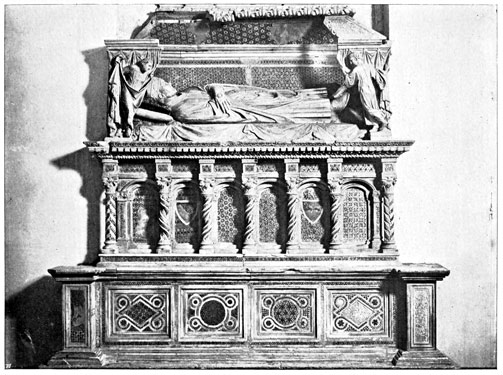
Monument to Cardinal de Braye. By Magister Arnolfo.
See page 314.
But neither Vasari nor Milanesi seem to reflect that there might have been two Lapi. Certainly, if two youths are fellow-disciples of one Master, it is not probable that the senior should be the son of the other. On the other hand, if "Jacopo il Tedesco," said to be Arnolfo's father, was elected head architect at Assisi in 1228, how could he have been a young pupil of Niccolò di Pisa in 1266?
Recognizing these difficulties, Milanesi sets out in search of a father for Arnolfo, in place of Lapo, his fellow-pupil. He comes across a document in the archives of the "Riformazione" of Florence, dated MCCC. Aprile 1, where the privileges of citizenship are accorded to "Magistrum Arnolphum de Colle, filium olim Cambij."[239] In quoting this, Gaye[240] says that in spite of it the Florentines will persist in calling Arnolfo the son of Lapo. Now cannot these conflicting facts be reconciled? It is a strange fact that in no other Florentine deed except this one privilege is any sign of parentage given to Arnolfo. He is so enveloped in the greatness of being caput magister, and the greatest architect of his day, that his parentage seems to be lost sight of, though the universal custom of the day was to cite the father's name as well as the son's in a document. Therefore, though we have never before heard the surname of Jacopo il Tedesco, there is no reason in the world why it should not be Cambi. By the time Arnolfo was grown up, Jacopo Tedesco had lived many years in Florence; he therefore, having become a Florentine citizen, may have taken office and might have been connected with the Cambio, or Exchange there, taking his name from that office, as a large family of Cambi during the Republic seems to have done.
I incline, however, to another theory—that Cambij is a corruption of Campij, or Campione—for the following reason—As early as 1228 Jacopo Tedesco was already a Magister, and of such fame that he was chosen as master architect of the grand church of S. Francesco at Assisi, in conjunction with Fra Philippus de Campello. In spite of Fergusson's opinion that the architect of these large buildings was generally a mere builder, working under some ecclesiastic who drew the plan, the evidence goes to prove, in this case, that Jacopo the layman was capo maestro, and Fra Philippus the ecclesiastic only aiutante (assistant). Campello was a corruption of Campiglione or Campione, which name, first taken from a place near Como, became afterwards the distinctive title of the Parma school of Comacine Masters. We find it spelt in different documents: Campillio, Campellio, Campilionum, Campione, often shortened into Campi͠o or Camp͠i. All the older writers say that Jacopo Tedesco was a Comacine or Lombard, and if so, he was one of the Campionesi. His name occurs in a stipulation made at Modena on Nov. 30, 1240, where he and Alberto are qualified as uncles of Magister Enrico, one of the contracting parties.[241] This may well have been the father of Arnolfo, especially as Baldinucci[242] asserts that Jacopo Tedesco lived at Colle in Val d'Elsa, where Arnolfo was born, while his father was building the castle there. With these lights Milanesi's documental "Arnolphus de Cambii" may be accounted for. If the members of the Campione school in the north took that as their name, why should not Jacopo also have signed himself Campione? It is more than probable he shortened it according to custom into Campi͠o, and may not have been very particular to distinguish between the kins-letters p and b, a very common fault in the sketchy spelling of old MSS., and especially likely to occur if, while Lombardy was a German province, he should have imbibed a German accent. This would reconcile all the dispute. Arnolfo was evidently closely connected with the elder Lapo, his style being so similar. Compare the Palazzo Vecchio and Bargello with Lapo's castle of Poppi, and the relation is evident. His connection with the younger Lapo is equally clear. In the list of qualified masters in painting at Florence, quoted by Migliore in Firenze illustrata, p. 414, is Niccolò Pisano's pupil, who is called Lapo di Cambio. This would suggest that Arnolfo and his fellow-pupil Lapo were brothers as well as fellow-pupils, so that when Lapo the younger finished Jacopo Tedesco's (Lapo the elder's) work at Colle, he was only following out the usual rules of the guild, in which the son succeeded the father.
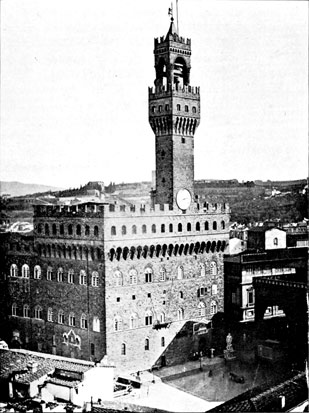
Palazzo Vecchio, Florence. Designed by Arnolfo.
See pages 257 and 317.
The thirteenth century was a time of immense development in art; what Niccolò and Giovanni di Pisa did for sculpture, Jacopo Tedesco and Arnolfo did for architecture. Jacopo was the first to introduce the pointed arch into Central Italy, at Assisi; Arnolfo further developed it in his cathedral at Florence, where the arches of the nave are round, and the windows pointed. After this era we have no more Romanesque—the reign of Italian Gothic has begun.
The Basilican form, too, has vanished; we have now the nave and transepts of the Latin cross. No longer the small double-arched window, but long pointed arches filled with beautiful tracery. The old symbolic animals linger on, but in the subordinate form of grotesques in ornamentation.
That distinctive mark of the guild, the lion of Judah, takes a new position in the Italian Gothic. It is no longer between the pillar and the arch, but beneath the column, as Niccolò and Guido da Como first placed it in their pulpits. You see it under the pillars of the north door of the Florentine Duomo, where the transition into Renaissance is indicated by a particularly classic figure of a child standing by the lion; and under the central column of the windows of the Spanish chapel in the cloister of S. Maria Novella, where it serves to mark the fact that the architects Fra Sisto and Fra Ristoro (who in the documents of the time are styled Magister Fra Sisto and Magister Fra Ristoro) were members of the Masonic Guild.
Jacopo, the inaugurator of Italian Gothic, spent all his later years in Florence, having left Colle many years before, when he had finished the castle there. Jacopo's work in Florence consisted of the building of the Bargello, which is a perfect specimen of the late Comacine style, built in modo gallico with large smoothly-hewn stones. The connection of the Masters of the guild with the south of Italy is shown here as well as at Pisa, for it is said that King Manfred commissioned Jacopo Tedesco to design the sepulchre of the Emperor Frederic in the abbey church of Monreale in Sicily. (Manfred died in 1266.)
Jacopo also introduced a reform into Florence. In the time when Messer Rubaconte of Como was Podestà of Florence (1236, 1237), his compatriot, Jacopo Tedesco of Campione, near Como, proposed to him that the streets should be paved with stones instead of bricks, to which Messer Rubaconte agreed, and the same method of paving still continues in Florence.
The second Lapo, Arnolfo's fellow-pupil, and perhaps brother, was the author of several buildings in the end of the thirteenth century, which Vasari falsely attributes to Jacopo the elder. He also continued Jacopo Tedesco's fortifications at Colle.[243]
Whether we look on Arnolfo as the son of Jacopo Tedesco, or only as the pupil of Niccolò Pisano, he was, either way, one of the guild; and more, a follower of Jacopo rather than of Niccolò, his bent being rather architectural than sculptural. We can, then, place Arnolfo as the first head of the laborerium of Florence; and in tracing the formation of this branch of the guild, we shall throw a light on all the former branches, which, from want of systematic documents, have remained as formless organizations of schola, laborerium, and Opera. After trying in vain to find something more explicit about these organizations at the National Library and State Archives, I consulted the director of the Opera del Duomo, who kindly saved me the work of long puzzling over old MSS., by lending me a copy of Cesare Guasti's valuable collection of abstracts from the books of the Opera, from the earliest days of Arnolfo to the completion of the cathedral.
Here the whole organization stands revealed. Here are the meetings of the lodge, and the subjects discussed; the names of the Magistri and Council of Administration from year to year; the payments to architects, artists, and men; the legal contracts and business reports.
It is clearly seen how the Opera is connected with the laborerium, and how the meetings are always composed of some civic members from the Council of Administration, and some from the working Masters of the lodge.
One, dated October 15, 1436, reports a meeting in the Opera del Duomo, at which the attendant Operai or councillors were Ugo Alessandri, Donato Velluti, Nicolo Caroli de Macignis, and Benedict Cicciaporci (pig's flesh); here's a nickname! They deliberated on the advisability of sending for a certain Francesco Livii de Gambasso, Comitatus Florentiæ, who was at Lubeck in Germany, to make the painted windows and mosaics. Francesco, when he came back to the city which he had known in his boyhood, and where he had learnt his art, bound himself to work in the laborerium of the Opera, "et in dicta civitate Florentiæ in Laboreriis dictæ Operæ toto tempore suæ vitæ eidem continuum, ac firmum inviamentum exhiberent, ita, et taliter, quod ipse una cum sua familia victum, et vestitum in præfata Civitate erogare posset."[244] This one document gives valuable proof on several points.
It proves that whether or not Italy got her architects from Germany, Italian Masters were employed in Germany.
It proves that there was a guild in Florence, "Comitatus Florentiæ," to which Francesco Livii belonged, and that there was a laborerium in Florence, in which Francesco, when a boy, had learned his art, and risen to the rank of Master. It proves, moreover, that the laborerium was connected with the Opera.
Another meeting of the same Opera on November 26, 1435, held to consider all the designs for the choir of the Duomo, marks this connection still more plainly.
"Nobiles viri Johannes Sylvestri de Popoleschis, Johannes Tedicis de Albizzis, Johannes ser Falconis Falconi, Jacobus Johannis de Giugnis, et Hieronymus Francisci dello Scarfa, Operarii dictæ Operæ, existentes collegialiter congregati in loco eorum residentiæ pro factis dictæ Opera utiliter peragendis, absque aliis eorum Collegis, et servatis servandis:
"Attendentes ad quandam Commissionem factam per eorum Offitium de ordinatione Altaris majoris dictæ Ecclesiæ, et Chori ipsius Ecclesiæ infrascriptis Civibus, et Religiosis Sacræ Theologiæ, Magistro Jacobo Grægorii del Badia Ordinis Fratrum Minorum, Magistro Sandro de Covonibus Converso Hospitalis Sanctæ Mariæ Novæ de Florentia, Francisco alterius Francisci Pierotii della Luna Nerio Gini de Capponibus egregio Medicinæ Doctori, Magistro Paulo M. Dominici, et Juliano Thomasii Gucci, omnibus Civibus Civitatis Florentiæ, et ad quemdam rapportum per eos factum coram eorum Offitio infrascriptæ continentiæ."[245]
Here follow the criticisms of this council on three designs for the choir: one by Filippo Brunelleschi; one by Nencio di Bartoluccio; a third by Magister Agnolo da Arezzo.
Observe that we have as master architects of the guild, a monk and a hospital warden, called on the Commission with the Operai, who were influential citizens, but not qualified Masters. This seems to throw a light on the word colligantes, "Magister comacinus cum colligantes suos," in the old laws of Rotharis. Would not the colligantes mean the Consuls and Operai, members of the Opera or administrative body in these great works of church-building, whom the Magistri of the guild elected from the influential men of the city in which they were?
Here are a few translations of his quaint statements of the orders the Provveditore received from the Operai—
"June 1353.—Operai: Lotto, Lapo, Piero di Cienni, Simone di Michele Ristori. They tell me to make haste and obtain the payments from the 'Camera' (council), and the 'Gabelle' (octroi). I must manage that by St. John's Day; the 'covelle' of the Campanile must be finished. And to do that, I must get two of the Magistri from Or San Michele. And the scaffolding must be taken down from S. Giovanni (the Baptistery), so that the work may be seen."
This entry shows how many buildings the guild were engaged on, and how the architects of them all were under the command of the Opera, or centre of administration for all.
"August 14, 1353.—Piero, Lotto, and Simone." (Every entry begins by naming the Operai in council.) "To order designs for a tabernacle.... Get it made. To order the design for the campanile, and in what kind. Have it done in wood. To order marble, for the work at the summit. To tell Francesco[246] there is work for a year. About the rations of Neri Fieravanti. Give him the money to pay all the master's claims, and you, Filippo, shall be the pay-master, and we will provide the means." ("Dalle danari per pagare tutti i maestri loro, e tu Filippo sia loro camarlingo, e noi ti faremo provedere.")[247]
The way in which the Provveditore, Filippo Marsili, talks of himself, and puts down his orders from the Operai just in their own words, is naïve in the extreme. His memoranda are certainly delightful.
Here is another very busy day—
"September 26, 1353.—Operai: Simone, Migliorozzo, Francescho, Piero." (This time the head architect, Francesco Talenti, was in council.) "To elect a salaried lawyer. About a notary for citations. About the nine hundred and fifty lire which the Commune has of ours. To pay by the piece, rather than by the day. To send to Carrara (for marble). Put it off till All Saints' Day. Of the many documents we need.... To reason with the Regolatori.[248] To speak with the captains of the Misericordia about our many legacies.... Tell them to let us know when they meet. About the Wills. To discuss it with Ser Francescho Federigi (a notary). To find means to get ready money. Try and get a discount on the tax on assignments. About the wine for the Masters. Take it away entirely. About Francesco and the window ... to pay the Master who had the commission ... and when the work is done, have it valued, and the surplus, or the deficit, will be entered to Francesco" (head architect).
Truly it was no sinecure to be Provveditore for the guild of architects in those days. He must have had his hands full indeed! When the Masters were not satisfied with their pay, and a work had to be appraised, like this window, a special council was called, consisting of the Consuls of the Arte della Lana, who were the Presidents of the Opera, the members of the Opera, and all the Magistri of the laborerium. The Masters were then called on one by one to give an estimate of the work, and discuss its merits; a ratio was taken, and the medium price fixed.
The same kind of council was called to consider any designs. Generally, several of the Magistri sent in their designs, or models made of wood. These were discussed in council, and votes taken before the final commission was given. The report of one of these meetings, where each Master naïvely voted for his own design, is very amusing.
The Masters were strictly bound by contract to the laborerium. In some cases they were paid by the day. We find, on May 29, 1355, that the salaries of Masters were lessened by two soldi a day, and workmen by one soldo. Sometimes the Commune found them wine and rations; at others they were paid by the piece, by contract. On June 7, 1456, the Provveditore writes—"It is desired that on no account shall any Master go to work outside the Opera, without the deliberation and consent of all four Operai. If any absent himself without this permission, he shall be considered as discharged."
The schools attached to the laborerium must have been very complete. They trained pupils in the three sister arts—architecture, sculpture, and painting. One sees the remains of them in the Belle Arti at Florence, Siena, and other towns, and the Academy of St. Luke at Rome. Not all the Magistri were teachers, but there were certain of them who held office as Professors. Niccolò di Pisa was certainly one of these, and so were Cimabue and Magister Giotto.
This full art-education accounts for the artist of the Renaissance being such an all-round man. One finds a painter like Giotto, or a sculptor like Niccolò Pisano, building grand architectural works. Sometimes they graduated in all three arts, as did Landi, Giotto, and Leon Battista Alberti.
When they graduated in the schools, they became Magistri of the guild, and could then undertake commissions. Besides the Magistri fratelli, there were the undergraduates as it were; in old Latin documents they are written as fratres; below these were the novices or pupils. The workmen employed by them were quite unconnected with the guild, and were paid daily wages as manual labourers.
The light thus thrown on the organization of the Masonic Guild by the valuable collection of documents made by Cesare Guasti, seems to me to explain much that was puzzling in the Florentine city guilds. For instance, why, among all the Arti, is there none which includes architects, sculptors, or painters? It would have been supposed that in the early days of the republic, when the Commune spent its wealth and enthusiasm on erecting great and noble buildings, architecture would certainly have ranked among the greater Arti, even in competition with the wool-combers and silk-weavers. But there was no such civic guild. There was a minor one for masons and stone-cutters, but it was established later for workmen and mere house-builders, and had nothing to do with great architects or master sculptors; while painters who wished to be members of the Commune and have any hand in the government, had to enroll themselves in the Goldsmith Guild, or the "Arte degli speziali" (doctors and apothecaries). The existence of this Freemasonic Guild would explain this hiatus in the greater arts. While such a powerful and self-governing body existed, which had evidently the monopoly for Italy in the art of church-building, a mere city guild would never have been able to compete with it, and would have been superfluous.
That it really held the monopoly is more than probable. We have traced the Comacines through each gradation, have seen the successive schools and branches started by them in each place where they had great works in hand. The Buoni family at Modena going on to the south of Italy and then to Pistoja, founded that school. The Campione branch at Verona and Parma hence passed to Assisi and Florence. The Lucca school of Lombard Masters spread to Pisa and gathered into it native talent.
The later gathering of Lombards and Pisans at Siena thence moved to Orvieto, and sent a branch to Florence in the persons of Jacopo Tedesco and Arnolfo. There taking root it grew into the goodly flower of the Renaissance. And after efflorescence,—decay; the old organization, by degrees, dissolved in the greater freedom of art. Each Master aimed to stand alone on his own merits, and was no longer necessarily enrolled as one in a guild.
A great many things besides are revealed to us by Guasti's collection of documents. We find that Arnolfo died in 1310; Vasari read it wrongly as 1300, so that Arnolfo would only have worked a year or two at his Duomo. The correct entry in the archives is—"IIII idus (martii) Quiescit magister Arnolfus de l'opera di Santa Reparata MCCCX."[249]
It is a strange coincidence that the death registered before Arnolfo in the Necrology should be a man named Cambio, a locksmith, but he seems to have no connection with Arnolfo, whose parentage as usual is not indicated.
Thus we see that Arnolfo at the most only worked eleven or twelve years at a building which took more than a century to finish. How much did he accomplish? Probably not more than the foundations and the design which he left, and which may be seen to this day; for it is usually understood that the church in the fresco of the Spanish chapel represents the Duomo as Arnolfo designed it. After his death Florence fell upon warlike times, and was unable to continue the work till 1331, when the "city being in a happy and tranquil state, recommenced the building of the church of Santa Reparata, which had for a long time been in abeyance, and had made no progress, owing to the many wars and expenses which the city had undergone." The deed goes on to relate that the Arte della Lana was placed at the head of the administration, and that a tax of two denari per libbra on all moneys paid to the Commune should be appropriated for the expense, as had been decreed before. They further added another tax on the customs, so that the two amounted to 12,000 libbre picciole a year. Besides this, every shop in Florence was to have a money-box where they were to place il denaro di Dio (tithes) on all they sold.[250] I quote this to show how cities in the good old church-building days paid their architects. It is probable that the schools of the guild had continued in this interval, though the Magistri may have had to seek work elsewhere, for by July 18, 1334, we find Giotto as a Magister, selected as architect of the Campanile, though he seems to have had very little to do with the Duomo. His marvellous tower, in its varied colouring and artistic effect, shows the hand of a painter rather than an architect. He did not live to see his work completed, for on January 8, 1336, he died, soon after his return from Milan, where he had been sent in the services of the Visconti, and had a public funeral at the expense of the Commune in Santa Reparata. The fact that the work of his tower went on in his absence, proves that he must have had brethren in the guild capable of carrying out his plans. As the foundations were only laid in July 1334, and Giotto died in January 1336, after a long absence at Milan, one wonders how he found time to sculpture the reliefs in his Hymn of Labour. However, we must take Ghiberti's testimony for it. In his second Commentary, Ghiberti says[251]—"The first line of reliefs which are in the Campanile which he erected were sculptured and designed by his own hand. In my time I have seen his own sketches beautifully drawn." A contemporary anonymous commentator on Dante writes[252]—"Giotto designed and superintended the marble bell-tower of Santa Reparata in Florence, a notable tower and costly. He committed two errors—one that it had no base, and the other that it was too narrow. This caused him such grief that, they say, he fell ill and died of it." I think indeed that if Giotto had found any error he would have rectified it in the plans which he left for his successors. That it had no foothold is not true, for the solid foundation was placed so far beneath the surface that it stood firm on the solid macigno (kind of granite rock) twenty braccia below.
His successor was of another branch of the guild, but a Masonic Magister all the same. On April 26, 1340, Andrea di Pisa was elected by vote by the Council of the Opera to succeed Giotto as head architect.[253]
There must have been other Magistri proposed as candidates, if the Council had to resort to black and white beans for the voting. Andrea only lived a few years; he died, or retired from office, in 1348, the year of the great plague; and Francesco Talenti became caput Magister in 1350. Francesco was a brother of Fra Jacopo Talenti, Magister lapidum et edificorum, who was joint architect with Fra Ristoro of the convent and church of Santa Maria Novella from 1339 to 1362. Francesco, like his brother, must have been in the guild; he worked at Orvieto cathedral among numbers of Como and Lombard Masters in 1329. In April 1336 we find him called to Siena as an expert.[254] There had been discovered some defect in the columns. Francesco's companion from Florence was Benci di Cione. His office as capo maestro of the Duomo of Florence continued some years, though he did not reign alone, but was associated with Giovanni di Lapo Ghino, who after 1360 is called joint capo maestro. The principal documents of their administration prove that there were endless councils and arguments about the size, height, and placing of the columns, and discussions on Talenti's plan for the chapels at the east end. This seems to have been a crucial question.... Councils of four Magistri in each were held for three consecutive days—July 15, 16, and 17, 1355; and their opinions given in writing. On August 5 the grand united council of twelve Masters and the whole lodge was held, when the proportions for the columns were decided, and Francesco's design for the chapel approved.
Another Council was held on June 8, 1357, with the Operai and Consuls of Arts, and their ecclesiastical colleagues, when the undermentioned Masters and monks gave their counsel on the church—a proof of the close affinity of ecclesiastics with the Masonic Guild.
Frate Francischo of Carmignano
Frate Jacopo Talenti. S. M. Novella
Frate Franciescho Salvini. S. Croce
Frate Tommasino. Ogni Santiv
Frate Jachopo da S. Marcho
Frate Piero Fuci, e
Frate Filippo sacrestano di S. Spirito
Frate Benedetto dalle Champora
Magister Neri di Fieravanti
Magister Stefano Messi
Magister Franciescho Salviati
Magister Giovanni Gherardini
Magister Giovanni di Lapo Ghini
Magister Franciesco dal Choro
Magister Ristori Cione
Magister Ambrogio Lenzi, or Renzi
The report was written by Sig. Mino, notary of the guild; the spelling of the names is his own.
Several of the same monks met at the Opera on July 12, 1357, to consult about the placing of the columns in the second foundation.
Also, on July 17, 1357, to choose between two designs of columns and a chapel made by Francesco Talenti and Orcagna, when each candidate elected two Masters as arbiters. Francesco Talenti chose Ambrogio Lenzi, a Lombard, and Frate Filippo Riniero of S. Croce. Andrea Orcagna chose Niccolò di Beltramo, also a Lombard, and Francesco di Neri. These could not decide, and Piero di Migliore the goldsmith was taken as umpire, the parties binding themselves to abide by his decision. Giovanni di Lapo Ghino and Francesco Talenti were ordered to make new designs. At length, on July 28, Orcagna's plan was chosen.
Talenti's office was no sinecure; we often find him disputing with other Masters. Indeed, the lodge greatly lacked unity. Disintegration was beginning. On August 5, 1353, the Provveditore, Filippo Marsili, writes—"I must get Neri di Fioravanti and Francesco Talenti to settle that dispute within fifteen days. They must choose an arbiter each, and may elect the third arbiter by joint consent." They chose Benozzi as mutual third. Again on October 4, 1353—"The Master who executes Francesco Talenti's design for the window must be paid his demands. When the work is done, have it valued, and the balance more or less to go to Francesco's account."
He seems also to have been an improvident sort of man. Here are two tell-tale entries in Filippo Marsili's memorandum book—"July 12, 1353. Advance him as soon as convenient the pay for four months. Take it out, by deducting half his salary weekly." Again in November the entry is—"Lend him what he wants."
In 1376 Francesco's son Simone became joint capo maestro with Benci Cione, Orcagna's father, at a salary of eight gold florins a month. Simone graduated also in the sculpture school, and executed a figure for the façade, for which he was paid thirteen florins on September 4, 1377. Zanobi Bartoli, also a Magister lapidum (sculptor), was at the same time paid twenty gold florins each for two marble figures, though he received only eighteen florins for his statue of the Archangel Michael in December of the same year.
Francesco's colleague, Giovanni di Lapo Ghino, is a good instance—one of many—of the hereditary nature of the guild. We first hear of Ghino at Siena in the thirteenth century. On February 7, 1332, his sons Simone and Jacopo, or Lapo di Ghino, sign a contract with Agostino and his son Giovanni of Siena, to build a chapel in the Pieve S. Maria at Arezzo—that of Bishop Tarlati, Bindo de' Vanni and his son Francesco, with two other Magistri, being witnesses.[255]
In 1362 a certain Ambrosius Ghino is named in a list of the lodge. He may have been a brother or nephew of Lapo. Then comes the third generation, and we find Giovanni, son of Lapo di Ghino, at Orvieto. He afterwards came to Florence, where he was elected capo maestro, at first in unison with Jacopo Talenti, and later by himself. In 1388 old Ghino's great-grandson, whose whole pedigree is given in the books as "Michele, Johannis, Lapi, Ghini," became in his turn capo maestro of the Duomo of Florence. His descendant, Antonio Ghino, also graduated in the Florentine Lodge, but he went back to Siena, where he appears as one of the Magistri employed there in 1472.
This family is only one of many hereditary Masonic brethren. The Cione family is another instance. The first Masters of the name appear in Florence on July 1355, as Ristoro and Benci Cione, two members attending the Council on Francesco Talenti's design for the chapels, but whether they were brothers or father and son I cannot tell; I presume brothers, or Benci would have been written down as Benci Ristori di Cione.[256] We have seen Benci Cione called to Siena as an arbiter. He was much occupied in Florence, where he worked at the building, or rather adaptation, of Or San Michele. He and Laurentius Filippi (Lorenzo, son of Filippo Talenti) were joint architects of the Loggia dei Lanzi, Lorenzo superintending the sculpture, and Cione the architecture. Lorenzo has set the sign of the guild on the base of his columns by surrounding them with small pillars on which lions are crouching; the proportions and ornamentation of the building are beautiful. Orcagna has always been credited as the architect of this Loggia, but he is here proved not to be the original designer, though he probably worked with his father.
Orcagna's name, Andrea di Cione, first appears in the great Council with monks and Magistri, held on June 18, 1357, to decide on the space which should be left between the columns of the Duomo.[257]
Andrea's nickname of Orcagna, a corruption of Arcangelo (Archangel), has clung to him through centuries, and over-shadowed his real patronymic of Cione. The relation between him and Benci di Cione remains rather obscure. Orcagna has also had the credit of building the church of Or San Michele. Probably writers confuse Orcagna, or Andrea di Cione, the sculptor of the beautiful shrine in that church, which is his masterpiece, with the Benci di Cione who was architect of the building. From the close connection of the two in the guild, and from Orcagna having worked so much with Benci, I think it probable they were father and son. Milanesi is rather uncertain about the father of Orcagna, and in the genealogical table at the end of his life he writes him as Cione with a note of interrogation, and no Christian name, which may well have been Benci.
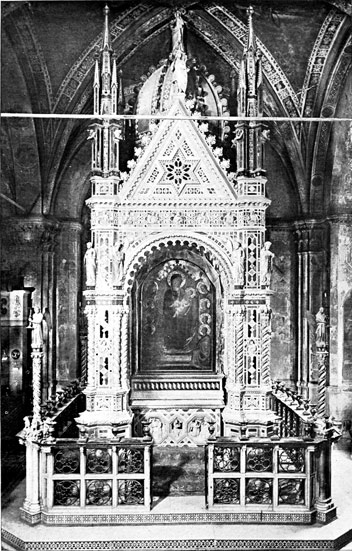
Shrine in Or San Michele, Florence. Designed by "Orcagna" (Andrea Cione).
See page 333.
Orcagna first studied painting under his elder brother Nardo (short for Bernardo), who was enrolled in the "company of St. Luke." But this was only one branch of Andrea's art-education. He matriculated in the Masonic Guild (Arte dei maestri di pietra e legname), in the books of which it is written—"Andrea Cioni, called Archangel, a painter of the parish of S. Michele Visdomini, took his oath and promises in the said guild, Magister Neri Fioravanti being his sponsor, in 1352, sixth indication, October 29."[258]
It was Orcagna's way to emphasize his varied qualifications by signing his paintings, "Andrea di Cione, scultore," and his sculptures, "Andrea di Cione, pittore." On his masterpiece, the shrine in Or San Michele, he has inscribed, "Andreas Cionis, pictor Florentinus, oratorii arch magister extitit hujus MCCCLIX." The expression "Archmagister of the Oratory" (or shrine) explains many things. It tells us that the whole of that complicated piece of sculpture, though it may have been designed entirely by Orcagna, was not entirely executed by him, but that, like other Magistri, he had a band of brethren working under him; for how could he have been chief Master where there were no lesser ones under his command?
It is interesting in studying the working of the Masonic Guild, of which Orcagna signs himself Archmagister, to see how they are occupied in building several grand edifices at once. The immense number of Masters congregated in the Florentine Lodge rendered this possible, and wealth was not lacking in the city to employ them.
The books at the Opera reveal how the Council of Administration dominates the laborerium. We shall see how the busy Provveditore has to change the Magistri about from Santa Croce to Or San Michele; or from the Duomo to San Michele Visdomini, just as need presses. He has to order marbles for all and any of these edifices; to call councils to consider designs for all kinds of different buildings and parts of buildings, such as windows, chapels, doors, etc. Sometimes we find him commissioning a certain architect to make a plan for a chapel, or a door, or a window. When Talenti and Giovanni Ghino had both made designs for the tribune in October 1367, the usual councils were not enough to decide the momentous question which to choose. The whole city had to be called into council, together with the monks (frati colleganti), the Magistri of the guild, etc. Hundreds and thousands of people came to the Opera, looked at the designs, signed their names on the list of approval, for one or the other.
After the joint reign as capi maestri of Giovanni di Lapo Ghino and Francesco Talenti, came a varied line of master builders lasting for a hundred years, so that it is impossible to say that any one man was the architect of the Duomo. Between Arnolfo's first plan and the final Italian Gothic development of the fifteenth century lies the whole history of the development of art.
The next great capo maestro after Talenti was Ambrogio of Lenzo or Lanzo, near Como, one of the Campione school. His name is given in a deed of February 3, 1363, as "Ambroxius filius magistri Guglielmi de Champiglione." It is remarkable that an ancestor and namesake of this "Ambroxius" was also written down as "filius Magistri Guglielmi" in 1130, two centuries earlier, when they were leading members of the Campione school at Modena, and sculptured the façades of Modena and Ferrara cathedrals; so our Ambrogio of Florence was one of the distinguished aristocracy of the lodge, his family dating from its cradle in Lombardy. From the deed which we quote we find that Ambrogio graduated under his father, and made his first contract with Barna Batis, then Provveditore of the Opera of the Duomo, to provide and prepare the black marble necessary to the work, for every braccio of which he was to be paid six soldi eight denari. This is the original—
"Archivio dell' Opera dell Duomo, February 3, 1362.—Ambroxius filius magistri Guglielmi de Champiglione, comitatus Mediolani, emancipatus a Domino magistro Guillielmo patre suo, ut continere dixit publice manu ser Joannis Arriglionis notarii de Champiglione, conduxit a Barna olim Batis provisore Operis Sancte Reparate de Florentia, locante vice et nomine operariorum ... ad faciendum et digrossandum totum marmum nigrum quod erit necessarium dicto operi, hinc ad unum annum proxime venturum, illarum mensurarum prout dicetur eidem per capomagistros dicti operis. Et dictus Barna locavit eidem die dictum marmum ad fovendum et digrossandum, et promisit pro dicto opere eidem Ambroxio de quolibet brachio dicti marmi dare eidem Ambroxio soldos sex et denarios octo f. p., etc. Que omnia, etc."
Ambrogio or Ambrose remained many years in Florence. His name often appears in council. In 1356 he was elected head architect of the Duomo, and also of the restorations at the Baptistery. On April 4, 1384, when as an old man he attended a meeting to decide whether the pilasters of the tribune were strong enough to support the dome, his name is given as Ambrogio de Renzo. A marked instance of the effect of twenty years among Florentine dialect, which has an inveterate habit of mixing up l's and r's. His son, Giovanni d'Ambrogio di Lenzo, who afterwards became capo maestro, was also in council, and Orcagna was chosen umpire.
But between the reign of Ambrogio and that of his son we have various changes in the directorship. In 1381, Giovanni, son of Stefano, called Guazetta, became capo maestro together with Giovanni Fetti, who was also of the guild, and preparing first in Siena, and next at Florence, for his future work in Lucca and Bologna. Giovanni Fetti designed and made the fine "window towards the houses of the Cornacchini, under the third arch of the nave."
Guazetta's peculiar line was laying foundations and devising complicated scaffolding. He also made the presses of the sacristy. He was perhaps not enough of a builder to hold the office of chief, for in 1375 this pair resigned in favour of Francesco Salvetti and Taddeo Ristori. Salvetti, however, very soon renounced office, preferring to remain in the guild on a simple salary, rather than incur responsibilities.[259]
Then Francesco Talenti's son Simone, who had by this time become a Magister, was put in his place with Taddeo Ristori. Their reign lasted till 1388, when Michele, son of Giovanni, son of Lapo, son of Ghino, was elected. In his time the pilasters of the tribune were begun.
In 1404 Ambrogio's son Giovanni was elected capo maestro. Here is the part of the entry of the Deliberation, November 17, 1404—"Operaris ... elegerunt et nominaverunt et deputaverunt in caput magister dicte opere Sancte Reparata providum virum Johannem Ambroxii, etc. etc., cum salario florenum otto, pro quolibet mense cum auctoritate, balia et potestate usitate et consueta."—Delib. xlix. 28.
Another deliberation, dated June 17, 1415, states that "Johannem Ambroxii caput magister" shall give the order for the species and form of the bricks for some special part.
Giovanni, the last of the Campione school whom we can register, was deposed for old age, and Baptista Antoni elected in his stead. He was probably the son of Antonio, the Grand Master mentioned above.
Giovanni had not always time to carry out his own designs. In 1408 we find that Magister Niccolao, surnamed Pela, took the contract to carve in marble the doorway near the chapel of the crucifix, which was designed by "Johannem Ambroxii, caput magistrum." It is rich with vines and other ornaments. Niccolao did not push the work, however, and in May 1408 the Opera decided that he owed the guild the sum of twenty-five florins for breaking his contract.
The number of different minds each leading the works in his own department is bewildering. The beautiful door called the Mandorla, so rich and elegant in sculpture, which is often said to have been executed by Jacopo della Quercia, was in reality the work of Nanni di Antonio di Banco. The books of the Opera register, on June 28, 1418, a payment of twenty florins on account to Nanni for this doorway, and in 1421 the last payment was made on the completion of the work. Nanni was a favourite scholar of Donatello; he was a person of good birth, who matriculated in the Arte dei Maestri di Pietra on February 2, 1405, and proved his membership by sculpturing the four patron saints of the Masonic Guild on Or San Michele.
We further find in this precious collection of documents that Magister Jacopo di Lapo Cavacciani made a model for a shaft; that Nato di Cenni and Jacopo di Polo were, in August 1357, engaged to make the bases of the columns, and that time after time different Masters were called on to make plans for chapels, windows, doors, etc.
Now we know the state of the building as it stood in this fourteenth century, we realize that it was not left for centuries without a dome. The old chronicler Buoninsegni, in his Storia Florentina, lib. iv. p. 642, says—"A di venti di giugno 1380 si cominciarono a riempire et murare i fondamenti della cupola di S. Maria del Fiore." Up till this time the nave only seems to have been built.
On August 7 a meeting of Magistri was called to consult on the foundation for the cupola, and on November 12, 1380, there is a long document commissioning "Bartolommeus Stefani, Johannes Mercati, and Leonardus Cecchii, Magistri Florentini," to build the pilasters to support the dome, which are to be of good stone and cement, and the builders are cautioned not to work in times of frost or snow, etc. etc. These pilasters caused much anxiety in the guild; in 1384 constant meetings were held about them. The Masters were afraid the foundations of the one towards Via dei Servi were not firm; day after day in July 1384 they met in scores to examine and report on it. Then they called in the consuls of the Art of Wool, the Operai, and all the chief men of the city; and everybody, excepting a certain Messer Biagio Guasconi (who after all was not an architect), agreed that the foundation of the pilaster was perfectly safe. However, good Messer Biagio still held his own opinion and refused to sign approval.
From the steady way in which the work went on, it is certainly possible and probable that there would in the natural course of the work have been a dome to the cathedral even without Filippo Brunelleschi. It was in the original plan, and the foundations and pilasters were placed in readiness for it. There was much talk of the difficulty of placing the framework of the scaffolding for it, but there seems to have been no doubt that it would be accomplished. In fact numbers of the Masters sent in plans for it at different times.
The first time that Brunellesco appears in the records is at a meeting of consuls, Opera, and Masters, convened on November 10, 1404, to consider a certain error in measurement committed by the capo maestro, Giovanni di Ambrogio. The question turned on the placing of the (sprone) brackets on the façade which interfered with the windows.
It does not seem that Brunellesco belonged to the brotherhood. He is merely mentioned as Filippo the goldworker, son of the notary Brunelleschi (Filippus ser Brunelleschi aurifex). In no place, either here or elsewhere, is he ever called Magister, and throughout his life his every action was a protest against what he called "the Maestranze" a term of contempt like "their Master-ships," which Brunelleschi applied to the Arte dei Maestri. He had matriculated in 1398, when twenty-one years old, in the Arte della Seta, but as his tastes were strongly artistic, and he refused to follow his father's profession of lawyer, he enrolled himself in 1404 in the Arte degli Orafi (goldsmiths), in which so many painters were already eminent. The goldsmiths or metal-sculptors, who seem to have seceded from the Freemasons, were still in some measure colleagues of the Masonic Guild, and their members were often called to vote or advise in the councils of the Opera.
Thus we find Brunellesco as one of the orafi called into council about the construction of the brackets. He appears to have held office as councillor in the Opera for a year till 1405, when he was paid off. He was probably one of the Operai on the part of the city.
When in the famous competition of 1402 Brunellesco lost the commission for the doors of the Baptistery, he left Florence in dudgeon, and with his friend Donatello went to Rome. His studies of the methods of the ancient Romans in making their great domes, suggested to him a way of vindicating his amour propre by defeating the whole guild of "Masters" on their own ground. He had made architecture a special study, and now thoroughly investigated the classic methods. He got to the roof of the Pantheon, and made studies of the stone-work in the ribs of the cupola, investigated the foundations, the supports, etc., and came back to Florence, where he let drop mysterious hints among the influential members of his own trade company, and in the studios of one or two artists, that even if the "maestranze were to call their Masters from France or Germany, and all parts of the world, none of them would be able to make a dome equal to the one he could make." The Masters of the laborerium at length heard of these assertions, and called on him to show his plans, which he declined to do.
Then the Opera, on August 19, 1418, announced a competition. Any artist whatsoever who had made a model of the projected cupola was to produce it, before the end of September, the model accepted to have a prize of 200 gold florins. The date of decision was prolonged to October, and then to December, when a number of models were sent in, the competitors being Magister Giovanni di Ambrogio, C.M. of the laborerium, Manno di Benincasa, Matteo di Leonardo, Vito da Pisa, Lorenzo Ghiberti, all Magistri of the Masonic Guild; Piero d'Antonio, nicknamed Fannulla (do nothing), Piero di Santa Maria in Monte, masters in wood. There were several models by members of the civic company, the Arte dei Scarpellini (stone-cutters); and last, not least, a model in brick and mortar without scaffolding, made by Brunellesco, Donatello, and Nanni di Banco,[260] so he was obliged after all to show his design. This last won the prize, but the Arte dei Maestri had not evidently faith enough in one outside their ranks to commence at once with the building. In Signor Cesare Guasti's collection of archivial documents regarding the building of the Duomo, we find that from October to December 23, 1418, several of the Masters, including Magistro Aliosso, Mag. Andrea Berti Martignoni, Mag. Paolo Bonaiuti, Cristofero di Simoni, and Giovanni Tuccio, were receiving payment for building a model in masonry of Brunellesco's plan for the cupola. I do not find that Brunellesco himself was employed in this, the only payment to him being "50 lib. 15 soldi" for his work on the lantern of the model, between July 11 and August 12, 1419; proving that he put the finishing touch, but that the Masters of the guild themselves tested his design for the great dome before finally adopting it. This brick model, which was built on the Piazza del Duomo, remained there till 1430, when the Opera ordered its destruction. Guasti[261] gives in full this order, which is dated January 23, 1430, and is in the usual low Latin of contemporary documents. When the model was finished, the Magistri of the guild assembled on May 14, 1421, to hold council on it. There are entries of expenses for a breakfast to the Masters, and for torch-bearers to accompany them on their internal investigations. We find the same ceremony of refreshment to the Magistri who visited the works of the real cupola in 1424, when six flasks of Trebbiano (the best Tuscan wine) with fruit and bread were provided. In 1420 Brunellesco was definitely commissioned to superintend the cupola, but even then the Magistri could not admit an outsider to full Masonic privileges. He was not named caput magister, as one of the guild would have been, but he and Ghiberti (whose model had been next best) were named provisori of the dome, while the Magister Baptista di Antonio was caput magister proper of the lodge. The terms of the contract were that "the provisori were to superintend the works, providing, ordering, building, and causing to build, the cupola from beginning to end, etc. etc."
At first both Ghiberti and Brunellesco drew three florins a month. The head Magister, Baptista, had the usual salary of the guild as head master.
The story of Brunellesco's restiveness at his old rival Ghiberti being associated with him in carrying out a design peculiarly his own, and how he tried to throw scorn on him, by locking up his plans and feigning illness, thus leaving Ghiberti to work in the dark, is too well known to need repetition here.[262] Perkins[263] is very hard on Ghiberti's ignorance, which, he asserts, was so great that he was obliged to resign because he could not do the work. But there are two sides to every question. How could a man carry out a work designed and begun by another without seeing his plans? Besides, Ghiberti's resignation, or rather relinquishment of his work at the cupola just then, was, I believe, due to the fact that he had a few months before received a commission for the second bronze gates of the Baptistery, and wanted his time free for them. This commission is dated January 2, 1425. His salary as provisore of the cupola ceased for a few months from June 28, 1425. The dates speak for themselves. He still, however, held office, or returned to it with partial pay, for in 1428 we find a decree of the Opera which raises the salary of Brunellesco to 100 gold florins a year, while Ghiberti only draws his usual three florins a month. But even then not an order is ever given in Brunellesco's own name; every document and every receipt was signed by Baptista d'Antonio, caput magister, and Filippo di Ser Brunellesco, provisore.
And now let us see who were the underlings employed by Brunellesco. Finding the workmen of the Florentine Lodge were disaffected, he got ten Lombards, and shut out all the Florentines, till they humbly came back, begging to be taken on again, which he did at a lower salary than before.
The Lombard element was still strong in the guild. A certain Maestro di legno, named Magister Antonio of Vercelli, invented a convenient mode of drawing up weights into the cupola. The workmen had a kitchen and eating-house up in the dome, so that they did not need to descend in the middle of the day. In fact the Opera made strict laws about this.
In 1436 another competition of models for the lantern was proclaimed, and again Brunellesco won the palm against Ghiberti and others. It seems that when the commission was given to Brunellesco, the Masonic Guild must have felt it infra dig. to make a non-member capo maestro of the dome. Consequently they matriculated him into the fraternity. But with his jealousy of the maestranze and determination to show that one need not be a Freemason to build a church, he ignored this membership and never paid his fees, on which the Masters of the laborerium sued him for debt, and he was imprisoned. This did not suit the City Patrons of the Opera, who were the all-powerful Arte della Lana, especially as Brunellesco's Arte della Seta was also on his side. A stormy meeting was held in the Opera on August 20, 1434, at which the civic party was too strong for the Maestri. It was decreed that Brunellesco should be liberated, and one of the Arte dei Maestri was imprisoned, on the plea of hindering public works![264]
After this triumph of independent architecture Brunellesco became in a manner architect in chief to the city. He built the pretty Loggie of the Foundling Hospital on Piazza della SS. Annunziata, and the Pazzi Chapel at Sta. Croce, both of which Luca della Robbia adorned with his beautiful blue and white reliefs. He erected the fine Palazzo Quaratesi on Piazza Ognissanti, and the remarkably grand church of Santo Spirito was after his death built from his designs.
Brunellesco's strike for independence appears to have given the death-blow to the great Masonic Guild which, as it became more unwieldy, had been slowly disintegrating. The local members in large cities like Siena and Florence, becoming too strong for the original Lombard element, had asserted their independence by forming other guilds of a local nature, in which even the ancient quartette of patron saints was forgotten. How long the lodge in Florence kept together after Brunellesco's defiance I do not know, though its educative influence certainly lingered on till Michael Angelo's time, he being as all-round an artist as any Magister of older days who could build a church and decorate it too.
The laborerium of the Florentine Opera must, however, have been closed by the time of Michael Angelo; for Lorenzo de' Medici had to supplement it by giving up his garden in the Via Larga as a school of sculpture, there being then no place where the art was taught. His teaching, however, was a heritage from the ancient guild, for old Bertoldo, scholar of Donatello, was the Master there, and the works of the Masonic Brotherhood for two centuries, together with the classic treasures collected by the Medici, were his models.