L. EMMETT HOLT, M.D., LL.D. (continued 3)
Reading edition
These habits belong especially to children over three years old. They are seen particularly in those who are excessively nervous or whose general health is below par; sometimes in those who develop serious nervous diseases later in life. Children with such tendencies should be closely watched, and every means used to break up these habits early. Dirt-eating is a morbid craving which is rarely seen in a normal child.
At what age may a child generally be expected to go without wetting the bed during the night?
Usually at two and a half years, if it is taken up late in the evening. Some children acquire control of the bladder at night when two years old, and a few not until three years. After three years habitual bed-wetting is abnormal.
How should a young child addicted to bed-wetting be managed?
At three or four years of age, punishments are sometimes useful, especially when it seems to depend more upon the child's indifference than anything else. They are of no value in older children, rewards being much more efficacious. In all cases one should give a child plenty of milk and water early in the day, but no fluids after 4 P.M., the supper being always of solid or semi-solid food. The child should be taken up regularly at ten o'clock or thereabouts. It often happens that the formation or continuance of the habit is due to the child being in poor general condition, to some irritation in the urine, or in the genital organs. Unless the simple means mentioned are successful the child should be placed under the charge of a physician.
What is masturbation?
It is the habit of rubbing the genital organs with the hands, with the clothing, against the bed, or rubbing the thighs together. Sometimes the child sits upon the floor, crosses its thighs tightly and rocks backward and forward. Many of these things are passed over lightly and are regarded for months as simply a "queer trick" of the child. It may be seen at any age, even in those not more than a year old, and in both sexes.
How should such a child be treated?
Masturbation is the most injurious of all the bad habits, and should be broken up just as early as possible. Children should especially be watched at the time of going to sleep and on first waking. Punishments and mechanical restraint are of little avail except with infants. With older children they usually make matters worse. Rewards are much more efficacious. It is of the utmost importance to watch the child closely, to keep his confidence, and by all possible means to teach self-control.
Some local cause of irritation is often present, which can be removed. Medical advice should at once be sought.
VACCINATION
Nowadays when small-pox occurs so seldom is it necessary to have every child vaccinated?
It should by all means be done. It is only by the practice of general vaccination that small-pox is kept down. In countries or in communities where vaccination is neglected, frightful outbreaks of small-pox occur every now and then just as in olden times.
What is the best time for vaccination?
The time usually selected is from the third to the sixth month. It may be deferred in a very delicate child who is not likely to be exposed to small-pox, or in a child suffering from any form of skin disease.
Which is preferable for vaccination, the arm or the leg?
The part which can be most easily protected and kept at rest is to be chosen. In infants who do not yet walk or creep, the leg is to be preferred? in older children, in most circumstances, the arm. If older children are vaccinated on the leg, they should not be allowed to walk much while the vaccination is active.
When should vaccination be repeated?
An unsuccessful vaccination proves nothing and should be repeated in two or three weeks. If success fully vaccinated in infancy, a child should invariably be revaccinated before puberty. If exposed or likely to be exposed to small-pox at any time vaccination should be repeated.
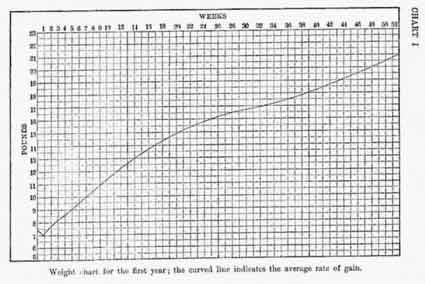
Weight chart for the first year; the curved line indicates the average rate of gain.
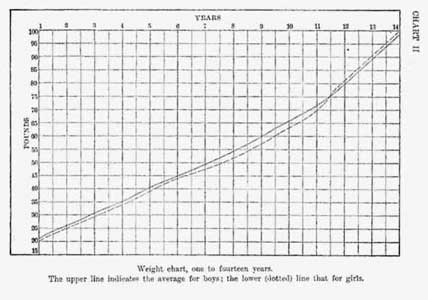
Weight chart, one to fourteen years. The upper line indicates the average for boys; the lower (dotted) line that for girls.
Footnotes: