THE THREE MISSES BENEDICT AT YALE
Reading edition
A heavy fall of snow upon the old streets of New Haven had not succeeded in blocking the wheels of progress of that merriest season of the collegiate year, known to the university world as “Prom Week.” For three days a crowd of fair visitors and their chaperons had trod the round of gayeties; had frequented the concerts, germans, teas, and receptions; they were now drawing breath and gathering energy for the last crucial test of physical endurance, the ball called the Junior Promenade.
For, to properly celebrate this time-honored and brilliant affair, custom decrees that the list of thirty or more dances and intermissions printed upon the ball-card presented to each damsel crossing the threshold of this hall of raptures shall, long beforehand, have been filled with names by the brother, cousin, or admirer having the list in charge. It follows naturally that by the time not only all these dances are accomplished but every “intermission” has been spent in an impromptu dance to the music of the band, alternating with the orchestra, night has brightened into dawn.
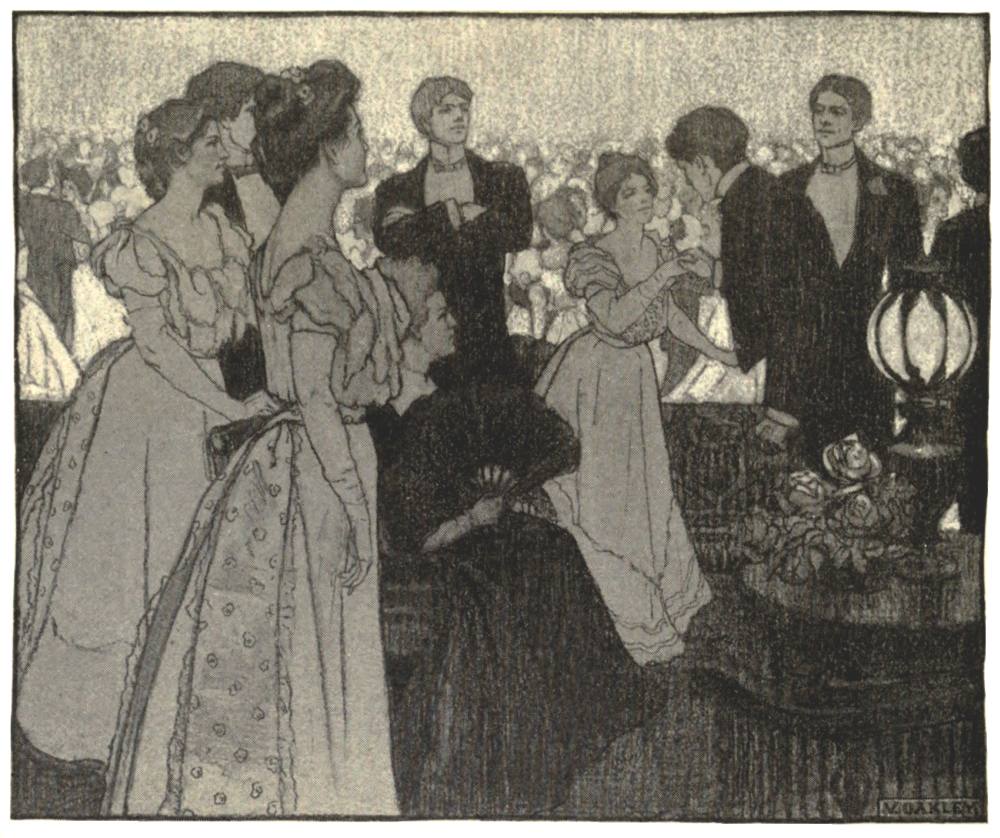
THE THREE MISSES BENEDICT AT YALE.
When the girls are finally induced by their exhausted matrons to withdraw from the giddy whirl, they leave behind a set of men, wild-eyed, and wilted as to shirt-fronts, cuffs, and collars, but undaunted in spirit. These men, the givers of the ball, then go away to their dormitories to snatch an hour or two of slumber before chapel, which has, not infrequently, been attended by beings in ulsters worn over evening clothes. It was to such tireless devotees rather invigorating than depressing to see snowflakes come trooping down upon the final scenes of their three-days’ gayety. Toward nine o’clock P.M. the streets were encumbered by lumbering old hacks pulling up before doors to receive their loads of hooded and cloaked figures, then driving with them at a furious pace to the door of the armory where the “Prom” is given, and dashing off again to secure new fares. The drivers of these vehicles, known by name to most of the students, extend to the university and its doings an almost parental indulgence. To the guests who are aiding to make the occasion brilliant they are suave beyond imagination; solicitous of comfort, descending from their perches to open the carriage doors, and assisting parlously at the elbow of the lady entering or getting out. Little of the evening’s fun is to be theirs, honest fellows, but they are sustained through the chilly vigils of the night by esprit de corps and a brave desire to keep up the credit of their town.
Quite early in the fray one of these hacks disgorged under the armory’s awning a party consisting of a mother, two daughters, and a girl cousin, all three of the young women marked with the same general characteristics of family, but differing in feature and degree of beauty. The mother, a stout, comely body, with diamond butterflies quivering about the base of a tall, black aigrette that, springing from her hair, swept the carriage top as she sat, emerged with a look denoting resolution to carry on the struggle of spirit against flesh to the bitter end. For was not her only son, her pride and joy, leader of the revels as head of the floor committee of the “Prom”? Not for worlds would she have given up the wearying privilege of sitting out the ball. Never, in her own palmiest days, had she drawn near to a scene of gayety with a more proud sense of identification than to-night, when she shone in the reflected glory of her handsome boy!
Jack Benedict was, on his part, modest, as becomes the truly great! An immense favorite with his class, he had been one of those fellows who sail serenely through college life, winning, without apparent effort, honors toiled for by others without success. A good scholar, an athlete of renown, frank, cordial, sympathetic, he was put forward by the vote of his comrades whenever opportunity occurred to represent them before the world; the election to his present post being upon one of these occasions.
Fresh-faced, clear-eyed, smiling, dressed in immaculate attire, the tall young hero advanced to meet his mother and, giving her his arm, conducted the party along the length of the large hall to a box fitted up for the friends of the committee of management. The girls following them were immediately surrounded by a throng of men, consulting their dance programmes and receiving with pride their compliments upon the charming arrangements of the hall. It had already been decided among the opinion-makers that the three Misses Benedict were the stars of the festive week, and their approbation of the scene was generally awaited.
The vast inclosure of the armory was lined to its arched roof with breadths of semi-transparent stuff, alternatively pale lavender and yellow in tint, giving it a delightfully fresh and blossomy effect. From the ceiling, lighted by veiled electric bulbs, depended a racing-shell filled with flowers and a floral football, emblems of the University’s late prowess in the athletic world. From high stands on either side of the hall the band, or else the orchestra, clashed forth unceasingly enlivening strains. Beneath one or the other of these draped eyries were seen to disappear during the progress of the ball panting and perspiring men, who went away wilted after saltatory toil—but returned arrayed in the glory of fresh linen, white collars, and cuffs immaculate. Around the walls, hung with tapestry and placques of flowers, were ranged the boxes severally sold at auction to the highest bidder among the classmen who desired thus proudly to extol the ladies of their visiting families and parties. In these dainty nooks were assembled treasures from many a college sitting-room. Easy-chairs, rugs, lamps, draperies, tables, cushions—above all, cushions!—of every size, material, and color, were brought hither by their owners or borrowers from acquiescent friends, to make resting-places for the chaperons, and, when possible, the girls.
The wide, crash-covered floor, soon covered with whirling figures, became a dazzling kaleidoscope. The suggestion presented by the sight was one of extraordinary brilliancy and lightness. It was as if the Genius of American youth were abroad and at his best. No face there that did not gleam with happiness, no foot that did not spring with rapturous life. Of those encumbrances of an ordinary ball-room, the sad, the sour, the world-weary, the middle-aged, none was discernible. The young men and maidens prominent in this function, gathered from far and near in the broad Republic, were types of blended races, or pure Americans such as one may hardly see elsewhere in an Eastern festivity; and the conventional uniformity of a dance in New York, Boston, or Philadelphia was thus most agreeably varied. And through all was apparent to older eyes the joy of living and being that comes only in the first quarter of the century of life.
“Are you satisfied with it, madre?” asked Benedict, as he stopped in his evening’s toil to bend affectionately over his mother, where she sat in front of the committee-box, her satin and jet rustling in the breeze created by an ostrich-feathered fan.
“Satisfied? Indeed I am! It is a perfectly enchanting scene,” said the biased critic. “And your decorations are really admirable. I never saw such a well-managed dance. But, my dearest boy, can’t you sit down and take a moment’s rest? You will really wear yourself out.”
“No fear of that,” quoth Jack, inflating his broad chest. “After to-night we shall all lapse into ‘innocuous desuetude,’ and there’ll be full time to repose. I hope you and the other mothers can hold out. You won’t see much of your charges, I’m afraid.”
Mrs. Benedict laughed cheerily. “Dear me, no; they only rush back to be pinned or put to rights, and are off again. As to keeping the faces, much less the names, of their partners in mind, I can’t pretend to do it. Agnes and Margaret, being older, take it with more composure, but Lou flies about as if she were on wings instead of high heels. It was a whim of Agnes and Margaret to come dressed alike in those blue satin gowns with the chiffon ruffles, and I must say they are becoming. I am proud of our dear girls’ looks, aren’t you?”
“I should think so,” said Jack, starting with something of a blush as she repeated this query. He had been straining his gaze over the revolving crowd, in the effort to identify not his sisters, Lou and Margaret—pretty blonde girls of eighteen and twenty—but his cousin Agnes, a tall and rather stately young woman, a year older than Margaret, whom he had his own private reasons for not allowing to get far out of his sight or thoughts.
Agnes, the orphan daughter of a good-for-nothing cousin of Mr. Benedict’s, had a year or two before, after the death of her father, been taken by these kindly people to reside under their roof in New York. When it was Jack had first owned to himself that he loved her he could not exactly say. But her clear, pale beauty, the soft luster of her hazel eyes, her somewhat foreign grace of speech and manner—born of wide wanderings in Continental cities—had begun by captivating his imagination, and ended by exciting his enthusiastic affection. Now he thought no vision of his future was complete without Agnes installed in its penetralia. And as yet she had no idea of it.
Knowing that his parents would disapprove of love-making between the cousins until Jack had at least been long enough out of college to see his way clear to an independence, he had had the rare strength of mind to keep his passion to himself. Not even his mother suspected what a cable had been thrown out to annex her bonny craft to this landing-stage for life!
One person only had shared in his secret, and he a classmate bound to Jack by the most intimate of college ties, the man of all others in the University whom Jack most admired and trusted. This was Hubert Russell, who, coming a stranger to Yale from his birthplace in a far Western town, had remained an enigma to the many, although treasured by the few who had found him out. Russell was known as a brilliant scholar, but had never been called a “grind.” His isolation seemed to be a thing of preference.
To the society of women his objection was apparently insuperable. No threshold in the hospitable town had been crossed by him for social purposes. Jack Benedict, who alone seemed to exercise over him the magnetism that drew him from his shell, had often talked to Russell about his own family, and had striven without success to induce his friend to visit them in the holidays. Russell had listened with a sort of fascinated reserve to Benedict’s happy boyish confidences, but had not responded to them in kind until one evening in junior year over their pipes in Jack’s sitting-room. Then he had blurted out a sad tale of his father’s disgrace and imprisonment and death in the penitentiary, following the embezzlement of trust-funds confided to his keeping. This awful chapter had left upon the boy’s mind an indelible imprint. To remove the effect of it his mother had strained every nerve to send him to an Eastern University. At the beginning of freshman year he had lost his mother, too; and since then the spell of darkness had reassumed its sway over Hubert Russell. Benedict, a wholesome, happy fellow, born to no great inheritance of riches, and having his own way to hew in the world’s wilderness, then set himself to the task of restoring Russell’s tone of mind and of dissipating in him the uncertainty as to his right of place among people of unblemished honor and respectability. Little by little he had succeeded in bringing about this result. In his zeal to win Russell’s full confidence he had poured out his own—had even told him of his love for the radiant cousin, Agnes Benedict, whom Jack hoped one day to win for his wife.
During the past days of gayety Russell had been more miserably shy and reserved than ever. In vain had Jack urged him to call upon or make acquaintance with his family. As a last resort he had gone to Russell’s room that afternoon, and had shot into the letter-slit upon the locked door a note inclosing a ticket for the “Prom,” begging Hubert to look in at the ball, if only for a glance in passing, at Jack’s people in their box. While Jack now stopped to speak to his mother he saw, with curious elation and surprise, Russell standing a little distance away, talking with one of the tutors. Before he had time to beckon his friend, his sister Louisa and their cousin Agnes hurried together into the box, forsaking each the young man who had escorted her, to have some trifling repair to her toilette made by Mrs. Benedict.
“Oh, Jack!” exclaimed his madcap sister, “I am too happy for anything, and Agnes should be, if she is not, for she has evidently captivated the best-looking man in the room—next to you, of course—that tall, dark one over there. He has done nothing but gaze after her in a moony, melancholy way, while I am dying to know him. Do fetch him here now, and introduce him, there’s a dear. Only give me half a chance and I can make him forget Agnes, I’ll promise you.”
“That?” said Jack, identifying at last the individual she was trying to point out, and watching for the effect of his revelation upon his family. “I am not surprised that you want to know him. That is my best friend, Hubert Russell.”
“Is that Russell?” said the three women in concert. To them he had long been a household word.
“Yes, and he came here to please me, dear old chap. The trouble is, I don’t know whether he’ll have the courage to follow it up by being presented to you.”
“Lou does not know why he was so interested in Agnes—my Agnes,” he added to himself, striving to repress the exultation of his heart as he looked upon her he loved.
II
Jack did not realize that his friend Russell could have any confusion of mind as to which of the three Misses Benedict was the cousin honored by preference undeclared. The fact was that Hubert had strayed into the whirl of the “Prom” for, indeed, nothing but to please his friend. While making up his mind to take his courage in two hands and seek for an introduction, Russell had espied, standing in a set of lancers, a girl who then and there struck him as his ideal of scarce acknowledged dreams of woman’s loveliness. So swift yet strong was the impression thus received that Russell gasped and wondered what had come over him. The blood of young manhood surging into his temples showed him in a flash that he was to the full as weak as those at whom he had often jeered—Jack Benedict, for example, whose ravings over his pretty cousin had often made Russell smile with superiority and amusement. Whatever had been Russell’s ambitions and hopes for the future, woman had had no part in them. And yet, here in the twinkling of an eye, the waving coils of a maiden’s loosely bound hair, her airy grace, her supple, slender waist and noble shoulders had held him captive. When she turned and he saw that her face was as lovely as her form, Russell had actually started to go away. What evil spell had fallen upon him to lure his steps into this place? He resented Jack’s influence, secretly objurgated Jack’s tiresome lady-love and sisters, vowed he must and would return home—and lingered.
When the set was over, and the girl went off with her partner, Russell, half-ashamed, asked the college official who had accosted him if he knew who was the young lady in pale blue with a small wreath of white roses perched sidewise upon her hair.
“Let me see,” said the flattered tutor, squinting his eyes to take in the receding figure. “Isn’t that—yes, of course it is—a sister of Benedict’s? I met them yesterday at Mrs. Clarkson’s tea. But you ought to know Benedict’s people better than I do, Russell.”
“You know I am a recluse,” said Russell, coloring.
“Then I advise you to repair neglected opportunities and make their acquaintance on the spot. There’s another one—a little, jolly, laughing girl, and a cousin—not so good-looking by a long shot, but nice manners and intelligent. Decidedly, Benedict’s party has lent luster to the week.”
Before Mr. Grampion had finished his chuckling remarks Russell had melted away from him, and stood alone, irresolute. In this attitude he was overhauled by Benedict, who, breathless, laid a hand upon his shoulder.
“Here you are, you old fraud; come along and be presented to my mother. She is all anxiety to meet you. Expects you to have wings and a harp, from my description. And the girls are, luckily, all in the box for a minute’s breathing spell. I call this kind, Russell, for you to turn up here after all, and I’ll not forget it in a hurry.”
Russell, having no alternative, rushed blindly upon his fate. How could he tell Benedict that he had already, without reason, without excuse, fallen in love with Jack’s beautiful sister, and knew that the better part of wisdom was to retire from the fray before matters should get worse. He walked, dream-like, beside his friend, went through the ceremony of introduction to Jack’s mother, received a kind hand-shake from Mrs. Benedict, and scarcely venturing to look up, heard Jack say:
“Mr. Russell, my sisters, my cousin—all Miss Benedicts; so you will have no trouble in knowing how to address them.”
Jack’s voice thrilled with affection for his friend. Russell’s fingers clasped in succession three gloved right hands. He knew by intuition when he touched those of the girl whose charm had enthralled him and, looking her full in the eyes, met in return a glance of gentle approbation.
“Jack has cried me in their market better than I knew,” he thought, gratefully. By the immediate departure of the other two young ladies in answer to the inspiriting strains of the “Washington Post,” set to a two-step, together with Jack’s flight in search of his own partner, Russell found himself for a moment alone with the Miss Benedict he most admired.
“I am not detaining you?” he asked, nervously.
“Not at all. In fact, I am stranded upon your hands. My idea is that the man I promised this dance to is fainting somewhere on the outskirts of the crowd. When I saw him last he was already pumped, and supper not yet served,” she answered, laughing.
“I hope they will not revive him,” said Russell, yielding for once to the temptation of the hour.
Back of the committee box was a little room set apart for wraps and tête-à-têtes, into which he had the hardihood to invite his companion to retire, hoping thus to seclude her from the observation of her tardy dancer.
“Yes, do go; I shan’t tell,” said Mrs. Benedict, smiling approval. “The little rest will do you good, and I know Jack will think well of your change of comrades.”
Thus everything conspired to bring closer around poor Russell the net he had not sought to weave. Sitting back among the cloaks and hats, with the music floating in to them in softened cadence, he could feast his eyes upon the beauty that had ensnared him. Her talk, bright, friendly, unaffected, girlish, was exactly calculated to win him from his habitual attitude of reserve. He found himself pouring out upon her ear the stream of strong original thought and language which had first made Jack Benedict his ardent admirer. She, in turn, felt a sense of pleasure and bedazzlement in this man’s society that she had never known before. All Jack had said of Hubert Russell was more than confirmed by her talk with him; and before the brief period of their isolation was ended, something of the same everyday marvel worked upon him by her was accomplished in her gentle breast by him. A tremor of admiration, of preference for his society, ran through her veins. She asked herself timorously what should she do if she never met him again; why fate had been so long in granting to her this experience of delight!
An invasion of young men (the missing partner, full of apologies for the accident of his detention, and the man to whom the next intermission was promised) broke up their tête-à-tête. Russell hardly believed his good fortune when she said, in a vexed aside:
“There, now, they have spoiled the best of the evening for me. I am sure we shall have no other chance to talk.”
“You are going to-morrow?” he murmured, trying to seem indifferent.
“Yes, at eleven. I am so sorry,” she answered in the same vein of restrained feeling.
“I must see you once more,” he said, briefly—then drew within himself, frightened at his own audacity.
After that he watched her from afar, not being able to bring himself to join the throng of chatterers who surrounded her in the intervals of dancing or at supper time. Once only, Jack, running upon him, paused under the weight of official cares to say, brightly:
“You took to them, then? My people, I mean.”
“I should say I did. They are all delightful, and your sister, Jack, is—well—”
“Which sister?” interrogated his friend, merrily.
“I actually do not know,” said Russell, shame-facedly. “But she wears blue and has a wreath of white roses.”
“That’s my sister Margaret. Do you know I always had an idea that you would hit it off with Margaret. She doesn’t let herself out to everybody by any means. But, Hubert, you might say one word for my own particular goddess—Agnes—who is the chief woman in the world for me, though I daren’t tell her so till I’m farther ahead in fortune.”
“Agnes? Which is she?” answered Russell, confusedly, conscious that he had given thought only to the companion of his talk in the committee-room.
“Stupid!” laughed Jack, pulled this way and that by people asking him questions. “There’s but one Agnes, as I said, and she—er—she wears blue.”
He was torn away by an imperative demand for the floor manager, and Russell felt relieved.
“I should not like to have confessed to him that neither of the others made the least impression upon my sensibility. I saw, of course, that there were two young females of pleasing but conventional exterior—that was all. Only the blindness of a brother could overlook the fact that Margaret is far and away the most distinguished, individual, high-bred, graceful, gracious, of the three. A man who has once spoken to Margaret would seek conversation with the other two only when he had absolutely no chance with Margaret.”
Russell stayed till daylight, looking in at the armory windows, drove the last dancers to withdraw. Poor Mrs. Benedict, yawning dismally behind the ostrich-feather fan, had to confess herself beaten by sheer fatigue. Walking stiffly out upon the arm of her son, she soon fell into the corner of her carriage, thanking heaven that Jack could by no possibility be again the floor manager of a Junior “Prom.” All around her limp figures were seen slinking into retreat. The most indefatigable of the dancers among the men revealed foreheads streaked with matted hair, staring eyes, shirt-fronts and collars flaccid for want of starch, buttonhole bouquets like crushed vegetables. Upon that stage of the annual festivity it were well to let fall a veil!
When Russell appeared at the carriage door to aid Jack in putting his family into their vehicle, a faint blush came into the clear pale cheeks of his companion in the talk of a few hours before.
“Might I—would you take a little stroll with me before you leave?” he ventured, with throbbing heart, to ask her.
“To-morrow? I mean, to-day?” she queried, a little confused.
“Yes; you see it is my only chance.”
“I will be waiting in the little reception-room of the hotel at ten,” she said, rapidly. It seemed to her that they were in a boat being borne onward by the current.
Jack and Russell walked together back to their dormitory building, where each man occupied with a room-mate a suite of two bedrooms and a sitting-room. As the gray of the sky warmed with rose color, Jack yawned mightily between two puffs at a cigar.
“I’d give a kingdom for a solid eight hours’ sleep,” he said, stretching his arms out. “But alas! I’ve got to be up betimes at the station, on duty, putting ‘them’ in the train, you know, or I think I’d take ‘cuts’ enough to tide me over a half a day in bed.”
“That is one of those things I can’t do for you, or I would,” said Russell. “I mean putting the ladies in the train.”
“Why, man, are you made of iron and whale-bone that you show not a sign of somnolence?” asked Jack.
“Not in the least. I never so heartily wished that I were constructed after that model as since this evening’s experience. But remember that you have danced many miles, while I’ve merely hung around on the outskirts.”
“You sound gay as a lark. What’s come over you? I’d advise a ball a week at this rate. Perhaps you are going to come out as a ‘fusser’—a regular squire of dames—in your old age.”
“No such good luck. I have seen but one dame I should care to squire, and she—well—” and Russell sighed genuinely.
“A confession?” exclaimed Jack, gleefully. “But it’s never too late to mend, so go ahead.”
“I have no story. I am simply the victim of overwhelming circumstances. Love came unsought, unsent, and it will probably expire when I do. So no more at present from yours idiotically.”
“I know you too well to press queries. You will, as usual, just shut your jaw and glare in silence if you don’t care to hold forth on any topic. I, too, am ready for silence, though for a grosser reason.”
They kept pace together without speaking, until they reached the landing where Jack turned in at his door, Russell ascending higher.
“Good night! Good day!” said Jack as they parted. “By the way, I forgot to mention that my mother tells me it was Agnes—my Agnes, you know—and not my sister Margaret, with whom you had that chat in the committee-room. Now, I did suppose that even a churlish old bach like you could tell the difference between those two. Margaret’s a nice girl—a dear girl—but Agnes—well, you know what I think of Agnes!”
“Agnes?” repeated Russell, almost in a whisper.
“Yes, my bride-to-be, when I get money enough to claim her. My mother said she as evidently took to you as you did to her. That’s as it should be, old chap. When I’m awake we’ll have a jolly long talk over her perfections. Meantime, you evidently need sleep as much as I do. I never saw such a pale face as you’ve got on you suddenly. Brace up, and good-by till we meet again.”
“Agnes,” repeated Russell, mechanically, as he crept up his flight of stairs and went into his room.
Down fell his card-castle! The havoc wrought on him by that one short talk must be borne in silence and lived down. It was Jack’s lady-love that he had coveted. To follow up the advantage he could not but feel that what he had gained with her would mean treachery to Jack. Rather than betray his friend he would so cancel his engagement to meet her at ten o’clock that she, considering him a boor, would not choose to hold speech with him again. He would simply fail to go to her hotel; and, cost him what it might, this course were better than undermining Jack.
III
As the hour of her appointment with Hubert Russell passed without sign or token from him, a blush of shame dyed the cheek of Agnes Benedict. She wondered at herself for making this engagement to meet Jack’s friend, and for feeling ashamed to speak of it to her family. But with a sort of desperate faith in him she waited in the little reception-room at the foot of the hotel stairs where she had promised to be found. When she could wait no longer she went into her room and burst into tears. Mortified by her want of self-control, she promised herself that Russell would yet explain satisfactorily the slight to her. At the station, where Jack finally appeared—arriving at a gallop in a cab just as the train was about to start—she experienced a new pang of disappointment. Not only was Hubert Russell nowhere to be seen, but he had sent no message. Agnes came to the swift, maidenly conclusion that it was because she had cheapened herself by making an appointment to see him alone after but a half-hour’s acquaintance. She would bear her punishment in silence, and tell nobody—Jack, least of all.
As the days wore on, Agnes felt that something had gone out of her life—something not quite warranted by the briefness of that interlude at the ball. Try as she might, she could not forget Russell and the emotion he had caused in and had seemed to feel for her. Jack’s letters home spoke of him as winning new honors in the college course. When June came the family went up again to Yale to hear the speaking for the “De Forest” medal, for which both Jack and Russell were to be competitors. It was known that popular opinion inclined to select Jack Benedict as the prize-winner, but that Russell was considered a close second. In their zeal for their own hero the Benedicts were beginning to look a little frigidly upon Jack’s opponent. And it is safe to say that all of them, save Agnes, hoped and prayed that Russell might not win.
Agnes, who would have given anything for an excuse to stay away, found none. The appointed day saw her one of an audience assembled within the walls of the old college chapel, whose prim Puritan interior made even this gala occasion seem a little less cheerful than a funeral elsewhere. She had been standing with her cousins in the corridor as the procession of senior classmen in caps and gowns filed by; and, to her utter discomfiture, a momentary halt in the line had brought her face to face with Hubert Russell. In an instant the blood rushed into her cheeks. Russell, looking her full in the face, saluted her with conventional reserve. In reality he felt more of inward excitement than did she. A moment more and they had parted, she to sit gathering her faculties together in one end of the pew to which the Benedicts had been assigned, and trying to believe that she had not cared a bit.
“Did you see that Mr. Russell?” whispered Louisa in her ear. “A stiff, cross-looking fellow, spite of Jack’s praises. Oh, Agnes, if he and not Jack should win the ‘De Forest’ I could never get over it—never. I almost hate him now, don’t you?”
“No-o,” whispered Agnes, blushing and hesitating.
“You are too angelic. And when any one can see Jack cares more for what you think than for all the rest of us put together! At any rate, you will own that Hubert Russell is very uncivil. He has never taken the least notice of Jack’s family, and considering all Jack has been to him! A man told me it is quite well known there’s a cloud over Russell’s family—something really dreadful, and that Jack has simply brought everybody to forget it and to treat Russell as if it had never been.”
“What Jack has done is grand, and I honor him for it,” said Agnes. “Who dares judge a man for the sins of his father? If ever any one showed a high and noble nature in his countenance it is Hubert Russell.”
“Don’t get excited,” said Lou, teasingly. “The object isn’t worth it, in my opinion. I suppose, though, you and Jack see things with the same eyes nowadays.”
“Lou, you mustn’t. Jack and I are nothing but cousins—dear cousins,” said Agnes, imploringly.
Mrs. Benedict, looking across Margaret, here hushed their whispers. The exercises were already under way.
When it was Jack’s turn to step upon the platform, and after a courteous bow in his student’s gown to the president and judges, to begin his oration, all hearts in the audience warmed toward the manly and graceful and straight-forward young fellow. His essay, well-written, carefully polished, was delivered with excellent judgment, and when he had ended and stepped down amid tremendous applause from his friends and classmen, the general verdict was that it would win the prize. Last upon the list of speakers came Hubert Russell. The rather measured applause bestowed on him as he appeared was warmed up by the individual hand-clapping of his friend and predecessor, Jack. Hardly a smile lighted Russell’s dark and handsome face as he began. His manner, never prepossessing, seemed now under some spell or chill of indifference.
By hazard the pew in which the Benedicts were placed was well to the front, upon the left-hand side of the speaker. As Russell finally approached his peroration, his glance chanced for a moment to rest upon the glowing, inspiring, appealing countenance of a girl who leaned forward to gaze on him with her whole soul in her eyes. The effect of this was immediate. Casting aside his embarrassment, his indifference, he burst into a fervor of natural eloquence the like of which had not been heard in that spot that day, or for many a day. To Russell was given the persuasiveness of speech, the music of the voice, the flow of language, the flexibility of countenance, that combined may give interest to material of less value than was his. When he had finished the brief essay there was no question among his hearers as to who had spoken best; they yielded him the spontaneous applause that no favor to the individual can simulate. Louder and longer than any other present applauded honest Jack Benedict, who knew himself outdone.
“Why, mother, that is not like you,” said Jack that evening, when he went to take supper with his family at their hotel.
Mrs. Benedict, who had been delivering herself of a few rather bitter criticisms upon the winner of the “De Forest” (news of the award to Hubert Russell had just been communicated to them by Jack), tried to smile deprecatingly, and ended by dropping a few tears.
“I know it, Jack darling. But it’s because you are so much more to us than any Mr. Russell.”
“Oh, mother dear, that’s the fortune of war. Russell did it a thousand times better than ever I could have done. When you think he has no one—absolutely no human being to whom to telegraph his success, and I have all of you—you will see that what I have is more than a balance for Hubert’s luck to-day.”
“Poor fellow! I wish he had come here with you. I wish we could say something nice to him,” said the good lady, her little fit of ill-temper dissipated by native kindness of heart.
“He can’t be captured, I’m afraid. He is more queer than ever regarding women since the Prom. About that time he let me think he was or had been hopelessly in love, and was ashamed of himself for being so. Had he confided in me, I should keep my lips sealed. But no! Hubert Russell lives and must always live, I fear, severely within himself.”
A secret love for some one that must govern all his life! Agnes, listening, felt her heart sink in very shame. Since she had heard Russell speak, her fancy for him, that had but lain dormant, had sprung up in full growth and vigor. And now she was told that he whom she loved in secret cared nothing at all for her. That meeting on going into chapel but confirmed her in this conviction. She little knew that a glimpse of her face it was which had inspired his brilliant effort of oratory. She little knew—
After supper, in the cool, soft evening air of June, they walked over to the town green, and while Mrs. Benedict and Margaret sat together on a bench talking, Lou strolled in one direction, accompanied by a certain young man who had of late begun to arrest her butterfly attention, while Agnes and Jack took another path.
The latter pair talked long and easily together, of the interests shared by them through relationship and intimacy of habit. It was only when Jack began insensibly to glide into the tone of tenderness she had noticed often of late with some alarm that his cousin drew back a little in her friendly attitude.
“Don’t Jack; there’s a dear boy,” she said, coaxingly. “If you only knew how nice you can be when you are sensible.”
Jack’s reply was a burst of long repressed devotion, to which Agnes listened in dismay. She had no idea matters had gone so far, and was shocked at this evidence of deep feeling.
Very gently, very tenderly, she pleaded with him to give up the idea, and after a long and painful talk brought herself to the point of avowing that her love was not hers to give. Jack, who knew most of her acquaintances, could not conceive of a rival among them. But the double blow of losing in one day the cherished hopes of two such prizes was more than the poor fellow could meet with equanimity. In their absorption, as they walked to and fro, neither observed that Russell, straying out to be alone beneath the starlight with his own swelling emotions, had encountered them; had made an irrepressible movement toward Agnes, then, seeing the expression of Jack’s face, had hurried on with a bitterness of jealousy in his heart that robbed success of all its charms.
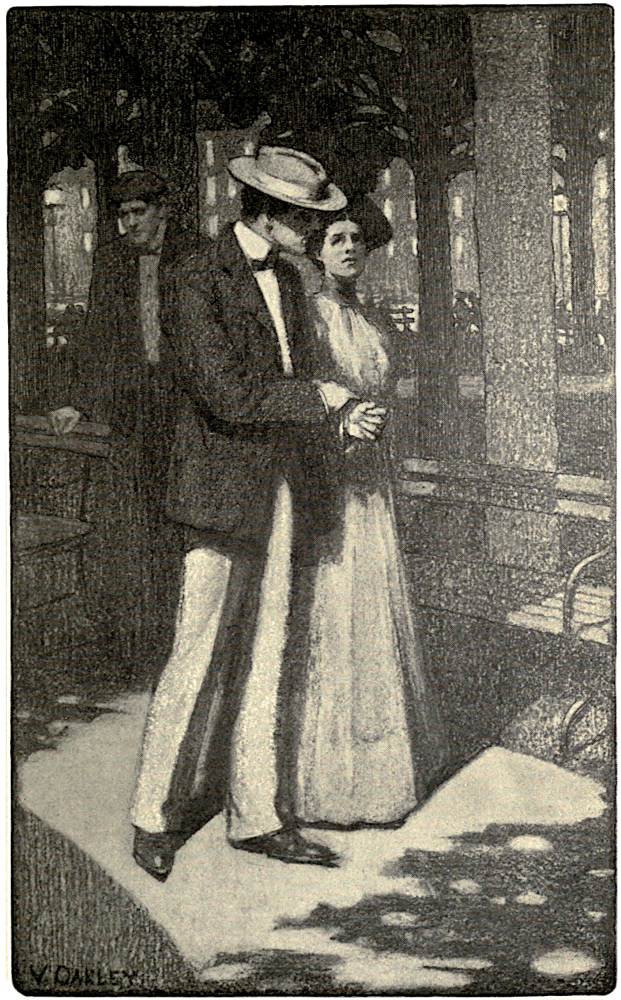
“AND WITH GLOOM IN HIS HEART HE WENT BACK TO HIS LONELY ROOM AND LIFE.”
“Then you care for some one else?” Jack was saying in a fierce undertone.
“Jack—don’t, please!” murmured she, tears welling into her eyes.
“But I must know,” he went on, hardly aware of his own insistence.
“Yes,” she said at last, never so faintly. “But he does not care for me.”
All of Jack’s manhood answered to this pitiful confession. He spoke to her gently, soothingly, laid her hand in his arm, and told her he would always watch over her like a brother. And Agnes, reassured, looked up in his face with loving gratitude.
At this point, Russell, on the return, again passed them. A single glance at the couple convinced him that Jack had won a prize dearer far than the one his friend had that day wrested from him.
“It was a miserable delusion of my vanity,” Russell said within himself, “that made me answer to the inspiration of her gaze. It is Jack, the fortunate, the pet of Destiny, who is to claim her. Here endeth the chapter of my folly.”
And with gloom in his heart he went back into his lonely room and life.
IV
Three years after the brief episode of Hubert Russell’s two meetings with Agnes Benedict he found himself enjoying a hard-earned holiday in camp on an island in Georgian Bay. Since graduating, he had made a quick climb up the ladder of success. A series of fortunate circumstances had enabled him to conquer difficulties apparently insuperable. His residence in a progressive town of the Middle West, congenial occupation, and the sense of work well bestowed, had done much to restore the healthy tone of his mind, biased to melancholy through another’s crime. He had corresponded intermittently with Jack Benedict, but without touching upon the subject of Jack’s domestic or sentimental ties. He had read, in the “society” columns of certain New York newspapers, of various occasions upon which the three Misses Benedict had appeared before the world; of their summers abroad and at home; of the marriage of Margaret; and recently of the more than amateur achievement of Agnes as the artist of some pastels displayed at an exhibition in the spring. What he had expected to read—the announcement of her marriage with her cousin Jack—had not yet reached Russell’s eye. When that event should occur, and not till then, Russell said to himself, he would give up, once and for all, the haunting witchery of Agnes Benedict’s fair face. Through the mists of three years of memory it shone upon him still!
One day in August a little pleasure-yacht of light draft and dainty build (meant to thread her way between innumerable rocky islands and dally beside tempting bits of shore, rather than to brave the rough water of the open bay) passed into an inlet where its owner had decided to throw a rope over a large rock and stop to lunch!
This primitive method of anchorage was a favorite one with the owners of the Juanita, the Cartwrights, a benevolent elderly couple from New York, who, owning a summer residence upon one of the islands lower down the bay, often took their house-parties away for days of pleasuring afloat. Mr. and Mrs. Cartwright had now as their guests several young men and maidens, among them Jack Benedict, his sister Louisa, and his Cousin Agnes. All day the Juanita had run through narrow channels of pale green water, between rocky ramparts crowned with spruce and birch, around the gray flanks of which sprang from the water forests of bulrushes, sprinkled with cardinal flowers and water-lilies. As they now steered skillfully into the channel, in which it was expected to find their usual landing-place open to approach, an expression of disappointment arose from the forward deck, where gathered a little group of voyagers in the gay attire of summer on the wave.
“A camp of men! Horrid things! Why did they choose our island!” cried Lou Benedict, pouting.
A rough house-boat anchored near the shore formed the center of supplies for the camp, often replenished by a tri-weekly steam launch from the mainland. Around a fire built upon stones a party of young men were making rather bored preparations for their mid-day meal. As the whistle of the toy yacht sounded a salute they arose to their feet and came hurrying down to the water’s edge, evidently not displeased at the invasion of their privacy.
“Hubert Russell!” exclaimed Benedict, joyfully, as he identified among them his old friend. “Who would have dreamed of our meeting here?”
Greetings and introductions followed, and from this point no expression was heard from the girls of disapproval of “those horrid men.”
It was in truth a stalwart and good-looking band of which Russell was the leader. Mr. and Mrs. Cartwright, nominally joining forces with them for luncheon, brought joy to the hearts of these weary cooks and bottle-washers by the unpacking of a dainty meal, well served by the yacht’s cook and stewards. As the party grouped itself under the shade of glimmering birches, Russell, as if through a mockery of Fate, found himself next to the lady of his dreams. The talk, at first general, subsided into chat between persons sitting at a picnic casually side by side. Russell, almost fearing to continue where he was, looked over the circle to see Jack Benedict half reclining on the moss at the feet of an extremely pretty girl in white duck, a sailor-hat tied down with a white veil half covering her face. Seeing him thus provided for, Russell had less scruple in accepting his own half-hour of joy.
He thought Agnes sweeter, more womanly, more to his taste than ever. The rare experience was his of finding one’s self confirmed in a predilection after three years of total separation from the object. They talked easily, without reference to the past, without touching upon intimate topics. He fancied, without being sure, that Agnes knew the incidents of his advance since leaving college. That she had thus kept track of him was a flattery he must accept only because he was Jack’s friend. When he left her, his pulses bounding with delight of her presence, Jack Benedict took him off to the roof of the yacht’s deck, where they sat by the pilot-house and smoked and chatted through a long and lazy hour. During this time the rest of the party had scattered for various enterprises—exploring the waters in canoes, fishing, reading novels under the deck-awning, or lounging beneath the trees and overhanging rocks.
And as yet no word had passed Jack’s lips concerning his sentimental relations with the sex. Suddenly Mrs. Cartwright’s voice called up to him:
“Mr. Benedict, won’t you please take a canoe and paddle up that inlet yonder in search of your cousin and Miss Clare? We shall be starting before long, and I must begin to gather my chickens under my wings.”
Jack blushed as he prepared to obey the chaperon’s behest.
“You will think that for an engaged man I’m rather forgetful of my treasure,” he said, smiling. “I meant to tell you, Russell, that I’m to be married in October.”
Russell’s heart gave a despairing leap. “Wasn’t it to be expected?” he said, smiling also.
“Well—I—there were reasons why I couldn’t bring myself to write to you, old chap,” rejoined Jack, as he dropped lightly into the canvas canoe a deck-hand had put into the water, Russell following. “And perhaps we need not discuss it further. But I’m happier than I deserve to be, and I have won a gem of purest ray.”
As they paddled rapidly around the sharp projection of rocks that had seemed to block the way ahead of them, they saw the girls’ canoe in the center of a field of lily-pads bordering another one of the rocky points here so numerous in the channel. When the lily-gatherers, who had half filled their craft with masses of gleaming flowers and long, curling stems, espied the search-party, they waved them a merry welcome.
“I knew they were not fishing; she’s too tender-hearted by far,” exclaimed Jack, with a lover’s pride.
Simultaneously the smiles vanished from his handsome face. A naphtha launch just then passing into this inlet had left behind it a swell that made the canoe containing the two girls rock perilously from side to side. Agnes, evidently recognizing the danger, sat quite still, but Edith Clare threw herself forward with a scream and clasped her companion in her arms. The canoe, upsetting, plunged both occupants into the broad-leafed greenery, under which they sank at once out of sight.
“Can they swim?” asked Russell, quickening his stroke.
“Yes, both of them, if they are not caught below,” answered Benedict, hoarsely.
Their canoe shot madly forward. Prompt as were the people in the naphtha launch in turning back to attempt rescue, they could not vie with these men in their eager effort to reach the scene of the disaster. It was soon fatally evident that while one of the young women had arisen to the surface and was keeping herself afloat, something had happened to prevent the reappearance of the other. Jack was not so quick as Hubert Russell to see that it was Agnes who was missing. With misery clutching at his heart-strings, Russell said, entreatingly:
“Let me save her for you, Jack! It will be something to pay back all you’ve done for me if I can put the woman I’ve loved ever since I first laid eyes on her into your arms again.”
He could not see that Jack was not even looking toward the place where Agnes had gone down. All his thoughts were directed to the spot whence Edith Clare called out to him to save her. “Coming, my darling; have no fear,” Jack answered her, tenderly.
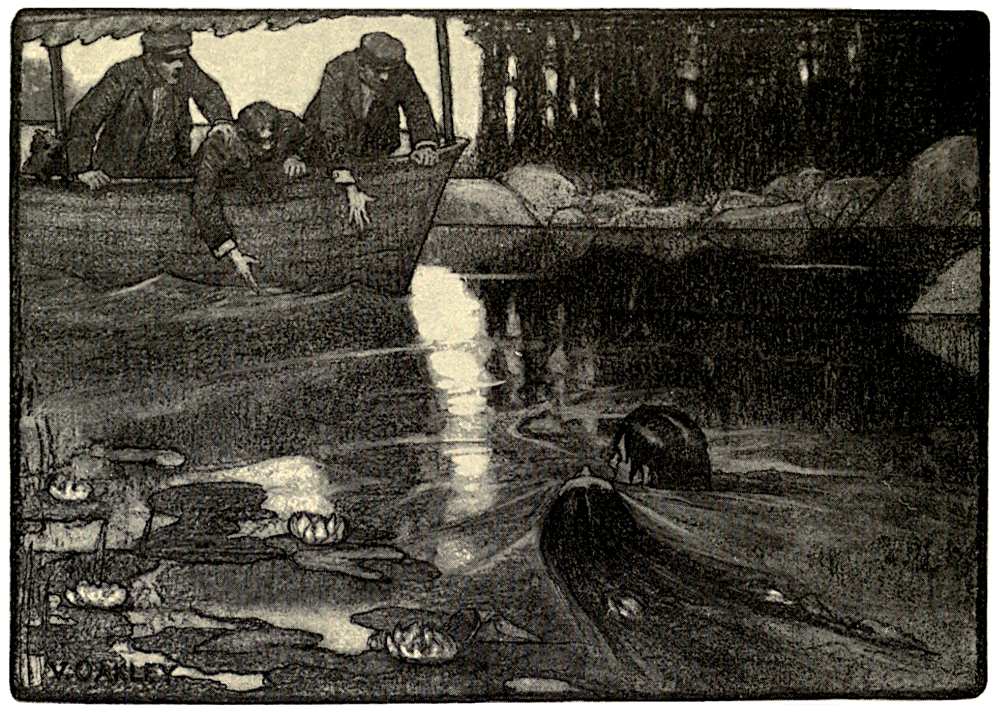
“RUSSELL REAPPEARED, BRINGING WITH HIM THE SODDEN FORM OF AGNES.”
Russell, without an instant’s further delay, dived overboard. The canoe, violently shaken, was yet steadied by the other occupant, who succeeded in reaching Edith and extricating her in safety from her perilous surroundings.
An anxious interval, and Russell reappeared, bringing with him the sodden form of Agnes, who, snared and held under water by the green serpents of the lily-stems, was quite inanimate. They got her aboard the launch and hurried back to the yacht, where poor Mrs. Cartwright received them wringing her hands over this sad ending of her day of pleasure. During the hour while Russell waited in an agony of fear on deck, Jack Benedict, who stood beside him, became for the first time aware of his friend’s long ordeal of repressed feeling for Agnes.
“And I might have spared you so much of it; it was my fault; I only was to blame,” Jack said, sorrowfully. “Ages ago, had I known this, I might have told you how she gently and tenderly—poor soul—but with finality, put a stop to my boy’s dream of winning her. Now, when God only knows whether she will be with us in the future, I can say no more. I think, Hubert—mind, I can’t say I am sure, but I think—she must have loved you from the first.”
Russell could not speak. He wrung Benedict’s hand, looking at him with hollow, haggard eyes.
“So many people have known for the last two years of my attentions to Edith Clare, we have been so frequently announced by our friends to be engaged, that, even before the engagement was a fact, it did not occur to me that you, though living so far from us, were in total ignorance of our relations. You can see, Hubert, that Edith is my other self. My fancy for Agnes grew up with me, but the love for Edith came with my maturer manhood. Our engagement was announced only just before we all came off here to visit Mrs. Cartwright, or I should have written to inform you of it officially and of my approaching marriage.”
“There!” exclaimed Russell, who was straining his ears to hear sounds from the little inner cabin, where Agnes lay under the care of Mrs. Cartwright and a doctor—found, fortunately, among the campers on the island. “I am sure I heard her voice.”
Jack’s sister Lou came out to them, her face beaming with delight. “She has stirred—has spoken; she breathes easily now,” was what they heard. “In a little while, the doctor says, she will be herself again,” Lou tried to add, but was choked by her excitement.
An hour or two later Russell, who had been invited by their hostess to go back with them for a little visit to her island villa, sat beside the lounging-chair of Indian bamboo heaped with rugs and cushions, in which they had placed Agnes upon deck—clad for the occasion in things they always carried aboard in a wardrobe assembled for such emergencies. The yacht was speeding merrily homeward over a track of westering sunshine. Forest fires upon the small islands along their route glowed like jewels under canopies of dense, pearly smoke. In the wake of the boat violet shadows appeared and vanished into the water. All ahead of the two was bright as the Promised Land.
What had so long seemed impossible to these lovers had come about in the simplest fashion. Their hands meeting had conveyed the joy of each at reunion with the other. A few broken words from Russell told Agnes that he had no dearer wish than to win her love. And Agnes—Now she was pouring out to him the confidences of three years past; was claiming his in return; was hanging upon his words, her face so full of happiness as to tell its own story.
“We are all avoiding that part of the deck as if it were a region of pestilence,” said Lou to her future sister-in-law. “I don’t think I ever saw such bare-faced love-making in public. I have had to put up a parasol so as not to see them. As for you and Jack, Edith, you may step down from your pedestal as fiancés. Although mamma will be very much taken by surprise to hear that Agnes has come up into these remote waters to annex a young man from off an island, I think Jack will induce her to feel resigned. Certainly, Russell is a fine, manly fellow. From all I can see, I fancy there will soon be only one Miss Benedict.”
“And for how long will there be even one?” asked Edith, teasingly.
Lou blushed, and would not answer.
A GIRL OF THE PERIOD