Front matter (continued 3)
Reading edition
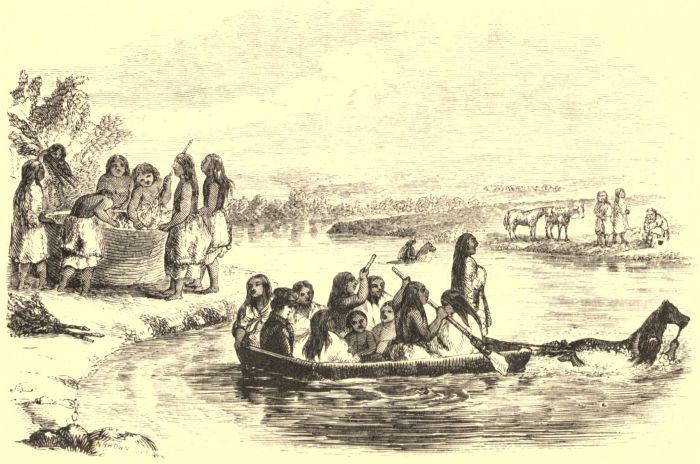
FERRYING THE SANTA CRUZ.
Several boats were constructed after the same unique model, and succeeded in crossing safely. Some of the horses, being better adapted to towing, were swam back to repeat the process, and our craft returned for a second freight. I watched the proceedings from the bank with intense interest, speculating on the probable consequences of an accident to any of the fleet. Such was their superstition, that, in the event of any ill befalling them, they would be quite likely to ascribe it to me, and serve me worse than Jonah was treated by his shipmates. The swiftness of the current, and the rudeness of their navigation, made them so liable to mischief, that it seemed wise to prepare for it; and I at once began ingratiating myself with two of the worst fellows in the whole tribe, by professions of special good will and admiration for them, and confidential hints that they would share more liberally in the bounties of “Holland” than any of their fellows. Whilst thus engaged, with cautious glances across the river, to make sure that all was right, I perceived that there was quite a commotion among the people below; some were springing upon their horses,—others, ready mounted, were dashing furiously down the bank. On looking some distance below, a boat appeared to be in distress; the lariat that bound it together had snapped asunder, and the pressure within, and the strain of the horse without, had broken the front stake; the horse, relieved of his freight, pulled for the shore, and could neither be coaxed nor beaten into a return to duty. The horsemen on the banks dashed into the stream, and swam for the wreck, which contained, among other passengers, a young child. It was already filled with water, and was partially turned on her side. The surface of the river was dotted with dark forms, struggling with the mad current; one horseman after another each grasped a floating object, and made for the shore. The craft had drifted nearly half a mile, and nothing could be made out very distinctly. The squaws, on first perceiving the mischance, watched the wreck, and sung in a loud and plaintive strain, all the while casting unfriendly glances at me, and gradually approaching the place where I stood. My apprehensions were so far confirmed by this movement, that I told John (the name I gave one of my present particular friends), as he loved rum and tobacco, and expected to get any, not to leave me. John saw at a glance what was in the wind, and appreciated both the immediate danger and the ultimate reward of averting it; namely, the privilege of being gloriously drunk at my expense. He told me to go into his hut, and pointed me to the furthest corner; where, I being duly ensconced, he took his station, cutlass in hand, directly in front of me. The singing grew louder, and the voices more numerous about the door; the song was their regular powwow strain, which invariably preluded the killing of a horse. The Indians began to enter the lodge, and looked unutterable things in the direction where I was crouching; the wigwam was soon filled with them, and they were beginning to crowd towards me, when old John opened upon them, and told them they ought to be ashamed of themselves, to come in there in that manner; they did not even know what had happened,—they did not know whether any lives were lost. They were threatening on account of the death of a child, when, for aught they knew, the child was alive; they had better wait patiently, till they knew more about the matter, before they made any further uproar about it. In this strain he parleyed with them for some time, till they concluded to retire, uttering, as they went, the most horrible sounds. I felt less relief from their absence than if John had not, by implication, fully assented that if the brat was drowned, my life should answer for it. News soon came that the children were all safe, but that the boat was lost.
An instant change ensued: the fire appeared to be quenched, but I feared it might break out at any moment afresh. Knowing their treachery, I kept a pretty suspicious watch on their movements; the chief soon came over the river, hurried, perhaps, in his movements by the accident, which he had witnessed from the opposite shore. After conferring with John, and giving him some instructions, and seeing that all was right, he reëmbarked for the other shore, as he made it his special business to see that all were passed across in safety. The ferrying ceased as night came on; the chief was likely to be on the opposite side all night, as there was a good day’s work yet to be done before the whole would be transported. I had overheard him giving special orders to keep a good look-out on me during the night. I felt, however, some uneasiness in his absence; he had been my most powerful protector, having twice, at least, saved me from imminent death.
I now began to revolve in my mind the possibility of escape; the thought suggested itself that I might steal one of their boats, and drift down the stream. I was long since heartily tired of captivity; my situation, especially if I was to be held a hostage of Providence for the safe ferriage of the tribe, was desperate. But, on second thought, I did not know that this was certainly the Santa Cruz; if it was, I was furthermore ignorant of our distance from the sea. I knew of no white settlement on or near the river; none, I remembered, was laid down in the chart; if such a settlement existed, I might hope to reach it in a boat, but a voyage in such a craft as one of these would be as hazardous as that of the wise men of Gotham. If there was no such settlement, and “Holland” was Patagonian for Utopia, my only chance, short of drifting in my leathern sack out to sea, would be to land on some island, in case an island there were; and then what should I live on, after landing? Berries I had never seen, except once or twice. Besides, my stolen craft could not be paddled,—the Indians had too good ears for that; I must follow the channel passively, through all its course, which was terribly crooked, while its rapidity increased the risk that the ungainly vehicle would be disabled. On the whole, it was so doubtful whether I could reach any particular place, or escape starvation after I got there, and so certain that failure would be death, the project seemed a forlorn hope. But then, again, it was not more forlorn than my present situation; so my poor mind vibrated between dangers,—the danger of remaining where I was,—the danger that I should escape only from the frying-pan into the fire. At last, as I felt the frying-pan, and only feared the fire, I concluded to try.
Crawling as noiselessly as possible from my resting-place, I stole softly out, and made for the river. Alack! in calculating the chances, I had not once thought of four-footed enemies, and they were upon me before I was halfway to the shore,—a half-dozen dogs, barking loud enough to wake the whole encampment. I retreated incontinently to the lodge, and succeeded in getting quietly into my quarters again, not without some inward spasms. It was all for the best, no doubt, but it was not, just then, easy to think so, or possible to feel so; and, therefore, after a little time, I once more emerged from the lodge, and stole towards the river by a different track, hoping to elude those infernal dogs; but they, or some others, were on the alert, and came pell-mell upon my rear, barking more uproariously than before. I cursed the dogs, their masters, and my own folly, and gave up the attempt.
The ferrying recommenced the next morning; and before night the whole tribe were safely landed, with their effects, on the west side of the river, and their wigwams were all pitched. We were short of provisions; but this was a common case, and I was accustomed to it. I got an occasional morsel of grease, sufficient to keep starvation at bay; but illness, with bad and insufficient food, had greatly emaciated me, till I was a spectacle but few degrees above the living skeleton. But hope was still in the ascendant, and I had no idea of lying down to die till I was quite sure my time had come. We continued our wanderings the next day in a westerly direction, slaying every living creature that came within reach, from a skunk to a guanaco. This was a great disappointment, as I hoped we should go down the river, the direction in which they said “Holland” lay, and the only direction in which we were likely to strike a white settlement, if any existed on the Atlantic coast. But my remonstrances on this head were vain; they would go where they pleased, and I must go with them. Time dragged heavily; hours seemed days, and days weeks. But impatience is no virtue, and submission was imperative.
The country hereabout was more broken and mountainous than any we had before traversed, with a more abundant growth of bushes, and some clumps of stunted trees here and there. As we proceeded, keeping still to the north-west, game was more plenty. We came to two ponds, or small lakes, one of not more than four acres in extent, the other considerably larger; the latter was shallow, at least near the shore, as some ostriches pursued by the Indians ran into it, and their pursuers waded after, and succeeded in capturing them.
At one time I observed a large scar in the calf of the chief’s leg; the mark of a wound that must have been inflicted a long time before, as it was completely healed. Its depression was so great as to indicate a very severe cut, unless the old fellow had grown uncommonly fat since he received it. On inquiring the cause of it, he said it was from a wound inflicted by the Alanagros, a tribe inhabiting a country to the northward. The name he gave them signifies the blacks; and, from the manner in which he spoke of them, I inferred they were in some respects superior to the Patagonians. He said they were armed with cutlasses, and very long knives,—had tobacco, and plenty of horses; and I conjectured that they might have been a party of Spanish Americans, or one of the mixed races of Spanish origin. The fight, he said, arose on occasion of his tribe being on a horse-stealing expedition; they encamped a short distance off, and at night he made a descent on the Alanagros, killed some of them, and plundered their camp, carrying off many of their horses. The plundered tribe rallied, hotly pursued them, and recaptured a part of the booty; in the struggle wounding him with a cutlass, and, as I judged by appearances, cutting to the bone. He told the story with great spirit, slashing right and left, and grunting with extraordinary emphasis, as if to give an impression that good hard blows were given and taken: but I afterwards learned that it was a cowardly running fight, in which more sweat than blood was spilled.
Nothing of importance occurred at our encampment near the lakes, except—what was a very noteworthy fact with me—such an abundance of ostrich that I was surfeited with the delicious fare, and was compelled by the chief to take a horse-rein emetic,—a more precise description of which the reader will have no difficulty in excusing. Had I not so completely disavowed the medical character, the chief might probably have allowed me to feel my own pulse,—if I could find it,—and to prescribe for myself; but the renunciation of professional honors brought me under the sanitary, as well as the political, jurisdiction of Parosilver.
Our line of march was now in a northerly direction, soon deflecting to the eastward,—a movement that revived my sinking hopes. There seemed to be some prospect of striking the Atlantic coast, and coming within reach of civilized men. On our way we observed the tracks of some animals different from any I had met with. The chief said it was the limerer, with which lucid definition I was fain to be content; and, as no specimens were visible, the inquisitive naturalist must trust to his imagination for the rest.
CHAPTER VIII.
Retrograde march—A look-out ahead—New specimens of birds observed—To the right again—Large inducements to visit Holland—Apparent effect—Council—Other tribes of Indians—Story of a battle—Capture of wild horses—A royal speech worth hearing—Deputation to Holland—A start and a sudden halt—Journey commenced in earnest—Order of arrangements—First view of Holland—A weary day and night—A boat—A short parley—Swimming for life and liberty—A rescue—Farewell to Patagonia.
My hopes were soon cast down, by a decided movement to the westward. Every step, I was convinced, lengthened the distance between me and the spot where my most earnest wishes centred; for, though I knew not of any settlements in this barren region, yet it was pretty certain that if there was one it must be sought in the line of the Santa Cruz. Of our latitude and longitude I could form no decisive judgment; but by the aid of the sun, of which occasional glimpses were caught, it was easy to take note of our direction, and I never retired to rest without taking landmarks, and satisfying myself as nearly as possible as to our whereabouts. At night there was a renewal of the discussions which had once so nearly turned my brain, and now at times came near verifying the plea which then saved me from destruction; but I was enabled to keep my feelings in more equal check. Disappointed and care-worn, I spent the night in commending myself to the mercy and good providence of God, praying that he would soften the heart of the savage and open a way of deliverance.
Among other matters that excited my curiosity, I was anxious to know whether the Indians were expert swimmers. The only occasion on which I had seen them attempt it was at the time of the accident in crossing the river. Then two of them swam across, while the others floated on their horses’ backs, clinging to the mane. In answer to some questions dropped on the subject, the chief assured me that they were all expert swimmers, and could stretch off a long distance without resting, as they would show me, but that the coldness of the season made the experiment too unpleasant. Others of the tribe told the same story. The question was interesting, for obvious reasons. I had thought a time might come when it would be a very practical one.
Some new specimens of birds made their appearance from time to time. One was a large black bird, resembling the turkey-buzzard, and subsisting on carrion. Another resembled the snow-birds of the north. I had also seen, near the sea-shore and by the lakes, several species of water-fowl,—one not unlike the wild goose, but the chief said they were not good for food.
Our course, the next day, was northward, and the day following turned once more decidedly towards the east, whereat my hopes, varying with the compass, began to revive, though their buoyancy was tempered by experience of the uncertainty of Indian movements. Observing a spot covered with small trees, over which a great number of carrion birds hovered, we approached and found the carcass of a poor old guanaco, which had most likely paid the debt of nature without compulsion, and was stripped of its flesh by the birds. The chief broke some of the bones and eagerly sucked the marrow, and then picked up the remainder to add to the domestic stock of grease.
At the close of the next day we brought up at a ravine, and found our camp by following it a short distance to a low flat. Proceeding to the eastward all the next day, we ascended a high eminence, from which the chief pointed in a south-westerly direction, and said that “Holland” lay there. I strained my eyes in the quarter indicated, without, however, making any discoveries, and with a strong disposition to think the Old Boy was hoaxing me. At dark we defiled down a steep declivity, and pitched our tents on the border of an extensive marsh covered with ice. Here I renewed my arguments for speeding our way to the promised land, dilating on the qualities of the promised rum in a style that would have astonished the advocates of the Maine liquor law, and impaired the confidence of those who had reasonably regarded me as a strict temperance man. Indeed, the antics and grimace with which I enforced the description, and illustrated the jovial effects of the creature,—the boasts of how I would teach them, by its aid, to throw the lasso, and perform most astonishing feats of horse-stealing and riding,—might have induced a suspicion that I knew more of it than mere observation or fancy could teach. But, however it may affect my reader, it produced unmistakable contentment and satisfaction to my Patagonian auditors; and that was what I aimed at. They looked and listened with watering mouths and hoarse laughter, giving token that the balmy description was appreciated to a most desirable degree. So evident was the impression that I spent the next day running about and giving line upon line to the most influential of the tribe, and succeeded, as I thought, in awakening a degree of enthusiasm to move towards the place where all these good things were to be got. In confirmation of this, I had the satisfaction of being called at night to attend a solemn council.
It was a peaceful gathering,—they left their weapons behind,—but it contemplated only a sort of preliminary inquiry; the Patagonians know how to make their forms of procedure as tedious as any of our courts of law, summary as are many of their dealings. They examined and cross-examined very strictly, sifting my story with a severity which showed that they were in earnest, and at the same time a little suspicious. It was necessary to be on my guard at all points; and if they had been more docile learners of arithmetic, and able to stick on questions of number and quantity, it might have been a harder matter to satisfy them. But, on the whole, the old story was stuck to with a degree of consistency that produced the desired effect. Their confidence was perceptibly raised, and, after a good deal of talk, the council adjourned, every one more than ever disposed to visit “Holland.”
While at this encampment, I observed on the ground about a dozen large oyster-shells, that appeared to have been recently opened. These were the first and only shells of the kind I saw in the country. I inquired if they were plenty in that vicinity. They said they were not; none of the tribe seemed to know where they came from, or anything about them. The chief said that he and his people did not relish oysters, but other Indians ate them. He did not like fish of any kind; no fish had grease enough for them; none of his Indians ate fish. This, and some similar incidents and conversations, convinced me that there were other Indian tribes in the vicinity. On one occasion I had noticed some places where a tribe, probably as numerous as our own, had encamped. Their fires appeared to have been very recently extinguished. Our tribe appeared to be considerably disturbed at these discoveries, and I judged that they were the traces of some enemies. It is certain that my captors had seen some desperate fights, of which they bore the marks on their persons. One of them had a deep scar on his breast, which he said was the mark of an arrow-shot received from the ”Yamaschoner” Indians, a tribe that use the bow and arrow. His description suggested the probability that these were the Terra-del-Fuego Indians; but, on mentioning the conjecture at a later period to a person I met at the Chilian penal settlement, he informed me that those islanders invariably shoot poisoned arrows, which would not leave the victim much leisure to describe their effect. The scar in question was a deep one, in the region of the heart; and while I was examining it, the chief remarked that the arrow passed through his body and came out at his back. On examination, a distinct scar was visible on his back, so far corresponding in form and direction with the one in front, that it seemed likely to have been made by the same weapon. But how the arrow could have transfixed him through the chest, without wounding the vital organs, was not easily to be conjectured. The only explanation I could conceive of was, that the fellow’s heart was so much harder than any material used for arrowheads, that the missile, instead of penetrating that important organ, had glanced aside and passed without mortal hurt. Enough had been developed to assure me that the tribe generally had hearts of no ordinary toughness, capable of serving them for all practical purposes wherein impenetrable stuff was in request; but the tale of this miraculous escape gave a new impression of obduracy, and entitled the hero to bear the palm among his fellows. I pretended to pity him for his former sufferings, and went so far as to volunteer—in case I should ever be permitted to enter the enemy’s territory—to make mince-meat of some of them, and so to avenge his cruel injuries. This spontaneous sympathy and forwardness to take up his quarrel was exceedingly gratifying to the sufferer and to the chief, and drew from them a more particular narrative of the combat.
They were out on a horse-stealing expedition,—the usual occasion, it seems, of Patagonian fights,—and made a swoop upon the camp of another tribe. The objects of this felonious invasion asserted title to the horses in their possession by certain tangible arguments, and induced a mortal combat. And now Old Boy waxed eloquent, and especially displayed that prime ingredient, “action.” His broad-sword exercise was really animated, and taught us “how fields were won,”—or would have done so, but that, while his right hand was slashing the air with his good steel, his left would hold the bridle-rein, and his heels involuntarily drive the spur;—in short, though it was a part on which he did not linger in the narration any more than in the act, there was some tall running on the occasion. So artlessly was the tale told, that while the hero was cutting and thrusting and grunting, to make due impression of the desperate bravery displayed in the encounter, his subordinate action clearly depicted a running and retreating fight, and convinced me that they got a sound drubbing for their pains. He said he killed one Indian, with an air that would have done justice to the slaying of a regiment. Shocking to relate, there were found persons who slanderously reported to me that Old Boy’s legs had the unhappy propensity of Pat O’Flaherty’s, whose heart was as brave as any man’s, but his cowardly legs ran away with his body; and they scrupled not to affirm that in this same hard-fought battle he crawled into the bushes, and there secreted himself till the cessation of hostilities enabled him to rejoin his tribe.
The reader has doubtless noticed that “the tribe” has been all along anonymous. The explanation comes rather late, but, in point of fact, I never could learn that they had any distinctive name; they never used any. Indeed proper names were very seldom heard. Even in conversation concerning each other, they managed to avoid “naming names” as strictly as so many honorable senators, though for no reason that I could discover. By signs and gestures, and other hints, they indicated the personal subject of remark, and seemed to suffer no inconvenience from what would be felt among us as a serious want.
While out hunting one day with the chief, we ascended a slight eminence, commanding a view of an extensive plain. The chief suddenly stopped his horse, and looked steadily forward. I bent my eyes in the same direction, and saw two or three mounted Indians moving towards a common point. There was nothing unusual to be seen, but Old Boy seemed to discover something. I inquired what it was. He answered by pointing; and, on a second view, I observed a horse loose, which I took to be that of some Indian temporarily dismounted. But the chief said they were about to catch a wild horse, and forthwith dashed off at a furious rate, bidding me follow. We were rapidly nearing the spot, when the two in advance of us put their horses at top speed towards the lone horse that was standing beside a clump of bushes. It suddenly ran before its pursuers, followed by two colts from the thicket. The colts appeared to be one or two years old, and were doubtless following their dam. One Indian singled out the mare, and another the larger colt. The little one did not lag behind. The chief and myself followed at a pace which would have made a single misstep fatal to our necks; but fortunately our horses proved sure-footed. On we dashed, helter-skelter, in a direction to head off the pursuers, and to place ourselves nearest to the affrighted animals. The mare yet holds the lead, and fairly tears up the soil with her flashing hoofs. An Indian, in close pursuit, presently swings his lariat about his head; but she makes a curve in her course, and springs beyond the reach of his aim. Her pursuer once more gains on her; again the lariat swings through the air,—he lets go,—the noose catches her neck,—the hunter’s horse turns suddenly off, and the rope, securely attached to the saddle, brings the poor captive headlong to the ground. The trained horse keeps a strain on the noose sufficient to prevent her from rising, while the hunter dismounts and secures his prize. The colts shared the same fate, and, with the mother, were subdued and made useful to the tribe.
The scenes and reminiscences I have described did not prevent the matter of most absorbing interest to myself—the projected visit to “Holland”—from engaging due attention. The chief came home from the council full of it. He was in royal good humor, and talked about it half the night; but several objections arose, which it was necessary for me to dispose of. These were met, apparently to his full satisfaction. One of the most serious was the fear that the white men would revenge upon him the murder of Captain Eaton. I assured him that so long as I was with him he had nothing to fear on that score; the people were all mine, and would do, or refrain from doing, whatever I should bid them. They would not dare to lift their hands against him contrary to my orders, or refuse to deliver what articles I chose to demand. Nothing, I found, would do, but the assertion of absolute supremacy over all white men whatever, the world around; less than this would not secure the confidence of these savages, and I regulated my speech by the necessities of the case. The chief inquired, half a dozen times over, what I would say to the white men, and I as often rehearsed an address for the occasion. At last his curiosity seemed abated, and we fell asleep.
Early the next morning we were up and stirring, and the chief having adjusted his toilet with care, a slight breakfast was made ready. This over, his highness stood forth, and from the door of his lodge made an official address to the tribe, wherein he set out the advantages of a visit to “Holland,” and suggested the most expedient style of making it. He advised that a few only of the tribe should be deputed, with himself, to accompany me, and receive the stores of rum, tobacco, bread, rice, tea, butter, beads, brass, copper, and so forth, that were to be forthcoming, as the expression of my gratitude for the distinguished consideration with which they had treated me. Though royal speeches seldom excite any jealousy of plagiarism, and it may seem a little captious on my part to make such a charge, it is due to “the truth of history” to declare, that herein the great Parosilver did but repeat a suggestion which he did me the honor to receive with favor over-night. It was not deemed essential to the case to inform his highness of all the reasons that led me to wish for as small an escort as the nature of the business would admit. On the contrary, acting upon the profound maxim, that one sufficient reason is as good as a dozen, and better than that number of questionable ones, I merely advised, that, after the experience which Captain Eaton and others had had of Patagonian prowess, the sight of too many of his giants would frighten away the whites, and prevent all beneficial communication with them; while the presence of a small deputation would be a pledge of their pacific inclinations. The speech from the throne proved less moving than most of the chief’s effusions: his lieges listened with great interest, and an earnest debate sprung up, at the conclusion of which it was decided that the chief, with four other Indians and their squaws, should be my body-guard, the rest of the tribe to follow after. Another old woman begged to go with us, which was agreed to. The horse I had been in the habit of riding was lame, and unfit for service; another was procured for me.
Our simple preparations for departure were soon made, and as we were about to start they all began bringing their dirty children to me, and requesting that I would bring brass and beads for them all; which was gravely promised, much to their satisfaction. There remained the last act in the comedy for which I had been long rehearsing,—if, indeed, it did not turn out a tragedy. The idea had early occurred to me, that if I had some object to which I appeared very much attached, it might prove to be for my advantage; the Indians might hold it, in my absence at any time, as a sort of surety for my return. A belle from among the beauties of the tribe would be effectual to that end; but, if no sentiments of virtue had restrained me from this expedient, the filth and unsightliness of them all were enough to insure continence. I chose, therefore, a little white dog for a pet,—a dirty, thievish little rascal;—but I fondled him in the style proper to a violent attachment. It is true that when I saw him licking the meat designed for our repast it was not easy to refrain from kicking his worthless brains out; but this was a trifle to other things I had to endure, and I made myself apparently so fond of him that the reality of the case was never suspected. Now and then I indemnified myself by giving him, when unobserved, a smart rapping for his misdeeds, though such chastisement made but a slight impression on the object of it. As we were about setting out, I was asked if I intended to take my dog. No, I told them, he would be better off there, and when I returned he should have some bread and other dainties to eat. The ruse more than answered its expected end, in lulling all suspicion of my sincerity.
At last we were under way. The grand crisis to which all my diplomacy and the utmost license of fiction had tended was near at hand. A strong hope of deliverance braced my spirits, shaded, it is true, by a natural apprehension of possible failure, and of the consequences that might follow. With no great elation of spirits, but with a stern, severe tension of all my mental energies, and a concentration of them into one focus of resolve, I waved a farewell, which I hoped might be everlasting, to the accursed gang of robbers who had tormented me so many tedious weeks. “Good-by to Patagonia!” I mentally ejaculated, and struck off with my escort; but had not gone more than an eighth of a mile, when the party wheeled about and ordered me to follow them back to the camp! I remonstrated, but it was of no use, and with a heavy heart I found myself once more in my dirty corner of a wigwam. The horses were turned adrift without a word of explanation, and the Indians sat down to a game of cards, with as much indifference to everything else as if the events of the past forty-eight hours had been a feverish dream. What could be the meaning of it? I questioned the chief. He merely replied that he would go by and by,—by and by; which, being interpreted, probably meant when he pleased, and that convenient season might never arrive! After I had teased him for a long time he took me to the door of the lodge, and, pointing to the river, said it was “no good then;” it would be “good” at night. What the state of the river, which was a shallow stream, a branch of the Santa Cruz, had to do with the matter, I could not divine, and was half inclined to vote myself fairly outwitted by the Old Boy.
The day, a long one, at last wore off, and at night we once more set off. We crossed the frozen marsh, and forded the river, and, after going about two miles, stopped for repose. We took no camp equipage, and had to shelter ourselves for the night under the lee of a clump of bushes. We thrust our feet into the thicket, while our heads lodged out of doors. In this interesting attitude I was made to repeat my wearisome detail of promises, and to rehearse once more my contemplated speech to the white men; which done, we dropped asleep. Waking early the next morning, I found my head and shoulders covered with a fleecy mantle of snow. Would the fortune of my expedition fall as lightly on me? I shook it off, turned up my coat-collar, pulled my poor, more than half worn-out cap over my ears, and so, partially protected from the storm, rolled over, and again sunk into a slumber. The storm ceased at dawn of day. I rose and went in search of fuel, while my dark companions still slept profoundly. In an hour or two they roused themselves, and kindled a fire. Meat, from a store brought along for our provision on the way, was cooked, and served for breakfast. The scanty meal being despatched, our horses were driven in, lassoed, mounted, and we resumed our journey, in a south-easterly direction. At the end of about three miles another halt was called, a fire was built to warm by, and the horses were watered. The order of arrangements was discussed, and a fresh edition of the promises and the speech critically listened to. Changing our course a little to the right, we soon struck the Santa Cruz. The Indians pointed far down the stream, and said, “There is Holland.” I strained my eyes in the direction pointed out, and thought I could discern an island with several small huts upon it. A mile or two further on the north bank brought us to the mouth of the river, in prospect of the Atlantic. The island was directly opposite the mouth, and the lower part only appeared to be inhabited. We halted. The Indians pointed towards it, exclaiming, “Esta Holland sarvey! muchas casas, mucho mucho hombres, tene mucho aquadiente, mucho travac, yeruen, arenar, arose!”—This is Holland, and has plenty of houses, and abundance of men,—plenty of rum, tobacco, bread, tea, flour and rice! I surveyed the spot in silence. This island was of considerable extent, lying two-thirds across the wide mouth of the river, its surface dotted over with little knolls or hillocks of earth. Could it be that these were dwellings inhabited by white men?
Our horses’ heads were now turned from the shore, and we rode back about an eighth of a mile to a large clump of bushes, unsaddled our beasts, and waited some time for the rest of our company, who had fallen in the rear. They came at last, our horses were turned adrift, fire was lighted, and, as the day was far spent, supper was in order. Then ensued a repetition—a final one, I trusted—of the grand present to be levied on the Hollanders, and of the speech which was to draw them out. The Indians arranged that I was to hoist the English flag,—the colors of the unfortunate brig Avon, which they had brought along at my request,—and then to walk the shore to attract the attention of the islanders. On the approach of a boat, I was to be kept back from the beach, to prevent escape; for I found that they were not, after all, as well assured of my good faith as might have been desirable. They thought, moreover, that when the white men saw a prisoner with them, they would come ashore to parley, and offer presents to effect his release; in that case, there might be a chance, if the negotiation proved unsatisfactory, to take bonds of fate in the form of another captive or two. So, at least there was ground to suspect,—and some cause to fear that the rascals might prove too shrewd for all of us!
After talking till a late hour, the Indians threw themselves upon the ground, stuck their feet into the bushes, and were soon fast asleep. I consulted the chief as to the propriety of modifying this arrangement, by placing our heads, rather than our feet, under cover, since both could not be accommodated. He declined any innovations, and told me to go to sleep. I stretched myself on the ground, but as to sleep, that was out of the question. I lay all night, thinking over all possible expedients for escape. We had no materials for a boat or raft of any description, and it was impossible to think of any plan that promised success; so that, after tossing, in body and mind, through the weary hours of night, I could only resolve to wait the course of events, and to take advantage of the first opportunity affording a reasonable hope of deliverance from this horrid captivity. Snow, sleet and rain, fell during the night; and I rose early, thoroughly chilled, every tooth chattering. A fire was kindled, and the last morsel of meat that remained to us was cooked and eaten. The weather continued squally till the middle of the afternoon.
After breakfast the chief went with me to the shore, bearing the flag. On the beach I found a strip of thick board, to which I fastened the colors, and then planted it in the sand. The bushes around, which have a kind of oily leaf and readily ignite, were set on fire. I then walked the beach,—but no boat came. When it cleared up sufficiently to see, I observed little objects moving about on the island. The day wore away with fruitless attempts to attract their attention. With an aching heart I returned, at dark, to the camping-ground. On this island my hopes had so long centred,—if they were now to be disappointed, how could I endure it? The Indians began to talk of rejoining the tribe the following day. I opposed the motion with all the dissuasives at command, assuring them that, at sight of our flag, the islanders would surely come over in a boat, and that, if they would only wait a little, they could go over to the island and enjoy themselves to their hearts’ content; representing the absolute necessity that I should procure the rum, &c., we had talked of, and how embarrassing it would be to go back to the tribe empty-handed, after all that had been said, to be ridiculed and reproached. It would never do. Our conversation was continued till quite late, when we ranged ourselves, hungry and weary, for another night. For hours I was unable to sleep. The uncertainties of my situation oppressed me, and I lay restless, with anxiety inexpressible, inconceivable by those whom Providence has preserved from similar straits. It was a season of deep, suppressed, silent misery, in which the heart found no relief but in mute supplication to Him who was alone able to deliver. Towards morning, exhausted with the intensity of emotion acting on an enfeebled body, I slept a little, and woke at early dawn, to a fresh consciousness of my critical position.
The weather had been fair during the night, but there were now indications of another snow-storm. I waited long and impatiently for my companions to awake, and at last started off in quest of fuel; on returning with which, they bestirred themselves and started a fire, which warmed our half-benumbed limbs. There lay the little island, beautiful to eyes that longed, like mine, for a habitation of sympathizing men, about a mile and a half distant; it almost seemed to recede while I gazed, so low had my hopes sunken, under the pressure of disappointment and bitter uncertainty. A violent snow-storm soon setting in, it was hidden from view; everything seemed to be against me. It slackened, and partially cleared up,—then came another gust, filling the air, and shutting up the prospect. In this way it continued till past noon; at intervals, as the sky lighted up, I took a fire-brand, and set fire to the bushes on the beach, and then hoisted the flag again, walking wearily to and fro, till the storm ceased, and the sky became clear. The chief concealed himself in a clump of bushes, and sat watching, with cat-like vigilance, the movements of the islanders. After some time, he said a boat was coming; I scarcely durst look in the direction indicated, lest I should experience a fresh disappointment; but I did look, and saw, to my great joy, a boat launched, with four or five men on board, and pushing off the shore. On they came; the chief reported his discovery, and the rest of the Indians came to the beach, where I was still walking backward and forward. The boat approached, not directly off where I was, but an eighth of a mile, perhaps, to the windward, and there lay on her oars.
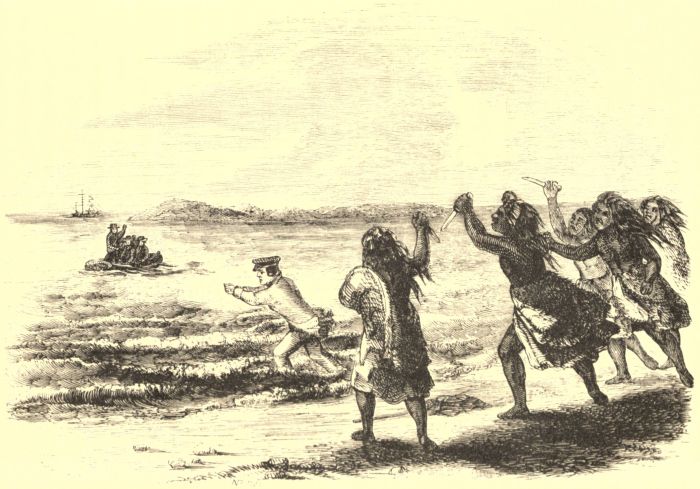
THE ESCAPE.
The Indians hereupon ordered me to return to the camping-ground; but, without heeding them, I set off at a full run towards the boat. They hotly pursued, I occasionally turning and telling them to come on,—I only wanted to see the boat. “Stop! Stop!” they bawled. “Now, my legs,” said I, “if ever you want to serve me, this is the time.” I had one advantage over my pursuers; my shoes, though much the worse for wear, protected my feet from the sharp stones, which cut theirs at every step; but, under all disadvantages, I found they made about equal speed with myself. As I gained a point opposite the boat, the Indians slackened their speed, and looked uneasily at me; the man in the stern of the boat hailed me, inquiring what Indians these were, what number of them, and how I came among them. I replied in as few words as possible, and told him we wished to cross to the island. He shook his head; they were bad fellows, he said; he could not take me with the Indians. They began to pull away! I made signs of distress, and waved them to return, shouting to them through my hands. The boat was again backed within hailing distance. “Will you look out for me, if I come by myself?” “Yes!” was the prompt reply. The Indians, all this time, had kept within ten or fifteen feet of me, with their hands on their knives, and reiterating their commands to come back, at the same time edging towards me in a threatening manner. “Yes, yes,” I told them, “in a moment,” but I wanted to look at the boat,—taking care, however, to make good my distance from them. At the instant of hearing the welcome assurance that I should be cared for, I drew out the watch (which I had brought, according to promise, to have a new crystal inserted at Holland), and threw it into the bushes; the salt water would spoil it, and, if I should be retaken, the spoiling of that would be an aggravation which might prove fatal. At the same moment I gave a plunge headlong into the river; my clothes and shoes encumbered me, and the surf, agitated by a high wind, rolled in heavy seas upon the shore. The boat was forty or fifty yards off; and, as the wind did not blow square in shore, drifted, so as to increase the original distance, unless counteracted by the crew. Whether the boat was backed up towards me, I could not determine; my head was a great part of the time under water, my eyes blinded with the surf; and most strenuous exertion was necessary to live in such a sea. As I approached the boat I could see several guns, pointed, apparently, at me. Perhaps we had misunderstood each other,—perhaps they viewed me as an enemy! In fact, they were aimed to keep the Indians from following me into the water, which they did not attempt. My strength was fast failing me; the man at the helm, perceiving it, stretched out a rifle at arm’s length. The muzzle dropped into the water, and arrested my feeble vision. Summoning all my remaining energy, I grasped it, and was drawn towards the boat; a sense of relief shot through and revived me, but revived, also, such a dread lest the Indians should give chase, that I begged them to pull away,—I could hold on. The man reached down, and seized me by the collar, and ordered his men to ply their oars. They had made but a few strokes, when a simultaneous cry broke from their lips, “Pull the dear man in! Pull the dear man in!” They let fall their oars, laid hold of me, and, in their effort to drag me over the side of their whale-boat, I received some injury; I requested that they would let me help myself; and, working my body up sufficiently to get one knee over the gunwale, I gave a spring, with what strength was left me, and fell into the bottom of the boat. They kindly offered to strip me, and put on dry clothes; but I told them, if they would only work the boat further from the shore, I would take care of myself. They pulled away, while I crawled forward, divested myself of my coat, and put on one belonging to one of the crew. Conversation, which was attempted, was impossible; it was one of the coldest days of a Patagonian winter,—I was chilled through, and could only articulate, “I ca-n’t ta-lk now; I’ll ta-lk by a-nd by.” Some liquor, bread and tobacco, which had been put on board for my ransom, on supposition that this was what the signal meant, was produced for my refreshment. The sea was heavy, with a strong head-wind; so that, though the men toiled vigorously, our progress was slow. I was soon comfortably warmed by the stimulants provided, and offered to lend a hand at the oar; but the offer was declined. The shouts and screams of the Indians, which had followed me into the water, and rung hideously in my ears while struggling for life in the surf, were kept up till distance made them inaudible. Whether they found the watch, whose mysterious tick at once awed and delighted them, and restored it to its place of state in the chief’s lodge, or whether it still lies rusting in the sands by the sea-shore, is a problem unsolved.
The boat at last grounded on the northern shore of the island; Mr. Hall, the gentleman who commanded the party, supported my tottering frame in landing; and, as we stepped upon the shore, welcomed me to their island. I grasped his hand, and stammered my thanks for this deliverance, and lifted a tearful eye to Heaven, in silent gratitude to God. I was then pointed to a cabin near by, where a comfortable fire was ready for me. “Now,” I heard Mr. Hall say, “let us fire a salute of welcome to the stranger. Make ready! present! fire!” Off went all their muskets, and a very cordial salute it appeared to be. He soon followed me, took me to his own dwelling, supplied me with dry clothing, and, above all, warmed me in the kindly glow of as generous a heart as ever beat in human bosom.
I was captured by the savages on the 1st of May, and landed upon the island on the 7th of August.
CHAPTER IX.
A civilized meal—A happy evening—A survey of the island—Preparation of guano—Preparations against invasion by the giants—A proposal to attack them—Loyalty and revenge—Killing time—Trouble in the settlement—A disagreeable situation—Arrival of vessels—Countrymen—A welcome by new friends.
After getting sufficiently thawed out, I gave a synopsis of my adventures. The cook presently laid the table, and brought in supper. I ate heartily of bread and Irish pork, and drank tea raised in Brazil, called matte. It may not compare favorably with the produce of China, but to me it was a delicious beverage. I had been in captivity ninety-seven days, living as the reader has seen. Although I partook freely of supper,—too freely for one in my weak condition,—I rose from the meal with as keen an appetite as I brought to it. I again expressed to Mr. Hall, on learning his name, my gratitude at finding myself, through his timely assistance, among friends, though a stranger. He cordially sympathized with me, observing that he had been a prisoner among the Patagonians for one day only, but had seen enough in that short time to be convinced that a life of ninety-seven days with them must have been dreadful indeed.
After supper the boat was hauled up on the island. Pipes and tobacco were furnished, and I passed in the society of my deliverers one of the happiest evenings of my whole life. The change was so great, from the miserable and almost hopeless existence I had so long lived, that my joy exceeded all bounds. My heart overflowed with gratitude. Words could not then, and cannot now, convey any adequate impression of my feelings,—of the freedom and joy that animated me, on being snatched from perils, privations and enemies, and placed, as in a moment, in security, in plenty, and in the society of friends. It seemed like a dream, the change was so sudden and so total.
The little house which for the present I called my home, and which, in fact, appeared to me at the time the pleasantest dwelling I had ever seen, was about twelve by fifteen feet upon the ground, built of boards and scantling, and lined with blue Kentucky jean. The fireplace was in the middle of one end, and a door opened at the opposite extremity. Two large closets were parted off, the one used as a cupboard, and the other for stores. Each side was lighted by a window containing four panes of seven-by-nine glass. Two comfortable settees, probably saved from some wreck, lined the sides of the room, and a good-sized hardwood table occupied the centre. It was floored overhead, and a trap-door opened into a sleeping apartment, fitted with two little berths,—one for Mr. Hall, and the other for Morrison, the Scotchman.
As we have described the interior of our snug little cottage, we will bestow a word or two on its exterior and surroundings. Its cracks and joints, over the roof and walls, were covered with strips of tarred duck, and battened with narrow pieces of thin board. It was situated on a little mound of guano, perhaps four feet high, and was banked up to the windows with the same material. The height of the walls above the embankment was about seven feet, the embankment three feet more. A ship’s bell was suspended on the north-east corner of the house, to notify the workmen of the hours of labor and of their meals. Sea Lion Island, as it is called,—the name “Holland” was probably corrupted by the Indians, from the word island, indistinctly pronounced in their hearing,—is about a mile and a quarter long from north to south, with an average width of an eighth of a mile, and is covered over its entire surface with low evergreen bushes. The settlement was made by an English company, for the purpose of collecting guano and preparing it for exportation, and was situated on the southern extremity.
Our social evening was prolonged to a late hour, the moments sped by the stimulus of novel enjoyment. One of the settees was assigned for my couch, bed-clothes were provided, and a bag filled with ships’ colors and other articles served for a pillow. Before committing ourselves to repose, however, we discussed the probability of an invasion from the continent, and came to the conclusion that nothing was to be feared in that quarter before morning. Old Boy and his party, it was obvious, would have to return to the main body of the tribe for reinforcements and naval equipage before attempting pursuit, as they had no materials for the construction of boats or rafts, even if they would dare to tempt salt water in their leathern sacks. We accordingly dismissed the subject for the time, and Mr. Hall and the Scotchman, having cared for my comfort with anxious kindness, disappeared through the trap-door, leaving behind a friendly benediction. The little cottage was warm; my couch was the perfection of comfort, in contrast with that which had been my lot for ninety-seven wretched nights. Above all, for the first time in so many weeks, I could lie down without the fear of treachery and violence. I was secure from savages. This indeed was luxury. I slept soundly, vying in the profundity of slumber with the immortal seven, till late in the morning. Daylight at length had dispossessed the darkness of every part of the interior, and I awoke. It was no dream. I was indeed free. Rude but unmistakable evidences of civilization surrounded me. The adventures of the preceding day flashed vividly on my hitherto clouded mind,—the suspense, the struggle, the seasonable rescue, the rejoicing welcome, the spontaneous and subduing kindnesses,—and a warm gush of tender and grateful emotion from my inmost soul thrilled and suffused my whole being. While these emotions were subsiding from the fervor of their first impulse, and the mind was gliding away into a delicious and confused revery, wherein all manner of delight seemed to encircle me as with an atmosphere, in whose genial glow all past suffering existed only for the heightening of present enjoyment, the trap-door overhead was lifted, and my generous friends dropped down with a hearty salutation. I sprang from my couch, as good as new, and younger than ever. A cheerful coal-fire was soon burning in the grate, the room was swept, breakfast was brought in and despatched, the bell rang, and the men issued forth to their daily labors, while I went out to explore my new abode.
The island is low and flat, and at high water its surface is only eight or ten feet above the water-line; but the tide here rises and falls about the same height as at the eastern mouth of the Straits of Magellan,—nearly forty-two feet. Within twenty-five feet of our house was a small store-house and shed, a hog-sty, and a large stone oven. About the same distance further on, was a house for workmen, framed of timber, and roofed and laid up at the sides with bushes; and the sides were banked and the roof coated with earth, an old sail forming the topmost and outermost feature of the edifice,—except that on one extremity of the roof a headless barrel communicated with the fireplace, and did duty very respectably as chimney and ventilator. There were no windows; the men, and whatever portion of light and air sufficed them, found ingress and egress through a door in one end. It was most evidently made for use, not for show; but appeared to be very comfortable, and was neatly fitted up with berths and benches, a table and cooking apparatus. Its occupants were eight in number,—three Frenchmen, two Spaniards, an Englishman, a Welshman and an Irishman; so that, the island having adopted (for a season, at least) a representative of the “universal Yankee nation,” may be thought to have brought together samples from a pretty considerable part of mankind.
Besides these human specimens, the settlement boasted of a dog, two mature porkers, and a litter of pigs. Near the house was a large heap of guano, prepared and ready for shipping to England and the United States. The men were at work hard by digging it up. It lies on the surface of the ground to a depth of from one to three feet; is dug up and conveyed in barrows to a cleared spot, where it lies in heaps, to be sifted. Stones, feathers, sticks, and other foreign substances, are carefully removed, the larger lumps are broken up, and the cleared guano is spread out in a thin layer; when thoroughly dried, it is covered up with planks. The business was carried on by Captain Matthew S. White, an Englishman, who had then been absent for several months at Montevideo, whither he had gone to procure vessels for conveying the guano already prepared, now amounting to some fifteen hundred tons, to market. The time he fixed for his return had expired a month before my advent upon the island, and Mr. Hall was beginning to feel very anxious for him, fearing lest some accident had befallen him, and anxious for himself and his company, also, as they had but a few months’ provisions; the island was rarely visited by vessels, and their only means of reaching any port, in case of extremity, were the ship’s long-boat, and a whale-boat, both too small to undertake so long a voyage with any hope of safety.
The possibility that my late hospitable friends on the main land might be led, by their high consideration for me, to visit “Holland” in a body, kept us busy, during the day, in making preparations to receive them with appropriate honors. Mr. Hall, who was left in charge of the settlement during the absence of the proprietor, observed that Captain White had often expressed apprehensions that the Indians would come upon the island, some time when he was away, and murder all hands. My slipping from them in the manner I had was not an event likely to dissuade them from the attempt, or weaken their motives for making it. There were two swivels in the camp, which we mounted upon wheelbarrows, to serve as flying artillery. I ground sharp an old whaling-harpoon, and fixed a handle to it; this was slung over my couch; and a large sheath-knife, for use in case we got to close quarters, reposed under my pillow. The Indians were prowling about the shore, probably expecting to see me reäppear among them, laden with the rum and tobacco they came after, and which they had earned by boarding and lodging me so long, and by the multiplied kindnesses with which they beguiled the months of my residence among them. It is likely they think, by this time, that I have been gone a long time for it.
Before retiring for the night, we loaded our swivels to the muzzle, and fired them, to let our neighbors know that we had the wherewithal to give them a warm reception, should they see fit to make us a visit. We then reloaded the pieces, each with a dozen or more large bullets, placed them ready primed at the door, and covered the primings, to keep our powder dry. We had six or eight muskets ready loaded, enough to arm the entire garrison, with plenty of ammunition. The dog was tied to the doorhandle, to give notice of danger, and the door carefully secured. Just as we were about retiring, Bose gave a portentous bow wow! but, on going out, and taking a survey of the premises, the alarm proved to be false. All was quiet; and, with a momentary doubt of the sagacity and discretion of our sentinel, we lay down with a sense of security,—first taking the axe into the house, thinking that the cunning rogues might try to burn us out, should they find the efforts to dislodge us otherwise ineffectual. With this final precaution, our faithful sentinel chained to his post, like a Chinese soldier to his gun, we were soon sound asleep. The night passed quietly away, without any further alarm from our look-out, who was of the English pointer breed,—a sleepy, dough-faced fellow, better qualified to show the game than to occupy the responsible station to which he was promoted. He was a great coward, but that was not altogether against him; for, since the law of self-preservation applies to brutes as well as to men, fear would impel him to make some kind of demonstration on the approach of foes, if fidelity did not; and one kind of demonstration would be as useful to us as another, if only audible.
After breakfast I walked forth, and cast an anxious look through the glass to the northern shore of the main land, to see if the Indians still occupied their position, and whether they were building boats, or making any other preparations for invasion. There they were,—the patient creatures!—still posted in view of our quarters, the English flag flying on the beach. There were several dogs on the shore, and among them I recognized my own; I almost fancied I could hear him barking. As we brought no dogs with us, I concluded that they had gone back to the main body, and got a reinforcement, with materials for boat-building, and brought my dog for the especial gratification of his affectionate master; and now he was capering about on the shore, as if to call me back. Having sufficiently gratified my curiosity in this direction, I turned the glass seaward, in hope to view some approaching sail but the broad expanse was clear,—no vessel to be seen. On the river banks a few stray guanacos were cropping the scanty, rank grass, while others, with their young, were lying on the sunny slopes of the sand-hills. The quiet of these animals assured me that their inveterate enemies, the Indians, were not in the vicinity.
Tired, at length, of this sort of sight-seeing, I returned to the house, and, taking our guns, started with Mr. Hall on a stroll up the island, hoping to shoot some sea-fowl; but returned at noon, unsuccessful. The afternoon was spent in wandering aimlessly over the island, killing time. Walking about on the sea-shore, I picked up some clear, transparent stones, coated on the outside with a kind of crust; some of them are very hard, and, when broken, cut glass like a diamond. I wrote my name, and place of residence, on a window of our little cottage, with a fragment of one; they are mostly white, some of them of a vermilion, and others of a straw color; they are, I suppose, a variety of quartz. The shore is, in some places, covered with these pebbles to the depth of two or three feet, on an average of the size of a walnut; the hardest specimens were not abundant, but I collected about a hundred of them. I might have picked up many more, if they had possessed any special value.
A further examination of the opposite shore disclosed Indians still prowling about, and I proposed to Mr. Hall to go over, with the men, and give them a sound drubbing. Revenge, I know, is said to dwell in little minds; if so, my abode in Patagonia must have dwarfed and contracted my own intellect for the time being, for I must confess to the consciousness of a desire to visit upon them some appropriate return for what they had inflicted upon me. Mr. Hall admitted the ill-desert of the Indians, and the entire rightfulness of a severe chastisement; but, not having the same stimulus to heat his blood that burned within me, he viewed the question with a more strict regard to prudence, and was altogether disinclined to undertake so hazardous an expedition; he dreaded going any nearer to the savages than was necessary. I would, myself, rather have been shot than fall into their hands a second time; but contended that the approach of the boat would bring them to the shore, and enable us to do them a mischief from the boat, without any necessity of landing among them. True, the Indians might succeed in getting upon the island some night, and effect our destruction; there certainly was nothing to prevent it, if they had the least ingenuity, and a moderate share of courage; but I knew them to be a gang of arrant cowards, and the reader may judge of their inventiveness by the preceding narrative. The subject was discussed till late in the evening, and the needful preparations and precautions were thoroughly talked over. When about to retire for the night, we went out and looked for our vigilant sentinel, whose due place, in right of his office, should have been at the door. Recreant to his trust, the rascal had deserted, to take up his night’s lodging with the pigs. He was soon hustled out of his nest, and compelled to return to the door, there to be tied, as on the preceding night, to the handle. His choice of such mean company greatly lowered the animal in my estimation. While fixing him in his place, we perceived a light on the north shore; it appeared to be carried about from place to place, and was at some distance from the Indians’ wigwams. This had much the appearance of preparation for a nocturnal visit from the rascals,—a symptom of boat-building. From my observation of their habits while among them, I was convinced that something extraordinary was on foot; they were not much in the habit of moving about after dark, with or without lights, and nothing but the pressure of an unaccustomed purpose could have made them so enterprising now. We uncovered the priming of our swivels, and greased their muzzles, to make them speak in a louder tone of warning and defiance to the enemy; they were discharged with a loud report, that made the island ring, and must have resounded with effect upon the hostile shore. The guns were reloaded, primed, and mounted upon their carriages at the door. The lights that had drawn forth this sonorous demonstration speedily disappeared; the Indians, it was presumed, had taken the hint, and abandoned or postponed their undertaking, whatever it might have been. I well knew their dread of big guns. When I attempted, at first, to persuade them to go with me to Port Famine, the chief reason assigned, besides the superior advantages of “Holland,” was, that there were big guns there, which were “no good for Indians.” A council of war came to the conclusion that there was nothing to be feared from them that night, and we thereupon retired.
If our careful preparations seem to belie my expressed belief of their cowardice, it should be remembered that they had once fleshed their swords, if not their teeth, in the bodies of some white men, and had held, for a brief period, islanders in their custody; they were numerous, and might so far confide in their numbers and strength as to dare the attempt to wreak their disappointments fully upon our heads. Our caution was reasonable, and, at the time, was not excessive in degree. In the morning we made a careful survey of the premises, exploring all the sheds, and every other place where an enemy could have secreted himself, but made no discoveries. We walked over the island, and examined the opposite shore; but perceived nothing strange or alarming, except that the Indians still remained in their quarters, and that their numbers had greatly increased.
The question of crossing over and driving them off was revived after breakfast, but, after considerable talk, no definite conclusion was reached, and I spent the day wandering over the island, gunning and picking up rare stones, occasionally surveying the coast through the glass. At night no lights appeared opposite; and having made our usual preparations against a nocturnal attack, we decided that if the black rascals did not speedily pick up their traps, and make themselves “scarce,” we would go over and hurry their movements. Mr. Hall found his loyalty stirring within him, in aid of revenge. He said it was too much to see that blood-stained British flag flying among such a miserable set of creatures, bringing freshly before his mind the forms of his slaughtered countrymen. This sentiment I was prompt to encore, and to enforce the propriety of an invasion to wrest the trophy from their hands. This was determined upon for the next day, unless they should sooner relieve us of their presence.
The day dawned with a cloudy sky and a thick atmosphere, which made it impossible to see distinctly for any distance. Towards noon it cleared up, and we discovered that our troublesome neighbors were still there. We thereupon set about the necessary preparations for a movement, immediately after dinner. Arms and equipments were appointed, knives sharpened, guns put in order and stacked against the house;—the bell rang for dinner, and we ate with appetites sharpened by excitement. But, on going out, and taking a final look through the glass before embarking, we observed the Indians catching their horses. They speedily mounted their beasts, and rode off. Our anticipated valor was soon cooled. They had slipped away without giving us a chance to do anything for revenge, for justice, or for the honor of the captive flag. On the whole, we were not sorry to abandon the expedition, though it seemed to me that our chances of security were not much improved by their departure. They would be very likely to lurk in the vicinity, and to return with full preparations for crossing and landing upon the island. Perhaps their movement was only a ruse to put us off our guard. Such thoughts crowded my mind; but there was no use in borrowing trouble, and I dismissed them.
The men returned to their work, and I set myself to devise some employment. I had become tired of idleness, and offered to assist in the preparation of guano; but Mr. Hall interposed a decided veto. He wished me, he said, to make myself entirely contented, and as comfortable as possible. But the sort of life I was leading was very decidedly uncomfortable; and I entreated so earnestly to be allowed to make myself useful in some way, that he set me to make a row-lock for a boat, or a few thole-pins, or some other trivial things, that served to occupy attention and divert the mind. Then our cottage wanted a new floor, and some alterations were found necessary about the premises. When everything was done, and no more was suggested, I was desired to go a gunning, to vary the supplies for the table, or to take a basket and pick the tops of the bushes for pickling. The bushes, which are evergreen, have on their tops little clusters not unlike barberries, that make a very fine pickle. Several jars were filled, and furnished an excellent condiment for our suppers.
Time passed on, and the non-arrival of Captain White made it drag slowly. I had thought to take passage in one of the guano vessels to Rio Janeiro, or some other South American port, from which it might be easy to obtain a passage for California. In default of other occupation, the large lighter, which lay up the creek, two-thirds the length of the island, was brought down opposite the house for repair, to be in readiness to load the ships when they should arrive. Their delay threatened us with famine, moreover, and it was beginning to be felt as a very serious matter. To add to our troubles, the scurvy broke out among the men, in consequence of living on salt provisions, without vegetables. They had been recommended, as a preventive, to make and eat freely of the pickle just described; but, either from want of faith in the virtue of the prescription, or because it was too much trouble, they had neglected to do so, and now found themselves in a poor plight.
About the same time, as troubles “come not single spies, But in battalions,” Mr. Hall was informed by the Welshman, who appeared very friendly, that Morrison, the Scotchman, was trying to prejudice the Frenchmen and Spaniards against him, and inciting the men to mutiny. The man had lived in the house and been treated like a gentleman, and this was all the return he made for the preference shown him. Sawney’s goods and chattels were forthwith thrown out of doors, and he was ordered to take his bed and board with the men. He took this descent in the world very much to heart, and when I talked with him on the impropriety of his conduct, appeared quite penitent. I strongly advised Mr. Hall to take him back into the house; for, though he had proved treacherous, it was better, after all, to have him under our immediate watch than with the men, as he might, in a short time, infect the whole company. After much coaxing, consent was given to his return, and he replaced his things in the house with much apparent gratitude. He was told that he must show himself an honest man, and labor to undo the mischief he had done, if he had any care of his personal safety; for should any trouble break out, and the sacrifice of life become necessary, his would be the first. He faithfully promised, and, I doubt not, exerted himself to allay discontents and prevent any outbreak. With the Spaniards he was successful; but the Frenchmen were more turbulent, and determined on a rupture. They complained that their allowance of food was insufficient, and threatened to break into the store-house and help themselves. Mr. Hall had served out their daily rations of meat, bread and flour, by weight, according to the directions of Captain White. The quantity I have forgotten, but remember Mr. Hall saying that it was the same as is allowed per man in the British navy. When the bell rang for work the next morning, the Welshman and Irishman alone went. The Spaniards said that they had the scurvy so badly they were unable to work; the Frenchmen marched up to the house, and peremptorily demanded more flour. Mr. Hall met them at the door; and, in reply, told them that they had the same food, in quality and quantity, with all the others, himself included, and that the allowance for the house proved to be more than we needed. None of the other men complained, and their complaints could not be listened to by him. They had all that Captain White allowed, and, if they were not satisfied, they could appeal to him when he returned, which would undoubtedly be very soon. Meanwhile he advised them “to be quiet, and do their own business.” They left in a very wrathful mood, not to their work, but to their quarters, and to idle away the rest of the day in sauntering up and down the island. They went on in this way for nearly a week, and at last consented to return to duty, under a promise that nothing should be deducted from their wages, which was given as a matter of prudence. It was not thought safe, in present circumstances, to strain authority over them. Nothing occurred to give serious uneasiness, though the men were so touchy and quarrelsome as to raise a slight tempest, now and then. On one occasion, Mr. Hall had been with three men up the creek, seven or eight miles, after fresh water, which could only be obtained at that distance and boated down to the settlement. While we were unlading the boat, a row was kicked up between one of the Frenchmen and the Welshman. Taffy, who was a thorough seaman, when adjusting the ropes to the casks, was assailed by one of the Frenchmen with some derogatory remark touching his seamanship, prompted by his mode of “putting on the parbuckle.” The critic attempted to take the rope into his own hands, by way of enforcing and exemplifying his view of the process; and the two were on the point of settling the question in a summary fashion, in a spirit which it required some effort to quell.
The Indians still hovered in the vicinity of the further shore, as the smoke of their fires plainly indicated, and we were obliged to keep up our preparations for defence. There was nothing to prevent them from paying us a visit but their cowardice; and knowing their revengeful tempers, and the tenacity of their purposes,—the long-lived malice with which they were capable of pursuing any evil designs,—it seemed not unlikely that, smarting under the disappointment I had caused them, their resentment would prove strong enough to overcome their timidity. In this connection I had an unpleasant thought, now and then, of a hint given them while we were on our way to “Holland.” When about a mile distant from the shore, I picked up a bit of plank, and somewhat rashly, in the impetuosity of desire to contrive ways and means to get to the island, in case the islanders could not be attracted towards us, told the Indians that, if we could find two or three more of the same sort, I could bind them together and make a raft, on which I might be paddled over to “Holland.” I informed them, moreover, what was the most favorable time for crossing; namely, at the last of the tide, as the distance to be passed would be less, and there would be no difficulty in effecting a landing on the island. No additional materials presented themselves, and the scheme was given up; happily there was no need of it. But, less happily, it now occurred to me that what I then spoke in my own behoof might be turned by the Indians to theirs, to our no small danger, in case a more earnest and vigorous search should disclose, along-shore, more abundant materials for extemporizing transport craft.
Some of the men became so sorely afflicted with the scurvy that we decided to land on the south shore and chase some of the guanaco for fresh provision. Two of the Frenchmen accompanied us. Just as we were getting off, their countryman who was left behind came running to us, with angry jabber and gesture, vociferating that one of them had his gun. He seized it and was taking it out of the boat, when the party dispossessed of it disputed his progress, and a regular French fight of kicking and fisticuffs ensued, which we had difficulty in subduing. At last we got off, but discovered only a lone guanaco in a hollow between the hills. We posted ourselves to surround him for a shot. When he came out I had a fine chance at him as he crossed the top of the hill, and made quite sure of him. Unluckily, the flint-lock missed fire, and, before it was possible to burn any powder, our expected prey escaped. We cruised about for several miles, and returned home tired and empty.
The men continued their work, as usual, the next day; but a storm was brewing. On the following morning the Frenchmen marched up to the house, and demanded their wages. They were told by Mr. Hall that he had none of the proprietor’s money, nor any authority to settle with them. Then they would work no longer. Very well, they were told, they might let work alone, but their wages and rations could not be meddled with on demand. So they indulged in another season of idleness and mischief. Their first revenge was taken on old “John,” the horse. On the second day of their mutiny the poor animal was seen to halt; a hamstring was cut. He was very fat, and was probably marked by them for food, in default of fresh provision. At all events, Mr. Hall ordered him, as he was useless, to be so dealt with. The men’s rations were served out, and the rest was laid up in the store-house for future use. “Horse-beef” has a strong and singular flavor. I had become accustomed to such diet among the Patagonians, though never privileged to partake of so fat a specimen as old John.
Not knowing to what height the mutinous spirit of his men might carry them, Mr. Hall wrote a brief statement of his affairs, and an account of my arrival on the island, and enclosed them, together with what money and valuable papers he had, in a tin box, which he buried at night in a guano-heap. That would certainly be removed on Capt. White’s arrival, or by some one else, if he never returned; so that our tale would not be lost, even though we should not survive to tell it. The desperate character of the men,—all but one or two of whom, as we had reason to believe, had left their country for their country’s good,—and the recklessness of their behavior, made our situation rather ticklish. Our fear of the Indians, moreover, was not laid entirely to sleep, though all visible tokens of their neighborhood to us had disappeared. By passing up and crossing the river, they might approach us from the south shore, which was separated from the island by a channel not more than half as broad as that on the opposite side. The bank, to be sure, was steep and muddy, involving the risk that they would be hopelessly bemired in attempting to land; but this was a weak security against them, if they were resolute enough to make the effort. Nothing occurred for several days to break the monotony of life. No work was done; the men received their allowances twice a week, spending their time in wandering over the island. The large boat needed repairs, but they rendered no aid. We took advantage of high water, rove tackles, and, by the help of rollers, drew it up high and dry on the land. When it was finished,—through fear that the men might seize it and make off to some place northward, thus depriving us of our only means of escape, if our provisions should be exhausted before Capt. White’s return,—it was turned over, and the sails and oars were secured, as far as possible, from depredation.
Old John was devoured, to the partial relief of the company; but some were still badly affected with scurvy. Yet we were afraid to go any distance in search of fresh provisions, on account of the risk of finding Indians about. The carcass of a guanaco, just killed by the dogs, was picked up in time to afford a sensible alleviation of suffering, and to replenish our rapidly wasting stock of provisions. Indians without, discontent and mutiny within, and the possibility of famine, together, would have made the island anything but a paradise to one who had not so lately escaped the purgatorial pains of a Patagonian captivity. The first of these disagreeables, however, began to be less vividly felt. We got tired of sweeping the horizon with our glass in search of the smoke of their camp-fires, or other appearances suggesting their vicinity, and gradually relaxed our vigilance. Bose was released from his sentry duties, and suffered to exchange such unwilling service for the society of his friends the pigs. But we still took the axe into the house by night, and kept our guns loaded. The boat had to be launched once more, to go up the creek for water. When it was unladed, we got the aid of a Spaniard and Frenchman in drawing it on land, to prevent the rascals from stealing it, by telling them that it needed painting, which was true enough. The seine was next got out, to see if some fish could not be had for the improvement of our diet; but we got what is vulgarly termed “fisherman’s luck,” and spread the ineffectual net on the gravelly beach to dry. Grown desperate, at last, we decided that, Indians or no Indians, we must have fresh provisions, if any were to be had, and manned the whale-boat for an expedition to the continent. We landed on the south shore, and succeeded in discovering and bringing down a solitary guanaco. The game was dressed, and we returned to our home in triumph. The two following days were chiefly spent in hunting, unsuccessfully.
In the afternoon of the second day, having nothing else to pass away the hours, I commenced repairing the lighter, but had not been long at work before Mr. Hall came down, with a smile. “Look out to sea!” he exclaimed; “Captain White is coming.” I looked as directed, and saw distinctly two sail approaching. A thrill of joy shot through me; I thought no more of work that day. An examination through the glass made them out to be a ship and a fore-and-aft schooner. Could it be any one else than Captain White? The island was not frequented by vessels except for guano; but it seemed very strange to see a schooner, as a vessel of that rig was not adapted to such a service. Mr. Hall began to think it might be some of General Rosas’ vessels despatched to drive away people engaged in taking guano on the Patagonian coast. It had been reported, some time before, that he designed doing so. He heard the rumor a few months previous at Montevideo; and also another, that the Chilian government claimed the country, and were determined to hold it.
The little schooner led the way, considerably in advance of the ship. As the vessels approached nearer, they presented a decidedly Yankee look. We watched them with intense interest, as they passed the shoals, and came up with a favorable breeze, under a press of sail. Soon they entered the river’s mouth. On passing the north point the schooner stood up, keeping the north shore, and cast anchor. It was evident they were not acquainted with the navigation, as there is a large shoal running from the upper end of the island nearly to the mouth of the river, and they had sailed within it. On discovering the error, she attempted to keep off, but, in so doing, struck the lower end of the shoal. Mr. Hall manned the boat, and boarded the schooner. She proved to be the Washington, tender to the ship Hudson, Captain Clift, of Mystic, Connecticut,—a whaling vessel, just from the Falkland Islands. Mr. Hall promised to go on board again during the following forenoon, and pilot the vessel into the channel.
I went with him for this purpose; and, as it was calm, the anchor was hove aweigh, and, with the boat ahead, we towed the schooner across the shoal, which at low water is plainly to be seen, but now, at flood tide, had plenty of water. After getting into the right position, the anchor was dropped, and we spent the day on board very pleasantly. The weather held moderate till afternoon. The ship yet lay off the mouth of the harbor, and made slow progress upward. The schooner, the day before, being so far ahead, had only daylight and wind enough to get in; and the ship, finding she would be benighted, as the wind sank with the sun, hauled on and off during the night, and then lay with scarcely wind enough to fill the sails. A smart breeze, however, sprung up in the afternoon, and she came gallantly into port, only repeating the mistake made by the schooner between the channels; but got off at night with the tide, and, after some delay, anchored securely in sufficient depth of water. As she intended making some stay in port, she was subsequently taken further up to the proper anchorage, and was moored on the 5th of October, having come in on the 4th.
Captain Clift had been informed by the mate, who had been ashore, and by Mr. Hall, of my misfortunes and adventures among the Patagonians, and on the following day sent a message inviting me on board his vessel. He received me very cordially, and insisted that I should make his ship my home as long as it should suit my convenience to do so. I accepted his kind offer, first going on shore, and communicating it to my liberal benefactor, Mr. Hall. He at once assented that it would undoubtedly be pleasanter to be with my countrymen. I could not leave him, however, without endeavoring to express my earnest gratitude for my rescue from a captivity worse almost than death, and for the kindly sympathy and generous hospitality that he had exercised for two months. In my destitute condition I had nothing but thanks to give, and I fervently hoped he might never be in a situation to need the like kindness from others; but he was assured, that whenever or however it might be possible to show my gratitude in a more substantial manner, it would be my happiness to do so. He begged me to give myself no trouble on that score, insisted on my retaining the articles of clothing with which he had supplied me, hoped I would come often and see him while the vessels continued there, and I bade this noble specimen of the true-hearted Englishman a tearful good-by.
CHAPTER X.
A Christian ship-master—Cruise for whales, and for a California-bound vessel—An outlandish craft—An American vessel—Passage secured for California—Tempestuous passage through the Straits of Magellan—Warlike demonstrations, with an inglorious issue—Chilian penal settlement—Pleasing reception—Extensive coal-mine—Sea-lions—Mutiny of the convicts, and awful fate of the governor and chaplain.
Captain Clift cordially welcomed me to his ship, and immediately tendered me whatever I might need for personal comfort. I declined availing myself of his generosity, assuring him that I could be comfortable with present supplies; but he insisted on replenishing my wardrobe, silencing all objections by the remark that I plainly needed the articles, and that it was a part of our duty on earth to give to the needy. Captain Clift was a Christian in precept and example. He had daily prayer on board his ship, and made his religion an inseparable part of himself; something more than a profession, that did not expend itself in words, but found expression in acts of kindness to all within his reach. He had on board a poor sick Irish lad, who was taken into the cabin, and nursed with all the care that circumstances admitted. Had poor Mike been his own son, he could not have done more for him. Such acts, incapable of being traced to any sordid or selfish motive, sprung spontaneously from his capacious heart, full to overflowing with the milk of human kindness. As the ship had been at the Falkland Islands for several months, where they lived exclusively upon fresh meat, it seemed impossible that there should be a case of scurvy on board; but the captain remarked that the Patagonian coast was the worst he ever visited in this respect.
The crew, under direction of the mate, a brother of the captain, were busy in landing cattle, swine, empty casks and other articles, to make room on board for trying out whales, in case they captured any more, for which the schooner was getting ready to cruise up and down the coast. The mate went in the tender on her first trip out; but she returned, in three or four days, unsuccessful. A second cruise was undertaken, but in a week’s absence only one whale was discovered, and this they failed to secure. A third and still longer trip was equally unsuccessful, and they returned not a little discouraged. During this time I had repeatedly exchanged visits with Mr. Hall, and felt quite comfortable in my new quarters; but suffered the misery of idleness, and of impatience at my detention, even among such generous and considerate friends. Partially to relieve the tedium of inactivity, in compliance with an urgent request for some useful employment, I was allowed to repair the ship’s spanker. But I determined that, on the next cruise of the tender, I would take a berth, in the hope of falling in with some vessel bound around Cape Horn, or to Montevideo, Rio Janeiro, Pernambuco, or any other port from which it might be possible to secure a passage to California,—a land I was resolved at least to see, after having got so far on my way, though so inauspiciously.
The vessel was soon ready to sail. The evening before our departure Mr. Hall visited me, and also came in the morning, before we were off;—the whole-souled fellow! I shall always pray for his happiness. Captain Clift added to his other kindnesses by pressing upon me various articles of comfort for the voyage, with a nice clothes-bag to contain them all. I parted from them, heartily praying a continuance of God’s blessing on them both; adding, however, that it was very likely they would see me turning up among them, like a bad penny, on the return of the schooner. In truth, my natural buoyancy had so far died out, that but faint hopes of a successful termination of the voyage, begun, so long before, under auspices apparently cheering, now encouraged me. We hove up the anchor, hoisted sail, and steered out of the harbor and down the coast, running off and standing in on the land, in hope to fall in with whales. On the fourth day out, we discovered a sail coming down the coast towards us. It proved to be an outlandish-looking craft, from her rig appearing to be a Portuguese schooner. We sailed towards her with a light breeze, lowered our boat, and went alongside the foreigner. She had on board a large crew of cut-throat looking fellows, loitering about. We were not asked on board, but remained in the boat talking with them through one of our men, a Portuguese. They said they were from some place, the name of which I have now quite forgotten, up the Straits of Gibraltar, and were bound through the Straits of Magellan to California. I suggested to Mr. Clift the propriety of getting on board, and going to Port Famine or to California. He said I could do as I pleased; but that, for his own part, he would feel hardly willing to trust himself among them, in which opinion I concurred.