ENTOMOLOGY FOR BEGINNERS.
Reading edition
BY JAMES FLETCHER, OTTAWA, ONT.
Entomology seems to be gradually throwing off the veil of contempt under which it has been so long hidden. The Botanist has always to a certain extent been deemed a philosopher from the important part plants play in Pharmacy; the Geologist and Mineralogist, too, from the possibility of their discovering precious metals have been treated by the outside unscientific world as sages worthy of some respect. Entomologists, however, have not thus been honored by the masses. The question would be asked—What tangible results can come from collecting flies and bugs and sticking pins through them? and in vain the amount of damage done by insects year by year might be estimated and pointed out. This state of affairs though I believe is now at an end. The claims of the science on all agriculturists and horticulturists are daily becoming more apparent. The institution of the United States Entomological Commission, and the success that has attended that organization from the happy choice of such men as Messrs. C. V. Riley and A. S. Packard as directors, has perhaps done more than anything else to open people’s eyes to the fact that after all there is something in Entomology. In Canada, too, much good work has been done. In 1868 two Entomological magazines were started, our own important organ, the Canadian Entomologist, in August, for Ontario; and Le Naturaliste Canadien, edited by the Abbé Provancher, in December, for Quebec; to these is chiefly due the progress the science has made in Canada. The Editors of the Canadian Entomologist—Rev. C. J. S. Bethune (1868-1873), and since that time our present esteemed Editor—have always by their many charming and descriptive papers evinced a desire to make the study of Entomology as fascinating and easy as possible for beginners, while at the same time they have paid full respect to their scientific readers. Le Naturaliste Canadien is published in the French language. It was commenced in December, 1868, from which time the Abbé Provancher has fought bravely, and almost single-handed, against all obstacles, striving by its means to create among the French Canadians a love for the natural sciences, particularly Entomology. I am very sorry to see by the December number that on account of the grant which the Editor received from the Government having been discontinued, his valuable work may possibly be stopped; this would be a great pity, and every Entomologist ought to give a hand in helping him out of his difficulty. The magazine has been of great value to the farmers of Lower Canada, who in its pages have always received courteous answers on any subjects in the many branches of natural history affecting agriculture.
In the eleven volumes of the Entomologist now published, or in the Annual Reports of the Society, descriptions of nearly all the common Canadian insects, and illustrations of many of them, will be found. I would particularly call attention to a paper in the Annual Report of 1872 by Rev. C. J. S. Bethune, entitled “Beneficial Insects.” This gives an outline sketch in a concise manner of the different divisions into which insects are divided and the distinguishing points of each.
With the above mentioned volumes and Dr. Packard’s Guide to the Study of Insects, a very complete knowledge of the rudiments of Entomology can be obtained; the rest can only be learned by observation and experience in the field. Undoubtedly the first and most important step of all is to commence a collection. Study can only be carried on satisfactorily from the actual specimens, which should be examined alive whenever possible and full notes taken of any striking peculiarities observed; when preparing specimens for the cabinet, the one idea which has to be borne in mind, and upon which the whole value and beauty of the collection depends, is that they may appear natural, and a knowledge of how to effect this can only be attained by observing living specimens.
At the last annual meeting of the Society the importance of popularizing Entomology was discussed, and the Editor of the Entomologist kindly consented to give up some space every month entirely to popular Entomology, for the benefit of beginners and others who are unable to study the science systematically; this step it was considered might materially increase the usefulness of our Society. It is proposed to have short papers on individual species, which will be illustrated whenever possible, and there will also be papers on the best modes of making and preserving collections. The work will be considerably facilitated if beginners will state any difficulties which they may encounter, for it is only by their mentioning their difficulties that the Editor can know how to assist them. Any questions which are of such a nature that they will be likely to assist others in their studies will be answered through the pages of the Entomologist when space admits.
THE CALOSOMAS OR CATERPILLAR-HUNTERS.
These insects belong to the Family called Carabidæ, which is a large and difficult Family to study, or even to define and limit exactly. The insects belonging to it are remarkable for their graceful forms, and at the same time for their cruel and predaceous habits, both in the larval and perfect states. It is this last trait which makes them such useful auxiliaries to the horticulturist.
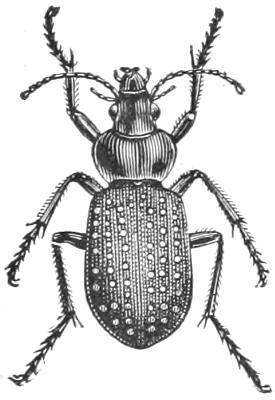
Fig. 4.
The better known of the two represented here is called Calosoma calidum, Fabr., (fig. 4) or “The Glowing Beautiful-bodied Caterpillar-hunter.” As an exception to the general rule, its English name is more formidable than the Latin; but so important a personage is its bearer that I will not deprive him of a single letter of his title, and indeed am almost tempted to add to it the words “most useful.” It well merits its appellation, Calosoma (Kalos = beautiful, and Soma = a body). Fig. 4 gives a life-size representation of it. The color of the polished elytra or wing-covers is a deep blue-black, and the six rows of dots with which they are adorned are of a fiery burnished red, for which reason it has been called by the specific name of calidum. The legs in our figure are too thick and clumsy, but it must be well known to everyone. It may generally be found in early summer in damp pastures, either hidden under stones or running in the grass in search of caterpillars and other soft-bodied insects. Jaeger, who first called the members of this genus caterpillar-hunters, says “they may be found every morning and evening upon the branches of trees, looking out for caterpillars and devouring them.” They do not, however, restrict themselves to caterpillars, for they will attack and devour a perfect June-bug when fresh from the pupa state and soft, with apparently the same relish as their special dainty, a fat Cut-worm. In the larval state they are equally rapacious; they lurk in holes in the ground or under sticks and stones in the day-time, and only leave their retreats as night draws on to go in search of prey. Every spring I have several of these useful and luckily common beetles brought to me by kind friends who have found them in their gardens. To the enquiry, “Is this of any use to you?” I have always the answer ready, which somewhat surprises them: “No, but it is of particular use to you; take it carefully back and put it in your garden again; it is the best friend you have there, for it feeds entirely upon your enemies, the Wire-worms, Cut-worms and White-worms.”
I am sure that through the agency of this beetle alone I have been able to gain more respect for the science of Entomology among horticulturists than from all the rest put together.
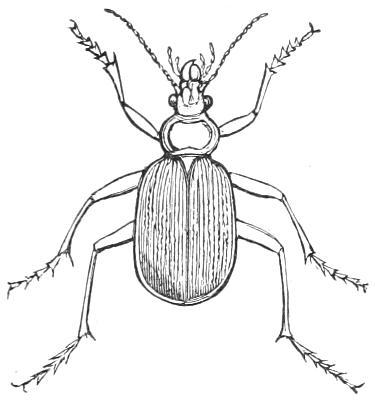
Fig. 5.
Much resembling this beetle in shape, but of a very much more striking appearance, is its near relative, Calosoma scrutator, Fabr., the “Beautiful-bodied Searcher,” fig. 5. The color of its wing-covers is bright metallic green, garnished with longitudinal lines and sparsely punctured; round the margin runs an effective line of coppery-red. The head, thorax and legs are almost black; the margin of the thorax having a greenish tinge. The under side is of a deep burnished blue-green hue. Its habits are the same as those of C. calidum, but it is a much rarer insect. I have never seen a live specimen; but they are occasionally found in Ontario, and dead specimens are said to be frequently washed up on the outer shore of Toronto Island after a southerly gale.
Annual Report of the Entomological Society for the Year 1879.—The Annual Report of our Society for the past year is now nearly ready for issue. Members may expect to receive their copies within a few days.