Front matter (continued 2)
Reading edition
A couple of hours' drive out of the town took one to a world of grim realities and sinister contrasts. Over the country between Tirlemont and Saint Trond, but yesterday full of tame beauty, rich in cornfields and carefully tended gardens, the withering breath of the ruthless Moloch had already fitfully passed. As the traveller moved along the dusty road, catching a glimpse of an occasional farmhouse quivering in the distance through the heat of the August day, he might well feel beset by the vague dangers that might at any moment have started into concrete shape and ended his hopes and cares for all time.
As one approached the village of Orsmael at this time unmistakable tokens of desolation thrust themselves on the view. At first shattered panes of glass, then domestic utensils flung among the cabbages of the gardens or before the wrenched doors, greybeards with shrivelled faces moaning under the trees, women trembling and wailing plaintively, and still beholding as a mirage the scenes of horror which upset their mental balance. Here a couple of children prattling in subdued tones, there a mother leading three orphaned little girls from the still smoking ruins of their house into the wide world, and everywhere the loathsome soilure and squalor of war.
Inhuman hate appeared to possess those Prussian invaders, whom terror drove and terror alone could curb. Belgians who dealt with them at close quarters, as at Dormael, declared that these Uhlans fought with the bitterness of personal fury, and, not content with killing those who manfully resisted them in fight, assassinated numbers who had laid down their weapons and held their hands up. Many of the corpses have their hands raised and their elbows on a level with the shoulders. The wounds of these brave defenders are horrible, having been inflicted with weapons fired at a distance of a couple of inches from the mouth or breast.
Some Uhlans met a Belgian chemist who was riding a bicycle near Jodoigne. Arresting him they inquired their way to the town hall, placing the muzzles of revolvers to his head while they listened. He gave them the required information and was allowed to pass on, but before he had gone ten yards they sent three bullets into his back.
On Friday afternoon, August 14th, the Press Bureau issued the following statement, summing up the position in Northern Belgium:
(1) After a successful resistance of five days at the passes of Sainte Marie aux Mines and Le Bonhomme, the French troops have occupied the region of the Saale Pass, which commands the valley of the Burche, an affluent of the Rhine.
(2) At Saale numerous desertions from the German troops are notified. The French have taken many prisoners, and have captured some machine-guns.
(3) It is now confirmed that in Belgium the Belgians were successful in an engagement which took place on August 12th between their troops and six regiments of German cavalry, supported by 2,500 infantry, machine-guns and artillery. The enemy was completely disorganised; the six cavalry regiments suffered great losses, and the Belgians pursued the infantry which gave way.
(4) This (Friday) morning, towards Eghezée, sixteen kilomètres to the north of Namur, a mixed detachment from the garrison surprised some German cavalry regiments in camp, threw them into confusion and forced them back towards the east, after taking numerous prisoners and capturing cannon and machine-guns. To the south of the Meuse the German cavalry avoids contact with the French.
(5) The news of fighting about Haelen yesterday is confirmed. The Germans were driven back eastwards, and there is now no German cavalry between Hasselt and Ramillies.
(6) Liège forts are reported to be still holding out, and to have plenty of supplies.
(7) German cavalry patrols are now reported north of Montmedy.
(8) General Joffre, by virtue of the powers conferred on him by the Ministry of War (decision of August 8th, 1914), has made Lieutenant Bruyant, of the Dragoons, a Knight of the Legion of Honour. "This officer," it is stated in the text of his appointment, "accompanied by seven horsemen, did not hesitate to charge a platoon of some thirty Uhlans: he killed the officer in charge of them with his own hand, and routed the German platoon, inflicting severe losses upon it."
(9) The Commander-in-Chief has conferred the first war medal of the campaign on Escoffier, Corporal of Dragoons, for having charged with the greatest courage and received several wounds.
(10) Belgian cyclists and cavalry from Namur surprised yesterday a force of German cavalry, accompanied by artillery and machine-guns, and compelled them to retire. The Germans lost a field gun and several machine-guns.
The French army was meanwhile making good progress, and on the night of the 14th it was officially announced by the War Ministry in Paris that the French were entering Belgium through Charleroi and were proceeding in the direction of Gembloux, some thirty miles to the north-east.
Reports were current on Friday evening that the German attack had been renewed, but these were afterwards seen to be baseless. The German forces around Liège were content to remain on the defensive for a time; and even towards the south, in the Vosges, the French troops were slowly driving the invaders before them. At Liège itself several bodies of the enemy had taken up their position in the town, but the forts were still intact. An observer of the scene at this juncture commented on the changed physiognomy of that once gay capital of the Walloon country. Some 30,000 of the inhabitants had fled from the place in terror when the enemy's guns began to shower shells upon the forts from Fléron. The remainder buried themselves in cellars and underground passages, scores huddling together without food, drink, or other of life's necessaries. The city bore marks of havoc everywhere. Gaping bridges, half-demolished houses, many without doors, which had been taken off their hinges and cast into the courtyard or the roadside, fallen roofs, smouldering ruins, told their dismal tale.
There was not a street in which shells had not fallen. The very asphalt was ploughed up in places like a cornfield at sowing time. Hurriedly-made graves with their soft mounds protruded in unexpected places. During the day the Germans were everywhere in evidence: they patrolled the principal thoroughfares, stood at the barricades which they had raised at all the approaches to the town, or crept up towards the forts with remarkable recklessness. Nine of them on bicycles rode to within 300 mètres of the forts one morning; eight returned unharmed, only one paying for the pleasant sense of daring adventure with his life. The inhabitants were cowed by recent deterrent examples and by the terrors hanging over them.
At nightfall the city assumed the aspect of a churchyard. The silence was soul-curdling, yet the hearts of the inhabitants beat quicker and louder when that silence was broken by the heavy tread of the Prussian patrols or the rending thunder of heavy guns. All the doors still extant had to be kept wide open. Early in the morning when the bakers removed their bread from the ovens, German guards, posted wherever victuals are to be had, were in the habit of pouncing down on the entire output of the bakeries, for which they sometimes paid; but the ill-starred inhabitants had no share. The soldiers made their own coffee and soup in great motor cauldrons, from which it was poured into metal porringers that they carry with them. They now wore reformed field uniforms, rendering them hardly distinguishable from a distance, just as their airships were so re-painted as to resemble the grey of cloudland.
At Haelen and Diest, the scene of Wednesday's engagement, one drew nearer to the ghastly realities of war. The struggle waxed desperate, man meeting man, striking, thrusting, and wrestling in the final fight for life or death. Here the once peaceful country-side was utterly transformed. In the background heaps of ruins that so lately were farmhouses still emitted pungent smoke. Between the leafy trees one saw the charred rents in the dwellings still erect, animals erring hither and thither, barricades hastily erected of dead horses, their horrible wounds gaping and spreading the mephitic reek of death, and along the carriage-road on either side freshly-made ridges which hid the German dead.
The serious attention of the civilised world was at this juncture once again directed to the inhuman methods of warfare practised by the German soldiery in Belgium, else, it was declared, the campaign would assume a character of fiendish savagery unmatched in the annals of war. "Unless some real respect be shown to the usages received by civilised nations," said one observer, "both sides will end by making no prisoners. If even a tithe of the narratives now passing from mouth to mouth about the atrocities committed by the invaders be well founded—and they are vouched for by credible and level-headed clergymen, mayors, and foreigners who feel no personal animus against the Germans—the soldiery of the Fatherland have outrun the Hercules pillars of inhumanity."
Another report stated that the Germans in Liège were trying to fraternise with the Belgians, and that German military bands played daily in the two Belgian cafés.
About the middle of August a Belgian who had a relative at Port Talbot, Cardiff, wrote:
Every day brings to light new acts of heroism displayed by the plucky little Belgians, whilst several more no doubt have been accomplished, of which we shall never hear. Their heroes are either too silent or for ever silent. Lupin, a boy of eighteen, a corporal in the regiment of Major Jeanne, who himself was nearly killed during the battle of Liège, has died, a great hero in the eyes of his whole regiment.
One of his comrades who has known Lupin for years tells this pathetic story, which Major Jeanne has himself brought to light. "We were on the right bank of the river Meuse at Bellaire, which is not far above Jupille, and we were in close touch with a German battery. The musketry on both sides was terrible. I was stretched out flat, continuously loading and shooting, and could feel my gun getting hot. Bullets were flattening their noses in front of me, raising clouds of sand and dust. My mouth, eyes, and ears were full of powder. Corpses were heaped round me, their faces black with powder, and stamped with the horrible grimace of death; their hands, with swollen veins, gripping their deadly Mausers. Yes, war is magnificently terrible.
"All at once the Germans adopted new tactics, and I must give them credit for being a cute lot. They seemed to withdraw from their position, and we could distinctly notice their ranks splitting as if in great confusion, but it was only to bring to the front some more artillery which had been rushing from behind. The move was smartly executed, the ranks closed again, and for a time they seemed as if they were going to have the advantage over us.
"But now young Lupin had seen his chance looming, and what he did altogether changed the face of things. 'Leave them to me now,' was what someone heard him say, and like a flash the boy dashed off under cover of a ditch on the left. Only a few of us had seen it, but Major Jeanne knew his corporal of eighteen, and knew he was up to something grand. Watching him, he shouted, 'Go for them! Get at those square-heads with your bullets. Fire!'
"In the meantime Lupin had managed to get to the left of the German battery, and at 300 mètres distance he sheltered behind a wall. He took aim at the battery in enfilade, and under the fire of his Mauser brought down in quick succession the chief officer, the under-officers, and the artillerymen. This time real confusion took place at the German battery, which was nearly silenced, the Germans, thinking that a whole platoon was now attacking them from behind the wall, directed their last piece of artillery on the wall, and with a terrific crash the wall came down, burying the brave Corporal Lupin. The boy's bravery had weakened the German position, and it did not take us long to scatter them, and put another victory on our list."
On Saturday and Sunday, August 15th and 16th, there was little definite news from any part of the theatre of war. There was some fighting in the south undoubtedly, and a French force defeated a strong body of Bavarians, capturing 500 prisoners. At Dinant, in Belgium, there was another stiff engagement, but no details of it came to hand for a few days. An authoritative report was given out at Brussels to the effect that the Germans had lost more than 25,000 killed, wounded, and prisoners at Liège—more than half an army corps. These losses, of course, would have been reckoned as trivial if the Germans had succeeded in their original design of executing a "military promenade" through Belgian territory. Apart from the scarcity of food, already referred to, the besieging forces at Liège suffered from lack of horses, and cavalry reconnaissances were gradually becoming impossible.
On Monday, August 17th, it was officially announced that the British Expeditionary Force had been safely landed on French soil; and it was at the same time stated that the French army had scored some successes in Upper Alsace. The movement of this wing of General Joffre's army appeared to extend from the Swiss frontier at Altkirch, near Mülhausen, as far away as Château Salins, a distance of eighty miles. Its object, which was afterwards frustrated by a strong German advance, was to isolate and "contain" the great fortresses of Metz and Strassburg. The two official notices issued by the War Ministry in Paris describe these operations:
Sunday Midnight [i.e., August 16th].
The forward movement has been developed along the whole front from Réchicourt to Sainte Marie-aux-Mines. In the Vosges we have carried Sainte Marie-aux-Mines and made progress towards Sainte Blaise.
The French troops which occupied the Donon yesterday have advanced. In the valley of Schirmeck especially their progress has been extremely rapid. We have taken 1,000 prisoners, in addition to the 500 captured yesterday. Large quantities of equipment have been abandoned by the enemy.
In this district, as at Sainte Marie, we have captured guns of large calibre, field-guns, and ammunition.
In the region Blamont—Cirey we have gained the heights of Lorquin, and in doing so have taken the convoy of a division of German cavalry, consisting of nineteen motor wagons.
In the attack on Dinant the enemy's forces consisted of the Cavalry Division of the Guard and the First Division of Cavalry, supported by infantry from several battalions and some companies with maxims. When these forces appeared on the left bank the French troops attacked them. This attack, delivered with magnificent dash, soon drove the enemy back, and they recrossed the Meuse in great disorder. Many were unable to regain the bridge, and fell into the river, which at this point has steep banks and flows swiftly. Numbers of the enemy were drowned.
Taking advantage of this disorder, one of our Chasseur cavalry regiments crossed the river after the Germans and pursued them for several kilomètres. Several hundred horses belonging to the Uhlans were captured and subsequently passed to the rear for remount purposes. In this pursuit the French regiment put to flight forces of the enemy considerably superior to itself in numbers.
Monday (11 a.m.) [i.e., August 17th].
Our advance continues to develop. Our troops have carried the heights to the north of the frontier, and their lines pass Breschwiller, Lorquin, Azaudange, Marsal.
In the Donon region we occupy Schirmeck, 7½ miles beyond Saales.
The number of field-guns taken by us at this point is not four, as was stated yesterday, but twelve, as well as twelve limbers and eight maxims. Our cavalry has pushed forward as far as Lutzelhausen and Muhlbach.
Further to the south we have occupied Ville, to the east of the Pass of Urbans, on the road to Schlestadt. Thann, Cernay, and Dannemarie are occupied.
At Blamont, a village from which the Germans have just been driven by our troops, they had, without reason or provocation, put to death three persons, of whom one was a young girl and another an old man of eighty-six, whose name was M. Barthélemy, and who was an ex-Mayor of the village.
On Monday, August 17th, the Queen of the Belgians and the Ministers for War, Finance, and Foreign Affairs retired from Brussels to Antwerp with the Ministers of France and Russia, who left French interests in the hands of the Spanish Legation.
It was officially stated that this was according to long pre-arranged and Constitutional arrangements, and not because the military situation was disquieting. The families of the withdrawing Ministers remained in Brussels, which was protected by over 20,000 Civic Guards, entrenched behind barbed-wire fences, making the capital quite safe against surprise attack.
This move was really made because the Germans had managed to bring up heavy siege guns; and, although the forts were still holding out, arrangements were gradually being made to "contain" them and to advance on the capital with the main army. The Belgian Government afterwards decided not to attempt to defend Brussels, and the barricades which had been erected were dismantled and the barbed-wire fences taken down.
CHAPTER V
Preparations at Namur—Scenes at Liège—Germans Pressing Forward—Occupation of Brussels
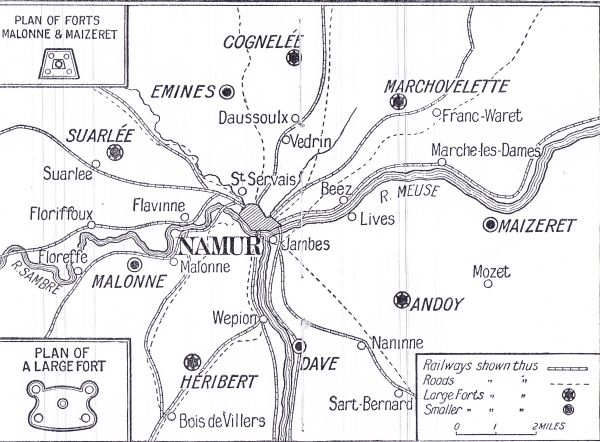
In the meantime the second stronghold of the Belgian army, Namur, was prepared for the onslaught of the enemy. On August 13th Mr. Granville Fortescue, who had arrived there, noted that the city exhibited all the grim circumstances of a siege except the actual falling of shells within its boundaries. When he arrived at the station he followed the crowd, which was herded into a corner until each passenger had been examined. One could not move without a "laissez-passer." Soldiers patrolled the streets, and every few hundred yards pedestrians were halted and made to show their papers. Barricades commanded all the main avenues into the city. They had been made by dragging enormous goods vans across the street and turning the van into a sort of blockhouse. The sides were pierced for rifle fire, and sand bags were piled breast-high inside.
Defences of sand bags and earth were built at either side of the van.
Suddenly the whirl of an aeroplane sounds overhead. Then we hear a scattered volley. The aeroplane is German, and the garrison are trying to pot it, despite the fact that it must be 2,000 feet up. They are striking in appearance, these German aeroplanes. Once seen it is easy afterwards to distinguish them. Seen from directly below, it is best described as scarab shaped—what I should imagine a giant scarab would look like on the wing. The whole machine is white, except for a panel of sky blue painted across the centre of each wing. The engine of the German machine makes a louder noise than either the French or Belgian. The aeroplane we were watching circled above the forts and remained in this vicinity about half an hour. Then it turned about and disappeared to the east.
The Kaiser, with three of his sons, left Berlin on August 17th for Mayence, about 100 miles to the north of Strassburg; but he did not venture upon Belgian soil.
An English officer who returned to England from Brussels at this time had had the most interesting experience, and, it should be added, privilege, of chatting with one of the heroic defenders of Liège, a Belgian officer. To a representative of The Daily Telegraph he said:
I never had any doubt that the Belgians were plucky fellows. The defence of Liège shows them in heroic light.
One of them, in the course of a casual conversation, which would not have given you any idea that he, or any of his colleagues, had taken part in anything extraordinary, said: "Some of us late arrivals only managed to get to our posts when the German attack began. It was night-time. We replied sharply with our guns. Until the dawn came we had no very distinct idea of what our practice was. Then we noticed heaps of slain Germans in a semi-circle at the foot of our fort. The German guns must have been much less successful, because they rarely hit us that night. They did better at daybreak. We did better still.
"As line after line of the German infantry advanced, we simply mowed them down. It was terribly easy, monsieur, and I turned to a brother officer of mine more than once and said, 'Voilà! They are coming on again, in a dense, close formation! They must be mad!' They made no attempt at deploying, but came on, line after line, almost shoulder to shoulder, until, as we shot them down, the fallen were heaped one on top of the other, in an awful barricade of dead and wounded men that threatened to mask our guns and cause us trouble. I thought of Napoleon's saying—if he said it, monsieur; and I doubt it, for he had no care of human life!—'C'est magnifique, mais ce n'est pas la guerre!' No, it was slaughter—just slaughter!
"So high became the barricade of the dead and wounded that we did not know whether to fire through it or to go out and clear openings with our hands. We would have liked to extricate some of the wounded from the dead, but we dared not. A stiff wind carried away the smoke of the guns quickly, and we could see some of the wounded men trying to release themselves from their terrible position. I will confess I crossed myself, and could have wished that the smoke had remained!
"But, would you believe it, this veritable wall of dead and dying actually enabled these wonderful Germans to creep closer, and actually charge up the glacis? Of course, they got no farther than half way, for our maxims and rifles swept them back. Of course, we had our own losses, but they were slight compared with the carnage inflicted upon our enemies."
The English officer added:
"There is, as you know, quite a large colony of English people in Brussels, and also in Bruges. They have their English club and tennis courts. Many of these Britishers have their own houses, and live in Belgium for three or six months every year. When the war broke out all but those owning, or renting, property were advised to leave the country, which they did. Many English householders in Belgium also closed their residences and left for England.
"The Belgians were at first extremely dubious of our intention to send troops to Belgium to support them, and night after night, at a certain well-known seaside resort, they crowded about the British Consulate for news. When it was definitely known that the British Expeditionary Force had started Belgian men and women asked for the Union Jack to be brought out by the Consul, and when this was done they filed past, kissing it. I saw this with my own eyes."
On the 18th it became evident that the German forces had gathered on the line Maastricht-Liège and were about to make an attempt to penetrate the allied armies facing them. There was no serious fighting on this date, but German cavalry were seen in the direction of Antwerp.
The long-expected battle appeared to have begun on the 19th (Wednesday), and Tirlemont, a town some twenty-three miles from Brussels, on the railway to Liège, was said to be its centre. Refugees hurried into Brussels from Aerschot and Diest, and hundreds of civilians from Tirlemont also made for the capital.
Saarburg was occupied by the French on the same day.
The great German advance on Belgium was begun on Friday, August 21st, in a line extending from Dinant, a town to the south of Namur, as far as a point opposite Antwerp. About noon Brussels was reached and occupied. The following account of the position of the Belgian Government was issued officially just before the capital was transferred to Antwerp:
At the present moment the general situation in the Belgian theatre of war may be described as follows: After having lost a great deal of time, a large number of men, and a great quantity of material, the Prussian army has managed to gain ground on both banks of the Meuse up to a line where it is in contact with the allied armies. The German troops on the north side of the Meuse belong to various corps, whose operations have been principally directed against Liège, and who in the course of time have become available in other directions. There is also a strong force of cavalry, by means of which the Germans have been able to make a great show by extending to the north and south.
In the south they came into collision with our troops and the French troops, and were repulsed. In the north, on the other hand, they found an open road, and small portions of them managed to make dashes far afield. In a word, the Germans have taken the measure of our position, but that they should have lost a fortnight in attaining this result is all to the honour of our arms. That may have incalculable consequences for the issues of the operations. The normal development of the latter, according to the plan concerted between the allies, may lead to the carrying out of "manœuvres," that is to say, to changes of position in order to effect a change in the general situation.
We are on the outside wing, where these manœuvres are nearly always necessitated, either for the direct or indirect protection of the flank. Our army, therefore, must necessarily modify its original positions, and thus carry out completely the first task devolving upon it, which consists in gaining time. There is, consequently, no ground for anxiety if the army makes a movement in such and such a direction, and armchair strategists need not occupy themselves with the arrangements made, but should realise that our army now belongs to a co-ordinated whole, and remember that the strategic conditions have entirely changed since close contact has been established with our allies on our right.
The object of the operations as at present going on is not to cover such and such a district or such and such a town, which has now become a matter of only secondary importance. The pursuit of the aim assigned to the Belgian troops in the general plan of campaign preponderates over everything. This object cannot be revealed, and the most well-informed persons are unable to discover it in view of the veil of obscurity which is rightly being spread over all the news allowed to come through regarding the operations.
Fighting is going on along the whole front from Bale to Diest. The closer the contact comes between the two armies and the closer one gets to a decisive action, the more one must expect to see an advantage gained at one point while ground is lost at another. That is only to be expected in the case of battles taking place over such immense fronts as those occupied by the great armies of modern times.
To sum up, one may say that what is going on at our gates is not the only thing to be thought of. A strategic movement conceived with a well-defined object is not necessarily a retreat. The fighting which has taken place at the front during the last few days has resulted in making the enemy more circumspect and in delaying his forward march to the great advantage of the whole scheme of operations. There is no reason at the present time for letting oneself be hung up, thus playing into the hands of the Germans. That is the motive of the movements now being carried out. We are not beaten, far from it, but are making arrangements for beating the enemy in the best possible conditions. The public should, in this matter, place all trust in the commander of the army, and should remain calm and confident.
The outcome of the struggle does not appear doubtful. Meanwhile the newspapers should abstain from mentioning movements of troops, as secrecy is essential for the success of the operations.
The exodus from Brussels was vividly described in a telegram from Mr. A.J. Rorke, the correspondent of the Central News Agency. He wired, under date of August 20th:
I left Brussels at three o'clock this morning, with the Germans at its very gates.
All through the evening, following the evacuation of Tirlemont, Louvain, and neighbouring villages, there had been coming into the city from all the roads leading into it one unending procession of old men, women, children, and wounded soldiers retreating before the advance of the Uhlan vanguard.
They came into the centre of the city, clamouring at the Gare du Nord for tickets to the coast, but the trains were all reserved for the hosts of wounded brought in by motor-ambulances and carts from the firing-line.
Most of the men had been wounded in the head and face, disproving the repeated stories that the Germans were bad marksmen and aimed low.
As a matter of fact, practically all the men wounded in yesterday's battle were hit high, proving that the Germans, infantrymen and cavalrymen, are firing from the hip.
Later came the news that there would probably be no more trains out of Brussels, so the more timid of the population began to prepare hurriedly for departure.
A dramatic moment in the history of Europe occurred when the Civic Guard, unwillingly, and only on instructions from the Executive Government at Antwerp, abandoned their defensive on the outskirts of the city, and in the forest around the town, and marched into Brussels.
They were ordered to Ghent, and singing, with unbroken spirit, the "Marseillaise," the strains of which rose over the murmurs of a panic-stricken population, they entered the railroad station.
And so Brussels, undefended, evacuated by its troops unwillingly, though their going really showed a finer spirit of patriotism than death on a battlefield, awaited the arrival of the "modern Huns."
Just before I left early this morning a rumour, which at that hour I was unable to confirm, spread through the city that the French had arrived, and that the Turcos were actually in action with the Germans on the Louvain road.
These facts must stand out in the battle of yesterday.
One long line of burning villages marked the German advance, and three regiments of Belgian troops are no more. They are, I hear, the First Regiment of Guides and the Third and Ninth Regiments of the Line.
A weeping woman whom I took into my automobile drew from her breast, on the road to Ghent, a blue cap with a yellow facing, upon which was the figure "3."
"Voilà une casquette d'un de nos braves petits soldats," she said to me, "mais il n'y a plus du Troisième."
As Mr. William Maxwell pointed out, the real capital of Belgium, in the military sense, had always been Antwerp, not Brussels; and Napoleon himself gave one of his generals to understand, in explicit terms, that there could be no glory in entering the undefended capital of an enemy's country. "Most of the country the Germans have overrun up to the present," said Mr. Maxwell, "has not been seriously contested, for it does not enter into the Allies' plan of action." Antwerp, as an important Belgian official explained, was provisioned for an indefinite period; it could be supplied with stores of every kind from the sea; and it was calculated that the forts would be able to hold out for at least a year. In these circumstances the Belgian army entrenched there would always be a menace to the right wing of the Germans, who would be obliged to detach a large part of their forces to prevent an attack from that direction.
Great indignation was aroused all over Europe when it became known that the Germans had imposed a war levy on Brussels of no less a sum than £8,000,000, the alternative being the sacking of the city, with all its priceless art treasures. A levy of £2,000,000 had already been imposed on the province of Liège.
The Germans made their official entry into Brussels at two o'clock in the afternoon of Friday, August 21st. To the eternal credit of the people it must be said that they betrayed not the slightest sign of panic, but faced their painful uncertainty with dignity and courage.
The Civil Guard, of whom 20,000 were in Brussels, were uniformed men, and may be compared to our old volunteers. They had made preparations to resist the capture of the city, and had covered the approaches with trenches and barbed wire entanglements. But Brussels is not a fortified place, and armed opposition would have involved severe penalties. The Guard, therefore, withdrew from the capital soon after midnight. They retired with the honours of war, singing songs of victory.
For some days the citizens had recognised the possibility of having the Germans for their uninvited guests, and when Louvain was abandoned they accepted the inevitable. The spirit they manifested was reflected in a dignified and courageous proclamation by their burgomeister.
At six o'clock in the morning the enemy's cavalry appeared at Tervueren, a distant suburb of the capital. From that hour every door was closed, and every window was darkened with shutter or blind. From the outskirts people began to flock into the heart of the city, yet there was no panic-fear. At nine o'clock the capital was surrounded, but no entry was made until after two o'clock. The occupation proceeded with method. Railway stations and telegraph and telephone offices were taken over, and sentries were posted on all the main roads. The city, which was crowded twelve hours before, looked like a deserted place.
Pushing on from Brussels the same evening, the Germans took possession of the undefended cities of Ghent and Bruges, and advance brigades of cavalry made their appearance at Ostend, which was occupied shortly afterwards. This advance—of no military importance, and savouring of what is colloquially known as window-dressing—was more than compensated for by a series of French successes in Alsace-Lorraine. General Joffre's forces drove the Germans out of several of the smaller towns, captured many hundreds of prisoners, and took ninety-one guns from the enemy.
Coincidentally with the arrival of the Germans in Brussels, it was announced that this country would lend our Belgian allies the sum of £10,000,000 in recognition of their splendid services at the beginning of the war.
The first complete account of the fighting at Dinant a few days previously was given in a special message from Mr. Granville Fortescue. Writing from Dinant on August 15th, Mr. Fortescue said:
A considerable force of German light infantry, supported by mountain batteries, to-day made a determined attack on this town. The fight lasted from daylight till dark. Although the Germans had some success in the morning, the arrival of French reinforcements compelled them to evacuate the excellent positions they had taken.
The first shell just missed the clock above the railroad station, which marked ten minutes past six, and fell through the roof. It did little damage beyond shattering numerous windows. The railroad station is directly opposite my hotel. The second shell tore through the chimney of the hotel. The kitchen was filled with bits of bricks and mortar. The breakfast coffee was spoiled.
Captain X., who was here on a special mission, made his escape in a motor, accompanied by a squad of khaki-clad couriers on motor-cycles. The guests of the hotel scuttled to the cellars.
It was nearly seven o'clock before the infantry began firing in earnest. The only French troops in the town were some of a regiment of the line. The French had no artillery when the action opened.
The position was in a certain state of defence, which might have been improved. However, the streets were barricaded and a field of wire entanglements stretched across the bridge, which was also commanded by a mitrailleuse.
Dinant lies in a well, one might say, on both banks of the Meuse. High limestone cliffs tower above the town. On the east bank these are steep, and are crowned by an ancient fort known as the citadel. The fort dominates the whole adjacent country. On the west bank of the Meuse the town scrambles up a hillside, covered with trees.
When the engagement opened I joined Commandant A. and Lieutenant B., who were in charge of the detachment defending the bridge.
At this time the Germans were making a strong effort to capture the citadel. It was held by a small French force, perhaps one company.
The cliffs resounded with the rifle and gun fire. The din and the falling shells drove the population en masse to the "caves."
Members of the Volunteer Hospital Corps, however, hurried along on their bicycles searching the streets for wounded.
The German mountain batteries fired with accuracy, although the small projectiles had little effect. I picked up the fuse of one shell, a Dapp, cut at 4,000 mètres.
About ten o'clock the Germans held the crest of the cliffs across the river, and soon took the citadel. They sent down a veritable hail of lead on the defenders. Behind the cover of the bridge abutments the French reply gallantly. Thus the fight goes on for an hour. One hears nothing save the irregular explosions of rifles, the machine-like sputterings of the mitrailleuse, punctuated by the shock of shell fire. It rains, but this in no way halts the firing. About thirty wounded are brought in when the French troops change position to the high ground back of the town. A sudden increase in the volume of sound tells me that the wished-for reinforcements have arrived. Soon a half-company of a regiment crowd into the hotel, expecting to find there a good field of fire. They bring with them a dozen frightened women who have been hiding in the station.
About noon the firing slackens, and the rain ceases. A few limping figures in blue coats and red trousers stagger into the hotel. A doctor stationed here gives them first-aid attention. While the lull continues a woman crosses to the pillar-box and drops in a postcard.
About one I return to my post of observation. The German flag has been hoisted over the citadel. This is a signal for renewed firing. The sight of the hated flag seems to rouse the French troops to fury. About 2 p.m. I hear for the first time the welcome sound of French field artillery. One of the first shots cuts the German flag across. Two French batteries have arrived, and they hail projectiles into the citadel with extraordinary accuracy. Another line regiment arrives to reinforce the troops here, and under a smothering fire I see the heads of the Germans that dotted the ramparts of the fort begin to disappear. At this time I also hear heavy firing in the south-east. About ten minutes before six I cannot distinguish a German on the ramparts. The only firing is some scattered shooting from the French side. A cheer greets the coming of another new regiment, and soon the French troops are back in the positions they held in the morning.
But the road back of the bridge is dotted with the dead. They lie in all sorts of contorted positions. Their blue coats are splashed with red, their red trousers are stained a deeper crimson.
And the cheers of the troops who have just arrived die down as they pass this grim testimony of what war means.
As it was the intention of the French to hold the Dinant bridge at all hazards, their strongest force was placed behind the abutment wings of this bridge. These are limestone block walls, about three feet high, and offer good cover. But this cover would have been vastly improved if the walls had been capped with sandbags. There was plenty of time to have so improved this defence. Again, the field of fire before this position was poor. But the gravest mistake was the neglect to construct protected approaches to the advanced position. Reinforcements had to be rushed across an open field of fire, where they suffered unnecessary casualties. And when the French line of defence had to be changed, and the troops withdrawn to a higher position behind the town, they suffered heavily because they must pass along a road swept by the German fire. All of which should have been provided against. This is not written in a spirit of criticism, but simply to call attention to certain mistakes that will, in the future, surely be corrected.
The French are under a severe handicap in the matter of uniform. It is over a dozen years since the Boer War, and certainly they should have discarded the blue coat and red trousers for a more neutral colour. They have covered the red crown of their caps with blue. This is to prevent their being discovered by aeroplane scouts. But the flamboyant uniform of the line regiments makes a fair mark, as far as the modern rifle is effective. In groups they are all the gunner asks for a target.
On the other hand, the Germans have adopted a grey-green colour that is almost invisible. Yesterday, with a first-class glass, I had difficulty in locating individuals.
What I have written applies with more force to the Belgian troops. These soldiers are as conspicuous as claret stains on a new tablecloth.
On my way here I passed some four or five regiments of infantry. Though the men are young, they are going into this war with a seriousness unusual in the French. Of course, the Gallic temperament is not changed. They still show their "esprit" and their gaiety is not altogether extinguished. Perhaps the solemnity I have alluded to is more noticed among the officers than the men. They are as grave as schoolmasters. All of which is a good sign.
I have been particularly struck by the professional atmosphere of the artillery officers. It needs but a glance of the eye to be sure that this arm will perform splendid service under their direction.
The Germans had so many men massed in the occupied portions of Belgium by this time that temporary checks did not stem what one correspondent aptly described as a tidal wave of troops sweeping irresistibly through the valley of the Meuse. Japan, who had sent Germany an ultimatum with regard to Kiao-Chau, declared war on receiving no reply by the stipulated time; but, it is unnecessary to add, this fact had no influence on the operations of the German troops in Belgium. Telegrams sent off on Sunday stated that a big battle was developing in the neighbourhood of Charleroi—Mons, and that the Germans in order to ensure the uninterrupted and safe passage of their army, had occupied all the villages between Louvain and Alost. The Liège forts, it was officially announced, were still holding out, but the Germans had "contained" them by a large force of soldiers. Attention was rather concentrated on the forts at Namur, to subdue which the Germans had advanced their heavy siege guns. It was said on Monday, August 24th, that "Namur had fallen," but no confirmation of this statement could be obtained, and it was generally taken as meaning that the invaders had managed to enter the town, but that the forts were still holding out. An official message from Brussels on the following Wednesday evening said that Namur had not yet fallen.
In the meantime refugees were hurrying from Ostend, to which city both Belgian and German wounded were being brought. The cross-Channel steamers were crowded, and Belgian refugees who had come away from Brussels and Tirlemont made their appearance in London.
CHAPTER VI
British Troops in Action—Their "Customary Coolness"—Zeppelin at Antwerp—German Atrocities—Lord Kitchener's Speech
The British Expeditionary Force was engaged in the battle at Mons, and it was subsequently stated that the soldiers had been fighting for thirty-six hours on end. A short statement by the Press Bureau was more usefully expanded into the following account, which was issued by the French Embassy and summed up the situation as it existed on Monday night, August 24th:
On the west of the Meuse the English army, which was on our left, has been attacked by the Germans. Its behaviour under fire was admirable, and it resisted the enemy with its customary coolness.
The French army which operated in this region attacked. Our army corps, with the African troops in the first line, carried forward by their over-eagerness, were received with a very murderous fire. They did not fall back, but later by a counter-attack by the Prussian Guard they were compelled to retire. They did so only after having inflicted enormous loss on the enemy. The flower of the Prussian Guard suffered very severely.
On the east of the Meuse our troops advanced across very difficult ground. They met with a vigorous attack as they left the woods, and were compelled to retire after fierce fighting on the south of the Semoy.
At the order of General Joffre, our troops and the English troops have taken up their position on the covering line, which they would not have quitted had not the splendid courage of the Belgian army permitted us to enter Belgium. The covering line is intact. Our cavalry has not suffered. Our artillery has proved its superiority. Our officers and our soldiers are in splendid physical and moral condition.
As a result of the orders given, the struggle will change its aspect for several days. The French army will for a time remain on the defensive. When the proper moment comes, as chosen by the Commander-in-Chief, it will resume a vigorous offensive.
Our losses are severe. It will be premature to estimate them or to estimate those of the German army, which, however, has suffered so severely as to be compelled to halt in its counter-attack and establish itself in new positions.
The communiqué then proceeds to deal with the situation in regard to Lorraine. It says:
Yesterday we four times counter-attacked from the positions we occupy on the north of Nancy, and we inflicted very severe losses on the Germans.
Generally speaking, we retain full liberty to use our railway system, and every sea is open for our re-provisioning. Our operations have permitted Russia to enter into action and to reach the heart of Eastern Prussia. It is, of course, regrettable that, owing to difficulties in execution which could not have been foreseen, our plan of attack has not achieved its object. Had it done so it would have shortened the war, but in any case our defence remains intact in face of an already weakened enemy.
All Frenchmen will deplore the momentary abandonment of the portions of annexed territory which we had already occupied. On the other hand, certain portions of the national territory must, unfortunately, suffer from the events of which they will be the theatre. The trial is inevitable, but will be temporary.
Thus, some detachments of German cavalry, belonging to an independent division operating on the extreme right, have penetrated into the Roubaix—Tourcoing district, which is defended only by Territorial forces. The courage of our brave people will support this trial with unshaken faith in our final success, which is beyond doubt.
In telling the country the whole truth, the Government and the military authorities afford it the strongest possible proof of their absolute confidence in a victory, which depends only on our tenacity and perseverance.
A thrilling description of the behaviour of the British troops at Mons was given by Mr. A.J. Rorke, the correspondent of the Central News Agency, who wired from Paris on Monday night:
Graphic stories of how the British troops at Mons fought during the two days in which they bore the brunt of the main German advance reached Paris in the early hours of this morning, when officers arriving from the front reported at the War Office, and, in subsequent conversation with their closest personal friends, told of the wonderful coolness and daring of our men. The shooting of our infantry on the firing fine, they said, was wonderful. Every time a German's head showed above the trenches and every time the German infantry attempted to rush a position there came a withering rifle fire from the khaki-clad forms lying in extending formation along a big battle front.
The firing was not the usual firing of nervous men, shooting without aiming and sometimes without rhyme or reason, as is so often the case in warfare. It was rather the calm, calculated riflemanship of the men one sees on the Stickledown range firing with all the artificial aids permitted to the match rifle expert whose one concern is prize money.
When quick action was necessary the firing and the action of the men was only that of prize riflemen firing at a disappearing target. There was no excitement, no nervousness; just cool, methodical efficiency. If the British lost heavily heaven only knows what the Germans must have lost, because, as one of their wounded officers (whom the British took prisoner) remarked, "We had never expected anything like it; it was staggering."
The British troops went to their positions silently but happily. There was no singing, because that was forbidden, but as the khaki-clad columns deployed and began to crawl to the trenches there were various sallies of humour in the different dialects of English, Irish, and Scottish counties. The Yorkshireman, for instance, would draw a comparison between the men they were going to fight and certain dogs that won't fight which the Yorkshire collier has not time to waste upon at the pit-head; the Cockney soldier was there with his sallies about "Uncle Bill," and every Irishman who went into the firing line wished he had the money to buy a little Irish horse, so that he could have a slap at the Uhlans.
And the cavalry! Officers coming from the front declare that our cavalrymen charged the much-vaunted German horsemen as Berserks might have done. When they got into action with tunics open, and sometimes without tunics at all, they flung themselves at the German horsemen in a manner which surprised even their own officers, who had themselves expected great things of them. The Uhlans, whose name and fearful fame had spread terror among the Belgian peasants and the frontier villages of France, were just the sort of men the British troopers were waiting for. The Britishers, mostly Londoners, who, as Wellington said, make the best cavalry soldiers in the world, were dying to have a cut at them; and when they got into clinches the Uhlans had the surprise of their lives.
From the scene of battle, the point of interest in the European war drama, as far as England is concerned, shifted in the small hours of this morning to the railway station at X, where officers and men of the Army Service Corps awaited the arrival of the wounded—the British wounded from the firing line. Everything was perfectly organised; there was no theatrical display; the officers and men of the British army waited silently and calmly for the toll of war, which they had been advised was on its way.
The station at the time was crowded with Americans coming to England from Paris after their release from Switzerland, and cheer after cheer, in which the French in the station joined, echoed under the arched roof. Britishers who were there felt very proud of their Empire and their soldiers at that moment. The men who were waiting for the wounded had not been in the first line of battle it was true—that was not their job—but their work was probably the greatest of all. It was for them to watch and wait, while every fibre of their inmost being thrilled to the note of war; and yet to restrain their desires while they practised that which the Iron Duke called the wonderful "two o'clock in the morning" courage. So they waited in a draughty station for their comrades, thrown back temporarily from the scene of action, to fit them to return, if possible, immediately.
While the crowd waited for the wounded, train after train rolled slowly through carrying more of "our boys" to the active front. They were sleeping in horse trucks alongside their equine friends; they were sleeping in cattle wagons; yet they stood up when the cheering reached their ears, looking fresh, fit, clean, and healthily British from their service caps to their puttee straps. All young, all full-blooded, all British; happy and eager to get at grips in what is to them a holy war. And then, at the end, as the boat-train was creeping out in the early morning, the wounded arrived.
It was my privilege to witness, on the road between Boulogne and Paris last Saturday, a scene as picturesque and deeply inspiring as a page from Froissart. The two English Cardinals, Cardinal-Archbishop Bourne and the Cardinal Abbot Gasquet, famed as an historian, had left London to journey to the Conclave at Rome. On the line the train in which they travelled was stopped, and by a curious chance a train in which a regiment including in its ranks a large number of Irish Catholics—these men, like the Plantagenets of old, wearing a sprig of green in their head-dress—was drawn up for a moment alongside.
The Cardinals, who, under their cassocks, wore the red of their rank, stepped into the corridor, and, leaning out of a window, said together, "May God bless you, my children."
In an instant every Catholic soldier in the open trucks of the troop train dropped to his knees to receive the Cardinals' blessing. It appears, maybe, a simple affair, but in its spontaneity and sincerity, its mingling of the spiritual with the grimly material, it was eloquent and moving beyond the comprehension of those who only read what others saw.
On August 25th the Germans made a raid by Zeppelin airship on Antwerp and dropped several bombs on the palace, the St. Elizabeth Hospital, and other public buildings. Twelve persons were blown to pieces in different parts of the city, and shots aimed at the airship proved ineffectual. The same evening the Belgian Government gave out the following official statement regarding the shocking atrocities committed by the invading forces in various parts of the occupied territory:
In spite of solemn assurances of goodwill and long-standing treaty obligations, Germany has made a sudden savage and utterly unwarranted attack on Belgium.
However sorely pressed she may be, Belgium will never fight unfairly and never stoop to infringe the laws and customs of legitimate warfare. She is putting up a brave fight against overwhelming odds, she may be beaten, she may be crushed, but, to quote our noble King's words, "she will never be enslaved."
When German troops invaded our country, the Belgian Government issued public statements which were placarded in every town, village, and hamlet, warning all civilians to abstain scrupulously from hostile acts against the enemy's troops. The Belgian Press daily published similar notices broadcast through the land. Nevertheless, the German authorities have issued lately statements containing grave imputations against the attitude of the Belgian civilian population, threatening us at the same time with dire reprisals. These imputations are contrary to the real facts of the case, and as to threats of further vengeance, no menace of odious reprisals on the part of the German troops will deter the Belgian Government from protesting before the civilised world against the fearful and atrocious crimes committed wilfully and deliberately by the invading hosts against helpless non-combatants, old men, women, and children.
Long is the list of outrages committed by the German troops, and appalling the details of atrocities, as vouched for by the Committee of Inquiry recently formed by the Belgian Minister of Justice and presided over by him. This committee comprises the highest judicial and university authorities of Belgium, such as Chief Justice Van Iseghem, Judge Nys, Professors Cottier, Wodon, etc.
The following instances and particulars have been established by careful investigations based in each case on the evidence of reliable eye-witnesses:
German cavalry occupying the village of Linsmeau were attacked by some Belgian infantry and two gendarmes. A German officer was killed by our troops during the fight and subsequently buried at the request of the Belgian officer in command. No one of the civilian population took part in the fighting at Linsmeau. Nevertheless, the village was invaded at dusk on August 10th by a strong force of German cavalry, artillery, and machine guns. In spite of the formal assurances given by the Burgomaster of Linsmeau that none of the peasants had taken part in the previous fight, two farms and six outlying houses were destroyed by gun-fire and burnt. All the male inhabitants were then compelled to come forward and hand over whatever arms they possessed. No recently discharged firearms were found. Nevertheless, the invaders divided these peasants into three groups, those in one group were bound and eleven of them placed in a ditch, where they were afterwards found dead, their skulls fractured by the butts of German rifles.
During the night of August 10th, German cavalry entered Velm in great numbers. The inhabitants were asleep. The Germans, without provocation, fired on M. Deglimme-Gevers' house, broke into it, destroyed furniture, looted money, burnt barns, hay and corn stacks, farm implements, six oxen, and the contents of the farmyard. They carried off Madame Deglimme, half-naked, to a place two miles away. She was then let go, and was fired upon as she fled, without being hit. Her husband was carried away in another direction, and fired upon. He is dying. The same troops sacked and burned the house of a railway watchman.
Farmer Jef Dierick, of Neerhespen, bears witness to the following acts of cruelty committed by German cavalry at Orsmael and Neerhespen on August 10th, 11th, and 12th:
An old man of the latter village had his arm sliced in three longitudinal cuts; he was then hanged head downwards and burned alive. Young girls have been maltreated, and little children outraged at Orsmael, where several inhabitants suffered mutilations too horrible to describe. A Belgian soldier belonging to a battalion of cyclist carabineers, who had been wounded and made prisoner, was hanged, whilst another, who was tending his comrade, was bound to a telegraph pole on the St. Trond road and shot.
On Wednesday, August 12th, after an engagement at Haelen, Commandant Van Damme, so severely wounded that he was lying prone on his back, was finally murdered by German infantrymen firing their revolvers into his mouth.
On August 9th, at Orsmael, the Germans picked up Commandant Knapen, very seriously wounded, propped him up against a tree, and shot him. Finally they hacked his corpse with swords.
In different places, notably at Hollogne sur Geer, Barchon, Pontisse, Haelen, and Zelck, German troops have fired on doctors, ambulance bearers, ambulances, and ambulance wagons carrying a Red Cross.
At Boncelles a body of German troops marched into battle carrying a Belgian flag.
On Thursday, August 6th, before a fort at Liège, German soldiers continued to fire on a party of Belgian soldiers (who were unarmed, and had been surrounded while digging a trench) after these had hoisted the white flag.
On the same day, at Vottem, near the fort of Loncin, a group of German infantry hoisted the white flag. When Belgian soldiers approached to take them prisoners the Germans suddenly opened fire on them at close range.
Harrowing reports of German savagery at Aerschot have reached the Belgian Government at Antwerp from official local sources. Thus on Tuesday, August 18th, the Belgian troops occupying a position in front of Aerschot received orders to retire without engaging the enemy. A small force was left behind to cover the retreat. This force resisted valiantly against overwhelming German forces, and inflicted serious losses on them. Meanwhile practically the whole civilian population of Aerschot, terrorised by the atrocities committed by the Germans in the neighbouring villages, had fled from the town.
Next day, Wednesday, August 19th, German troops entered Aerschot without a shot having been fired from the town and without any resistance whatever having been made. The few inhabitants that remained had closed their doors and windows in compliance with the general orders issued by the Belgian Government. Nevertheless the Germans broke into the houses and told the inhabitants to quit.
In one single street the first six male inhabitants who crossed their thresholds were seized and shot at once under the very eyes of their wives and children. The German troops then retired for the day, only to return in greater numbers on the next day, Thursday, August 20th.
They then compelled the inhabitants to leave their houses and marched them to a place 200 yards from the town. There, without more ado, they shot M. Thielmans, the Burgomaster, his fifteen-year-old son, the clerk of the Local Judicial Board, and ten prominent citizens. They then set fire to the town and destroyed it.
The following statement was made by Commandant Georges Gilson, of the 9th Infantry of the Line, now lying in hospital at Antwerp:
I was told to cover the retreat of our troops in front of Aerschot. During the action fought there on Wednesday, August 19th, between six and eight o'clock in the morning, suddenly I saw on the high road, between the German and Belgian forces, which were fighting at close range, a group of four women, with babies in their arms, and two little girls clinging to their skirts. Our men stopped firing till the women got through our lines, but the German machine guns went on firing all the time, and one of the women was wounded in the arm. These women could not have got through the neighbouring German lines and been on the high road unless with the consent of the enemy.
All the evidence and circumstances seem to point to the fact that those women had been deliberately pushed forward by the Germans to act as a shield for their advance guard, and in the hope that the Belgians would cease firing for fear of killing the women and children.
This statement was made and duly certified in the Antwerp Hospital on August 22nd by Commandant Gilson, in the presence of the Chevalier Ernst N. Bunswyck, Chief Secretary to the Belgian Minister of Justice, and M. de Cartier de Marchienne, Belgian Minister to China.
Further German atrocities are continuously being brought to notice and made the subject of official and expert inquiry by the proper authorities.
In issuing the above statements to the English Press, the only comment the Press Bureau could offer was that these atrocities appeared to be committed in villages and throughout the country side with the deliberate intention of terrorising the people, and so making it unnecessary to leave troops in occupation of small places or to protect lines of communication. In large places like Brussels, where the diplomatic representatives of neutral Powers are eye-witnesses, there appeared to have been no excesses.
When Parliament met on August 25th, after a short adjournment, Lord Kitchener, Minister for War, gave the following account of the situation in the House of Lords:
As this is the first time that I have had the honour of addressing your lordships, I must ask for the indulgence of the House. In the first place I desire to make a personal statement. Noble lords on both sides of the House doubtless know that, while associating myself in the fullest degree for the prosecution of the war with my colleagues in His Majesty's Government, my position on this Bench does not in any way imply that I belong to any political party, for as a soldier I have no politics.
Another point is that my occupation of the post of Secretary of State for War is a temporary one. The terms of my service are the same as those under which some of the finest portions of our manhood, now so willingly stepping forward to join the colours, are engaging. That is to say for the war; or if it lasts longer, then for three years.
It has been asked why the latter limit has been fixed. It is because should this disastrous war be prolonged—and no one can foretell with any certainty its duration—then, after three years' war, there will be others, fresh and fully prepared, to take our places and see this matter through.
The very serious conflict in which we are now engaged on the Continent has been none of our seeking. It will undoubtedly strain the resources of our Empire and entail considerable sacrifices on our people. These will be willingly borne for our honour and the preservation of our position in the world, and will be shared by our dominions beyond the seas, now sending contingents and assistance of every kind to help the Mother Country in this struggle.
If I am unable, owing to military consideration for the best interests of the allied armies in the field, to speak with much detail on the present situation of our army on the Continent, I am sure your lordships will pardon me for the necessary restraint which is imposed upon me.
The Expeditionary Force has taken the field on the French north-west frontier, and has advanced to the neighbourhood of Mons, in Belgium. Our troops have already been for thirty-six hours in contact with a superior force of German invaders. During that time they have maintained the traditions of British soldiers, and have behaved with the utmost gallantry. The movements which they have been called upon to execute have been those which demand the greatest steadiness in the soldiers, and skill in their commanders. Sir John French telegraphed to me at midnight, as follows:
"In spite of hard marching and fighting, the British force is in the best of spirits."
I replied:
"Congratulate troops on their splendid work. We are all proud of them."
As your lordships are aware, European fighting causes greater casualties than the campaigns in which we are generally engaged in other parts of the world. The nation will, I am sure, be fully prepared to meet whatever losses and sacrifices we may have to make in this war. Sir John French, without having been able to verify the numbers, estimates the loss since the commencement of active operations at rather more than 2,000 men hors-de-combat.
As to the work of the last few weeks, I have to remark that when war was declared, mobilisation took place without any hitch whatever, and our Expeditionary Force proved itself wholly efficient, well equipped, and immediately ready to take the field.
The Press and the public have, in their respective spheres, lent invaluable aid to the Government in preserving a discreet silence, which the exigencies of the situation obviously demanded, and I gladly take this opportunity of bearing testimony to the value of their co-operation. The hands of the military authorities were also strengthened by the readiness with which the civilian community faced and accepted the novel situation created by the issue of requisitions for horses, transport, supplies and billets.
The railway companies, in the all-important matter of the transport facilities, have more than justified the complete confidence reposed in them by the War Office, all grades of railway services having laboured with untiring energy and patience. And it is well to repeat that the conveyance of our troops across the Channel was accomplished, thanks to the cordial co-operation of the Admiralty, with perfect smoothness and without any untoward incident whatever.
We know how deeply the French people appreciate the value of the prompt assistance we have been able to afford them at the very outset of the war, and it is obvious that not only the moral but the material support our troops are now rendering must prove to be a factor of high military significance in restricting the sphere and determining the duration of hostilities.
Had the conditions of strategy permitted, everyone in this country would have rejoiced to see us ranged alongside the gallant Belgian army in that superb struggle against desperate odds which has just been witnessed. But, although this privilege was perforce denied to us, Belgium knows of our sympathy with her in her sufferings, of our indignation at the blows which have been inflicted on her, and also of our resolution to make sure that in the end her sacrifices will not have been unavailing.
While other countries engaged in this war have under a system of compulsory service brought their full resources of men into the field, we, under our national system, have not done so, and can, therefore, still point to a vast reserve drawn from the resources both of the Mother Country and of the British Dominions across the Seas.
The response which has already been made by the great Dominions, abundantly proves that we did not look in vain to these sources of military strength, and while India, Canada, Australia, and New Zealand are all sending us powerful contingents, in this country the Territorials are replying with loyalty to the stern call of duty which has come to them with such exceptional force.
Over seventy battalions have, with fine patriotism, already volunteered for service abroad, and when trained and organised in the larger formations, will be able to take their places in the line.
The 100,000 recruits for which, in the first place, it has been thought necessary to call, have been already practically secured. This force will be trained and organised in divisions similar to those which are now serving on the Continent.
Behind these we have our Reserves. The Special Reserve and the National Reserve have each their own part to play in the organisation of our national defence.
The Empires with whom we are at war have called to the colours almost their entire male population. The principle we, on our part, shall observe, is this, that while their maximum force undergoes a constant diminution, the reinforcements we prepare shall steadily and increasingly flow out, until we have an army in the field which in numbers, not less than in quality, will not be unworthy of the power and responsibilities of the British Empire.
I cannot, at this stage, say what will be the limits of the forces required, or what measures may eventually become necessary to supply and maintain them. The scale of the Field Army which we are now calling into being is large and may rise in the course of the next six or seven months to a total of thirty divisions continually maintained in the field. But if the war should be protracted, and if its fortunes should be varied or adverse, exertions and sacrifices beyond any which have been demanded will be required from the whole nation and Empire, and where they are required we are sure they will not be denied to the extreme needs of the State by Parliament or the people.
THE CASE FOR BELGIUM
It has been sought in the preceding chapters to give as detailed a description as the information at our disposal will allow of the fighting in the North—i.e. the struggle for Liège and Namur, and the subsequent series of closely-contested battles from Tirlemont to Mons. The case for the Belgian people, and an account of the sufferings which had to be endured by a peaceful, non-combatant population, will be found mentioned also in the course of the narrative. The diplomatic case for Belgium has already been given to the public in another volume of this series ("How the War Began"); but the details of this case, and the reasons why this country is taking part in the war, have been so well summed up by Mr. Asquith that a few extracts from his speech are necessary to make this volume complete.
The first of a series of meetings to bring home to the people of England the vital importance of the questions at issue was held in the Guildhall on Friday, September 4th; and the speakers included the Prime Minister, Mr. Bonar Law, Mr. Churchill, and Mr. Balfour. In the course of his remarks Mr. Asquith referred to the Arbitration Treaty between Great Britain and the United States, which he mentioned at a previous Guildhall meeting some three and a-half years previously. "We were very confident three years ago in the rightness of our position," he said. "We are equally confident to-day, when reluctantly and against our will, but with a clear judgment and with a clean conscience we find ourselves involved with the whole strength of this Empire in a bloody arbitrament between Might and Right."
Mr. Asquith continued:
The issue has passed out of the domain of argument into another field, but let me ask you, and through you the world outside, what would have been our condition as a nation to-day, if we had been base enough, through timidity, or through a perverted calculation of self-interest, or through a paralysis of the sense of honour and duty, if we had been base enough to be false to our word and faithless to our friends?
Our eyes would have been turned at this moment, with those of the whole civilised world, to Belgium, a small State, which has lived for more than seventy years under the several and collective guarantee to which we, in common with Prussia and Austria, were parties; and we should have seen, at the instance and by the action of two of these guaranteeing Powers, her neutrality violated, her independence strangled, her territory made use of as affording the easiest and most convenient road to a war of unprovoked aggression against France.
We, the British people, would at this moment have been standing by with folded arms, and with such countenance as we could command, while this small and unprotected State, in defence of her vital liberties, made an heroic stand against overweening and overwhelming force. We should have been admiring, as detached spectators, the siege of Liège, the steady and manful resistance of their small army; the occupation of their capital, with its splendid traditions and memories; the gradual forcing back of their patriotic defenders of their native land to the ramparts of Antwerp; countless outrages suffered through buccaneering levies exacted from the unoffending civil population, and finally, the greatest crime committed against civilisation and culture since the Thirty Years' War—the sack of Louvain and its buildings, its pictures, its unique library, its unrivalled associations—shameless holocaust of irreplaceable treasures, lit up by blind barbarian vengeance.
What account should we, the Government and the people of this country, have been able to render to the tribunal of our national conscience and sense of honour if, in defiance of our plighted and solemn obligations, we had endured, if we had not done our best to prevent—yes, and to avenge—these intolerable outrages?
For my part I say that sooner than be a silent witness, which means in effect a willing accomplice, of this tragic triumph of force over law, and of brutality over freedom, I would see this country of ours blotted out of the page of history.
Several German newspapers, distorting the facts of the case with remarkable disingenuousness, had roundly asserted that England had chosen to take part in the war for purely materialistic reasons, and that this country was not so anxious to vindicate the principle of Belgian neutrality as to secure the oversea trade of the German Empire. Even if Mr. Asquith had not spoken on the subject at all, it would have been realised sooner or later that there was no foundation for this assertion; for it was hardly likely, if we had had only this object in view, that a community of practical business men would have tolerated the enormous sacrifice of life and money involved in attempting by war to displace German exports to European and non-European countries.
As this argument was advanced with such persistence in the German Press, it may be worth while dwelling on it for a moment. The total value of the German export trade for 1913 was just over £495,000,000, and of our own export trade £635,000,000. With many German products, such as dyes, and certain chemical and electrical goods, this country has never been able to compete. At the beginning of the war, for example, when the German coast had been blockaded by our Fleet, we should have been compelled to spend millions of pounds in order to experiment with, and later on to manufacture, aniline dyes analogous to those produced in Germany. The same remark applies to many classes of electrical goods. Millions would have had to be spent on experiments before we began to manufacture the products, assuming—in many cases a large assumption—the success of the experiments. This, too, at a time when money was notoriously scarce, when accommodation could not be obtained from the banks, and when the Government had just announced that it wanted a hundred millions sterling as a first instalment of war expenses.
Apart from this, even if we had thought of capturing Germany's export trade, or a large part of it, it was clear that other nations had conceived the same notion and were getting ready to act upon it. Japanese merchants, for instance, had their eyes fixed on the markets of China, and manufacturers in the United States had been showing, even before the war, a deep interest in South America. Is it likely, in these circumstances, that a nation such as this would have seen at least half a million men withdrawn from productive work, and the expenditure of millions of money, purely for the sake of competing with the United States and Japan in foreign markets?—always realising that the war must end some time, that Germany must once more begin to manufacture, and that competition would be as severe as ever in less than a decade? No; if we can capture some of Germany's export trade, that will be a mere incidental in the struggle for national existence, and the profits represented thereby will but ill balance the lives and money which will have to be sacrificed in the meantime.
Fortunately, Mr. Asquith took the opportunity, when speaking at the Guildhall, to make it clear that Great Britain and the British Dominions were not actuated by materialistic aims in entering upon the greatest campaign in history. There was something to be considered besides profits. Having referred to the sacking of Louvain, Mr. Asquith went on to say:
That is only a phase—a lurid and illuminating phase—in the contest in which we have been called, by the mandate of duty and of honour, to bear our part. The cynical violation of the neutrality of Belgium was, after all, but a step—a first step—in a deliberate policy of which, if not the immediate, the ultimate and the not far-distant aim was to crush the independence and the autonomy of the Free States of Europe. First Belgium, then Holland and Switzerland—countries, like our own, imbued and sustained with the spirit of liberty—were one after another to be bent to the yoke; and these ambitions were fed and fostered by a body of new doctrines, a new philosophy, preached by professors and learned men.
Free and full self-development, which to these small States, to ourselves, to our great and growing Dominions over the seas, to our kinsmen across the Atlantic, is the well-spring and life-breath of national existence—that free self-development is the one capital offence in the code of those who have made force their supreme divinity, and upon its altars are prepared to sacrifice both the gathered fruits and the potential germs of the unfettered human spirit. I use this language advisedly.
This is not merely a material; it is also a spiritual conflict. Upon its issue everything that contains promise and hope, that leads to emancipation, and a fuller liberty for the millions who make up the mass of mankind, will be found sooner or later to depend.
The Prime Minister proceeded to combat the absurd suggestions that the Anglo-French Agreement of 1904, and the Anglo-Russian Agreement of 1907, were likely to prove a menace to the German Empire:
Let me now just for a moment turn to the actual situation in Europe. How do we stand? For the last ten years, by what I believe to be happy and well-considered diplomatic arrangements, we have established friendly and increasingly intimate relations with the two Powers, France and Russia, with whom in days gone by we have had, in various parts of the world, occasions for constant friction, and now and again for possible conflict. Those new and better relations, based in the first instance upon business principles of give-and-take, have matured into a settled temper of confidence and goodwill. They were never in any sense or at any time, as I have frequently said in this hall, directed against other Powers.
No man in the history of the world has ever laboured more strenuously or more successfully than my right honourable friend, Sir Edward Grey, for that which is the supreme interest of the modern world—a general and abiding peace. It is, I venture to think, a very superficial criticism which suggests that, under his guidance, the policy of this country has ignored, still less that it has counteracted and hampered, the Concert of Europe. It is little more than a year ago that under his presidency, in the stress and strain of the Balkan crisis, the Ambassadors of all the Great Powers met here day after day, curtailing the area of possible differences, reconciling warring ambitions and aims, and preserving, against almost incalculable odds, the general harmony.
And it was in the same spirit, and with the same purpose, when a few weeks ago Austria delivered her ultimatum to Servia, that the Foreign Secretary—for it was he—put forward the proposal for a mediating Conference between the four Powers who were not directly concerned—Germany, France, Italy, and ourselves. If that proposal had been accepted actual controversy would have been settled with honour to everybody, and the whole of this terrible welter would have been avoided.
With whom does the responsibility rest for its refusal and for all the illimitable suffering which now confronts the world? One Power, and one Power only, and that Power is Germany. That is the fount and origin of this world-wide catastrophe.
We are persevering to the end. No one who has not been confronted, as we were, with the responsibility of determining the issues of peace and war can realise the strength and energy and persistency with which we laboured for peace. We persevered by every expedient that diplomacy could suggest, straining almost to the breaking point our most cherished friendships and obligations, even to the last making effort upon effort, and hoping against hope. Then, and only then, when we were at last compelled to realise that the choice lay between honour and dishonour, between treachery and good faith—when we at last reached the dividing line which makes or mars a nation worthy of the name, it was then, and then only, that we declared for war.
Is there anyone in this hall, or in this United Kingdom, or in the vast Empire of which we here stand in the capital and centre, who blames or repents our decision? (Cries of "No!") For these reasons, as I believe, we must steel ourselves to the task, and in the spirit which animated our forefathers in their struggle against the domination of Napoleon, we must, and we shall, persevere to the end.
At the Guildhall, as in the House of Commons, the Prime Minister referred to the noble example shown by the Belgian people in summoning all their available forces to repel the aggression of a Power which had been presumed to be friendly. He said:
It would be a criminal mistake to under-estimate either the magnitude, the fighting quality, or the staying power of the forces which are arrayed against us. But it would be equally foolish and equally indefensible to belittle our own resources whether for resistance or attack. (Cheers.) Belgium has shown us by a memorable and a glorious example what can be done by a relatively small State when its citizens are animated and fired by the spirit of patriotism. In France and Russia we have as allies two of the greatest Powers of the world engaged with us in a common cause, who do not mean to separate themselves from us any more than we mean to separate ourselves from them, (Cheers.)
Having paid this tribute—how well deserved it was, and to what a remarkable extent the German check at Liège influenced the subsequent developments of the campaign, the world is now beginning to realize—Mr. Asquith paid an equally warranted tribute to our own Fleet:
We have upon the seas the strongest and most magnificent Fleet which has ever been seen. The Expeditionary Force which left our shores less than a month ago has never been surpassed, as its glorious achievements in the field have already made clear, not only in material and equipment, but in the physical and the moral quality of its constituents.
As regards the Navy, I am sure my right honourable friend (Mr. Winston Churchill) will tell you there is happily little more to be done. I do not flatter it when I say that its superiority is equally marked in every department and sphere of its activity. We rely on it with the most absolute confidence, not only to guard our shores against the possibility of invasion, not only to seal up the gigantic battleships of the enemy in the inglorious seclusion of their own ports, whence from time to time he furtively steals forth to sow the seeds of murderous snares which are more full of menace to neutral ships than to the British Fleet—our Navy does all this, and while it is thirsting, I do not doubt, for that trial of strength in a fair and open fight which is so far prudently denied it, it does a great deal more.
It has hunted the German mercantile marine from the high seas. It has kept open our own sources of food supply and largely curtailed those of the enemy, and when the few German cruisers which still infest the more distant ocean routes have been disposed of, as they will be very soon, it will achieve for British and neutral commerce passing backwards and forwards from and to every part of our Empire a security as complete as it has ever enjoyed in the days of unbroken peace. Let us honour the memory of the gallant seamen who in the pursuit of one or another of these varied and responsible duties have already laid down their lives for their country.
As not the least important object of the Guildhall meeting was to stimulate recruiting, Mr. Asquith naturally referred to the army and its work. At a very early stage in the war both Germany and France had called up practically their last available man. Indeed, so hard pressed did the German Empire find itself after five weeks' fighting that arrangements, it was officially announced, were made for giving instruction in rifle shooting to boys aged from sixteen to nineteen. It was not, of course, intended that these lads should at once take an active part in the fighting: but it was assumed that by the time they reached their military age they would be familiar with the use of weapons and more or less adequately drilled. Retired officers who were too old to take part in the campaign were ordered to take the boys in hand.
To remedy the inevitable wastage in the French Army, as well as in our own Expeditionary Force—which, a few days before Mr. Asquith's speech, had already fought gallantly and lost some 14,000 men at Mons and Charleroi—it was desired that armies should be raised in England, trained, and sent out to the fighting line as required. For this purpose Lord Kitchener had intimated that at least 500,000 men would be required, and calls were made for 100,000 men at a time. The oversea Dominions, and, above all, India—where the German Government had vainly tried to bring about a disloyal outbreak—hastened to come forward with offers of men; but all this did not relieve the home country of its responsibility. Speaking on this subject, Mr. Asquith said:
In regard to the Army, there is call for a new, a continuous, a determined, and a united effort. For, as the war goes on, we shall have not merely to replace the wastage caused by casualties, not merely to maintain our military power at its original level, but we must, if we are to play a worthy part, enlarge its scale, increase its numbers, and multiply many times its effectiveness as a fighting instrument. The object of the appeal which I have made to you, my Lord Mayor, and to the other Chief Magistrates of our capital cities, is to impress upon the people of the United Kingdom the imperious urgency of this supreme duty.
Our self-governing Dominions throughout the Empire, without any solicitation on our part, demonstrated, with a spontaneousness and a unanimity unparalled in history, their determination to affirm their brotherhood with us, and to make our cause their own. From Canada, from Australia, from New Zealand, from South Africa, and from Newfoundland the children of the Empire assert, not as an obligation but as a privilege, their right and their willingness to contribute money, material, and, what is better than all, the strength and sinews, the fortunes, and the lives of their best manhood.
India, too, with no less alacrity has claimed her share in the common task. Every class and creed, British and natives, Princes and people, Hindus and Mahommedans, vie with one another in noble and emulous rivalry. Two divisions of our magnificent Indian Army are already on their way. We welcome with appreciation and affection their proffered aid. In an Empire which knows no distinction of race or cause we all alike, as subjects of the King-Emperor, are joint and equal custodians of our common interests and fortunes. We are here to hail with profound and heartfelt gratitude their association, side by side and shoulder to shoulder, with our home and Dominion troops, under the flag which is the symbol to all of a unity that a world in arms cannot dissever or dissolve.
With these inspiring appeals and examples from our fellow-subjects all over the world what are we doing, and what ought we to do here at home?
Mobilisation was ordered on August 4th. Immediately afterwards Lord Kitchener issued his call for 100,000 recruits for the Regular Army, which has been followed by a second call for another 100,000. The response up to to-day gives us between 250,000 to 300,000. I am glad to say that London has done its share. The total number of Londoners accepted is not less than 42,000.
I need hardly say that that appeal involves no disparagement or discouragement of the Territorial Force. The number of units in that force who have volunteered for foreign service is most satisfactory and grows every day. We look to them with confidence to increase their numbers, to perfect their organisation and training, and to play efficiently the part which has always been assigned to them, both offensive and defensive, in the military system of the Empire.
But to go back to the expansion to the Regular Army. We want more men—men of the best fighting quality—and if for a moment the number who offer themselves and are accepted should prove to be in excess of those who can at once be adequately trained and equipped, do not let them doubt that prompt provision will be made for the incorporation of all willing and able men in the fighting forces of the kingdom. We want first of all men, and we shall endeavour to secure them, and men desiring to serve together shall, wherever possible, be allotted to the same regiment or corps. The raising of battalions by counties or municipalities with this object will be in every way encouraged.
But we want not less urgently a larger supply of ex-non-commissioned officers, and the pick of the men with whom in past days they served, men, therefore, whom in most cases we shall be asking to give up regular employment and to return to the work of the State, which they alone are competent to do. The appeal we make is addressed quite as much to their employers as to the men themselves. The men ought to be absolutely assured of reinstatement in their business at the end of the war. Finally, there are numbers of commissioned officers now in retirement, who are much experienced in the handling of troops and have served their country in the past. Let them come forward, too, and show their willingness, if need be, to train bodies of men for whom at the moment no cadre or unit can be found.
Mr. Asquith concluded one of the most eloquent speeches he had ever delivered with a warning to the optimists who had predicted a too easy task for the allied forces, and recommended those present—and, through them, the British Empire generally—to cultivate the virtue of patience:
I have little more to say. Of the actual progress of the war I will not say anything, except that, in my judgment, in whatever direction we look there is abundant ground for pride and for confidence. I say nothing more, because I think we should all bear in mind that we are at present watching the fluctuations of fortune only in the early stages of what is going to be a protracted struggle. We must learn to take long views, and to cultivate, above all other faculties, those of patience, endurance, and steadfastness.
Meanwhile, let us go, each of us, to his or her appropriate place in the great common task. Never had a people more or richer sources of encouragement and inspiration. Let us realise first of all that we are fighting as a united Empire in a cause worthy of the highest traditions of our race; let us keep in mind the patient and indomitable seamen, who never relax for a moment, night or day, their stern vigil of the lonely sea; let us keep in mind our gallant troops, who to-day, after a fortnight's continuous fighting, under conditions which would try the mettle of the best army that ever took the field, maintain not only an undefeated, but an unbroken front.
Finally, let us recall the memories of the great men and the great deeds of the past, commemorated, some of them, in the monuments which we see around us on these walls; nor forgetting the dying message of the younger Pitt, his last public utterance, made at the table of one of your predecessors, my Lord Mayor, in this very hall: England has saved herself by her exertions, and will, as I trust, save Europe by her example.
The England of those days gave a noble answer to his appeal, and did not sheath the sword until after nearly twenty years of fighting the freedom of Europe was secured. Let us go and do likewise.
As the published documents now at our disposal sufficiently show, the German Government matured its preparations for the greatest war in history in what they believed to be the certain hope that Great Britain would not intervene. It was fully believed at Berlin that our domestic differences would prevent any designs at helping Belgium which the Government here might wish to carry out. The sudden change in national feeling, which reconciled political opponents like Sir Edward Carson and Mr. John Redmond, or Mr. Asquith and Mr. Bonar Law, Mr. Winston Churchill and Lord Charles Beresford, could not be comprehended on the other side of the North Sea, and completely upset the plans of the German Government. This loyalty to the nation, taking the place of loyalty to party at a time of national emergency, was demonstrated in the House of Commons as soon as the crisis became acute. At the Guildhall, too, Mr. Bonar Law once more proved how ready the Opposition were to sink their differences with the Government, and to support the Liberal Ministry in its endeavours to bring the campaign to an honourable conclusion.