THE CAMPAIGN OF KÖNIGGRÄTZ. (continued 2)
Reading edition
The position of the First Army was now critical. The last battalion of the infantry reserves had been brought into action. Von Fransecky was on a desperate defensive. The other divisions were all subjected to a furious, crushing fire from nearly 250 pieces of artillery, which the Austrians had brought into action on the heights from Lipa to Problus; while, owing partly to the wooded ground, partly to the difficulty of crossing the stream, and partly to the inefficiency of the Prussian artillery officers, only 42 guns were on the left bank of the Bistritz to reply to this formidable cannonade. Only a portion of Frederick Charles’ guns were brought into action at all; and their long range fire from the positions west of the Bistritz was ignored by the Austrian batteries, whose entire energy was devoted to a merciless pelting of the Prussian infantry.
The statement of the Prussian Staff History that the center was in no danger, seems, therefore, to savor more of patriotism than of candor. To advance was impossible. The infantry was suffering terribly from the Austrian fire; the artillery was feebly handled; and the cavalry could render no assistance. There was danger that the army would be shaken to pieces by Von Benedek’s artillery, and that the demoralized troops would then be swept from the field by the comparatively fresh infantry and cavalry of the Austrians. The King and his generals eagerly scanned the northern horizon with their glasses; and, with the intense anxiety of Wellington at Waterloo, waited for tidings from, the army on the left, and strained their vision for a sight of the advancing columns. The question of retreat was discussed. The Reserve Cavalry was ordered up to Sadowa, apparently with a view to covering the withdrawal of the army to the right bank of the stream. It was now past 1 o’clock. It was resolved to hold the line of the Bistritz at all hazards, and a heavy artillery fire was kept up. In the meantime, events on other parts of the field were already beginning to extricate the First Army from its perilous situation.
At 11:30, the 14th and 15th Divisions of the Army of the Elbe having come upon the field, an attack was ordered upon both flanks of the Saxons. The 15th Division, followed by a brigade of cavalry, moved, through Hradek, against Ober-Prim. The 14th Division moved on the heights east of Popowitz, through the forest, against Problus. The advanced-guard, between the two divisions, moved to the attack, pushing its flanks forward, for the double purpose of avoiding the heavy fire from the enemy’s front and masking the movements of the turning divisions. The Prince of Saxony, believing it a favorable opportunity to assume the offensive, attacked the Prussian advanced-guard with a Saxon brigade. The attack, though made with great spirit, was repulsed. Again the Prince attacked, this time with two brigades; but the advancing Saxons being struck on the left flank by the 15th Division, were driven back with heavy loss, and Ober-Prim was carried by the Prussians. General Herwarth Von Bittenfeld had succeeded in bringing 66 guns to the left bank of the Bistritz, and he now pushed them forward to within 2,000 paces of Nieder Prim, upon which they concentrated a heavy fire, under cover of which the place was carried by a regiment of the 15th Division. The 14th Division, having gained possession of Popowitz and the wood east of that village, now joined the 15th Division in a concentric attack upon Problus. The Prince of Saxony had not only observed the preparations for this attack, but he had also observed the arrival of the Prussian Second Army at Chlum; and he now, at 3 o’clock, ordered a retreat to the heights southwest of Rosnitz. The troops at Problus, acting as a rear-guard, offered a stubborn resistance to the advancing Prussians; but they were driven from the village, and the advance of the 14th and 15th Divisions was checked only by the artillery fire of the Saxons and the VIIIth Corps, stationed on the hills north-east of Problus.
During this time the Second Army had been working great results. At 8 o’clock Von Alvensleben, commanding the advanced-guard of the Guard Corps, at Daubrowitz, heard the cannonade in the direction of Benatek. Without waiting for orders, he at once put his command in march for the scene of conflict, notifying his corps commander of his departure, and sending word to Von Fransecky that he would be at Jericek by 11:30. The rest of the corps quickly followed, marching straight across country, up hill and down hill, pushing through the heavy mud with such restless energy that several of the artillery horses dropped dead from fatigue. The advanced-guard arrived at Jericek at 11 o’clock, and at the same hour the heads of the columns of the main body arrived at Choteborek, to which point the Crown Prince had hurried in advance of the troops.
The VIth Corps advanced from its position, near Gradlitz, in two columns. The 12th Division marched, via Kukus and Ertina, to the heights east of Rosnow, detaching a battalion and a squadron to mask the fortress of Josephstadt. The 11th Division marched, via Schurz, to Welchow. As soon as it neared the latter place Von Mutius, commanding the corps, ordered both divisions to keep connection and march to the sound of the cannonade. The troops pushed on “over hills, meadows and ditches, through copses and hedgerows,” across the swampy valley of the Trotina, part of the troops crossing the stream by the single bridge, and part wading breast-deep through the water. At 11 o’clock the 11th Division arrived at the heights north of Racitz, and came under the fire of the enemy’s batteries.
At 8 o’clock the Vth Corps began its march, via Schurz and Dubenitz, to Choteborek; and at 11 o’clock its advanced-guard was approaching that village.
The Ist Corps did not start until 9:30. It marched via Zabres, Gross-Trotin and Weiss Polikau; and at 11 o’clock it had not yet reached Gross-Burglitz.
Thus, at 11 o’clock, the only troops that had reached the Trotina were the Guards and the VIth Corps; and they were still two and one-half miles from the left wing of the First Army. In three hours the Second Army had been so concentrated as to reduce its front from twenty-two and one-half miles to nine miles; and it now occupied the line Burglitz-Jericek-Choteborek-Welchow.
The Crown Prince, from his station on the heights of Choteborek, about four and one-half miles from Maslowed, had an extended view towards the valley of the Bistritz; and notwithstanding the rain and fog, he could trace the direction of the contending lines by the smoke of the burning villages and flashes of the guns. It was evident that his columns were marching in such a direction as to bring them directly upon the flank and rear of the Austrian troops already engaged; but, though the formidable heights of Horenowes appeared to be occupied by only one battery, it seemed probable that the passage of the Elbe by the Crown Prince was known by Von Benedek, and that the troops on the Austrian right were waiting behind the crest of the hills, to spring forward into action when the Prussians should undertake to cross the swampy valley between the Trotina and the heights of Horenowes. The different divisions were ordered to direct their march upon a prominent group of trees on the Horenowes hill.
The Austrians were now in a position of extreme danger. The heights of Horenowes, which seemed to offer such a formidable obstacle to the advance of the Crown Prince, had been left almost defenseless. As we have seen, the Austrian IVth and IId Corps had taken up the line Cistowes-Maslowed-Horenowes, and the space between the right flank and the Elbe was guarded by only one brigade and two battalions. To make matters worse, the IVth and IId Corps had been drawn into the fight with Von Fransecky in the Swiep Wald, and, facing west, they now presented a flank to the advancing columns of the Crown Prince. The advance of these two corps beyond the line Chlum-Nedelist had carried them far beyond support; and now, with the Prussian Second Army within two and one-half miles of them, their reserves were fully three miles away.
Von Benedek discovering that these two corps had not taken up their designated positions, sent orders, before 11 o’clock, to their commanders, to fall back to the positions originally assigned to them. Unfortunately, the commander of the IVth Corps, ignorant of the approach of the Crown Prince, and flushed with his success against Von Fransecky, thought it an opportune moment to assume a vigorous offensive against the Prussian left, and would not make the movement ordered until he had sent a report to that effect to his chief. The projected offensive was disapproved, and the former order was repeated. The two corps now retired to the positions originally designated, the movement being covered by the fire of 64 pieces of artillery posted on the plateau of Nedelist. The withdrawal had been delayed too long; for the Crown Prince already had 48 guns in position between Racitz and Horenowes, the Prussian infantry was advancing, and the Austrian movement partook, consequently, of the nature of a retreat. Yet it is greatly to the credit of the Austrian troops that they were able to execute a flank movement—and a retrograde movement, too—under the fire of the enemy; though they had been in action fully three hours.
At noon Von Benedek received a telegram from Salney, via Josephstadt, announcing the approach of the Second Army. At this very moment the guns of the Crown Prince were playing upon the Austrian right flank.
The advanced-guard of the 1st Division of Guards had debouched from Zizilowes at 11:15 A. M.; its right flank being covered by the cavalry brigade which had covered the left of the 7th Division. The advanced-guard of the 2d Guard Division, (which had been separated from the main body by the Reserve Artillery of the 1st Division cutting into the column on the road) without waiting for the arrival of its comrades, joined the 1st Division in its attack upon Horenowes. At noon the 12th Division had captured the Horicka Berg, the 11th Division had driven the Austrians from Racitz, and the Guards were advancing upon Horenowes. The withdrawal of the Austrian IId Corps had been covered by 40 guns posted east of Horenowes, which kept up a heavy fire upon the Prussians. But the Guards easily carried Horenowes, the position of the great battery was turned, the hostile infantry was advancing upon its flank, and the artillery was forced to retire. The 12th Division, in the meantime, had captured Sendrasitz, cutting off the Austrian brigade which had been covering the right flank. The 11th Division then moved up to a position north of Sendrasitz, on the left of the Guards, and the latter advanced to Maslowed. The Prussians now had 90 guns on the heights of Horenowes; and most of these pieces were hurried forward beyond Maslowed, within 1,300 paces of the Austrian position, where they prepared the way for the infantry assault by a vigorous cannonade.
When the Guards advanced, the Austrian IVth Corps was still engaged in taking up its new position. Unchecked by the fire of more than 100 guns in position west of Nedelist, the Guards crushed the two battalions on the left of the IVth Corps, and penetrated into the gap; the left wing rolling up the flank of an Austrian brigade, and pushing on in the direction of Sweti; while the right wing, changing front to the right, stormed the village of Chlum, which, though the key of the Austrian position, was occupied by only a single battalion. As the Guards advanced, the force under Von Alvensleben, which had constituted the advanced-guard in the morning, moved forward in echelon on their right. A brigade of the Austrian IVth Corps, which, by some mistake, had been left at Cistowes, and was now marching to the new position of its corps, was struck by Von Alvensleben, and driven to the westward of Chlum with heavy loss. Simultaneously with the Guards, the VIth Corps advanced upon the enemy, the 11th Division capturing Nedelist, and the 12th driving the cut-off Austrian brigade into Lochenitz. The Austrians made several determined attacks from Langenhof and the Lipa wood upon the Prussians in Chlum; but though they fought with great bravery and penetrated into the village, they were repulsed by the Guards, who then seized Rosberitz and the forest of Lipa. The 1st Austrian Reserve Cavalry Division, consisting of five regiments, charged the Prussians south of Chlum. The brigade on the left consisted of two regiments of cuirassiers, and was formed in double column: the one on the right was composed of two regiments (one of cuirassiers and one of lancers), formed in double column, with a regiment of cuirassiers following as a second line. The charge was repulsed by four companies of the infantry of the Guard. It is remarkable that in this case, the cavalry came within 200 yards of the infantry before the latter opened fire.
At 3 o’clock matters had, consequently, changed very much for the worse with the Austrians. On the left, the Saxons had been driven from their position; on the right, the Prussian Guards and VIth Corps occupied the line Rosberitz-Nedelist-Lochenitz. The Austrian IVth and IId Corps had been defeated, and were retreating upon Wsestar, Sweti, Predmeritz and Lochenitz. The 1st Division of the Guards had captured 55 guns, and had seized the key of the Austrian position. The Austrian IIId Corps was sandwiched between the Guards and the First Army. Yet the position of the Guards was full of danger. In the valley of Sweti-Wsestar-Rosnitz were the two intact corps of Austrian reserves, with more than 70 squadrons of cavalry; and between Wsestar and Langenhof were massed the powerful batteries of the reserve artillery, which kept Rosberitz and Chlum under a heavy fire. The main body of the 2d Division of the Guards was just ascending the heights of Maslowed. There were no other troops within a mile and a quarter upon whom they could depend for assistance.
Von Benedek, who had taken his position between Lipa and Chlum, hearing of the occupation of the latter village by the Prussians, could scarcely believe the surprising news. As he rode hurriedly toward Chlum, the information was rudely corroborated by a volley from the Prussians, which mortally wounded an aide-de-camp, and seriously injured several other members of his escort. There was no longer any doubt. Victory was now out of the question, and it was necessary to take prompt measures to save the right wing from annihilation, and to prevent the retreat of the rest of the army from being cut off.
A brigade of the Austrian Ist Corps was sent to reinforce the Saxons near Problus, and another brigade of the same corps was sent against the Lipa wood and the heights west of Chlum. The latter brigade, reinforced by a brigade of the IIId Corps and fragments of the IVth Corps, made three desperate attacks upon the advanced-guard of the 2d Division and part of the 1st Division of the Prussian Guards at these points, only to recoil, completely baffled, before the deadly fire of the needle gun. The IIId Corps no longer had any intact troops; it was between two fires; it began its retreat, and abandoned the village of Lipa to the Prussians. On the left, the main body of the 1st Division of the Guards was engaged at Rosberitz with the Austrian VIth Corps. Advancing resolutely to the attack, the Austrians dislodged the Guards from the village after a bloody struggle; but as they halted at the outskirts of the town to re-form for another assault, the Guards were reinforced by the advanced-guard of the Ist Corps. At the same time, the commander of the Prussian VIth Corps, leaving the 12th Division engaged with the Austrians at Lochenitz, half-wheeled the 11th Division to the right, and advanced from Nedelist upon Rosberitz. The Austrian IId Corps was already in retreat. A counter-attack of the Guards and the Ist Corps drove the Austrians out of Rosberitz; and the 11th Division striking them on the flank routed them with heavy loss. The 11th Division then attacked a brigade of the Austrian IVth Corps, which had taken up a position near Sweti to protect the reserve artillery. The brigade and the artillery were driven back to the village, which was carried by assault, many cannon being captured. The Vth Corps reached Horenowes at 4 o’clock, and was designated as the general reserve of the army.
The full tide of Prussian success had now set in. The 16th Division had not yet crossed at Nechanitz, but the 14th and 15th Divisions had defeated the Saxons and the Austrian VIIIth Corps, and the allies were in retreat. Both of the Austrian flanks had been crushed, and the First Army was now actively engaged in an attack upon Von Benedek’s front.
The aide-de-camp sent by the Crown Prince to announce his approach had been delayed by the condition of the roads and the necessity of making a long detour, and did not arrive at the royal headquarters until late in the afternoon. The Crown Prince’s advance was first made known to the commander of the First Army by the flashes of the Prussian guns on the heights of Horenowes. Soon after, the Prussian columns were seen ascending the heights of Maslowed. The fire of the Austrian guns in front perceptibly diminished, and it was evident that some of the batteries had changed front to the right. It was clear that the Second Army had struck the Austrian flank; and at 3:30 o’clock the King ordered “an advance all along the line” of the First Army. The retreat of the Austrian Xth Corps had begun, but it was concealed by the nature of the ground, and covered by the line of artillery, which devotedly maintained its position, and kept up a heavy fire, until its own existence was imperiled by the advance of the foe. The Xth Corps had passed well beyond the danger of infantry pursuit when the advance of the First Army was ordered. The Austrian artillerists held to their position until the enemy was almost at the muzzle of the cannon, and then withdrawing to Rosnitz and Briza, with all the guns that their stubborn defense had not compelled them to sacrifice, again opened fire upon the Prussians. The cavalry, too, devoted itself to the task of covering the retreat. The Prussian cavalry, which had been delayed by the blocking of the bridges by the artillery, and the crowding of the roads by the infantry, now appeared in the front of the pursuers, and fierce cavalry combats took place near Langenhof, Stresetitz and Problus. Though eventually overmatched, the Austrian cavalry made a noble fight, and, at the sacrifice of its best blood, materially assisted in covering the retreat of the army.
Frederick Charles, bringing up 54 guns to the heights of Wsestar and Sweti, opened fire upon the new line of Austrian artillery. The Austrian batteries replied with spirit, until the advance of the 11th Division upon Rosnitz and Briza compelled them to withdraw, with the loss of 36 guns. Still undaunted, the artillery took up a new position on the line Stösser-Freihofen-Zeigelshag. Here all available guns were brought into action, and under their fire the Prussian pursuit virtually ended. Withdrawing in excellent order to the line Placitz-Kuklena, the Austrian artillery kept up a duel with the Prussian guns on the line Klacow-Stezerek until long after darkness had set in.
The Prussian Staff History says: “The behavior of the cavalry and the well-sustained fire of the powerful line of artillery at Placitz and Kuklena, proved that part, at least of the hostile army still retained its full power of resistance.
“It is true that affairs behind this line of artillery bore a very different aspect. At first the corps had, for the most part, taken the direction of the bridges northward of Königgrätz, but were prevented from using them by the advance of the Prussian extreme left wing. This caused the different bodies of troops to become promiscuously and confusedly mingled together. The flying cavalry, shells bursting on all sides, still further increased the confusion, which reached its climax when the commandant of Königgrätz closed the gates of the fortress.
“Hundreds of wagons, either overturned or thrust off from the highroad, riderless horses and confused crowds of men trying to escape across the inundated environs of the fortress and the river, many of them up to their necks in water—this spectacle of wildest flight and utter rout, immediately before the gates of Königgrätz, was naturally hidden from the view of the pursuing enemy.”
A prompt pursuit would, however, have been impracticable, even if the Prussians had fully appreciated the extent of the Austrian demoralization. The concentric attacks, so magnificently decisive on the field, had produced an almost chaotic confusion on the part of the victors themselves. Owing to the direction of their attacks, the Second Army and the Army of the Elbe were “telescoped” together; and the advance of the First Army had jammed it into the right flank of the former and the left flank of the latter. At noon the front of the combined Prussian armies had been more than sixteen miles long. The front of this great host was now but little more than two miles; and men of different regiments, brigades, divisions, corps, and even armies, were now indiscriminately mingled together. Aside from this confusion, the exhaustion of the Prussian soldiers precluded pursuit. Most of them had left their bivouacs long before dawn, and it had been a day of hard marching and hard fighting for all. Many had been entirely without food, all were suffering from extreme fatigue, and several officers had fallen dead on the field from sheer exhaustion.
As a result of the exhaustion of the Prussians and the excellent conduct of the Austrian cavalry and artillery, Von Benedek slipped across the Elbe, and gained such a start on his adversaries that for three days the Prussians lost all touch with him, and were in complete ignorance of the direction of his retreat.
Thus ended the great battle of Königgrätz. The Prussian losses were 9,153, killed, wounded and missing. The Austrians lost 44,200, killed, wounded and missing, including in the last classification 19,800 prisoners. They also lost 161 guns, five stands of colors, several thousand muskets, several hundred wagons and a ponton train. The sum total of the killed, wounded and missing (exclusive of prisoners) in this battle was 27,656.
It is not necessary, for the present, even to sketch the retreat of the Austrian army upon Olmütz and Vienna; the masterly march of Von Moltke to the Danube; the Italian disasters of Custozza and Lissa; and the campaign in which the Army of the Maine defeated the Bavarians and the VIIIth Federal Corps.[13] Königgrätz was the decisive battle of the war. Austria could not rally from her disaster, and twenty-three days after the battle the truce of Nikolsburg virtually ended the contest.
COMMENTS.
It is not only on account of its great and far-reaching results that Königgrätz must be rated as one of the greatest battles of the world. In point of numbers engaged, it was the greatest battle of modern times; for the two contending armies aggregated nearly half a million men. In this respect it exceeded Gravelotte, dwarfed Solferino and even surpassed the “Battle of Nations” fought on the plains of Leipsic, fifty-two years before.
Yet, considering the numbers engaged, the loss of life was not great. The sum total of the killed and wounded was nearly 6,000 less than at Gettysburg, though in that sanguinary struggle the combined strength of the Union and Confederate armies was less than that of the Austrian army alone at Königgrätz.[14] In fact, of all the battles of the War of Secession, Fredericksburg, Chattanooga and Cold Harbor were the only ones in which the losses of the victors, in killed and wounded, did not exceed, in proportion to the numbers engaged, the losses of the defeated army at Königgrätz. A bit of reflection upon these facts might convince certain European critics that the failure of victorious American armies to pursue their opponents vigorously was due to other causes than inefficient organization or a lack of military skill. In the words of Colonel Chesney: “In order to pursue, there must be some one to run away; and, to the credit of the Americans, the ordinary conditions of European warfare in this respect were usually absent from the great battles fought across the Atlantic. Hence, partly, the frequent repetition of the struggle, almost on the same ground, of which the last campaign of Grant and Lee is the crowning example.” It is, perhaps, not too much to say, that had Von Benedek been a Lee, and had his army been of the nature of Lee’s army, even if defeated at Königgrätz, the next day would have found him on the left bank of the Elbe, under the shelter of hasty entrenchments, presenting a bold front to the Prussians; for there was no reason, aside from demoralization, for the retreat of the Austrians far from the scene of their defeat. Their communications were neither intercepted nor seriously endangered; their losses had not been excessive; and, but for their discouragement and loss of morale, there is no reason why their defeat at Königgrätz should have been decisive.
Not the least of the causes of the Austrian defeat was the autocratic policy of Von Benedek, which caused the entire management of the army to be centralized in his own person, and the plan of battle to be locked up in his own mind. However brave, willing and obedient a subordinate officer may be, there can be no doubt that his duties will be better done, because more intelligently done, if he has a clear knowledge of the part that he is called upon to perform. The higher the rank, and the more important the command, of the subordinate officer, the more certainly is this the case. Yet Von Benedek seems to have desired from his corps commanders nothing more than the blind obedience of the private soldier. On the day before the battle of Königgrätz all the corps commanders were summoned to headquarters; but Von Benedek, after alluding merely to unimportant matters of routine, dismissed them without a word of instruction as to the part to be performed by them in the battle which he must have known to be imminent. On the day of the battle the commanders of the corps and divisions on the right were not informed of the construction of the batteries, and were not notified that these entrenchments were intended to mark their line. Instead of being thrown up by the divisions themselves, these works were constructed by the chief engineer, without one word of consultation or explanation with the corps commanders. Had the commanders of the IIId, IVth and IId Corps been informed that their principal duty would be to guard against a possible, if not probable, advance of the Crown Prince, it is not likely that the line Cistowes-Maslowed-Horenowes would have been occupied by the right wing; but these generals seem to have taken up their positions with no more idea of their object or of their influence upon the result of the battle than had the men in the ranks.
The selection made by Von Benedek of a field for the coming battle cannot be condemned. On the whole, the position was a strong one, and the fault lay in the dispositions purposely made, or accidentally assumed, rather than in any inherent weakness in the position.
According to some writers, Von Benedek committed an error in holding his advanced posts in the villages on the Bistritz with small forces (which in some cases did not exceed a battalion), while the Prussian advanced-guards generally consisted of a brigade at least. Derrécagaix says: “It was of importance to the Imperial Army to compel the Prussian forces to deploy at the earliest moment; to tire them before their arrival at the Bistritz; to dispute the passage of that river, which constituted an obstacle, in order that they might approach the main position only after having exhausted their efforts and lost their élan through heavy casualties.” To this end, he suggests that the Austrians should have established west of the Bistritz, on the two roads by which the Prussians must necessarily have advanced, two strong advanced posts, composed of troops of all three arms, and sufficiently strong to resist the enemy’s advanced-guards. He continues: “The Bistritz formed a first line of defense, on which it would have been possible to check the assailant’s efforts. It possessed the peculiarity of having all along its course villages distant from 1,000 to 1,500 meters, and separated by marshy meadows with difficult approaches. With some batteries in rear of the intervals which separated the villages, it would have been possible to hold them a certain time, and compel the enemy to execute a complete deployment. The Imperial Army had, it is true, on the Bistritz and beyond, detachments of considerable strength. But they played an insignificant part, by reason of the orders given, or modified their positions in the morning. As a result, the line of the Bistritz, its banks, the villages and the woods beyond, were occupied by the Prussians without great efforts, and they had from that moment defensive points d’appui on which it was possible to await events and sustain the fight.”
It is impossible to agree fully with Derrécagaix on this point. Speaking of defensible points in front of a position, Hamley says: “A feature of this kind will be especially valuable in front of what would otherwise be a weak part of the position. Strong in itself, and its garrison constantly reinforced from the line; while the ground in front is swept by batteries, such a point is difficult to attack directly; the enemy cannot attempt to surround it without exposing the flank and rear of the attacking troops; and to pass by it in order to reach the position, the assailants must expose their flank to its fire. If several such points exist, they support each other, isolate the parts of the enemy’s attack, and force him to expend his strength in costly attacks on them: in fact, they play the part of bastions in a line of fortification. But it is important that they should be within supporting distance and easy of covered access from the rear; failing these conditions, they had better be destroyed, if possible, as defenses, and abandoned to the enemy.”
Now, none of the advanced posts in question were in front of a weak part of the position (for the line adopted by Von Benedek was incomparably stronger than anything on the line of the Bistritz), and it would have been impossible to use artillery in them with anything like the murderous effect produced by the batteries on the line Lipa-Problus. They were more than a mile and a quarter in front of the position, and were not “easy of covered access from the rear.” They were, it is true, within supporting distance of each other; but, while attacking them, the Prussians would have been beyond the best effect of the powerful artillery in the main Austrian line. The preliminary combats would have largely fallen on the infantry; and, owing to the inferior arms and impaired morale of his infantry, it was, doubtless, the first aim of the Austrian commander to use his artillery to the fullest extent; for in that arm he knew that he was superior to the Prussians. Von Benedek’s plan was, apparently, to lure Frederick Charles into a position where he should have the Bistritz at his back; where he should be at the mercy of the Austrian artillery; and where he could be overwhelmed by the attack of superior numbers of infantry and cavalry, after he had been demoralized and shattered by a crushing cannonade. The Bistritz (above Lubno) is an insignificant obstacle; but it might have been a troublesome obstruction in the rear of a defeated army. Had the Crown Prince been delayed five or six hours, it is probable that Von Benedek’s plan would have succeeded. The terrible battering which Frederick Charles received, as it actually was, is shown by the fact that his losses exceeded those of the Second Army and the Army of the Elbe combined. In fact, the event proved that, so far as the repulse of a front attack was concerned, Von Benedek’s position fulfilled every condition that could be desired; and it does not seem that anything could have been gained by the occupation in force of the villages on the Bistritz above Lubno. They should rather have been abandoned and destroyed, and everything left to depend on the magnificent position in rear—a position scarcely inferior in strength to Marye’s Heights or St. Privat.
The only village on the Bistritz that had any real value was Nechanitz. Von Benedek’s weak points were his flanks. Had Nechanitz been occupied in strong force, the turning of the Austrian left by the Army of the Elbe would have been a matter of extreme difficulty, if not a downright impossibility. We have seen that the retreat of the Austrian brigade from Sadowa uncovered the flanks of the advanced posts, and compelled the withdrawal of the troops successively from Dohalitz, Dohalica and Mokrowous; and it might seem, at first, that the abandonment of Nechanitz might have been caused in a similar manner: but such is not the case. The heights in rear of that village, and between it and Hradek, should have been held by two corps, from which a strong detachment should have been placed in Nechanitz. This detachment could easily have been reinforced as occasion demanded. Any attempt to make a flank attack upon the village, from the direction of Popowitz, would have been made over unfavorable ground, and the attacking force could have been assailed in flank by Austrian troops from the heights. Attempts to cross at Kuncitz or Boharna could have been promptly met and repulsed; and attempts to cross further down would have extended the Prussian front to such a degree as to expose it to a dangerous counter-attack through Nechanitz. This occupation of Nechanitz would, it is true, have thrust Von Benedek’s left flank forward, towards the enemy; but that flank would have been strong in numbers and position; it would have been covered by the Bistritz (where that stream is swollen into a true obstacle); and it would have occupied a position commanding Nechanitz and Kuncitz, and within easy reinforcing distance of each. Nechanitz would have been to Von Benedek’s left what Hougomont was to Wellington’s right; and in the event of Austrian success, it would have given the same enveloping front that the British had at Waterloo. The neglect of Von Benedek to hold Nechanitz in force is surprising; for the position of his reserves indicates that he expected an attack upon his left—a not unsound calculation, as his main line of retreat lay in rear of his left wing.
On the right there were three positions, any one of which might have been so occupied as to check the attack of the Crown Prince; namely: 1. The line Trotina-Horenowes; 2. The line Trotina-Sendrasitz-Maslowed; 3. The line Lochenitz-Nedelist-Chlum. The first is regarded as the best by the Austrian Staff. The third is the one actually chosen by Von Benedek, but not taken up, owing to a misunderstanding of orders. Without undertaking to discuss in detail the dispositions that should have been made by the Austrian commander, or the relative merits of the three defensive positions available on the right, the assertion may be ventured that, in order to make them well suited to the ground and the circumstances of the battle, the Austrian dispositions actually made needed only to be modified so as to make the left strong in the vicinity of Nechanitz and the heights of Hradek, and to occupy any one of the three defensive positions on the right with two corps, with another corps in reserve within easy supporting distance. If then, profiting by American experience, Von Benedek had covered his position with hasty entrenchments (for the construction of which the battle field afforded every facility), he should have been able to repulse the combined Prussian armies; for the numerical odds against him were not great at any time; his reserves would have been in a position to push forward promptly to any point seriously endangered; and his entrenchments would have fully counterbalanced the superior firearms of the Prussian infantry. Though he could not, in all probability, have gained a decisive victory, he could have inflicted greater losses than he received, he could have given his adversaries a bloody check, and the mere possession of a hard-fought field would have raised the morale of his depressed army.
For a defensive battle, the formation on a salient angle would, in this case, have been deprived of its usual objections. Considering the nature of the country, and the enormous armies engaged, it is plain that the whole force of the assailant could not be brought to bear on one face of the angle; and the heights of Chlum would have served as a huge traverse to protect the lines from enfilade fire by the enemy’s artillery.
A serious defect of the Austrian position was its want of proper extent. As we have seen, the entire army occupied a position only six and three-quarters miles long. Including the reserves, there were, then, more than 30,000 men to a mile. The entire army was crowded, and the cavalry had no room for action. The latter should have operated across the Bistritz against the Prussian right; or (sacrificing itself if necessary) it should have operated against the Prussian left, opposing the advance of the Crown Prince, and gaining time for the infantry to take up the new position.
The “spectacle of wildest flight and utter rout” in the passage of the defeated army over the Elbe[15] would surely seem to support the views of Derrécagaix, rather than those of Hozier, in regard to a position with a river at its back, even though the river be spanned by many bridges. Yet Von Benedek undoubtedly derived considerable advantage from having the Elbe at his back; for the Prussian Staff History says: “The Elbe formed a considerable barrier to any further immediate pursuit. As soon as the bridges over the river were once reached by the enemy—to whom moreover the fortress of Königgrätz, which commands so large a tract of the surrounding country, afforded a perfectly secure place of crossing—the pursuers were obliged to make the detour by way of Pardubitz.” If Von Benedek had encountered only a front attack, and had been defeated, it is probable that the Elbe at his back would have been advantageous to him in the highest degree; for the superb behavior of his artillery and cavalry would have effectually covered the retreat of his infantry over the numerous bridges, and the Elbe would have played the same part in favor of the Austrians that the Mincio did after Solferino. But the direction of the Crown Prince’s attack destroyed the value of the bridges north of Königgrätz; and, but for the protection afforded by the fortress, the Elbe, instead of being of the slightest advantage, would have completely barred the retreat of a great part of the Austrian army.
Von Benedek’s selection of his individual station for watching the progress of the battle was unfortunate. From his station on the slope between Lipa and Chlum, his view of the field was limited by the Swiep Wald on the north, and Problus on the south; and his view of the entire northeastern portion of the field was cut off by the hill and village of Chlum. The hill of Chlum was his proper station, and the church tower in that hamlet should have been used as a lookout by some officer of his staff. From that point the Horica Berg, the heights of Horenowes, the Swiep Wald, the village and wood of Sadowa, the villages on the Bistritz (almost as far as Nechanitz), the villages of Langenhof and Problus—in brief, every important part of the field—can be plainly seen. Had this important lookout been utilized, Von Benedek could not have been taken by surprise by the advance of the Crown Prince. Even the rain, mist and low-hanging smoke could not have wholly obscured the advance of the Second Army from view; for the Crown Prince was able to trace the direction of the contending lines from the heights of Choteborek, a point much farther from the scene of action than Maslowed and Horenowes are from Chlum. Von Benedek’s neglect to make use of the church tower of Chlum probably had not a little to do with the extent of his defeat.[16]
Among the causes of Prussian success in this campaign, the needle gun has been given a high place by all writers; and Colonel Home, in his admirable “Précis of Modern Tactics,” says: “It is not a little remarkable that rapidity of fire has twice placed Prussia at the head of the military nations of Europe—in 1749 and 1866.” Nevertheless, the importance of the breech-loader in this campaign has probably been over-estimated. The moral and physical effects of the needle gun upon the Austrian soldiers were tremendous, and were felt from the very beginning of the campaign. All other things equal, the needle gun would have given the victory to the Prussians; but all other things were not equal. The strategy and tactics of the Prussians were as much superior to those of their opponents as the needle gun was to the Austrian muzzle-loader. In every case, the Prussian victory was due to greater numbers or better tactics, rather than to superior rapidity of fire; and when we consider the tactical features of each engagement, it is hard to see how the result could have been different, even if the Prussians had been no better armed than their adversaries. The needle gun, undoubtedly, enabled the Prussian Guards to repulse the attacks of the Austrian reserves at Chlum; but the battle had already gone irretrievably against the Austrians, and if they had driven back the Guards, the Ist and Vth Corps would have quickly recovered the lost ground, and the result would have been the same. Derrécagaix, too, overestimates the influence of the needle gun when he points, for proof of its value, to the great disparity of loss between the Prussians and Austrians at Königgrätz. The same enormous disproportion of loss existed in favor of the Germans at Sedan, though the needle gun was notoriously inferior to the Chassepot. This inequality of loss is to be attributed mainly to the superior strategical and tactical movements of the Prussians, by which, in both these battles, they crowded their opponents into a limited space, and crushed them with a concentric fire.
It is a remarkable fact, moreover, that the superiority of the needle gun over the muzzle-loader did not arise so much from the greater rapidity of fire, as from the greater rapidity and security of loading. Baron Stoffel says: “On the 29th of June, 1866, at Königinhof, the Prussians had a sharp action with the enemy. After the action, which took place in fields covered with high corn, Colonel Kessel went over the ground, and to his astonishment, found five or six Austrian bodies for every dead Prussian. The Austrians killed had been mostly hit in the head. His [Kessel’s] men, far from firing fast, had hardly fired as many rounds as the enemy. The Austrian officers who were made prisoners said to the Prussians: ‘Our men are demoralized, not by the rapidity of your fire, for we could find some means, perhaps, to counterbalance that, but because you are always ready to fire. This morning your men, like ours, were concealed in the corn; but, in this position, yours could, without being seen, load their rifles easily and rapidly: ours, on the other hand, were compelled to stand up and show themselves when they loaded, and you then took the opportunity of firing at them. Thus we had the greatest difficulty in getting our men to stand up at all; and such was their terror when they did stand up to load that their hands trembled, and they could hardly put the cartridge into the barrel. Our men fear the advantage the quick and easy loading of the needle gun gives you; it is this that demoralizes them. In action they feel themselves disarmed the greater part of the time, whereas you are always ready to fire.’”
As to rapidity of fire, it only remains to add that in the battle of Königgrätz the number of cartridges fired by the infantry averaged scarcely more than one round per man. This, however, is largely accounted for by the fact that during a great part of the battle the Austrian artillery kept most of Frederick Charles’ army beyond effective infantry fire, as well as by the circumstance that a large part of the Crown Prince’s army did not fire a shot—the Vth Corps not coming into action at all.
The needle gun was of inestimable value to the Prussians, but it was by no means the principal cause of their triumph. The great cause of the success of Prussia was, without doubt, the thorough military preparation which enabled her to take the field while her adversaries were yet unprepared, and to begin operations the minute war was declared. This, combined with the able strategy of Von Moltke, enabled the Prussians to seize the initiative; to throw the Austrians everywhere upon the defensive; and to strike them with superior numbers at every move, so that Von Benedek’s troops were demoralized before the decisive battle was fought.
The tactics of the Prussians can be best described in the words of Derrécagaix:
“In advancing to the attack, the Prussian divisions generally adopted, in this battle, a formation in three groups; the advanced-guard, the center and the reserve. In the 7th Division, for instance, the advanced-guard consisted of four battalions, four squadrons, one battery and one-half company of pioneers. The center, or main body, was composed of six battalions and one battery. In the reserve there were one and three-fourths battalions, two batteries and one and one-half companies of pioneers.
“These dispositions enabled them to launch against the first points assailed a succession of attacks, which soon gave a great numerical superiority to the assailants. This accounts for the rapidity with which the points of support fell into the hands of the Prussians. Their groups gained the first shelter by defiling behind the rising ground, and when a point was stubbornly defended, the artillery opened fire upon it, while the infantry sought to turn it by pushing forward on the flanks.”
On this point Hamley says: “When it is said that the Prussians are specially alive to the necessity of flank attacks, it is not to be supposed that the turning of the enemy’s line alone is meant; for that is a matter for the direction of the commanding general, and concerns only a fraction of the troops engaged. The common application lies in the attack of all occupied ground which is wholly or in part disconnected from the general line, such as advanced posts, hamlets, farm buildings, woods, or parts of a position which project bastion-like, and are weakly defended in flank.”
The Prussians seem, in almost every case, to have advanced to the attack in company columns, supported by half-battalion columns, or even by battalions formed in double column on the center. Though the columns were preceded by skirmishers, the latter seem to have played only the comparatively unimportant part of feeling and developing the enemy; and the present system by which a battle is begun, continued and ended, by a constantly reinforced skirmish line, was not yet dreamed of. It is remarkable that, after witnessing the destructive effects of the needle gun upon their adversaries, the Prussians should have retained their old attack formation, until, four years later, the thickly strewn corpses of the Prussian Guards at St. Privat gave a ghastly warning that the time had come for a change.
It is interesting to compare the tactical features of the campaign of 1866 with those of our own war. The necessity of launching upon the points assailed a succession of attacks was recognized in the tactical disposition frequently made, during the War of Secession, in which the assaulting divisions were drawn up in three lines of brigades, at distances of about 150 yards, the leading brigade being preceded by one, or sometimes two, lines of skirmishers.[17] The skirmishers being reinforced by, and absorbed in, the first line, the latter, if checked, being reinforced and pushed forward by the second, and the third line being similarly absorbed, the assaulting force, at the moment of collision, generally consisted of all the successive lines merged into one dense line. This formation was the outgrowth of bitter experience in attacking in column, though the attack with battalions ployed in close column had not altogether disappeared in 1864.[18] In comparison with the beautiful tactics by which the Germans now attack, with a firing line constantly reinforced from supports and reserves kept in small columns for the double purpose of obtaining the greatest possible combination of mobility and shelter, the attack formation used in the Civil War seems far from perfect; but it was certainly superior to the Prussian attack formation of 1866, for it recognized the hopelessness of attacks in column, and provided for the successive reinforcement of an attacking line. General Sherman, in describing the tactics in use in his campaigns, says: “The men generally fought in strong skirmish lines, taking advantage of the shape of the ground, and of every cover.” Dispositions being, of course, made for the constant reinforcement of these lines, we find Sherman’s army habitually using tactics embracing the essential features of the German tactics of the present day.[19]
The Austrian infantry tactics possessed the double attribute of antiquity and imbecility. Major Adams, of the Royal Military and Staff Colleges, says: “Since the Italian war, when Napoleon III. declared that ‘arms of precision were dangerous only at a distance,’ it had been the endeavor of Austria to imitate the tactics to which she attributed her own defeat. If the uniform success of the French in 1859 had established the trustworthiness of the Emperor’s theory, how much more necessary must it now be to arrive at close quarters, where precision was accompanied by unusual rapidity of fire? The more recent experiences of the American war would seem indeed to have excited but little interest in Austria. Could it really be reasonably expected that Austrian soldiers should effect what American generals had long discarded as no longer to be attained? The advocacy of the bayonet, so loudly proclaimed in Austrian circles, would surely have elicited a contemptuous smile from the veterans of the Army of the Potomac. During three years of war, but 143 cases of bayonet wounds were treated in the northern hospitals; of these, but two-thirds were received in action, and six only proved eventually fatal. How, then, could it be imagined that tactics, which had already failed against the common rifle, ... should now prevail against the Prussian breech-loaders? The manner in which these naked Austrian battalions were ignorantly flung against the murderous fire of the enemy soon produced results which every novice in the art of war will readily appreciate. Even under cover the dread of the Prussian weapon became such that, as the enemy approached, the Austrian infantry either broke or surrendered.”
The important aid that the Austrians might have derived from hasty entrenchments has already been pointed out.[20] In not one single instance did they make use of such shelter-trenches or breastworks as were habitually used by the American armies, though the theater of war offered the best of opportunities for the quick construction and valuable use of such works. Such attempts at the construction of entrenchments as were made, savor more of the days of Napoleon than of the era of arms of precision. But the Austrians were not alone in their neglect to profit by American experience in this respect. It was not until Osman Pasha showed on European soil the value of hasty entrenchments, that European military men generally took note of a lesson of war that they might have learned thirteen years earlier.[21]
The great value of hasty entrenchments, and the immeasurable superiority of fire action over “cold steel,” were not the only lessons taught by our war which were unheeded by Austrian soldiers steeped in conservatism and basking serenely in the sunshine of their own military traditions. Their use of cavalry showed either an ignorance of, or contempt for, the experience of the American armies; but, in this respect, the Austrians were not less perspicacious than their adversaries. The campaign produced some fine examples of combats between opposing forces of cavalry; but it also produced many instances in which the Austrians hurled their cavalry against intact infantry armed with breech-loaders, only to learn from their own defeat and an appalling list of killed and wounded, that they had applied the tactics of a past age to the conditions of a new era. Both armies seem to have been afraid to let their cavalry get out of sight, and to have reserved their mounted troops solely for use on the field of battle. If they had studied the great raids of the American cavalry leaders, they would have learned a lesson which there were excellent opportunities to apply.
It would, probably, have been impossible for the Austrian cavalry to cut the Prussian communications before the junction of the invading armies was effected. A cavalry column attempting to move around the left of Frederick Charles would almost certainly have been caught between the First Army and the impassable Isergebirge, and captured before doing any damage. A column moving around the Prussian right, into Saxony, would have encountered the cavalry division of Von Mülbe’s reserve corps, to say nothing of the infantry and artillery; and the movement would, doubtless, have come to naught. A movement against the communications of the Crown Prince could have been made only via the valley of the Oder, where it could have been effectually opposed. But it is certain that after the battle of Königgrätz the Austrians had it in their power to balk the advance of Von Moltke by operating with cavalry against his communications. In this case the raiders would have been operating in their own country, and among a friendly population; the railways could have been cut without difficulty, and the cavalry could have retreated without serious danger of being intercepted. The effect upon the invading army does not admit of doubt. We have seen that, with unobstructed communications, the Prussian army was subjected to no slight distress, after the battle of Münchengrätz, for want of rations. Even two days after peace had been agreed upon, the Austrian garrison of Theresienstadt, ignorant of the termination of the war, by a successful sally destroyed the railway bridge near Kralup. The line of communication of the Prussians with the secondary base of supplies at Turnau was thus broken; and, though hostilities were at an end, the invaders were subjected to much inconvenience. It is easy to imagine what would have been the effect upon the Prussians during their advance to the Danube, if a Stuart, a Forrest or a Grierson had operated against the railways upon which the supply of the invading army necessarily depended.
Nor were the raiding opportunities altogether on the side of the Austrians. The Prague-Olmütz line of railway, of the most vital importance to Von Benedek, ran parallel to the Silesian frontier, and in close proximity to it. This line of railway should have been a tempting object to a raiding column of cavalry. If it had been cut at any point near Böhmisch-Trübau, the Austrian army would have been in sore straits for supplies. Vigorous and determined cavalry raids against the railroad between Böhmisch-Trübau and Olmütz would surely have been productive of good results, even if the road had not been cut; for Von Benedek was extremely solicitous about his communications in this part of the theater (as is shown by his long detention of the IId Corps in this region), and an alert and enterprising raider might have found means of detaining from the main Austrian army a force much larger than his own.
But neither the Austrian nor the Prussian cavalry was so armed as to be able to make raiding movements with much hope of success. Cavalry without the power of using effective fire-action can never accomplish anything of importance on a raid; for a small force of hostile infantry can easily thwart its objects. The dragoon regiments were armed with the carbine, it is true, but they seem to have been studiously taught to feel a contempt for its use. At Tischnowitz (on the advance from Königgrätz to Brünn) a Prussian advanced-guard, consisting of dragoons, kept off a large force of Austrian cavalry by means of carbine fire, until the arrival of reinforcements enabled the dragoons to charge with the saber. According to Hozier, the Austrian cavalry pulled up sharply, “half surprised, half frightened, to find that a carbine could be of any use, except to make noise or smoke, in the hands of a mounted man.” Yet nothing seems to have been learned from this incident, and it was not until a brigade of German cavalry, consisting of three regiments, was stopped at the village of Vibray, in December, 1870, by a bare dozen of riflemen, and the Uhlans were everywhere forced to retire before the undisciplined Francs-tireurs, that the necessity of fire-action on the part of all cavalry was forced home to the Germans. Even yet the strategical value of the American cavalry raids seems to be under-estimated by European military critics, who seem also to regard anything like extensive fire-action on the part of cavalry as scarcely short of military heresy. Von der Goltz says: “Much has been spoken in modern times of far-reaching excursions of great masses of cavalry in the flank and rear of the enemy, which go beyond the object of intelligence, and have for their aim the destruction of railways, telegraph wires, bridges, magazines and depots. The American War of Secession made us familiar with many such ‘raids,’ on which the names of a Stuart, an Ashby, a Morgan and others, attained great renown. But, in attempting to transfer them to our theaters of war, we must primarily take into consideration the different nature, civilization and extent of the most European countries, but more especially those of the west. Then, regard must be paid to the different constitution of the forces. If a squadron of horse, improvised by a partisan, was defeated in such an enterprise, or if, when surrounded by the enemy, it broke itself up, that was of little consequence. It was only necessary that it was first paid for by some successes. Quite a different impression would be caused by the annihilation of one of our cavalry regiments, that by history and tradition is closely bound up with the whole army, and which, when once destroyed, cannot so easily rise again as can a volunteer association of adventurous farmers’ sons.
“The thorough organization of the defensive power of civilized nations is also a preventive to raids. Even when the armies have already marched away, squadrons of horse can, in thickly populated districts, with a little preparation, be successfully repulsed by levies. The French Francs-tireurs in the western departments attacked our cavalry, as soon as they saw it isolated.”
With all deference to the great military writer here quoted, it is impossible to concede that he has grasped the true idea of cavalry raids. The slight esteem in which he holds “a volunteer association of adventurous farmers’ sons” is not surprising, for Europeans have rarely formed a just idea of American volunteers, and the effective fire-action of the American cavalry seems to be taken by foreign critics as proof positive that those troops were not cavalry, but merely mounted infantry—a view not shared by those who participated in the saber charges of Merritt, Custer and Devin. As to the annihilation of a Prussian cavalry regiment, there should be no objection to the annihilation of any regiment, however rich it may be in glorious history and tradition, provided that the emergency demands it, and the results obtained be of sufficient value to justify the sacrifice. Von Bredow’s charge at Mars-la-Tour was deemed well worth the sacrifice of two superb cavalry regiments; yet the results obtained by that famous charge certainly were not greater than those achieved by Van Dorn in the capture of Holly Springs. The former is supposed to have stopped a dangerous French attack; the latter is known to have checked a Federal campaign at its outset. Even had Van Dorn’s entire force been captured or slain (instead of escaping without loss) the result would have justified the sacrifice. Nor is the danger of annihilation great, if the cavalry be properly armed and trained. That cavalry untrained in fire-action can be successfully repulsed by levies, in thickly populated districts, is undoubtedly true; but such cavalry as that which, under Wilson, dismounted and carried entrenchments by a charge on foot, would hardly be stopped by such troops as Francs-tireurs or any other hasty levies that could be raised in a country covered with villages. Superior mobility should enable cavalry to avoid large forces of infantry, and it should be able to hold its own against any equal force of opposing cavalry or infantry. The objections of Von der Goltz and Prince Hohenlohe to raids by large bodies of cavalry, lose their force if we consider the cavalry so armed and trained as to be capable of effective fire-action. When cavalry is so armed and organized as to make it possible for Prince Hohenlohe to state that a cavalry division of six regiments “could put only 1,400 carbines into the firing line,” and that “in a difficult country it could have no chance against even a battalion of infantry decently well posted,” we must acknowledge that a respectable raid is out of the question.
We do not find, in 1866, the cavalry pushed forward as a strategic veil covering the operations of the army. On the contrary we find the cavalry divisions kept well to the rear, and the divisional cavalry alone entrusted with reconnoissance duty, which it performed in anything but an efficient manner. At Trautenau, Von Bonin’s cavalry does not seem to have followed the retreat of Mondl, or to have discovered the approach of Von Gablentz. If it was of any use whatever, the fact is not made apparent in history. At Nachod, Steinmetz’s cavalry did better, and gave timely warning of the approach of the enemy; but generally, throughout the campaign, the Prussian cavalry did not play a part of much importance either in screening or reconnoitering. It profited greatly by its experience, however, and in the Franco-German war we find it active, alert, ubiquitous, and never repeating the drowsy blunder committed when it allowed Frederick Charles unwittingly to bivouac within four miles and a half of Von Benedek’s entire army, or the inertness shown when it permitted the Austrian army to escape from all touch, sight or hearing, for three days, after the battle of Königgrätz.
On the part of the Austrians, the cavalry was even more negligent and inefficient. Outpost and reconnoissance duties were carelessly performed; and Von Benedek was greatly hampered by a want of timely and correct information of the enemy’s movements. In only one instance does the Austrian cavalry seem to have been used profitably; namely, in covering the retreat of the defeated army at Königgrätz. In the words of Hozier: “Although operations had been conducted in its own country, where every information concerning the Prussian movements could have been readily obtained from the inhabitants, the Austrian cavalry had made no raids against the flank or rear of the advancing army, had cut off no ammunition or provision trains, had broken up no railway communications behind the marching columns, had destroyed no telegraph lines between the front and the base of supplies, had made no sudden or night attacks against the outposts so as to make the weary infantry stand to their arms and lose their night’s rest, and, instead of hovering around the front and flanks to irritate and annoy the pickets, had been rarely seen or fallen in with, except when it had been marched down upon and beaten up by the Prussian advanced-guards.” Surely it needed all the energy and valor shown in the last hours of Königgrätz to atone, in even a small degree, for such inefficiency.
The full offensive value of artillery was not yet understood in any army; and it is not surprising to notice in this campaign the utter absence of the tactics which, in the war with France, brought the German guns almost up to the skirmish line, and kept them actively engaged at close range until the end of the battle. It is, however, amazing to observe the slowness and general inefficiency of the Prussian artillery in every action. At Trautenau, though there were 96 guns belonging to Von Bonin’s corps, only 32 were brought into action, while 42 remained in the immediate vicinity without firing a shot. The remaining 22 guns do not seem to have reached the field at all. At Soor the Austrians brought 64 guns into action; but of the 72 guns of the Prussians, only 18 were brought into action from first to last. At Nachod, Skalitz and Gitschin it is the same story—plenty of Prussian artillery, but only a small portion of the guns brought into action, and those without appreciable effect.
Prince Hohenlohe says that in the entire campaign “the Prussian artillery, which numbered as many pieces as its adversary, had only once been able to obtain the numerical superiority. It had, on all occasions, fought against forces two, three, or even four times superior in number.” At Königgrätz the Prussian artillery was handled with surprising feebleness. The Crown Prince finally succeeded in bringing to bear on the Austrian right a force of artillery superior in numbers to that opposed to him; but, even in this case, his guns accomplished but little. As to the artillery of Frederick Charles, it practically accomplished nothing at all; and it was scarcely of more use on the Bistritz than it would have been in Berlin. From the beginning to the end of the battle, the Austrians had everywhere a decided superiority of artillery fire, except only in the one case on their right.
The Prussian Staff History says, in regard to the engagement south of the Sadowa wood: “A want of unity in the direction of the artillery was painfully evident on this part of the field. Two commandants of regiments were on the spot, but the eleven batteries then present belonged to five different artillery divisions, some of them to the divisional artillery and some to the reserve. This accounts for the want of unity of action at this spot; some batteries advanced perfectly isolated, whilst others retired behind the Bistritz at the same time.” To this Colonel Home adds: “A great deal of this was due to the fact that the guns came into action on one side of a small, muddy, stream, over which there were very few bridges, and across which bridges might have been thrown with ease, while the wagons remained on the other.” It may be further added, that the Prussian artillery seems to have been unduly afraid of encountering infantry fire, and to have had a bad habit of withdrawing to refit and to renew its ammunition. It is said of the Prussian artillery, that “they planted themselves here and there among the reserves, and never found places anywhere to engage.”[22] On the march the artillery was kept too far to the rear, and, owing to its inefficient action, the infantry, long before the close of the campaign, generally showed a disposition to despise its help, and to hurry into action without it, crowding the roads, and refusing to let the guns pass. Much had been expected of their artillery by the Prussians, and its feeble action was a severe disappointment to them. It is to the glory of the Prussians that they were quick to fathom the causes of the inefficiency of their artillery, and that they were able, in four years, to replace the impotence of Königgrätz with the annihilating “circle of fire” of Sedan.
The Austrians far surpassed their adversaries in the skill and effectiveness with which they used their artillery. The superiority of the French artillery had largely contributed to the Austrian disasters in Italy seven years before, and the lesson had not been forgotten. From the beginning of the Campaign of 1866, the Austrian artillery was an important factor in every engagement, and at Königgrätz it was handled superbly. But, in every case, it was used defensively, and the Austrian artillerists originated no new tactical features, and taught no lessons that could not have been learned from Gettysburg, Malvern Hill, Solferino, or even Wagram.
The concentration of the Prussian armies preparatory to hostilities was made partly by marching, and partly by railroad transportation. The work accomplished by the railroads may, perhaps, be best expressed in the words of the Prussian Staff History: “The whole of the marches and of the railway movements were so arranged by the General Staff, in harmony with the railway department, that in their execution, in which both the military and civil powers were concerned, no impediments or delays could occur. The result of these arrangements was, that in the twenty-one days allowed, 197,000 men, 55,000 horses, and 5,300 wagons were transported for distances varying between 120 and 300 miles, without any failure, and in such a manner that they attained the required spots at the very hour requisite.” Prussia was thus enabled, in the short space of three weeks, to place 325,000 men on the hostile frontiers, of which number 267,000 were ready for operations against Austria. Yet, great as this achievement was, it shows that the Prussian military system had not yet reached the perfection shown in 1870, when nineteen days sufficed for the mobilization of an army of 440,000 Germans, and its concentration on the frontier of France.
Further than in the matter of mobilization and concentration, the use of railways in the Austro-Prussian war presented no new features. In the matter of supplying armies in the field, the small area of the theater of war, and the inertness of the cavalry, were such that it is almost impossible to make a comparison of the use of railways in this campaign with the use of the same means of transport in the War of Secession. If we imagine a Prussian army pushing entirely through the Austrian Empire, to the vicinity of Belgrade, and dependent for its supplies on a single line of railway, back to a base on the Prussian frontier; and if we imagine, moreover, that the Austrian cavalry possessed vigilance, enterprise, good firearms and modern ideas, instead of being a mere military anachronism, we can picture a parallel to Sherman’s Atlanta campaign.
In regard to the use of the electric telegraph by the Prussians, Hamley says: “The telegraphic communication between the two Prussian armies invading Bohemia in 1866 was not maintained up to the battle of Königgrätz: had it been, and had the situation on both sides been fully appreciated, their joint attack might have been so timed as to obviate the risk of separate defeat which the premature onset of Prince Frederick Charles’ army entailed.” Yet Hozier describes in glowing terms the equipment of Frederick Charles’ telegraph train, and speaks with somewhat amusing admiration of the feat of placing the Prince’s headquarters, at the castle of Grafenstein, in direct telegraphic communication with Berlin, though the castle was five miles from the nearest permanent telegraph station. With each of the Prussian armies was a telegraph train, provided with the wire and other material requisite for the construction of forty miles of line. Yet, though communication was opened between the Crown Prince and Frederick Charles early on June 30th; though there were three days in which to construct a telegraph line; though the headquarters at Gitschin, Kamenitz and Königinhof could have been put in direct communication without exhausting much more than half the capacity of a single telegraph train, the Prussians neglected even to preserve telegraphic communications to the rear of their armies (and thus with each other via Berlin), and, as we have seen, staked their success upon the safe delivery of a message carried by a courier, over an unknown road, on a night of pitchy darkness. Here again a valuable lesson might have been learned from the Americans.[23]
Though the War of Secession was begun without military preparation on either side; though its earlier operations sometimes presented features that would have been ludicrous but for the earnestness and valor displayed, and the mournful loss of life which resulted; our armies and generals grew in excellence as the war continued; and before the close of the conflict, the art of war had reached a higher development in America than it attained in Europe in 1866, and, in some respects, higher than it reached in 1870.
Notwithstanding the excellent organization, the superior arms and thorough preparation of the Prussian armies; notwithstanding the genius of Von Moltke and the intelligence and energy of his subordinates, the prime cause of Austrian failure is found in the neglect of the Austrian generals to watch the development of the art of war on our side of the Atlantic. Had they profited by our experience, their infantry, on one side of the theater of operations, would have been able, behind entrenchments, to contain many more than their own numbers of the Prussians; and Von Benedek, profiting by his interior lines, could then have thrown superior numbers against the other armies of his adversary. Opposing the Prussian columns with heavy skirmish lines constantly reinforced from the rear, the men of the firing line availing themselves of the cover afforded by the ground, he would have neutralized, by superior tactics, the superior arms of his opponent. His cavalry, instead of using the tactics of a by-gone age, would have been used, in part, in cutting the Prussian communications, bringing their advance to a halt, gaining time for him, when time was of priceless value, and enabling him to seize the initiative.
Possibly the war might, nevertheless, have resulted in Prussian success; for Von Moltke has always shown a power to solve quickly, and in the most perfect manner, any problem of war with which he has been confronted, while Von Benedek had only the half-development of a general possessing tactical skill without strategical ability. But the great Prussian strategist would have failed in his first plan of campaign, and he could have been successful only when, like his opponent, he availed himself of the new developments in warfare illustrated by the American campaigns. The Seven Weeks’ War would have been at least a matter of months; Austria would not have been struck down at a single blow; other nations might have been drawn into the prolonged conflict, and the entire history of Europe might have been different.
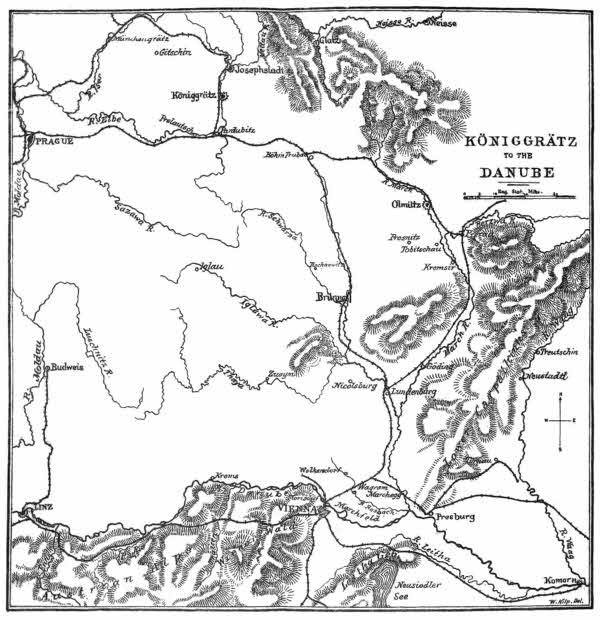
KÖNIGGRÄTZ TO THE DANUBE