Front matter (continued 2)
Reading edition
Bettina Graham's conversation had been continued from inside her own bedroom, with the door opening into the sitting-room which adjoined it. In fact the six-room apartment the Sunrise Camp Fire girls were sharing for the winter, was so built that the three bedrooms and kitchen opened into a single large room. This served as their dining-room, sitting-room and reception room. A small room, apart from the others, Miss Patricia Lord's room, could be used as a study the greater portion of the time, since Miss Patricia was rarely in New York.
Only twice in the last few months had she appeared unexpectedly. Confessing herself as satisfied with the life the girls were leading and the work they were accomplishing, almost immediately she had returned to her home near Boston, never at any time mentioning Mrs. Burton's name, even to make an inquiry concerning her health.
The little apartment was comfortable. There were no signs of the wealth and luxury with which in the past, during the periods when their guardian was with them, Miss Patricia had surrounded the Sunrise Camp Fire. This, Miss Patricia explained, was due to two reasons. The erection of a home for French war orphans in one of the devastated regions of France was absorbing more of her capital than she had anticipated; moreover, she wished the girls to live simply and to resist the temptation of the worldliness of the city she professed to abhor.
The front door of the little apartment now opened a second time. Carrying several books under her arm and a package in her hand, Vera entered.
"Sorry to have been delayed, Sally, but I had to go several places before I could find the kind of cake you said you wished for tea. I wanted to help you get things ready; you seem to do so much more work these days than the rest of us in spite of our classes and Bettina's social settlement."
"You are not the last, Vera. Where is Alice? I thought you would come home together."
Vera smiled; there was a unique quality in her appearance which made her interesting always, even if she were handsome to only a few persons. In her large eyes with their heavy lashes, her wide mouth and irregular nose there was a charm of character and intelligence more marked than conventional beauty.
"Alice and I said farewell half an hour ago and she was to hurry home. I saw her stop to speak to her cousin, Philip Stead, for a moment and I suppose they have not been able to separate. Dear me, I hoped that Alice and I were to remain eternal friends without masculine interference, but these last few weeks Alice is failing me! She insists that she is only friendly with Philip Stead because he is her cousin and a stranger in New York, and lonely."
"Never mind, Vera, you may have me to take Alice's place. I shall never desert you. I am through with all masculine friendships forever, besides their being through with me!" Sally Ashton returned, thinking of the letter she had just finished re-reading. At the same time she extended her hand for the package.
"Thanks for the cake, but I did find time to make the kind Tante specially likes! However, we will manage to get through with both. You girls are becoming so learned as college students that I try to cling to the few useful feminine arts which represent my only talents."
"And the greatest of us is Sally!" Bettina Graham exclaimed, coming into the sitting-room, clad in her Camp Fire costume. "There is Alice at the door. Suppose we light our candles and begin our Camp Fire meeting, while she slips into her Camp Fire dress. Tante told us not to await her arrival. She is too uncertain of coming. And besides I hope we may have an opportunity to discuss the addition of Juliet Temple to our Sunrise Camp Fire club. We have had this in mind for some time. Is it our duty to add to our old group now so many of the original group have vanished? Juliet Temple has lived in the same house with us and is at present living with our Camp Fire guardian, so she seems the most natural person to invite."
A few moments later, when the business had been disposed of, Alice Ashton, continuing the subject Bettina had introduced, said slowly, with the seriousness characteristic of her:
"I feel as you girls do about Juliet Temple. I never have really liked her, although it would be difficult to say why. Perhaps it is because she has been so reticent about her past history and revealed so little interest in us. I feel that she does not especially desire to become a member of our Sunrise Camp Fire. She only wishes it because Tante wishes it and is our guardian. Possibly you girls may not agree with me, but now and then I have been afraid that my own distrust is largely jealousy. Juliet seems to have been able to make herself useful to Tante in ways none of us has succeeded in doing. Of late she depends upon her for a great variety of things."
Sally Ashton smiled.
"Good old Alice, of course we realize that we are jealous of Juliet Temple! Are you actually only beginning to be conscious of the fact? Now I for one am in favor of asking her to become one of our Camp Fire girls for certain reasons I do not care to divulge at present. As I am more candid than the rest of you, besides having a less agreeable disposition, I want to say frankly that I shall be glad when for any cause Juliet and Tante separate. Aunt Patricia has always disliked her and believes she has interfered with their devoted relation. I think she remains one of the reasons why Aunt Patricia refuses to be even friendly with Tante, when she is eating her heart out with loneliness and hurt pride. But goodness, there is the door bell and doubtless Juliet is outside! A reflection on our Camp Fire to be caught gossiping! Now if Tante suggests our inviting Juliet Temple to join our Sunrise Camp Fire group, and if Juliet wishes it and can pass the requisite tests, I see no reason we can offer for not including her. For a good many reasons I think it may be wiser to learn to know her better. Please put fresh wood on the fire, I'll open the door."
The following moment the Camp Fire guardian entered the room, followed by Sally Ashton, Juliet Temple and a third girl.
CHAPTER VIII
THE ENIGMA
Half an hour after, seated at the tea table, Sally Ashton was presiding over the serving of tea. She had agreed to relieve the Sunrise Camp Fire guardian of the responsibility in order that she might be able to talk more freely.
A few feet away, surrounded by the other girls, Mrs. Burton was occasionally drinking her tea, but more frequently answering or asking questions. Her custom was to devote one afternoon each week to the ceremonial meeting of the Sunrise Camp Fire. Now and then her visits were interrupted and until to-day she had not been present in several weeks at one of the councils.
Dressed in exquisite taste in olive green, trimmed in an odd, oriental embroidery of green and gold, her dark hair simply dressed, her health entirely restored, the Camp Fire guardian appeared not more than ten years older than the oldest of her group of girls.
"I can't tell you how glad I am that you came directly to us, Gill, without even waiting to telegraph," she was saying at this instant, speaking to the third girl who had entered the little apartment with her only a short time before. She was in deep mourning.
"You will stay on here with us at least until you can make some arrangement you like better," Bettina Graham added, slipping her hand inside her companion's and looking at her with an expression of sympathy and affection.
For the first time in their acquaintance Mary Gilchrist's eyes filled with tears.
"I knew no one else would be so kind, or give me such help, so, as soon after my father's death as I could arrange my affairs I started east. But I did write and gave the letter to one of the men on the place to mail. We are several miles from a post-office and I wanted it to go at once. He must have forgotten, so the letter will probably arrive later.
"I have scarcely any relatives. My father left the farm in Kansas to me. Some day I shall go back and try to become a successful farmer, but when that time arrives I hope to take all the Sunrise Camp Fire home with me. At present I felt that I could not live on in the big empty house alone, so I left one of our men in charge and came to you. I know I failed to live up to the ideals of our Camp Fire when we were together last winter at Half Moon Lake, yet I believe you realize I shall try not to fail again."
"My dear Gill," Sally announced from her place of honor at the tea table, "you have always taken the attitude that no one of us ever committed a fault in our Camp Fire life together until you failed to confess last winter to Allan Drain that accidentally you had thrown away the manuscripts of his poems. You did confess finally so why not forget the whole occurrence! Certainly you are to live here with us this winter and occupy the room with me; Vera and Alice are together and Bettina and Elce, so I have been alone. Tante is so occupied with her work you will be less lonely with us and Miss Patricia I know will be delighted."
"Nevertheless, Sally, don't you think Gill had best be with me for a few weeks, or a few months, until she has rested?" the Camp Fire guardian protested glancing at the girl in whom the past few months had wrought such changes.
Gill's former air of almost boyish strength and vigor had vanished. Her cheeks were sunken, her eyes had lost their gaiety, even the characteristic light sprinkling of freckles, due to her constant outdoor life, were gone.
Many weeks Mary Gilchrist had nursed her father with a completeness of devotion that had left no opportunity for an hour away from him.
"No, certainly not, Tante; Gill will be a great deal better off here with us. I am sure she would be lonely with you; you are so busy these days and have so many strange people calling on you. There would be no one with whom Gill could talk, or who would look after her as I shall. I believe she needs being taken care of for a time."
Mrs. Burton glanced toward Sally, frowning.
"You forget, Sally, Juliet Temple lives with me, and Gill would not have to be alone when I cannot be with her. Juliet takes wonderfully good care of me and I am sure would enjoy transferring her services to some one who has a better right to them. I am afraid I am growing lazy with Juliet looking after my business affairs, writing my notes and seeing that I am punctual for my engagements. In spite of my being a Camp Fire guardian and struggling to conquer all my faults of character in order to be a proper example to you girls, I am afraid punctuality remains an effort. But Gill of course must do what she likes. I only wish her to realize I want to have her, if she chooses to be with Juliet and me. Juliet is not a member of the Sunrise Camp Fire, but may be some day."
The grating of a key in the front door lock prevented further conversation at the moment.
Sally arose from the tea table.
"I wonder who that can be? No one has a key to our apartment except our own family and no one is away from home!"
The instant later a familiar step was heard in the hall and then a tall, spare figure entered the sitting-room.
"Aunt Patricia Lord, who dreamed you were in New York and how glad we are to see you! Come and sit down and let me give you your tea at once, I know it is tea you always wish after a journey!" Sally exclaimed, putting her arms about the elderly spinster and embracing her.
"Sure and I do, my dear," Miss Patricia agreed, relaxing into a mild Irish brogue, which with her was always a sign of especial satisfaction. "And glad I am to arrive at a Camp Fire meeting. Perhaps it was my duty to have let you know of my coming, but of a sudden I grew so lonely I could not wait to see what mischief you were up to at present. If my little room is occupied I'll go to a hotel to-night and come to see you to-morrow."
Her usual sternness relaxed, Miss Patricia looked from one member of the little group to the other. Suddenly her face stiffened and hardened.
The Camp Fire guardian had risen and was moving toward her with both hands outstretched in a lovely, pleading gesture.
"Dear Aunt Patricia, surely you will speak to me? What have I done to offend you so deeply? Do you realize that you have not replied to one of my letters or allowed me to see you since we parted at Half Moon Lake?"
"I realize it perfectly, Polly, and I refuse to speak to no one. How do you do. You may give my love to your husband. Sally, if it is not too much trouble I prefer to go to my room and have my tea there. Gill, is that you? Come and kiss me, I was sorry to hear of your loss."
Miss Patricia was turning away when the Camp Fire guardian spoke a second time.
"Don't go, Aunt Patricia, on my account. I will leave at once. Our Camp Fire meeting is over and the girls will wish to talk with you. I wonder if you know how it hurts me for you to be unwilling to remain in the same room with me? Once I thought you cared for me--a little."
Without replying the gaunt figure moved away, Sally following her.
Bettina Graham put her arm about the younger woman.
"You are not to go, Tante, we will not allow it. Aunt Patricia is too absurd and unkind! It would be difficult to forgive her, if one did not appreciate that she is suffering more than any one else. Besides, you promised to recite for us before you left."
Mrs. Burton made a swift gesture
"Please release me from my promise, I don't feel that I can just now. Aunt Patricia's attitude toward me makes me more unhappy than any one knows. Juliet, I prefer to go home alone and I wish to walk. Will you stay and talk to the girls about becoming a member of their Sunrise Camp Fire. If they are willing and you will conform to the Camp Fire requirements I should like it very much."
With Bettina's assistance putting on her hat and coat, Mrs. Burton lingered a moment longer.
"Will you really be disappointed if I do not recite for you? I don't wish to be selfish and shall keep Aunt Patricia away from you only a few moments more.
"The other day I came across this poem written by an old friend of mine. I shall only repeat a part of it, I don't suppose if Aunt Patricia is in her room that I shall annoy her. I'll speak quietly."
If Mrs. Burton's tone was low, her voice held the quality that no one who heard it ever forgot.
The little Camp Fire sitting-room was now in shadow with only the light of the dying fire and the flickering candles.
"Be with us, Beauty, through the toil of life,
Through youth and through the everlasting years,
That we may live unwearied by the strife
Knowing the wisdom of laughter and tears.
"Be with us, Duty, while we seek the goal,
Honor and fame, courage and high desire,
Sister of Beauty, as the mortal soul
Kindles the body with her sacred fire."
There was a moment of silence as Mrs. Burton ended. Then with a wave of her hand and a few words of farewell, she went quickly away.
Immediately after Sally returned.
"I am sorry not to have been able to say good-by to Tante, but Aunt Patricia kept me standing in the hall while she listened hungrily to her every word. She then shut me out of her room. I never knew any one who was behaving more foolishly, and I should tell her so, if I dared."
"Juliet Temple, now that we have an opportunity, would you care to discuss becoming a member of our Camp Fire? We have never understood whether you really wished it."
At Sally's words the other girls resumed their positions on their ceremonial cushions, which left the one girl an outsider. She remained standing, facing them.
"Won't you please be seated," Bettina invited, acting as spokesman for her Camp Fire group which was her usual task.
"You know of course that our guardian desires you to become a member of our Camp Fire and what her wish and influence mean, but the fact remains that you have never shown any interest in the organization or suggested in any way that you would care to join us. After spending several months with us at Half Moon Lake you know something of our requirements and our ideals. Will you please be perfectly candid?"
At Bettina's request, Juliet Temple had not sat down.
Instead she stood looking down at the six girls as if slightly amused by Bettina's speech.
Never at any time in her memory had she cared for intimate girl friends. Never had she cared less for one than at the present time. Among the girls before her of varying tastes and temperaments not one attracted her.
"You are very kind and I am sure Mrs. Burton intends being equally so and yet I feel it best I should not become a member of your Sunrise Camp Fire. You know nothing of my history, little of my disposition and tastes and I might prove entirely uncongenial to you. I appreciate that you are inviting me, not on my account, but on Mrs. Burton's and yet I am none the less grateful. There are certain obligations in the Camp Fire, certain promises I do not feel willing to make. I am going to ask one favor. Please do not speak of this to Mrs. Burton; allow me to explain my position to her. She may be disappointed and her friendship means a great deal to me, more than any one of you can realize."
"Why can't we realize it? I think I do better than you imagine," Sally Ashton returned, looking closely at the girl who had just finished speaking. "I don't mean to be unkind and naturally we don't wish you to join our Camp Fire circle unless it would give you a great deal of pleasure and be a help to you as well. I do understand, however, that you wish to gain a great deal from your association with our Camp Fire guardian and to separate her from us as much as possible. We are not really so stupid as you consider us. But there, I am extremely sorry to have been rude to you, and Mrs. Burton would be angry," Sally confessed.
Alice Ashton rose and slipped her arm through the other girl's.
It was dark outside and twilight in the little room.
"Will you forgive Sally? No one of us agrees with her and come and see us whenever you have time. Then we shall learn to understand one another better and you may change your mind about our Camp Fire."
"Sally, it was you who suggested that we invite Juliet Temple to join our Camp Fire group. I cannot understand your behavior," Bettina Graham said reproachfully when the unwelcome visitor had disappeared.
Sally looked uncommonly penitent.
"I wanted to ask her simply because I felt sure she would decline. She has some reason for not desiring any of us to know her too intimately. I am sure I regret being rude to her. Unexpectedly I seem to have lost my temper."
"Undoubtedly you did, Sally, and she was our guest," Bettina protested.
She was interrupted by the re-entrance of Miss Patricia into the room. Vera switched on the electric light and Miss Patricia gave a sigh of relief.
"I am glad that girl has gone; I don't trust her for some reason. But there, I suppose I resent Polly's affection and dependence upon her. It is very odd. At first she appeared to have no force of character, but she is cleverer than I gave her credit for; I sometimes fear she is cleverer than any one of us. Without her being aware of it, from the first moment of their acquaintance she has flattered Polly, when I employed too much the other method. Well, I am glad she is apparently so devoted to her interests. Polly no longer has any sense of affection or of duty toward me."
Bettina rose and placed her arm about the older woman, drawing her down into the most comfortable chair.
"Nonsense, Aunt Patricia, nothing separates you from Tante save your own obstinacy and self-will. Forgive me, but I must say it. Juliet Temple is only an excuse. Tante has no special affection for her. Juliet has her own living to make and few friends, and Tante finds her fairly useful and wishes to be kind. But she is devoted to you and your unkindness to her is her one sorrow in her happy and successful winter. Certainly she deserves her success, after so long a sacrifice of her time and talent to us."
"We will not discuss my relation with Polly, Bettina. Girls, change your costumes and let us go out for dinner. It is too late to prepare anything at home."
CHAPTER IX
THE HOUSE BY THE BLUE LAGOON
"It is enchanting, Betty. How in the world did you and Anthony make the discovery?"
"By accident, dear. We were with some friends on a yacht sailing about in the bay, when afar off I spied this tiny island and asked if we might anchor here for an hour and investigate.
"One could not see the house from the shore, but Anthony and I followed the line of the lagoon until on an autumn afternoon we found it in its deserted splendor. It is a theory of mine, Polly, that each one of us possesses a house of dreams. As soon as my eyes fell upon this, I recognized it as mine. But don't let me tire you either with my enthusiasm, or by trying to make you see everything at once. Were I wise I should keep a fresh attraction for each day that I might have you with me the longer."
The two friends were walking about in an open space of lawn before a house built like an English manor house. The house had fallen into partial decay; on this spring day pale green tendrils of ivy climbed the old walls, in the eaves birds were building their nests, here and there bits of the stone were crumbling away.
"We shall never have the money to rebuild the place and have the house appear as it must have a hundred years ago, but I am not altogether sorry. When Anthony found the old place was for sale and the whole of the little island he told me that if we bought it I must never expect this. We only hope to keep it from further destruction."
"You don't mean that you actually own the whole of this island, Betty, all these magnificent trees, the blue lagoon, the shore line with its view of the sea? Let us walk down to the lagoon and rest for a few moments. I am more tired than I realized after last night's journey. As soon as it is warm enough I shall crawl into a small boat and anchor myself in the lagoon for days and nights, when you have grown weary of my society. This might be known as a place of heavenly rest. In sailing across to the island so late yesterday afternoon, I only had a brief glimpse of the lagoon, which cuts into the island from the bay does it not, as if it were an arm reaching into the shore."
Betty Graham nodded.
"Yes, the island is nearly a complete, circle. One can start from a bank of the lagoon, follow the shore line and return to the opposite bank. Originally the lagoon was to form an anchorage for boats without having to depend on the tides. Once the channel was dug the water has forced its way in until the lagoon has become surprisingly deep. You must promise me to be careful, Polly. I can well imagine your dreaming in your boat and being carried out into the bay and then on toward the sea."
"Well, dear, would it be a bad way of ending things? Yet I believe I would rather float into your blue lagoon from the sea than away from it. I wonder if the depth of the water makes it appear blue as the waters in the Tropics? Please tell the Camp Fire girls to be careful. What a magical place to bring a lot of people together in! I was sorry not to come to you with the Camp Fire girls, but had to give a half dozen more performances of 'A Tide in the Affairs', before my season ended. It was difficult at best, Betty, dear, to close things up while the play was in the height of its popularity. I never could have managed save that you and Richard saw to it that in my original contract I was to be released from playing in the spring. I am supposed to put the same play on next fall, yet I really don't wish to. I was never enthusiastic over it."
"I was not either, Polly, as I told you. Why not play something else? It was never big enough for you!"
"All very well, Betty Graham, but you know nothing of the difficulty of discovering a worth-while play in accord with one's personality or talents. The good fortune of a real play comes only once or twice in a lifetime."
Mrs. Graham hesitated.
"Polly, while you are here do me a favor. In a rash moment I told Allan Drain, our young poet-playwright, to bring the manuscript of his latest effort and that if you were in a good humor you might permit him to read it to you. There is no reason to believe his play would be any worse than other plays one has seen. The boy is very ambitious and I think clever and I have invited him for several weeks, so you will have a chance to rest beforehand."
Mrs. Burton stopped and frowned.
"Betty, dear, please don't ask this of me. Of course if you make it a favor to you, I have no choice but to agree. But I am so tired and shall never be rested in a few weeks. Of course this is not the real trouble. You don't know how disagreeable it is to have youthful geniuses read you their efforts and then be obliged to tell them the truth about their work, or at least the truth as one sees it. It hurts them horribly when you cannot admire what they have done and often they never forgive you. Besides, I am a sympathetic person and really hate having to wound them. As for your young playwright, Allan Drain, to whom you have taken an unaccountable fancy, I several times allowed him to read his efforts to me during the winter when we were shut up in the mountains.[*] I was not busy then and more amiable. His work was only fairly good; really he did not reveal exceptional ability. I am cross and tired now and it would only destroy the boy's pleasure and mine to have to disappoint him. I cannot have him encouraged in the idea that I would ever consider one of his youthful effusions. You are not disappointed, are you?"
[*] See "Camp Fire Girls at Half Moon Lake."
"A little, Polly, but the main thing is that you must not be worried, or have anything affect the pleasure of your first visit to me in 'The House by the Blue Lagoon'. I hope you won't mind the young people."
Mrs. Burton laughed.
"If you mean my Camp Fire girls, Betty, I regard the speech as too impossible to answer. As for the youths whom you have asked to entertain them, or be entertained by them, I've an idea that no one of them will have any attention or time to spare for me. Who is here? Not coming down to dinner last evening I am not sure of all the names the girls poured into my ears."
"Oh, only the girls' special friends, Dan Webster, David Hale, Allan Drain of course, Philip Stead, Alice's and Sally's cousin, and Robert Burton. Bettina surprised me by suggesting that I ask the young fellow whom she met by accident in New York when she was searching for you. I wonder if she has seen a great deal of him in the past winter? Has she spoken of him to you? He seems a pleasant chap and admires Sally Ashton. Do you know, Polly, I have half an idea that David Hale is in love with Bettina, and although she is absurdly young, now and then I feel that I would rather she return his affection and lead a woman's natural existence than pursue this idea of social service that the winter's experience, which I hoped in a way might cure her, seems to have deepened. Anthony says David Hale has a brilliant future ahead of him."
The two friends sat down on a low stone bench a few feet from the lagoon. In the April sky small white clouds played at hide and seek upon the field of blue, reflected in the deeper blue of the water.
"And you would like Bettina, Betty dear, to repeat your own life, marry a famous man and be happy ever after? Most parents seem to want their children to repeat their lives, if they have been at all happy and successful. Yet how few of them ever do! Don't set your heart on this idea of Bettina and David. She does not care for him."
"Nonsense, Polly, how do you know! I believe she likes him extremely. She used to write me of him from France."
"Very well, I won't argue the question. There is one person you have left out of your house party, I am afraid purposely, and for my sake I want you to relent. You did not tell me that I might bring Juliet Temple with me, and I need her. Do you dislike her? I never have understood the situation; not one of my Camp Fire girls has ever made a friend of her, Aunt Patricia is violently prejudiced against her, only Richard and I are fond of her. I can scarcely tell you how much she does for us both. She is extremely clever and of late not only has kept house for me, but attends to small business matters that are so annoying. She writes out all the checks for the tradespeople and merely brings them to me to sign, and oh, I scarcely know what she does not attend to! Richard is always congratulating himself at having discovered and brought her to me at Half Moon Lake. The child does not mind doing what a maid would do when I am very tired or very busy, although of course I do not feel I should allow this. I have no right to ask you a favor, have I, Betty, having just refused the one you asked me?"
Betty Graham put her arm about her companion whose frailty always gave her a pang when the met again after any length of parting.
"Oh, have your Juliet Temple if you wish and are so dependent upon her. You know you can do anything you like so far as I am concerned. Yet I think you are making a mistake to trust the girl to such an extent and certainly you should not have her look after your business affairs. She might be careless, and as you are extremely careless yourself, Polly, and Richard not much better, there might be unnecessary temptations. I really believe you both do need Aunt Patricia."
Mrs. Burton shrugged her shoulders.
"You did not succeed in inducing Aunt Patricia to make you the visit while I am here, did you? I am sorry, although not surprised. Richard went to see her not long ago and she seemed rather pathetically pleased, made him stay in the house with her and would hardly allow him out of her sight. She refused, however, to forgive me for whatever imaginary wrong I have committed. She says now that she had grown so old and difficult that I returned to the stage largely in order to be rid of her and that she refuses to be any further burden upon me. And this in view of the fact that Aunt Patricia has taken care of me as if I were a child, has lavished her wealth and time and strength upon me and never allowed me to do anything of any kind to repay her. Well, I am through with making repeated efforts to have her forgive me, for what I am not sure. Alice Ashton and Vera Lagerloff seem to have taken my place and I trust she may find them more satisfying than she ever did me. At no time do I remember Aunt Patricia's approving of anything I ever thought or did."
"Don't talk as if you were a spoiled child, Polly; at any moment you need Aunt Patricia she will come to you at once."
Mrs. Burton shook her head.
"No, I shall never allow it, or accept any favor from her again. I told Richard this when he returned and said Aunt Patricia still declined to have anything to do with me. I asked him to write this to her, that I should not trouble her at any time in the future. But about Juliet Temple! The child is alone in my New York apartment; Richard is out of town on business for a few days, and I am afraid she is lonely. She has no friends and no relatives except a brother, whom I am afraid, from what she has told me, is not of much account. She seems fond of him, however, and they come from this part of the country I believe; I am not sure just where. As for trusting Juliet to attend to my business affairs, there is an especial reason why I wish her to appreciate that I have entire faith in her. She gave me her confidence upon an occasion when there was no necessity for it and I have always believed in her. As far as money goes, Betty, I am not rich enough to be a temptation to anyone. You know that Richard and I made some unfortunate investments after our return from France and lost the small estate we had saved between us. You did not know that other people were also involved and because Richard was one of the officers of the company, we both feel that we want to pay back to them at least a portion of what they lost. I made a good deal of money last winter, but have kept only what we need for our personal expenses until fall, when I start to work."
"Oh, Polly, you are so quixotic and so unpractical! Suppose you should fall ill again? But there, forgive me, I should not have spoken of such a possibility. When we are both old and you have grown tired of being famous and admired, will you come here and live with me at my 'House by the Blue Lagoon'?"
Mrs. Burton laughed.
"Yes, Betty dear, I'll hide somewhere in one of your secret passages, while you entertain house parties of distinguished persons from Washington, or elsewhere--Senators, Ambassadors, even Congressmen. With all my love for my work, it is you who are admired and who care for society. Small wonder Bettina was never able to keep up with you! Here comes Bettina with her shadows, Elce and the little girl she brought from the settlement. 'Ardelia in Arcady'! Do you recall the old story of the child who came from the city to the country and was expected to care for it and did not? It was very amusing. Bettina's latest protégé is a pathetic little figure, with her crutch and her city pallor, but she feels dreadfully lost on your desert island amid all this beauty and romance. She is a little daughter of the tenement! I believe I can understand her better than you or Bettina."
"Princess, what are our visitors doing? Polly and I ran away for an hour's quiet talk. She is to learn to love our place nearly as much as I do," Mrs. Graham exclaimed.
Bettina Graham came nearer. She looked grave and sweet, although a little smile showed at the corners of her lips.
"Oh, they are perfectly well entertained without us, dear, and I thought Maida and Elce needed my society for a little while.
"We have small hope of seeing much of you and Tante for a few days until you have grown accustomed to the wholly new experience of being with each other. You are worse than lovers.
"Actually, mother, your house party has accepted your suggestion and has set to work to make you a garden, a new garden where the old one has been this hundred or more years. It is a charming idea! We are to leave such shrubs and roses as will bloom. David Hale and Dan Webster have taken charge and say we are to work two hours every morning, before we are allowed to do anything else--boat, or bathe, or fish, or sail. It is to be a memory or a friendship garden, although we intend to find a prettier and more original title. Anyhow, the garden is to commemorate our first Camp Fire house party by the blue lagoon. Isn't the place exquisite, Tante? Sitting here by the lagoon can one imagine the poverty and sorrow I see every day in my settlement work, or such an experience as Maida's, whose father is responsible for her lameness? Forgive me, mother, I promised myself not to speak of these things, or even to think of them while I am on your enchanted island."
"This is not my kingdom, Princess, but yours when you will come home to it, yours and Polly's. It is only you people who work for others who deserve enchanted islands. I am delighted to hear about my new garden and my gardeners. We must send for all the flowers we can think of, as April is the perfect month for planting. Do you know I always have wanted a blue garden, I suppose because I have loved blue more than any color all my life and wondered why there were so few blue flowers. Suppose we plant only blue flowers here by the blue lagoon.
"You stay here, dear, I must go and see about luncheon. Bring Polly back with you. I don't want her to go off alone to explore our island and am afraid she has it in mind. One always has the feeling that she will slip away from one somehow."
"No such good fortune, Betty! Bettina, while I think of it, mother has agreed to let me have Juliet Temple here with me, although I am afraid you girls do not want her. I wish you would not be so prejudiced and unfair. She will not be troublesome or intrude on you I am sure, but you will try and see that she has an agreeable time."
"Naturally, Tante, I am not apt to be rude to a guest and will do what I can. Your Camp Fire girls hoped you would be willing to allow us to be with you and do whatever you wished to have done for the little time you are here. If you cannot get on without Juliet Temple, we shall of course be friendly to her. She has been unfriendly, we never have."
"You are cross already, Bettina. Will you speak to Sally? Obviously Sally does not like Juliet, and Sally has a habit of frankness. Tell her I shall be hurt and displeased if she is not especially kind. Now let us talk of something else. Ask Elce and your little lame girl to come and sit by us.
"Elce, if you will sing for me some day all alone here by the blue lagoon, I'll recite a poem to you about these old trees:
"When by the spring's enchanting blue,
You trace your slender leaves and few,
Then do I wish myself re-born
To lands of hope, to lands of morn.
"And when your wear your rich attire,
Your autumn garments touched with fire,
I want again that ardent soul
That dared the race and dreamed the goal.
"But, oh, when leafless dark and high,
You rise against this winter's sky,
I hear God's word: "Stand still and see
How fair is mine austerity.
"Come, let us go back to the house, it must be nearly lunch time."
CHAPTER X
ONE NIGHT
The grounds surrounding the old house were hung with Chinese lanterns.
Walking about in the semi-darkness were groups of figures, ordinarily two in number.
In the big drawing-room the music had just ceased, while the musicians were having their supper and a brief rest. Senator and Mrs. Graham were giving an informal dance for their daughter and house party.
Other guests had crossed over from the mainland, which was not an hour's journey in a motor boat or one of the small steamboats that carried mail and provisions, but was apt to be a long crossing in the uncertainty of a sail, and almost impossible in a rowboat, unless one were a singularly strong oarsman.
There were half a dozen young officers from the fort and as many girls from a fashionable hotel on the Virginia coast.
"Sally, it has been utterly impossible to have a word with you, to say nothing of a dance! A fellow likes a girl to be a good dancer, but not so good that he never has a chance with her. I must say that you and Robert Burton look pretty well together, he dances almost as well as you do and makes me feel awkward and clumsy. Somehow I am surprised that you are such a fine dancer, Sally, when you don't like other kinds of exercise," Dan Webster concluded.
"If you are going to start our walk, Dan, enumerating my faults, I do not intend to go one step with you, although it is one of your favorite amusements. All very well we have known each other a long time, but I do not think that a sufficient excuse."
Arm in arm Sally Ashton and Dan Webster were sauntering away from the veranda toward a more deserted portion of the lawn.
Sally spoke in the demure tone and manner, which oftentimes disturbed her companion, since he was not able to guess whether she were in earnest or amusing herself at his expense.
"Nonsense, Sally, I could not enumerate your faults for any length of time! I only think you possess two or three faults, and sometimes, not often, I have been known to speak of them.
"At present I cannot imagine what I have said or done to annoy you, unless following you around all evening and trying to induce you to pay some slight attention to me has troubled you. In that case of course in future I shall leave you alone.
"I joined the house party when it was extremely difficult for me to be spared from the farm, chiefly in order to see you. I have seen less of you than any one else and at times this has not looked like an accident. If this is true will you be kind enough to be frank."
Sally gave her companion's arm a slight squeeze.
"Don't be such a bear, Dan. You always were a surly small boy when you were annoyed in the days we used to play together.
"There is a hammock under the linden trees; let us sit down if you do not mind, I am a little tired after dancing so long. You know perfectly well how much engaged we all have been since our arrival at the island. You reproach me for not deliberately separating myself from the others, when I have not said a single word to you for failing to write me a half dozen letters all during the past winter. I suppose you were writing to so many other persons!"
"No such thing, Sally. As you well know, I simply can't write letters that are worth a row of pins; they never seem to express what I think or feel, and I am afraid of boring you. If I speak of something now, you won't consider that I intend criticizing you; I suppose I do keep more of a watch on you than on other girls, because I am more interested. Twice lately you have deserted every one in the house party and gone off somewhere to some mysterious part of the island alone. Please don't repeat this. You see it does not look well and worries me. The island is fairly deserted, but there are spots where fishing boats might land, or people out for a holiday. If you feel you want to be alone, I can follow you and promise not to interfere in any way."
In a hammock swung by chains in a small grove of linden trees, Dan and Sally sat down.
The April night was surprisingly warm with a breath of summer that comes now and then in the southern spring. The tiny blooms of the trees made a shower of fragrant gold about them. From beyond blew the salt breath of the sea.
Sally remained quiet a moment before replying.
"You are very kind, Dan, I am sorry you have noticed that I have gone away once or twice alone. I have not been in the slightest danger and had a definite reason for going. I can't tell you what this is, probably it is not of any consequence, yet I must ask you under no circumstances to follow me."
"And I decline to make you such a promise, Sally, in fact I forbid your wandering about the island alone. If there is any mystery connected with your behavior, I thought you hated mysteries; in fact you assured me that after your experience in caring for Lieutenant Fleury[*] in France, you were through with all secrecy forever!"
[*] See "Camp Fire Girls in Glorious France."
"There is no especial mystery in what I am interested in at present, Dan, at least nothing of importance. Indeed, I am indulging in a whim, and as I am doing no one any harm I think I have the right. Perhaps I shall not keep up my quest very long, only a few days until I make a discovery," she added, feeling a stiffening of the figure beside her and appreciating, without having to behold the firm line of the lips. She and Dan Webster had known each other so many years that there were traits of his character she thoroughly understood.
"Besides," she protested, as an afterthought, "you have not the faintest right to forbid my doing anything I wish."
"No, I suppose not," Dan returned, not looking toward Sally, but at the old house a short distance away, shadowy and stately under the stars. "I presume I never shall have that right, even if you come to care for me some day as I hope you may care. Indeed, I almost believed you would when we parted last, but now I see what an ass I was. I told you then I would not speak of this until you were older and I had made something of myself. I never will amount to much, Sally, I see that pretty plainly here in comparison with only a small group of other fellows. David Hale is the real thing, brilliant and ambitious and knows what an educated man should know. Allan Drain is the artist with his writing of poetry and plays. He talks in a way that makes you sit up now and then, even when you do not agree with him or get all he means. Philip Stead is a student and will end by being a professor. Robert Burton I don't understand so well, although he has something none of the rest of us have, not just good looks and good manners, while I--well, Sally, I only want to make things grow, to watch the wheat ripen and turn gold, the cows on the old New Hampshire hillsides feeding beside their calves. The farm is double the size it was once and I intend it shall be four times larger. I mean to gather men about me interested in making agriculture what it should be and farmers' lives the most independent and worth while. When I am rich, rich as ever I am apt to be, I plan to found an agricultural school and to give the land and the benefit of the experience I have had and my father and grandfather before me. Don't think I fail to realize how dull this sounds; when I speak of it most people yawn or struggle to appear polite and change the subject. I don't care, it is only how you feel, Sally, that matters. You have had so much experience and this past winter in New York has changed you more even than the years abroad. Once upon a time you would have granted the small favor I just asked you, now you won't even do this for me."
"Dan, you are stupid; I wonder sometimes if I shall ever make you understand how dull you are on one particular subject. At present I'd rather you would not know. As for doing the favor you asked, I won't because I have a reason which I believe justifies my refusing. You know how obstinate I am, everybody who knows me is of the same opinion on the subject. Why not try to trust me? As to the effect the past winter has had, I do feel older and more self-reliant. Mary Gilchrist was ill almost the entire winter and I had the care of her, then I was the housekeeper for the Camp Fire girls. Never apologize to me for your stupidity, Dan, dear, which I don't think is apparent to any one save you. Among the Sunrise Camp Fire, no one even thinks of disputing the recognized fact that I am the least clever of all the girls. I do not even mind especially. I find life interesting and after all one cannot make oneself over altogether!"
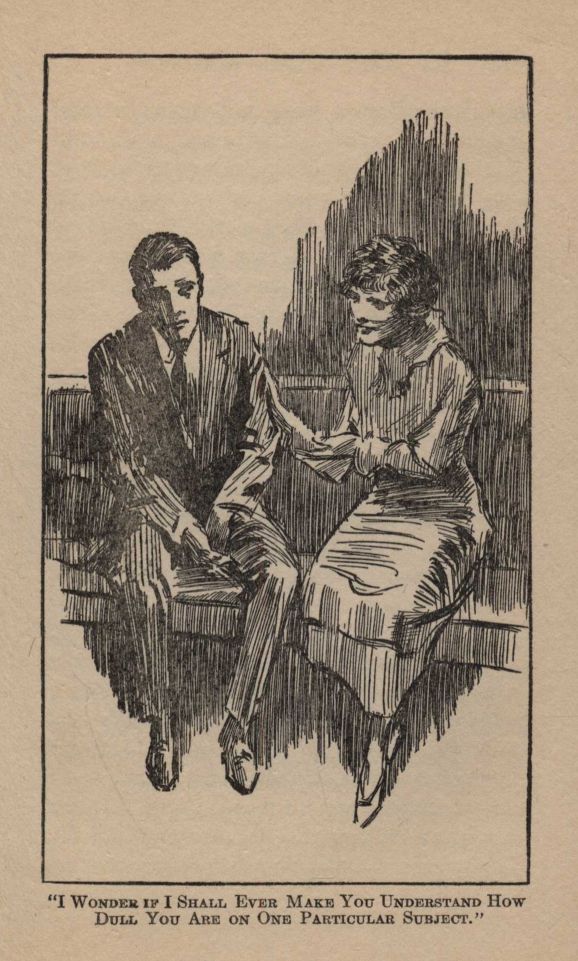
"I Wonder if I Shall Ever Make You Understand How Dull You Are on One Particular Subject."
For the first time in the interview Dan laughed, a good natured, boyish laugh, full of strength and sweetness.
"If you are stupid, Sally, then I am proud to be in the same company with you. I should like to know what Tante thinks of you! You may be less interested in books and more in human beings."
In the half darkness Sally smiled.
A lantern in one of the trees overhead swung and tilted so that the light shone down on her face.
Sally wore her rose-colored net and had a scarf of the same rose color about her shoulders. Tucked under her brown coil of hair in the fashion of the women who had danced in this old southern house and paraded its lawns a century ago, was a pink rose, a little crumpled now and faded.
Dan put up his hand and touched the rose gently, one could scarcely have thought there could be such gentleness in the strong fingers.
"Give me your rose, please, Sally; I don't know just why I want it, but I do. I never could see much sense in fellows wanting to hold on to things like this before."
Sally jumped up suddenly and the little rose fell to the ground.
"Please be careful, Dan, here comes Tante and she may see you. I don't know what she would think."
The girl's movement arrested Mrs. Burton's attention.
She was walking about in the silver night with Senator Graham, whom she had known many years before as a poor boy, with little education, with nearly every handicap, lack of family, of influence and position. He was now one of the distinguished men of the country.
"Is that you, Sally and Dan? May I speak to you? Anthony, go back to Betty and see that she rests for a few moments, she is the most tireless hostess in the world! Sally and Dan will escort me to the house if I am not able to walk the few yards alone. And will you tell Betty that if I disappear I have gone up to my own room. I shall listen to the music until the dancing ends and then go to bed. The boat goes back at midnight, so I suppose the dancing can't last much longer."
Mrs. Burton sat down in the hammock between Sally and Dan, slipping a hand into each of theirs.
Dan Webster was her nephew, the son of her twin sister and of the man who had been under the impression that he cared for her before his discovery that they were entirely unsuited, and that the sister, who was her opposite in everything save her personal appearance, was the real love of his life.[*]
[*] See "Camp Fire Girls Amid the Snows."
Sally Ashton was the daughter of two friends of her girlhood.
With no children of her own, Mrs. Burton cherished a deep affection for Sally and for Dan, but for different reasons. One reason was the same--she had a feeling of dependence upon them both. Dan was nearly like her son. Sally Ashton, well, most people who knew Sally intimately did depend upon her, without being able to explain why.
"Children, do a favor for me. You'll hate it, but Sally has promised. Come with me and find Juliet Temple and see if she is having a good time. If she is not you'll dance with her, Dan, and make yourself agreeable? Juliet has not been here so long as the rest of you and I am afraid feels lonely. She seems to spend most of her time alone. You like her well enough, don't you, Dan?"
"Of course, Tante, she seems all right, strikes me as clever. She isn't about much; when she is, it never occurred to me that she would be interested in me. If you are fond of her I'll do my best."
Dan put his arm about Mrs. Burton's waist.
"You are coming to the farm to be with us for a time when you finish your visit to the 'House by the Blue Lagoon'? Mother will never forgive you and will perish of jealousy if you do not. She does not enjoy the idea that you are fonder of Aunt Betty than of your own twin sister. We both wish you would give up that plagued stage and you and Uncle Richard live with us until you are a little less like a wraith. But see here, Tante, I'll strike a bargain with you. Sally will have nothing to do with me at present. If you will promise to bring her with you to the farm for a visit this summer I shall devote myself while I am here to your Juliet Temple, that is, if she will allow it."
Mrs. Burton smiled.
"Dan, I suppose you know you are like your father, only nicer. I don't want you to be so attentive as to deceive Juliet, only to see that she has a good time. I have been looking for her for the past hour and she does not seem to have danced with any one."
"Juliet may have gone for a walk, Tante, I think I saw her a short time ago. I have not forgotten that you said you wished me to have her in mind," Sally remarked. In her speech, or in her manner there was nothing that was unusual, nevertheless both Dan and the Camp Fire guardian were aware of bewilderment.
"Do you mind walking about with me for a few moments and trying to find her? Of course I know you do mind, but will you in any case?" Mrs. Burton pleaded.
"I am a tiresome woman, Dan, to have interrupted your talk with Sally, but I will make it up to you some day. Sally is difficult, but worth the effort. You must promise me that you will say nothing to her and even feel nothing for the next few years, then I will be your warmest ally," Mrs. Burton whispered, walking close beside the tall fellow who towered nearly a foot above her, while Sally moved along the path in front of them, a figure of rose and silver.
Half an hour later the Camp Fire guardian was sitting in her room half reading, half listening to the music and voices in the house and garden beneath her open windows.
She was in her dressing gown and her hair was unbound. The big room was in shadow, save where the light fell about her reading-lamp. One could see the tall ceilings, the high windows, the few pieces of old English furniture, brought to America by the early Virginia settlers.
There was a faint noise of a door being softly pushed open in the adjoining room.
"Juliet, is that you?" Mrs. Burton inquired. "Are you tired of the dance and on your way to bed as I am? I looked for you before I came up and could not find you, I suppose you were somewhere in the grounds."
"Yes, I was. Is there anything I can do for you? Is your bed turned down?" the girl answered.
Mrs. Burton nodded.
"I believe so, but you must be more tired than I am, so please don't trouble about me to-night. You are too considerate of me altogether. There is some business in the morning I should like to have you help me with for an hour or more. My accounts seemed to have become tangled in the most absurd fashion and I should like to have them straightened out before Captain Burton joins us. You are a good mathematician, Juliet, and neither of us are. Now go to bed."
The girl lingered.
"I want to say something first, perhaps this is not the proper occasion, but it does not make much difference. Since I came to live with you, Mrs. Burton, I have tried to make myself useful, but I don't think I have ever spoken of the fact that I have grown to be very fond of you. Oh, I realize this is not an unusual experience so far as you are concerned, most of your friends and family seem to adore you, but it is unusual with me. I never have cared for any one, except my brother. I told you that he and I were orphans and that he was younger. Until he joined the army he gave me a good deal of trouble, but has been better since. I persuaded him to continue as an enlisted man and to try to pass the examinations for an appointment as an officer later."
"A wise idea, Juliet. Is there anything I can do to help you? I am not a very influential person, but would do anything possible."
"No, no, there is nothing," the girl returned hastily; "I am going to bed in a moment."
The older woman continued her reading, a little disturbed by the fact that her companion would not retire and leave her alone. She liked Juliet Temple and was grateful and appreciative, but never had felt for her the spontaneous affection she had for her group of Sunrise Camp Fire girls. This fact did not trouble her, she never had cared equally for all the girls associated with her in the most intimate fashion during the past few years. Human nature makes its inevitable selections. At the moment not wishing to be unsympathetic she was hoping that her companion would make no special demand upon her at this hour of the night when they were both weary. Sentimentality in their relations the Sunrise Camp Fire girls never had indulged in and she never had encouraged.
"Mrs. Burton, I hate to speak of this, but I must. Do you think you can give me a larger salary for the work I am doing for you. I need it a great deal."
A short silence, then Mrs. Burton laid down her book and flushed.
"Juliet, is this what you have been trying to say? I am glad you have been frank, even though I must refuse your request, Please don't think I am not sorry, but you understand Captain Burton's and my circumstances at present almost as well as we do. You know we are trying to pay a debt that we believe we owe. We enjoy having you live with us, you have been the greatest aid and pleasure, but the fact is that you really have been spoiling me, as it is not actually essential that I should have you. I could manage to keep house with dear old Elspeth, who came to New York to be with me from Half Moon Lake, and who could probably look after things as well as you or I. I can even attend to my tiresome letters and business if I must. I have told you several times, dear, that I thought you were being wasted upon me. When I go back to town I can find you a much better position with a good deal larger salary. I can do this at once if you like."
The girl shook her head.
"No, I told you I did not wish this, perhaps it does not matter, I may not need the money after all."
"Don't decide at once, Juliet. Good night. Are you having a happy time here? I wish you liked the Camp Fire girls better. You would be happier with more friends."
"Oh, the girls are agreeable enough, the fault is mine. Mrs. Burton, do you think it possible to be truly fond of any one and yet to do that person an unkindness, a serious unkindness, not a trivial one?"
Mrs. Burton closed her book.
"My dear Juliet, what are you talking about? Of course it is possible, almost anything is possible with human beings, yet it is scarcely the kind of affection one would care to receive. But now really I want to go to sleep, the music has ceased downstairs and I hear voices in farewell. The dance must be over."
CHAPTER XI
THE SAME EVENING
Reluctantly Mary Gilchrist had joined the house party at the "House by the Blue Lagoon".
After her arrival in New York for the first time in her life she had been ill, nothing serious at first, merely a languor and depression which she could not shake off, and then a fever which persisted for some time in spite of every care and devotion.
Never a day passed that she did not say either aloud or to herself that she would have felt scant interest in her own recovery had she not been living with the Camp Fire girls.
After her father's death she was almost entirely alone, with no relatives save distant cousins and separated from the friends of her youth by the years in France. Always she and her father had led a fairly isolated existence on their big thousand-acre wheat farm. Her own love of the outdoors, of boyish amusements and of the work of the estate, together with her father's companionship, had been sufficient.
Shut up in the small New York apartment, ill and grieving, notwithstanding, the affection and attention lavished upon her, for several months Gill had found life difficult.
With the arrival of the cold New York spring she approached a better frame of mind, but still was without desire to join in any gaiety.
Her one expressed wish was to be allowed to remain alone in the apartment while the other girls went for the visit to the "House by the Blue Lagoon".
This they positively refused to consider.
As she had been Sally's especial charge, Sally announced that she did not believe Gill sufficiently strong to make the journey or to be in the society of so many persons, so she had concluded to stay on in New York with her. Sally was not easily dissuaded from a decision, so partly to avoid this sacrifice, partly because she did not wish to be separated from her friends and was interested in Bettina Graham's home, Gill finally agreed to accompany them.
The stipulation was that she was to be allowed to be alone as much as she liked and to take no part in any of the entertainments, unless she felt the inclination. No one would try to persuade her to do anything against her wish.
On this evening of the dance, Gill had been undecided whether or not to leave her own room. At length the desire to see the beautiful old house lighted and filled with spring flowers and the girls in their party dresses brought her down to the drawing room. Here she was introduced to a number of the guests and enjoyed talking to them, but positively refused to dance. And no one insisted beyond the ordinary demands of courtesy, as her black dress offered a sufficient explanation.
Gill was not in deep mourning; her dress was of sheer black muslin, cut low in the neck, with a narrow edging of black net.
She no longer wore her hair bobbed in the old, half boyish fashion, but dressed as simply as possible in a knot at the back of her head.
The small claim she possessed to good looks, Gill believed had vanished altogether and for all times. Her color was gone and her animation and she had depended upon both.
Yet to Allan Drain, who found himself glancing toward her with interest several times during the evening, she possessed an attraction he had not been aware of in their acquaintance at Half Moon Lake. There was a softer and gentler atmosphere about her. Her pallor, in contrast with the red-brown hair and eyes, had its own beauty.
Toward the latter part of the evening, observing that Gill was so white that she appeared ill, Allan crossed the room to the chair where she was sitting alone at the moment.
"Won't you come out of doors with me for a little while, Miss Gilchrist. I believe you will like it better than indoors and I know I shall."
Then, as Gill hesitated.
"Please come, I have not had an opportunity to talk to you alone since our arrival. I want to tell you that I think I was a good deal of a boor in refusing to say I forgave you last winter when you confessed that by accident you had burned up the manuscripts of my poems. After I returned home I discovered copies of a number of them stored away in odd places. I am obliged to confess they seemed so utterly no account that you did me a favor by destroying them before they could be read by any one."
Gill shook her head.
"You are kind, but I don't in the least believe you. I told you then and I still feel that I would rather you would not forgive me. I have no idea of forgiving myself."
"Is it too far, shall we walk down to the lagoon? I have not seen it at night."
Allan picked up a white shawl which some one had left on the veranda.
"No, it is not far, but it is probably cold down there, so put this around you. Isn't this place a marvel? Any one who could not write poetry here, or at least dream it, could nowhere on earth. Do you know the story of the house and the island and the blue lagoon? I have made myself a nuisance trying to find out."
"No, not as much as I should like to hear," Gill answered, placing the shawl about her shoulders in an obedient fashion.
"Originally the island was given by a special grant from the British king to an Irishman named Bryan O'Bannon, who had fought gallantly in his service during one of the innumerable wars. He appears to have been unlike most Irishmen and a man of wealth, or else he married wealth, because his wife was one of the sisters of the great Lord Fairfax of Virginia.
"They built this place and lived here like royalty, with hundreds of colored servants I suppose. There is no special story of a tragedy until the civil war. Then one day a boatload of northern soldiers landed on the island and took possession. None of the men of the family were at home. It chanced, however, that a young Confederate officer was on leave of absence visiting the girl to whom he was engaged. When the northerners surrounded the house, she hid him in one of the secret passages. The story goes that she was insulted by one of the enemy and drowned herself in the blue lagoon. The young officer, waiting her return and not knowing how to escape, starved to death."
Gill shivered.
"Good gracious, what a tale on a night like this! No matter how beautiful a place is, nor how shut off from the world, it seems never able to escape sorrow."
Allan Drain looked more closely at his companion, whose expression was scarcely discernible in the flickering lights made by the Chinese lanterns, swinging like censers between the trees that led to the blue lagoon. The winter before she would not have been capable of a speech like this!
"I am sorry, perhaps I should not have told you so unhappy a story. I should have remembered that you have been ill and in trouble. I have not had an opportunity before to express my sympathy. I have been through such a lot of bad health myself, at least I appreciate what it means."
"You are all right now, or a great deal stronger? Certainly you look so. You are kind to be so good to me. I was so stupid and disagreeable when you were ill and lonely during the winter in the Adirondacks. I seem to be one of the persons who has to learn through experience. Until recently I have always been so well and I am afraid spoiled. I hope I shall never be so impossible again. Tell me do you feel more interested in your medical studies, or is writing still your one ambition?"
"I am ashamed to say that it is, ashamed because I seem to have so little talent to justify all the time and thought I give to it, when I should be hard at work trying to learn my profession. I often fear I am one of the people who shall fall between the two, a failure in both. I did not intend to be so dismal, but I have had a pretty severe disappointment of late."
"I am sorry, would you rather tell me of it, or not?"
By this time they had reached the edge of the lagoon and stood looking down at the water, so deep a blue it was nearly black under the night sky with the stars reflected in its surface.
There were few waves and only a light breeze; a small row-boat tied to a stake lapped gently to and fro.
"Would you like to go for a row? I am not a skillful oarsman, but I can manage. We need not be out long."
Gill hesitated.
"I would like it very much, but we must be sure to return before the dance is over. I won't be able to help with the rowing, I have never attempted it in my life. You know I am an inland person and never have spent any time near the sea until now. I never saw the ocean until we crossed to France."
With the boat untied, Allan helped his companion in and Gill sat down facing him.
Neither of them spoke until they were a few yards from the shore and moving toward the opening into the bay.
"Yes, I would like to tell you of my disappointment. I have not wished to speak of it to any one else, why you will understand when I explain the circumstances.
"Last winter in New York Mrs. Graham suggested that, when I came to make her a visit in the spring at the 'House by the Blue Lagoon', I might bring with me the manuscript of the play, which I have been at work upon for a year and that she would persuade Mrs. Burton to allow me to read it to her. Of course with this possibility I have worked doubly hard until there have been moments, not many I confess, when my play has not seemed altogether bad. I have had Mrs. Burton in mind as I wrote; I could not help this, she is the only great actress I have ever known personally and in some ways the greatest I have ever seen act. I don't believe I have been mad enough to dream that she would like my play well enough to appear in it, but I hoped that she might say a few words of encouragement, perhaps give me a letter of introduction to a manager who would read my play if she made the request."
"Well, what has happened?" Gill demanded, leaning forward with her lips slightly parted, her eyes large and interested fixed upon her companion's face.
"Only that Mrs. Burton declines to be annoyed. Mrs. Graham did not offer exactly this explanation, but what she said amounted to the same thing. Please don't think I am blaming Mrs. Burton, I understand her position. She sent word to me that she was very tired after a winter of hard work and that for the present wished to forget the stage altogether. She begged me to appreciate that she was not a producer of plays and that her opinion of what I have written would be of small value. In case she did not like my work she might disappoint me, when a manager might be delighted with what I have accomplished."
"Yes, that is true," Gill returned, "so why feel especially disappointed? I am sure Mrs. Burton will give you a letter to a manager, even if she prefers not to read your play."
With the peculiar despondency which is an attribute of the artistic temperament, Allan Drain shook his head.
"No, if Mrs. Burton is not interested, I do not care to interest any one else. With every line I have written I have thought and dreamed of her as my heroine. I don't want any one else to play it, at least this is the way I feel at present."
In several moments Gill did not speak, while Allan Drain pulled hard at his oars, wishing to conquer his discouragement through strenuous physical exercise.
He was surprised when his boat so soon shot out of the lagoon into the broader waters of the bay. The waves were not high and he rowed quietly and steadfastly, keeping close, as he believed to the shores of the small island.
Still Gill dreamed on, feeling wonderfully peaceful and happier than in many months. She never had forgiven herself for her carelessness in throwing the manuscript of Allan Drain's verses into the fire in their winter cabin at Half Moon Lake. Now it was a consolation to discover that Allan Drain really had forgiven her; there was no pretence in his words and friendliness to-night. If only she had possessed sufficient influence with their Camp Fire guardian to persuade her to do what he so greatly wished! After all it was not so tremendous a favor, in Gill's estimation. However, if Mrs. Burton had refused the request made by her hostess and most dearly loved friend, no one else would avail.
"I am so sorry, I do wish I could be of service," Gill murmured, speaking as much to herself as to her companion. "Don't you think perhaps we had better start home? I don't wish to, I did not realize that I was so tired watching the dancing and being in the midst of so many people until you brought me out into this beauty and quiet."
"Yes, well I'll go on only a few moments longer and then turn around. Once we are inside the lagoon we can reach our landing in a quarter of an hour."
When he spoke Allan was not aware that the wind was growing stronger and that the tide was turning and running out toward the sea. Neither did he realize the length of time he and Gill had been on the water, nor the distance they had gone, so swiftly and smoothly his oars worked, as the beat moved in unison with the tide.
Ten minutes after their brief conversation, in attempting to swing around, Allan discovered that he had a task ahead of him. To his surprise and consternation he also found that already he was fatigued. He had been out on the water only once since his arrival at the island and then in company with David Hale who was an excellent oarsman. It had not occurred to him that as he had rowed only two or three times in several years he was not in training.
Fortunately his companion was not aware of his difficulty and was remaining blessedly silent, so that he could give his entire attention to his rowing.
Allan strained and pulled, realizing that the wind was blowing him out of his course.
A half hour he kept on without faltering, always with the intention of reaching the shores of the island and skirting it until he could discover the lagoon. And always his companion continued silent.
When he had time to think, Allan concluded that she had fallen asleep and was grateful.
If he could not get in to shore he was managing not be driven far out of the course.
At midnight the small steamboat would call at the island to take the guests back to the mainland, who were not to spend the night, and with luck he might be able to signal them.
"Don't you think you had better rest for a few moments, Mr. Drain?" A quiet voice suggested. "Please don't be worried, I am not uneasy. At the worst, if we cannot reach the lagoon and no boat comes to our rescue, we shall only drift about until the tide turns. When daylight arrives we shall have no difficulty. I hate your wearing yourself out and wish I could help."
Gill laughed, a more courageous, gayer laugh than he had heard from her since their earlier acquaintance.
"Why, you did not think I was asleep? I am not so stupid as all that! I did not wish to trouble you by talking."
Compelled to follow Gill's advice, resting his oars, Allan allowed their boat to move with the tide. Another half hour went by; at length both of them appreciated that it must be well past midnight and there was little chance of rescue by their friends. The small steamboat crossed directly from the island to the mainland and made no circuit of the bay.
Without comment Allan picked up his oars again.
"I think I can manage to reach the island, even if we do not discover the lagoon before dawn. I have walked around the island several times and there are a number of places where one can land. We will be more comfortable than in this cramped little boat and warmer. Besides we are in some danger with the waves growing higher and stronger and the night darker. I am not going to attempt to disguise the fact from you, you are as courageous as I am, in truth you are more courageous as I remember you. If you wish to have the score settled with me in regard to the accidental burning of my manuscript, I have accomplished it with a vengeance to-night by bringing you out on the water and getting you into this difficulty. I only hope you may not be ill again as a result of my stupidity. But I must not talk, I have no breath to spare. Once we are safe and ashore I'll offer my apology."
"Don't worry about me. If it were not that the others may be troubled, and I trust Mrs. Graham and Mrs. Burton went to their rooms before anyone missed us, and if you were not wearing yourself out, do you know I could enjoy this experience. I am not in the slightest degree frightened, I suppose I am a kind of an adventurer."
A quarter of an hour after, Allan and Gill beheld a darker line of land and rowing closer their boat grounded in the sand amid shallow water.
"I'll carry you ashore, it will be simpler than trying to get in by any other method. Then I'll wade out and drag the boat after us."
"I can wade, please don't, I am far too heavy," Gill protested, remembering the character of illness from which Allan Drain had suffered at the time of their first meeting.
As he lifted her from her place and her arms closed about his throat, there was no sign of weakness in her companion.
Five minutes later she was seated on the dry sand, able to see the tall figure struggling in the darkness and drawing the heavy boat ashore.
"You should have allowed me to help, it was not fair," Gill argued almost angrily, as, panting for breath, he dropped down at her side with the boat only a few feet away.
CHAPTER XII
THE CAMP FIRE
"No, I don't need your coat. With the heat from the fire the white scarf is sufficiently warm. I am grateful to you for making me bring it along. I don't think we had best sit still at present. You are so overheated, it will be wiser to cool off slowly. Do you mind my taking your arm? I am blind in the dark, blinder than most persons, and although this coast is chiefly sand there are a few rocks in unexpected places." The girl extended her hand.
With a groan at Gill's words, Allan Drain half arose to a sitting posture.
"Don't be so sensible; I realize that it would be more intelligent to tramp about until we get rid of the stiffness from our cramped position in the boat and until I feel less like a wet blanket, yet the desire of my heart at present is to stretch out here by the fire and not to stir save to put on fresh firewood."
"Poor woodsman, how long would our few sticks last?" Gill remonstrated. "Be a man; if you won't come with me I shall have to go stumbling along in the dark, picking up more driftwood until we have a supply that will last all night. After a time we shall probably be too sleepy to exert ourselves. It is rather fun, isn't it, playing Robinson Crusoe and his man Friday, when we cannot be more than a few miles from the house and the lagoon? At dawn we can reach home in an hour or so, but to go tramping about the island in the dark with no idea of the direction strikes me as the height of absurdity. I am sorry you do not like sensible persons, because I do try to be sensible on occasions. I suppose it is too much to expect of a poet. Come with me, please?"
"Did you suppose I would allow you to wander off alone, even if I am poet, or struggle to be one?" Allan Drain demanded, feeling Gill's slender fingers close firmly on his arm. "Do you know it never occurred to me that you and I would be friends, but after to-night I shall insist upon it, whether you like me or not. Don't dare say that I do not like sensible persons, I never liked anything better than the calm fashion in which you accept our dilemma, treating it as if it were rather a joke, than a disaster. Do you mind if I mention that you have not once suggested that there might be any gossip, or even discussion of the fact that you and I are forced to spend the night, in this--in this--well, in this informal fashion."
Gill laughed and stumbled a little, her companion promptly assisting her.
"Of course I have thought of it, but it makes no difference. This is no special virtue on my part; as soon as we are able to explain, none of the house party will consider the subject again. Yet I believe I am capable of going ahead in this world and doing what I think right, even if people should talk. Perhaps I am mistaken, one really never knows about oneself. Isn't that a log I fell over a moment ago? If you take one end and I the other it will burn a long time. Then in case any one comes to look for us they can discover us by the sign of the red flower."
"Red flower? What are you talking about?" Allan Drain said irritably, feeling uninterested in further physical exertion, now that he had landed Gill safely on the island and had only to wait a few hours before they could row or walk home.
"Wait until I can tell you," Gill answered.
A few moments after, when they had carefully laid the old log, cast up on the island after voyaging upon what unknown waters, on the camp fire and stood watching the flames leap up into the night, blue, rose and gold, Gill added:
"Did you not know that in the old days our forefathers called flame, the 'Red Flower'? If by any chance the tribal fire died out they went forth, sometimes to war, to steal the 'Red Flower' from the enemy."
Allan Drain remained silent.
Glancing at him and seeing his face lit by the glow, Gill was startled by his expression.
"You can't guess what you have just done for me? Oh, it may not seem of importance to you, and yet I can scarcely explain how much it means to me. For months and months I have been trying to find a title for my new play and now you have given me the perfect title: 'The Red Flower'. It's a wonder! The theme of my play is the flame of life that burns for good or ill in each one of us, and burns with greater beauty and purity in my heroine than in any one else.
"Forgive me, to think of my daring to talk of my play and myself (for at times they seem the same thing) with you here in the cold and dark, waiting for morning! Shall we continue to walk, or will you rest for a little, while I explore. It is possible I may find a more comfortable place than this for you."
Gill sat down, resting her chin in her hand and gazing into the fire. She could hear the waves lapping against the shore of the little island and behind her the wind rustling in the trees.
After to-night, surely she and Allan Drain must be good friends as he had stated. In any case her former prejudice against him was vanishing.
If he were willing to believe that this night's experience canceled the injury she had done him, the price was not severe.
Gill looked up at the stars; it must now be between two and three o'clock in the morning. She only could hope that her Camp Fire guardian, her hostess and friends were not seriously troubled. This thought alone made her unhappy, although she was beginning to feel weary and lonely now that Allan Drain had disappeared, if only for a few moments.
"Miss Gilchrist, Gill," she heard him calling, using her diminutive name in his excitement for the first time in their acquaintance. "I have discovered a tiny house an eighth of a mile back from the shore, a fisherman's cottage I think it must be. I have noticed one or two of these huts when I have tramped over the island. It isn't clean and it is pretty dark, but it is under shelter and if you will go in and rest I'll keep guard outside until daylight."
Gill shook her head.
"Leave our fire and the stars and the outdoors? Thank you, no. We will sit here together and you won't mind if I doze now and then. See here, Mr. Drain, Allan Drain, when we met in the Adirondacks you did not like me because you thought I was like a boy. I know it is unattractive, but to-night suppose you try to think of me as a boy, as if we were two comrades who had met with an unexpected adventure, for which one was no more to blame than the other, and that we were both determined to make the best of it.
"If you don't mind sitting closer I'll lean against your shoulder a few moments. If I am a nuisance don't hesitate to say so."
In ten minutes Allan Drain discovered that his companion was asleep, this time in reality.
Her red-brown hair having tumbled partly down--Gill had unloosened it, so that it hung crisp and straight to her shoulders--her pallor seemed strangely to have departed with the night's adventure, or else her skin was warmed by the heat from the fire; her lips, irregular in shape, were slightly parted.
An interesting face, Allan Drain concluded, if not a beautiful one, and a nature, generous and faulty, which so far was not fully awakened. Doubtless she would fight valiantly for a friend, but might prove a formidable enemy.
Gill stirred, and without being aware of the fact her companion smiled.
After the night's experience would they be enemies or friends? He hoped and intended they should be friends, as he had announced earlier in the evening.
Few girls, in his estimation, possessed the gift for friendship. And personally there was no possibility of a relation deeper than friendship in his own life for many years; whether as a physician or a writer, he had a long and difficult road to travel before he could expect even a fair amount of wealth.
Now and then during the next few hours Allan dozed. Occasionally he would have to awaken Gill by rising and going forth in search of fresh firewood.
At dawn they both opened their eyes at the same moment.
A mist was rising from the sea, curling heavenward and scattered by light winds.
In the sky there was an indefinite, faint glow.
Later the clouds parted and Allan recalled his reading of the Iliad and Homer's description of Apollo and his immortal horses and chariot. Almost one could see them move across the sky trailing clouds of glory. Then the colors blended and day arrived.
In the interval neither Allan nor Gill spoke after their first good morning.
Finally Gill stood up, stretching out her arms, her face radiant.
"Never shall I forget the beauty of this dawn, never as long as I live. I had not thought to see the morning come up out of the ocean. I beg your pardon if I seem too enthusiastic; please remember that I was born and brought up in Kansas and an island in the midst of the sea is almost as thrilling an experience as the sight of a new planet. Now I'll descend to realities and go and wash my face in the salt water. Shall we walk or row back home? I'm starving, aren't you?"
"Then what do you say to remaining an hour longer and catching fish and frying them for breakfast? Perhaps I can find fishing tackle in the hut I stumbled into last night."
On the way to the water Gill called back over her shoulder.
"Don't tempt me, we must return as soon as possible."
"Then we will row home; it will be quicker and save the trouble of bringing the boat in later. Besides, how much more dignified to row calmly up the blue lagoon than to tramp across the island!"
Gill rejoined him and was attempting to fix her hair.
"Sorry to disappoint you, but there is nothing to suggest dignity in either one of us at present. I am judging by your appearance and guessing at my own."
"Sure you feel none the worse for the night outdoors?"
Then as she shook her head, Allan made no further comment, although conscious of the fact that few persons would have passed through the discomforts of such a night and on awaking make no reference to anything save the beauty of the morning.
There were a number of other circumstances Allan felt he would like to mention--the soreness of his arms and back, the stiffness of his legs, a general shiveriness and a sensation of not having been to sleep in ages. Yet in the face of Gill's better sporting instinct he declined to complain. The freshness and splendor of the dawn had brought a physical as well as spiritual exaltation.
Landing at the accustomed place in less than an hour, as they approached the old house no one appeared to be stirring except the birds in the eaves.
"Do you suppose by some good fortune no one has missed us? One scarcely knows whether to be pleased or chagrined. At least I shall awaken Bettina and recount our adventure. Good-by, I shall try to sleep most of the day and see you to-night I hope."