Family ERYCINIDÆ (The Metal-marks).
Reading edition
This is a great family of small or rather less than medium-sized butterflies, which is found in both the eastern and western hemispheres, but is mostly confined to the American tropics, where there are known to be about a thousand species, some of them remarkably beautiful in their colors and markings. The males have the fore legs aborted as in the case of the Nymphalidæ, while the females have six legs for walking. In this respect they resemble the Lycænidæ. The chrysalids are not pendent as are those of all the insects which we have hitherto described in this book, but are held in place by a silken girdle, and are closely appressed to the supporting surface. The strongest mark of distinction from other butterflies is the fact that the precostal vein of the hind wing is located on the extreme inner margin of the wing and sends out a little free hook, very much as is the case in many of the moths. The antennæ are very long and slender, distinctly knobbed at the end. Many genera have the peculiarity when alighting of not folding their wings, but carrying them flat, and they have also the habit of hiding under leaves, like moths. Most of the species found in our region occur in the Southwestern States, two alone are found in the Eastern States.
Genus CHARIS Hübner (The Metal-marks).
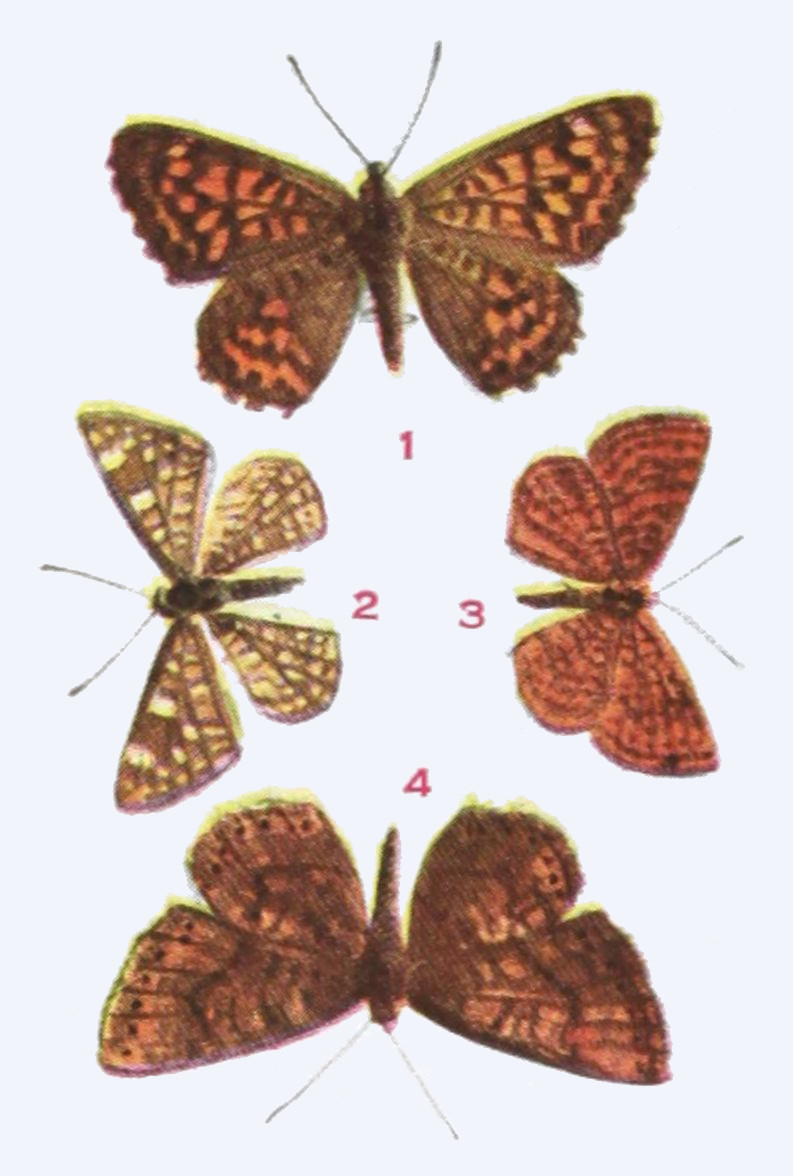
PL. LXXVIII
There are nearly fifty species of this genus found in the American tropics. There are but two species in the eastern parts of the United States, and two others in California. The figures we give will enable any one to tell apart the two species found in the Atlantic region.
(1) Charis cænius (Linnæus), Plate LXXVIII, Fig. 3, ♂ (The Little Metal-mark).
Very small, brighter red on the under side than on upper. Wings both above and below spotted with small steely-blue metallic markings. Common in Florida, ranging northward to Virginia and westward to Texas. Expanse 0.75 inch.
(2) Charis borealis (Grote & Robinson), Plate LXXVIII, Fig. 4, ♂ (The Northern Metal-mark).
Larger than the preceding species. Upper side sooty brown marked with blacker spots and a marginal and submarginal row of coppery red spots. On the under side the wings are light red with a multitude of small black spots arranged in transverse rows. The metallic spots of the upper side reappear below. Expanse 1.15 inch.
Range from New York to Illinois and Michigan and south to the Carolinas. Rare.
Genus APODEMIA Felder (The Mormons).
There are about ten species of this genus confined mainly to the Southwestern States and northern Mexico. Some, like the one we figure, are quite small, others are larger, spreading as much as 1.50 inch. They are rather gayly colored, usually with the wings on the upper side checkered or spotted with red, black, and white, and lighter on the under side. None of them have metallic markings on either side.
(1) Apodemia palmeri (Edwards), Plate LXXVIII, Fig. 2, ♂ (Palmer’s Mormon).
One of the smallest species of the genus, mouse-gray, spotted with white above; on the under side whitish gray, laved with pale red at the base of the fore wings, the spots of the upper side reappearing on this side. Expanse 0.75-0.95 inch.
Ranges from Utah to Mexico.
Genus POLYSTIGMA Salvin & Godman
There is thus far but one species known to belong to this genus, which is marked off from all others by the fact that the males have normally developed fore legs as well as the females, and thus are the “exception” in the family, “which proves the rule.”
(1) Polystigma nais (Edwards), Plate LXXVIII, Fig. 1, ♂, Type (The Many-spot).
The lower side of the wings is pale red mottled with buff on the hind wings; the marks of the upper side reappear below and stand out boldly upon the paler ground. Expanse 1.00-1.25 inch.
P. nais occurs from Colorado to Mexico, east of the Rocky Mountains.