THE BROWN OWL
Reading edition
ONCE upon a time, a long while ago—in fact long before Egypt had risen to power and before Rome or Greece had ever been heard of—and that was some time before you were born, you know—there was a king who reigned over a very large and powerful kingdom.
Now this king was rather old, he had founded his kingdom himself, and he had reigned over it nine hundred and ninety-nine and a half years already. As I have said before, it was a very large kingdom, for it contained, among other things, the whole of the western half of the world. The rest of the world was divided into smaller kingdoms, and each kingdom was ruled over by separate princes, who, however, were none of them so old as Intafernes, as he was called.
Now King Intafernes was an exceedingly powerful magician—that was why he had remained so long on the throne; for you must know that in this country the people were divided into two classes—those who were magicians, and those who weren’t. The magicians called themselves Aristocrats, and the others called themselves what they liked; also in this country, as in all other countries, the rich magicians had the upper hand over the rest, but still the others did not grumble, for they were not badly treated on the whole. Now of all the magicians in the country the King was the greatest, and no one approached him in magic power but the Chancellor, who was called Merrymineral, and he even was no match for the King.
Among other things King Intafernes had a daughter, who was exceedingly beautiful—as indeed all princesses are or ought to be. She had a very fair face, and a wealth of golden hair that fell over her shoulders, like a shining waterfall falling in ripples to her waist.
Now in the thousandth year of her father’s reign the Princess was eighteen, and in that country she was already of age. Three days before her nineteenth birthday, however, her father fell sick and gradually weakened, until at last he had only strength left to lie in his royal bed. Still, however, he retained his faculties, and on the Princess’s birthday he made all the magicians file before his bed and swear to be faithful for ever to the Princess. Last of all came the Chancellor, the pious Merrymineral, and as he took the oath the King looked at him with a loving glance and said:
‘Ah! my dear Merrymineral, in truth there was no need for thee to have taken the oath, for it is thy nature to be faithful; and it being thy nature, thou couldst not but be faithful.’
To which the pious Merrymineral answered:
‘To such a master and to such a mistress how could I but be faithful?’ and to this noble sentiment the three hundred and forty-seven magicians could not help according unanimous applause.
When they were quiet again the King said:
‘So be it, good Merrymineral, do thou always act up to thy words. But now leave, good men all, for I am near my end, and would fain spend my last moments with my daughter here.’
Sorrowfully, one by one, the courtiers left, wishing him their last adieux. He had been a good king to all, all through his long reign, and they were sorry that he had to leave them at last.
Soon they were all gone except the good Merrymineral, and at last he too went, his whole frame shaking with suppressed sobs; his body seemed powerless with grief, and his limbs seemed to refuse their functions. The King looked after him, carefully noticing whether the door was shut. Then he spoke:
‘My dear daughter,’ he said, ‘when I am gone be kind to every one, and, above all, cherish the Owl—do cherish the Owl—promise me to cherish the Owl.’
‘But how can I cherish the Owl?’ cried the poor Princess; ‘how can I, unless I know who he is?’
But the King only answered:
‘Dear Ismara, do promise to cherish the Owl!’
And he said nothing else for a long time, until at last the Princess saw that the only way to let him rest in peace was to promise, and she said:
‘I promise, dear father, but still I do wish I knew who or what the Owl is that I am to cherish.’
‘You will see that in good time,’ answered the King. ‘Now, my dear Ismara, I shall die happy, and you will be safe. If you had not promised—however, we will let that rest unsaid. Now wheel the bed to where I can see out of the window.’
The Princess did as she was told. Now from this you must not imagine that she was a very strong princess—for she was no stronger than most princesses of her age; but the old King, who was a very powerful magician, as I have told you already, made the bed easy for her to move. He might have made it move of its own accord, but he knew that it would please his daughter to be of service to him, and so he let her move it.
The view from the window was very fine. A dark wood grew in the foreground, and far away over the tree-tops were the blue hills, behind which the sun was just preparing to retire. And it seemed angry, the sun, for its face was dark and clouded, and its beams smote fiercely on everything, and gilded the tops of the autumn trees with a purer gold than their natural tint. But overhead the clouds spread darkly, and they reached in a black pall to the verge of the horizon, forming a black frame to the red-gold sunset; for only the extreme west was bright with the waning light.
The Princess sat on the bed beside the King, and the dying sun lit them both and fell with a ruddy glare on the King’s hard countenance, as if it knew that his work on earth for the day, and for ever, was done.
‘Is it not grand?’ cried the old King, as if the glorious sight warmed his blood again and made him once more young. ‘And is it not grand to think of the power that thou hast, my daughter? If thou but raise thy little finger armies will move from world’s end to world’s end. Fleets come daily from every land for thee alone; all that thou seest is thine, and utterly within thy power. Think of the power, the grand power, of swaying the world.’
But long before he had got thus far, the Princess was weeping bitterly—partly at the overwhelming prospect, and partly from her great grief. She seized her father’s hand and kissed it passionately.
‘My father, my father,’ she cried, ‘say not so; they are all thine, not mine, for thou livest still, and all is yet well.’
But the old King cut her short:
‘Dost thou see the sun? Look, its lower rim is already cut by the mountains. When its disc is hidden I too shall have joined the majority, and my soul will have left my body, and the power will be thine. But above all cherish the Owl. Never go out of its sight, for if thou do, some harm will happen.’
As he stopped speaking a flash of lightning lit up the sky, and the sullen roar of distant thunder followed.
From every church in the land the passing bell tolled forth and the solemn sounds came swelling on the breeze. Again came the flash of lightning, and again the thunder, and now the splash of falling rain accompanied and almost drowned the thunder. The sun’s rim was now almost down.
For the last time the old King kissed his daughter, as she hung weeping on his neck. Again the lightning came, but this time the thunder was drowned in a more fearful sound. Never before had the sound been heard, except at the death of the Princess’s mother. It was the passing bell of the cathedral of the town. And as its sound went forth throughout the whole land men shook their heads in sorrow, for they knew that the soul of the good King had left his body. Through the whole land the news was known—to every one except to the Princess.
For she lay on the bed passionately kissing the dead face—not yet cold in death—and calling on his name in vain; for the ears of the dead are closed ‘to the voice of the charmer, charm he never so wisely.’
Gradually the voice of the Princess died away into low sobs and her breathing came more regularly, and in spite of the tolling of the death-bell she slept, worn out by her grief. No one came near her, for at the Court no one was allowed to enter the royal presence without a command, whatever happened. So for a time the Princess slept on, clasping the still face to her warm cheek. But at last the death-cold of the face wakened her once more to the death-cold of the world. For a time her wakening dreams refused to let her believe the worst, but the stern reality forced itself on her. She raised herself on her two arms and gazed through the darkness at the white face that made her shudder when her longing eyes at last traced out its lines as a flash of lightning lit it up. She sprang off the bed with a wild impulse of calling for help.
But no sooner had she got to the door and had given the call than she once more fainted and seemed for a time lifeless.
When she came to herself again she was in bed in her own room. It was still night, and at the side of her bed a night-light was burning in a glass shade. She could not understand what it all meant; but her head did ache so, and she could not tell why they were making such a noise at the far end of the room. For you see she was lying on her back low down in the pillows, and so she could not see beyond the foot of the bed. However, she raised herself on her elbow and looked. For a short time she could see nothing, for the room was somewhat dark, as the night-light gave but little light But at the other end of the room a large fire was burning, and by its light the Princess saw a strange scene.
For in the middle of the floor she could make out a group of three ladies-in-waiting, who were struggling with a large black object—what it was the Princess could not see, but it seemed to be attempting to attack the Court doctor, who was huddled up in a corner with his umbrella spread out before him, and he was gradually sinking down behind it, giving vent to the most horrible groans and shrieks for mercy, and calling to the ladies to keep it off. However, in spite of their efforts, the ‘thing’ was gradually drawing them nearer and nearer to the poor doctor.
But the strangest thing of all was that the doctor’s face was lit up by two distinct rounds of light. It was just as if some one had turned the light of a bull’s-eye lantern on him, and this the Princess could not understand at all. However, she lay still and watched.
The doctor got farther and farther behind the umbrella until only his head appeared over the top of it. At last he shrieked:
‘Send for a regiment of Lifeguards—let them shoot the Owl—it is necessary for the health of the Princess. Owls are very bad things to have in bedrooms—they bring scarlatina, and they always carry the influenza epidemic. Lifeguards, I tell you, send for them.’ But still the ‘thing’ came nearer, and with an agonised shriek of ‘The Owl!’ he sank altogether under the rim.
This loud cry of ‘The Owl’ roused the Princess, and she remembered her promise to cherish the Owl. So she called to the ladies-in-waiting, and they, astonished, let go the thing, and the Owl immediately flew at the umbrella, underneath which the doctor was coiled up, and perched on the top. The Princess, however, thought it was rather rash to have promised to cherish the Owl if it was going to eat up her physicians in that reckless manner. However, the Owl did not seem aggressive, and only seemed as if it were waiting for further orders. The Princess determined to see if it would come when it was called, like a dog. So she called in a sweet, persuasive voice:
‘Come here, good Owl.’
Immediately the dark shape of the Owl flitted noiselessly to her side as she sat on the bed. The wind of its flight blew out the flickering night-light in spite of the glass shade. But the glittering eyes of the Owl lit up the whole room, so that there was no need of light. As it alighted on the bed it turned its eyes on the Princess as much as to say, ‘What shall I do now?’
But the fierce light of the eyes was softened as it turned to her, as if the Owl feared to hurt her with the blinding rays.
‘Cherished Owl,’ said the Princess, ‘why didst thou hurt the physician?’
The Owl shook his head; but the Princess could not understand whether he meant that he did not know why he had hurt him, or if he meant he had not hurt him. So the Princess told one of the ladies-in-waiting to remove the umbrella from over the doctor. But this was not so easy as it sounded, for the doctor held firmly on to the handle, and in spite of the united efforts of the three ladies-in-waiting he managed to hold on. At last the Princess lost patience.
‘Go and help them, good Owl,’ she said; and the Owl, overjoyed, flew to the doctor, and seizing the top of the umbrella flew with it up to the ceiling, and as the doctor still held on, he flew round and round, until the doctor, hitting the top of a cupboard, let go, and fell in a heap in the middle of the floor, where he lay half unconscious, repeating as he sat:
‘Orange juice for influenza; try a seidlitz powder and a blue pill, and keep the owls out of the room and take a warm bath, and—send for the Lifeguards.’
But the Princess did not seem inclined to send for them; and in truth it would have been rather awkward for the horses to get in, as the room was on the second floor.
So the Princess told the ladies-in-waiting to drag him out of the room, and they obeyed; but as he went he said: ‘Sleeping in unaired sheets causes rheumatism, sciatica, pleurisy, pneumonia and—owls;’ and as the door closed they heard him say, ‘Gregory powder and Epsom salts.’
The poor Princess, however, began to weep again, and the Owl sat perched on the bed-post at her feet, watching her with his bright eyes.
However, after she had cried thus for a long time, she thought it would be better to stop her tears, for they were all in vain, as she knew but too well.
So she rose from her bed; for you must know she had only been laid on her bed when she had fainted, and so she still had all her clothes on.
Through the window-blinds the light of dawn was already beginning to show itself. So the Princess went to the window and drew back the curtains, and let the bright sunlight shine into the room. A beautiful day was dawning after the last night’s rain, and the sun was rising brightly over the edge of the blue sea. For a moment, as she looked out, everything was quiet except the shrill chirp of a solitary sparrow that seemed to have awakened too early. From the chimneys of the red-roofed town below her no smoke was rising, for all in the town were asleep still.
Suddenly, with a rush, the morning breeze came from over the land behind her, and with the rustle of the wind everything seemed to wake and come to life once more. The solitary chirp of the sparrow was drowned in the flood of song that poured forth from the trees in the palace garden, and with the birds the rest of the living animals awoke, and from far inland the lowing of the cows was borne on the breeze, and now and again came the joyful bark of the shepherd’s dog as it recognised its master’s whistle as he called it to work again among the sheep, whose plaintive bleating came softly, as if from a distance, to the Princess’s ear.
Everything seemed joyful at the sight of the beautiful morning except the Princess, and she felt oh so lonely, for it seemed as if her only friend had gone from her for ever. And at the thought her tears began to flow afresh, for she felt very lonely, while everything else seemed to rejoice. But as she leant thus against the window-sill, with a great lump in her throat and the hot tears in her eyes, she suddenly felt a weight on her shoulder and a rushing wind waved her hair, and as she turned her head to see what it was, her face was covered in the soft brown feathers of the Owl, who had perched on her shoulder.
The touch of the Owl seemed to have driven away her grief, and she felt quite light and joyful in the beautiful sunshine. For it seemed as if the Owl had become a companion to her that would take the place of her father; so she leaned her head against the Owl, and her golden hair mixed with the dusky brown feathers, till each streak of golden hair shone again in the bright sunlight. And the Owl too seemed very happy. So for a time the Princess stood looking over the deep-blue sea.
Suddenly, however, a footstep sounded in the courtyard below, and the Princess drew back from the window, for a thought suddenly came into her head:
‘Oh dear,’ she said, ‘I have been crying such a lot that my eyes must be quite red, and my hair is all ruffled. This will never do.’ And as she looked in the glass she said, ‘Ah, just as I thought. Come, my cherished Owl, sit there on the crown on the top of the looking-glass frame and wait while I wash my hands and face and make myself tidy.’
The Owl did as he was told, and the Princess began to wash in cold water—a thing she had never done before—but she did not like to call to her ladies-in-waiting, lest they should see how red her eyes were. So she had to put up with the cold water, and very pleasant she found it, for it cleared the tear-mist out of her eyes and made her feel quite happy and cheerful again: ‘And I have heard,’ she thought to herself, ‘that washing in cold water is matchless for the complexion.’
When she had finished washing she went and combed her hair before the glass. For she was a very artistic Princess, and liked looking at beautiful things, and so she liked sometimes to look at herself in the glass. Not that she was in the least conceited.
So she combed her hair with a gold comb, and when she had finished combing it, she put on her gold circlet as a sign of her rank, and then she said to the Owl, who had been sitting patiently on the looking-glass blinking at her as if he quite enjoyed himself:
‘Now, cherished Owl, you may sit on my shoulder again.’
When the Owl was again in his place he blinked in the glass at his own reflection as if the light were too strong for him, and he shut his eyes and drew in his neck and lifted up one foot into his feathers, as if he felt quite happy and comfortable, and the Princess smiled at his happy look, for she seemed quite to have forgotten her sorrow in the company of the Owl.
So she, with the Owl on her shoulder, went to the window. Here in the courtyard already a large crowd had collected to catch a glimpse of the Princess if possible, so that it fell about that when they saw her they raised a mighty shout of joy and pity:
‘The King is dead,’ they cried. ‘Long live the Queen!’ And throughout the city far and wide echoed and re-echoed the cry:
‘Long live the Queen’; and it seemed as if the waves of the sea murmured the sound.
The Princess, however, held out her little hand to still the tumult, and as if by magic the cries stopped.
‘Good people all,’ she said in clear ringing tones, ‘I thank you for your good wishes, and I will try always to be worthy of them as my father was. For to-day, however, rejoice not; remember that the great King Intafernes, the founder of the kingdom to which we all belong, has but just left the earth—sorrow for him but a short time; joy will come soon enough for all.’
So the crowd, silent and pensive for a time, dispersed in groups. More than one of them asked what had been perched on the Princess’s shoulder, and those who had been near enough, said that it was an owl—though what it meant they knew not.
‘To me it seemed as if the head of the old King were looking over his daughter’s shoulder,’ said one of the listeners who stood on the outskirts of the crowd.
But she was only a little hunchback, and the rich citizens laughed at her, saying: ‘Tush, child—thy fancy is not sound! Or else before looking at the Princess thou didst look at the fierce sun, and the sun-spots in thy eyes caused thee to see it thus. It was but an owl.’ But the little hunchback held to her own opinion.
But while the Princess stood watching them depart, a tapping came at the door, and the Princess cried ‘Come in.’ A page entered and said that the Chancellor, Merrymineral, was below and requested audience of the Princess.
‘Let him be shown into the audience chamber to await me there.’
The page bowed and departed on his errand, and the Princess went to another door in the room and down the staircase that led from it to the audience chamber, and the Owl remained seated on her shoulder until they reached the room. When they got there the Chancellor had not yet entered, for the staircase from the Princess’s bedroom to the audience chamber was much shorter than that from the entrance hall, and then you see the Princess was much more nimble than Merrymineral, who was an old man, and she ran quickly downstairs whilst he walked slowly up. However at last he entered. As he came in the Princess said:
‘Good morning, dear Merrymineral. How is it you are so late? I shall have to fine you if you keep me waiting like this again. And now what do you want with me?’
The good Chancellor received her laughing reproach with his head bowed down. He heaved a deep sigh, and drew his pocket-handkerchief from his pocket and applied it to his eyes. As he drew it away the tears could be seen flowing fast down his withered cheeks.
‘I came,’ he moaned, ‘to console you for your great loss. I too,’ he continued in a voice choked with sobs, ‘I too am an orphan.’
It seemed funny to the Princess to see him weeping thus, and she could hardly help laughing at him, but her grief soon came back.
‘Poor Merrymineral,’ she sighed, ‘to you also it must be a sad blow, for you were always faithful and attached. But it was fated to happen thus, and you must really try and be comforted, for crying will not mend matters.’
The Chancellor began again:
‘The beloved King your father’; but his sobs choked him, and he hid his face.
‘The beloved King your father,’ echoed a loud voice, exactly mimicking the tones of the Chancellor, but where the voice came from no one could tell. The Chancellor started.
‘Did you say that?’ said the Princess.
‘Not the second time,’ answered Merrymineral.
‘Who could it be?’ said the Princess; ‘for there is no one in the room except the cherished Owl; and you can’t speak, can you, Owl dear?’
The Owl shook his head dismally. But the change that came over Merrymineral was most astonishing as his eye suddenly lit upon the Owl—for since his entrance he had not raised his eyes from the floor. He jumped backwards over three rows of seats, for you see the seats in the audience chamber were arranged in rows, and he alighted in a sitting posture on the other side. As he sat on the floor he looked up at the Owl in a terrified manner, then threw up his arms and fainted. The poor Princess did not know what to do, so she rang a bell that stood on the table in front of the throne. Several pages at once came in.
‘Just bring that man to,’ said the Princess.
The pages bowed low, and went and shook the Chancellor violently. He showed no signs of recovering, so one of the pages turned to the Princess and said:
‘May it please your Majesty, but the Chancellor refuses to come to, and we can’t bring him.’
‘So he refuses to obey my orders,’ said the Princess. ‘He must be punished for this. However, now go and get a bucketful of water and pour it on him. Perhaps that will bring him to.’
Now when she said he was to be punished, she was only joking, but she said it very gravely, so that many people might have thought it was quite in earnest. Meanwhile the pages departed to fetch the water. They soon came back and brought a large pailful.
‘You had better not throw it all over him,’ said the Princess; ‘just let it trickle over his face gently.’
So one of the pages began to do as he was told, but somehow—either he had a sudden push, or, as he said afterwards, the Owl looked at him, and startled him—he let the pail go, and all the water and the pail too fell over the unlucky Chancellor. This really did bring him very much to—much too much to, in fact—for he sprang up in such a rage that the Princess really wished herself out of the room.
‘You jackanapes,’ he screamed at the unfortunate page; ‘you ape, you boar, you cow, you clumsy monkey, I’ll be revenged on you.’
But the Princess, who had gained courage while he was screaming, said:
‘You will not be revenged on him.’
‘But I shall,’ he said.
‘Indeed you will not,’ said the Princess, ‘for he did it by my orders.’
‘Oh! he did it by your orders,’ said the Chancellor; ‘then I’ll be revenged on you too,’ and he began to move uncomfortably near to the Princess. But the three pages threw themselves on him and tried to drag him back, but he turned suddenly on them.
‘What,’ he said scornfully, ‘you try to stop me—ye frogs! Ah! a good idea—by virtue of my magic power I command you to turn into water-rats; then perhaps the Owl there will eat you up.’
No sooner said than done, and the three pages instantly became water-rats, squattering in the water that was still in a pool on the floor.
Somehow the Princess did not seem to be at all frightened at this; she was only very angry.
‘I thought I told you not to hurt those pages.’
‘Who cares what you say?’
‘Dear me,’ thought the Princess, ‘he is getting excessively insolent—I shall have to be severe with him in a moment.’ So she said:
‘Turn those pages back again.’
‘I shall not.’
‘Then leave the room.’
‘I shall not.’
The Princess did not know what to do; he was really very rude, and he was walking towards her evidently intending to attack her. When he was within ten feet of her he stopped, and though he tried to get nearer he could not.
‘Ha! ha!’ he cried; ‘you think to keep me off by magic, but it is not so easy, I can tell you. By virtue of my magic power I command you to turn into a mouse.’
But the Princess, leaning her head against the soft feathers of the Owl, only smiled, and did not turn into a mouse at all.
The Chancellor seemed perplexed.
‘Is that not enough for you?’ he said; ‘I thought I told you to turn into a mouse.’
But the Princess smiled calmly and said:
‘Do you suppose I am going to do anything of the sort—you have forgotten your manners to speak to your Queen thus. I believe there is a fine of five shillings for any one who speaks to the King or Queen without saying “Your Majesty.” You had better pay it, Sir Chancellor, and turn those pages back again, or I shall have you turned out of the kingdom.’
But the Chancellor laughed. ‘You can’t send me out if you wanted to. Meanwhile I shall not turn those rats back, for if I am not much mistaken your Owl there will carry them off.’
It really seemed as if the Owl were going to obey him, for greatly to the Princess’s surprise it sprang off her shoulder and seized the three rats, one in each claw, and one in its beak—but it returned at once to her and laid them squeaking on the table in front of her—but no sooner did they touch the table than they turned into men again just as quickly as they had become rats. When Merrymineral saw this he became perfectly frantic, and tried in vain to get at the Princess—he even went back a little and tried to run at her—but it was no use, for no sooner did he reach a certain spot than he was suddenly stopped, just as if he had run against a wall. At last he became so frantic that the Princess could stand it no longer. So she said:
‘Will you be quiet, you naughty old man?—leave the room or I will send for the police.’
But Merrymineral answered:
‘Oh, send for the police and the soldiers and sailors and candlestick-makers.’
So the Princess rang the bell that stood on the table: a page at once appeared at the door.
‘Send for a policeman and ask him to step this way.’
The page looked astonished, but he saluted and left the room. Almost immediately a policeman came in—for you see there was one always on the palace steps. He entered the room with a low bow.
‘Take the Chancellor out of the room,’ said the Princess, ‘and put him in prison for three days.’
But the policeman shook his head.
‘Excuse me, mum—I mean your most gracious Majesty—but it is against the law to imprison a member of Parliament, much less a chancellor.’
The Chancellor laughed sarcastically.
‘Oh, is it?’ said the Princess; ‘never mind, take him into custody; I depose him—he is no longer Chancellor.’
Merrymineral looked astonished, but the policeman cleared his throat and said:
‘Come, I say, young fellow; will you go quietly, or shall I make you?’
‘Oh, make me, by all means,’ answered Merrymineral.
So the policeman advanced and held out his hand to take him by the collar, but had no sooner touched Merrymineral than he fell to the ground as if he had been thunderstruck.
The Chancellor smiled. ‘I told you so,’ he said.
The Princess was now thoroughly nonplussed. However, she rang the bell again. Again the page appeared.
‘Summon the Lords of the Council; let them come here at once.’
Almost immediately afterwards the lords appeared. As they came in each one bowed profoundly to the Princess. But in spite of their grave appearance they could not help looking astonished at the policeman, who was lying on the floor, and at the three pages who were still sitting on the table—for as they had not yet been told to go they could not depart.
But each one took his seat without questioning. Last of all came the Court doctor, who looked in an alarmed manner at the Owl—nevertheless he took his seat.
When all was quiet the Princess began to speak.
‘My lords,’ she said, ‘I have been obliged to assemble you on the first day of my reign; but the matter is a very grave one. I have found it necessary to dismiss the Chancellor, for these reasons: first, he attacked these three pages who were executing my bidding; next, he attacked me; and lastly, he attacked the law, in the person of the policeman there, whom he knocked down. Now I ask your advice as to how I am to get rid of him, for he refuses to leave the room at my command.’
So spoke the Princess, but before any one could answer Merrymineral spoke:
‘My lords,’ he said, ‘are we, we, the lords of the kingdom, to be governed by this schoolgirl, who is not even a magician as we are? What good has she ever done us? What power is to keep us from deposing her and electing as a ruler one of ourselves?’——but before he could finish a perfect uproar of shouts of rage interrupted him.
The Princess put her fingers in her ears to keep out the sound, and when the lords saw that the noise was annoying her they stopped at once. When they were quiet the Princess spoke again:
‘What he has just said is right,’ she said; ‘I have no right to reign over you, for I am but a girl. Do ye therefore elect a ruler.’
For a moment all was silence in the Council, but all eyes were turned on a lord who stood next to Merrymineral in rank. He was a portly man, and a great magician too, though his power was not quite so great as Merrymineral’s. When therefore he saw that all eyes were turned on him, Lord Licec, for so he was called, rose.
‘Your most gracious Majesty,’ he began, ‘although you had no need to command us to elect a ruler, we are of course bound to obey your commands, whatever they are. I therefore speak, giving my vote, and I believe the vote of all the rest of the assembly, that you shall be our ruler according to the oath which we sware to your father.’
And then turning to the rest of the assembly he said:
‘Am I not right, my lords?’ and with one voice they answered:
‘We will die for our Queen Ismara.’
Only one voice objected, but as that was Merrymineral, no one noticed him.
So the Princess rose and thanked them for their confidence in her, though, to tell the truth, she had known all along what they would say. That done she said:
‘And now what are we to do about turning this man out? for he refuses to go of his own accord.’
No one could suggest anything better than to send for the Lifeguards and let them carry him off. But before this was done they decided to try to persuade him to go. But it was of no use, for he stood on the spot where he had stopped, with his arms folded and his hat on, looking down at the ground in a brown study, and he took no notice of anything they could do, even though they rang the bell close to his ear. Now he did no particular harm as he stood there, but you see no one could tell whom he might attack next. So they determined to send for the Lifeguards as a last resource.
So they were sent for, and in a short time they came, although they left their horses outside in the courtyard. Fifty of them were then marched into the hall and they were ordered to move the man out. So they divided into two parties of twenty-five each, and they put a rope round him, and each body of twenty-five took an end of the rope and pulled, but it was no good, for he took no more notice of the pulling than if he had been Samson or any other strong man. So the fifty gave up the attempt in despair; the only thing to do seemed to be to cut him to pieces. So they drew their swords and hacked at him, but it was no use: the swords bent or broke just as if they had been bulrushes or paper, and still Merrymineral took no notice in particular. So they gave up the attempt in despair when they had broken up all their swords. However, they did not give in, for they called in the best horseman in the regiment and told him to charge on horseback with his lance in rest. So the soldier rode in on his horse; this was not so difficult as it may seem, for the council chamber was on a level with the ground, and a lane was opened in between the chairs to where Merrymineral still stood with his arms folded.
At the word of command the soldier rode at full speed towards Merrymineral, aiming his lance at the centre of his face—that is his nose. His aim was true, and the lance hit fair, but it might just as well have been made of macaroni, for it crumbled just as a stick of that delightful eatable would do if you ran it against a wall. The horse, however, swerved just in time, although it pushed against him in going by; but even this made no difference to Merrymineral. As a last resource they suggested putting a lighted match under his nose. Whether this would have succeeded or not I can’t say. But just at this moment Merrymineral seemed to wake up again.
‘Ah,’ he said, ‘I see you have not yet managed to get me out of the room. However, as your soldiers have been practising on me for some time past, I think it only right that I should try my hand on them a little. I used to be thought rather strong in the arms at one time, and I have cut down a good many trees in my time. Just see how you like that,’ he said to the man on the horse as he swung his umbrella round his head and brought it down with a tremendous thwack on the horse’s side. In fact he hit so hard that the horse and man were knocked right through the window into the courtyard below. With three more blows he knocked twenty more of the men through the same window, and the rest made their escape as fast as they could by the door.
‘I see I have not quite forgotten how to clear a room yet,’ he said, as he once more folded his arms in the same attitude and relapsed into silence.
‘What am I to do?’ said the poor Princess, wringing her hands and almost crying with vexation.
A voice came from the far end of the room, and every one turned to see who it might be. And all saw it was the Court physician who spoke. ‘If I might be allowed to make a suggestion,’ he said, ‘I would say that the best thing your Majesty could do would be to request that gentleman who is sitting on your shoulder to turn him out. From my own experience I should say he was very competent to perform such a task. And if I might be allowed to add yet another suggestion it would be, “to be well shaken before taken,” as they say in prescriptions.’
As he said this an extraordinary change came over Merrymineral. He pressed his hat on his head, put his umbrella under his arm, and began to put on his gloves in such a hurry that he mistook the left for the right hand. As he did so he said:
‘Do you know, I can’t stop any longer; so sorry, but I have an engagement and I am rather in a hurry. Good-day.’ And he began to walk quickly towards the door. But the Princess had already whispered to the Owl, ‘Catch him, dear Owl.’
And however fast he went the Owl caught him up, and taking him by the middle of his coat-tails—and I am bound to say some of his skin too—he shook him violently, and flew round and round the room banging him violently against any high piece of furniture that was convenient.
‘O-o-o-h,’ shrieked the wretched man, ‘I say, do you know you’re tearing my best coat, and your beak is awfully sharp? O-o-ouch,’ and he filled the room with his shrieks. After they had continued like that for some minutes the Princess said:
‘I think he has been punished enough now, cherished Owl, so let him down.’
The Owl did as he was told, not, however, without giving him a sly tweak with his bill that must have hurt him a good deal.
‘I’ll be revenged on you,’ roared Merrymineral; ‘you’ve spoilt my Sunday coat, and I shan’t be able to afford another for I don’t know how long. I’ll be revenged on you.’ And he took out a red pocket-handkerchief and began to suage the blood that was coming from the bite, all the while abusing the Owl and the Princess and threatening to be revenged.
‘You had better be quiet and go,’ she said.
‘I shall not.’
‘Oh, very well,’ she answered, perhaps you would like to try the Owl again.’
At the same time the Owl gave him such a look from its gleaming eyes that he turned first red and then white with fright. He made a dash for the window, and he was in such a hurry that he left his umbrella and one of his gloves behind him.
He jumped right through the window high into the air, and as soon as he got outside, strange to say, he began to burn furiously, and he went gradually up into the sky like a fire-balloon—just as when a piece of tissue paper is put on the fire, if you are not careful, it will fly blazing up the chimney.
They watched him out of sight, and then the Princess said with a little sigh of relief:
‘That’s an end of him at last.’
But the Owl shook his head—he knew better.
When he was thus at last got rid off the Princess said to the physician:
‘How can we ever thank thee enough, good doctor, for thy timely suggestion!’
‘Oh, your Majesty,’ said the blushing doctor, ‘experience does it; and I had plenty of that this morning. Do you know, I think I shall never be free again from pain—although I have bathed in opodeldoc and arnica, and I am clothed from head to foot in Court plaster.’
The Princess smiled and said:
‘I am afraid the Owl is a little over-vigorous in such matters; however, I will give orders to the Court apothecary to supply you with remedies at my expense until you shall be cured.’ She then said to the three pages who still sat on the table:
‘I must ask you to depart now as Parliament cannot carry on business with strangers in the house. However, ye are, I believe, pages; I will turn over a new leaf and will advance you each a step in rank. Now, however, go.’
Thanking her profusely they went. When they had gone the Princess turned to the Councillors and said:
‘As there seems no further need to keep you, I will detain you no longer.’
Having her permission the Councillors left the hall. Last of all was Lord Licec, and he remained as if hesitating whether to go, or to stay and speak to the Princess. She, noticing his hesitation, said:
‘Ah, Lord Licec, hast thou something to ask me?’
The old lord made answer:
‘I would ask your Majesty’s permission to enter the room of the late King, your Majesty’s father, for, as you are aware, it is against the law to enter the royal presence without the royal permission.’
‘You have my permission of course; but ought not some preparations to be made for the funeral?’
Lord Licec answered:
‘They are already made. For as the late King had announced his intention of dying yesterday at half-past six P.M., there was ample time.’
‘Let us then go together to the room, my lord,’ said the Princess.
So they went together, the Princess leaning on Licec’s arm, and the Owl sitting on her shoulder.
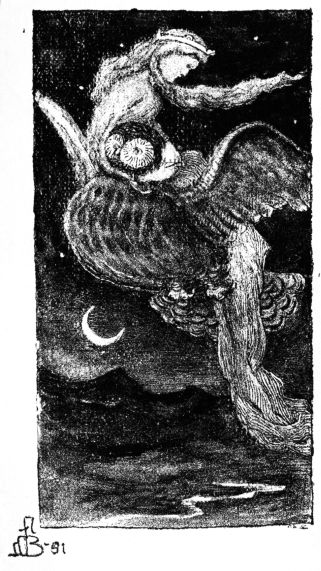
The guards of the room saluted as they passed in, but what was their astonishment on entering to find that the King had disappeared. When they asked the guards who had come into the room during the day, they replied that no one had been near the room during their watch, and the guards of the watch before said exactly the same thing. All over the palace inquiries were made, but to no purpose, and the rumour gradually spread to the town, and throngs of anxious citizens flocked about the palace gates to ask, but neither they nor any one else ever heard what had become of him, and it is my opinion that the King himself is the only person who knew anything about it. It came out in the course of inquiries that when the attendants had rushed in on hearing the Princess’s call for assistance the night before, they had not seen the King on the bed, but in his place had sat an enormous owl, and this owl had insisted on accompanying the Princess wherever she went.
This was the first time that the Princess had heard of how the Owl had come to her, but still she had known all along that the Owl was the one her father had made her promise to cherish. But there were ill-natured people who said that it was not so very unlikely that the Owl had eaten the King up, but the Princess only laughed and said:
‘How could the Owl eat a king up when the poor thing has so little appetite that it only eats very small pieces of meat off my golden fork at dinner?’
And so the Owl remained with the Princess: during the day it always sat on her shoulder, or took short flights round her head, and at night it slept on the foot of her bed.
So six weeks glided peacefully away, and everything prospered; but one day a terrified messenger rode into the city at full speed, and the message that he brought was this.
Merrymineral, who, as the Owl had said, was by no means done with, had been inciting the people of far-off lands such as Mesopotamia and Padan-Aram and Ireland to rebel, and he was now marching against the Princess at the head of an immense army, laying waste the country for miles around. At the rate he was coming, however, it would take him a fortnight to get near the country round. So you see there was no immediate danger; still an enemy’s army could not be allowed to remain in the country unopposed. So the Princess gave Lord Licec the order to assemble the army, and, as you may imagine, it was an immense one when it did assemble. I can’t say how large it was, but if you could have stood on a hill in the centre of the town you would have seen nothing for miles around but shining silk banners and glistening helmets and lances. Never before had the world held such an army, and it never will again. Yet this army even was hardly as large as that of the enemy. The command of the army was given to Lord Licec, for he was well known to be the most prudent man in the kingdom.
Three days passed till the last of the army had started, and all the while the Princess stood at the window and watched them march along the winding street below, and the knights and men-at-arms were inspired with fresh courage at the sight of such a princess as they had to defend, and they cheered so loud and long that it seemed like the continual roar of the sea beating on a rocky shore, sometimes rising, sometimes falling, but always sounding.
The Princess indeed felt quite lonely when they had all gone, even though their shouts did make her head ache. However, she consoled herself by riding all day towards the army, and returning at night to the lonely town. So she occupied three days; and the Owl always flew over her head, protecting her from the sun when it was too hot, or else sitting on her shoulder, or on the horse’s head, although the horse did not like it at all.
For three days no news came, but on the fourth as the Princess was riding out with her ladies-in-waiting she saw at a great distance in front of her along the straight white road a cloud of dust that was coming swiftly towards her. As it came nearer she could see the glint of armour, and soon she could plainly see the form of an armed knight galloping at full speed towards them. He came so fast that they had to rein their horses to one side that they might not be run down. At first he did not seem to know who the Princess was, or perhaps he was going so furiously that he could not see; at any rate he had almost got past them before he recognised her. As soon as he did, however, he drew up, but so sudden was the action that the horse first sank back on his haunches, and then bounded so high into the air that the marks that his hoofs made when he alighted on the ground again, were a foot deep in the hard road. As soon as the plunging of the horse stopped and the Princess could make herself heard she said:
‘What news, Sir Knight, from the front, that thou ridest in such haste?’
‘But bad news, I fear,’ answered the knight.
‘What say you?’ said the Princess; ‘bad news, and with such an army as ye had? has some fresh rebellion broken out among the men?’
‘No rebellion, but plain fighting has beaten us—but what can we do against such foes? This Merrymineral, alone, rides on a green dragon, and with one stroke of his sword he kills a hundred men. Myself I charged him with my lance, but as it struck his shield it broke in pieces as if it had been made of glass; and it was fortunate for me that my horse carried me past him before he could strike me, for I saw him myself cut the Knight of Pendred in half, as you would cut a radish. And if we slay a thousand men during the day he restores them in the night. So we have gradually been driven back, till after three days’ fighting the army remains at Arecarp. Thence I started at eight this morning to hurry the reinforcements from Britain and Gaul.’
‘Alas! they are still at three days’ march from here, though they are marching night and day. But thou saidst the army was at Arecarp, and that thou didst start to-day at eight in the morning. That is impossible. Arecarp is twenty-four hours’ journey for a fast horse, and it is now but twelve o’clock. Not even the horse that I ride could go faster than that, though he is said to be the fastest horse in the world, except Selim, the horse of the Prince of India. However, no time is to be lost. Sir Knight, will you escort these ladies back to the town, and rest for a while?’
‘But what will you do, your Majesty?’
‘I must ride forward to Arecarp.’
‘To Arecarp! Your Majesty, what will you do there? The battlefield is no place for a girl.’
‘Nevertheless I must go, for my place is with the army.’
‘But if you are killed what will happen to your people without their Queen?’
‘What do they do now without their Queen? Besides once before the cherished Owl has defeated this man and he may do it again. If he does not, no power on earth could save me from death, for the army is being gradually defeated.’
‘But your Majesty could send the Owl in a cage against the enemy.’
‘I promised my father never to go out of its sight—no, I must go.’
‘I beseech you then, your Majesty, to allow me to accompany you, for the road to the camp is full of danger.’
‘But your horse is tired, and even if he were not he could never keep up with me.’
‘But if you will excuse the contradiction, I think I shall.’
‘Well then, have your own way, but mark me, if you lag behind I shall not stop. However, we are losing time. Let us go.’
And they set off—the Princess ignoring the entreaties of the ladies that she should not go.
The Princess immediately started at the full speed of her horse, expecting that the knight would soon fall behind; but no, he galloped at her side as if the speed were not more than usual, and his great black charger seemed to enjoy the exercise as though he had not already galloped over a hundred miles that morning.
The Princess could not understand how it was, but she thought he would soon get tired and fall behind, but an hour passed and he showed no signs of being fatigued. So she leant over her horse and whispered softly in his ear. Instantly the horse bounded forward more swiftly than ever—so fast, indeed, that she could hardly keep her eyes open against the wind, and her golden crown was suddenly whisked away, and her beautiful golden hair streamed far out behind. Still the knight kept up, and seemed not the least distressed at the speed. The Owl meanwhile was flying far overhead, but she was not at all surprised at his keeping up, for nothing seemed impossible to him. After they had been riding thus for nearly two hours they came to a place where the path was crossed by a river, and here the Princess thought it advisable to stop and rest a moment and to let the horses drink. So she called to the knight to stop, as she was going to get off for a moment, and he at once sprang off his horse, and coming to her saddle-bow held her stirrup for her to dismount. When she was off she leaned against a tree looking at the horses as they drank eagerly from the river, and then came out to browse for a moment on the bank. Then she went to where the knight’s horse stood, and patted him on the neck, for you see he was not a very fierce-looking animal, and she was not at all afraid of him.
‘He’s a wonderfully swift horse, Sir Knight,’ she said suddenly, ‘and I believe there is no other horse in the world as swift—not even Selim—the horse I spoke about—that belongs to the Prince of India.’
The knight nodded.
‘He is a good horse, but he is no better than Selim, your Majesty, for I know Selim very well.’
All this while he had kept his vizor down, and the Princess had been too polite to ask him to raise it, even though it was rather rude of him to keep it down. So she could not tell who he was. She knew all the knights of her own kingdom by sight, as well as most of her allies, for you must know that a great many foreign princes had sent her troops to assist her against the rebel. She looked at the device on his shield; it was a crowned tiger, but that did not help her, for she did not know whose crest it was. So at last when she could bear her curiosity no longer, she determined to ask him. So she said:
‘Sir Knight, should you think me very rude if I were to ask you whether you are under a vow of hiding your face?’
‘I am bound by no such vow; but why do you ask, your Majesty?’
‘Because ever since I have seen you you have kept your vizor down, and I thought perhaps it was on account of some such vow.’
‘Oh, I beg your pardon a thousand times, your Majesty,’ said the knight. ‘But I did not remember that I had let it down, for you see I look through its bars without noticing the difference. But I hope your Majesty will pardon the absent-mindedness,’ and he raised the vizor, at the same time bowing low to her. But it was now the Princess’s turn to be confused, for she saw before her Sir Alured the Emperor of India, a prince nearly as powerful as herself. She blushed with shame and then said:
‘Oh, Sir Knight, I mean your Royal Highness, it is I who should crave your pardon, for all the while I have addressed you as “Sir Knight,” instead of as “your Majesty.” But I am very sorry.’
But Sir Alured said:
‘Nay, your Majesty, you have the right to call me what you will, for I am always your humble vassal.’
‘My ally, you should say, your Majesty.’
‘I am always your servant, not your ally, your Majesty.’
‘Then I fear you will soon be the vassal of a queen without a kingdom; and if this Merrymineral prevail over me, I fear he will punish you for having aided me.’
But the Prince said:
‘All is not yet lost, your Majesty, and whatever happens your Majesty will always have a protector while I am alive.’
The Princess smiled.
‘Ah! you mean the cherished Owl. You will always protect me, won’t you, Owl?’ she said, looking up at the Owl who was seated again on her shoulder. And the Owl nodded his head.
She looked at her watch just then. ‘Why,’ she said, ‘we have been here just ten minutes, and it is time to start again, if you are rested sufficiently.’
So he helped her to mount, and they crossed the river. It was not very deep, but still she got the skirts of her dress quite wet, for the water was high enough for that.
However, the gallop in the hot sun on the other side soon dried them.
In an hour and a half they were on the top of a hill from which they could see the town of Arecarp in the valley beneath.
The sun was shining brightly on the tents of the army as it lay round the town, and at some distance the camp of the enemy appeared. But still all looked peaceful.
The Prince gazed carefully at the armies. After a moment he said:
‘There has been no fighting since I left the city this morning, nor has the position altered at all. I fancy Merrymineral has sent ambassadors to demand surrender from Lord Licec.’
The Princess smiled.
‘He will never surrender,’ she said.
‘Nor will any of us, your Majesty,’ added the Prince. ‘However, let us descend the hill.’
Down the hill the road lay through a deep gorge, so deep that the sun did not penetrate it, and it lay in delicious shade. The sides of the valley were lined with the silver-barked birch, below which grew nodding foxgloves, and as they went slowly down the steep path, ever and anon a rabbit would scuttle out of the grassy track to a safe distance in front of them, where it sat on its haunches with its little ears pricked up, smelling at them anxiously as they came near again, and then it would scutter along into the thick rank grass to its home.
So they went slowly down the path until they came once more to the level ground, and they were again able to gallop on.
Soon they reached the town, and clattered through the cobbled streets to the market-place, where Lord Licec had his head-quarters. But the market-place was crowded with soldiers and knights who were bargaining for food, so that it was by no means easy to get through the crowd. However, as soon as they got near the place, the soldiers recognised the Princess and began to cheer, and immediately an avenue was formed up to the door of the council-house, and the Princess rode smiling through the throng, followed by the Prince.
The news of her arrival ran through the whole camp, and immediately such a shout went up from the men that the enemy thought they were preparing for battle, and they made ready to resist the attack. At the door of the council-hall Lord Licec was waiting with the rest of the captains of renown, and they followed the Princess upstairs to the council-chamber.
As soon as they were seated the Princess asked for the latest news. She was told all that had happened, and when she had heard it she dismissed the Lords of the Council, all except Lord Licec and the Prince of India, who were to stay and dine with her, and she gave orders that the dinner should be brought as soon as possible, for to tell the truth she felt rather hungry, as she had had nothing to eat since breakfast-time.
Now when the Princess had finished giving her orders about the dinner, Licec could not refrain from asking her why she had come.
‘Was it not rather foolish,’ he said, ‘to hazard your life for nothing? for of a truth you are——’
But the Princess put her finger on his mouth.
‘I will not be bullied by you, my lord, even though you are old enough to be my father. I know what you were going to say—that the battlefield is no place for girls. Now I won’t be called a girl, for I’m nineteen, you know. His Majesty the Emperor of India there insulted me by calling me a girl, and I have not forgiven him yet. Besides you’ll spoil my appetite for dinner if you lecture me. It always does; so do be quiet now, at any rate till after dinner.’
So Licec had to be quiet, and they talked about something else till dinner-time.
Just as they had finished, a frightful shouting outside made them drop their dessert knives and run to the window, but as the window did not face on to the street they could not tell what was the matter. So the Princess rang the bell, and when the servant appeared she asked him what was the cause of the shouting.
‘May it please your Majesty, ambassadors have arrived from the enemy and would speak to you.’
‘Show them this way and send at the same time for the Lords of the Council.’
So the servant went, and in a short time a heavy stumping was heard on the stairs. Suddenly the door burst open and the ambassadors entered. They were a rather remarkable pair of ambassadors, although they could hardly be said to pair well. For the one was an enormous giant with a long beard, dressed in leaves mostly, and so tall that he could not stand upright in the room; in his hand he carried an enormous pole, from the end of which a spiked ball dangled. The other, however, was very nearly his opposite in everything. For he was very small, a dwarf in fact, and he was dressed in very tight yellow armour, and from the top of his helmet a crest of red roses hung down to his saddle—for you must know he had insisted on not getting off his horse, or rather pony, for that too was very small—in fact it just fitted the dwarf.
As soon as the Princess had recovered from her astonishment, she rose from her seat and said:
‘Are you the ambassadors from the rebel Merrymineral?’
The dwarf replied:
‘I don’t know anything about the rebel part of the business, but we are the ambassadors from Merrymineral, whom we are bound to serve for a certain time. But who are you, I should like to know, and what right have you to speak to me in this insulting manner? D’you think I’m here to be insulted by you? If you think so, I’ll tell you point-blank I’m not—so there.’ And in the rage he had worked himself into he began to spur his steed till it jumped off the floor so high that it knocked his head against the ceiling.
The Princess was not used to being treated like that. However she was not at all angry at it—she only laughed at his misfortune, which made him all the more outrageous.
‘How dare you laugh at me?’ he screamed; ‘who are you, you minx, you minx, you lynx—you——’
But the Princess did not listen to him. She turned to the giant, who at any rate was quiet, and said:
‘Will you not take a chair until the Lords of the Council arrive?’
The giant looked at her in stupid astonishment.
‘What shall I do with the chair when I’ve taken it?’ he mumbled.
‘I mean you to sit down on it, of course,’ said the Princess.
The giant growled out in reply:
‘Well, I never sat on a chair before, but to please you I will.’
So he sat down, but as he was not used to sitting on chairs he sat down on its back; but it was only a small cane-bottomed chair, and as he was very big, and the chair was very small, the result is easily foreseen, for the chair collapsed under him as if he had sat on a top-hat, and he reclined comfortably on the floor, where he remained for the rest of the time.
‘I think I’ll stop where I am,’ he said, when they offered him a wooden stool to sit on, ‘for you see I’m not used to chairs.’ So they let him stop where he was.
One by one the Lords of the Council began to arrive; they looked curiously at the ambassadors but said nothing. When they were all arrived the Princess said to the dwarf:
‘Now if you will state your message we will listen.’
So the dwarf snarled in a bad-tempered voice:
‘I shan’t tell you—you aren’t the commander-in-chief of the army, are you?’
‘No, but I am the Queen of the Western World.’
‘Oh! you’re the Queen of the Western World, are you? Well, you won’t be Queen of the Western World long, if you don’t mind your P’s and Q’s. The king Merrymineral sent me to say that if you don’t marry him and make him king, he’ll kill the lot of you and make himself king in spite of you—so there; and I’m to wait for an answer.’
After consulting the Council for a moment the Princess said:
‘Of course I shan’t marry him—how could he be so ridiculous as to think so?’
The dwarf laughed.
‘That’s your answer, is it?’ he said. ‘I thought so. I say, Gog, have you written it down?’
But Gog had gone to sleep. So the dwarf pricked him with the end of his lance.
‘I say, Gog,’ he said, ‘she’s given her answer and you haven’t written it down, and I’ve forgotten it already. Just say it over again, Queen, will you? and not too fast, or Gog here will never get it down.’
The giant now drew from his pocket a very soiled and crumpled half-sheet of a copy-book and began to write from the Princess’s dictation.
‘Of course I should not do anything so——’ Here he stopped.
‘How do you spell “ridiculous”?’ he said.
‘With two “k’s,” of course,’ said the dwarf; ‘even I know that, though I can’t write.’
When he had finished he handed it to the Princess:
‘Just sign your name, will you?’
The Princess signed her name, but she could not help seeing that the writing was very bad and the spelling was awful.
‘Why didn’t they send some one who could write better? Why! that “r” is more like a “k” than an “r”.’
But the giant shook his head mournfully.
‘They hadn’t got any one else in the army who could write except Merrymineral, and he was afraid to come.’
‘But weren’t you afraid to come?’ she said.
The giant shook his mace round so violently that it grazed the helmet of the dwarf, and cut his crest of roses off.
‘Whom am I to be afraid of?’ he growled. ‘I could kill your whole army single-handed’; and he laughed loud and long.
But just at this moment the Owl, that had been sitting on the floor behind the Princess’s chair, flew up on to her shoulder, and no sooner did the giant see the Owl than he jumped up from the floor, where you remember he was sitting, and he was in such a hurry that he knocked a hole in the plaster of the ceiling with his head.
‘Come, I say, you know,’ he said, ‘I can fight anything in reason—but I’m not going to tackle that, you know; besides, we’re ambassadors, and you can’t hurt us. I’m going’; and he rushed out of the room as fast as he could, and the dwarf followed him as fast as he could make his horse gallop, and they never stopped till they reached the camp of Merrymineral. For they were very frightened, you see.
After they had gone the Princess again dismissed the Councillors, and when they had gone, she said to Lord Licec and the Prince, who by the bye still remained:
‘Now let us finish our dessert’—for the ambassadors had come in right in the middle of it.
After a moment the Princess said:
‘How absurd of him to think I would marry him—why, he’s old enough to be my great-grandfather.’
But suddenly she became grave:
‘But perhaps I ought to have thought before I gave the answer. Would it not have been better for my people if I had consented? for then he would kill no more of them.’
But the Prince became quite angry at such an idea. ‘It’s absurd,’ he said. ‘Why, as soon as he had married you and become king he would murder you and then kill just as many of your people as he will now; besides, who knows that we may not still conquer him?’
The Princess turned to Lord Licec:
‘What do you say, my lord?’ she said.
‘I think just as the Prince of India—for even if he did not murder you he would oppress the people without mercy, and besides, your people would never allow you to marry him, so that is out of the question.’
The Princess gave a sigh of relief.
‘Since you say so, Lord Licec, it must be right; besides, I don’t think I could ever marry him—he is such a very unpleasant sort of man.’
And the Prince answered:
‘You are quite right there’; and he seemed quite happy again.
Soon after it became evening, and Lord Licec had to go out to look after his army, and the Prince too went to see that his men were all prepared for any night attack—for his men were right in the very front of all, and so they were quite close to the enemy, who might at any time begin an attack.
So the Princess was left all alone with the Owl, but she did not feel lonely with him, for he was very sociable, and would do anything that he was told to do. So they played hide-and-seek till it was too dark to see any more, and then she went to bed and slept soundly till the rays of the sun falling on her face the next morning woke her up. She was soon dressed, and when she had finished she went into the next room, where she found Lord Licec already awaiting her.
‘What does your Majesty intend to do this morning? for I shall not be with you, as I am going to order the army to advance to the attack, and so your Majesty had better stay within the town for the rest of the day.’
‘Indeed, I shall do nothing of the sort,’ she answered. ‘I am going to lead the army to-day to see if we cannot regain some ground, for I had rather die fighting than be driven back like this, so please don’t say I mustn’t go; besides, the Owl will protect me; he promised to; didn’t you, Owl?’ and the Owl nodded.
‘But they may shoot the Owl with their arrows, and then——’
‘But the Owl before now has conquered Merrymineral himself, and he may still do it. Oh, please don’t tell me not to go. If you’ll only let me go I’ll promise to keep near the Prince of India, and he’ll protect me, even if the Owl can’t.’
‘But the Prince of India is always in the thickest of the fight, and you will be in much greater danger if you keep near him.’
‘Oh, never mind the danger; do let me go.’
And she begged so hard that Lord Licec had to give in. She put on a breastplate and a sword, but she would not put on a helmet, for she said that it made her head ache, and that no one would know who she was if she covered her face up. So she only wore a gold circlet on her head, as she usually did, and besides this she carried a silver shield with the royal crest on it, and a small lance just like a knight’s spear, only not so heavy, and thus mounted on her white horse she rode to the very front of the line of battle, and there she found the Prince of India at the head of his men.
They had already furled their tents and were quite ready to begin the battle as soon as the others were ready.
The Prince was very much astonished when he saw her, for it was the last place in the world he had expected to see her in.
‘Do you really mean to say,’ he exclaimed, ‘that Lord Licec allowed you to come out to the field of battle? Why, he must be mad.’
‘Oh no, he’s not,’ answered the Princess; ‘but you see if I only beg hard enough he’ll let me do whatever I like, and then I promised to keep near you, for I thought you would protect me. However, you don’t seem very glad to see me—perhaps you think I shall hinder you—so I’ll go and ask some one else to take care of me, as you don’t seem to relish the task. Good-morning’; and she began to move off; but she knew very well that he would not let her go like that, and to tell the truth she rather hoped he wouldn’t, for she thought she would like him to take care of her better than any one else in the army. Of course he did stop her and said:
‘If you really insist on stopping on the field no one is more fit to take care of you than I. So do stop.’
And she allowed herself to be persuaded to stop with him.
Just as they had managed to arrange it so, a trumpet blew in the direction of the town, and immediately troops of knights and men-at-arms began to pour out of the gates, and to form the line of battle, and as each band of men came along they cheered long and loud at the sight of the Princess, and the Princess felt very happy, for she liked to know that her people loved her. Gradually the immense army came into one long line of glistening steel, and again the trumpets sounded, and the line began to move forward like a wave of the sea as it runs up the smooth sand sweeping all before it. The smooth plain which was to form the battlefield was dotted here and there with troops of cattle which had come down in the night from the hills to feed on the long sweet grass, and they raised their heads in astonishment at the line of knights and bowmen that marched slowly down on them; so they shook their heads and galloped off straight in front of the line, with their tails high in the air, and they were in such blind haste that they charged right through the lines of the enemy who were now approaching, and not only through them they went, but also through their camp, tossing the tents into the air with their horns as they went by. However, at last they reached the hills, and did not disturb the combatants any more.
Meanwhile the armies had got quite close together—so close indeed that they could see each other’s faces quite plainly—but they did not seem particularly eager to fight. So when they had got thus far they halted, and looked at one another.
As yet Merrymineral had not arrived, for to tell the truth he was never a very early riser, and he did not see why he should hurry himself—for you see he was quite sure of winning the battle without much trouble.
Just opposite the Princess was the flower of the enemy, and she recognised many of the great men of the countries that had rebelled with Merrymineral. They did not seem particularly happy where they were, and especially when the Princess looked at them they looked very red and uncomfortable, as if they did not like it at all.
‘I do believe they’re ashamed of themselves,’ she said to the Prince; and he answered:
‘They certainly look like it.’
‘Do you think,’ she asked, ‘if I were to go over to them and offer to pardon them that they would leave Merrymineral and come on my side?’
The Prince thought a moment.
‘I believe they would,’ he said; ‘only if I were you I would not go, I should send an ambassador or a herald.’
But the Princess shook her head.
‘That would never do,’ she said. ‘I’m sure they’d be offended at that. Why, it would look as if I thought they were not to be trusted, and besides they would not hurt me. No, I’ll go to them quite alone.’
But the Prince said:
‘You had better let me go with you, for if they did attack you it would be awkward; besides, you know you promised to keep near me all the morning, and if you go without me you will not be keeping your promise, don’t you see?’
So the Princess said:
‘Well, I suppose you’re right, only you must come alone.’
And as he agreed to this they went forward. Her own army evidently did not understand what she meant to do, nor, for the matter of that, did the enemy, but as they had neither of them received the order to commence fighting they neither of them advanced.
So the Prince and Princess advanced at a gentle trot until they were quite close to the others, and the Owl sat on her shoulder.
When they were quite close the knights tried to get one behind the other just as if they had done something they ought not to have done, and were each afraid of being punished first.
In particular the Princess noted the giant and dwarf, the ambassadors of the evening before; they tried to hide themselves behind the others altogether. For the dwarf this was easy enough, but for the poor giant, he could not manage it at all, he was so very big.
However, she did not look at all angry, and she only said:
‘Good-morning, my lords.’
And they replied in chorus:
‘Good-morning, your Majesty.’
So she went on:
‘I have come to ask you why you have assisted my rebellious subject, and what grievance you have? If there is any I will try to redress it.’
One of the nobles replied:
‘We have no grievances.’
‘Then why have you fought against me?’
‘Because we could not help it, your Majesty.’
‘But I should have thought you could have helped fighting.’
‘I mean, your Majesty, that Merrymineral threatened to kill us all if we did not fight.’
‘Then you were not very brave. But that has nothing to do with it. What I wish to know is, whether you will now submit to me again?’
‘We would most willingly; only perhaps your Majesty might inflict some punishment on us for our misdeeds.’
But the Princess shook her head.
‘No; I will give you all a free pardon if you return to your allegiance.’
So the nobles gave a shout of joy, and they seemed quite happy again. And the Princess too was overjoyed; however, she ordered them to go each knight to his own men and to tell them what had happened, and to conduct them to her own army.
So they all went and did as they were told, and soon the whole army of Merrymineral melted away, with the exception of a very few, and these were mostly the servants of Merrymineral himself, and of the giant and the dwarf, who still remained faithful to him. However they seemed quite unhappy about it.
So the Princess turned to them and said:
‘And you, sirs, will you not also join me?’
But the giant shook his head, and the dwarf said snappishly:
‘Don’t you know we can’t?’
But the Princess answered:
‘No; I do not know why you can’t.’
So the dwarf snarled:
‘We’re bound to serve him for a certain time, whether we like it or not. I’m the King of the Underground Gnomes—we live in tunnels under the earth, and never come up unless we’re obliged to.’
And the giant said:
‘I’m the Spirit of the Woods—that’s why I’m dressed in leaves like this; and I’m the King of the Foresters, and we live in trees.’
But just at this moment a frightful roar came from the camp:
‘Why don’t you begin?’ it came.
It was so sudden that it quite startled the Princess, but the giant shook his head mournfully:
‘He always roars like that when he’s in a temper. He’ll be coming out in a moment, and won’t there be a row?’
Just then the voice came again.
‘Bring Popfelwuski to the door.’
‘Popfelwuski’s his dragon that he rides on,’ said the giant.
And then some servants led the dragon to the door of one of the tents.
It was a most marvellous-looking creature, for it had eyes as large as tea-trays, and they twinkled awfully; and it was golden-coloured all over, and it shone so brightly in the sun that it made the Princess’s eyes quite ache to look at it. And it was growling and prancing and kicking up the dust, and making more fuss than fifty horses could have done. Just then the tent opened and Merrymineral came out. He looked just as usual, and had not any armour or weapons except a huge battle-axe, which must have weighed nearly a ton, but he carried it with the greatest ease, although he was an old man—for he was over eight hundred years old. He vaulted on to his dragon’s back with very great ease, and putting his spurs to its golden sides made it gallop at a great rate. As yet he had not seen what had happened to his army, for he was rather short-sighted, but when he had got within a few yards of where it ought to have been, he suddenly stopped as if he were bewildered, but then his eye fell on the Princess and he roared out:
‘Oh, it’s you, is it? I’ll soon do for you,’ and he made his dragon fly towards the Princess at a very great rate. But precisely the same thing happened now as had happened once before, for the dragon came to a sudden stop as if it had hit against a wall. The Prince of India did not understand it at all.
‘Had we not better retreat and join the rest of the army?’ he said.
But the Princess answered:
‘Oh no, we’re quite safe here. He won’t be able to get at us. Only you’d better come a little closer to me, because he might be able to hit you.’
So the Prince came a good deal closer, and they sat watching the frantic efforts of Merrymineral to get at them, but it was no use. Suddenly, however, he changed his mode of attack. He made his dragon fly high into the air—so high indeed that it would have been invisible if its golden coat had not shone brightly in the sun. It was quite unpleasant to look at him, for he was so high up that it made them feel dizzy as it shone out against the sky, miles high. Suddenly, however, just as it was directly over them, it seemed to be growing larger.
‘I do believe he’s going to drop on us from above’; and so he was. The Prince put up his lance that the dragon might be spiked on it as it fell. But he might have saved himself the trouble, for suddenly, when the thing had fallen to within a few feet of their heads, it stopped as if it had fallen on to the roof of a house, and then it bounced off again like a ball.
But the Princess had shut her eyes, so she did not see this; but when she opened them she saw the dragon and Merrymineral lying on the grass in a heap where they had fallen.
But he was soon on his feet again, and again he tried to charge at the Princess; but it was no use, and he only tired himself. At last the Princess began to get tired too, so she turned to the Prince and said:
‘I think we’ve had enough of this—don’t you?’
And he replied:
‘Oh, plenty; but I don’t see how we’re to get rid of him, unless I go out and fight him.’
But the Princess answered:
‘Oh, I don’t think you need do that, although it’s very good of you to offer—but you’ve forgotten all about the Owl.’ So she took the Owl off her shoulder, and putting it on the horse’s head with its face to her she asked it:
‘You can drive him away, can’t you, dear Owl?’
And the Owl nodded gravely. So the Princess said:
‘Then I wish you would—only don’t hurt him; only drive him away.’
As she said this a wonderful change came over the Owl. It began to grow bigger and bigger, until it quite covered them over as it spread its wings to fly. Merrymineral seemed to know what was coming, for he drew his steed’s reins up tight and examined his stirrups and saddle. And then, as the Owl flew towards him, he tried to spur the golden dragon against him; but the dragon refused to move, and at last it turned and bolted with its tail between its legs, like a whipped dog.
Merrymineral tried hard to stop it, but he might as well have tried to stop a mad bull. As he could not stop, and the Owl was catching him up, he turned in his saddle and hurled his heavy battle-axe at the Owl; but the Owl caught it as it flew, and flung it back with such good aim and force that it hit the dragon on the back and cut it clean in half, so that it fell from under Merrymineral and left him standing on the ground.
But when he saw that the Owl was quite close to him, a wonder happened—for he suddenly caught fire at his feet and shot up into the air just as you may have seen a rocket do, and he shot right away, so that the last they saw of him was just as he disappeared over the mountains. But the Owl flew back to its mistress quite small again, and it perched once more on her shoulder as affectionately as ever. As to the golden dragon, it had disappeared altogether—and the funny part was that nothing was heard of it ever after, and no one knew how it had gone—so that the only thing that remained was the battle-axe, and that took seven men to lift it. However, the main thing was that Merrymineral had departed, and there seemed no likelihood of his returning.
So you may imagine how great the Princess’s joy was.
As soon as he had quite disappeared, she said:
‘That really does seem to be the last of him.’
But the Prince shook his head:
‘You never know when that sort of man will turn up again; and in the meantime what are we to do with the giant and the dwarf? I suppose we had better attack them at once and get rid of them.’
‘But why?’ asked the Princess. ‘They don’t seem to want to fight much, and why should we attack them? Let us go and ask them to go away quietly, and I should think they will.’
So they went up to where the giant and the dwarf and their forces were standing.
‘What are you going to do now?’ she asked of them.
‘I don’t know,’ answered the dwarf, and the giant too shook his head. So the Princess said:
‘Will you come and join our rejoicings?’
But the dwarf said:
‘No; I must be going back to my kingdom, or I don’t know what won’t happen.’
And the giant said:
‘And I’ll go too, or they might rebel there just as your subjects have done.’
So he said good-day, and in three minutes he had disappeared. The dwarf too said good-day quite politely for him, and then he struck the ground with the point of his lance, and immediately the earth opened before him and he marched into the opening at the head of his troops, and with their trumpets blowing and banners waving they disappeared, and the Princess never saw them nor their master again—and to tell the truth she was not very sorry. But the Prince and Princess marched back to the town at the head of the army, and there Lord Licec met them and congratulated the Princess on her success, and the people shouted for joy, and the bells pealed gladly.
So they marched through the town to the principal city, from which you may remember she had set out on the day before. And there they were received with even greater joy, and for six days there was feasting and rejoicing throughout the whole land, but on the seventh day, after the Princess had rewarded the knights who had fought the best, the army dispersed, and the town quieted down, and everything went on just as usual.
Only the Prince of India remained of all the knights who had fought. He said he was not well, and wanted a rest before he set out for India, which was a long way off. So he stopped and rested, and the winter changed to summer, and the summer to autumn, and he was still there, and he did not seem as if he were likely to go either. The time slipped away quietly enough, and no more was heard of Merrymineral—not even a word. One day when the Lords of the Council had finished sitting for the day, and were departing, Lord Licec remained, as he always did when he had anything private to say to the Princess. So she said:
‘Well, my lord, what is it that you wish to tell to me to-day?’
‘I had come, your Majesty, to make a suggestion to you that it would be greatly to the good of the nation if your Majesty would condescend to think about marrying some one.’
The Princess was so startled that she quite jumped:
‘Marry any one! good gracious me, whom am I to marry? I don’t know any one that I like at all.’
Lord Licec stroked his chin:
‘That is rather a drawback,’ he said; ‘but I had thought that perhaps the Prince of India might——’
But the Princess interrupted him:
‘Oh, he would never do; besides he would have to ask me, and he won’t do that.’
But it might have been noticed that she blushed just a little as she said it, so that perhaps she was not quite sincere in what she said. Lord Licec did not notice that, so he said:
‘Well, if he won’t suit, the only thing to do is to have a tournament, and then you must marry the winner.’
But she did not seem to like the idea at all.
‘Suppose the winner should turn out a hunchback, or a cripple, or a very hideous man,’ she said.
‘Your Majesty might arrange it so that the candidates should only be allowed to tilt if they were sufficiently handsome.’
She agreed to the suggestion.
‘I suppose it is the only thing to do,’ she said; and it was arranged that in four weeks’ time a grand tournament was to take place for the hand of the Princess Ismara, and that all the handsome knights in the world could come if they liked.
As to the Owl, when he was asked if he liked the arrangement, he gravely nodded his head; so the Princess felt quite safe in her choice, and the Prince of India felt contented also, for he knew he had a very good chance of winning, unless some knight of whom he had never heard should suddenly turn up. He spent the time in between in practising for the tournament, and he ordered a new set of armour to be sent to him from India in time.
So every one seemed pleased with the arrangement, except, perhaps, the ugly knights, but they kept quiet about it.
The month went away quietly, except that the town was gradually filling with knights, who were coming to take part in the contest. The lists were erected on a plain just outside the town-walls, and on the day before the tournament the free seats were already filled with people, who had come there determined to get places even if they had to wait all day long and had to sleep there all night. As you may imagine, the Princess did not get much sleep that night, for she was naturally in a great fever of excitement thinking about who the knight would be. One thing she was sure about, and that was, that if she did not like him she would not have anything to do with him, even if she had to forfeit her kingdom. However that might be, she did not sleep that night, and on the morrow she felt quite tired. She dressed herself in her most splendid robes, and drove to the lists in a little basket-work pony carriage drawn by eight little mouse-coloured ponies. It was a beautiful day, and the road to the lists was covered with people who were going to look on, or to take part in the tournament, and as she went by they drew up their horses to bow to her, for she had specially forbidden them to cheer—she said it made her head ache. So she drove down the hard, white road bowing and smiling to the people, and they smiled and looked glad too, for they were very fond of their Princess.