William Le Queux (continued 3)
Reading edition
Chapter Fifteen.
Raife’s Resolve.
On the day succeeding Raife’s night excursion, having refreshed himself by a little sleep, that had come readily after the night’s adventure, and those aids that come to a rich man in rooms in St. James’s, he was planning a day’s pleasure-hunting with Gilda. He was writing a note, making an appointment, when his man, Pulman, entered and announced a visitor. “Mr Herrion wishes to see you, sir.”
“Ask him in, Pulman, I’ll see him at once,” said Raife.
Inspector Herrion entered, immaculately clad, as usual, but without the drawl in his speech which he used principally at society functions, and when he felt it would serve him in his work.
“Good morning, Herrion,” said Raife, cheerily, and with extended hand. “What were we chasing that fellow last night for? I got so keen on the hunt, I forgot to ask what it was all about.”
Herrion smiled a cryptic smile, and then said solemnly: “Sir Raife, I want to speak very seriously to you on a subject that concerns you deeply, and the rest of your family.”
“Great Scott! Herrion, what’s the meaning of this? What’s it all about? You look like an undertaker. Come, my dear fellow, what’s it all about?”
“Well, Sir Raife, I am speaking to you entirely outside my professional capacity. If you take offence, I can’t help it. I shall be very sorry, but, I repeat, I can’t help it. It is the high regard in which I hold you and your family that prompts me to speak.”
Raife laughed heartily and said: “Come, come, Herrion, you’re getting worse and worse. I shan’t take offence. Sail ahead and tell me all about it. First of all, have a drink.”
“Well, I take you at your word, but please listen to me to the end.”
Raife dispensed the drinks and Herrion proceeded:
“The man we chased last night was one of a gang of burglars. I had word they were making an attempt on Gildersley House, which contains a lot of valuable property, and there is jewellery and plate, too. I was right. Somehow, we did not succeed in catching them. When I seized you, I did not, of course, recognise you, and I thought you were one of the gang.”
Raife intervened. “I think that’s rather amusing, don’t you?”
“No, Sir Raife, I fear not. That Apache-looking fellow is practically in the employ of a certain Doctor Malsano.”
Raife started, and his expression became engrossed.
“The important part of what I want to say is,” proceeded the detective, “that, although it is merely a coincidence that you should have been in the middle of the night on the scene of an attempted burglary, I saw you, earlier in the evening, dining at the Savoy with a Miss Gilda Tempest, who is supposed to be the niece of this Doctor Malsano.”
Raife sprang from his seat and said: “Come, come, Herrion, I can’t hear a word against Miss Tempest.”
“I ask you to keep cool, Sir Raife, until I explain to you how serious is the situation. It is incredible to feel that your good name—Sir Raife Remington—should be associated with a gang of continental swindlers, of whom this lady is the decoy.”
Again Raife hotly intervened. “I must ask you, Herrion, not to drag Miss Tempest’s name into the dust.”
“It is true, I think you will agree, that my professional position entitles me to speak.”
Raife winced, but his was not the nature to give in easily. In spite of his own personal knowledge of the doctor, and of Gilda, he loved the girl dearly, and love is blind—sometimes to the point of madness.
Herrion continued: “I assure you, in confidence, that Doctor Malsano and Miss Tempest are liable to arrest at any moment. When I was in Nice, a short while ago, they had a plan for stealing the Baroness von Sassniltz’s jewels. She was staying at the Hôtel Royal, and so were they. In addition, this Apache-looking fellow, who fell in the river last night, was in their service for the purpose. He was employed as a messenger, and I had him removed. I had other work on and could not stay to protect the baroness’s jewels. I did my best in the circumstances. The doctor caught sight of me in the hotel, and he, and his niece, disappeared at once.”
This was circumstantial enough, and, but for the obstinate strain in all young lovers, would have carried conviction. Raife remained obdurate, almost defiant, but the skilled observation of the famous detective noticed that he was wavering. With great dignity and deliberation he added: “Sir Raife Remington, in your own interests, I beg of you to abandon this mad alliance. It is suicidal.”
Raife rose from his chair and walked slowly around the room. He mixed himself a whisky and soda, and drank the contents at a gulp. He crossed the room to Herrion, and, extending his hand, said:
“Herrion, you are right. I thank you heartily for your most disinterested action. I will abandon the whole accursed crew. They have blighted my life.”
The strong, stern, little man, relentless in the conviction of crime, unwavering in the performance of his duty, had saved a man’s name—a family name. A whimsical smile spread over his countenance as he left the room.
Two days later Gilda Tempest received a letter from Raife. It was brief, and to the point. It stated that it was his duty not to be associated with a man whom he was convinced was an unscrupulous criminal. He expressed regrets and bade farewell.
Gilda’s wonderful, beautiful, and yet inscrutable face did not tell how much she suffered. Doctor Malsano was furious, and showed growing signs of weakness by allowing his passion to get beyond control.
A few days after the foregoing events, Raife Remington, accompanied by Colonel Langton, was on his way to Egypt. Colonel Langton was a big-game shooter, and a club friend of some years standing. Their intention was to make for Khartoum and thence up the Blue Nile.
“The Nile-guarded city, the desert-bound city, The city of Gordon’s doom. The womanless city, cradleless city, The city of men—Khartoum.”
This was to be the goal of Raife Remington who had emerged from a great crisis, the crisis of a dangerous passion for a woman. A passion for a beautiful woman—but a woman whose very presence seemed to herald trouble. The big game was to be found beyond Meshrael Zerak, and he was to forget the loss of his love, with the companionship of his friend, Colonel Langton, among the mysterious and unfathomable Arabs of the desert.
Some men are destined, by nature, to live in an atmosphere of altered plans or broken hopes. Raife Remington’s inheritance had, so far, been attended by both. Raife got to Khartoum, but he did not reach Meshrael Zerak; there were other plans for him. When he and Colonel Langton arrived at Khartoum, there remained much to be done before it was possible to get together the entire outfit necessary to a big-game shooting expedition. Colonel Langton’s experience was essential to this part of the work, and Raife took the opportunity of seeing what there is of the fantastic life of the desert city of Khartoum. In the daytime the city slumbers, and when the stars or moon rise, there is life. There are cafés in Khartoum, as well as poultry-farms, in this late land of the Mahdi and incredible horrors. Raife selected a seat at a café from which point of vantage to observe the passers-by on the broad plank walk. He called for a bottle of Greek wine, an impossible concoction, less for his consumption than as a passport or ticket for the use of the table and chair, and the enjoyment of the vantage point of observation. There were many other tables at which men sat, for be it remembered that Khartoum is “The womanless city, the cradleless city. The city of men.” They were men of many nations, from Greece, Sicily, Roumania, and nomadic Semitics from no one knows where. The British conquerors govern there, as in so much of the east and south, not by weight of numbers, but by the inherited knowledge that he is pre-eminently the sahib, the acknowledged ruler in such quarters.
There was not much of comfort in the café of Raife’s choice. The Greek wine was bad, the food he called for was worse. A couple of arc lights shed a flickering brilliance which revealed myriad insects of all sizes and shapes, and possessed of malignity in varying degree. They fell in shoals all over the place and created a sense of nausea. In spite of all this, overhead was the deep-blue vault of the unfathomable skies flecked by a million stars. The stolid, sulky silence of the dusky Arabs, in every variety of costumes, which include the turban, the tarboosh, loose, flapping drawers, and the coarse woven jibba, added to a melancholy sense. If it were possible to supplement Raife’s dejection, that was achieved by the snuffling dogs who sought garbage under chair and table, and a certain smell which belongs to much of the East.
Raife tired of the café, the plank walk, and his neighbours. He rose from the table, paid his addition and sauntered away. He was passing a narrow, evil-smelling street of the native quarter when he heard blows and cries. Raife, being unfamiliar with Oriental methods, sought a reason for the disturbance, imagining that a good row would cause a diversion and relieve the monotony of the last few hours. He proceeded down the street and discovered that there was a woman in Khartoum, and she was being beaten by a big, dusky Nubian. The woman seemed to look appealingly at Raife, and he, with all the proper, but, in the circumstances, unwise impulse of a normal man of the West, sailed in and hit that Nubian many blows with his useful fists. He should then have beaten a hasty retreat, but he did not. The result of this later indiscretion was that he received from somebody, from somewhere, a stab in the shoulder, which taught him some of the wisdom necessary in the Orient. He found his way back to his hotel, and the regimental surgeon, being sent for, treated the wound, which, though not very serious, would take a long time to heal in a place like Khartoum.
When Colonel Langton returned from purchasing water-bags, sacks, girths for camels, and many of the articles necessary for a well-equipped caravan, he discovered Raife bound up in bandages, and the regimental surgeon putting on the finishing touches to a very neat job of surgery. Having learnt the cause of things, the Colonel swore, in a characteristic fashion, at the prospect of his plans for big-game shooting being at least altered, if not indefinitely postponed.
The news of the occurrence spread, and a few of the officers called on Raife to learn about it. The story having been repeated several times, headed by Colonel Langton, the regimental surgeon and each visitor, in turn, talked interminable lectures on the folly of Raife’s action.
Raife’s pride, as well as his shoulder, was sorely hurt. He felt he had made an ass of himself, and that these fellows, with their experience, were inwardly laughing at him. He cursed the fact that, for the second time, a woman had landed him in trouble.
His days at Khartoum were very miserable. His wound would not heal and he saw that he would be a drag on the expedition if he started. He decided to return to Cairo, and try and patch himself up there.
Chapter Sixteen.
The Mysterious Stab in the Dark.
A few weeks after Raife’s unfortunate interference in a Nubian’s domestic affairs at Khartoum, he was reclining amid soft cushions on the piazza of Shepheard’s Hotel at Cairo.
There may be no women in Khartoum—at least, there was one, who, being in trouble herself, made trouble for Raife—but there are women at Cairo. Just what the attraction is, no one really knows. It is hot and dusty. There are flies, mosquitoes, and plenty of other irritating little things in Cairo. But Shepheard’s Hotel is generally full of visitors, and there is a predominance of gaily and richly-dressed women. They come from all countries and speak many languages. The language that one hears more than any is that of the United States of America. Americans do not, individually, stay longer, but there are more of them, therefore the supply is greater. Further, the American woman is a good talker; that is, she talks quickly and talks quite a good deal. There are several of them who talk very well.
Exclusiveness used to be the prerogative of the English to a greater extent than most other countries. As the English are becoming less exclusive, so American women are cultivating the habit. The new generation of American women have cultivated, almost inherited, a score or more of little habits, mannerisms—perhaps affectations, which are quite charming to the impressionable young English person. There is a certain gaucherie about the English which, in turn, retains a charm for the American woman. They would openly hate one another if it were not for these peculiarities, which make the one interesting to the other.
The limelight of publicity has always been turned on to the American boy and girl from infancy. For that reason they have never suffered from shyness. Until recently there has been an excess of privacy in the lives of the English of most ages. That has been altered, and now there are English girls who can rock a chair level with any girl from Kentucky to California.
Of course, the voice question had almost as much vogue as the colour question. That, in turn, has been altered. There are as many soft contraltos, or, at least, mezzo-sopranos coming from the United States as from England nowadays. Altogether, there is less need for antagonism and more need for good fellowship between the United States and Great Britain, than at any period since “The Great Misunderstanding” of a hundred years ago. This helps to explain the circumstances of the very rapid friendship that had sprung up between Sir Raife Remington, Bart., of Aldborough Park, and Miss Hilda Muirhead, the daughter of Reginald Pomeroy Muirhead, Esq., President of the Fifth State Bank of Illinois, U.S.A.
In writing of Americans it has ever been customary to allude to their wealth, of which many people possess an exaggerated estimate. The successful American is, frequently, very generous, and it is from that freedom and generosity that the exaggerated notion springs.
Mr Reginald Pomeroy Muirhead was not a very wealthy man, but he was a prosperous man, and a generous man, a fine and courtly type of the American banker.
His daughter, Hilda, who had formed such a rapid friendship with Raife Remington, on the piazza—the balcony—in the drawing-room—on the staircase—in the foyer—or any of those places where friendships are made abroad, calls for more description.
Hilda Muirhead was not more than twenty. In some respects she had the knowledge and experience of a woman of thirty. In other respects she was a simple ingénue, with the attractive grace of a gazelle-like child. The latter was her natural mood and attitude. The former had been acquired and thrust upon her by the bitterness of cruel experience at an immature period of her life.
She had a gift of talk, and the charm of her conversation won for her the attention which invariably ended in admiration. Many girls, of any nationality, do not realise the value of natural and intellectual conversation. Her father had seen to it that Hilda did. Hilda’s mother died in her infancy, leaving Hilda an only child of a devoted and gentle parent.
Hilda’s appearance was striking in the extreme, and if she had been of the “abounding” type who flaunt themselves for admiration, she would have, in an obsolete vernacular, “swept the board.” Her restraint and lack of self-consciousness were an addition to her charm.
Her hair was a glory to behold. Few had seen the full extent of that glory of her womanhood. Her old nigger “mammy” was almost the only one who had seen it in its full maturity. Her face had an indefinable irregularity of contour, and showed the southern blood in her veins. Her eyes were only large when she opened them under some strong emotion. They were not of that pertinacious, staring type, that are aggressively anxious to attract on all occasions. Her eyes were grey, and constructed for the purpose of normal sight and restrained emotion—but they were beautiful eyes.
The form of her lips had not been moulded into beauty by an assumed pout, nor were they distorted by youthful grimace. They were just wholesome lips, that helped her to talk, and laugh and sing. The rest of her face was in perfect harmony. It was not classical on the lines of a Grecian statue, nor an Italian Madonna. It was a modern, fascinating, yet dignified face.
A broken arm or a bandaged wound invariably attract attention and sympathy, especially from women. Raife’s bandaged shoulder, which necessitated that the right sleeve should remain empty, attracted the attention of the women at Shepheard’s Hotel. His Apollo-like appearance added to the effect when he arrived. In addition to the side glances in his direction, as he reclined on a long wicker chair, shaded from the hot sun which streamed from above, he had to endure the bold stares of the more brazen-faced. At this time, Raife had suffered from two women, and he was, for the present, at least, a woman-hater. He, therefore, refused to notice any of the glances that he received, whatever their nature might be. The balcony piazza and foyer of an hotel are very like the deck of an ocean steamer, and it is not possible for an invalid to resist the advances of those who wish to be polite and render aid.
Raife and Hilda Muirhead met in such a manner. The foyer was almost deserted, and Raife dropped his book just out of reach. Hilda Muirhead and her father were passing. Hilda darted forward and restored the book to Raife, who thanked her.
Mr Muirhead remarked: “I hope your injury is not serious, sir?”
To which Raife replied: “Oh, no. It is just a slight dagger wound.”
Hilda exclaimed, involuntarily: “A dagger!” Even in Egypt men are not frequently suffering from dagger wounds, and the word has a shudder in its sound.
Mr Muirhead said, smilingly: “There is generally romance surrounding a dagger wound, sir. If it would not bore or distress you, perhaps, some time later, you might feel inclined to tell us as much as you care.”
Raife thought to himself: “Oh, hang these people. Why don’t they go away? She’s a charming girl, though.”
As he thought, Mr Muirhead, with a promptitude characteristic of Americans, produced his card, and, proffering it, said: “Here is my card, sir. I am a very humble American citizen. My daughter and I occupy the suite on the first floor, facing north. I shall take it as a compliment, if you should have a dull few minutes to spare, that you should honour us with a visit. We shall be here, or hereabouts, for a week or two.”
Even in Cairo the warmth of the old gentleman’s invitation appeared rather sudden to Raife. However, he had not been in the United States, and had met few Americans. He certainly had not met one who combined so much courtliness of manner and dignity as Mr Reginald Pomeroy Muirhead, of the Fifth State Bank of Illinois, and father of a charming daughter with a musical voice.
Raife forgot he was a woman-hater. He replied, “I’m sorry I haven’t got a card with me, and, if I had, I couldn’t get at it with this confounded shoulder. My name is Remington, sir, and I’m an Englishman. I will try to avail myself of your very kind invitation.”
As they departed, Raife, for the first time, saw those lips that helped Hilda Muirhead “to talk and laugh, and to sing.” He also encountered her eyes that were for the purpose “of normal sight and restrained emotion.” On this occasion it was a sympathetic emotion.
When they had gone out into the hot sun for one of those expeditions on donkeys, that are such an attraction to visitors to Egypt, Raife contemplated. In the end he had determined that he would not accept Mr Muirhead’s invitation to visit them in his suite. He hated the sound of the word “suite,” anyhow.
It is dull work for a strong young man to recline in a wicker chair, to smoke and to read all day in a hotel, whether it be in Cairo or elsewhere. To refuse the advances of a hundred eyes of every hue, and to maintain a stoical indifference to every one around, because one has suffered at the hands of two women was a brave endeavour. Raife confined himself to his own rooms and dined in solitary state for three days. At the end of that time his desire for companionship of some kind was uncontrollable.
Raife sat in the foyer once more, and Mr Muirhead came across to him with an air of urbanity. “Ah, Mr Remington! We have not seen you during the last few days. I hope your wound has not been troubling you.”
Raife stood up and looking straight at the genial, old gentleman, said: “No, Mr Muirhead, not much; but the doctors have told me that if I don’t keep quiet, I shall have complications, and I am already tired of ‘keeping quiet,’ as they call it.”
“Well, Mr Remington, if you are tired of keeping quiet by yourself and you will dine with me to-night, in my room, I promise you quietude, and, at the same time, it may prove a relaxation to you.”
Raife could not refuse the invitation offered so gracefully, and he accepted.
When Raife was announced that evening, in Mr Muirhead’s suite of rooms, the first impression he received was that a very ordinary hotel room had been transformed into a bower of flowers and blossom, and that there were many evidences of home life around it in the shape of daintily-framed photographs and tiny ornaments representative of many countries. The arrangement of flowers on the dinner-table which awaited them, showed that an appreciative hand had tended them. Mr Muirhead received his guest, and after the ordinary interchange of greetings, sounded a gong which brought a dusky attendant.
“Mr Remington, may I have the privilege of mixing for you an American cocktail?” said his host. “There are many spurious editions of the cocktail throughout Europe, and, indeed, the world; but it is essentially an American drink, and, if you will allow me to play the part of ‘bar-tender,’ I think I may please you.”
Mr Muirhead’s cocktail, which he mixed from the ingredients handed to him by the attendant, was a superlative success.
Raife said: “Splendid! how do you do it?”
At this moment Hilda Muirhead entered.
The Oriental atmosphere at night-time is a thing apart. There is a subtle, undefinable charm about an Oriental apartment, which combines with it just sufficient of the modern to add to luxury. Mr Muirhead’s reception-room had been adapted as a dining-room for Raife’s benefit, and was sumptuous. There were rich oriental draperies and soft divans, with subdued lights; in the centre, a perfectly-appointed dinner-table for three, on which was cream-coloured napery, silver, cutlery and sparkling glass. The whole scene was a wealth of many colours, subdued and harmonised. The sombre black and white of the Western evening dress of men took its place in the soft light and deep shadows. This was the setting and background when Hilda Muirhead entered the room.
The introduction was both formal and informal. “Mr Remington, I present my daughter, my only daughter.” Then to Hilda he said: “Are you ready, my dear; shall dinner be served?”
They were, indeed, a handsome trio around the table in the rich apartment of a hundred colours, lights and shadows all welded.
Skilled were the movements of the attendants which brought the dishes—the plats which Mr Muirhead had ordered well, as a polished and travelled American.
Raife hated women less at that time than for many months past. Hilda Muirhead displayed the well-bred and experienced side of her character, and made a charming hostess. Her delicately-tinted, clinging gown revealed a neck and bust of daintily-tinted alabaster, with rounded arms. A pearl necklace was the only article of jewellery that supplemented this confection, which adorned a simple American girl. The environment, the charm of Mr Muirhead’s conversation, and the subdued grace of the fascinating girl who confronted him, presented to Raife an aspect of “Americanhood” that he had not conceived possible. There are many degrees of trippers from the United States and elsewhere. If these were trippers, then they possessed an exalted rank amongst trippers. No! they were not trippers. They were aristocrats of a type that Sir Raife Remington, Bart., had not previously encountered.
The dinner was finished and the coffee was served. Hilda had retired and the two men smoked cigarettes. Mr Muirhead, after a silence of a minute or two, said, “Mr Remington, I do not wish to intrude on any subject that may be unpleasant to you. Your allusion, the other day, to the fact that your wound was due to a blow from a dagger interested me very much at the time, and I have thought of it several times since. May I ask, I do not press the question, which may even appear impertinent—may I ask, was it—er—was it an accident?”
Raife smiled as he said: “No, there is no secret about it, although I am rather ashamed of the business. It made me appear such a fool, and has spoilt a big-game hunting expedition I had started on. I should be much further south by now, and probably mauled by some big beast I had failed to hit. So, perhaps, it’s just as well.”
Mr Muirhead was evidently interested. Big-game shooting is known mostly in America by the exploits of an ex-president, whose deeds were, at the same time, exploited and travestied by a Press peculiar to the country.
He interrupted: “Do you mind if I ask my daughter to join us again. I am sure the story will interest her so much. Do you mind? You are sure you don’t mind?”
It was impossible for Raife “to mind,” and he assented.
When Mr Muirhead returned, followed by Hilda Muirhead, every atom of Raife’s hatred of women had vanished. She had changed her dinner-gown, and was now attired in a long, trailing robe of soft silk, clasped at the waist by an antique metal belt studded with quaint stones. The conventional tight folds of her wonderful hair had been loosened and gave indication of the wealth of that glory of womanhood. Her arms were still half bare and some Egyptian bangles hung loosely around her wrists. She stood for a moment holding aside a fortière of the deepest eau-de-nil blue mingled with Indian reds. It was a complete picture of human loveliness in a background of Oriental splendour. As Raife rose from the divan, on which he had been reclining, to acknowledge her presence, he gasped with admiration.
In her well-modulated contralto tones she said, with evident earnestness: “Mr Remington, father tells me that you have consented that I should hear the story of your wound—that dagger wound.” Then she shuddered.
“My dear Miss Muirhead, I am afraid it will make a very dull story, and will make me appear very foolish. However, I will willingly appear foolish before such an audience.”
Raife told the story of the woman who was beaten by the Nubian in the back street of Khartoum; of her cries, and his attempt at rescue—and of the stab in the dark from behind. He told it in a characteristically English way—haltingly, and without embellishment.
With elbows on knees, and with dainty fingers entwined under her chin, Hilda Muirhead sat and gazed at this handsome young man—his nationality mattered not to her—as he told the story that “made him appear foolish.” It was incredible to her that a man who boldly ran down a slum, in a hateful place like Khartoum, to hammer a great big ugly black man, who was beating a woman, should be considered foolish by any one, much more so by himself. The thought, a woman’s thought, came to her—“he did it in the dark, too. What curious people these Englishmen are. How they love to ridicule themselves and one another. Fancy being considered foolish to risk his life for helping a woman.”
Hilda Muirhead gazed with admiration, whilst Mr Muirhead rose, crossed the room, and, seizing Raife’s hand, said: “Mr Remington, that’s a fine story. We shouldn’t call you a fool in the United States. We should call you a hero and give you the time of your life. I’m your friend, sir, if you will allow me that honour.”
Raife stammered and blushed. Hilda Muirhead saw that blush and admired it, for there are not many men who blush in the United States.
In an effort to change the subject, which was tiresome to him, Raife said, “By the by, Mr Muirhead, I owe you an apology.”
“Well, now, father,” said Hilda, laughingly, “I wonder what Mr Remington will apologise for next?”
Raife continued, smiling: “Oh, this isn’t so foolish as the other. Only I omitted to give you my card, when we met. I hadn’t got one with me at the moment.” He handed his card to Mr Muirhead, and, turning to Hilda, said: “May I present you with one also, Miss Muirhead?”
Father and daughter read the little neat piece of pasteboard:
Sir Raife Remington, Bart., Aldborough Park, Tunbridge Wells.
Chapter Seventeen.
Mr Muirhead and Hilda Discover Raife’s Identity.
When Raife had returned to his room after the pleasantest evening of his life, he meditated, as is the wont of impulsive young men after an event. The night was very hot and, in spite of the clear starlit sky overhead, it was sultry. He donned a light cashmere dressing-gown and walked out to the balcony which overlooked the old town. Seating himself in a wicker chair, he lit a cigar and talked to himself, a practice of elderly people and those who are mentally perturbed. He talked to himself softly, in short, disjointed sentences. He muttered, with a curl of his lips: “Gilda! Ha! ha! That was a passing fancy. I was a fool. I’m glad I got out of it as well as I did. It was good of that fellow, Herrion, to steer me out of the mess I was landing myself into. Fancy marrying a ‘lady’ burglar.”
He yawned and relit his cigar which had gone out. Cigars make no allowance for meditative monologues. Continuing, he raised his voice slightly: “Woman-hater! Of course, I’m a woman-hater. Two women have landed me in a hole.” Starting from his reverie, he thought he heard a cough. Yes, it was a woman’s cough. He stood up and leant over the balcony. As he looked down, he saw a woman with a light shawl over her head. She was on the balcony immediately under his. He only caught a glance as the figure entered the window below, which corresponded with the one that led to his own room. He whispered now, lest he should be overheard: “I wonder who that woman was. Was it Miss Muirhead?—Hilda! I rather like the name. It rhymes with Gilda. But what a different type of girl. And, after all, I must have companionship of some sort.”
Next morning the trio met again in the foyer. The ice was broken now. Hotel friendships are very warm whilst they last. Would this one last?
When Raife left, after his story of the wound he got on behalf of a strange woman in Khartoum, Mr Muirhead and Hilda, each holding the card in their hands, the card that Raife had given them, looked at one another with puzzled expressions. Then Mr Muirhead read aloud: “Sir Raife Remington, Bart., Aldborough Park, Tunbridge Wells.”
Hilda asked: “Why didn’t he tell us he was a baronet?”
Her father answered, reflectively: “Yes, these Englishmen certainly are curious. Now, if he’d been an American judge, or colonel, we should have known all about it in five minutes, and more than we wanted to know before the day was out, and before the dinner was over, we should have hated him for it.”
Hilda, too, gazed reflectively, and said, “Yes, that’s only too true. Then again, how strange that he should be ashamed of helping that poor woman in Khartoum, and after being stabbed, too.”
It has been said of Americans and others that they dearly love a lord. Why shouldn’t they? Especially if he is a nice lord. Raife was not a lord, but he was a baronet, and a very handsome and agreeable baronet. Mr Muirhead was an American business man, and it is the habit of such men to go to the “rock-bottom” of things, so he said to Hilda: “I wonder whether he’s a new-fledged political baronet, or one of the old families. I expect they’ve got a Debrett or Burke’s Peerage downstairs. I’ll look it up in the morning.”
When Mr Muirhead looked up Raife’s ancestry in the morning, he was not sorry to learn that Raife was descended from the Tudor and Elizabethan Reymingtounes. He had just completed this operation when they met Raife in the foyer. They greeted one another with cordiality, and Mr Muirhead induced Raife, without much difficulty, to join them in an expedition. Hilda was divinely beautiful at the dinner of the previous night. On this morning, riding in the bright sunlight, she was radiant. The reserve of the previous evening was absent and she talked intellectually. At times, her conversation was brilliant, and interspersed with those quaint witticisms that seem only possible to Americans, and are doubly entertaining when they flow from the lips of a pretty American girl. As Raife sat opposite to her, listening to the pleasing flow of her talk, he wrestled with his inclinations, and his mind determined for him that he need not be altogether a woman-hater. There was no harm in enjoying the society of a pretty girl as long as he did not allow himself to become entangled. At the same time, he could not help contrasting this sunny, vivacious young girl, with the handsome, white-haired, courtly father, against the mysterious Gilda, admittedly a “lady” burglar, and her sinister uncle with the unpleasing eyes.
During a lull in the talk, which had been mostly between Hilda and Raife, Mr Muirhead said: “I notice from your card that you are Sir Raife Remington, a baronet. I’ve been wondering why you didn’t mention that fact before.”
Raife laughed, and replied: “Oh, I don’t know. It didn’t occur to me.”
Mr Muirhead was characteristically American, a seeker after information or truth, so he added: “I am a very plain American and I am not familiar with the observances or etiquette of English society. I hazard the suggestion that we should address you as ‘Sir Raife,’ Is that correct?”
Raife was very charmed with these ingenuous people, and this time he laughed heartily until his shoulder reminded them all of the dagger wound. Recovering from the spasm of pain, which had caused Hilda to regard him with the real sympathy which brought the perfect beauty into her lustrous eyes, he said: “I hope, sir, you will call me Remington, just Remington. The intricacies of etiquette are far too tiresome for such pleasant occasions as these. If Miss Muirhead insists on calling me ‘Sir Raife’ I must submit, but the sooner she will forget the prefix the greater will be my happiness.”
Hilda, with eyes that had changed from sympathy to merriment, and with fun that was not intended for flirtation, exclaimed: “Really, Sir Raife, do you mean that? If so, how soon may I call you just ‘Raife’ only?”
Mr Muirhead raised his eyebrows with a quizzical smile.
Raife replied: “I am not very familiar with your language as you always charmingly and frequently quaintly express it, but I dare to suggest ‘right now!’”
Hilda had not imagined that an Englishman, especially an English aristocrat, could be so quick and graceful in repartee, and in spite of her natural self-possession she blushed.
Raife was playing his part as a woman-hater rather badly; but he, at the time, was very confident of himself. Raife was brave enough when they had returned to the hotel, and he felt that the day’s pleasure had, in no sense, altered his determination in the matter. His bravery came to his rescue in so far that he managed to avoid the incident of a dinner together. He pleaded the excuse of his wounded shoulder and retired to his rooms.
Alone, after dinner, he renewed his moralising. He sat again on the balcony, and tried to chase away the fever of love which was more to him than a mere stab of a dagger in the shoulder. He flattered himself that he was still a woman-hater, and that he had only played a game. This was a divertissement which should last until his shoulder was healed, and then he would rejoin Colonel Langton and renew his intention of big-game shooting. It did not occur to him that he was “big game,” and that he stood to be shot at. It was yet another of those divine nights which are so frequent in Cairo, and Raife’s mood was quite contented as he sat on the balcony and surveyed this fascinating city.
Among the cities of the East, Cairo is counted one of the most enchanting. All that Europe has done to spoil the primitive grandeur of the older civilisation, which has existed centuries before us of the West, leaves Cairo a monument of the gorgeous and inscrutable past. Aladdin with the wonderful lamp and all the stories of the Arabian Nights seem to have emanated from such a place as Cairo.
Raife sat and contemplated the mysterious view which confronted him. It was dark, but it was early, and the lights of the crowded cafés flickered below in a serried row of all that counted for speculation. There, in every garb, every conceivable costume, was a mixture of nationalities from every corner of the globe Americans, Europeans, Egyptians, Turks, Arabs, Negroes, and the unfathomable Indians of the remote East. Raife thought of his first experience of the Americans, and it was a pleasing one. Hilda Muirhead was a novel type to him; for, in spite of the fact that fortune had been kind to him in the matter of wealth and family and inheritance, his experience was limited. A strange vein of adventure was his. He was descended from the Reymingtounes, who, in the days of Elizabeth, helped to found the British Empire, and saved our diminutive islands from invasion and conquest by the all-powerful Spaniard of the period. His mind did not travel in this direction. He was an English aristocrat, and possessed all the endowments of a lavish fortune. At the moment, he was a very ordinary, human young man. He thought he was a woman-hater. Hilda Muirhead was to him an interesting specimen. At least, he flattered himself that was his view of the matter.
Hilda’s opinion of Raife is rather hard to determine. She was bred, or, as they still sometimes say in the United States, “reared” in Cincinnati, which is on the border-line of south, and hers was an aristocratic lineage, dating, as far as that country is concerned, to the old colonial days when the present United States were peopled almost entirely by British. The British who fought against British before the Declaration of Independence, were, in a large number of instances, aristocrats. Hilda Muirhead was descended from such “stock.”
Raife now gazed at the wonderful grouping of minarets and mosques which were silhouetted against the sparkling sky of deepest transparent blue. Cairo is not a noisy city at night-time, and from his wickered chair everything was seductively calm. This calm was suddenly made more pleasing by the strains of music. It was soft, restrained music, and a human voice predominated. “The Rosary” should, preferably, be sung by a subdued contralto voice to a low-pitched accompaniment. This was the song that completed the breaking of a responsive string in Raife’s heart. Hilda Muirhead was singing to her father, but the song floated upwards and through the still, pure night air, reached him. Could it be an accident or was it design? No one shall ever know. It happened. The conquest, for a time, was complete, and Raife felt and knew that only one woman could have sung that song, that night, in that way.
The song was finished. No ragtime melody followed—nothing. The exquisite completeness of the situation and the incident left Raife very doubtful as to whether he really was a woman-hater.
Chapter Eighteen.
A Shadow on Raife’s Courtship.
Under the pleasant conditions of Raife’s life at Shepheard’s Hotel, his dagger wound rapidly healed, and he was again able to resume an active life. Hilda Muirhead was trained to that freedom of action which belongs to the American bred. The excessive chaperonage which is customary in Europe does not belong to the United States. Mr Muirhead was an indulgent father, and he, feeling safe as to Raife’s credentials, was not in the mood to spoil the sport of young people. He remembered the days of his own courting on the beautiful countryside outside the high cliffs which overshadow the city of Cincinnati. Raife did not even now realise that he was courting. He was perfectly satisfied that he was merely having a good time and amusing himself. He and Hilda made excursions together. They visited bazaars and purchased all sorts of trifles, some of which were cheap and some were not, for an American girl has expensive tastes.
Heluan is about half an hour’s train ride from Cairo, and here, sitting in the shade outside the hotel, Raife and Hilda for the first time disclosed to themselves that their attraction for one another was not entirely platonic. The pretty little town pitched in the desert was singularly quiet. They had talked of many things and their conversation was rarely flippant, and they both possessed the faculty of enjoying silence when there was nothing of importance to say. In this remote little town, the silent spirit of the vast desert encouraged this mood.
After some minutes of such contemplation Hilda remarked to him “Raife, tell me what is a woman-hater?” She had accepted his invitation to call him “just Raife” right from the time when that invitation was extended.
Raife started, and his bronzed cheeks suffused with a scarlet tinge. Had she heard him talking to himself that night on the balcony? Was she the woman with the white shawl whom he caught a glimpse of on the balcony beneath? These thoughts crowded on him as he stammered an evasive reply. “I don’t know. Why do you ask?”
Hilda, with characteristic candour, said: “I overheard some man talking one night and he said, ‘I am a woman-hater.’”
Their conversations on many subjects had been singularly open and free, and Raife now felt that he must disclose some of his career, so with a responsive candour he said: “Hilda, it was I whom you must have heard that night. I felt that I hated a woman, and I had every reason to do so. I had fancied that I loved her, and she, with an abominable old uncle, was conspiring to ruin me. Yes. I was a woman-hater, and I came out here and started on my big-game expedition to get away from women.”
Hilda’s face wore a puzzled and pained expression, and for some time she made no reply. Then she spoke tremulously. “Raife, I am so sorry. To think I have been in your way all this time, and I thought that we had been such good friends.”
He stopped her abruptly. “Hilda! Hilda! don’t talk like that. The woman I hated is a wicked, harmful woman. You are the embodiment of all that is pure and beautiful in womanhood. Your sweet influence has softened my bitterness and restored my mind to its normal state!”
Then, archly, Hilda said: “Then I need not run away?”
Impetuously he exclaimed, striking the table with the palm of his hand: “Run away! If you do I shall follow you. Follow you? Yes, to the end of the world, for Hilda you have made me love you.”
“Hush! don’t talk like that, Raife. In America boys and girls, men and women, can be friends—just friends.”
In spite of these brave words, her breast was heaving and her pulses throbbed. “Let us go back now,” she added. “This has troubled me and I must think.”
Mr Muirhead was waiting for them when they arrived at Shepherd’s Hotel, and greeted them with his customary cordiality. As they ascended the stairway together he said: “Remington, I want you to dine with us to-night. Don’t refuse. I have arranged for a special American dish, which I am going to prepare myself.”
“Oh! What is that? If it’s as good as the cocktails you make, I can’t refuse,” said Raife, laughingly.
“It’s better, much better, my boy. It’s ‘lobster newburgh,’ and, if you don’t like it I shall count you an enemy of my country.”
“My dear Mr Muirhead, I could not be an enemy of the country that produced your genial self and your gracious daughter,” was Raife’s flattering retort.
The dinner that night was served with rather more ceremony than usual, and Mr Muirhead’s dish was a great success. Hilda did not participate so much as usual in the conversation, and her father rallied her on her quietude. At the close of dinner an attendant brought a telegram for Mr Muirhead. He opened it and having read it exclaimed, “Pshaw! that’s a nuisance. Remington, will you excuse me? This calls for attention. I must cable to the bank. I don’t suppose I shall be more than half an hour. Hilda will entertain you.”
When her father had gone, and they were alone, they sat, as was their wont, for some time in silence. Hilda poured out some coffee and handed it to Raife. In doing so she touched his hand. The momentary contact thrilled him and he broke the silence. “Hilda, perhaps I was wrong in speaking as I did this afternoon. Yet it is true. Let me tell you more of the buried incident, and of another tragedy in my life.”
Raife told of his father’s murder and those fateful dying words which warned his son to beware. He told some portion of his association with the mysterious Gilda Tempest. Then he added: “There must be a kink in my own character somewhere, which I have inherited from some of my filibustering ancestors. Or perhaps there is gipsy blood in me. Things seem to happen differently to me—than to other men. But everything appears to be in my favour. I am rich, and I am the head of a distinguished family. Yet I have a wandering spirit, and an uncontrollable desire for the unconventional. I am rudderless and cannot steer a straight course.”
He had looked straight at the carpet during his narration, and his tones had been agitated. He paused and, raising his head, met her eyes gazing at him with a pained, sympathetic look. When their eyes met neither flinched, nor did they speak for some seconds.
At length Hilda placed her hand on his arm saying, “Raife, I’m so sorry. How I wish I could help you.”
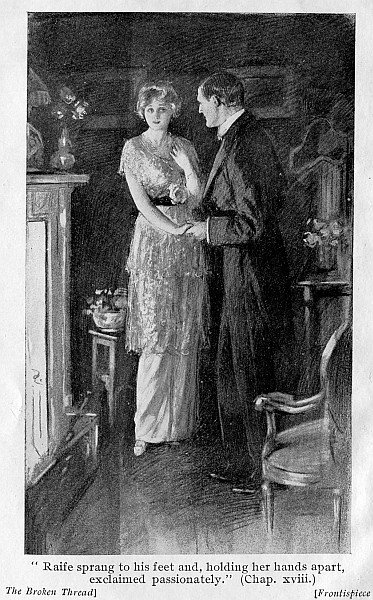
Raife sprang to his feet and, holding her hands apart, each in one of his, exclaimed passionately, “Hilda, dear, sweet Hilda! You can help me. I love you madly! Let me love you! Will you be my wife? Will you steer me to a better, a more useful life?”
She dropped her head and fell forward into his arms. He seized her and showered kisses, she yielding. When at length they spoke again she said, “Raife, I loved you from the moment you told us the story of your wound. I had not met such modesty and courage combined before. Raife, dear, I will strive to help you to a happy—yes, and, as you ask me, to a useful life.”
When Mr Muirhead returned, Hilda was at the piano, singing Elizabeth Barrett Browning’s tender song, “Love me sweet with all thou art.”
Raife did not wait for a chance meeting. On the following morning he wrote a note and sent it to Mr Muirhead:
“Dear Mr Muirhead,—I have a matter of vital importance that I would like to discuss with you. Can I see you at once?—Yours very truly,—
“Raife Remington.”
When the two men met and Raife had made a statement of his affairs and position, and had asked for Hilda’s hand, the old gentleman was visibly affected, and, taking Raife’s hand, said “Remington, I like you very much. I love my daughter with all the love of a father for his only daughter. She is more precious to me than my own life. I only had one other love. It was for her mother. She is dead. The man who breaks Hilda’s heart kills me and commits a double murder. Remington, I trust you—take her.”
Raife’s happiness was now complete, and, if his complex temperament would allow him, a great future was before him. In addition to title and wealth, he had inherited marked ability, allied to a wayward disposition. The future was fraught with possibilities for good or evil. In the battle of his life would the good or evil genius win?
On the night following his betrothal to Hilda, he was strolling among the bazaars seeking to purchase something worthy of his beloved. As is the custom among those picturesque, swarthy traders, who ensconce themselves in dark corners awaiting custom as a spider awaits a fly, Raife was haggling over the price of a trinket, when he became conscious of the presence of a figure watching him. Hastily dropping the trinket, he wheeled round. He was just in time to see a familiar figure slide rather than dart around a corner a few yards away. He was determined at all hazards to capture this uncanny person and demand of him his intentions. Raife chased him around the corner and searched every nook and cranny where he could possibly have hidden. He was too late, his quarry had escaped.
Raife muttered to himself: “Curse that infernal Apache fellow! He dogged me at Nice. He was ‘killed’ in a motor smash at Cuneo. He was ‘drowned’ in the Thames at Hammersmith, and now the brute haunts me in the Bazaar at Cairo. What does he want? Why does he shadow me?”
As he sauntered back to renew his haggling for the trinket, the white-bearded and turbaned old Arab was saying to himself, “He must be Ingleesi. All the Ingleesi are mad.” It had served a useful financial purpose for Raife, however; for, fearing he might dart off again, this time not to return, he sold the trinket to Raife at his own price, which was just one-tenth of what the old man had asked. That is the way of the Oriental trader. On his way back to the hotel with his purchases, his father’s dying words recurred to him, and he was more than ever puzzled by their mystic warning. These were the halcyon days of Raife’s short life, and they had been disturbed by this hateful phantom Apache. Raife Remington might be wayward and impressionable, but he was brave and fearless, so he chased the incident from his mind, as he had chased the elusive phantom in the Bazaar.
The sight of Hilda, and the warmth of her affectionate greeting, entirely dispelled this ill-omened cloud. He had quite recovered from the dagger wound now, and the weeks passed by with joyous rapidity. He and Hilda had made excursions together of many varieties. Into the desert, mounted on big white donkeys. To Memphis, the Pyramids of Sakkárah and the Serapeum, the tomb of Beni Hassan. By the luxuriously-appointed steamer, with its double decks and cool verandas, to Luxor, with its palatial modern hotels, contrasting strangely with the ancient ruins, temples, and monuments of a long-forgotten civilisation. Here was ideal ground for love-making among the whispering palm groves, with a turquoise sky above. Each scene so different from the Western ideal, yet so picturesque. The long lines or files of pelicans fishing on the sandy shore, with the flights of pink flamingoes hovering overhead. The line of native women gracefully swaying to and from the water’s edge with their pitchers balanced on their heads. These and a thousand strange sights and scenes, and, over all, the wondrous sky of the East, with its gorgeous sunrises and sunsets, and its weird depths of night. In such an Elysium did Hilda and Raife run the first course of their love, and it ran smoothly. Could such happiness last?
Hilda’s life until she met Raife had been happy, a life of sunshine untouched by shadow, save the loss of her mother. She had given her heart to this handsome young Englishman. She had no knowledge of Englishmen, except that gained by brief and flitting visits to London. The wise and practical side of her character prompted her to reflect often in the seclusion of her chamber. Were English husbands like American husbands? Would an ideal lover make an ideal husband? Raife had told her that he had loved another woman. Would that woman enter into his life again and destroy their happiness? Yes, there was misgiving in her mind at times. When Raife appeared and paid her gallant court, all doubts were dispelled, and she abandoned herself to his caresses.
In his spare moments Raife haunted the bazaars hunting for “that Apache fellow.” He was determined, if possible, to probe the mystery to its depths, no matter how foul the consequences. Once, on a trip up the Nile, among a group of lascars, he had fancied he saw a man who was not of them, and his mind at the time being slightly distrait, he conceived the idea it might be his enemy. He made straightway for the group, but by the time he got there the fellow was gone.
It had become a frequent practice for Raife to dine with Mr Muirhead lately, and at the dinner-table he announced one night: “Oh, say! Remington, I’ve had news from the bank and I’m afraid I must cut short my vacation. I mustn’t grumble; I think I’ve done rather well. But I’ve worked hard for it.”
“No doubt,” replied Raife reflectively, and with a deprecatory smile. “You’ve worked hard for your holiday. My life’s been all holiday and my work’s to come. You are going to help me, aren’t you, Hilda?”
Hilda laughed and retorted: “Surely, Raife, I’ll help, but you must promise to obey.”
Mr Muirhead joined in. “Ha! ha! I thought that was your part of the marriage contract, Hilda? Never mind, as long as you both obey perhaps it will be better all round. That brings me to what I was going to say. For the second time I have to apologise for being unfamiliar with English etiquette. I don’t know quite what is the method of procedure in the matter of English marriages, especially when the bridegroom is an exalted person.”
Raife said laughingly, “Pardon me, Mr Muirhead, but you mean I’m an ‘exulting’ person. I’ve captured the prize of the world, and I mean to preserve it. If you will accompany me to England, I will take you to Aldborough Park, and introduce you to my mother.”
Hilda intervened: “That’s just what I’m dreading. She’ll hate me, and I feel, I know it. Then I shan’t cry, I shall just stamp, and, for the first time in my life I’ll shake my fist and say ‘I told you so.’”
This assumed outburst produced the merriment that was intended. Raife proceeded. “You’ll like my mother, Hilda, and she’ll like you. If Hilda consents,” he added, looking first at one and then the other, “we’ll be married from our town house in Mayfair. We will have a ‘real’ proper marriage, ceremony, and it shall take place at St. George’s, Hanover Square.”
“Well! We’ll leave all that until we get to Aldborough Park,” intimated the prospective father-in-law. “I’m very anxious to meet your mother, and I trust we shall be friends. I believe you, my dear Raife, when you describe your mother’s amiable disposition and charms, but I expect, with that modesty of yours, you have under-estimated the grandeur of that Tudor mansion which is also yours. Ah well, then! It’s agreed we start for England as soon as we can.”
Chapter Nineteen.
Gilda Receives a Staggering Blow.
Gilda Tempest sat in her room in her uncle’s well-appointed flat in Bloomsbury. Her face showed traces of great mental strain. There were no lines in her face, but a drawn expression, which her enemies would have called haggard. She held a copy of the Morning Post, and was reading it leisurely until her attention was attracted by a paragraph as follows:
“The engagement has been announced of Sir Raife Remington, Bart., of Aldborough Park, Tunbridge Wells, to Miss Hilda Muirhead, daughter of Reginald Pomeroy Muirhead, Esq., President of the Fifth National Bank of Illinois, U.S.A. We understand that the marriage will take place shortly at St. George’s, Hanover Square.”
Gilda read this announcement three times. The third time she threw the paper on the floor and stamped upon it. Then, clutching her head with her hands, she sank on to a lounge and sobbed violently, exclaiming:
“What have I done to deserve this? Raife! Raife! You were the only one who could have saved me from this hideous nightmare, called life. I have lost you!” Her sobs choked further utterance, and she collapsed, huddled into a tangled mass of broken-hearted, crumpled womanhood.
Good, bad, or indifferent, Gilda Tempest had one affection which had penetrated her heart. Her love for Raife was sincere and with all the temptestuous fury of a jealous woman she now hated Hilda Muirhead.
She hissed the words between her sobs, “Daughter of Reginald Pomeroy Muirhead, President of the Fifth National Bank of Illinois! Why must she rob me of the only hope I had in life?” With a desperate effort she rose from the lounge and, straightening herself to her full height, staggered across the room to a full-length mirror, where she stood rigidly glaring at her own presentment. The face that had been drawn before she had read the announcement in the Morning Post, was now distorted, and her beautiful hair was dishevelled. Tears streamed down her cheeks. Passion was written on the face that now showed lines, lines of rage and rebellion. “I will not obey any more! My life has been a torture. I mutiny! I will win, or I will die!”
The door opened softly. Doctor Malsano stood there with folded arms, and in a still, soothing tone, he said, “Gilda, child. Come, tell me what is the meaning of this?”
Gilda turned on him with an expression fierce and defiant. For many seconds neither spoke. Then, urbanely, the doctor murmured soothingly: “Come, Gilda! Let me help you in your trouble. What is the reason of your distress?”
The girl stood erect, throbbing with intense emotion. Again there was a long silence. Then, bursting into sobs again, she pointed to the newspaper and said, “Read that. See! See what you have done. You have made me a robber, and now you have robbed me of the only desire I have on earth. I will rob you now, for I will kill myself.”
The doctor smiled and, crossing the room, picked up the paper. Then he approached the girl and said suavely: “Show me, Gilda. What shall I read?”
The girl seized the paper and pointed to the paragraph. He read it, and his face momentarily lost its ingratiating expression, and he muttered, “Bah! that fool Lesigne.” He recovered himself and led the girl to the lounge. Smoothing her hands and gazing earnestly into her eyes he talked. “Gilda! this is unfortunate, and that fool Lesigne is to blame. He is not worth his money. I shall dispose of him if he is not cleverer. He has bungled more than once. I sent him to Cairo. His report to me was incomplete. I did not know it was as bad as this. Gilda, I am your uncle, your guardian. We will alter this somehow. Child, go to sleep now. I will make my plans.”
The mysterious power of this man had its influence. He left the room. Gilda, still sobbing but pacified, did the doctor’s bidding and slept.
He went to his room and turned the key in the door. He flung himself into a chair and snatched a phial from a table at his side, drinking the full contents. Every indication of benevolence had left his face, and now it showed signs of torture. He cursed violently, murmuring: “That fool Lesigne! How shall I dispose of him? He bungled at Nice—at Cuneo—at Hammersmith—now at Cairo. I must kill him somehow, for he knows too much.” The drug now began to take effect and his features relaxed. Just before sleep overtook him he muttered:
“She must avenge her father’s death. The feud must be carried on. I will see to it to-morrow.” The doctor slept peacefully in the deep recess of the big arm-chair. The soft light of the solitary lamp reflected from a distance on his face. There was a smile on his face. A close observer would have noticed that it was cruel—sardonic, and that the breathing was stertorous.
When Raife, Mr Muirhead and Hilda arrived at Tunbridge Wells, they decided that they should stroll through the town before driving to Aldborough Park. It was morning-time. There was no hurry, and Hilda had never seen an old-world English town. They entered the motor-car which awaited them at the station and Raife ordered the chauffeur to drive to the “Blue Boar.” On the way he said: “If you were English, I would not dare to do anything so unconventional as this, but I feel I know you will like it, and I want you to see one of our old-world posting-houses. It is a fine type of an English inn.”
When they pulled into the stable-yard and had dismounted, Hilda was charmed with the quaintness of everything. Mr Twisegood had heard their arrival, and greeted them with all the pomp and ceremony at his command. With the inevitable “Lud a mussy!” which was a prelude to most of his speech, he said, “Why, Sir Raife, we’ve missed you this many a long day; I’m sure, sir, as ’ow we welcomes you ’ome, sir.”
Hilda, after the manner of American girls, walked “right in,” and Mr Twisegood had soon invited her to look over the house. Raife took Mr Muirhead into the parlour, saying: “Now, sir, you have mixed some delightful cocktails for me in Cairo; will you allow me to introduce to you an old English coaching drink in an old English coaching and posting-house? Mary!”
In response to his call a rosy-cheeked, buxom maid appeared.
“Bring two glasses of sloe gin and put them in two of those old ‘rummers.’ Bring me the bottle and I will pour them out,” were Raife’s instructions.
There was no time to contrast the merits of sloe gin with cocktails, for Hilda’s voice was heard from the top of the staircase. “Father, oh, do come! Here’s the sweetest old room I ever saw. It’s all white, and smells of lavender.”
They climbed the staircase and entered the room. Whilst they were admiring the whiteness and the quaintness of it, Raife’s mind was charged with the memory of the last occasion when he had been there, and of other curious occasions. He remembered his meeting there with Gilda Tempest, dressed as a hospital nurse; his mother outside the door and Gilda escaping by the secret staircase to the loose box in the stable below. Altogether he was sorry he had brought them to the “Blue Boar.” He crossed the room and looked through the latticed window into the stable-yard. Another car had arrived, and the chauffeur was just starting under the archway. The sight of that chauffeur was strangely reminiscent. His coat was open and betrayed a loose, flowing black necktie. Was it possible—could it be that infernal Apache fellow? What was he doing there? Was there no rest from this vigilant spectre who traced him everywhere?
Raife was maddened with the combination of incidents which had spoilt his return to Aldborough Park with his fiancée. Making an excuse to leave the room, he ran downstairs, and, hastily swallowing a full glass of the abandoned sloe gin, he went into the yard and asked the chauffeur: “Did you see the number of that car that was here just now?”
“No, sir,” came from the man.
He found the solitary ostler and asked him whether he knew the car or anything about it. The man had been feeding the horse in the loose box and had not seen the car.
Raife was a good-tempered man, but he was morose for a while. After the disconcerting incident of the stable-yard, and the somewhat mixed recollections caused by the visit to the white room, Raife decided that it was best to drive straight to Aldborough Park, and postpone the stroll through the town. As they drove, the apparition of Gilda Tempest in the garb of a hospital nurse, yielding to his caresses in the white room, haunted his mind. He had waived aside the Apache spectre. He could fight him, but he could not fight this apparition.
Hilda Muirhead sat opposite to him. Presently she said: “You look troubled, Raife. Has anything real serious happened?”
Raife forced a smile, and answered cheerily: “No, my dear! I’ve got a bit of a headache. One isn’t used to trains after the quietude of the desert.”
Then anent nothing, which was not her wont, Hilda added. “Oh, say! Raife. After you had left the queer white room I discovered a little door behind a curtain. It wasn’t a cupboard. I’m sure it led somewhere. It looked so cunning and mysterious. Do tell me where it leads to.”
This was the door of the narrow staircase leading to the loose box in the stable, through which Gilda Tempest had escaped when Lady Remington was about to enter the room. Raife winced at the question. The sweet young face of his fiancée opposite contrasted strangely with the face of Gilda, whom he had taught himself to hate. He replied: “Yes. There is a staircase there. I’ll show it to you some day, perhaps.” The last word qualified the promise, for he had no intention of showing it to her.
The handsome and silent-running Rolls-Royce car sped merrily over the smooth roads up and down the Kentish hills—the roads of “the garden of England,” and it was spring time. The sun of an English spring day is not as the sun of the Egyptian desert, but it is sufficient to reveal the tender buds and dainty blossom of the hedgerow. As they sped through the narrow roads that led to Aldborough Park, it made an exquisite picture. It was a picture that was entirely unfamiliar to Hilda. She may have read of a spring day in “the garden of England,” but she had not seen one, and the sight of it thrilled her. She noticed the respectful greetings of the labourers, the women and children as they passed. Sir Raife Remington was a respected power in this land of his. He was not an owner of mines and mills in a disaffected area, to be met with scowls or curt nods. He was a landlord of ancient lineage, among tenants whom he and his ancestors had ruled generously, and with mutual sympathy. A downward sweep and a curve in the road brought them to the lodge gates. The massive wrought-iron gates, surmounted by the Reymingtoune arms, were already open. The lodge-keeper and his family were grouped together, saluting and curtseying to the master of Aldborough on his return from “furrin’” parts. Raife greeted them cheerily, as the car swept through and into the avenue with its long line of stately beeches. Hilda’s breast heaved, and her heart throbbed. “I am to be Lady Remington and the mistress of all this,” she said to herself. She thought of the soot-laden city of Cincinnati, in Ohio, where she had spent so much of her time. She compared the crudeness of an American landscape with the finished charm of this historical place, of which she was to be mistress. It seemed too good to be true. The phantom of “the other woman” flitted through her mind, and her pleasure was, for a time, less restrained.
As they emerged from the avenue, the mansion, in all its ancient grandeur, came into view. They passed through the shadow of a group of ancient pines and cedars of Lebanon, a graceful sweep around flower beds ablaze with blossoms brought them to the main entrance, where the stately old butler, Edgson, stood bareheaded to receive them. He was supported by a group of white-aproned and white-capped maids, and a pert little page-boy in livery, with a liberal display of bright buttons.
Mr Muirhead had not spoken much during the car ride, but his quick powers of perception had taken in, at a glance, the majesty of this old Tudor mansion. His keen eyes had observed the extended row of gables, the twisted chimneys, the oriel windows, the massive ivy-clad walls, and the added buttresses. The mind of a banker is trained to values, and as he surveyed, with his quick comprehensive glance, the extensive stabling and greenhouses, with a vista of beautiful gardens beyond, he was satisfied that he had not made a mistake in allowing his daughter to become mistress of Aldborough Park, and any of the estates and property that Raife might own.
He did not know of Raife’s story of “the other woman.” By common consent it had been agreed that it was not necessary to tell him. Youth, in love, revels in secrets, and this was the secret of these young lovers.
Chapter Twenty.
The Most Momentous Occasion of Hilda’s Life.
Hilda was a fairly practical, self-reliant, American girl. She was face to face with the most momentous occasion of her life as she passed through that line of respectful servants. With a woman’s knowledge she was fully conscious of the strict scrutiny to which she was being subjected from under all those apparently drooping eyelashes.
“Where is my mother, Edgson?” asked Raife.
“She is in the library, Sir Raife,” answered the old butler.
“Will you announce us, please. No, don’t trouble, I will go upstairs myself, if you good folk will wait here,” and he ushered them into an old oak-panelled room, with gloomy old portraits that seemed to frown down upon them.
Raife’s meeting with his mother was affectionate, and tears were in her eyes as she asked: “Have you brought her, Raife?”
He replied, cheerily: “Yes, mother dear, and I want you to like her and give her and her father a hearty welcome to Aldborough.”
In somewhat anxious tones, she said: “I hope I shall, dear, and I promise to try. Of course, they shall have a hearty welcome. She is my son’s choice, and I will do my duty.” Then, in halting accents, she added: “You are your own master here. Forgive me, Raife, if I appear anxious. I love you very dearly, and with all a mother’s love. You are all I have left in this world, and I fear for your happiness.” Then, smiling, she again added: “I will not remind you that you were always a brave, darling, wayward boy.”
Raife took his mother in his arms and reverently kissed her on the forehead, saying, with a happy laugh: “You dear, darling mother! Never fear for me. I will not forget that I am a Reymingtoune.” As he left the room Lady Remington turned to the window and wiped away a tear.
Raife almost ran down the staircase, and, bursting into the room, called out cheerily to Hilda and her father: “Come along, good folks, and meet my dear old mother. She is upstairs and awaits you.”
The close scrutiny of the servants was easy to bear. Hilda’s heart fluttered as they climbed the wide old staircase and entered the library. Lady Remington was standing to receive them. Raife started to present them. “Mother, this is—”
He did not finish.
Hilda, with a charming impulse, had crossed the room with both hands extended, exclaiming: “You are Raife’s mother. Oh, I’m so glad!”
The radiance of this beautiful young girl, the charm of her musical voice, and the evident spontaneity of the action, were magical. The stately Lady Remington took the two extended hands and kissed Hilda on both cheeks, saying: “Welcome, Hilda. I am sure I shall like you, and I hope you will like me. May you both be very happy.”
Mr Muirhead stood by Raife’s side, viewing this unconventional scene, where the newer West had conquered the stiffer conventions of the older West by a display of genuine frankness. His handsome face was made the more handsome by the pleased smile that it bore. Raife now presented him to his mother with more formality than Hilda had allowed in her case.
When Lady Remington and Mr Muirhead had left the room to stroll around the gardens, Hilda exclaimed: “Oh, Raife. This is all very wonderful. I did not believe such places existed outside storybooks. Your mother is a darling. I love her already. I’m glad I don’t have to stamp my foot and shake my fist, as I told you I would in Cairo, if she didn’t like me.”
Raife kissed her again and again, and through the kisses said: “How do you know she likes you?”
Imitating Raife’s accents, she said: “Woman’s instinct, dear boy, woman’s instinct. Besides, she wouldn’t have kissed me so hard if she didn’t like me.”
The words were hardly finished when he seized her, exclaiming: “That settles it! Then I’ll show you I more than like you, I love you!” And he kissed her until she pretended that it hurt.
Now, at last, were Raife’s ideals realised, and complete happiness was nearly his. There could be no other spectres or phantoms to cast a shadow over their pure love. Hilda broke away and ran to the other side of the room. The window was open and she looked out, crying: “Oh, do come, Raife, look at that wonderful clump of rhododendrons.”
She did not see it, but a pained expression crossed his face as he came to the window, and, placing an arm around her, they looked down together on the rhododendrons. Why could not happiness last? What was the curse that at every turn blighted his fondest hopes? The last time he had looked on those rhododendrons was on that fateful dark night, when Gilda Tempest, the burglar—the burglar whom he had fancied that he loved—slid down the silken rope from the window, and disappeared in their dark shadows. And now the hideous memory came to his mind, to destroy his brightest hopes, his dream of bliss. He turned away, leaving Hilda at the window. He stood lighting a cigarette, and again his gaze chanced in a tragic direction. In front of him was the safe, where his father had shot and killed the burglar, and there, the spot where his murdered father had, in his dying words, stammered out, in choking gulps to Edgson, the awful warning to Raife, his son, to “beware of the trap—she—that woman.” Who was that woman and what was the trap? Again, that was the spot where he had nearly shot Gilda Tempest, the second burglar. Why, oh why, had his mother chosen this room in which to receive his beloved Hilda—his fiancée?
Calling to Hilda, he said: “Come, Hilda, let us go downstairs and find your father. They have gone into the grounds, and won’t be far away.”
They went downstairs, she on to the terrace, and he into a morning-room. He rang the bell and Edgson, the butler, entered. “Mix me a stiff whisky and soda, Edgson, please.”
The old man eyed his master quizzically as he handed him the cool drink in a long, sparkling tumbler. “Aren’t you feeling well, Sir Raife?”
Between gulps, Raife replied: “Oh, yes, Edgson, only a bit tired, thank you.”
“I hope, Sir Raife, you’ve had a pleasant holiday, sir. We are all very glad to see you back again, sir.”
“Thank you, Edgson. Yes, very pleasant indeed.”
Then, with the licence of an old servant of the family, Edgson chatted on: “Pardon the liberty, Sir Raife, but we saw the announcement in the Morning Post, sir, Miss Muirhead who has just come to stay, sir. She’s your ‘fyancee,’ isn’t she, sir? She’s a very beautiful young lady, sir, if I may take the liberty, sir. And if that’s her father, sir, he’s a very handsome old gentleman— Again asking your pardon, Sir Raife, we, in the servants’ hall, wishes to offer you our hearty congratulations.”
Raife was accustomed to the old butler’s garrulity and smilingly replied: “Thank you, Edgson. And will you thank the others for me. If all goes well, we’ll very soon be having gay times in the old house.”
As he retired towards the door the old man talked to himself. “Ay! That we will, I warrant, if Master Raife has anything to do with it.” He had barely closed the door when he knocked and entered again. “Excuse me, Sir Raife—”
Raife was worried and said, rather impatiently: “Yes, Edgson,” then smiling a forced smile, added: “What is it this time?”
Closing the door, and looking around with an air of mystery, the old servant almost whispered: “Do you remember the night, sir, in last September, when I saw the light in the library, and I had the house surrounded?”
“Yes,” interrupted Raife, irritably. “What about it?”
The old man, once started, was not to be waved aside: “Well, sir, one of the under-gardeners, Hodgson, it was. He was at work among the rhododendrons, and he picked up a long piece of silk rope.”
Raife cut him short, saying: “Yes, I know, where is it?”
The old man stared at this outburst, and said: “He handed it to me, sir.”
“Did he; and have you mentioned it to anyone, else?”
With a sly look, that bordered as nearly on a wink as his well-trained discretion would allow, the old man replied, “No, Sir Raife, I have the rope. I gave him half a crown and told him to mind that we didn’t want no gabblers round Aldborough Park.”
“Quite right, Edgson, you acted very wisely. I’ll tell you all about it, perhaps, some day.”
“Perhaps” is always useful, in qualifying a promise. Producing a sovereign-purse, he extracted two sovereigns and handing them to Edgson, said: “Do what you like with these, Edgson. I suggest you give the man, Hodgson, one.”
Edgson bowed low. “Very good, Sir Raife, I’ll carry out your instructions.”
When the old man had finally gone, Raife mixed himself another whisky and soda, and cursed with a freedom that was not customary with him. This contretemps was more tangible than the others, and it was the fourth incident or train of unpleasant thoughts that had been forced on him, on this the joyful day, when he had brought Hilda to his home. He was not superstitious, but his nerves were affected by the sequence of events. Did they spell disaster?
The spring day had ended in an unusually warm moonlight night. After dinner they walked on to the terrace and sauntered up and down. Hilda’s happiness was very great, and unmarred by doubt or foreboding. “The other woman” was not in her thoughts. She surveyed the ornamental flower beds which, even in this light, showed the wealth of blossom. She had already examined, at close quarters, the old sundial and the quaint-carved stone figures around the lily pond, with a fountain in the centre, with sleepy old carp gliding through the dark shadows of its waters. At length, they decided it was warm enough to sit in the chairs that had been brought from some mysterious corner where they had rested through the long winter time.
The silence that was customary among the trio, when conversation appeared superfluous, was broken by the sound of bells from a church on a hillside some distance away. Softly at first, in irregular clangs of varying notes, they burst into a carillon, ending in crashes, known in some parts as firing. There was an evident intention of joy in the sounds that floated through the still night air until it reached the group seated in the moonlight on the terrace of old Aldborough Park.
Raife broke the silence. “Mother, why are the church bells ringing? This used not to be practice-night, for I’ve helped myself many a time to clang with those ropes in our old church tower. They wouldn’t ring like that for an ordinary week-day service, besides, it’s too late for a service. I’ll call Edgson. Perhaps he’ll know.”
The duties of an old family butler are many and not well-defined. Speaking generally he does mostly what he pleases. He is always working in some way or another, and may be safely trusted to guard the interests of his master. It is his own chosen duty to know everything that transpires on his domain, and to know the reason for it. In response to Raife’s call, Edgson appeared. “What are the church bells ringing for, Edgson?”
With a beaming countenance, the old man replied: “They are ringing for you, Sir Raife, and, begging your pardon, Sir Raife, they are ringing for the young lady, Miss Muirhead.”
Hilda, in astonished tones, exclaimed: “What’s that? Ringing for me? What are they ringing for me for?”
Edgson stammered, but failed to make a coherent reply.
“Thank you, Edgson. That’ll do,” intimated Raife.
The old man retired, chortling to himself: “She’s a nice young lady for an American. But, lor’, these Americans don’t know as much as we do.”
When Edgson had gone, Lady Remington explained how those church bells had rung for the birth and marriage of many generations of Reymingtounes during four centuries, and sadly, she added, they had tolled a knell at many a funeral of the family. Then, more cheerfully, smiling at Raife, she continued: “My son, I am glad to say, is very popular with the bell-ringers, as well as all over the estate.”
Raife intervened. “Please leave that out, mother.”
His mother retorted: “It’s true, Raife, and I am glad of it. Well, Hilda, they are ringing those bells to welcome him back home, and to welcome you to Aldborough as the future Lady Remington.”
Hilda felt very glad and very proud. She had loved Raife for his own sake, before she had known of all these things so wonderful to her, and, indeed, before she knew he was a baronet. She had loved him for his modesty and courage in fighting the Nubian who was beating the woman in Khartoum.
Lady Remington presently said, graciously:
“Hilda, you have had a long and trying day; perhaps you would like to retire early?” Together they walked along the terrace, and Lady Remington took Hilda’s arm, and personally conducted her to her room. There the two women talked awhile. The elderly lady, so soon to be a “Dowager,” and the young American girl who was to hand down the traditions of the ancient family, and, perchance, become the mother of the future heir to the estate. Lady Remington spoke very kindly, but there was a sad note throughout. She told of her anxiety until they had met. She expressed, ungrudgingly, how Hilda’s manner had charmed her from the moment of their meeting. She alluded to the great responsibility she was undertaking. They talked for long, and at length, Lady Remington affectionately bade her good-night, and Hilda was left in privacy to her thoughts and sleep, if it would come.
A maid tapped discreetly at the door, and offered her services. Hilda’s needs were very slight that night, and she was glad when she had dismissed the maid. Attired in a loose dressing-gown she sat in a chair and wondered whether all could possibly be as well as it appeared. Her reverie lasted long. How long she did not know. Rousing herself she made preparation for sleep. Impulse prompted her to have a final look at the fine night and beautiful scene. To view those lovely gardens that were to be hers with Raife. As she approached the window, a slip of paper appeared underneath the door which opened on to a balcony. She started, but Hilda was not the type of girl to scream or become panic-stricken. She opened the paper and read a typewritten message on a plain piece of paper:
“It is dangerous to rob another.”
What did it mean? Rob another of what? Was it her fancy that the paper had just been placed there, or had it lain there a long time? Perhaps it was a text, or something of that kind. If so, it was harmless and was, perhaps, a crazy fad of some one who had occupied the room before. She studied the fastenings of the window and went to bed without looking at the night as she intended. Then she thought of “the other woman” Raife had told her about. She decided to say nothing about it, as it might make her appear foolish. It was long before sleep overtook her, but her youthful nature asserted itself and she, being very tired, at length slept.
Chapter Twenty One.
Raife’s Jealousy Ends Disastrously.
They were happy days at Aldborough Park.
Each succeeding day seemed to complete the sum of Hilda Muirhead’s hopes. In addition to motor-car rides to Southport, the scene of Raife’s first meeting with “the other woman,” Gilda Tempest, Hilda learnt the joys of riding behind good horses. Raife was an expert whip and drove a tandem as an expert. The countryside was again alive, now that the wayward young man had returned to reside among them. There were dinner-parties at the Park, and garden-parties, where Hilda was introduced to the county families, some of whom were amiable, and even affable, whilst others were not. It was a meeting of disappointment to many of the stately dames, and sometimes frigid daughters, that an American woman should have been selected to reign as queen at the beautiful old home, which, hitherto, had been regarded as a stronghold of English womanhood. These matters were, however, of slight consequence to Hilda, whose happiness was supreme in the possession of the love of the handsome and dashing young aristocrat, whom Fortune had thrown in her way.
She captured the hearts of all the men, and a large proportion of the women, with her frank and ingratiating manners. She over-ruled convention without destroying good taste; the tenants and townspeople were completely won over by her cordiality and good nature, which was frequently lavish. The old landlord, Twisegood, added to his evening custom by narrating the free and unconventional manner in which she made her first entry into his house. The old town of Tunbridge had not been so gay since the days of farthingales, frills and furbelows.
Hilda excelled in most sports. At tennis, golf, and every pastime, she led the way, and there was renewed life in clubs that had become, in a sense, rusty for want of what is generally called “fresh blood.”
Raife Remington, the woman-hater of a few months ago, had become the most courtly of lovers, and it only needed the joy of marriage bells to complete the symposium of human delight.
In human affairs, however, it is not to be supposed that Fate will not be fickle, and cast a cloud to destroy the perfection of desire. Jealousy has ever been an accompaniment to love, and it draws no distinction between the yokel and the aristocrat.
When Harold Brookman, in the competition flight from the Hendon aerodrome to Manchester, came to grief and descended rather hurriedly in the home-croft of Aldborough Park, it was Hilda who, by chance, extricated him from a tangled mass of machinery. With a sense of initiative and promptitude she obtained assistance, and Harold Brookman was installed in a room at the Park, pending his recovery from the crumpled state in which he found himself.
It has been customary to surround aeronauts with a halo of heroism, and Harold Brookman’s exploits were the talk of the world of flying. It happened, unfortunately, that Harold possessed that form of good looks that belongs to flying men, indicating firm resolve and determination. Further, chance willed it that he should be an American.
Those who live under foreign flags are naturally attracted to their fellow-countrymen when they happen to meet. Hilda Muirhead was supremely happy in her love for Raife Remington, and he in turn, was satisfied in their mutual devotion. It was unfortunate, therefore, that Raife should have overheard Hilda’s genuine and impulsive utterance as she and the injured man met for the first time on the terrace after his recovery from the accident.
“Well now, sakes alive, it’s good to hear your voice, Mr Brookman. I’ve been away from home so long, it seemed I was never going to hear a good American voice again.”
Raife, who came over on to the terrace at that moment, glared at Harold, and in response to Hilda’s invitation: “Hullo, Raife, come and talk to us,” he replied, rather gruffly, “I’m sorry, I’m busy just now. Besides, I haven’t got a good American voice.”
The incident should have been quite unimportant, but nothing is unimportant where jealousy is concerned.
Raife nursed his indignation, and, without announcing his intention, went to London that afternoon. Lady Remington, realising that it was natural that Hilda should be pleased to meet one of her countrymen, especially in such exceptional circumstances, urged Harold Brookman to prolong his stay. In spite of his daring aerial exploits, Harold was very human, and the prospect of enjoying the hospitality of this charming old lady, and the company of his attractive young countrywoman, was agreeable. So he stayed at Aldborough Park, and, when the slight repairs that were necessary had been effected to his aeroplane, he made some trial flights from the croft, which was admirably adapted for the purpose.
It was natural that he should invite Hilda to accompany him on a flight, and she accepted the invitation with enthusiasm. The delights of aviation have been described, and their fascination for the more courageous type of woman is a matter of surprise to many, but it is easily understood by the psychologist. Many days passed, and the wayward Raife sulked at his club in London.
Eventually he returned unannounced, as was his custom. He imagined that Harold Brookman had taken his departure. He chose to drive in a cab that attended at the station, and called on the old landlord, Twisegood, on his way home. The old man greeted him with his customary enthusiasm. The somewhat incongruous couple were really friends, in spite of the difference in their station in life. For a while, Raife’s ill-humour subsided, and he greeted the landlord cheerily.
“Well, Twisegood, how are you, and what’s the news?”
Without waiting for a reply, he smacked the old man on the back, saying:
“Come along, let’s go up to the white room and have a chat. You have what you like, but bring me a bottle of your sparkling cider.”
He ascended the stairs and entered the quaint white room. As he threw himself into a chair, and awaited the landlord with the refreshment, his mind, which was already perturbed, reverted to the occasions when he had met Gilda Tempest in that same room. It also brought to his memory the tragic death of his father, and the extraordinary encounter with Gilda in his library in the middle of the night. In spite of these episodes of crime, this strange girl still exercised an extraordinary fascination over him. The fit of jealousy was still on him, and his prolonged fit of sulking in London had not alleviated it. He sprang from his chair, and paced the room angrily, muttering:
“It’s good to hear your American voice, Mr Brookman. Bah! She’ll call him Harold next.” Twisegood stood in the doorway, holding the silver tray of refreshments. The old man waited, wondering what could have disturbed the young master in this way. Turning on his angry stride, Raife said:
“Come in, Twisegood. Put the tray down and let’s sit and talk. I’m not quite myself to-day, so don’t take any notice of me, if I’m disagreeable.” He took a deep draught of the cider, and added: “What’s the news up at the Park? I’ve been away for a few days.”
Twisegood smacked his lips after a long pull at his favourite Kentish ale, and commenced:
“Well, Master Raife, there be fine times. That American gentleman, he be flying in his machine all over the place, and they do tell me that Miss Muirhead, she be a real plucked ’un, and she goes up along with him.”
Raife did not wait for any more. The demon of jealousy and hate possessed him. He rushed from the room and down the stairs, exclaiming in passionate tones: “I’ll murder the brute, in spite of his American voice.”
Old Twisegood stood mystified by this extraordinary outburst. He descended slowly, wagging his head.
Raife drove up to the main entrance of Aldborough Park, and, as he entered, met his mother, Lady Remington. In a fierce rage he approached her. “Mother! What’s that American fellow doing here? He’s got to go—and go at once.”
Lady Remington was alarmed at her son’s agitation, and endeavoured to pacify him, saying: “Raife, what’s the matter with you? You look positively deranged.”
They went up the staircase together, and the old lady endeavoured to pacify her son. They entered the library, and, with all the tact and patience at her command, she tried to soothe his wounded feelings. It seemed to her that some terrible streak of ill-fortune had entered into her life, and that of her unfortunate son.
He rang the bell viciously for Edgson. No one else would have answered the noisy peal that indicated the master’s rage. When he appeared, Raife demanded: “Where is Mr Brookman?”
The butler replied, with deference: “I think he’s in the croft, Sir Raife, with his flying-machine.”
In sharp tones, that were unfamiliar to the old servant, he rasped out: “Where is Miss Muirhead?”
The answer came back: “I think she is in the croft, too, Sir Raife.”
Raife seized his hat, which he had flung upon the table, and descended with heavy tread to the hall. His powerful frame quivered with emotion. He slammed the door and, endeavouring to control himself, sauntered down the terraces, and entered the croft by way of the stable-yard. He was just in time to hear the buzz of a rapidly-revolving engine, and, looking upwards, he saw an aeroplane winging its way at lightning speed over the turrets and twisted chimneys of the Tudor mansion that was his. At the far end of the croft he descried Hilda, his fiancée, waving a handkerchief to the disappearing airman. His rage knew no bounds. He wanted a gun to take a parting shot at this American, who had intruded himself on his happiness. He waited with folded arms and scowling face, until Hilda had tripped across the soft grass of the croft. She ran straight up to him, and, before he had time to resist, threw her arms around his neck. Her sweet voice, in genuine tones, rang in his ears: “Raife, Raife, how we have missed you. You dear, wicked old thing to have run away from us.”