Brochure Series Competition. Number One.
Reading edition
Design for the case of an upright piano. Prizes offered by the Henry F. Miller & Sons Piano Co., Boston.
The object of this competition was not to secure designs for pianos at the least possible cost, as is the object of many competitions in design, but merely to attract the attention of designers to this special problem, and take one more step towards a better condition of things in the piano business. The Henry F. Miller Co. have for several years followed a policy the results of which are seen in some of their later designs. It has been the practice to turn special cases over to furniture and cabinet makers, entailing an expense that has been practically prohibitory for all but the richest clients architects have. The Miller piano factory has been equipped with every facility for executing work from architects' special designs and within a reasonable cost. The prizes have been offered in the most liberal spirit, and while a large number of the designs submitted were unsatisfactory, they have been instructive and their shortcomings will be borne in mind in preparing the program of another competition, with larger prizes, which will shortly be announced in The Brochure Series.
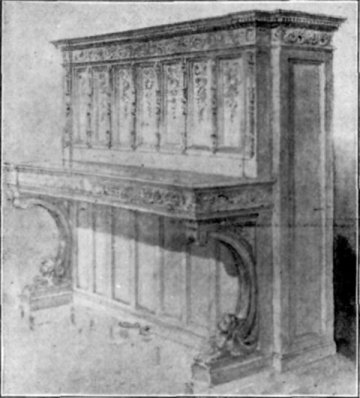
First Prize. A.B. Le Boutillier.
Seventy-five designs were submitted, several of which arrived too late to be entered. The drawings were very carefully examined by the officers of the company, assisted by Mr. C. Howard Walker, and the following awards were made:—
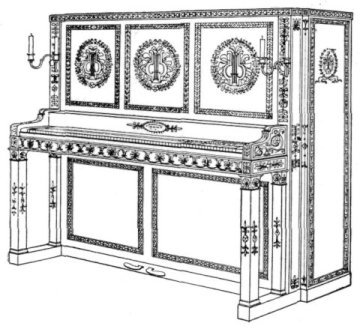
Second Prize. E.F. Maher
First prize, $25, A.B. Le Boutillier, Boston; second prize, $15, Edward F. Maher, Boston; third prize, $10, James C. Green, Brooklyn, N.Y.
Report of the Jury.
In judging the designs for piano cases, the element of economy, though recognized, played but a small part in the decision of the judges. The qualities which made the premiated designs superior to others, were those of refinement, beauty of line, and of general proportions.
A piano case presents, necessarily, but restricted opportunity for design, and any attempt at great novelty is apt to be disastrous; if originality appears, it will be in the smaller details.
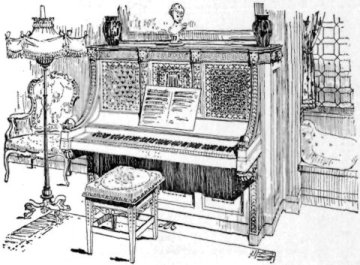
Third Prize. J.C. Green.
There also exists the question of style, which is determined largely by the character of the room in which the piano is to be placed, and yet, if the element of style is forced too far, it prevents the use of the design for any but one case.
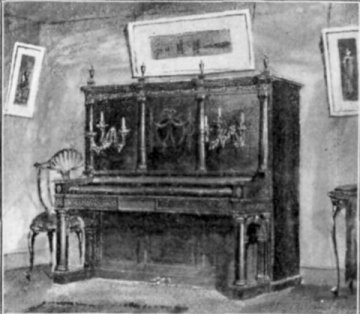
Of the premiated designs those placed first and second are in distinct styles, the one having almost the character of François I, the other being of the time of the Empire. Both, however, are simple and could be placed in rooms of other styles of architecture.
The first prize design is especially commended for the disposition of its ornament, and the delicate but vigorous lines of the bracket beneath the keyboard, or what is technically called the "truss."
The design placed second has excellent proportioning of panels and Empire ornament in excellent relative scale, well disposed.
The design placed third is a most direct development of the requirements, and is a very simple, practicable design with good proportions and lines.
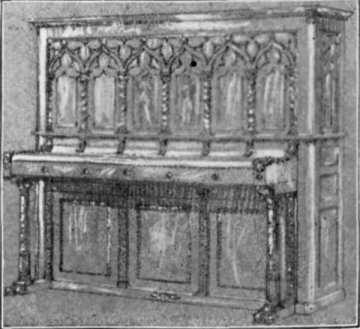
The three remaining designs published were considered worthy of mention, each in its own way. The Gothic design could be made very rich and interesting with panel colored decoration. The upper portion is well proportioned, the lower portion somewhat too meagre. The Colonial design is interesting above the keyboard; the arches below the "trusses" are out of scale. The Baroque design would depend for its good or bad quality entirely upon the delicacy and skill with which the carving was done. Both the Gothic and Baroque designs could only be used in rooms of their own respective styles.
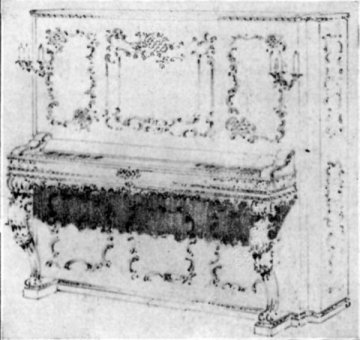
Design by E.B. Wells.
Design by E.R. Clark.
Design by A.H. Cox.