OF ARCHITECTURAL ILLUSTRATION.
Reading edition
Vol. I. MAY, 1895. No. 5.
TWO FLORENTINE PAVEMENTS.
The church of San Miniato al Monte, just outside the walls southeast of Florence, and the Baptistery, or church of San Giovanni Battista, in Florence, are among the finest examples of the Tuscan Romanesque style, and both probably date from about the same time—the early part of the twelfth century—although the date of San Miniato has until recently been referred several centuries further back.
These two churches have many points of similarity, although entirely different in plan. San Miniato was referred to in the article upon the Byzantine-Romanesque doorways of Southern Italy in our February number, and Fergusson's classification of Byzantine-Romanesque was, for the time being, adopted for lack of better authority. Later writers have, however, generally agreed that there is little or no Byzantine influence in these two churches; that the delicate and refined treatment of classic forms here found is not the result of Byzantine or Greek influence, but is due entirely to the natural refinement of the Tuscan race. The same characteristic was again shown later in the treatment of Gothic detail, and is evident in the Renaissance work of this locality.
The dimensions of San Miniato were given in the February number referred to above. The interior of this church is generally considered one of the most beautiful interiors of Italy on account of its effective basilican plan with a crypt opening from the nave, its beautiful and rich detail, and its fine mosaics and decorations. The pavement is not the least of its attractions.
The Baptistery will be remembered for its famous bronze doors, the work of Ghiberti, which have given occasion for so much discussion, favorable and unfavorable. It is octagonal in plan, and 108 feet in diameter externally. It was erected originally for the cathedral of the city, but in the eleventh and twelfth centuries was so thoroughly remodeled that no recognizable features of the old building remain.
The pavements, in point of design, appear quite independent of the other ornamental work in the two buildings we are considering.
The motives of ornament are those commonly found in the stuffs, especially silks, of Sicily and the East, and their use here could easily be accounted for through connection with Sicily. It is known that the Hotel de Tiraz at Palermo, the great royal manufactory of stuffs, artistic metal work, mosaics, etc., established in the sixth century, and which continued until the sixteenth, supplied not only much of the finest textile products for all of Europe in that time, but also furnished workmen who carried with them the designs and methods of Sicilian textile manufacture to other countries. Such manufactories were established in several Italian cities, among them Lucca.
The relationship seems clear, as the forms are perfectly similar. The beasts and birds set in balancing pairs facing each other and repeated in an all-over pattern, as in a woven fabric, strongly suggest the Sicilian silks. Eug. Muentz in his work, "La Tapisserie," speaks of this evident relationship. The internal evidence of the design itself would be quite sufficient if we had no other means of tracing it.
These two pavements are practically unique, as far as we are able to learn. They are marble inlay, the pattern having been cut out in a slab of white marble and pieces of black marble carefully fitted in to form the figure. This is not true mosaic, and differs essentially in design from the mosaic work of the same period which was derived from the Roman mosaics made up of small pieces of marble or other material. Most of the floor mosaics in Italy have suffered from wear and tear, and have in many cases been very poorly restored; but these two pavements appear to be in nearly their original condition.
The design does not have the merit of belonging distinctively to the material in all cases, and might just as well be applied to wood parquetry as stone. In fact, it might be even more effective in this material if the colors were judiciously chosen.
XXXIII. Portion of the Pavement in the Baptistery, Florence, Italy.
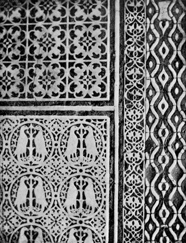
XXXIV. Portion of the Pavement in the Baptistery, Florence, Italy.
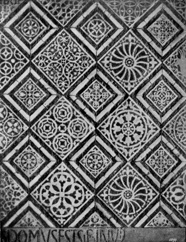
XXXV. Portion of the Pavement in the Baptistery, Florence, Italy.
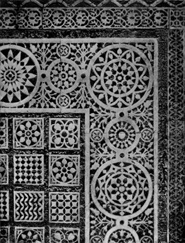
XXXVI. Portion of the Pavement in the Baptistery, Florence, Italy.
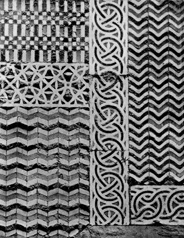
XXXVII. Portion of the Pavement in the Baptistery, Florence, Italy.
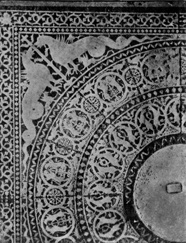
XXXIII to XXXVII.
PORTIONS OF THE PAVEMENT IN THE BAPTISTERY, FLORENCE, ITALY.
One exception should be made to the remarks above in relation to true mosaic. The lower left-hand portion of plate XXXVI is without doubt made up of small pieces put together after the manner of the old Roman mosaics, and it is possible that the portion shown in the upper left-hand corner of the same plate is made in the same way. There are several parts of the floor laid in this manner, but they are distinctly secondary in interest to the inlaid portions.
The pavement is divided irregularly by squares and rectangles, the portion especially rich in ornament being that between the door and the altar. The rectangular patterns are irregularly cut into by special pavements, placed before several of the monumental tombs in the walls.
XXXVIII. Portion of the Pavement in the Church of San Miniato al Monte, Florence, Italy.
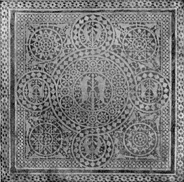
XXXIX. Portion of the Pavement in the Church of San Miniato al Monte, Florence, Italy.
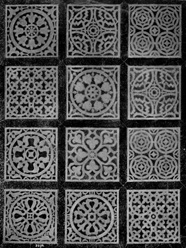
XL. Portion of the Pavement in the Church of San Miniato al Monte, Florence, Italy.
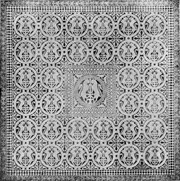
XXXVIII to XL.
PORTIONS OF THE PAVEMENT IN THE CHURCH OF SAN MINIATO AL MONTE, FLORENCE, ITALY.
In the first of these plates there is a suggestion of the mosaic treatment commonly seen in the pavements of Rome, Venice, and Siena. The sort of guilloche of interlacing circles was very generally used.
Plate XL on the other hand is as plainly reminiscent of textile designs as it well might be; and in plate XXXIII from the Baptistery the same characteristic can be seen.