Ravenna Capitals.
Reading edition
With the reign of Constantine, and the introduction of Christianity as the acknowledged religion of Rome, Byzantine art, as such, made its appearance. The culture of Rome was transferred to Byzantium, henceforth to be known as Constantinople. Governed alternately by Greek and by Persian, it had received a strong Oriental character from the Eastern nations, and had added to the Greek subtlety and delicacy of expression the Oriental love of detail. When converted by Constantine into New Rome, it became a perfect treasure house of Eastern and Grecian art. The Byzantine work, which spread over the East in the sixth, seventh, and eighth centuries, is therefore a union of the refinement of the Greek, the desire for color and detail of the Oriental, and the vigor of constructional invention and conception of mass and grandeur of the Roman. A portion of it was transplanted to Ravenna during Justinian's reign, and there is a glorious afterglow in the Venetian splendor of the tenth and eleventh centuries. The three great centres of Byzantine art work are Constantinople, Ravenna, and Venice; and the three most noted examples, the churches of Sta. Sophia, S. Vitale, and St. Mark's. Apart from these, the cathedral at Monreale, and the Capella Palatina in Palermo, Sicily, represent a variation from the Byzantine type affected by Moslem design.
From the time of Constantine to that of Justinian, one hundred and fifty years, is a period of formation. Under the reign of Justinian, Byzantine art reached its height. Prominent among its factors is the use of mosaic, the influence of which spread insidiously through its whole system, until in the later work the cornices and entablatures of classic design withered into long thin lines of moulding; projections which disturbed the effect of color by the shadows they cast were discarded; voussoirs disappeared under a mosaic veil; surfaces resolved themselves into broad expanses of infinitely varied tones, bounded by narrow but strongly contrasting bands and borders of marble. All ornament had resolved itself into surface decoration, or as nearly that as possible.
In 539 Belisarius took Ravenna in the name of the Emperor Justinian, and to celebrate this event Justinian decided to erect a magnificent monument in the city. He chose to replace, by a more important structure, the small church dedicated to S. Vitale, and built by Néon in the reign of Theodoric.
The wonderful basilica of Sta. Sophia at Constantinople was just completed, and the novelty of its plan and immense effect Produced by its dome, a method of construction entirely novel in Roman architecture, doubtless excited the admiration of the Emperor and led to the adoption of a similar plan for S. Vitale. S. Vitale 18 by no means a copy of Sta. Sophia, but unquestionably was strongly influenced by it.
It was founded in 540, and consecrated in 547. It is octagonal in plan, with an inner structure of eight large piers, arranged in a circle, connected by arches which support a pendentive dome. Following the custom then in vogue, its interior is incrusted throughout with elaborate mosaics in a wealth of color. The most elaborate design and richest color is used in the apse, which was the centre of display in all Byzantine churches.
XXI. Capital from the Apse of the Church of S. Vitale, Ravenna, Italy.
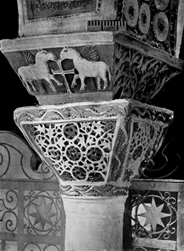
XXI.
CAPITAL FROM THE APSE OF THE CHURCH OF S. VITALE, RAVENNA, ITALY.
This is one of the most beautiful and most characteristic capitals of the Byzantine style. Its form and decoration are both typical of the style. The flat treatment of the interlace of the vine motive is very generally used, and can be seen in great variety in S. Vitale and elsewhere. The ornament is here enriched with gold and color. In the double capitals of Ravenna the upper member, or cushion, is usually ornamented with symbolic designs drawn from various sources, both Pagan and Christian.
XXII. Capital from the Church of S. Vitale, Ravenna, Italy.
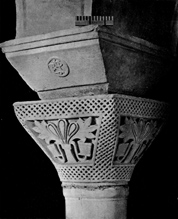
XXII.
CAPITAL FROM THE CHURCH OF S. VITALE, RAVENNA, ITALY.
Here again is the rhomboidal double capital of a much more severe design than that of the preceding plate, but with a remarkable delicacy and refinement of treatment.
XXIII. Capital from the Church of S. Vitale, Ravenna, Italy.
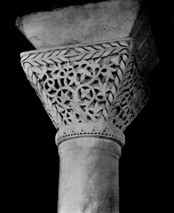
XXIII.
CAPITAL FROM THE CHURCH OF S. VITALE, RAVENNA, ITALY.
This is a mean between the two extreme types shown in Plates XXI. and XXII.
In all these examples the treatment of the angles should be noted. Strong confining lines, with a distinct upward tendency of the ornament, contrasted with the flat sides, contribute much to the good effect of these capitals as constructive members.
XXIV. Capital in the Museum of the Accademia di Belle Arti, Ravenna, Italy.
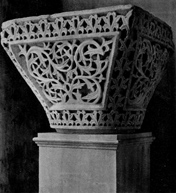
XXIV.
CAPITAL IN THE MUSEUM OF THE ACCADEMIA DI BELLE ARTI, RAVENNA, ITALY.
Whether this capital was originally intended for S. Vitale or some of the other churches of Ravenna we cannot state, but at all events it is a fitting companion for the others illustrated in this number.