Book 9 — CHAPTER VIII. (continued 2)
Reading edition
A strict watch was kept all along our lines—the Turks, who occupy the hilly grounds of Balaklava, were on the alert, and watched Alsou; and General d'Allonville, also put on his guard, doubled his vigilance in the high valley of Baidar. My mind was quite at rest, moreover, as regards the extreme right; it is one of those mountainous regions where it is impossible to manœuvre large bodies of men. The enemy could only make false demonstrations there—in fact, that is what occurred. In the night between the 15th and 16th of August, General d'Allonville notified that he had troops opposite him; but his attitude imposed upon the enemy, who attempted nothing on that side, and dared not attack him. During this time, the main body of the Russian troops, which had descended from the Mackenzie Heights with the intention of debouching near Ai Todor, advanced, favoured by night, on the Tchernaya; to the right, the 7th, 5th, and 12th Divisions crossed the plain; and to the left, the 17th Division; a portion of the 6th and the 4th followed the plateau of Tchouliou. A strong body of cavalry and 160 pieces of artillery supported the infantry.
A little before daybreak the advanced posts of the Sardinian army, placed as vedettes as far as the heights of Tchouliou, fell back, and announced that the enemy was advancing in considerable force. Shortly afterwards, in fact, the Russians lined the heights of the right bank of the Tchernaya with heavy guns (pièces de position), and opened fire on us.
General Herbillon, who commanded the French troops on this point, had made his arrangements for battle. To the right of the Traktir Road, Faucheux's division, with the 3rd battery of the 12th artillery; in the centre, his own division, with the 6th company of the 13th; to the left, Camou's division, with the 4th battery of the 13th. On his side, General Della Marmora had ranged his troops in order of battle. At the same time, General Morris's fine division of Chasseurs d'Afrique, speedily joined by General Scarlett's numerous and valiant English cavalry, took up a position behind the hills of Kamara and Traktir. This cavalry was to take the enemy in flank, in case he should succeed in forcing a passage by one of the three outlets of Tchorgoun or Traktir, or at the incline to the left of General Camou.
Colonel Forgeot, in command of the artillery of the Tchernaya lines, kept six batteries of horse artillery, two of which belonged to the Imperial Guard, ready to act as a reserve. Six Turkish battalions of Osman Pasha's army, led by Sefer Pasha, came to lend us their assistance. Finally, I ordered forward Levaillant's division of the 1st corps, Dulac's division of the 2nd corps, and the Imperial Guard, comprising reserves capable of remedying the most serious contretemps. The thick mist which covered the depths of the Tchernaya, and the smoke of the cannonade which had just commenced, prevented us distinguishing against which particular point the chief effort of the enemy would be directed; when, on our extreme left, the 7th Russian division came tilt against Camou's division. Received by the 50th of the Line, the 3rd Zouaves, who charged them with the bayonet, and by the 82nd, which took them in flank, the enemy's columns were compelled to make a demivolte to recross the canal, and could only escape the fire of our artillery by getting out of range to rally. That division did not appear again during the day.
In the centre, the struggle was longer and more desperate. The enemy had sent two divisions (the 12th supported by the 5th) against Traktir Bridge. Many of their columns rushed at once upon the bridge, and the temporary passages they constructed with ladders, pontoons, and madriers. They then crossed the Tchernaya, the trench of our lines, and advanced bravely on our positions. But, assailed by Generals Faucheux and De Failly, these columns were routed, and the men recrossed the bridge occupied by the 95th, and were pursued beyond it by the 2nd Zouaves, the 97th of the Line, and by a portion of the 19th battalion of Chasseurs-à-Pied.
However, while the artillery was roaring on both sides, the Russians re-formed their columns of attack, the mist had cleared, and their movements became distinctly visible. Their 5th division reinforced the 12th, which had just been engaged; and the 17th was preparing to descend the heights of Tchouliou to support these two first divisions.
General Herbillon then ordered General Faucheux to be reinforced by Cler's Brigade, and gave the 73rd as a reserve to General de Failly. Colonel Forgeot, moreover, placed four batteries of horse artillery in position, which gave him on this front a total of seven batteries to be brought to bear upon the assailing masses. The result was, that the second attempt of the Russians, in spite of its energetic character, proved of no avail against us; and they were compelled to retreat with great loss.
The 17th Russian Division, which had come down throwing out large bodies of riflemen as skirmishers, had no better success. Received with great resolution by General Cler's Brigade, and by a half battery of the Imperial Guard, harassed on the left by the troops of Tretti's Division, who pressed it closely, that division was compelled to recross the Tchernaya, and to fall back behind the batteries of position which lined the heights from which it had started.
From this moment, 9 A.M., the defeat of the enemy was inevitable. Their long columns withdrew as fast as they could, under the protection of a considerable body of cavalry and artillery.
For a moment I felt inclined to order a portion of the cavalry to charge and cut down the remnant of the 17th Russian Division, between the Tchouliou and Traktir Bridges. With this object in view, I had prepared some squadrons of Chasseurs d'Afrique, who were joined by some Sardinian squadrons, and by one of General Scarlett's regiments, the 12th Lancers (from India); but the retreat of the Russians was so prompt, that we could only have made a small number of prisoners, and this fine cavalry might have been reached by some of the enemy's batteries still in position; I deemed it preferable not to expose it for so small a result. General Della Marmora did not, moreover, stand in need of this support boldly to retake the advanced positions which his small posts occupied on the heights of Tchouliou.
At three o'clock the whole of the enemy's army had disappeared. The Division of the Guard and Dulac's Division relieved the divisions engaged, as they stood in need of some rest. I sent back the first corps of Devaillant's Division, and the cavalry returned to its usual bivouac. This splendid action does the greatest honour to the infantry, to the horse artillery of the Garde, to that of the reserve, and to the artillery of divisions. I will shortly ask your Excellency to place before the Emperor the names of those who have deserved rewards, and to submit to the approbation of his Majesty those which I may have awarded in his name. Our losses are doubtless to be regretted, but they are not in proportion to the results obtained, and to those we have inflicted upon the enemy. We have eight superior officers wounded, nine subaltern officers killed, and fifty-three wounded; 172 non-commissioned officers and soldiers killed, 146 missing, and 1,163 wounded. The Russians have left 400 prisoners in our hands. The number of their killed may be estimated at more than 3,000, and of their wounded at more than 5,000, of which number 1,626 men and thirty-eight officers have been taken to our ambulances. Among the slain found by us are the bodies of two generals, whose names I have not been able to ascertain.
The Sardinian army, which fought so valiantly at our side, has about 250 men hors de combat. It inflicted a much greater loss upon the enemy. One hundred prisoners, and about one hundred and fifty wounded, remain in its hands. I am sorry to announce to your Excellency that General Della Marmora has informed me that Count de Montevecchio, whose character and talents he greatly appreciated, was killed gloriously at the head of his brigade.
I must point out to your Excellency the rapidity with which General Scarlett's cavalry, placed at my disposal by General Simpson, came up. The martial appearance of these magnificent squadrons betrayed an impatience which the happy and prompt result of the battle did not allow me to gratify.
The English and Sardinian position batteries, and the Turkish battery which Osman Pasha had sent to Alsou, fired with great precision and success. I thanked Osman Pasha for the promptitude with which he sent me six Turkish battalions under Sefer Pasha (General Koscielzki), four of which during the day occupied the passage near Tchorgoun.
Nothing remarkable took place during the day on the Sebastopol side. Generals De Salles and Bosquet were, however, prepared to drive back with energy any attack of the besieged. I send your Excellency with this report the copy of the plan for the battle of the 16th, found upon the body of a Russian general, supposed to be General Read, who commanded the enemy's right, and was especially entrusted with the attack on Traktir Bridge.
I am, &c., &c., Pelissier, Commander-in-Chief.
As this battle really decided the fall of the place, inasmuch as it enabled the Allies to continue without fear of molestation the armament of those tremendous batteries which would have annihilated the whole forces of Russia inside the walls of Sebastopol, it may not be uninteresting to add the despatches of General Simpson, who was late on the field, and of General Della Marmora, who took an active part in directing the operations of the Sardinians on this memorable day. General Simpson wrote as follows:—
Before Sebastopol, August 18.
My Lord,—In my despatch of the 14th instant, I informed your Lordship that I had reason to believe that the Russians would attempt by a vigorous attack to force us to raise the siege! This they endeavoured to do on the morning of the 16th, but the result was most glorious to those of the Allied troops who had the good fortune to be engaged.
The action commenced before daylight, by a heavy column of Russians under the command of General Liprandi, and composed of the 6th and 17th Divisions, with the 4th and 7th Divisions in reserve, attacking the advanced posts of the Sardinians. The ground occupied by them is on commanding hills on the right of the position, on the left bank of the Souhaia river, where it forms its junction with the Tchernaya, with two advanced posts on the opposite side. These were held with very determined gallantry for a considerable time; but being separated from their supports by the river, and not having the protection of artillery, they were compelled to leave the most advanced one.
About the same time, the 5th and 12th Divisions, to which was added a portion of the 17th, advanced against the bridge of Traktir, held by one battalion of French infantry of the Line, who were for a short time obliged to yield and fall back upon the main supports; with these, however, they quickly retook the bridge at the point of the bayonet. Again the Russians attacked with persevering courage, and were enabled to follow up their advantage by gaining the heights which rise precipitously on each side of the road; their success was but momentary—they were driven back across the river, leaving the ground covered with dead and wounded.
The Russian General, in no way daunted by the failure of his two attempts, ordered a second column, of equal force to the first, to attack; they advanced with such impetuosity, covered by the fire of their numerous artillery, that a third time the bridge was carried, and the heights above it crowned, but they were again repulsed, and retired in great confusion into the plain, followed by the bayonets of our gallant allies. The General Officer who commanded the Russian column, and who is supposed to be General Read, was killed, and in his possession was found the orders for the battle, signed by Prince Gortschakoff, who commanded in person. From these it would appear that it was a most determined attempt to force us to raise the siege. Had they succeeded, Balaklava was to have been attacked by one portion of their army, whilst the heights on which we now are were to have been stormed with the other; at the same time a vigorous sortie was to have been made from the town on the French works on our extreme left from the Quarantine, and another on the works on our extreme right on Mount Sapoune.
The action which I have endeavoured to describe is most glorious to the arms of the French and Sardinian troops. To meet the force of the Russians, the former had but 12,000 infantry and four batteries of artillery engaged; the latter had 10,000 men in position, 4,500 actually engaged, and twenty-four pieces of cannon.
The Russian force consisted of from 50,000 to 60,000 men, with 160 pieces of artillery, and cavalry to the amount of 6,000. This disparity of numbers will readily explain to your Lordship the difficulty that would have been experienced had an attempt been made to follow up the advantage by a pursuit. The Russian retreat, moreover, was protected by the fire from the heavy guns in position on the Mackenzie Heights.
The loss sustained by the Russians is estimated at between 5,000 and 6,000 men, including 600 prisoners, whilst on the part of the Allies it does not amount to more than 1,000 men.
This brilliant affair has caused the greatest delight amongst the ranks of the Allied army; and while it adds fresh lustre to the gallant achievements of the French arms, it is with the utmost pleasure that I have to record the intrepid conduct and gallant bearing of the Sardinian troops, under General Della Marmora, who have for the first time met, conquered, and shed their blood against our common enemy, who is now disturbing the peace of Europe.
Captain Mowbray's battery of 32-pounder howitzers was placed in advance with the Sardinian troops, and did most excellent service in preventing the advance of the enemy's artillery.
Our cavalry, under Lieutenant-General Sir J. Scarlett, K.C.B., was placed in the plain of Balaklava, prepared to take advantage of any circumstance that might present itself, but the opportunity did not arise for calling upon their services.
I regret that I am unable to give a more detailed account of the part performed by the Sardinians, as up to this time I have not received General Della Marmora's report.
I have, &c., James Simpson, General Commanding. Lord Panmure, &c. &c. &c.
Before Sebastopol, August 21.
My Lord,—In my despatch of the 18th instant I was unable to give as detailed an account of the part taken by the Sardinian troops, in the battle of the Tchernaya, as I could have wished. I have since received General La Marmora's report, of which I have now the honour to send you a copy.
The killed and wounded of the Russian army exceed, if anything, the number I originally stated. An armistice was granted, to enable the enemy to bury the dead, and vast quantities were carried away.
The fire from the batteries of the Allies has been very effective, and the result attained has been sufficient to enable the works against the place to progress satisfactorily.
I beg to enclose the list of casualties to the 19th instant.
Major M'Gowan, 93rd Highlanders, who was reported by me as missing in my despatch of the 11th August, I have since ascertained was attacked whilst posting his sentries in advance of the trenches, wounded severely, and made prisoner.
I have, &c., James Simpson, General Commanding.
The Lord Panmure, &c. &c. &c.
[Translation.]
Sardinian Army.—Head-quarters of the Expeditionary Forces in the East, Kadikoi, August 17.
Sir,—The interest which you are so kind as to evince in everything relating to the Sardinian Expeditionary Army makes it imperative upon me to inform your Excellency of the share taken by the troops under my command in the engagement on the Tchernaya yesterday.
Upon receiving the report of Colonel Dessaint, attached to the French head-quarters, which you were good enough to communicate to me on the evening of the day before yesterday, and by which we were led to expect very shortly an attack on the line of the Tchernaya, I at once gave orders that my troops should be under arms yesterday morning at an earlier hour than usual.
At break of day our outposts stationed on the Mamelon, which commands Tchorgoun, were enveloped in a well-sustained fire of artillery, which proceeded from three batteries posted opposite to the breastworks by which our outposts were covered, and on the two Mamelons further to the right, which form the two banks of the Souliou. They were at the same time vigorously charged by three Russian columns, which came on with fixed bayonets, and attacked our breastworks in front and rear. The men composing these columns carried ladders with them to scale the parapets. The preconcerted signal of alarm was immediately given; and the troops took up the positions which had been assigned to them in anticipation of this attack.
I begged his Excellency Hosman Pasha to bring up the Turkish troops which were stationed furthest off; and I ordered the 4th battalion of Riflemen (bersaglieri) to the support of our outposts, which only consisted of three companies, in order that these latter might be enabled to hold their ground as long as possible, and thus give us time to complete our arrangements.
Attacked in the rear by the enemy's artillery, and charged by three columns of infantry, the outposts, after an hour's firing, fell back, the reinforcements I had sent to them greatly facilitating their retreat. At the same time I made every effort to silence the enemy's guns. In this endeavour I was assisted by the Turkish field-pieces from Alsou, and by the English battery, with which you were good enough to reinforce us. Several of the enemy's ammunition wagons exploded between seven and eight o'clock.
In the meantime the Russians had stationed fresh batteries near the centre of their position, and had opened a most effective fire of artillery on the tête-de-pont at Traktir, and on the French positions on our left. A column of infantry, under cover of this fire, attacked the Mamelon, which formed the extreme right of General d'Herbillon's Division. The first column had crossed the Tchernaya, and surmounted the steep ascent of the Mamelon in spite of the fire of the tirailleurs, when it was vigorously attacked by the French troops in support, and hurled back, broken and disordered, into the Tchernaya.
As I considered, from the subsequent dispositions of the enemy's forces, that he only intended to make a demonstration of artillery before our position, while he concentrated his infantry chiefly on the extreme right of the Third Division (Faucher's), on which point a second column was now advancing, I ordered a portion of my 5th Brigade, under the command of General Mallard, to march to the support of the right wing of the French, and I posted two of our batteries in a position from whence they could maintain an oblique fire upon the Russians. At the same time I requested the English cavalry to move down into the plain to be in readiness to charge. I had given similar orders to my own cavalry.
When the soldiers of my 5th Brigade arrived at the Mamelon, they found that the enemy's attack had been already repulsed; but the fire of the two batteries of the 2nd Division (Trotti's) appeared to do great execution on the 2nd Russian column, which, checked in front by the French troops, and harassed in the rear by the fire of our batteries and the musketry of our battalions, fell back in the greatest disorder. I then ordered some of our battalions to advance under cover of the Riflemen (bersaglieri), but I was requested to countermand this movement.
The enemy, repulsed at all points, commenced his retreat. One column, which appeared to me to consist of a division, retreated by the valley of the Souliou. Another division, the one which had attacked our outposts and the French right in the morning, fell back upon the zigzag Mamelon; while a third division followed the road which leads to Mackenzie's Farm.
I took advantage of this state of things to reoccupy with my troops the zigzag Mamelon; in which design I succeeded perfectly, in spite of the imposing force which the enemy still retained on that point. In the meantime, three battalions of Turkish troops advanced into the Valley of Tchorgoun, to replace the battalion of Cialdini's Brigade, which was occupying the heights of Karlooka.
Later in the day I crossed the Tchernaya with four squadrons, and marching in a parallel line with the zigzag Mamelon, came upon the old Russian redoubt, whence I could easily discern, at a little distance before us, a very fine array of regular cavalry, supported by horse artillery. It was distributed in twelve separate bodies, and must have been composed of at least fifty squadrons. This cavalry did not fall back on Mackenzie Road till the whole of the infantry and artillery had effected their retreat.
The losses sustained by our troops, a portion only of whom was engaged, were very inconsiderable. They amount to about two hundred men placed hors de combat; and I impute the fact of our not having lost more men mainly to the works with which we fortified our position, and to the batteries of heavy guns which you were so obliging as to lend us for their defence. It is, however, my painful duty to announce to your Excellency that Count Montevecchio, the General commanding the 4th Brigade, is mortally wounded; a ball passed through his chest.
Pray accept, General, the assurance of my high consideration.
The General Commanding-in-Chief the Sardinian Expeditionary Forces, (Signed) La Marmora.
To his Excellency the General Commanding-in-Chief the English Army.
GENERAL SIMPSON'S DESPATCH. General Simpson To Lord Panmure. (Received September 22.)
Before Sebastopol, September 9, 1855.
My Lord,—I had the honour to apprise your Lordship in my despatch of the 4th instant, that the Engineer and Artillery Officers of the Allied Armies had laid before General Pelissier and myself a report recommending that the assault should be given on the 8th instant, after a heavy fire had been kept up for three days.
This arrangement I agreed to, and I have to congratulate your Lordship on the glorious results of the attack of yesterday, which has ended in the possession of the town, dockyards, and public buildings, and destruction of the last ships of the Russian Fleet in the Black Sea. Three steamers alone remain, and the speedy capture or sinking of these must speedily follow.
It was arranged that at twelve o'clock in the day the French columns of assault were to leave their trenches, and take possession of the Malakoff and adjacent works. After their success had been assured, and they were fairly established, the Redan was to be assaulted by the English; the Bastion, Central, and Quarantine Forts, on the left, were simultaneously to be attacked by the French.
At the hour appointed our Allies quitted their trenches, entered and carried the apparently impregnable defences of the Malakoff with that impetuous valour which characterizes the French attack; and, having once obtained possession, they were never dislodged.
The Tricolor planted on the parapet was the signal for our troops to advance.
The arrangements for the attack I entrusted to Lieutenant-General Sir William Codrington, who carried out the details in concert with Lieutenant-General Markham.
I determined that the second and light divisions should have the honour of the assault, from the circumstance of their having defended the batteries and approaches against the Redan for so many months, and from the intimate knowledge they possessed of the ground.
The fire of our artillery having made as much of a breach as possible in the salient of the Redan, I decided that the columns of assault should be directed against that part, as being less exposed to the heavy flanking fire by which this work is protected.
It was arranged between Sir W. Codrington and Lieutenant-General Markham that the assaulting column of 1,000 men should be formed by equal numbers of these two divisions, the column of the light division to lead, that of the 2nd to follow. They left the trenches at the preconcerted signal, and moved across the ground preceded by a covering party of 200 men, and a ladder party of 320. On arriving at the crest of the ditch, and the ladders placed, the men immediately stormed the parapet of the Redan, and penetrated into the salient angle. A most determined and bloody contest was here maintained for nearly an hour, and although supported to the utmost, and the greatest bravery displayed, it was found impossible to maintain the position.
Your Lordship will perceive, by the long and sad list of casualties, with what gallantry and self-devotion the officers so nobly placed themselves at the head of their men during this sanguinary conflict.
I feel myself unable to express in adequate terms the sense I entertain of the conduct and gallantry exhibited by the troops, though their devotion was not rewarded by the success which they so well merited; but to no one are my thanks more justly due than to Colonel Windham, who gallantly headed his column of attack, and was fortunate in entering, and remaining with the troops, during the contest.
The trenches were, subsequently to this attack, so crowded with troops that I was unable to organize a second assault, which I intended to make with the Highlanders under Lieutenant-General Sir Colin Campbell, who had hitherto formed the reserve, to be supported by the third division under Major-General Sir William Eyre. I, therefore, sent for these officers, and arranged with them to renew the attack the following morning.
The Highland Brigade occupied the advanced trenches during the night. About eleven o'clock the enemy commenced exploding their magazines, and Sir Colin Campbell having ordered a small party to advance cautiously to examine the Redan, found the work abandoned; he did not, however, deem it necessary to occupy it until daylight.
The evacuation of the town by the enemy was made manifest during the night. Great tires appeared in every part, accompanied by large explosions, under the cover of which the enemy succeeded in withdrawing their troops to the north side by means of the raft-bridge recently constructed, and which they afterwards disconnected and conveyed to the other side.
Their men-of-war were all sunk during the night.
The boisterous weather rendered it altogether impossible for the Admirals to fulfil their intention of bringing the broadsides of the Allied Fleets to bear upon the Quarantine Batteries; but an excellent effect was produced by the animated and well-directed fire of their mortar vessels, those of Her Majesty being under the direction of Captain Wilcox, of the Odin, and Captain Digby, of the Royal Marine Artillery.
It now becomes my pleasing duty, my Lord, to place on record the high sense I entertain of the conduct of this Army since I have had the honour to command it. The hardships and privations endured by many of the regiments during a long winter campaign are too well known for me to comment upon. They were borne both by officers and men with a patience and unmurmuring endurance worthy of the highest praise, and which gained them the deserved applause and sympathy of their country.
The Naval Brigade, under the command of Captain the Honourable Henry Keppel, aided by Captain Moorsom, and many gallant officers and seamen who have served the guns from the commencement of the siege, merit my warmest thanks.
The prompt, hearty, and efficacious co-operation of Her Majesty's Navy, commanded by Rear-Admiral Sir Edmund Lyons, and ably seconded by Sir Houston Stewart, has contributed most materially to the success of our undertaking; and here, perhaps, I may be permitted to say that, if it had pleased God that the successful result of this memorable siege should have been reported by my ever to be lamented predecessor in this command, I am sure that it would have been one of his most pleasing duties to express the deep sense which I know he entertained of the invaluable assistance and counsel he received on all occasions from Sir Edmund Lyons. When at times affairs looked gloomy and success doubtful, he was at hand to cheer and encourage; and every assistance that could tend to advance the operations was given with the hearty goodwill which characterizes the British sailor.
Nothing has contributed more to the present undertaking than the cordial co-operation which has so happily existed from the first between the two services.
I cannot sufficiently express my approbation of the conduct of the Royal Engineers under Lieutenant-General Sir Harry Jones, who has conducted the siege operations from the beginning of this year. For some time past he has been suffering on a bed of sickness, but the eventful hour of the assault would not permit him to remain absent; he was conveyed on a litter into the trenches to witness the completion of his arduous undertakings.
My warmest thanks are due to the officers and soldiers of the Royal Artillery under the command of Major-General Sir R. Dacres, who, during the arduous operations of this protracted siege, have so mainly contributed to its ultimate success.
I must beg further to record my thanks for the cordial co-operation and assistance I have received in carrying out the details of the service from the Chief of the Staff, the Adjutant and Quartermaster-Generals, and General Staff, as well as Generals commanding Divisions and Brigades of this Army.
I must reserve to myself, for the subject of a future despatch, bringing before your Lordship the particular mention of officers of the various branches of this Army, whom I shall beg to recommend to your favourable notice.
I entrust this despatch to the care of Brevet-Major the Honourable Leicester Curzon, who has been Assistant Military Secretary to my noble predecessor and myself since the commencement of this war, and who will be able to give your Lordship more minute details than the limits of a despatch will allow.
I have, &c., James Simpson, General Commanding.
FINAL ASSAULT ON SEBASTOPOL. Marshal Pelissier's Report.
Head-quarters, Sebastopol, September 11, 1855.
Monsieur le Maréchal,—I shall have the honour to send you by next courier a detailed report of the attack which has rendered us masters of Sebastopol. I can only give you to-day a rapid sketch of the principal features of this great military achievement.
Since the 16th of August, the day of the Battle of the Tchernaya, and despite the repeated notifications of a new and more formidable attack of the enemy on the positions which we occupy on that river, every preparation was being made for a decisive assault upon Sebastopol itself. The artillery of the Right Attack opened already on the 17th of August a better sustained fire against the Malakhoff and against the Redan and Careening Bay, the neighbouring defences, and the roadstead, so as to allow the engineers to establish lodgments near the place, where the troops could throw themselves promptly on the enceinte. The engineers, moreover, prepared their scaling ladders, and all our batteries of the left opened a very violent fire against the town on the 5th of September. On their side the English kept up a heavy and incessant fire at the Great Redan and its redoubts, which they had to attack.
Everything being ready, I resolved, in concert with General Simpson, to give the assault on the 8th of September, at noon.
M'Mahon's division was to storm the Malakhoff works; Dulac's division the Redan of Careening Bay; and in the centre the division of La Motterouge was to march against the Curtain which unites those two extreme points. In addition to these troops I have given General Bosquet General Mellinet's division of the Garde to support those three first divisions. So much for the right.
In the centre the English were to attack the Great Redan by scaling it at its salient.
On the left the first corps, to which General della Marmora added a Sardinian Brigade, having at its head Levaillant's division, was to penetrate by the Central Bastion into the interior of the town, and then turn the Flagstaff Bastion, to make a lodgment there. General de Salles' instructions were only to follow up his attack if circumstances allowed him.
Moreover, the fleets of Admiral Lyons and Bruat were to make a powerful diversion by attacking the Quarantine, the roadstead, and sea fronts of the fortress. But the state of the sea, owing to a strong wind from the N.E., was such that neither the line-of-battle ships nor frigates could leave their anchorage. The English and French mortar-boats were, however, enabled to open fire. They fired in a remarkable manner, and did us good service.
Precisely at noon M'Mahon, La Motterouge's, and Dulac's divisions, electrified by their leaders, threw themselves against the Malakhoff, the Curtain, and the Little Redan of Careening Bay. After surmounting unheard-of obstacles, and after a terrible hand-to-hand struggle, M'Mahon's division succeeded in making good a footing in the front part of the Malakhoff. The enemy kept up a hail of projectiles of every description upon our brave troops. The Redan of Careening Bay, exposed to a cross fire and to the fire of the steamers, was obliged to be evacuated after having been occupied; but La Motterouge's division held its ground on a portion of the Curtain, and M'Mahon's division gained ground in the Malakhoff, where General Bosquet poured in reserves, which I hastened up.
The other attacks were subordinate to that of the Malakhoff, the key of the defences of the whole place.
From the Brancion Redoubt, where I had placed myself, I saw that the Malakhoff was in our hands, and I gave the signal agreed upon with General Simpson.
The English at once advanced bravely against the salient of the Great Redan; they succeeded in lodging themselves there, and struggled for a long time to keep it; but, overwhelmed by the Russian reserves, which never ceased advancing, and by a violent fire of artillery, they were forced to fall back into their parallels.
At the same signal General de Salles attacked the Central Bastion. Levaillant's division had commenced establishing itself there, as also on the right lunette, when, after a sweeping fire of grape, such strong Russian reinforcements came up, that our troops, decimated by the fire, and their officers hors de combat, were compelled to return to the places d'armes they had started from.
Convinced that the capture of the Malakhoff must decide the success, I prevented a renewal of the other attacks, which, by occupying the enemy on all the points of his vast enceinte, had already fulfilled their chief object, and I concentrated all my attention on the possession of the Malakhoff, now completely in the power of General M'Mahon. A critical moment was, however, at hand.
General Bosquet had just been struck by a large fragment of a shell, and I was obliged to give his command to General Dulac. A powder magazine in the Curtain near the Malakhoff blew up, and made me fear the most serious consequences.
The Russians, hoping to profit by this accident, advanced in dense masses, and in three columns attacked the centre, left, and right of the Malakhoff. But arrangements had already been made within the work. General M'Mahon had daring troops, who feared nothing, to oppose them, and after some desperate attempts the Russians were compelled to beat a retreat. From that moment they relinquished any offensive attack. The Malakhoff was ours, and could not be taken from us. It was half-past four. Measures were immediately taken to put us in a condition to repulse the enemy, should he attempt to attack us in the night. But our uncertainty was soon put an end to. At nightfall flames burst out on all sides, mines exploded, powder magazines blew up. The spectacle of Sebastopol in flames, witnessed by the whole army, was one of the most imposing and terrible sights ever presented in the history of wars. The enemy was evacuating the place. The retreat was effected during the night by means of the bridge established between the two sides of the roadstead, and under cover of the successive explosions, which prevented me from approaching to harass it. On the morning of the 9th the whole south side of the town was abandoned and in our hands.
I need not point out to your Excellency the importance of such a success; nor need I speak of that brave army whose warlike virtues and devotion are so well appreciated by our Emperor, and I shall have, though the number is great, to point out to you those who distinguished themselves among so many valorous soldiers. I cannot do so yet, but I shall fulfil that duty in an early despatch.
Accept, M. le Maréchal, the expression of my respectful devotion.
Pelissier, Commander-in-Chief.
On the 9th of September, when it became known that the city was abandoned, the following order was issued:—
"General After-Order.
"Head-quarters, September 9.
"The Commander of the Forces congratulates the army on the result of the attack of yesterday.
"The brilliant assault and occupation of the Malakoff by our gallant Allies obliged the enemy to abandon the works they have so long held with such bravery and determination.
"The Commander of the Forces returns his thanks to the general officers and officers and men of the Second and Light Divisions, who advanced and attacked with such gallantry the works of the Redan. He regrets, from the formidable nature of the flanking defences, that their devotion did not meet with that immediate success which it so well merited.
"He condoles and deeply sympathizes with the many brave officers, non-commissioned officers, and men who are now suffering from the wounds they received in the course of their noble exertions of yesterday.
"He deeply deplores the death of the many gallant officers and men who have fallen in the final struggle of this long and memorable siege.
"Their loss will be severely felt, and their names long remembered in this army and by the British nation.
"General Simpson avails himself of this opportunity to congratulate and convey his warmest thanks to the general officers, officers and soldiers of the several divisions, to the Royal Engineers and Artillery, for their cheerful endurance of almost unparalleled hardships and sufferings, and for the unflinching courage and determination which on so many trying occasions they have evinced.
"It is with equal satisfaction that the Commander of the Forces thanks the officers and men of the Naval Brigade for the long and uniform course of valuable service rendered by them from the commencement of the siege.
"By order, H. W. Barnard, Chief of the Staff."
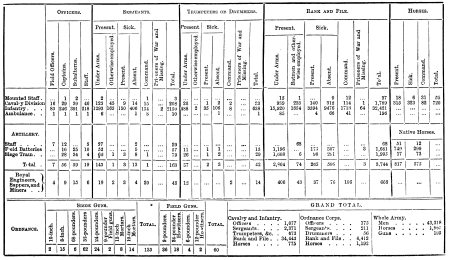
STATE OF ARMY, MARCH, 1855.

THE TREATY OF PARIS.
THE FOLLOWING ARE THE MOST IMPORTANT ARTICLES OF THE TREATY, SIGNED BY THE REPRESENTATIVES OF THE GREAT POWERS, AT THE END OF THE CRIMEAN WAR.
Art. VII. Her Majesty the Queen of the United Kingdom of Great Britain and Ireland, His Majesty the Emperor of Austria, His Majesty the Emperor of the French, His Majesty the King of Prussia, His Majesty the Emperor of all the Russias, and His Majesty the King of Sardinia, declare the Sublime Porte admitted to participate in the advantages of the public law and system (concert) of Europe. Their Majesties engage, each on his part, to respect the independence and the territorial integrity of the Ottoman Empire; guarantee in common the strict observance of that engagement, and will, in consequence, consider any act tending to its violation as a question of general interest.
Art. VIII. If there should arise between the Sublime Porte and one or more of the other signing Powers any misunderstanding which might endanger the maintenance of their relations, the Sublime Porte, and each of such Powers, before having recourse to the use of force, shall afford the other Contracting Parties the opportunity of preventing such an extremity by means of their mediation.
Art. IX. His Imperial Majesty the Sultan, having, in his constant solicitude for the welfare of his subjects, issued a firman which, while ameliorating their condition without distinction of religion or of race, records his generous intentions towards the Christian population of his empire, and wishing to give a further proof of his sentiments in that respect, has resolved to communicate to the Contracting Parties the said firman, emanating spontaneously from his sovereign will.
The Contracting Powers recognize the high value of this communication. It is clearly understood that it cannot, in any case, give to the said Powers the right to interfere, either collectively or separately, in the relations of His Majesty the Sultan with his subjects, nor in the internal administration of his empire.
Art. XI. The Black Sea is neutralized: its waters and its ports, thrown open to the mercantile marine of every nation, are formally and in perpetuity interdicted to the flag of war, either of the Powers possessing its coasts, or of any other Power, with the exceptions mentioned in Articles XIV. and XIX. of the present Treaty.
Art. XIII. The Black Sea being neutralized according to the terms of Article XI, the maintenance or establishment upon its coast of military-maritime arsenals becomes alike unnecessary and purposeless; in consequence, His Majesty the Emperor of all the Russias and His Imperial Majesty the Sultan engage not to establish or to maintain upon that coast any military-maritime arsenal.
Art. XXII. The Principalities of Wallachia and Moldavia shall continue to enjoy, under the suzerainty of the Porte, and under the guarantee of the Contracting Powers, the privileges and immunities of which they are in possession. No exclusive protection shall be exercised over them by any of the guaranteeing Powers. There shall be no separate right of interference in their internal affairs.
Art. XXVIII. The Principality of Servia shall continue to hold of the Sublime Porte, in conformity with the Imperial Hats which fix and determine its rights and immunities, placed henceforward under the collective guarantee of the Contracting Powers.
In consequence, the said Principality shall preserve its independent and national administration, as well as full liberty of worship, of legislation, of commerce, and of navigation.
Art. XXIX. The right of garrison of the Sublime Porte, as stipulated by anterior regulations, is maintained. No armed intervention can take place in Servia without previous agreement between the High Contracting Powers.
Treaty between Her Majesty, the Emperor of Austria, and the Emperor of the French, guaranteeing the Independence and Integrity of the Ottoman Empire.
Signed at Paris, April 15, 1856. Ratifications exchanged at Paris, April 29, 1856.
Art. I. The High Contracting Parties guarantee, jointly and severally, the independence and the integrity of the Ottoman Empire, recorded in the Treaty concluded at Paris on the thirtieth of March, one thousand eight hundred and fifty-six.
Art. II. Any infraction of the stipulations of the said Treaty will be considered by the Powers signing the present Treaty as casus belli. They will come to an understanding with the Sublime Porte as to the measures which have become necessary, and will without delay determine among themselves as to the employment of their military and naval forces.
THE DENUNCIATION OF THE TREATY OF PARIS. Earl Granville to Sir A. Buchanan.
FOREIGN OFFICE, Nov. 10, 1870.
Sir,—Baron Brunnow made to me yesterday the communication respecting the Convention between the Emperor of Russia and the Sultan, limiting their naval forces in the Black Sea, signed at Paris on the 30th of March, 1856, to which you allude in your telegram of yesterday afternoon.
In my despatch of yesterday I gave you an account of what passed between us, and I now propose to observe upon Prince Gortschakoff's despatches of the 19th and 20th ult., communicated to me by the Russian Ambassador on that occasion.
Prince Gortschakoff declares, on the part of His Imperial Majesty, that the Treaty of 1856 has been infringed in various respects to the prejudice of Russia, and more especially in the case of the Principalities, against the explicit protest of his representative, and that, in consequence of these infractions, Russia is entitled to renounce those stipulations of the Treaty which directly touch her interests.
It is then announced that she will no longer be bound by the Treaties which restrict her rights of sovereignty in the Black Sea.
We have here an allegation that certain facts have occurred which, in the judgment of Russia, are at variance with certain stipulations of the Treaty, and the assumption is made that Russia, upon the strength of her own judgment as to the character of those facts, is entitled to release herself from certain other stipulations of that instrument.
This assumption is limited in its practical application to some of the provisions of the Treaty, but the assumption of a right to renounce any one of its terms involves the assumption of a right to renounce the whole.
This statement is wholly independent of the reasonableness or unreasonableness, on its own merits, of the desire of Russia to be released from the observation of the stipulations of the Treaty of 1856 respecting the Black Sea.
For the question is, in whose hand lies the power of releasing one or more of the parties from all or any of these stipulations?
It has always been held that that right belongs only to the Governments who have been parties to the original instrument.
The despatches of Prince Gortschakoff appear to assume that any one of the Powers who have signed the engagement may allege that occurrences have taken place which in its opinion are at variance with the provisions of the Treaty; and, although this view is not shared nor admitted by the co-signatory Powers, may found upon that allegation, not a request to those Governments for the consideration of the case, but an announcement to them that it has emancipated itself, or holds itself emancipated, from any stipulations of the Treaty which it thinks fit to disprove. Yet it is quite evident that the effect of such doctrine, and of any proceeding which, with or without avowal, is founded upon it, is to bring the entire authority and efficacy of Treaties under the discretionary control of each one of the Powers who may have signed them; the result of which would be the entire destruction of Treaties in their essence. For whereas their whole object is to bind Powers to one another, and for this purpose each one of the parties surrenders a portion of its free agency, by the doctrine and proceeding now in question one of the parties, in its separate and individual capacity, may bring back the entire subject into its own control, and remains bound only to itself.
Accordingly, Prince Gortschakoff has announced in these despatches the intention of Russia to continue to observe certain of the provisions of the Treaty. However satisfactory this might be in itself, it is obviously an expression of the free will of that Power, which it might at any time alter or withdraw; and in this it is thus open to the same objections as the other portions of the communications, because it implies the right of Russia to annul the Treaty on the ground of allegations of which she constitutes herself the only judge.
The question therefore arises, not whether any desire expressed by Russia ought to be carefully examined in a friendly spirit by the co-signatory Powers, but whether they are to accept from her the announcement that, by her own act, without any consent from them, she has released herself from a solemn covenant.
I need scarcely say that Her Majesty's Government have received this communication with deep regret, because it opens a discussion which might unsettle the cordial understanding it has been their earnest endeavour to maintain with the Russian Empire; and for the above-mentioned reasons it is impossible for Her Majesty's Government to give any sanction, on their part, to the course announced by Prince Gortschakoff.
If, instead of such a declaration, the Russian Government had addressed Her Majesty's Government and the other Powers who are parties to the Treaty of 1856, and had proposed for consideration with them, whether anything has occurred which could be held to amount to an infraction of the Treaty, or whether there is anything in the terms which, from altered circumstances, presses with undue severity upon Russia, or which, in the course of events, had become unnecessary for the due protection of Turkey, Her Majesty's Government would not have refused to examine the question in concert with the co-signatories to the Treaty. Whatever might have been the result of such communications, a risk of future complications and a very dangerous precedent as to the validity of international obligations would have been avoided.
I am, &c., (Signed) Granville.
P.S.—You will read and give a copy of this despatch to Prince Gortschakoff.
Prince Gortschakoff to Baron Brunnow.
Czarskoe Selo, 8 (20) November, 1870.
M. le Baron,—The English Ambassador has read to and given me a copy of a despatch of Lord Granville relating to our communications of the 19th (31) of October.
I have hastened to place it before His Majesty the Emperor. It has pleased our August Master to notice, first, the earnest desire of the Cabinet of London to maintain a cordial understanding between England and Russia, and secondly, the assurance that it would not refuse to examine the modifications which circumstances have caused in the results of the Treaty of 1856. As regards the view of strict right laid down by Lord Granville we do not wish to enter into any discussion, recall any precedent, or cite any example, because such a debate would not conduce to the understanding that we desire.
Our August Master has had an imperative duty to fulfil towards his country, without wishing to wound or threaten any of the Governments who signed the Treaty of 1856. On the contrary, His Imperial Majesty appeals to their sentiments of justice, and to the consciousness of their own dignity.
We regret to see that Lord Granville dwells chiefly on the form of our communications. It was not done by our choice. Assuredly, we should have desired nothing better than to arrive at the result in harmony with the Powers who signed the Treaty of 1856. But Her Britannic Majesty's principal Secretary of State well knows that all the efforts repeatedly made to unite the Powers in a common deliberation, in order to do away with the causes of complication which trouble the general peace, have constantly failed. The prolongation of the actual crisis, and the absence of a regular Power in France, remove still further the possibility of such an union. Meanwhile, the position of Russia by this Treaty has become more and more intolerable. Lord Granville will allow that the Europe of to-day is very different from that which signed the Act of 1856. It was impossible that Russia should consent to remain indefinitely bound by a transaction which, already onerous when concluded, lost its guarantees from day to day.
Our August Master knows his duty towards his country too well to impose on it any longer an obligation against which the national feeling protests.
We cannot admit that the abrogation of a theoretical principle without immediate application, which only restores to Russia a right of which no other nation would be deprived, can be considered as a menace to peace, or that the annulment of one point in the Treaty implies the annulment of the whole.
Such has never been the intention of the Imperial Cabinet. On the contrary, our communications of the 19th (31st) of October declare in the most explicit manner that His Majesty the Emperor adheres entirely to the general principles of the Treaty of 1856, and that he is ready to come to an understanding with the Powers who signed that transaction, either by confirming the general stipulations, or by renewing them, or by substituting for them any other equitable arrangement which will be considered fitting to ensure tranquillity in the East, and the equilibrium of Europe. There seems to be no reason why the Cabinet of London, if agreeable to it, should not enter into explanations with those who signed the Treaty of 1856.
On our part, we are ready to join in any deliberation having for its object the general guarantees for consolidating the peace of the East.
We are sure that this peace would receive additional security if a permanent cause of irritation now existing between the two Powers most directly interested in it was removed and their mutual relations were resettled on a good and solid understanding.
You are requested, M. le Baron, to read and give a copy of this despatch to Lord Granville.
The principal Secretary of State of Her Britannic Majesty has expressed to you the regret he would experience if this discussion would alter the good understanding which the Government of Her Majesty the Queen has striven to maintain between the two countries. Will you inform his Excellency how much the Imperial Cabinet would share in this regret.
We think the good understanding of the two Governments essentially useful to the two countries, as well as to the peace of the world. It is with a lively satisfaction that we have seen it become during the last few years more and more intimate and cordial.
The parity of the circumstances in which we are placed seem of a kind to render this more desirable than ever.
Receive, &c., Gortschakoff.
Earl Granville to Sir A. Buchanan.
Foreign Office, Nov. 28.
Sir,—The Russian Ambassador has read and given to me a copy of a despatch of Prince Gortschakoff of the date of 8th (20th) November.
It is not necessary for Her Majesty's Government to recur to the important questions of international law raised by the circular of Prince Gortschakoff, as they have nothing to add to the declaration on the subject which they have already made.
His Excellency has been good enough to appeal to my knowledge of facts which His Excellency states prevented that consultation and agreement with other parties to this Treaty which Russia would have preferred.
I am aware that suggestions for Congresses to settle other European questions have been made and not adopted.
It has been also stated to me that intimations have been given to some of my predecessors, that in the case of certain contingencies, which however have never occurred, such as the possession of the Principalities by Austria, Russia would feel bound to call into question some of the provisions of the Treaty of 1856. But I am ignorant of any occasion on which Russia, the party most interested, has proposed in any way to this country that a relaxation of the Treaty should be taken into consideration.
I cannot therefore admit that the Imperial Government can justify this proceeding by the failure of efforts which have never been made.
The courteous language in which Prince Gortschakoff's despatch is written, his assurance of the manner in which he would have preferred to open this question, and his declaration of the strong desire for a confirmation of good relations between the two nations, particularly important at this time, encourage Her Majesty's Government in the belief that the obstacle to such relations will be removed.
They observe that His Excellency describes the declaration which has been made by Russia as an abrogation of a theoretical principle without immediate application. If these words are to be construed into an announcement that Russia has formed and stated her own opinion of her rights, but has no intention of acting in conformity with it without due concert with the other Powers, they go far to close the controversy in which the two Governments have been engaged.
Her Majesty's Government have no objection to accept the invitation which has been made by Prussia to a Conference, upon the understanding that it is assembled without any foregone conclusions as to its results. In such case Her Majesty's Government will be glad to consider with perfect fairness, and the respect due to a great and friendly Power, any proposals which Russia may have to make.
You will read and give a copy of this despatch to Prince Gortschakoff.
I am, &c., (Signed) Granville.
THE CONFERENCE OF 1871.
THE RESULT OF THE DENUNCIATION OF THE TREATY OF PARIS BY RUSSIA WAS THAT A CONFERENCE, SUGGESTED BY PRINCE BISMARCK, WAS ARRANGED TO MEET AT LONDON.
Protocol No. 1. At the Sitting of January 17.
Earl Granville expressed himself as follows:—
Earl Granville—
"The Conference has been accepted by all the co-signatory Powers of the Treaty of 1856, for the purpose of examining, without any foregone conclusion, and of discussing with perfect freedom, the proposals which Russia desires to make to us with regard to the revision which she asks of the stipulations of the said Treaty relative to the neutralization of the Black Sea.
"This unanimity furnishes a striking proof that the Powers recognize that it is an essential principle of the law of nations that none of them can liberate itself from the engagements of a treaty, nor modify the stipulations thereof, unless with the consent of the contracting parties by means of an amicable understanding."
The Plenipotentiary of Russia requested the permission of the Conference to read a summary which he wished to be inserted in the Protocol:—
"He instanced specially the precedent of the Conferences held at different periods in Paris, and cited the decisions adopted by general agreement with the view of modifying the Government of the Principalities of Moldavia and Wallachia, an alteration which received the sanction of the Sublime Porte, as well as the assent of the other Contracting Powers.
"He affirmed that these deviations from the Treaty have exercised no influence on the firm intention of the Emperor to maintain intact the general principles of the Treaty of 1856, which have defined the position of Turkey in the system of Europe.
"In fact, these stipulations, suggested at another period under the influence of conjunctures entirely different from the present situation are no longer in harmony with the relations of good neighbourhood which exist at this moment between the two Riverain Powers."
Annex.
The Plenipotentiaries of North Germany, of Austria-Hungary, of Great Britain, of Italy, of Russia, and of Turkey, assembled to-day in Conference, recognize that it is an essential principle of the law of nations that no Power can liberate itself from the engagements of a treaty, nor modify the stipulations thereof, unless with the consent Powers by means of an amicable arrangement.
In faith of which the said Plenipotentiaries have signed the present Protocol.
Done at London, the 17th January, 1871.
(Signed) Bernstorff. Apponyi. Granville. Cadorna. Brunnow. Musurus. Broglie.
March 13, 1871.
INDEX.
A, B, C, D, E, F, G, H, I, J, K, L, M, N, O, P, Q, R, S, T, U, V, W, Y, Z
Adams, Brigadier-General, at Inkerman, 169 Adelaide, the, her arrival in Balaklava, 201 Agamemnon, the, her orders for sailing, 81; enters Balaklava, and attacks the fort, 137 Airey, General Sir R., his encampment, 42; superseded, 423 Aladyn, encampment at, 42, 46 Alexander, Colonel, 128 Alexander, Dr., 8 Allied armies, assembled at Varna, 50; military review of the, 51; their great losses in killed and wounded, 341; their preparation for winter quarters, 379; error of their campaign, 494, 495. See French, and Soldiers Alma, the river, halt of the Allied forces at, and preparations for the battle of, 98; account of the battle, 102 et seq.; position of the Russians on, 106; the Allies victorious, 120; retreat of the Russians from, ib.; military conduct of the battle of, 121; state of the battle-field, 483; telegraph at, 486; position and attack at, 486, 487; bitter reflections on the battle, ib.; graves at, 489; frightful losses at, 490; its entrenchments, ib.; monument at, 491 Aloupka, visit to, 482; the Colonel of, ib.; dinner at, ib. Aloushta, 476; visits to, 479 Ambalaki, capture of, 268 Ambulance corps, wretchedness of the, 199; disbanded, 378 Ambulances, their great utility, 363; superiority of the English ones, 439 Anderson, Captain, 42, 87 Araba drivers, their disappearance from Roumelia and Bulgaria, 201 Arabas, arrival of, with provisions, 97 Arabat, Spit of, 277, 496; unsuccessful attack on the fortress of, ib. Armies of the Russians and the Allies, condition of the, 303; their respective positions before Sebastopol, 305; general state of the, 469 Armistice, for the burial of the dead, and interchange of civilities during the, 228, 246, 267; sad scenes during the, 295; news of, from the respective governments, 457; mutual visits after the, 458 et seq.; agreed to, 462; followed by peace, 467 Arms, a gallant feat of, 258, 259 Army, British, its distressed position at Varna, 62; its different divisions, and General Commander, 87; its improved condition, 238; its concentrated attack on Sebastopol, 351 et seq.; its amount of armament in the bombardment of Sebastopol, 336 et seq.; jealousies in the, 385, 386; preparations for its winter encampment, 420. See Crimea, and Soldiers Artillery, duel of, 249; its powerful effects, 463 Athens, Gulf of, 12 Athos, Mount, 12 Autemarre, General d', the French Commander in the Sea of Azoff, 265. Azoff, expedition to the Sea of, 265; capture of Yenikale, 268; operations in the, 270 et seq.; destruction of the Russian shipping, &c., 280; complete success of the expedition, 281; purity of its water, 496 Baidar, miserable state of, 475 Bakschiserai, retreat of the Russians to, 131; visit to, 472; miserable state of, 474 Balaklava, march of the expedition to, 137; a poor village, ib.; surrender of the town, ib.; cholera at, 138; intended attack of the Russians on, 156; fortified earthworks thrown around, 166; hurricane at, 180 et seq.; miserable condition of, 191, 192; dreadful scenes among the Turks in, 192; false alarm at, 193; improvements in, 235; general state of, 250; movements in front of, 325; its singular aspect, 375; discipline in the harbour of, 450; improvements in, ib. Baltschik, rendezvous of the expedition in, 70, 71 Barnard, General, appointed chief of the staff, 305; his meeting with the Russians, 458 Bashi-Bazouks, their military characteristics, 51; their encampment, 52; disbanded, 57 Batteries before Sebastopol, 214, 215; relative position and strength of the, 336 et seq. Bayonet, sanguinary charge with the, at Inkerman, 169, 170; contests with the, 255, 259; reluctance to charge with the, 347 Bazancourt's strictures on the Allied forces, 97-100 Beatty, the engineer, his death, 250 Belbek, the river, 132; scenery of the, ib.; barrier of the, 133; arrival of the Allied troops at, ib.; false alarm at, 135; deliberations at, 136; march from the, ib.; heights of the, 484; cantonments on the, ib. Bell, Captain, his gallantry at Alma, 114 Bentinck, Major-General Sir H., lands at Eupatoria, 86; his orders relative to the services of the fourth division, 392 Berdiansk, attack on, 270 Birds, crowds of, on board ship, 9, 10; Crimean varieties, 233 Bizot, General, killed, 252 Black River, the, 133; gorge of the, 166 Black Sea, entrance of the expedition into the, 39 Blane, Major, 183 Bombardment of Sebastopol, 250 et seq.; terrible effects of the, 335, 338 et seq. See Sebastopol Bomb-shells of the Russians, 248, 343 Bonaparte, Emperor, his intended visit to the Crimea, 260 Bono Johnnies, 53, 54, 175 Bosphorus, arrival of the British troops in the, 23; scenery of the, 37, 38 Bosquet, General, commander of the second division of the French, 56; his command at the Alma, 98; his bravery, 102, 103; at the Tchernaya, 155; at Inkerman, 172 Bouljanæk, affair at, 94 et seq. Bouet Willaumez, the French Admiral, 487 Boussiniere, his bravery at Alma, 103 Boxer, Admiral, commander of Balaklava, 210; his improvements at Balaklava, 239 British soldiers, their devoted heroism, 2, 3 British troops, their disembarkation at Eupatoria, 84. See Soldiers Brown, General Sir G., 8; visits Rustum Pasha, 15; his quarters, 16; cordiality of the French towards, 16; a strict disciplinarian, 23; proceeds to Varna, 36; his landing at Eupatoria, 85; his danger, ib.; commands the light division, 87; his gallantry at the Alma, 113, 114; at Inkerman, 169; his operations, 242; commander of the expedition to the Sea of Azoff, 265 Bruat, Admiral, 27; death of, 447; high mass celebrated for the soul of, ib. Bucharest, captured by Omar Pasha, 55 Bug, river, expedition up the, 413; scenery on the banks of the, ib.; conflict with the Russians, 414; its confluence with the Dnieper, 415; operations in the, 416, 417; raising of the blockade, 419; difficulties of ascending it, ib., note Bulair, town of, 16, 21; military works at, 23; fortifications at, 27 Bulgaria, peasantry of, 43, 44; immense forces assembled in, 48, 49; the natives forsake their homes, 46 Buller, Brigadier-General, 42 Burgoyne, Sir John, proposes the flank march, 132, 134; his departure for England, 243 Burliouk, ruins of, 489, 491 Burrell, Dr., 8 Cafés at Gallipoli, 17, 18 Calvert, Mr., the consul at Gallipoli, 15; his active efforts, ib. Cambridge, Duke of, his arrival at Gallipoli, 30; dines with the Sultan, 33; lands at Eupatoria, 86; commands the first division, 87; his gallantry at Alma, 114; at Inkerman, 169 Camel, anecdote of one at Sebastopol, 439 Cameron, General, of the Highland division, 324 Camp-followers in the Crimea, 449, 450 Camp life, 48 Campbell, General Sir Colin, 25; his military experience, 114 Campbell, General Sir J., of the fourth division, 242; his military operations, ib.; death of, 292 "Canards," hatching of, 215 Canrobert, General, 6; at Gallipoli, 15; arrives at Varna, 41; his bravery at Alma, 102; assumes the command of the French troops, 139; at Inkerman, 172; his order of the day after the battle of Inkerman, 190; his address to the troops, 260 Canteen-keepers, their rapacity, 445 Carbuccia, General, death of, 56 Cardigan, Lord, his difficult reconnaissance, 54; his early operations, 94; at the Tchernaya, 155; his desperate cavalry charge at Balaklava, 159 Careening Bay, Sebastopol, 143 Casualties, number of, 324, 432 Cathcart, Sir G., commands the fourth division, 87; at Balaklava, 139; slain at Inkerman, 170; his advice while living disregarded, 436 Cathcart's Hill, its position, 248, 249, 252; view of Sebastopol from, 334; present state of, 375 Cavalry brigade, British, criticisms on the, 152; its charge on the Russians, 157; relics of the, 257 Cemetery, struggle for the, 292; its capture, 294 "Chambers of horrors," 367 Chapman, Captain, at Sebastopol, 151 Charges at night, difficulties of describing, 261 Chasseurs, at Inkerman, 171; review of the, 261 Cherson, Cape, lighthouse of, 138 Cherson Bay, cruise up the, 413 Chersonese, Cape, 76; memorials of the brave at the, 494 Cholera, its violence in Bulgaria, 56; at Varna, 57, 58; horrors attending it, 58, 61, 62; its ravages at Balaklava, &c., 138, 139, 447 Christian subjects of Turkey, their right to protection, 2 Christmas of 1854, its dreariness in the Crimea, 196; of 1855, 447 Church, desolated interior of a, 257 Civilians, their criticisms on military matters, 447 Classical fictions, 10 Clifford, Hon. Mr., 115 Climate of the Dardanelles and surrounding country, 25, 26 Clothing, terrible deficiency of, 196, 197; supplied by the Times' commissioner, 196; general supplies of, 202, 441 Codrington, General Sir W., his gallantry at Alma, 111, 112; at Inkerman, 169; his justification, 353; appointed commander-in-chief, 423; his various promotions, 424, 425; his career, 425; his general orders, 425; his grand review of the British troops, 454-456; his general orders respecting the departure of the Sardinians, 492 Coffee, wretched supply of, 204 Colborne, Major, 31 Cold, destructive effects of the, 205, 206; paralyzing effects of, 221 Colville, Captain, his bravery at Alma, 111 Comet, appearances of the, 9 Commissariat department, 8; its difficulties at Gallipoli, 20, 21; its pressure of business, 59; its supplies, 179; its deficiencies, 191; improvement in the supplies, 238; favourable changes in the, 437 Commission, mixed, at Sebastopol, for distributing the prize captures, 381-385 Cooking, want of apparatus for, 478 Cooking rations, receipts for, 219 Corn, destruction of, in the Sea of Azoff, 270; quantity of, issued to the English army, 375; great waste of, 444 Cossacks, appearance of the, 80, 84; first encounter with the, 94, 95; their indefatigability, 202; their cunning, 212; a brush with the, 258; their sly manœuvres at Kinburn, 420; their appearance and habiliments, 459, 473, 480; their horses, 480, 481 Councils, divided, evils of the, 426 Crimea, causes of the expedition to the, 1; preparations for the campaign, 2 et seq.; influence of the press on the, 2, 3; early difficulties, and imperfect arrangements for the war, 15, 17; orders for attacking the, 56; preparations for invading the, ib.; Russian forces at the, ib.; departure of the expedition, 70; its shores and anchorage, 73 et seq.; landing at Eupatoria, 84-86; first encounters with the Russians, 89, 94, 95; amount of the invading force, 87; Tartar race of the, 88; march of the Allied army, 83 et seq.; battle of the Alma, 97 et seq.; advance from the Alma, 129; movements of the Russians, 133; advance on Belbek, 134; capture of Balaklava, 137; arrival at Sebastopol, 138; and its investment, 141 (see Sebastopol); battle of Inkerman, 169; hardships of the campaign, 179; attack on Eupatoria, 190; attack of the French on Sebastopol, and the progress of the siege, 200; great hardships, 203; climate, ib.; the Times' fund sent to the, 196; commencement of active operations in the spring, 231; railway in the, 232; birds and flowers in the, 233; sports of the camp, 234; march of improvement in, 235; severe fighting before Sebastopol, 244 et seq.; Kertch expeditions, 263, 265; expedition to the Sea of Azoff, 265; severe fighting before Sebastopol, 284 et seq.; death of Lord Raglan, 299; General Simpson appointed Commander-in-Chief, 301; battles of the Tchernaya, 155, 315; the Sardinian contingent, 310; capture of the Malakoff, 343; retreat of the Russians, 361; capture of Sebastopol, 362; review of the great struggle, 370 et seq.; state of the two armies, 387; ruins of Sebastopol, 387-389; General Simpson's despatch respecting operations in, 390; mildness of the weather in November, 1855, 427, 429; disadvantageous position of the Allies in the, 427; winter of 1855, 440; mud of the, 444; Russian forces in the, 446; a second Christmas in the, 447; winter in the, ib.; storm in the, 448; camp followers in the, 449; destruction of the Sebastopol docks, 451-453; the British forces in the, 454-456; armistice takes place, 462; peace proclaimed, 467; preparations for evacuation, 468; review of the great struggle, 468-471; excursion into the interior, 472; tour through the, and general aspect of the country, 473; departure of the Sardinian staff from, 492; memorials of the brave, 494; tour in the north of the, ib.; its outlets, and the difficulties these presented to the Russians, ib.; wells of the, ib.; salt waters of the, 495; German villages of the, 496; reflections on the campaign, ib. Crimean Flora, 477 Croat labourers, their physical strength and endurance, 232 "Crow's Nest," battery so called, 338 Cuddy, Lieut.-Colonel, his bravery and ill-treatment, 466; his death, ib. Dardanelles, arrival of the British troops at the, 12; coasts of the, ib.; climate and scenery of the, 25, 26 Dead, armistice for the burial of the, 228, 246, 287, 295 Death, the valley of, 64, 67 Demur Kapu, 476 Desaint, Colonel, 56 Deserters from the Allied forces, 204; from the Russians, 204, 234; their accounts from Sebastopol, 204; stories of the, 387; their miserable plight, ib. Devno, march to, 50; the Valley of Death, 64, 67 Diarrhœa among the troops at Varna, 46 Dickson, Colonel, 24; at Balaklava, 139; at Sebastopol, 146; at Inkerman, 170 Dinner, a Crimean one, 219 Discipline, relaxation of, 427 Divisions of the British forces, and their commanders, 87; their landing at Eupatoria, 85, 86; their order of march, 93 Djemel Pasha, commander of the Dardanelles, 19; his learning and intelligence, 19, 20 Dnieper, entry of the united squadron into the, 415; its blockade raised, 419; difficulties of ascending the, 419, note Dobrudscha, campaign in the, and losses experienced thereby, 56 Docks, of Sebastopol, destroyed, 451-453 Dog-hunting in the Crimea, 235 Dogs and cats from Sebastopol, 439 Doyne, Mr., the head engineer, his vigorous labours at Sebastopol, 388, 421, 441 Dragoon Guards, their charge on the Russians, 157 Drainage, operations of, 442 Dress of the British soldiers, 18 Drummers of the Crimea, 450 Drunkenness, punishment of, 445 Dundas, Admiral, 41; his orders, 76 Egerton, Colonel, his bravery at the Alma, 116 Egyptian troops at Varna, 49 Elchingen, Duc d', death of, 56 Electric telegraph laid down, 236; its tendency to mischievous consequences, 443 Electricity, agencies of, 278 Eman, Colonel, killed, 353 Emperor, the guiding star of the fleet, 82 Engineering works, scarcity of men for, 243, 244 England, her commercial interests as regards Turkey, 1 England, Sir Richard, arrives at the Dardanelles, 25; commands the third division, 87 English. See Soldiers, and Army Enniskilleners, their charge on the Russians, 157 Enos, town of, 15 Entrenchments, advance of the, 308 Espinasse, General, 56 Estcourt, General, 129; death of, 299 Etesian wind, 11 Etonnoirs of the French, 255, 494 Eubœa, 12 Eupatoria, survey of the coast of, 59; coast of, 75, 76; town of, 80; selected for the landing-place, ib.; inhabitants of, 82; landing of the French at, 82, 83; resolution to garrison it, 91; Russian attack on, 190 Evans, General Sir de Lacy, arrives at the Dardanelles, 25; commands the second division, 87; lands at Eupatoria, 86; his bravery at the Alma, 107, 115; his report of military operations at the Alma, 116; his despatch from the heights of the Tchernaya, 161-163; his illness, 165, 175 Expedition, Crimean, its departure, 70; its extent, 71; vastness of the armada conveying it, 73; its voyage from Varna to the Crimea, 73-75; its uncertainties, 75, 76; account of its disembarkation, 84-88; military force of the, 87; marches into the interior, ib.; its order of march, 93; its halt at the Alma, 96; at the Katcha, 132; accession of forces at the, ib.; makes a détour round the Belbek, 132 et seq.; its march from the Belbek to Balaklava, 136, 137. See Crimea, and Sebastopol Explosions, disastrous ones, 328, 361, 380, 429-433; causes, 433 Eyre, Brigadier, 25; appointed to the command of the third division, 311; his excursion in the interior of the Crimea, 479 Fatigue parties, severe duties of the, 197 Fatima Hanoum, the Kurdish chieftainess, 54 Ferguson, General, 7 Fidonisi, French rendezvous of, 71 Fighting, love of, an anecdote, 434 Filder, Commissary-General, 40; his office in Varna, 59; his instructions, 67 Fire, a disastrous one, 380 Flagstaff Battery, contentions for the, 191 Flank march of the Allies, 134 Fleet of the Russians, its submergement, 472, 473 Flowers of the Crimea, 233 Food, prices of, at Varna, 41 Forey, General, his bravery at the Alma, 103 Fort Constantine, in Sebastopol, 138 Forts of the north side of Sebastopol, 472 Fourth division, General Bentinck's testimony to their services, 392 France, her political interests as regards Turkey, 1 French camp, sickness in the, 218; their superiority in cooking, ib. French fleet, conveying the expedition, 73, 74 French Spahis effect a landing at Eupatoria, 83 French forces, their arrival at Malta, 6; their superior arrangements, 15, 16, 21, 47; their accommodations at Gallipoli, 17, 18; their police regulations, 18; their mode of making purchases, 17; number of, at Gallipoli, 16, 21; their cordiality to the English, 18, 48; their uniforms, ib.; their methods of dealing with the Turks, 17; review of, at Gallipoli, 28; staff of the, 29; first land on the Crimea, 82, 83; their successful bravery at the Alma, 102; their landing at Kamiesch, 138; their siege and bombardment of Sebastopol, 140 et seq.; their order of battle at Inkerman, 174, 175; road made by the, 198; important reinforcements received, 205; their sufferings, 209; their conflicts with the Russians, 239; their contests for the rifle-pits, 253-255; their gallantry, 259; their capture of the Mamelon, 284, 285; their unsuccessful attack on the Malakoff, 290, 291; great losses sustained thereby, 292-294; their second attack, and capture of the Malakoff, 343; engaged at the battle of the Tchernaya, 316, 319; amount of their ordnance on their last bombardment of Sebastopol, 336; their works for storming the Malakoff, 364; their operations after the fall of Sebastopol, 375 et seq.; review of the, 422; their system of mines, 493 Frost-bites in the Crimea, 202, 205, 221 Fury, the, her reconnaissance of Sebastopol, 59 Fusileer Guards, their arrival at Malta, 5; their severe losses, 357 Gallipoli, departure of the English and French troops for, 8, 9; arrival at, 13; description of, 13, 14; wretchedness of, 14; population of, ib.; its bad quarters, 15-17; difficulties of the commissariat at, 17, 21; high price of provisions, 22; police regulations at, 18; alarming fire at, 24; confusion arising therefrom, 24, 25; climate and scenery of, 25, 26; arrival of generals at 27, 30 Gambier, Lieut. Colonel, commander of the siege train at Sebastopol, 146; at Inkerman, 170 Generals of the army, deficiency of, 190 German colonists of the Crimea, 496 Genitchi, attack on, 270 Gibb, Captain, 9 Golden Fleece, the, 8, 9, 10, 12; her arrival at Gallipoli, 13 Golden Horn, the, 37 Goldie, Brigadier-General, at Inkerman, 169; slain, 170 Goodram, Samuel, blown up, 434; anecdotes of, ib. Gordon, Captain, 42; at Sebastopol, 142 Gortschakoff, Prince, 101; his operations, 437; his intended plan of operations, 441 Grant, Captain, of the ambulance corps, 199 Greece, localities of, 10, 11 Greek and Latin Churches, their quarrels in Turkey, 1 Greek hermit, 11 Greeks, their religion, 16; their apathy, 29 Greys, their charge on the Russians, 157 Guards, their departure from London, 3; their arrival at Malta, 4, 5; their difficulty of obtaining provisions, 6; their arrival at Varna, 47; leave Varna for the Crimea, 67; their gallantry at the Alma, 110, 114, 120; their heroism and severe losses at Inkerman, 171, 175; Queen Victoria's presents to the, 212; their magnificent appearance in line, 115, 116 Hall, Dr., his letter to Dr. Smith, 385 Hallewell, Captain, 15, 31 Hamelin, Admiral, 41 Hammersley, Major, his tour in the north of the Crimea, 494 Handcock, Colonel, killed, 346 Harbour discipline at Balaklava, 450 Highland Brigade, their condition, 64; leave Varna for the Crimea, 67; their gallantry at the Alma, 110, 120; steadiness of their movements in action, 115; their bravery at the Tchernaya, 156; their kilt, 202 Hill, Captain, shot, 247 Himalaya, the, her arrival at Malta, 5; at the Bosphorus, 23; her enormous cargo of horses and men, 90 Hoey, Colonel, his bravery at the Alma, 118 Horses, difficulty of getting them on shore, 90; great havoc among, 206 Hospital quarters at Gallipoli, 17 Hurricane at Balaklava, 180; its violence, 181-186; distress caused thereby, 184, 185; miserable state of Balaklava after the, 187 Hussars, arrival of the, 255 Hut of the author, 440; its situation, 441 Huts, decorations of the, 439, 448; robberies of the, 439; complaints against the, 448 Ida, Mount, 12 Inkerman, the British force taken by surprise at, 168; sanguinary battle of, 169-172; a series of sanguinary hand-to-hand fights, 170; review of the dreadful battle-field, 173; the frightful slaughter at, 174-176; ghastly relics of the battle, 257 Isarkaia, ruined chateau of, 478 Jack Tar at his tricks, 238; his playbill, 329 John Bull at a nonplus, 326-328 Jones, General Sir H., replaces Sir J. Burgoyne, 243, 305 Kadikoi, encampment at, 144; road made from, 198; its administrative government, 445 Kamara, village of, 166 Kamiesch, landing of the French at, 138; amusements at, 440 Kara-Bournou, destruction of the magazines, at, 267 Karaguel, town of, 67 Kariakoff, the Russian commander, 101 Kars, fall of, 447 Katcha, mouth of the, 59; valley of the, 129-132; river of the, 130; Russian vessels sunk in the harbour of the, 132; march from, 134 Keppel, Captain, commander of the naval brigade, 302 Kertch, expedition to, 263; return of the expedition, 264; second expedition, 265; town of, 268, 269; capture of, 268; plunder of, 269, 270, 279; its inhabitants, 272, 273; hospital at, 274; dreadful ravages in, 275, 276; peninsula of, 419, note Kinburn, expedition to, 406; description of, ib.; plan of the attack on, 407-409; bombarded by the Allied fleet, 410; surrender of, 411; fort described, 412; refortified by the Allies, 419; Cossacks in the neighbourhood of, ib. Koran, not adapted to the civil law of Turkey, 20 Kostendji, village of, laid waste, 57 Kurds, chieftainess of the, 54 Lancaster gun, destroyed by a shot, 252 Laspi, the French doctor, plundered by the Turks, 313 Lawrence, Colonel, 9, 111, 112 Leblanc, Mr., accidentally shot, 241 Leander, frigate, 12 Leslie, Lieutenant, wounded, 119 Letters from head-quarters, 31 Levinge, Major, death of, 60 Levinge, Captain, 42 Liège muskets, used by the Russians, 178 Light Cavalry Brigade, its desperate charge at Balaklava, 159; ordered to embark for Eupatoria, 393 Light division, its heroic gallantry, 109, 111, 112; its severe losses, 357; its casualties, 432; its attack at the Alma, 491 Lights, short supplies of, 440 "Looting" at Kertch, 272 Lucan, Lord, commander of the cavalry division, 33, 87; at the Tchernaya, 154; his desperate cavalry attack, 159; his recall, 220 Lüders, General, 457 Luggage of the English and French armies, 30 Lyons, Admiral, his opinions on the flank march of the expedition, 134; commands the expedition to the Sea of Azoff, 266; his operations in Cherson Bay, 413 et seq. Machines, for exploding, 278 Mackenzie's Farm, 133 Macnish, Lieutenant W. L., drowned, 34 Malakoff Tower, 207; French preparations for attacking, 215; unsuccessful attack on the, 290, 291; great losses sustained, 292-294; a second attack on the, left to the French, 303; the French advances towards, 308; assaulted and captured by the French, 343; contest in the rear of the, 350, 351; its capture causes the loss of Sebastopol, 365; strength of its works, ib.; terrible scenes of the, ib.; number of guns captured in the, 383 Malea, Cape, 10, 11 Malta, arrival of the Guards at, 4; busy scenes in, 5; cordial reception of the British troops at, 5, 6; arrival of the French troops at, 6, 8 Mamelon, attack on the, 243; contest for the, 244; firing from the, 249; capture of the, 284; continued struggles for the, 285; interior of the, 297 Manilla, her arrival at Malta, 5 Mansell, Captain, 24, 54 Markham, General, assumes the command of the second division, 305 Marmora, Sea of, 14, 16, 25, 37 Marmora, General della, the Sardinian commander, 264; his departure from the Crimea, 492; honours paid to, ib. Martimprey, General, 6 Matapan, Cape, 10 Maule, Colonel, death of, 60 May-day, in the Crimea, 262 Medals, distribution of, at Sebastopol, 372 Medicines, utter want of, in the Crimea, 208 Mediterranean, storm in the, 9 Mehemet Kiprisli Pasha, 34 Memorials of the brave in the Crimea, 494 Menschikoff, Prince, the Russian commander, at the battle of the Alma, 101; his military force, 123; his military genius, 436; satirical songs on, 470 Michael, Grand Duke, at the battle of Inkerman, 168; his reconnaissance of the Allied armies, 191 Middle Packet Ravine, 246, 296 Military spectacle, a grand one, 260 Military matters, criticisms of civilians on, 447 Mines, explosion of, 255; of the French and Russians, 493 Minié rifle, its destructive effects, 171, 172 Miskomia, valleys of, 448, 475 Mitylene, 12 Mixed commission for dividing the spoils of Sebastopol, 381-385 Monastir, town of, 64, 67 Monetary arrangements, intricacy of, 22 Money, waste of, 326 Money-changers, Jew and Armenian, 32 Montezuma, her arrival at Malta, 6 Monument at the Alma, 491 Morea, coast of the, 10; arrival of the troops at, 12 Mortar-battery, contest for the, 245 Mounted staff corps, disbanded, 378 Mud, of the Crimea, 444; of Balaklava, 445 Mule-litters of the French, 199 Muscovite character, type of the, 490 Muscovite infantry, a bad lot of, at Kinburn, 412 Music, military, influence of, 141 Musketry, affair of, between the Russians and the French, 210 Napoleon, Emperor, his Christmas presents to the Crimean army, 198 Napoleon, Prince, arrives at the Dardanelles, 27; reviews the troops, ib.; his arrival in Bulgaria, 48 Naval brigade, their attack on the Redan, 291; their severe losses, 294; their admirable practice, 336 "Navvies," their rapid progress, 214; their industry, 232 Newbury, Mr., death of, 60 Newspaper correspondence in the Crimea, 188; its difficulties, 189 Newspapers, effect of their statements, 209, 210 Nicholaieff, its situation in the bay, 404; dockyards of, 418; its ship-building and arsenal, ib. Nicholas, the Czar of Russia, his menacing pretensions, 1; his ideas respecting the campaign, 65, 66; death of, 236 Nicholas, Grand Duke, at the battle of Inkerman, 168 Niel, General, the French engineer, 214 Night attacks, difficulty of describing, 261 Nightingale, Miss Florence, her devoted labours at Scutari, 24 Nixon, Lieutenant, his bravery at the Alma, 111 Nolan, Captain, killed at Balaklava, 160 Norcott, Colonel, 105; his bravery at the Alma, 109, 111, 114 November, anniversary of the month, 429; favourable change of circumstances in the, ib.; its seasonable mildness, ib. Oczakoff, fort of, destroyed, 412 Odessa, threatened by the Allied fleets, 398; the alarm of the inhabitants, 399; reasons for not attacking, 401, 403; description of, 398, 402 Old Fort, selected for the landing-place for the expedition, 81 Omar Pasha, his military appearance, 50; his review of the troops, 51; at Varna, 33; his conference with Lord Raglan and Marshal St. Arnaud, 34; his proposed plans, ib.; his arrival at Sebastopol, 197; his visit to the Crimea, 217; undertakes to send 20,000 Turks to Sebastopol, 239; is tired of his inactive position in the Crimea, 306; his expedition in Asia Minor, 447 Order of Merit, suggestion respecting, 296, 451 Osmanli, their military courage, 49; their want of discipline, ib.; their military appearance, ib.; their temperance and spare diet, 145; their kindness to the sick, 165 Out-posts, good-fellowship of the, 211 Ovens, combat for the, 191 Paget, Lord G., ordered to Eupatoria, 393 Pashas of Turkey, their adherence to ancient usages, 20 Paskiewitch, General, his bombardment of Silistria, 34 Patton, Captain, death of, 139 Paulet, Lord, W., his promotion, 420 Pavlovskaia, fort of, 268; occupation of, 277 Peace, rumours of, 325; proclamation of, 467 Pelissier, Marshal, succeeds General Canrobert, 264; created a marshal, 372; his review of the British troops, 454-456 Pennefather, Brigadier-General, 25, 169 Pera, district of, 38 Perekop, its defences, 495 Peroffsky, mined chateau of, 475 Phoros, visit to, 475; obstacles at, 476, 477 Pickets, affair of, 187 Piedmont, political situation of, 310; character of her army, 311 Pluton, the, 8 Polish deserters, 191, 234, 387 Post-house, imperial, in Sebastopol, 130 Potteries district, 252 Powell, Captain, 55, 166 Press, its faithfulness and ability, and its support of the ministry, 2, 3 Promotions of officers, 420 Provisions, prices of, at Gallipoli, 24; general depôt for, 201; dearness of, at Balaklava, 213; want of apparatus for cooking, 478 Purchase system, evils of the, 465-467 Quarantine battery, contentions for the, 191 Quarries, capture of the, 284; continued contests for the, 285; batteries of the, 338 Races in the Crimea, 234, 265 Rafts, Russian, capture of, 517 Raglan, Lord, the British Commander-in-Chief, his arrival at Gallipoli, 27; his conference with Omar Pasha at Varna, 34; visits the Turkish encampment, ib.; his head-quarters at Scutari, 32; his review of the troops, 94; his want of communication with General Evans, 98; his strong political feelings and aristocratic prejudices, 104; an accomplished gentleman, but no general, 105; his operations against Sebastopol, 140 et seq.; his orders at Balaklava, 158, 159, 161; his despatch after the battle of the Tchernaya, 163; his death, 299; his qualities, 300; succeeded by General Simpson, 301 Railway road, its formation in the Crimea, 213, note, 214; brought into use, 232 Railway train, accident with the, 249 Railway works, 441 Ranken, Major, death of, 458 Rations, ill supply of, 17; scarce supply of, 440 Reade, Mr., death of, 139 Reconnaissance, preparations for, 220; frustrated, 222 Red tape and routine business, 208, 212 Redan, defences of the, 253; unsuccessful attack on the, 291, 292; great losses sustained, 292-294; final attack on the, 346 et seq.; plan of assault, 344, 345; description of the interior, 349 et seq.; failure of the English attack, 350; detailed account of the conflict 351 et seq.; causes of the repulse, 356; tremendous losses sustained thereby, 354, 355, 357-359; ruin and desolation of the, 367; number of guns captured in the, 383; melancholy accident in the, 433 Redschid Pasha, the Turkish commander in the Sea of Azoff, 265 Reid, Sir W., 7 Rifle-pits, position of the, 241; attacks on, and severe contests for the, 242, 243, 244, 253-255, 259 Riza Pacha, 34 Road-making, 375, 421; difficulties of, 388 Roads, 198; round Sebastopol, 441; one from Balaklava to Kadikoi, 442 Rocket practice, its effects, 258 Ros, Lord de, quartermaster-general, 27; his interview with Omar Pasha, 33 Rose, Brig-Gen., commissioner for the British army, 88 Round Tower of Sebastopol, defences of the, 253; desperate contests for the, 285 Russia, causes of the war with, 1; her spirit of aggression, 1, 2; her armies on the Danube, 33; and their siege of Silistria, 48; death of the Emperor of, 236 Russian forces in the Crimea, 60; their encampment bombarded by the Allied fleet, 89; first encounter with the, 94, 95; their determined bravery at the battle of the Alma, 103, 107-109; their position, 106, 123; their defeat, 113, 114, 125; their retreat towards Simpheropol, 120; their numbers, 123; their loss in the battle, 126; their defences on the north of Sebastopol, 133; their movements ib.; their defence of Sebastopol, 149 et seq.; their manœuvring, 155, 159, 193; their attack from the Tchernaya, 151, 193; their cavalry defeated, 155; their retreat from Balaklava, 160; their fortified position, 166; surprise the British at Inkerman, 168; their desperate attack, 171; defeated, 172; formation of the army, 177; their uniform and weapons, 177, 178; their general appearance, 177, 178; their devotion to their officers, ib.; their barbarity to our men, ib.; their furious conflicts, 214, 216, 227, 239, 242 et seq.; receive reinforcements from Sebastopol, 243; their great losses, 246; their contests for the rifle-pits, 253, 254; their movements towards the Tchernaya, 263; their furious attack, and defeat, 263-265; destruction of their ports, corn, and shipping, in the Sea of Azoff, 270; continue to receive supplies of men and food, 306; defeated at the battle of Tchernaya, 318; the divisions engaged in the battle at Tchernaya, ib.; concentration of the, 330; their distressed condition, 339; lose the Malakoff, and retreat to the north side of Sebastopol, 343; their retreat after the capture of the Malakoff, 360, 361; ability of their engineers, 362; their operations after the fall of Sebastopol, 372, 373; their defences and activity on the north side of Sebastopol, 376; their firing, 380; their miserable state after the capture of Sebastopol, 387; their continued firing, 388; capture of their immense rafts in the Dnieper, 417; apprehensions of their renewed attacks, 435; their threatening movements, 443, 446; their attempt to surprise, 446; their continued firing, 451; their military music, 471; their fleet submerged, 472, 473; their mutual intercourse with the Allies, 465; their mines, 493; their immense losses in the Crimea, 496, 497 Russian New Year, opening of the, 200 Russian officer discovered at Eupatoria, 84 Russian song on the war, 470 Rustum, Pasha of Adrianople, 15 Sailor, his comparative comforts, 72 Sailors, British, their good-natured assistance to the troops, 86, 87 Sailors' batteries, their activity, 247, 249 Sailors' brigade, their severe losses, 253 St. Arnaud, Marshal, his arrival at Gallipoli, 30; dines with the Sultan, 33; his conference with Omar Pasha, at Varna, 34; his vigour and coolness, 61; his declaration to the army, on embarking for the Crimea, 66; seized with illness, 74; reviews the troops, 94; explains his plan of battle, 97; death, 139 St. Laurent, M., death of, 248 Salt lakes of the Crimea, 266, 495 Saltmarshe, Lieutenant, death of, 65 Sanatorium at Balaklava, 240 Sappers and Miners at Varna, 43 Sardinians, their arrival at the Crimea, 264; their soldierlike equipments, ib.; their character as soldiers, 311, 492; their skill and bravery at the battle of the Tchernaya, 316-318; their departure from the Crimea, 492; general orders respecting, ib. Saros, Gulf of, 16 Scarlett, Brigadier-General, 52; at Balaklava, 157 Schapan, on the coast of the Crimea, 79 Scutari, arrival of troops at, 23; the Alied forces at, 31, 32; departure from, 36 Sea, life at, 72 Sea-passage, the, 9 et seq. Sebastopol, orders for besieging, 56; report respecting, 59; reconnoitring of, 76; forces of, 89; its northern defences, 133; south of, occupied by the Allies, 138; investment of, and commencement of the siege, 140; operations against, 141; first sortie, 143; the line of operations, 143, 144; difficulties of the ground, 146; the Russian defence, ib.; the first bombardment, ib.; effects of the fire upon, 146, 147; the Russian manœuvres, 151; its continued defence, 186; its great strength, 211; the tales of the siege, 193 et seq.; during the winter, 195 et seq.; reconnaissance of, 206; Russian defences of, 206, 207; furious contests before, 214; a good view of, 224; its general appearance, 225; cannonading of, 227; ships sunk in the harbour of, 228; active operations against, 229, 231; Russian reinforcements, 243; furious struggles for, 244; a number of officers killed and wounded, 244, 245; its general defences, 248, 249; desultory contests, 249; continued bombardment of, 250 et seq.; the various batteries brought against, 252; its ruinous condition, 253; renewed operations against, 282; preparations for the general attack, ib.; capture of the Mamelon and Quarries, 284; and further struggles, 285 et seq.; positions of the contending parties, 303 et seq.; principal events of the siege, 304-306; the writer's opinions as to its capture, 308; letter of a Russian lady respecting, 309; ominous preparations for the final assault, 312, 313; crisis of the siege, 330; commencement of the sixth and last bombardment, 334; aspect of the city from Cathcart's Hill, ib.; tremendous bombardment of, 335, 339; frightful state of the town, 339, 348; in flames, 341; the Russians retreat to the north side on the capture of the Malakoff, 343, 360, 361; visit to the city after its capture, 362; plunder taken from, 363; hospital of, 364; general review of the great struggle, 370; the Russian defences on the north side of, 376; the mixed commission appointed for adjudicating the spoils of, 381-385; materials and build of the forts of, 388; ruins of, 387-389; Russian account of its capture, 389; state of affairs in, 420; want of proper system and organization, 421; proceedings of the mixed commission on the division of the spoils, 381-385; how the city might have been taken, 436; spoils of, contribute to the comfort of the army, 438; sales of the different articles, ib.; destruction of the docks, 451-453; the city a mass of ruins, 454; reflections on the siege, 468 et seq.; northern forts of, 472 Seymour, Lieut.-Colonel, slain, 170 Shipping of the Russians, sunk in the harbour of Sebastopol, 228; on fire, 340; sunk and destroyed, 341 Ships of war engaged in the Crimean expedition, 67 Shumla, Turkish forces at, 34 Sick, comforts for the, 378 Sickness of the British troops, 196, 209, 217; in the French camp, 198, 209, 218 Siege works, formidable progress of the, 236, 308, 322 Sievernaya, the, 133, 309; defence of the, 133 Silistria, bombardment by the Russians, 34; siege of, raised, 48 Simeis, Tartar village of, 481 Simoom, her arrival at Malta, 5 Simpheropol, typhus-haunted streets of, 473 Simpson, General, succeeds Lord Raglan as Commander-in-Chief, 300; not suited for the position of Commander-in-Chief, ib.; his order of the day announcing his appointment to the command, 301; his personal staff, ib.; receives the Grand Cross of the Legion of Honour, 372; his despatch respecting the operations on the 8th of September, 390; his failure as a commander, 424; suspended, ib.; his farewell address, ib. Sinope, slaughter of, avenged, 370 Sivash, waters of the, 495 Snow-storm, effects of one, 221-223 Social vultures, 445 Soldier, his hardships, 72 Soldiers, British, their devoted heroism, 2; their departure for Gallipoli, 9; their voyage, 9 et seq.; their arrival at the Dardanelles, 12; quartered at Gallipoli, 15; deficiency of accommodation for the, 16; their difficulties at Gallipoli, 17; their arrival in the Bosphorus, 23; their uniforms, 18; their complaints 46; their disposition, 33; their games and amusements, 35; their sufferings at Varna, 62; their landing at Eupatoria, 84; want of accommodation for, 89; sickness among, 91; their operations and bravery at the battle of the Alma, 107 et seq.; enter Balaklava, 137; their siege and bombardment of Sebastopol, 140 et seq.; surprised at Inkerman, 168; their want of clothing, 179; their distressing position, 180 et seq.; their heroism, 199; continual drain of, 209, 210; effect of the author's statements, ib.; their armament, 305; their severe losses, 354, 355, 357-359; not equal to the French as labourers, 389; their increased comforts, 437, 441; grand review of the, 454; their splendid appearance, 455, 456 Soyer, M., at the Crimea, 328; his system of cookery, ib. Spahis, their capture of cattle, 91, 92 Spencer, Hon. General A., commander of the expedition to Eupatoria, 394 Spirit vendors, their abominable articles, 445; expelled the Crimea, ib. Sports of the camp, 234 Spring, sports of the, 234; its genial influence, 239 Spy, Russian, in the trenches, 210; his information trustworthy, 216 Squadrons, English and French, their formidable array before Odessa, 399, 400; their plan of operations in the expedition to the Bay of Cherson, 406-409; their attack on Kinburn, 407 et seq.; compel its surrender, 411; their departure from the Bay of Cherson, 417, 419 Strangways, General Fox, slain at Inkerman, 171 Staff of General Simpson, 301 Stanislaff, threatened attack on, 417 Star fort, in Sebastopol, 138, 309 Steamers, Russian, sunk at Sebastopol, 370 Stewart, Admiral Houston, 7; his operations in Cherson Bay, 413, 414 Storms, in the Mediterranean, 9; in the Dardanelles, 26; their fatal effects, 33, 34, 180-186; in the Crimea, 449 Sullivan, Colonel, 15 Supplies received by the Russians, 306 Surgeons of the Crimean army, official neglect of, 385 Suttlers, their rapacity, 445 Surgery of the English, its skill, 439 Taganrog, attack on, 270 Taioutine regiment, 133 Takli Bournou, Cape of, 266 Taman, coast of, 266 Tarkan Cape, promontory of, 73, 77 Tartar race of the Crimea, 88, 475; their friendliness, 92; their ruined villages, 478, 479 Tartars of Kertch, 272 Tchernaya, the river, 133; occupied by the Russian infantry, 152; the adjoining country, 153; the Russians advance from the, 154, 155; despatch of General Evans after the battle, 161-163; attack on the, 315; position of the, ib.; battle of the, 316 et seq.; the Russians defeated at, 318; a review of the battle-field, struggle between the French and the Russians, 319; fire of the English battery, 320; last effort of the Russians, ib.; their retreat, ib.; memorials of the fight, 322; excursion to the, after the armistice, 483 Tchongar, its defences, 495 Telegraph, information by, 421; at Alma, 486 Tenedos, Mount, 12 Thaw, effects of a, 199, 200 Theatre, play-bill of the, 329; acting in the, 329, 330 Therapia, number of wounded officers at, 311 Thomas, General, at the Alma, 102 Thompson, Dr., 129; death of, 139 Tice, Dr., 42 Times, commissioner, various articles sent by the, 196; his valuable supplies to the troops, ib. Timoyoieff, General, his negotiations respecting the armistice, 459; characteristics of, 461 Tornado, its violence, 368 Torrens, Brig.-General, at Inkerman, 169 Traktir, hamlet of, 137 Traktir bridge, novel scene at the, 458 et seq.; armistice signed at the, 462 Transport, want of, at Varna, 46 Transports to the Crimea, 70 Trenches, terrible state of the, 197; conversations in the, 261; service in the, 331 Troad, the, 12 Trochu, Colonel, 56 Truce, flags of, 389; See Armistice Tryon, Lieut., death of, 190 Turco-Egyptian troops at Varna, 49 Turkey, her independence menaced, 1; protection of her Christian subjects, 2; her need of reform, 20 Turkish commission, its difficulties, 19 Turkish forces, strength of the, 34 Turks, their opinion of the English and the French, 18; their apathy, 29, 35; at Sebastopol, 145; their redoubts, 153; their flight from the Russian attack, 154; employed in the trenches, 165; their inefficiency, 165, 166; their dreadful state in Balaklava, 192; their removal from Balaklava, 235; 15,000 infantry join the besiegers before Sebastopol, 254; their dress and appearance, ib.; reconnaissance by the, 256; their position in Asia Minor, 306; their plundering disposition, 313, 314 Turner, Commissary-General, 15 Tylden, Brigadier-General, of the Engineers, death of, 128 Unett, Colonel, killed, 346 Uniforms of the French and English, 18 Upton, Mr., capture of, 138 Valetta, arrival of the British troops at, 5; of the French troops, 6, 8 Valetta, the transport, 8 Varna, conferences at, between Omar Pasha and the Allied generals, 34; departure of the troops at, 36; arrival at, ib.; town of, described, 40, 41; march from, 41; improvements at, 43; surrounding country of, ib.; animals of, ib.; natives of, ib.; inconveniences at, 45; further arrival of troops at, 48, 49; council of war at, 55; cholera at, 57; great fire at, 61; council of war at, 63; determine on invading the Crimea, ib.; the army embarks from, 70 Varnutka, valley of, 475 Vatika Bay, landing at, 11 Vegetables and fruits, mismanagement in their supply, 217 Veliki, Lake of, 495 Vicars, Captain, killed, 245 Victor, Colonel, 9 Victoria, Queen, celebration of her birthday in Turkey, 35 Vivandière, the, 21 Wallachia occupied by Omar Pasha, 54 Walpole, Mr., leader of the Indian Osmanli, 55 Walsham, Lieutenant, 119 War, its false economy, 36, 45; dreadful picture of the horrors of, 97 et seq.; havoc of, 360 et seq. Warren, Colonel, his bravery at the Alma, 118 Weare, Captain, 119 Weather, improvements in the, 214; state of the, 217; returning mildness of the, 235; effects of the, 251 Wellington, Duke of, his circular to commanding officers in 1812, 390-392 Wells of the Crimea, 484, 494 Welsh Fusileers, monument to their officers slain at the Alma, 491 Wetherall, Colonel, 185 "Whistling Dick," 165 White buildings of Sebastopol, destruction of the, 457 Whitmore, Captain, 15 Wild-fowl shooting in the Crimea, 203, 234 Wild-fowl of the Crimea, 233 Windham, Colonel, bravery of, 346, 349, 350; goes for assistance, 349; his promotion, 420 Winter of 1855, four months of, 440; its severity, 445 Winter encampments round Sebastopol, 193 et seq.; requisitions, &c., evil system of, 194, 208 Winter quarters, preparations for, 166, 438 Wolff, Admiral, 270 Woronzoff, Colonel, palace of, 483 Woronzoff Road, 144, 310, 340, 342, 343 Wrangel, General Von, his hospitality, 495 Yalta, visit to, 476 Yea, Colonel, 118 Yellon, Deputy-Assistant-Commissary, killed, 432 Yenikale, capture of, 267; town of, 270; destruction and plunder at, 267-269 Yursakova, town of, 67 Yusuf, General, 51, 57 Zouaves, their dress and appearance, 22; their martial bearing and equipments, 27, 28; their pillaging propensities, 91, 195, 223; their bravery at the Alma, 102; at the Tchernaya, 155; at Inkerman, 171; our gay and gallant friends, 195; their activity and bravery, 242; review of the, 260; their capture of the Mamelon, 284