Front matter
Reading edition
BY
ARTHUR CONAN DOYLE
AUTHOR OF "THE GREAT BOER WAR," ETC.
SECOND EDITION
HODDER AND STOUGHTON LONDON NEW YORK TORONTO MCMXVI
TO GENERAL SIR WILLIAM ROBERTSON THIS CHRONICLE OF THE GREAT WAR IN WHICH HE RENDERED SUCH INVALUABLE SERVICE TO HIS COUNTRY IS DEDICATED
PREFACE
It is continually stated that it is impossible to bring out at the present time any accurate history of the war. No doubt this is true so far as some points of the larger strategy are concerned, for the motives at the back of them have not yet been cleared up. It is true also as regards many incidents which have exercised the minds of statesmen and of many possibilities which have worried the soldiers. But so far as the actual early events of our own campaign upon the Continent are concerned there is no reason why the approximate truth should not now be collected and set forth. I believe that the narrative in this volume will in the main stand the test of time, and that the changes of the future will consist of additions rather than of alterations or subtractions.
The present volume deals only with the events of 1914 in the British fighting-line in France and Belgium. A second volume dealing with 1915 will be published within a few months. It is intended that a third volume, covering the current year, shall carry on this contemporary narrative of a tremendous episode.
From the first days of the war I have devoted much of my time to the accumulation of evidence from first-hand sources as to the various happenings of these great days. I have built up my narrative from letters, diaries, and interviews from the hand or lips of men who have been soldiers in our armies, the deeds of which it was my ambition to understand and to chronicle. In many cases I have been privileged to submit my descriptions of the principal incidents to prominent actors in them, and to receive their corrections or endorsement. I can say with certainty, therefore, that a great deal of this work is not only accurate, but that it is very precisely correct in its detail. The necessary restrictions which forbade the mention of numbered units have now been removed, a change made possible by the very general rearrangements which have recently taken place. I am able, therefore, to deal freely with my material. As that material is not always equally full, it may have occasionally led to a want of proportion, where the brigade occupies a line and the battalion a paragraph. In extenuation of such faults, and of the omissions which are unavoidable, I can only plead the difficulty of the task and throw myself upon the reader's good nature. Some compensation for such shortcoming may be found in the fact that a narrative written at the time reflects the warm emotions which these events aroused amongst us more clearly than the more measured story of the future historian can do.
It may seem that the political chapters are somewhat long for a military work, but the reader will find that in subsequent volumes there are no further politics, so that this survey of the European conditions of 1914 is a lead up to the whole long narrative of the actual contest.
I would thank my innumerable correspondents (whom I may not name) for their very great help. I would also admit the profit which I have derived from reading Coleman's Mons to Ypres, and especially Lord Ernest Hamilton's The First Seven Divisions. These books added some new facts, and enabled me to check many old ones. Finally, I desire to thank my friend Mr. P. L. Forbes for his kind and intelligent assistance in arranging my material.
ARTHUR CONAN DOYLE.
WINDLESHAM, CROWBOROUGH, October 1916.
CONTENTS
CHAPTER I
THE BREAKING OF THE PEACE
CHAPTER II
THE OPENING OF THE WAR
CHAPTER III
THE BATTLE OF MONS
The landing of the British in France—The British leaders—The advance to Mons—The defence of the bridges of Nimy—The holding of the canal—The fateful telegram—The rearguard actions of Frameries, Wasmes, and Dour—The charge of the Lancers—The fate of the Cheshires—The 7th Brigade at Solesmes—The Guards in action—The Germans' rude awakening—The Connaughts at Pont-sur-Sambre
CHAPTER IV
THE BATTLE OF LE CATEAU
The order of battle at Le Cateau—The stand of the 2nd Suffolks—Major Yate's V.C.—The fight for the quarries—The splendid work of the British guns—Difficult retirement of the Fourth Division—The fate of the 1st Gordons—Results of the battle—Exhaustion of the Army—The destruction of the 2nd Munsters—A cavalry fight—The news in Great Britain—The views of General Joffre—Battery L—The action of Villars-Cotteret—Reunion of the Army
CHAPTER V
THE BATTLE OF THE MARNE
The general situation—"Die grosse Zeit"—The turn of the tide—The Battle of the Ourcq—The British advance—Cavalry fighting—The 1st Lincolns and the guns—6th Brigade's action at Hautvesnes—9th Brigade's capture of Germans at Vinly—The problem of the Aisne—Why the Marne is one of the great battles of all time
CHAPTER VI
THE BATTLE OF THE AISNE
The hazardous crossing of the Aisne—Wonderful work of the sappers—The fight for the sugar factory—General advance of the Army—The 4th (Guards) Brigade's difficult task—Cavalry as a mobile reserve—The Sixth Division—Hardships of the Army—German breach of faith—Tâtez toujours—The general position—Attack upon the West Yorks—Counter-attack by Congreve's 18th Brigade—Rheims Cathedral—Spies—The siege and fall of Antwerp
CHAPTER VII
THE LA BASSÉE—ARMENTIÈRES OPERATIONS
The great battle line—Advance of Second Corps—Death of General Hamilton—The farthest point—Fate of the 2nd Royal Irish—The Third Corps—Exhausted troops—First fight of Neuve Chapelle—The Indians take over—The Lancers at Warneton—Pulteney's operations—Action of Le Gheir
CHAPTER VIII
THE FIRST BATTLE OF YPRES
The Seventh Division—Its peculiar excellence—Its difficult position—A deadly ordeal—Desperate attacks on Seventh Division—Destruction of 2nd Wilts—Hard fight of 20th Brigade—Arrival of First Corps—Advance of Haig's Corps—Fight of Pilken Inn—Bravery of enemy—Advance of Second Division—Fight of Kruiseik cross-roads—Fight of Zandvoorde—Fight of Gheluvelt—Advance of Worcesters—German recoil—General result—A great crisis
CHAPTER IX
THE FIRST BATTLE OF YPRES (continued)
Attack upon the cavalry—The struggle at Messines—The London Scots in action—Rally to the north—Terrible losses—Action of Zillebeke—Record of the Seventh Division—Situation at Ypres—Attack of the Prussian Guard—Confused fighting—End of the first Battle of Ypres—Death of Lord Roberts—The Eighth Division
CHAPTER X
A RETROSPECT AND GENERAL SUMMARY
Position of Italy—Fall of German colonies—Sea affairs—Our Allies
CHAPTER XI
THE WINTER LULL OF 1914
Increase of the Army—Formation of the Fifth Corps—The visit of the King—Third Division at Petit Bois—The fight at Givenchy—Heavy losses of the Indians—Fine advance of Manchesters—Advance of the First Division—Singular scenes at Christmas
INDEX
MAPS AND PLANS
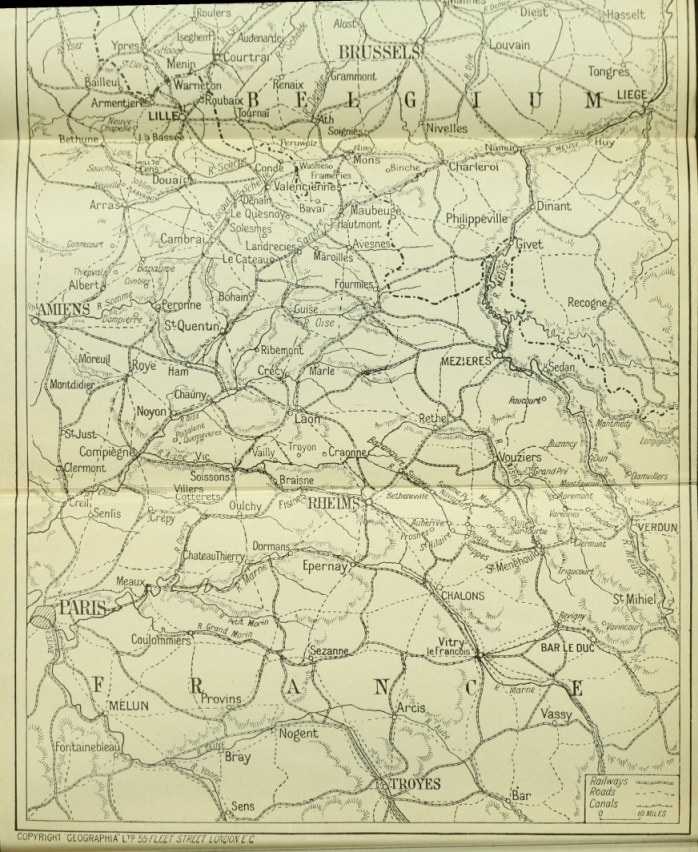
Map to illustrate the British Campaign in France and Flanders, 1914
Position of Second Army Corps at Mons, August 23
First Morning of Retreat of Second Army Corps, August 24
Sketch of Battle of Le Cateau, August 26
Line of Retreat from Mons
L Battery Action, September 1, 1914
British Advance during the Battle of the Marne
British Advance at the Aisne
Diagram to illustrate Operations of Smith-Dorrien's Second Corps and Pulteney's Third Corps from October 11 to October 19, 1914
Southern End of British Line
General View of Seat of Operations
Line of Seventh Division (Capper) and Third Cavalry Division (Byng) from October 16 onwards
General Scene of Operations
Sketch of Battle of Gheluvelt, October 31
Map of north-east France and Belgium