XI. THE REED ERA.
Reading edition
In 1862 Mr. (afterwards Sir) E. J. Reed, was appointed Chief Constructor, and proceeded at once to produce the type of ship chiefly associated with his name. His ideals ran in the direction of short, handy ships of medium size, as heavily armed as possible, and with a good turn of speed. His arguments in favour of these ideals he afterwards described as follows:—95
“The merits of ironclad ships do not consist in carrying a large proportion of weights to engine-power, or having a high speed in proportion to that power; but rather in possessing great powers of offence and defence, being comparatively short, cheap, and handy, and steaming at a high speed, not in the most economical way possible, but by means of a moderate increase of power on account of the moderate proportions adopted in order to decrease the weight and cost, and to increase the handiness.”
Generally speaking, his views were very revolutionary. The greatness of Sir E. J. Reed lay in the fact that he was the first man to conceive of the ironclad as a separate and distinct entity. Previously to him the ironclad was merely an ordinary steamer with some armour plating on her.
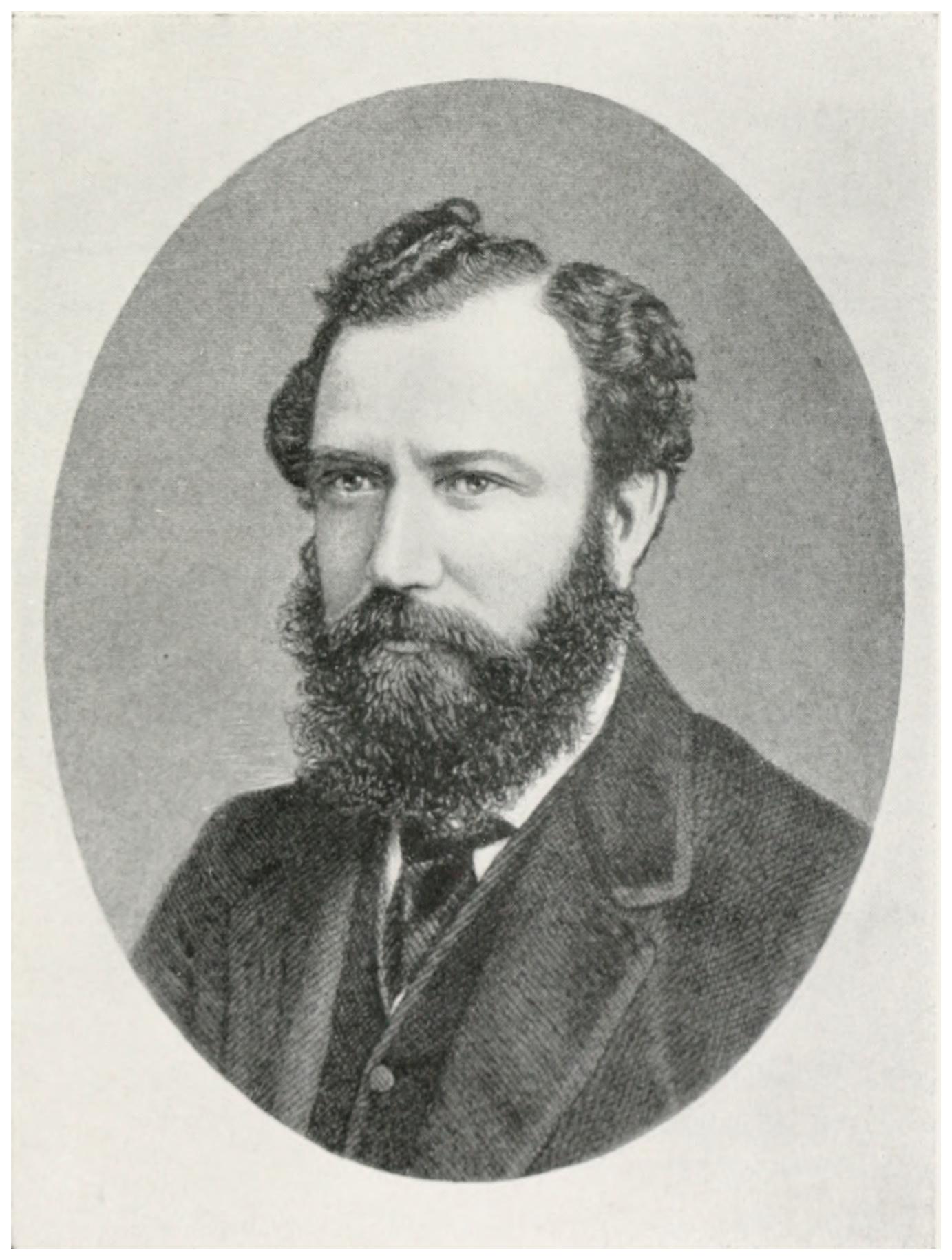
SIR E. J. REED.
From a portrait made when he was Chief Constructor of the British Navy
His first ship was the Bellerophon, of 7,550 tons displacement. She embodied distinct novelties in the construction of her hull, described by her designer in the following passages:—95
“The Warrior and the earlier ironclads are constructed with deep frames, or girders, running in a longitudinal direction through the greater part of the length of the ship, combined with numerous strong transverse frames, formed of plates and angle-irons, crossing them at right angles. In fact, up to the height of the armour the ship’s framing very closely resembles in its character that of the platform or roadway of a common girder bridge, in which the principal or longitudinal strength is contributed by the continuous girders that stretch from pier to pier, and the transverse framing consists of short girders fitted between and fastened to the continuous girders. If we conceive such a platform to be curved transversely to a ship-shape form, and the under side to be covered with iron plating, we have a very fair idea of the construction of the lower part of the Warrior. If, instead of this arrangement, we conceive the continuous longitudinal girders to be considerably deepened, and the transverse girders to be replaced by so-called ‘bracket-frames,’ and then, after curving this to a ship-form, add iron-plating on both the upper and the under sides, we have a correspondingly good idea of the construction of the lower part of the Bellerophon. The Bellerophon’s construction is, therefore, identical in character with the cellular system carried out in the Menai and other tubular bridges, which system has been proved by the most elaborate and careful experiments to be that which best combines lightness and strength in wrought-iron structures of tubular cross-section. The Warrior’s system, wanting, as it does, an inner skin of iron—except in a few places, such as under the engines and boilers—is not in accordance with the cellular system, and is inferior to it in strength. As regards safety, also, no comparison can be made between the system of the Warrior and that of the Bellerophon. If the bottom plating is penetrated, in most places the water must enter the Warrior’s hold, and she must depend for safety entirely on the efficiency of her watertight bulkheads. If the Bellerophon’s bottom is broken through, no danger of this kind is run. The water cannot enter the hold until the inner bottom is broken through, and this inner bottom is not likely to be damaged by an ordinary accident, seeing that it is two or three feet distant from the outer bottom. Should some exceptional accident occur by which the inner bottom is penetrated, the Bellerophon would still have her watertight bulkheads to depend on, being, in fact, under these circumstances in a position similar to that occupied by the Warrior whenever her bottom plating is broken through; while an accident which would prove fatal to the Warrior might leave the Bellerophon free from danger so long as the inner bottom remained intact.”
As to be related later, the Vanguard disaster tended to contravert this optimism—but of that further on. The point of present interest is the recognition and establishment of a principle which, however commonplace to-day, was in those days a complete novelty and a special feature of the iron ship as a peculiar war entity.
Equally of interest, in some ways more so, are the following anticipations of torpedo possibilities. The torpedo is such a familiar thing to-day that it is hard to throw ourselves back into the point of view necessary to appreciate the prophetic instincts of the man who created the first vessels which can really be called “battleships.”
“It may be proper in this connection to draw attention to the fact that the probable employment of torpedoes in a future naval war has not been lost sight of in carrying out these structural improvements. Up to the present time torpedoes have been used almost solely for coast and harbour defence, and have, under those circumstances, proved most destructive, as a glance through the reports of the operations of the Federal Fleet at Charleston and other Confederate ports will show. It is still doubtful, however, whether these formidable engines of war can be supplied with anything like the same efficiency at sea under the vastly different conditions which they will there have to encounter. The Americans have, it is true, proposed to fit torpedo-booms to their unarmoured ocean-cruisers, such as the Wampanoag, and a naval war would doubtless at once bring similar schemes into prominence. Nothing less than actual warfare can be expected to set the question at rest; but whatever the result of such a test may be, it is obviously a proper policy of construction to provide as much as possible against the dangers of torpedoes; and it must be freely admitted that the strongest ironclad yet designed, although practically impenetrable by the heaviest guns yet constructed, would be very liable to damage from the explosion of a submerged torpedo. No ship’s bottom can, in fact, be made strong enough to resist the shock of such an explosion; and the question consequently arises: How best can the structure be made to give safety against a mode of attack which cannot fail to cause a more or less extensive fracture of the ship’s bottom, even if it does no more serious damage? In our recent ships, as I have said, attempts have been made to give a practical answer to this question. Seeing that the bottom must inevitably be broken through by the explosion of a torpedo which exerts its full force upon the ship, it obviously becomes necessary to provide, as far as possible, against the danger resulting from a great in-flow of water. This is the leading idea which has been kept in view in arranging the structural details of our ships to meet this danger, and the reader cannot fail to perceive that the double bottom and watertight subdivisions described above are as available against injury from torpedoes as they are against the injuries resulting from striking the ground.”
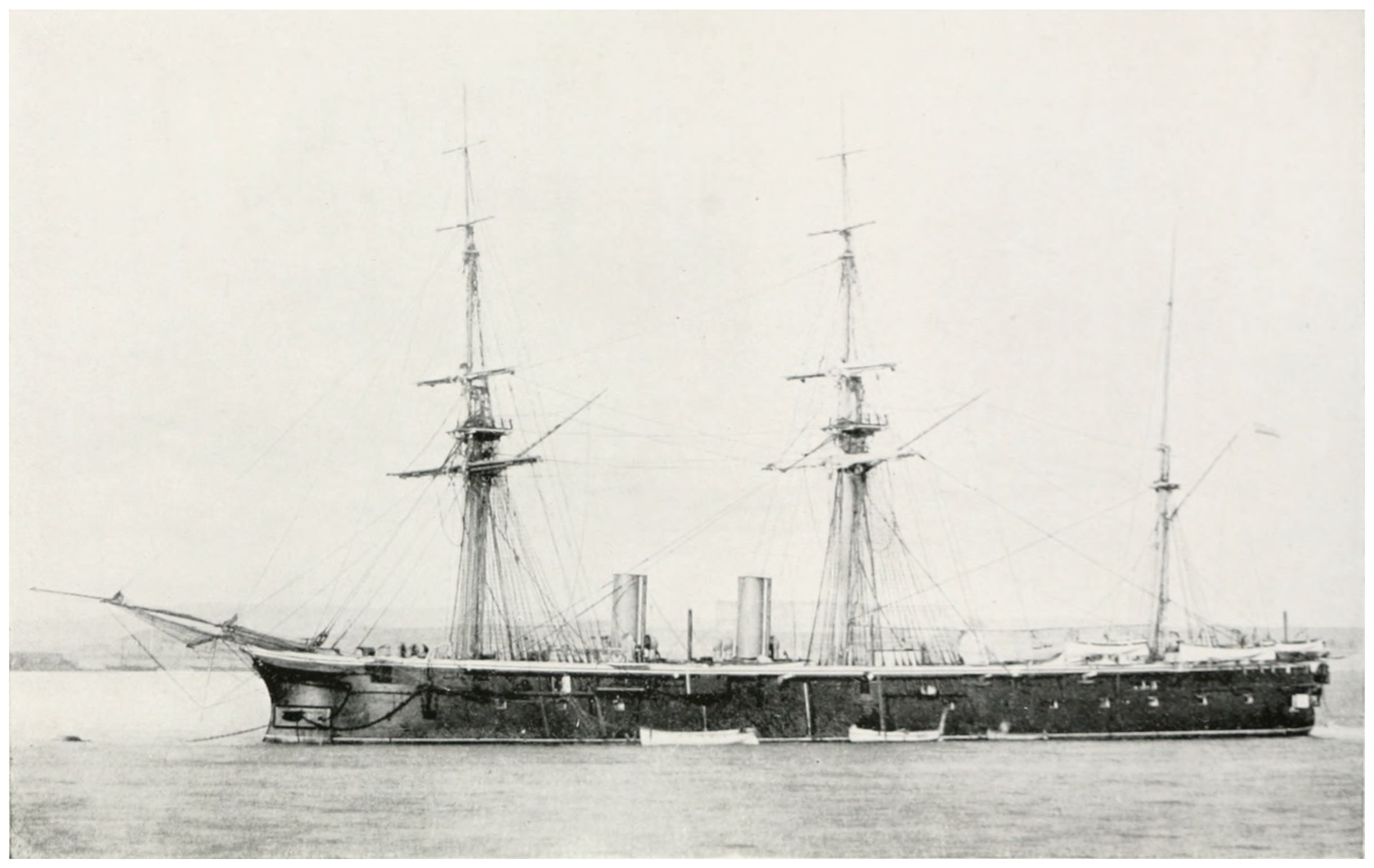
THE
BELLEROPHON
, COMPLETED 1866.
Details of the Bellerophon were as follows:—
Displacement—7,550 tons.
Length—300 ft. between perpendiculars.
Beam—56ft. 1in.
H.P.—6,520.
Mean Draught—26ft. 7ins.
Guns—Ten 12-ton M.L.R., five 6½-ton M.L.R. (changed in 1890 to ten 8-in. 14-ton B.L.R., four 6-in., six 4-in. ditto.)
Armour (iron)—Belt 6in., Battery 6in., Bulkhead 5in., Conning tower 8in.
Speed—14.17 knots.
Coal—650 tons.
Launched—1865; completed, 1866.
Cost—Hull and machinery—£322,701.
The 12-ton guns were on the main deck, the 6½-ton on the upper deck, two of them being in an armoured bow battery. The Bellerophon, completed in 1866, was ship rigged, and carried the then novel feature of an armoured conning tower, abaft the mainmast.96 She proved extremely handy, her turning circle being 559yds. as against 939yds. for the Minotaur and 1,050yds. for the Warrior. A balanced rudder, introduced in her for the first time, helped this result to some extent; but the well thought-out design of this, the first real “battleship,” was the main cause.
The Bellerophon was followed by a series of “improved Bellerophons,” which will be dealt with later. First, however, it is necessary to revert to the coming of the turret-ship.
So long ago as the Crimean War Captain Cowper-Coles had introduced the Lady Nancy, “gun-raft,” previously mentioned in connection with that war. In the year 1860 his plans had matured sufficiently for him to make public the designs of a proposed turret ship, with no less than nine turrets in the centre line, each carrying two guns which were to recoil up a slope and return automatically to position.
There has been much discussion in the past as to whether Coles or Ericsson, the designer of the Monitor, first hit upon the turret-ship idea. As a matter of fact neither of them invented it, as the idea was first propounded in the 16th century, and “pivot guns” had long existed. In so far as adapting the idea to modern uses is concerned, Ericsson was first in the field, but his turret revolved on a spindle. The merit of the Cowper-Coles design was that he evolved the idea of mounting the turret on a series of rollers, thus making it of real practical utility.
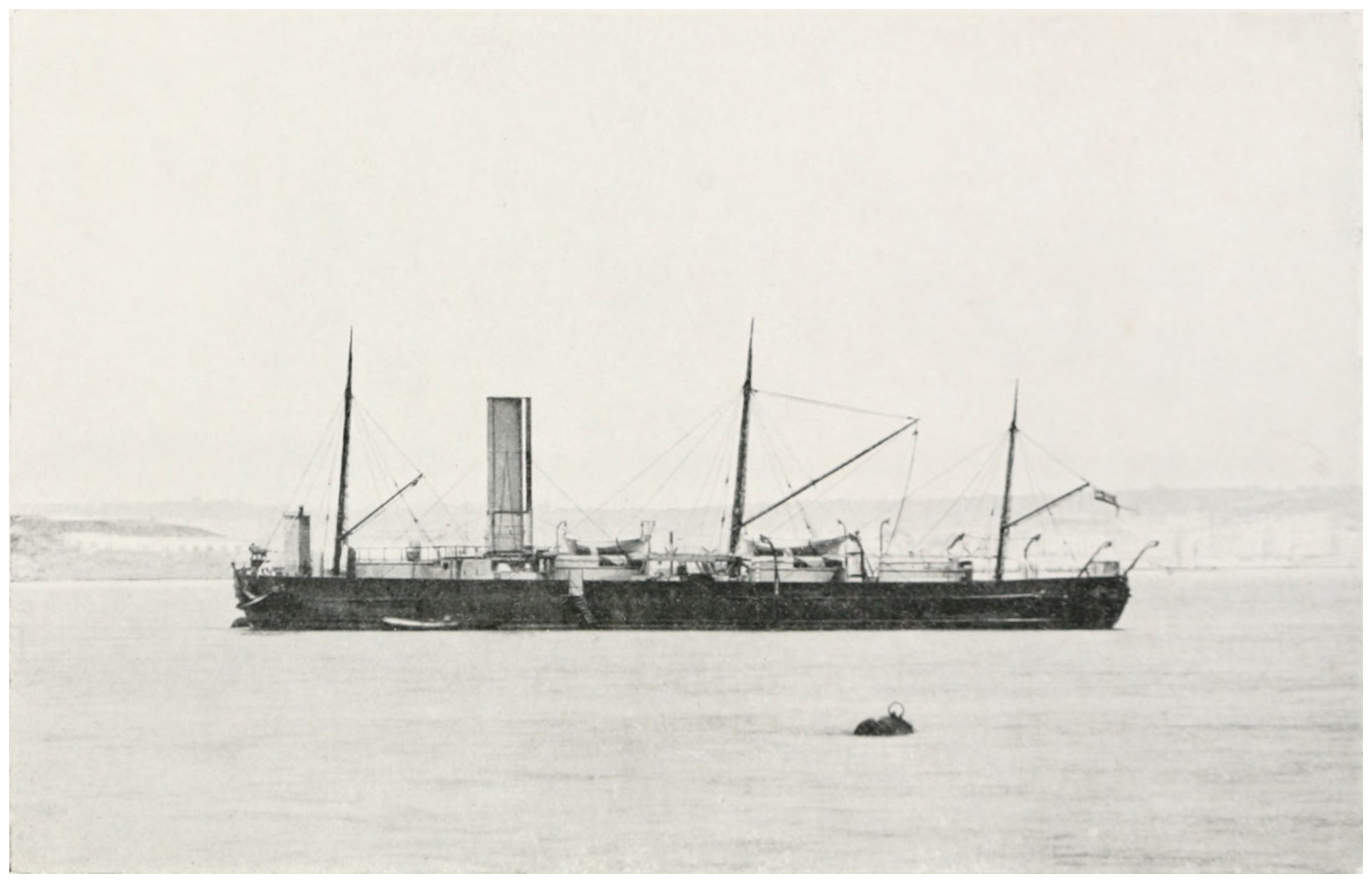
THE
ROYAL SOVEREIGN
, 1864.
Coles’ ideal turret ship was not received officially with any great show of enthusiasm; as a matter of fact it was an impracticable sort of ship. The famous fight between the Monitor and the Merrimac, early in 1862, in the American Civil War, was, however, followed by a perfect “turret craze.” Turret ships were popularly acclaimed as essential to the preservation of British naval power. The idea of a sea-going ship without sail power was unthinkable; but the turret ships for coast defence purposes were demanded with such insistence that in 1862 Captain Coles, now more or less a popular hero, was put to supervise the reconstruction of the old steam wooden line-of-battleship Royal Sovereign into a turret ironclad.
This ship was originally a three-decker. Coles cut her down to the lower deck, leaving a freeboard of ten feet. The sides were covered with 4½-inch iron armour. Four turrets were mounted on Coles’ roller system, the forward turret carrying two and the other three one 12½-ton guns. These turrets were generally five inches thick, but at the portholes were increased up to ten inches. They were rotated by hand power. There was one funnel, in front of which a thinly armoured conning tower was placed. Three pole masts were fitted. This ship was completed in 1864, and was fairly successful on trials. The cost of conversion was very heavy, and being wooden-hulled her weight-carrying ratio was small, 1837 tons to 3,243 tons, weight of hull.
Coles was at no time satisfied with this old three-decker an a proper test of his ideas, and his agitation was so far successful that the Prince Albert was presently built to his design. She was an iron turret-ship, generally resembling the Royal Sovereign, though carrying only one gun in each turret.
Particulars of her are:—
Displacement—3,880 tons.
Length—240ft. p.p.
Beam—48ft. 1in.
H.P.—2,130.
Mean Draught—20ft. 4ins.
Speed—11.65 knots.
Coal—230 tons.
Guns—Four 9-in. 12-ton M.L.R.
To the same era belong three armoured gunboats—Viper, Vixen, and Waterwitch—of about 1,230 tons each, armed with a couple of 6½-ton M.L.R. guns, armour 4½ins. The Waterwitch, which was slightly the heavier, was fitted with a species of turbine, sucking water in ahead and ejecting it astern (a very old idea revived). This was moderately successful, as the trial speeds of the three were:—
Viper—8.89 knots.
Vixen—9.59 knots.
Waterwitch—9.24 knots.
In the Vixen twin screws were for the first time tried.
The Prince Albert was completed in 1866, the same year as the Bellerophon. Long before she was completed, Coles was agitating for the application of his principles to a sea-going masted ship.
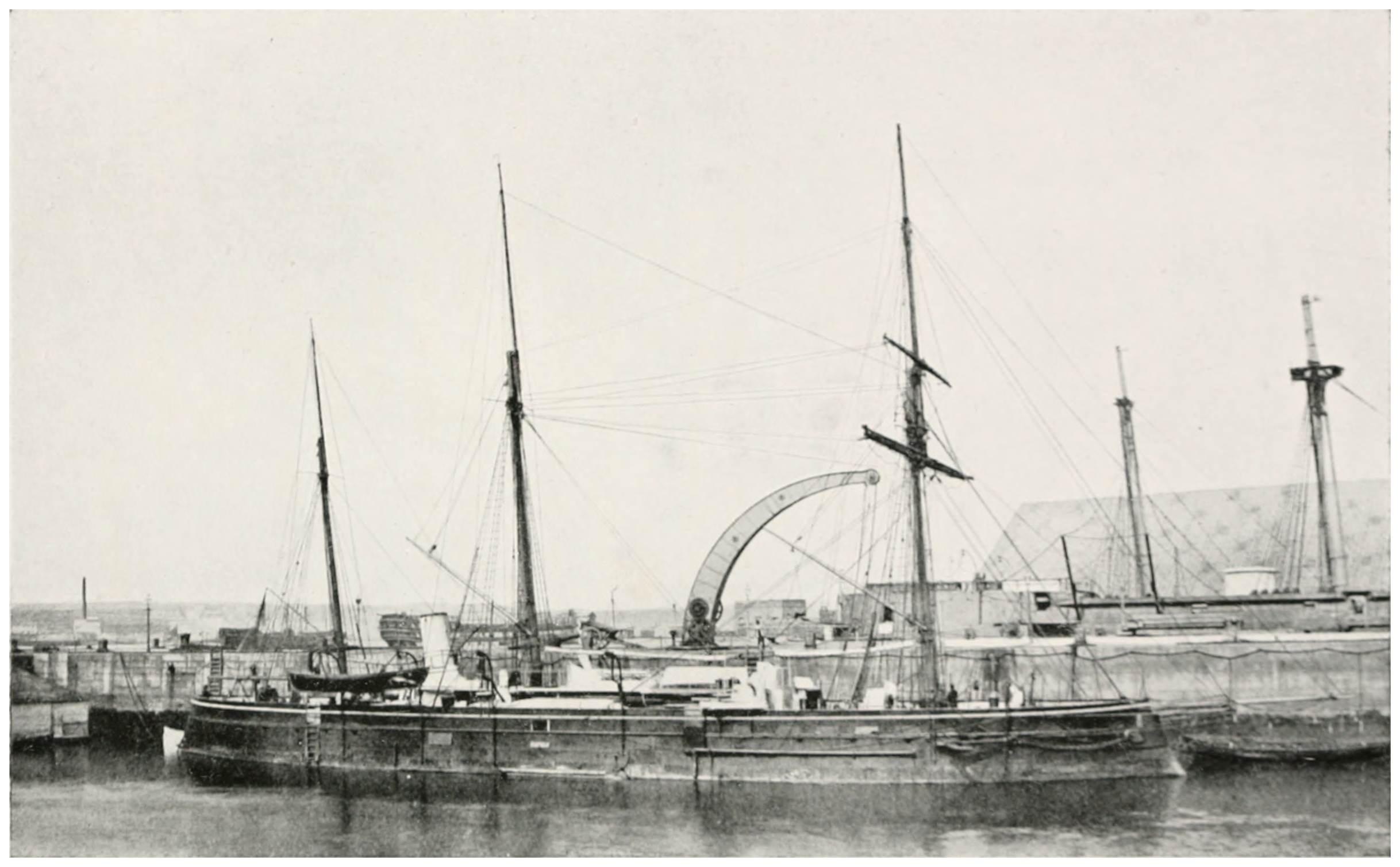
THE
WATERWITCH
, COMPLETED 1867.
Sir E. J. Reed has left it on record that his attitude in the matter was that of an interested observer. He was at no time blind to the advantages that the turret system conferred; but, unlike the Coles’ party, he was equally observant of its disadvantages. At a very early date he threw cold water on the masted turret-ship idea, and insisted that for a sea-going turret-ship to become practicable she must be mastless. He further pointed out that for a given weight eight guns could be mounted broadside fashion for four carried in turrets.
He developed his own ideas in the Hercules, laid down in 1866. The Hercules, except that recessed ports were introduced to supply something like end-on fire to the battery, was an amplified Bellerophon. Particulars of the Hercules (which was always a very successful ship) are:—
Displacement—8,680 tons.
Length—325ft.
Beam—59ft. ½in.
Mean Draught—26ft. 6ins.
H.P.—6,750.
Guns—Eight 18-ton M.L.R., two 12½-ton M.L.R., four 6½-ton M.L.R.
Armour (iron)—9in. 6in. Belt and Battery.
Speed—14.00 kts. (14.69 on the measured mile trials).
Coal—610 tons.
Cost—Hull and machinery, £361,134.
The Hercules was completed in 1868, contemporaneously with the completion of the Agincourt and Northumberland, which were very slowly finished.
At and about the same time the Penelope was built. She was designed for light draught and river service, her maximum draught being kept down to 17½ft. She carried eight 9-ton guns and had a 6-inch belt. Sir E. J. Reed being absent from office, his chief assistant, afterwards Sir N. Barnaby, was mainly responsible for this ship. She was given twin screws.
Captain Coles meanwhile continued to demand turret-ships, and in 1865 submitted a design for a sea-going turret-ship, which was referred to a Committee of Naval Officers. They declined to approve the design, but expressed much interest in the principle involved, and recommended that an Admiralty design on similar principles should be worked out, and a ship built to it. This eventuated in the Monarch, which in substance was an ordinary ironclad of less freeboard than usual (14ft.) with two turrets on the upper deck, carrying each a pair of the heaviest guns then in existence (25 tons).
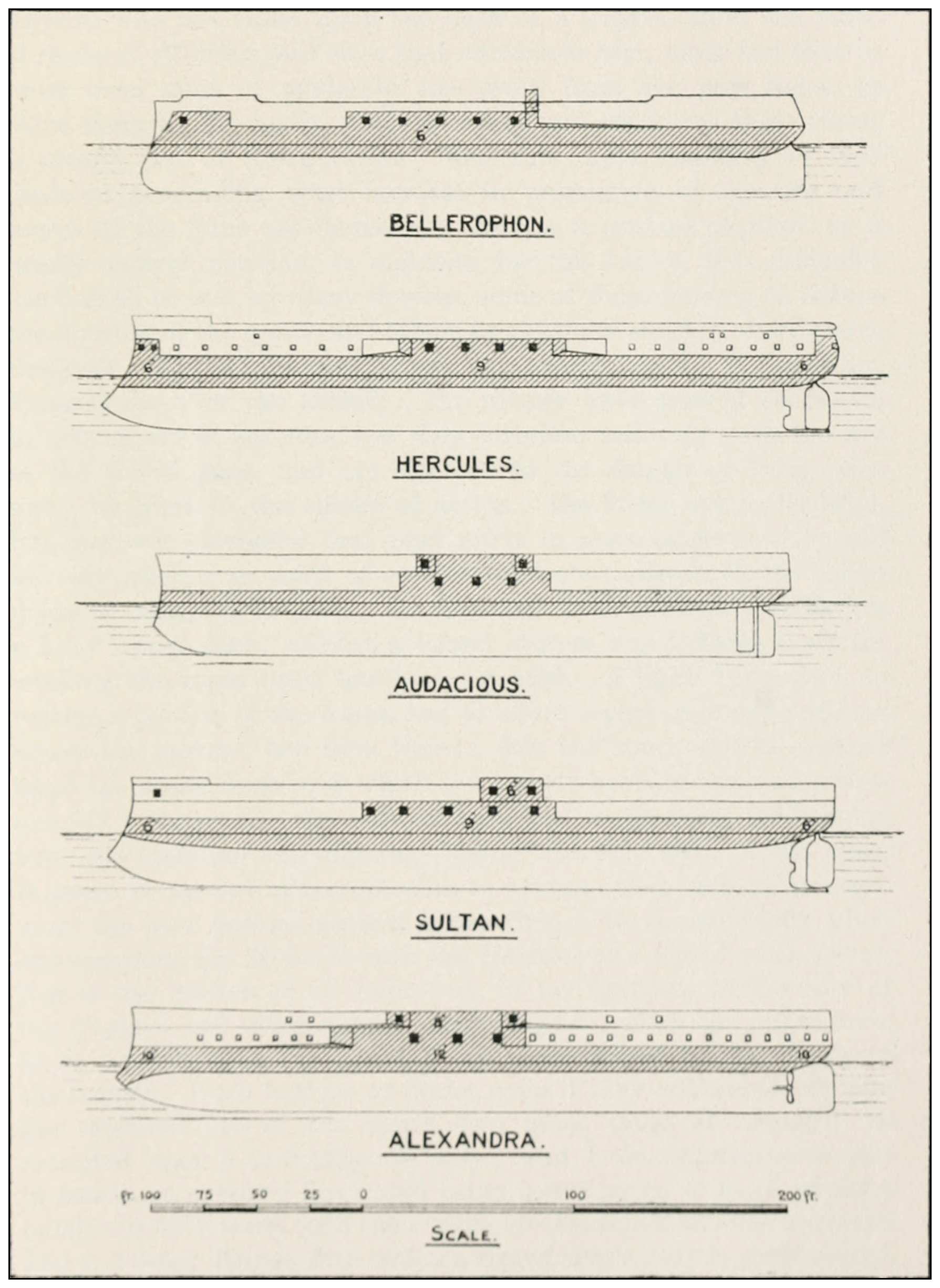
BELLEROPHON. HERCULES. AUDACIOUS. SULTAN. ALEXANDRA.
BROADSIDE AND CENTRAL BATTERY SHIPS OF THE REED ERA.
It is difficult to ascertain what part (if any) Sir E. J. Reed had in the design of the Monarch. At a later date in the work already referred to (1869) he criticised her severely enough.97
“I have already intimated that the enlarged adoption of the turret system has usually been associated in my mind with those classes of vessels in which masts and sails are not required. It is well known that others have taken a wider view of its applicability, and have contended that it is, and has all along been, perfectly well adapted for rigged vessels. I have never considered it wholly inapplicable to such vessels: on the contrary, I have myself projected designs of sea-going and rigged turret-ships, which I believe to be safe, commodious, and susceptible of perfect handling under canvas. But most assuredly the building of such vessels was urged by many persons long before satisfactory methods of designing them had been devised; and my clear and strong conviction at the moment of writing these lines (March 31, 1869) is that no satisfactorily designed turret-ship with rigging has yet been built, or even laid down.
“The most cursory consideration of the subject will, I think, result in the feeling that the middle of the upper deck of a full-rigged ship is not a very eligible position for fighting large guns. Anyone who has stood upon the deck of a frigate, amid the maze of ropes of all kinds and sizes that surrounds him, must feel that to bring even guns of moderate size away from the port holes, to place them in the midst of these ropes, and discharge them there, is utterly out of the question; and the impracticability of that mode of proceeding must increase in proportion as the size and power of the guns are increased. But as a central position, or a nearly central position, is requisite for the turret, this difficulty has had to be met by many devices, some of them tending to reduce the number of the ropes, and others to get them stopped short above the guns. In the former category come tripod masts; in the latter, flying-decks over the turrets; the former have proved successful in getting rid of shrouds, but they interfere seriously with the fire of the turret guns, and are exposed to the danger of being shot away by them in the smoke of action; the latter are under trial, but however successful they may prove in some respects, they will be very inferior in point of comfort and convenience to the upper decks of broadside frigates. In the case of the Monarch, which has a lofty upper deck, neither a tripod system nor a flying deck for working the ropes upon has been adopted. A light flying deck to receive a portion of the boats, and to afford a passage for the officers above the turrets, has been fitted; but the ropes will be worked upon the upper deck over which the turrets have to fire, and consequently a thousand contrivances have had to be made for keeping both the standing and running rigging tolerably clear of the guns. It seems to me out of the question to suppose that such an arrangement can ever become general in the British Navy, especially when one contrasts the Monarch with the Hercules as a rigged man-of-war. Nor is the matter at all improved, in my opinion, in the case of the Captain and other rigged turret-ships in which the ropes have to be worked upon bridges or flying-decks poised in the air above the turrets. Such bridges or decks, even if they withstand for long the repeated fire of the ship’s own guns, must of necessity be mounted upon a few supports only; and I am apprehensive that in action an enemy’s fire would bring down parts, at least, of these cumbrous structures, with their bitts, blocks, ropes, and the thousand and one other fittings with which a rigged ship’s deck is encumbered, with what result I need not predict.
“It is well known that both in the Captain and in the Monarch the turrets have been deprived of their primary and supreme advantage, that of providing an all-round fire for the guns, and more especially a head fire. This deprivation is consequent upon the adoption of forecastles, which are intended to keep the ships dry in steaming against a head sea, and to enable the head-sails to be worked. When it first became known that the Monarch was designed with a forecastle (by order of the then Board of Admiralty) there were not wanting persons who considered the plan extremely objectionable, and who took it for granted that as a turret-ship the new vessel would be fatally defective. The design of the Captain shortly afterwards, under the direction of Captain Coles, with a similar but much larger forecastle, was an admission, however, that the Board of Admiralty did not stand alone in the belief that this feature was a necessity, however objectionable. Both these ships, therefore, are without a right-ahead fire from the turrets, the Monarch having this deficiency partly compensated by two forecastle (6½-ton) guns protected with armour, while the Captain has no protected head-fire at all, but merely one gun (6½-ton) standing exposed on the top of the forecastle.”
Time has shown that he was quite correct in his views; but in 1866 and the years that followed he was regarded as unduly conservative and non-progressive.
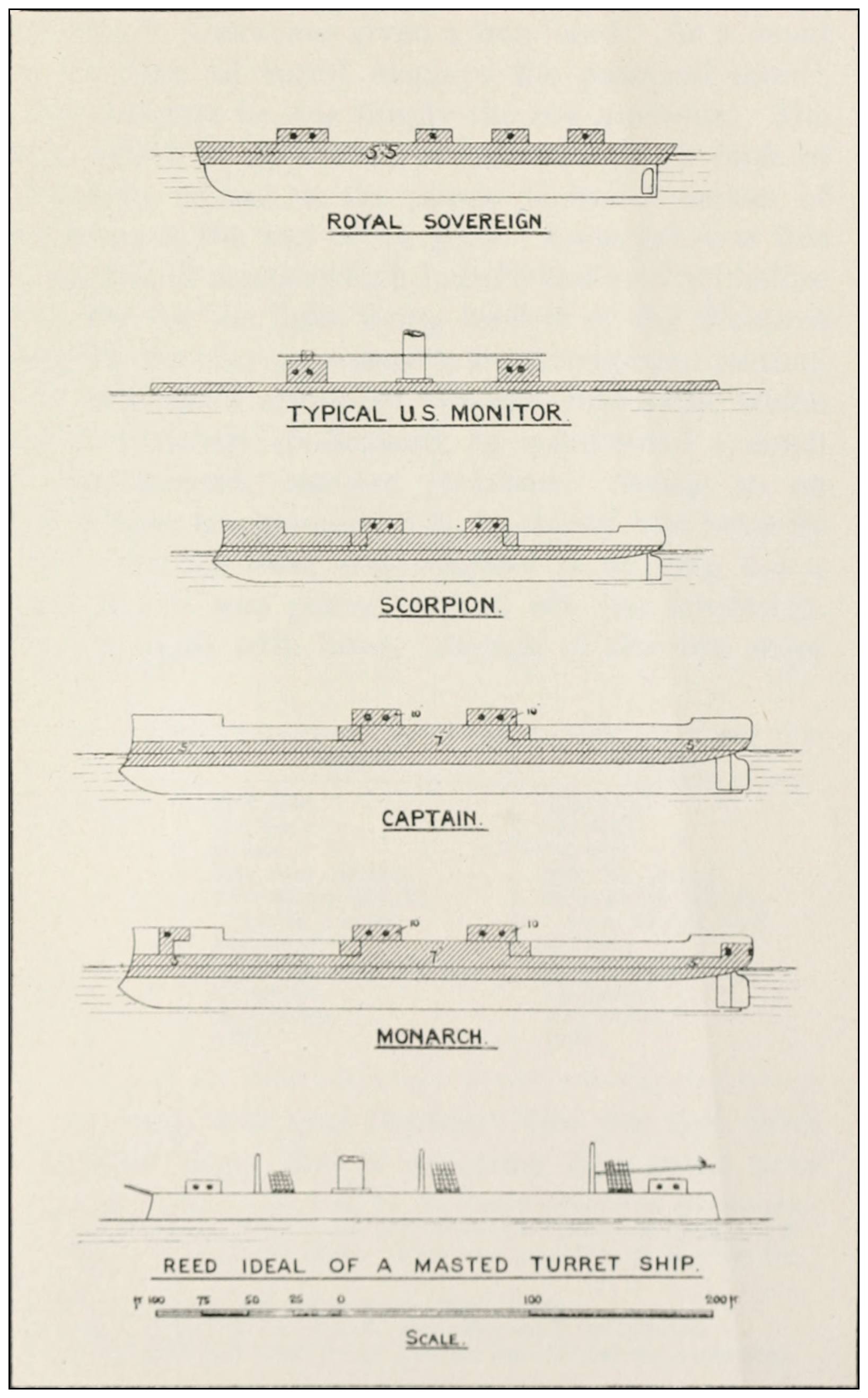
ROYAL SOVEREIGN. TYPICAL U.S. MONITOR. SCORPION. CAPTAIN. MONARCH. REED IDEAL OF A MASTED TURRET SHIP.
TURRET-SHIPS OF THE REED ERA.
Captain Coles objected to the Monarch altogether. He insisted with vehemence that she did not in the least express his ideas. She had a high forecastle, also a poop; these features depriving her of end-on fire, except in so far as a couple of 6½-ton guns in an armoured forecastle supplied the deficiency. The Admiralty replied that a forecastle was essential for sea-worthiness; but Coles was so insistent that eventually he was allowed to design a sea-going turret-ship on his own ideas, in conjunction with Messrs. Laird, of Birkenhead, who had already had considerable experience in producing masted turret-ships.98 Coles was given a free hand. As a naval officer his form of turret displays the practical mind; as a ship designer he was simply the raw amateur. The Captain, which he produced, accentuated every fault of the Monarch, except in the purely technical matter of rigging being in the way of the guns. Coles got over this by fitting tripod masts (which Laird’s had evolved before him99); but for the light flying bridges of the Monarch he substituted a very considerable superstructure erection. For the Monarch’s armoured two-gun forecastle, which he had so violently condemned, he substituted a much larger unarmoured, one-gun structure. Owing to an error in design, his intended 8-ft. freeboard was actually only 6ft., and his ideal ship resulted in nothing but a Monarch of less gun power, and of 8ft. less freeboard. Her fate is dealt with later. Details of the two ships are:—
Captain. Monarch.
Displacement 6900 tons. 8320 tons.
Length (p.p.) 320 feet. 330 feet.
Beam 53 feet. 57½ feet.
Draught 25ft. 9½in. (mean). 26ft. 7in. (max.)
Guns Four 25 ton M.L.R., two 6½ ton, do. Four 25 ton M.L.R., three 6½ ton, do.100
Coal 500 tons.101 630 tons.
Speed 14.25 kts. (twin screws). 14.94 (single screw).
Waterline Belt 8.6 inches. 7.6 inches.
Turrets 13.8 inches. 10.8 inches.
Completed 1869. 1869.
It has been said that Captain Coles was tied down by Admiralty ideas that a sea-going ship must have auxiliary sail power. All the evidence is, however, to the effect that not only did he recognise this limitation from the first, but that he concurred with it and believed his design to fill the conditions best. It failed to do so, the Monarch under all conditions doing far better than the Captain on trial (except occasionally under sail).
Sir E. J. Reed’s objections to the Captain design have already been mentioned. He was not the only critic, since Laird’s, of Birkenhead, who built the ship, were so suspicious of the design that they requested the Admiralty to submit her to severe tests for stability.
The ship, however, came through these tests very well, and the public were more convinced than ever that she was the finest warship ever built. One or two naval officers who had criticised her also modified their opinions after she had done a couple of very successful cruises across the Bay of Biscay. Her crew had the utmost confidence in her. She was commanded by Captain Burgoyne, and Captain Coles was also on board her when she made her third cruise in September, 1871.
On the 6th September she was off Cape Finisterre in company with the Channel Fleet, consisting of the Lord Warden, Minotaur, Agincourt, Northumberland, Monarch, Hercules, Bellerophon, and the unarmoured ships Inconstant and Bristol. Admiral Milne came on board her from the Lord Warden, and drew attention to the fact that she was rolling a great deal,102 but nobody on board the Captain agreed with him that this was dangerous. During the night a heavy gale suddenly arose, and in the morning the Captain was missing. Eighteen survivors reached the land with the story of what had happened.
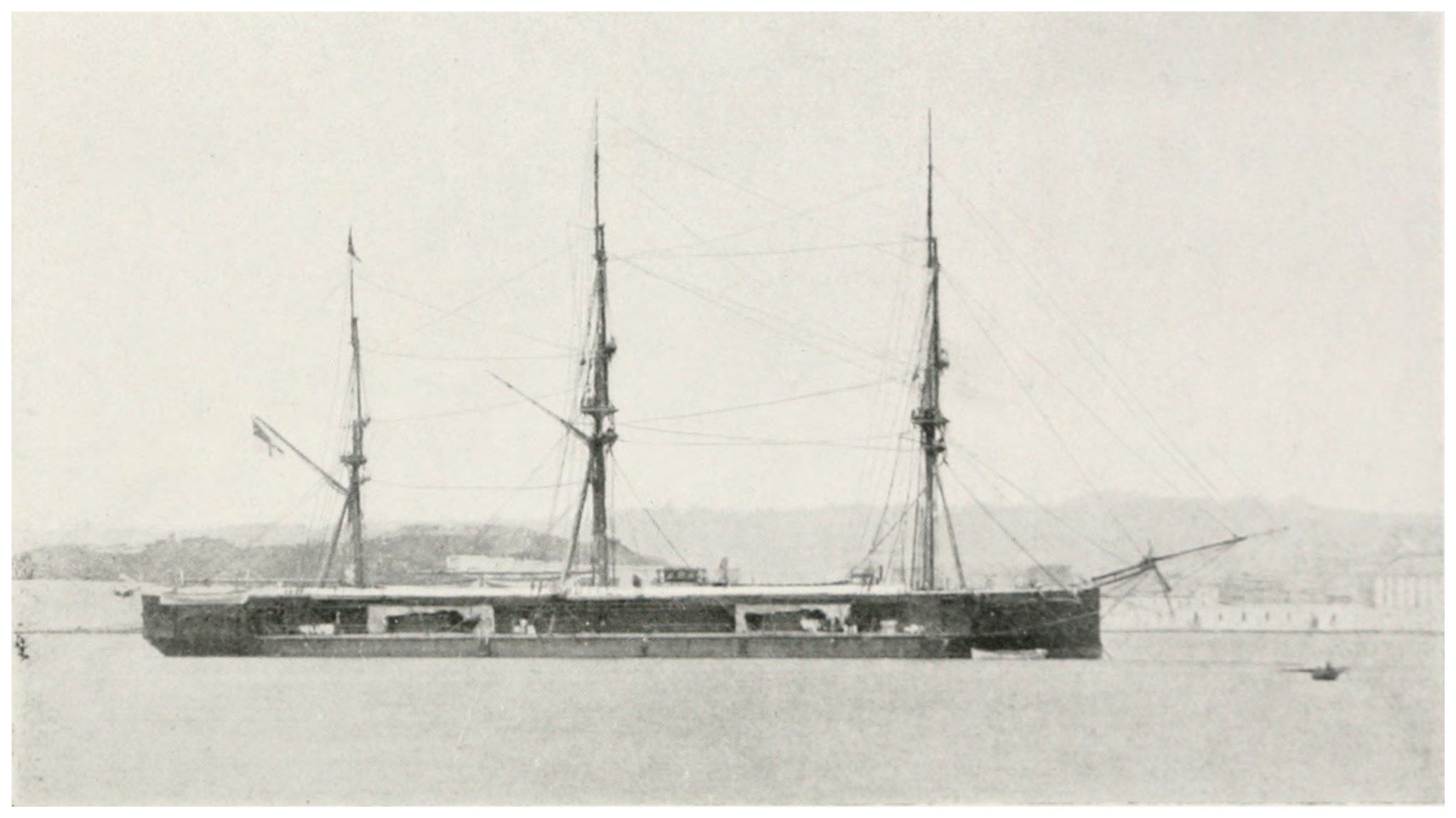
THE
CAPTAIN
.
From this it appears that about midnight the ship was under her topsails, double reefed. She had steam up, but was not using her screw. The ship gave a heavy lurch, righted herself, and the captain gave the order, “Let go the topsail halyards,” and immediately afterwards, “Let go fore and main topsail sheets.” The ship, however, continued to heel, and “18 degrees” was called out. This increased until 28 degrees was arrived at. With the ship lying over on her side some of the crew succeeded in walking over her bottom, and these were practically the only survivors. Immediately afterwards the ship went down stern first. There were at this time some five and twenty survivors, including Captain Burgoyne and Mr. May, the gunner. Some of these were in the launch, others clinging to the pinnace, which was floating bottom upwards. Captain Burgoyne was amongst those who were clinging to the pinnace, and that was the last seen of him. A few of the men in the pinnace succeeded in jumping into the launch and so escaped. The rest were never seen again.
The subsequent court-martial placed it on record that “the Captain was built in deference to public opinion and in opposition to the views and opinions of the Controller of the Navy and his Department.” The instability of the ship and the incompetence of Captain Coles to design her were emphasised.
After the loss of the Captain considerable panic on the subject of turret-ships arose. The Monarch was submitted to a number of tests which, however, generally proved satisfactory, and there was never anything to be said against her except that the forecastle and the poop necessitated by her being a rigged ship, negatived one of the principal advantages of the turret system.
To the loss of the Captain is to be traced some of the extraordinary opposition which the Devastation idea subsequently encountered.
The various writings of Sir E. J. Reed make it abundantly clear that just as in the Bellerophon he had realised that an ironclad battleship must be something more than an old-type vessel with some armour on her, so he realised from the first that the ordinary sea-going warship with turrets on deck, instead of guns in the battery, was no true solution of the turret problem. There is ample evidence that he studied the monitors of the American Civil War with a balanced intelligence far ahead of his day, taking into consideration every pro and con with absolute impartiality, and applying the knowledge thus gained to the different conditions required for the British Fleet. It is no exaggeration to say that he was the only man who really kept his head while the turret-ship controversy reigned; the one man who thought while others argued.
He swiftly recognised the tremendous limitations of the American low-freeboard monitors, and at an early date evolved his own idea of the “breastwork monitor,” which began with the Australian Cerberus, and ended with the predecessor of the present Dreadnought. The ships of this type varied considerably from each other in detail; but the general principle of all was identical. All, whether coast-defence or sea-going, were “mastless”; all, while of low freeboard fore and aft, carried their turrets fairly high up on a heavily armed redoubt amidships. Side by side with them he developed the central battery ironclads of this particular era. He ceased to be Chief Constructor before either type reached its apotheosis; but all may be deemed lineal descendants of his original creations.
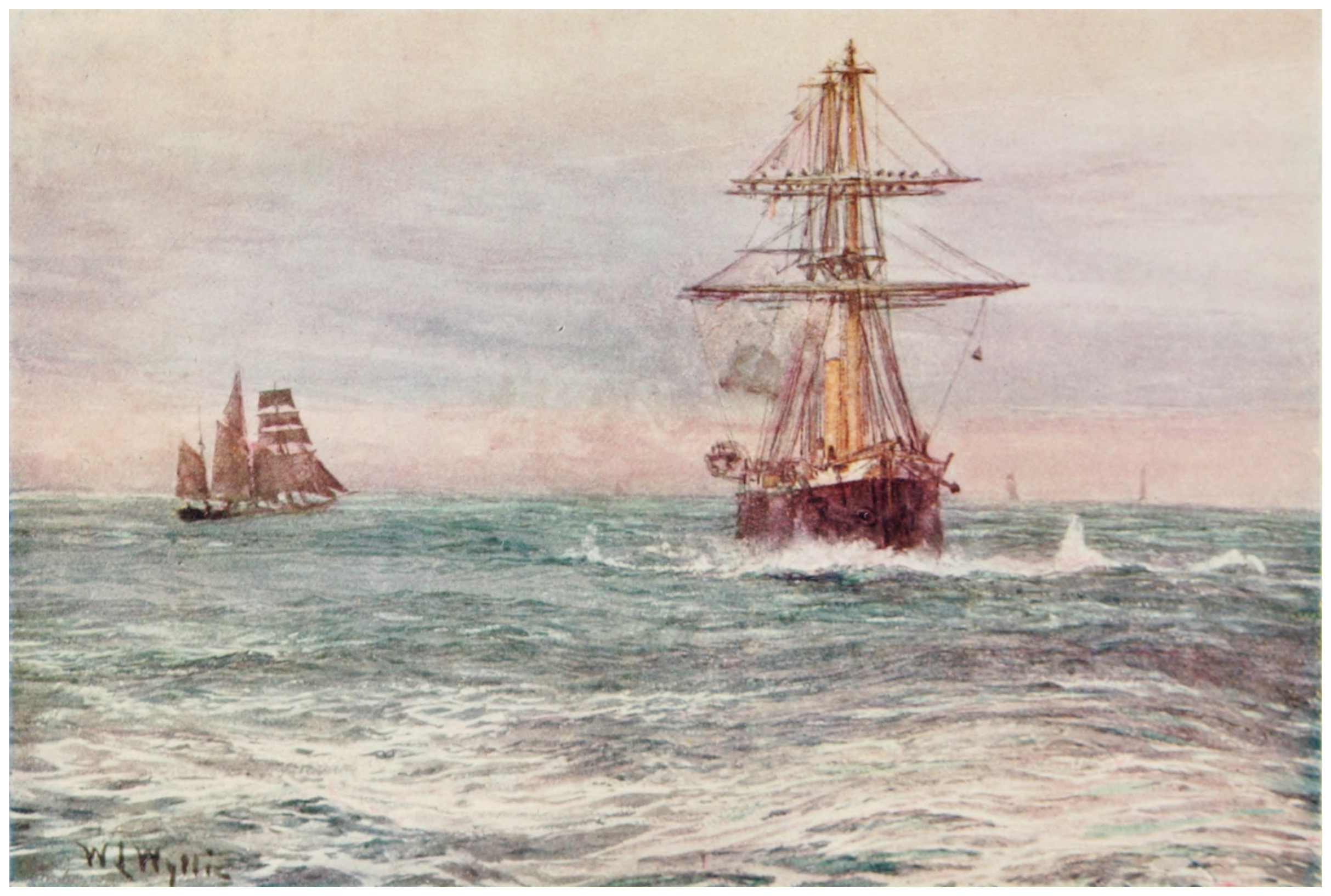
THE OLD “INVINCIBLE.” 1872.
First, however, it is desirable to revert to the Reed broadside and central battery-ships.
The Audacious class, which followed closely upon the Hercules, and were contemporary in the matter of design, were avowedly “second-class ships,” intended for service in distant seas. The ships of this class, of which the first was completed in 1869 and the last in 1873, were the Audacious, Invincible, Iron Duke, Vanguard, Swiftsure, and Triumph. As the sketch plan illustrations indicate, the main deck battery in them was more centralised than in the Hercules, while instead of the bow battery they carried on their upper decks four 6½-ton guns capable of firing directly ahead or astern.
Excluding the converted ships, the Audacious was the eleventh British ironclad to be designed in point of date of laying down, but in the matter of design she followed directly on the eighth ship—Hercules.
Her weights, as compared with the Bellerophon, were:—
Name. Weight of hull. Weight carried.
Bellerophon 3652 tons. 3798 tons.
Audacious 2675 tons. 3234 tons.
In some of these ships the principle of wood-copper sheathing was re-introduced; the iron ships having been found to foul their hulls more quickly than wooden hulled ships. The Swiftsure and Triumph (the two latest) were the ones so treated. Sir E. J. Reed was not responsible for the experiment, which was entirely an Admiralty one. It proved successful enough, the loss of speed being trifling.
Details of the Audacious class:—103
Displacement—6,010.
Length—280ft.
Beam—54ft.
H.P.—4,830.
Mean Draught—23ft. 8ins.
Guns—Ten 12-ton M.L.R.
Coal—500 tons.
Belt Armour—8ins. to 6ins.
Audacious Iron Duke Invincible Vanguard Swiftsure Triumph
Speed 13.2 13.64 14.09 13.64 13.75 13.75
Builder of Ship Glasgow Pembroke Glasgow Jarrow Jarrow
Builder of Machin’y Ravenhill Ravenhill Napier Maudslay Maudslay
Launched 1869 1870 1869 1869 1870 1870
Completed 1869 1871 1870 1871 1872 1873
Cost—Hull & Machin’y £246,482 £196,479 £239,441 £257,081 £258,322
The sheathing increased the displacement of the two latest ships by about 900 tons in the Swiftsure, and some 600 tons in the Triumph. These two were single-screw ships only, whereas all the others were twin-screw.
In September, 1875, the Vanguard was rammed and sunk by the Iron Duke.
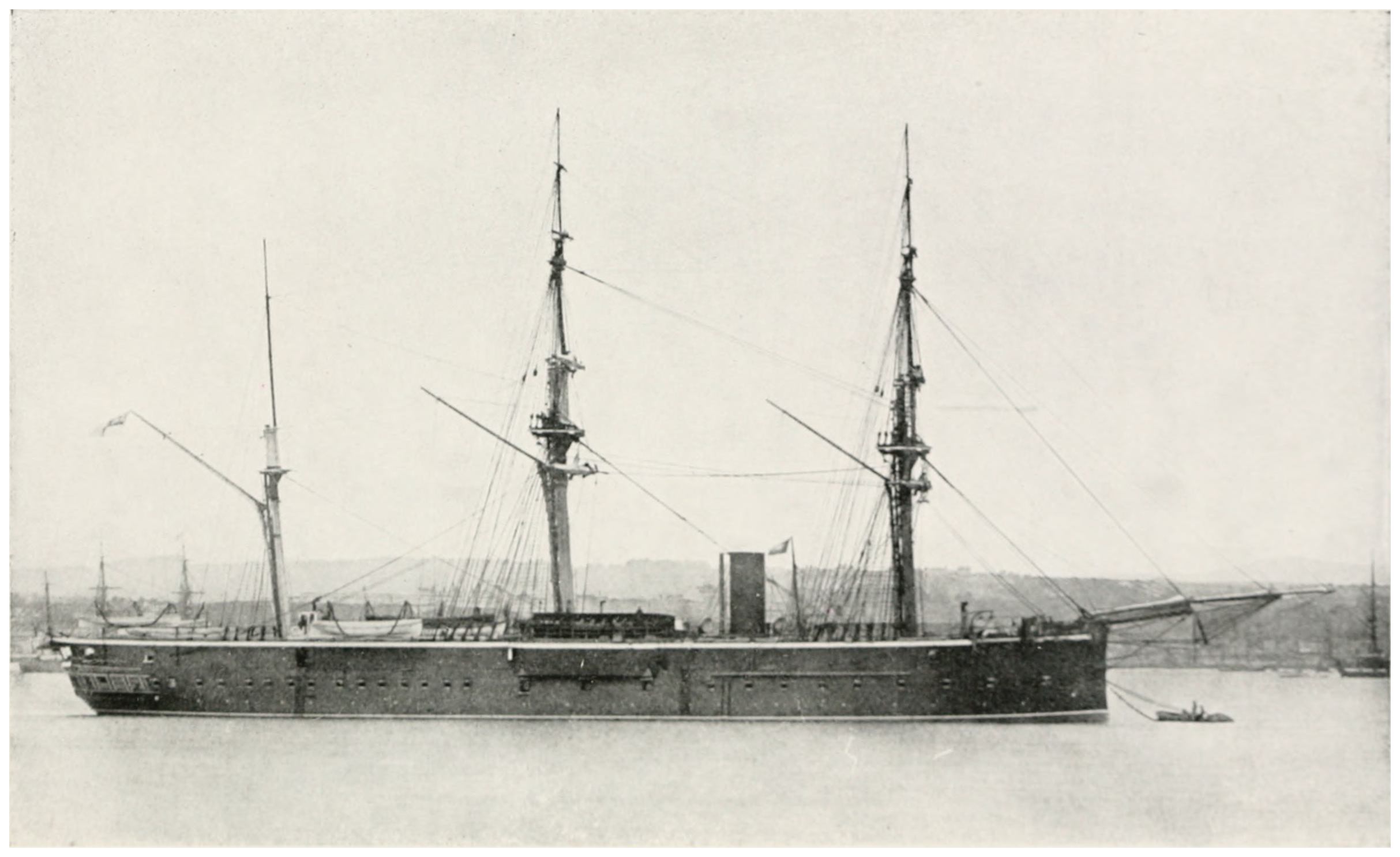
THE
VANGUARD
, COMPLETED 1874.
The finding of the Court Martial was as follows:—
“The court having heard the evidence which had been adduced in this inquiry and trial, is of opinion that the loss of Her Majesty’s ship Vanguard was occasioned by Her Majesty’s ship Iron Duke coming into collision with her off the Kisbank, the Irish Channel, at about 12-50 on the 1st September, from the effects of which she foundered; that such collision was caused—First, by the high rate of speed at which the squadron, of which these vessels formed a part, was proceeding whilst in a fog; secondly, by Captain Dawkins, when leader of his division, leaving the deck of the ship before the evolution which was being performed was completed, as there were indications of foggy weather at the time; thirdly, by the unnecessary reduction of speed of H.M.S. Vanguard without a signal from the vice-admiral in command of the squadron, and without H.M.S. Vanguard making the proper signals to the Iron Duke; fourthly, by the increase of speed of H.M.S. Iron Duke during a dense fog, the speed being already high; fifthly, by H.M.S. Iron Duke improperly shearing out of the line; sixthly, for want of any fog signals on the part of H.M.S. Iron Duke.
“The court is further of opinion that the cause of the loss of H.M.S. Vanguard by foundering was a breach being made in her side by the prow of H.M.S. Iron Duke in the neighbourhood of the most important transverse bulkhead—namely, that between the engine and boiler rooms, causing a great rush of water into the engine-room, shaft-alley, and stoke-hole, extinguishing the fires in a few minutes, the water eventually finding its way into the provision room flat, and provision rooms through imperfectly fastened watertight doors, and owing to leakage of 99 bulkhead. The court is of opinion that the foundering of H.M.S. Vanguard might have been delayed, if not averted, by Captain Dawkins giving instructions for immediate action being taken to get all available pumps worked, instead of employing his crew in hoisting out boats, and if Captain Dawkins, Commander Tandy, Navigating-Lieutenant Thomas, and Mr. David Tiddy, carpenter, had shown more resource and energy in endeavouring to stop the breach from the outside by means at their command, such as hammocks and sails—and the court is of opinion that Captain Dawkins should have ordered Captain Hickley, of H.M.S. Iron Duke, to tow H.M.S. Vanguard into shallow water. The court is of opinion that blame is imputable to Captain Dawkins for exhibiting want of judgment and for neglect of duty in handling his ship, and that he showed a want of resource, promptitude, and decision in the means be adopted for saving H.M.S. Vanguard after the collision. The court is further of opinion that blame is imputable to Navigating-Lieutenant Thomas for neglect of duty in not pointing out to his captain that there was shallower water within a short distance, and in not having offered any suggestion as to the stopping of the leak on the outside. The court is further of opinion that Commander Tandy showed great want of energy as second in command under the circumstances. The court is further of opinion that Mr. Brown, the chief engineer, showed want of promptitude in not applying the means at his command to relieve the ship of water. The court is further of opinion that blame is imputable to Mr. David Tiddy, of H.M.S. Vanguard, for not offering any suggestions to his captain as to the most efficient mode of stopping the leak, and for not taking immediate steps for sounding the compartments and reporting from time to time the progress of the water. The court adjudges Captain Richard Dawkins to be severely reprimanded and dismissed from H.M.S. Vanguard and he is hereby severely reprimanded and so sentenced accordingly. The court adjudges Commander Lashwood Goldie Tandy and Navigating-Lieutenant James Cambridge Thomas to be severely reprimanded, and they hereby are severely reprimanded accordingly. The court imputes no blame to the other officers and ship’s company of H.M.S. Vanguard in reference to the loss of the ship, and they are hereby acquitted accordingly.”
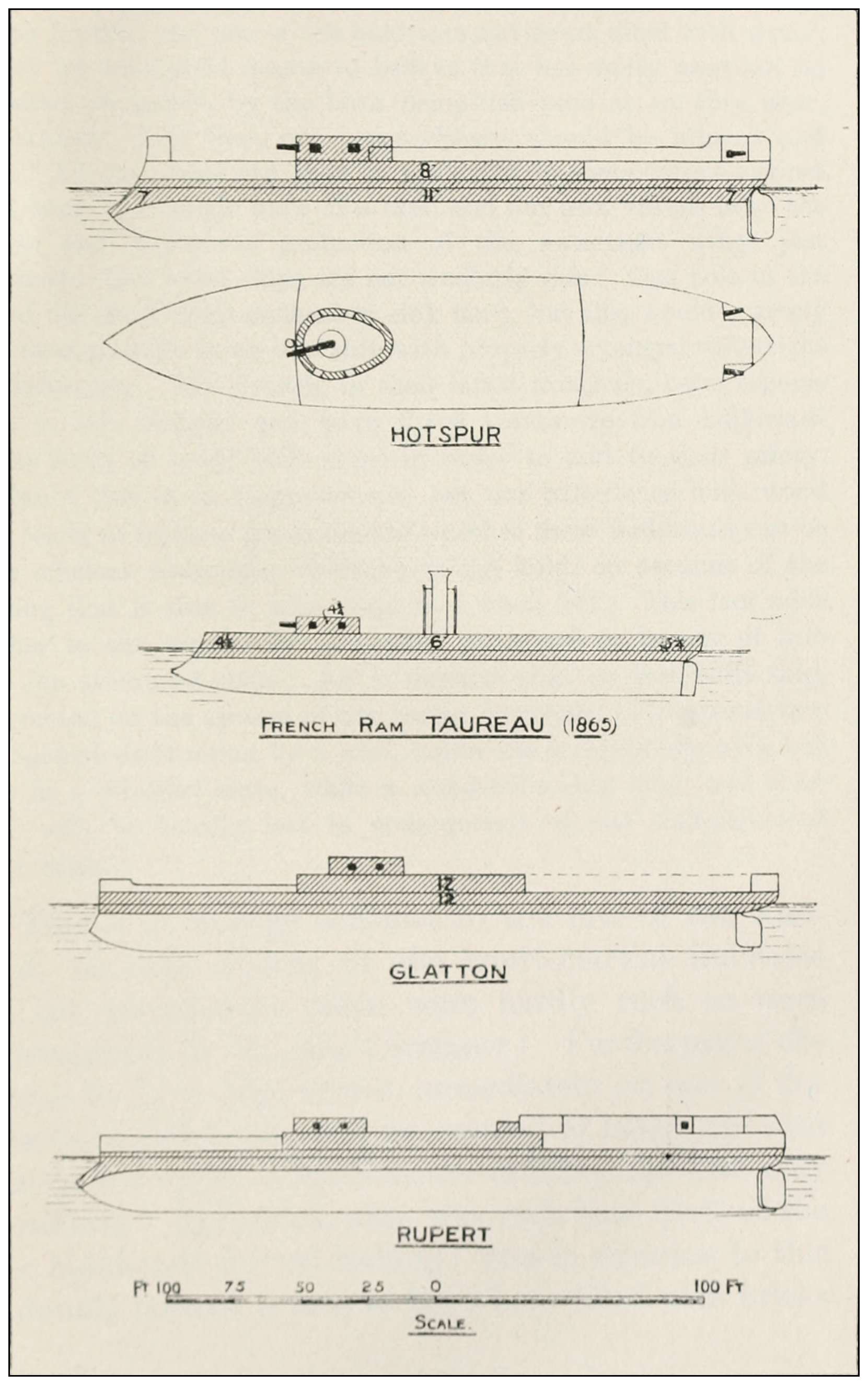
HOTSPUR French Ram TAUREAU (1865) GLATTON RUPERT
RAMS OF THE REED ERA.
This disaster drew attention to the ram, the more so when it became known that the Iron Duke was uninjured. Ram tactics had, of course, been heard of before, and had been discussed at great length by Sir Edward Reed in 1868. At that date, although one or two special ram-ships had been built, Sir E. J. Reed had expressed a certain amount of scepticism as to whether the ram could be successfully used in connection with a ship in motion, and pointed out that in the historical instance of the Re d’Italia at the battle of Lissa, the ship was stationary. He further had written:—104
“Even if the side were thus broken through, any one of our iron-built ships would most probably remain afloat, although her efficiency would be considerably impaired, the water which would enter being confined to the watertight compartment of the hold, enclosed by bulkheads crossing the ship at a moderate distance before and abaft the part broken through. In fact, under these circumstances the ship struck would be in exactly the same condition as an ordinary iron ship which by any accident has had the bottom plating broken, and one of the hold-compartments filled with water, so that we have good reason to believe that her safety need not be despaired of, unless, by the blow being delivered at, or very near, a bulkhead, more than one compartment should be injured and filled. All iron ships can thus be protected to some extent against being sunk by a single blow of a ram, and our own vessels have the further and important protection of the watertight wings just described; but wood ships are not similarly safe. One hole in the side of the Re d’Italia sufficed to sink her; but this would scarcely have been possible in an iron ship with properly arranged watertight compartments. The French, in their latest ironclads, have become alive to this danger, and have fitted transverse iron bulkheads in the holds of wood-built ships in order to add to their safety. No doubt this is an improvement, but our experience with wood ships leads us to have grave doubts whether these bulkheads can be made efficient watertight divisions in the hold, on account of the working that is sure to take place in a wood hull. This fact adds another to the arguments previously advanced in favour of iron hulls for armoured ships; for it appears that an iron-built ship, constructed on the system of our recent ironclads, is comparatively safe against destruction by a ram, unless she is repeatedly attacked when in a disabled state, while a wood-built ship may, and most likely will, be totally lost in consequence of one well-delivered heavy blow.”
This is in strange contrast to the fate of the Vanguard, but the finding of the court-martial indicates that the precautions taken were hardly such as were contemplated by the ship’s designer! Furthermore, she appears to have been struck immediately on one of the watertight bulkheads, and so, instead of being left with seven of her eight compartments unfilled, she had only six unfilled. The shock, also, was such that most of the other bulkheads started leaking; and in addition to this the double bottom is said to have been filled with bricks and cement,105 and so less operative than it might otherwise have been, since any shock on the outer bottom would thus be immediately communicated to the inner one.
The actual successor of the Hercules, in the matter of first-class ships, was the Sultan. She differed from the Hercules merely in a somewhat increased draught and displacement, and increased provision for end-on bow fire—four 12½-ton guns able to fire ahead being substituted for the one smaller gun in the Hercules.
This end-on fire was given because ram-tactics were then coming greatly into favour. Particulars of the Sultan,106 which was the last of the central battery ironclads to be designed and built by Sir E. J. Reed, are as follows:—
Displacement—9,290 tons.
Length—325ft.
Beam—59ft. ½-in.
H.P.—7,720.
Mean Draught—26ft. 5ins.
Guns—Eight 18-ton M.L.R., four 12½-ton M.L.R.
Coal—810 tons.
Armour (iron)—9ins., 8ins., and 6ins.
Speed—14.13 knots (single screw).
Builder of Ship—Chatham.
Builder of Machinery—Penn.
Cost—Hull and machinery, £357,415.
Launched—1870; completed for sea in 1871.
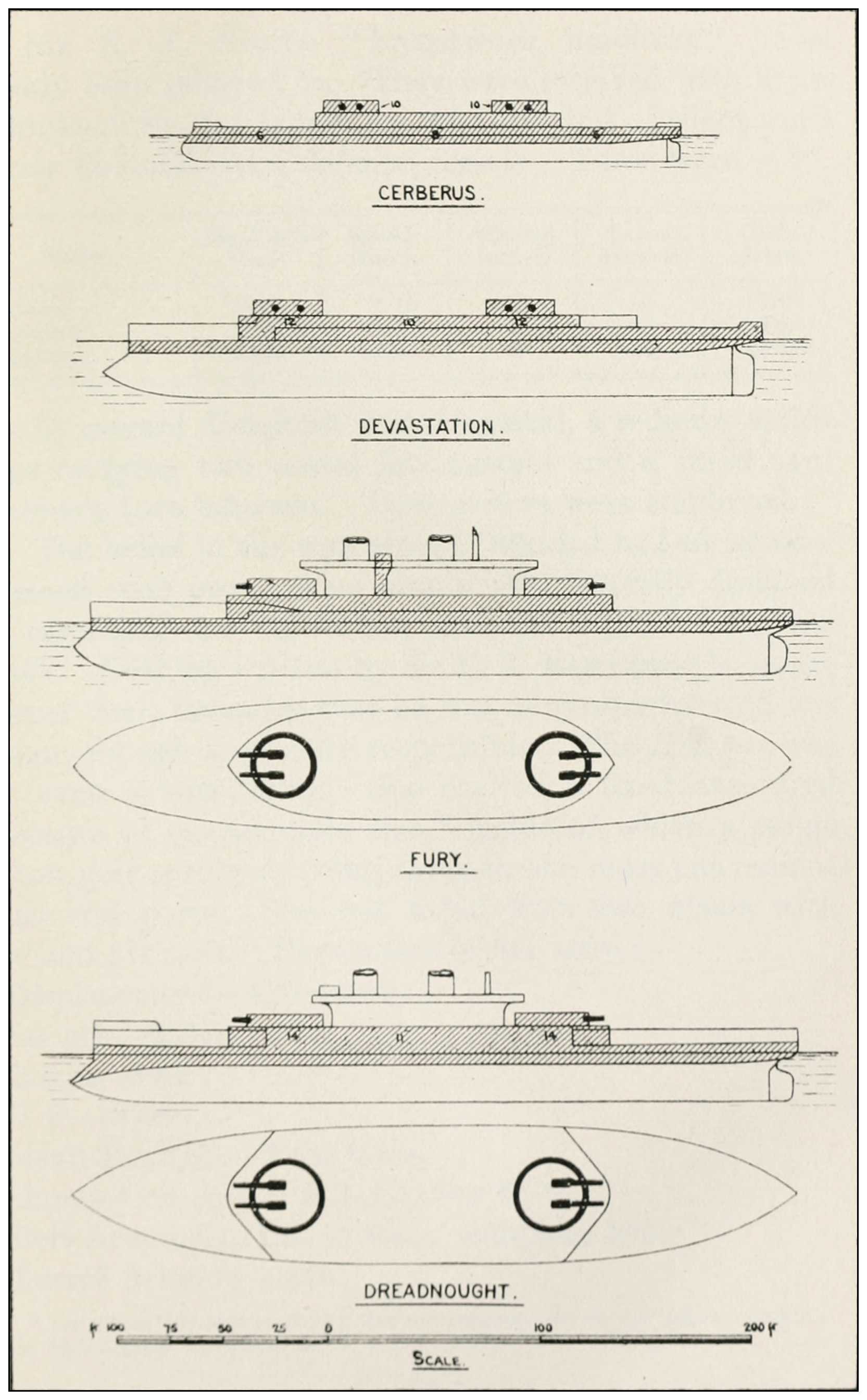
CERBERUS. DEVASTATION. FURY. DREADNOUGHT.
BREASTWORK MONITORS.
Sir E. J. Reed’s “breastwork monitors” have already been referred to. They were received with little enthusiasm by the Admiralty, and the first of them were merely Colonial coast defence vessels. These were:—
Name. Displ’m’t. Tons. Speed. Knots. Armour. Inches. Turret Armour. Completed.
Cerberus 3480 9.75 8 10 1870
Abyssinia 2900 9.59 7 10 1870
Magdala 3340 10.67 8 10 1870
In general design all were identical, a redoubt amidships carrying two centre line turrets and a small oval superstructure between. Twin screws were employed.
The belief in the ram already alluded to had by now attained such proportions that a ship specially designed for ramming was called for, and the Hotspur was the result. Nothing written by Sir E. J. Reed (and he wrote a great deal) indicates that he was in sympathy with her design, though nominally responsible. The Hotspur was not even a turret-ship. She carried a fixed armoured structure of considerable size,107 inside of which a single 25-ton gun revolved, firing through the most convenient of several ports. She was fitted with two masts with fore and aft sails. Particulars of her were:—
Displacement—4,010 tons.
Length—235ft.
Beam—50ft.
H.P.—3,060.
Mean Draught—21ft. 10ins.
Guns—One 25-ton M.L.R., two 6½-ton.
Belt Armour—11in. to 8in.; complete belt.
Turret Armour—10in.
Coal—300 tons.
Speed—12.8 knots (twin-screw).
Builder—Napier, Glasgow.
Launched—1870; completed, 1871.
Cost—Hull and machinery, £171,528.
She was built solely and simply as an “answer” to a series of “rams” projected for the French Navy, apparently more with an Admiralty idea of not being caught napping “in case,” than from any belief in her efficacy.
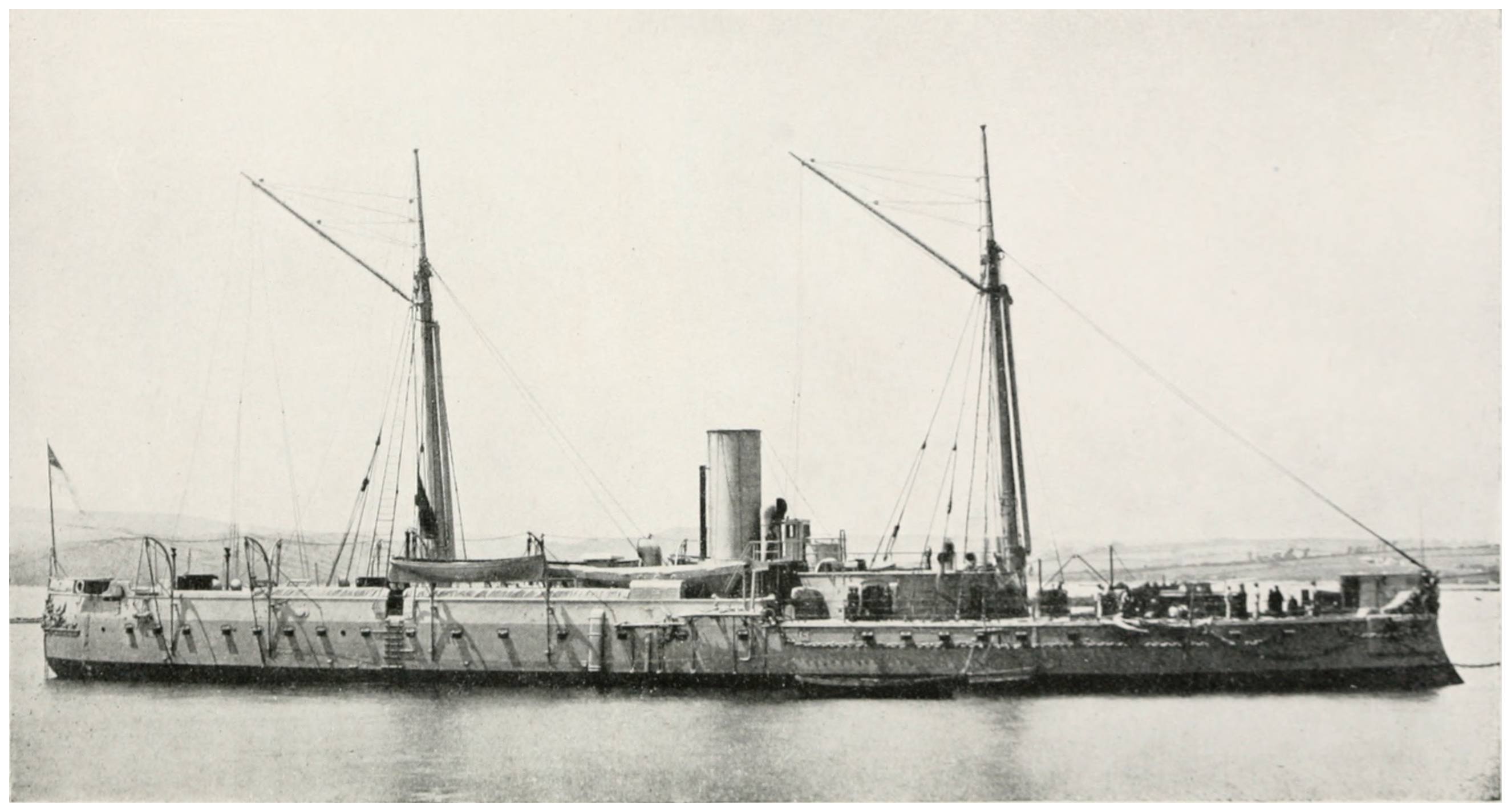
THE
HOTSPUR
, AS ORIGINALLY COMPLETED, 1871.
Sir E. J. Reed’s ideas in the matter of turret-ships now found expression in four ships of the Cerberus type enlarged. These were the Cyclops, Gorgon, Hecate, and Hydra. Like their prototype, they were of the breastwork type, and differed only in having an inch more belt armour and a displacement of 3,560 tons. Differing from them, and perhaps more on Reed lines, was the Glatton. Her special feature was the introduction of water to reduce her freeboard in action. She had a single turret only, but her belt was 12ins. thick, and she represented the, then, “last word” in coast defence ships, so far as the British Navy was concerned. Details of her are as follows:—
Displacement—4,910 tons.
Length—245ft.
Beam—54ft.
H.P.—2,870.
Mean Draught—19ft. 5ins.
Guns—Two 25-ton M.L.R.
Armour (iron)—12-10in. Belt Turret, 14in.
Coal—540 tons.
Speed—12.11 knots (twin screw).
Builder of Ship—Chatham Dockyard.
Builder of Machinery—Laird.
Floated out of Dock—1871; completed, 1871.
Cost—Hull and Machinery, £219,529.
The last ship of this group was the ram Rupert, of 5,440 tons, laid down at Chatham, in 1870. She was, in substance, merely an enlarged Hotspur, carrying two 18-ton guns in a single revolving turret forward and two 64-pounders behind the bulwarks aft. Her armour was slightly inferior to the Glatton’s: her speed considerably higher—14 knots being aimed at, though it was never reached. She was one of the very few ships which had their engines built in a Royal Dockyard, hers being constructed at Portsmouth Yard.
About the year 1890, when re-construction was very much to the fore, the Rupert was re-constructed. She was given a couple of 10in. breech-loaders instead of her old 10in. M.L., a military-top, and a few other improvements. The net result of this re-construction was that when, after it, she first proceeded to coal she began to submerge herself almost at once. Her torpedo tubes were awash before she had received her normal quota of coal, and she was, generally, the most futile example of re-construction ever experienced.
The failure was such that thereafter no further attempt to modernise old ships was ever made; instead, a policy of “scrapping” all such was introduced. This is probably the best service that the Rupert ever rendered to the Navy. She demonstrated for all time that—so far as the British Navy was concerned—modernising was a hopeless task. It took France and Germany many years to learn a similar lesson. To-day, it is generally recognised that, as a ship is completed, she represents the best that can be got out of her; and that any attempt to improve her in any one direction merely spells reduced efficiency in some other. Hence the apparently early scrapping of many ships of later date and the present day proverb, “Re-construction never pays.”
The whole of the series, however, can only be regarded as improvements on the old Prince Albert idea. Sir E. J. Reed’s real answer to the Captain was the Devastation, designed in 1868, but not completed till 1873; at which date he had left the Admiralty. The Devastation and the Thunderer (completed four years later than her sister) cost Sir E. J. Reed his position. In them he introduced all his ideas as to what the sea-going turret-ship should be. He carried the Admiralty with him; but before ever the Devastation was set afloat, it was “proved” to the satisfaction of the general public that she was an “egregious failure.” The date of her design is about 1868, though, as mentioned above, she was not completed till 1873. The Dreadnought of more or less these times was nothing in the way of novelty compared to the Devastation of the later sixties.
Details of the Devastation (laid down Nov., 1869), were:—
Displacement—9,330 tons.
Length—385ft.
Beam—62ft. 3ins.
Mean Draught—25ft. 6ins.
H. P.—6,650.
Guns—Four 35-ton M.L.R.108
Belt Armour—12in. and 10in. (iron).
Turret Armour—14in. (iron).
Coal—1,800 tons.
Speed—13.84 knots (twin-screw).
Where Built—Portsmouth Dockyard.
Builder of Machinery—Humphrys.
Launched—1871; completed, 1873.
Cost—Hull and Machinery, £353,848.
On her trials the Devastation proved completely successful. An interesting and little known item in connection with her is that as designed she was to carry two signal masts,109 one forward of the turrets, one aft. For these, on completion, a single mast on the superstructure was substituted.
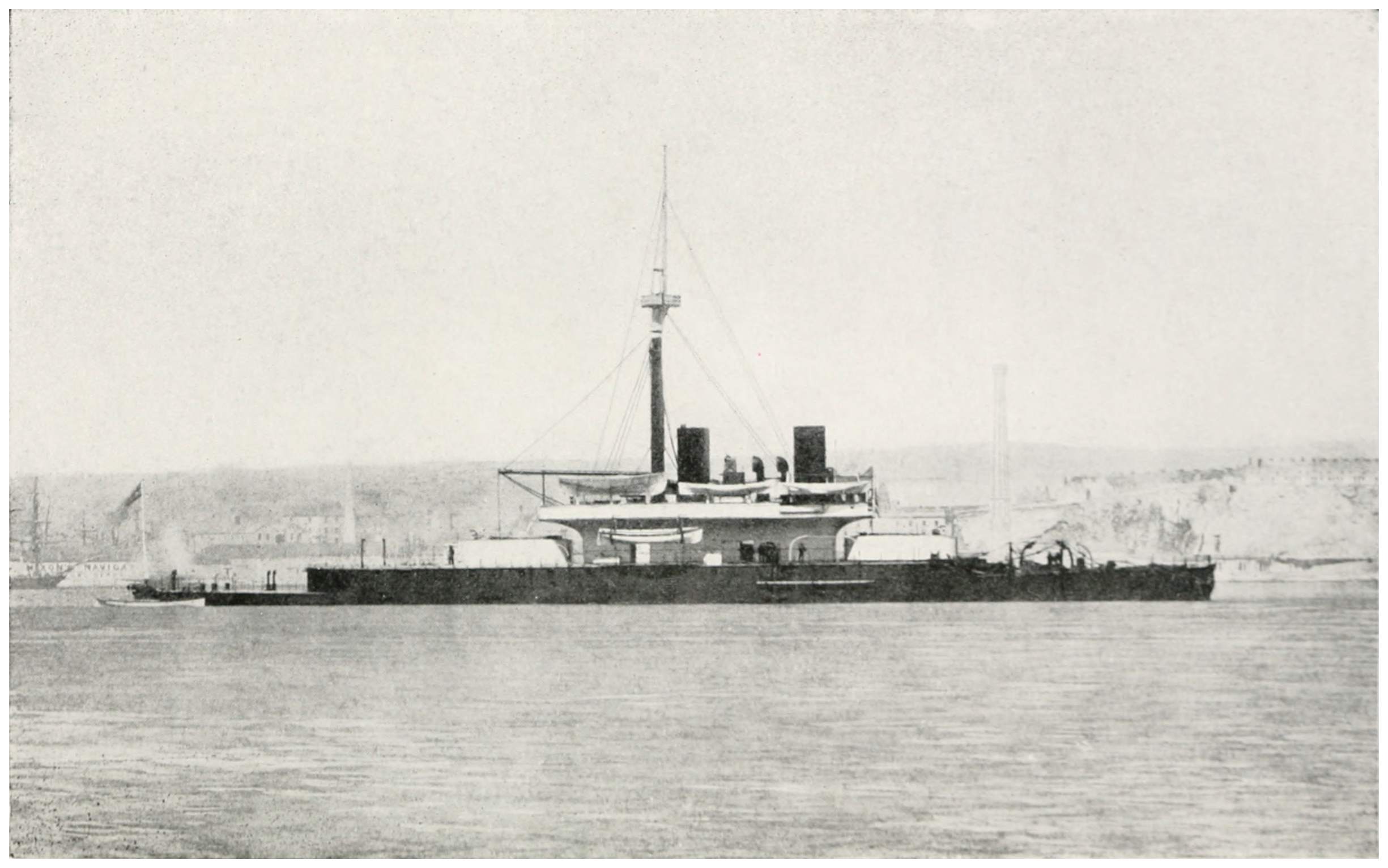
THE
DEVASTATION
, AS COMPLETED, 1873.
How the Devastation, even after successful completion, was received by the public can be gleaned from the following extracts from the contemporary press:—110
“It is a weakness with the officers and men of any of Her Majesty’s ships to ‘crack up’ the vessels to which they belong, and it is rarely that a bluejacket growls openly against his ship. The warm confidence expressed in the ill-fated Captain by her unfortunate crew is well remembered, and is sufficient to prove that even the first of this necessarily uncomfortable class of monitors was not met by the seamen of the Fleet in any complaining spirit, but that they submitted to the discomforts imposed upon them with characteristic cheerfulness. When, therefore, an unmistakable feeling of dissatisfaction prevails throughout a ship, and no hesitation is shown in expressing it, we may be certain that there is some valid reason for so unusual an occurrence. We hesitated to give currency to reports which reached us during the cruise of the Devastation around the coast with the Channel Squadron, as we had good reason to believe that it was the intention of the Admiralty to pay her off, and berth her in Portsmouth harbour as a tender to the Excellent, the advantage of so doing being that a very large number of men passing through the School of Gunnery would thus be enabled to become acquainted with the latest improvements in the turret system.... But since the arrival at the Admiralty of Rear-Admiral Hornby, late in command of the Channel Squadron, who certainly should be able to form a correct estimate of the Devastation’s fitness in every respect for sea service, it has been determined that she shall be ordered to Gibraltar, there probably to remain during the coming winter as a kind of ‘guardo.’ A cruise across the bay in the month of November is not looked forward to by the present crew, who have had a little experience both of being stifled by being battened down and of being nearly blown out of their hammocks when efforts at ventilation are made by opening every hatch. Her qualities as a sea-boat have been fairly tested, and the present notion of filling her up with stores for six months’ further service, and then stowing her away at Gibraltar, leads to the conclusion that on this point at least the value of the counsel of the First Lord’s new Naval adviser is not altogether apparent.
“... It is needless to comment on the facts. They speak for themselves. The condensers will be repaired, no doubt, and strengthened and modified; but no engineer can guarantee that they will not fail again, or, if they turn out a permanent job, that the cylinders will not split, or some other of the mishaps to which marine engines in the Navy are subject may not happen. If the failure takes place in the day of battle it will constitute little short of a national calamity. Even as it is, it must be looked on as a most fortunate circumstance that the sea was perfectly smooth and the vessel near a port. Had the breakdown occurred during the six hours’ run of the ship—which was to have been made on Wednesday—and in a stiff breeze blowing on a lee shore, the ship might have been lost before an effort could have been made to save her. Very important improvements in marine engines of large size must be made before we can reconcile ourselves to the adoption of mastless sea-going monitors.”
With such labour and travail was the modern British battleship born! Public opinion decidedly modified naval construction—leading, as it did, to a considerable delay with the Thunderer,111 the re-designing of the Fury, and the building of some old-type ships which else had probably never been constructed.
As already mentioned, Sir E. J. Reed left the Admiralty before the Devastation was completed. None the less the ships which immediately followed were in all essential particulars “Reed Ships,” and so are included in this chapter.
The Devastation, owing to the Committee on Designs, received certain minor modifications before completion. These mainly concerned the hatches. Her sister ship, the Thunderer, built at Pembroke and engined by Humphrys, was held back, pending the Devastation’s trials, and not completed till 1877.
Save that in one turret she carried a couple of 38 ton (12.5-inch) instead of 35 ton (12-inch) guns, she was a replica of the Devastation.
A third ship of the same type, named the Fury, was in hand, but criticisms of the Devastation caused her to be re-designed, and she was eventually completed as the Dreadnought. In her the very low freeboard forward and aft of the Devastation type was done away with and freeboard maintained at a uniform medium height.
The Devastation and Thunderer had their armour-plates amidships pierced with square portholes. These with some reason were attacked as likely to weaken the armour very considerably, and the Dreadnought was built entirely wall-sided and so depended on artificial ventilation, known in the Navy in those days as “potted air,” even more than her predecessors.
Particulars of the Dreadnought:—
Displacement—10,820 tons.
Length—320ft.
Beam—63ft. 10in.
Draught—26ft. 9in.
Armament—Four 38-ton M.L.R., two 14in. torpedo tubes.
Armour (iron)—Belt 14-11in., Bulkheads 13in., Turrets 14in.
H.P.—8,210 = 12.40 knots.
In the original design of the Fury provision was made for a conning tower with a heavily-armoured communication tube. She proved a very successful ship. No sisters were ordered, probably because the Admiralty wished to see how she did before committing themselves to the type. Ere she was finished a different fashion in warships had set in. The cost of the Dreadnought was about £600,000.
The Alexandra was designed long after Reed had left the Admiralty. That famous constructor had nothing whatever to do with her. None the less she was the apotheosis of his box-battery ironclad ideas and for that reason is included in his era. She was simply an “improved Sultan.”
Particulars of her:—
Displacement—9,490 tons.
Length (between perpendiculars)—325ft.
Beam—63⅔ft.
Draught—26½ft.
Armament—Four 25-ton M.L., ten 18-ton M.L., four above-water torpedo dischargers (14in.)
Armour (iron)—12-6in. belt, flat deck on top of it. Bulkheads 8-5in. Battery 12-6in.
Horse-power—9,810 = 15 knots.
Coal—680 tons = 2,700 knots at 10 knots (nominal).
She was built at Chatham Dockyard; engined by Humphrys; completed for sea, 1877.
Four of the 18-ton guns were carried in an upper deck battery, and had end-on training. The other guns were carried in the main-deck battery, which was some 10ft. high. The 25-ton guns had a right-ahead training.
After completion she served as Mediterranean flagship, though at the bombardment of Alexandria the flag was transferred to the Invincible, which, being of lighter draught, was able to enter the inner harbour. At a later date (about 1890) she was “partially reconstructed.” For her original barque rig a three-masted military rig was substituted, and six 4-inch Q.F. were mounted on top of her upper deck battery. She has been described as the apotheosis of Reed broadside ideas, and a very apotheosis she was. No broadside or central battery ironclad of the British or any other Navy ever equalled her, and she dropped out of the first rank only because the big gun rendered broadside ships entirely obsolete.
GUNS IN THE ERA.
The principal guns (all M.L.R.) in the Reed Era were as follows:—
Weight in tons. Bore in inches. Length in Calibres. Weight of Projectile lbs. Muzzle Velocity. f.s. Muzzle Energy. f.t. Penet’n Iron at
yds. 2000 yds. 1000
38 12.5 16 810 1575 13,930 16 18
35 12 13½ 707 1390 9470 13 15
25 12 12 609 1288 7006 11 12
25 11 12 544 1314 6560 13 14
18 10 14½ 406 1370 5360 10 12
12½ 9 14 253 1440 3695 9 10
9 8 15 174 1384 2391 7 8
6½ 7 16 112 1325 1400 6 7
In the early part of the period Armstrong breech-loaders up to 120 pounders had been in use, but the elementary breech blocks were so unsatisfactory that the Navy quickly discarded them, and adhered to muzzle-loaders long after all other Powers had given them up.
The big muzzle loaders tabulated were of a very elementary type also. They were made by shrinking red hot wrought-iron collars over a steel tube; and it was never quite certain how far the interior would be affected. The projectiles never fitted accurately, with the result that there was considerable leakage of gas and very erratic firing. The rifling consisted of five or six grooves into which studs in the projectile fitted.
In 1872 some experiments were carried out, the Hotspur firing at the Glatton’s turret at a range of 200 yards. The first shot missed altogether, the other two struck the turret, but not at the point aimed at. The turret was not appreciably damaged, though theoretically it should have been completely penetrated. This eventually led to the invention of an improved gas check—reference to which will be found at the end of the Barnaby Era.
UNARMOURED SHIPS OF THE ERA.
Contemporaneously with the Hercules the Inconstant was designed. She was inspired by the United States Wampanoag, a type of large, fast, unprotected, heavily-gunned frigate, to which the Americans had always been partial. The Wampanoag, as a matter of fact, never reached expectations, whereas the Inconstant was a decided success so far as she went. She marked, so far as the British Navy was concerned, the first appearance of the theory that speed and gun power—in other words, “the offensive”—might be developed advantageously, at the cost of defensive arrangements, a theory which still survives in the “battle-cruisers” of to-day, though of course in a very modified form. None the less, the Inconstant represents the germ idea of our present battle-cruisers, and is supremely important on that account.
Particulars of the Inconstant were:—
Displacement—5,780 tons.
Length (between perpendiculars)—337⅓ ft.
Beam—50¼ft.
Draught (mean)—25½ft.
Guns—Ten 12½ ton M.L.R., six 6½ ton M.L.R.
H.P.—7,360 = 16 knots (trial 16.2).
Speed—Sixteen knots (trial 16.2).
Built at Pembroke Dockyard. Completed for sea 1868 at a cost of £213,324. She had an iron hull, wood-sheathed and coppered. A coal supply of 750 tons gave a nominal radius of 2780 miles. She was ship-rigged and sailed well.
She was followed by a couple of variants on her, the Raleigh and Shah, the former 5,200 tons and the latter 6,250 tons.
The Shah was originally named the Blonde, but rechristened out of compliment to the Shah of Persia, who was visiting England at the time of her launch.
At a later stage in her career (1877) the Shah, then flagship on the S.W. Coast of America, fought a much-criticised action with the Peruvian turret-ship Huascar, a Laird-built monitor, carrying a couple of 12½ ton guns, launched in 1865, and generally of the same type (though smaller) as the British Hotspur and Rupert.
The Huascar had been seized by the Revolutionists and practically turned into a pirate ship. In attacking her the British Admiral de Horsey gave hostages to fortune, seeing that it was an axiom of those days that an unarmoured ship was helpless against an ironclad monitor. He had, however, no alternative.
As things turned out, the Huascar never succeeded in hitting either the Shah, or the Amethyst which accompanied her, while the British flagship, having a speed advantage, the efforts of the Huascar to ram her were futile. The Huascar was hit about thirty times, and one man was killed on board her, but the damage done to the turret-ship was practically nil. The engagement is of further special interest as for the first time a torpedo was used from a big ship in action. The range, however, was too great and no hit was secured.
During the night following the action an attempt was made to torpedo the Huascar from the Shah’s steam pinnace, but the enemy could not be found. Yet it is probable that the knowledge of the Shah’s torpedoes was the reason why Pierola surrendered the Huascar next morning to the Peruvian fleet.
It must have been abundantly clear to him that he had next to nothing to fear from the British gun-fire, while a single water-line hit from him would probably have put the Shah entirely at his mercy, save in so far as her torpedoes might make attempts to ram fatal to him.
END OF VOL. I.