XXI THE TRICOLOR
Reading edition
When the representatives of the people of France, to the number of more than twelve hundred, came together in a great hall in the palace at Versailles on the 5th of May, 1789, the king opened the session, with the queen and royal princes beside him on a throne gorgeous with purple and gold. Immediately in front of him sat his ministers, and in other parts of the hall were the three orders in separate groups. The nobles were brilliant in ruffles and plumes. The Third Estate was sober enough in dress, but there were six hundred of them; twice as many in proportion as had ever been allowed in a similar gathering. Most of them were lawyers; only forty belonged to the farming class. In the group of clergy some wore the flaming scarlet robes of cardinals, some the plain cassocks of village priests; and events proved that these last were brothers in spirit with the six hundred. The galleries were crowded with ladies and courtiers and envoys from distant lands. Even roofs of neighboring houses were covered with spectators bent on seeing all they could.
The queen looked anxious. She had no fondness for reforms; but of the two upon the throne she had the stronger character and was therefore the better king. She was brave, quick to decide, and daring to execute. Unfortunately she was also narrow-minded and had little sympathy with the common people. Louis had already proved himself a complete failure as a ruler. He was a good husband, a lover of hunting, and a passable locksmith. It was a bit of tragic irony that his hobby should have been the making of little, smoothly turning locks. After his one attempt at reform he had not even tried to govern, but spent his days in meaningless detail, while the country drifted toward ruin.
Necker, who was once more in charge of the treasury, meant to keep the States General very busy with the duty for which they had been convened, that of providing money. But if the Notables had been refractory, this assembly was downright rebellious. A quarrel developed at the very outset about the manner of voting. In previous States General the three orders had held their meetings separately, and in final decisions each order had cast only one vote. The nobles and clergy could be counted on to vote the same way, which gave them a safe majority of two to one. Expecting the rule to hold this time, very little objection had been raised to the proposal that the Third Estate elect six hundred representatives instead of three hundred. The people liked it and it meant nothing at all. Now that the six hundred had been elected, however, they contended that the three orders must sit in one assembly and that each man's vote be counted separately, which made all the difference in the world. A few liberals among the nobles and more than a few of the clergy in simple cassocks appeared to agree with them. The quarrel continued for six weeks, and meanwhile neither party was able to do any work.
At the end of that time the number favoring the new way of voting had increased. These declared themselves to be the National Assembly of France and that they meant to begin the work of "national regeneration" at once, whether the others joined them or not. Reforms were to be along lines indicated in the cahiers, or written statements of grievances, that voters had been urged to draw up at the time of the election. Tens of thousands of these had been received, some written in the polished phrases of courtiers, some in the earnest, ill-chosen words of peasants. All expressed loyalty to the king; and almost all demanded a constitution to define the rights of people and king alike. Among other things they asked that lettres de cachet be abolished; that the people be allowed liberty of speech; that the States General meet at regular intervals; and that each of the three orders pay its just share of the taxes.
Soon after the liberals declared their intention of going to work they found the great hall at Versailles closed and were told curtly that it was being prepared for a royal session. They retired to a near-by tennis-court, lifted the senior representative from Paris, an astronomer named Bailly, to a table, elected him president of their National Assembly, and took an oath not to disband until they had given France a constitution. A few days later the king summoned all the members of the States General to the great hall, scolded them for their recent acts in a speech written by somebody else, commanded that each order meet in future by itself, and left the hall to the sound of trumpets and martial music. The clergy and the nobles obediently withdrew. The Third Estate and a few liberals from the other orders remained. The king's master of ceremonies, a very important personage indeed, came forward and repeated the king's order. Soldiers could be seen behind him. There was a moment's silence; then Mirabeau, a homely, brilliant nobleman from the south of France, who had been rejected by his own order, but elected by the Third Estate, advanced impetuously toward the master of ceremonies, crying, in a loud voice, "Go tell your master that we are here by the will of the people, and that we shall not leave except at the point of the bayonet." Next he turned to the Assembly and made a motion to the effect that persons laying hands upon any member of the Assembly would be considered "infamous and traitors to the nation—guilty of capital crime." The master of ceremonies withdrew and reported the scene to the king. Louis, weak as water, said: "They wish to remain? Let them." And they did remain, to his undoing.
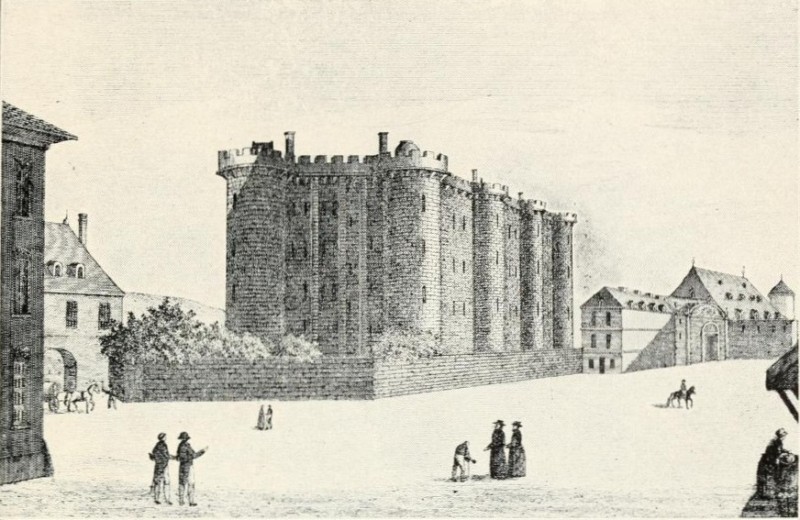
THE BASTILLE From a contemporary print
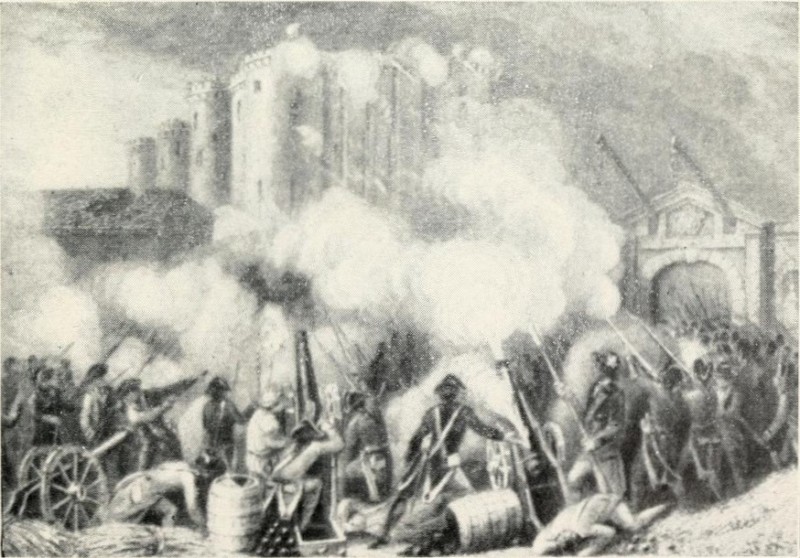
SIEGE OF THE BASTILLE
Lafayette was in an embarrassing position. He sympathized with the Third Estate, yet he had been elected to represent the nobles, and his commission bound him to vote according to their wishes. He considered resigning in order to appeal again to the voters of Auvergne; but before he came to a decision the king asked the nobles and clergy to give up their evidently futile opposition. Lafayette took his place with the others in the National Assembly, but refrained for a time from voting. The king and his ministers seemed to have no settled policy. One day they tried to please the Third Estate; on another it was learned that batteries were being placed where they could fire upon the Assembly and that regiments were being concentrated upon Paris. It was upon a motion of Mirabeau's for the removal of these threatening soldiers that Lafayette broke his silence and began to take part again in the proceedings of the Assembly.
On the 11th of July, about a fortnight after the nobles and clergy had resumed their seats, he presented to the Assembly his Declaration of Rights, modeled upon the American Declaration of Independence, to be placed at the head of the French Constitution. Two days later he was elected vice-president of the Assembly "with acclamations." Toward evening of the 14th the Vicomte de Noailles came from Paris with the startling news that people had been fighting in the streets for hours; that they had gained possession of the Bastille, the gray old prison which stood in their eyes for all that was hateful in the old regime; that its commander and several of its defenders had been murdered; and that their heads were being carried aloft on pikes among the crowds.
On the 15th the king came with his brothers to the Assembly and made a conciliatory speech, after which Lafayette hurried away to Paris at the head of a delegation charged with the task of quieting the city. They were met at the Tuileries gate and escorted to the Hôtel de Ville, where the City Council of Paris, a parliament in miniature, held its meetings. Lafayette congratulated the city on the liberty it had won, delivered the king's message, and turned to go. As he was leaving the room somebody cried out saying that here was the man Paris wanted to command its National Guard, and that Bailly, who accompanied him, ought to be mayor. It was one of those sudden ideas that seem to spread like wildfire. Lafayette stopped, drew his sword, and, acting upon that first impulse which he was so apt to follow, swore then and there to defend the liberty of Paris with his life if need be. He sent a message to the National Assembly asking permission to assume the new office, and on the 25th took, with Bailly, a more formal oath. The force of militia which he organized and developed became the famous National Guard of Paris; while this governing body at the Hotel de Ville which had so informally elected him, enlarged and changing from time to time as the Revolution swept on, became the famous, and infamous, "Commune." Lafayette himself, not many days after he assumed the new office, ordered the destruction of the old Bastille. One of its keys he sent to Washington at Mount Vernon. Another was made into a sword and presented by his admirers to the man whose orders had reduced the old prison to a heap of stones.
The court party was aghast. The Comte d'Artois and two of his friends shook the dust of their native land from their feet and left France, the first of that long army of émigrés whose flight still further sapped the waning power of the king. Louis was of one mind one day, another the next. Against the entreaties and tears of the queen he accepted an invitation to visit Paris and was received, as Lafayette had been, with cheers. He made a speech, ratifying and accepting all the changes that had taken place; and to celebrate this apparent reconciliation between the monarch and his subjects Lafayette added the white of the flag of the king to red and blue, the colors of the city of Paris, making the Tricolor. Up to that time the badge of revolution had been green, because Camille Desmoulins, one of its early orators, had given his followers chestnut leaves to pin upon their caps. But the livery of the Comte d'Artois, now so hated, was green, and the people threw away their green cockades and enthusiastically donned the red, white, and blue, echoing Lafayette's prediction that it would soon make the round of Europe.
The passions which had moved the city of Paris spread outward through the provinces as waves spread when a stone is cast into a pool. One town after another set up a municipal government and established national guards of its own. Peasants in country districts began assaulting tax-collectors, hanging millers on the charge that they were raising the price of bread, and burning and looting châteaux in their hunt for old records of debts and judgments against the common people. July closed in a veil of smoke ascending from such fires in all parts of the realm.
All day long on the 4th of August the Assembly listened to reports of these events, a dismaying recital that went on and on until darkness fell and the candles were brought in. About eight o'clock, when the session seemed nearing its end, De Noailles mounted the platform and began to speak. He said that there was good reason for these fires and the hate they disclosed. The châteaux were symbols of that kind of unjust feudal government which was no longer to be tolerated. He moved that the Assembly abolish feudalism. His motion was seconded by the Duc d'Aiguillon, the greatest feudal noble in France, with the one exception of the king. The words of these two aristocrats kindled another sort of fire—an emotional fire like that of a great religious revival. Noble after noble seemed impelled to mount the platform and renounce his special privileges. Priests and prelates followed their example. So did representatives of towns and provinces. The hours of the day had passed in increasing gloom; the night went by in this crescendo of generosity. By morning thirty or more decrees had been passed and feudalism was dead, so far as law could kill it.
The awakening from this orgy of feeling was like the awakening from any other form of emotional excess. With it came the knowledge that neither the world nor human nature can be changed overnight. When the news went abroad there were many who interpreted as license what had been given them for liberty. Forests were cut down. Game-preserves were invaded and animals slaughtered. Artisans found themselves out of work and hungrier than ever because of the economy now necessarily practised by the nobility. Such mighty reforms required time and the readjustment of almost every detail of daily life. Even before experience made this manifest the delegates began to realize that towns and bishoprics and provinces might refuse to ratify the impulsive acts of their representatives; and some of the nobles who had spoken for themselves alone did not feel as unselfish in the cold light of day as they had believed themselves to be while the candles glowed during that strange night session. The final result was to bring out differences of opinion more sharply and to widen the gulf between conservatives who clung to everything which belonged to the past and liberals whose desire was to give the people all that had been gained and even more.