THE BOYS’ BOOK OF MODEL AEROPLANES
Reading edition
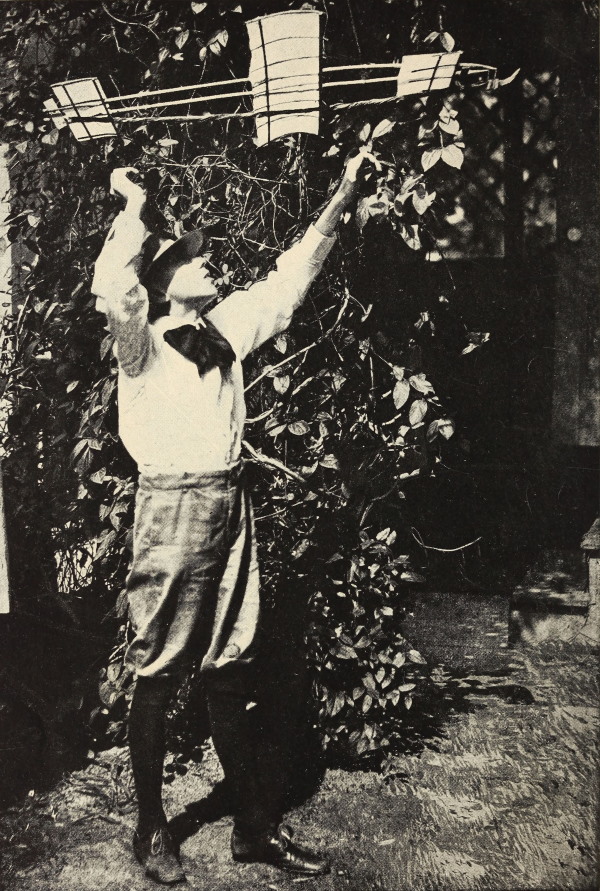
Launching the Airship.
THE BOYS’ BOOK OF MODEL AEROPLANES
HOW TO BUILD AND FLY THEM: WITH THE STORY OF THE EVOLUTION OF THE FLYING MACHINE
BY
FRANCIS A. COLLINS
ILLUSTRATED WITH MANY PHOTOGRAPHS AND DIAGRAMS BY THE AUTHOR

LONDON EVELEIGH NASH 1912
TO ARNOLD MILLER COLLINS (Aged Ten)
THAN WHOM NO COLLABORATOR COULD HAVE BEEN MORE ENTHUSIASTIC
CONTENTS
PART I
MODELS: HOW TO BUILD AND FLY THEM
CHAPTER PAGE
I. The New Sport for Boys 3
II. Why the Aeroplane Flies 18
III. How To Build a “Glider” 30
IV. Building the Motor 50
V. Fine Points of Construction 68
VI. Simple Monoplane Models 84
VII. Elaborating the Monoplane 102
VIII. Building a Biplane 121
IX. Combining Monoplane and Biplane Forms 137
X. Faults and How to Mend Them 143
PART II
THE HISTORY AND SCIENCE OF AVIATION
I. The First Flying Machines 163
II. Developing the Aeroplane 175
III. The Wright Brothers’ Own Story 193
IV. Aboard the Wrights’ Airship 224
V. Other Aeroplanes Appear 238
VI. Successful Monoplanes 254
VII. Aerial Warfare 272
VIII. Sports of the Air, Aeroplanes 293
LIST OF ILLUSTRATIONS
PAGE
Launching the Airship Frontispiece
A Junior Aëroclub with its Instructor in One of the New York Public Schools 7
A Young Inventor in His Workshop 14
Boys Comparing Models 14
The First Glider Weighted at the Front 28
Dowel Strips of Different Sizes 33
Plate A—Diagrams of Plan of Aëroplane on Page 58 38
A Coil of Cane or Reed 42
Splitting a Bamboo Fish-Pole 47
Plate B—The Propeller before Cutting Down 51
Model Constructed from Diagram, Plate A 58
Splitting the Segar Box Cover to Build the Propeller 63
Plate C—The Diagram of a Monoplane 65
A Model Aëroplane Built from the Drawing (Plate C) 71
Detail of Rudder and Propeller of Model Built from Drawing (Plate C) 78
Plate I—A Clever Folding Model. The Wings Are Broader than Need Be 88
Plate II—A Model Aëroplane Worth Imitating 93
Plate III—An Ingenious French Model Made of Umbrella Wire 100
Plate IV—One of the Simplest of Aëroplanes to Construct 105
Plate V—Too Large for Beginners but Will Make Long Flights 112
Model Shown in Plate V Ready for a Flight 117
Plate VI—A Model with Both Good and Bad Features 124
Plate VII—A Good Example of Careful Designing and Workmanship 129
Plate VIII—An Effective Model with Wooden Wings 136
Plate IX—An Interesting Experiment Along New Lines 139
Plate X—An Excellent Monoplane Capable of Long Flights 150
Detail of Model Shown in Plate X 153
Plate XI—Well Thought Out Monoplane 158
Plate XII—A Good Example of Tilted Planes 165
Plate XIII—A Serviceable Form Made of Wire 172
Plate XIV—The Under Body of the Monoplane Shown in Plate XIII 179
Plate XV—A Simple Model which Proves Steady in Flight 184
Plate XVI—The Propeller and Shaft of the Model Shown in Plate XV 189
Plate XVII—An Ingenious Model which Fails to Fly 196
Plate XVIII—A Good Model Excepting That Its Vertical Rudders Are Too Large 201
Plate XIX—A Simple Cellular Form 208
Plate XX—A Cellular Type with Rudder and Elevating Plane 213
Plate XXI—A Complicated Model Capable of Long Flights 220
Plate XXII—An Interesting Form which Flies Backward or Forward 225
Plate XXIII—A Well Built Model Badly Proportioned 230
Plate XXIV—Wright Model Ready for Flight 235
Plate XXV—Another View of the Wright Model 246
Plate XXVI—An Ingenious Model which Rises Quickly 251
Plate XXVII—An Aëroplane with Paper Wings 255
A Very Simple Monoplane for Beginners 262
Otto Lilienthal about to Take Flight 267
A Machine for Testing the Lifting Power of Aëroplanes 274
Maxim’s First Aëroplane 280
The Machine on the Rails, as it Appeared in 1893 280
First Flight of the Wright Brothers’ First Motor Machine 285
Three-quarter View of a Flight at Simms Station, November 16, 1904 292
Front View of the Flight of the Wright Aëroplane, October 4, 1905 297
PART I
MODELS: HOW TO BUILD AND FLY THEM
THE BOYS’ BOOK OF MODEL AEROPLANES