Captain Mayne Reid (continued 4)
Reading edition
Apparently, here was a difficulty not to be got over. Considering that I had no standard of measurement within reach—neither yard-stick, nor foot rule, nor graduated scale of any kind—you will naturally conclude that I must have abandoned the problem. A computation founded on the mere length of the stick would have been absurd, and could have given me no information whatever upon the point about which I wanted to be informed. To find the cubic and liquid contents of the cask, I must first have its length, with its largest and shortest diameters, expressed in standard terms—that is, either in feet or inches, or some other divisions of a scale.
And how, I ask, was this to be ascertained, when I possessed no standard of measurement about my person? None whatever. I could not make one; for in order to do so, I should have required another for a guide. Of course, I could not guess the length either of feet or inches.
How, then, was I to proceed?
Apparently, the difficulty was not to be got over. The thing seemed impracticable.
To you it may seem so, but it did not to me. I had thought of this before. I should not have proceeded as far as I had done—taking so much pains and trouble with the splitting and splicing of my sticks, and making my measurements so exact—had I not foreseen this difficulty, and thought of a way to surmount it. All this had been prospectively arranged. I knew before-hand that I could measure my sticks, and tell their linear dimensions to the exactness of an inch.
“How?”
Thus, then—
When I said just a little ago that I had no standard about my person, I spoke the truth only literally. Although not exactly about my person, I had one in my person—I was myself that standard! You will now remember my having submitted myself to a measurement, which showed me to be four feet in length. Of what value that knowledge now proved to me!
Knowing, then, my own height to be very nearly four feet, I could notch off that measure upon one of the sticks, which would give me a measuring-rule of four feet in length.
I proceeded to obtain this result without delay. The process was simple and easy. Laying myself horizontally, I planted my feet against one of the great ribs of the ship, and rested the end of the stick between them. I now stretched myself out at full length, and guiding the rod so as to keep it parallel to the axis of my body, I brought it across my forehead, and beyond. With my fingers I could tell the point that was opposite the crown of my head, and carefully marking this point, I afterwards notched it with the knife. I now possessed a four-foot rule, exact enough for my purpose.
But there were difficulties yet to be encountered. With a four-foot rule, I was but little advanced towards my computation. I might make a nearer approach to the measurement of my diameters, but that would not avail. I must know them exactly. I must know them in inches, and even fractions of inches; for, as I have said, an error of half an inch in some of my data would make a difference of gallons in the result. How, then, was I to divide a four-foot stick into inches, and register the inches upon its edge? How was this to be done?
It seems simple enough. The half of my four feet—already ascertained—would give me two feet; and the half of that again would reduce the standard to a foot. This again notched in the middle would make two lengths of six inches each. Then I could subdivide those into lengths of three inches, which, if not small enough for my calculation, could be still further subdivided into three equal parts, each of which would be the desired minimum of an inch.
Yes, all this seems easy enough in theory, but how was it to be put in practice upon a piece of plain straight stick, and in the midst of as perfect darkness as that which surrounds a blind man? How was I to find the exact middle—for it must be exact—of even the four feet, much less divide and subdivide till I got down to the inches?
I confess that I was puzzled for awhile, and had to pause and reflect.
Not very long, however; I was soon able to get over this trifling obstacle.
The plan that first suggested itself was to cut a third piece of stick of a little over two feet in length, which I could easily guess at within a few inches. This I could apply alongside of my four-foot rule, beginning at the end, and proceeding as if I was measuring the latter with the former. Of course, on the first application, two lengths would reach from the end of the rule to the notch that marked the four feet length, and perhaps extend a little beyond. I should then shorten the measure and apply it again. This time its end would have approached nearer to the aforesaid notch. Another bit cut off would bring it still nearer; and the process being repeated, by shaving gradually from the end of the stick, I should at last find that two lengths of it would exactly correspond with the length of my four-foot rule. I should then have a piece exactly two feet in length, and by the help of this I could find the middle part of the longer piece, and could mark it with a “nick.”
By cutting the short piece into two nearly equal parts, I could then take the larger of them, and, by a similar process, obtain the standard of a foot, and mark it also upon my rule; and so on till I had succeeded in arriving at the inches.
Of course, to do all this would require time, patience, and the nicest precision; but I had plenty of time upon my hands, and it was my interest to be both patient and precise.
Although I regarded not the time, just as I was about to carry out the plan described, another suggested itself that promised to lead me sooner to the issue; it would call for less patience, though an equal amount of precision.
This new plan was a sort of corollary of the former one, the only difference being, that instead of a stick I should perform my subdivision and graduation with a string.
The thongs of my buskins came into my mind—the very thing!
I could not have found a better string for the purpose. They were strips of best calfskin, cut with the grain, and could not have been stretched the eighth part of an inch. They would, therefore, measure as accurately as a rule of boxwood or ivory.
One would not be long enough; so I knotted the two together, taking care to make a neat, firm knot of it. They made a string of over four feet, and having laid it along the four-foot rule, I cut it with my knife to that length exactly. I was not satisfied till I had measured it over and over again, each time pulling the thong with all my strength, lest some “kink” might be lurking in it. A slight error would derange my intended scale, though there is less danger in graduating four feet down to inches than in going from the less to the greater standard. In the former, each subdivision naturally lessens the error, while in the latter it is continually doubled.
When convinced that I had got the thong to the precise length, I placed its two ends together, and then drawing it with a firm pull through my fingers, I creased it exactly in the middle. Holding it taut upon the blade of my knife, I cut through at the crease, and thus divided it into two moieties of equal length, each two feet long. The part with the knot I laid aside as being no longer needed, and the remaining half I again doubled, and cut into two. This gave me two pieces each a foot in length.
One of these I next folded in triple, and creased for cutting as before. This was a delicate operation, and required all the skill of my fingers to accomplish, for it is much easier to divide a string into two equal parts than into three. I was a good long time before I could get it trebled to my satisfaction; but I succeeded at length, and then severed the parts.
My object in thus cutting into three, was to get the pieces in even fractions of four inches each, in order that by two more doublings I might arrive more accurately at the inch.
And in two more doublings I found it.
To make sure that I had committed no error, I took up the knotted piece, which I had laid aside, and after placing the other fragments where they could be got at, I reduced the second half of the string as I had done the first.
To my gratification, the inch I obtained from both exactly corresponded. There was not a hair’s breadth of difference.
I was now in possession of a guide to the true graduation of my measuring-stick. I had pieces of one foot, of four inches, of two, and of one; and by the help of these I proceeded to mark my rod after the manner of a draper’s yard-stick.
It occupied some time, for I worked with care and caution; but my patience was rewarded by finding myself in possession of a measure upon which I could rely, even in a calculation involving the question of my life.
I was not much longer in deciding the point. The diameters were now measured by feet and inches, and the mean of the two taken. This was reduced to surface measure by the usual method of squaring the circle (multiplying by eight, and dividing by ten). This gave the base of the hollow cylinder, which would be equal to the frustum of a cone of like altitude; and another multiplication by the length produced the entire cubic content.
Dividing by sixty-nine, I got the number of quarts, and so gallons.
The butt, when full, had contained somewhat above 100 gallons—as near as I could calculate, about 108—and therefore it was in all likelihood an old pipe that had once contained sherry.
Chapter Thirty Two.
The Horror of Darkness.
The result of my calculation was of the most satisfactory nature. Eighty gallons of water would give half a gallon each day for 160 days, or a quart per diem for 320 days—nearly a whole year! Surely I could subsist on a quart a day?—surely the voyage could not last for so long a period as 320 days? A ship might sail round the world in less time. I remembered having been told so, and it was fortunate I remembered it, for my mind was now at ease on the score of water. For all that, I resolved not to drink more than a quart a day, and on this allowance I made no doubt that the supply would be sufficient.
There was more danger of running short of food; but, upon the whole, I now felt very little apprehension, as I had fully resolved to diet myself on the most economic scale.
So far, then, as food and drink were concerned, I felt no further uneasiness. It was well assured that I was not to die either of thirst or starvation; and the very remarkable manner in which both food and drink had been supplied—placed, as it were, before me—naturally led me to the reflection that the hand of Providence had been extended to aid me, and I was still further consoled with the hope that He who had thus mercifully preserved me for the present, would not forsake me in the future.
In this state of feeling I continued for several days, and although it was an irksome life—every hour seeming of itself a day—still I was able to endure it. Sometimes I endeavoured to kill time by counting not only the hours, but even the minutes and seconds; and in this occupation (for I could think of no other) I often passed several hours at a time. My watch enabled me to amuse myself in this manner, and I found companionship in its cheerful ticking. I fancied that it beat louder than I had ever before heard it, and most likely this was so, the sound being magnified by the wooden walls that surrounded my cell. I took care never to let the watch go to the full length of its chain, lest it might run down and derange my reckoning. Not that I cared to know the hour. That was of no consequence. I did not even know whether it was night or day by the watch, nor would it have mattered had I not known the one from the other, as the brightest sun could not have lent a ray of his light to cheer my dungeon. It chanced, however, that I did know the night from the day. No doubt you will wonder how I came by this knowledge—since I had kept no time for the first hundred hours after getting aboard, and there was then, in the complete darkness that surrounded me, no means of distinguishing the one from the other. I had a means of telling, however, and it was this: During all my life I had been trained to the habit of going to bed at a particular hour—ten o’clock at night—and also of rising at six exactly. This was a rule in my father’s house, as well as that of my uncle—in the latter, indeed, I was compelled to observe it with a stern exactitude. The consequence of this habit was, that whenever the hour of ten drew nigh, I naturally felt the inclination for sleep; and the habit had grown so fixed, that, notwithstanding the change of circumstances, it still continued. This I was not slow to observe. I felt the desire to sleep come upon me at regular periods, and I concluded, therefore, that whenever I had this feeling upon me it was about ten o’clock of the night. I had discovered, too, by registering the time with my watch, that I usually slept about eight hours, and then I felt no desire to remain asleep any longer. When I awoke it would be six in the morning; and, in this belief, I regulated my watch to that hour. So convinced was I of these facts, that I felt confident I could have counted the days without the watch; but fearing that some change might occur in my habitual hours of rest, in consequence of the altered circumstances in which I was placed, I resolved always to keep the time-piece going. Ever before lying down to sleep, I took the precaution to wind it up to the full length of its chain, and on awaking I repeated the operation, so that there might be no danger of even a moment’s stoppage.
Though satisfied that I could tell night from day, I have said that it mattered little, or not at all. It was of importance, however, that I should know when each twenty-four hours had ended, for it was only by that means I could have any knowledge of the progress of the voyage. I took especial care to count the hours; and whenever I perceived that the hour-hand had completed two circuits around the dial, I cut a fresh notch in a piece of stick, set aside for this especial purpose. I need not say that my registry was kept with the greatest care. The only part of it on which I could not depend was that referring to the first days after my departure, when I had taken no notice whatever of the time that had passed. By guess I had put down four notches against those days and nights, and I afterwards found that my memorandum was correct.
Thus for several days—nearly a week—passed I the hours—the long hours—long, and dark, and irksome: ever more or less miserable, at times sadly dejected, but never positively despairing.
Strange to say, my greatest misery arose from the absence of light. I had at first suffered from my cramped position, and also from lying upon the hard oak timber; but I got used to these inconveniences. Besides, for the hardness of my bed I soon discovered a remedy. I had observed that the box which stood upon the other side of my biscuit-house contained some sort of stuff that had the feel of woollen goods. On further examination, it proved to be broadcloth, closely-packed in large webs as it had come from the manufactory. This suggested an idea that was likely to contribute to my comfort; and I set about putting it into execution. After removing the biscuits out of my way, I enlarged the hole (which I had already made in the side of the cloth-box) to such an extent that I was able—not without much labour, however—to detach one of the pieces, and draw it out; and then with less trouble I pulled forth another and another, until I had as much as would serve my purpose. I was two hours in completing this operation, but having got possession of the cloth, and shaken it out of its hard foldings, I procured both carpet and couch soft enough for a king to rest upon; and perhaps as costly, too—for I could feel that I was handling an article that was “superfine.” I did not use more of it than was absolutely required to cover the hard oaken planks. Its bulk would have inconvenienced me had I taken much of it from the box; and before spreading it out, I had to clear the way, by returning all the biscuits to their old repository.
Having spread my costly couch, I lay down upon it, and felt a great deal more comfortable than I had yet done.
But I still longed for light more than for anything else. It is difficult to conceive the misery of existence under complete darkness; and I could now well comprehend the reason why the “dungeon” has always been regarded as the most awful punishment which a prisoner can be made to endure. No wonder men’s hair has turned grey, and their senses have forsaken them, under such circumstances; for in truth darkness is as hard to endure as if light were essential to our existence.
I thought that if I only had a light, I could have passed the time without thinking it half so long. The darkness appeared to me to double the duration of the hours, as though it was something physical and substantial that clogged the wheels of my watch, and hindered the motion of time itself. Amorphous darkness! I fancied it gave me pain—a pain that light would at once have alleviated; and sometimes I felt as I had once done before, when laid upon a sick couch counting over the long drear hours of the night, and anxiously watching for the day. In this way slowly, and far from pleasantly, did time pass on.
Chapter Thirty Three.
The Storm.
More than a week had I spent under this tedious monotony of existence. The only sound that reached my ears was the hoarse rushing of the waves above me. Above me—for I knew that I was far down amid their depths, far below the surface of the sea. At long intervals only, I could distinguish other noises, like a thumping upon the decks as if some heavy object was being moved about, and no doubt such was the cause of it. In calm weather I sometimes fancied I could hear the bell calling the men upon their watches, but I was not sure of this. At all events, the sound appeared so distant and indistinct, that I could not positively say it was a bell; and if so, it was only during the calmest weather I could hear it.
I speak of calm weather, for I knew perfectly when there were changes. I could tell the breeze, the gale, the storm—when they commenced and when they ended—just as well as if I had been upon deck. The rolling of the ship, and the creaking of her timbers, were good indices as to how the wind blew, or whether it was rough or mild weather. On the sixth day—that is, the tenth from departure, but the sixth of my register—we encountered a regular storm. It lasted for two days and a night; and must have been a terribly severe one, as it shook the timbers of the vessel as though it would have torn them asunder. At times I really thought that the great ship was going to pieces; and the noises made by huge boxes and casks striking and grinding against each other, or knocking violently upon the sides and bulwarks of the ship itself, was sufficiently terrible. At intervals, too; I could distinguish the sound of big waves—“seas,” as the sailors call them—breaking against the vessel with awful crash, as if a huge trip-hammer or battering-ram had been directed with full force against the timbers of the ship.
I had no doubt that the vessel was in danger of being wrecked; and under this belief you may fancy my situation. I need not tell you that I was in fear. When I thought that we should go to the bottom of the sea, and I situated as I was—shut in on all sides as if in a coffin—with no chance to move, not even to make, an effort to save myself by swimming, how could it be otherwise with me than a time of great fear? Had I been upon deck and free, I am certain I should not have been half so frightened at that storm.
To increase my misery, the sea-sickness had returned upon me, for this is usually the case with those who go to sea on a first voyage. A great storm encountered brings a return of the nauseous malady, often as disagreeably vigorous as that experienced during the first twenty-four hours at sea. This is accounted for very easily: it is simply the consequence of the more violent rocking of the ship while buffeted by the storm.
For nearly forty hours the gale continued, and then there succeeded a perfect calm. I knew this to be the case, because I no longer heard the seething sound which usually betokens that the ship is moving through the water. But notwithstanding that the wind had ceased to blow, the vessel kept tumbling about; and her timbers creaked, and boxes and barrels rolled and knocked each other, as badly as ever. This was occasioned by the “swell” which always succeeds a heavy gale, and which is sometimes as dangerous to vessels as the stormy weather itself. In a very heavy swell the masts are sometimes broken, and the ship thrown upon her beam-ends—a catastrophe ever dreaded by sailors.
The swell gradually subsided, until, in about twenty-four hours after, it had ceased altogether, and the vessel appeared to glide along more smoothly than ever. The nauseating sickness took its departure about the same time, and I felt the reaction of health, which produced a little cheerfulness within me. As my fears had kept me awake during the whole time the storm was raging, and as I had continued ill so long as the violent rocking prevailed, I was quite worn out; so that the moment things were smooth again, I fell off into a profound slumber.
I had dreams that were nearly as terrible as the realities through which I had been passing. In fact, I dreamt what but the hours before I had been dreading. I dreamt that I was being drowned, and just under the circumstances in which I was—shut up in the hold without the chance of swimming a stroke for my life. Nay more, I dreamt that I actually was drowned, and lying at the bottom of the sea—that I was dead, but not unconscious. On the contrary, I could see well around me, and perceived, among other things, horrible green monsters—crabs or lobsters—crawling towards me, as if with the design of tearing me with their hideous claws, and feasting on my flesh! One, in particular, drew my attention, larger and more spiteful-looking than the rest, and closer to me than any. Each instant, too, he was drawing nearer and nearer. I thought he had reached my hand, and I could feel him crawling upon it. I could feel the cold harsh touch as he dragged his unwieldy shape over my fingers, but I could not move either hand or finger to cast him off. On he came over my wrist and straight up my arm, which was lying outstretched from my body. He appeared as if determined to attack me in the face or the throat. I read his intention to do so from the eagerness with which he advanced, but despite the horror I felt, I could do nothing to repel him. I could not move hand or arm—nor a muscle of my body. How could I, since I was drowned and dead? “Ha! he is on my breast—at my very throat—he will soon clutch me—ha!”
I awoke with a shriek, and started upward. I would have risen to my feet, had there been room to stand erect. As it was, there was not room; and a blow which I received by dashing my head against the great oak rib of the vessel, brought me back to my couch, and, after some moments, to a consciousness of my situation.
Chapter Thirty Four.
A Novel Drinking-Cup.
Notwithstanding that it was all a dream, and that no crab could possibly have crept up my arm—notwithstanding that I was now awake, and knew I had been only dreaming about it—I could not help fancying that a crab actually had been crawling over me—a crab or some other creature. I felt that peculiar tingling sensation along my arm and upon my breast, which was quite open and bare, that might be produced by the claws of some small animal creeping over one, and I could not help thinking that there had been something!
So convinced was I of this, that on awaking I flung out my arms mechanically, and groped all over the spread broadcloth, and around the edges of my lurking-place, expecting to lay them upon some living creature!
Half asleep, I still believed it was a crab; but as my senses became clearer, I reasoned upon the improbability of there being one in such a place. And yet, why not? A crab might very well find lodgment in the hold of a ship: it might have been brought aboard in some strange way—among the ballast—or possibly carried aboard by some of the sailors, out of curiosity; it may have been abandoned to its fate, and left to hide itself among the numerous corners and crevices which are found among the timbers of a vessel’s hold? It might procure sustenance in the bilge-water, or in the ballast rubbish, or perhaps, like the chameleon, crabs could exist on air?
I had such thoughts, but only for a few moments after awaking; and as I reasoned further on the matter, I abandoned them. It could only be my dream that had made me think of crabs at all. But for that, the thought of such a creature would not have entered my mind. There could have been no crab, else I should have laid my hands upon it; for I had lost no time in groping over the surface of my cloth carpeting—every inch of it—and I found nothing there. There were but two crevices leading out of my cell, by which a crab of any considerable size could have entered or escaped; and I had felt these places at the very first moment. So slow a traveller could not have passed through either of them in so short a time! No, there could have been no crab; and yet there was something, certainly—something had crawled over me. I could not be convinced of the contrary.
I lay for a long time pondering over the subject of my dream. The unpleasant feeling which it had occasioned me soon passed away. It was very natural I should have dreamt what I did, since it was almost the same thing I had been thinking of during the continuance of the storm.
On examining my watch, I found that I had considerably overslept myself, having been unconscious for nearly sixteen hours! This prolonged slumber was the result of my having been kept so long awake by the storm, and the sickness that it had occasioned me.
I now felt more hungry than I had done for days, and at once set about satisfying that appetite. Strive as I would, I could not resist the temptation of eating more than my allotted ration, and I did not leave off till I had eaten four of my precious biscuits. I had been told that nothing creates so keen an appetite as a turn of sea-sickness, and I found this to be truth. Indeed, I felt as if I could have consumed the whole of my stock, and the four biscuits I ate scarcely took the edge well off my hunger. Nothing but the dread of running short hindered me from eating three times as many.
I was also in great thirst, and swallowed far more than my allowance of water; but I was not so careful of this, as I believed it would be quite sure to last me to the end of the voyage. One thing about the water troubled me not a little. Each time that I went to take a drink, a considerable waste took place, in consequence of my having no vessel to draw it in; and, moreover, to drink from the hole I had made was altogether an unsatisfactory way of quenching my thirst. As soon as the peg was drawn out, a strong jet would shoot forth, to which I applied my mouth. But I could not swallow it as fast as it came, and it was sure—after taking away my breath, and half choking me—to squirt all over my face, wetting my clothes and everything else about me, before I could get the stopper back into its place.
If I only had had a vessel to draw it in—a cup or anything?
I thought of using one of my buskins, for I had no need for them otherwise; but I felt some qualms about making this use of them.
I should not have hesitated to have drunk out of them, or any other vessel, when pressed by thirst previous to my having tapped the butt; but now that I had water in plenty, the case was different. Still, I could get one of them sufficiently clean for the purpose. Better, thought I, to waste a little water in washing one of them, than lose a large quantity every time I went to drink.
I was about to put this design into execution, when a better idea came into my head—that was to make a drinking-cup out of a piece of broadcloth. This was altogether better. I had already observed that the cloth was waterproof—at least, the water that was spilt from the butt appeared to lie upon it without passing through—for I had been obliged to shake it off on each occasion. A piece of the cloth, therefore, formed into a cup shape, would be likely enough to serve my purpose; and accordingly I resolved to make me such a vessel.
It needed only to cut a broad strip with my knife, roll it up, as if I was intending it for a funnel—taking care to fold it of several thicknesses of the cloth. When rolled, I bound it in its place with a fragment of the thong from my buskins, and I thus succeeded in making me a drinking-vessel, which would, and did, serve me as well as if it had been of best china or glass. I was henceforth enabled to take a drink more to my satisfaction, and without wasting the precious fluid upon which my life depended.
Chapter Thirty Five.
Mysterious Disappearance.
As I had eaten so many biscuits for breakfast, I intended to make breakfast serve me for that day; but, hungering as I was, I could not carry out my good intent. About mid-day, I found myself groping at the box, and the result was, that I abstracted another biscuit. I resolved, however, to eat only half of it for dinner, and keep the other half for supper. Following out this resolution, I broke the biscuit across the middle, and laid one half aside. The other I ate, washing it down with a little more water.
You may think it strange that I did not fancy a little brandy along with it, which I might have had without any trouble, since there were at least a hundred gallons of it within reach. The brandy, however, was nothing to me; and the great cask might as well have contained vitriol, for aught I cared for it. There were several reasons why I did not meddle with it. First, because I did not relish it; second, because it made me feel sick, and nauseated both my palate and stomach. I suppose it had been of an inferior kind, intended, not as an article of commerce, but for the use of the sailors, as casks of very bad brandy and rum are carried in most ships for the use of the crew. A third reason why I kept clear of the brandy was, that I had already drunk of it—only about one wine-glassful—and it had the effect of making me so thirsty that I drank nearly half a gallon of water before I succeeded in fully quenching my thirst again. I reasoned, therefore, that if I touched the brandy, it would cause me, either great suffering from thirst, or that I should have to use more water than I could spare. Therefore it was, that I determined to abstain altogether from this alcoholic spirit.
When my watch warned me that it was my usual hour to go to sleep, I resolved to eat the odd half biscuit, which I had reserved for supper; and then “retire for the night.”
This operation consisted simply in stretching myself in a new position, and drawing a fold or two of the broadcloth over me, to keep me from getting chilled while asleep.
For the first week after leaving port, I had found it very cold, for it was the winter season when we left home. The cloth, however, after it was discovered, enabled me to wrap up snugly enough, and I no longer cared for the cold. After a time, however, I began to perceive that the cold had quite taken its departure, and each day and night the atmosphere in the hold of the ship appeared to be growing warmer. On the night after the storm had passed, it did not feel at all cold, and the slightest covering sufficed.
At first, I was surprised by this sudden change in the state of the atmosphere; but when I reflected a little, I was able to explain it to my satisfaction. “Beyond a doubt,” thought I, “we have been all the while sailing southward, and we are getting into the hot latitudes of the torrid zone.”
I knew but little of what that meant, but I had heard that the torrid zone—or the tropics, as it was also called—lay to the south of England; and that there the climate was hotter than the hottest summer day at home. I had also heard that Peru was a southern country, and therefore we must be going in a southerly direction to reach it.
This was a very good explanation of the warm weather that had set in. The ship had now been sailing for nearly two weeks; and allowing her to have made two hundred miles a day (and ships, I knew, often go faster than that), she would at this time be a long way from England, and in a different climate altogether.
Thus reasoning with myself, I contrived to pass that afternoon and evening, and as I felt the hands of my watch indicating the hour of ten, I resolved, as already stated, to eat the half biscuit, and then go to sleep.
I first drew a cup of water, so that the biscuit might not be eaten dry; and, this done, I stretched forth my hand for the bread. I knew the exact spot where it lay, for I had a little corner, just alongside the great beam, where I kept my knife and cup, and wooden almanack—a sort of little shelf, raised by a roll of the cloth above the common level of my cell. There I had placed the half biscuit, and there, of course, I could lay my hand upon it as well without a light as with one. So perfectly had I become acquainted with every corner of my apartment, and every crevice leading from it, that I could place my finger on any given spot of the size of a crown-piece, without the slightest deviation.
I reached forth my hand, then, to clutch the precious morsel. Judge my astonishment when I touched the spot where I supposed it to be lying, and found it was not there!
At first, I fancied I might be mistaken—that perhaps I had not left it in the usual place on my shelf. There it certainly was not.
I felt the cloth cup, for that was in my hand full of water. The knife was in its place—so, too, the little notched stick, and the pieces of the string which I had used in measuring the butt—but no half biscuit!
Could I have put it anywhere else? I thought not; and yet, to make sure, I felt all over the bottom of my cell, and among the folds and wrinkles of the cloth, and even in the pockets both of my jacket and trousers. I felt in my buskins too, for these were not upon my feet, as I no longer needed them, but lying idle in a corner. I left not an inch of the place that I did not examine—and minutely too—yet still no half biscuit could be found!
I looked carefully for it, not so much on account of its value; but that its disappearance from the shelf was something rather strange—stranger still that I could nowhere lay my hand upon it.
Had I eaten it?
I began to fancy that I had done so. Perhaps, during a period of absent-mindedness, I might have swallowed it up, without ever thinking of what I was doing. Certainly, I had no remembrance of having tasted food since I ate its counterpart—the other half; and if I had eaten it also, it must have done me very little good. I had neither enjoyed the meal, nor yet did my stomach appear to have received much benefit from it, since I was just as hungry as if I had not tasted food that day.
I recollected perfectly having placed it alongside the knife and cup; and how could it part from the place, unless it had been taken away by my own hand? I could not have thrown it accidentally from the little shelf, for I did not remember making a movement in that direction. But even so, it would still have been somewhere about me? It could not get underneath the butt, for the crevice there was closed up, regularly caulked with pieces of the cloth. I had done this for the purpose of making a level surface to rest upon.
Certainly the half biscuit was not to be found. It was gone—whether down my throat or in some other way, I could not decide—but if the former, I thought to myself, what a pity I had eaten it without knowing what I was about, for certainly my absence of mind had deprived me of all enjoyment of the meal.
I wavered for a long while, as to whether I should take another biscuit out of the box, or go to bed supperless. But the dread of the future decided me to abstain; and, summoning all my resolution, I drank off the cold water, placed my cup upon the shelf, and laid myself down for the night.
Chapter Thirty Six.
An Ugly Intruder.
For a long while I did not sleep, but lay thinking over the mysterious disappearance of the half biscuit. I say mysterious, for I was more than half convinced that I had not eaten it, but that it had gone in some other way; though how, I could not even guess, since I was perfectly alone, the only living thing, as I supposed, in that vessel’s hold which could have touched it. Ah! now I thought of my dream—of the crab! Perhaps, after all, there might have been a crab?—and though it was but a dream that I was drowned, yet the rest might be true enough, and a crab might actually have crawled over me? It might have eaten the biscuit?
It would not be its natural food, I knew; but shut up in a ship’s hold, where it could have no choice, it would be likely enough to eat such a thing rather than suffer starvation. There might be a crab after all?
Partly by such a train of reflections, and partly by the hungry craving of my stomach, I was kept awake for hours. At length I found myself going off, not into a regular sleep, but a half sleep or doze, from which every two or three minutes I awoke again.
In one of these intervals, during which I lay awake, I fancied that I heard a noise, different from the sounds that habitually fell upon my ear. The ship was running smoothly, and I could distinguish this unusual sound above the soft sighing of the waves. This last was now so slight, that the ticking of my watch appeared louder and more distinct than I had ever observed it.
The sound which had attracted my attention, and which was something new to me, appeared like a gentle scratching. It came from the corner where my buskins lay empty and idle. Something was scratching at my buskins!
“The crab, to a certainty!” I said to myself. The thought at once drove away all ideas of sleep; and I placed myself in an attitude to listen, and, if possible, lay my hands on the thievish intruder; for I now felt certain that, crab or no crab, whatever creature was making the scratching noise was the same that had stolen my supper.
Once more I heard the scraping and scratching noise. Certainly it proceeded from my buskins?
Slowly and silently I raised myself into a half-upright position, so that I could reach the buskins with a single effort, and in this attitude I again listened for a repetition of the sound.
But though I remained patient for a considerable time, I did not hear it again; and I then passed my hands over the buskins, and around the place where they were lying, but felt nothing there. They appeared to be just as they had been left, and nothing amiss. I also groped over all the floor of my cell, but with like result. Nothing was there that ought not to have been.
I was not a little perplexed, and lay for a good while awake and listening, without hearing anything more of the mysterious noise. Sleep once more began to steal upon me, and I dropped off into a series of dozing fits as before.
Once again the scraping and scratching noise falling upon my ear disturbed me, and caused me to lie listening. Most surely it came from the buskins; but when I moved to get within reach of them, the noise instantly ceased, as if I had frightened the creature that was making it; and, just as before, I groped everywhere and found nothing!
“Ha!” muttered I to myself, “I now know what has been causing all this disturbance: no crab at all—for a crab could not possibly crawl so quickly out of the way. The intruder is a mouse. Nothing more nor less. Strange I did not think of this before! I might have guessed that it was a mouse, and not have made myself so uneasy about it. It could only be a mouse; and, but for my dream, I should, perhaps, never have thought of its being a crab.”
With this reflection I lay down again, intending to go to sleep at once, and not trouble myself any more about the mouse or its movements.
But I had scarcely settled my cheek upon the pillow, when the scratching began afresh, and it now occurred to me that the mouse was gnawing at my buskins, and probably doing them a serious damage. Although they were of no service to me just then, I could not permit them to be eaten up in this way; and, raising myself once more, I made a dash to catch the mouse.
In this I was unsuccessful. I did not even touch the animal; but I thought I heard it scampering through the crevice that led out between the brandy-cask and the timbers of the ship.
On handling the buskins, I discovered to my chagrin that half of the upper leather of one of them was eaten away! The mouse must have been busy to have made so much ruin in so short a time, for it was but a few hours before that I had had the buskins in my hands, and I had then noticed nothing wrong with them. Perhaps several mice had been at work? This was likely enough.
Partly to save the buskins from total destruction, and partly to hinder myself from being disturbed again, I took them out of the corner, and placing them near my head, covered them up with a fold of the broadcloth. This done, I once more laid myself out for a sleep.
After awhile the dozing fit came on me, but I was again awakened by a singular sensation, as of something crawling over me! It appeared as if some creature had just crept over my legs with great rapidity.
The feeling startled me into complete wakefulness, I did not move, however, but lay quietly waiting to see if the thing should come again.
Of course, I concluded that it was still my mouse, now running about in search of the buskins. I was getting annoyed by its intrusion, and I knew it would be no use to grope for it, as it would easily escape through one of the crevices, as soon as it found me moving. I determined, therefore, to lie quite still, and let it again crawl upon me as before, and I could then easily seize upon it. It was not my intention to kill the little creature; but I intended to give it a good squeeze, or pinch its ear sharply, so that it would not come troubling me any more.
I lay a long while without hearing or feeling it. At last, however, my patience was likely to be rewarded. I could tell by a slight movement, in the piece of cloth that covered my limbs, that something was running upon it, and I even fancied that I heard the pattering of little feet. Nearer still the cloth appeared to move, until I could distinctly feel a creature crawling on my ankles, and then upward to my thighs. It appeared heavy for a mouse; but I did not stay to reflect about this, for now or never was the time to seize upon it.
Down came my hands, with fingers outstretched to cover it; but, oh, horror! what a mistake I had made.
Instead of the little tiny mouse, which I intended to clutch, my hand rested upon the body of an animal almost as large as a kitten! There was no mistaking what it was. Beyond doubt, it was a great, horrid rat!
Chapter Thirty Seven.
Reflections on Rats.
The ugly animal left me no choice to doubt of its species. The moment my fingers touched its smooth coat, I recognised it by the “feel;” but I felt the wicked creature in a double sense, for before I could disengage my hand from the clutch I had so rashly taken, its sharp teeth had pierced my thumb, until they nearly met through the flesh. At the same instant its screech sounded in my ears shrill and terrifying!
I withdrew my fingers as quickly as I could, and flinging myself to the furthest corner of the chamber—that is, the one which I thought furthest from my disagreeable visitor—there for some minutes I crouched, listening to hear whether the hideous animal had left me.
I could hear nothing, and I concluded it had made a retreat to some other part of the ship. Most probably it was as badly scared as I—though that could hardly have been—and in proof that I was the more frightened of the two, the rat had the presence of mind to use its teeth and bite me, while I was for the moment quite driven out of my senses.
In the brief encounter my antagonist had certainly proved victorious; for in addition to the fright he had given me, he had inflicted a severe and painful wound, that was every moment growing more painful. I perceived that my thumb was bleeding freely, for I could feel the blood running over my fingers, and glueing them to the very tips.
I could have borne my discomfiture calmly enough, for what signified the bite of a rat? but that was not the whole question. The thought that troubled me was, whether the creature had quite gone away, or whether it was still near, and would return?
The thought of its coming back again, perhaps emboldened by having got off without punishment, caused me very great annoyance.
You may wonder at this, but it was really the case. During all my life I have had a sort of instinctive antipathy to rats—I might even say a dread of them. This feeling was stronger while I was only a boy; but, although I have since encountered animals of a much more dangerous character, and fought with some, I do not remember any that ever inspired me with more fear than I have felt in coming in contact with that common and ubiquitous creature—the rat. It is a fear blended with a feeling of disgust; and it is a fear not altogether unfounded—for I know of many well-authenticated cases, in which rats have attacked human beings, and not a few where children, and even men, wounded or otherwise disabled, have actually been killed and devoured by these hideous omnivora.
Many such stories had been told me while I was a boy; and it was but natural I should remember them at that moment. I did remember them; and under the influence of such memories, I felt a fear upon me very much akin to terror. The rat, too, was one of the largest I had ever encountered, so large that for a moment I could scarce believe it to be a rat. It felt as bulky as a half-grown cat.
As soon as I became a little composed, I tied up my thumb with a rag torn from my shirt. The wound in a few minutes’ time had grown exceedingly painful—for the tooth of a rat is almost as poisonous as the bite of a scorpion—and small as was the scratch, I anticipated a good deal of suffering from it.
I need not add that the incident had banished sleep, at least for a time. In reality I did not go to sleep again till nearly morning; and then I awoke every minute or two with a start—from fearful dreams, in which the vision was either a rat or a crab making to seize me by the throat!
For hours before I slept at all, I lay listening to see if the brute would return; but I did not note any signs of his presence for the remainder of that night. Perhaps the squeeze I had given him—for I had come down rather heavily upon him—had frightened him enough to hinder a repetition of his visit. With this hope I consoled myself, else it might have been still longer before I should have slept.
Of course, the presence of the rat at once accounted for the disappearance of my half biscuit, as well as for the damaged upper leather of my buskin, which latter had been lying at the door of his milder cousin the mouse. The rat, then, must have been prowling around me all the while, without my having known of it.
During the hours I lay listening, before falling asleep again, my mind was busy with one particular thought—that was, how I should manage in case the rat should return? How was I to destroy—or, at all events, get rid of—this most unwelcome intruder? I would at that moment have given a year of my life for the loan of a steel trap, or any trap that would take rats; but since the loan of a trap was out of the question, I set my brains to work to invent some contrivance that would enable me to rid myself of my unpleasant neighbour: neighbour I might call him, for I knew that his house was not far off—perhaps at that moment he had his den not three feet from my face—likely enough, under the biscuit-box or the cask of brandy.
Cudgel my brains as I might I could hit upon no plan to get hold of him—at least, no plan to trap him with safety. I felt pretty sure I could lay my hands upon him, provided he came near enough, just as I had done already; but I was in no humour to repeat that performance. I knew the crevice by which he had retreated. It was the aperture between the two great barrels—the brandy-cask and the water-butt.
I fancied he would return the same way, if he came back at all; and it occurred to me that if I were to stop up all the other apertures except that one—which I could easily do with pieces of cloth—let him come in, and then suddenly cut off his retreat by caulking that one also, I should have him in the trap. But this would be placing myself in an awkward situation. I should be in the trap as well as he, and he no nearer destruction than ever, unless I finished him by a hand-to-hand tussle. Of course, I knew I could conquer and kill the rat. My superior strength would enable me to squeeze him to death between my hands, but not without getting a good many severe bites, and the one I had got already hindered me from having any relish for another encounter of the kind.
How, then, was I to manage without a trap? That was the thought that occupied me as I lay sleepless and in dread of the rat returning.
But I cogitated to no purpose. It was well-nigh morning, when, worn with watching and planning, I fell off into the half-dozing half-dreaming State—of which I have already spoken—and still no feasible plan had offered itself for entrapping the “vermin” that was causing me so much annoyance and alarm.
Chapter Thirty Eight.
Oh! For a Steel Trap!
After several hours spent in dozing and dreaming by “fits and starts,” I was again fairly awake, and could sleep no more for thinking of the great rat. Indeed, the pain I suffered was of itself sufficient to keep me awake; for not only my thumb, but the whole hand was swollen, and ached acutely. I had no remedy but to bear it patiently; and knowing that the inflammation would soon subside and relieve me, I made up my mind to endure it with fortitude. Greater evils absorb the less; and it was so in my case. My dread of the rat paying me another visit was a far greater trouble to me than the pain of my wound, and as my attention was wholly taken up with the former, I almost forgot that my thumb was aching.
As soon as I was well awake, my thoughts returned to the subject of trapping my tormentor. I was quite sure he would return to trouble me, for I already had some indications of his presence. The weather still continued calm, and I could hear any occasional sounds very distinctly. I heard what resembled the pattering of little feet, as of the rat running over the lid of an empty box; and once or twice I clearly distinguished the short, shrill cricket-like “chirp” that rats are wont to utter. I can think of no more disagreeable sound than the voice of a rat, and at that time it sounded doubly disagreeable. You may smile at my simple fears, but I could not help them. I could not help a presentiment that somehow or other my life was in danger from the presence of this rat, and the presentiment was not a vain or idle one, as you shall afterwards learn.
The fear that I had, then, was that the rat would attack me in my sleep. So long as I might be awake, I was not much afraid that it could do me any very great injury. It might bite me, as it had done already, but that signified little. I should be able to destroy it somehow. But supposing I should fall into a deep sleep, and the spiteful creature should then seize me by the throat? Some such idea as this it was that kept me in misery. I could not always keep awake and on the qui vive. The longer I did so, the more deeply would I slumber afterwards, and then would be the time of danger. I could not go to sleep again with any feeling of security until that rat was destroyed; and therefore its destruction was the end I now aimed at.
I remained cogitating as to how I should encompass it; but for the life of me I could think of no other way than to gripe the creature in my hands, and squeeze it to death. If I could have made sure of getting a proper hold of it—that is, with my fingers round its throat, so that it could not turn its teeth upon me—then the thing would be easy enough. But therein lay the difficulty. I should have to seize it in the dark—at random—and likely enough it would prove as quick as myself in getting the advantage of the hold. Moreover, my crippled thumb was in such a condition, that in that hand—my right one, too—I was not sure I could even hold the rat, much less crush the life out of it.
I bethought me of some means of protecting my fingers from its teeth. If I had only been possessed of a pair of strong gloves; but then I was not, and it was no use thinking of them.
Yes, it was of use: it proved so; for thinking of the gloves suggested the idea of a substitute; and this substitute was within my reach—my buskins. By inserting my hands into these, and covering them up to the wrists, I should gain a protection against the sharp teeth of the rat, and could I only get the animal under the soles, I would surely have strength enough to squeeze the breath out of it. A capital idea, and I at once proceeded to carry it into execution.
Placing the buskins in readiness, I crouched near the crevice where the rat should enter. All the others, as already stated, I had carefully plugged up, and I now determined, if the rat came in, to stuff my jacket into the aperture before it could retreat, and thus have it at my mercy. I should then speedily put on my gloves, and pound away till I had finished the business.
It seemed as if the rat had either determined to brave the encounter, or that fortune was against it.
I had scarcely set my house in order to receive my visitor, when the pattering of feet upon the broadcloth, and a little squeak which I heard, told me that the rat had passed through the crevice, and was actually inside the enclosure. I plainly heard it rushing about, as I pushed the jacket into the aperture; and once or twice I felt it coursing across my legs; but I took no heed of its movements until I had made all secure against its retreat. Then I planted my hands firmly in the buskins, and commenced searching for the enemy.
As I was intimately acquainted with the shape of my little chamber, and knew to the breadth of a hair where every corner lay, I was not long in “feeling” it up. My mode of proceeding was to raise the buskins, and plant them down again, each time striking upon new ground. I believed that if I could only get one of them upon a portion of the rat’s body, I could hold it, until I might secure a safer hold with both, and then it would only remain to press downward with all my might. This was my programme, but though well enough designed, I was unable to carry it through.
The affair ended in a very different way. I succeeded in planting one of the buskins upon the animal, but from the want of a firm floor underneath, I was not able to hold it, and the soft cloth yielding enabled it to get away. It escaped from my hold with a loud screech, and the next place I felt it was running up the leg of my trousers and inside!
A feeling of horror ran through my veins; but I was now warmed to the encounter; and, throwing aside the buskins, which were no longer of service, I grasped the body of the rat, just as it had reached the height of my knee. I was able to hold it there, although it struggled with a strength that quite astonished me, and its loud squealing was terrible to hear.
I still held on, pressing the body with all my might, and quite insensible to the pain in my thumb. The cloth of my trousers protected my fingers from being bitten, but I did not come off unscathed, for the spiteful creature buried its teeth in my flesh, and kept them there as long as it was able to move. It was only after I had got my thumb round its throat, and fairly choked it to death, that the teeth relaxed their grasp, and I perceived that I had succeeded in putting a period to its existence.
Having released the body from my hold, I shook it out of my trousers quite lifeless and limp; and then, removing my jacket from the aperture, I flung the dead rat out in the direction whence it had come.
I felt greatly relieved; and, confident that I should no longer be troubled by Monsieur Rat, I betook myself to sleep, determined to make up for what I had lost during the night.
Chapter Thirty Nine.
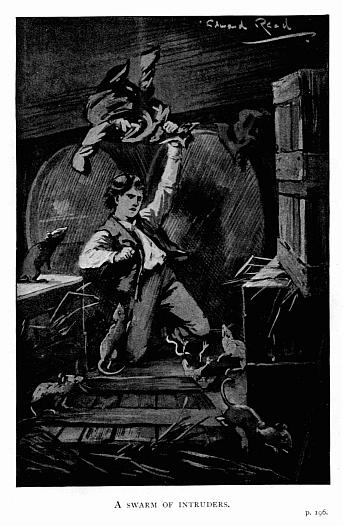
A Swarm of Intruders.
My feeling of security proved to be a false one. I could not have been asleep more than a quarter of an hour, when I was suddenly awakened by something running over my breast. Was it another rat? If not, it certainly was some creature that behaved exactly like one.
I lay for some moments without stirring, and listened attentively; but I could hear nothing. Had I only dreamt that something ran over me? Not so; for just then I thought I could hear the pattering of little feet over the loose cloth. Right; I did hear the sound, and the moment after felt the same feet upon my thigh.
Starting upward, and bringing my hand down upon the spot, I was again horrified by feeling a large rat, that, as soon as I touched it, sprang away, and I could hear it rattling off through the crevice between the casks.
Surely it could not be the same I had just despatched? No, cats do come to life again after being supposed to be dead (sometimes after being buried!) but I never heard of rats possessing this extraordinary power of vitality. I felt satisfied that I had quite killed the rat—in fact, the handling I gave it might have taken nine lives, if it had had that number to spare. It was dead as a nail when I flung it out. It could not be that one.
And yet, absurd as it may seem, I fancied, half asleep as I was, that it was the same rat returning to avenge itself. This fancy, however, forsook me as soon as I was fairly awake, and I knew it could not be the same. Most likely it was its mate, or partner, and a fit partner it was, for I noticed as I passed my fingers over it, that this second one was also a rat of very large size.
No doubt, thought I, this is the female of the one I have killed coming in search of her mate. But she had entered by the same crevice; she must have passed where the dead one lay, and must know what had occurred? Was she going to avenge his death?
Sleep was again banished from my eyes. How could I sleep, with such a hideous animal prowling about, and perhaps with the fixed intention to attack me?
Wearied as I had now grown with watching, I could not go to rest until I should rid myself of this second intruder.
I was under the belief that this one would soon return again. I had not caught hold of it, but merely touched it with my fingers, and as I had offered no particular violence to it, likely enough it would soon venture back.
Under this conviction I placed myself as before, close to the crevice, jacket in hand, and with my ear set close to the aperture, I listened attentively.
In a few minutes I distinctly heard the chirrup of a rat outside, and almost continually the same scratching and pattering I had noticed before.
I think there was some loose board or hollow box by which the sound was produced—for it was very loud to be caused by so small an animal. These noises continued, and I fancied that I also heard the rat passing into my chamber, but still the pattering and scratching were kept up outside, and therefore the animal could not be in.
Once more I was sure I heard it passing me, but at the same time the chirrup fell on my ear, and that certainly came from without. Again and again I fancied I was not the only tenant of the chamber, but I still restrained myself from closing up the crevice, thinking I might be mistaken.
At length, however, a loud squeal was uttered to the right of my position, certainly within the enclosure; and, waiting no longer, I stuffed the jacket into the aperture, and made all tight and sure.
I now turned to feel for the rat, taking the precaution, as before, to insert my hands into the buskins. I had taken still another precaution, and that was to tie the legs of my trousers tight around my ankles, lest this other rat should act as its predecessor had done. Thus prepared, I proceeded to grope around.
I had no liking for the encounter, but I was determined to rid myself of the annoyance which I had been suffering, and get some sleep, without being again disturbed; and I could think of no other way than to kill the rat as I had done its companion.
So to work I again went. Horror of horrors! fancy the terrible fears that ran through me, when, instead of one rat, I discovered that a whole swarm of these hideous brutes was enclosed in my apartment! Not one, but probably half a score of them! The place appeared crowded with them, and I could scarce put down the buskins without touching one. I felt them running all around me, over my legs, the backs of my hands—everywhere—at the same time uttering their fierce cries as if they were menacing me!
It is but truth to say, I was frightened nearly out of my senses. I thought no longer about killing them. For some moments I scarcely knew what I was doing; but I remember that I had the presence of mind to lay hold of my jacket, and pull it out of the aperture. Then swinging it around, I continued to beat the floor in every direction, shouting all the while at the top of my voice.
My shouts and the violence of my actions appeared to produce the desired effect, for I heard the rats retreating through the crevice; and after a time, on venturing to reconnoitre the floor with my naked hands, I found, to my delight, they had taken their departure, one and all of them.
Chapter Forty.
The Norway Rat.
If I was uncomfortable before with the presence of a single rat, how much more uneasy was I with the knowledge that a whole gang of these disgusting animals was in my neighbourhood! There must be a still greater number than those I had just routed; for before closing up the aperture with my jacket, I had still heard others squeaking and scraping on the boards outside. Like enough there were scores of them; for I had heard that in many ships such vermin abound, finding a secure hiding-place in the numerous crevices among the timbers of the hold. I had heard, moreover, that these ship-rats are the fiercest of their kind, and when driven to extremes by hunger—which is not unfrequently the case—will not hesitate to attack living creatures, and show but little fear of either cat or dog. They often commit extensive damage upon articles of the cargo, and are thus a great nuisance in a ship, especially when she has not been properly overhauled and cleaned out before loading for a voyage. These ship-rats are the sort known as “Norway rats,” on account of a belief that they were first brought to England in Norwegian ships; but whether they originated in Norway or elsewhere, it matters little, as they are now universally distributed over the whole globe, and I believe there is no part of the earth, where ships have touched, that Norway rats are not found in abundance. If Norway was in reality the country of their origin, then it follows that all climes are alike to them, since they are especially abundant and thriving in the hot tropical climates of America. Seaport towns in the West Indies and the continents of both North and South America are infested with them; and so great a nuisance are they deemed in some of these places, that a “rat-bounty” is usually offered by the municipal authorities for their destruction. Notwithstanding this premium for killing them, they still exist in countless numbers, and the wooden wharves of these American seaports appear to be their true harbours of refuge!
The Norway rats are not individually large rats. Occasionally very large ones are found among them, but these are exceptional cases. They are in general less distinguished for size, than for a fierce and spiteful disposition, combined with a great fecundity, which of course renders them exceedingly numerous and troublesome. It has been observed that wherever they make their appearance, in a few years the rats of all other species disappear; and it is therefore conjectured that the Norway rats destroy the other kinds! Weazels are no match for them—for what they lack in individual strength is amply compensated for by their numbers—and in these hot countries they outnumber their enemies in the proportion of hundreds to one. Even cats are afraid of them; and in many parts of the world the cats will shy away from an encounter with Norway rats, choosing for their prey some victim of a milder disposition. Even large dogs, unless specially set on, will prefer to pass and give them a wide berth.
One fact about the Norway rat is peculiar: it appears to know when it possesses the advantage. Where they are but few and in danger of being destroyed, they are timid enough; but in those countries where they are allowed to increase, they become emboldened by impunity, and are much less awed by the presence of man. In the seaports of some tropical countries they will scarce take the precaution to hide themselves; and on moonlight nights, when they come out in great numbers, they hardly deign to turn aside out of the way of the passenger. They will just creep a little to one side, and then close up behind the heels of any one who may be passing along. Such creatures are the Norway rats.
I was not acquainted with all these facts at the time of my adventure with the rats in the ship Inca; but I knew enough, even then, from sailors’ yarns I had heard, to make me very uncomfortable at the presence of so many of these ugly animals; and, after I had succeeded in driving them out of my little chamber, I was far from being easy in my mind. I felt almost certain they would return again, and perhaps in greater force than ever. Perhaps they would become hungered during the voyage, and consequently bolder and fiercer—bold enough to attack me. Even then, I thought that they had appeared by no means afraid of me. Though with my shouts and violent efforts I had forced them out, I could still hear them near at hand, scampering about and squeaking to one another. What if they were already half famished and meditating an attack upon me! From facts that I had heard of, the thing was not very improbable; and I need hardly say that the very suspicion of such a probability made a most painful impression upon me. The thought of being killed and devoured by these horrid creatures, caused within me a feeling of dread far greater than I had felt when I was anticipating death by being drowned. I should have preferred drowning to a death like that; and when for a moment I dwelt upon the probability of such a fate, the blood ran coldly through my veins, and the hair seemed to stiffen upon my scalp.
For some minutes I sat, or rather knelt (for I was upon my knees while striking around me with the jacket), not knowing what course to follow. I still believed that the rats would not have the boldness to approach me, so long as I remained awake and could defend myself. But how would it be were I to go to sleep again? Then, indeed, they might be encouraged to attack me, and once they had got their teeth into my flesh, they might resemble the tiger, who, having tasted blood, is not satisfied till he has destroyed his victim. I dared not go to sleep.
And yet I could not always keep awake. Sleep would in time overpower me, and I should have to yield to it in the end. The longer I struggled against it, the deeper the sleep that would follow; and perhaps I might fall into some profound slumber from which I might never awake—some terrible “nightmare” that would bind me beyond the power of moving, and thus render me an easy prey to the voracious monsters that surrounded me!
For a short while I suffered these painful apprehensions, but soon an idea came into my mind that gave me relief; and that was, to replace my jacket in the crevice through which the rats had entered, and thus shut them out altogether.
It was certainly a very simple way of getting over the difficulty; and, no doubt, it would have occurred to me sooner—that is, when the first and second rats had been troubling me—but then I thought there were but the two, and I might settle with them in a different way. Now, however, the case was different. To destroy all the rats that were in the hold of that ship would be a serious undertaking, if not an impossibility, and I no longer thought of such a thing. The best plan, therefore, would be that which I had now hit upon: to stop up the main aperture, and also every other through which a rat could possibly squeeze his body, and thus be at once secured against either their intrusion or their attacks.
Without further delay, I “plugged” up the crevice with my jacket; and, wondering that I had not thought of this simple plan before, I laid me down—this time with a full confidence that I might sleep undisturbed, as long as I should feel the necessity or inclination.
Chapter Forty One.
Dream and Reality.
So wearied had I become with fears and long waking, that my cheek had scarce touched my pillow, before I was off into the land of dreams. And not the land of dreams either, for it was the sea of which I dreamt; and, just as before, that I was at its bottom, and surrounded by horrid crab-like monsters who threatened to eat me up.
Now and then, however, these crab-like creatures assumed the form of rats; and then my dream more resembled reality. I dreamt that they were in vast numbers around me, and menaced me from every side; that I had only my jacket to keep them off, and that I was sweeping it from side to side for that purpose. I thought they grew bolder and bolder as they saw how little damage I was able to do them with such a weapon; and that a very large rat, much bigger than any of the others, was encouraging them on to the attack. This was not a real rat, but the ghost of one—of that one I had killed! He was leading the swarm of my assailants, and counselling them to avenge his murder! Such was the fancy of my dream.
I thought that, for a long time, I was successful in keeping them at bay; but my strength was fast failing me, and unless succour arrived, I would be overpowered. I looked around and called loudly for help, but no one appeared to be near me.
My assailants at length perceived that my strength was gone; and, at a signal given by their ghost leader, made a simultaneous rush upon me. They came from the front, from behind, from both sides, and although I struck around me in a last despairing effort, it was to no purpose. Dozens of them I had flung backward, tumbling upon their backs and over one another, but their places were instantly filled up again by others that came from behind.
I could struggle no longer. Resistance was idle. I felt them crawling up my legs, my thighs, my back. They clung to me all over, their bodies covering mine like a swarm of bees upon a branch; and before they had time to inflict a wound upon my flesh, their very weight caused me to stagger, and fall heavily to the earth!
The fall appeared to save me; for as soon as I touched ground, the rats let go their hold and ran scampering off, as if frightened at the effect they had produced!
I was pleasantly surprised at this dénouement, and for some moments was unable to explain it; but my senses soon became clearer; and I was rejoiced to find that the horror I had been experiencing was only the illusion of a dream; and the fall which I had suffered, was the breaking up of the vision that had awakened me!
In the next instant, however, I changed my mind; and my new-sprung joy departed as suddenly as it had arisen. It was not all a dream. Rats had been upon me, and rats were at that moment in my chamber! I heard them scampering about. I heard their ugly screeches; and before I could raise myself, one of them ran over my face!
This was a new source of terror. How had they got in? The very mystery of their being inside was of itself enough to give me a shock. How had they got there? Had they pushed out the jacket? Mechanically, I felt for it. No. It was there in its place, just as I had left it! I drew it out for the purpose of striking around me, to drive the vermin off. I struck with it and shouted as I had done before, and succeeded in clearing them off; but I was now in greater terror than ever, for I could not explain how they were able thus to reach me, notwithstanding all my precautions.
For a time, I was sorely perplexed, but I found the explanation at length. It was not through the crevice, I had stopped with the jacket, they had sought entrance; but by another aperture, which I had caulked with a piece of cloth. The cloth was too small—it had been loose, and the rats had actually torn it out with their teeth!
This accounted for their gaining an entrance; but, at the same time, it by no means removed my alarm. On the contrary, it furnished me cause for increased anxiety. Why were those creatures thus pertinacious, returning again and again? What wanted they in my hiding-place, more than in any other part of the ship? What could they want, but to kill and eat me?
Verily, I could think of no other reason why I was thus assailed.
The fear of such a consequence now aroused all my energies. I had not been asleep more than an hour, as I knew by my watch; but I could not go to sleep again, until I had fully secured myself; and for this purpose, I set about putting my fortress in a more proper state of defence. I removed the former stuffings from the apertures, one by one, and replaced them more firmly. I even went through the labour of taking all the biscuits out of the box, and drawing forth two or three fresh pieces of cloth to help me in my “caulking.” I then restored the biscuits to their places, and closed up every aperture that existed. I had the greatest difficulty upon that side where the box stood, for around it there were many ill-shaped crevices; but I got over the difficulty, by means of a large web of cloth, which, when placed upon its end, exactly fitted the open space—through which I had squeezed my own carcass on that occasion, when I was so unfortunate as to set my foot aboard the ship. On this side, the piece of cloth left no more caulking to be done, as it fitted just tight enough to prevent any living creature from passing beside it. The only disadvantage it offered was, that it hindered me from getting conveniently at my store of biscuits, for it covered the opening in the box; but I thought of this before pushing it into its place, and carried a supply of the biscuits inside—enough to last me for a week or two. When these should be eaten, I could remove the web; and, before any rats could come in to trouble me, provide myself for another week.
It occupied me full two hours, in completing all these arrangements, for I worked with great care to make my fortress walls secure. It was no play I was performing. It was a matter that possessed the serious interest of my life’s safety.
When I had made all tight to my perfect satisfaction, I lay down to sleep again—this time quite certain that I should get something more than a mere “cat-nap.”
Chapter Forty Two.
A Sound Sleep at Last.
I was not disappointed. I slept for a period of twelve hours’ duration—not without many fearful dreams—terrible encounters with crabs and rats. So far as the comfort of the thing was concerned, I might almost as well have been awake, and actually engaged in such conflicts. My sleep was far from refreshing, notwithstanding its long continuance; but it was pleasant on awaking to find that my unwelcome visitors had not been back again, and that no breach had been made in my defences. I groped all around, and found that everything was just as I had left it.
For several days, I felt comparatively at my ease. I had no longer any apprehension of danger from the rats, though I knew they were still close to me. When the weather was calm (and it continued so for a long while), I could hear the animals outside, busy at whatever they had to do, rattling about among the packages of merchandise, and occasionally uttering spiteful shrieks, as if they were engaged in combats with each other. But their voices no longer terrified me, as I was pretty sure they could not get nearer me. Whenever, for any purpose, I removed one of the cloth pieces with which my little cabin was “chinked,” I took good care to return it to its place again, before any of the animals could know that the aperture was open.
I experienced a good deal of discomfort from being thus shut up. The weather was exceedingly warm; and as not a breath of air could reach me, or circulate through the apartment, it felt at times as hot as the inside of a baker’s oven. Very likely we were sailing under the line, or, at all events, in some part of the tropical latitudes; and this would account for the calmness of the atmosphere, since, in these latitudes, stormy weather is much more rare than in either of the so-called temperate zones. Once, indeed, during this time, we experienced a very sharp gale, which lasted for a day and night. It was succeeded as usual by a heavy swell, during which the ship tumbled about, as if she would turn bottom upwards.
I was not sea-sick on this occasion; but, as I had nothing to hold on by, I was sadly rolled about in my little cabin, now pitching head foremost against the butt, now falling backward upon the side of the ship, till every bone in my body was as sore as if I had been cudgelled! The rocking of the vessel, too, occasionally caused the boxes and barrels to move a little; and this had the effect of loosening the cloth caulking, and causing it to drop out. Still apprehensive of an inroad from the rats, I was kept busy, all the time the gale lasted, in plugging the crevices afresh.
Upon the whole, I think that this employment was pleasanter than doing nothing. It rather helped me to pass the time; and the two days during which the gale and swell kept me so occupied, seemed shorter than any other two. By far the bitterest hours were those in which I could find nothing at all to do—absolutely nothing to engage my thoughts. Then I would remain for long hours together—sometimes without making a motion, or changing the attitude in which I lay—sometimes without even having a thought; and thus dark, and lonely, and longing, I feared that my reason would forsake me, and that I should go mad!
In this way, two more weeks had passed over, as I knew by the notches on my stick. Otherwise they might have been months—ay, years—so long did the time appear. With the exception of the hours in which we experienced the gale, all the rest was complete monotony; and not one fact or occurrence transpired to make an impression on my memory.
During all this time, I had strictly adhered to my regulations regarding food and drink. Notwithstanding that I often hungered, and could have eaten up a week’s allowance at a single meal, I had not exceeded the prescribed ration. Many a time it cost me an effort to deny myself; and often the half biscuit, which was to serve for another meal, was put aside with most tardy reluctance, and seemed to cling to my fingers, as I placed it on the little shelf. But I congratulated myself that up to this time—with the exception of that day upon which I had eaten the four biscuits at a meal—I had been able to keep my resolve, and contend bravely against the craving appetite of hunger.
Thirsty I never was. I had no uneasiness on this score. My ration of water was quite enough for me, and more than enough. On most days I used far short of the allowance, and could drink as much as I wanted.
The supply of biscuits I had brought inside, when shutting myself up against the rats, was at length exhausted. I was glad of this. It proved that time was passing away—two weeks must have elapsed, as I had counted the biscuits at the commencement of this period, and found that they were just the allowance for so long. The time, then, had come round for me to go back to my larder, and procure a fresh supply.
As I proceeded to do so, a singular apprehension arose in my mind. It came suddenly, as if an arrow had been shot into my heart. It was the presentiment, of a great misfortune; or not exactly a presentiment, but a fear caused by something I had noticed only the minute before. I had heard a noise outside, which as usual I attributed to my neighbours the rats. Often, indeed almost continually, similar noises had proceeded from without, but none that impressed me like this, for it appeared to reach me from a new direction—the direction of the biscuit-box.
My fingers trembled as I removed the web; and still more as I thrust my hands into the box. Merciful heavens! the box was empty!
No, not empty. As I plunged my hand deeper, it rested upon something soft and smooth—a rat. The animal sprang suddenly aside as it felt my touch, and I drew back my hand with a like rapid movement. Mechanically I felt in another place, only to touch another rat, and then another, and another! The box appeared half full of them, side by side, as close as they could sit. They leaped about and scattered off in different directions, some even jumping against my breast, as they shot out by the aperture, and others striking the sides of the box, and uttering loud cries.
I succeeded in routing them. But, alas! when they were gone, and I proceeded to examine my store, I found, to my chagrin, that nearly the whole of my biscuits were gone too! All of them that were left were broken to pieces, and nothing remained in the box, but a pile of crumbs covering the bottom, upon which the rats had been feeding at the moment I surprised them.
This was an evil of the grandest magnitude; and I was so overwhelmed upon the discovery of it, that for a time I scarce knew what I was doing.
The consequences were plain enough. My provisions were gone—starvation stared me in the face. Nay, starvation was no longer a matter of doubt. It was now certain. The mumbled crumbs which the hideous robbers had left (and which they would also have eaten up in another hour, had I not surprised them) would not keep the life in me for a week; and what then? ay, what then! Starvation—death by hunger!
There was no alternative. So reasoned I, and how could it be otherwise?
For awhile, I felt reckless and despairing—almost reckless enough to refrain from taking any steps to hinder the rats from returning to the box. It was my belief, that I must in the end succumb to this misfortune—must starve—and it was no use procrastinating my fate. I might as well die at once, as at the end of the week. To live for days, knowing that death was certain, would be a terrible state of endurance—worse than death itself; and here again returned to me those dark suicidal thoughts, that had once before passed through my mind.
They troubled me only for a moment. The remembrance that I had had them before, and that then I had been delivered from them—as it were miraculously—that although I could not see how it was to be found, there might still be a way of escape—the hand of Providence, as it had done already, might still be held over me, and point out that way—these reflections and remembrances came back into my mind, and once more a ray of hope shone upon my future. True, there was no definite hope, but just enough to arouse me to fresh energy, and save me from absolute despair. The presence of the rats, too, had an effect in quickening my actions. I perceived that they were still close at hand, threatening to re-enter the box and finish their work of demolition. In truth, I could now only keep them out by making the most violent demonstrations.
I found that the place where they had got in was not the aperture which I myself used. That was closed up with the web, and they could not pass through there. They had entered on the opposite side, from the box of cloth, into which they had been able to make their way, since I had myself removed one of the boards out of its side. It had all been done recently; or, more likely, to cut through the thick plank had employed them for some time, and so delayed the execution of their design. But for this, they might have reached the inside sooner, and then not a morsel would have been left. No doubt it was for the purpose of getting at the biscuits that they had swarmed once or twice into my chamber—for that gave them free access to the box.
I now deeply regretted my negligence in not securing my store in a safe way. I had already thought of doing so, but I never imagined these creatures could make an entry from behind, and I knew that the web of cloth completely shut them out on the inside.
Alas! it was now too late; regrets were idle; and, following out that instinct which prompts us to preserve life as long as we can, I transferred the fragments from the box to my little shelf inside; and then, making all tight as before, I lay down to reflect upon my situation, rendered gloomier than ever by this unexpected misfortune.