XI.—The Lie[K]
Reading edition
XI.—The Lie[K]
By Hermann Hagedorn
"DID you prepare this lesson, Burton?"
Burton, big, athletic, handsome as a movie hero—hesitated a second before he answered. He was busy picking up a pad which lay under his seat.
He deposited the pad on the wide armrest and looked up inquiringly as though he had not fully comprehended the question. Mr. Beaver, the algebra teacher, was smiling his friendly and slightly irritating smile.
"I asked you, Burton," he repeated gently, "whether you had prepared. Did you?"
"Yes, sir," answered Burton.
"Thank you," said Mr. Beaver. He opened a certain terrifying little black book and made a dot in the lower left-hand corner of a certain square opposite the name of Burton. "Perhaps," he added, "you had better go over it again," and smiled the same smile, which would have been sardonic but for the mildness of his tone.
Burton sank glumly back in his seat.
Mr. Beaver regarded his little book studiously for a moment. Then he looked up. The smile was gone. The alert face, adequately adorned by a reddish beard fading into gray, was now solicitous.
"Harrington," he said.
A Fourth Former in the middle row stood up. He was slight and rather pallid, and it was evident that he should begin shaving without further delay, for there was already a shadow of fuzz on his cheeks and chin that made him look unwashed and rather weak. His mother, who was vain, had insisted that he postpone shaving. She could not bear to think that she was the mother of a son who was almost a man, she always said. It made her feel so old.
Harrington, sallow and unshorn, was not an inspiring sight. Mr. Beaver evidently thought so. His eyes were unquestionably serious.
"Harrington," he said, "it seems that you are another of our weak brethren this morning. Did you prepare your lesson?"
Again, the second's hesitation. Harrington turned a shade paler, if possible. Then, with an effort, he spoke.
"No, sir."
"I was afraid not," said Mr. Beaver making another cryptic dot. Then he smiled. Harrington writhed and the rest of the class, except Burton, laughed. "Why not?"
"I—I was ill."
Mr. Beaver was at once sympathetic, though serious. "Did you report to Dr. Stevens?"
"No, sir."
"Why not?"
"I knew he had already gone."
"You were ill after ten o'clock?"
"Yes, sir."
Again Mr. Beaver smiled. "But surely you might have done your algebra before ten o'clock?"
"I was—busy, sir."
"With other lessons?"
Harrington hesitated.
"With other lessons?" Mr. Beaver repeated.
"No, sir."
"Well?"
"I had a spread."
There was a roar from the other boys.
"Quiet!" said Mr. Beaver. "Now, Harrington, as I understand the situation," he continued mildly, "you failed to prepare your lesson because you were ill in consequence of a spread which it was against the rules to indulge in. Is that it?"
"Y—yes, sir."
"Professor is very much opposed to—illicit spreads, as you know"—("Professor" was the Headmaster)—"I am afraid this will mean about thirty demerits, therefore. You have other demerits?"
"Yes, sir."
"How many?"
"Twenty."
Mr. Beaver closed his little book and stood a moment by his desk looking quietly over at Harrington. His face was serious, but even his victim could not help feeling that there was a certain affectionate sympathy behind the quiet sternness.
"Look out, Harrington," he said at last with a return of that curious smile of his. "Broad is the way that leadeth to destruction and the milestones are always spreads—of one sort or another. You may sit down."
The boy sat down and the work of the class proceeded. Two boys, for widely divergent reasons, heard the other boys go through their paces as though it were all a bad dream of wriggling x's and y's like snakes darting in and out of the placid waters of Mr. Beaver's endless questioning.
The bell clanged at last, indicating the end of the period. Three or four boys went forward to confer with Mr. Beaver about certain vexing algebraic problems. Needless to say, neither Burton nor Harrington was among these. They drifted out into the cloister with the rest of the class, having certain problems of their own, not algebraic. One or two boys addressed Burton and were rebuffed with a curt word, which was unusual, as Burton was almost painstakingly friendly to everybody.
"Say!" whispered one to the other, "Burton's got a grouch on. He's sour at Beaver, I guess."
"Beaver is awfully fresh sometimes. After all, Bill Burton's captain of the football team."
"He's a good deal more important to the school than Beaver'll ever be."
"That's no joke either."
The two boys parted. Neither ventured to intrude again upon Burton's sacred resentment. For Burton was a very great man at The Towers.
No one spoke to Harrington. No one cared whether he had a grouch or not. For Harrington was a new boy who had as yet failed to "fit in." He was emphatically not an athlete. But he was not a "sissy" either. He was quite as emphatically not a student nor a literary light; but he was as quick as a jack rabbit in his physics "lab" work and not to be scorned as a guesser in reading Cæsar at sight. He was not openly religious—which kept him out of the Y. M. C. A. But, on the other hand, in a quiet way, he deeply loved the out of doors, and that love, like all love, is a kind of worship of God. Harrington was unquestionably "hard to place." The boys as well as the masters, when they spoke about him at all, agreed on that. The only pigeon-hole into which he seemed to fit was the pigeon-hole of the "Queer Dicks." His first name happened to be Richard, which helped to settle the classification.
Burton passed through the West Wing, being a Sixth Former, with a room on the top floor of the New Building, and, chewing his lips, crossed the wide level lawn—with its strip of bright green grass that showed where the hot water pipes ran—and disappeared through a door in the western end.
Harrington did not go to his room. Young men who get demerits were not privileged at The Towers to study in their own rooms. They spent periods not occupied with recitations in the school room, a long room containing some two hundred desks, with a raised platform and an organ at the southern end; the place had once been used as the school chapel and was still used for the morning song-service which enlivened the daily grind. Plaster busts of the great of all ages, from Homer to Longfellow, peered from their plaster brackets. There was a verse also on the southern walls:
So nigh is grandeur to our dust, So near is God to man: When Duty whispers low, Thou must, The Youth replies, I can.
Dick Harrington didn't like that verse. In fact, he thought it was rot. He disliked even more the black tablets on the opposite wall containing in gilt letters at least four inches high the names of the exemplary youths who in their time had been Heads of School. And in this place, surrounded by Models of Good Conduct, he was supposed to study four, five and sometimes six hours a day! Two hundred bent forms and Mr. Watrous, the day's jail-keeper, wandering aimlessly about, pretending not to be the spy that he was! Altogether, the schoolroom was a horror.
Harrington bent over his desk like the rest and pretended to study French. But he did not study. He did a little mathematical problem instead. Twenty demerits and thirty demerits made fifty demerits. And fifty demerits meant probation, and probation meant that he could not go to Chancellor's Hill to see the big game to-morrow afternoon. That was a tragedy. All the autumn the game with Chancellor's Hill had been held before him by the old boys as the last word in thrills; for a week there had been talk of nothing else. You would have thought that the final whistle of that game was going to bring the heavens crashing down on creation. No one seemed to be planning anything beyond that Saturday afternoon. The general notion seemed to be that if The Towers won, the rapture of that victory would make any trial thereafter bearable; and if The Towers lost—well, torture and death would, in comparison, be sweet.
And now, he, Dick Harrington, who loved thrills as much as any man, was not to see the game. For days his nerves had been at a sharp tension of anticipation. Now suddenly they relaxed, leaving him weak and despairing. Life had lost its meaning. Of course, the game would be held anyway, and there would be the excitement of getting the telegraphic reports at the end of the periods; but the real thrills would all be at Chancellor's Hill; and he would be at The Towers.
He luxuriated in misery; he reveled in despair. Just because of a bit of a spread with Sammy Oakes and Chet Burrowes, just because of one unprepared lesson! Of course there had been other spreads before this fatal one; and of course there had been one or two unprepared lessons also—therefore the original twenty demerits. But why ruin a boy's happiness forever because of a missed recitation?
Dick Harrington was exceedingly sorry for himself.
His indignation was violent while it lasted but it did not last long, for there was sharp regret of another sort hovering all the while at the rim of his consciousness. It was a regret not so pleasant to indulge as the other. He had been made the butt—the laughing stock—of the algebra class. He tingled and flushed at the memory of it. Bill Burton had also flunked his lesson; but Burton had been able to say that he had at least prepared it, and the whole proceeding had been dignified and everybody loved and admired Burton all the more because with all his greatness he was just like other boys about lessons. But he, Dick Harrington, had been disgraced. And in the presence of William Burton!
That, after all, was the hardest thing to swallow. That was worse than missing the game with Chancellor's Hill. For Dick Harrington worshiped Bill Burton, because he was physically and socially everything that Dick never could hope to be. He was the school's crack athlete, the president of the Sixth Form, the chairman of the Student Council, the president of the Y. M. C. A. He was the One Great Hero of the boys, and the Headmaster himself consulted him whenever he had a knotty problem of boy-nature to solve. Before Dick had been at school a week, he knew that he would rather find favor with "Colonel" Burton than see his name in gold letters in the schoolroom, or, for that matter, on the Common Room tablets, where the athletic records are kept. "The Colonel" was rather used to adoration, and, being human, liked it. But he was no more attentive to this particular adorer than to any one else, which intensified Dick Harrington's "case."
Dick did not study much French on that morning in late October. For suddenly a new, insidious question jumped into the forefront of his thoughts: Why had he blurted out everything to Mr. Beaver? Why hadn't he just lied?
That question thrust at the very roots of life, and Dick Harrington knew it. He went cold and hot by turns. Somehow it had never occurred to him to lie. He did not know why. It was possibly because his father was such a shining figure of truthfulness personified. He remembered something he had overheard his mother say to his father a long time ago—"I never realized until I married you that it is really awful to lie."
Was it really so awful? A lie in time certainly simplified life a lot. And as long as it did not hurt anybody else—what was really the difference? A goody-goody Sunday-school teacher had told him, when he was five, that the lightning would smite him if he told a lie. Whereupon he had told a lie deliberately during the course of the next thunderstorm to test Mr. Goody-Goody's veracity, and proved him a liar, first thing.
Staring at French irregular verbs, Dick clenched his hands, trying to figure it all out. Suddenly, forgetting where he was, he pounded the desk-top with his left fist. Then he gave a yowl which rang through the schoolroom, providing exhilarating diversion to two hundred lifted heads. For in his cogitations his right hand had clutched the edge of the desk on which the top closed.
He explained the accident to Mr. Watrous, who proved skeptical, though the Spy was forced to admit that the hand looked red enough to hurt.
The schoolroom settled again into quiet. The excitement, from start to finish, had covered about ninety seconds. No one suspected that the unshaven, disheveled boy was, in that studious, quiet place, having his first great wrestle with life.
The football team, accompanied by the coaches, the Headmaster Brewster and his wife, a half-dozen masters, and the Fourth, Fifth and Sixth Forms almost in a body, in auto-hacks and horse-hacks, on foot and by trolley, departed for the railroad station and Chancellor's Hill next morning at eight, to the sound of cheers.
Dick Harrington stood in the great Archway with the Lower School and a handful of other boys, like himself on probation (or just "broke"), cheering the school, the team, "The Colonel," the manager, the school, the team, and again and again "The Colonel," until the last boy was out of sight. The team was hopeful of victory; the school was confident of it. But "The Colonel's" face was curiously grave. He smiled and joked; now and then he tossed some gay piece of derision into the crowd of woe-begone stay-at-homes. But the gravity remained in the eyes all the while. Harrington saw it, and it occurred to him that it was natural that the Captain of The Towers football team should feel the weight of a great responsibility; he was quite sure that "Colonel" Burton had never seemed to him so heroic as to-day. There was no question about it. There was an unusual nobility in Bill Burton's eyes and in the carriage of his head. But there was also a curious impression of suffering there and about the lips. Dick saw Mrs. Brewster look at Burton with a friendly, somewhat quizzical, smile. Then in two minutes the fortunate ones were gone and The Towers became a St. Helena, where a chill wind played shrilly all day long around corners of buildings and in and out the cloisters.
Lessons that morning were a gloom and dinner in the huge, half empty dining-room offered an opportunity to satisfy the boy's hunger and—that was all. As a social function it was a flat failure. Everybody talked of the game, as wrecked sailors drifting in an open boat talked of shore. Life was unreal somehow, everything so empty, so quiet. If, as some one had once remarked, The Towers was a very furnace of flaming life and energy—some one had certainly dumped the grate.
The game was to be called at Chancellor's Hill at one-thirty; and at one-thirty the first stragglers appeared in the chilly Archway to take their position at the bulletin board, where the score was to be posted as it came along the wire.
Dick Harrington, in sweater and cap, arrived at one-forty-five. The first score had just been posted:
Chancellor's Hill 5
The Towers0
The Headmaster's secretary, a studious but otherwise attractive young man, who posted the notice, volunteered the information that the Chancellor's Hill left end had turned the trick with a fifty-five yard run when The Towers eleven had tied itself into a knot through a jumbled signal.
"That's an awful beginning!" said Runt Woods, who was standing next to Dick Harrington. He was a little, flat-faced, brownie sort of boy, whom everybody loved. "Must have been in the first five minutes of play."
"They won't get any more," Dick answered confidently. "It's too bad they scored, but they won't get any more."
His optimism was unwarranted. There was a long wait without news. Then Mr. Tuttle, the secretary, reappeared from the Main Building, wearing a rueful smile. He picked up the eraser under the bulletin board, but he did not disturb the zero which stood to the credit (or debit) of The Towers. He rubbed out the 5 that followed Chancellor's Hill and set down 11.
"Something's happened!" cried Dick.
"Two touchdowns and a goal have happened," said Runt Woods gloomily.
"I don't mean that. I mean that something's happened to the team! Lost their heads, or something."
He wondered whether "The Colonel" had been taken ill. "The Colonel" was so completely the heart and soul of the team. If for some reason he were out of it——
They must be playing the second period by now. There was another long wait. Then at last Mr. Tuttle, looking grave, reappeared.
At the edge of the Archway, he stopped. "Don't mob me, now," he said, trying to grin.
"What's the score? Score!" cried a hundred voices.
"End of the second period," he said, striding toward the board. "Score 11 to 0."
Groans, loud and prolonged.
The wind whistled through the Archway. The boys stuck their hands in their pockets and danced, shivering, but not one deserted the bulletin board. They stared at the dismal figures and a dozen versions of How It Must Have Happened were launched by imaginative spectators, attacked ruthlessly and torpedoed as improbable. The trouble with the whole matter of explaining Chancellor's Hill's two touchdowns was that the very fact of the touchdowns would, an hour ago, have seemed the last word in improbabilities. They talked and shivered and bantered and sang and cheered (just to keep warm) for a solid hour. Mr. Tuttle reappeared at last.
The boys surged out of the Archway into the Quadrangle to meet him.
"Score! What's the score?"
"Get back, you wild Indians!" cried the studious secretary to some importunate First Formers who were tugging at his arms. "There is no news, and I can't get Chancellor's Hill on the telephone."
There were murmurs of bewilderment. The Senior Master, tall, genial, and conspicuous for his good sense, came out of the Main Building, and suggested a run for health's sake. He tagged Runt Woods lightly and was off. With a shout the crowd followed him at a jog-trot past the Music House, past the Cottage out on to the cinder track. They jogged a quarter-mile.
As they reached the Cottage on the return trip, they saw Mr. Tuttle dancing toward them, wildly waving his arms.
The Senior Master halted his band.
"Fifteen to eleven!" shouted Mr. Tuttle ecstatically. "We win!"
The roar that followed was memorable. Eppie, the confectionery man, picking his teeth in his empty shop at the foot of the hill, threw away his toothpick and went to the kitchen to tell his wife that The Towers had won, and business for the rest of the afternoon would be brisk.
Two minutes later the jubilant invasion began. Dick Harrington was not one of the crowd that rushed, cheering down the hill. He was on probation, and Eppie's was out of bounds.
He stood in the Archway, lonely and miserable.
Why hadn't he lied?
The team was due back at Hainesburg, the railroad station for The Towers, at eight-thirty. One or two Sixth Formers, flushed and almost incoherent with excitement, had asked the Senior Master for permission to organize a torchlight parade.
"Sure enough! Good idea!" exclaimed the Senior Master. "Go to it! Don't burn yourselves up, don't get lost, don't get in the way of the train and don't all have apoplectic fits as my friend Andrew here is promising to do shortly if some one doesn't put an ice compress on his enthusiasm. But go on. Give 'em a good time."
"Thank you ever so much, sir!" cried Andrew, "and I'll promise to cool off."
"Go 'way!" cried the Senior Master cheerfully. "You don't know how. You're a perpetual human Roman candle."
"I'll hold him down, sir," said the other boy.
"Pshaw!" cried the Senior Master. "You're a Whiz-bang yourself—go 'long! Shoo!"
The boys went.
At eight, Dick Harrington made his way to the Study to ask the Senior Master whether boys "on probe" could join the triumphal procession. The Senior Master was kindly, but firm.
"Sorry, old man," he said. "Probe rules hold."
That was all. But Dick Harrington without a word went to his room on the third floor of the East Wing, stumbling on the stairs, because of the tears.
Why, he asked himself bitterly again and again—why hadn't he lied?
He crept out of his room an hour later, hearing the cheers of the returning revelers. His hallway was utterly deserted, the school was deserted. If he needed any further evidence that virtue did not pay, here it was. "Be good and you'll be lonesome." There was one aphorism proved, at least.
Suddenly, standing in the Quadrangle, he heard singing. Then through the bare branches he saw the glow of many torches. It was all magical and mysterious, for the wild cheering which had brought him down from his room had given way to a solemn exaltation of triumph. If he had had a hat on his head, he would have pulled it off, hearing the school song sung that way. He felt a tug at his heart and again the dimness covered his eyes because he should be fated to have no active part in that thrilling chorus of victory.
He stood quite still, swallowing hard. At the end of the first stanza, there was a "regular yell" for The Towers, as the procession turned sharply, with torches flaring, up the steep drive. He could see now that they were dragging a hay-wagon with ropes. The team was on the hay-wagon. The second stanza of the school song floated up to him, it seemed a chant drifting over from fairyland.
The procession came nearer now. The hill and the hay-wagon together proved too much for the singers and the song died off in breathless laughter and another cheer. Then somebody started to call off the score: "One—two—three—four—" to a climactic burst—"Fifteen!" The procession disappeared behind the Main Building only to reappear a minute or two later around the corner of the Office, on the other side of the Archway. Dick Harrington wished that he had enough manly pride to scorn it all and go back to his room. But he didn't, so he rushed to where the crowd was gathered and listened in rapture to the cheers and the speeches and the songs and all the wonderful stories of a wonderful game.
"Colonel" Burton was there, smiling embarrassed appreciation. He had won the game for The Towers, when it seemed hopelessly lost. Every one agreed to that. He made a speech, thanking everybody for everything.
Why, oh, why, Dick cried to himself, as he climbed three flights after "creams" a half-hour later—Why hadn't he had the sense to lie?
Dick Harrington crept into bed, and his roommate crept into bed. The roommate slept and Dick Harrington tried to sleep, but sleep eluded him—it seemed for hours. Perhaps it was only for fifteen or twenty minutes. Then he too slept, dreaming of torchlit chariots.
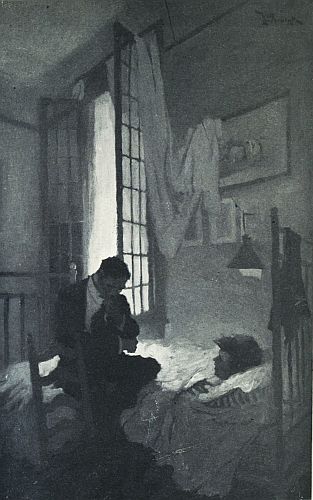
He woke and gave a low cry. Some one was sitting on his bed. He started to jump up, scared through; but a strong hand touched his shoulder and a friendly voice whispered—"It's all right, Harrie; don't be scared."
HE WOKE AND GAVE A LOW CRY. SOME ONE WAS SITTING ON HIS BED
Dick was still half asleep and dazed. "Who are you?" he cried in an unnatural voice.
"It's Bill Burton."
"Who?" he asked, amazed.
"Bill Burton."
"You're somebody trying to fool me," Dick whispered after a pause.
"No, I'm not, Harrie," said the other's deep, rich voice. "I wanted to talk to you. I couldn't wait until to-morrow, so I got permission from Prof, and here I am."
"What makes you want to see me?" asked Dick softly. "I guess I don't understand at all. I didn't think you knew me."
"You remember yesterday in the Algebra class?"
"You bet I remember," whispered Dick emphatically.
There was a moment's utter quiet. From away over in the direction of Chicken Hill came the sound of a rumpus in the Black Belt of Hainesburg. Then again quiet.
Burton spoke at last, slowly and rather more softly than before. "Beaver asked you and me the same question, you remember?"
"Yes," murmured Dick, breathlessly.
"You told him the truth."
"I just blurted out a lot of——"
"Well, I lied."
Somehow the shock of those words was to Dick Harrington like the impact of a terrible fist. He literally saw stars. The idea that "The Colonel" should tell a lie was inconceivable. Sneaks and cowards lied. His reeling standards straightened suddenly. His bitter regret that he hadn't had the sense to lie evaporated in the glow of an overwhelming gratitude. He could not speak.
"Harrie," Burton went on with a quiet depth of feeling which was not lost on Dick (for Dick had deep capabilities of sympathy himself if any one bothered to find it out). "You told the truth and I know what it cost you. I lied. And it took all the stuffin's out of me, Harrie. As soon as the lie was out, I felt I'd have given my head to have it back. You see, Harrie, quite apart from the right or wrong of it, it wouldn't have mattered if I had told the truth."
"It wouldn't?"
"No, I've had a fairly good record in class lately. But——"
"Why did you do it?"
"That's just it, old man. It was habit, I guess. It was just the line of least resistance. It was the quickest way out of a box—I didn't think, and bang!—first thing I knew I'd gone and done it! I'm a good deal older than you, Harrie, I'm twenty-one. I was a pretty bad kid until Prof. and Mrs. Brewster got hold of me. I've managed to get most of the worst devils under. And I thought I had the lie-devil under. I haven't told a lie for two years. But I didn't have him under, Harrie. When I least expected him, there he was. I guess I haven't been as unhappy for a good many years as I was yesterday and to-day."
Dick Harrington floundered helplessly for words—"I never thought——"
"I was getting pretty cocky about my own goodness, I guess," Burton went on quietly. "That's why I got it in the neck this way. But it took the sand right out of me. It seemed that all the years of tussle were in vain and I wasn't worth a little yaller dog's respect, and here the school was looking to me to do big things. It took it right out of me, Harrie. Do you know what was the trouble with the first two periods of the game to-day?"
"The team lost their heads, and then you bucked 'em up and won the game. The fellows told me."
"That sounds good, old man. But the trouble was that I couldn't get my mind down on the game. I was all the time thinking of that algebra class and that lie. I thought of it out on the field and mixed up the plays. That was the reason for those two first periods."
Dick Harrington sat bolt upright. "Really? Really?" he exclaimed.
"Instead of trying to win the game, I was all the time trying to puzzle out what I could do to wipe out that Lie. It wasn't square to the team, it wasn't square to the school, but there it was. There was that Lie. I tried to laugh at myself, but that didn't do any good. There was that Lie. I tried to curse myself out, but that didn't do any good. There was that Lie, sitting in my heart."
Dick stared at him through the darkness with burning eyes. "Then what happened?" he cried in a low voice.
"I dunno exactly, Harrie," Burton answered, speaking very slowly. "Suddenly I just found that I was thinking of you."
"Of me?" There was awe in the exclamation.
"And then it was all clear. I had to square myself with you. Suddenly I knew that that was what would wipe out that Lie and give me a fresh start. It was like a sort of revelation. You see, Harrie, I knew that you thought I was pretty fine, and you just had to be set straight."
"I—I haven't changed my mind at all about you," said Dick Harrington timidly. "And you won the game after all."
Bill Burton leaned over the younger boy. His hand groped for Dick's shoulder and clutched it.
"I didn't win the game," he whispered tensely. "The game wasn't really played at Chancellor's Hill at all. It was played in the algebra class. It was lost when I lied, and it was won a minute later when you told the truth. And I guess I'm pretty glad you told the truth."
"So am I," murmured Dick very softly.
They both breathed deeply. It had been a notable victory.
Next morning, between breakfast and Sunday service, Dick Harrington surreptitiously borrowed his roommate's safety razor, and shaved with shining eyes.