Captain Mayne Reid (continued 3)
Reading edition
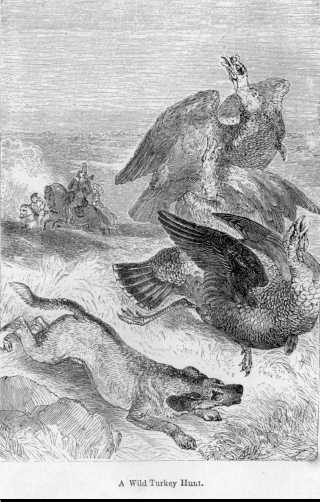
The chase was prolonged for a considerable time. The bird, at length, became completely exhausted; and squatting down, thrust his head and long neck among the weeds, like the ostrich, thinking himself thus hidden from his pursuer. Basil now drew his horse’s rein, raised his long rifle, and the next moment a bullet passed through the gobbler, and stretched him dead upon the grass.
Basil then dismounted; and, taking up the turkey, tied its legs to the cantle of his saddle. This required all Basil’s strength, for the bird was one of the largest size—a forty-pounder.
As soon as the hunter had made all fast, he leaped back into his saddle, and commenced riding—Where? Ay, that was the question which he asked himself before his horse had advanced three lengths of his body—where was he going? All at once the thought came into his mind that he was lost! Groves of timber were on all sides of him. They were like each other; or, if they differed, he had not in his wild gallop noted that difference, and it could not serve to direct him now. He had not the slightest idea of the point whence he had come, and therefore knew not in what direction to go. He saw and felt that he was lost!
My young reader, you cannot conceive the thoughts that come over one who is lost upon the prairies. Such a situation has appalled the stoutest hearts ere now. Strong men have trembled at feeling themselves thus alone in the wilderness; and well might they, for they knew that the consequence has often been death. The shipwrecked mariner in his open boat is scarcely worse off than the lost traveller upon the prairie-sea; and many, under the circumstances, have gone mad! Fancy then the feelings of the boy Basil.
I have already said, he was a cool and courageous lad. He was so, and proved it now. He did not lose presence of mind. He reined in his horse, and surveyed the prairie around him with an intelligent eye. It was all to no purpose. He saw nothing that would give him a clue to the spot where he had separated from his brothers. He shouted aloud, but there was neither echo nor answer. He fired off his rifle, and listened—thinking Lucien or François might reply by a similar signal; but no such signal gratified his ear. He reloaded, and sat for a while in his saddle, buried in thought.
“Ha! I have it!” he exclaimed, suddenly raising himself in his stirrups, “Why was I so stupid? Come, Black Hawk! we are not lost yet!”
Basil had not been all his life a hunter for nothing; and although he had but little experience upon the prairies, his wood craft now stood him in stead. The thought which had so suddenly occurred to him was a good one, the only one that could with certainty save him. He had resolved to return upon his own tracks.
He wheeled his horse; and, with eyes bent upon the ground, rode slowly along. The turf was firm, and the hoof-marks were not deep; but Basil had a hunter’s eye, and could follow the track of a fawn. In a few minutes he arrived on the spot where he had killed the turkey. The blood and feathers upon the grass made him sure of this. Here he halted a moment, until he could determine the direction in which he had approached this spot. That was at length resolved to his satisfaction; and he rode slowly in the back-track. After a few lengths of his horse had been passed over, the trail doubled. Basil followed the double, and came back, passing almost over the same ground again. Again it doubled as before, and again and again, without going a hundred yards from the place where the bird had been shot. All these turnings the young hunter retraced with the greatest care and patience. In this he showed his judgment and his knowledge of hunter-craft; for, had he grown impatient and taken a wider range to find the trail, he might have fallen upon his last-made tracks, and thus have brought himself into a regular maze.
After a while the circles in which he travelled became larger; and, to his great joy, he at length found himself advancing in a straight line. Many horse-tracks crossed his trail; some of them nearly as fresh as his own. These did not baffle him. They were the tracks of mustangs; and although Black Hawk was not shod any more than they, his rider knew the print of the latter’s hoof as well as he knew the appearance of his own rifle. The Arab’s track was considerably larger than those of the wild horses.
After following the trail backward for nearly an hour,—his eyes all the time bent upon the ground,—he was suddenly startled by a voice calling him by name. He looked up, and beheld Lucien by the edge of the woods. With a shout of joy he plied the spur and rode forward. As he drew near, however, his feeling of joy became one of painful apprehension. There was Lucien,—there were Jeanette and Marengo,—but where was François?
“Where is François?” inquired Lucien, as Basil rode up.
The latter could hardly speak, so strong were his emotions.
“O brother!” he faltered out at length, “has François not returned?”
“No,” answered Lucien, “I was thinking he was with you, and you would come back together. I have been wondering what could have detained you so long.”
“O God, he is lost!” cried Basil, breaking into an agony of grief. “Lucien! Lucien! our brother is lost!”
“Lost! what mean you?” asked Lucien, half believing that François had been attacked by Indians, or some wild animal, and that that was what Basil meant. “Has anything happened to him? Speak, Basil!”
“No, no!” replied Basil, still speaking wildly, “lost on the prairie! O brother, you know not what it is—it is a fearful thing. I have been lost,—I have got back; but François, poor little François! there is no hope for him! he is lost—lost!”
“But have you not seen him since we all three parted?” inquired Lucien in dismay.
“No, not since we parted. I was myself lost, and have been all this time finding my way. I succeeded by following back my own trail, else we might never have met again. O François! poor brother François! what will become of him?”
Lucien now shared the apprehensions as well as the agony of his brother. Up to this time he had been under the impression that they had got together, and something had detained them—perhaps the breaking of a stirrup-leather or a girth, he knew not what—and he was just beginning to grow uneasy when Basil made his appearance. He knew not what it was to be lost; but Basil’s wild explanations enabled him to conceive what it might be; and he could well appreciate the situation of François. It was no time, however, to indulge in paroxysms of grief. He saw that Basil was half unmanned; the more so because the latter looked upon himself as the cause of the misfortune. It was Basil who had counselled the running of the turkeys and led on to the chase.
Instead of giving way to despair, however, both felt that they must take some steps for the recovery of their lost brother.
“What is to be done?” said Lucien.
Basil now became himself again. The hope of saving François restored him to his wonted energy and courage.
“Is it better we should remain here?” asked Lucien, who knew that his brother’s strong judgment would decide upon the best plan.
“No,” replied the latter; “it is of no use. I could not have found my way back, but for the tracks of my horse. François will not think of that; and even if he did, his horse is a mustang, and the prairie is covered with mustang tracks, running in every direction. No, no, he will never come back here, except by chance; and there are a thousand chances to one against it. No, we must go in search of him; we must go upon his trail; and that I fear will be impossible among so many others. Before we leave this place,” continued Basil, “let us try every chance that is left. Are you loaded?”
“Yes,” replied Lucien.
“Fire, then, a moment or two after I do. The first report may call his attention to the second.”
Basil raised his piece and fired into the air. A few seconds after, Lucien fired also, and both stood to listen, their hearts beating audibly.
For five minutes or more they stood—so that François might have time to load his gun, if empty. There was no response.
Again the brothers loaded their rifles—with powder only—putting in heavy charges and ramming home tightly, in order that the explosions might be the louder. Again they fired as before. The result was the same; there was no answer to their signal.
“It proves that he is very distant,” said Lucien, “for sounds can be heard a great way off in this region.”
“Let us try a smoke,” said Basil, putting away his rifle. “Gather some wood, Luce, while I kindle the leaves.”
Basil picked up some pieces of the burning wad; and having taken it out to the open ground, raked together a pile of dry leaves and grass, and ignited it. Meanwhile Lucien collected an armful of sticks, and placed them upon the pile. Others were then thrown on top, with green leaves and boughs broken from the trees, and, over all, several armfuls of Spanish moss which hung plentifully from the oaks. A thick blue smoke soon ascended high into the heavens; and the brothers stood with searching eyes that scrutinised the prairie in all directions.
“He must be far off if he cannot see that,” remarked Lucien. “It should be visible for ten miles around, I should think!”
“At least that much,” answered Basil; “but he would not be long in getting ten miles away. The chase might have carried him a good part; and, finding himself lost, he would soon gallop the rest.”
“Unless,” suggested Lucien, “he may have ridden about, as you did, upon his own trail.”
“No, he would not be likely. Poor little François would not think of it; he has not enough craft for that; and, indeed, I almost hope that he has not done so.”
“Why do you hope so?” inquired Lucien.
“Because we will stand a better chance of making out his trail if he has gone straight forward.”
“True, true,” rejoined Lucien, and both again were silent, and stood watching the prairie openings with anxious eyes.
They remained for a considerable time, but at length turned to each other with countenances that exhibited a disappointed and sad expression.
“He is not coming,” said Lucien, in a sorrowful tone.
“No; he would have been up long since. He would be certain to gallop if he had seen the smoke. We must go after him.”
They turned towards their horses. Basil’s glance fell upon the dog. A gleam of joy shot into his eye, and big whole bearing became suddenly changed.
“Ha!” he exclaimed, “we have been wasting time. Quick, Lucien!—your horse! to your horse!”
“What is it?” asked Lucien in surprise.
“Do not ask me—a good thought strikes me; but we have not a moment to lose—time is precious. Let us be off!”
“But shall we leave Jeanette?”
“By all means. François might come up.”
“If he should, how is he to know where we are gone?”
“True,” answered Basil, reflecting a moment. “Oh!” he continued, “give me your paper and pencil. You tie Jeanette while I write.”
Lucien handed him a small slip of paper with a pencil; and then proceeded to tie the mule securely to one of the branches.
Basil took the paper and wrote:—
“François, we are gone upon your trail. Stay by Jeanette.”
He fastened the paper conspicuously to the trunk of a tree; and then, seizing his rifle and leaping into the saddle, called upon Lucien to follow him.
Lucien mounted, and rode after, while the dog Marengo trotted in the rear.
Chapter Fifteen.
Trailing with a Blood-Hound.
They rode in a direct line to the spot where they had started in pursuit of the turkeys. From this place François had taken to the left; but there were many tracks leading in the same direction—of horses, too, that had galloped.
“As I told you, brother,” remarked Basil, “we could never have followed his trail by the tracks. Even here we are not certain of it. These must be his though—they look a little fresher than the others. Let us try them. Marengo!”
“Stay, brother!” interrupted Lucien. “The last place I saw François was yonder. I caught a glimpse of him passing round that point of timber.”
“Ha! that is better. Perhaps, there his tracks may be separate from the others. Come on!”
They rode about a hundred paces farther, which brought them to the point of timber indicated by Lucien.
“Yes,” exclaimed Basil, “you are right! He has passed here. There are his tracks distinctly.”
Basil dismounted, giving Lucien his rein. He knelt upon the grass, and examined the hoof-prints, one after the other, with extreme care.
“So!” he muttered, as he rose again to his feet, “I shall know you among a thousand.”
“Make yourself ready for a hard ride,” he continued, addressing Lucien. “The dog, no doubt, will lead us in a gallop. Marengo!”
The hound came running up to where the young hunter was stooping over the trail. The latter held a red object in his arms. It was François’ blanket, which he had loosed from his horse’s flank, and flung away when starting on the chase. The dog scented the blanket, uttering as he did so a low whimper, and gazing in his master’s face with a look of intelligence. He seemed to comprehend what was required of him.
Basil now flung the blanket over his own saddle, stooped again, drew his fingers along the grass, and, with a wave of his hand, motioned Marengo to follow its direction. The hound, uttering a single yelp, bent his nose to the ground, and sprang forward upon the trail.
Basil instantly leaped into his saddle; and, snatching up the reins, cried out to his brother,—
“Come, Lucien! we must not lose sight of the dog, though our horses drop dead in their tracks! All depends upon keeping him in view.”
Both plied the spur, and dashed forward at a gallop.
“We must know how to find our way back again,” said Basil, reining up, as they passed the edge of one of the timber clumps. “We must not ourselves get lost;” and, as he said this, he crashed the branch of a tree, until the broken end hung dangling downward. He then resumed his gallop.
For nearly a mile the hound ran in a direct line. It was the first flight of the turkey. His course then altered, although not a great deal, and carried him half a mile or so in a direct line as before.
“The second flight,” remarked Basil to his brother, as both followed at a loose gallop, now with their eyes anxiously watching the dog, and now halting a moment by some conspicuous tree to “blaze” their way, by breaking one of its branches.
The dog at length entered a copse.
“Ha!” exclaimed Basil, “François has killed his turkey there. No,” he continued—as the hound shot out of the copse again, and struck off into the open plain—“no. It has sought shelter there, but it has been run out again, and gone farther.”
Marengo now led in a direct line for several hundred paces; when, all at once, he began to double and run in circling courses over the prairie.
“Draw up, Lucien! draw up!” cried Basil, as he pulled upon his bridle-rein. “I know what that means. Do not ride upon the track—you may baffle him—leave him to himself.”
In a few seconds the hound stopped, uttered a short howl, and appeared to toss a dark object upon the grass with his snout. Basil and Lucien had halted at a considerable distance, but they could see that the object was some loose feathers.
“The spot, beyond doubt, where François has killed the turkey,” muttered Basil. “If Marengo can only catch the trail by which he rode off all may be well; but—that—that—see! he is off again!”
Now was the time that Basil and Lucien watched with beating hearts. They knew that a crisis was at hand. If Marengo, as Basil said, could find François’ departing trail, then he could follow it up almost to a certainty. Of this both the brothers were confident, as they knew the capabilities of the dog. But that was the point to be decided; and both felt for the moment as if the life of their brother hung upon its decision. No wonder, then, that they watched every manoeuvre of the hound with breathless anxiety while they sat, motionless and silent, in their saddles.
The hound after a while ran off from the feathers; and was seen once more to double and circle over the ground. He did not go freely. He was evidently baffled by so many trails approaching and crossing each other. Again he came back to the spot where the turkey had been killed, and there paused with a howl of disappointment!
Basil and his brother uttered a simultaneous exclamation, that betokened painful feelings. They knew that the howl was a bad sign; but neither spoke.
Once more the dog ran off, and as before turned and wheeled about upon the prairie.
“O God!” exclaimed Basil, in agony, “he is coming on the old track!”
It was too true; for the next moment the hound, running on the back-track, bounded in among the feet of their horses. Here he stopped suddenly, throwing up his head, and uttering another howl of disappointment.
Basil waved him back. He struck out again and followed the old trail, but with like success. He then became confused, and ran every way over the ground, evidently baffled. The brothers regarded each other with looks of dismay. The trail was lost!
“Hold! There is hope yet,” said Basil. “We may find it by making a wider circuit. Take my bridle,” continued he, throwing himself from his horse. “Marengo!—up, Marengo!”
The dog obeyed the call, uttered in accents of command; and came running up to the feet of his master. The latter, telling Lucien to follow with the horses, struck off over the prairie.
He walked slowly, bent forward and downward, carefully observing the ground as he went. He followed the circumference of an irregular circle, of wide diameter—in order to keep outside the doublings which François had made in his last struggle after the wearied bird, and which had thrown the dog out. He passed several horse-trails leading various ways. All these he examined, but none satisfied him. In this manner he had gone half a mile around the circle, when his eye fell upon some that seemed fresher than the rest. He sprang forward, stooping over them with, a shout of joy, as he recognised the hoof-prints of François’ mustang. He knew them by a mark he had taken—where the dog had been first set upon the trail—a small chip broken from one of the fore hoofs. But Marengo needed not this. He was once more on the right scent; and again started off, nose down, over the prairie.
Basil leaped into his saddle; and, waving his brother to follow, galloped after, riding close upon the heels of the hound.
The trail did not lead in a direct line. At some places it did so for several hundred yards—then it would turn suddenly to the right or left—then turn again and again in zig-zag lines. Sometimes it described the circumference of a circle and at one or two points it recrossed itself. At these places the dog was once or twice nearly baffled again.
They well knew the reason why the trail thus meandered about. Poor François had been wandering, and knew not which way to go.
Once more the trail ran direct for a distance of two miles or more. No doubt François had there kept up his resolution and ridden straight forward; but, as Basil remarked, he had been travelling all the time with his back to their camp! Over this part, as the trail was fresh, the hound ran rapidly, keeping the hunters at a brisk gallop. At the end of the stretch it again turned to the right and westward.
As they faced in this direction, the attention of the brothers was called to the sky. The sun was setting!
A new feeling of apprehension came over them. They knew there was no twilight, or next to none, on these high southern plateaux. Should it come on a dark night, how were they to follow the dog, going as he was upon a run? He might still keep the trail and come up with François, but what would be the good of that, so long as they were not with him? It would only give François another companion in his misery, but no clue by which he would be enabled to find them, or they him.
These thoughts were communicated between the two as they galloped on side by side. Soon the sun set, and the shades of twilight fell upon the grass. It grew darker, until it was difficult to distinguish the dusky body of the hound passing over the sward. What was to be done? He would soon glide away from them, and leave them without a guide!
“I have it!” suddenly exclaimed Basil; and at the words he spurred his horse forward to overtake Marengo. The next moment he flung himself from the saddle; and, seizing the hound, arrested him in his tracks.
“Alight, brother!” he cried; “alight, and help me. Off with your shirt—it is whiter than mine.”
Lucien, half comprehending his design, immediately pulled off his blouse, and after that his shirt—which was of bleached cotton cloth lightly striped, and in the dim light showed nearly white. Basil took hold of it; and hurriedly tore off the sleeves. He then drew it upon the dog; and having passed the animal’s fore-feet through the arm-holes, tied the collar securely around his throat with a piece of thong, and knotted the skirts over the flanks behind. Thus arrayed, Marengo looked like a street monkey; and was rendered quite visible in the glimmering darkness.
“Now!” cried Basil, exultingly, “we can follow him if it were as dark as pitch.”
“Stay a moment,” said Lucien; “let us make sure. It is clear enough—I can write yet.” As Lucien said this, he took out his note-book, and wrote:—
“François, come back on your own trail. You will find us upon it. If you cannot follow it, let Marengo guide you.”
He tore out the leaf, handing it to Basil, who fastened it securely to the shirt.
Marengo was again set loose, and took to the trail, while both mounted hastily and followed him.
Fortunately the night did not turn out so dark as they had anticipated; and they could see the white covering with sufficient distinctness to enable them to follow it, even at a gallop. And thus they rode for nearly another hour—Basil still blazing their trail as they swept past the timber islets.
All at once, as they rounded a thick grove, a bright object glistened before their eyes. It was a blazing fire under the shadow of some tall trees! Marengo made straight for it. Fearing it might be an encampment of Indians, Basil galloped forward; and, alighting from his horse, intercepted the dog. A halt was made to determine what was best to be done. At that moment the fire blazed up, and a spotted object was seen near it. Hurrah! It was François’ mustang! Basil and Lucien now advanced rapidly; and, to their great joy, beheld François sitting by the fire holding something over the blaze. The next moment the brothers were in each other’s arms, all three weeping with joy as they embraced!
François soon related his adventures. He had killed his turkey, and then lost himself; but instead of going back upon his own trail, as Basil had done, he had wandered about until night-fall, at intervals shouting and firing his gun. At times his spirit failed him; and he rode for long stretches without touching the bridle, or in any way guiding his horse. Wearied at length, he dismounted, and tied the animal to a tree. It was night when he did so; and feeling cold and hungry, he took courage and kindled a fire. Fortunately the gobbler still hung from the cantle of his saddle; and he had just singed, and was roasting it over the fire, when so agreeably interrupted by the approach of his brothers. At sight of the fine broiling turkey, Basil and Lucien became as hungry as a pair of wolves—for, in consequence of their anxiety, they had not thought of dining. The roast was soon ready; and, after a plentiful supper—which Marengo shared—the young hunters staked their horses upon the grass, wrapped themselves in their blankets, and went to sleep.
Chapter Sixteen.
Jeanette and the Javalies.
Next morning they were astir at an early hour; and, after giving the remains of the gobbler a hurried “devilling,” they ate them, and rode off on the back trail. They did not put the dog upon it to guide them—as the scent was now cold, and they feared that Marengo, keen as he was, might get astray upon it. They trusted to find it from their own tracks, and the “blazes” they had made. It was a slow process, and they were obliged to make frequent halts; but it was a sure one, and they preferred it on that account, as they knew the importance of getting back to Jeanette. The tent, with all their provisions and implements, was in her keeping.
They were in high spirits—as most people are who have just escaped from a perilous adventure—and joked each other as they rode along. Lucien was without a shirt—for Marengo had torn it, and it was now draggled, wet, and worthless. This was a staple joke for François. Jeanette came in for a share of their badinage, as Lucien now remembered that he had tied her head within a foot of the tree, and of course she would be all this time without eating a morsel. Moreover, in their hurry, the pack had been left upon her back; and that was not likely to improve her temper.
It was near mid-day when they came within sight of her.
“Hilloa!” exclaimed François, who first caught a glimpse of her round a point of timber. “What’s going on yonder?”
All three halted, and looked across the plain with astonishment depicted in their faces; and no wonder, for a sight it was to astonish anybody. It was Jeanette, to be sure; but Jeanette in most singular attitudes. Her heels were flying in the air—now her fore-feet, now her hind ones—not in single flings, but in constant and rapid kicking. Sometimes the whole set appeared to bounce up at once; and the white canvas of the tent, which had got loosened, was flapping up and down, as her body rose and fell.
The boys looked on for a moment, with feelings of curiosity, not unmingled with fear. “It might be Indians,” thought they.
“No,” said Basil. “It is wolves—she is attacked by wolves! Let us hasten to her rescue!”
All three spurred their horses into a gallop, and soon got within a few hundred yards. They could now see the ground by the mule’s feet, which was covered, not with wolves, but with animals of a far different species. They were hog-shaped, with small, dark bodies, and long pointed snouts. They had no tails—only knobs in their place; and their tapering snouts opened into a pair of long jaws, with white tusks, that could be seen even in the distance.
“Javalies!” cried Lucien, who, although he had never seen the animal, knew them from description. Javalies they were in fact—the wild-hogs of Mexico.
All three had pulled up, as soon as they saw the animals were not wolves. They did not halt long, for Jeanette was in danger. She was still kicking and squealing like a cat; while the javalies, although several of them lay stretched behind her heels, were uttering their shrill grunts, and rushing at her shanks whenever these rested for a moment upon the earth. There were more than a hundred of them around her feet. The ground was literally covered with their dark forms, crowding each other, and springing nimbly about.
Without waiting to consider the danger, Basil dashed into their midst, followed by François and Lucien. It was well they were mounted, else they never would have come out of that crowd again. All three had fired as they rode up. They believed that this would have scattered the drove; but they found their mistake, for although each of them shot down a victim, it had no effect; and the next moment, their three horses were hopping about, plunging and pitching as badly as Jeanette. The javalies surrounded them with shrill gruntings, driving their tusks into the horses’ shanks, and leaping up almost high enough to reach the riders themselves. It was well for them they were good riders. Had any of them been unhorsed at that moment, his fate would have been sealed. They kept their saddles, however, but without being able to reload their pieces. Marengo, who was an old Texas hound, had seen javalies before; and having wisely shied off upon the prairie, stood looking on.
The young hunters soon saw that it was no use keeping their ground, and prepared to retreat. Basil urged his horse forward to the tree, and with his hunting-knife cut the lasso that fastened Jeanette; then, shouting to his brothers to follow, started in a gallop across the prairie.
Perhaps never was a mule more pleased at getting loose from a fastening than was that she-mule Jeanette; and never did a mule make better use of the heels that had been left her. She galloped over the prairie, as if the very deuce had been after her. But if he was not, the javalies were; for on came the whole drove, scores of them, grunting and screaming as they ran.
The horses easily distanced them. So, too, did Marengo—but there was still danger for Jeanette. She had been now nearly two days without either food or water, and was weak in consequence. Her legs, too, were much torn by the tusks of the wild-hogs. Moreover, the tent that had got loose, trailing on one side to the ground, considerably impeded her flight. This last circumstance in the end proved her salvation; for the javalies, overtaking her, seized the hanging canvas in their jaws, and pulled it from the pack. It fell spreading over the grass like a blanket; and the herd, now coming up and mistaking it for their real enemy, commenced stamping upon it with their hoofs, and tearing it with their teeth. This gave Jeanette time; and she was just the mule at that moment to profit by it. Lightened of her load, she struck out into a fleet gallop, and soon overtook the horses; and the whole cavalcade now kept on, until they had placed several miles between themselves and the javalies. Here they halted with the intention of pitching their camps, as their animals were not only wearied, but Jeanette was hardly able to travel at all. The process of “pitching camp” was now considerably simplified, as they had lost not only their tent, but several of their camp utensils.
What had induced the javalies to attack the mule? This was the subject of conversation with our adventurers, as soon as they had fairly cooled from their race. They knew that these creatures rarely make an assault in such a manner without provocation. But it was likely Jeanette had given them this. No doubt they had been wandering about in search of food, and lighted upon the turkeys, that Lucien and Basil in their haste had left lying upon the ground. The wild-hogs are not particular as to their food. They will eat fish, flesh, or fowl, snakes, or vegetables; and, finding the brace of birds, had commenced devouring them. In doing so they had come within reach of Jeanette’s heels; who, at that moment not being in the best temper had no doubt let fly, and kicked one of them over, and this of course had led to a general onslaught from the whole herd.
It was well for Jeanette that her masters arrived when they did, else her old ribs would soon have cracked under the sharp tusks of the enraged animals.
The javalies, or peccaries—as they are more often termed by naturalists—are in general of a harmless disposition; and, if not interfered with, will rarely make an attack upon man. When provoked, however—by one of their number being wounded, or even when their haunt is invaded—they become both fierce and dangerous. Though small creatures, they possess extreme courage; and their powerful jaws and large tusks render them formidable assailants. Like all animals of the hog species when enraged, they seem to be unconscious of danger; and a herd of them will battle with an enemy until every one has fallen. Not unfrequently the Mexican hunter is “treed” by javalies, and compelled to remain on his perch for hours, and sometimes for days, before his besiegers retire, and leave him to descend with safety.
Chapter Seventeen.
A Cunning Cat and a Sly Old ’Possum.
The place where our adventurers now encamped was in a large grove of white oaks and shell-bark hickory-trees. There was a spring near the centre of the grove, and near this spring the horses were tied, as there grew around it plenty of grass of the mezquite species. The dried meat, which formed the staple of their own provisions, had been scattered by Jeanette in her flight, and of course lost. What were they to have for dinner? This was an important question; and by way of answer to it, Basil and François took up their guns and walked out to see whether they could fall in with a squirrel or some other eatable creature. But the sun was yet high, and no squirrels could be seen—for these little creatures hide themselves during mid-day, coming out only in the mornings and evenings to feed and play.
Failing to start any game in the thick shady grove, the young hunters bethought them of making trial around its edge; and, after walking a hundred yards or so, they came near the border of the prairie. They did not show themselves suddenly, as they were in hopes they might discover deer, partridges, or some other game in—what is usually a favourite resort—the open ground along the edge of the woods. They stole silently forward, therefore, using the large tree-trunks to screen them.
The prairie was a clear one—that is, without timber-islands, only here and there a tree, and these but small ones, mostly black-jacks and shell-barks. They could see over its surface to a great extent, as it was quite level and covered with short spring buffalo-grass. No deer was upon it. Not an animal of any sort. Yes, there was. On looking more carefully, at no great distance—about two hundred yards out—they beheld two small creatures running over the sward, and at intervals squatting upon their haunches like monkeys, as if conversing with each other.
“Prairie-dogs,” suggested François.
“No,” said Basil, “they are not that, for I see no tails. The prairie-dogs have long tails.”
“What can they be, then?”
“Hares, I take it,” replied Basil, looking through his fingers.
“Hares!” ejaculated François, in some surprise. “Why, they are not bigger than rats! Do you mean that they are young hares?”
“No, indeed, full-grown hares of their species.”
“Ha! ha! ha!” laughed François. “Why, brother, what are your eyes good for? You think they are far off, don’t you? I tell you they are not two hundred yards from us, and a grey squirrel would be a giant beside them. Hares, indeed!”
“I am still of that opinion,” answered Basil, as he continued to gaze intently at the animals. “I am not certain, though. I wish Lucien were here. Perhaps he could tell us what they are.”
“Here he is, then,” said François, as the footstep of Lucien was heard behind them. “Look yonder, Luce!” continued he. “See what Basil calls a pair of full-grown hares!”
“And Basil is right,” replied Lucien, after having examined them for a moment. “They are full-grown hares.”
François looked confounded.
“If I mistake not,” continued Lucien, “they are the species known among the Indians of the prairie as the ‘little chief hare.’ They may be a different variety, though, for there are several species of these small hares found in the Rocky Mountains, and the prairies that lie around them. They are very rare. I wish we could get the skin of one. I am sure papa would prize it highly.”
“That we may soon get,” said François. “Can I not step forward, and shoot one of them?”
“No,” replied Lucien, “they would be off like the wind, before you could get within range.”
“What about Marengo? Can he not catch one?”
“I think not; besides, he would tear it in pieces. No. Our only chance is to remain here. They appear to be making this way.”
The three now took their stations behind the trunks of large trees, so as not to be observed by the timid little animals.
The latter, as they fed and sported over the grass, were still getting nearer to the edge of the grove; but as they advanced in an oblique direction, they were not likely to approach the point where the young hunters were stationed. These thought of moving farther along, so as to meet them; and were about starting to do so, when an object appeared that caused them to remain where they were.
Silently moving among the weeds and brambles, now trotting quickly behind the covering of a prostrate log, now slowly crawling over the more open ground, went a strange animal. At intervals it stopped, squatted low along the earth, and looked eagerly out upon the prairie. It did not see the young hunters. Its yellow eyes were bent upon the innocent little creatures that gambolled over the grass beyond.
It was an odd-looking animal—about the size of a terrier-dog, but, otherwise, altogether unlike one. It was of a reddish yellow colour, with brown spots upon its sides, and stripes or bands of the same along its back. These gave it the appearance of the leopard or tiger species, and it resembled these animals in the rounded, cat-like form of its head. Its erect tufted ears, however, and short tail showed that it differed, in some respects, from the tiger kind. The tail, indeed, was the oddest thing about it. It was not over five inches in length, curving stiffly upward, and looking as if it had been “stumped,” as the tails of terriers usually are. It was not so, however. Five inches was all the tail it ever had; and this shortness of tail, with the thick clumsy legs—but, above all, the high tufted ears, approaching each other at their tips,—enabled the young hunters to tell what it was—a lynx. It was that species known as the “bay lynx” (lynx rufus), commonly called in America the “wild cat,” and sometimes the “catamount.” It was the Texas variety of this animal—which is deeper in colour than the common bay lynx, and, I think, a different species. It was evidently doing its best to get near the little hares, and seize one or both of them. It knew it was not swift enough to run them down, but it might get close enough to spring upon them. It was favoured to some extent by the ground; for, although it was open prairie, the white withered grass of the previous year rose here and there over the new growth in tufts, large enough to conceal its body as it squatted.
Nearly in a direct line between the lynx and the hares grew a solitary tree, of the pecan species, with spreading limbs; and almost under it was a little patch or thicket of briars, weeds, and high grass—no doubt where some old log, or the carcass of an animal, had mouldered away, and fertilised the soil. For this the lynx was making on one side, and towards it the hares were feeding on the other.
The latter had got very near it, and near, too, to the boys, who could now distinguish their long, erect ears, slender limbs, and graceful motions—resembling, in fact, those of the common hare. Their colour, however, was different. It was a rusty fern, lighter underneath, but in no part—not even under the tail—did any white appear. It was a beautiful sight to behold these innocent little creatures, now nibbling at the blades of grass, now leaping a few feet over the sward, and then settling comically upon their haunches. The young hunters thought it a beautiful sight; and so would you, boy reader, had you witnessed the manoeuvres of these miniature hares.
An odd-looking object now presented itself directly in front of them, and close to the briars. It was of a round shape, and looked like a large clew of hair or wool of a greyish colour, half-buried in the ground. Whether it had been there before, neither Basil, nor Lucien, nor François, could tell. It might have been without their noticing it, as their attention was so occupied with the hares and the lynx. François said he had noticed it a little before; but it had only slightly arrested his attention, as he supposed it to be a tuft of the dry grass or a globe-cactus (echinocactus)—a species of which they had seen much of late, and to which it bore a considerable resemblance. It was evident, however, on closer scrutiny it was not that.
The little hares seemed to notice it about the same time; and, prompted by curiosity, they drew nearer and nearer to it. There was nothing about its appearance to alarm them. They had never been attacked by an enemy in that shape. To all appearance it had neither teeth nor claws, and consequently they had nothing to fear.
Encouraged by the absence of all danger, and vieing with each other in boldness, the little creatures advanced, first one and then the other, a few inches farther, and so on, until their noses almost touched the strange object. All at once the clew-like body flew out, displaying a sharp-snouted four-footed animal, whose long serpent-like tail, at the same instant, sweeping around caught one of the hares in its prehensile embrace! The little creature uttered a shrill squeak, while its companion bounded off in terror.
The opossum (for it was no other than an old she ’possum), now turned upon her tail; and, seizing the head of the hare in her hog-like jaws, killed it at a single “cranch.” She then released it from the coil; and, laying it out upon the grass, would have made a meal of it then and there, had she been permitted to do so. But that was not ordained to be.
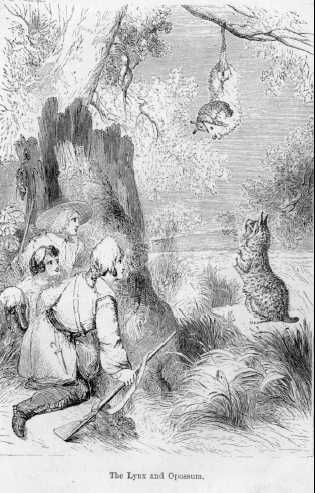
The lynx, who was crouching forward, not twenty feet from the briars, had been a witness to all this. At first it seemed to give him chagrin. In a little while, however, he appeared rather to like it than otherwise.
“On second thoughts,” said he to himself, “it is better as it is. The ’possum has saved me the trouble of catching the hare, and I might have missed it withal. She has captured the game, but I shall eat it, I guess.”
These thoughts he certainly had—for they were as clearly expressed by his actions, as if he had been gifted with speech and had uttered them aloud. In accordance with them, therefore, he crept on, intending to spring upon the ’possum unawares.
The latter, however, before commencing to eat, like all who know that they have done a guilty deed, raising herself to her full height, looked around to see if any one had been a witness to the act. Her eyes fell upon the lynx; and, hastily seizing the hare in her teeth, she plunged into the bramble.
The lynx, seeing that further concealment was of no use, bounded forward with curved back and mane erect. He did not at once follow into the briars, but ran around them, in order to discover at what point the ’possum had hid herself. He was not without apprehensions that she might have a hole there. If so, good-bye to both hare and ’possum, thought he.
It appeared not, however; for, after a few circlings around the patch, he was seen to dash boldly in.
For some time nothing could be seen of either lynx or ’possum. The patch covered only a few yards of the prairie, but it was a regular “brake,” with vines, briars, and thistles, thickly interwoven and canopied with leaves. Neither uttered any noise; but the motion of the leaves, and of the brambles at different points, told that a hot pursuit was going on underneath—the pursued no doubt baffling the pursuer, by her body being much smaller and better adapted for squeezing through narrow places.
For some minutes this curious chase was kept up. Then the ’possum glided out into the open ground, to the astonishment of all still carrying the hare in her mouth. She made directly for the tree, and proceeded to climb it, grasping the trunk with her fore-arms, like a human being. Her taking to the tree also excited surprise, as it was a small one—not over thirty feet high—and the young hunters knew that the lynx could climb as well as she.
The latter now came out of the bramble; and with one bound sprang to the foot of the pecan. He did not follow up immediately, but stopped a moment to breathe himself, evidently exulting—as he knew he could easily climb after, and feeling satisfied that he now had his game safe and secure.
“Treed at last, old mother ’possum!” soliloquised he, although not aloud. “I’ll get you now, an’ if I don’t give you a good woppin’ for the trouble you’ve put me to—see if I don’t! I wouldn’t eat ye, nohow—you ain’t sweet enough for that—but I’ll eat that hare, an’ I’ll chastise you for using it so!”
And with this determination he galloped up the pecan, his claws rattling against the bark.
By this time the opossum had got near the top of the tree, and out upon one of the branches that grew horizontally. Along this the lynx followed; and had arrived almost within reach of the object of his pursuit, when the opossum, suddenly lapping the branch with her tail, let herself down to the limb below! The lynx appeared for a moment as if about to spring after; but the limb was a slender one, and he was not sure that he might be able to grasp it. He, therefore, turned back, evidently chagrined; and, descending by the main trunk, ran out upon the branch now occupied by the opossum. The latter, as before, again let herself down to another limb; and then, without waiting for her pursuer, to another still lower, until she hung on the very lowermost branch of the tree!
The boys thought she was about to drop to the ground, and endeavour to escape to the woods. That, however, was not her intention, for she knew the lynx would soon overtake her if she made the attempt. She had got into the safest situation possible, under the circumstances, and she seemed to know it. She therefore continued to hang on the lowest limb of the pecan—so near its extremity, that the branch bent under her weight. It would not have carried another ’possum—much less the heavier body of a lynx; and the latter, with the “eye of a lynx,” saw that at a glance.
Mortified as he was, however, he was determined to satisfy himself by a trial. He first crawled out upon the limb, proceeding with great caution as far as he dared venture; and then with outstretched claw endeavoured to reach the rings of her tail, thinking he might scratch them off. In this he was not successful. He could barely touch the tail with his toes; and he might just as well have tried to open the claws of an eagle. He next mounted the brands above, thinking this would bring him nearer; but he soon discovered his mistake. Again he ran out upon the limb where the opossum hung, and looked for a moment as if determined to spring down upon her, and carry her along with him to the earth; but the distance deterred him, and after a while he skulked back and squatted himself in a fork of the tree.
He did not rest long before a new thought, seemed to strike him. The ’possum was not so very high above the ground; perhaps he could spring up and seize her by the nose? It was at all events easy to make the trial. And with this intention he descended to the foot of the tree, and ran out to the spot over which she was hanging. But she was higher than he had calculated; and, like the fox with the grapes, after a few leaps he gave it up. He was resolved, however, to make her stand a siege; and, thinking he would be as comfortable where he was, he did not return to the tree, but sat down upon the grass, keeping his eyes fixed upon his antagonist.
All this while the old ’possum hung quietly upon her tail, holding the hare in her teeth. From the moment she had secured herself in her present position, she seemed to have no fear of her antagonist. On the contrary, her countenance exhibited the expression of a malicious laugh—and this was as evident to the spectators, as words could have made it. The cunning creature plainly enjoyed the chagrin she was causing to the “catamount.”
At intervals, however, the thought seemed to stray across her mind as to how it would all end: and then she assumed a graver look. The lynx, was determined—she saw that in his face—to make her stand a long siege. It would be, therefore, a question of patience and hunger. For the latter she was prepared; and, to enable her to endure it the better, she passed the hare into her hand-like fore-feet, and commenced tearing and eating it!
This was too much for the patience of the lynx. He could bear it no longer, but rose suddenly to his feet; and, with mane erect, rushed up the tree again, and out upon the branch where hung the opossum. This time, without stopping to calculate the danger, he sprang forward, throwing his fore-feet around the other’s hips, and seizing her tail in his teeth. The branch creaked, then broke, and both fell together to the earth!
For a moment the lynx seemed stunned by the fall; but, the next moment, he was “himself again.” He raised himself up; arched his back like a true cat; and, with a wild scream, pounced down upon the ’possum. He seemed to have forgotten the hare, which the other had dropped in her fall. Revenge was the passion that now raged strongest within him. Revenge caused him to forget that he was hungry.
The opossum, as soon as she came to the ground, had suddenly clewed herself up; and now presented the same appearance as when she first came upon the stage. Head, neck, limbs, and tail, were no longer visible—nothing but a round ball of thick, woolly hair! At this the catamount tugged with “teeth and toe-nails.” He worried it for not less than ten minutes, until he became weary. The ’possum was dead to all appearance; and this the other seemed to think,—or whether he did or not, at all events, he became tired, and left off worrying her. The sweeter morsel—the hare—was before his eyes; and this, perhaps, tempted him to desist, preferring to try his teeth for a while upon it. Leaving the ’possum at length, he turned round and seized upon the hare.
At this moment François let Marengo slip, and the whole party rushed forward with shouts.
The lynx, seeing his retreat cut off from the timber, struck out upon the prairie; but the great hound soon overtook him; and after a short but desperate fight, put an end to his poaching.
The young hunters in the pursuit had picked up the hare, which the lynx had dropped in his flight. When the chase was over they came back to the tree, with the intention of getting the dead ’possum, which they meant to cook for their supper. To their astonishment no ’possum was there—neither in the tree, nor the briar-patch beside it, nor anywhere! The sly creature had been “playing ’possum” throughout all that terrible worrying; and, finding the coast clear, had “unclewed” herself, and stolen off to her hiding-place under the roots of some neighbouring tree!
Nothing remained but the body of the lynx and the poor little carcass of the hare. The former none of our adventurers cared to eat, although it is often eaten both by the trappers and Indians—and the latter was so torn and chawed as to render it worthless. So, since no other game—not even a squirrel—could be found about the place, all four—Lucien, Basil, François, and Marengo, went to sleep—for the first time since the commencement of their journey—supperless!
Chapter Eighteen.
An Odd Adventure before Breakfast.
They had plenty of meat for their breakfast though—such as it was—and came nigh paying dearly enough for it.
The three brothers slept lying along the ground within a few feet of one another. Their tent was gone, and, of course, they were in the open air. They were under a large spreading tree, and, wrapped in their blankets, had been sleeping soundly through the night. Day was just beginning to break, when something touched François on the forehead. It was a cold, clammy object; and, pressing upon his hot skin, woke him at once. He started as if a pin had been thrust into him; and the cry which he uttered awoke also his companions. Was it a snake that had touched him? François thought so at the moment, and continued to think so while he was rubbing his eyes open. When this feat was accomplished, however, he caught a glimpse of some object running off, that could not be a snake.
“What do you think it was?” inquired Basil and Lucien, in the same breath.
“A wolf, I think,” replied François. “It was his cold nose I felt. See! yonder it goes. See—see—there are two of them!”
François pointed in the direction in which the two animals were seen to run. Basil and Lucien looked, and saw them as well. They were about the size of wolves, but appeared to be quite black, and not like wolves at all. What could they be? They had suddenly passed into a darker aisle among the trees, and the boys had only caught a glimpse of them as they went in. They could still distinguish their two bodies in the shade, but nothing more. What could they be? Perhaps javalies? This thought, no doubt, occurred to the brothers, because of their late adventure with these animals.
“They are too large, and run too clumsily, for javalies,” said Lucien.
“Bears?” suggested François.
“No, no; they are not large enough for bears.”
All three were puzzled.
They had risen upon their hands and knees, disencumbered themselves of their blankets, and each had grasped his gun, which they always kept close by them when asleep.
They remained in this position, straining their eyes up the gloomy alley after the two black objects that had stopped about fifty yards distant. All at once the form of a man rose up before them, and directly in front of the animals. Instead of retreating from the latter, as the boys expected, the upright figure stood still. To their further astonishment, the two animals ran up to it, and appeared to leap against it, as if making an attack upon it! But this could not be—since the figure did not move from its place, as one would have done who had been attacked. On the contrary, after a while, it stooped down, and appeared to be caressing them!
“A man and two dogs,” whispered François; “perhaps an Indian!”
“It may be a man,” returned Lucien, also speaking in a whisper. “I know not what else it could be; but those are no dogs, or I never saw such.”
This Lucien uttered with emphasis and in a serious tone, that caused the brothers to draw closer to each other.
During all this time Marengo stood by, restrained by them from rushing forward. The dog had not awaked until the first cry of François roused him. He was wearied with the long gallop of the preceding days; and, like his masters, had been sleeping soundly. As all started almost simultaneously, a word from Basil had kept him in—for to this he had been well trained—and without a signal from him he was not used to attack any creature, not even his natural enemies. He therefore stood still, looking steadily in the same direction as they, and at intervals uttering a low growl that was almost inaudible. There was a fierceness about it, however, that showed he did not regard the strange objects as friends. Perhaps he knew what they were, better than any of the party.
The three mysterious creatures still remained near the same spot, and about fifty yards from the boys. They did not remain motionless though. The two smaller ones ran over the ground—now separating from the upright figure and then returning again, and appearing to caress it as before. The latter now and then stooped, as if to receive their caresses, and—when they were not by—as though it was gathering something from the ground. It would then rise into an upright position, and remain motionless as before. All their manoeuvres were performed in perfect silence.
There was something mysterious—awe-inspiring in these movements; and our young hunters observed them, not without feelings of terror. They were both puzzled and awed. They scarcely knew what course to adopt. They talked in whispers, giving their counsels to each other. Should they creep to their horses, mount, and ride off? That would be of no use; for if what they saw was an Indian, there were, no doubt, others near; and they could easily track and overtake them. They felt certain that the strange creatures knew they were there—for indeed their horses, some thirty yards off, could be plainly heard stamping the ground and cropping the grass. Moreover, one of the two animals had touched and smelt François; so there could be no mistake about it being aware of their presence. It would be idle, therefore, to attempt getting off unawares. What then? Should they climb into a tree? That, thought they, would be of just as little use; and they gave up the idea. They resolved, at length, to remain where they were, until they should either be assailed by their mysterious neighbours, or the clearer light might enable them to make out who and what these were.
As it grew clearer, however, their awe was not diminished; for they now saw that the upright figure had two thick strong-looking arms, which it held out horizontally, manoeuvring with them in a singular manner. Its colour, too, appeared reddish, while that of the small animals was deep black! Had they been in the forests of Africa, or South instead of North America, they would have taken the larger figure for that of a gigantic ape. As it was, they knew it could not be that.
The light suddenly became brighter—a cloud having passed off the eastern sky. Objects could be seen more distinctly, and then the mystery, that had so long held the young hunters in torturing suspense, was solved. The large animal reared up and stood with its side towards them; and its long pointed snout, its short erect ears, its thick body and shaggy coat of hair, showed that it was no Indian nor human creature of any sort, but a huge bear standing upright on its hams.
“A she-bear and her cubs!” exclaimed François; “but see!” he continued, “she is red, while the cubs are jet-black!”
Basil did not stop for any observation of that kind. He had sprung to his feet and levelled his rifle, the moment he saw what the animal was.
“For your life do not fire!” cried Lucien. “It may be a grizzly bear!”
His advice came too late. The crack of Basil’s rifle was heard; and the bear dropping upon all fours, danced over the ground shaking her head and snorting furiously. The light had deceived Basil; and instead of hitting her in the head as he had intended, his bullet glanced from her snout, doing her but little harm. Now, the snout of a bear is its most precious and tender organ, and a blow upon that will rouse even the most timid species of them to fury. So it was with this one. She saw whence the shot came; and, as soon as she had given her head a few shakes, she came in a shuffling gallop towards the boys.
Basil now saw how rashly he had acted, but there was no time for expressing regrets. There was not even time for them to get to their horses. Before they could reach these and draw the pickets, the bear would overtake them. Some one of them would become a victim.
“Take to the trees!” shouted Lucien; “if it be a grizzly bear, she cannot climb.”
As Lucien said this, he levelled his short rifle and fired at the advancing animal. The bullet seemed to strike her on the flank, as she turned with a growl and bit the part. This delayed her for a moment, and allowed Lucien time to swing himself to a tree. Basil had thrown away his rifle, not having time to reload. François, when he saw the great monster so near, dropped his gun without firing.
All three in their haste climbed separate trees. It was a grove of white oaks, as we have already stated; and these trees, unlike the pines, or magnolias, or cypress-trees, have usually great limbs growing low down and spreading out horizontally. These limbs are often as many feet in length as the tree itself is in height.
It was upon these that they had climbed—Basil having taken to that one under which they had slept, and which was much larger than the others around. At the foot of this tree the bear stopped. The robes and blankets drew her attention for the moment. She tossed them over with her great paws, and then left them, and walked round the trunk, looking upward, at intervals uttering loud “sniffs,” that sounded like the “’scape” of a steam-pipe. By this time Basil had reached the third or fourth branch from the ground. He might have gone much higher; but, from what Lucien had suggested, he believed the animal to be a grizzly bear. Her colour, which was of a fern or fulvous brown, confirmed him in that belief—as he knew that grizzly bears are met with of a great variety of colours. He had nothing to fear then, even on the lowest branch, and he thought it was no use going higher. So he stopped and looked down. He had a good view of the animal below; and to his consternation he saw at a glance that it was not a grizzly, but a different species. Her shape, as well as general appearance, convinced him it was the “cinnamon” bear—a variety of the black, and one of the best tree-climbers of the kind. This was soon put beyond dispute, as Basil saw the animal throw her great paws around the trunk, and commence crawling upward!
It was a fearful moment. Lucien and François both leaped back to the ground, uttering shouts of warning and despair. François picked up his gun, and without hesitating a moment ran to the foot of the tree, and fired both barrels into the hips of the bear. The small shot hardly could have penetrated her thick shaggy hide. It only served to irritate her afresh, causing her to growl fiercely; and she paused for some moments, as if considering whether she would descend and punish the “enemy in the rear,” or keep on after Basil. The rattling of the latter among the branches above decided her, and on she crawled upward.
Basil was almost as active among the branches of a tree as a squirrel or a monkey. When about sixty feet from the ground, he crawled out upon a long limb that grew horizontally. He chose this one, because he saw another growing above it, which he thought he might reach as soon as the bear followed him out upon the first; and by this means get back to the main trunk before the bear, and down to the ground again. After getting out upon the limb, however, he saw that he had miscalculated. The branch upon which he was, bending down under his weight, so widened the distance between it and the one above, that he could not reach the latter, even with the tips of his fingers. He turned to go back. To his horror the bear was at the other end in the fork, and preparing to follow him along the limb!
He could not go back without meeting the fierce brute in the teeth. There was no branch below within his reach, and none above, and he was fifty feet from the ground. To leap down appeared the only alternative to escape the clutches of the bear, and that alternative was certain death!
The bear advanced along the limb. François and Lucien screamed below, loading their pieces as rapidly as they could; but they feared they would be too late.
It was a terrible situation; but it was in such emergencies that the strong mind of Basil best displayed itself; and, instead of yielding to despair, he appeared cool and collected. His mind was busy examining every chance that offered.
All at once a thought struck him; and, obedient to its impulse, he called to his brothers below,—
“A rope! a rope! Fling me a rope! Haste! for heaven’s sake haste! a rope, or I am lost!”
Fortunately, there lay a rope under the tree. It was a raw-hide lasso, used in packing Jeanette. It lay by the spot where they had slept.
Lucien dropped his half-loaded rifle, and sprang towards it, coiling it as he took it up. Lucien could throw a lasso almost as well as Basil himself; and that was equal to a Mexican “vaquero” or a “gaucho” of the Pampas. He ran nearly under the limb, twirled the lasso around his head, and launched it upwards.
Basil, to gain time, had crept out upon the limb as far as it would bear him, while his fierce pursuer followed after. The branch, under their united weight, bent downward like a bow. Fortunately, it was oak, and did not break.
Basil was astride, his face turned to the tree and towards his pursuer. The long snout of the latter was within three feet of his head, and he could feel her warm breath, as with open jaws she stretched forward, snorting fiercely.
At this moment the ring-end of the lasso struck the branch directly between them, passing a few feet over it. Before it could slip back again, and fall off, the young hunter had grasped it; and with the dexterity of a packer, double-knotted it around the limb. The next moment, and just as the great claws of the bear were stretched forth to clutch him, he slipped off the branch, and glided down the lasso.
The rope did not reach the ground by at least twenty feet! It was a short one, and part of it had been taken up in the hasty knotting. Lucien and François, in consternation, had observed this from below, as soon as it first hung down. They had observed it, and prepared themselves accordingly; so that, when Basil reached the end of the rope, he saw his brothers standing below, and holding a large buffalo-skin stretched out between them. Into this he dropped; and the next moment stood upon the ground unhurt.
And now came the moment of triumph. The tough limb, that had been held retent by Basil’s weight, becoming so suddenly released, flew upward with a jerk.
The unexpected violence of that jerk was too much for the bear. Her hold gave way; she was shot into the air several feet upwards, and falling with a dull heavy sound to the earth, lay for a moment motionless! She was only stunned however, and would soon have struggled up again to renew the attack; but, before she could regain her feet, Basil had laid hold of François’ half-loaded gun; and, hurriedly pouring down a handful of bullets, ran forward and fired them into her head, killing her upon the spot!
The cubs by this time had arrived upon the ground, and Marengo, who had now partially recovered, by way of revenging himself for the castigation he had received from their mother, attacked them with fury. The little creatures fought fiercely; and, together, would have been more than a match for Marengo; but the rifles of his masters came to his assistance, and put an end to the contest.
Chapter Nineteen.
Jerking a Bear.
All three—old bear and cubs—now lay stretched along the grass dead as may be. A rare-looking trio they were. The old one could not have weighed less than five hundred pounds. Her long, rough coat was of a fawn, or cinnamon colour, while the cubs were of a uniform black. This, however, is quite a common thing; and, what is still more singular, the cubs of the black bear are often seen of a reddish or cinnamon colour, while the mother herself is pure black. No doubt the cubs when full-grown change to the colour of their own species; but even at all ages bears of the same species are found varying in colour from difference of climate or other circumstances.
On the continent of North America, say the naturalists, but three species of bears are found, viz the “black,” the “polar,” and the “grizzly.” This is not certain, however, for the cinnamon bear, of which we have been speaking, is probably a species distinct from the black. If so, there are four kinds on that continent, and, perhaps, a fifth; as the brown bear of the Hudson’s Bay furriers, hitherto set down as a variety of the black, is more likely the Russian or brown bear of Europe. It may have reached the American continent by Kamschatka, where it is a common species.
The polar bear is found only in the snowy regions that border the Arctic Ocean; and never ranges above one hundred miles from the sea. The “grizzly,” for strength, courage, and ferocity, takes the first place among the bear family—outranking even his white cousin of the north. We shall have more to say of him by-and-bye. The black bear is our present subject; and as all that is known of the cinnamon variety goes to show that its habits are similar to those of the black, what is here said of the one may be considered applicable to both.
The black bear (Ursus Americanus) is said to resemble the brown bear of Europe. I can see no resemblance. There is enough of difference, certainly, to constitute them separate and distinct species. The former has one molar tooth more than the latter; besides, the profile of the black bear is not so much arched, or convex, as that of the brown. In every respect, except habits, they are unlike each other. Their habits are nearly similar.
The whole American continent is the range of the black bear. He can live, and no doubt enjoy life, in all climates. He is equally at home in the icy regions of Canada and the tropic swamps of Louisiana. He is found from the shores of the Atlantic to the Pacific. He inhabits thick forests, and ranges in rocky desert regions, where scarcely any timber grows. He prefers wooded districts, however; and in these is most commonly met with.
Black bears were very plentiful in America previous to its colonisation by the whites. The demand for their skins caused them to be much hunted since that event; and of course they are growing less numerous every day. The fur companies during the last hundred years have obtained thousands upon thousands of their skins both from white and Indian hunters. There are still many of these animals found in wild, unsettled parts; and even in the old and long-inhabited states they are occasionally met with in secluded and mountainous districts. You would wonder that they have not been extirpated long ago—being such large creatures, easily discovered and easily tracked; besides, it is always an ambition with the settlers and amateur-hunters to kill them. Moreover, but two cubs are produced at a litter, and that only happens once a-year. The fact is, that during winter, when the snow is on the ground and the bear might be easily tracked and destroyed, he does not show himself, but lies torpid in his den—which is either a cave in the rocks or a hollow tree. This happens only in the northern countries, where there are snows and severe winters. In these he disappears for several months, hiding himself in his dark lair, and living, as the hunters assert, by “sucking his paws.” This assertion, however, I will not attempt to corroborate. All I can say is, that he retires to his lurking-place as “fat as butter,” and comes out again in early spring as “thin as a rail.”
There is another curious fact about bears, that, to some extent, explains why they are not easily exterminated. It is this: the old she-animals are never killed during the period of gestation—for they are never met with at that time. It has been said there is no hunter to be found in all America who remembers having killed a she-bear with young, either of the black or grizzly species. Now this is not the case with most other animals—such as foxes and wolves—which are often killed with a whole litter of young, many of their species being thus destroyed at once.
The she-bear brings forth in winter in the deep recesses of some cave, where she has lain hid during the whole period of her gestation; and on this account while with young, she rarely, if ever, falls a victim to the hunters. When the cubs are large enough to go abroad, she takes them out, treating them with as much tenderness as a mother would her children. She will lay down her life for them at any time, defending them with great courage when attacked. It has been said that, like the alligator-mother, she is sometimes called upon to protect them from their savage fathers, who would devour them if they could. This I do not believe.
The black bears are omnivorous. They will eat fish, flesh, fowl, and vegetables. They are fond of all kinds of berries and sweet fruits. They “go crazed” after honey, climbing bee-trees and robbing the nests. They dig for roots—such as groundnuts and prairie-turnips. They lick up the larva of insects greedily, turning over great logs to get at them. In the south they tear open the nests of turtles and alligators, and devour the eggs; and, where there are settlements, they steal into the fields and eat quantities of young corn and potatoes, making sad havoc with the crops. They will devour pigs and other animals, eating their flesh—it might be said, alive—as they do not stop to kill them, but eat while tearing them to pieces. They will satisfy their hunger with putrid carcass, or, in short, with anything that is eatable by any other creature.
Notwithstanding the disgusting variety of his food, the flesh of the black bear is very palatable. It is a treat among the Indians and white hunters—particularly the large fat paws, which are esteemed the “tit-bits.” It is, perhaps, because these people are so fond of them, that they are led to believe the bear himself must be so, and therefore during his winter retirement entertains himself by sucking them.
There are many ways of capturing the bear. He is hunted by trained hounds. When thus attacked he will run straight on for ten miles, if his pursuers do not press him too close. When overtaken, however, he turns upon the dogs; and, should one of the latter come near enough, a single blow of his paws will usually send it sprawling. He runs awkwardly on his plantigrade feet; but, although from his great length and size he appears to move but slowly, it is not so. He manages to shuffle over the ground much more rapidly than one would suppose. He can overtake a man on foot—although a mounted hunter, with his dogs, will easily overtake him. When he finds that he cannot escape by running, he takes to a tree; and, having clambered high up, tries to hide himself among the leaves. He does not often succeed in this, as the keen noses of the hounds guide them to the right tree, where they stand barking and howling until the hunters come up. These finding the bear “treed,” rarely fail to bring him down with their rifles. He will then, if only wounded, fight fiercely both with dogs and hunters; but it is only at such times that the black bear will contend with man; as, when not attacked by the latter, he will never attack him. When wounded, however, or assailed by the hunter, he becomes a dangerous antagonist; and men have been dreadfully mutilated and torn on such occasions, escaping only with their lives. Some there are who have been nearly crushed to death by his “hug.”
The black bear is often trapped and snared, in various ways—such as by log-traps, nooses tied to bent saplings, dead-falls, and steel-traps—and he is thus caught much more readily than either the lynx, the fox, or the wolf.
It would be easy to fill a volume with anecdotes and adventures in which the black bear figures as the hero. Many stories of his peculiar habits are related in the back settlements of America, some of which are true, while others partake largely of exaggeration. We have not room for these, however; and I have given you only facts, such as will enable you to form some idea of the general habits of this animal.
Most of these facts were communicated by Lucien to his brothers, while they were engaged in preparing their breakfast; and, as all three were very hungry, this was the first thing that occupied them after the bears had been killed.
The breakfast consisted of part of a cub, which was cleared of the hair by being singed, and then roasted. They knew that bear-meat, like pork, is spoiled by skinning; and they followed the Indian fashion of preparing it. They made a hearty meal, as the cub-meat proved both tender and juicy—having a flavour something between young pork and veal. Of course, Marengo had his breakfast as well, coming in for refuse bits enough to have filled a large basket. The feet, however, which would have fallen to his share, had it been a deer or a buffalo, he did not get. Our young hunters had eaten bear-paws before; and, of coarse, reserved these delicate morsels to themselves.
As soon as breakfast was finished, and their animals had been led to the water, the brothers met together in a “council of three.” It was necessary to take into consideration how they should now act. Their circumstances were very much altered. The whole of their provisions of dried meat, flour, and coffee, had been dropped by Jeanette in her flight, and, of course, eaten up or destroyed by the javalies. Henceforth they would have to depend entirely on their guns to supply them. The loss of their tent did not vex them, as in the fine summer weather, which they then had, they thought nothing of sleeping in the open air. But to be deprived of their coffee, that much-prized luxury of the prairie traveller, was a great chagrin. However, as Basil observed, they would have to get along without it. It would not be long before they should come across the buffalo, and with the delicious “hump-ribs” in plenty, hunters rarely long for other luxuries. All three felt satisfied that the buffalo-range was not far off, and that by keeping due westward they would soon be gratified with the sight of large droves of these animals. They resolved, however, to act with caution. They had heard that many tracts of the prairies are almost barren of game. With this fact before their minds, they were not going to leave so much good food behind them as appeared to be in the carcass of the bear. She therefore must be “jerked,” and packed upon Jeanette, in lieu of the load which the latter had kicked off. So, with these intentions, Basil and François set to skinning her, while Lucien commenced collecting dry wood for a large fire. Of course they intended staying another night in the same camp, as it would take a day, at least, to “jerk” the bear-meat.
The bear was soon skinned and cut up into thin slices and strips—for that is the mode adopted in “jerking,” or preserving without salt. It is usual to cure the meat by simply hanging it over poles or lines, in a hot sun; where it will dry sufficiently in three days, so that there will be no risk of its spoiling afterwards. But our adventurers did not wish to be detained so long, and therefore adopted another mode of curing it—that was by “barbecueing” it slightly over a fire. This was the plan:—A shallow pit was scooped out in the ground, and across it were laid green saplings, parallel to each other. Into the pit were thrown embers and red cinders, so as to give up a considerable heat. Upon the saplings thin slices of the meat were laid—as on a gridiron—so that they might become dried and slightly toasted at the same time. Meat cured in this way will keep for months; and the Indians and hunters usually adopt this plan, when they have no time to wait for a regular “jerking.”
The second cub was singed, and cut up without skinning, as pork usually is. It was roasted, to be ready for eating at once—as they designed bringing it “to the table” before many hours.
While the meat was drying, Basil melted some of the fat in the kettle, which fortunately was one of the utensils that still remained. With this fat—which beyond a doubt was genuine bear’s grease—he anointed poor Jeanette’s shanks, that had been almost clean skinned by the teeth of the javalies. She had been suffering with them ever since, and the application of the bear’s grease seemed to give her great relief.
Chapter Twenty.
A Nocturnal Adventure.
When night came again the young hunters went to sleep by the fire. As it had suddenly grown chilly, they lay with their feet towards it, such being the usual practice of hunters when sleeping by a fire. When the feet are warm, the remainder of the body can easily be kept so; but, on the contrary, when one’s feet become cold, it is scarcely possible to sleep. They were not troubled with cold, and all three were soon sleeping soundly.
From the necessity of supplying the barbecue every now and then with fresh embers, a large fire had been kept up during the day. It still continued to blaze and crackle in a bright red pile. The meat remained resting upon the saplings, where it had been placed to dry.
No one had thought of keeping watch. When camping out at night, in their hunting expeditions in the swamps of Louisiana, they had not accustomed themselves to this habit, and they did not think of its being necessary here. It is the fear of Indians alone that causes the prairie traveller to keep sentry during the live-long night; but our young hunters had much less fear of them than might be supposed. There had been as yet no hostilities in this quarter between whites and Indians; besides, Basil knew that he carried a token of friendship should the latter come upon them.
They had not been more than half-an-hour asleep when a growl from Marengo awoke them. They all started up into a sitting posture, and looked anxiously out into the darkness. They could see nothing strange. The great trunks of the trees, with the long silvery moss of whitish hue, were glistening in the light of the still blazing fire. All the space between was gloomy and black as ebony. They could hear nothing that sounded strange. There was not a breath of air stirring, so that the trees were still and silent, as if asleep. Only up among their leaves and high tops, the tree-frogs (Hyloidea) and cicadas kept up their continuous music. Amid their numerous and varied calls could be distinguished the “ll–l–luk” of the tree-toad (Hyla versicolor); and from the aquatic plants, that lined the spring close by, came the merry chirrup of the Hylodes gryllus, or “Savanna cricket.” Far up among the leaves of the oaks the little green tree-frog repeated his tinkling bell-like note that fell with a pleasant sound upon the ear. But all these were the usual voices of the night—the voices of the southern forest—and they produced no strange impression upon the listening hunters. The call of the Hyla, indeed—loud and oft-repeated as it was—warned them that a rain-storm was near; and the darkness of the sky above confirmed the warning.
But it was not these sounds that had caused Marengo to spring up with such a savage growl; and the boys continued attentively listening to discover what it could have been.
The dark aisles of the forest sparkled with moving lights. The fire-flies were abroad in thousands; and their phosphoric lamps, more than usually luminous, also betokened the approach of a rain-storm.
As the young hunters gazed, other lights attracted their attention, causing them to hold their guns in readiness. These lights were very different from those of the insects. They were low down near the surface of the ground. They were round, of a fiery green lustre, and appeared in motion. Now they remained shining steadily for some moments, then they disappeared, but immediately shone out afresh in some other place. There were many of them moving about. They were not fire-flies.
Our hunters knew what they were—they were the eyes of animals—of wild beasts! This they knew, but no more. What sort of animals they might be was a thing about which they were all three ignorant; and this uncertainty very naturally filled them with dread. They might be bears, wolverines, or panthers.
The boys talked in whispers, looking to the locks of their pieces, and preparing themselves for the worst. They were, of course, already seen by the animals, sitting as they did in the light of the fire. Marengo stood by, looking into the darkness, and at intervals uttering the growl with which he was accustomed to hail the presence of an enemy.
The shining eyes appeared to multiply. All at once a dog was heard to utter three distinct barks. Was it a dog? No. The long and piteous howl that followed told that the animal was no dog, but a wolf—the barking-wolf (Canis latrans). The moment it had ceased, another took up the strain, and then another and another, until the woods rang on all sides with their hideous howls. This did not come from any particular side, but seemed everywhere; and as the boys looked into the dark aisles between the tree-trunks, they could perceive glancing eyes—a perfect circle of them all around!
“Bah!” cried Basil, now breaking silence, “it’s only a pack of prairie-wolves. Who cares for their howling?”
The minds of all were thus set at rest. They had no fear of prairie-wolves; which, though fierce enough when attacking some poor deer or wounded buffalo, are afraid of anything in the shape of man; and will skulk off, whenever they think the latter has any intention to attack them. This, however, is seldom the case, as the prairie hunter does not care to waste a bullet upon them; and they are often permitted to follow, and squat themselves unmolested around the hunter’s camp, within reach of his rifle.
The prairie-wolves are much smaller than any other species of wolf found in America. They are not much larger than English terriers, and quite as cunning as the English fox. They can hardly be caught or trapped in any way—though they can be easily run down with horses and dogs. They are of a dull, reddish hue, mixed with a grizzle of white hairs. This is their usual colour, though, like other animals, there are varieties. They have thick bushy tails, black at the tips, and one-third the length of their bodies. They resemble the dogs found among the prairie Indians, of which they are, no doubt, the progenitors. They are met with throughout all the regions from the Mississippi westward to the Pacific, and southward into Mexico. They hunt in packs, like the jackals; and will run down deer, buffaloes, or any other animals which they think they can master. They dare not attack a buffalo in the herd, though packs of them always follow a drove of these animals. They wait until some one gets separated—a young calf, or, perhaps, a decrepit old bull—which they fall upon and worry to pieces. They follow all parties of hunters and travellers—taking possession of a camp-ground, the moment its occupants have moved out, and devouring every scrap of eatables that may have been left behind. They will, even, sometimes steal into the camp by night, and appropriate the very morsel which the hunter had designed for his breakfast in the morning. This sometimes leads to a spirit of retaliation; and the indignant hunter, growing less provident of his powder and lead, cracks away until he has laid several of them stretched along the grass.
They are more numerous than any other species of American wolves; and on this account—having so many mouths to feed, and so many stomachs to satisfy—they often suffer from extreme hunger. Then, but not till then, they will eat fruits, roots, and vegetables—in short, anything that may sustain life.
These wolves take their trivial name from their being met with principally on the great prairies of the west—although other species of American wolves are found in the prairie country as well as they. They are sometimes called “barking” wolves; because, as we have noticed, the first two or three notes of their howl resemble the bark of a dog. It ends, however, in a prolonged and disagreeable scream.
“I am glad it is they,” said Lucien, in reply to Basil’s remark. “It is well it is no worse. I was afraid it was our friends, the javalies, who had come to pay us a visit.”
“Bad enough as it is,” said Basil. “We shall now have to keep awake, and guard the meat, or these skulking jackals would not leave us an ounce of it by morning.”
“That is true enough,” replied Lucien; “but we need not all watch. You and François go to sleep. I’ll stand sentry.”
“No,” responded Basil. “Go you and François to sleep. Let me keep watch.”
“Brothers,” said François, “I am not a bit sleepy; let me be the sentry. I’ll keep ’em off.”
“No, no,” exclaimed Basil and Lucien, in a breath, “I—I.”
It was finally agreed that Basil should take the watch for a couple of hours or so—until he became sleepy—when he was to awake and be relieved by Lucien; who, in his turn, could arouse François. This being arranged, the two latter wrapped themselves in their blankets and lay down again, while Basil sat alone, now gazing into the fire, and then into the gloomy darkness beyond.
Both Lucien and François, notwithstanding the declaration of the latter, were soon snoring like a brace of tops. They had had an early awaking by the bear-scrape of the previous morning; besides, they had been at work all day, and were wearied. This they must have been, to have gone to sleep with such a discordant howling around them—enough to have kept an opium-eater awake. Basil was wearied as well as they; and he soon began to feel what a painful thing it is to keep awake when one is sleepy. The eyes of the wolves continued to glare upon him from all sides; but he did not dread them any more, than if they had been so many hares. There appeared to be a very large pack of them though. The odoriferous bear-meat had, no doubt, collected all there were for miles around—in addition to numbers that had been following the trail for days past. As Basil watched them, he saw they were growing bolder, and gradually approaching nearer. At length, some of them came upon the spot, where lay the bones of the bear at some distance out from the fire. These they attacked at once; and through the dim light Basil could see them rushing from all quarters to come in for a share. He could hear the bones cracking under their teeth, and could see them struggling and worrying the skeleton and each other in a moving mass. This soon ended. The bones were scraped clean in a twinkling; and the wolves now left them, and scattered over the ground as before.
“Come,” soliloquised Basil, “I must have more light; they may steal a march upon me;” and he rose up and threw several armfuls of wood upon the fire, which soon blazed up again, reflecting the yellow eyes of the wolves in dozens of pairs all around him. This helped to brighten Basil a little, and keep him awake; but he sat down again by the fire, and soon became drowsy as before. Every now and then he caught himself nodding; and, each time, as he shook himself awake, he noticed that the wolves had ventured nearer to the bear-meat. He could easily have shot any one of them, and thus drive them off for a time; but he did not wish either to waste his ammunition, or startle his companions.