[351]
Reading edition
[351]
Saxifraga Mutata. Saffron-Colour'd Saxifrage.
Class and Order.
Decandria Digynia.
Generic Character.
Calyx 5-partitus. Corolla 5-petala. Caps. 2-rostris 1-locularis polysperma.
Specific Character and Synonyms.
SAXIFRAGA mutata foliis radicalibus aggregatis lingulatis cartilagineo-serratis, caule racemoso folioso, calyce villoso et viscido. Linn. Syst. Vegetab. ed. 14. Murr. p. 411. Jacq. Ic. Pl. rar. Fasc. 9.
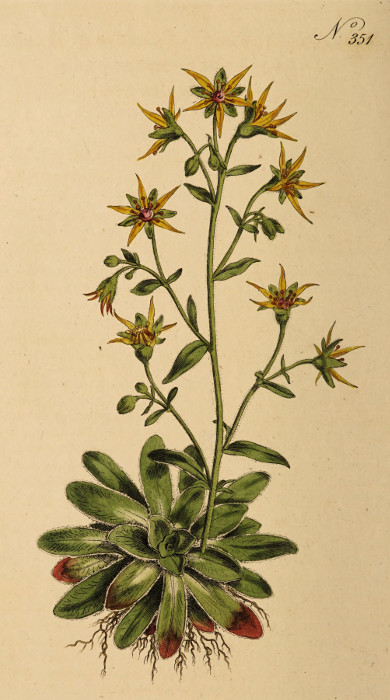
No. 351
Linnæus has arranged several distinct species of Saxifrage under the Saxyfraga Cotyledon, but very properly separates this; though in the general form of its foliage it is as nearly related to it as most of the others; from four of them it is indeed perfectly distinct, instead of the sawed cartilaginous edge, it has only fine soft hairs, more especially towards the base; towards the extremity there is some appearance of little teeth, but widely differing from those of the others. The whole plant is covered with viscid hairs; the stalk about a foot high, is much branched; but the great peculiarity of this plant consists in its flowers, the petals being long, narrow, and pointed, and of a saffron colour, of a deeper tint when they first open, and gradually changing to a pale yellow; the beauty of the flowers is heightened by a glandular substance in the centre of each, which when the flower expands is of a bright purple colour.
This rare species of Saxifrage is a native of the Alps of Switzerland and Italy; we raised it with difficulty from seeds sent us by Mr. Daval, of Orbe, in Switzerland; it was three years before the plants flowered; those now in bloom in my garden, June 15, bid fair to produce seeds in abundance; the plant may also be produced from offsets, in the same way as the Saxifraga Cotyledon, vulgarly called Pyramidal Sedum, and requires a similar treatment; though an Alpine plant, it must be sheltered from much wet and severe frosts.
Baron Haller describes it with spots on the petals; those certainly did not exist on our plants.