Chapter V · DURING THE NINETEENTH CENTURY. (continued 2)
Reading edition
Mr. M‘Neill was so completely occupied with his large works in the construction of railways that he could give only a general superintendence to the school, and on the 5th of November, 1842, Mr. Henry Rennie, formerly a lieutenant in the Royal Engineers, was appointed Assistant Professor and Lecturer. After holding the office for two years he resigned, and Mr. Thomas Oldham, B.A., was appointed in his room. Doctor Apjohn was elected to the joint Professorships of Chemistry and Geology; but in 1843 it was found necessary to appoint a distinct Professor of Geology, and on December 30th, 1843, Mr. John Phillips, the eminent geologist, was elected to this chair at a salary of £200, to be increased to £400 on the death of Doctor Whitley Stokes, then an old man, which took place in 1845. In the latter year Mr. Phillips resigned the Professorship, and he was succeeded by Mr. Thomas Oldham, afterwards Director of the Geological Survey of India. In 1846 Mr. Samuel Downing was appointed to the Professorship of Engineering, which he continued to hold until his death in 1882.
It was soon found that a two years’ course in Engineering was insufficient, and in 1845 it was extended to one of three years. The studies of the first year are in the main theoretical; in the second and third years they are practical—viz., drawing and office work, levelling, surveying and general engineering, and chemistry as taught in the laboratory.
At first, diplomas in Engineering were granted to students who had passed successfully through this school. In 1860 it was resolved by the University Senate that in lieu of these the license of the University should be conferred publicly at the Commencements; and in 1872 it was further resolved that the degree of Bachelor in Civil Engineering should be created, and that it should be conferred on Bachelors of Arts who were entitled to the license by having completed the full course in Engineering. From the year 1860 to 1891 inclusive, 352 students obtained degrees and licenses in Engineering. The degree of Master of Engineering is conferred on those who, after taking the degree of Bachelor of Engineering, have practised for three years in the work of their profession.
At each final examination in Engineering, special certificates are awarded to students who answer in a distinguished manner in the following subjects:—I. Practical Engineering; II. Mechanical and Experimental Physics; III. Mining, Chemistry, Geology, and Mineralogy.
School of Law.—The lectures of the Professor of Feudal and English Law remain very much as they were in 1792. The Professorship of Civil Law was then and for many years afterwards held by a Senior Fellow, often by a clergyman; the duties were nearly nominal, and the salary small. In the year 1850, however, the Board, being anxious to found an effective Law School in Dublin, decided that in future the Professorship of Civil Law should be held only by a Doctor of Laws, and a Barrister of at least six years standing; and as such he was required to regulate the courses and lectures in the Civil Law class, and bound to deliver at least twelve lectures in each Term.
The Law School of the University of Dublin is under the control of the Provost and Senior Fellows of Trinity College, who, however, act in concurrence with the Benchers of the King’s Inns.
The Regius Professor of Laws delivers lectures on Roman Law, Jurisprudence, and International Law. The Regius Professor of Feudal and English Law delivers lectures on the subject of Real Property; a third professor, whose chair was founded in 1888 by Mr. Richard T. Reid for the study of “Penal Legislation, including principles of prevention, repression, and reformation,” delivers lectures on—(1) Penal Legislation; (2) Constitutional and Criminal Law; (3) the Law of Evidence. These lectures are open to the public and King’s Inns students, who have credit for the Term’s lectures, and those who have credit for the academic year have their names reported to the Benchers.
The Law Professors also examine all candidates for degrees in Law. These degrees, like those in the other professional schools, can only be obtained after a course of legal study or strict examinations in Law.
THE COLLEGE SOCIETIES.
The College Historical Society, which was formed in 1770, had in 1794 come into collision with the Governing Body of the College, in consequence of the action of many of the Graduates of some years’ standing, who, though they were no longer subject to College discipline, continued to be active members of the Society, and acted without respect to the orders of the Board. The Society was consequently excluded from the College, and a new Association of the Students, under the same name, was organised. Their meetings for debate were permitted by the Board, on the distinct understanding that they would not choose for discussion any question of modern politics, or admit into their proceedings any allusion to such subjects. They continued to meet in the old rooms, now the Common Room of the Fellows and Professors, until 1815, when they again got into trouble with the College authorities, who insisted that they should expel, without discussion, two of the members of the Society whose conduct in its debates was disapproved of by the Board. The discussions upon the private business of the Society became imbued by party spirit, and the younger members, who exceeded in number the seniors, who had greater experience and wisdom, took upon themselves the management of the Historical Society, and it became continually engaged in angry debates. The Board consequently insisted that Junior Sophisters should be no longer admitted as members, and ordered a committee of five to be appointed to settle all private business of the Society. Four of the five refused to act, and the result was that on the 5th of February, 1815, the last debate was held. It is a strange coincidence that, shortly afterwards, similar difficulties arose between the Cambridge Union and the Cambridge University authorities. In the month of March, 1817,[106] Mr. Whewell was President. Dr. Wood, at that time Vice-Chancellor, took with him the Proctors, together with a Tutor from Trinity College, and another from St. John’s: they proceeded to the place of meeting for debate, at the Red Lion Inn. The Proctors were sent into the room to desire the members to disperse, and to meet no more. The President requested the Proctors to retire, in order that the Society might discuss the subject. This they refused to do. At last a deputation, consisting of Mr. Whewell (afterwards Master of Trinity), Mr. Thirlwall (afterwards Bishop of St. David’s), and Mr. Sheridan, was permitted to have an interview with the Vice-Chancellor. The deputation urged their claims strongly, but the Vice-Chancellor insisted that, while they might conclude the present debate, they should not meet again for a similar purpose.
After frequent petitions to the Board, supported by the Junior Fellows, the Historical Society was again, on the 16th November, 1843, permitted to meet within the walls of the College, on which occasion William Connor Magee, Scholar, afterwards Archbishop of York, delivered, as Auditor of the Society, an opening address of remarkable eloquence and of great promise, which produced an effect such as has never yet been equalled in the Society. Since that period the College Historical Society continues to meet regularly for debate within the College walls. Junior Sophisters are again admitted as members, but the subjects for discussion must always, in the first instance, receive the approval of the Board. The Society has been allowed, moreover, to have Reading and Committee Rooms within the College. During the half-century which has elapsed since the restoration of the Society, perfect harmony has existed between the members and the Governing Body of the College.
The Philosophical Society.—During the year 1842, some of the students of Trinity College whose age and reputation did not warrant their seeking admission into the leading scientific societies of Dublin, but who were anxious to improve themselves in knowledge and in the art of composition, combined to form a Society called the Dublin Philosophical Society, the object of which was the reading of papers on scientific and literary subjects, and the discussion of these papers by the members after they were read. The first meeting was held in November, 1842, in a room in Marlborough Street, and the first volume of their transactions was published at the end of 1843.
In the beginning of 1845, after the Historical Society had been received back within the walls of the College, the Committee sought permission to have the use of one of the lecture-rooms for the purposes of their meetings. This was granted. The name of the Society was changed into “The Dublin University Philosophical Society,” and new rules were adopted, which were required by the closer connection of the Society with Trinity College. The members were nearly all graduates, and although junior students were by no means excluded from the Society, few of them were disposed to join in the proceedings. The Society continued to exist for some years, but the members, being generally senior men, were too soon called away from aiding in its meetings by the requirements of professional or official duties. This Society published five volumes of Transactions, containing papers by young men, many of whom afterwards became distinguished in science and literature.
The Society having fallen too much into the hands of graduates, in the year 1854 the undergraduates, feeling the want of a similar organisation which should give them free scope for their own literary exertions, formed a new Society called “The Undergraduate Philosophical Society,” the ruling body of which was composed of students who had not taken their B.A. degrees. The new Society became rapidly popular among the students of the College, and its numbers largely increased. The first Philosophical Society having been at length discontinued, that which was managed by the undergraduates took its place as the University Philosophical Society. All undergraduates are now admissible as members, and at present it so happens that the majority of the officers of the Society and the Committee are graduates.
At the first, the spirit which actuated the former Philosophical Society influenced its younger sister, and scientific subjects formed the main topic of discussion. After one or two sessions, essays and discussions on literary subjects were introduced, followed by poetry, fiction, biography, and history; so that ultimately questions of abstract science disappeared from the proceedings of the Philosophical Society, and questions of pure science are now discussed at the meetings of the University Biological Association and the University Experimental Science Association.
The Theological Society.—Shortly after the Divinity School was placed upon its present basis, it was found that a place of meeting was required where theological students could discuss the important questions which formed the subjects to which their attention was directed. The Society was founded outside the College on November 23, 1838. Its first presidents were Rev. Doctor Singer, then a Junior Fellow, the Rev. Robert J. M‘Ghee, and the Rev. Charles M. Fleury. The Society met in a room in Upper Sackville Street, and the discussions of the members were very much confined to the Roman Catholic controversy. It was soon found necessary that the Society should be brought more under the control of the teachers in the Divinity School, and in 1860 the then Regius Professor of Divinity was appointed President; the other Professors in the Divinity School, along with the assistant Divinity teachers, were made Vice-Presidents; and since that year the Society meets in a public room in the College. Dr. Butcher, the then Regius Professor, always presided at the weekly meetings up to 1866, when he became Bishop of Meath. His successor, Dr. Salmon, gave the same unwearied attention to the Society until he became Provost, and the discussions of the Society, which now take a much wider range in Theology, are always conducted under the control of the Regius Professor, or of Archbishop King’s Lecturer in Divinity.
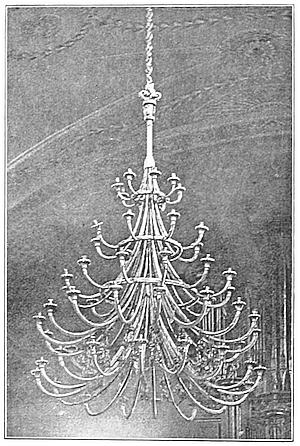
CANDELABRUM. EXAMINATION HALL. CARVED OAK—GILT.
FOOTNOTES: