Front matter (continued 2)
Reading edition
No. 5. TALLY-HO!
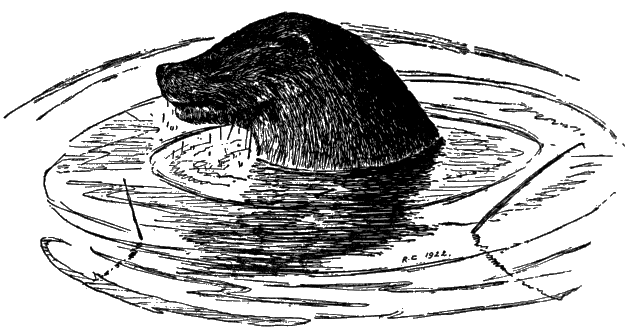
In rapid, or deep water, an otter will often pass an experienced hunter without being tallied, particularly if it is moving close to the farther bank. The angle at which the light falls on the water often makes it extremely difficult to detect an otter as it passes. After being hunted for some length of time, the otter shows himself more and more frequently. He may vary the water work by making an excursion overland, or running the length of a nearby wood. Perhaps he takes refuge in a holt, and is then bolted by the terriers. Anyway, if things go right, the time comes when he can do no more, and he dies fighting on the shallows, leaving his mark on nearly every hound. The huntsman at last gets the pack to leave him, not using a whip, but pushing hounds off with knees, hands, and pole, after which he slips the carcass under water for a minute or two until he recovers his wind, and then carries it ashore. There it is weighed, mask, pole, and pads are severed, the carcass is slit up, and tossed to the eagerly expectant pack. "Hi, worry, worry, worry," "Who-whoop! tear him and eat him." After blowing the "rattle," and cheering hounds to keep up the excitement, the various trophies are distributed, and one's thoughts then turn in the direction of certain bottles which are snugly reposing in a friend's car on the nearest highway.
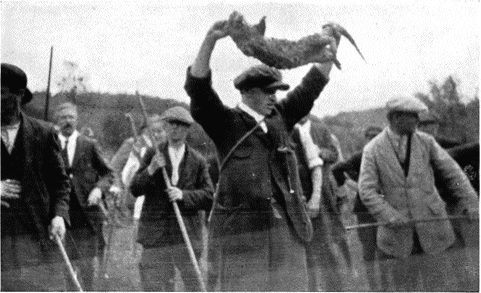
A Kill with the K. & D.O.H.
(Copyright by Mrs. R. F. Lees, Blackpool).
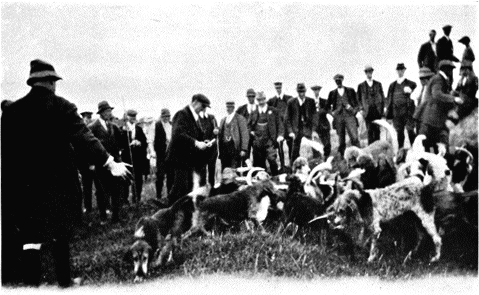
Hi, Worry, Worry!
(Copyright by R. F. Lees, Blackpool).
To face p. 102.
Early, or late in the season, when the weather is boisterous and the water cold, it pays to hold up a few couples of hounds, reserving them until the working pack has had about enough of it. Then at the right moment, throw in your reserves and make a quick finish. This plan is especially applicable to lake hunting, when hounds are continually swimming in deep water.
When hounds are on a drag, or have put down their otter, the huntsman should encourage them, cheering them on to any particular hound which has made a hit, and the same when they mark solidly at a root. There is no need to be noisy, but hounds work all the better for encouragement, and a bit of excitement at a holt teaches young hounds to mark their otter. To make a success of otter-hunting, or any other kind of hunting for that matter, a man must use his brains, and to some extent call on his powers of imagination.
A chapter on hunting is hardly complete without some mention of that elusive mystery called scent, so a few words will be devoted to it here. You get good and bad scenting days in otter-hunting just as you do when hunting fox or hare, but the chase of the otter has the advantage of being conducted both on land and water, and if scent is bad on the latter, it may be quite the reverse if your otter takes to terra firma. Sometimes it is good on both, though it may happen that an otter which has been hustled about the woods or across country apparently gives off little scent when he returns to the water. A bitch otter in cub, or one with a young family, appears to often give off little or no scent, and where hunting takes place on a river polluted by oil, or other foreign matter, scent is generally conspicuous by its absence. Scent varies too at different times of day. In the early morning, before the sun has dispelled the dew, it is generally good, but dies away as the atmosphere becomes warmer. When the sun begins to sink and the air becomes damp again, scent is likely to freshen; while a shower of rain may affect it in the same way. The vagaries of scent are impossible to foretell with anything like certainty, and perhaps it is as well so, otherwise sport would become too cut and dried, and would lose much of its interest on that account.
Occasionally an otter takes refuge behind weiring or in some other retreat, that necessitates pulling down a certain amount of the obstruction before he can be evicted. In this case, permission from the owner or tenant of the place should be obtained before beginning operations. In the same way, should the owner or tenant object to the presence of hounds on his land, always be civil, no matter what he says, and take hounds away without any argument. The life of the sport depends upon the existence of amicable relations between the Hunt and the owners of the land which they cross. Although terriers can as a rule bolt an otter if they can get to him, ferrets have been used for the same purpose before to-day. Both otters and foxes have on occasion been bolted from rabbit burrows during ferreting operations. In some countries artificial drains or holts have been constructed for the use of otters, but there is usually a good deal of uncertainty as to whether the otters will take to such abodes. Where old drains run a long way into the land, with possibly a number of branch drains, it is often wise to place iron gratings at some distance from the mouth, in order to facilitate matters when it comes to bolting an otter. As the great charm about otter-hunting is its freedom from artificiality, made holts or drains need hardly be encouraged, except perhaps in extreme cases where there is no suitable lying-up place for otters over a long stretch of water.
When hunting hounds, the Master will be assisted in the field by two whippers-in, which may consist of the paid kennelman, and an amateur. Their job is to keep hounds in check when necessary, prevent rioting, if any, and keep in touch with the pack should hounds go off across country with a screaming scent. Taking it for granted that the paid hand knows his job, the amateur should be equally proficient. He must keep a keen look out as he goes for signs of otters, as well as hidden drains, etc., and he must know the names of all the hounds and their individual idiosyncrasies, so as to tell instantly if they are inclined to riot, or they show an inclination to mark at roots, or take a line away from the river. Speaking broadly, the whippers-in prevent hounds going too fast and outpacing the Master and the field, but it should be remembered that hounds can be kept too much in check, and by so doing they are balked in their desire to hunt, as well as drive on when scenting conditions are good. In fox or hare hunting, the huntsman's place is with his hounds, whether they are drawing or running, and there appears to be no good reason why an otter-huntsman should not "get a move on" when his hounds push ahead on a hot drag, or drive along across country. It is quite as necessary to run, and often run hard, with otterhounds, as to ride hard with foxhounds, and the huntsman who takes his own time whilst his whipper-in is bursting himself across country is surely lacking in keenness.
Although otter-hunting does not call for as much quickness on the part of the huntsman as fox-hunting, we still must confess we like to see a huntsman of otterhounds show some agility when his hounds run fast. This particularly applies to hunting in the north, where otters so often cross steep watersheds. A great deal of valuable time is frequently lost, simply because the huntsman prefers to take his own time, instead of attempting to keep in close touch with hounds, and thus be on the spot should they momentarily require his assistance. As far as the field are concerned, it is their own fault if they are left behind when hounds run. When travelling with hounds on the highway, however, the huntsman and whippers-in should go at a reasonable pace, so as to give the field a chance—particularly the ladies—to be there when hounds are put to water. Racing ahead with hounds on the roads gets the pack into the habit of pushing on when there is really no need for it, so a reasonable walking pace should be aimed at.
When hounds have put their otter down, or "hit him abroad," to use an old expression, and are swimming him, the huntsman should keep on the shallow side of the river, more particularly if the farther bank is thickly overgrown with willows or other cover. From the shallow side he has a clear view of what his hounds are doing, and if it is necessary to pole the farther bank if an otter persists in hanging there, he should ask one of his whippers-in, or some experienced member of the field to do it for him.
With regard to clothing and etceteras for otter-hunting, little need be said here. Hunt uniforms are usually made of woollen serge material, which dries quickly, and withstands a lot of rough usage. Shorts are sometimes worn, but in our experience loose knickerbockers are much preferable, particularly for hunt officials who may have to force their way through briers or other undergrowth in the execution of their duty. Bare knees and thorns do not associate well together, while breeches of the semi-riding type are too tight-fitting, and retain water. Boots or shoes should be well nailed to prevent slipping, preferably with soft, wrought-iron hobs, which get a better grip on rocks than steel nails. An iron-shod pole of ash or hazel—the latter is light yet strong—is necessary for crossing deep or swift water, and in some districts as an aid to jumping wide ditches and open drains. A pole shod with a double-pronged spike is less liable to slip than one armed with a single spike. Likewise a pole cut from the growing tree or sapling looks more workmanlike than a "made" one, ornamented with a fancy metal head or other embellishment. With regard to the whip, for use by Hunt officials, one with a short lash is to be preferred, for it can be far more easily cracked when the user is standing in water than a long-lashed affair.
The huntsman who cannot blow an ordinary horn without unnecessary discords will be well advised to secure a reed-horn. Every call can be sounded on this, with the exception of that "to call hounds away," and for this quite a good substitute can be blown. When using the horn, he should employ distinct calls, then both hounds and field know what he means. Some huntsmen blow the same note all day long, and hounds take no heed of it, while the monotonous sound gets on the nerves of the field.
Nowadays the otter-hunting season extends from April to September, but in the fourteenth century it lasted from February to June.
CHAPTER IV HOUNDS AND TERRIERS
The average otterhound pack to-day is usually composed of foxhounds, cross-bred hounds, and a few couples of pure, rough-coated otterhounds. In the old days the latter predominated in most packs, and it is only of late years that the foxhound has come to the fore in the pursuit of Lutra.
The origin of the rough-coated hound is more or less shrouded in mystery, but it is pretty safe to say that he is closely related to the bloodhound. If true to type he possesses many of the bloodhound's characteristics, including the long pendulous ears, the deep-set eye showing the haw, and the black and tan colour which so often predominates. The rough coat was gained by a cross of some sort, but it is impossible to say with certainty what this cross was. The wire-haired Welsh harrier may have had something to do with it, and again it is quite likely that the old hard-coated Lancashire harrier may have been used for the same purpose. It is possible, too, that the old southern hound was crossed with the bloodhound, while there are those who believe that the French griffon had a share in the business. Thus we see that the rough outer coat may have come from a variety of sources, but the thick, woolly under-coat is no doubt a provision of nature to protect the hound from the effects of frequent and long-continued immersion in the water. This under coat is worn by the Chesapeake Bay dog, a breed of retriever much used by wildfowl shooters in America.
In the fourteenth century raches or running hounds—known later simply as hounds—were of various kinds. In the "Master of Game" it says: "There be also many kinds of running hounds, some small and some big, and the small be called kenets, and these hounds run well to all manner of game, and they (that) serve for all game men call them harriers. And every hound that hath that courage will come to be a harrier by nature with little making."
Harrier was in those days spelt heyrer, and it was not until after the sixteenth century that the modern spelling came into vogue. It was probably derived from the Anglo-Saxon herian, to harry or disturb. In the "Boke of St Albans" it says that the hart, the buck, and the boar should be started by a limer, and that all "other bestes that huntyd shall be sought for and found by Ratches so free." Thus it appears that all beasts that were enchased were moved by a lime-hound, while those that were hunted up were found by raches. The otter-hunting illustration in the "Master of Game" shows five hounds, one of which is on leash, and appears to be a limer. The otter was certainly not enchased in those days, being looked upon as vermin, yet as the picture shows a limer at work, it is possible that lime-hounds were sometimes used for other game than the recognised beasts of chase. The hound shown swimming the otter is bloodhound-like, while two smaller hounds appear to have broken coats. In the fourteenth century the otter and various other creatures, such as the rabbit, fox, wild cat, etc., were hunted by biss hunters (fur hunters) for their skins, and no doubt the smaller breed of hounds then known as heyrers were employed in their capture.
Coming down to modern times, there are, as far as we are aware, but two existing otterhound packs entirely composed of pure, rough-coated otterhounds. All other establishments employ mixed packs. Cross-bred hounds are usually the result of a union between a pure otterhound bitch and a foxhound. The majority of foxhounds which find their way to the otterhound kennels have been drafted for over-height, age, or faults. They are often presented to the M.O.H., or he buys them at a low figure. Having purchased or otherwise got together sufficient hounds to make a start, you can gradually weed them out, retaining the best workers for future breeding operations. It is perhaps unnecessary to state that you must have a couple or two of entered hounds to begin with, otherwise you are likely to walk as far as the Rev. Jack Russell did before you find an otter. As regards cross-bred hounds, the first cross may be capital workers, but it is doubtful if much good comes from breeding from them.
One sees all shapes, makes, and sizes of rough hounds in the various packs, but the best bred ones are big, upstanding animals, from twenty-two to twenty-four or more inches in height. Speaking from our own experience, we have found the majority of rough hounds to be much more clumsy and less active than foxhounds. Their feet, too, are often inclined to be open and flat, and they lack the heart and stamina of the foxhound. There are, of course, exceptions, and we have come across rough hounds that were capital workers, but take them all round they are too big and clumsy, at any rate for work on rough, rocky streams. Despite their rough jackets, they suffer from the effects of long immersion in water far more than the foxhound, whose short, smooth coat is dry after a shake or two. In addition they are not such good doers as the foxhound, and require more attention after hunting. They are also apt to be quarrelsome in kennel. Many of them possess extremely fine noses, and can speak to a line a day or two old, but this is of no practical help in hunting, because it is impossible to drag up to an otter that has been so long gone. They swim well, and often draw well when swimming, but the foxhound is quite their equal in this respect. In our experience the hound that can wind his otter across the stream and go straight to him is more often a foxhound than a rough hound.
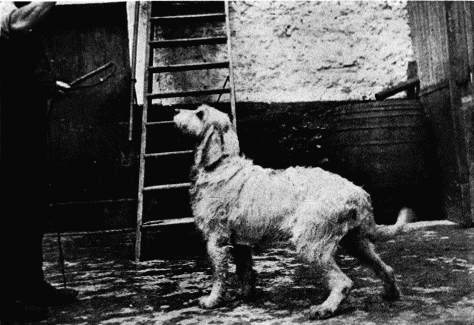
A Famous Otterhound, Mr. W. Thompson's "Snowdrop."
(Photo by R. Clapham).
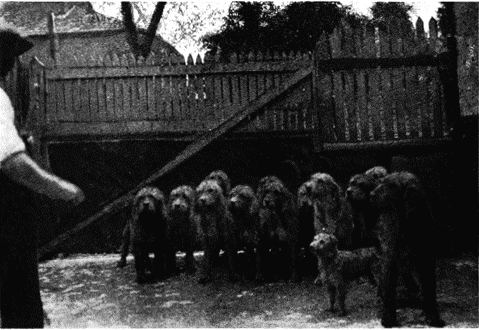
Some of Mr. W. Thompson's Rough Otterhounds.
(Photo by R. Clapham).
To face p. 116.
The foxhound, too, is usually a better marker once he has entered properly, and when it comes to holding and killing an otter, the rough hound cannot compare with him. Across country, too, and when an otter runs through covert, the foxhound's dash and drive at once put him in the lead. The rough hound has a resonant, musical voice, and a picturesque appearance, but taking him all round, from a solely working point of view, he is, in our humble opinion, inferior to the foxhound, particularly on rough, rocky rivers, where a light-built, active type of hound shows to advantage. Custom ordains that hounds for otter-hunting should be rough jacketed, and by employing cross-bred or rough Welsh foxhounds you get the rough coat, without the undesirable qualities found in the pure otterhounds.
The latter show to the best advantage in low-lying country, where the rivers are slow running, and the going easy. In these days, when meets are late and time is valuable, pure otterhounds with their tender noses dwell and revel on the drag instead of pushing forward. The foxhound, on the other hand, may feather on a stale line, but he will not as a rule open unless the drag is fairly fresh. When he does throw his tongue, you can confidently cheer the others to him, knowing that your otter is not so very far in front. Although we cannot deny that the deep, resonant music of a pack of pure otterhounds is delightful to listen to, something more than the "band" is required to kill an otter.
Foxhounds, cross-breds, and Welsh hounds throw their tongues well enough, and in addition they possess dash and drive, with little or no inclination to dwell. Foxhounds, before they have entered properly, draw wide and will not always stick to the river, but if they have done a few season's stag-hunting—thus being used to water work—they generally enter well to otter and draw closely enough. A hound may not take any interest in the sport during his first season, but the following season he may prove to be one of the best. Unfortunately the majority of draft foxhounds are aged before they find their way to the otterhound kennels, therefore any lengthy delay in entering to their new quarry shortens the period of their usefulness, that at the best cannot be very long.
Aged foxhounds after a time show an inclination to dwell and revel in the scent, and when this happens it is a sign that their utility is coming to an end. If possible always get hold of foxhounds which throw their tongues freely, and have nothing whatever to do with a mute hound. However closely you keep an eye on the latter, he will sooner or later get away "on his own," and be the means of spoiling more than one good hunt. No matter how good a mute hound is in his work, get rid of him, for unless he lets you know what he is doing he is useless to you. Likewise, never on any consideration be tempted to breed from a mute hound. Rough otterhounds cannot stand punishment like the foxhound, and will howl and kick up a dreadful racket if hurt, or hit with the whip for some fault.
It is during the course of a long hunt in heavy or chilly water that the average rough otterhound will pull out and sit shivering on the bank, while the foxhounds are keeping their otter on the move. In our experience, the foxhound is a much better fresh-finder than the pure otterhound, and it is the hounds good at fresh-finding and keeping their otter going that do most towards bringing the quarry to hand. At the end of a long day, too, the cross-breds and foxhounds will return to kennels with their sterns up, while many of the rough sort exhibit a very depressed appearance. They never seem to pick their feet up like a foxhound, but shuffle about in an ungainly fashion. When it comes to killing an otter, the foxhound has it all his own way. Time and again we have seen him seize and hold a big otter, often shaking his quarry like a fox. The rough hound often fails in this respect, for he has not the courage to make him a good seizer and killer. A foxhound which comes to the otterhound kennels with the reputation of being a good marker nearly always keeps up his fame in the same way when entered to otter. Good marking hounds are the mainstay of any pack. As far as brains are concerned, the foxhound appears to make more use of his "grey matter" than the rough hound, and shows more initiative and individuality. His pace and activity, too, are beyond question, both of which qualities are of the greatest assistance when swimming an otter, and more particularly when hunting one across country or through extensive coverts. It is the active hounds which score so often on rough and rocky rivers, for drive and pace are an occasion quite as necessary in otter-hunting as fox-hunting.
The cross between foxhound and rough otterhound possesses many of the attributes of the former, including a rough jacket, and thus is admirably fitted for the pursuit of Lutra.
Turning to Welsh hounds, some of which have rough, and others smooth coats, we find a breed admirably suited to both fox and otter-hunting. Many Welsh hounds are white or nearly so, while others are the old black-and-tan colour. The English foxhound of standard type is bigger and has more substance than the Welsh hound, but the latter excels in nose and tongue, and can stand any amount of hard work in rough country. In our experience, too, Welsh hounds—particularly those of the smaller type—are very active, and have plenty of drive, while they are often capital markers, and can hold and kill an otter quite as quickly as any English foxhound.
Another type of hound admirably suited to otter-hunting is the fell-foxhound of Cumberland and Westmorland. He is for the most part a light-built, active sort, with a capital nose, and any amount of tongue. In the Lakes and certain districts adjoining, fell-hounds often hunt fox in winter and otter in summer. The fell-hounds are kennelled in the fox-hunting season, but go out to walk in summer, and generally a few couples are lent to the local otterhounds for the chase of Lutra. In our experience fell-hounds enter quickly to otter, and on our rough and rocky northern rivers they are very hard to beat as all round performers. Many of them are capital markers, and they will hunt a drag, and kill an otter with the best.
Turning to the "Otter-hunting Diary" of the late Mr James Lomax, of Clayton Hall, who kept a pack from 1829 to 1871, we find an illustration of the old Lancashire harrier or foumart-hound. The picture shows a couple of rough-haired hounds in full cry, which appear a medium-sized, light-built, active type; more suggestive of the rough Welsh foxhound than the modern otterhound. Mr Lomax used these foumart-hounds in crossing with his otterhounds. In another illustration, showing some of the pack in 1835, the type of hound appears to be lighter-built and more active-looking than the big, present-day rough otterhound.
The tendency with English foxhounds has been to breed them much bigger than was the case in former years, and the same apparently applies to the rough otterhound. Certainly a tall hound can wade where a smaller hound is obliged to swim, but a medium-sized, active type is less clumsy, and more fitted for work on rocky streams than the heavy hounds now seen in most packs. From a purely working point of view, a pack composed of English, Welsh, and fell-foxhounds would be very hard to beat. By judicious crossing, an ideal pack could be bred, retaining to a great extent the rough coat of the Welsh hound, if that was thought indispensable to the appearance of the pack.
Although draft foxhounds are generally used for otter-hunting, it pays to get hold of a bitch or two and breed from them. By so doing you can gradually get together a pack composed of hounds of the desired sort, and if you are lucky you may be able to hunt fox with them in the winter, and thus keep hounds in condition for their summer work. Hounds, like human beings, get very fed-up with continual road exercise, therefore a bit of winter hunting appeals to them far more than the dull routine of exercise walks.
Next in importance to the hounds are the terriers, for without their help it would be impossible to eject an otter from his holt. The most important quality in a terrier is gameness, for no matter how well built he is, if he has not the courage to go below ground and stay with his otter until the latter bolts, or the diggers unearth him, he is not worth his keep. Provided he is thoroughly game, and not too big, it matters not how a terrier is bred. He is there to work, and not to be looked at. Roughly speaking, a terrier of about 14 lb. weight will be suited to otter-hunting. As, apart from bolting otters, he will not be called upon to do any great amount of travelling over rough country, short legs are no great drawback to him. For all that, however, we like to see a terrier with a fair length of leg, for there are certain holts, particularly amongst rocks, where an otter can command the upper position, and a short-legged terrier is much handicapped when trying to get at him. A terrier should have a fair head and jaw, and he should be as narrow in front as is compatible with adequate heart and lung room. A narrow-fronted dog can always get into a smaller place than a broad-chested one, even if he is longer on the leg. A terrier that will lie up close to an otter and move him with his tongue is preferable to one that goes straight in to the attack. His barking eventually gets on the otter's nerves and causes him to get "out of that," while should the otter refuse to bolt, the terrier's voice is a guide as to where to dig. A terrier soon learns his job, and after getting mauled a time or two by otters, he will make more use of his tongue than his teeth. When entering a puppy for the first time, choose an easy place, so that the youngster has a fair chance to get in touch with his otter.
As to the colour of a terrier, good ones—like horses—come in all colours. White is perhaps preferable, as a white terrier is less likely to be mistaken for the otter by hounds at a kill. Certainly white terriers appear to suffer fewer casualties in this respect than coloured ones. As to whether terriers should run loose with hounds is a question the Master must settle for himself. When terriers are loose, there is always the chance that cubs may be chopped by them, though to set against such a contretemps, many an otter is found and put down by the terriers. Again, coloured terriers running loose may be killed or badly mauled by hounds, when the latter are hard at their otter.
During the season of 1921, with the K. and D.O.H., we had two coloured terriers worried by hounds, one of which recovered but the other died the same night. The otter, which was getting beat, took to land, and hounds collared him as he left the water, the terriers being seized by some of the pack in mistake for their quarry. Had those terriers been in the couples at the time, they would have been saved. It is really safest to lead the terriers until they are wanted, and after bolting their otter they should be got hold of again as soon as possible. The same when hounds are worrying their otter, always pick up the terriers if any of them are loose.
In order that hounds shall keep fit and well, they must receive proper attention in the kennel. Less flesh is needed for feeding otterhounds than foxhounds, because they do their work in summer, and both the season of the year and the work itself do not make so great a call on their powers as does the chase of the fox in winter. During the off season, otterhounds should be exercised for two or three hours daily, and as the hunting season approaches the exercise can be gradually lengthened. With a pack of cross-bred, Welsh, or English foxhounds, it is possible to hunt otters in summer and fox in winter, and where this can be done, hounds will, of course, keep perfectly fit. In the case of the fell-foxhounds, those hunting otter in summer return to their own kennels for the winter fox-catching. As far as food is concerned, this should always be given thick, rather than soft and sloppy. Hounds splash "slop" into their eyes, and get particles of it up their nostrils, to the detriment of both sight and olfactory powers. On the return from hunting, cuts and bruises should be attended to, and thorns, etc., extracted. Hounds' coats should also be brushed, and burrs, etc., removed. Rough hounds require more looking after in this respect than smooth-coated ones. The huntsman should see that his hounds are fed and properly bedded down before he attends to his own wants. If hounds look well and hunt well, you can rest assured that your huntsman or feeder is paying proper attention to the pack in kennel. As regards kennels, these need not be of an expensive nature, but the drainage and general sanitation must be adequate if hounds are to keep fit. Wherever waste matter is present, either in the boiling house, feeding place, or yards, there will disease germs gather, and complaints amongst hounds will be for ever breaking out. The old adage "Cleanliness is next to godliness" applies as much to hounds and their kennels as it does to human beings and their houses.
Some huntsmen are apt to let hounds get very much out of condition during the winter months, instead of exercising regularly, which means that on the approach of the hunting season all sorts of physic is used in an attempt to get them fit again. It is quite safe to say that the less medicine you employ about the kennels the better, and there will be little or no need for it if hounds are rationally fed and exercised in the winter.
CHAPTER V REMINISCENCES
There are very few Masters in the country who hunt fox in winter and otter in summer with the same hounds, and fewer still we imagine who have killed an otter and a fox on the same day. The latter feat was performed by the Master of the South Tetcott, whose hounds found and killed an otter on the River Othery, after which they unkennelled a fox cub, and after rattling him about a bit, eventually brought him to hand.
One of the few packs hunting both fox and otter is the Ynsfor, a private pack owned by Major Evan Jones. His country lies in Carnarvon and Merioneth, Snowdon and the adjoining mountains lying within its borders. The Master is his own huntsman, and hounds are followed on foot, owing to the precipitous nature of the country. The pack is composed of the old Welsh breed, some rough and some smooth, with many of the old black-and-tan colour amongst them. These hounds have been in Major Jones's family since 1765.
Probably few people have been out with both foxhounds and otterhounds on the same day, but we can plead guilty to having accomplished this feat. Before the L.D.O.H. were disbanded, hounds met very early one morning, but failed to get an otter afloat, and when they returned to kennels we went off and joined the Coniston Foxhounds, and eventually saw Reynard accounted for.
A great many people appear to have a rooted idea that an otter is a slow-moving, clumsy creature, which never leaves the vicinity of water. Such an assumption is, to say the least of it, inaccurate, as anyone can easily testify, particularly those who have done much otter-hunting on the rocky rivers of the north. In a previous chapter we have mentioned a hunt during which the otter crossed a watershed, and this brings to mind a seven and a half hours' hunt by the K. and D.O.H. on the River Lune in the season of 1921. The otter was lying rough in a hanging wood overlooking the river, and was found by a little fell-foxhound named Cragsman, belonging to the Ullswater pack. After some up and down work on the river, our otter stole away on land, and crossed some fields to a small stream which runs between steep banks. There was a screaming scent, and hounds fairly flew in pursuit. The otter ran the small stream nearly to the top of the ghyll, then turned and came back. In a rock-bound pool he lay low, but hounds were soon at him again. The pool lay between smooth and slippery walls of rock, and at first the otter barely showed his nose. Suddenly, however, he made a terrific spring—his hind legs no doubt getting purchase on a ledge below the surface of the water—and all but got clear of the pool. He hung for a brief instant on the rock wall, making the picture of a lifetime for anyone lucky enough to have been there with a camera, then he turned and fell with a splash into the pool. It was a miracle how he got clear, but get away he did to run the fields again, and take refuge in a rabbit burrow on the bank of the main river. Hounds were taken away, and after a bit of work the terriers bolted him. He took down stream, and after the pack was laid on, a couple of hounds collared him on the shallows. He appeared to fling these hounds off as if they were straws, then he shot into a pool, raising a splash and a wake like a hydroplane as he crossed it.
Reaching the farther bank, he at once took to the hanging wood, and went straight up it. He gained a short start by this manœuvre, then the pack was roaring in his wake. Running the wood like a fox, it looked at first as if he was going right out at the top, but he turned and came down again, crossed the river and took refuge in a strong root holt. Some time was spent digging before he could be ejected, and when he was at last obliged to bolt, he again went straight across the river and took to the wood. Hounds drove him round it, and he once more took the water. Here he entered a long but not very deep pool, and hounds swam him down it, then he turned and hounds checked. There was little or no cover on the banks, but he got out without being seen, the first warning we had of his departure being given by a young, rough hound which hit off his line in the wood. This time he ran straight out to the top of the covert, turned left-handed and crossed the open fields for more than a mile, just beating hounds to a drain, the grating of which had been moved, where he got in and was eventually left.
We viewed this otter several times at close quarters, and estimated his weight at nearer 30 lb. than 25 lb.
He showed extraordinary running powers and activity for so large an otter, and it was hard luck on hounds that he beat them.
There was a screaming scent on land, but when he took the water for the last time, hounds had some difficulty in owning the wash. That otter would most certainly have convinced anyone who was sceptical of Lutra's activity and running powers.
We have already mentioned the fondness that otters have—particularly in Canada—for sliding. When engaged in this amusement, they tuck their forelegs in, and toboggan down the bank on their stomachs. This season (1921), whilst the Coniston Foxhounds were hunting on the fells, a couple and a half of hounds ran a fox in the direction of an earth on which some of the field were standing. About the same time, an otter suddenly ran out from some rocks near the main earth, and after going some distance, tucked in its head and forelegs, and actually rolled some yards downhill. We were on the opposite side of the valley at the time, but a very keen and experienced fox and otter hunter who was there, and witnessed the incident, said that he had never seen anything like it before in his life.
A name to conjure with in the annals of Lakeland otter-hunting is that of the late Bobby Troughton. He was born on Fellside, Kendal, in 1836. In the early eighties he purchased three hounds, "Raleigh," "Ragman," and "Londesborough," and with these three hounds and a couple of terriers he began to hunt the local rivers. Having thus formed the nucleus of a pack, he gradually added to it and improved it, until the late Mr Courtenay Tracy, M.O.H., said there was not another pack like it in England. Bobby's heaviest otter was a big dog weighing 32 lb., and was killed in Rydal Lake. One of his most famous hunts took place in Lever's Water on the Coniston fells. Hounds met at 5 a.m. at the foot of Yewdale Beck, and striking a hot drag at once, went out towards the hills. Near the edge of the tarn they put their otter down, and he at once took to the water. For nine hours he kept hounds going, and it was not until some of the field volunteered to go to Coniston for a boat—no small undertaking—that Bobby was able to get afloat himself, and give his hounds a helping hand. At long last the otter attempted to land, and hounds collared him, thus earning their reward.
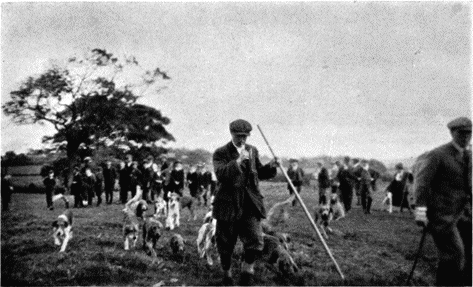
K. & D.O.H. Moving Off to Draw.
(Copyright by R. F. Lees, Blackpool).
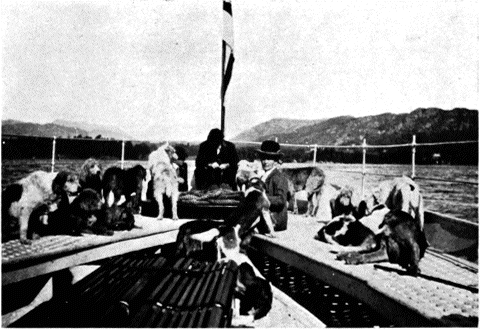
Going to the Meet by Ferry on Lake Windermere.
(Photo by R. Clapham).
To face p. 139.
At one time in the north, packs of rough hounds were kept for hunting otter, marten, and foumart. One of the last of these packs to hunt in the Lake District belonged to the late Mr Fleming Green, of Grasmere. Anthony Chapman, who was his huntsman, and later hunted the Windermere Harriers for many seasons, is still hale and hearty, and delights in a "crack" about old times.
Another well-known Master in the north was the late Mr James Lomax, of Clayton Hall, Great Harwood, Lancashire.
His "Otter-hunting Diary" contains an account of the sport he enjoyed from 1829 to 1871, and is most interesting reading. Like Bobby Troughton in later years, he bred a very perfect pack of hounds of the rough-coated type. In 1871 rabies unfortunately broke out in his kennels, necessitating the destruction of all but three of the hounds. Being himself advanced in years, he made no attempt to start a new pack, despite the many offers of hounds he received, and one cannot blame him. By the time he had got together another pack as good as the one he had lost, he would as he said himself have been too old to follow and enjoy the sport. Mr Lomax always met very early in the morning, often as soon as 3 a.m. He showed wonderful sport on Ribble, Lune, and many other rivers, and old men who can remember hunting with him, speak in glowing terms of the great hunts they enjoyed with his pack. In one respect Mr Lomax differed from present-day Masters, i.e., in the practice of "sacking" otters and removing them to more huntable waters. There are in the diary, several instances recorded of such otters having died, so that the practice was not a profitable one.
The most famous otter-hunter Scotland has ever seen was the late Mr Waldron Hill, of Murrayfield House, near Edinburgh.
When quite a young man he contracted consumption, and was told by his doctors that he had not long to live. Nothing daunted, however, Mr Hill took to otter-hunting, and the sport agreed with him so well, that he hunted practically every river in Scotland, and lived to be far advanced in years.
When the West Lothian Foxhounds were in existence, Mr Hill used to run with them, and saw as much sport as most of the mounted brigade.
In "Field and Fern," The Druid wrote regarding Mr Hill: "Some years ago he had a pack of otterhounds in Monmouthshire, of the Welsh breed, smooth and white with yellow ears; for the last five years he has had black and tans, a cross between the bloodhound and rough Lancashire hound, which is used in that country for otter and foumart. Their nose is nearly equal to the Lancashire hound, who are unrivalled in this respect and never disposed to be tonguey. The bloodhound cross also makes them more savage in their worry, but they are often very unpleasant to manage in kennel. Mr Hill has found the foxhound fail in working up to his otter in a cold drag, but excellent on the line when the game is fairly started. With him the southern hound has only failed from lack of constitution, which is injured by too much swimming."
Mr Hill used terriers of Welsh breed, which he got from the kennels of Mr Ramsay Williams, after the latter's death. These terriers weighed about 15 lb., and were bred as flat-sided as possible to enable them to squeeze into narrow places. They were fairly long on the leg, and were used for bolting fox, otter, marten, and foumart. Mr Hill's principal river was the Tyne, flowing through Haddingtonshire. Speaking of the South Esk, The Druid says: "Last August it was the scene of a very remarkable run, as the otter only touched the water twice for a few minutes throughout a run of eight or nine miles, and was eventually pulled down in the heart of one of the East Lothian fox-whins." Regarding a long drag with Mr Hill's hounds, The Druid says: "In '62 the hounds hit upon one at the Clutby Dam reservoir on the north side of the Pentlands, and hunted him through the sheep-drains right over the Pentlands, down to the reservoir at St Catherine's. He had gone through it on the north side, and from there down the Glencorn burn, nearly to the North Esk. Leaving this for another burn across the country, he headed back to the reservoir at St Catherine's, where, on account of the water being too high, he could not be moved. This otter must have travelled nearly twenty miles during the night, and it was well for Mr Hill that his terriers were long-legged; and that he himself is always in condition summer or winter, or he would have seen nothing of the fun on that hot and very wet September morning." We wonder how far the members of a modern otter-hunting field would get, if asked to follow hounds on a hot drag for twenty miles? Not far we'll warrant, for most of them would swear that hounds were on a fox.
People who incautiously "tail" an otter are very apt to get bitten, and regarding this The Druid says: "In all these forays Mr Hill has never got heavily bitten himself; but many years ago, when he was hunting on the Kenvy near Abergavenny, the otter came out of the water just before it was killed, made straight at the whip, who was a few yards off his master, shook him savagely by the trousers, and then passed on."
We have heard people say that an otter makes no splash when diving or otherwise entering the water. Certainly at times he does not make much of a disturbance, for his sinuous body is built for swimming, but when playing in the water, or when hunted, he splashes quite a lot. We were on one occasion watching the mouth of a drain on the river Lune, in which the terriers were baiting an otter. In front of this drain was a row of willow trees. Standing quietly a yard or so to one side of the drain entrance we at last saw the otter show himself. He stood at the drain mouth sniffing the air, the muscles working his thick "whiskers," giving his face a very puffed out appearance. Hearing or seeing some of the field on the opposite bank of the river he turned round and went back up the drain. A fairly long interval elapsed, and we were just bending down to listen at the drain mouth, when, without the slightest warning the otter shot out, and leapt straight through the willow tree, to land in the water with a splash like a sack of oats. From where he took off, to the point where he hit the river, constituted a remarkable jump, and he must have been coming pretty fast when he shot out of the drain.
On another occasion at the same drain, which is a favourite resort of otters, the terriers were at work, and an opening had been made into the drain at some distance from the river. We were watching the drain mouth, and after a bit the otter showed himself, but went back. The bank where we stood was high, and there was a certain amount of rubbish in the way of dead branches, etc., partially covering the drain mouth. Being below the bank we could not see what was happening in the field, and we were greatly astonished when a big otter suddenly rushed over the edge of the bank, nearly on top of us, scrambled through the branches, and disappeared up the drain. The terriers had bolted him in the field, and we, of course, were unaware of what was happening. This otter finally emerged at the drain mouth, but unlike his predecessor, took the water quietly below the willow trees.
In Walton's description of a morning's sport with Mr Sadler's "Otter-dogs," Sweetlips—one of the hounds—brings the carcass of the otter to "Venator." We have on several occasions seen a hound seize and carry a dead-beat otter ashore. This is easily done in the case of a 12 lb. or 14 lb. otter, but it is a different matter for a hound to handle a big, fighting dog otter. When a hunted otter is floating on top of the water, he often makes a considerable splash if he dives in a hurry.
Although perhaps not so good a climber as some other members of the weasel family, the otter is no slouch at negotiating steep, rocky ghylls, and can scramble about in a wonderful manner. It seems rather hard to account for the fact that in some seasons hounds kill a majority of dog otters, while in other seasons the total is chiefly made up of bitches. Where you find a bitch otter, there is often a dog within a mile or so, either up or down stream; and no doubt the two of them keep that particular stretch of water free from other lutrine intruders.
Scent and its vagaries will no doubt always be a mysterious problem. How often have we seen hounds able to hunt quite well amongst the undergrowth, yet when they reached an open expanse of sand where the seal of an otter was plainly visible, they have crossed it without a single hound speaking. An instance of this comes to mind during the season of 1921, when hounds ran well across country, whereas on a sand-bank, literally padded flat with otter tracks, never a hound opened.
Although hounds may sometimes travel a long way up-stream without touching a drag, that does not always signify that you will not find. An instance of this comes to mind when we were hunting a small hill-stream. Hounds had covered some miles of water without a sign of a drag, and the field was becoming rather discouraged, when suddenly the pack opened in no uncertain manner, and began tearing at a holt on the bank. While hounds were thus occupied, the otter bolted and went downstream, and after a short hunt was accounted for. Until reaching the spot where hounds marked, there was little or no lying ground, and seeing that there was also no up-stream drag it pointed to the fact that our otter had travelled over a neighbouring watershed, and had entered the holt on his journey downstream. It is always well to remember that an otter may be found anywhere, and because there happens to be no drag up-stream that does not mean to say that you may not find when you reach the head waters.
Regarding the agility and jumping powers of otters we remember hounds finding an otter lying rough, which, after a certain amount of dusting up and down stream, jumped a wall into a road, passed under a motor car standing there, and went over another wall into the field beyond. Leaving the field it scaled a third wall before returning to the water. Eventually it took to some extensive coverts, and after running a ring through them, it was bowled over by hounds in the open as it was making its way back to the river. That an otter knows every inch of ground over which he has once travelled is made quite apparent to those who do much otter-hunting.
We have, in a previous chapter, told of an otter which travelled ten miles overland from one stream to another, going straight to the various smoots through the walls which barred its passage. In an emergency, too, an otter makes up his mind pretty quickly. On one occasion the terriers got to their otter in a drain, and after opening the latter, the otter backed out. The drain lay parallel to a hedge, and like a flash the otter darted through this, ran down behind it, and was into another underground retreat before anyone had time to realise his game.
As a rule, if two otters are put down together, the one which is not being hunted will promptly make itself scarce. We remember on one occasion, however, when hounds were hunting a bitch otter, the dog hung about in plain sight under a bridge, and remained there until the bitch was accounted for, after which he himself suffered the same fate.
Otter-hunting is the least artificial of our British field sports. The otter is a wild animal, living the same free life that he has done for generations, and we have yet to learn a good deal concerning him. Being a great wanderer, he is here to-day and gone to-morrow, and his hunting provides more "glorious uncertainty" than the chase of any other beast. Before you can hunt him you must find him, but whereas with deer, fox, and hare, the finding is often the easiest part of the business, in the case of the otter it is the most difficult. In a previous chapter we have made brief mention of otter-hunting dress. In these days blue is the popular colour for Hunt livery, the material most favoured being woollen serge. We wonder how modern otter-hunters would like to wear the dress mentioned by Blaine, i.e., a green dress turned up with red, fur cap with gold band, and waterproof hip-boots decorated with red or gold tassels.
It was Somervile in The Chase who coined the phrase "sly goose-footed prowler," and gave to the world one of the best accounts of an otter-hunt ever penned. Otter-hunting seems to have been little catered for in the matter of songs pertaining to the sport. No doubt there are many purely local ditties concerning the doings of various packs, but few songs of real worth have made their appearance. In "The Poetry of Sport" by Hedley Peek, we find one or two, and in the "Otter-hunting Diary" of Mr James Lomax there are a couple of Lancashire otter-hunting songs. One of these songs is in dialect, and we take the liberty of quoting a verse or two for to anyone who understands broad Lancashire they convey a lively description of the sport. The song is entitled "The Hunt in the Hodder." In the first verse the narrator goes to the meet:
"Old Squire Lomax's dags I'd oft heerd um tell, I bethought me one morning I'd see um mysell, So I donn'd me, and reet off for Mytton dud trig, Un I landed me just as they loosed under th' Brig. Chorus Cobbler wur theer, Carver wur theer, Random and Rover, oud Pilot and aw."
After a good drag, hounds mark their otter in his holt, and Crab the terrier is sent in.
"Hark! Crab's agate feighting him, hard as he con, Be sharp un seize howd of a dog, every mon. We had nobbut just cleeked um, un roven um back, When th' grey-headed maister croap eawt in a crack." Chorus
Hounds swim their otter for some time until at last he takes refuge in a holt.
"We swum him to Winckley, un theer he dud hoyle, But a pick un a spade soon his harbour dud spoil; Then he fought into Ribble, ay, reet thro' the pack, Thro' foar on um once had him dean of his back." Chorus
Hounds eventually account for their otter, and the song finishes with:
"This otter whoas weight wor just twenty-four peands, Two hears, forty minits, wor hunted by th' heands; Heer's luck to all th' pack, when they meeten next year, May th' Captain, un me, un aw us be theer." Chorus
A rather amusing incident occurred some years ago when we were whipping-in to the now disbanded Lake District Otterhounds. Whilst waiting at Lakeside for the boat that runs up Lake Windermere, a char-a-banc load of trippers arrived, to whom the sight of a pack of otterhounds was evidently a novelty. Before we knew what was happening, the crowd of sightseers had formed a ring round hounds, each member of the party producing a song book. There then rose on the air the well-known refrain "John Peel." The old huntsman listened whilst they sang the first verse, then suddenly exclaimed "Give it more weft! give it more weft!" Isaac evidently thought that their efforts compared badly with the way in which the old song is sung by fox-hunters in Cumberland or Westmorland.
In addition to being the least artificial of our British field sports, otter-hunting affords unrivalled opportunities for those who love to watch the work of hounds. It is more popular now than it ever was, yet there is still ample room for many more packs before our rivers and lakes are thoroughly hunted as they should be. The more otters you kill the more you will have, for riparian owners and tenants are for the most part quite willing to afford protection to Lutra, when they know that a keen huntsman and a killing pack of hounds are hunting their waters regularly throughout the season.
In conclusion we will finish with the old south-country toast "Death to dog otters! Long life to the little bitches!"
FINIS
INDEX
A | B | C | D | E | F | G | H I | I | J | K | L | M | N | O P | R | S | T | U | W | Y | Z
Abnormal colour, 32 Activity of otter, 55, 137 Adult otter, eyes of, 46 African otter, 23 Age of otters, 32 Air, in holts, 50 "Argyll, a Fauna of," 32 Back teeth of otter, 22 Bethel, William, 43 Bitch otter, breeding of, 31 Biss hunters, 115 Black-and-tan Welsh hounds, 122 Bloodhound, 112 Blaine, 150 Bobby Troughton, 138 British otter, 22 "British Rural Sports, Manual of," 76 Coke, 37, 38 Colour of otter, 26 Charles St John, 56 Claw-marks of otter, 40 Clothing for otter-hunting, 109 Claws, otter, 71 Chase, The, 151 Colour of terriers, 127 Chesapeake Bay dog, 113 Cross-bred hounds, 115 Cubs, 31, 32, 42, 43, 45, 46, 47, 48, 60 Dabchicks, 62 Dalnaspidal, 63 Digging by otter, 70 Dixon, H. H., 77 Digging, 98 Drains, 106, 107 Druid, The, 141, 142, 143 Dress, otter-hunting, 150 Drag, 78, 79, 80 Ducklings, 64 Eels, 60 Early meets, 77-80 Essex O.H., 31 Equipment, otter-hunting, 110 Evicting otter, 96 Exercising hounds, 129 Excrement, 37 Feet, otter's, 25 "Field and Fern," 77 Finding otters, 87, 88 Food for hounds, 129 Footprints, 38-40 Fur, otter's, 25, 26 Gaits of otter, 41 Harrier, Lancashire, 113 Hazel pole, 110 Head, otter's, 24, 26 Hebrides, otters in, 55 Hide, otter's, 33 Highlands, otters in, 55 Highway, hounds on, 108 Hill, Mr Waldron, 140 Holts, 49, 50 Hound, lime, 75 Horn, 110 Indian otter, 23 Interdigital webs, 28 James Lomax, 77, 123 John, King, 73 Jones, Major Evan, 132, 133 John, Charles St, 56 Jura, 32 King John, 73 Kenets, 113 Kennels, 130 Lash, whip, 110 Liam, 75 Lime hound, 75 Lomax, James, 77, 123 "Master of Game," 73, 75, 113, 114 Marten, 65, 66 Meeting early, 77-80 Milbourne, 36 Notes on the horn, 111 Otter, natural history of, 21-41 ----, head of, 24, 26 ----, hide of, 33 ----, Indian, 23 ----, digging, 70 ----, excrement of, 37 ----, feet of, 25 ----, fur of, 25, 26 ----, footprints of, 38-40 ----, African, 23 ----, age of, 32 ----, activity of, 55, 137 ----, British, 22 ----, back teeth of, 29 ----, colour of, 26 ----, cubs, 31, 32, 42, 43, 45, 46, 47, 48, 60 ----, coke, 37, 38 ----, claw-marks of, 40 ----, claws, 71 ----, holts, 49, 50 ----, abnormal colour of, 32 ----, weights and measurements of, 30, 31 Peek, Hedley, 151 Pine-marten, 65, 66 "Poetry of Sport," 151 Record weights, 30 Rose, Mr, 31 Salmon and otter, 57, 58 Seal, 38 Scent, 104, 105 Signal, on whistle, 100 Size of otters, 30, 31 Songs, otter-hunting, 151 Spears, otter, 74 Spraints, 37 Spur, 38 Tail, otter's, 25 Tame cubs, 47 Tallying, 99, 100 Teeth, otter's, 29 Track, otter's, 38 Troughton, Bobby, 138 Terriers, 125-128 Uniforms, hunt, 109 Weights of otters, 30, 31 Welsh hounds, 122 Ynsfor O.H., 132 Zoological Gardens, 47, 54, 72
PRINTED IN GREAT BRITAIN AT THE NORTHUMBERLAND PRESS LIMITED, NEWCASTLE-UPON-TYNE
Transcriber Note
Illustrations moved so as to not split paragraphs. On page 114, braches was changed to raches.