THE DUKE OF TRUE LOVERS
Laurence Binyon translation
I was a mere lad when I first experienced a great desire to become a lover. And for that I heard it maintained that a lover is courteous above other folk, and better esteemed amongst men, I desired to be one. To this end I resorted thither where I might choose a lady whom I might serve, but ne'ertheless I was longwhile without one, for, on my soul, I had not the understanding to make choice, and although I had enough of leisure, I ne'ertheless understood not how to discover the way to this. And because of my desire, I frequented much fair company of dames and maidens, and saw many very fair damsels, but youth still kept possession of me, so that in nowise did I know how to determine whom to choose. Thus I was longwhile happy, content with this gay and pleasing life. But when the time dured too long for me, in this manner did I make sore plaint to love:—
Very God of Love, who art of lovers Lord,
And Venus, thou, Love's Lady and Goddess,
Since in love only is set my happiness,
Vouchsafe to turn my heart soon thitherward.
Vouchsafe, that I be with right courage stored,
Soon to bring unto me my heart's mistress,
Very God of Love, who art of lovers Lord.
And may I choose, if thou the grace accord,
One that shall pardon me the simpleness
Of youth, and honour on my days impress;
Out of a great desire have I implored,
Very God of Love, who art of lovers Lord.
And because of the desire which I had in view, oft did I discourse thus until that true love heard me, and gratified my longing. And I will rehearse unto you in what manner love first took possession of my heart and made it captive, and never after set it free.
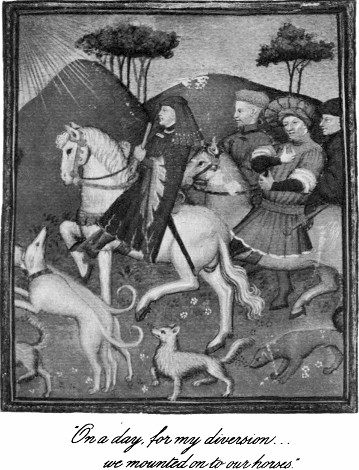
“On a day for my diversion ... we mounted on to our horses”
On a day, for my diversion, with one of my kinsfolk and four others of my gentlemen, we mounted on to our horses. A longing for the chase took possession of me, and, to ensure success, I caused the huntsmen to take greyhounds and ferrets. Then, without ado, we entered on a path the which I had ofttimes followed, but not far had we gone when a wide beaten track led us whither I knew there were many rabbits. And near by, I assure you, there was a strong and very goodly castle, but its name I will not make known.
At that time there was come to this place a Princess who was held of every one as so good and beautiful, and of so great worth, that she was had in honour of all. In nowise did we know that she was there, since we came thither by chance. Here and there, without the castle, her attendants amused themselves, some singing, some casting the weight, and others, afoot, exercising with the bar. And as they remained there, we turned our steps toward them. Then they all turned them toward us, and when they perceived us, and recognised who we were, the chief amongst them at once rose up. And when they had saluted us, they tarried not, but, as it seemed to me, by twos and by threes repaired them to their mistress. And methinks they did not hide from her that we were come there, for as soon as we were come quite nigh unto the castle, we saw a goodly company of ladies coming forth to meet us. And these gave us welcome with gracious bearing.
And we straightway turned toward them, and saluted them on bended knee. And there was amongst them both a lady and a maiden who were kinsfolk of her who was mistress of them all. And without giving affront, and without rebuke, I kissed the maiden with fair tresses, as well as the lady. And my cousin and I escorted the maiden, who was high-born, and the noble lady, and in suchwise entered the castle.
And the Lady, of whom every one spake well, had already come forth from out her chamber, and stood there with noble mien, neither proudly, nor haughtily, but in such manner as befitted her noble estate and royal person. And as soon as we saw her, we duly saluted her, and, in a little space, she came forward, and took me with ungloved hand, and kissed me, and said, “I knew not of your coming, fair cousin. You are right welcome, but what brings you here now?”
Then said my cousin, “Certes, my Lady, we set out for amusement, and knew not that you were here. Chance brought us hither, but praised be God who has so favoured us that we have found at your hands so warm a welcome.”
And the good and gracious lady laughed at this, and made answer, “Then let us go amuse ourselves.”
So we descended down into a green meadow, and then, accompanying us, she went to a very fair place, and drew me to her right side to sit down beside her. And without more ado, large cushions of gold and of silk were brought to her, under the shade of a willow, where, beneath the trees, the waters of a spring ran fair and clear along a straight channel fashioned and cut with skill through the green and tender herbage.
And no longer did she remain standing, but she seated herself with me beside her, and then the others withdrew them to a distance from us, and sat them down, here and there, beside the stream. Then she began to question me, for I confess that I knew not at that time how to converse with her or with others, for I was still somewhat young.
And she began her discourse by making enquiry of me concerning a journey from the which I was newly come, and, in especial, of the demeanour and the appearance of the ladies, and, further, in what manner the Court, the which the King and Queen held, was ordered. And I made her answer according to my knowledge. And I remember me that we discoursed together there of many things.
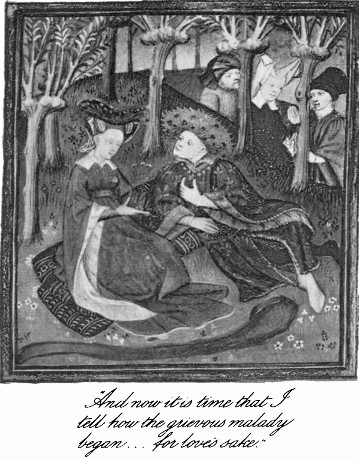
“And now it is time that I tell how the grievous malady began ... for love's sake.”
And now it is time that I tell of how the grievous malady began the which has made me to suffer right cruelly for love's sake. Truly it is a marvel to understand how it came to pass that love of her whom I had ofttimes seen, but whom I had never before thought on, took possession of my heart. It is like unto one who passes over the sea, exploring many lands to discover that which he might find close at hand, but the which he perceives not until another makes it known unto him. Thus in truth did it befall me, for, by reason of my want of understanding, in nowise did I perceive the grace of my precious lady until love put me in the way, and I had but desired to see such an one in order to yield my heart to her. For long had I seen her oft, but, until that day, no thought had I given to her. Thus I had ready to my hand that which I went elsewhere to seek. But, in order to allay my passion, love at length willed to release my heart from this strife. And now, when this perfect one, who has caused me sore trouble, spake to me, her speech and her gentle and gracious bearing pleased me more than ever aforetime, and made me wholly dumb. Intently did I observe her, and right well did I contemplate her beauty, since she seemed to me to be more distinguished, and to have much more of grace and sweetness, than I had ever before observed.
Then love, the playful archer, who saw my silent demeanour, and that I was inclined unto love, took the arrow with the which it is his wont to surprise lovers, and bent his bow, and drew it silently. But I heeded it not. The arrow of a tender glance, the which is so pleasing and so powerful, pierced me to the heart. Then was I sore bewildered. Verily did I think myself to be lost when I felt the loving blow, but my heart yielded itself to the amorous wound. In nowise was the wound mortal, for it came to pass that the sting pierced me again and again.
Then her gentle, laughing eyes, all fraught with loving fetters, so stirred my heart, that I knew not how to make answer unto her. Truly must she have thought my look and my manner to be foolish, since I moved neither hand nor foot, and I so ofttimes changed colour at her glance, that it might have been thought that my heart trembled with fear. How shall I set the matter forth briefly? If I longed to be made captive, then in this I failed not.
Thus ended the life of my early youth. How to live otherwise, true love now taught me. In this manner was I made captive from that hour.
Longwhiles did I remain there, and I discoursed in a simple manner, like unto a child, and, without ceasing, I kindled the burning fire-brand in my heart. When I gazed on her beauty, I was caught as is the moth in the candle, or the bird in the lime, and no heed did I take of it.
And when I had tarried in this place nigh unto the third of a summer's day, my cousin no longer remained in meditation, but said to me, “Take your leave now, for, on my soul, methinks you have detained my Lady too long here, and it is the time to sup.”
Then the noble and courteous one, who is called fair and good, besought me much to sup with her, but I excused me. For but a short while longer did I linger there, and then I arose, and would have taken my leave, but it behoved us first to take wine, and so we drank. And when we had drunken and eaten, I besought her that of her grace it might please her that I should escort her to her dwelling, but the fair one consented not. So, without tarrying, I took leave of her and of them all.
Then love, the more to pierce my tender heart, caused me of a sudden to receive a loving glance from her, the which came to me like a tender greeting as I left the place, for, whiles I was departing, I turned towards her, and, as I turned me away, the tender, fervent look from her fair, loving eyes, fell upon me in such wise that never, since love lodged there, has it faded away. And thus I departed with love's arrow.
And when we were without the walls, we straightway mounted on to our horses, and made all haste to set forth because of the night, the which was already come. And by the way, my cousin made great endeavour to be merry, but as for me, certes I spake not a word, but kept silence, and bowed my head in a very pensive way, for the burning and living flame with the which the tender glance had pierced and wholly taken possession of my heart, left me not, and I so thought without ceasing on the beauty of the gentle countenance where I had left my heart in pledge, and on her fair and faultless body and her winning eyes, that all came up before me. Thus I rode forward in pensive mood. And my cousin conversed much with me by the way, and spake with much good sense, but since I was wrapped in thought, I listened not to him until he said to me, “Fair Sir, what do you thus think on in silence, and what is the cause of this? Have you not had great joy there from whence you come, that you bear yourself so pensively? Certes, it seems to me, so help me God, that whoso desires a lady, could not have one fairer and more perfect than, without doubt, is the one from whom you but now come. What say you to this? Do I not speak truly? Is she not courteous and kind? Have you ever in your life seen a lady in every way more perfect? To my thinking, she is beautiful to look on, and excels all others in discretion, in honour, in grace, and in nobility, and, in fine, never on my soul have I seen her like, save only the lady who is mistress of mine own heart, for her pure heart displays such surpassing virtue that there is none other to be compared to her, save only her of whom I have spoken, and this God would allow.”
And when I heard another praised more than her whom I thought on, although before I had held my peace, no longer for all the gold in the world could I remain silent, and therefore, pondering deeply, I sighed and said, “Certes, I will say what I think, if it be only that I believe it certain that, if God would choose an earthly mistress and friend, none other could he desire if he would possess the one in the world the most beyond compare, and in pledge of this I offer my body in combat. If you take not up this gage, then you love not this same lady of yours who is without equal in the world, and once again do I avouch that all other ladies are, to this one, only as are the small sparks from a candle to the brightness of the stars.”
And when he heard me speak thus, he began to smile, and verily do I believe that he perceived my heart to be already gone out to her.
And then he went on in front, and we, riding in all haste, came in a short space to the place where I dwelt, and the night had already closed in. And at the time, my father was looking out into the court, and he sternly made enquiry where I had been all the day long, and I, who had made great haste for that I feared and dreaded his anger, saw him at a window, and much did I wish that he had been elsewhere. Howsoever I dismounted, and then, without waiting, I knelt to greet him. Then said he, turning his head, “Whence come you, fair Sir? Is it the time to return home when the night is already come? But all is well with him who returns.”
And I said not a word to him, and he left me, and I departed to my chamber. And there I supped, pensive and sad, albeit there were many youths there who were at great pains to divert me, and who related many tales to me, but know that without ceasing my thoughts were elsewhere, for it ever seemed to me that I saw, face to face, her who knew not how she had made captive my heart. And when the time to retire to rest was come, I laid me down in a well-prepared and comfortable bed, but I believe not that I slept one hour and a half, and if there was one thing which disquieted me more than another, it was that I was fearful lest perchance she for whom I felt such sweet, joyous longing, might not look upon this as I desired, for, as it seemed to me, nowhere could I obtain solace which could give me so much pleasure, and from the which my heart could derive such happiness, and, in this mood, I pondered, and said:—
BALLAD
Verily, Love, I have no language, none
Of thanksgiving sufficient for thy grace
That moved me unto love, and such an one
Gave me for mistress as doth all abase
Beside her, queen of beauty and of grace
And precious worth; O, when on her I muse,
Truly my speech with my thought keeps no pace.
Thanks be to thee, who mad'st me her to choose.
Now all that I desired so dear is won,
Having a lady to serve all my days,
Who holds my heart in joy to think upon
Her beauty, and in every hour and place
Makes my heart high and glad, so to embrace
Her soul with mine, joy that I may not lose.
Mine was the choice, but thine shall be the praise.
Thanks be to thee who mad'st me her to choose.
O now, Love, into whose dominion
I yield my heart, vouchsafe my service space
That to my lady I suffice alone,
Being all hers, and that her beauteous face
And her regard that doth all pain erase,
Bend pitying on me and not refuse
Her tender eyes; I ask no other grace.
Thanks be to thee, who mad'st me her to choose.
Ah, God of Love, ere that I run my race,
Vouchsafe I may alone content her, whose
I am always, in good and evil case.
Thanks be to thee, who mad'st me her to choose.
In such wise did I commune with myself, and as yet I felt not the fierce onset of the ardent desire which assails lovers, and makes them to burn, to grow pale, to pine away, and to fret. This was not yet come. Thus I only bethought me at the time to consider how I might be blithe and gay, and possess a very fine equipment and fair raiment, and give away very freely and without stint, and behave so honourably that in all things I might everywhere be praised of gentlefolk in such sort that my lady might regard me with favour on account of my well-doing. Thus I desired to perfect my conduct, and thereafter to abandon the childish ways which until then had made me wayward, and to take heed that thoughtlessness did not overtake me, and to learn how to have a care for that which is worthy.
All these thoughts had I at that time, and thus I sought how, in my bearing and conduct, I might put all this into practice. So I much changed my ways, and now all my endeavour was to think, and to say, and to do, that which was in every way pleasing and gracious, and on no account to do aught that was discourteous.
And I was neither sad nor foolish, but was cheerful, happy, contented, and prudent, and so as to become familiar with the ways of love, I took pains to learn to sing and to dance, and also to give myself up to the pursuit of arms, for it seemed to me that it was said truly that credit of a surety results from the pursuit of love, of arms, and of valour.
Then forthwith I so importuned my father and my mother, that I came by that which I sought after, the which was that I might have gold and silver to spend freely, and that in all ways I might be richly attired; and then I chose a device and a motto, in the which was the name of my lady in such form that none could recognise it; and I commanded chargers for jousting, and caused a festival to be arranged in order to make essay at the joust, and, as I have said, other things beside did I purpose.
So the festival was prepared, to the which many a noble lady was bidden, but ere I had answer that my lady would come to it, I made request of him to whom this was due, and who was distantly related to me; and he most heartily gave consent to it, and gave me welcome to his castle. And there I saw my lady at my leisure, but how wholly I loved her and held her dear, I told not unto her, but my face, methinks, made it quite manifest, for Love which, the more to arouse my passion, taught me its devices, made me to be all silent, and to pale, and then to regain colour, but the fair one held her peace concerning it, as if she perceived it not, and so little did she take notice of it, that I bethink me she in nowise perceived the cause of all that happened to me, and that all came from love of the which she was the cause, and the one from whom flashed the loving spark which pierced my heart which made no complaint of it. Ne'ertheless I lived happily, and ofttimes did I see her, and this it was that comforted my heart, the which rejoiced, and, aside to myself, I thus addressed her whom I so loved:—
BALLAD
My lady, and my sovereign, flower most rare,
In whom honour and worth are glorified,
Fountain of all things wise, gracious, and fair;
Who art my way toward virtue, and the guide
That over all my goings dost preside;
Lady, to whom humbly is vowed my fate,
Serving in that sweet service at thy side,
All of my days to thee I dedicate.
How else, since none could with thyself compare?
Thou Beauty filled with sweetness, O provide
Ensample kindling me to do and dare,
And bring my ship in honour's port to ride!
So sweet my joy, Lady, it cannot hide;
Therefore, in my simplicity elate,
Out of my heart and body have I cried;
All of my days to thee I dedicate.
Most noble Duchess, surely the hours prepare
That time, when thou shalt well be certified
How my heart serves thee with its every prayer.
Then shall my life be brimmed and satisfied,
When thou its full devotion having tried
Know'st it all truth; O honour's path and gate!
Fame's flowering tree! O valour's starry guide!
All of my days to thee I dedicate.
Princess, who dost in power and praise abide,
Early I learnt to love thee; and love, being great,
Lifts up my heart above all thought of pride,
All my days, all, to thee I dedicate.
And now I must turn me again to the former matter.
In all haste, a great and fair festival was prepared, where many folk had much diversion. And proclamation was made of the jousts, at the which whosoe'er would combat lustily might win jewels of great worth and the prize, and that to this tournament there would come twenty knights who would joust with all comers.
And on the day appointed, the meeting was held in a fair meadow, where, well placed at the end of a lake, was a castle the which had six high towers. And in this meadow were set up large and spacious tents and scaffolds, and pavilions in great number, and all was made ready for the festival and the jousts. And without adding more of this, I tell you that when the day named was come, my sweet lady arrived before nightfall, and there met her a goodly company of noble folk, and, certes, minstrels with drums, of the which there were more than three pairs, and trumpets the which they blew so loudly that the hills and valleys resounded.
And know that I had great joy when I saw my goddess coming toward me, and never could aught beside happen from the which I could derive such joy. So I met her in the way with a very noble retinue, and I approached her litter, and saluted her, as she did me, and then my fair lady said to me, “You take great trouble, fair cousin, for it puts you to inconvenience to come at such a time.”
Thus holding, with joyful countenance, much converse with my sweet and dear lady, we came nigh unto the castle, and riding beside her litter (and, certes, it seemed to me that I had for my service sufficient recompense, since my great joy was doubled in that it appeared to me that she then looked on me more tenderly than she had ever done afore), we arrived at the castle, where we found awaiting her many fair ladies, who kneeled before her in seemly manner.
And in the courtyard she descended down from the litter, and was received there with great rejoicing; and I forthwith escorted her through the rooms to her tiring chamber. And all the house had been made ready for her whom I thought on, and at whose dwelling I had sojourned.
Then those whose duty it was brought wine and comfits, and the fair one desired that I should partake of them with her. And after this we withdrew, and retired elsewhere, so as to suffer her to have repose for a while, and I straightway withdrew me elsewhere, and dressed and attired me.
And so as to dance in the German fashion, and to the end that naught should be wanting to make the festival perfect, I had caused an hundred rich liveries to be made according to my device, and I remember me that the five-and-twenty of them the which the knights had on this occasion, were of green velvet, and of cloth of gold broidered. But on the day following the joust, the esquires and the gentlefolk, but not the waiting-men, apparelled them, whatsoe'er it cost, in satin, broidered with silver.
And when that we were dressed, we appeared before my mistress. And there we found a goodly assemblage of ladies and damsels of the country who were already come to this festival. Then, without tarrying, I saluted my lady and them all, and verily do I believe that I changed colour. Ne'ertheless I said, “My Lady, it is time to sup.” And straightway I took her by the hand, and led her to the hall. Then each one descended thither. The knights led the ladies, and the minstrels blew their trumpets in such manner that everything re-echoed with the sound, and the feast gave such pleasure, that it made a goodly sight to witness.
And my lady seated herself on the large raised dais, and I think not that it was displeasing to her that next to her I placed my mother, and that, after her, four countesses, who entertained her well, seated them close by, following down the hall each one according to her rank. And the gentlewomen-in-waiting all sat them down in order of rank. And the gentlemen seated them apart. And I hope and believe that in all respects they were well served at the supper with meats and with wine.
And, without making any excuse, I tell you that, when we had supped, after taking comfits, we drank. Then the minstrels came forward, and began to sound their horns in pleasing harmony. And, in a short space, there began the dance, joyous and gay, and at it every one, because of the happy festival, made merry.
Then no longer did I tarry, but I went straightway to beseech my lady to dance. And for a little she made excuse, but at last she gave consent. So I took her by the hand, and led her to the dance, and then I escorted her back to her seat, and misdoubt not that I was so carried away by love of her, that I seemed to myself to be altogether overcome of delight to be near her. I bethink me that I conceived this to be indeed the celestial paradise, and desired naught better. And that which pleased and rejoiced me the most, was her very sweet countenance, the which, fearlessly and without frowardness, and with a gentle, tender glance, looked upon me so sweetly and so kindly, that it seemed to me that all I said and did was pleasing unto her. And I observed her very intently, and then I cried for joy, for I seemed to possess the great happiness which I desired.
And it was right fitting that I should now approach her joyously. And so we danced merrily a greater part of the night, and then the revel ended, for it was time to make ready to retire to rest. Then I led her who was as fair as amber to her chamber, and there many a courteous word was spoken. And when she had gazed on me with her eyes the more to inflame my passion, after partaking of comfits, I took leave of her and of all. And we laid us down, here and there, on fair beds, with rich coverlets, but all the night long I ceased not to think on her beauty, and I gave utterance to these words, the which were in my heart:—
ROUNDEL
When you are come, joy is so all complete,
The heart leaps in my breast, beholding you,
O flower of beauty, O rose fresh and new,
Whose slave I am, whose servitude is sweet.
Lady of gracious ways, whom all men greet
Most beautiful of women and most true,
When you are come, joy is so all complete.
For you the happy festival shall meet
In glee; with none else have I need to do
For my delight; from you alone I drew
The life and joy that make my heart to beat,
When you are come, joy is so all complete.
And like unto one who is consumed with love, I was impatient for the morn, when I might see my mistress. So I arose from my bed as soon as I saw that the time was fitting. And already was the house full of brave and valiant knights, and esquires who even now were jousting with foils and overthrew many an one.
And when that I was ready, and mass was said, I went out, and because I saw not my lady, I remained pensive. Then I went to meet her, and in a short space I found her. For the nonce she was at mass, but after hearing it, she hasted to make ready her attire.
And when, after she was come forth from the chapel, she had attired her fair form, the which of a truth was fair above all, I courteously made her salutation. And she said tenderly, “Welcome, fair cousin. Take good heed, for every one who would win a fair lady will appear at the joust.”
Then I smiled, and took courage to say, “I would make a request of you, my Lady, and if you will grant it, right glad shall I be. It is that you give me, if so it pleases you, a sleeve from off one of your bodices, and a chaplet of periwinkle, to wear on my helm. Methinks it would not please me more, or give me greater joy, if that you gave me a kingdom!”
Then my lady pondered awhile, and at length she said, “Certes, fair cousin, it would profit you more to have agreement with some other lady for whom to adventure knightly and brave deeds. There are here many ladies of high degree, but right certain it is that you cannot have a lady here without jeopardy of your life if you would have of her, to place on your helm, a token for the which it behoves you to go forth to do deeds of chivalry. This you should receive from your mistress and friend, and not from me, but I tell you that I am by no means willing to refuse you your request, for even more would I do for you, though I would not that any one should know of it.” Then she drew a knife from beneath her bed-hangings, and cut out the sleeve with the ermine from one of her bodices of cloth of gold, and gave it to me. And for this I gave her much thanks, and I likewise received from her the green chaplet, wherefore I was happy and joyous, and said that I would bear it on my helm, and would joust for love of her, but she must be willing to take all in good part, for I had still to learn how to do this.
Then my gracious lady was silent, without letting it be seen whether this was pleasing unto her, or whether it gave her displeasure, and more I dared not say. And I took my leave, for it was time to go.
And the dinner was made ready early on that summer's day. We all dined hastily in our chambers, and then repaired to the meadow where the jousts were to be held, and dismounted before the gorgeous pavilions set up around. The armour was there already, and the lances were got ready, and the chargers were examined. And there you might see high saddles with stirrups, and covered with devices, white, and red, and green, and shields of many colours, and painted lances; and already there was a great assemblage, in many rows, of the common folk, and much quarrelling and uproar.
And then I armed me, and made me ready, in my pavilion, but I tarried there awhile, for it fell not to me to sally forth to begin the joust. And there were twenty of us, apparelled alike, and all akin, and we were knights prepared to joust with all comers.
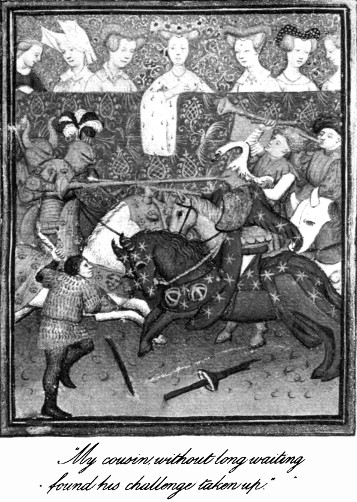
“My cousin, without long waiting, found his challenge taken up”
And my cousin, of whom I have before spoken, and who was very courageous, was the first in the field. To this he was well accustomed, and in such array did he enter the lists, that verily he looked like a kinsman of the king. And he had his helm laced for to tourney in proper manner; and painted lances, and banners, and much fair company were to be seen there, and, as was fitting, many a player on the pipes was to be heard, the which gave delight to all around. But of this we will say no more.
And I had caused many pavilions to be set up there for the service of strangers, where they could lodge and refresh them. And you may be assured that before the appointed hour there came thither many valiant knights who failed us not at the joust. Others, who came to look on, remained on their horses.
And my cousin, without long waiting, found his challenge taken up by a knight who touched his shield with the point of his lance, and he avoided it not, so that if it should chance unto him to be overthrown in the encounter, then must his blood be spilt.
And it was our part to be the first to take the field, and the heralds might be heard making proclamation in a loud voice of the name of this one, who was known in England and in many lands. And then five of our company sallied forth from the tents, and in nowise did they fail to joust with all comers, and of a truth each one did his duty there so exceeding well, that it is indeed right that the renown of their achievements should endure.
Then the general tourney began, and, in double file, and much increased in numbers, our company sallied forth, and, as it behoved them, tourneyed bravely. The trumpets sounded joyously, and the heralds made proclamation, and the knights on noble battle horses, and according to their several ranks, tourneyed lustily. And my lady, and many other ladies, each one of whom was fair to look upon, twenty ladies with fair tresses, nobly born, and adorned with chaplets, of whom the sovereign and mistress was her who was in my thoughts, were seated apart, in order of rank, on scaffolds richly bedecked. And, certes, they were all apparelled in gowns of white silk, broidered with gold of special design. They seemed like unto goddesses from heaven, or fairies fashioned as faultlessly as one could desire.
And you may know of a surety that many a glorious course was run that day, and, certes, it must have been not a little pleasing to those who watched such beings, since they made great endeavour to merit their regard, and to overcome each other, the better to win their favour. Thus you could here see many a thrust quickly parried, and how that one overthrew another in the shock, and another aimed at the opening of the visor, or else struck at shield or helm. One was unhelmed, or at once cast to the ground, and another came who carried him off. Lances were broken, and blows resounded, and the trumpets were sounded so loudly, that God's thunder could not be heard. And hard blows were given on either side.
At length, with lance in rest, I sallied forth from my pavilion swifter than a merlin, well planted in the stirrup, and armed all in white on a charger, the which had a white caparison. Neither red, nor green, nor any other colour whatsoever was there, save fine gold. And there came forth with me all those of the place, and these meted out many a good blow, and all were armed in white, and the lances the which our folk bare were all of white. And I had caused the sleeve, the which my lady had given me, to be right well disposed, and fastened firmly to my helm, so that it could not be torn off. And I placed the green chaplet on my helm, and set me forth with a goodly company, for exceeding great desire had I to see my very sweet goddess.
Then, all full of gladness, I arrived at the place of jousting. And I turned my eyes to where she was, and met with her tender glance, and thus I feared not any mischance. I passed before her, and then quickly closed my helm and went to my place. And, in her presence, a noble count forthwith brought me my lance, at the same time saying unto me that much shame would it be to me if I jousted not worthily since I bare so noble a crest.
Then, with lance lowered, being desirous that it should be rightly placed, without ado I spurred my charger against another, and you could see him come towards me. And we faltered not in the encounter, but, since it is not seemly to relate one's own deeds, I will not here tell aught with regard to my exploits on that occasion, save that the fair one held what I performed that day so well done, that, of her grace, she gave me very great praise for it, and, in the end, she awarded the prize for those who were of the place to me, and, right joyous, I took it with the ready assent of the ladies, and thus you may know of a truth that, according to my age, I did my duty there, all the day, as much as in me lay. If I did aught that was valiant, no praise do I deserve for it, for you may know of a surety that it was love, and not I myself, which was the cause of it all. Without doubt there were to be found in this company many proven knights more doughty than myself, for, of a truth, as was well known, there were come there, from all parts, both nobles and those of lesser degree who were more worthy of the prize. But I trow that the ladies did this for that they saw how eager I was, and because of this favourable disposition, I believe that when they awarded me the prize, they were really desirous that I might be constrained to joust the more readily.
And the prize which was decreed for strangers, was given to a German, an able and skilful jouster amongst a thousand.
Thus did the tournament dure all the day, and, without ceasing, fresh jousters came to it, and our men maintained themselves against all comers. And how shall I sum it all up? Every one jousted well and fairly, but the blows which were given, and by whom, and in what manner, it concerns me not to recount, for that is not what I have in view, nor what I purpose to tell.
And night came, and the joust ended. Then every one departed quickly, and all returned to the castle, where the cooks made haste with the supper. And I sent my gentlemen to those who were lodged without, as to friends, with a message that, in the name of the noble ladies, and in my own name, I earnestly besought of all gentlefolk, both strangers and neighbours, that they would come and keep festival with us. Thus on all sides I caused a knightly entertainment to be proclaimed, and that whoso would, might come and keep the feast.
Then straightway there came those of both high and low degree. There were barons from many lands, and it needs not to ask if there was a great assemblage, and, certes, there were received there, with ever increasing pleasure, so many folk, that the castle was filled. And I received them with glad countenance. And there was a great number of barons and of gentlefolk from many parts, and, with right goodwill, I did honour to each one according to his rank. And the supper was plenteous and choice.
And when that we were risen from the table, the minstrels sounded their horns, and those of noble rank apparelled them for the dance, and none were there amongst them who did not wear rich broidered doublets, all sewn over with lace of beaten gold and silver, and the ladies were arrayed in like manner; in suchwise did they make ready to dance gaily. Then merrily commenced the glad festival, at the which many a gracious lady and fair damozel courteously besought the strangers to dance, and led them forth.
Then the dancing commenced throughout the hall, and every one strove to dance gaily. But I, whom love had filled with ardent passion, thought only of my lady, and gave no heed to this. I essayed to dance a little, so that my longing might not be perceived or known. Then I joined the elder knights, until word was brought to me to go without tarrying into the hall, for that my lady, who eagerly made enquiry for me, sent for me. And truly did I rejoice at this. So with a goodly company of gentlefolk, I turned me to the hall, where all were merry for that they vied with one another in the dance.
And when I was come to my lady, she said to me, “Fair Sir Cousin, wherefore do you not dance?”
And I made answer, “Do you dance, my Lady, and thus set me the example.”
And she said that I must dance first; and so, to make commencement, I led to the dance a fair lady with a merry countenance, and escorted her round once or twice, and then led her back to her seat. Then I took my lady by the hand, and with her assent, gaily led her forth to the dance.
Thus the dance dured the most part of the night, and at last it ended, and each one retired to rest, and laid him down on fair white sheets. But I who had lady and mistress, and who in my heart felt the torment of the desire to be loved of her with the which I was consumed, spake thus under my breath:—
ROUNDEL
Laughing grey eyes, whose light in me I bear,
Deep in my heart's remembrance and delight,
Remembrance is so infinite delight
Of your brightness, O soft eyes that I fear.
Of love-sickness my life had perished here,
But you raise up my strength in death's respite,
Laughing grey eyes, whose light in me I bear.
Certes, by you my heart, I see full clear,
Shall of desire attain at last the height,
Even that my lady, through your sovereign might,
May me continue in her service dear,
Laughing grey eyes, whose light in me I bear.
And the day dawned, and what shall I tell concerning it? Wherefore should I longer stray from my subject without good cause? On the morrow, throughout the whole day, the esquires, who bore them fairly and well in every way, likewise jousted. And there were also twenty, clad all in green, who maintained the combat, and the ladies assembled to watch them, and to bestow the prizes. And there were twenty damsels there, apparelled in green, and they wore golden chaplets on their tresses, and were all very noble ladies, comely, and fair to look on. And during the encounter, many high-saddled chargers were overthrown, and shields were struck, and lances broken. And many a blow deserving of praise was given and endured. But I will not stay me further to give a long account of this, for it pleases me better to rehearse that for the sake of which I began this story, and that which I thought and did and said in this love affair, about the which at that time I made great dole.
For three whole days—this is no fable—the pleasing festival dured, at the which all were made welcome and at their ease. Then the revel ended, but my lady departed not for the space of a whole month. I besought of him who was her lord to grant this, and he granted it, and if that I had dared, right willingly would I have made a recompense unto him for this.
And you may know right well what joy I must needs have had from this pleasing sojourn. Each hour my only care was to devise perfectly how I could best give her diversion.
And on a day I caused baths to be made ready, and the stoves to be heated, and the tubs to be placed in white pavilions in a fitting spot. And it chanced that I went thither when my lady was in the bath, and she received me not with pleasure, but I had perfect joy when I looked upon her fair flesh as white as a lily. Greatly did this delight me, as you who hear tell of it can well believe. On another day we went to the chase, and on another we descended down to the river to fish. In suchwise did we pass the whole month, following many gladsome pursuits.
But know that in the midst of this my happiness, love bound my heart in its toils more firmly than ever, and laid so violent hold on it, that a great desire to be loved was so kindled within me, that, ere the festival was ended, never did any other miserable being endure such stress of mind. No happiness had I if I could not see her and gaze constantly upon her, of the which I never wearied, for, as it seemed to me, never could I be enough in her presence, and moreover this mood made me so to crave after her kindly goodwill, that dolour laid grievous hold on me, and you may well believe that I was not skilled enough to know how wholly to hide the grievous sorrow I endured. And albeit I would not discover my thoughts to either man or woman, ne'ertheless so troubled was I in mind, and in such great tumult, that, in spite of myself, my face revealed my state.
I was now pensive, now merry. And like unto one forsaken, I ofttimes wept so bitterly, that I seemed to myself like to die in grievous sorrow from despair and from loss of the hope of ever gaining her love; wherefore I paled, and trembled, and reddened, and oft changed colour, and sweated from fear, and became disquieted, so that at times my courage altogether failed me, and then it oft happened that in bed I became quite calm. I neither drank nor ate meat with relish, nor could I in anywise sleep, the which threw me into such state, that I grew worse and worse. And no one knew what ailed me, for in nowise would I speak to any one of my condition, nor for my life would I confess it even to her whom I loved. Ne'ertheless she ofttimes enquired of me what ailed me, and bade me tell unto her my condition, and hide it not from her, and that I should speak to her without fear, for I must not doubt me that she would do all that in her lay to ease me.
Thus longwhiles my lady comforted me, but ne'ertheless I dared not, for all the gold in the world, make known or confess unto her the load which my heart bare, and thus, in deep thought, I wept and sighed.
And at that time I became so filled with love, that I know not what more to say concerning it, save that I had troublous and painful acquaintance with it, and from that time lacked the quiet and pleasurable peace of mind which aforetime I enjoyed, and plunged my heart into another peril, for I came to reject all solace, and to make of sorrow my very pitiless guest. Longwhiles did I remain in this state, without daring to pray for mercy, for fear of refusal. And thus, bewailing my ill-fortune, I made complaint in these words:—
BALLAD
Love, I had not ever thought
Thou would'st bid thy servant share
Grief to which all else is naught,
Grief whereunder I despair:
Thus unfaltering I declare
That in death I pass away
If thy saving grace delay.
In a burning passion caught
I grow faint, and may not bear
All the torment it hath wrought:
Thine the fault, be thine the care!
Loose me from this evil snare!
Other help is none to pray,
If thy saving grace delay.
Rather had I death besought,
(So without deceit I swear),
Since my heart is all distraught
With thy flame enkindled there.
Murmuring is not mine to dare:
I must perish as I may,
If thy saving grace delay.
Love, with gladness meet my prayer,
Cleanse my soul and make it fair,
Since in sorrow I must stay
If thy saving grace delay.
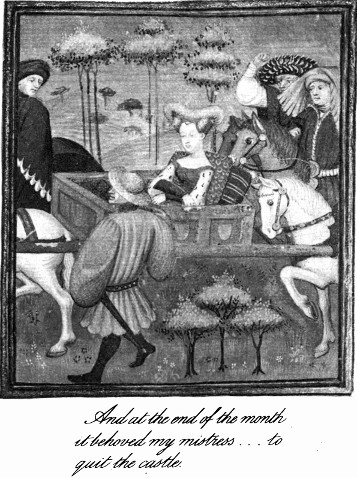
And at the end of the month it behoved my mistress ... to quit the castle
And at the end of the month it behoved my mistress, by reason of whom I lived in anguish, to quit the castle afore-named, for no longer could she remain there, and so she departed. Then was I truly in grievous plight, since I lost from sight the very perfect fair one without whom I could not live. Now was all my happiness ended, for longwhiles had I been used to look on her, and to be with her, at all times. But now it befell that perchance three months or four would pass ere I should hear of her, or see her, the which was very grievous unto me to endure. And I so grieved over the past, and felt such dolour at her departure, that I lost my colour, my judgment, my demeanour, and my self-command. Thus I believe that, as it might well be, many folk perceived my yearning, about which they made gossip, the which caused her disquiet. And so much did this weigh upon me, that I thought to die of grief. And when I heard it noised abroad that I loved my fair lady, my grief was the more increased, for, because of this, I had suspicion that this great friendship made discord between me and her friends, and this grief caused me very dire distress, for I much feared me that she was constrained to leave because of this, and so much did this disquiet me, that I know not how to tell of it. Howsoever, as far as in me lay, I hid my sorrowful anger better than was my wont, and, enduring great grief, sighing, I uttered these words:—
BALLAD
Now in good sooth my joy is vanished clean,
And all my gladness changed to grievous ire:
What profits it, dear flower! since I have seen
Thy going hence, that I could never tire
When thou wast here
To greet thee every day in every year?
Delight that was is grown disaster fell:
Alas! How can I bid thee now farewell!
My love, my choice, my lady and my queen,
For whom my heart is kindled in desire,
What shall I do when love from what hath been
Taketh the gold and leaveth me the mire?
Nor far nor near
Is comfort found, nor any pleasant cheer.
Gone is thy beauty, that did all excel:
Alas! How can I bid thee now farewell!
Thine is the deed, O evil tongue and keen!
Forged for my fate upon an anvil dire:
Fortune, that loveth not my hand, I ween,
Nor yet my pen, did in the task conspire.
No help is clear
Save Death, when God shall grant him to appear;
Else thou alone could'st win me out of hell.
Alas! How can I bid thee now farewell!
Ah, simple and dear!
At least behold me and my mourning drear.
Thy loss is torment more than I can tell.
Alas! How can I bid thee now farewell!
And the day of departure came, and my lady set forth, and I verily believe that she would have still delayed her going if she had dared, but it was meet for her to do her lord's will, since it behoved her to guard his good name. And she gave thanks to all, and took her leave, and set out on her way.
And I, unhappy being, who attended her, rode beside her litter, and the fair one, who could well perceive how that, without disguise, I loved her with a true love, looked at me fixedly with so tender a glance, that methinks she desired to cheer my drooping heart, which was sad, and moreover she might perchance have conversed with me but that on her left hand there rode another, who came so nigh unto us that we were not free to say aught which he might repeat, for the which I hated him fervently, and I saw well that I should oft have to endure much vexation.
In such manner we rode for a day and a half, until that we were come to her dwelling, but in nowise did the journey seem long to me, but quickly ended, and in truth it wearied me not, albeit I verily suffered. And I would have taken my leave of her, but her Lord, making much false pretence of welcome, endeavoured to detain me, but I knew from his demeanour that he was beside himself on account of me. And this jealousy had been put into his head by one who was at our feast, and to whom I had afterward made a recompense, and never did I think that he would keep watch on her. This caitiff had the charge of the fair one whom I worshipped, and for whom I was dying of grief. So I took my leave, and went on my way, and out of regard for my sovereign lady I dissimulated, and hid the sorrow that was mine, and never did any eye discover that which was such grievous pain to me, and scarce could I restrain my feelings. But this was needful for fear of the slanderer, and so I departed, saying:—
BALLAD
Farewell, my lady dear and dread,
Farewell, of all sovereign and queen,
Farewell, perfect and sacred head,
Farewell, who dost all honour mean,
Farewell, true heart, loyal and clean,
Farewell, best flower the world doth bear,
Farewell, yet not farewell, O white and fair!
Farewell, O wise, that no ill said,
Farewell, river that made life green,
Farewell, in whom fame harboured,
Farewell, voice that all ears could win,
Farewell, solace of all my teen,
Farewell, whose grace is wide as air,
Farewell, yet not farewell, O white and fair!
Farewell, soft look that through me sped,
Farewell, more fair than Helen queen,
Farewell, body and sweet soul wed,
Farewell, thou most gracious demesne,
Farewell, pole-star, joyous and keen,
Farewell, fountain of valour rare,
Farewell, yet not farewell, O white and fair!
Farewell, Princess of noblest mien,
Farewell, thou aweing smile serene,
Farewell, without fault, sin's despair,
Farewell, yet not farewell, O white and fair!
Thus did I commune with myself, and, sighing, I departed, and made great haste to reach my dwelling. And I was weighed down and troubled with grievous sorrow when I no longer saw there her whom I had dared choose as my lady, and whom my heart held so dear.
Now I made known at the beginning how that I desired to be a lover, and to be gentle, and how love wounded me with his dart, of the which my heart will never be healed, and as I have spoken of the ill that came to me from that time, so is it meet that I tell you of the good. And this distemper increased, by reason of which my strength diminished, so that in a little I grew pale, and thin, and sad, and ofttimes sighed from grief, for no solace had I, since I knew not how to discover any good way to see my sweet lady, and, certes, so much did I fear her rebuke, that I dared not approach her, however grievous it was, and this plunged me into tears, and troubled me. Thus I was sick a-bed, and then I uttered this ballad:—
BALLAD
Since, O my Love, I may behold no more
Thy sovereign beauty that was all my cheer,
My heart is given up to sorrows sore:
For though the wealth of all the world were here,
There is no ease but in beholding thee
Who art afar! Whence I of tears am fain
Mourning the happy days that used to be:
Yet unto none but thee may I complain.
Doubt not of this, true love whom I adore,
Thine image in my soul is ever clear:
I think but on the blessedness of yore
And on thy beauty, simple-sweet and dear.
So fiercely smiteth love, I may not flee
Nor may my soul the dread assault sustain:
Death could not bring a sorrier weird to dree,
Yet unto none but thee may I complain.
Alas! one only mercy I implore.
When I am dead (as I to death am near)
Pray for me, and thy praying shall restore
My wounded spirit: shed one tender tear—
Great were my comfort if my piteous plea
Might touch thy heart, if sorrow might constrain
Thy lips to sigh, such need of sighs have we.
Yet unto none but thee may I complain.
Sweet flower, to whom I do abandon me,
My heart is broken down with bitter pain
For one whom Fortune would not have me see:
Yet unto none but thee may I complain.
Here is set forth how the Lover made Complaint
unto his Friend
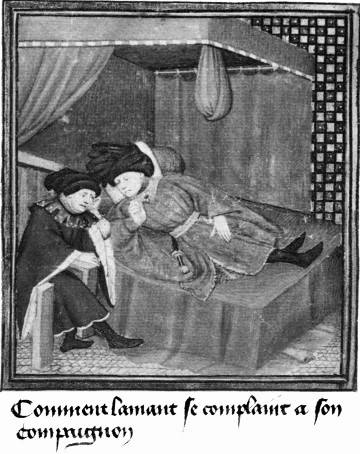
Comment l'amant se complaint a son compaignon
Thus did my sorrow increase until my heart endured very grievous torment, and without doubt this sore trouble would have killed me if God had not betimes brought back my kinsman of the whom I have made mention, and who delivered me from destruction. And when he was come back from the country, he well perceived and understood from my countenance the sorrow which possessed me. Thus he found me very sick and without colour, the which caused him great disquiet. And he came to me as soon as ever he was able, and I was o'erjoyed when I heard his voice, for right dearly did I love him. And he wept when he saw me thus grown worse. And I drew him near to me, and embraced him lovingly, and he said to me, “My God, what a face! Is there cause for it? In good sooth you must tell me truly of your state, without reserve, and naught must you conceal from me of your condition which you would not do from a priest to whom you would make confession, and, certes, very foolish would you be to keep sealed up in your heart the trouble which robs you of your peace of mind and your health. So much have I frequented the world, that I perceive and understand your sorrow, for I have been in danger of the like malady. This is not sickness; rather is it passion, for doubtless such love has come to you as consumes you like as fire does straw. Of this, naught have I to learn of you. And greatly do you misconceive our close fellowship if you fear that in aught I would betray you, and that I would not screen you more than I would myself. When you have told unto me the trouble which has cruelly taken possession of you, doubtless you will find your grief diminished, for very great hurt comes to him who suffers from love-sickness without speaking of it to any one. Therefore tell me the whole matter, my dear cousin, my lord and my master, without keeping aught back, or, if you do not so, for longwhiles will I go into Germany, for believe me that it grieves me not a little to see you thus, and not a whit can I rest.”
And when this one, who held me dear, had thus, to the utmost of his power, urged me to make confession unto him of my inmost thoughts, his gentle speech so touched and melted my heart, that I began to sob and to weep piteously enough to kill me, since it seemed as if I neither ought nor could tell unto him the grief which everything caused me. And he, cast down and sad by reason of the trouble from the which he saw that I suffered, out of great compassion wept bitterly, and began freely to make offer to me of himself and his possessions for to make me happy, and in every way, no matter how great it was, he strove to this end, and without ceasing he strongly counselled me rather to take comfort, and to weep no more, since this was neither reasonable nor dignified.
In suchwise did my good friend exhort me to be happy once more. Then I at once made him answer, “Sweet cousin and friend, I know well that you have great love for me, even as I, forsooth, have for you, therefore it is meet that we conceal not from one another our joys, or our misfortunes, or aught beside. Therefore I will tell unto you truly all my state, although to none other, however much I loved him, would I speak of it. You know, very sweet cousin, and you have in remembrance, how that we went together, not long since, to a place nigh unto this, where we met with a lady whose coming I have since paid dearly for, for from that time my very simple youthfulness has left me, and, without intent to do me harm, love has brought this trouble upon me, from the which I am dying, but in nowise must I blame any one, for truly no lady is there who is her equal in beauty, in prudence, or in worth. And you know how that I devised our festival, the which was gorgeous, and that all this was for love of her. And after the feast was ended, I besought of him who is her lord, to allow my sweet lady to remain all the summer at our castle for her diversion and pleasure, and to hunt in the forest, the which was green then, and is so still. And you know that he willingly gave consent, but you stayed not, methinks, three whole days after that, for you soon departed thence, but life was joyous to me because of my lady whom I saw the while without hindrance. But, with intent to make me sorrowful, misfortune, which busies itself with bringing much hurt to lovers, caused one, whom may hell-fire consume, to keep watch on my doings, and this one, like unto one full of malice, well perceived my state (for I was very inexperienced), and that my heart was altogether in bondage to her. In nowise do I know how he was able to perceive it, for, to deceive every one in this affair, I took much pains to dissemble, and so much the more frequented the company of other ladies, and never did I discover my thoughts to any one, nor did I even speak of them to her whose liegeman I am, and who wots not aught of that which weighs heavily on me. And this disloyal one noised abroad such report, that her jealous lord constrained the fair lady to depart without more delay. Wherefore, if I had not feared me to bring dishonour upon her, I would have made him who brought this about to feel regret for it, and greatly to repent it, and to experience my vexation and displeasure. Thus have I lived in distress for the space of three months, and sooner would I die, so as to be delivered from this sad grief, than live thus, since I can no longer see her, albeit she has since, of her grace, made enquiry regarding my state, and has caused me to know that in a little while I may count upon seeing her, although I must not let this be known, and that a time will come when a change in affairs will come about, and that I must be of good cheer. So I know, or at least bethink me, that my dear lady perceives and knows without doubt that I love her sincerely, but scarce can I endure the strain of the longing which possesses me, for greatly do I long for her. Ne'ertheless I have since seen her, though unknown to others, for I disguised me so that I might not be recognised, and, from a distance, I have seen her pass by. Thus you can understand that I have since lived in such grief that a speedy death has been my only desire. But I see not how either you or any other can succour me, for it is not possible that this jealous one, with his spies, would not discover it, and be assured that I must either endure this or die, but if that you will give heed for a while, you will understand wherefore it behoves me to rejoice over this grievous experience of love, and how I maintain this in my song.
BALLAD
Thou, O Love, the traitor art!
Tender once as any may,
Then the wielder of the dart
That is pointed but to slay.
Thee with reason, by my fay,
Double-visaged we declare:
One is as the ashes grey,
But one is as an angel fair.
Loth am I to find my part
In the night without a ray,
Yet desire hath stung my heart
And I sigh in sorrow's sway.
Gentle hope will never stay
In the mansions of despair:
One to death would point the way,
But one is as an angel fair.
Hope might in my spirit start,
Death thy servant bids her nay:
While beneath thy scourge I smart,
Doleful still must be my lay,
Since to set my steps astray,
Thou at once art wheat and tare:
One is like a devil, yea,
But one is as an angel fair.
Love, thou teachest me to say
Double tribute is to pay
For thy servants everywhere:
One is grievous, well-a-day!
But one is as an angel fair.
Much did this ballad charm my cousin, but greatly was he distressed at my grief, and in this manner did I, who never wearied of, or ceased from, weeping, make an end to my discourse. And thereby my distemper was diminished, but my cousin was forthwith angered when he saw me thus discomforted. And he spake thus to me: “Alack-a-day! Right well do I perceive that you possess little discretion and courage. What reason have you, fair Sir, to demean you thus? Certes, you should be happy, methinks, since your lady, by her messenger, makes promise to you of solace at a fitting time. You are foolish when you relinquish the hope which gives you comfort, for be assured that your lady is mindful of your love, and that she longs to give you pleasure. How can such grief enter your foolish thoughts, so as to allow you to be thus cast down and to die of despair? Many a lover, without any hope of being loved by his mistress, has longwhiles served in great anguish without any solace either of soul or body, and not a single glance from her has he received, nor has he dared to approach her for fear of slander. If you have patience, and believe what I say, certes, you have but to make plaint as I have done, and you will soon be able to attain your desire. Since your lady takes pleasure in your doings, you may be assured that no fear will be strong enough to restrain her. But however grievous it may be, it may lead to your undoing that you have allowed so long time to pass by without making her acquainted with your state. Very certain is it that never will she importune you, and I know not wherefore you were so foolish that, when you had opportunity, and were unhindered, you spake not to her of all the love with the which you loved her, instead of giving yourself up longwhiles to dreams!”
Then I forthwith made answer, “Alas, Cousin! I dared not, even if I had fitting opportunity, for I was afraid, and so much did I fear her, that I dared not tell her of it, even if I died because of this. For this reason I faltered, and greatly do I repent me of it, but never had I the courage to do it, for in her presence I was greatly disquieted, although when I was alone I thought to myself that I would speak to her. And it ofttimes happened to me thus, but, certes, I persevered not when I was in her presence. The delight of her loving glance, the which was so sweet to me, filled me with such great ecstasy, that it seemed to me that she would perceive my distress of mind without my saying aught.”
Then my cousin made answer, “Foolish is the lover who hides from a lady the love he bears her, for, on my soul, the delay may do him sore hurt. But since you dared not speak to her because of the fear which possessed you, as you know well how to write, wherefore do you not send her a letter or missive? And I am still more surprised at your folly that, when you received her messenger, you sent not back word to her of your state since the time when you parted from her. And wherefore did you delay? His coming was indeed timely had not your folly held you back, and in this I without doubt speak the truth, for, since she so desired to give you gratification that she took thought to hear news of your doings, you can perceive that your love was in her thoughts. She must indeed regard you as a novice since you sent not to her! Never a day let fall from your lips a single word in anywise touching upon sadness, but rather be cheerful, and leave all to me, and so well shall I know how to deceive every one, that I am willing to become a monk if there is any one on this earth who will be able to hinder you from seeing the fair one without this ever being noised abroad, if she so wills it, and you desire it. So grieve no more, but make glad countenance, for, without preaching longer to you, I make promise and swear to you that ere the week is passed, more than once shall you see your lady. And if God guides me in this, verily shall I find out the way to accomplish this.”
Then, even as the light illumines the darkness, and the exceeding brightness of the sun banishes the gloom, so was the cruel torment of my suffering subdued and ended by this one, who so truly comforted me that he filled me with joy and gladness, and stayed my grief, so that I had naught left of the which to make complaint.
And in nowise did he make default, but when that an hour and a half was gone by, he set forth to my lady. To be brief, he spoke prudently to the fair one, and right gladly did he plead on my behalf, and of his own free will he told unto her all the truth concerning my sad trouble, and how that he had found me nigh unto death, and knew not whether I could recover from the sickness the which constrained me not to stir from my bed, and he told her all, and, in a word, that he could not comfort me. Then he counselled her that, for God's sake, she should not suffer one so young to be placed in peril of death by reason of too great love of her, and that she would be to blame if she were the cause of my death.
In such manner did he, by his gentle and wise speech, entreat my lady to feel pity for the sickness from the which I was languishing on account of her, since never did I waver in the desire the which brought misery unto me and made me long to see her. And he told me that when he had ended his discourse, he saw that the fair one, who was very silent, was pale as death, and of very sad countenance, and he well perceived from her demeanour that my sickness grieved her, and aroused her compassion, but she ne'ertheless desired it to appear quite otherwise. And she spake in this wise: “This is a strange thing that you tell unto me, fair Sir, that my cousin and yours is in this state. By the Apostle Paul, scarce can I believe that he could ever have thought on this! Good God, that this should have entered his thoughts! But if this be so, doubtless it is naught but youthfulness and great lack of prudence which plunges him into sadness, and, with God's help, in a little while this will pass away. Turn him from this if you can, and counsel him that he put an end to it, and turn his thoughts elsewhere, for never could he come near me without great ill coming of it if that he were seen. I wot not how it came to the knowledge of that spy (God curse him), by reason of whom I have not the courage to speak to any living man, and if he were within, I should not dare to hold converse thus with you. Since he discovered that this young man had the daring to love me, he has filled my lord with bitter anger, and has aroused such jealousy of me, that in nowise do I dare speak to any one alone, and wheresoe'er I am, there the varlet must be, and I have him ever at my heels, for he is set to keep watch on me. And I fear me that all this is only because of suspicion of your cousin, for he pays close attention to that which is said to me, and ofttimes goes to the gate to see who enters here. And by God I swear to you that, if it were not for qualms of conscience, I would have him so well beaten by my kinsfolk that, unless he were very foolhardy, never would he dare return to keep watch on me. And so that this espial, the which is so irksome to me, might come to an end, I sent word to your cousin, and urged him much that for awhile he would refrain from coming hither, so that this spy might not see him, and that when this watchfulness was somewhat abated, he could come to see us, and more he could not look for. It indeed seems to me certain that it will come to an end by degrees, and thus I believe that doubtless my lord will no longer give thought to jealousy, so that he will soon be able to come here, but sincerely do I believe that, if he has a care for me, it will be better that he keep away, and come not here. Of a truth, as every one bears witness, the love which dwells only in the imagination, fades away.”
Thus strangely did she make answer, and not a word more did she utter for my comfort. And he forthwith made answer in this wise: “You are so full of compassion, my Lady, that, whatever you may say, I tell you truly I believe not that you will leave him, who is wholly yours, to perish both in body and soul. You have said that I can turn him from it. Yea, truly, by rending his soul from his body! No other way do I know. Certes, I have made every endeavour to divert him from it, but I tell you, forsooth, that he will die if he is left without hope, and naught will you have profited if his days are cut off through losing you. Worthy Lady, give me your answer, for I care not a whit for the jealous one, and never will his spies make use of such cunning that I shall not altogether deceive them. But, since I perceive you pity him, grant him this favour. I speak thus much of him to you so that you may be willing that he come here with me, and I will apparel him duly and fittingly, and will so much concern me with this, that he shall be recognised of none provided you tell me how you would that he should deport himself in order to see you. So hesitate no longer, for the matter moves too slowly for him.”
And she said: “In nowise believe that I am so much his enemy that his grief and his sorrow do not cause me much discomfiture, for you may know of a truth that right well do I love him, and he is right in guarding mine honour, and without delay I shall do all that should content him, but I am not willing to say more now concerning this matter save that he demean himself with prudence, and come not here as yet, but you may come ofttimes provided you hold but little discourse with me before this spy. Let me know of your doings by one who is prudent, who shall go to you. This messenger is loyal, I give you my faith, and if you and he trust not one another, I shall be uneasy, for none other dare approach me. And now we have discoursed together long enough, and we know not whether we are being watched. So tell your friend that he may be joyous and happy, and that you have so prevailed with me that, if violence does not intervene, he will not fail in that which he asks for. Thus you will commend me to him, and cheer him, saying that ere a week is gone by he will be able to see much of me. And let us hold counsel together no longer now, and do you trouble yourself no more about the matter. We have indeed been fortunate in that we have not been disturbed whiles that we have so long time discoursed together at our ease. Await, however, my lord, who, as I well know, has not for long time had such pleasure as he will have when he knows of your coming. Meanwhiles, we will play at chess. We may amuse ourselves in this manner for a while.”
And then, without more ado, they forthwith commenced to play at a side table. And at the end of the game the master and lord entered the chamber. Then my cousin went towards him, and when the latter met him, he gave him hearty welcome, and said that his coming was very pleasing, and that he was welcome. In a word, without detaining you longer, he treated him with great deference, and said that all that was his was at his command, and that whensoe'er he stayed in those parts, nowhere else must he lodge, but he must come there. This would give him happiness above all things, but otherwise he would be displeased. And the latter gave him much thanks for this. And on the morrow, after meat, he took his leave and departed thence, and he hasted his return, for he knew how I was longing for this and that it would bring me very great delight.
And when he was returned, he related unto me all that had happened to him on his journey, and that he believed that my affairs would prosper right well provided it were pursued yonder quickly and with skill, wherefore, as he had made promise to my lady, he would have all things, both great and small, under his ordering, since he had so agreed with her. Thus did he tell and recount all to me.
Then much joy had I in my heart, the which had erewhile been in sorrow which harassed it. But in order the sooner to advance my affair, he advised me that in the first place I should write a letter, in the which I should wholly set forth my condition, and how that love of her weighed heavily upon me, and that she should hearken to the plaint of her slave who besought her love and asked naught beside, and that I should put all suchlike things in a sealed letter, and he would be the bearer of it for to assuage my grief. And I trusted in him, and so I wrote a letter in the which I set forth how it fared with me by reason of love of her, and all that grieved me. And I enclosed two ballads with the letter, the which I sealed, to the rehearsal of which give heed all you who incline unto love.
Sealed Letter
To her who surpasses all, and whom my heart fears and worships
Lady, the flower of all of high degree, very renowned and revered princess, the desire of my heart, and the joy of my eyes, who art exalted above the consideration of the lowly, my much loved and coveted lady, deign, for pity's sake, to hearken unto and to accept the sad plaint of your servant, who, since he is under restraint, is like to one who is nigh unto death, and who takes perilous remedies in order that he may either end his days or live. To you, very sweet Lady, who, by your refusal, can slay me, or, by the tender solace of your consent, can give me life, I come to entreat either swift death, or a speedy cure. Most beautiful one, I know well that you have such discernment that you have been able to perceive how that, because of you, love has longwhiles held me, and still holds me, in its toils, and how that the fear and dread with the which great love has filled my heart, has robbed me of the courage to tell you of it, sweet lady. And I know that you are so gracious, that if you had perceived and known all the pain and the torment which I have since suffered, and still endure, through desire for your tender love, then, albeit I have not yet performed enough deeds of valour, and have not enough of worth, to have deserved the love of even one of less noble birth than yourself, the gentle pity of your kindly heart would not have suffered me to endure such disquiet. Ah, Lady, if you have regard to your worth and your great renown for that, by reason of my youth, I have not yet been counted valiant, it will be my death! But, my honoured Lady, know that you can so strengthen me as to give me heart and courage to undertake and to achieve, according to my ability, all honourable things that the mind of a lover dare think on or do for love of lady. And, sweet Lady, and my goddess on earth, since you can, with much ease, greatly gladden him who loves and worships you as his most coveted possession, deign to recognise how that, by your tender solace, he may be saved from death, and life may be restored to him. And if you would ask or would know what has brought him to this, I tell you that it is your very sweet, pleasing, beautiful, laughing, and loving eyes. Ah, Lady, since it is by them that this cruel wound has been inflicted, it seems to me but just that it should be soothed and healed by the delight of your compassion. Therefore may it please you, very winsome and honoured Lady, to make me acquainted with your good pleasure, and whether you would that I die or recover. By no means would I weary you with a long letter, and be assured that I know not how to tell or to write fully how matters stand with me, but you will indeed come to know this, whether I win your love or not, for, if I fail in this, you will see me die, but if by good fortune I win it, the result will be seen in willing service. So I send you these two ballads here enclosed, the which may it please you to receive kindly. Very beautiful and fair one, whose praise I am not able duly to set forth, I pray God that He will vouchsafe to you as many favours and delights as the tears the which I have shed for love of you.—Written with a fervent and longing heart,
Your very humble and obedient slave.
BALLAD
Sweet Lady, fair and gentle without peer,
Have mercy on me, who all thy words obey
Body and soul do I abandon here
Unto thy will, and humbly thus I pray:
Come quickly nigh,
Have pity, and cure my sickness when I cry:
Oh, I beseech thee, graciously attend
And so consent to take me for thy friend.
To thee I give myself, O flower most dear.
For mercy I beseech, and wilt thou slay?
I charge thee by that Lord whom we revere
To lift this wrong that crushes me away.
No help have I
From any other: leave me not to die!
See, faithfully I serve thee to the end,
And so consent to take me for thy friend.
Seest thou not how I shed full many a tear:
And if thy help for longer shall delay
I am but shent, what need to speak more clear?
Ah, love me, Love so holds me in his sway!
Then hither hie,
Be merciful, for near to death I lie:
'Tis truth, thou knowest, I have no hope to mend,
And so consent to take me for thy friend.
Lady, I thank thee, and all my duty send,
And so consent to take me for thy friend.
ANOTHER BALLAD
In this sad world have pity, my lady dear,
Dear to me more than any other there:
Their pride you know not; let not gracious cheer
Cheer me at so great cost, oh white and fair!
Fare I thus ill, yet canst thou bid me see
Seasons of solace that may comfort me.
If for unfitness I be slighted here,
Here am I dead, and arrows of despair
Spare not to pierce my heart, and life grows drear,
Drear as my brooding on the doom I bear.
Bear witness, Love withholds in obduracy
Seasons of solace that might comfort me.
O loveliest one and sweetest, without peer,
Peerless in honour, of all bounties heir,
Ere I thy servant pine in sorry fear
Fear not a kind and gentle guise to wear.
Where shall I find, 'mid this deep dolorous sea,
Seasons of solace that may comfort me?
Dear Lady, grant in gracious courtesy
Seasons of solace that may comfort me.
Thus as you have heard did I write to my lady, and by my letter I made known to her my trouble, for to gain her solace. And my cousin bare the letter. For awhile he remained on his guard, and carefully watched for the time when he could safely have speech of her. And then he told her of my letter, at the which she in nowise made complaint, but received it gladly. And, smiling, she read the letter and the ballads twice or thrice, and then the fair and gracious one said, “I will write in reply to your cousin, and more I will not say to you now, but I will set me about it. And whiles that I am so occupied, do you divert yourself with chess, and checkmate my kinswoman here.”
Then she withdrew to an inner chamber with her secretary, who well knew how to keep her counsel, and than whom she had none other more confidential, and she commenced to express her thoughts in writing, and composed the letter the which is here set forth.
Reply of the Lady to the Afore-Mentioned Letter
To my Courteous Friend—
My fair and courteous knight, may it please you to know that I have received your tender and loving letter and ballads in the which you make known to me that, unless you have speedy succour, you will die. So I write you this letter in reply. If you feel assured that it is on account of me that you are so ill at ease, I am heartily sorry for it, for I would not be the cause of sorrow to any one, and it grieves me the more in your case than in that of any other, since so long time have I known you. But when, dear friend, you ask of me to give you solace, I understand not the meaning of your request, but so that you may know my determination, be well assured that if you asked of me, or I discovered that you meant, aught that would be dishonouring or shameful, never would you obtain your desire, and wholly would I banish you from me. Of this you can be certain, for rather would I die than that, for aught in the world, I should consent to soil mine honour. But if so it be that the love of a lady, given honourably and without evil intent, can suffice you, you may know that I am the one whom love has made disposed to hold you in esteem, both now and for aye. And once again I make confession unto you that, when I know of a surety that your desire is satisfied with that which I am willing to grant, I shall think on you as my one dearly loved friend, if I see your loving purpose and goodwill continue. And if it be, as you have declared in your aforesaid letter, that I can be the means of your advancement in valour, I would ask of God no greater favour. Therefore be pleased to write to me all your wishes in the matter, but have a care, ne'ertheless, that no desire make you false in aught which may hereafter prove to be anyways contrary to that which you avouch, or wholly shall I banish you from me. So I would that you put away from you all melancholy and sadness, and be merry and contented and cheerful, but above all I charge and enjoin you to be discreet, and, as far as in me lies, I forbid you to concern yourself with the habit common to many of your age, the which is, not to know how to keep aught secret, and to make boast of being even more favoured than others. And have a care that you reveal naught to friend or companion, however intimate you may be, save what, for your aid, it is needful that your best friend should know. And if you do thus, and hold to it, you may be sure that love will in nowise fail to bestow its favour on you in large measure. My dear and good friend, I pray God to give you all that you can wish for, for methinks not that this is beyond what is seemly.—Written in gladsome mood,
Your friend.
When this letter was finished, my lady arose, and returned to my cousin. And she gave it to him, and told him that, despite its contents, I must no longer be sad, and that she would take pains to heal me of my sickness, and ere long would appoint a day, hour, and place, when I could without fail have speech with her, and that she sent the letter to me with the message that she trusted herself in my hands, and charged me to be no longer ill at ease.
Then he gave her thanks, and departed, and on his return he related unto me how gracious and good he had found my lady to be. And I, who awaited him with the fierceness and fervour of a great longing, held out my hands with joy, saying, “I thank Thee, my God, for Thy mercy to me.”
And he delivered the letter to me, and I, whom this filled with great joy, straightway took it. And as soon as I had read it, I kissed it, I think, an hundred times, and I read it, I assure you, not once only, but more than twenty times, for never did I tire of this when I understood its contents, the which cheered me. Wherefore I made merry, and ceased to grieve, for I would be joyous, since my sweet lady so ordained. Thus was hope wholly restored to me, and no longer had I fear of refusal as had been my wont, but I desired to make answer to her letter. So I took pen and paper, and pounce and ink, and withdrew me. Then gladly, and without hindrance, I wrote in suchwise as I here set forth.
To the Fairest of All
My very Honoured Mistress—
Very fair and kind, and indeed I could, from the bottom of my heart, say, very loved, honoured, and coveted Lady, for whose sake love, through the charm of your beauteous eyes, has made me willingly become your true bondsman, and in whose sweet service I would, as far as I am able, even if not as far as I should do, unreservedly spend all my life, I give you thanks for your very gracious and pleasing letter, which, through the comfort of sweet hope, has imparted vigour and strength to my heavy-laden heart, the which was sorrowful and almost broken through despair of ever gaining your love. And, my much longed-for and honoured Lady, in answer to one of the matters you treat of in it, the which is that you understand not the meaning of my request, whilst on your part you would have me to know that you would rather die than that your honour were soiled, I tell you truly, very sweet Mistress, and give you assurance, that my wish is altogether and entirely like unto your own. Of a truth, if I could desire aught but your goodwill, in nowise could I hold you as the lady of my heart, nor myself as your liegeman. And touching your warning to me to take heed that I so demean me as not to make boast of aught which may afterward prove to be untrue, I verily make promise unto you, very gentle Lady, and I swear faithfully on my word of honour, that all my life long you shall find me such an one, and if in this I make default, I am willing, and bind myself, to be cut off from all joy, and to be counted as vile. And as to concealing my secret, and refraining from telling it to either companion or friend, save to the one from whom I may not hide it, be assured, sweet Lady, that of this I take good heed, and, as far as in me lies, neither in this, nor in aught beside, shall you find me wanting, and I give you thanks for your good counsel, kind Lady. And since I give you assurance on all matters which might embroil me, may it please you to perform that which you make promise of in your letter, the which is, that of your grace you will hold me as your one loved friend, and if in aught you find me disobedient, I am willing to be banished, and to accept great disgrace as my due, and may God never suffer me so much as to live if at any time I have desire to be false or untrue to you. And when, moreover, you say that it would give you pleasure to be the cause of my advancement, know, sweet Lady, that this could never come to pass save through you, for none but you can either save me, or be my undoing. Therefore, sweet Lady, may it please you to comfort me, and give me perfect happiness, by according to me your sweet love, and may you be willing to satisfy my famished heart and eyes by granting them opportunity to see your loved and much-desired self. And may you be minded to send me the very joyous news concerning this the which I long for. Sweet and winsome one, who art renowned above all others, I plead for your help more often than I can tell unto you, and I pray God to grant you a happy life, and the will to love me well.—Written right joyously, in the hope of better fortune,