REMY DE GOURMONT (continued 2)
John Howard translation
He has undertaken two great romantic epopees which his ardent bold spirit will perfect to the condition of monuments, l'Epoque and les Volontés merveilleuses. He works alone, like a swarm, and at the first ray of sunshine, the bee ideas rush tumultously forth and disperse across the vast fields of life.
Paul Adam is a magnificient spectacle.
LAUTRÉAMONT

He was a young man of savage and unexpected originality, a diseased genius and, quite frankly, a mad genius. Imbeciles grow insane and in their insanity the imbecility remains stagnant or agitated; in the madness of a man of genius some genius often remains: the form and not the quality of the intelligence has been affected; the fruit has been bruised in the fall, but has preserved all its perfume and all the savor of its pulp, hardly too ripe.
Such was the adventure of the amazing stranger, self-adorned with this romantic pseudonym: Comte de Lautréamont. He was born at Montevideo in April, 1846, and died at the age of twenty-eight, having published the Chants de Maldoror and Poésies, a collection of thoughts and critical notes of a literature less exasperated and even, here and there, too wise. We know nothing of his brief life: he seems to have had no literary connection, the numerous friends apostrophized in his dedications bearing names that have remained secrets.
The Chants de Maldoror is a long poem in prose whose six first chants only were written. It is probable that Lautréamont, though living, would not have continued them. We feel, in proportion as we finish the reading of the volume, that consciousness is going, going—and when it returns to him, several months before his death, he composes the Poésies, where, among very curious passages, is revealed the state of mind of a dying man who repeats, while disfiguring them in fever, his most distant memories, that is to say, for this infant, the teachings of his professors!
A motive the more why these chants surprise. It was a magnificent, almost inexplicable stroke of genius. Unique this book will remain, and henceforth it remains added to the list of works which, to the exclusion of all classicism, forms the scanty library and the sole literature admissible to those minds, oddly amiss, that are denied the joys, less rare, of common things and conventional morality.
The worth of the Chants de Maldoror is not in pure imagination: fierce, demoniac, disordered or exasperated with arrogance in crazy visions, it terrifies rather than charms; then, even in unconsciousness, there are influences that can be determined. "O Nights of Young," the author exclaims in his verses, "what sleep you have cost me!" And here and there he is swayed by the romantic extravagances of such English fictionists as were still read in his time, Anne Radcliffe and Maturin (whom Balzac esteemed), Byron, also by the medical reports on eroticism, and finally by the bible. He certainly had read widely, and the only author he never quotes, Flaubert, must never have been far from his reach.
This worth I would like to make known, consists, I believe, in the novelty and originality of the images and metaphors, by their abundance, the sequence logically arranged like a poem, as in the magnificent description of a shipwreck, where all the verses (although no typographie artifice betokens them) end thus: "The ship in distress fires cannon shots of alarm; but it founders slowly ... majestically." So, too, the litanies of the Ancient Ocean: "Ancient Ocean, your waters are bitter. I greet you, Ancient Ocean. Ancient Ocean, O great celibate, when you course the solemn solitudes of your phlegmatic realms ... I greet you, Ancient Ocean." Here are other images: "like a corner, as far as the eye can reach, where shivering cranes deliberate much, and soar sturdily in winter athwart the silence." And this terrifying invocation: silk-eyed octopus. To describe men he uses expressions of a Homeric suggestiveness: narrow-shouldered men, ugly-headed men, lousy-haired men, the man with pupils of jasper, red-shanked men. Others have a violence magnificently obscene: "He returns to his terrified attitude and continues to watch, with a nervous trembling, the male hunt, and the great lips of the vagina of gloom, whence ceaselessly flow, like a river, immense dark spermatazoae which take their flight in the desolate ether, concealing entire nature with the vast unfolding of their bat wings, and the solitary legions of octopuses, saturnine and doleful at watching these hollow inexpressible fulgurations." (1868: so that one cannot class them as phrases fancied from some print of Odilon Redon). But what a theme, on the other hand, what a story for the master of retrograde forms, of fear and the amorphous stirrings of beings that are near—and what a book, written, we might say, to tempt him!
Here is a passage, at once quite characteristic of Lautréamont's talent and of his mental malady:
"With slow steps the brother of the blood-sucker (Maldoror) marched through the forest.... Then he cried: 'Man, when you come upon a dead dog, pressed against a milldam so as to prevent it from issuing, go not like the others, and take with your hands the worms that flow from his swollen belly, considering it with astonishment, opening a knife, and then cutting a great number of them from the body, as you repeat that you too will be no more than this dog. What mystery seek you? Neither I nor the four fins of the sea bear of the Northern Seas have succeeded in solving the problem of life.... Who is this being, near the horizon, that fearlessly approaches, with troubled oblique bounds? And what majesty blended with serene gentleness! His gaze, though kind, is piercing. His enormous eyelids play with the breeze and appear alive. He is unknown to me. My body trembles as he fixes his monstrous eyes on me. Something like a dazzling aureole of light plays around him.... How fair he is.... You should be powerful, for you have a form more than human, sad as the universe, beautiful as suicide.... How! ... it is you, toad!... great toad ... unfortunate toad!... Pardon!... What do you on this earth where are the accursed? But what have you done with your viscous fetid pustules to have such a sweet air? I saw you when you descended from above, poor toad! I was thinking of infinity, and at the same time of my weakness.... Since then you have appeared to me monarch of the ponds and marshes! Covered with a glory which belongs only to God, you have departed thence, leaving me consoled, but my staggering reason founders before such grandeur.... Fold your white wings and gaze not from on high with those troubled eyes." The toad rests on its hind legs (which resemble those of a man) and, while the slugs, woodles, and snails flee at the sight of their mortal enemy, gives utterance to those words: "Hearken, Maldoror. Notice my figure, calm as a mirror.... I am but a simple dweller of the reeds, 'tis true, but thanks to your own contact, taking of good only what is in yourself, my reason has grown and I can converse with you.... As for myself, I should prefer to have protruding eyes, my body lacking feet and hands, to have killed a man, than to be as you are. For I hate you! Adieu, then, hope not to find again the toad in your passage. You have been the cause of my death. I leave for eternity, to implore pardon for you."
Alienists, had they studied this book, would have classified the author among those aspiring to pass for persecuted persons: in the world he only sees himself and God—and God thwarts him. But we might also inquire whether Lautréamont is not a superior ironist, a man forced by a precious scorn for mankind to feign a madness whose incoherence is wiser and more beautiful than the average reason. There is the madness of pride; there is the delirium of mediocrity. How many balanced and honest pages, of good and clear literature, would I not give for this, for these words and phrases under which he seems to have wished to inter reason herself! The following is taken from the singular Poésies:
"The perturbations, anxieties, depravations, deaths, exceptions in the physical or moral order, spirit of negation, brutishness, hallucinations fostered by the will, torments, destruction, confusions, tears, insatiabilities, servitudes, delving imaginations, novels, the unexpected, the forbidden, the chemical singularities of the mysterious vulture which lies in wait for the carrion of some dead illusion, precocious and abortive experiences, the darkness of the mailed bug, the terrible monomania of pride, the innoculation of deep stupor, funeral orations, desires, betrayals, tyrannies, impieties, irritations, acrimonies, aggressive insults, madness, temper, reasoned terrors, strange inquietudes which the reader would prefer not to experience, cants, nervous disorders, bleeding ordeals that drive logic at bay, exaggerations, the absence of sincerity, bores, platitudes, the somber, the lugubrious, childbirths worse than murders, passions, romancers at the Courts of Assize, tragedies, odes, melodramas, extremes forever presented, reason hissed at with impunity, odor of hens steeped in water, nausea, frogs, devil-fish, sharks, simoom of the deserts, that which is somnambulistic, squint-eyed, nocturnal, somniferous, noctambulistic, viscous, equivocal, consumptive, spasmodic, aphrodisiac, anaemic, one-eyed, hermaphroditic, bastard, albino, pédéraste, phenomena of the aquarium and the bearded woman, hours surfeited with gloomy discouragement, fantasies, acrimonies, monsters, demoralizing syllogisms, ordure, that which does not think like a child, desolation, the intellectual manchineel trees, perfumed cankers, stalks of the camelias, the guilt of a writer rolling down the slope of nothingness and scorning himself with joyous cries, remorse, hypocrisies, vague vistas that grind one in their imperceptible gearing, the serious spittles on inviolate maxims, vermin and their insinuating titillations, stupid prefaces like those of Cromwell, Mademoiselle de Maupin and Dumas fils, decaying, helplessness, blasphemies, suffocation, stifling, mania,—before these unclean charnel houses, which I blush to name, it is at last time to react against whatever disgusts us and bows us down." Maldoror (or Lautréamont) seems to have judged himself in making himself apostrophised thus by his enigmatic Toad: "Your spirit is so diseased that it perceives nothing; and you deem it natural each time there issues from your mouth words that are senseless, though full of an infernal grandeur."
TRISTAN CORBIÈRE
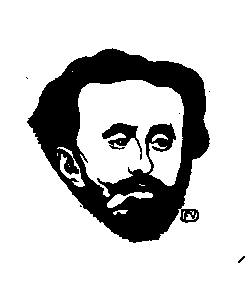
Laforge, in the course of a reading, sketched some notes regarding Corbière which, though not printed, are nevertheless definitive, as for instance:
"Bohemian of the Ocean—picaresque and tramp—breaking down, concise, driving his verse with a whip—strident as the cry of gulls, and like them never wearied—without aestheticism—nothing of poetry or verse, hardly of literature—sensual, he never reveals the flesh—a blackguard and Byronic creature—alway the crisp word—there is not another artist in verse more freed of poetic language—he has a trade without plastic interest—the interest, the effect is in the whip stroke, the dry-point, the pun, the friskiness, the romantic abruptness— he wishes to be indefinable, uncataloguable, to be neither loved nor hated; in short, declassed from every latitude, every custom hither and beyond the Pyrenees."
This doubtless is the truth: Corbière all his life was dominated and led by the demon of contradiction. He supposed that one must be differentiated from men by thoughts and acts exactly contrary to the thoughts and acts of the mass of men; there is much of the willful in his originality; he labored at it as women labor over their complexion during long afternoons between sky and earth, and when he disembarked, it was to draw broadsides of stupefaction. Dandyism à la Baudelaire.
But a nature cannot be developed except in the sense of its instincts and inclinations. Corbière had inherently to be something of what he became, the Don Juan of singularity; it is the only woman he loves; he mocks the other with the clever phrase "the eterna madame."
Corbière has much wit, wit at the same time of the Montmartre wine-shop and of the blade of past times. His talent is formed of the braggart spirit, uncouth and humbug, of a bad impudent taste, of genius thrusts. He has the drunken air, but he is only laboriously clumsy; to make absurd chaplets, he shapes from miraculous, rolled pebbles works of a secular patience, but in the dizaine he leaves the little stone of the sea quite naked and rough, because at bottom he loves the sea with a great naiveté and because his folly for paradoxical things gives way, from time to time, to an intoxication of poetry and beauty.
Among the never ordinary verses of Amours jaunes, are many that are admirable, but admirable with an air so equivocal, so specious, that we do not always enjoy them at the first meeting; then we judge that Tristan Corbière is, like Laforgue, a little his disciple, one of those undeniable, unclassable talents which are strange and precious exceptions in the history of literature—singular even in a gallery of oddities.
Here are two little poems of Tristan Corbière, forgotten even by the last publisher of the Amours jaunes:
PARIS NOCTURNE C'est la mer;—calme plat—Et la grande marée Avec un grondement lointain s'est retirée.... Le flot va revenir se roulant dans son bruit. Entendez-vous gratter les crabes de la nuit. C'est le Styx asséché: le chiffonier Diogène, La lanterne à la main, s'en vient avec sans-gêne. Le long du ruisseau noir, les poètes pervers Pêchent: leur crâne creux leur sert de boîte à vers. C'est le champ: pour glaner les impures charpies S'abat le vol tournant des hideuses harpies; Le lapin de gouttière, à l'affût des rongeurs. Fuit les fils de Bondy, nocturnes vendangeurs. C'est la mort: la police gît.—En haut l'amour Fait sa sieste, en tétant la viande d'un bras lourd Oû le baiser éteint laisse sa plaque rouge. L'heure est seule. Écoutez. Pas un rêve ne bouge. C'est la vie: écoutez, la source vive chante L'éternelle chanson sur la tête gluante D'un dieu marin tirant ses membres nus et verts Sur le lit de la Morgue ... et les yeux grands ouverts. PARIS DIURNE Vois aux deux le grand rond de cuivre rouge luire, Immense casserole où le bon Dieu fait cuire La manne, l'arlequin, l'éternel plat du jour. C'est trempé de sueur et c'est trempé d'amour. Les laridons en cercle attendent prés du four, On entend vaguement la chair rance bruire, Et les soiffards aussi sont là, tendant leur buire, Les marmiteux grelotte en attendant son tour. Crois-tu que le soleil frit donc pour tout le monde Ces gras graillons grouillants qu'un torrent d'or inonde? Non, le bouillon de chien tombe sur nous du ciel. Eux sont sous le rayon et nous sous la gouttière. A nous le pot au noir qui froidit sans lumière. Notre substance à nous, c'est notre poche à fiel. (Tr. 41)
Born at Morlaix in 1845, Tristan returned there in 1875 to die of inflammation of the lungs. He was the son (others say the nephew) of the sea romancer, Edouard Corbière, author of Négrier, whose violent love for the things of the sea had such a strong influence upon the poet. This Négrier, by Edouard Corbière, captain on a long-voyage vessel, 1832, 2 vol. in-8, is a quite interesting tale of maritime adventures. The fourth chapter of the first part, entitled Prisons d'Angleterre, (the convict ships) contains the most curious details about the habits of the prisoners, about the loves of the corvettes with the "forts-a-bras"—in one place, the author says, where "there was only one sex." The preface of this novel reveals a spirit that is very proud and very disdainful of the public: the same spirit with some talent and a sharper nervousness,—you have Tristan Corbière.
ARTHUR RIMBAUD
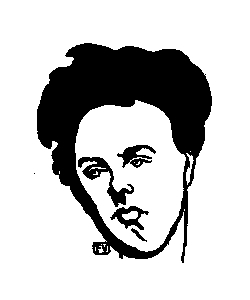
Jean Nicolas Arthur Rimbaud was born at Charleville, October 20, 1854, and from the most tender age showed traits of the most insupportable blackguardism. His brief stay in Paris was in 1870-71. He followed Verlaine in England, then in Belgium. After the little misunderstanding which separated them, Rimbaud roved through the world, followed the most diverse trades, a soldier in the army of Holland, ticket taker at Stockholm in the Loisset circus, contractor in the Isle of Cyprus, trader at Harrar, then at Cape Guardafui, in Africa, where a friend of M. Vittorio Pico saw him, applying himself to the fur trade. It is likely that, scorning all that lacks brutal gratification, savage adventure, the violent life, this poet, singular among all, willingly renounced poetry. None of the authentic pieces of Reliquaire seem more recent than 1873; although he did not die before the end of 1891. The verses of his extreme youth are weak, but from the age of seventeen Rimbaud acquired originality, and his work will endure, at least by virtue of phenomena. He is often obscure, bizarre and absurd. Of sincerity nothing, with a woman's character, a girl's, inherently wicked and even savage, Rimbaud has that kind of talent which interests without pleasing. In his works are pages which give the impression of beauty one feels before a pustulous toad, a good-looking syphillitic woman, or the Chateau-Rouge at eleven o'clock in the evening. Les Pauvres â l'èglise, les Premières Communions possess an uncommon quality of infamy and blasphemy. Les Assis and le Bateau ivre,—there we have the excellent Rimbaud, and I detest neither Oraison du soir nor les Chercheuses de Poux. He was somebody after all, since genius ennobles even baseness. He was a poet. Some verses of his have remained living almost in the state of ordinary speech:
Avec l'assentiment des grands héliotropes. (Tr. 42)
Some stanzas of Bateau ivre belong to true and great poetry:
Et dès lors je me suis baigné dans le poème De la mer, infusé d'astres et latescent, Dévorant les azurs verts où, flottaison blême Et ravie, un noyé pensif parfois descend, Où, teignant tout à coup les bleuités, délires Et rythmes lents sous les rutilements du jour, Plus fortes que l'alcool, plus vastes que vos lyres, Fermentent les rousseurs amères de l'amour. (Tr. 43)
The whole poem marches: all of Rimbaud's poems march, and in les Illuminations there are marvelous belly dances.
It is a pity that his life, so poorly known, was not the true vita abscondita; what is known disgusts from what can be understood of it. Rimbaud was like those women whom we are not surprised to learn have taken to religion in some house of shame; but what revolts still more is that he seems to have been a jealous and passionate mistress: here the aberration becomes debauched, being sentimental. Senancour, the man who has spoken most freely of love, says of these inharmonious liaisons where the female falls so low that she has no name except in the dirtiest slang:
"When in a very particular situation, the need results in a minute of misconduct, we can perhaps pardon men totally vulgar, or at least banish its memory; but how understand that which becomes a habit, an attachment? The fault may have been accidental; but that which is joined to this act of brutality, that which is not unforseen, becomes ignoble. If even a passion capable of troubling the head and almost of depriving one of liberty, has often left an ineffaceable stain, what disgust will not a consent given in cold-blood inspire? Intimacy in this manner, that is the height of shame, the irremediable infamy."
But the intelligence, conscious or unconscious, though not having all rights, has the right of all absolutions.
... Qui sait si le genie N'est pas une de vos vertus, (Tr. 44)
monsters, whether you are called Rimbaud,—or Verlaine?
FRANCIS POICTEVIN

Like all writers who have achieved an understanding of life, Francis Poictevin, though a born novelist, promptly renounced the novel. He knows that everything happens, that a fact in itself is not more interesting than another fact and that the manners of expression alone have significance.
I recall something to this effect reported by Sarcey apropos of the lamentable Murger: "About gave him a subject for a novel; he made nothing of it. He was decidedly a sluggard." It is very difficult to persuade certain old men—old or young—that there are no subjects; there is only a subject in literature, and that he who writes, and all literature, that is to say all philosophy, can arise equally from the cry of a run-over dog as from Faust's exclamations as he questions Nature: "Where seize thee, O infinite Nature? And thou, Breasts?"
The author of Tout Bas and of Presque, like any other person, could have arranged his meditations in dialogues, order his sentiments into chapters divided at random, insinuate through pseudo-living characters a bit of gesticulating life and have them express, by the act of kneeling on the flag-stones of some familiar church, the virtue of an unrecognized creed: in short, write "the novel of mysticism" and popularize the practice of mental prayer for the "literary journals." By this means his books would have gained him a popularity which certainly he now lacks, for few writers among those whose talent is evident are so little esteemed, less known and less discussed. Poictevin disdains all artifice save the artifice of style, a snare into which we are content to fall. Whether he notes the delicacies of a flower, a little girl's attitude, the grace of a madonna, or the cold and quite hard purity of Catherine de Gênes, he wins us with sure strokes, by that very preciosity with which some clumsily reproach him. This preciosity is rigorously personal. Apart from all groups, as remote from Huysmans as from Mallarmé, the author of Tout Bas works, one would say, in a cell, an ideal cell he carries with him while traveling; and there, standing, often kneeling, he pours out his poems and prayers in phrases that have the unique musical quality of a Byzantine organ. Less phrases than vibrations, vibrations so peculiar that few souls find themselves attuned. Music of Gregorian plain-chant, such as one listens to in a sumptuous Flemish church, with sudden fugues of exalted prayer that soar aloft towards the high lines and hurl themselves against the painted vaults, kindling old stained-glass windows, illuming the lines of the darkened cross with love. The mystic monk, the true mystic, Fra Angelico, and Bonaventura a little, live again in the pages of Presque with its chatoyant spirituality, more than in all the pseudo-mystic literature of our time. Would not the author of Recordare sanctae crucis find more satisfaction in this prayer than in the patronizing and fructiferous deductions; "Here below the Christ appears the most adorable, most absorbed figure of the eternal substance, scented with all virtues; a figure with dulcet blues, the burning clear yellows of topaz or chrysanthemum, the blood-red hues of future glories. And despite my daily relapses, I compel myself, according to Jesus' word to the Samaritan, to adoration in spirit and in truth," Poictevin has entered the "Garden of all the flowerings" of which Saint Bonaventura sang,
(Crux deliciarum hortus In quo florent omnia....) (Tr. 45)
and kneeling, he has kissed the heart of roses whose rosary is of blood,—the blood of the great torment. While Morning, fair-haired youth, delivers moist adolescence to folly-driven women, he goes towards a priestly peace, to masses of solitude, and one of the graces gathered is that his soul becomes impregnated with the "interior light, claritas caritas."
It is the essential point. Mere phrases, yes; but the phrases are no more than the attire and reserve of his art. He has felt, dreamed or thought before speaking; especially has he loved: and some of his, metaphors leap like a fervent prayer, like one of the cries of Saint Theresa.
He strives clearly to reach the bottom, to penetrate even the vital center of the hortensia's umbel. Everywhere he seeks—and finds—the soul. No one is less a rhetorician than this stylist, for the rhetorician is he who clothes the solid common things with garments fit to sustain all the vulgarity of bedizenings, while Poictevin ever diaphanizes a phantom, a rainbow, an illusion, an azalea flower, thus: "Would a hand of a consumptive in the contraction of its quasi-diaphaneity, leaning, not lazily, but which no longer is conscious, seem to warn, less exalted than before and indulgently returned?"
Yes, how subtle it is!—and why not write "like everybody"?
Alas! that is forbidden him,—because he is a mystic, because he feels new rapports between man and God, and because, veiled in the dolorous perfection of a form where grace becomes pearled in minutiae, Poictevin is a spontaneous writer. How many things, doubtless, has he never transcribed, afraid of not having discovered the exact expression, the unique and very rare, the unedited!
Everything, indeed, in a work of art should be unedited,—and even the words, by the manner of grouping them, of shaping them to new meanings,—and one often regrets having an alphabet familiar to too many half-lettered persons.
Disciple of Goncourt, from whom he further sharpened his precious style of writing, Francis Poictevin by degrees refined himself to immateriality. And that is just his genius, the expression of the immaterial and the inexpressible: he invented the mysticism of style.
ANDRÉ GIDE
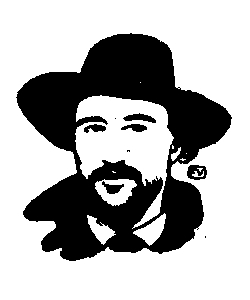
In 1891 I wrote as follows apropos of the Cahiers d'André Walter, an anonymous work: "The diary is a form of good literature and perhaps the best for some extremely subjective minds. De Maupassant would make nothing of it. For him the world is like the cover of a billiard table; he notes the meetings of the balls and stops when the balls stop, for if there is no further material movement to be perceived, there is nothing more to be said, The subjective soul feeds on itself through the reserve of its stored sensations; and, by an occult chemistry, by unconscious combinations whose numbers approach infinity, those sensations, often of a faraway past time, become changed and are multiplied in ideas. Then are narrated, not anecdotes, but the very anecdotes of oneself, the only kind that can often be retold, if one has the talent and gift to vary their appearances. In this way has the author of these copy books worked and thus will he work again. His is a romantic and philosophic mind, of the lineage of Goethe. One of these years, when he will have recognized the helplessness of thought against the onward course of things, its social uselessness, the scorn it inspires in that mass of corpuscles named society, indignation will seize him, and since action, though illusive, is forever closed to him, he will wake armed with irony. This oddly enough, is a writer's finishing touch; it is the co-efficient of his soul's worth. The theory of the novel, stated in a note of page 120 is of more than mediocre interest; we must hope that the author upon occasion will recollect it. As for the present book, it is ingenuous and delicate, the revealer of a fine intelligence. It seems the condensation of a whole youth of study, dreams and sentiment, of a tortuous, timorous youth. This reflection (p. 142) rather well sums up André Walter's state of mind: 'O, the emotion when one is quite near to happiness, when one has but to touch it,—and passes on.'"
There is a certain pleasure in not having been deceived in one's first judgment of the first book of an unknown person. Now that André Gide has, after several intelligent works, become one of the most luminous of the Church's Levites, with the flames of intelligence and grace quite visible around his brow and in his eyes, the time nears when bold discoverers will discuss his genius, and, since he fares forth and advances, sound the trumpets of the advancing column. He deserves the glory, if anyone merits it (glory is always unjust) since to the originality of talent the master of minds willed that in this singular being should be joined an originality of soul. It is a gift rare enough to justify speaking of it.
A writer's talent is often nothing but the terrible faculty of retelling, in phrases that seem beautiful, the eternal clamors of mediocre humanity. Even gigantic geniuses, like Victor Hugo or Adam de Saint-Victor were destined to utter an admirable music whose grandeur consists in concealing the immense emptiness of the deserts: their soul is like the formless docile soul of deserts and crowds; they love, think, and desire the loves, thoughts, desires of all men and of all beasts; poets, they magnificently declaim what is not worth the trouble of being thought.
The human species, doubtless, in its entire aspect of a hive or colony, is only superior to the bison species or the king-fisher, because we are a part of it; here and there man is a sorry automaton; but his superiority lies in his ability to attain consciousness; a small number reach this stage. To acquire the full consciousness of self is to know oneself so different from others that one no longer feels allied with men except by purely animal contacts: nevertheless, among souls of this degree, there is an ideal fraternity based on differences,—while social fraternity is based on resemblances.
The full consciousness of self can be called originality of soul,—and all this is said only to point out the group of rare beings to which André Gide belongs.
The misfortune of these beings, when they wish to express themselves, is that they do it with such odd gestures that men fear to approach them; their life of social contacts must often revolve in the brief circle of ideal fraternities; or, when the mob consents to admit such souls, it is as curiosities or museum objects. Their glory is, finally, to be loved from afar and almost understood, as parchments are seen and read above sealed glass cases.
But all this is related in Paludes, a story, as is known, "of animals living in dusky caverns, and which lose their sight through never being used"; it is also, with a more intimate charm than in the Voyage d' Urien, the ingenuous story of a very complicated, very intellectual and very original soul.
PIERRE LOUYS
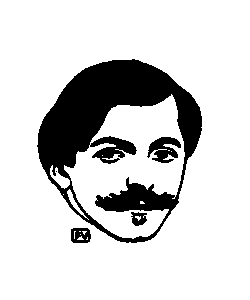
At this moment there is a little movement of neo-paganism, of sensual naturalism and erotism at once mystic and materialistic, a springtime of those purely carnal religions where woman is adored even for the very ugliness of her sex, for by means of metaphors we can idealize the imperfect and deify the illusive. A novel of Marcel Batilliat, a young unknown man, is, despite its serious faults, perhaps the most curious specimen of this erotic religiosity which zealous hearts are cultivating as dreams or ideals. But there is a famous manifestation, the Aphrodite of Pierre Louys, whose success, doubtless, henceforth will stifle as under roses, all other claims of sexual romanticism.
It is not, although its appearance has deceived young and old critics, a historical novel, such as Salammbô or even Thaïs. The perfect knowledge which Pierre Louys possesses of Alexandrian religions and customs has allowed him to clothe his personages with names and garbs veraciously ancient, but the book must be read divested of those precautions which are not there, just as in more than one eighteenth century novel, where the customs, gestures and desires of an incontestable today are at play behind the embroidered screen work of hieratic phallophores.
By the vulgarizing of art, love finally has returned to us naked. It is in the epoch of the flowering of Calvinism that the nude began to be banned from manners and that it sought refuge in art, which alone treasured the tradition of it. Formerly, and even in the time of Charles the Fifth, there were no public celebrations without speculations regarding lovely nude women; the nude was so little dreaded that adulterous women were driven stark naked through the towns. It is beyond a doubt that, in the mysteries, such roles as Adam and Eve were acted by persons free of fleshings,—monstrous display. To love the nude, and first of all femininity with its graces and insolences, is traditional in those races which hard reform has not altogether terrorized. The idea of the nude being admitted, costume can be modified to take in floating loose robe, manners can be softened, and something of splendor illume the gloom of our hypocricies. By its vogue, Aphrodite has signalled the possible return to manners where there will be a bit of freedom; coming from that period, this book has the value of an antidote.
But how fallacious is such a literature. All these women, all this flesh, the cries, the luxury so animal, so empty and so cruel! The females gnaw at the brains; thought flies horror-stricken; woman's soul oozes away as by the action of rain, and all these copulations engender nothingness, disgust and death.
Pierre Louys has felt that his fleshly book logically must end in death: Aphrodite closes in a scene of death, with obsequies.
It is the end of Atala (Chateaubriand invisibly hovers over our whole literature), but gracefully refashioned and renewed with art and tenderness,—so well that the idea of death comes to join itself with the idea of beauty; the two images, entwined like two courtisans, slowly fades into the night.
RACHILDE
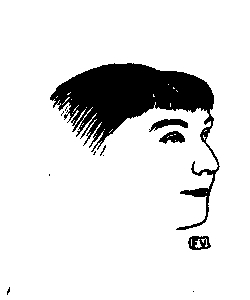
Sincerity, what an enormous unreasonable demand, if it is a question of woman! Those most praised for their candor were nevertheless comedians, like the weeping Marceline, an actress moreover who wept through her life, as in a role, with the consciousness which the plaudits of the public give. Since women have written, not one has had the good faith to speak and confess themselves in bold humility, and the only ideas of feminine psychology known to literature must be sought in the literature of men. There is more to learn of women in Lady Roxanna than in the complete works of George Sand. It is not perhaps a question of untruthfulness; it is rather a natural incapacity to think for herself, to take cognizance of herself in her own brain, and not in the eyes and in the lips of others; even when they ingenuously write into little secret diaries, women think of the unknown god reading—perhaps—over their shoulders. With a similar nature, a woman, to be placed in the first ranks of men, would require even a higher genius than that of the highest man; that is why, if the conspicuous works of men are often superior to the men themselves, the finest works of women are always inferior to the worth of the women who produced them.
This incapacity is not personal; it is generic and absolute. It is needful, then, to compare women exclusively with themselves, and not scorn them for whatever of egoism or personality is lacking: this fault, outside of literature and art, is generally estimated as equal to a positive virtue.
Whether they essay their charms in perversity or candor, women will better succeed in living than in playing their comedy; they are made for life, for the flesh, for materiality,—and they will joyfully realize their most romantic dreams if they do not find themselves arrested by the indifference of man whose more sensitive nerves suffer from vibrating in the void. There is an evident contradiction between art and life; we have hardly ever seen a man live in action and dream at the same time, transposing in writing the gestures that first were real: the equivalence of sensations is certain and the horrors of fear can better be described by whosoever imagines them than by the man that experiences them. On the contrary, the predominance in a temperament of tendencies to live, dulls the sharpness of the imaginative faculties. With the more intelligent women, those best gifted for cerebral pursuits, the impelling motivation will most easily be translated into acts than into art. It is a physiological fact, a state of nature it would be as absurd to reproach women with as to blame men for the smallness of their breasts or the shortness of their hair. Moreover, if it is a question of art, the discussion, which touches such a small number of creatures, has for humanity, like all purely intellectual questions, but an interest of the steeple or the street corner.
All this, then, being admitted, and it also being admitted that l'Animale is Rachilde's most singular book (although not the most ambiguous) and that le Démon de l'Absurde is the best, I will willingly add, not for the sole pleasure of contradicting myself and destroying the virtue of the preceding pages, that this collection of tales and imaginative dialogue proves to me a realized effort at true artistic sincerity. Pages like la Panthère or les Vendanges de Sodom show that a woman can have phases of virility, to write, careless of necessary coquetteries or customary attitudes, make art with nothing but an idea and from words, create.
J. K. HUYSMANS
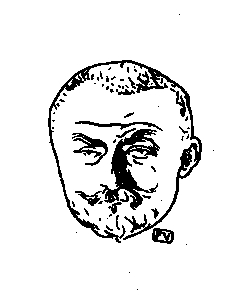
"Le Romanée and Chambertin, Clos-Vougeot and Corton made the abbatial pomps, princely fetes, opulences of vestments figured in gold, aglow with light, pass before him. The Clos-Vougeot especially dazzled him. To him that wine seemed the syrup of great dignitaries. The etiquette glittered before his eyes, like glories surrounded by beams, placed in churches, behind the occiput of Virgins."
The writer who in 1881, in the midst of the naturalistic morass, had, before a name read on a wine list, such a vision, although ironic, of evoked splendors, must have puzzled his friends and made them suspect an approaching defection. In fact, several years later, the unexpected A Rebours appeared, and it was not a point of departure, but the consecration of a new literature. No longer was it so much a question of forcing a brutal externality to enter the domains of Art by representation, as of drawing from this very representation motives for dreams and interior revaluations. En Rade further developed this system whose fruitfulness is limitless,—while the naturalistic method proved itself still more sterile than even its enemies had dared hope,—a system of strictest logic and of such marvelous suppleness that it permits, without forfeiting anything to likelihood, to intercalate in exact scenes of rustic life, pages like "Esther" or like the "voyage sélénien."
The architecture of Là-Bas is based on an analogous plan, but the license profitably finds itself restrained by the unity of subject, which remains absolute beneath its multiple faces: the Christ of Gunewald, in his extreme mystic violence, his startling and consoling hideousness, is not a fugue without line, nor are the demoniac forest of Tiffauges, the cruel Black Mass, or any of the "fragments" displaced or inharmonious; nevertheless, before the freedom of the novel, they had been criticized, not in themselves, but as not rigorously necessary to the advance of the book. Fortunately the novel is finally free, and to say more, the novel, as still conceived by Zola or Bourget, to us appears a conception as superannuated as the epic poem or the tragedy. Only, the old frame is still able to serve; it sometimes is necessary to entice the public to very arduous subjects, to simulate vague romantic intrigues, which the author unravels at his own will, after he has said all he wished to say. But the essential of yesterday is become the accessory, and an accessory more and more scorned: quite rare at the present hour are those writers who are clever or strong enough to confine themselves to a demolished genre, to spur the fatigued cavalry of sentimentalities and adulteries.
Moreover, aesthetics tends to specialization in as many forms as there are talents: among many vanities are admissible arrogances to which we cannot refuse the right to create into normal characters. Huysmans is of those; he no longer writes novels, he makes books, and he plans them according to an original arrangement; I believe that is one of the reasons why some persons still take issue with his literature and find it immoral. This last point is easy to explain by a single word: for the non-artist, art is always immoral. As soon as one wishes, for example, to translate sexual relations into a new language, he is immoral because he discloses, fatally, acts which, treated by ordinary procedures, would remain unperceived, lost in the mist of common things. Thus it is that an artist, not at all erotic, can be accused of stupid outrages by the foolish or the mischievous, before the public. It, nevertheless, does not seem that the facts of love or rather of aberration related in Là-Bas at all entice the simplicity of virginal ignorance. This book rather gives disgust or horror of sensuality in that it does not invite to foolish experiences or even to permissible unions. Will not immorality, if we behold it from a particular and peculiarly religious point of view, consist, on the contrary, in the insistence upon the exquisiteness of carnal love and the vaunting of the delights of legitimate copulation?
The Middle Age knew not: our hypocrisies. It was not at all ignorant of the eternal turpitudes, but it knew how to hate them. It had no use for our conduct, nor for our refinements; it published the vices, sculped them on its cathedral portals and spread them in the verses of its poets. It had less regard for refraining from terrifying the fears of mummied souls than for tearing apart the robes and revealing the man, and showing to man, so as to make him ashamed, all the ugliness of his low animality. But it did not make the brute wallow in his vice; it placed him on his knees and made him lift his head. Huysmans has understood all this, and it was difficult to conquer. After the horrors of the satanic debauch, before the earthly punishment, he has, like the noble weeping people he evokes, forgiven even the most frightful slayers of infants, the basest sadist, the most monstrous fool that ever was.
Having absolved such a man, he could without pharisaism absolve himself, and with the aid of God, some more humble and quite brotherly succor, of helpful reading, visitations to gentle conventual chapels, Huysmans one day found himself converted to mysticism, and wrote En Route, that book which is like a statue of stone that suddenly begins to weep. It is a mysticism a little raucous and hard, but like his phrases, his epithets, Huysmans is hard. Mysticism first came to him through the eyes rather than through the soul. He observed religious facts with the fear of being their dupe and the hope that they would be absurd; he was caught in the very meshes of the credo-quia-absurdum,—happy victim of his curiosity.
Now, fatigued at having watched men's hypocritical faces, he watches the stones, preparing a supreme book on "The Cathedral." There, if it is a question of feeling and understanding, is it especially a question of sight. He will see as no other person has seen, for no one other person has seen, no one ever was gifted with a glance so sharp, so boring, so frank and so skilled in insinuating himself into the very wrinkles of faces, rose-windows and masks.
Huysmans is an eye.
JULES LAFORGUE
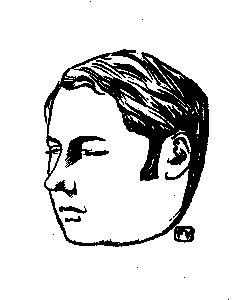
In the Fleurs de bonne Volonté is a little complaint, like the others, called Dimanches:
Le ciel pleut sans but, sans que rien l'émeuve, Il pleut, il pleut, bergère! sur le fleuve.... Le fleuve a son repos dominical; Pas un chaland, en amont, en aval. Les vêpres carillonnent sur la ville, Les berges sont désertes, sans une île. Passe un pensionnat, ô pauvres chairs! Plusieurs out déjà leurs manchons d'hiver. Une qui n'a ni manchon ni fourrure Fait tout en gris une bien pauvre figure; Et la voilà qui s'échappe des rangs Et court: ô mon Dieu, qu'est-ce qui lui prend? Elle va se jeter dans le fleuve. Pas un batelier, pas un chien de Terre-Neuve.... (Tr. 46)
And there we have, prophesized, the sudden absurd death, the life of Laforgue. His heart was too cold; he departed.
His was a mind gifted with all the gifts and rich with important acquisitions. With his natural genius made up of sensibility, irony, imagination and clairvoyance, he had wished to nourish it with positive knowledge, all the philosophies, all the literatures, all the images of nature and art; and even the latest views of science seemed to have been familiar to him. He had an ornate flamboyant genius, ready to construct architectural works infinitely diverse and fair, to rear new ogives and unfamiliar domes; but he had forgotten his winter muff and died one snowy day of cold.
That is why his work, already magnificent, is only the prelude of an oratorio ended in silence.
Many of his verses are as though reddened by a glacial affectation of naiveté; they speak of the too dearly cherished child, of the young girl hearkened to—but a sign of a true need of affection and of a pure gentleness of heart,—adolescent of genius who would still have wished to place on the knees of his mother, his "equatorial brow, greenhouse of anomalies." But many have the beauty of purified topazes, the melancholy of opals, the freshness of moon-stones, and some pages, like that which commences thus:
Noire bise, averse glapissante Et fleuve noir, et maisons closes.... (Tr. 47)
have a sad, consoling grace, with eternal avowals: forever on the same subject, Laforgue retells it in such fashion that it seems dreamed and confessed for the first time. And I think that what we must demand of the translator of dreams is, not to wish to fix forever the fugacity of a thought or air, but to sing the song of the present hour with such frank force that it seems the only one we could hear, the only one we could understand. In the end, perhaps, it is necessary to become reasonable and delight us with the present and with new flowers, indifferent, except as a botanist, to the faded fields. Every epoch of thought, art or sentiment should take a deep delight in itself and go down from the world with the egoism and languor of a superb lake which, smiling upon the old streams, receives them, calms them, and absorbs them.
There was no present for Laforgue, except among a group of friends. He died just as his Moralités Légendaires was coming to birth, but still offered to a minority, and he had just learned from some mouths that these pages consecrated him to live the life of glory among those whom the gods created in their image, they, too, gods and creators. It is a literature entirely new and disconcertingly unexpected, giving the curious sensation (specially rare) that we have never read anything like it; the grape with all its velvet hues in the morning light, but with curious reflections and an air as if the seeds within had become frozen by a breath of ironic wind come from some place farther than the pole.
On a copy of l'Imitation de Notre-Dame la Lune, offered to Bourget (and since thrown among old papers in the quay) Laforgue wrote: "This is only an inter-mezzo. I pray you to wait yet awhile, and give me until my next book";—but he was of those who ever look forward to finding themselves in their next work, the noble unsatisfied who have too much to say ever to believe that they have said other things than prolegomenae and prefaces. If his interrupted work is but a preface, it belongs to those which counterbalance a finished work.
JEAN MORÉAS
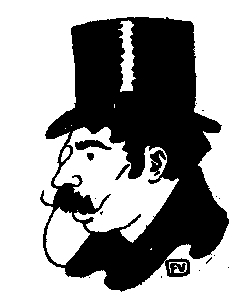
Raymond de la Tailhède thus exalts Moréas:
Tout un silence d'or vibrant s'est abattu, Près des sources que des satyres ont troublées, Claire merveille éclose au profond des vallées, Si l'oiselet chanteur du bocage s'est tu. Oubli de flûte, heures de rêves sans alarmes, Où tu as su trouver pour ton sang amoureux La douceur d'habiter un séjour odoreux De roses dont les dieux sylvains te font des armes Là tu vas composant ces beaux livres, honneur Du langage français et de la noble Athènes. (Tr. 48)
These verses are romances, that is, of a poet to whom the romantic period is but a witch's night where unreal sonorous gnomes stir, of a poet (this one has talent) who concentrates his efforts to imitate the Greeks of the Anthology through Ronsard, and to steal from Ronsard the secret of his laborious phrase, his botanical epithets, and his sickly rhythm. As for what is exquisite in Ronsard, since that little has passed into tradition and memory, the Romantic school had to neglect it on pain of quickly losing what alone constitutes its originality. There is I know not what of provincialism, of steps against life's current, of the loiterer, in this care for imitation and restoration. Somewhere Moréas sings praise
De ce Sophocle, honneur de la Ferté-Milon, (Tr. 49)
and it is just that: the Romantic school always has the air of coming from Ferté-Milon.
But Jean Moréas, who has met his friends on the road, started from somewhere farther away, introduces himself more proudly.
Arrived in Paris like any other Wallachian or Eastern student, and already full of love for the French language, Moréas betook himself to the school of the old poets and frequented the society of Jacot de Forest and Benoit de Sainte-Maure. He wished to take the road to which every clever youth should vow himself who is ambitious to become a good harper; he swore to accomplish the complete pilgrimage: At this hour, having set out from the Chanson de Saint-Léger, he has, it is said, reached the seventeenth century, and this in less than ten years. It is not as discouraging as one supposes. And now that texts are more familiar, the road shortens: from now on less halts. Moréas will camp under the old Hugo oak, and, if he perseveres, we shall see him achieve the aim of his voyage, which doubtless is to catch up with himself. Then, casting aside the staff, often changed and cut from such diverse copses, he will lean on his own genius and we will be able to judge him, if that be our whim, with a certain security.
All that today can be said is that Moréas passionately loves the French language and poetry, and that the two proud-hearted sisters have smiled upon him more than once, satisfied to see near their steps a pilgrim so patient, a cavalier armed with such good-will.
Cavalcando l'altrjer per un cammino, Pensoso dell andar che mi sgradia, Trovai Amor in mezzo della via In abito legger di pellegrino. (Tr. 50)
Thus Moréas goes, quite attentive, quite in love, and in the light robe of a pilgrim. When he called one of his poems le Pèlerin passionné, he gave an excellent idea and a very sane symbolism of himself, his role and his playings among us.
There are fine things in that Pèlerin, and also in les Syrtes; there are admirable and delicious touches and which (for my part) I shall always joyfully reread, in les Cantilènes, but inasmuch as Moréas, having changed his manner, repudiates these primitive works, I shall not insist. There remains Ériphyle, a delicate collection formed of a poem of four "sylvae", all in the taste of the Renaissance and destined to be the book of examples where the young "Romans", spurred on by the somewhat intemperate invectives of Charles Maurras, must study the classic art of composing facile verses laboriously. Here is a page:
Astre brillant, Phébé aux ailes étendues, O flamme de la nuit qui croîs et diminues, Favorise la route et les sombres forêts Où mon ami errant porte ses pas discrets! Dans la grotte au vain bruit dont l'entrée est tout lierre, Sur la roche pointue aux chèvres familière, Sur le lac, sur l'étang, sur leurs tranquilles eaux, Sur les bords émaillés où plaignent les roseaux. Dans le cristal rompu des ruisselets obliques, Il aime à voir trembler tes feux mélancoliques.
* * * * *
Phébé, ô Cynthia, dès sa saison première, Mon ami fut épris de ta belle lumière; Dans leur cercle observant tes visages divers, Sous ta douce influence il composait ses vers. Par dessus Nice, Eryx, Seyre et la sablonneuse Ioclos, le Tmolus et la grande Epidaure, Et la verte Cydon, sa piété honore Ce rocher de Latmos où tu fus amoureuse. (Tr. 51)
Moréas, like his Phoebe, has tried to put on many diverse countenances and even to cover his face with masks. We always recognize him from his brothers: he is a poet.
STUART MERRILL
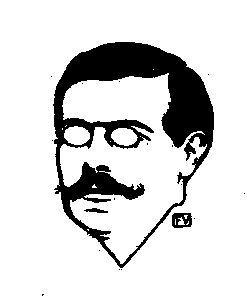
The logic of an amateur of literature is offended upon his discovering that his admirations disagree with those of the public; but he is not surprised, knowing that there are the elect of the last hour. The public's attitude is less benignant when it learns the disaccord which is noticeable between it, obscure master of glories, and the opinion of the small oligarchic number. Accustomed to couple these two ideas, renown and talent, it shows a repugnance in disjoining them; it does not admit, for it has a secret sense of justice or logic, that an illustrious author might be so by chance alone, or that an unknown author merits recognition. Here is a misunderstanding, doubtless old as the six thousand years ascribed by La Bruyère to human thought, and this misunderstanding, based on very logical and solid reasoning, sets at defiance from the height of its pedestal all attempts at conciliation. To end it, it is needful to limit oneself to the timid insinuations of science and to ask if we truly know the "thing in itself," if there is not a certain inevitable little difference between the object of knowledge and the knowledge of the object. On this ground, as one will be less understood, agreement will be easier and then the legitimate difference of opinions will be voluntarily admitted, since it is not a question of captivating Truth—that reflection of a moon in a well—but to measure by approximation, as is done with stars, the distance or the difference existing between the genius of a poet and the idea we have of it.
Were it necessary, which is quite useless, to express oneself more clearly, it might be said that, according to several persons whose opinion perhaps is worth that of many others, all the literary history, as written by professors according to educational views, is but a mass of judgments nearly all reversed, and that, in particular, the histories of French literature is but the banal cataloguing of the plaudits and crowns fallen to the cleverest or most fortunate. Perhaps it is time to adopt another method and to give, among the celebrated persons, a place to those who could have attained it—if the snow had not fallen on the day they announced the glory of the new spring.
Stuart Merrill and Saint-Pol-Roux are of those whom the snow gainsaid. If the public knows their names less than some others, it is not that they have less merit, it is that they had less good fortune.
The poet of Fastes, by the mere choice of this word, bespeaks the fair frankness of a rich soul and a generous talent. His verses, a little gilded, a little clamorous, truly burst forth and peal for the holidays and gorgeous parades, and when the play of sunshine has passed, behold the torches illumined in the night for the sumptuous procession of supernatural women. Poems or women, they doubtless are bedecked with too many rings and rubies and their robes are embroidered with too much gold; they are royal courtisans rather than princesses, but we love their cruel eyes and russet hair.
After such splendid trumpets, the Petits Poèmes d'Automne, the noise of the spuming wheel, a sound of a bell, an air of a flute in tone of moonlight: it is the drowsiness and dreaming saddened by the silence of things, the incertitude of the hours:
C'est le vent d'automne dans l'allée, Soeur, écoute, et la chute sur l'eau Des feuilles du saule et du bouleau, Et c'est le givre dans la vallée, Dénoue—il est l'heure—tes cheveaux Plus blonds que le chanvre que tu files.... Et viens, pareille à ces châtelaines Dolentes à qui tu fais songer, Dans le silence où meurt ton léger Rouet, ô ma soeur des marjolaines! (Tr. 52)
Thus, in Stuart Merrill we discover the contrast and struggle of a spirited temperament and a very gentle heart, and according as one of the two natures prevails, we hear the violence of brasses or the murmurings of viols. Similarly does his technique oscillate from Gammes to his latest poems, from the Parnassian stiffness to the verso suelto of the new schools, which only the senators of art do not recognize. Vers libre, which is favorable to original talent, and which is a reef of danger to others, could not help winning over so gifted a poet, and so intelligent an innovator. This is how he understands it:
Venez avec des couronnes de primevères dans vos mains, O fillettes qui pleurez la soeur morte à l'aurore. Les cloches de la vallée sonnent la fin d'un sort, Et l'on voit luire des pelles au soleil du matin. Venez avec des corbeilles de violettes, ô fillettes Qui hésitez un peu dans le chemin des hêtres, Par crainte des paroles solennelles du prêtre. Venez, le ciel est tout sonore d'invisibles alouettes.... C'est la fête de la mort, et l'on dirait dimanche, Tant les cloches sonnent, douces au fond de la vallée; Les garçons se sont cachés dans les petites allées; Vous seules devez prier au pied de la tombe blanche.... Quelque année, les garçons qui se cachent aujourd'hui Viendront vous dire à toutes la douce douleur d'aimer, Et l'on vous entendra, autour du mât de mai, Chanter des rondes d'enfance pour saluer la nuit. (Tr. 53)
Stuart Merrill did not embark in vain, the day he desired to cross the Atlantic, to come and woo the proud French poetry, and place one of her flowers in his hair.
SAINT-POL-ROUX
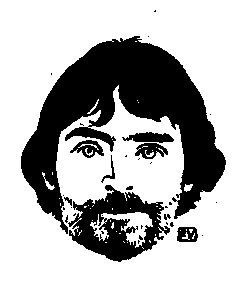
One of the most fruitful and astonishing inventors of images and metaphors. To find new expressions, Huysmans materializes the spiritual and the intellectual spheres, thus giving his style a precision somewhat heavy and a lucidity rather unnatural: rotten souls (like teeth) and cracked hearts (like an old wall); it is picturesque and nothing else. The inverse operation is more conformable to the old taste of men for endowing vague sentiments and a dim consciousness to objects. It remains faithful to the pantheistic and animistic tradition without which neither art nor poetry would be possible. It is the deep source from which all the others are formed, pure water transformed by the slightest ray of sunshine into jewels sparkling like fairy collars. Other "metaphorists" like Jules Renard, venture to seek the image either in a reforming vision, a detail separated from the whole becoming the thing itself, or in a transposition and exaggeration of metaphors in usage; finally, there is the analogic method by which, without our voluntary aid, the meaning of ordinary words change daily. Saint-Pol-Roux blends these methods and makes them all contribute to the manufacture of images which, if they are all new, are not all beautiful. From them a catalogue or a dictionary could be drawn up:
Wise-Woman of lightmeansthe cock.
Morrow of the caterpillar in balldress—butterfly.
Sin that sucks—natural child.
Living distaff—mutton.
Fin of the plow—plowshare.
Wasp with the whip sting—diligence.
Breast of crystal—flagon.
Crab of the hand—open hand.
Letter announcement—magpie.
Cemetery with wings—a flight of crows.
Romance for the nostrils—perfume of flowers.
To tame the carious jawbone of bemol of a modern tarask—to play the piano.
Surly gewgaw of the doorway—watchdog.
Blaspheming limousine—wagoner.
To chant a bronze alexandrine—to peal midnight.
Cognac of Father Adam—the broad, pure air.
Imagery only seen with closed eyes—dreams.
Leaves of living salad—frogs.
Green chatterers—frogs.
Sonorous wild-poppy—cock-crow.
The most heedless person, having read this last, will decide that Saint-Pol-Roux is gifted with an imagination and with an equally exuberant wretched taste. If all these images, some of which are ingenious, followed one after another towards les Reposoirs de la Procession where the poet guides them, the reading of such a work would be difficult and the smile would often temper the aesthetic emotion; but strewn here and there, they but form stains and do not always break the harmony of richly colored, ingenious and grave poems. Le Pèlerinage de Sainte-Anne, written almost entirely in images, is free of all impurity and the metaphors, as Théophile Gautier would have wished, unfold themselves in profusion, but logically and knit together; it is the type and marvel of the prose poem, with rhythm and assonance. In the same volume, the Nocturne dedicated to Huysmans is but a vain chaplet of incoherent catachreses: the ideas there are devoured by a frightful troop of beasts. But l'Autopsie de la Vieille fille, despite a fault of tone, but Calvaire immémorial, but l'Ame saisissable are masterpieces. Saint-Pol-Roux plays on a zither whose strings sometimes are too tightly drawn: a turn of the key would suffice for our ears ever to be deeply gladdened.
ROBERT DE MONTESQUIOU
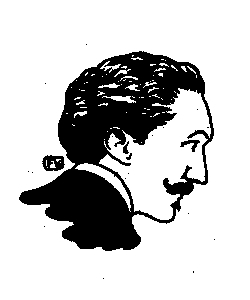
Upon the first appearance of his Chauves-Souris in violet velvet, the question was seriously put whether de Montesquiou was a poet or an amateur of poetry, and whether the fashionable world could be harmonized with the cult of the Nine Sisters, or of any one of them, for nine women are a lot. But to discourse in such fashion is to confess one's unfamiliarity with that logical operation called the dissociation of ideas, for it seems elementary logic separately to evaluate the worth or beauty of the tree and its fruit, of man and his works. Whether jewel or pebble, the book will be judged in itself, disregarding the source, the quarry or the stream from which it comes, and the diamond will not change its name, whether hailing from the Cape or from Golconda. To criticism the social life of a poet matters as little as to Polymnia herself, who indifferently welcomes into her circle the peasant Burns and the partician Byron, Villon the purse-snatcher and Frederick II, the king: Art's book of heraldry and that of Hozier are not written in the same style.
So we will not disturb ourselves with unraveling the flax from the distaff, or ascertaining what of illusiveness de Montesquiou and his status of a man of fashion have been able to add to the renown of the poet.
The poet, here, is "a précieuse".
Were those women really so ridiculous, who, to place themselves in the tone of some fine and gallant poets, imagined new ways of speech, and, through a hatred of the common, affected a singularity of mind, costume and gesture? Their crime, after all, was in not wishing to conform with the world, and it seems that they paid dearly for this, they—and the entire French poetry which, for a century and a half, truly feared ridicule too much. Poets at last are freed from such horrors; in fact they are now allowed to avow their originality; far from forbidding them to go naked, criticism encourages them to assume the free easy dress of the gymnosophist. But some of them are tattooed.
And that is really the true quarrel with de Montesquiou: his originality is excessively tattooed. Its beauty recalls, not without melancholy, the complicated figurations with which the old Australian chieftains were wont to ornament themselves; there is even an odd refinement in the nuances, the design, and the amusing audacities of tone and lines. He achieves the arabesque better than the figure, and sensation better than thought. If he thinks, it is through ideographic signs, like the Japanese:
Poisson, grue, aigle, fleur, bambou qu'un oiseau ploie, Tortue, iris, pivoine, anémone et moineaux. (Tr. 54)
He loves these juxtapositions of words, and when he chooses them, like those above, soft and vivid, the landscape he seeks is quite pleasantly evoked, but often one sees, relieved against an artificial sky, hard unfamiliar forms, processions of carnival larvae—Or rather, women, girls, birds,—baubles deformed by a too Oriental fancy; baubles and trinkets:
Je voudrais que ce vers fût un bibelot d'art, (Tr. 55)
is the aesthetics of de Montesquiou, but the bauble is no more than an amusing fragile thing to be placed under a glass case or closet,—yes, preferably in a closet. Then, disburdened of all this grotto work, all this lacquer, all this delicate paste, and as he himself wittily says, all these "shelves of infusoria," the poet's museum would become an agreeable gallery, where one would pleasantly muse before the many metamorphoses of a soul anxious to give a new nuance-laden grace to beauty. With the half of the Hortensias bleus one could make a book, still quite thick, which would be almost entirely composed of fine or proud or delicate poetry. The author of Ancilla, of Mortuis ignotis, and of Tables vives would appear what he truly is, excluding all travesty,—a good poet.
Here is a part of the Tables vives, whose title is obscure, but whose verses have beautiful clarity, despite the too familiar sound of some too Parnassian rimes and some verbal incertitudes:
... Apprenez à l'enfant à prier les flots bleus, Car c'est le ciel d'en bas dont la nue est l'écume, Le reflet du soleil qui sur la mer s'allume Est plus doux à fixer pour nos yeux nébuleux. Apprenez à l'enfant à prier le ciel pur, C'est l'océan d'en haut dont la vague est nuage. L'ombre d'une tempête abondante en naufrage Pour nos coeurs est moins triste à suivre dans l'azur. Apprenez à l'enfant à prier toutes choses: L'abeille de l'esprit compose un miel de jour Sur les vivants ave du rosaire des roses, Chapelet de parfums aux dizaines d'amour.... (Tr. 56)
In short, de Montesquiou exists: blue hortensia, green rose or white peony, he is of those flowers one curiously gazes upon in a bed of flowers, whose name one asks and whose memory one cherishes.
GUSTAVE KAHN
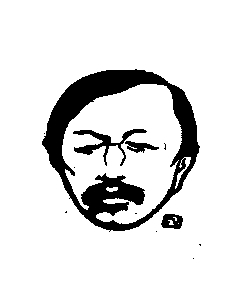
Domaine De Fée, a Song of Songs recited by one lone voice, very charming and very amorous, in a Verlainian setting,—O eternal Verlaine!
O bel avril épanoui, Qu'importe ta chanson franche, Tes lilas blancs, tes aubépines et l'or fleuri De ton soleil par les branches, Si loin de moi la bien-aimée Dans les brumes du nord est restée. (Tr. 57)
That is the tone. It is very simple, very delicate, very pure and sometimes biblical:
J'étais allé jusu'au fond du jardin, Quand dans la nuit une invisible main Me terrassa plus forte que moi— Une voix me dit: C'est pour ta joie. (Tr. 58)
Dilectus meus descendit in hortum ... but here the poet, as chaste, is less sensual: The Orient has thrown a surplice over an Occidental soul, and if he still cultivates large white lilies in his enclosed garden, he has learned the pleasure of escaping, by secret paths known to fairies, "in the forest noiselessly laughing", as they gather bindweed, broom,
Et les fleurettes aventurières le long des haies. (Tr. 59)
This poem of twenty-four leaves is doubtless the most delicious little book of love verses given us since the Fêtes Galantes, and with the Chansons d'amant are perhaps the only verses of these last years where sentiment dare confess in utter frankness, with the perfect and touching grace of divine sincerity. If, in some of these pages, there still remains a touch of rhetoric, it is because Kahn, even at the feet of the Sulamite, has not renounced the pleasure of surprising by the ever novel deftness of the jongleur and virtuoso, and if he sometimes treats the French language tyrannically, it is that for him she has always had the affectionate yieldings of a slave. He abuses his power a little, giving some words meanings that hang on the skirts of others, making phrases yield to a too summary syntax, but these are mischievous habits not exclusively personal to him. His science of rhythm and mastery in wielding free verse, he borrows from no one.
Was Kahn the first? To whom do we owe free verse? To Rimbaud, whose Illuminations appeared in Vogue in 1886, to Laforgue, who at the same period, in the same precious little review,—conducted by Kahn—published Légende and Solo de lune, and, finally, to Kahn himself; at that time he wrote:
Void l'allégresse des âmes d'automne, La Ville s'évapore en illusions proches, Void se voiler de violet et d'orangé les porches De la nuit sans lune Princesse, qu'as tu fait de ta tiare orfévrée? (Tr. 60)
—and particularly to Walt Whitman, whose majestic license was then beginning to be appreciated.
How joyfully this tiny Vogue, which today sells at the price of miniature parchments, was read under the galleries of the Odéon by timid youths drunk with the odor of novelty which these pale little pages exhaled.
Kahn's last collection, la Pluie et le Beau temps, has not changed our opinion of his talent and originality: he remains equal to himself with his two tendencies, here less in harmony, towards sentiment and the picturesque, quite apparent if one compares with Image, that so mournful hymn,
O Jésus couronné de ronces, Qui saigne en tous coeurs meurtris, (Tr. 61)
the Dialogue de Zélanae,
Bonjour mynher, bonjour myffrau, (Tr. 62)
as pretty and sweet as some old almanac print. Here, in the middle tone, is a truly faultless lied:
L'heure du nuage blanc s'est fondue sur la plaine En reflets de sang, en flocons de laine, O bruyères roses, ô ciel couleur de sang. L'heure du nuage d'or a pâli sur la plaine, Et tombent des voiles lents et longs de blanche laine O bruyères mauves—ô ciel couleur de sang. L'heure du nuage d'or a crevé sur la plaine, Les roseaux chantaient doux sous le vent de haine, O bruyères rouges—ô ciel couleur de sang. L'heure du nuage d'or a passé sur la plaine Ephémèrement: sa splendeur est lointaine, O bruyère d'or—ô ciel couleur de sang. (Tr. 63)
Words, words! Doubtless, but well selected and artistically blended. Kahn is before everything else an artist: sometimes he is more.
PAUL VERLAINE
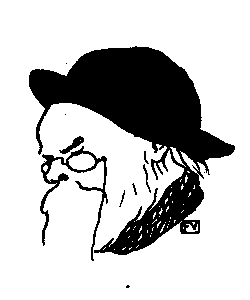
Gaston Boissier, in crowning (touching custom) a fifty-year-old poet, congratulated him for never having innovated, for having expressed ordinary ideas in a facile style, for having scrupulously conformed to the traditional laws of French poetics.
Might not a history of our literature be written by neglecting the innovators? Ronsard would be replaced by Ponthus de Thyard, Corneille by his brother, Racine by Campistron, Lamartine by de Laprade, Victor Hugo by Ponsard, and Verlaine by Aicard; it would be more encouraging, more academic and perhaps more fashionable, for genius in France always seems slightly ridiculous.
Verlaine is a nature and as such undefinable. Like his life, the rhythms he loves are of broken or rolling lines; he ended by disjoining romantic verse, and having destroyed its form, having bored and ripped it so as to permit too many things to be introduced, all the effervescences that issued from his crazy skull, he unwittingly became one of the instigators of vers libre. Verlainian verse with its shoots, its incidences, its parentheses, naturally evolved into vers libre; in becoming "libre," it did no more than reflect a condition.
When the gift of expression forsakes him, and when at the same time the gift of tears is removed, he either becomes the blustering rough iambic writer of Invectives, or the humble awkward elegist of Chansons pour Elle. Poet by these very gifts, consecrated to talk felicitously only of love, all loves; and he whose lips press as in a dream upon the stars of the purifactory robe, he who wrote the Amies composed those Canticles of the month of Mary. And from the same heart, the same hand, the same genius,—but who shall chant them, O hypocrites! if not those very white-veiled Friends.
To confess one's sins of action or dreams is not sinful; no public confession can bring disrepute to a man, for all men are equal and equally tempted; no one commits a crime his brother is not capable of. That is why the pious journals or the Academy vainly took upon themselves the shame of having abused Verlaine, still under the flowers; the kick of the sacristan and scoundrel broke on a pedestal already of granite, while in his marble beard, Verlaine was everlastingly smiling, with the look of a faun hearkening while the bells peal.
TRANSLATIONS FROM THE TEXT
(Tr. 1)
Magnificent, but who without hopes delivers himself for not having praised the country in which to live when ennui has grown resplendent out of the sterile winter.
(Tr. 2)
His neck will shake off this white agony.
(Tr. 3)
As if he were fashioning the steel of souls, hammers with great full strokes, the immense plates of patience and silence.
(Tr. 4)
The savage wind of November, the wind, have you met it, the wind at the crossroads of three hundred paths...?
(Tr. 5)
Seated gigantically on the side of the night
(Tr. 6)
* * * * *
—O these crowds, these crowds, and the misery and distress that whips them like billows.
Monstrances, decorated with silk, towards the heaped up towns, in roofs of glass and crystal, from the height of the sacerdotal choir, stretch the cross of gothic ideas.
They obtrude themselves in the gold of clear Sundays—All Saints' day, Christmas, Easter, and white Pentecosts. They obtrude themselves in the gold and in the incense and in the fête of the great organ beating with the flight of its storms.
The red capitals and vermillion vaults are a soul, in sunlight, living in the old background and antique authoritarian mystery.
Yet, when the song and the naive, prismatic anthem ceases, a grief of incense evaporated stamps itself on the golden tripods and brazen altars.
And the stained glass windows, lofty with ages kneeling before Christ, with their immobile popes and martyrs and heroes, seem to tremble at the sound of a proud train passing through the town.
(Tr. 7)
Formerly—there was the errant, somnambulous life, across the mornings and fabulous evening, when the right hand of God towards the blue Canaans traced the golden road in the depth of the shadows.
Formerly—there was the enormous, exasperated life, fiercely hung on the manes of stallions, suddenly, with great sparks from their hoofs, and towards immense space immensely provoked.
Formerly—there was the ardent, evocative life; the white Cross of heaven, the red Cross of hell advanced, to the splendor of iron armors, each across blood, towards his victorious heaven.
Formerly—there was the foaming livid life, alive and dead, with strokes of crime and tocsins, battle between them, of proscribers and assassins, with splendid and mad death above them.
(Tr. 8)
The melancholy time has ornamented its hours like dead flowers; the passing year has yellowed its days like dry leaves. The pale dawn is seen by gloomy waters and the faces of evening have bled under the arrows of the laughing, bleeding, mysterious wind.
(Tr. 9)
I know sad waters in which die the evenings; flowers which nobody gathers fall there one by one.
(Tr. 10)
Yesterday the dawn was so pale over the peaceful meadows and shavegrass; in the clear morning came a child to gather plants, leaning on them his pure hands that gathered the asphodels.
Noon was heavy with storm and dismal with sunlight in the garden dead of pride in its lethargic sleep of flowers and trees; the water was hard to the eye like marble, the marble warm and clear like water, and the child that came was comely, clad in purple and golden-hair, and long one saw the peonies, one by one, draw their blood from the petals at the passage of the fair child.
The child that came that evening was naked. He gathered roses in the dusk, he sobbed at having come, he retreated before his shadow. It is like him, naked, that my destiny has recognized itself.
(Tr. 11)
Goat's leaf grows under my May forest. The sun drops in gold through the heavy gloom. A roe-buck stirs in the leaves he gathers. The breeze in the frieze of birches passes from leaf to leaf.
The grasses are silvered in my May field. There the sun gleams like a play of swords. A bee vibrates to the lilies of the valley in the lane of tall grouped flowers, towards the bed of the stream. The breeze sings in the frieze of the ash-trees.
(Tr. 12)
Where is the Marguerite, O gué, o gué, where is the Marguerite? She is in her château, weary and tired at heart, She is in her hamlet, gay and childish at heart. She is in her grave, let us gather there the lily-of-the-valley, O gué, the Marguerite.
(Tr. 13)
Where are our beloved ones? They are in the grave; they are happier in a fairer sojourn.
(Tr. 14)
Of what use is beauty? Its use is to go in earth, to be eaten by worms, to be eaten by worms....
(Tr. 15)
Do you not feel in you the opulence of being only for yourself beautiful, O Sea, and of being yourself?
(Tr. 16)
Through me the way that runs among the Lost.
(Tr. 17)
Nature is a temple where living pillars sometimes let confused words issue; man passes there through forests of symbols watching him with friendly gaze.
Like long echoes blended in distance to deep, dim unity, vast as night and clear as day, the perfumes, colors and sounds answer each other.
(Tr. 18)
The flesh is sad, alas! and I have read all the books. To fly yonder! I feel that the birds are drunk At being among the unknown foam and the heavens.... An autumn strewn with stains of redness.... And you were the sobbing whiteness of lilies.... I bring you the child of an Idumean night.... His neck will shake off this white agony....
(Tr. 19)
The dream, in a heliotrope robe, and her thought on her fingers, with loosened girdle, passes, lightly grazing souls with her cloud train, to the extinct rhythm of a music of other times.
(Tr. 20)
In the lingering fragrance of an evening of the last days.
(Tr. 21)
The roses of the west shed their leaves on the stream; and, in the pale emotion of the falling evening, is evoked an autumnal park where, on a bench, dreams my youth, already sober as a widow.
(Tr. 22)
Chastely you walked in the robe of your soul, which desire followed like a tamed faun; I breathed through the evening, O purity, my dream enveloped in your womanly veils.
(Tr. 23)
Fair verses where the fluid sense is loosened like the hair of Ophelia under the water. Silent verses, without rhythm or trammels, where noiselessly the rhyme slips like an oar. Verses of an old thin stuff, impalpable as sound or cloud. Verses of autumnal evenings bewitching the hours with the feminine rite of minor syllables. Verses of evenings of loves enervated with verbena, where, exquisitely, the soul hardly feels a caress.
(Tr. 24)
In the splendor of violet moonlights.
(Tr. 25)
Then from the depths and holy night, as a young sun springs from abysms of the sea, white, letting stream from shoulders to back her hair where pale hyacinths swim, a woman rises.
(Tr. 26)
If you clasp only chimerae, if you drink the intoxication of delusive wine, what matter! The sun dies, the imaginary crowd is dead, but the world subsists in your own soul: See! the days are faded like brief roses, but your word has created the mirage in which you live.
(Tr. 27)
I have known all the gods of earth and heaven.
(Tr. 28)
Eternal flowers, flowers equal to the gods I
(Tr. 29)
The fair, the white, the lovely lady of lilies.
(Tr. 30)
The autumn roses wither, the flowers that bedecked the graves; slowly the corollae are scattered and the cold ground is strewn with falling petals.
(Tr. 31)
There are houses whose fronts weep, there are knells that toll in the belfry, where faint bells ring. Towards what streams of death have the virgins marched, the virgins with fair rings on their fingers?
(Tr. 32)
Lady of amourous, swooning lilies, Lady of languishing, faded lilies, Sad with eyes of belladonna. Lady of dreams of royal roses, Lady of sombre, nuptial roses, Frail as a madonna— Lady of heaven and rapture, Lady of ecstacy and renouncement, Chaste far-off star. Lady of hell, thy sullen smile, Lady of the devil, a kiss of thy mouth, Is the fire of evil fountains, And I burn if I touch thee.
(Tr. 33)
Methinks, my soul, thou art a garden.
(Tr. 34)
Of the lady that has passed away.
(Tr. 35)
HELEN
(Faust's laboratory at Wittenberg)
From the evolved ages I have reascended the stream and, with a heart intoxicated by sublime designs, deserted the Hades and holy shades where the soul is steeped in an ineffable calm.
Time has not bent the curve of my breasts. I am ever up and strong in trial, I, the eternal virgin and eternal widow, glory of Hellas, among war with its black tocsins.
O Faust! I come to you, abandoning the bosom of the Mothers! For you I have left, on wings of the chimerae, the pale shades where he buried the gods.
I bring for your love, from the depths of antique skies, my neck whose lilies time has not vanquished and my voice made supple with prophetic rhythms.
(Tr. 36)
Bourget, Maupassant and Loti are found in all the stations, offered with the roast. Choose these authors at the same time as the cigars. Bourget, Maupassant are found in all the stations.
(Tr. 37)
She is the victim and the little spouse.
(Tr. 38)
Truly, Monsieur Benoist approves of persons who have read Voltaire and are opposed to Jesuits. He muses. He is partial to long controversies, calmuniates priest and theriac.
He even was an orator at a Scotch lodge. Nevertheless—because his lawful child believes in God—his little daughter, in white veils and blue ribbon, received the sacrament. This required that several liters at sixteen sous be drunk at the bistro, among the filthy benches, where the billiard man was sleeping, the waiters sprawling, and where his little maid in floss-silk gloves was blushing.
Now, Benoist who colors at the sight of a churchman, shows some pleasure at having seen, that morning, the marriage of the only son and his young girl.
(Tr. 39)
The proud indolence of nights, perfumes and breasts.
(Tr. 40)
On Heaven's balconies in antiquated robes.
(Tr. 41)
NOCTURNAL PARIS
It is the sea;—calm sheet. And the great tide with distant rumbling has receded.... The wave returns, wallowing in its noise. Hearest thou the clawing of the night crabs.
It is the drained Styx: Diogenes, lantern in hand, unceremoniously arrives. Perverse poets angle along the black stream: their hollow skulls serve as boxes for worms.
It is the field: to glean impure lint falls the whirling flight of hideous harpies; the gutter rabbit, on the watch for rodents, flees the sons of Bondy, nocturnal vintagers.
It is death: the policeman lies dead. On high, love takes a siesta, sucking the meat with heavy hand where the extinguished kisses leave a red patch. Alone is the hour. Listen. Not a dream stirs.
It is life: listen, the lively spring sings the eternal song on the head of a sea-god drawing green naked limbs on the bed of the Morgue ... and the great open eyes.
DIURNAL PARIS
See gleaming in the skies the great disk of red copper, immense casserole where the good God cooks manna, the harlequin, eternal plat du jour. It is dipped in sweat and dipped in love.
The laridons wait in a circle near the oven; vaguely one hears the rustling of rancid flesh, and the tipplers, too, are there, holding out their jugs; the wretches shiver, waiting their turn.
Thinkest thou the sun then fries for everybody these fat stirring scraps of burnt meat which a flood of gold inundates? No, the dog-soup falls on us from the sky.
They are beneath the ray and we beneath the gutter. To us the black jug that grows cold without light. Our substance for ourselves is our bag of gall.
(Tr. 42)
With the assent of the tall sunflowers.
(Tr. 43)
And since, then, I have bathed me in the poem of the sea, steeped in stars and latescent, mastering the green azure where, flotation pale and ravished, a pensive drowned person sometimes descends; where, suddenly staining the nuances of blue, frenzied and slow rhythms beneath the glinting red of day, stronger than alcohol, vaster than your lyres, the bitter redness of love ferments.
(Tr. 44)
Who knows if genius is not one of your virtues.
(Tr. 45)
Torment of the garden of delight In which everything flourishes...
(Tr. 46)
The sky rains without ending, though nothing agitates it; it rains, it rains, shepherdess! on the stream....
The stream has its dominical repose; not a barge up stream, downstream.
Vespers chime in the town; the banks are deserted, not an isle.
Passes a boarding-school group, o poor flesh! Several already have on their winter muffs.
One that has neither muff nor fur makes a quite sorry figure all in gray.
And see! She breaks from the ranks and runs; O God, what has seized her?
She goes and throws herself in the stream. Not a boatman, not a Newfoundland dog....
(Tr. 47)
Dismal north wind, screaming downpour and dark stream, and shut houses....
(Tr. 48)
A full silence of vibrant gold has descended near the springs which satyrs have troubled; a clear marvel enclosed in the heart of the valleys, if the little singing bird remains silent.
Oblivion of the flute, hours of fearless dreams, where thou hast known how to find for thy amorous blood the peacefulness of inhabiting a place odorous with roses, whose sylvan gods make thee arms.
There thou goest, composing beautiful books, a credit to the French language and the noble Athens.
(Tr. 49)
Of that Sophocles, credit to Ferté-Milon.
(Tr. 50)
Once while riding on a journey, Pensive along the route that displeased me, I found love in the middle of the road In a vagrant's scant attire.
(Tr. 51)
Brilliant star, Phoebe with outspread wings, O name of night that grows and wanes, favor my way through the gloomy forest where my errant soul takes its modest steps! In the grotto with hollow sounds, whose entrance is ivy-covered, on the rock topped with the familiar she-goat, on the lake, on the pond, on the tranquil waters, on the enamelled banks where reeds moan, she likes to see the trembling of thy melancholy fires.
Phoebe, O Cynthia, from the first season my soul was drunk with thy lovely light; observing thy diverse faces in their orb, beneath thy gentle influence, she composed verses. Above Nicias, Eryx, Siris and the sandy Iolchos, Timolus and the grand Epidorus, and Green Sidon, her piety reveres this rock of Latmos where thou loved.
(Tr. 52)
It is the autumn wind in the lane, sister, hearken, and the fall of willow and beach tree leaves on the water, and the hoar-frost in the valley.
And come, like those drooping great ladies, to him who is thinking of thee, in the silence when thy light spinning-wheel dies, O sister of the sweet marjoram.
Loose—'tis the hour—thy hair fairer than the hemp thou spinnest....
(Tr. 53)
Come with wreathes of primroses in thy hands, O young girls, who mourn the sister dead at dawn. Bells of the valley peal the end of a destiny, and spades are seen gleaming in the morning sun.
Come with baskets of violets, O young girls who slightly hesitate in the path of beeches, for fear of the priest's solemn words. Come, the sky is quite sonorous with invisible larks....
'Tis the festival of the dead, one would say Sunday, the bells ring so gently in the heart of the valley; boys have hidden in the lanes. Thou alone goest to pray at the foot of the white grave.
Some year, the boys, who today are hidden, will come to tell you the sweet pain of loving, and they will hear you all, around the maypole, sing songs of childhood to greet the night.
(Tr. 54)
Fish, crane, eagle, flower, bird-bent bamboo. Turtle, iris, peony, anemone, sparrows.
(Tr. 55)
I wish that this verse were a bauble of art,
(Tr. 56)
Learn from the child to pray to the blue waves, for 'tis the sky here below whose cloud is foam. The sun's reflection sparkling on the sea is sweeter to gaze on to our gloomy eyes.
Learn from the child to pray to the pure sky, 'tis the ocean above, whose void is cloud. The gloom of a cloud rich in wrecks to our hearts is less sad to follow in the azure.
Learn from the child to pray to all things: the bee of the spirit makes a honey of light on the living aves of the rosary of roses, a chaplet of perfumes on the rosaries of love.
(Tr. 57)
O lovely April, glad and bright, What matters your blithe song, White lilacs, hawthorns, and the flowered gold Of sunlight streaming through the branches, If far-away my well-beloved In the northern fogs stays.
(Tr. 58)
I had gone to the heart of the garden, When in the night some invisible hand, Stronger than me, struck me to earth,— 'Tis for your joy, a voice did say.
(Tr. 59)
And the tiny venturous flowers along the hedges.
(Tr. 60)
Behold the rapture of autumnal souls, The town dissolves like near illusions; Behold the portals of the moonless night Veiled in violet and orange-hues. Princess, what did'st thou with the jeweled tiara.
(Tr. 61)
O Jesus crowned with thorns, bleeding in every bruised heart.
(Tr. 62)
Gooday mynher, gooday myffrau.
(Tr. 63)
The hour of white cloud is cast o'er the plain, Like reflections of blood, or flocks of wool, O rose-colored sweet-heather, O blood-colored sky. The hour of gold cloud has paled o'er the plain, The long slow veils of white wool fall, O mauve-colored sweet-heather—O blood-colored sky. The hour of gold cloud has burst o'er the plain, Gently the reeds sang under angered winds, O red sweet-heather—O blood-colored sky. The hour of gold cloud has passed o'er the plain So swiftly: its splendor has vanished. O gold sweet-heather—O blood-colored sky.