Part 2 — NOTE D. “TWO THOUSAND AND THREE HUNDRED DAYS.” [DANIEL VIII. 14.]
Reading edition
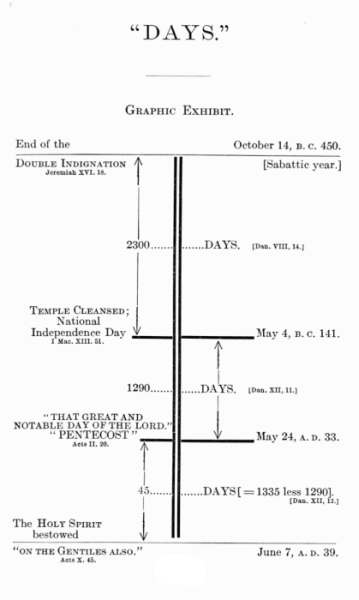
In the vision of “the evening and the morning” it is evident that 2300 days must end with a complete cleansing of the sanctuary, and unquestionably this was accomplished by Simon Maccabeus on May the 4th B.C. 141. [I Mac. XIII. 51]; but at what time they should begin to count is not so evident. The 19th verse tells us: “I will make thee know what shall be in the last end of the indignation.”
We ask: what indignation? When was the first end? When the middle? and When the last end?
We note first, that the speaker was the angel Gabriel, consequently the indignation referred to was of Divine origin. The word indignation stands for “sore displeasure” [Zech I. 2]. It arose in the year B.C. 590, the seventh of the captivity, at which time Israel was cast off and Nebuchadnezzar prepared to wage war against them. It was announced in the following words:—“As I live saith the Lord God, I will not be inquired of by you” [Ezek. XX. 3]. The indignation lasted just 70 years [Zech. I. 12] and ended by a promise of pardon made in the eighth month, which according to the calendar of Rabbi Hillel II. (Idan Olamim of J. L. Sossnitz) began October 25th B.C. 520 [Zech. I. 1 and 3]. We note in passing that although Cyrus put an end to the Babylonian captivity in B.C. 536 and the people returned to the land of Judea, yet they encountered insuperable obstacles which held up their work [Ezra V. 3] until the year B.C. 520, which was the end of 70 years’ indignation. From these passages we learn what were the limitations in one case of “sore displeasure.” But Isaiah prophesied that Jerusalem would receive of the Lord’s hand double for all her sins [Isa. XL. 2]. Jeremiah also spoke in the same vein “And first I will recompense their iniquity and their sin double” [Jer. XVI. 18]. When we reach B.C. 433 we find that Nehemiah dreaded a still further return of God’s sore displeasure and warned the nobles of Judah against profaning the Sabbath day. [Neh. XIII. 16, 18.] As the first indignation ended with the 8th month of B.C. 520, a double period ought to end with the 8th month of B.C. 450, that is, with October 2nd of that year. But you object, how could a period be truly 70 years in length, when it began with October 25th and ended with October the 2nd? This question admits of easy explanation. According to the Jewish calendar the eighth month comes and goes with the phases of the moon, just like our Easter occurs at different seasons, hence we must take the average of these dates, viz: October the 14th as our representative day. We have already alluded to the delays experienced by the Jews when freed by Cyrus and desire at this point to draw attention to the fact that Zerubbabel’s temple was not completed until B.C. 515, JUST 5 YEARS after the indignation period expired, in B.C. 520; and that in like manner Nehemiah’s temple was not completed until B.C. 445, JUST 5 YEARS after the next indignation period expired, in B.C. 450. We might also add that from the time when the Jews first worshipped in Babylon as captives in B.C. 585, to the time when they worshipped in Zerubbabel’s temple as free men in B.C. 515 was another instance of a period 70 years long. This frequent recurrence of 70-year periods shows that as a numeral 70 may justly be regarded as one of the units of TIME in the dispensation of God’s providence, and therefore to be reckoned with in the study of prophecy.
But returning to our representative day, October 14th B.C. 450, we realize that when the first and the second indignation had passed, the time came for “the last end of the indignation” spoken of in the 19th verse, and known as the “2300 days.” By the calculations given in Note C, we find that 2300 prophetic days exactly fill the interval between Oct. 14th B.C. 450 and May the 4th B.C. 141. Having thus brought out the limitations of the “2300 days” we would add, that Daniel’s eleventh chapter gives in outline a complete history of the period under consideration, so that the Jews had it in their power to tell the prophetic time of day at any moment between B.C. 450 and B.C. 141.
“DAYS.”